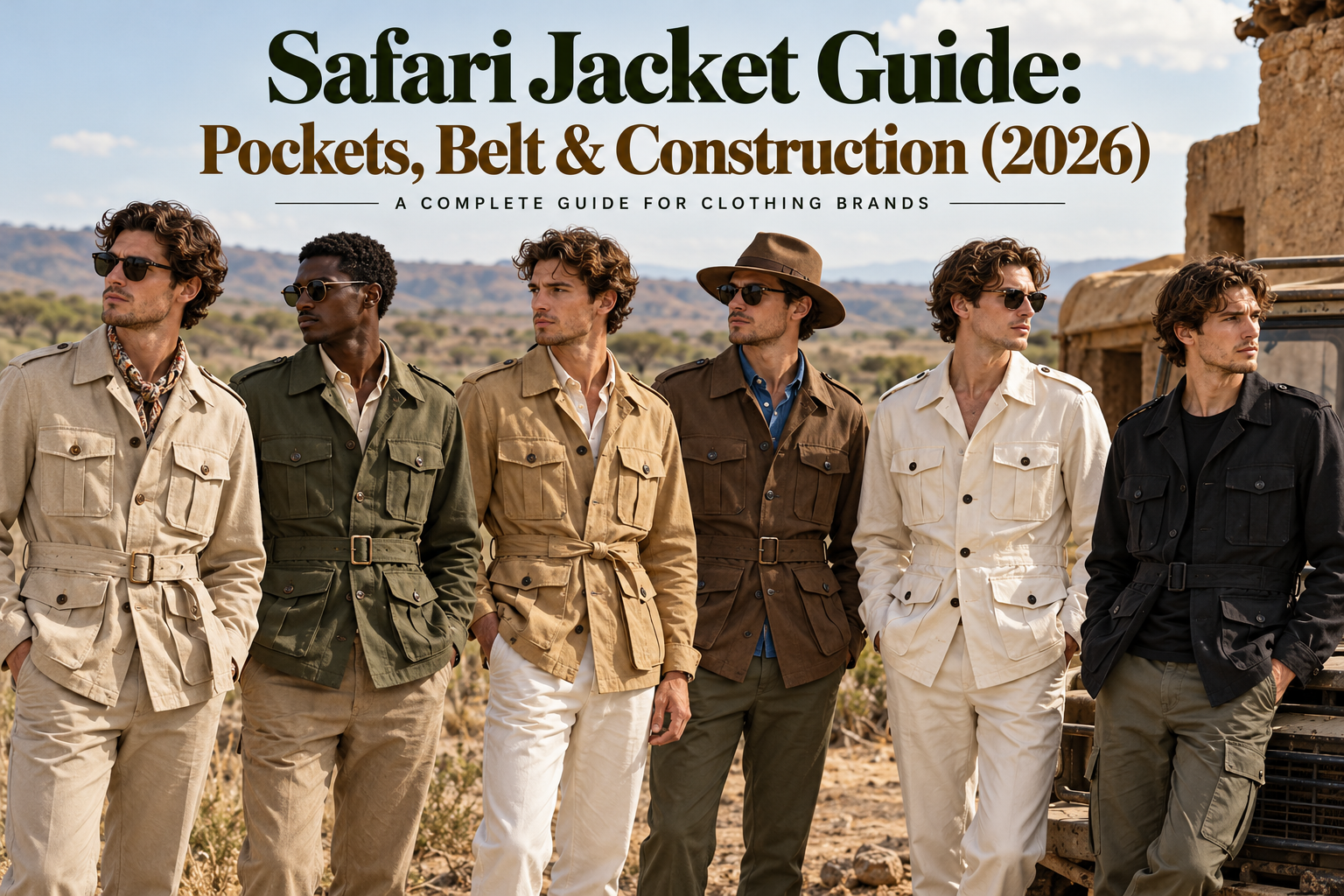
A safari jacket is one of the clearest examples of functional clothing becoming refined menswear.
Its identity is usually built around several recognizable elements:
- Four front pockets
- A defined or adjustable waist
- Self-fabric belt
- Point or spread collar
- Lightweight woven fabric
- Shoulder epaulettes
- Practical sleeve construction
- Khaki, olive, sand or brown color palette
But a good safari jacket is not simply a normal jacket with four pockets and a belt added to the outside.
Its proportions depend on the relationship between:
body length + pocket position + pocket volume + belt height + waist shaping + fabric structure + collar + sleeve
If the upper pockets sit too low, the torso looks compressed.
If the lower pockets are too large, the jacket becomes visually heavy.
If the belt is positioned incorrectly, the entire silhouette can look unbalanced.
And if expandable pockets are made from fabric that is too soft or too heavy, they may collapse or become bulky.
For clothing brands, safari-jacket development therefore requires the pockets, pattern, belt and fabric to be designed as one system.
What Is a Safari Jacket?
A safari jacket is a lightweight utility-style jacket originally associated with warm-weather travel and field clothing.
Modern men's versions commonly use:
- Point or spread collar
- Button or snap front
- Two chest pockets
- Two lower pockets
- Pocket flaps
- Self-fabric waist belt
- Shoulder epaulettes
- Adjustable cuffs
- Hip-length body
- Lightweight or midweight woven fabric
Traditional colors include:
- Khaki
- Sand
- Beige
- Olive
- Tobacco
- Brown
Modern versions may also appear in:
- Black
- Navy
- White
- Ecru
- Washed gray
The strongest design identifier is usually the combination of:
four-pocket front + defined waist + utility details
rather than any single fabric.
Safari Jacket vs Safari Shirt
These two garments can look similar.
However, their construction and intended use are different.
A safari shirt generally stays closer to shirt construction.
It may use:
- Lightweight poplin
- Linen
- Shirt cuffs
- Shirt-tail hem
- Smaller chest pockets
- Minimal internal structure
A safari jacket usually has more:
- Body structure
- Pocket capacity
- Seam reinforcement
- Layering ease
- Hardware
- Outerwear construction
A safari shirt might be worn as a normal shirt.
A safari jacket is usually designed as an outer layer.
For broader shirt-based utility construction, see our Utility Shirt Guide.
Safari Jacket vs Field Jacket vs Barn Jacket
| Style | Main Identity | Typical Pockets | Waist | Typical Fabric |
|---|---|---|---|---|
| Safari Jacket | Refined utility + four-pocket front | Usually 4 front pockets | Belted or shaped | Twill, gabardine, linen blend |
| Field Jacket | Military utility | Multiple functional pockets | Drawcord or relaxed | Twill, canvas, technical woven |
| Barn Jacket | Workwear outerwear | Large lower pockets | Usually straight | Canvas, twill, waxed cotton |
| Utility Jacket | Broad functional category | Varies | Varies | Twill, canvas, ripstop |
| Safari Shirt | Lightweight shirt construction | Usually chest pockets | Usually unbelted | Poplin, linen, lightweight twill |
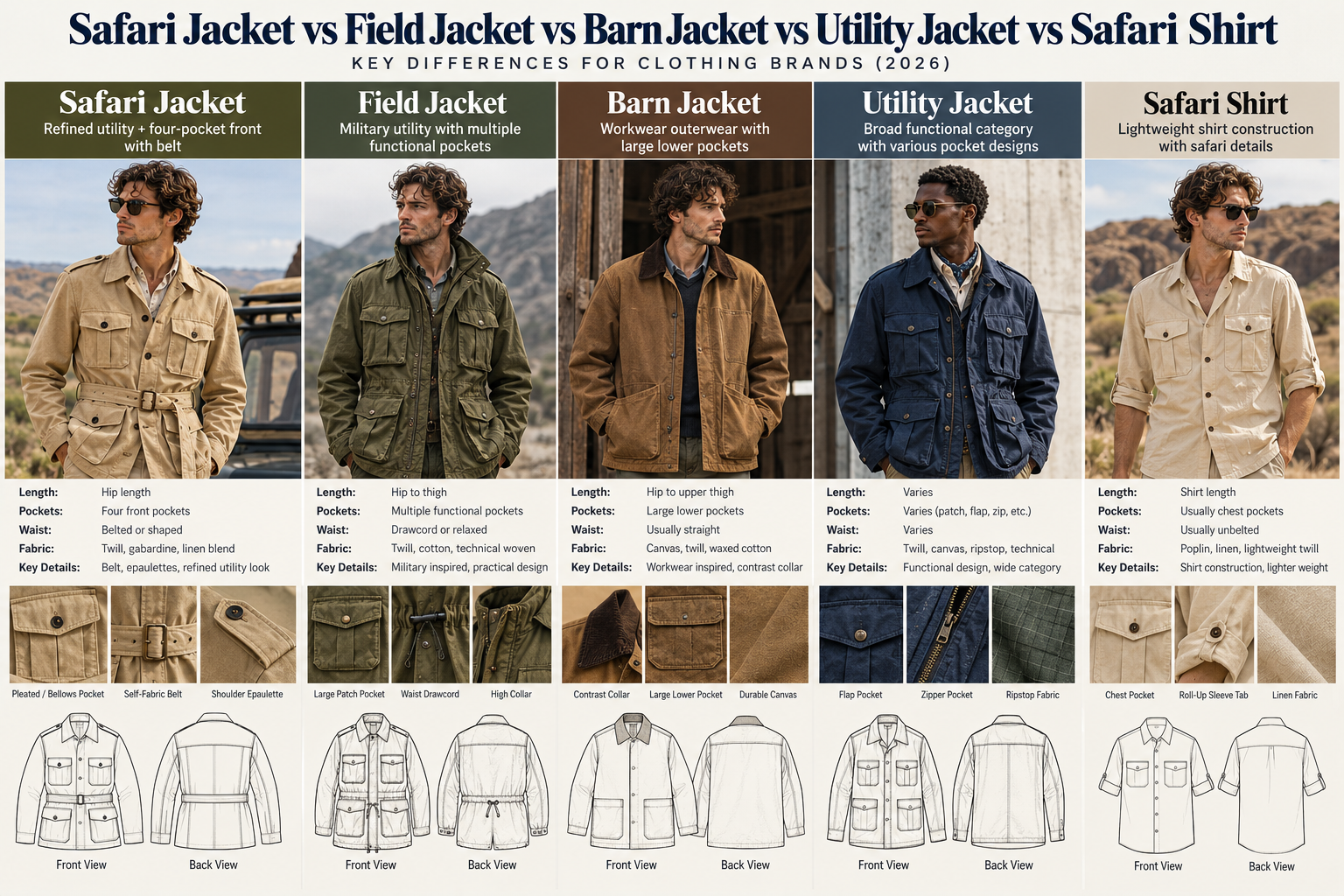
The categories can overlap.
For example, a safari jacket may borrow:
- Field-jacket pocket construction
- Military epaulettes
- Workwear reinforcement
But the four-pocket arrangement and waist treatment normally give it a more distinctive safari silhouette.
The Four-Pocket Front
The front pocket layout is one of the most important parts of safari-jacket development.
A classic arrangement uses:
- Two upper chest pockets
- Two lower body pockets
This creates strong vertical and horizontal symmetry.
Because all four pockets are visible at the same time, small placement differences become easy to notice.
Upper Chest Pockets
Chest pockets may use:
- Flat patch construction
- Box pleat
- Inverted pleat
- Bellows construction
- Flap closure
Important measurements include:
- Pocket width
- Pocket height
- Flap depth
- Distance from center front
- Distance from shoulder
- Distance from belt
Pocket position should be measured from fixed pattern reference points.
Do not rely only on:
Place the pockets like the reference photo.
Lower Safari Jacket Pockets
Lower pockets are usually larger than the chest pockets.
They may be designed for:
- Visual balance
- Hand access
- Actual storage
Common constructions include:
- Flat patch pocket
- Pleated patch pocket
- Bellows pocket
- Flap pocket
The lower pockets need to coordinate with:
- Belt
- Side seam
- Hem
- Front closure
A lower pocket placed too close to the belt may look crowded.
A pocket placed too low may make the body appear longer.
Bellows Pockets
A bellows pocket includes additional folded fabric at the sides, bottom or both.
This allows the pocket to expand outward.
Compared with a flat patch pocket, it creates:
- More volume
- Stronger utility appearance
- Greater visual depth
However, it also introduces more sewing operations and more potential bulk.
Full Bellows Pocket
A full bellows construction may expand around:
- Both sides
- Bottom edge
This creates maximum capacity.
It is useful for stronger heritage or expedition-inspired designs.
Side Bellows Pocket
Expansion is added mainly at the sides.
This provides volume while keeping the bottom cleaner.
Pleated Safari Pocket
Instead of a true bellows, a pocket may use:
- Center box pleat
- Inverted pleat
- Folded pleat
This creates visual dimension without the full complexity of a bellows pocket.
Box Pleat vs Bellows Pocket
These terms should not automatically be treated as the same.
A box pleat adds folded volume within the pocket surface.
A bellows pocket creates expansion around the pocket perimeter.
Both can produce a three-dimensional appearance, but the pattern pieces and sewing method are different.
For production, the tech pack should identify the actual construction.
Pocket Volume Must Match the Fabric
A large expandable pocket behaves differently depending on the shell material.
Light fabric may:
- Collapse
- Pull
- Wrinkle
Heavy fabric may:
- Become bulky
- Create thick corners
- Make the front too stiff
Pocket construction and fabric selection should therefore be confirmed together.
Pocket Flaps
Safari jackets commonly use pocket flaps.
Possible shapes include:
- Straight
- Slightly angled
- Pointed
- Curved
The flap should be slightly wider than the finished pocket opening where required by the design.
Key measurements include:
- Finished width
- Finished depth
- Corner shape
- Button or snap position
Pocket-Flap Reinforcement
Depending on fabric weight, reinforcement may include:
- Lightweight fusible
- Partial fusible
- Additional shell layer
- No additional reinforcement
The goal is to keep the flap stable without making it unnaturally rigid.
Pocket Closure Options
Common choices include:
- Button
- Snap
- Hidden snap
- No functional closure
Metal snaps can give the garment a stronger utility feel.
Buttons usually create a more traditional or refined appearance.
Reinforcing Pocket Stress Points
Functional pockets place stress on:
- Upper corners
- Flap attachment
- Bellows folds
- Snap positions
Possible reinforcement includes:
- Bartacks
- Additional stitching
- Internal backing
- Interfacing
The level of reinforcement should match the expected use.
The Safari Jacket Belt
The waist belt is another major identifier.
It can completely change the silhouette.
A safari jacket may use:
- Self-fabric belt
- Buckled belt
- D-ring belt
- Tie belt
- Half belt
- Internal waist adjustment
Self-Fabric Belt
A self-fabric belt is made from the same or coordinated shell material.
This creates a clean, integrated appearance.
The belt construction should specify:
- Finished width
- Finished length
- Number of layers
- Interfacing
- Buckle type
- Topstitching
Belt Width
A narrow belt creates a lighter and more refined look.
A wider belt creates:
- Stronger waist definition
- More military or expedition character
The belt width should remain proportionate to:
- Pocket size
- Body length
- Buckle size
Belt Position
Belt height has a major effect on proportion.
If the belt sits too high:
- Upper chest may look short
- Lower pockets may feel disconnected
If the belt sits too low:
- Torso may appear long
- Waist shaping becomes weak
The belt position should be tested on the actual garment.
Belt Loops
Possible belt-loop locations include:
- Side seam
- Front side
- Back side
- Multiple points around the waist
Important factors include:
- Loop width
- Loop height
- Belt thickness
- Reinforcement
The belt should move through the loops easily without excessive looseness.
D-Ring Safari Belts
D-ring closures can create a more contemporary utility appearance.
Possible materials include:
- Metal
- Coated metal
- Plastic
The ring diameter should match the belt width.
An oversized ring can look visually heavy.
A ring that is too small can make adjustment difficult.
Buckled Safari Belts
Buckles can be:
- Metal pin buckle
- Covered buckle
- Utility buckle
- Roller buckle
When using metal buckles, check:
- Weight
- Finish
- Corrosion resistance
- Wash compatibility
Belt Reinforcement
A soft linen-blend belt may require more support than a dense cotton twill belt.
Possible internal materials include:
- Fusible
- Woven reinforcement
- Nonwoven reinforcement
The final belt should remain flexible enough to tie or buckle naturally.
Safari Jacket Waist Shaping
Not every safari jacket relies only on the belt for shape.
The body pattern itself may use:
- Straight side seams
- Slight waist suppression
- Darts
- Princess-style panels
- Back shaping
This affects how the jacket looks with the belt:
- Open
- Loosely tied
- Fully tightened
The jacket should still look intentional when the belt is not tightly closed.
Shoulder Epaulettes
Epaulettes are common on safari-inspired jackets because of their military and fieldwear influence.
Typical construction includes:
- Shoulder tab
- Button or snap attachment
- Reinforced anchor point
Epaulettes may be:
- Functional
- Decorative
- Removable
Epaulette Width
The epaulette should scale with shoulder width.
A narrow tab can look too weak on a broad oversized jacket.
An excessively wide tab can dominate the shoulder.
Epaulette Position
The tab should align cleanly with:
- Shoulder seam
- Collar
- Sleeve head
Left and right positioning should match.
Safari Jacket Collar
Common options include:
- Point collar
- Spread collar
- Convertible collar
- Small utility collar
The collar strongly affects whether the jacket appears:
- Rugged
- Tailored
- Shirt-like
- Minimal
Collar Scale
A classic safari jacket normally uses a clearly visible collar.
For a relaxed modern body, the collar may need slightly more scale.
A very small collar on a wide four-pocket jacket can look visually weak.
Collar Interfacing
Interfacing should follow fabric weight.
Light linen or poplin blends may need support.
Dense twill or gabardine may require less.
Too much reinforcement can make the collar excessively stiff.
Safari Jacket Front Closure
Common closure options include:
- Buttons
- Snaps
- Concealed buttons
- Zipper + snaps
- Buttons with belt closure
A clean four-pocket safari jacket often uses a relatively straightforward button front.
Button Size
Button size should coordinate with:
- Pocket-flap buttons
- Epaulettes
- Cuffs
- Belt details
Using several unrelated button sizes can make the design feel inconsistent.
Custom Buttons
Custom buttons can include:
- Engraved logo
- Raised logo
- Matte finish
- Antique metal finish
- Tonal resin
For custom garment hardware, see our Trims & Branding.
Sleeve Construction
Most safari jackets use set-in sleeves.
Modern interpretations may use:
- Natural shoulder
- Slightly extended shoulder
- Relaxed shoulder
Very dramatic drop shoulders can weaken the classic safari character, although they may work for streetwear interpretations.
Sleeve Roll-Up Tabs
Roll-up tabs are common on safari shirts and lightweight safari jackets.
The sleeve is rolled and secured using:
- Internal tab
- Button
- Snap
The tab needs to be tested with the sleeve actually rolled.
A position that looks correct on a flat sleeve may not function correctly in use.
Safari Jacket Cuffs
Possible cuff constructions include:
- Button cuff
- Straight cuff
- Adjustable tab cuff
- Shirt-style cuff
- Simple hem
Heavier jackets usually need a more substantial cuff than lightweight safari shirts.
Back Construction
The back can be:
- Clean
- Yoked
- Belted
- Pleated
- Ventilated
The choice depends on whether the design prioritizes:
- Clean tailoring
- Movement
- Utility
- Heritage styling
Action Pleats
Back action pleats can increase movement.
Common options include:
- Side action pleats
- Center box pleat
They are especially useful when the jacket uses:
- Structured woven fabric
- Relatively close body fit
But they also add volume.
The pattern should control how much the pleat opens.
Back Yoke
A back yoke can provide:
- Structure
- Visual separation
- Pattern control
It may also become a design area for:
- Contrast fabric
- Embroidery
- Decorative topstitching
Not every safari jacket needs one.
Back Vent
A jacket may use:
- No vent
- Center vent
- Side vents
A center vent can improve movement on longer versions.
Shorter safari jackets may not require one.
Safari Jacket Anatomy & Pattern Development
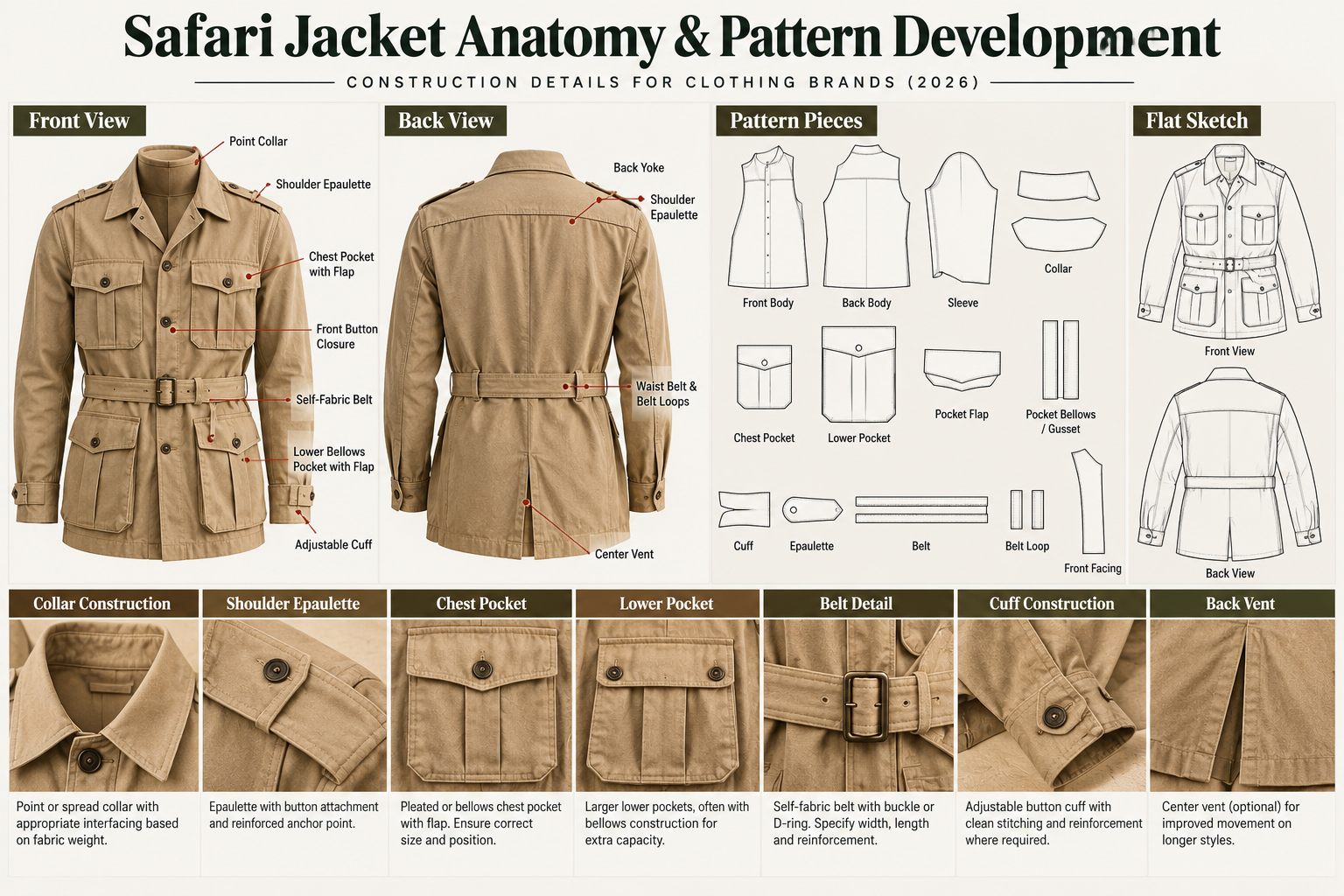
A typical safari jacket pattern may include:
- Front body
- Back body
- Sleeve
- Collar
- Upper chest pocket
- Upper pocket flap
- Lower pocket
- Lower pocket flap
- Pocket bellows / gusset
- Cuff
- Epaulette
- Belt
- Belt loops
- Front facing
Depending on design, additional pieces may include:
- Back yoke
- Action pleat components
- Half belt
- Lining
- Shoulder reinforcement
Safari Jacket Pattern Development
The pattern should be built around three visual reference lines:
- Chest pocket line
- Belt / waist line
- Lower pocket line
These horizontal zones define much of the garment's appearance.
Chest Pocket Position
Important reference measurements include:
- HPS to pocket top
- Center front to pocket edge
- Pocket width
- Pocket height
Both sides should mirror each other.
Lower Pocket Position
Specify:
- Waist / belt to pocket top
- Center front to pocket edge
- Hem to pocket bottom
This is more reliable than visual placement alone.
Belt-Line Position
Record the belt position as a finished measurement.
For example:
HPS to belt center
or another clearly defined factory measurement.
This helps maintain the same proportion across sizes.
Important Safari Jacket Measurements
| Measurement | Why It Matters |
|---|---|
| Chest Width | Controls fit and layering |
| Waist Width | Controls belted silhouette |
| Hem Width | Controls lower shape |
| Body Length | Defines jacket proportion |
| Shoulder Width | Controls upper structure |
| Sleeve Length | Controls cuff position |
| Bicep Width | Controls movement |
| Collar Point | Controls visual scale |
| Chest Pocket Width | Controls upper proportion |
| Chest Pocket Position | Controls symmetry |
| Lower Pocket Width | Controls front balance |
| Lower Pocket Position | Controls utility and proportion |
| Belt Position | Defines waist line |
| Belt Width | Controls visual strength |
| Epaulette Width | Controls shoulder detail |
Safari Jacket Fit Options
Modern safari jackets can use several silhouettes.
Classic Fit
Typical characteristics:
- Regular shoulder
- Moderate chest ease
- Slight waist shaping
- Hip length
- Four balanced pockets
This produces the most traditional safari-jacket appearance.
Relaxed Safari Jacket
A relaxed version can use:
- Wider chest
- Slightly extended shoulder
- Larger sleeve
- More layering room
The pockets should also increase in scale.
Slim Safari Jacket
A slimmer interpretation can use:
- Reduced chest ease
- Defined waist
- Smaller pockets
- Cleaner shoulder
Movement must still be checked, especially when the shell fabric has little stretch.
Cropped Safari Jacket
A modern cropped version may finish around:
- Waist
- High hip
When body length is reduced, pocket spacing becomes more difficult.
You may need to reduce:
- Pocket height
- Flap depth
- Vertical spacing
while keeping the four-pocket identity recognizable.
Do Not Create an Oversized Safari Jacket by Simply Sizing Up
Simply increasing the entire garment can cause:
- Body too long
- Belt too low
- Chest pockets too low
- Lower pockets too large
- Collar too big
- Sleeves too long
Instead, develop the oversized proportion intentionally.
Increase:
- Chest
- Shoulder
- Bicep
while controlling:
- Length
- Pocket position
- Belt height
- Collar scale
Best Fabrics for Safari Jackets
A safari jacket traditionally works best in woven fabrics with enough stability to support the pockets and belt.
Cotton Twill
Cotton twill is one of the most practical choices.
It provides:
- Structure
- Matte appearance
- Durability
- Clean pocket construction
Possible finishes include:
- Clean
- Garment washed
- Peach finish
- Enzyme washed
Cotton Gabardine
Gabardine uses a pronounced twill structure and can create a more refined safari jacket.
It can provide:
- Smooth surface
- Dense construction
- Clean drape
- Tailored appearance
This works well for premium menswear versions.
Linen
Linen creates a lighter, warm-weather direction.
Advantages include:
- Breathability
- Natural texture
- Relaxed appearance
However, pure linen can wrinkle heavily and may not support large pockets as cleanly as denser twill.
Pocket and belt construction should be tested carefully.
Linen Blends
Common blends may combine linen with:
- Cotton
- Viscose
- Lyocell
- Polyester
A blend may improve:
- Stability
- Wrinkle recovery
- Drape
- Sewing performance
while retaining some linen character.
Lightweight Canvas
A lighter canvas can create a more rugged safari jacket.
It provides:
- Strong pocket support
- Workwear character
But heavier canvas can push the garment toward:
- Field jacket
- Work jacket
rather than refined safari outerwear.
Ripstop
Ripstop can create a more technical interpretation.
It works especially well for:
- Utility collections
- Travel-inspired designs
- Lightweight outerwear
The grid structure changes the visual character significantly.
Example Fabric Weight Ranges
There is no mandatory safari-jacket GSM.
As a development reference:
| Direction | Approx. Weight |
|---|---|
| Lightweight Summer Safari | 150–210 GSM |
| Standard Lightweight Jacket | 200–260 GSM |
| Structured Twill Safari | 250–320 GSM |
| Heavy Utility Version | 300+ GSM |
These numbers are only starting references.
Actual structure depends on:
- Fiber
- Yarn
- Weave
- Finishing
- Density
For custom fabric development, see our Fabric Sourcing & Development.
Classic Safari Jacket Colors
Common colors include:
- Khaki
- Sand
- Stone
- Olive
- Tobacco
- Camel
- Chocolate brown
- Ecru
These colors reinforce the explorer / utility identity.
Khaki Safari Jacket
Khaki remains one of the clearest options.
But "khaki" can describe many shades.
The brand should provide:
- Pantone reference
- Lab dip
- Approved fabric swatch
rather than only writing:
khaki.
Brown Safari Jacket
Brown creates a richer menswear direction.
Possible shades include:
- Tobacco
- Chocolate
- Espresso
- Camel
Hardware can coordinate with:
- Antique brass
- Gunmetal
- Dark brown
- Matte black
Black Safari Jacket
Black removes much of the traditional explorer color language.
This creates a more:
- Minimal
- Urban
- Contemporary
appearance.
Tonal stitching and matte hardware work particularly well.
Topstitching
Visible topstitching can emphasize:
- Pocket shape
- Belt
- Epaulettes
- Collar
- Front edges
Possible approaches include:
- Tonal single needle
- Tonal double row
- Contrast workwear stitching
A refined safari jacket usually benefits from cleaner, more controlled stitching than heavy carpenter-style workwear.
Pocket Stitching
Large pockets need consistent:
- Edge distance
- Corner shape
- Stitch length
Because there are four visible pockets, inconsistent stitching becomes easy to notice.
Safari Jacket Manufacturing Process
A practical manufacturing route may include:
- Fabric inspection
- Shrinkage testing
- Pattern development
- Grading
- Cutting
- Pocket component preparation
- Pocket pleat / bellows construction
- Pocket flap construction
- Front pocket positioning
- Epaulette preparation
- Sleeve and cuff preparation
- Collar construction
- Main body assembly
- Pocket attachment
- Belt and belt-loop construction
- Front closure preparation
- Final assembly
- Garment washing or finishing where required
- Final pressing
- Measurement inspection
- Pocket and belt QC
- Final packing
The exact sequence may vary according to:
- Pocket construction
- Lining
- Wash
- Hardware
- Factory method
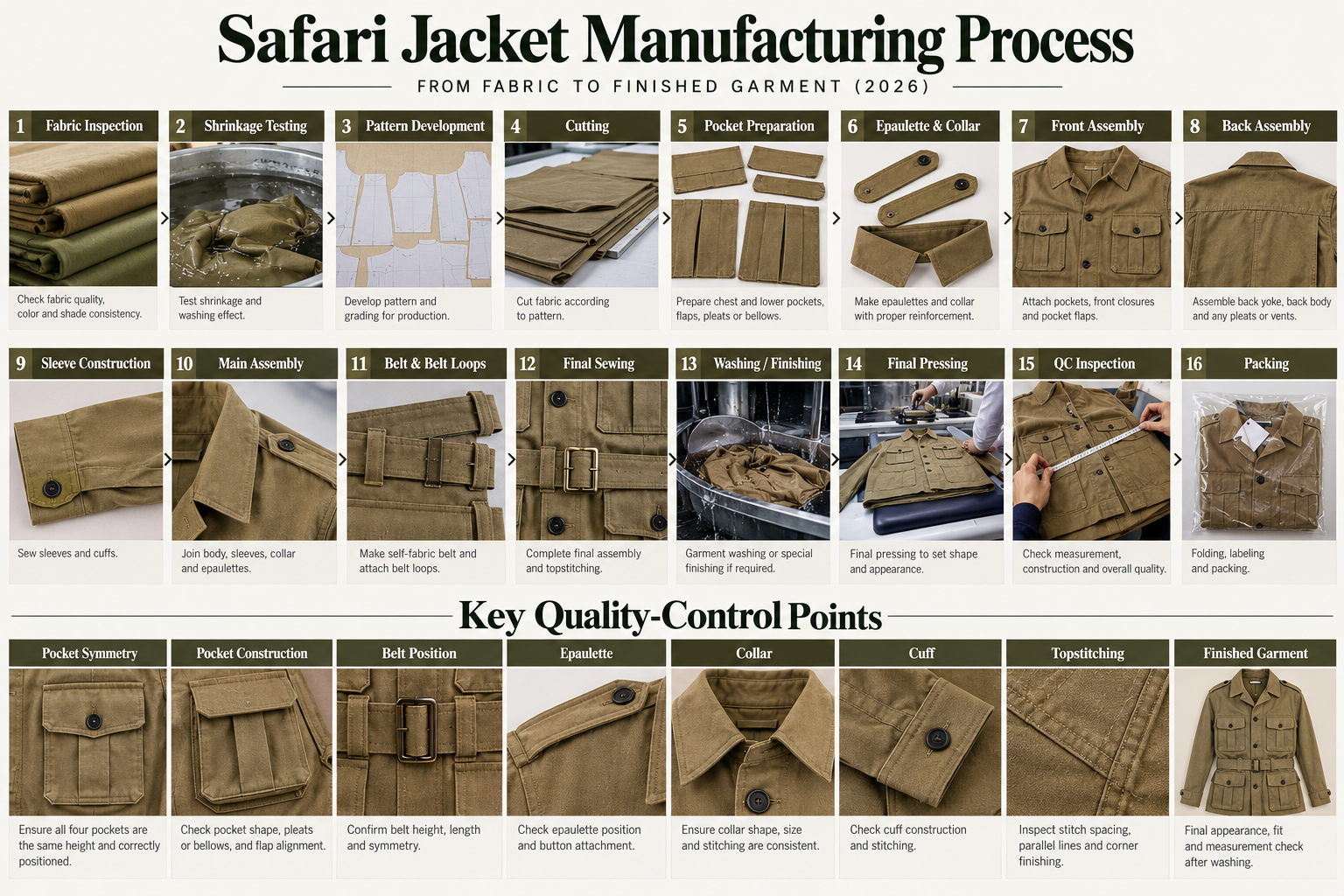
Key Safari Jacket Quality-Control Points
Pocket Symmetry
Check:
- Left / right chest pocket height
- Left / right lower pocket height
- Distance from center front
- Flap position
Four-pocket designs make asymmetry highly visible.
Pocket Shape
Check that:
- Pleats open evenly
- Bellows are equal
- Corners match
- Flaps remain level
Pocket Capacity
If the design is intended to be functional, test the pocket with realistic contents.
Heavy items should not:
- Pull the front excessively
- Distort the pocket opening
- Twist the garment
Belt Position
Check the belt around the full body.
The belt should remain level.
Belt Length
Test the intended wearing method.
For example:
- Buckled
- Tied
- Hanging open
The finished belt length needs to support the intended styling.
Belt Loops
Check:
- Height
- Width
- Strength
- Symmetry
Epaulette Symmetry
Left and right epaulettes should match in:
- Length
- Width
- Angle
- Button position
Collar Symmetry
Check:
- Collar points
- Collar height
- Stand
- Front opening
Front Closure Alignment
Buttons or snaps should form a straight vertical line.
Sleeve Symmetry
Compare:
- Sleeve length
- Cuff
- Tab position
Final Measurements
For washed garments, measurement inspection should happen after the intended finishing process.
Common Safari Jacket Production Problems
Uneven Pocket Height
With four front pockets, even small differences can become obvious.
Control: Use fixed placement measurements and templates.
Bellows Pockets Collapse
Possible causes include:
- Fabric too soft
- Pleat structure too weak
- Pocket too large
Control: Test the pocket construction with the actual shell fabric.
Bellows Pockets Become Too Bulky
Possible causes include:
- Heavy fabric
- Too many folded layers
- Thick seam allowances
Control: Reduce internal bulk and refine the pocket pattern.
Pocket Flaps Curl
Possible causes include:
- Uneven shrinkage
- Incorrect interfacing
- Fabric tension
Belt Twists
Possible causes include:
- Incorrect grainline
- Uneven folding
- Shrinkage
Belt Sits Too High or Too Low
This is usually a pattern-position problem rather than a belt problem.
The waist reference should be approved on the sample.
Belt Loops Are Uneven
Use fixed pattern positions before attachment.
Pocket Snaps Pull the Fabric
Lightweight fabric may need reinforcement behind snap positions.
Jacket Looks Like a Utility Shirt
Possible causes include:
- Fabric too light
- Body too shirt-like
- Pockets too small
- Weak belt structure
Increase the appropriate jacket elements rather than simply adding more hardware.
Jacket Looks Like a Field Jacket
Possible causes include:
- Very heavy fabric
- Too many technical details
- Large military pockets
- Drawcord-heavy construction
- Strong tactical hardware
If the desired result is a refined safari jacket, simplify the utility details.
Safari Jacket Grading
Grading a four-pocket belted jacket requires more than increasing chest and length.
Pocket Size Grading
Pocket dimensions may increase slightly through the size range.
However, the increase should remain controlled.
Very large pocket growth can make upper sizes look heavy.
Pocket Position Grading
As chest width changes, pockets may need to move outward.
The distance from center front should therefore be reviewed by size.
Belt Position Grading
Belt height should remain visually consistent.
Do not allow the belt position to drift significantly downward in larger sizes.
Belt Length Grading
Belt length normally needs to increase with body circumference.
The buckle or tie allowance should remain sufficient across sizes.
Epaulette Grading
Epaulette length may change slightly with shoulder width.
But excessive grading can make large sizes visually over-detailed.
Example Men's Safari Jacket Tech Pack
| Area | Example Specification |
|---|---|
| Product | Men's Safari Jacket |
| Fit | Relaxed |
| Body Length | Hip Length |
| Shell | 100% Cotton Twill |
| Weight | 240 GSM |
| Color | Khaki |
| Collar | Point Collar |
| Front Closure | 5-Button Front |
| Chest Pockets | 2 Pleated Patch Pockets |
| Lower Pockets | 2 Bellows Pockets |
| Pocket Flaps | Buttoned |
| Shoulder | Set-In |
| Epaulettes | Buttoned |
| Sleeve | Long Sleeve |
| Cuff | Adjustable Button Tab |
| Waist | Self-Fabric Belt |
| Belt Closure | Metal Buckle |
| Back | Clean Back + Center Vent |
| Stitching | Tonal |
| Hardware | Antique Brass |
| Finish | Garment Washed |
This is only an example.
Actual specifications should follow the intended design.
Example Lightweight Linen Safari Jacket
A summer version could use:
- Relaxed fit
- 180 GSM linen-cotton blend
- Sand color
- Four flat / lightly pleated pockets
- Lightweight buttons
- Self belt
- Minimal interfacing
- Unlined interior
This keeps the safari identity while reducing weight.
Example Refined Gabardine Safari Jacket
A premium version might use:
- Regular or slightly slim fit
- Cotton gabardine
- Tobacco brown
- Four structured pockets
- Covered or horn-look buttons
- Clean self belt
- Minimal visible reinforcement
- Partial or full lining
This moves the garment toward refined menswear.
Example Relaxed Streetwear Safari Jacket
A contemporary version might use:
- Wide body
- Slightly dropped shoulder
- Controlled hip length
- Oversized four-pocket front
- Washed cotton twill
- Matte metal snaps
- Wide belt
- Tonal topstitching
Pocket scale should increase together with the body.
Example Black Minimal Safari Jacket
A cleaner version could use:
- Black cotton twill
- Tonal stitching
- Hidden snaps
- Four simplified patch pockets
- Narrow self belt
- No epaulettes
This reduces the historical styling while keeping the recognizable four-pocket / belted structure.
How to Describe a Safari Jacket to a Manufacturer
Avoid sending only:
I want a khaki safari jacket like this picture.
A stronger development brief would be:
Men's relaxed safari jacket in 240 GSM cotton twill with a hip-length body, natural shoulder, point collar, two pleated chest pockets, two larger bellows lower pockets, buttoned pocket flaps, shoulder epaulettes, adjustable cuffs, self-fabric waist belt with antique-brass buckle and tonal double-needle topstitching.
Then provide:
- Chest
- Waist
- Hem
- Body length
- Shoulder
- Sleeve
- Bicep
- Chest-pocket dimensions
- Chest-pocket position
- Lower-pocket dimensions
- Lower-pocket position
- Flap dimensions
- Belt position
- Belt width
- Belt length
- Epaulette dimensions
- Button / snap size
- Fabric reference
- Color reference
- Finishing
This gives the pattern and sewing teams measurable information.
Safari Jacket Development Checklist
Before sampling, confirm:
- Fit
- Body length
- Fabric
- Weight
- Color
- Collar
- Front closure
- Chest-pocket type
- Lower-pocket type
- Bellows / pleats
- Pocket flaps
- Pocket closures
- Epaulettes
- Sleeve
- Cuffs
- Belt
- Belt width
- Belt closure
- Belt loops
- Back construction
- Stitching
- Hardware
- Lining
- Finishing
Before bulk production, confirm:
- Final fabric
- Shrinkage
- Approved color
- Approved pattern
- Grading
- Pocket templates
- Belt placement
- Hardware
- Finished measurements
- Final wash
- Pocket symmetry
- Belt symmetry
- QC standard
FAQ
What Is a Safari Jacket?
A safari jacket is a utility-inspired outerwear style commonly identified by a four-pocket front, defined waist or belt, point collar and lightweight woven construction.
What Are the Four Pockets on a Safari Jacket?
Classic safari jackets usually have:
- Two chest pockets
- Two lower front pockets
These may be:
- Flat patch pockets
- Pleated pockets
- Bellows pockets
depending on the design.
Does a Safari Jacket Need a Belt?
Not every modern safari jacket needs one, but a waist belt is one of the most recognizable traditional details.
Modern alternatives include:
- Half belt
- Internal drawcord
- Shaped waist
- No belt
What Is the Best Fabric for a Safari Jacket?
Common options include:
- Cotton twill
- Cotton gabardine
- Linen
- Linen blends
- Lightweight canvas
- Ripstop
The correct material depends on the intended:
- Season
- Structure
- Fit
- Pocket design
What Is the Difference Between a Safari Jacket and a Field Jacket?
A field jacket normally emphasizes military function through:
- Multiple utility pockets
- Drawcords
- High collars
- Technical or military details
A safari jacket generally has a cleaner four-pocket front and stronger waist definition, often through a belt.
For military-inspired outerwear distinctions, see our Military Jacket Guide.
What Is the Difference Between a Safari Jacket and a Barn Jacket?
A barn jacket normally uses:
- Straighter body
- Large lower pockets
- Workwear construction
- Often a contrast collar
A safari jacket usually emphasizes:
- Four-pocket layout
- Belt / waist definition
- Epaulettes
- Lighter explorer-inspired construction
See our Barn Jacket Guide for the separate construction approach.
What Is a Bellows Pocket?
A bellows pocket includes folded side or bottom sections that allow the pocket to expand outward.
It creates more capacity than a flat patch pocket.
Can Safari Jackets Be Made From Linen?
Yes.
Linen and linen blends work especially well for lightweight summer safari jackets.
Pocket support and shrinkage should be tested carefully.
Can a Safari Jacket Be Oversized?
Yes.
However, pocket size, belt position, collar scale and body length should be redeveloped together.
Simply choosing a larger standard size usually produces poor proportions.
Can Safari Jackets Use Snap Buttons?
Yes.
Snaps can create a more modern utility appearance.
Lightweight shell fabrics may require reinforcement behind the snap positions.
Should a Safari Jacket Be Lined?
It depends on the fabric and season.
Lightweight summer versions are often:
- Unlined
- Partially lined
More structured versions may use:
- Full lining
- Partial lining
The lining should not make the garment unnecessarily heavy.
What Should Be Checked During Safari Jacket QC?
Important checks include:
- Four-pocket symmetry
- Pocket dimensions
- Pocket-flap alignment
- Bellows construction
- Belt position
- Belt length
- Belt-loop symmetry
- Epaulettes
- Collar
- Sleeve symmetry
- Front closure
- Finished measurements
Final Thoughts
A safari jacket may appear simple because its main elements are easy to recognize:
four pockets + collar + belt + utility details
But those elements create a highly structured visual system.
The chest pockets need to coordinate with the shoulder and collar.
The lower pockets need to coordinate with the belt and hem.
The belt needs to sit at the correct point on the body.
And the fabric needs enough structure to support the pockets without making the jacket unnecessarily heavy.
For clothing brands, the strongest safari jackets are therefore developed as one complete system:
fit + pocket architecture + belt position + fabric + hardware + pattern + finishing
When those elements are controlled together, the safari jacket can move easily between:
- Heritage menswear
- Refined casualwear
- Streetwear
- Lightweight summer tailoring
- Utility-inspired collections
without losing its core identity.
Keep Reading