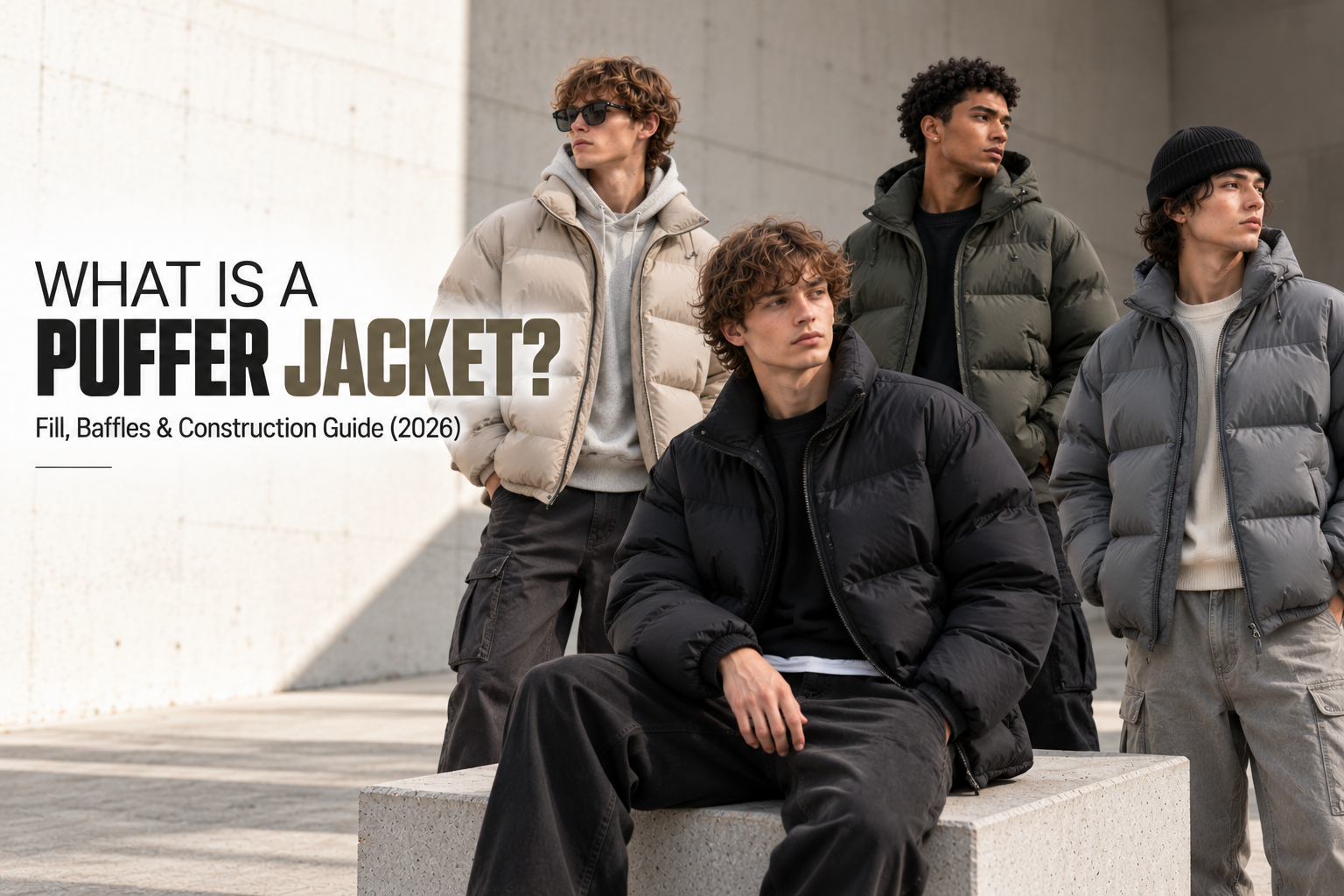
A puffer jacket is an insulated outerwear garment built around one central idea:
trap insulating material between outer and inner fabric layers to create warmth without relying entirely on heavy shell fabric.
The visible "puffed" appearance usually comes from sections that contain:
- Down
- Feather/down blends
- Synthetic insulation
- Other engineered insulation materials
These sections may be created through:
- Horizontal quilting
- Vertical quilting
- Square quilting
- Diamond quilting
- Wide baffles
- Narrow baffles
- Internal baffle structures
From the outside, a puffer jacket can look relatively simple.
Shell.
Zipper.
Collar.
Insulation.
But from a manufacturing perspective, the jacket is a system of materials that need to work together.
The final result depends on:
shell fabric + insulation + fill quantity + baffle construction + stitching + lining + pattern + hardware + finishing
Too little insulation creates flat areas.
Too much insulation can distort the silhouette.
Poorly distributed down can create empty sections and cold spots.
A shell fabric that is not sufficiently down-resistant can allow feathers to migrate through the surface.
And badly planned quilting can change the finished garment measurements after the panels are filled.
For clothing brands, developing a successful puffer therefore requires much more than choosing how "puffy" the reference image looks.
This guide explains the major construction decisions behind a production-ready men's puffer jacket.
What Is a Puffer Jacket?
A puffer jacket is an insulated jacket divided into compartments that help hold insulation around the body.
Common versions include:
- Lightweight puffers
- Midweight puffers
- Heavy winter puffers
- Down jackets
- Synthetic insulated jackets
- Cropped puffers
- Oversized puffers
- Hooded puffers
- Collarless puffers
- Packable puffers
The word puffer usually describes the visible padded or inflated appearance.
It does not identify one specific insulation.
A puffer jacket can therefore contain:
- Natural down
- Down/feather blend
- Polyester fiber
- Sheet insulation
- Cluster-style synthetic insulation
Two jackets that look nearly identical from outside may have completely different internal constructions.
Why Are Puffer Jackets Relevant in Men's Fashion in 2026?
Men's outerwear in 2026 continues to balance two directions:
functional cold-weather protection
and
stronger fashion silhouettes
That makes the puffer particularly adaptable.
A puffer can be:
- Technical
- Minimal
- Oversized
- Cropped
- Luxury
- Outdoor-inspired
- Streetwear
- Packable
- Performance-focused
A compact black puffer can work as a clean everyday jacket.
A high-loft oversized version can become the main visual piece in a streetwear collection.
A thin synthetic jacket can function as a midlayer.
A longer down jacket can move closer to a winter parka.
For clothing brands, the category offers many design possibilities while still being immediately recognizable to consumers.
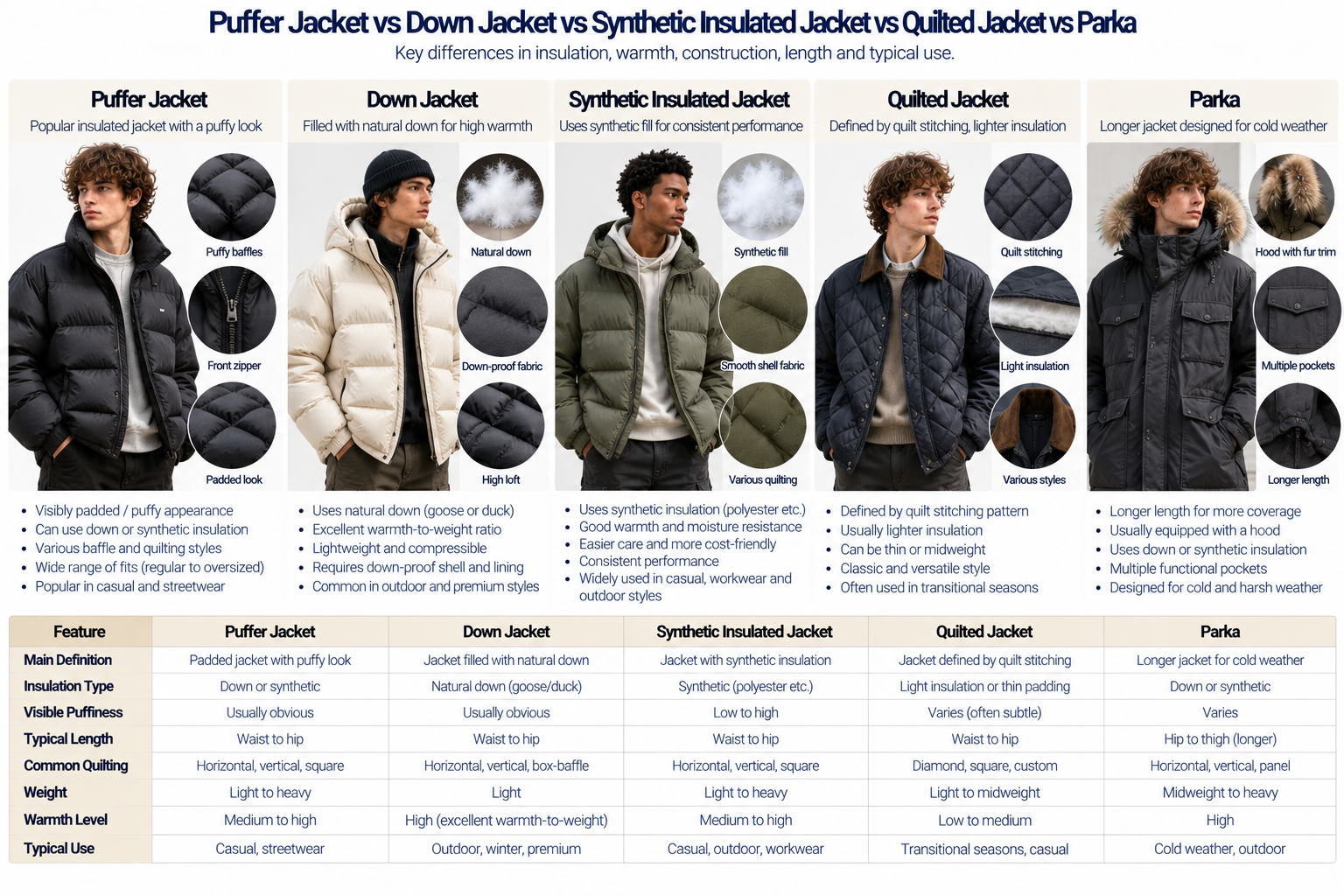
Puffer Jacket vs Other Insulated Jackets
Terms such as puffer jacket, down jacket, quilted jacket and insulated jacket are often used interchangeably.
They overlap.
But they do not mean exactly the same thing.
| Product | Main Meaning | Insulation | Visible Puffiness | Typical Construction |
|---|---|---|---|---|
| Puffer Jacket | Visibly insulated jacket style | Down or synthetic | Usually obvious | Quilted / baffled |
| Down Jacket | Jacket defined by down insulation | Down | Usually | Quilted / baffled |
| Synthetic Insulated Jacket | Jacket using synthetic insulation | Synthetic | Low to high | Quilted or sheet insulated |
| Quilted Jacket | Garment defined by quilt stitching | May be light insulation | Varies | Quilting |
| Parka | Longer protective outerwear category | Down or synthetic | Varies | Longer outerwear construction |
This means:
a down jacket can be a puffer jacket
and:
a puffer jacket does not need to use down.
Puffer Jacket vs Down Jacket
A down jacket is defined primarily by its insulation.
The fill normally contains:
- Goose down
- Duck down
- Down blends
A puffer jacket describes the overall padded outerwear style.
Therefore:
Down Puffer Jacket
is a completely normal product description.
But a synthetic puffer contains no natural down.
Puffer Jacket vs Quilted Jacket
A quilted jacket is defined by stitching that secures layers together.
It may contain:
- Very thin padding
- Sheet insulation
- Lightweight synthetic insulation
and may have almost no visible loft.
A puffer usually contains enough insulation to create noticeable volume.
So:
quilting describes construction
while:
puffer describes the resulting insulated garment style.
Puffer Jacket vs Insulated Jacket
"Insulated jacket" is a broader technical category.
It simply means the garment contains material designed to reduce heat loss.
An insulated jacket may be:
- Puffy
- Very slim
- Quilted
- Seamless-looking
- Laminated
Therefore, not every insulated jacket is visually a puffer.
Puffer Jacket vs Parka
A parka is generally longer and designed for greater body coverage.
Common features may include:
- Hood
- Longer body
- Weather-protective shell
- Multiple pockets
- Insulation
A puffer can be:
- Waist length
- Hip length
- Cropped
- Long
A long insulated puffer may overlap strongly with the parka category.
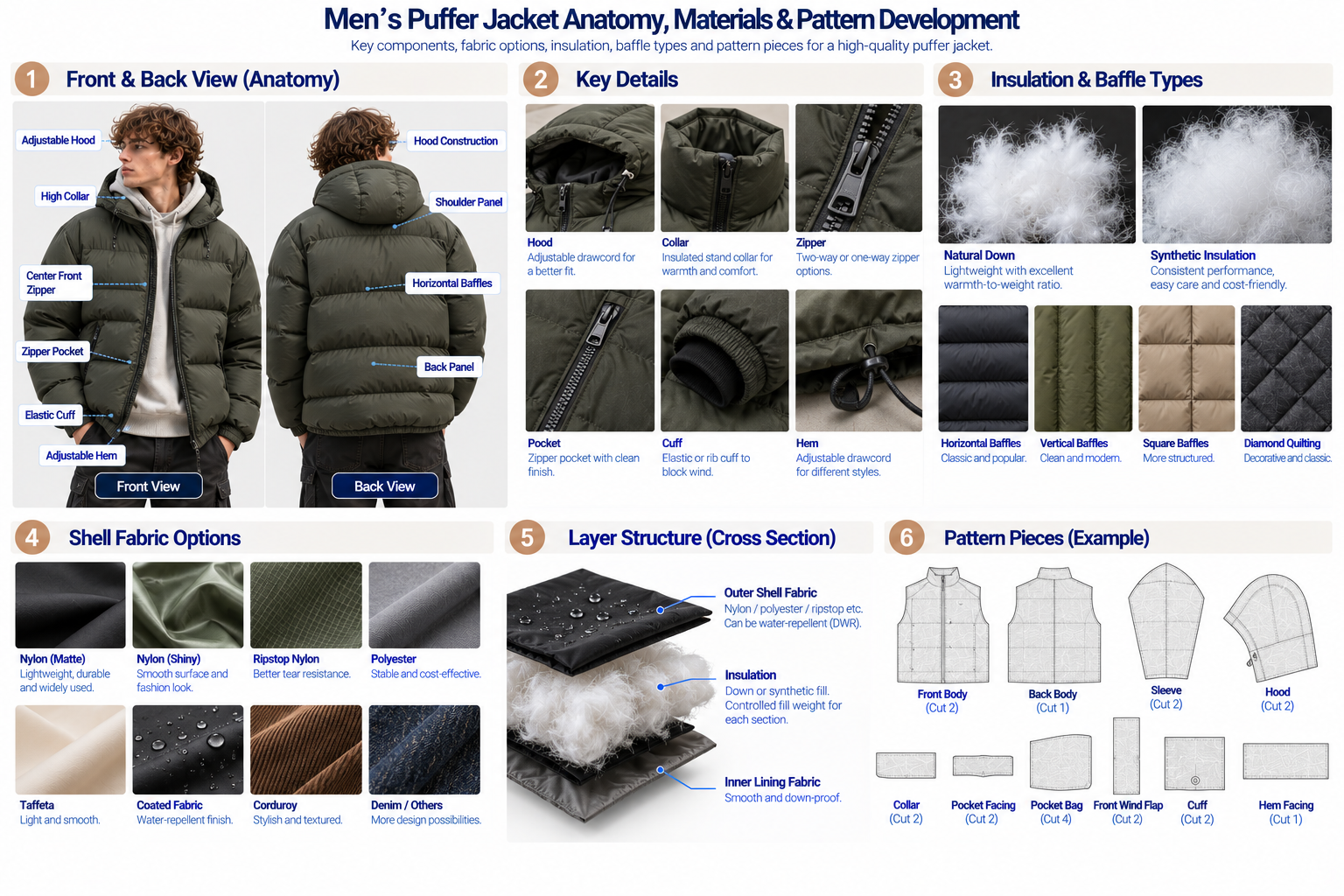
The Anatomy of a Puffer Jacket
A typical puffer may include:
- Outer shell
- Lining
- Insulation
- Baffles or quilt lines
- Front zipper
- Collar or hood
- Pockets
- Cuffs
- Hem
- Drawcords
- Internal wind flap
- Optional chin guard
- Optional internal pockets
Each element affects the performance and appearance of the finished garment.
The Shell Fabric
The shell holds the insulation and forms the exterior surface.
Common materials include:
- Nylon
- Polyester
- Nylon/polyester blends
- Lightweight ripstop
- Taffeta
- Technical woven fabrics
For fashion-oriented puffers, some brands also experiment with:
- Cotton blends
- Corduroy
- Denim
- Velvet
- Coated fabrics
But the shell must still work with the chosen insulation construction.
For custom shell sourcing and technical woven development, see Brad Apparel's Fabric Sourcing & Development.
Nylon Shell Fabric
Nylon is widely used because it can provide:
- Low weight
- Smooth surface
- Good tear performance depending on construction
- Packability
- Technical appearance
Possible fabric directions include:
- Matte nylon
- Shiny nylon
- Crinkle nylon
- Ripstop nylon
- Down-resistant nylon
Polyester Shell Fabric
Polyester can provide:
- Dimensional stability
- Broad color options
- Different surface finishes
- Cost flexibility
The choice between nylon and polyester should not be based only on fiber name.
The brand should evaluate:
- Fabric construction
- Density
- Finish
- Hand feel
- Strength
- Down resistance
- Coating
What Does Denier Mean?
Technical shell fabrics are often described using denier, commonly abbreviated as D.
Examples include:
- 10D
- 20D
- 30D
- 40D
- 70D
Denier relates to yarn linear density.
It should not be confused with:
- GSM
- Fabric thickness
- Finished garment weight
A lower-denier fabric is not automatically weaker or better.
Actual performance also depends on:
- Yarn
- Weave
- Density
- Ripstop structure
- Coating
- Finish
Lightweight Shells
Thin technical shells are useful for:
- Packable puffers
- Lightweight down jackets
- Midlayers
Advantages include:
- Low weight
- Small packed volume
- Soft drape
Challenges include:
- Greater sewing sensitivity
- Potential insulation leakage
- Increased snag risk
- More visible needle damage
Heavier Shells
A heavier woven shell may create:
- Stronger fashion silhouette
- More structure
- Higher abrasion resistance
- Less delicate appearance
But it also increases:
- Garment weight
- Packed volume
- Seam bulk
The shell should match the intended end use.
What Is Down-Proof Fabric?
When natural down is used, shell and lining fabric need to resist down migration.
Very fine feathers or down fibers may otherwise push through:
- Fabric pores
- Needle holes
- Seams
Down resistance depends on:
- Fabric density
- Weave
- Calendering
- Coating
- Yarn size
Brands should test the actual shell rather than assume that every lightweight nylon is suitable for down.
Calendered Fabric
Calendering compresses the fabric surface using controlled pressure and heat.
It can help create:
- Smoother surface
- Reduced air permeability
- Improved down resistance
The exact result depends on the material and finishing method.
Some calendered fabrics also develop:
- Slight shine
- Papery hand feel
- Technical appearance
Ripstop Shell
Ripstop fabric contains reinforcement yarns arranged in a visible or subtle grid.
It can provide:
- Technical appearance
- Improved resistance to tear propagation
The grid size may be:
- Very fine
- Highly visible
depending on design.
DWR and Water Repellency
Some puffer shells use a water-repellent finish.
This can help light moisture bead on the fabric surface.
But:
water-repellent does not automatically mean waterproof.
Actual rain protection depends on:
- Shell construction
- Coating or membrane
- Seams
- Zippers
- Design
Brands should only make performance claims that match actual material and testing specifications.
Natural Down Insulation
Down consists of fine clusters found beneath the outer feathers of waterfowl.
It can provide an excellent warmth-to-weight ratio because the structure traps air.
Common sourcing categories include:
- Goose down
- Duck down
Product specifications may also describe the ratio between:
- Down
- Feather
For example:
90% down / 10% feather
But this ratio alone does not tell the complete performance story.
Down vs Feather
Down clusters are soft three-dimensional structures.
Feathers have:
- Central quill
- Flatter shape
Higher-quality insulation usually relies more heavily on down clusters for loft.
However, exact product requirements depend on:
- Price point
- Target warmth
- Certification
- Local regulations
- End use
What Is Fill Power?
Fill power is commonly used to describe the loft potential of down.
Higher fill-power down can generally create more loft for a given weight of material.
Examples may include:
- 550 fill power
- 650 fill power
- 700 fill power
- 800+ fill power
But a common mistake is assuming:
Higher fill power automatically means a warmer jacket.
That is incomplete.
Fill Power vs Fill Weight
These are two separate specifications.
Fill Power
Describes the loft characteristics of the down.
Fill Weight
Describes how much down is actually placed into the garment.
A jacket using high-fill-power down but very little total fill may still be lighter and less insulating than a jacket containing a greater quantity of lower-fill-power insulation.
For product development, both need to be considered.
Example
Imagine:
Jacket A
800 fill-power down
Low fill weight
Jacket B
650 fill-power down
Much higher fill weight
It is not possible to determine which finished jacket will be warmer based on fill power alone.
The complete jacket construction matters.
Down Distribution
The total insulation must be distributed across the jacket.
Common areas include:
- Front body
- Back body
- Sleeves
- Collar
- Hood
Each area may use a different fill quantity.
For example, the sleeves may require less insulation than the torso.
The hood may need a separate fill specification.
Fill Weight by Panel
For more controlled production, a technical specification can state fill quantity by section.
For example:
| Area | Example Fill Allocation |
|---|---|
| Front Body | 70 g |
| Back Body | 60 g |
| Left Sleeve | 25 g |
| Right Sleeve | 25 g |
| Collar | 8 g |
| Hood | 20 g |
These numbers are illustrative only.
Actual fill weight depends on:
- Size
- Baffle volume
- Desired warmth
- Fill power
- Silhouette
Synthetic Insulation
Synthetic insulation is typically made from engineered fibers.
Possible formats include:
- Continuous sheet insulation
- Loose cluster insulation
- Staple fiber fill
- Engineered polyester insulation
Examples from insulation suppliers may use proprietary structures.
Advantages of Synthetic Insulation
Depending on product and material, synthetic insulation may offer:
- Easier handling
- More predictable distribution
- Lower cost
- Reduced sensitivity to moisture
- Animal-free product positioning
But performance varies widely.
Not all polyester fills behave the same way.
Sheet Insulation
Sheet insulation arrives as a continuous layer.
It is cut according to garment pattern pieces.
This can simplify production because there is no need to inject loose fill into individual baffles.
It works well for:
- Lightweight insulated jackets
- Quilted jackets
- Thin puffers
Loose Synthetic Fill
Loose synthetic clusters can create a look closer to traditional down.
They may be inserted into:
- Chambers
- Baffles
in a similar manner to natural down.
The factory needs to control:
- Weight
- Distribution
- Compression
Down vs Synthetic Insulation
| Factor | Down | Synthetic |
|---|---|---|
| Loft-to-Weight | Often very high | Varies |
| Packability | Usually excellent | Varies |
| Moisture Sensitivity | Greater | Often lower |
| Cost | Often higher | Broad range |
| Fill Handling | Loose fill | Sheet or loose |
| Animal-Free | No | Yes |
| Production Control | Fill-weight sensitive | Depends on format |
Neither is automatically better.
The correct insulation depends on the product.
What Is a Baffle?
A baffle is a compartment that controls insulation position.
Without compartments, loose insulation would move freely throughout the jacket.
This could create:
- Uneven distribution
- Empty zones
- Large lumps
Baffles divide the garment into controlled sections.
Horizontal Baffles
Horizontal chambers are one of the most recognizable puffer constructions.
They create:
- Classic puffer appearance
- Strong horizontal lines
- Easy visual control of fill distribution
The baffle height strongly affects the final silhouette.
Narrow Baffles
Narrow baffles create:
- More quilting lines
- Flatter profile
- More technical appearance
They are common on:
- Lightweight puffers
- Packable jackets
Wide Baffles
Wide baffles create:
- Greater visual volume
- Stronger puffiness
- More streetwear character
But they require careful fill distribution.
If a wide chamber is underfilled, insulation can shift more visibly.
Vertical Baffles
Vertical sections create a different visual proportion.
They can make the garment appear:
- Longer
- Cleaner
- Less traditionally puffy
They may appear on:
- Side panels
- Full body
- Hybrid designs
Square and Grid Quilting
Square quilting creates smaller compartments.
It works well for:
- Controlled insulation
- Retro styling
- Liner jackets
- Lightweight puffers
The look can move closer to a quilted jacket when fill volume is low.
Diamond Quilting
Diamond quilting creates:
- Heritage appearance
- More decorative visual texture
It is often associated with:
- Quilted jackets
- Liner jackets
rather than extremely high-loft puffers.
Stitch-Through Construction
One common method is sewing the outer and inner layers together along the quilt line.
This creates compartments directly through the garment.
Advantages include:
- Simpler construction
- Lower manufacturing complexity
- Lower weight
- Defined quilting
However, the stitched areas contain less insulation.
These lines can create localized cold spots.
Box-Baffle Construction
A box-baffle structure uses internal fabric walls between outer and inner layers.
Instead of the shell and lining touching directly at each division, a small wall maintains chamber depth.
This can reduce heat loss through compressed stitch lines.
It is commonly associated with:
- Higher-loft products
- Performance cold-weather garments
But it also adds:
- Pattern pieces
- Sewing
- Labor
- Weight
- Cost
Not Every Fashion Puffer Needs Box Baffles
For many casual or streetwear puffers, stitch-through quilting is completely appropriate.
Box baffles make more sense when:
- Maximum loft is important
- Higher thermal performance is required
- Product positioning justifies additional construction cost
Choose construction according to end use rather than assuming more complexity always means better quality.
Baffle Height
Baffle height should be specified.
For example:
Finished horizontal baffle height: 11 cm
This is much clearer than telling the factory:
Make it very puffy.
Baffle height influences:
- Appearance
- Fill volume
- Number of quilt lines
- Pattern proportions
Baffle Position
The placement of quilt lines affects the entire jacket.
Important areas include:
- Chest
- Waist
- Pocket opening
- Sleeve
- Shoulder
- Hem
A quilt line should not accidentally pass through an area where it complicates:
- Pocket construction
- Logo placement
- Zipper attachment
Baffle Matching Across Front Panels
Horizontal baffles create very obvious reference lines.
The left and right front should align across the center zipper unless the design intentionally creates asymmetry.
This is a major quality-control point.
Sleeve Baffle Alignment
Sleeves may use the same baffle height as the body or a different arrangement.
If body and sleeve lines are intended to connect visually, placement should be planned during pattern development.
Fill Migration
Loose insulation can move within a large chamber.
This may create:
- Empty corner
- Lumped fill
- Uneven loft
Smaller baffles can control movement more effectively.
But smaller chambers also increase:
- Stitching
- labor
- potential cold lines
The design needs balance.
What Are Cold Spots?
Cold spots are areas where insulation is:
- Thin
- Compressed
- Missing
These areas reduce thermal consistency.
Potential locations include:
- Quilting seams
- Shoulder seams
- Pocket construction
- Zipper edges
- Underarm
- Side seams
A fashion jacket may tolerate some thermal variation.
A technical product with performance claims requires much stricter engineering.
Puffer Jacket Fit
Puffer fit cannot be developed exactly like an uninsulated jacket.
The pattern needs to account for:
- Internal fill volume
- Layering
- Compression
- Desired exterior silhouette
Common fits include:
- Regular
- Relaxed
- Boxy
- Oversized
- Cropped
Regular Puffer Fit
A regular puffer typically provides enough room for:
- T-shirt
- Sweatshirt
- Light knit
while maintaining controlled body volume.
This works well for:
- Everyday jackets
- Lightweight puffers
- Commercial winter outerwear
Relaxed Puffer Fit
A relaxed fit adds more:
- Chest width
- Armhole space
- Sleeve width
without becoming dramatically oversized.
It works particularly well with modern men's casualwear.
Boxy Puffer Jacket
A boxy puffer often uses:
- Wider chest
- Shorter or controlled length
- Larger baffles
- Wider sleeves
This creates a stronger fashion silhouette.
The hem may be:
- Straight
- Elasticated
- Drawcord-adjustable
Oversized Puffer Jacket
Oversized puffers should be purpose-built.
Do not simply enlarge a normal jacket pattern.
That can create:
- Sleeves too long
- Hood too large
- Pockets too low
- Excess body length
- Oversized neck opening
Width and length should be controlled independently.
Cropped Men's Puffer
Cropped men's puffers can create a strong contemporary proportion.
The body may finish:
- At waistband
- Slightly below waistband
- High hip
When shortening the body, adjust:
- Baffle count
- Pocket height
- Zipper length
- Hem
- Drawcord
rather than simply cutting the bottom off a longer pattern.
Puffer Jacket Pattern Development
A puffer pattern requires consideration of the finished padded volume.
Possible pattern pieces include:
- Front body
- Back body
- Sleeve
- Hood
- Collar
- Pocket components
- Front wind flap
- Chin guard
- Shell panels
- Lining panels
- Internal baffle walls where used
Exact construction depends on the insulation system.
Quilting Can Change Panel Dimensions
When flat shell fabric is stitched into quilted sections and filled, the finished panel may become:
- Shorter
- Narrower
than its original flat dimensions.
This is because the fabric curves around the insulation volume.
That means a puffer pattern cannot always use the same dimensions as an unfilled jacket.
Loft Allowance
The pattern may require allowance for:
- Insulation thickness
- Quilting take-up
- Internal garment space
The amount depends on:
- Baffle width
- Fill quantity
- Shell stiffness
- Intended loft
Sampling is essential.
Front Body
Important considerations include:
- Zipper length
- Baffle alignment
- Pocket position
- Fill distribution
- Chest volume
If a front pocket interrupts a baffle, the construction needs to be planned before filling.
Back Body
The back may use:
- Same baffle layout as front
- Wider baffles
- Different quilting pattern
If alignment around the side seam matters visually, front and back positions should be coordinated.
Sleeve Pattern
A puffer sleeve needs enough room for:
- Insulation
- Arm movement
- Base layers
But excessive sleeve volume can make the entire jacket feel bulky.
Important measurements include:
- Bicep
- Elbow
- Sleeve length
- Cuff opening
Shoulder Construction
Possible shoulder directions include:
- Set-in sleeve
- Raglan
- Drop shoulder
A drop shoulder works particularly well for oversized streetwear puffers.
A set-in sleeve can create a cleaner commercial silhouette.
Hood Construction
A puffer hood may contain:
- Shell
- Lining
- Insulation
Possible features include:
- Drawcord
- Elastic adjustment
- Peak
- Snap closure
- Detachable construction
The hood should be evaluated both:
- Up
- Down
because heavy insulated hoods can pull the back neckline.
Hood Insulation
The hood does not necessarily use the same fill quantity as the body.
Overfilling can create:
- Excessive bulk
- Poor visibility
- Stiff opening
Underfilling can look visually flat compared with the jacket body.
Detachable Hood
Possible attachment systems include:
- Zipper
- Snaps
- Buttons
The attachment seam needs enough strength to support the hood weight.
When detached, the collar should still look finished.
Puffer Collar
Common options include:
- Stand collar
- Funnel collar
- Fold collar
- Hooded neckline
An insulated stand collar can provide both:
- Visual volume
- Neck warmth
But too much fill can make it uncomfortable.
Chin Guard
A chin guard helps prevent the zipper slider from contacting the skin.
It is especially useful for:
- High collars
- Technical puffers
Possible materials include:
- Shell fabric
- Fleece
- Soft tricot
Center-Front Zipper
Common zipper options include:
- Nylon coil
- Reverse coil
- Molded plastic
- Metal
The correct choice depends on:
- Jacket weight
- Shell
- Style
- Weather performance
For custom zipper and puller development, see Brad Apparel's Trims & Branding.
Two-Way Zipper
Longer or oversized puffers may benefit from a two-way zipper.
The bottom slider can open upward to provide:
- Sitting comfort
- More movement
- Styling flexibility
But two-way zippers require more precise operation and component quality.
Internal Wind Flap
A fabric strip behind the front zipper can help:
- Reduce air movement
- Cover the zipper internally
- Improve comfort
The flap may be:
- Lightly insulated
- Uninsulated
depending on design.
Pocket Options
Common puffer pockets include:
- Zipper hand pockets
- Welt pockets
- Side-entry pockets
- Patch pockets
- Internal pockets
- Chest pockets
Pocket construction needs to avoid excessive insulation compression.
Zipper Hand Pockets
Zipper pockets provide security and support:
- Technical
- Outdoor
- Modern casual
styling.
The pocket zipper should remain aligned with the surrounding baffles.
Fleece-Lined Pockets
Pocket bags may use:
- Fleece
- Tricot
- Brushed knit
to improve hand comfort.
The material adds bulk.
This should be considered around the pocket opening.
Internal Pocket
Inside pockets can hold:
- Phone
- Wallet
- Small items
Possible constructions include:
- Patch pocket
- Zipper pocket
- Welt pocket
Heavy items can pull lightweight lining, so reinforcement may be needed.
Puffer Jacket Cuffs
Possible cuff systems include:
- Elastic binding
- Internal elastic cuff
- Rib cuff
- Straight cuff
- Velcro adjustment
- Snap adjustment
The correct option depends on product positioning.
Internal Elastic Cuff
An internal elastic cuff can create:
- Clean exterior
- Improved wind control
It works well for technical puffers.
Rib Cuff
Rib creates a more casual or streetwear appearance.
But rib and shell may have different:
- Shrinkage
- color behavior
- recovery
They should be tested together.
Hem Construction
Common options include:
- Straight hem
- Internal elastic
- Drawcord
- Elastic binding
- Rib waistband
The hem can dramatically change the silhouette.
Drawcord Hem
An adjustable drawcord allows the wearer to change:
- Hem circumference
- Jacket volume
It can create a more cropped or ballooned shape.
Check the garment:
- Fully relaxed
- Partially tightened
- Fully tightened
during fit approval.
Drawcord Safety and Construction
Depending on market and garment category, drawcord design may need to comply with relevant safety requirements.
Brands should confirm requirements for their target market rather than copying a reference garment blindly.
Shell Color
Puffer jackets often use highly visible solid colors because the quilting creates enough visual interest.
Common directions include:
- Black
- Navy
- Olive
- Gray
- Brown
- Cream
- Red
- Cobalt
- Metallic finishes
Shell finish can make the same color appear very different.
Matte vs Shiny Puffer Fabric
Matte Shell
Creates:
- Cleaner
- Technical
- Minimal
appearance.
Shiny Shell
Creates:
- Retro
- Fashion
- Stronger visual volume
appearance.
Gloss also emphasizes:
- Wrinkles
- Baffle curvature
- Stitch lines
Contrast Panels
Puffers can use different materials around:
- Shoulder
- Yoke
- Elbow
- Collar
Examples include:
- Nylon + fleece
- Matte + shiny nylon
- Woven reinforcement panels
Mixed fabrics need compatibility testing.
Embroidery on Puffer Jackets
Embroidery is possible, but placement matters.
It is often easier to embroider:
shell panel before filling
rather than through a completed high-loft baffle.
This helps prevent:
- Insulation compression
- Uneven embroidery
- Down leakage through needle holes
For embroidery options, see Brad Apparel's Embroidery Techniques.
Patches and Appliqué
Patches can work well on:
- Chest
- Sleeve
- Yoke
But heavy patches may flatten insulation.
Attach them according to the approved construction stage.
Screen Printing on Puffer Shell
Printing lightweight synthetic shell can be challenging.
The print system needs to be compatible with:
- Fabric coating
- Surface finish
- Heat sensitivity
Always test printing on the actual production fabric.
Heat Transfer
Heat transfers can work on selected synthetic shells.
But temperature and pressure must be controlled.
Excessive heat can:
- Damage coating
- Melt fabric
- create gloss marks
A production test is essential.
Down Leakage
Small down fibers can occasionally migrate through fabric or stitch holes.
Excessive leakage can indicate problems with:
- Shell density
- Lining density
- Needle size
- Stitch density
- Seam construction
Do not judge down resistance only from the first finished sample.
Wash and wear testing can reveal additional issues.
Needle Size Matters
An unnecessarily large needle creates larger holes.
This can increase:
- Down leakage
- Visible needle marks
Machine settings should be developed around thin shell fabric rather than copied from heavier jackets.
Stitch Density
Very dense stitching can:
- Perforate lightweight shell
- weaken the seam area
- create puckering
Too-low stitch density can reduce seam strength.
The correct setting depends on the fabric.
Seam Puckering
Light synthetic fabrics can show puckering easily.
Possible causes include:
- Thread tension
- differential feeding
- needle selection
- zipper installation
- fabric stretch
The sewing line should be tested before bulk production.
Insulation Distribution Control
Loose fill needs accurate weight control.
Factories may use:
- Electronic scales
- Filling equipment
- Section-by-section fill records
Each panel should receive the approved amount.
Underfilled Baffles
Signs include:
- Flat appearance
- Empty corners
- Poor loft
- inconsistent warmth
Possible causes include:
- Incorrect fill weight
- Fill migration
- Baffle leakage into another chamber
Overfilled Baffles
Overfilling can cause:
- Excess pressure
- Distorted seams
- Very round silhouette
- Reduced compressibility
More fill is not always better.
The chamber needs enough space for the insulation to loft.
Fill Consistency Across Sizes
Larger sizes have greater chamber volume.
Therefore, one identical fill quantity should not automatically be used across all sizes.
Fill specifications may need grading.
Insulation Grading
A size XL normally has larger:
- Body
- Sleeves
- Baffles
than a size S.
The technical team should decide how fill quantity changes by size.
Do not assume:
same fill weight = same appearance
across all sizes.
Puffer Jacket Measurements
Important measurements include:
| Measurement | Why It Matters |
|---|---|
| Chest Width | Controls layering and overall fit |
| Body Length | Controls jacket proportion |
| Shoulder Width | Defines upper-body silhouette |
| Sleeve Length | Controls wrist position |
| Bicep Width | Allows movement and insulation |
| Hem Width | Controls lower silhouette |
| Neck Opening | Controls collar fit |
| Collar Height | Controls warmth and appearance |
| Baffle Height | Controls quilting proportion |
| Pocket Position | Controls function and appearance |
| Hood Height | Controls head coverage |
| Hood Opening | Controls visibility and fit |
Measurements should be taken according to a defined finished-garment method.
Measure the Finished Puffer, Not Only the Flat Shell
The shell panel before filling does not represent the final garment dimension accurately.
Insulation volume can change how the jacket measures.
Final measurement inspection should therefore happen after:
- Filling
- Sewing
- Finishing
- Loft recovery
Puffer Jacket Sampling
The first sample should be evaluated for:
- Fit
- Loft
- Fill distribution
- Quilting
- Weight
- Shell appearance
- Zipper
- Pockets
- Collar
- Hood
Do not evaluate only from photographs.
Loft Recovery
Puffers can become compressed during:
- Packaging
- Shipping
- Storage
After unpacking, allow the garment time to recover.
The final inspection should consider expected loft recovery.
Compression Test
For packable products, repeatedly compress and release the jacket.
Check whether the insulation:
- Recovers
- Clumps
- Shifts
The target depends on the actual insulation type.
Wear Test
Test the sample while:
- Walking
- Sitting
- Raising arms
- Crossing arms
- Wearing intended base layers
Check whether the insulation creates excessive restriction.
Hood Test
With the hood up, check:
- Visibility
- Neck comfort
- Opening
- Drawcord function
With the hood down, check whether it:
- Pulls the neckline
- Creates excessive bulk
Pocket Test
Check:
- Entry angle
- Depth
- Zipper
- Pocket bag
- Insulation interference
The wearer's hand should enter naturally.
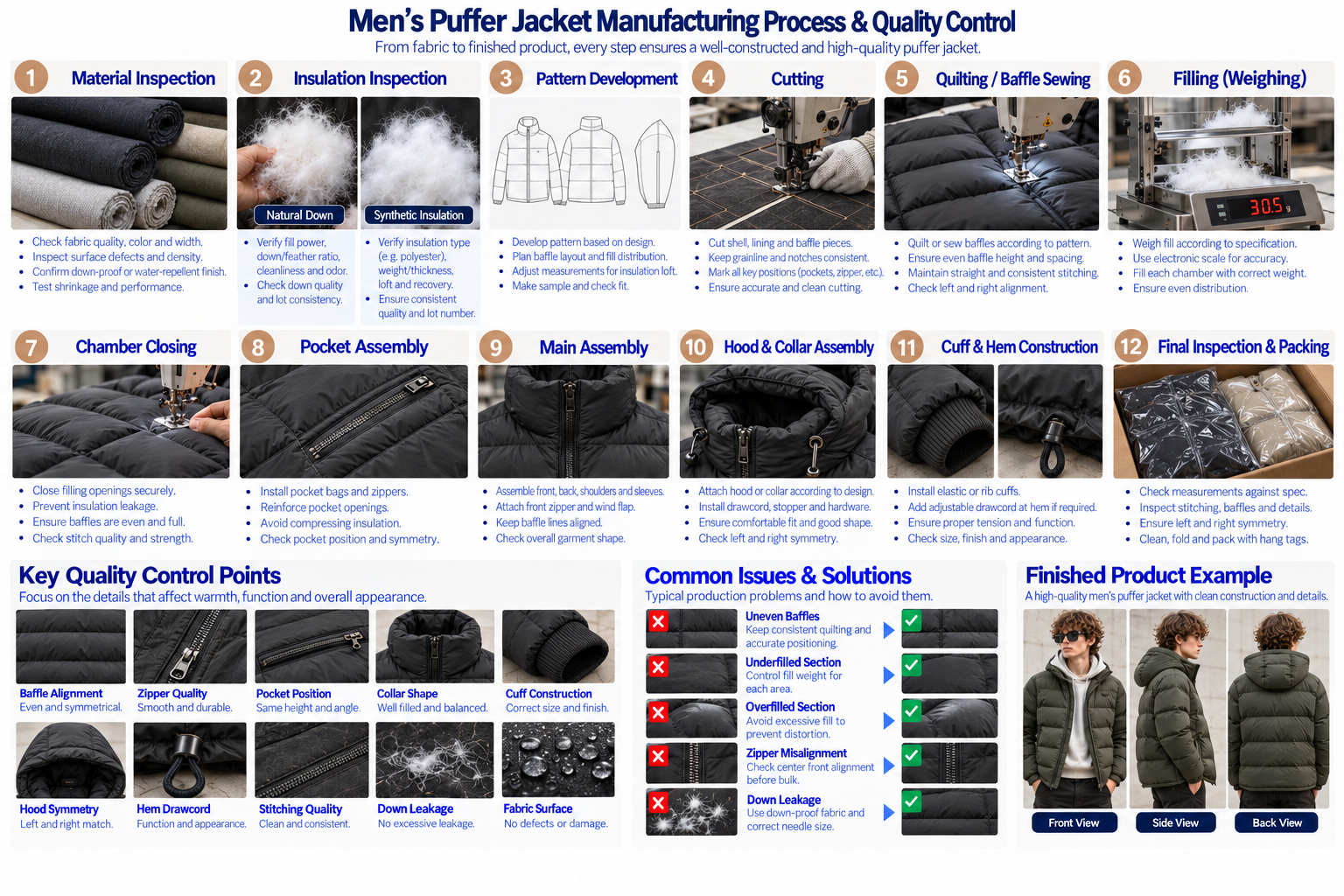
Puffer Jacket Manufacturing Process
A typical production process may include:
- Shell and lining inspection
- Insulation approval
- Shrinkage / performance testing where applicable
- Pattern development
- Quilting and baffle planning
- Cutting
- Decoration before filling where required
- Baffle sewing
- Fill weighing and insertion
- Chamber closing
- Pocket preparation
- Front zipper preparation
- Main body assembly
- Sleeve assembly
- Hood / collar assembly
- Cuff and hem construction
- Final hardware
- Cleaning and finishing
- Measurement inspection
- Fill and loft QC
- Final inspection
- Packing
The exact order depends on the insulation and garment design.
1. Shell Fabric Inspection
Check:
- Fabric width
- Color
- Shade
- Density
- Surface
- Ripstop consistency
- Coating
- Defects
Thin fabrics should also be checked for:
- Snags
- holes
- damaged yarns
2. Insulation Inspection
For natural down, verify the approved specification.
Possible information includes:
- Fill composition
- Fill power
- Cleanliness requirements
- Certification requirements
For synthetic insulation, verify:
- Type
- Weight
- Thickness
- Recovery
- Lot consistency
3. Pattern Development
The pattern should account for:
- Loft
- Quilting take-up
- Layering ease
- Fill distribution
- Pocket construction
The sample needs to confirm the final finished measurements.
4. Cutting
Cut:
- Shell
- Lining
- Baffle walls where required
- Reinforcement
- Pocket pieces
Maintain:
- Grainline
- directional finish
- size identification
Light shell materials can shift during cutting and require careful control.
5. Decoration
If embroidery or printing is required, determine whether it should happen before insulation filling.
For many designs, decoration on the flat shell panel provides:
- Cleaner result
- easier machine access
- less compression
6. Baffle Sewing
Quilt or construct the insulation chambers according to the approved layout.
Check:
- Baffle height
- Line spacing
- Left/right alignment
- Stitch consistency
7. Fill Weighing
Each required section should receive its approved fill amount.
Record weight accurately.
Small variations may become visible as different loft levels.
8. Filling
Insert insulation evenly into the chamber.
Avoid concentrating the fill entirely in the center.
Check corners and edges.
9. Chamber Closure
After filling, close the chamber securely.
The insulation should not leak into neighboring sections.
10. Pocket Assembly
Construct pockets carefully around the filled structure.
Avoid compressing insulation unnecessarily around:
- Pocket opening
- Pocket bag
- Zippers
11. Main Assembly
Join:
- Front
- Back
- Shoulders
- Side seams
while maintaining baffle alignment.
12. Sleeve Assembly
Check:
- Left/right fill
- Baffle alignment
- Sleeve pitch
- Cuff
Both sleeves should have comparable loft.
13. Collar / Hood Assembly
Attach the collar or hood while controlling:
- Bulk
- Fill
- Neck circumference
- Seam thickness
14. Zipper Installation
The center zipper needs to remain:
- Straight
- Centered
- Smooth
Uneven feeding can create:
- Waviness
- Different front lengths
15. Final Loft Check
After assembly, inspect the jacket for:
- Flat zones
- Overfilled sections
- Empty corners
- Uneven sleeve loft
Redistribution may be possible before final packing depending on construction.
Key Quality Control Points
Baffle Alignment
Check that quilting lines remain:
- Level
- Symmetrical
- Consistent
especially across the center front.
Fill Consistency
Compare adjacent chambers.
They should show controlled and intentional loft.
Down Leakage
Inspect:
- Shell surface
- Seam lines
- Needle holes
for excessive migration.
Zipper Alignment
The center zipper should:
- Remain straight
- Close smoothly
- Match top and bottom positions
Pocket Position
Left and right pockets should remain level unless asymmetry is intentional.
Collar Loft
The collar should look balanced and comfortable.
Hood Symmetry
Check:
- Left/right shape
- Drawcord position
- Fill
- opening
Sleeve Loft
Both sleeves should have similar volume.
Cuff Construction
Check:
- Size
- Elastic recovery
- Left/right consistency
Hem
Check:
- Straightness
- Drawcord
- Elastic
- left/right balance
Common Puffer Jacket Quality Problems
Uneven Baffles
One side may sit higher or lower.
Possible Causes
- Pattern marking
- Sewing
- Uneven filling
Control
Use clear quilting guides and inline inspection.
Underfilled Section
A chamber looks noticeably flatter.
Control
Verify fill weight and distribution before closing the chamber.
Overfilled Section
A chamber appears excessively rounded.
Control
Follow approved fill-weight specifications.
Insulation Clumping
Insulation may collect in one area.
Possible causes include:
- Large chamber design
- Poor distribution
- Washing
- low recovery
Test the actual insulation system.
Down Leakage
Excessive down may escape through:
- Shell
- lining
- seam holes
Review:
- Fabric density
- needle
- thread
- seam construction
Wavy Front Zipper
Possible causes include:
- Shell stretching
- Zipper feeding
- Excess bulk
- quilting distortion
Zipper construction should be tested on the actual padded panel.
Baffle Lines Not Matching at Center Front
Because horizontal quilting creates strong visual lines, misalignment becomes immediately obvious.
Mark front panels carefully before assembly.
Flat Shoulder Area
Seam construction may compress insulation too aggressively.
Review:
- Seam allowance
- Fill placement
- shoulder construction
Uneven Collar
One collar side may have:
- More fill
- different height
- different shape
Control both pattern and insulation quantity.
Pocket Distortion
A pocket may pull the surrounding shell or flatten the baffle.
The pocket construction needs to coordinate with the quilt layout.
Twisted Sleeve
Possible causes include:
- Pattern balance
- sewing
- shell movement
Check sleeve pitch before bulk production.
Lining Too Tight
If the lining does not provide enough room for the filled shell, it can:
- Compress insulation
- pull side seams
- restrict movement
The lining requires appropriate ease.
Lining Too Loose
Excess lining may:
- Hang
- twist
- catch around the hem
Balance is necessary.
Puffer Jacket Tech Pack Example
| Area | Example Specification |
|---|---|
| Product | Men's Puffer Jacket |
| Fit | Relaxed / Boxy |
| Shell | 30D Nylon Ripstop |
| Lining | Lightweight Down-Proof Nylon |
| Insulation | Synthetic Cluster Fill |
| Baffle | Horizontal |
| Baffle Height | 12 cm |
| Collar | Insulated Stand Collar |
| Front Closure | Two-Way Molded Zipper |
| Zipper Hand Pocket | |
| Sleeve | Set-In |
| Cuff | Internal Elastic |
| Hem | Adjustable Drawcord |
| Decoration | Small Chest Embroidery |
| Finish | Matte |
| Branding | Woven Main + Care Label |
These specifications are illustrative rather than universal.
Example Lightweight Puffer Jacket
A lightweight version might use:
- Regular fit
- 20D nylon
- Lightweight synthetic sheet insulation
- Narrow quilting
- Coil zipper
- Elastic cuffs
- Packable construction
This direction prioritizes:
- Weight
- packability
- layering
rather than dramatic loft.
Example Oversized Streetwear Puffer
Possible specification:
- Boxy oversized fit
- Drop shoulder
- Matte nylon shell
- Wide horizontal baffles
- High-loft synthetic fill
- Large stand collar
- Two-way zipper
- Side zipper pockets
- Adjustable hem
- Minimal chest logo
The pattern should be developed specifically around the larger baffle volume.
Example Down Puffer Jacket
Possible specification:
- Relaxed fit
- Down-resistant nylon shell
- Natural down fill
- Horizontal baffles
- Insulated hood
- Internal wind flap
- Elastic cuffs
- Zipper pockets
The tech pack should additionally specify:
- Down composition
- Fill power
- Fill weight
- Fill distribution
Example Cropped Men's Puffer
Possible specification:
- Short body
- Wide chest
- Drop shoulder
- Large baffles
- High stand collar
- Elastic or drawcord hem
- Hidden hand pockets
Pocket position and baffle count need to be developed around the shorter body.
Example Technical Synthetic Puffer
Possible specification:
- Regular fit
- Ripstop shell
- Synthetic sheet insulation
- Reverse-coil zipper
- High collar
- Zipper chest pocket
- Internal elastic cuffs
- Adjustable hem
If the product makes performance claims, testing requirements should be agreed separately.
How to Describe a Puffer Jacket to a Manufacturer
Avoid sending only:
I want a thick oversized puffer like this reference.
A more useful development brief would be:
Men's boxy puffer jacket in matte 30D nylon ripstop with wide 12 cm horizontal baffles, high-loft synthetic cluster insulation, dropped shoulders, insulated stand collar, two-way molded front zipper, zipper hand pockets, internal elastic cuffs and adjustable drawcord hem.
Then specify:
- Chest
- Body length
- Shoulder
- Sleeve
- Bicep
- Hem
- Baffle dimensions
- Shell fabric
- Lining
- Insulation type
- Fill weight
- Fill distribution
- Collar
- Hood
- Zipper
- Pockets
- Cuffs
- Hem
- Branding
- Performance requirements
This gives the factory a far more accurate production target.
Common Puffer Jacket Development Mistakes
1. Specifying Only "Down Jacket"
This does not tell the manufacturer:
- Fill power
- Fill weight
- Down ratio
- Baffle design
- Shell
2. Using Fill Power as the Only Warmth Specification
Fill quantity matters too.
3. Saying "Synthetic Fill" Without Identifying the Material
Different synthetic insulations behave very differently.
4. Choosing Shell Fabric Without Testing Down Resistance
Down can migrate through unsuitable fabric.
5. Making Baffles Too Large
Loose fill may shift excessively.
6. Making Baffles Too Small
The jacket can become:
- Over-stitched
- flatter
- more expensive to sew
7. Ignoring Quilting Take-Up
The padded garment may finish smaller than expected.
8. Using the Same Fill Weight for Every Size
Larger sizes have more chamber volume.
9. Overfilling the Jacket
More insulation does not automatically create a better product.
The chambers need room to loft.
10. Underfilling the Jacket
Flat areas make the garment look inconsistent.
11. Placing Pockets Without Considering Baffles
Pocket construction can interrupt fill distribution.
12. Embroidering Through a Finished High-Loft Jacket Without Testing
This can compress insulation and create leakage.
13. Ignoring Needle Holes
Thin down-proof fabrics require appropriate sewing settings.
14. Assuming DWR Means Waterproof
Water repellency and waterproofing are not the same claim.
15. Ignoring Packaging Compression
Puffers may look flat immediately after long-term compression.
Packaging and recovery should be evaluated.
Puffer Jacket Development Checklist
Before sampling, confirm:
- Product type
- Fit
- Shell composition
- Shell construction
- Shell denier / weight
- Lining
- Insulation type
- Down composition where applicable
- Fill power where applicable
- Fill weight
- Baffle direction
- Baffle dimensions
- Fill distribution
- Collar
- Hood
- Front zipper
- Wind flap
- Pockets
- Cuffs
- Hem
- Drawcord
- Decoration
- Branding
- Performance requirements
Before bulk production, confirm:
- Approved shell
- Approved insulation
- Insulation lot
- Approved pattern
- Fill chart
- Baffle layout
- Quilting standard
- Zipper
- Fit sample
- Wash / care testing
- Down leakage standard
- Measurement tolerance
- Loft standard
- Hardware
- Packaging
- Final QC standard
FAQ
What Is a Puffer Jacket?
A puffer jacket is an insulated outerwear garment made with padded or filled compartments that create visible loft.
The insulation may be:
- Natural down
- Synthetic material
depending on the product.
Is a Puffer Jacket the Same as a Down Jacket?
Not always.
A down jacket specifically uses down insulation.
A puffer jacket can use:
- Down
- Synthetic insulation
and is more broadly defined by its padded appearance.
What Is the Best Insulation for a Puffer Jacket?
There is no single best option.
Down offers strong loft-to-weight performance.
Synthetic insulation can provide different advantages around:
- Cost
- moisture handling
- animal-free sourcing
- production
The correct choice depends on the product.
What Is Fill Power?
Fill power describes the loft capability of down.
A higher number generally indicates that the down can create more loft for a given weight.
It does not by itself determine the warmth of the finished jacket.
What Is Fill Weight?
Fill weight is the actual quantity of insulation used in the garment.
Both:
- Fill power
- Fill weight
need to be considered when developing a down jacket.
Does Synthetic Insulation Have Fill Power?
Synthetic insulation is normally specified using its own material system, such as:
- Weight
- thickness
- construction
- supplier performance data
rather than relying on the same fill-power terminology used for natural down.
What Are Puffer Jacket Baffles?
Baffles are compartments that help keep insulation distributed around the jacket.
They may be:
- Horizontal
- Vertical
- Square
- Diamond
- Custom shaped
What Is Box-Baffle Construction?
Box-baffle construction uses internal walls to create deeper insulation chambers.
This helps reduce compression at the division between chambers.
It is more complex than basic stitch-through quilting.
What Is Stitch-Through Construction?
Stitch-through quilting joins shell and inner layers directly along the quilt line.
It is relatively simple and lightweight but compresses insulation at each stitch line.
Why Is My Puffer Jacket Flat?
Possible causes include:
- Low fill quantity
- Compressed storage
- Poor insulation recovery
- Large baffle design
- Uneven fill distribution
The correct diagnosis depends on the insulation type.
Why Does Down Come Out of a Puffer Jacket?
A small amount of migration can occur, but excessive leakage may be related to:
- Shell density
- Needle holes
- Seam construction
- Lining
Down-proof fabrics and appropriate sewing settings reduce the problem.
What Fabric Is Used for Puffer Jackets?
Common shell fabrics include:
- Nylon
- Polyester
- Ripstop
- Taffeta
- Technical woven materials
The correct fabric depends on:
- Weight
- durability
- insulation
- appearance
- performance requirements
Are Puffer Jackets Waterproof?
Not automatically.
A puffer may be water-repellent or water-resistant depending on the shell and finish.
True waterproof performance requires appropriate:
- Fabric
- membrane or coating
- seams
- closures
- testing
Can Puffer Jackets Be Embroidered?
Yes.
It is often preferable to embroider selected shell panels before insulation filling.
This reduces compression and makes machine access easier.
Can a Puffer Jacket Be Oversized?
Yes.
Oversized puffers are common in modern menswear.
The pattern should be designed intentionally around:
- Chest width
- shoulder
- sleeve
- length
- baffle volume
rather than simply using a larger standard size.
How Do You Check Puffer Jacket Quality?
Important quality-control points include:
- Shell fabric
- Baffle alignment
- Fill weight
- Fill distribution
- Loft consistency
- Down leakage
- Zipper
- Pocket position
- Collar
- Hood
- Cuffs
- Measurements
- Stitching
- Final appearance
Final Thoughts
A puffer jacket may look simple because much of its construction is hidden inside.
But the quality of the product depends heavily on what cannot immediately be seen.
The critical relationship is:
shell + insulation + baffle + fill quantity + pattern + stitching
A lightweight synthetic puffer can be slim and highly packable.
A down jacket can prioritize warmth-to-weight performance.
An oversized streetwear puffer can use wide baffles and dramatic volume.
And a technical puffer can combine specialized shell fabric with performance-focused insulation.
For clothing brands, the most important development step is therefore not simply choosing how thick the jacket should look.
The shell fabric, insulation type, fill specification, chamber dimensions, pattern proportions and intended end use should be developed together.
Once those elements are controlled as one system, the puffer becomes much easier to reproduce consistently from sample to bulk production.
Keep Reading