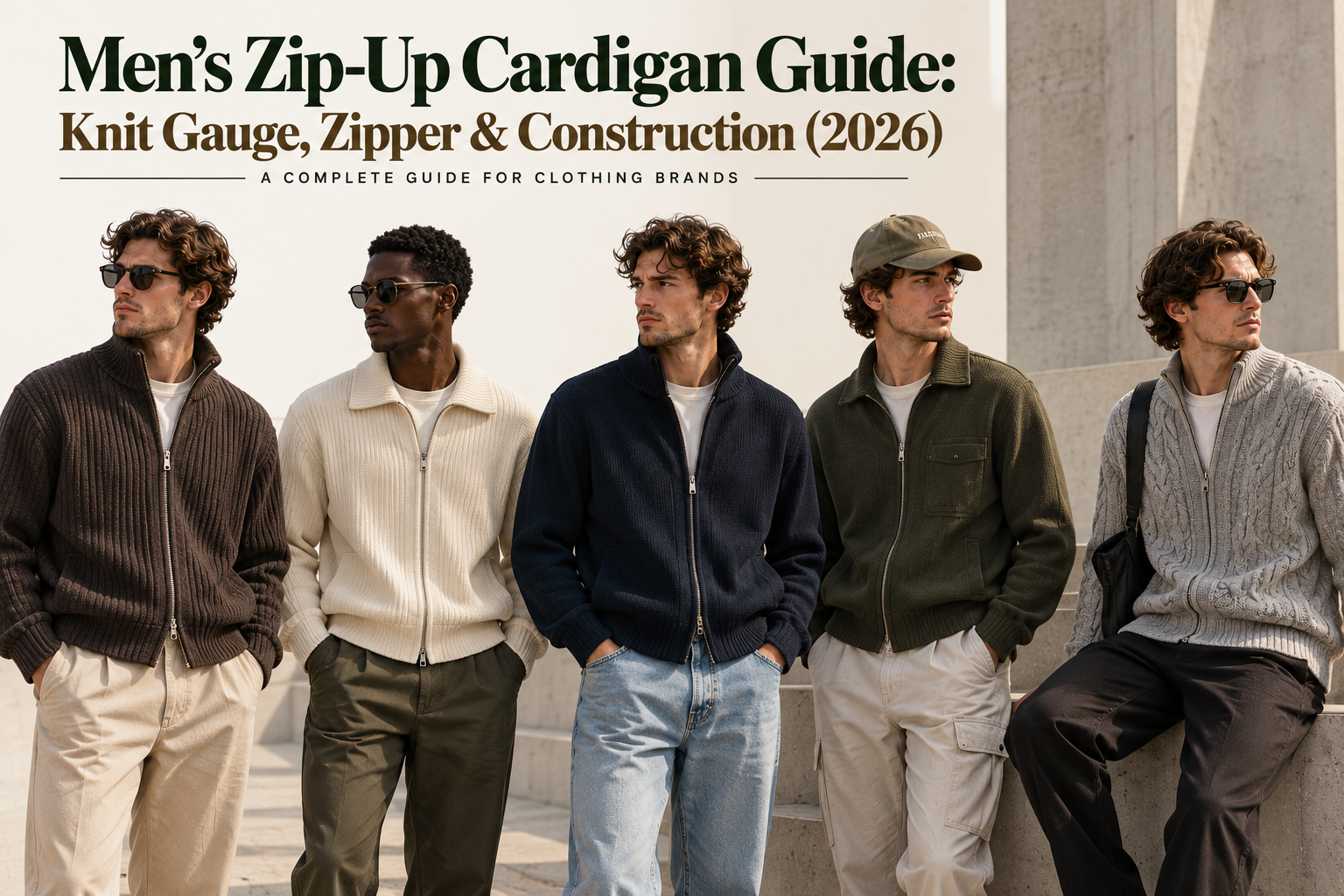
The men's zip-up cardigan is becoming one of the clearest knitwear directions of 2026.
Instead of the traditional button-front cardigan, the modern version uses a full center-front zipper and often combines:
- Relaxed knitwear proportions
- Ribbed cuffs and hem
- Funnel, mock or shirt-style collars
- Full-length metal or molded zippers
- Two-way zipper options
- Merino wool, cotton or blended yarns
- Textured rib, cable or Milano structures
The result sits somewhere between:
cardigan + sweater + lightweight jacket
But manufacturing a good zip-up cardigan is more complicated than simply adding a zipper to a knitted sweater.
The final garment depends on the relationship between:
yarn + machine gauge + stitch structure + body weight + rib tension + zipper length + zipper tape + front-edge stability + garment finishing
If the zipper area stretches during sewing, the front may become wavy.
If the knit shrinks more than the zipper after washing, the zipper can buckle.
If the hem rib is too tight, the cardigan may balloon above the waistband.
And if a heavy metal zipper is used on a very lightweight knit, the center front can collapse.
For clothing brands, the zipper and knit structure should therefore be developed together from the beginning.
What Is a Zip-Up Cardigan?
A zip-up cardigan is a knitted upper-body garment with a full-length center-front zipper.
Unlike a pullover sweater, the front opens completely.
Unlike a traditional cardigan, the front closure is normally:
- One-way zipper
- Two-way zipper
rather than buttons.
Common modern features include:
- Full front zip
- Long sleeves
- Ribbed cuffs
- Ribbed or knitted hem
- Funnel collar
- Mock neck
- Polo-style collar
- Regular or relaxed body
- Side pockets
- Textured knit structures
The garment may be produced using:
- Fully fashioned knitwear
- Knitted-to-shape panels
- Cut-and-sew knitted fabric
These production methods should not automatically be treated as the same.
Why Zip-Up Cardigans Are Different From Quarter-Zips
A quarter-zip sweater or sweatshirt only opens through the upper chest.
A full-zip cardigan opens from:
neckline to hem
This changes the entire front construction.
| Feature | Full-Zip Cardigan | Quarter-Zip |
|---|---|---|
| Zipper Length | Full center front | Upper chest only |
| Front Opening | Fully opens | Partial opening |
| Front Stability | Critical along entire body | Mainly placket area |
| Bottom Zipper Alignment | Important | Not applicable |
| Two-Way Zip | Common option | Rare |
| Layering | Can be worn fully open | Usually pullover |
| Manufacturing Risk | Front waviness, hem mismatch | Placket distortion |
This is why a full-zip cardigan should not simply reuse a quarter-zip pattern.
Zip-Up Cardigan vs Other Knitwear
| Style | Closure | Main Identity | Typical Construction |
|---|---|---|---|
| Zip-Up Cardigan | Full zipper | Knitwear + jacket hybrid | Knitted panels / full zip |
| Button Cardigan | Buttons | Traditional cardigan | Knitted front bands |
| Quarter-Zip Sweater | Partial zipper | Pullover knit | Short zipper placket |
| Zip Hoodie | Full zipper | Casual / sportswear | Jersey, fleece or knit |
| Knit Jacket | Varies | More structured knit outerwear | Dense knit / lining possible |
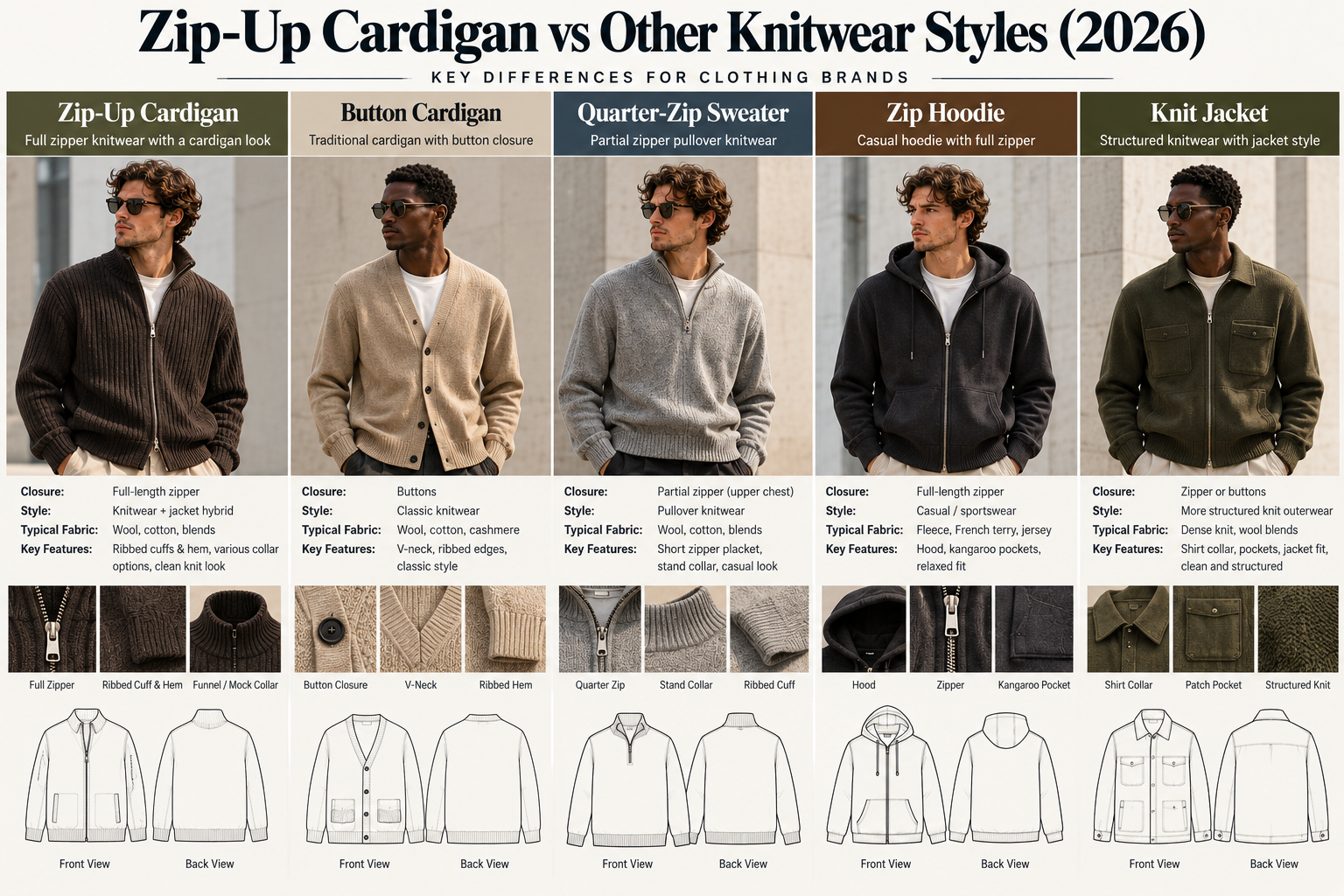
The most important distinction is that the zip-up cardigan remains primarily a knitwear product.
Its structure should come from:
- Yarn
- Knit stitch
- rib
- knitted shaping
rather than simply copying the construction of a woven jacket.
Fully Fashioned vs Cut-and-Sew Knit Construction
There are two major ways a knit cardigan may be developed.
Fully Fashioned / Knitted-to-Shape
Individual garment panels are knitted close to their final shape.
Typical components include:
- Front panels
- Back panel
- Sleeves
- Collar
- Rib components
The panels are then assembled using linking or appropriate knitwear seaming.
Advantages can include:
- Cleaner knitwear construction
- Reduced cutting waste
- Better control of knitted shaping
- Premium sweater appearance
Cut-and-Sew Knit
A knitted fabric may also be produced in larger yardage and then:
- Spread
- Cut
- Sewn
more like conventional apparel.
This approach may be useful for:
- Jersey knits
- Sweater-look fabrics
- Certain rib structures
- Fashion knitwear
However, cut edges may require more stabilization and finishing.
Why the Production Method Matters
A fully fashioned cardigan and a cut-and-sew knit cardigan can look similar in photos.
But they behave differently during:
- Pattern development
- Seaming
- Zipper installation
- Rib attachment
- Grading
- Finishing
Brands should therefore confirm the intended manufacturing method before sampling.
Knit Gauge
Gauge is one of the most important specifications in sweater development.
It generally refers to the needle density of the knitting machine.
In simple terms:
lower gauge → coarser knit
higher gauge → finer knit
But gauge should never be considered alone.
The final appearance also depends on:
- Yarn count
- Yarn thickness
- Fiber
- Stitch structure
- Machine setting
- Knitting tension
Example Gauge Directions
The exact capability varies by factory and knitting system, but a broad design reference can be:
| Knit Direction | Example Gauge Range | Typical Appearance |
|---|---|---|
| Chunky Knit | 3–5 gauge | Thick, visible loops |
| Medium Knit | 7–9 gauge | Balanced sweater structure |
| Fine Knit | 12–14+ gauge | Cleaner, lighter surface |
These are general development references rather than universal manufacturing rules.
A 7-gauge cardigan can still feel very different depending on the selected yarn and stitch.
Chunky Zip-Up Cardigan
A chunky cardigan can create:
- Strong texture
- Heavy winter appearance
- Visible rib
- Oversized silhouette
Common design directions include:
- Large rib structures
- Cable knit
- Wool blends
- Relaxed fit
- Heavy metal zipper
However, the zipper installation becomes more difficult when the knitted front edge is thick.
The factory may need to control:
- Front-edge thickness
- Zipper tape width
- Sewing method
- Internal reinforcement
Medium-Gauge Zip Cardigan
Medium gauge is a versatile direction for:
- Everyday knitwear
- Premium casualwear
- Relaxed menswear
- Transitional layering
It can support:
- Merino wool
- Cotton
- Wool blends
- Acrylic blends
and works well with:
- Funnel collars
- Regular collars
- Rib hems
- Two-way zippers
Fine-Gauge Zip Cardigan
Fine-gauge knitwear creates a cleaner and more refined appearance.
It can work for:
- Smart casualwear
- Office collections
- Lightweight layering
- Minimal menswear
But lightweight knitwear requires careful zipper selection.
A heavy zipper may overpower the fabric.
Yarn Selection
The yarn influences:
- Hand feel
- warmth
- drape
- recovery
- pilling
- wash behavior
- zipper support
Common options include:
- Merino wool
- Lambswool
- Cotton
- Cotton blends
- Wool / nylon
- Wool / acrylic
- Viscose blends
- Cashmere blends
- Recycled fibers
Merino Wool
Merino can create:
- Soft hand feel
- refined surface
- good temperature regulation
- premium positioning
Possible zip-cardigan directions include:
- Fine-gauge merino cardigan
- Rib-knit cardigan
- Milano-knit cardigan
- Funnel-neck full zip
The final garment should still be tested for:
- Pilling
- shrinkage
- dimensional stability
Cotton Knit
Cotton can create a cleaner and more casual cardigan.
Advantages include:
- Familiar hand feel
- lower wool sensitivity
- strong spring / autumn use
- good color options
But cotton knit can be relatively heavy and may grow depending on the stitch structure.
This matters around the zipper.
Wool Blends
Blending wool with fibers such as:
- Nylon
- acrylic
- polyester
can change:
- Durability
- recovery
- cost
- softness
- pilling behavior
The composition should be chosen around the intended product rather than only price.
Cashmere Blends
Cashmere can provide:
- Softer touch
- premium appearance
- lighter warmth
But high-end fibers do not automatically solve construction problems.
A premium cardigan with poor zipper installation will still look low quality.
Stitch Structure
A zip-up cardigan can be made with many different knitted structures.
Common options include:
- Jersey knit
- Rib knit
- Milano knit
- Half-cardigan stitch
- Full-cardigan stitch
- Cable knit
- Moss stitch
- Textured knit
- Jacquard knit
Each structure behaves differently.
Jersey Knit
Jersey creates a relatively smooth surface.
It works well for:
- Fine-gauge cardigans
- Minimal designs
- Lightweight products
However, the edges can curl depending on construction.
This should be considered around the center front.
Rib Knit
Rib provides:
- Stretch
- recovery
- strong vertical texture
It is commonly used for:
- Cuffs
- hem
- collar
Some modern zip cardigans also use rib across the entire body.
Milano Knit
Milano-style structures can create:
- More stability
- smoother surface
- structured hand feel
This can work especially well for cardigan-jacket hybrids.
A stable front edge can also make zipper installation easier than very loose structures.
Cable Knit
Cable structures create strong texture and visual interest.
But cable placement must be planned carefully.
The left and right fronts should usually remain visually balanced around the zipper.
Cable Placement Around the Zipper
If a cable pattern runs too close to the center front, zipper attachment may distort the pattern.
Useful planning may include:
- Plain knit zipper zone
- Rib zipper zone
- Reduced cable width near front edge
The knit program should account for the zipper before production.
The Center-Front Zipper
The zipper is the most important trim on this garment.
Common options include:
- Metal zipper
- Coil zipper
- Molded plastic zipper
- One-way zipper
- Two-way zipper
The choice changes both:
- Appearance
- Performance
One-Way vs Two-Way Zipper
One-Way Zipper
Opens from the top downward.
It provides:
- Simpler operation
- Lower component complexity
- Classic appearance
Two-Way Zipper
A two-way zipper can open:
- From the top
- From the bottom
This is particularly useful on modern relaxed cardigans.
Opening the bottom can:
- Reduce sitting tension
- Create styling flexibility
- Change the silhouette
Two-way zippers are therefore increasingly common on knitwear that sits between a sweater and jacket.
Metal Zipper
Metal zippers can create:
- Premium appearance
- Strong visual contrast
- Heritage styling
Possible finishes include:
- Silver
- Gunmetal
- Antique brass
- Matte black
However, metal zippers can be heavy.
The zipper weight should suit the knitted body.
Coil Zipper
Coil zippers are usually:
- Lighter
- more flexible
- less visually dominant
This can make them suitable for:
- Fine knitwear
- minimalist designs
- lightweight cardigans
Zipper Tape
Zipper tape is often overlooked.
But the tape interacts directly with the knit.
Important factors include:
- Width
- stiffness
- color
- shrinkage
- sewing compatibility
The zipper tape should not be dramatically more rigid than the knitted front.
Why Zip-Up Cardigans Become Wavy
One of the most common defects is a wavy center-front zipper.
Possible causes include:
- Knit stretching during sewing
- Zipper tape feeding differently from the knit
- Incorrect front length
- Poor stabilization
- Steam or wash shrinkage differences
- Excessive sewing tension
This is not only a zipper-quality problem.
It is usually a:
knit + zipper + sewing process problem
Stabilizing the Front Edge
The center front often needs additional stability before zipper installation.
Possible methods include:
- Knitted reinforcement
- Internal tape
- Stay tape
- Lightweight woven support
- Controlled front-edge structure
The correct method depends on:
- Yarn
- Gauge
- stitch
- zipper weight
Too much reinforcement can make the front unnaturally stiff.
Too little can create waves.
Zipper Length
The zipper length should match the finished cardigan length, not an estimated unfinished panel length.
Important references include:
- Top collar position
- Bottom hem position
- Rib height
- zipper stop position
A zipper that is even slightly too long can create bubbling.
A zipper that is too short can pull the garment upward.
Bottom Zipper Alignment
The bottom stop should align accurately with:
- Hem
- waistband
- rib
Left and right fronts should meet evenly.
Misalignment becomes very visible when the cardigan is fully zipped.
Collar Options
Modern zip-up cardigans commonly use:
- Funnel neck
- Mock neck
- Stand collar
- Polo-style collar
- Shirt collar
- Simple round neck
The collar changes the garment's identity dramatically.
Funnel-Neck Zip Cardigan
A funnel collar creates a strong contemporary knitwear direction.
The collar can be worn:
- Fully zipped
- Partially open
- Folded or relaxed
depending on construction.
Important measurements include:
- Collar height
- Neck opening
- zipper extension
- collar circumference
Polo-Collar Zip Cardigan
A polo-style collar can create:
- Retro sportswear
- smart casual
- preppy styling
The collar needs enough stability so it does not collapse beside the zipper.
Shirt-Collar Zip Cardigan
A knitted shirt collar creates a hybrid between:
- Cardigan
- polo
- lightweight jacket
This works particularly well in:
- Milano knit
- structured cotton knit
- merino blends
Cuffs
Common cuff structures include:
- 1×1 rib
- 2×2 rib
- fine rib
- wide rib
The cuff should provide enough recovery without becoming excessively tight.
Hem Rib
The hem rib controls the lower silhouette.
A tight hem creates:
- Blouson effect
- fuller upper body
A relaxed hem creates:
- Straighter silhouette
- jacket-like appearance
Why Hem Rib Tension Matters
If the hem is too tight:
- The body may balloon
- Zipper bottom may distort
- Side seams may pull inward
If the hem is too loose:
- The garment may look stretched
- Recovery can become weak
The hem should be developed together with the body width.
Full-Zip Cardigan Fit
Popular fit directions include:
- Slim
- Regular
- Relaxed
- Boxy
- Oversized
- Cropped
Regular Fit
Typical characteristics:
- Natural shoulder
- Moderate chest ease
- Straight body
- Controlled sleeve
This works well for fine and medium gauge knitwear.
Relaxed Fit
A relaxed cardigan may use:
- Wider chest
- slightly extended shoulder
- larger sleeve
- straighter hem
This is one of the strongest contemporary directions.
Boxy Zip Cardigan
A boxy version combines:
- Wider chest
- controlled body length
- wider sleeve
- relatively straight hem
The zipper must remain vertical and flat despite the increased body width.
Oversized Does Not Mean Sizing Up
Simply increasing every measurement can create:
- Excessive body length
- Sleeve too long
- Collar too large
- Zipper too long
- Pockets too low
Instead, control:
- Chest
- shoulder
- sleeve
- body length
- zipper length
separately.
Pocket Options
Zip-up cardigans may include:
- No pockets
- Patch pockets
- Welt pockets
- Side-entry pockets
- Hidden seam pockets
Pockets add weight and can distort lightweight knitwear.
Patch Pockets
Knitted patch pockets can work well on:
- chunky cardigans
- heritage styles
- relaxed knitwear
Pocket size should remain proportionate to the body.
Welt Pockets
Welt pockets create a cleaner appearance.
However, they may require:
- reinforcement
- precise opening stabilization
- careful pocket-bag control
Loose knit structures can be difficult around welt openings.
Pocket Bags
Pocket bags may use:
- knitted fabric
- woven lining
- jersey
- lightweight tricot
The material should not create excessive bulk.
Zip-Up Cardigan Anatomy & Pattern Development
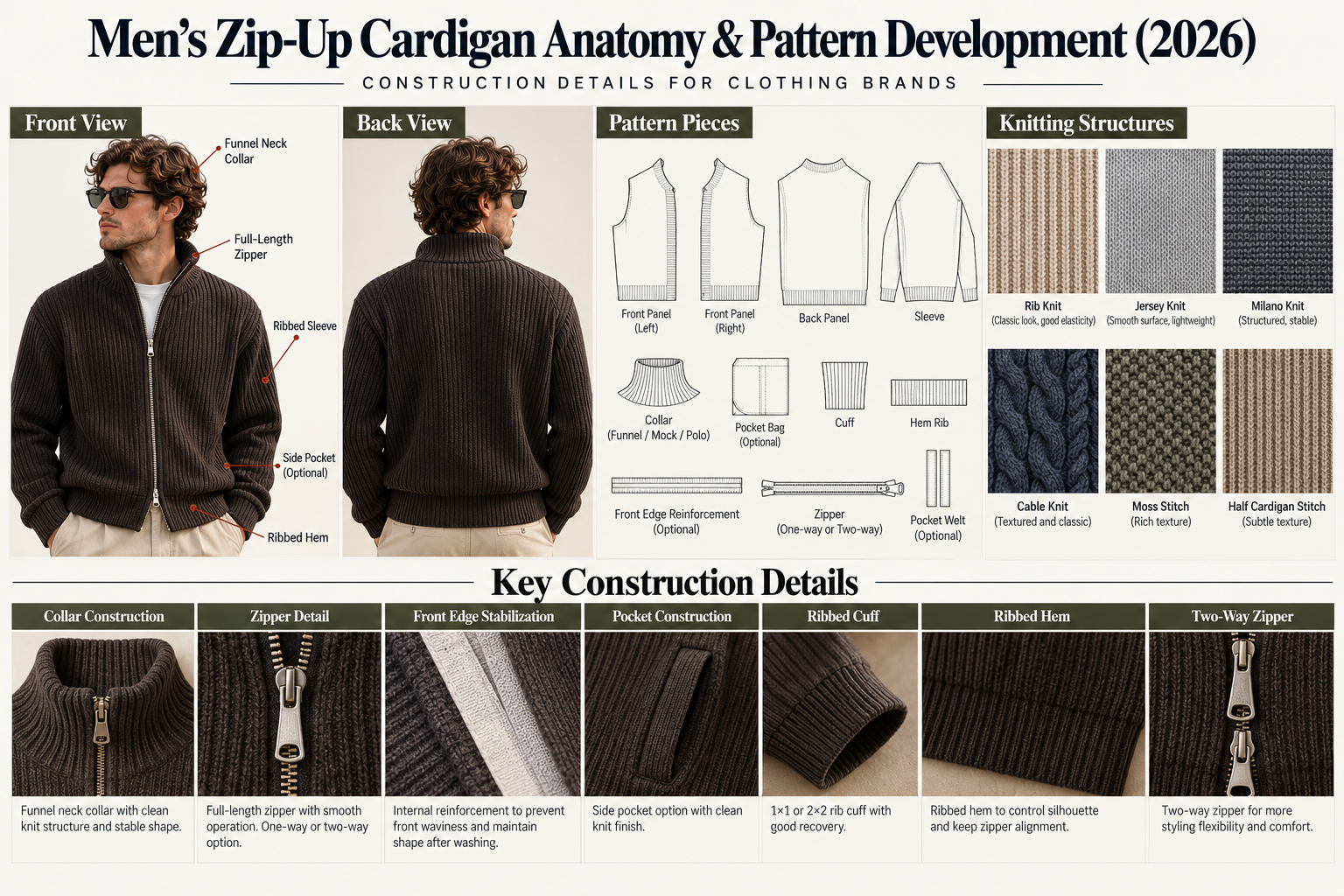
A full-zip cardigan development may include:
- Left front panel
- Right front panel
- Back panel
- Sleeves
- Collar
- Cuffs
- Hem rib
- Pocket components
- Front-edge reinforcement
- Zipper
If fully fashioned, these may be knitted as shaped components rather than conventional cut paper-pattern pieces.
Knit Panel Development
For knitted-to-shape production, specifications should include:
- Finished body width
- finished length
- shoulder
- armhole
- sleeve length
- sleeve width
- neck opening
- collar height
The knit technician then translates those finished requirements into:
- needle count
- rows
- shaping
- stitch program
according to the yarn and machine.
Knitwear Measurements Can Change After Finishing
Knitted panels may change after:
- washing
- steaming
- pressing
- relaxation
This is why measurements should be confirmed after the approved finishing process.
Important Measurements
| Measurement | Why It Matters |
|---|---|
| Chest Width | Controls body volume |
| Body Length | Controls proportion and zipper length |
| Shoulder Width | Controls fit |
| Sleeve Length | Controls cuff position |
| Bicep Width | Controls movement |
| Hem Width | Controls lower silhouette |
| Collar Height | Controls neckline |
| Neck Opening | Controls comfort |
| Zipper Length | Must match finished front |
| Pocket Position | Controls front balance |
| Cuff Width | Controls wrist fit |
| Hem Rib Height | Controls proportion |
Knitwear Shrinkage
Knitted garments can change significantly after finishing.
Possible changes include:
- Body length
- width
- sleeve length
- rib tension
Fiber choice also matters.
Wool and cotton do not behave identically.
Wash Testing
Before bulk production, test:
- Yarn / knit structure
- finished garment
- zipper
- label
- pocket structure
using the intended care method.
Zipper and Knit Shrinkage Compatibility
One of the most important tests is whether:
knit body + zipper tape
remain compatible after finishing.
If the knit shrinks and the zipper does not, the zipper may wave.
If the zipper tape shrinks differently, the front may pull.
The completed sample should therefore be evaluated after the intended wash or finishing process.
Pilling
Pilling performance depends on:
- fiber
- yarn twist
- knit structure
- finishing
- wear
Soft yarn is not automatically better.
Very soft surfaces may sometimes pill more easily.
The yarn should be selected according to the target customer and price position.
Linking and Seaming
Fully fashioned knitwear is commonly assembled using linking or other specialized knitwear seaming methods.
The seam should:
- remain flexible
- follow the knit loops cleanly
- avoid excessive bulk
Poor seaming can create:
- hard ridges
- uneven shoulders
- restricted stretch
Shoulder Construction
Possible directions include:
- Standard shoulder
- Fully fashioned shoulder
- Raglan sleeve
- Drop shoulder
Raglan Zip Cardigan
Raglan sleeves create:
- softer shoulder shape
- increased visual continuity
- sporty or vintage appearance
The diagonal seam can also become part of the knit design.
Drop-Shoulder Cardigan
A drop shoulder creates:
- relaxed silhouette
- wider upper body
- contemporary proportion
Sleeve length must be adjusted because the shoulder extends farther outward.
Decoration Options
Knitwear decoration requires different planning from normal jersey garments.
Possible options include:
- Intarsia
- Jacquard
- Embroidery
- Patches
- Knit-in logos
Intarsia
Intarsia allows color blocks or graphics to be knitted into the garment.
It works well for:
- Large logos
- geometric designs
- varsity-inspired graphics
Jacquard
Jacquard knit can create:
- repeated motifs
- patterns
- logos
- all-over designs
The reverse-side construction and yarn floats should be considered during design.
Embroidery on Knitwear
Embroidery is possible but requires stabilization.
Dense embroidery on soft knitwear may:
- pull
- distort
- become stiff
Artwork density should match the fabric structure.
Knit-In Branding
Branding may also be integrated through:
- Jacquard logos
- Intarsia
- knitted stripes
- custom rib patterns
This can create a more premium result than adding a large surface print.
Zipper Pullers
The zipper pull can become an important branding area.
Options include:
- Standard metal puller
- Custom engraved puller
- Rubber puller
- Logo puller
The puller weight should remain appropriate for the knit.
For custom zipper and trim development, see Brad Apparel's Trims & Branding.
Two-Way Zipper Development
A two-way zipper requires extra attention.
Check:
- Bottom slider engagement
- Front alignment
- hem stability
- zipper tape stiffness
- slider movement
The user should be able to:
- zip upward normally
- open from the bottom
without excessive force.
Zip-Up Cardigan Manufacturing Process
A typical knitted-to-shape production route may include:
- Yarn confirmation
- Yarn color approval
- Knit structure development
- Gauge confirmation
- Knit swatch approval
- Shrinkage / finishing test
- Panel programming
- Panel knitting
- Panel inspection
- Linking / garment assembly
- Collar, cuff and hem assembly
- Pocket construction where required
- Center-front stabilization
- Zipper installation
- Finishing / washing
- Steaming and shaping
- Measurement inspection
- Zipper-function inspection
- Final QC
- Packing
The sequence may vary depending on:
- Construction method
- yarn
- stitch
- zipper
- finishing
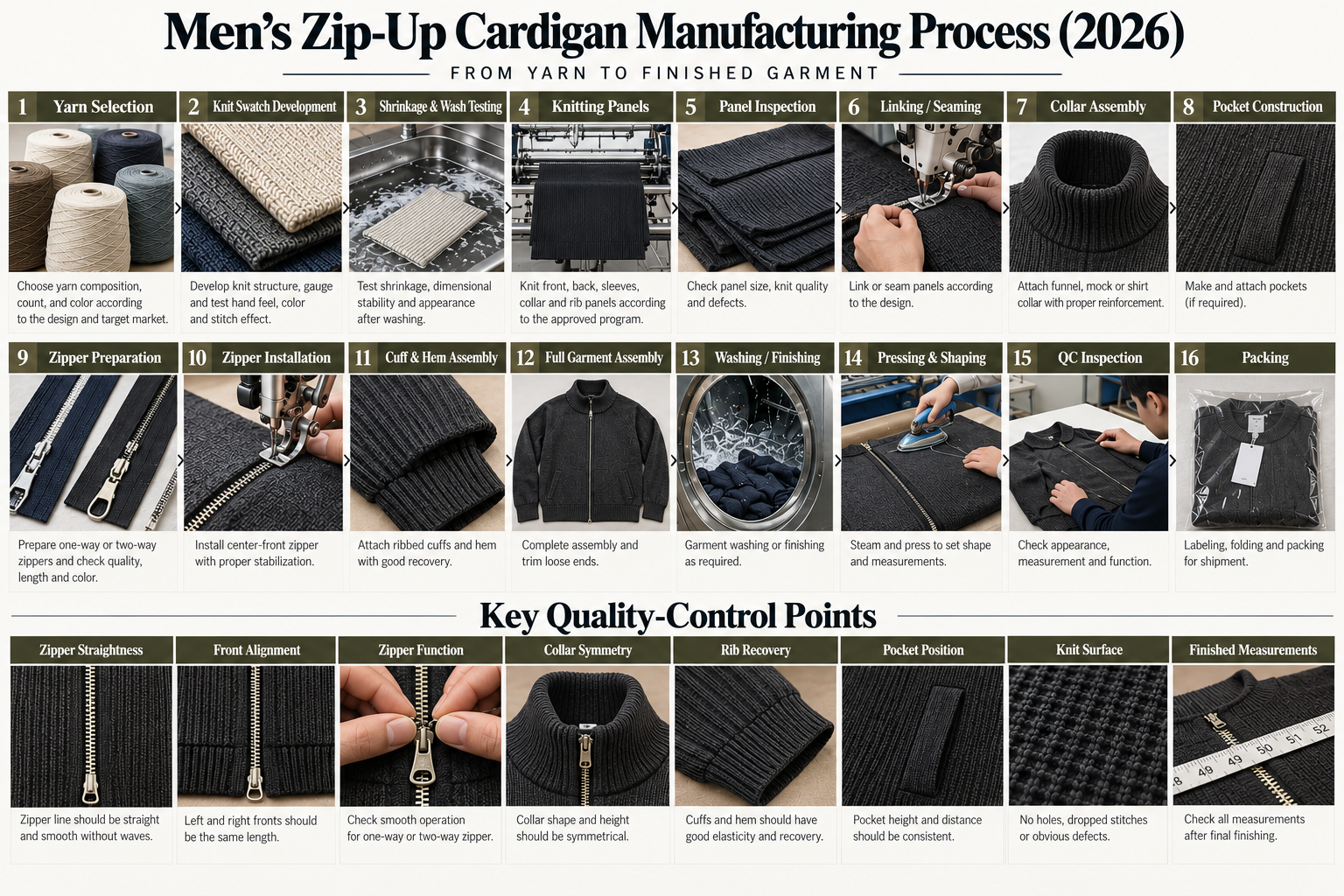
Key Quality-Control Points
Zipper Straightness
Lay the garment flat.
The center front should remain:
- straight
- smooth
- symmetrical
without visible waves.
Left and Right Front Length
The two front panels should finish evenly.
Unequal panel length can create:
- hem mismatch
- collar mismatch
- zipper twisting
Zipper Operation
Test the zipper repeatedly.
For two-way zippers, test:
- top opening
- bottom opening
- slider engagement
Collar Symmetry
Check both sides of the collar.
The zipper should meet the collar cleanly.
Rib Recovery
Check:
- cuffs
- hem
after stretching.
Poor recovery can make the garment look worn before use.
Sleeve Symmetry
Compare:
- Length
- width
- cuff
between left and right sleeves.
Knit Surface
Inspect for:
- dropped stitches
- holes
- yarn defects
- uneven tension
- contamination
Linking Quality
Seams should remain:
- clean
- flexible
- comfortable
Pocket Symmetry
If pockets are included, check:
- Height
- width
- distance from zipper
Finished Measurements
Measurements should be checked after final finishing.
Common Zip-Up Cardigan Production Problems
Wavy Zipper
This is one of the most common defects.
Possible causes:
- Front stretched during sewing
- Poor stabilization
- Length mismatch
- Different shrinkage
Zipper Bulging at the Bottom
Possible causes:
- Zipper too long
- Hem rib too tight
- Incorrect attachment tension
Uneven Collar at Zipper
One collar side finishes higher than the other.
Control: Confirm front-panel and collar symmetry before zipper installation.
Knit Stretching During Sewing
Soft knit structures can stretch under the sewing machine.
Control: Use appropriate stabilization and feeding methods.
Hem Ballooning
The body expands above an overly tight rib hem.
Control: Adjust rib tension and hem circumference.
Heavy Zipper Pulling the Front Down
A zipper that is too heavy can distort fine knitwear.
Control: Match zipper weight to garment structure.
Pocket Sagging
Large pockets on lightweight knit can stretch.
Control: Reduce pocket weight or increase reinforcement.
Zipper Tape Visible Unevenly
One side shows more tape than the other.
Control: Use consistent seam allowance and attachment position.
Puckering After Washing
Possible causes include:
- Knit shrinkage
- zipper tape mismatch
- sewing tension
Always test the completed garment.
Grading a Zip-Up Cardigan
Grading knitwear needs to preserve both fit and zipper balance.
Body Width
Increase according to the intended size range and fit.
Body Length
Control body-length growth carefully.
A short boxy cardigan should remain short and boxy in larger sizes.
Zipper Length by Size
If body length changes significantly, zipper length may also need to change.
Do not assume one zipper length can be used for every size.
Pocket Position
Pockets may need to move outward as chest width increases.
Collar
Neck opening changes through grading.
Collar dimensions need to remain compatible.
Example Full-Zip Cardigan Tech Pack
| Area | Example Specification |
|---|---|
| Product | Men's Full-Zip Cardigan |
| Fit | Relaxed |
| Construction | Knitted-to-Shape |
| Gauge | 7 Gauge |
| Yarn | Merino / Nylon Blend |
| Knit Structure | Milano / Rib Combination |
| Collar | Funnel Collar |
| Zipper | Two-Way Metal Zipper |
| Zipper Finish | Gunmetal |
| Shoulder | Slightly Dropped |
| Sleeve | Long Sleeve |
| Cuff | 2×2 Rib |
| Hem | 2×2 Rib |
| Pockets | Two Side Welt Pockets |
| Branding | Woven Neck Label |
| Finish | Washed / Steamed to Approved Measurement |
This is only an example.
The actual specification should follow:
- Yarn
- machine capability
- design
- target price
Example Fine-Gauge Merino Zip Cardigan
A cleaner premium version could use:
- 12–14 gauge
- fine merino yarn
- regular fit
- funnel neck
- lightweight two-way zipper
- fine rib cuffs
- straight or lightly ribbed hem
The zipper should remain relatively lightweight.
Example Chunky Zip Cardigan
A heavier version might use:
- 3–5 gauge
- wool blend
- oversized fit
- chunky rib
- wide collar
- heavy metal zipper
- patch pockets
Front-edge stabilization becomes especially important because of the thickness.
Example Rib-Knit Zip Cardigan
A contemporary version could use:
- Full rib body
- slim or regular fit
- two-way zipper
- mock neck
- clean cuffs
- tonal zipper
The rib structure naturally creates strong vertical texture.
Example Cable-Knit Zip Cardigan
Possible design:
- Relaxed body
- medium gauge
- cable front panels
- plain zipper zone
- rib collar
- metal zipper
The cable repeat should be balanced on the left and right fronts.
How to Describe a Zip-Up Cardigan to a Manufacturer
Avoid sending only:
I need a men's zip cardigan like this photo.
A better development brief would be:
Men's relaxed full-zip knitted cardigan in a 7-gauge merino-blend yarn, with a structured Milano-knit body, slightly dropped shoulders, funnel collar, two-way gunmetal zipper, 2×2 rib cuffs and hem, and two side welt pockets.
Then provide:
- Yarn composition
- yarn count if known
- gauge
- color
- stitch structure
- chest
- body length
- shoulder
- sleeve
- bicep
- collar height
- hem width
- pocket size
- pocket position
- zipper type
- zipper finish
- zipper direction
- branding
- care requirement
This gives the knitting and production teams a much clearer target.
Development Checklist
Before sampling, confirm:
- Full zip or partial zip
- One-way or two-way zipper
- Yarn
- Gauge
- Knit structure
- Fit
- Body length
- Shoulder
- Collar
- Cuffs
- Hem
- Pockets
- Zipper type
- Zipper finish
- Branding
- Finishing
Before bulk production, confirm:
- Approved yarn
- Approved color
- Knit swatch
- Gauge
- Stitch program
- Shrinkage
- Finished measurements
- Zipper sample
- Zipper wash compatibility
- Rib recovery
- Pocket construction
- Linking quality
- Final QC standard
FAQ
What Is a Zip-Up Cardigan?
A zip-up cardigan is a knitted garment with a full center-front zipper instead of the traditional button closure.
It can be worn:
- Fully open
- Partially zipped
- Fully closed
and often works as a sweater-jacket hybrid.
Is a Zip-Up Cardigan the Same as a Zip-Up Sweater?
The terms often overlap.
"Zip-up sweater" is a broader category that can include:
- Full-zip sweaters
- Half-zips
- Quarter-zips
A zip-up cardigan normally refers more specifically to a garment that opens fully down the front.
What Is a Zip-Through Cardigan?
A zip-through cardigan is another term for a full-zip cardigan.
The zipper runs through the full center front rather than stopping at the chest.
Are Zip-Up Cardigans Popular in 2026?
Yes.
Full-zip knitwear has become an important 2026 menswear direction, with modern versions using:
- Funnel necks
- Two-way zippers
- Rib structures
- Relaxed proportions
- Textured yarns
What Gauge Is Best for a Zip-Up Cardigan?
There is no single best gauge.
The correct gauge depends on:
- Yarn
- season
- stitch structure
- desired weight
- appearance
Broadly:
- Lower gauge creates chunkier knitwear
- Higher gauge creates finer knitwear
What Is the Best Yarn for a Zip Cardigan?
Common options include:
- Merino wool
- Cotton
- Wool blends
- Cashmere blends
- Synthetic blends
The choice depends on:
- Price
- softness
- durability
- warmth
- care requirements
Why Does the Zipper Wave on a Knit Cardigan?
Common causes include:
- Stretching during sewing
- Incorrect zipper length
- insufficient stabilization
- shrinkage differences between knit and zipper tape
The complete garment should be tested after finishing.
Should a Knit Cardigan Use a Two-Way Zipper?
It is optional.
A two-way zipper can provide:
- more styling flexibility
- easier sitting
- less tension around the hem
It is particularly useful for longer or relaxed-fit cardigans.
Can You Add Pockets to a Zip-Up Cardigan?
Yes.
Options include:
- Patch pockets
- Welt pockets
- side-entry pockets
The pocket weight and reinforcement need to suit the knit structure.
Can Zip-Up Cardigans Have Custom Zippers?
Yes.
Brands can customize:
- Zipper finish
- Puller
- color
- logo
- one-way / two-way construction
The zipper should be tested with the actual knit.
Can You Embroider a Knitted Cardigan?
Yes.
But soft knit structures may require stabilization.
Dense embroidery should be tested to avoid:
- puckering
- distortion
- excessive stiffness
What Should Be Checked During Zip-Cardigan QC?
Key checks include:
- Zipper straightness
- Zipper operation
- Left / right front length
- Collar symmetry
- Rib recovery
- Sleeve symmetry
- Knit defects
- Linking quality
- Pocket position
- Finished measurements
What Is the Difference Between a Zip Cardigan and a Quarter-Zip Sweater?
A zip cardigan opens fully from neckline to hem.
A quarter-zip sweater only opens through the upper chest and is still fundamentally a pullover.
The full-length zipper changes:
- Pattern balance
- front reinforcement
- zipper length control
- hem construction
significantly.
Final Thoughts
The modern zip-up cardigan looks simple:
knit body + full zipper
But a successful product depends on much more than those two elements.
The most important relationship is:
yarn + gauge + stitch structure + front stability + zipper + rib tension + finishing
A fine-gauge merino cardigan may need a lightweight zipper and subtle stabilization.
A chunky wool cardigan may need:
- stronger front support
- larger zipper
- thicker rib
A relaxed contemporary cardigan may benefit from a two-way zipper so the garment can open from the hem.
And a cable-knit version needs the pattern repeat planned around the center front before knitting begins.
For clothing brands, the zipper should therefore never be treated as a trim added at the end.
It is part of the garment architecture.
The strongest zip-up cardigans are developed as one complete system:
yarn + knit structure + fit + zipper + rib + pockets + finishing + QC.
Keep Reading