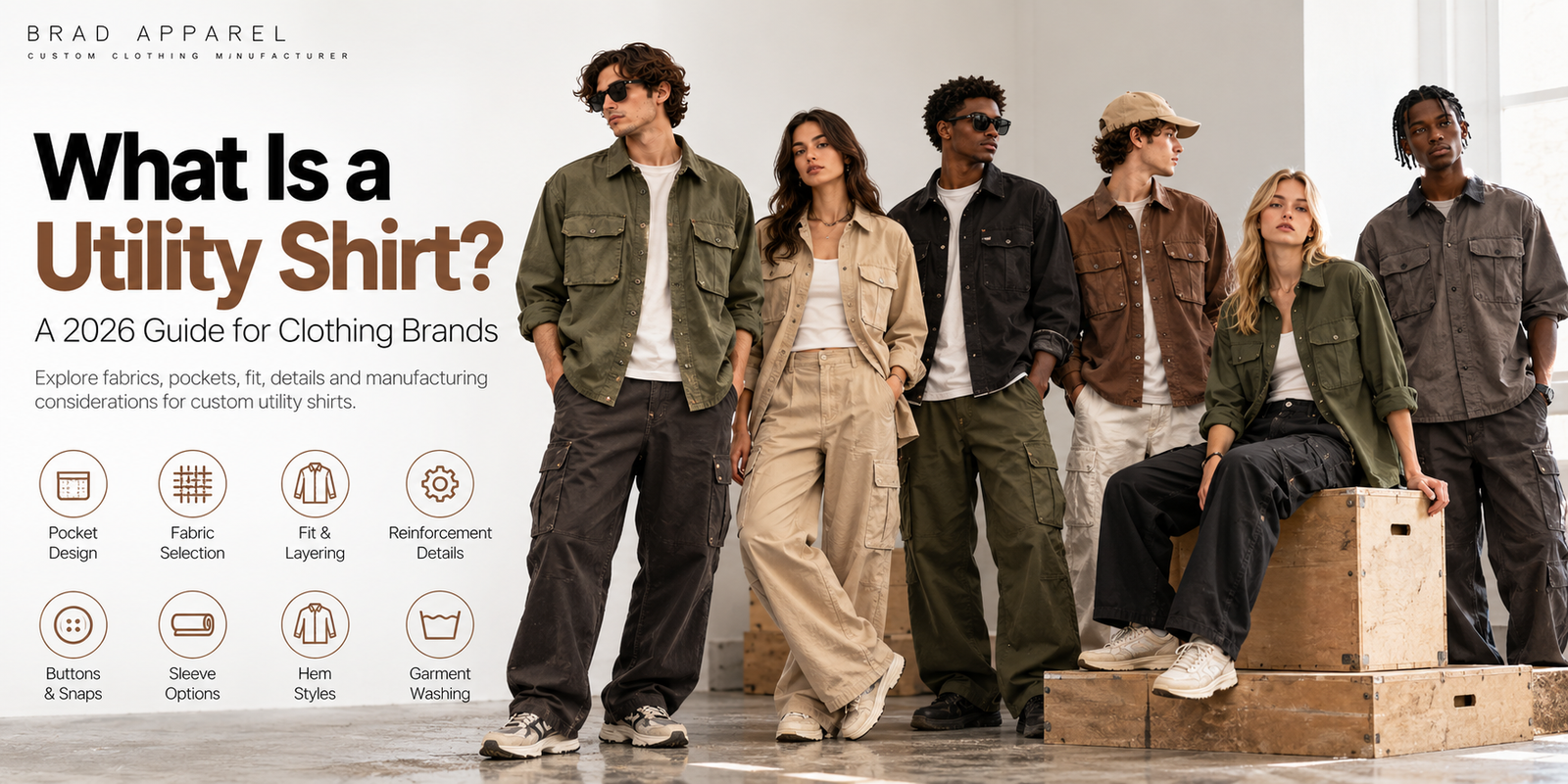
The utility shirt is moving beyond traditional workwear.
Modern versions now appear across:
- Streetwear
- Contemporary menswear
- Workwear-inspired collections
- Travel clothing
- Minimal casualwear
- Safari-inspired fashion
- Overshirt programs
The design is recognizable because function becomes part of the visual language.
Chest pockets, reinforced seams, durable woven fabrics, button or snap closures and practical details can make a relatively simple shirt feel highly distinctive.
But developing a good utility shirt is not simply a matter of adding more pockets.
The finished garment depends on how the:
Fabric
Fit
Pocket construction
Reinforcement
Closure
Sleeve
Hem
and
Finishing
work together.
This guide explains what defines a utility shirt and what clothing brands should consider before developing one for production.
What Is a Utility Shirt?
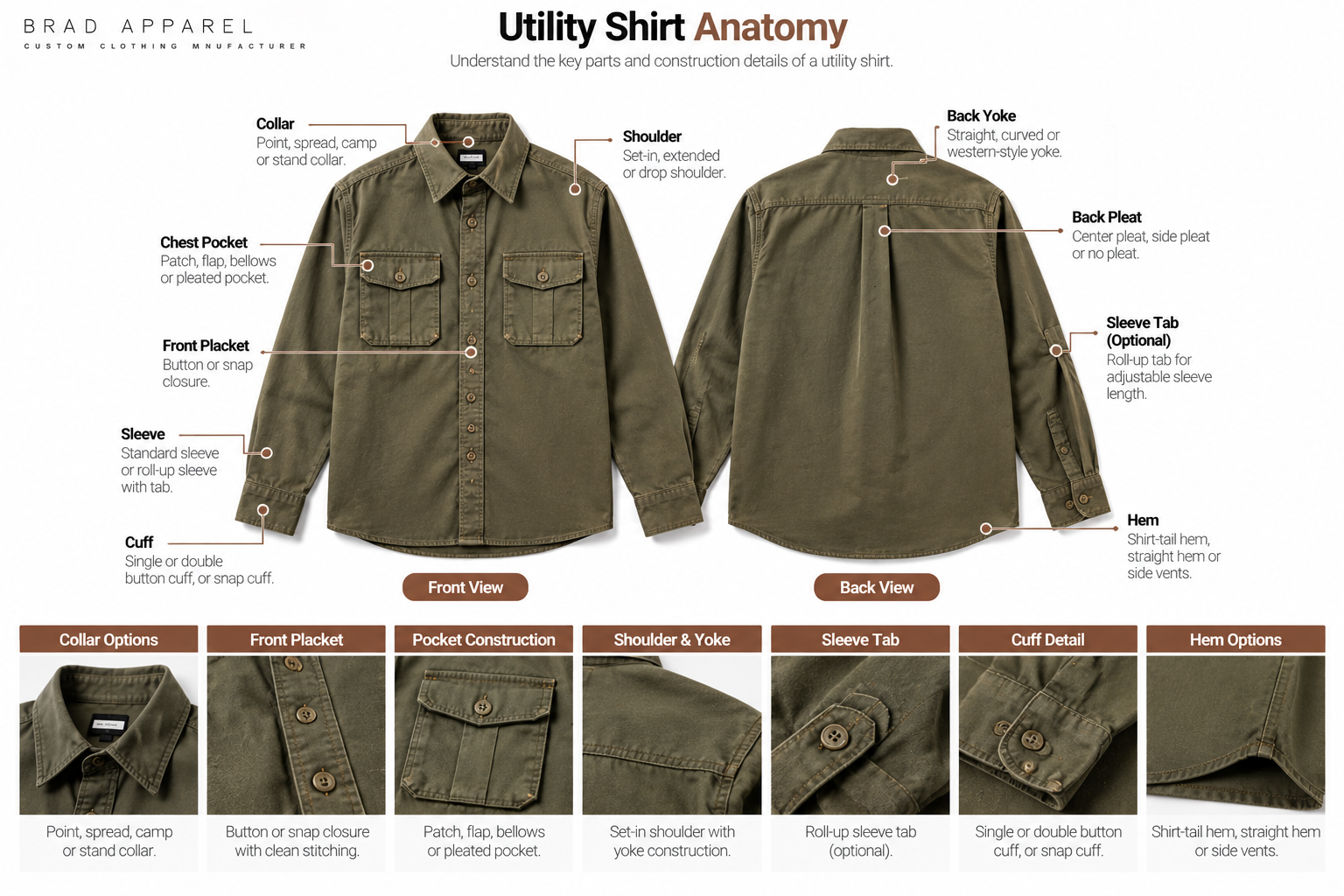
A utility shirt is generally a woven shirt influenced by:
- Workwear
- Military clothing
- Field uniforms
- Safari clothing
- Outdoor apparel
Common design details may include:
- One or more chest pockets
- Pocket flaps
- Button or snap closures
- Structured collar
- Durable woven fabric
- Reinforced stitching
- Straight or shirt-tail hem
- Adjustable cuffs
- Back yoke
- Sleeve roll-up tabs
- Utility loops or small attachment details
Not every utility shirt uses all of these elements.
The category is better understood as a functional design direction rather than one fixed garment specification.
Why Are Utility Shirts Relevant in 2026?
Utility-inspired clothing works well with several current fashion directions:
- Earth-tone palettes
- Heritage workwear
- Outdoor-inspired styling
- Relaxed menswear
- Functional details
- Khaki and brown
- Layering
- Refined casualwear
The utility shirt is especially flexible because it can sit somewhere between:
a normal shirt
and
a lightweight jacket.
A lighter version may be worn like conventional shirting.
A heavier version can function more like an overshirt.
For clothing brands, that creates several product opportunities without changing the basic design language.
Utility Shirt vs Work Shirt vs Overshirt vs Safari Shirt

These names frequently overlap.
There is no universal rule separating every product, but they often emphasize different characteristics.
| Style | Common Direction | Typical Construction |
|---|---|---|
| Utility Shirt | Functional / military / outdoor-inspired | Practical pockets and woven construction |
| Work Shirt | Traditional workwear | Durable fabric and straightforward construction |
| Overshirt | Layering | More body and armhole ease |
| Safari Shirt | Explorer-inspired | Chest pockets, earth tones and lightweight woven fabrics |
| Field Shirt | Military / outdoor | Functional details and structured woven fabric |
For manufacturing, the product name is less important than the actual:
- Measurements
- Fabric
- Pocket specification
- Closure
- Intended base layer
- Construction details
Pockets Are the Most Important Visual Feature

Utility shirts often use the pocket as both:
function
and
design.
Possible pocket types include:
- Patch pockets
- Flap pockets
- Bellows pockets
- Pleated pockets
- Zipper pockets
- Hidden pockets
- Combination pockets
Each changes both appearance and manufacturing complexity.
Simple Patch Pocket
A basic patch pocket is sewn directly onto the shirt body.
Advantages include:
- Clean construction
- Easy access
- Lower bulk
- Flexible sizing
It works well for minimal utility shirts where function should not dominate the entire garment.
Flap Pocket
A flap adds:
- More visual structure
- Additional coverage
- Space for snaps or buttons
Possible closures include:
- Button
- Snap
- Hidden snap
- No closure
The flap should remain proportionate to the pocket.
An oversized flap on a small pocket can make the front look visually heavy.
Bellows Pocket
A bellows pocket adds additional volume through folded side sections.
This can create:
- Stronger utility styling
- More dimensional construction
- Increased pocket capacity
But it also adds:
- Fabric
- Sewing operations
- Thickness
- Production time
The fold depth should therefore be defined in the tech pack.
Pleated Pocket
A central or inverted pleat can provide controlled additional volume.
Compared with a full bellows pocket, the result may feel:
- Cleaner
- Less bulky
- More fashion-oriented
The pleat should lie flat when the pocket is empty.
Pocket Position Changes the Entire Shirt
Two identical pockets can look completely different depending on placement.
Important dimensions include:
- Distance from center front
- Distance from shoulder
- Pocket height
- Pocket width
- Left/right spacing
If pockets sit too low:
the torso may look visually long.
If they sit too high:
the chest can look crowded.
Pocket position should therefore be approved on the actual garment rather than from artwork alone.
Pocket Scale Should Match the Fit
A regular-fit utility shirt may use relatively compact pockets.
An oversized shirt may require larger pockets to maintain visual balance.
Otherwise:
large body + small pocket
can make the pocket look accidentally undersized.
The pocket should be developed together with the body pattern.
Pocket Weight Matters
A heavy pocket construction on lightweight fabric can pull the shirt front downward.
This is especially relevant when using:
- Heavy snaps
- Metal hardware
- Multiple fabric layers
- Bellows construction
- Embroidery patches
The base fabric needs enough stability for the intended pocket design.
Reinforcement Should Be Applied Where It Is Needed
Utility clothing often uses visible reinforcement.
But adding reinforcement everywhere can make a shirt unnecessarily stiff.
Common stress points include:
- Pocket corners
- Sleeve placket
- Cuff attachment
- Side seam
- Button or snap areas
- Utility loops
Possible reinforcement methods include:
- Bartacks
- Additional stitching
- Internal reinforcement
- Interfacing
- Backing fabric
The correct method depends on the actual fabric and component.
Bartacks
Bartacks are short, dense reinforcement stitches commonly used at stress points.
They may be useful at:
- Pocket openings
- Pocket corners
- Belt or utility loops
- Sleeve-placket openings
Bartacks can also become a visual detail.
For example:
tonal thread
creates a subtle result.
Contrast thread
creates a more workwear-driven appearance.
Fabric Defines the Character of the Utility Shirt
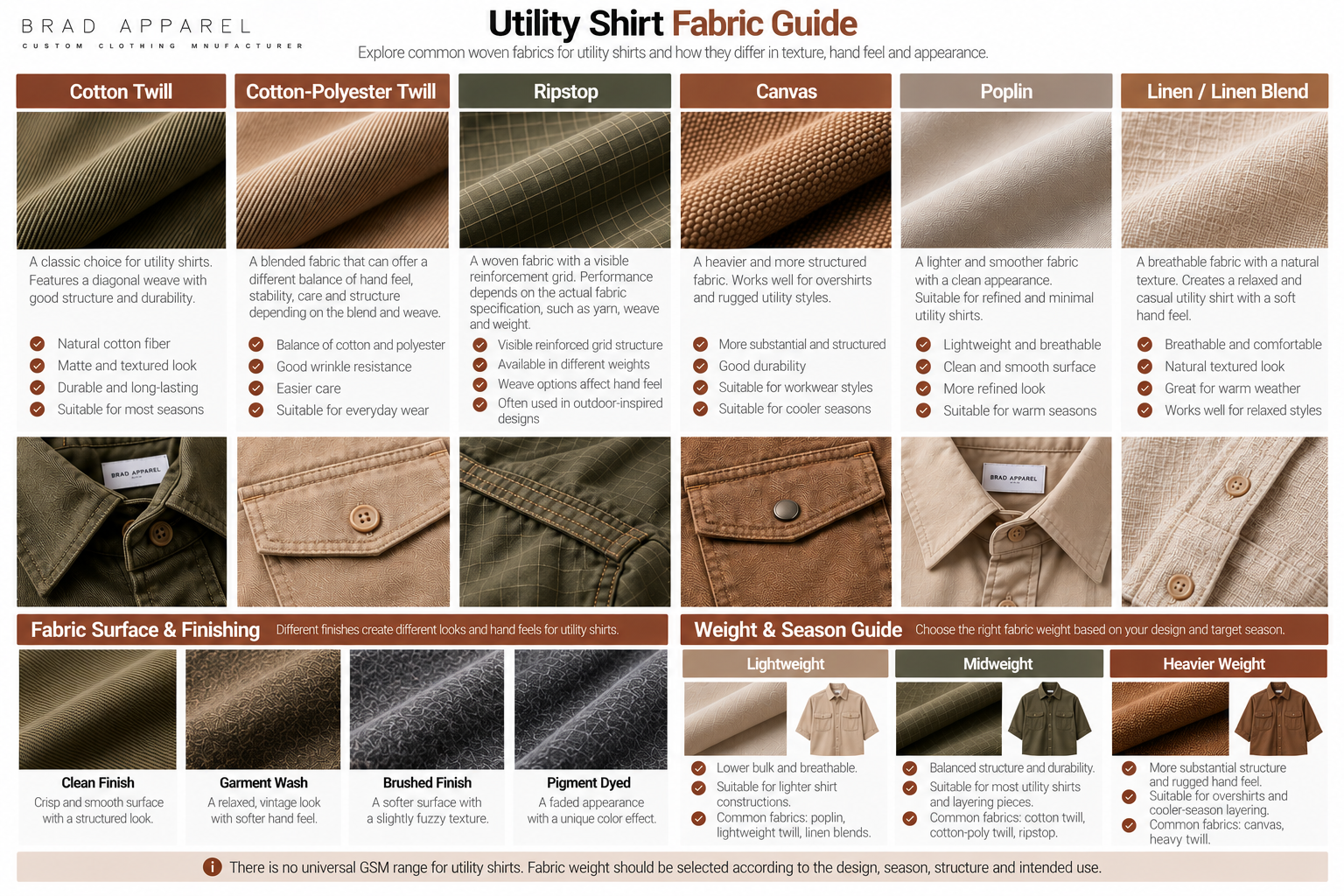
The same pattern can feel completely different depending on fabric.
There is no single mandatory utility-shirt fabric.
Cotton Twill
Cotton twill is one of the most natural directions for a utility shirt.
It can provide:
- Visible diagonal weave
- Clean structure
- Matte appearance
- Workwear character
Different twills can range from:
- Lightweight
- Soft
- Dense
- Structured
The actual fabric should therefore be selected by physical hand feel and garment purpose rather than fiber name alone.
Cotton-Polyester Twill
Blended twill can be useful when a brand wants a different balance of:
- Hand feel
- Stability
- Care
- Structure
The final behavior depends on the exact blend and weave.
The composition alone does not determine the finished quality.
Ripstop
Ripstop fabric contains a visible reinforcement grid in the woven structure.
That grid creates a more technical or military-inspired appearance.
It can work well for:
- Utility shirts
- Field shirts
- Lightweight overshirts
- Outdoor-inspired collections
However, the presence of the grid alone does not define the fabric's complete durability or weather performance.
Those characteristics should be confirmed from the actual textile specification.
Canvas
Canvas can create a heavier and more structured interpretation.
It may work well for:
- Overshirts
- Workwear
- Structured utility tops
- Cooler-season layering
But heavy fabric increases bulk around:
- Pockets
- Collar
- Cuffs
- Placket
The pattern and seam construction should be adjusted accordingly.
Poplin
A lighter poplin can create a cleaner and more refined utility shirt.
This is useful when the brand wants:
utility details without heavy workwear weight.
Possible directions include:
- Summer shirts
- Minimal menswear
- Lightweight safari styling
- Smart casual utility shirts
Linen and Linen Blends
Linen or blended woven fabrics can create a softer, more relaxed version.
These can work well for:
- Warm-season utility shirts
- Safari-inspired designs
- Relaxed menswear
Fabric behavior varies depending on the blend and finishing.
The actual sample should be checked for:
- Creasing
- Drape
- Shrinkage
- Seam stability
Fabric Weight Should Follow the Product
There is no universal GSM requirement for a utility shirt.
A lighter version may be intended as:
a shirt
while a more substantial fabric may move the product toward:
an overshirt.
Rather than beginning with one fixed GSM number, brands should define the desired:
- Structure
- Season
- Layering
- Hand feel
- Finished silhouette
Brad Apparel's Fabric Sourcing & Development service supports woven fabric sourcing according to composition, structure, weight, texture, color and garment requirements.
Shirt vs Overshirt Patterning
A utility shirt and utility overshirt should not automatically use the same measurements.
An overshirt may need more:
- Chest ease
- Shoulder width
- Armhole room
- Sleeve width
- Cuff room
because it may be worn over:
- T-shirts
- Long sleeves
- Knitwear
- Sweatshirts
Simply using a larger shirt size may increase:
- Length
- Sleeve length
- Collar size
without creating the correct layering proportion.
The pattern should be purpose-built around the intended base layer.
Regular vs Relaxed vs Oversized Utility Shirt
Utility shirts can work in several fits.
Regular Fit
Provides a cleaner, traditional shirt proportion.
Useful for:
- Heritage workwear
- Minimal casualwear
- Lightweight fabrics
Relaxed Fit
Adds more ease through:
- Chest
- Shoulder
- Sleeve
without becoming highly oversized.
This works particularly well for layering.
Oversized Fit
An oversized utility shirt may use:
- Wider chest
- Extended or dropped shoulder
- Larger sleeves
- Larger pockets
- Straighter body
But the silhouette should remain balanced.
Oversized should not simply mean:
everything becomes longer.
Shoulder Construction
Possible approaches include:
- Set-in sleeve
- Extended shoulder
- Drop shoulder
- Raglan-inspired construction
A set-in shoulder creates more structure.
A drop shoulder creates a softer and more relaxed silhouette.
The correct direction depends on the intended collection.
Back Yoke
A back yoke can provide:
- Shirt structure
- Design detail
- A location for shaping
- Additional sewing control
Possible variations include:
- Straight yoke
- Curved yoke
- Split yoke
- Western-inspired yoke
Not every utility shirt needs a decorative yoke.
Minimal versions may keep the back extremely clean.
Back Pleats
Pleats can add movement and volume.
Possible options include:
Center Box Pleat
Adds fullness through the upper back.
Side Pleats
Provide additional movement near the shoulder blades.
No Pleat
Creates a cleaner and flatter back.
The amount of added volume should match the intended fit.
Collar Options
Utility shirts can use several collar styles.
Possible directions include:
- Point collar
- Spread collar
- Camp collar
- Small workwear collar
- Stand collar
A traditional point or workwear collar provides a recognizable shirt structure.
A camp collar can make the product more casual.
A stand collar can shift the product toward military or minimal styling.
Collar Structure Should Match the Fabric
A lightweight shirt may use relatively light interfacing.
A heavy overshirt may need more support.
Too much interfacing can make the collar feel disconnected from the garment.
Too little support can cause:
- Collapsed collar points
- Uneven edges
- Poor shape
The actual shell fabric and interfacing should therefore be tested together.
Front Closure Options
The standard utility shirt usually uses:
- Buttons
- Snaps
but other constructions are possible.
Buttons
Possible options include:
- Matte resin
- Horn-look
- Metal
- Custom logo buttons
Buttons work particularly well for:
- Heritage utility shirts
- Casual shirts
- Minimal designs
Snaps
Snaps can create:
- More visible hardware
- Faster operation
- Western or workwear styling
Possible finishes include:
- Matte
- Antique metal
- Polished metal
- Tonal coated hardware
Brad Apparel's Trims & Branding capabilities cover custom buttons, snaps, labels, patches and other branded garment components.
Button and Snap Reinforcement
Closures repeatedly place pressure on the shirt fabric.
Lightweight woven fabrics may require additional support where hardware is attached.
The reinforcement method should match:
- Fabric weight
- Hardware weight
- Closure size
Heavy metal components should not be added to an unstable base fabric without testing.
Sleeve Roll-Up Tabs
A roll-up sleeve tab is a recognizable utility detail.
The wearer rolls the sleeve upward and secures it using:
- Button
- Snap
- Tab
This can create both:
function
and
visual identity.
The tab position should be tested with the sleeve actually rolled.
A tab that looks correct when the sleeve is flat may sit awkwardly once used.
Cuff Options
Possible utility-shirt cuffs include:
- Standard button cuff
- Adjustable double-button cuff
- Snap cuff
- Straight overshirt cuff
Heavier overshirts may use:
- Larger buttons
- Stronger snaps
- More substantial cuff construction
The cuff should remain proportionate to the sleeve.
Straight Hem vs Shirt-Tail Hem
The hem changes how the garment is styled.
Shirt-Tail Hem
Creates a more traditional shirt appearance.
Useful when the garment may be:
- Tucked
- Partially tucked
- Worn as standard shirting
Straight Hem
Creates a stronger overshirt or jacket-like appearance.
It works particularly well when the shirt is designed to remain untucked.
Side vents can also be added where required.
Four Modern Utility Shirt Directions

Utility shirts can be developed in very different ways.
1. Heritage Workwear Utility Shirt
Typical features:
- Cotton twill
- Regular or relaxed fit
- Two chest pockets
- Buttons
- Reinforced stitching
- Earth-tone colors
Suitable for:
- Workwear-inspired brands
- Heritage collections
- Premium casualwear
The design should feel functional without becoming visually overloaded.
2. Minimal Modern Utility Shirt
Possible features include:
- Cleaner pockets
- Tonal buttons
- Matte fabric
- Minimal visible stitching
- Straight hem
- Reduced hardware
This direction works well for brands that prefer:
fabric + silhouette
over obvious workwear detailing.
3. Oversized Streetwear Utility Shirt
Possible features include:
- Wide body
- Drop shoulder
- Large sleeves
- Oversized pockets
- Strong straight hem
- Embroidery or patches
The pocket dimensions should scale with the oversized silhouette.
A standard pocket placed on a very wide shirt can look visually incorrect.
4. Safari / Explorer Utility Shirt
Possible details include:
- Lightweight woven fabric
- Khaki, sand, olive or brown
- Two or four pockets
- Sleeve roll-up tabs
- Relaxed fit
- Lightweight hardware
This direction creates a more refined outdoor-inspired product.
The fabric does not need to be heavy to communicate utility.
Pocket Layout Can Create Brand Identity
Utility shirts do not always need symmetrical pockets.
Possible designs include:
two matching chest pockets
or
one main pocket + one smaller utility pocket.
Asymmetry can create a stronger fashion identity.
But functional logic should still be considered.
A pocket should not exist only because there is empty space on the garment.
Hidden Pockets
Some contemporary utility shirts use concealed storage.
Possible locations include:
- Behind chest pockets
- Inside front body
- Side seam
- Interior panel
Hidden construction can create a cleaner exterior.
But additional pocket bags may add bulk.
The shirt should be tested while the pocket is actually carrying an object.
Utility Loops and Tabs
Small loops can be added for visual or practical purposes.
Possible locations include:
- Chest
- Side seam
- Pocket edge
- Back yoke
However, loops that are intended to carry load should be reinforced appropriately.
Decorative loops should not automatically be described as heavy-duty functional attachments.
Garment Washing Can Change the Final Product
Utility shirts often work well with washed finishes.
Possible directions include:
- Garment wash
- Enzyme wash
- Vintage wash
- Pigment-dyed appearance
- Faded finish
The finishing process may affect:
- Color
- Softness
- Shrinkage
- Seam appearance
- Hand feel
The final garment should be evaluated after the intended process.
Washed Twill vs Clean Twill
The same twill fabric can create two very different products.
A clean finish can look:
- Minimal
- Crisp
- Contemporary
A washed finish can feel:
- Softer
- Vintage
- Workwear-inspired
- More relaxed
The finishing direction should therefore be decided early.
Decoration Options
Utility shirts can support:
- Direct embroidery
- Embroidered patches
- Woven patches
- Screen print
- Heat transfer
- Custom labels
- Branded hardware
The decoration should match the fabric and shirt construction.
Embroidery on Utility Shirts
Small chest or pocket embroidery can work well.
But the design should consider:
- Fabric stability
- Pocket layers
- Stitch density
- Backing
- Placement
Dense embroidery directly on a lightweight shirt can cause puckering.
Brad Apparel's Embroidery Techniques page covers flat embroidery, embroidered patches and other techniques developed according to the base garment fabric.
Patch vs Direct Embroidery
Direct embroidery creates a more integrated appearance.
A patch can create:
- More visual depth
- Military or workwear styling
- Easier application to certain pocket areas
Neither is universally better.
The choice depends on:
- Artwork
- Fabric
- Size
- Desired appearance
What Should You Check on a Utility Shirt Sample?
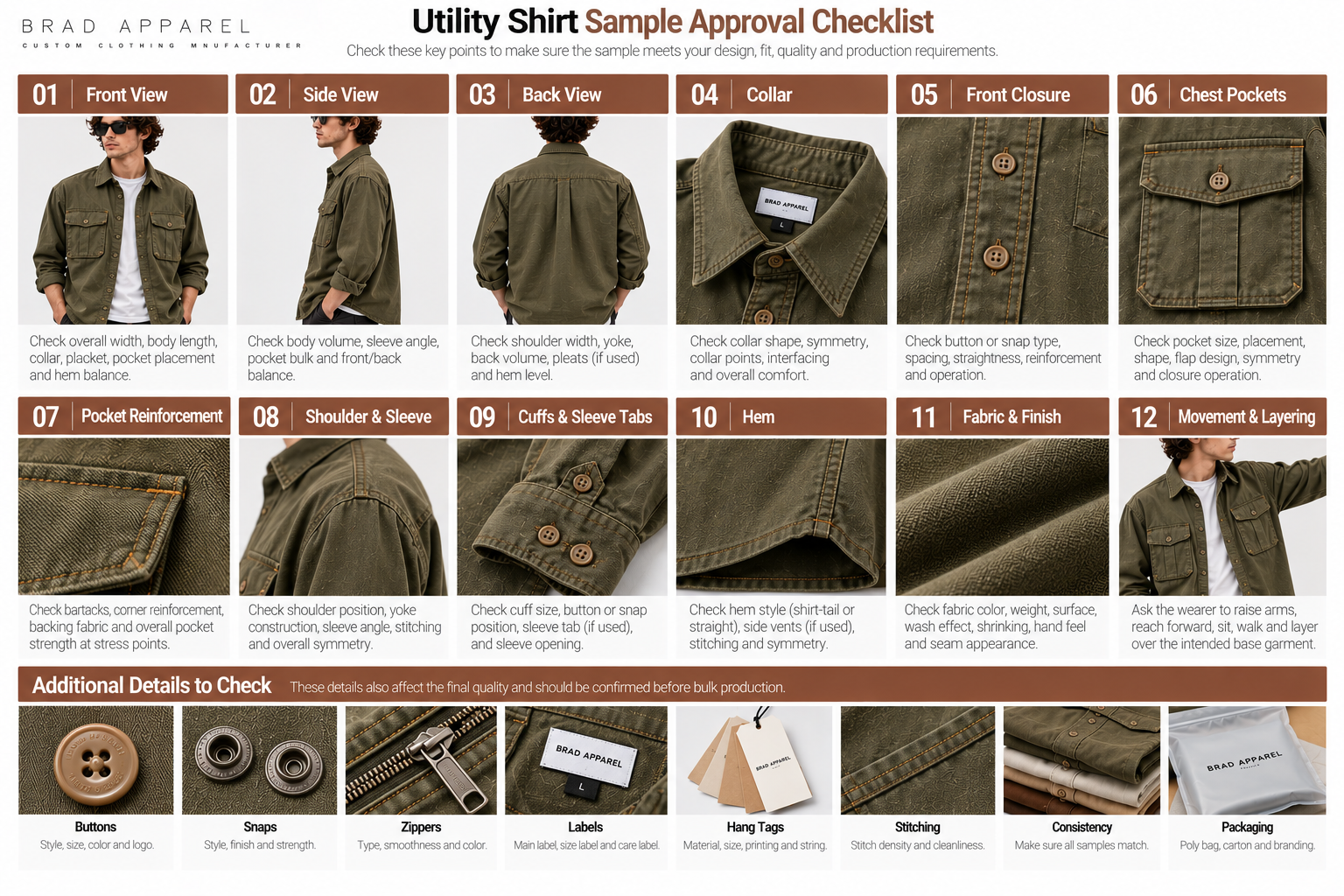
A utility shirt should be reviewed for both:
fit
and
functional details.
1. Front View
Check:
- Overall width
- Body length
- Collar
- Placket
- Pocket placement
- Hem balance
2. Side View
Check:
- Body volume
- Sleeve angle
- Pocket bulk
- Front/back balance
3. Back View
Check:
- Shoulder width
- Yoke
- Back volume
- Pleats if used
- Hem level
4. Collar
Check:
- Shape
- Symmetry
- Collar points
- Interfacing
- Comfort
5. Front Closure
Check:
- Button or snap spacing
- Straightness
- Reinforcement
- Operation
- Left/right alignment
6. Chest Pockets
Check:
- Size
- Height
- Symmetry
- Flap alignment
- Closure operation
If the pockets are intended to carry items, test them with a realistic load.
7. Pocket Reinforcement
Check:
- Bartacks
- Pocket corners
- Backing
- Stitching
- Stress points
8. Shoulder & Sleeve
Check:
- Shoulder position
- Sleeve width
- Sleeve pitch
- Arm movement
- Symmetry
9. Cuffs & Sleeve Tabs
Check:
- Cuff size
- Button or snap position
- Tab placement
- Rolled-sleeve position
- Comfort
10. Hem
Check:
- Straightness or curve
- Side vents if used
- Symmetry
- Stitching
- Overall proportion
11. Fabric & Finish
Check:
- Color
- Surface
- Wash effect
- Shrinkage
- Hand feel
- Seam appearance
12. Movement & Layering
Ask the wearer to:
- Raise arms
- Reach forward
- Sit
- Walk
- Layer over the intended base garment
The shirt should provide the intended ease without excessive fabric.
Common Utility Shirt Development Mistakes
Adding Too Many Pockets
More pockets do not automatically make the shirt better.
The layout should remain balanced and purposeful.
Using Heavy Hardware on Lightweight Fabric
This can pull or distort the shirt body.
Making an Overshirt by Simply Sizing Up
Correct layering proportions require purposeful pattern development.
Ignoring Pocket Load
A pocket that looks good empty may distort when used.
Making Every Reinforcement Extremely Heavy
Excess reinforcement can make a shirt stiff.
Support should be applied where needed.
Choosing Fabric After the Pocket Design
Fabric stability and pocket construction should be considered together.
Forgetting Sleeve-Tab Testing
The roll-up tab should be checked with the sleeve actually rolled.
Approving the Sample Before Washing
If the bulk product will receive garment finishing, approve the final post-finish measurements and appearance.
What Should You Send a Utility Shirt Manufacturer?
A useful development brief should define:
| Area | What to Specify |
|---|---|
| Product Type | Shirt / overshirt |
| Fit | Regular / relaxed / oversized |
| Fabric | Twill / ripstop / canvas / poplin / blend |
| Composition | Target fiber content |
| Surface | Clean / washed / vintage |
| Collar | Point / spread / camp / stand |
| Pocket Type | Patch / flap / bellows / pleated |
| Pocket Size | Width and height |
| Pocket Position | Exact placement |
| Closure | Button / snap |
| Sleeve | Standard / roll-up tab |
| Cuff | Button / snap / straight |
| Back | Yoke / pleats / clean |
| Hem | Shirt-tail / straight |
| Reinforcement | Bartacks / backing / interfacing |
| Branding | Embroidery / patch / custom trims |
| Wash | Required finishing |
| Quantity | Sample and bulk quantity |
This information allows the factory to develop the utility details as part of the garment rather than adding them after the pattern is finished.
How Brad Apparel Can Develop a Custom Utility Shirt
A utility-shirt development process can follow:
Design Reference
↓
Fabric Selection
↓
Fit & Layering Requirement
↓
Pocket Layout
↓
Pocket Construction & Reinforcement
↓
Collar / Sleeve / Hem Development
↓
Button / Snap Confirmation
↓
First Sample
↓
Fit + Pocket Function Review
↓
Wash / Finish Review
↓
Pre-Production Approval
↓
Bulk Production
Brad Apparel supports woven garment development through Fabric Sourcing & Development, custom buttons, snaps, labels and patches through Trims & Branding, embroidery through Embroidery Techniques, and broader garment development through our Manufacturing Capabilities.
FAQ
What Is a Utility Shirt?
A utility shirt is a woven shirt influenced by workwear, military, field and outdoor clothing.
It often uses practical pockets, structured woven fabric and functional closures.
Is a Utility Shirt the Same as a Work Shirt?
Not necessarily.
The categories overlap, but utility shirts may place more visual emphasis on pockets and functional details.
A work shirt may use a simpler traditional construction.
What Is the Difference Between a Utility Shirt and an Overshirt?
An overshirt is primarily defined by its layering role.
A utility shirt is defined more by its functional design language.
A garment can be both:
a utility shirt
and
an overshirt.
Is a Safari Shirt a Utility Shirt?
They can overlap.
Safari shirts often use utility-style chest pockets, lightweight fabrics, earth tones and sleeve tabs.
However, not every utility shirt uses safari styling.
What Fabric Is Best for a Utility Shirt?
There is no universal best fabric.
Common directions include:
- Cotton twill
- Blended twill
- Ripstop
- Canvas
- Poplin
- Linen blends
The correct choice depends on weight, season, structure and intended use.
Can Utility Shirts Be Oversized?
Yes.
The body, shoulder, sleeve and pocket scale should be developed together for the oversized silhouette.
Simply selecting a larger standard shirt size may create incorrect proportions.
Can Utility Shirts Use Snap Buttons?
Yes.
Snaps work particularly well for workwear, military-inspired and Western-influenced designs.
The fabric should be reinforced appropriately around the hardware.
Do Utility Shirts Need Reinforced Stitching?
Not every seam needs additional reinforcement.
Stress points such as pocket corners, tabs and closure areas may benefit from reinforcement depending on the fabric and design.
What Is a Bellows Pocket?
A bellows pocket uses folded side sections that allow the pocket to expand outward.
It creates a more dimensional utility appearance than a simple flat patch pocket.
Can Utility Shirts Be Embroidered?
Yes.
Direct embroidery or embroidered patches can both be used.
The artwork, stitch density and backing should be tested with the intended shirt fabric.
Can a Utility Shirt Be Garment Washed?
Yes.
Garment washing can create softer or more vintage-looking utility shirts.
The final fit and measurements should be checked after the intended finishing process.
What Should Brands Check Before Bulk Production?
Important points include:
- Fit
- Body length
- Pocket position
- Pocket size
- Pocket function
- Reinforcement
- Collar
- Closures
- Sleeves
- Cuffs
- Hem
- Fabric and finishing
- Movement
- Layering
The final approved sample should represent the intended bulk fabric, trims and finishing.
Final Thoughts
A utility shirt looks functional because its construction details are visible.
That means those details need to work as a complete system.
The strongest products balance:
Fabric
+
Fit
+
Pocket Scale
+
Pocket Placement
+
Reinforcement
+
Hardware
+
Sleeve
+
Finishing
rather than simply adding multiple pockets to a standard shirt.
For clothing brands, that is the difference between a shirt that only looks “utility-inspired” and one that feels intentionally developed from sample through bulk production.
Keep Reading