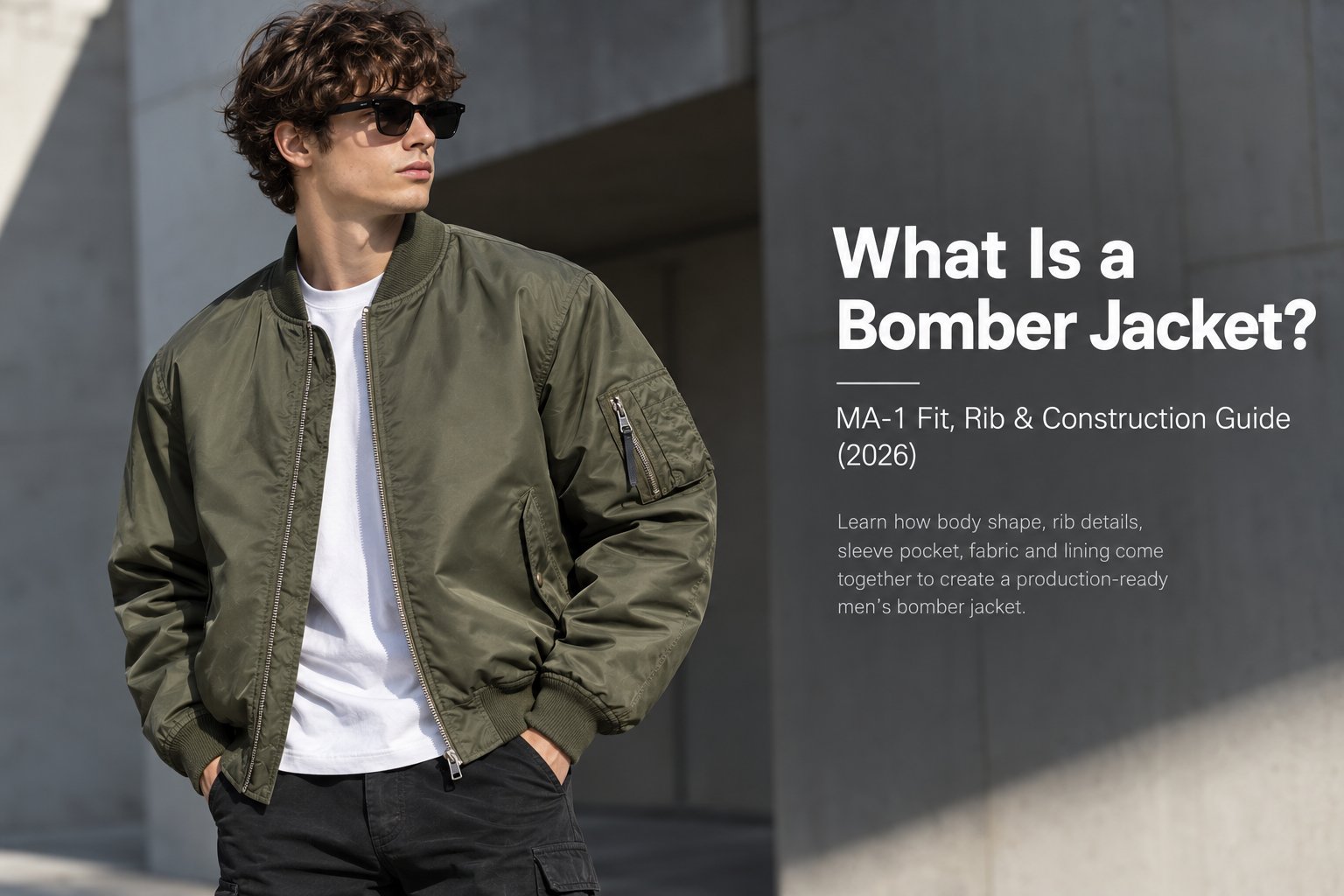
A bomber jacket is a short outerwear garment usually built around a zip front, controlled hem and relatively full upper body.
The silhouette is simple enough to recognize immediately:
- Short body
- Front zipper
- Ribbed or controlled collar
- Rib cuffs
- Rib waistband
- Fuller chest and sleeves
- Welt or slash pockets
But from a manufacturing perspective, the characteristic bomber shape does not come from the zipper alone.
It comes from the relationship between:
body volume + body length + rib tension + sleeve shape + shell fabric + lining + zipper + insulation
A jacket with a short body and rib waistband can still look wrong if:
- The waistband is too tight
- The sleeves are too narrow
- The chest does not contain enough volume
- The zipper is too heavy for the shell
- The lining is too small
- The rib does not recover correctly
For clothing brands, this means a bomber jacket should not be developed by simply shortening a normal zip jacket and adding rib at the bottom.
The pattern needs to create a controlled blouson silhouette.
This guide explains what defines a modern men's bomber jacket, how MA-1-inspired construction differs from related jackets and what brands should specify before sampling and bulk production.
What Is a Bomber Jacket?
A bomber jacket is generally a short zip-front jacket with a controlled lower hem and a relatively relaxed upper body.
Common features include:
- Front zipper
- Short body
- Rib collar or stand collar
- Rib cuffs
- Rib waistband
- Welt or slash pockets
- Full lining
- Relaxed sleeve
- Blouson silhouette
Depending on the style, a bomber may also use:
- Sleeve utility pocket
- Snap-flap pockets
- Internal pockets
- Insulation
- Reversible lining
- Two-way zipper
- Storm flap
- Custom zipper pull
- Leather or suede shell
- Wool shell
- Nylon shell
- Technical woven fabric
The category has expanded considerably.
A modern bomber can be:
- Minimal
- Lightweight
- Oversized
- Cropped
- Technical
- Leather
- Suede
- Wool
- Padded
- Reversible
The bomber therefore describes a recognizable construction and proportion rather than one single military specification.
Why Are Bomber Jackets Relevant in Men's Fashion in 2026?
Bomber jackets continue to work because the silhouette sits between several major menswear categories.
It can function as:
- Transitional outerwear
- Streetwear
- Heritage military-inspired clothing
- Minimal casualwear
- Sportswear
- Premium outerwear
- Lightweight layering
A classic nylon bomber works with:
- T-shirts
- Sweatshirts
- Knitwear
- Jeans
- Cargo pants
- Wide trousers
while a suede or wool bomber can move into a much more refined collection.
The silhouette is also highly adaptable.
Brands can change:
- Fabric
- Fill
- rib
- zipper
- body volume
- body length
- sleeve volume
while still maintaining a recognizable bomber identity.
Bomber Jacket vs MA-1 Bomber Jacket
These terms overlap, but they are not identical.
Bomber jacket is the broader modern category.
MA-1 refers to a specific flight-jacket design lineage that strongly influenced the modern bomber silhouette.
An MA-1-inspired bomber typically uses elements such as:
- Nylon-style shell
- Rib-knit collar
- Rib cuffs
- Rib waistband
- Front zipper
- Full lining
- Sleeve utility pocket
- Compact blouson body
Modern fashion bombers may remove or change many of these elements.
For example:
wool shell + hidden side pockets + no sleeve pocket
can still clearly be a bomber jacket.
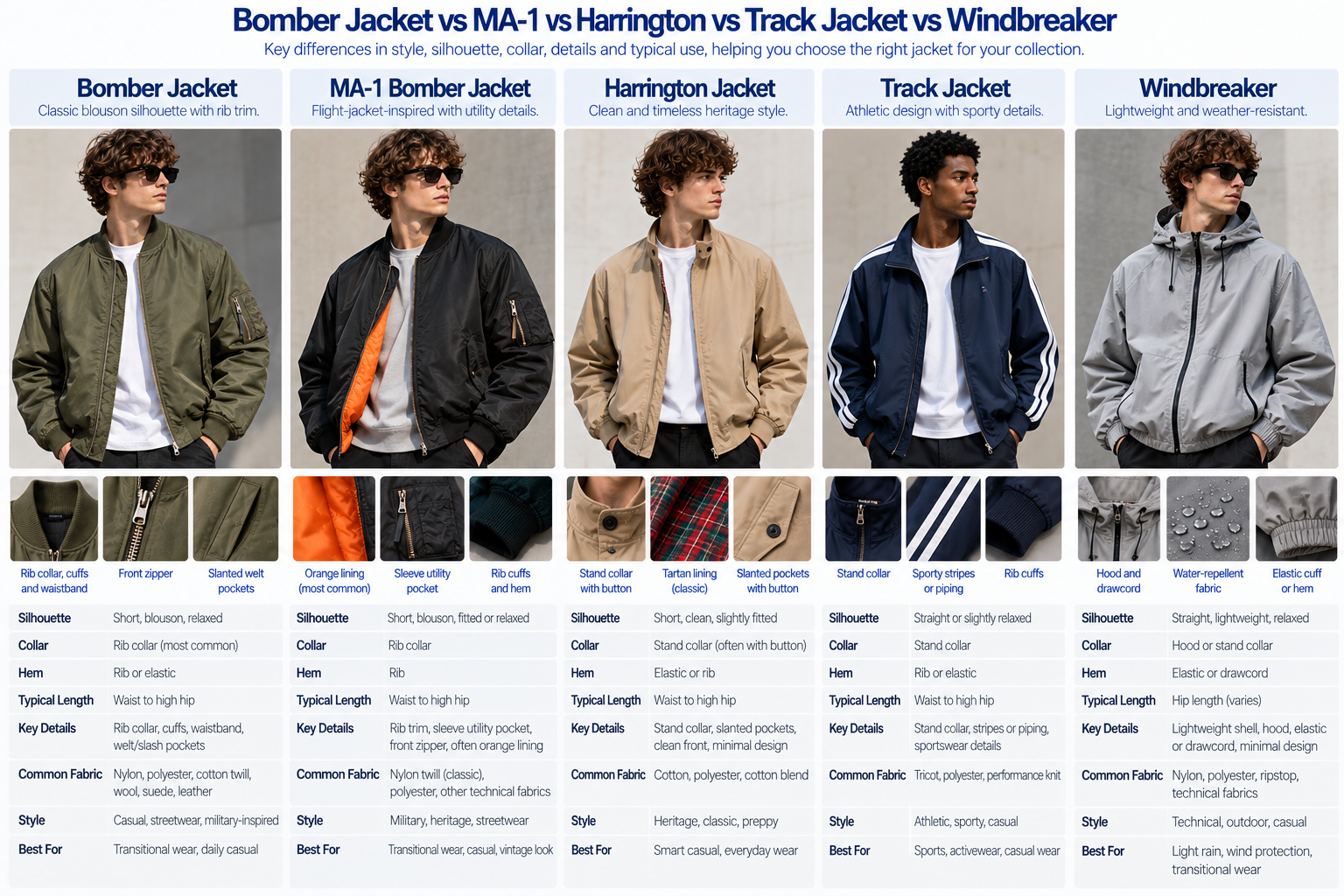
Bomber Jacket vs Other Men's Jackets
Bomber jackets are frequently confused with other short zip jackets.
| Style | Main Identifier | Collar | Hem | Typical Character |
|---|---|---|---|---|
| Bomber Jacket | Blouson body + controlled hem | Rib or structured | Usually rib / elastic | Military / casual / streetwear |
| MA-1 Bomber | Flight-jacket-inspired construction | Rib | Rib | Military heritage |
| Harrington Jacket | Clean short jacket | Stand / buttoned | Controlled / elastic | Heritage / preppy |
| Track Jacket | Athletic zip jacket | Stand collar | Rib / elastic / straight | Sportswear |
| Windbreaker | Lightweight protective shell | Hood / stand collar | Elastic / drawcord | Lightweight technical |
The categories can overlap.
Modern designers regularly combine:
- Bomber body
- Harrington collar
- Windbreaker fabric
- Track-jacket piping
For production, the actual specifications are more useful than the marketing name.
Bomber Jacket vs Harrington Jacket
Both garments can use:
- Short body
- Front zipper
- Elasticated hem
- Lightweight woven shell
But the typical silhouettes differ.
A bomber usually emphasizes:
- Fuller body
- Fuller sleeve
- Rib collar
- Rib waistband
- Rounded blouson effect
A Harrington more commonly emphasizes:
- Stand or buttoned collar
- Cleaner body
- Slanted pockets
- Heritage casual styling
Brad Apparel's Harrington Jacket Guide covers that construction in more detail.
Bomber Jacket vs Track Jacket
A track jacket is primarily connected to athletic clothing.
Typical track-jacket details include:
- Stand collar
- Stripes
- Piping
- Paneling
- Tricot or performance knit
- Matching pants
A bomber is more strongly defined by:
- Short body
- Fuller volume
- Rib trim
- Flight-jacket-inspired construction
A fashion track jacket may become bomber-like when its body is shortened and heavily bloused.
Bomber Jacket vs Windbreaker
A windbreaker is primarily a lightweight shell category.
It may use:
- Nylon
- Polyester
- Hood
- Elastic
- Drawcord
with little or no insulation.
A bomber can use similar lightweight shell fabric but usually has a stronger:
- Rib collar
- Cuff
- Waistband
- Blouson
identity.
For detailed lightweight shell construction, see Brad Apparel's Windbreaker Jacket Guide.
Bomber Jacket vs Puffer Jacket
A puffer is defined primarily by visible insulation and padded chambers.
A bomber is defined more by silhouette.
This means a garment can technically combine both ideas.
For example:
short padded body + rib collar + rib waistband
can be described as a:
puffer bomber
or:
padded bomber jacket
depending on the brand.
The Bomber Jacket Silhouette
The characteristic bomber silhouette is often called a:
blouson
shape.
This means the jacket has more volume through the body and then draws inward around the hem.
The silhouette is created by:
body width > finished waistband width
The rib or elastic hem controls the extra body volume.
Why Bomber Jackets Blouse at the Waist
If the main body were exactly the same width as the finished rib waistband, the jacket would hang relatively straight.
Instead, bomber patterns often contain additional body width.
When that wider shell is attached to a smaller waistband, the lower body gathers slightly.
This creates the familiar rounded shape.
Rib Ratio Controls the Blouson Effect
The relationship between:
shell hem circumference
and:
finished rib circumference
is critical.
A smaller rib creates:
- More gathering
- Stronger blouson shape
- Tighter waist
A larger rib creates:
- Cleaner lower body
- Less gathering
- More relaxed hem
There is no universal ratio.
The correct relationship depends on:
- Fabric
- rib stretch
- rib recovery
- body width
- desired silhouette
Why Rib Percentage Should Not Be Copied Blindly
Factories sometimes work with general rib ratios.
But using the same ratio on every fabric can create problems.
A soft high-stretch rib behaves differently from:
- Dense cotton rib
- Polyester rib
- Wool rib
- Heavy tubular rib
The physical rib needs to be tested.
Classic Bomber Fit
A classic bomber may use:
- Regular-relaxed chest
- Short body
- Full sleeve
- Controlled waistband
- Natural or slightly extended shoulder
The jacket should have enough upper-body ease to create shape without becoming oversized.
Relaxed Bomber Fit
A relaxed version adds room through:
- Chest
- Back
- Sleeve
- Bicep
while keeping body length relatively compact.
This works well for modern menswear.
Boxy Bomber Jacket
A boxy bomber generally uses:
- Wide chest
- Wider shoulder
- Short body
- Larger sleeve
- Less aggressive waistband tension
This creates a cleaner contemporary silhouette.
Oversized Bomber Jacket
An oversized bomber should be intentionally patterned.
Do not simply use a jacket two sizes larger.
That can create:
- Excessive body length
- Sleeves too long
- Neck opening too large
- Pockets too low
- Rib waistband too wide
A true oversized pattern normally increases:
- Chest
- Shoulder
- Bicep
more aggressively than:
- Body length
- Collar
- Pocket dimensions
Cropped Bomber Jacket
A cropped bomber can end around:
- Waist
- High hip
This creates a stronger fashion proportion.
When reducing body length, the designer needs to reconsider:
- Pocket height
- Zipper length
- Rib height
- Sleeve proportion
Do not simply cut several centimeters from the bottom of an existing bomber.
Bomber Jacket Body Length
Body length is one of the most important measurements.
A traditional bomber is usually shorter than many:
- Harrington jackets
- Windbreakers
- Field jackets
The exact target depends on the fit.
A very long bomber can lose its characteristic compact appearance.
Shoulder Construction
Bomber jackets can use:
- Set-in sleeve
- Drop shoulder
- Raglan sleeve
- Hybrid panel construction
The shoulder direction changes the overall character.
Set-In Sleeve Bomber
A set-in sleeve creates:
- Controlled shoulder
- Traditional jacket construction
- Cleaner upper-body shape
It works well for:
- Classic MA-1-inspired bombers
- Leather bombers
- Minimal woven bombers
Drop-Shoulder Bomber
Drop shoulders create:
- Larger silhouette
- Streetwear appearance
- Extra upper-body volume
The sleeve length should be adjusted accordingly.
Raglan Bomber
Raglan construction creates:
- Softer shoulder line
- Greater visual movement
- Athletic influence
This can work well for:
- Sports-inspired bombers
- Wool bombers
- Oversized designs
Bomber Jacket Sleeve Shape
Bomber sleeves are often fuller than the sleeve of a standard woven jacket.
Volume is typically controlled at the wrist by:
- Rib cuff
- Elastic cuff
The sleeve therefore needs enough width through:
- Bicep
- Elbow
- Forearm
to create the intended shape.
Sleeve Volume
Too little sleeve volume can make the jacket look like:
- A normal zip jacket
- Harrington
- Track jacket
rather than a bomber.
Too much volume can create:
- Excessive bunching
- Heavy sleeve appearance
- Poor arm movement
The correct amount depends on the body silhouette.
Sleeve Taper
The sleeve usually becomes narrower toward the cuff.
But the taper should work together with the rib cuff.
A very narrow sleeve connected to a tight rib can create an abrupt shape.
Sleeve Utility Pocket
The sleeve utility pocket is strongly associated with MA-1-inspired bombers.
It may include:
- Vertical zipper
- Patch pocket
- Pen slots
- Pull tab
Modern designs can simplify it substantially.
Does Every Bomber Need a Sleeve Pocket?
No.
The sleeve utility pocket is a recognizable MA-1 detail, not a requirement for every bomber jacket.
Minimal bombers often remove it completely.
Sleeve Pocket Position
If used, specify:
- Distance from shoulder seam
- Distance from sleeve center
- Pocket length
- Zipper length
- Pen-slot width
The pocket should sit cleanly without rotating excessively toward the front or back of the sleeve.
Sleeve Pocket Reinforcement
The pocket creates extra weight and stitching on one sleeve.
Depending on shell material, reinforcement may be needed around:
- Zipper opening
- Pocket corners
- Stitch line
Light nylon is particularly sensitive to excessive perforation.
Bomber Jacket Collar
The classic bomber collar is often a rib-knit collar.
It creates:
- Soft neckline
- Stretch
- Comfort
- Sportswear character
Modern bombers can also use:
- Stand collar
- Point collar
- Funnel collar
- Fur / shearling collar
- Hood
Rib Collar
A rib collar needs good:
- Stretch
- Recovery
- Shape retention
Too much tension can:
- Pull the neckline inward
- Create zipper distortion
- Feel tight
Too little tension can make the collar:
- Flare outward
- Look loose
- Collapse
Collar Rib Height
A lower rib collar creates:
- More classic MA-1 appearance
- Open neckline
A taller rib collar creates:
- More coverage
- stronger visual neckline
The collar height should remain balanced with:
- Body width
- Shoulder
- Zipper
- Rib waistband
Stand-Collar Bomber
Replacing the rib collar with a woven stand collar can create a more:
- Minimal
- Technical
- Fashion-forward
appearance.
But this may move the garment visually toward:
- Harrington
- Funnel-neck jacket
so the rest of the bomber silhouette should remain clear.
Bomber Jacket Cuffs
Rib cuffs are one of the most recognizable bomber details.
A good cuff needs:
- Strong recovery
- Comfortable opening
- Correct finished length
- Clean attachment
Rib Cuff Tension
If the cuff is too tight:
- Wrist feels uncomfortable
- Sleeve bunching becomes excessive
If too loose:
- Sleeve drops over the hand
- Bomber shape becomes weak
The cuff should be tested physically.
Cuff Rib Height
Taller cuffs create:
- More visible sportswear detail
- Stronger vintage character
Shorter cuffs create:
- Cleaner appearance
- More subtle finishing
Bomber Jacket Waistband
The waistband controls the entire lower silhouette.
Common options include:
- 1×1 rib
- 2×2 rib
- Custom knitted rib
- Elasticated woven hem
- Partial rib
- Straight hem on fashion hybrids
Traditional bomber styling usually uses rib.
Waistband Height
A deeper waistband becomes a stronger visual element.
It can also make the jacket appear shorter.
A shallow waistband creates a more subtle transition between:
- Body
- Hem
Rib Construction
Rib can vary by:
- Yarn
- Composition
- Knit structure
- Weight
- Stretch
- Recovery
Common compositions may include:
- Cotton
- Polyester
- Cotton/polyester
- Wool blends
- Elastane blends
The rib does not need to use exactly the same fiber composition as the shell.
Main Fabric and Rib Color Matching
Matching woven shell and knitted rib can be difficult.
Even when both are dyed to the same target color, they may reflect light differently.
Always approve:
- Shell
- Rib
together.
A physical reference is more reliable than screen color alone.
Rib Shrinkage
Rib and shell can shrink differently.
This may lead to:
- Tight waistband after washing
- Loose waistband
- Twisted cuffs
- Wavy attachment seam
Test both components according to the intended care method.
Best Fabrics for Bomber Jackets
Bomber jackets can use a wide range of materials.
Common choices include:
- Nylon
- Polyester
- Twill
- Satin
- Wool
- Wool blends
- Suede
- Faux suede
- Leather
- Cotton canvas
- Technical woven fabric
For custom fabric sourcing by composition, weight and finish, see Brad Apparel's Fabric Sourcing & Development capabilities.
Nylon Bomber Jacket
Nylon is strongly associated with flight-jacket-inspired bombers.
It can provide:
- Lightweight structure
- Technical appearance
- Smooth surface
- Broad finish options
Possible directions include:
- Matte nylon
- Shiny nylon
- Crinkle nylon
- Twill nylon
- Ripstop nylon
Nylon Twill
A dense nylon twill can create a particularly strong bomber look.
The diagonal structure may be subtle but gives the shell more character than very light plain-weave nylon.
It can work well for:
- MA-1-inspired jackets
- Premium streetwear
- Padded bombers
Polyester Bomber Jacket
Polyester can provide:
- Dimensional stability
- Broad color choice
- Cost flexibility
- Different surface finishes
It can be used for:
- Fashion bombers
- Lightweight bombers
- Satin-look bombers
Satin Bomber Jacket
A satin surface creates:
- Shine
- Smooth hand feel
- Retro sportswear appearance
But satin-like fabrics can show:
- Needle marks
- Puckering
- Scratches
- Seam pressure
very clearly.
Sewing parameters should be tested before bulk production.
Cotton Twill Bomber
Cotton twill creates a more:
- Casual
- Workwear
- Matte
interpretation.
It can also support:
- Garment wash
- Enzyme wash
- Pigment effects
depending on the fabric and dye route.
Wool Bomber Jacket
Wool can create a more refined bomber.
Possible materials include:
- Wool twill
- Melton
- Brushed wool
- Wool blend
The rib should match the heavier shell visually.
Suede Bomber Jacket
Suede or suede-look fabric can create a premium bomber direction.
Important production considerations include:
- Nap direction
- Shade matching
- Seam bulk
- Hardware weight
- Pressing
Brad Apparel's Suede Jacket Guide covers these material-specific issues separately.
Leather Bomber Jacket
Leather bombers require specialized development around:
- Hide size
- Panel placement
- Needle holes
- Seam construction
- Thickness
- Edge finishing
Leather production should be confirmed with the appropriate specialist production route.
Shell Weight
There is no single correct GSM for a bomber jacket.
A lightweight uninsulated bomber may use a thin shell.
A winter bomber may combine:
- Midweight shell
- Lining
- Insulation
The total garment structure matters more than one GSM number.
Lightweight Bomber Jacket
A lightweight bomber can use:
- Thin nylon
- Lightweight polyester
- Unlined or lightly lined construction
It works well for:
- Spring
- Fall
- Transitional weather
The pattern still needs enough body volume to retain bomber character.
Padded Bomber Jacket
A padded bomber can use:
- Polyester sheet insulation
- Loose synthetic fill
- Other insulation systems
The added thickness changes:
- Chest
- Armhole
- Sleeve
- Cuff
- Waistband
The insulated version should therefore not simply reuse an unlined bomber pattern without adjustment.
Bomber Jacket Lining
Common lining options include:
- Polyester taffeta
- Nylon
- Satin
- Viscose-style lining
- Quilted lining
- Mesh in lightweight variations
The lining should support:
- Movement
- Interior appearance
- Easy dressing
Lining Ease
The lining needs enough ease to avoid pulling the shell.
This is especially important around:
- Back
- Sleeve
- Underarm
If the lining is too tight, it can reduce the relaxed bomber shape.
Lining Color
Classic fashion bombers may use:
- Tonal lining
- Contrast lining
- Bright orange-inspired lining
- Printed lining
A contrast lining becomes more visible when the jacket is worn open.
Reversible Bomber Jackets
A reversible bomber requires a different construction approach.
Both sides need:
- Clean seam finishing
- Usable pockets
- Presentable zipper installation
- Branding solution
Traditional lining construction may no longer work.
The garment should be developed as reversible from the beginning.
Insulated Lining
Cold-weather bombers may use quilted or insulated lining.
Possible effects include:
- Increased warmth
- More body structure
- Greater total thickness
The rib and zipper need to remain proportionate to the heavier garment.
Center-Front Zipper
The zipper is one of the strongest visual lines on a bomber jacket.
Common options include:
- Metal zipper
- Nylon coil
- Molded plastic
- Reverse coil
The correct choice depends on:
- Shell
- garment weight
- styling
- cost
For custom zippers and pullers, see Brad Apparel's Custom Zippers & Sliders capabilities.
Metal Zipper
Metal zippers create:
- Heritage
- Military-inspired
- Premium
appearance.
But a heavy zipper can distort lightweight shell fabric.
Coil Zipper
A coil zipper is:
- Flexible
- Lightweight
- Smooth
and can work well for:
- Lightweight bombers
- Minimal designs
- Technical variations
Molded Zipper
A molded zipper creates a stronger technical appearance.
It can work well for:
- Nylon bombers
- Sportswear hybrids
- Padded jackets
Two-Way Zipper
A two-way zipper allows the bottom to open upward.
This can improve:
- Sitting
- styling
- mobility
particularly on oversized or longer bomber interpretations.
Zipper Length
Zipper length needs to correspond with the finished body length.
If too long:
- Waistband can distort
- Bottom may buckle
If too short:
- Front alignment becomes poor
- Waistband may not close correctly
Zipper Facing / Wind Flap
Some bombers use an internal strip behind the zipper.
This can:
- Improve interior appearance
- Reduce direct wind entry
- Prevent lining from catching
The construction may be:
- Unpadded
- Lightly padded
depending on product direction.
Pocket Options
Common bomber-jacket pockets include:
- Slanted welt pocket
- Welt pocket with snap
- Zipper pocket
- Slash pocket
- Flap pocket
- Sleeve utility pocket
- Internal pocket
Slanted Welt Pocket
A classic option.
The angle should allow natural hand entry.
Pocket position should be balanced with:
- Jacket length
- Waistband
- Zipper
Snap Pocket
A concealed or visible snap can provide:
- Security
- military-inspired detail
The reinforcement should match the closure force.
Zipper Pocket
Zipper pockets create a more:
- Technical
- contemporary
appearance.
The pocket zipper should not overpower the main front zipper.
Internal Pocket
Interior pockets can hold:
- Phone
- Wallet
- Small accessories
Lightweight lining may require reinforcement if the pocket is expected to carry heavier items.
Bomber Jacket Pattern Development
A typical bomber pattern may include:
- Front body
- Back body
- Sleeves
- Collar rib
- Cuff rib
- Waistband rib
- Pocket welts
- Pocket bags
- Front zipper facing
- Sleeve utility pocket
- Lining front
- Lining back
- Lining sleeves
Exact pattern-piece quantities depend on design.

Front Body Pattern
The front body controls:
- Chest
- Body length
- Zipper
- Hem gathering
The amount of width entering the waistband has a major effect on the final silhouette.
Back Body Pattern
The back should provide enough:
- Shoulder movement
- Upper-back ease
- Blouson volume
A narrow back can restrict movement even if the front appears oversized.
Sleeve Pattern
The sleeve needs to coordinate with:
- Shoulder type
- Bicep
- Cuff width
- Sleeve pocket
For MA-1-inspired designs, the sleeve usually carries substantial volume.
Rib Pattern / Specification
Rib is not normally treated exactly like a woven pattern piece.
The tech pack should specify:
- Finished dimensions
- Knit structure
- Composition
- Stretch
- Recovery
- Color
- Height
for:
- Collar
- Cuffs
- Waistband
Waistband Finished Measurement
The finished waistband circumference should be specified independently from the shell hem.
This lets the manufacturer understand the intended amount of blousing.
Cuff Finished Measurement
Specify the finished cuff opening rather than relying only on the rib piece's unstretched width.
Collar Finished Measurement
Important specifications include:
- Finished collar height
- Finished neck opening
- Collar length
- Stretch requirement
Utility Pocket Pattern
A sleeve utility pocket may contain:
- Pocket panel
- Zipper opening
- Pen slot
- Reinforcement
The exact construction depends on the style.
Pocket Bag Pattern
Pocket bags need enough depth to be functional without:
- Extending below the waistband
- Distorting the jacket front
Lining Pattern
The lining should have enough movement ease.
It may require:
- Back pleat
- Additional sleeve ease
depending on the shell and fit.
Bomber Jacket Measurement Points
| Measurement | Why It Matters |
|---|---|
| Chest Width | Controls upper-body volume |
| Body Length | Controls bomber proportion |
| Shoulder Width | Controls silhouette |
| Sleeve Length | Controls cuff position |
| Bicep Width | Controls sleeve fullness |
| Shell Hem Width | Controls body volume |
| Finished Waistband Width | Controls blouson effect |
| Neck Opening | Controls collar fit |
| Collar Height | Controls neckline |
| Cuff Opening | Controls wrist fit |
| Pocket Position | Controls function and balance |
| Sleeve Pocket Position | Controls MA-1 detail |
Body Length Measurement
Use a consistent method such as:
Measure from highest point of shoulder to the bottom edge of the finished waistband.
Clearly state whether the rib waistband is included.
Chest Width
For a flat garment:
Measure straight across at the specified point below the armhole.
The exact point should remain consistent between:
- Sample
- Size chart
- QC
Hem Measurement
A bomber may have two different useful measurements:
Shell hem before rib
and:
Finished waistband
Do not confuse the two.
Sleeve Length
For set-in sleeves:
Measure from shoulder seam to finished cuff edge.
For drop shoulders, shoulder extension affects apparent sleeve length.
Bicep Width
Measure flat across at the specified bicep point.
Bomber sleeves often require more bicep ease than standard woven jackets.
Bomber Jacket Grading
Grading a bomber needs special attention because:
- Body grows
- Rib changes
- Pockets move
- Sleeve volume changes
but not every detail should scale proportionally.
Waistband Grading
Waistband length usually increases with size.
But the amount of negative ease relative to the shell needs to remain controlled.
Using one fixed rib length for every size would change the silhouette.
Rib Height Grading
Rib height commonly remains relatively stable across sizes.
There is usually no reason to increase cuff height dramatically between S and XL.
Pocket Grading
Pocket size may increase slightly.
But fully proportional grading can create excessively large pockets.
Position also needs to move with body dimensions.
Sleeve Pocket Grading
A utility pocket may remain nearly the same functional size across several sizes.
Its position may need to change more than its actual dimensions.
Zipper Grading
Different size groups may require different zipper lengths if body length grades significantly.
The exact zipper-length strategy should be planned before bulk ordering.
Rib Development
Rib deserves separate approval.
Do not treat rib as a generic trim that can be selected after the jacket sample.
It directly controls:
- Fit
- silhouette
- comfort
- recovery
Rib Stretch Test
Check how easily the rib stretches.
Then check whether it returns to its original dimension.
Poor recovery can result in:
- Loose cuffs
- Stretched waistband
- Collar deformation
Rib Recovery
Recovery is especially important after:
- Repeated wear
- Washing
- stretching
A rib can feel strong in the first sample but fail after repeated use.
Rib Weight
Rib should visually match the jacket.
A lightweight rib can look weak on:
- Wool
- Leather
- Heavy padded bombers
A very heavy rib can overpower a thin nylon shell.
Rib Color Approval
Approve the rib with the actual shell.
Because knitted and woven surfaces reflect light differently, a digitally identical color may still look mismatched.
Bomber Jacket Interfacing
Bombers typically require less tailoring structure than coats.
But selective reinforcement may still be useful around:
- Pocket opening
- Zipper
- Snap
- Sleeve pocket
The goal is stability without making the jacket stiff.
Lightweight Shell Reinforcement
Very thin nylon or polyester may require local support where:
- Zippers
- Snaps
- Embroidery
create stress.
Reinforcement should remain hidden.
Bomber Jacket Embroidery
Embroidery works particularly well on:
- Chest
- Back
- Sleeve
But lightweight shells can pucker.
Test:
- Stitch density
- Backing
- Needle
- Artwork size
on production fabric.
For additional embroidery methods, see Brad Apparel's Embroidery Techniques.
Large Back Embroidery
A bomber can support large back graphics or embroidery.
But dense stitching may:
- Stiffen the back panel
- Distort lightweight fabric
- Pull lining
Sampling is necessary.
Patches
Possible patch types include:
- Embroidered patch
- Woven patch
- Chenille patch
- Appliqué
These can reinforce:
- Varsity
- military
- streetwear
directions.
Printing
Bomber shells may use:
- Screen print
- Heat transfer
- Silicone print
- Specialty transfers
The print system must match:
- Fiber
- Coating
- Heat sensitivity
Synthetic shells should always be tested first.
Heat Sensitivity
Thin nylon and coated polyester can be damaged by:
- Excessive heat
- Long pressing
- High transfer pressure
Possible problems include:
- Shine
- Melting
- Coating marks
- Color migration
Bomber Jacket Sample Evaluation
A bomber should be checked both:
- Open
- Fully zipped
because the front closure affects shape.
Front View
Check:
- Body width
- Body length
- Zipper
- Pocket symmetry
- Waistband
- Collar
Side View
Check:
- Blouson volume
- Sleeve fullness
- Shoulder
- Hem tension
The jacket should not balloon excessively at the back while remaining flat at the front.
Back View
Check:
- Shoulder balance
- Upper-back volume
- Waistband level
- Sleeve symmetry
Collar Check
Inspect:
- Height
- Stretch
- Recovery
- Left/right symmetry
The collar should not pull the zipper inward.
Zipper Check
Repeatedly open and close the zipper.
Check:
- Smoothness
- Bottom alignment
- Fabric catching
- Zipper wave
Pocket Check
Check:
- Height
- Angle
- Opening
- Accessibility
Left and right pockets should generally match.
Sleeve Pocket Check
If used, check:
- Position
- Zipper
- Pen slot
- Reinforcement
and confirm the pocket does not twist around the sleeve.
Cuff Check
Check:
- Opening
- Tension
- Recovery
- Symmetry
Waistband Check
This is one of the most important bomber QC points.
Check:
- Finished width
- Rib tension
- Gathering distribution
- Left/right balance
Blouson Balance
The body should gather evenly into the waistband.
Common problems include:
- Excess gathering only at side seams
- Front too flat
- Back too full
The shell and rib need to be distributed consistently during attachment.
Movement Test
Ask the wearer to:
- Raise arms
- Reach forward
- Sit
- Turn
The bomber should maintain reasonable mobility without pulling severely through:
- Back
- Armhole
- Bicep
Lining Check
Check:
- Ease
- twisting
- sleeve movement
- attachment
- hem
The lining should not pull the rib upward.
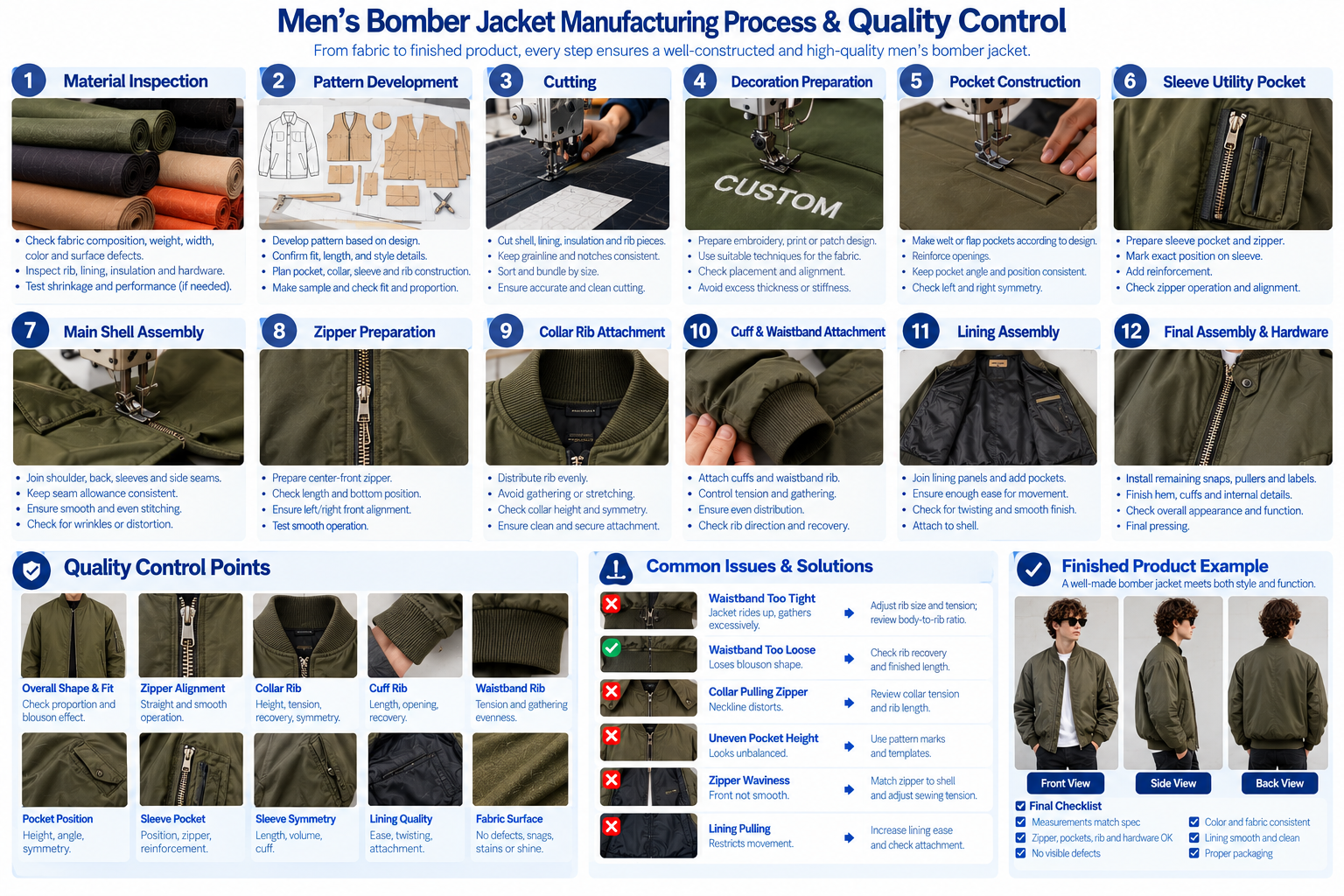
Bomber Jacket Manufacturing Process
A practical production process may include:
- Shell and rib inspection
- Lining / insulation inspection
- Shrinkage and component testing
- Pattern development
- Grading
- Cutting
- Decoration where required
- Pocket preparation
- Sleeve utility-pocket preparation
- Main shell assembly
- Zipper preparation
- Collar rib attachment
- Cuff rib preparation and attachment
- Lining assembly
- Shell and lining joining
- Waistband rib attachment
- Final hardware
- Cleaning and pressing
- Measurement inspection
- Final quality control
- Packing
The actual order may change according to:
- Construction
- insulation
- decoration
- reversible design
- factory method
Shell Fabric Inspection
Check:
- Composition
- Width
- Weight
- Shade
- Surface
- Coating
- Defects
Thin synthetic shells should also be checked for:
- Snags
- needle sensitivity
- creasing
Rib Inspection
Check:
- Composition
- Color
- Weight
- Stretch
- Recovery
- Shrinkage
Collar, cuff and waistband rib should remain consistent.
Lining Inspection
Check:
- Color
- Surface
- Defects
- Width
- shrinkage where applicable
For padded bombers, insulation should also be checked separately.
Cutting
Maintain:
- Grainline
- Direction
- Size identification
- Left/right components
Light synthetic shell can move easily during cutting.
Decoration Preparation
When possible, certain decoration may be easier on flat panels before final assembly.
This includes:
- Embroidery
- Appliqué
- Patches
The exact stage depends on the design.
Pocket Preparation
Prepare:
- Pocket opening
- Welt
- Pocket bag
- Snap or zipper
before attaching the jacket body together where required.
Sleeve Pocket Preparation
For MA-1-inspired construction:
- Mark exact sleeve position
- Reinforce opening
- Install zipper
- Attach utility pocket
- Create pen slots where required
Check the completed pocket before sleeve assembly.
Main Shell Assembly
Join:
- Shoulder
- Back
- Sleeves
- Side seams
according to the approved pattern.
Maintain consistent seam allowance.
Zipper Preparation
The center-front zipper needs accurate:
- Length
- Bottom position
- Top position
The left and right fronts should remain level.
Collar Rib Attachment
Distribute the rib according to the approved ratio.
Avoid:
- Localized gathering
- Neckline stretching
- Collar twisting
Cuff Attachment
Attach left and right cuffs consistently.
Check:
- Rib direction
- Seam position
- Tension
Lining Assembly
The lining should provide enough movement ease.
For padded designs, insulation may be combined with lining according to the selected construction.
Shell and Lining Joining
Check:
- Neckline
- zipper
- sleeve
- hem
before final waistband attachment.
Waistband Attachment
This stage strongly affects the final shape.
Distribute shell volume evenly into the rib waistband.
Avoid:
- Uneven gathering
- Rib twisting
- Overstretching
Final Hardware
Install remaining:
- Snaps
- Pullers
- Decorative hardware
- Labels
according to construction.
Pressing and Finishing
Press carefully according to material.
Synthetic shell fabric can be heat-sensitive.
Do not automatically use the same temperature as cotton twill.
Measurement Inspection
Measure the finished jacket after assembly.
Important points include:
- Chest
- Body length
- Shoulder
- Sleeve
- Bicep
- Finished waistband
- Collar
- Cuff
Key Quality Control Points
Bomber Proportion
Check:
- Short body
- Chest volume
- Sleeve volume
The silhouette should match the approved sample.
Zipper Alignment
The front zipper should remain:
- Straight
- Smooth
- Centered
Collar Rib
Check:
- Height
- tension
- recovery
- symmetry
Cuff Rib
Compare left and right cuffs.
Check:
- Opening
- length
- stretch
Waistband Rib
Check:
- Tension
- finished width
- gathering
- recovery
Pocket Position
Left and right pockets should match in:
- Height
- Angle
unless asymmetry is intentional.
Sleeve Utility Pocket
Check:
- Position
- Zipper
- Reinforcement
- alignment
Sleeve Symmetry
Compare:
- Length
- Volume
- Cuff
Lining
Check:
- Ease
- twisting
- attachment
Fabric Surface
Check for:
- Snags
- stains
- shine
- coating damage
- needle damage
Common Bomber Jacket Quality Problems
Waistband Too Tight
Result
- Jacket rides upward
- Excess body gathering
- Zipper bends
Control
Review:
- Rib dimensions
- Stretch
- Body-to-rib ratio
Waistband Too Loose
The jacket loses its characteristic blouson shape.
Review:
- Rib recovery
- Finished length
Uneven Blousing
One part of the body contains more gathering than another.
Use consistent distribution during waistband attachment.
Collar Rib Waving
Possible causes include:
- Wrong rib length
- Poor feeding
- Stretch imbalance
Test the actual rib before bulk sewing.
Collar Pulling the Zipper
If collar tension is excessive, the upper front can distort.
Review:
- Neckline
- Rib length
- Zipper position
Loose Cuffs
Poor rib recovery can allow cuffs to stretch permanently.
Perform recovery testing before bulk production.
Zipper Waviness
Possible causes include:
- Shell stretching
- Heavy zipper
- feeding
- seam tension
Match the zipper to the shell.
Uneven Pocket Height
Use:
- Pattern marks
- Templates
- Inline checks
Sleeve Pocket Rotation
The utility pocket appears too far toward the front or back.
Confirm sleeve orientation and position marks.
Sleeve Twisting
Possible causes include:
- Pattern balance
- Grainline
- Sewing
- Shell movement
Lining Pulling
Insufficient lining ease can distort:
- Back
- Sleeves
- Hem
Rib Color Mismatch
Shell and rib may appear different even when dyed to similar standards.
Approve them together physically.
Rib Shrinkage Mismatch
The rib may become tighter or looser after washing.
Test the complete component system before bulk production.
Press Shine
Synthetic or dark shell fabrics may develop unwanted shine.
Use suitable:
- Temperature
- Pressure
- Press cloth
Bomber Jacket Tech Pack Example
| Area | Example Specification |
|---|---|
| Product | Men's MA-1-Inspired Bomber Jacket |
| Fit | Relaxed / Boxy |
| Body Length | Short / High Hip |
| Shell | Nylon Twill |
| Lining | Polyester Taffeta |
| Insulation | Light Synthetic Padding |
| Shoulder | Set-In |
| Collar | 1×1 Rib |
| Front Closure | Metal Zipper |
| Slanted Welt Pocket | |
| Sleeve Detail | Zipper Utility Pocket |
| Cuff | Rib |
| Waistband | Rib |
| Branding | Small Chest Embroidery |
| Hardware | Matte Gunmetal |
| Finish | Matte / Clean |
These specifications are illustrative rather than universal.
Example Classic MA-1-Inspired Bomber
A heritage-oriented version might use:
- Regular-relaxed fit
- Short body
- Nylon shell
- Light insulation
- Rib collar
- Rib cuffs
- Rib waistband
- Metal front zipper
- Sleeve utility pocket
- Welt hand pockets
- Full lining
The design can retain military references without reproducing an exact historical specification.
Example Lightweight Modern Bomber
A transitional version might use:
- Relaxed fit
- Lightweight matte nylon
- No insulation
- Tonal rib
- Coil zipper
- Minimal welt pockets
- No sleeve pocket
- Lightweight lining
This creates a cleaner everyday product.
Example Oversized Streetwear Bomber
Possible specification:
- Wide boxy body
- Drop shoulder
- Large sleeves
- Short body
- Heavy nylon shell
- Wide rib waistband
- Oversized metal zipper
- Sleeve utility pocket
- Internal pockets
The body and sleeve should be purpose-built rather than simply sized up.
Example Wool Bomber
A premium version might use:
- Relaxed fit
- Wool-blend shell
- Dense rib trim
- Metal zipper
- Welt pockets
- Full satin lining
- No sleeve pocket
This keeps bomber proportion while moving away from technical military styling.
Example Suede Bomber
Possible specification:
- Relaxed fit
- Faux suede or approved suede material
- Rib collar
- Rib cuff
- Rib waistband
- Heavy metal zipper
- Welt pockets
- Smooth full lining
Nap direction and hardware weight should be tested carefully.
Example Padded Bomber
Possible specification:
- Boxy fit
- Nylon shell
- Synthetic sheet insulation
- Full lining
- Rib trim
- Two-way zipper
- Zipper hand pockets
Pattern dimensions should account for insulation thickness.
How to Describe a Bomber Jacket to a Manufacturer
Avoid sending only:
I want an oversized bomber like this photo.
A clearer brief would be:
Men's relaxed boxy MA-1-inspired bomber jacket in matte nylon twill with a short high-hip body, slightly dropped shoulders, full sleeves, 1×1 rib collar, cuffs and waistband, metal center-front zipper, two slanted welt pockets and a left-sleeve zipper utility pocket.
Then provide:
- Chest
- Body length
- Shoulder
- Sleeve
- Bicep
- Shell hem
- Finished waistband
- Neck
- Collar
- Cuff
- Pockets
- Sleeve pocket
- Shell fabric
- Lining
- Insulation
- Rib
- Zipper
- Hardware
- Branding
This gives the sample team a much clearer development target.
Common Bomber Jacket Development Mistakes
1. Copying a Regular Jacket and Adding Rib
The body needs enough volume to create the intended blouson shape.
2. Making the Body Too Long
The silhouette loses its compact bomber character.
3. Using Rib That Is Too Tight
The jacket bunches excessively and rides upward.
4. Using Rib That Is Too Loose
The body hangs straight instead of blousing.
5. Ignoring Rib Recovery
The jacket may look correct initially but stretch out after wear.
6. Using the Same Rib Ratio for Every Rib Quality
Different ribs behave differently.
7. Making Sleeves Too Slim
The garment begins to look like a standard casual zip jacket.
8. Adding Excessive Sleeve Volume
The sleeves can become visually heavy and difficult to control at the cuff.
9. Using a Heavy Zipper on Thin Nylon
The front may wave or pull downward.
10. Positioning the Sleeve Pocket by Eye
MA-1-style details require controlled placement.
11. Ignoring Shell and Rib Color Matching
The two structures can reflect color differently.
12. Ignoring Shell and Rib Shrinkage Differences
The proportions may change after care testing.
13. Making the Lining Too Tight
This reduces movement and collapses the intended volume.
14. Using Dense Embroidery on Lightweight Shell Without Testing
This can cause severe puckering.
15. Treating Every Bomber as an MA-1
Bomber is a broader category.
Not every design needs:
- Nylon shell
- Sleeve pocket
- Orange lining
- Military details
Bomber Jacket Development Checklist
Before sampling, confirm:
- Bomber direction
- Fit
- Body length
- Shell fabric
- Lining
- Insulation
- Shoulder construction
- Sleeve volume
- Collar rib
- Cuff rib
- Waistband rib
- Rib composition
- Rib color
- Rib stretch
- Rib recovery
- Front zipper
- Pocket type
- Sleeve utility pocket
- Decoration
- Hardware
- Branding
Before bulk production, confirm:
- Approved shell
- Approved rib
- Rib recovery
- Shrinkage
- Final pattern
- Fit sample
- Finished waistband dimension
- Cuff opening
- Collar measurement
- Pocket placement
- Sleeve-pocket placement
- Zipper
- Lining ease
- Pressing standard
- Measurement tolerance
- QC standard
FAQ
What Is a Bomber Jacket?
A bomber jacket is a short zip-front outerwear garment commonly characterized by a relaxed upper body and controlled hem.
Typical features include:
- Rib collar
- Rib cuffs
- Rib waistband
- Front zipper
- Welt pockets
Modern versions vary widely.
What Is an MA-1 Bomber Jacket?
The MA-1 is a flight-jacket design that strongly influenced the modern bomber category.
MA-1-inspired fashion jackets commonly use:
- Nylon shell
- Rib collar
- Rib cuffs
- Rib waistband
- Sleeve utility pocket
- Front zipper
Not every modern bomber is an MA-1.
Are Bomber Jackets in Style in 2026?
Yes.
Bomber jackets remain a major men's transitional outerwear category in 2026, with current versions ranging from classic MA-1-inspired designs to lightweight, oversized, suede and premium fabric interpretations.
What Is the Difference Between a Bomber and Harrington Jacket?
A bomber normally has a more rounded blouson body and commonly uses rib:
- Collar
- Cuffs
- Waistband
A Harrington generally uses a stand collar and cleaner heritage-casual construction.
What Is the Difference Between a Bomber and Track Jacket?
Track jackets are more closely associated with athletic styling and may use:
- Stripes
- Piping
- Tricot
- Stand collars
Bombers are more strongly associated with the short blouson silhouette and rib trim.
What Is the Difference Between a Bomber and Windbreaker?
A windbreaker is primarily a lightweight protective shell.
A bomber is more strongly defined by:
- Body proportion
- Controlled hem
- Rib trim
A lightweight nylon bomber may have characteristics of both.
What Fabric Is Best for a Bomber Jacket?
Common options include:
- Nylon
- Polyester
- Cotton twill
- Wool
- Suede
- Leather
- Technical woven fabrics
The correct choice depends on:
- Season
- silhouette
- insulation
- styling
- price target
What Rib Is Used for Bomber Jackets?
Common rib constructions include:
- 1×1 rib
- 2×2 rib
- Custom knitted rib
The correct rib depends on:
- Shell weight
- Stretch
- Recovery
- Desired appearance
Why Does a Bomber Jacket Have a Tight Waist?
The smaller waistband controls the wider body and creates the characteristic blouson silhouette.
The waistband should be fitted enough to control volume without feeling excessively tight.
Why Does My Bomber Jacket Ride Up?
Possible causes include:
- Waistband too tight
- Rib ratio incorrect
- Body too short
- Excessive shell gathering
Fit and rib tension should be evaluated together.
Can a Bomber Jacket Be Oversized?
Yes.
An oversized bomber should be deliberately patterned with controlled changes to:
- Chest
- Shoulder
- Sleeve
- Body length
- Waistband
rather than simply using a larger standard size.
Does a Bomber Jacket Need a Sleeve Pocket?
No.
A sleeve utility pocket is strongly associated with MA-1-style bombers but is optional on modern fashion versions.
Can Bomber Jackets Be Padded?
Yes.
Synthetic insulation or other padding can be added for colder-weather versions.
The pattern needs to account for added thickness.
Can Bomber Jackets Be Embroidered?
Yes.
Common locations include:
- Chest
- Back
- Sleeve
Lightweight shell fabric should be tested for puckering before bulk production.
What Should Be Checked During Bomber Jacket QC?
Important checks include:
- Body proportion
- Zipper alignment
- Collar rib
- Cuff rib
- Waistband tension
- Rib recovery
- Pocket position
- Sleeve-pocket position
- Sleeve symmetry
- Lining
- Fabric surface
- Finished measurements
Final Thoughts
The bomber jacket is one of the most recognizable men's outerwear silhouettes, but its apparent simplicity hides several important manufacturing relationships.
The most critical is:
body volume + short length + rib control
A classic MA-1-inspired bomber can use:
- Nylon
- Full lining
- Rib trim
- Sleeve utility pocket
A modern minimalist bomber can remove almost every military detail.
A wool bomber can become premium casualwear.
A suede bomber can rely primarily on texture.
And an oversized bomber can become a strong streetwear piece.
In every case, the jacket should still feel intentionally balanced between the fuller upper body and the controlled hem.
For clothing brands, rib should therefore never be treated as a minor trim selected at the end of development.
The shell pattern, rib dimensions, sleeve volume, body length, zipper, lining and intended fit should be developed together.
When those elements work as one system, the bomber jacket becomes much easier to reproduce consistently from sample through bulk production.
Keep Reading