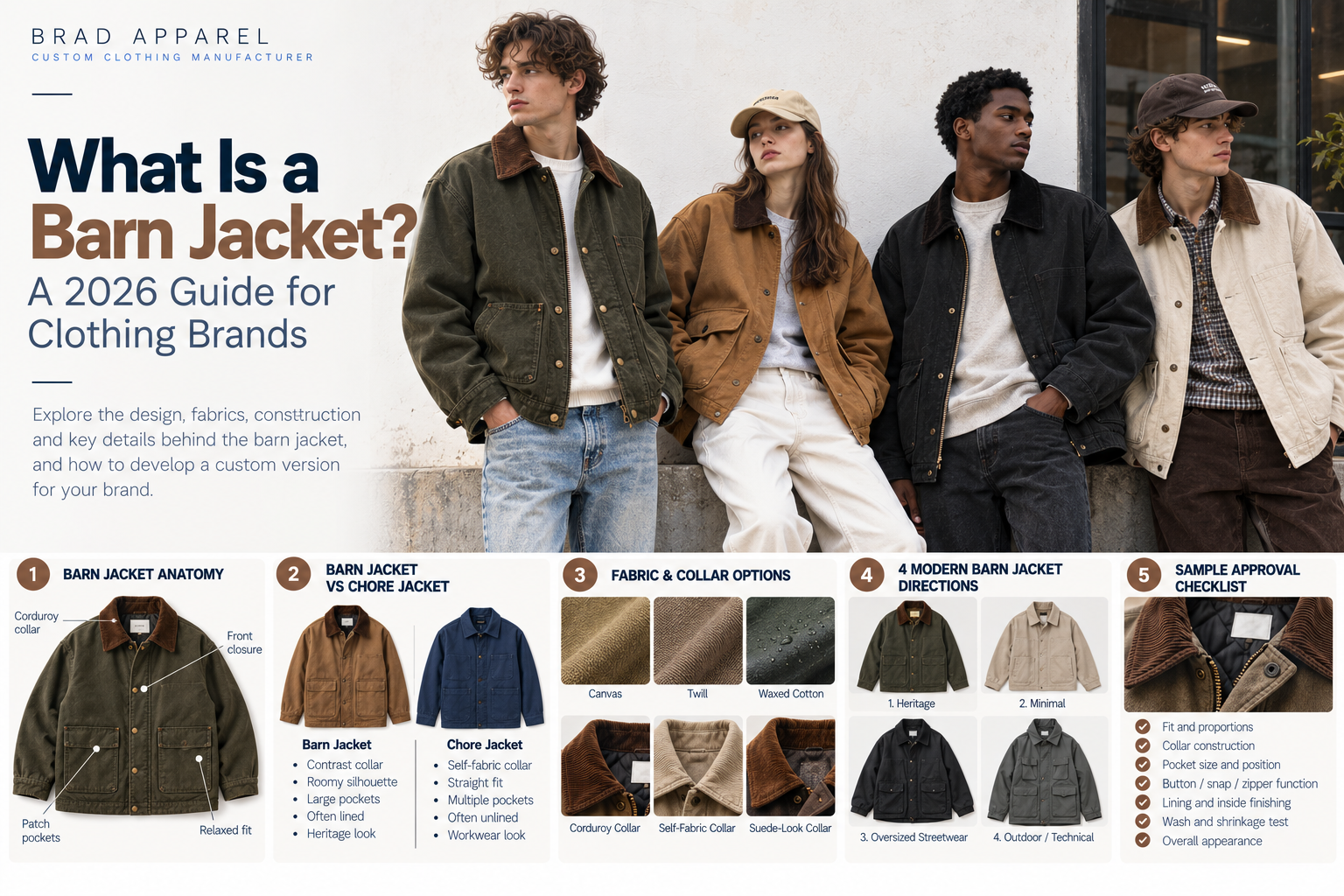
The barn jacket has become one of the most visible outerwear trends of 2026.
But unlike many fashion trends, the design is not new.
Barn jackets originally developed from practical workwear and field jackets built around:
- Durable woven fabrics
- Roomy silhouettes
- Large functional pockets
- Strong front closures
- Contrasting collars
- Easy layering
Today, those same functional details are being reinterpreted for:
- Streetwear
- Premium casualwear
- Women's fashion
- Heritage collections
- Workwear-inspired brands
- Transitional outerwear
For clothing brands, that creates an interesting opportunity.
A barn jacket looks simple.
But its final quality depends heavily on:
Fabric structure
Collar construction
Pocket engineering
Body proportion
Lining
Hardware
and
Finishing
This guide explains what defines a barn jacket and what brands should consider when developing one for production.
What Is a Barn Jacket?
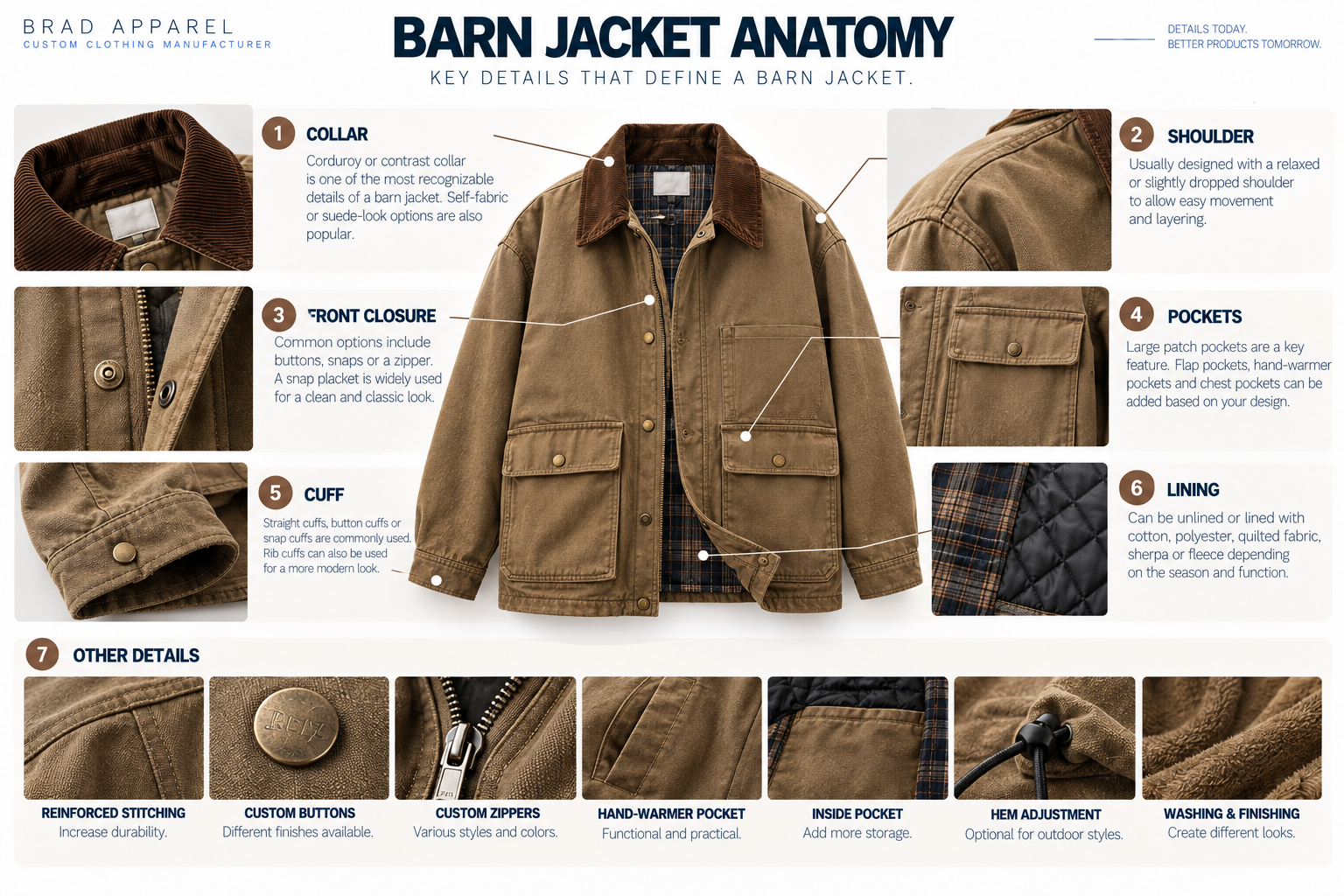
A barn jacket is a practical woven outerwear jacket traditionally associated with agricultural and outdoor work.
Modern versions commonly feature:
- Boxy or relaxed body
- Hip-length or slightly cropped silhouette
- Point or spread collar
- Corduroy or contrasting collar
- Large front patch pockets
- Button or snap front
- Durable cotton canvas or twill
- Optional lining
The overall appearance sits somewhere between:
Work jacket
and
casual everyday outerwear
That versatility is one reason the style has moved easily from practical clothing into fashion.
Why Are Barn Jackets Trending Again in 2026?
The current revival is part of a broader return to:
- Heritage workwear
- Country-inspired clothing
- Preppy casualwear
- Utility details
- Functional outerwear
- Everyday layering
The barn jacket works especially well because it does not feel overly technical or overly formal.
It can be styled as:
workwear
streetwear
minimal casualwear
or
premium heritage outerwear
without fundamentally changing the garment.
Barn Jacket vs Chore Jacket: What's the Difference?
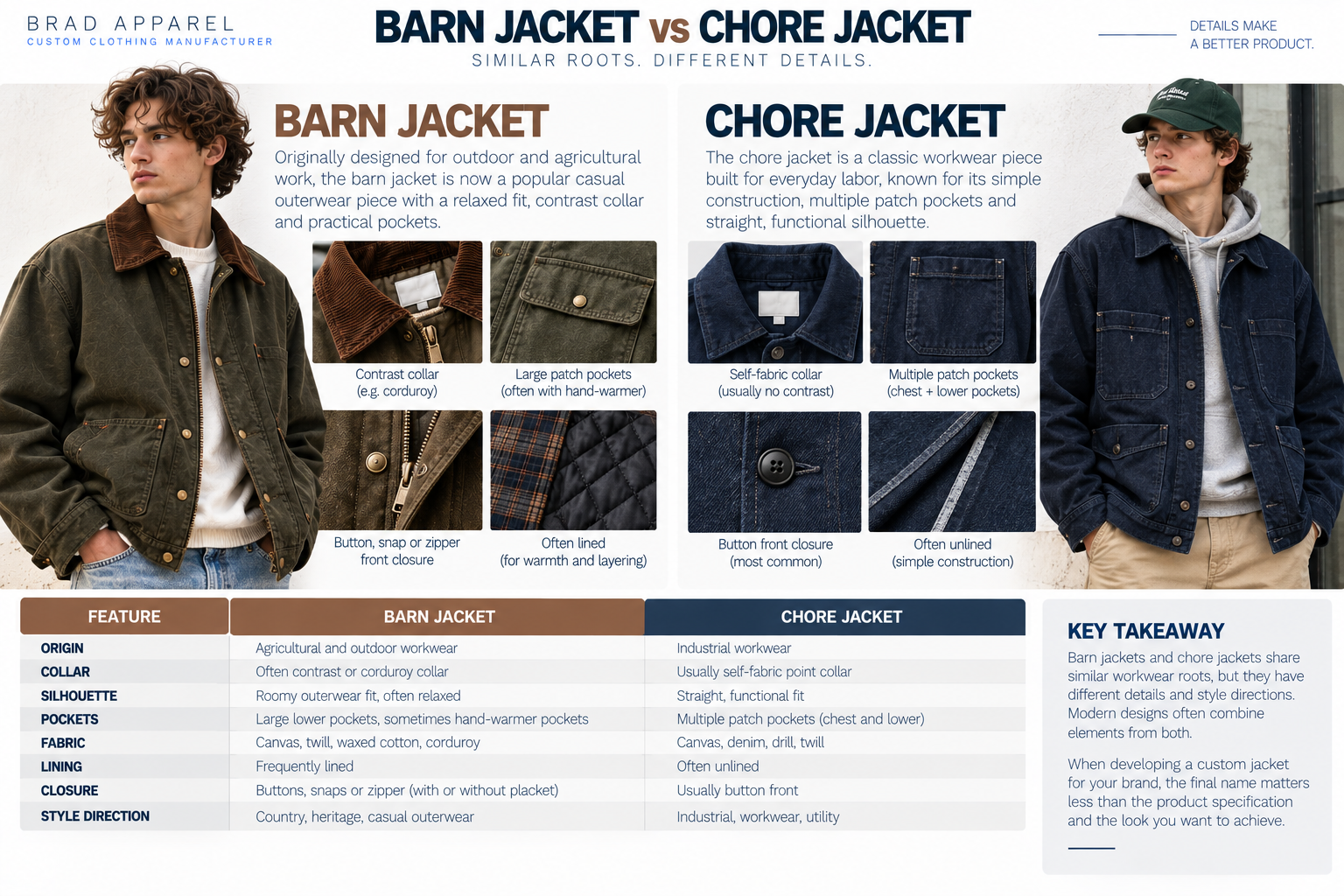
The two terms often overlap.
Both originate from functional workwear and may use similar fabrics.
However, there are several common differences.
| Feature | Barn Jacket | Chore Jacket |
|---|---|---|
| Typical Collar | Often contrast or corduroy collar | Usually self-fabric point collar |
| Body Shape | Roomy outerwear silhouette | Straight work-jacket silhouette |
| Pockets | Large lower pockets, sometimes hand-warmer pockets | Multiple patch pockets |
| Fabric | Canvas, twill, waxed cotton, corduroy | Canvas, drill, denim, twill |
| Styling | Country / heritage / casual outerwear | Industrial / workwear |
| Lining | Frequently lined | Often unlined |
These are not universal rules.
Modern brands increasingly combine elements of both garments.
For manufacturing purposes, the product specification matters more than the marketing name.
Barn Jacket vs Field Jacket
A field jacket usually contains more military or technical details.
It may include:
- Multiple flap pockets
- Internal drawcord
- Stand collar
- Epaulettes
- Zippers
- Technical fabric
- Longer body
A barn jacket is generally simpler.
Its identity usually comes from:
fabric + collar + pockets + relaxed workwear silhouette
rather than complex technical construction.
The Main Design Features of a Barn Jacket
A strong barn jacket usually depends on several recognizable design elements working together.
1. Relaxed, Boxy Silhouette
Traditional workwear needed room for movement and layering.
That same shape is now part of the fashion appeal.
Modern options include:
Classic Fit
- Relaxed chest
- Regular shoulder
- Hip length
Oversized Fit
- Wider body
- Dropped shoulder
- Larger sleeve
- More layering space
Cropped Fit
- Shorter body
- Wider chest
- Contemporary proportions
Long Barn Coat
- More coverage
- Stronger outerwear direction
The pattern should be developed intentionally.
Simply increasing the size of a regular jacket can make the garment too long rather than properly oversized.
2. The Collar Defines the Look
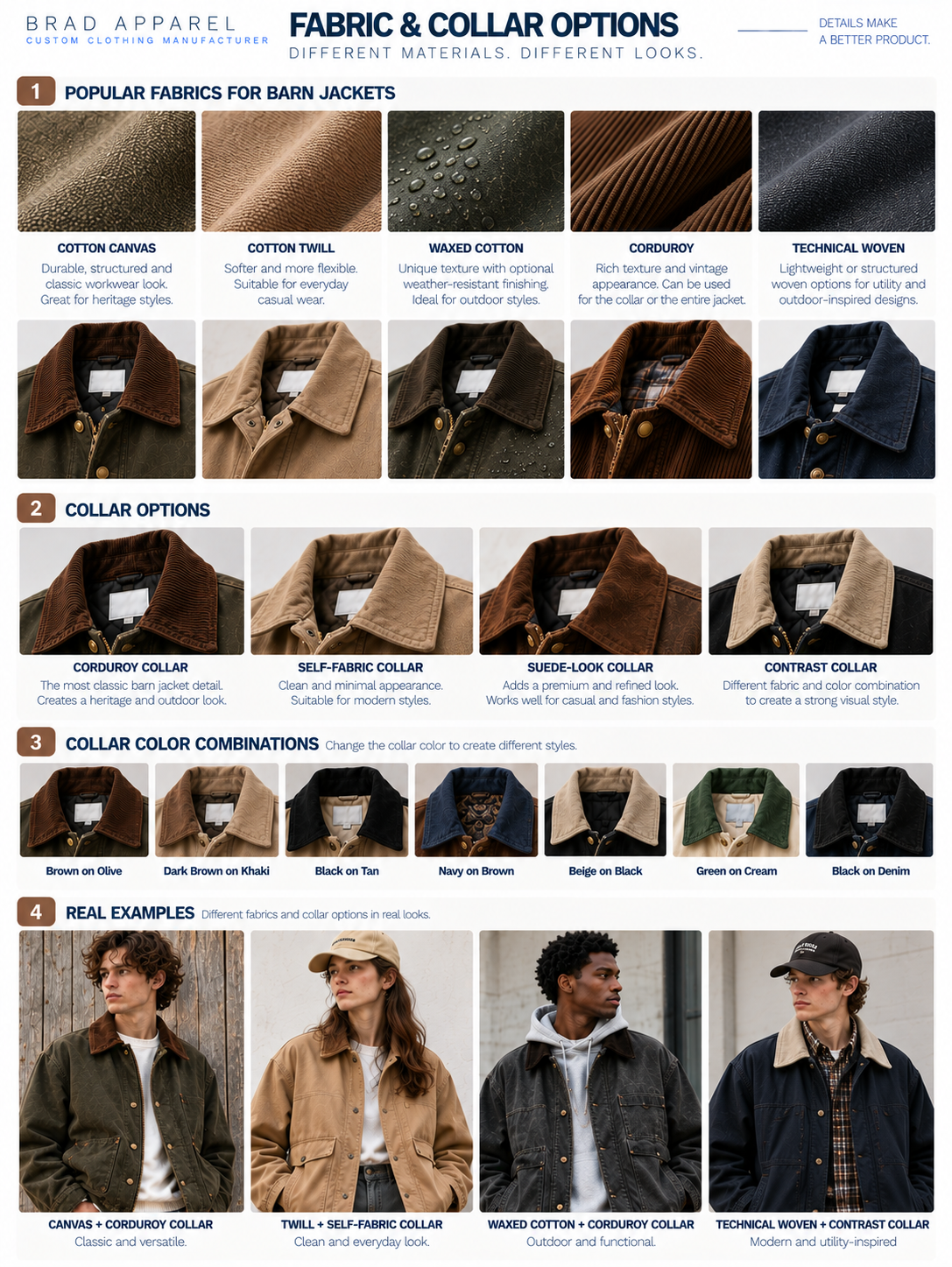
The collar is one of the most recognizable details.
Common options include:
Corduroy Collar
Probably the most recognizable barn-jacket direction.
It creates:
- Texture contrast
- Heritage appearance
- Visual separation from the body fabric
Self-Fabric Collar
Cleaner and more minimal.
Suitable for brands that want less traditional styling.
Suede-Look Collar
Creates a more premium heritage appearance.
Oversized Collar
Can give the jacket a more fashion-driven silhouette.
Collar Contrast Matters
Imagine:
Olive canvas + brown corduroy collar
versus
Black canvas + black self-fabric collar
The pattern may be identical.
But the perceived product becomes very different.
Collar material should therefore be selected together with:
- Body fabric
- Hardware finish
- Lining
- Color palette
rather than treated as an independent detail.
3. Fabric Determines Whether It Feels Like Workwear or Fashion
A barn jacket is usually made from woven fabric.
Several options can create very different products.
Cotton Canvas
One of the most traditional options.
Characteristics:
- Firm structure
- Durable hand feel
- Strong workwear appearance
- Good support for large pockets
Useful for:
- Heritage brands
- Streetwear
- Workwear-inspired collections
Cotton Twill
Usually softer and more flexible than heavy canvas.
Useful when the brand wants:
- Easier drape
- Lighter transitional outerwear
- Cleaner casual styling
Washed Canvas
Garment washing can soften an otherwise rigid woven fabric.
Possible visual effects include:
- Vintage appearance
- Faded seams
- Softer hand feel
- Broken-in look
Wash results should always be tested on the actual fabric.
Waxed Cotton
Waxed finishes can create:
- More traditional outdoor appearance
- Surface character
- Improved weather resistance depending on the treatment
However, waxed fabrics require different handling from ordinary cotton.
The factory should confirm:
- Sewing compatibility
- Needle marks
- Pressing method
- Packaging
- Surface consistency
before bulk production.
Corduroy
Corduroy can also be used for the entire jacket rather than only the collar.
This creates a softer, more fashion-focused version of the barn jacket.
4. Pocket Design Is More Important Than It Looks
Barn jackets are often defined by their pockets.
Common options include:
Large Patch Pockets
Simple and functional.
Flap Pockets
Adds more structure and visual detail.
Hand-Warmer Pockets
Can be integrated behind a patch pocket.
Chest Pocket
Adds additional workwear character.
Internal Pocket
Useful for more premium or practical outerwear.
Pocket Scale Should Match the Jacket
A wide oversized jacket with tiny standard-size pockets may look visually unbalanced.
The pocket should be reviewed relative to:
- Chest width
- Body length
- Hem position
- Button spacing
For oversized garments, pocket dimensions often need to increase as well.
Pocket Reinforcement Matters
Large pockets experience repeated pulling.
Stress usually concentrates around:
- Pocket corners
- Pocket openings
- Flap attachment points
Depending on the fabric and design, reinforcement may include:
- Bartacks
- Double stitching
- Reinforcement fabric
- Stronger seam construction
This is especially important for heavier canvas jackets.
5. Button, Snap or Zipper?

The front closure changes the entire character of the jacket.
Buttons
Creates the most traditional look.
Options include:
- Matte plastic
- Horn-look buttons
- Metal buttons
- Custom branded buttons
Snaps
Creates a cleaner and slightly more modern appearance.
Useful for:
- Minimal outerwear
- Technical-inspired versions
- Faster opening and closing
Zipper
Less traditional, but possible.
A zipper may move the product closer toward:
- Utility jacket
- Work jacket
- Lightweight outerwear
Zipper + Snap Placket
Combining both can create a more substantial outerwear construction.
This is more common when:
- Weather protection
- Structure
- Heavier layering
are part of the design.
Custom Hardware Can Change Perceived Quality
Details such as:
- Matte-black snaps
- Antique brass buttons
- Custom logo buttons
- Custom zipper pullers
can strongly affect the final impression.
Brad Apparel's verified Custom Zippers & Sliders page shows current zipper and slider development options.
6. Should a Barn Jacket Be Lined?
Not necessarily.
Both lined and unlined constructions are possible.
Unlined Barn Jacket
Benefits include:
- Lighter weight
- Simpler construction
- Better transitional use
- More visible internal seam finishing
But the inside needs to look clean.
Possible finishing methods include:
- Overlock
- Binding
- Clean-finished seams
Fully Lined Jacket
A lining can improve:
- Comfort
- Warmth
- Interior appearance
- Layering
Possible linings include:
- Cotton
- Polyester
- Quilted lining
- Sherpa
- Fleece
Partial Lining
Some jackets may use:
- Body lining only
- Sleeve lining only
- Upper-back lining
This can balance comfort and weight.
7. The Cuff Can Completely Change the Style
Traditional barn jackets may use:
Straight Sleeve Hem
Simple and classic.
Button Cuff
Adds adjustment and heritage detail.
Snap Cuff
More functional and modern.
Rib Cuff
Moves the garment closer toward bomber or streetwear styling.
Again, the right option depends on the design direction.
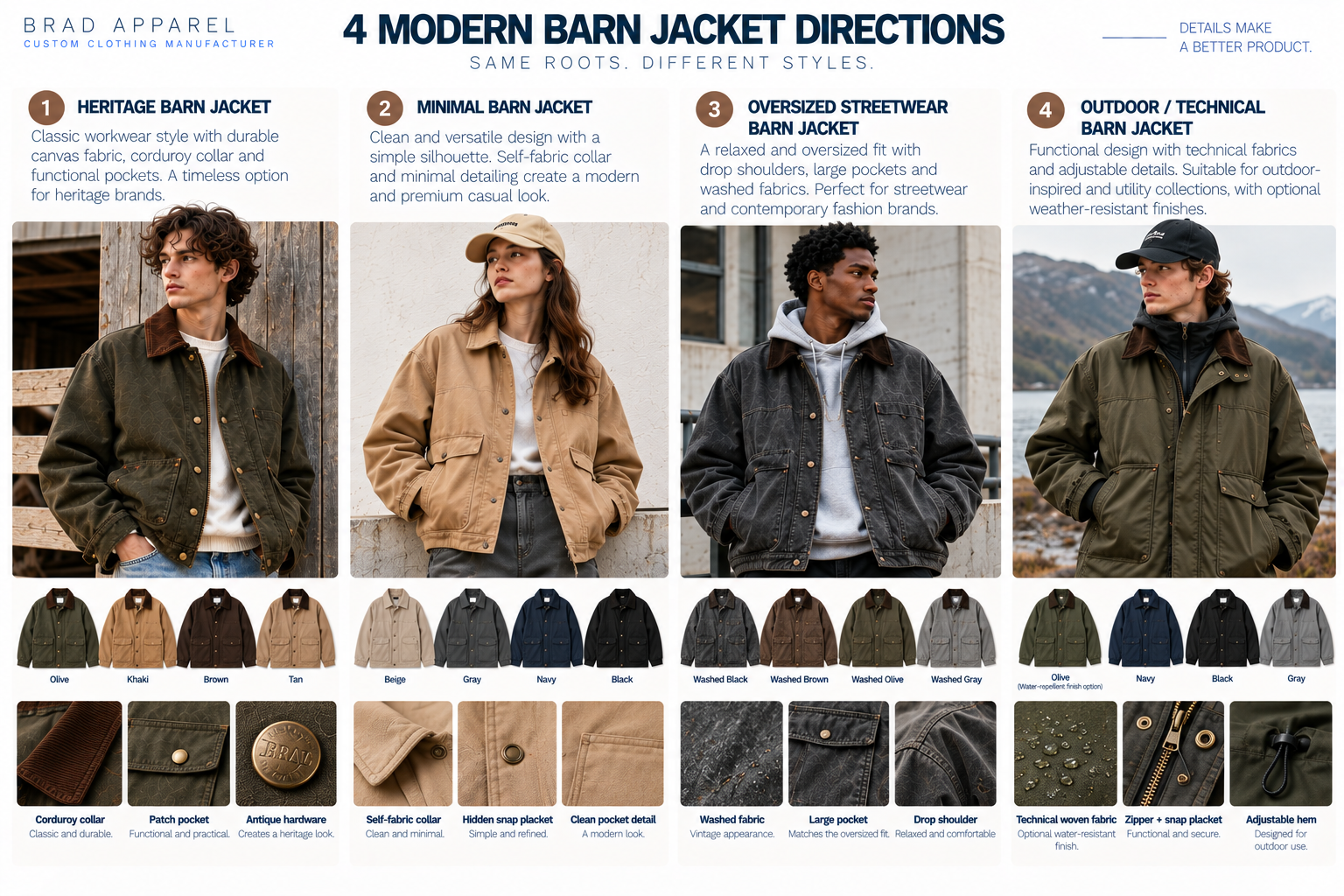
Four Modern Barn Jacket Directions
Brands do not need to copy one traditional version.
The basic structure can support several market directions.
1. Heritage Barn Jacket
Typical features:
- Cotton canvas
- Corduroy collar
- Relaxed fit
- Brown or antique hardware
- Large patch pockets
Best for:
- Heritage brands
- Workwear
- Premium casual collections
2. Minimal Barn Jacket
Possible features:
- Clean twill
- Self-fabric collar
- Hidden snaps
- Reduced pocket detailing
- Neutral colors
Best for:
- Minimal brands
- Premium casualwear
- Modern basics
3. Oversized Streetwear Barn Jacket
Possible features:
- Drop shoulder
- Wide body
- Cropped or controlled length
- Large pockets
- Washed fabric
- Custom graphics or embroidery
Best for:
- Streetwear
- Fashion collections
- Unisex brands
4. Outdoor / Technical Barn Jacket
Possible features:
- Coated woven fabric
- Snap or zipper closure
- Functional pocket layout
- Adjustable hem
- Weather-resistant finishing where specified
Best for:
- Outdoor-inspired brands
- Gorpcore
- Utility collections
How Should an Oversized Barn Jacket Be Patterned?
An oversized barn jacket should not simply be a larger regular jacket.
Important measurements include:
- Chest width
- Shoulder width
- Body length
- Sleeve width
- Sleeve length
- Armhole depth
- Hem opening
For example:
A brand may want:
more chest width
but
a relatively short body
to create a boxy silhouette.
If all measurements are increased equally, the jacket may become long rather than boxy.
What About Shrinkage?
Woven cotton fabrics can still change after washing.
This matters especially when the garment uses different materials.
For example:
Cotton canvas body
+
Corduroy collar
+
Polyester lining
may each react differently.
The factory should evaluate:
- Body shrinkage
- Collar shrinkage
- Twisting
- Seam puckering
- Lining compatibility
before bulk production.
Garment Washing Changes Measurements
If the jacket is intended to have:
- Vintage wash
- Pigment wash
- Enzyme wash
- Distressed finish
the final measurements should be checked after the intended wash process.
The pre-wash garment is not necessarily the final fit.
Why Collar Shrinkage Can Be a Problem
A contrast collar made from a different fabric may shrink differently from the jacket body.
This can create:
- Collar curling
- Uneven neckline
- Puckering
- Distorted front opening
The collar material should therefore be tested together with the main body fabric.
Decoration Options for Barn Jackets
Barn jackets usually rely more on construction and fabric than large graphics.
But decoration can still work.
Useful options include:
Small Chest Embroidery
Subtle and premium.
Back Embroidery
Good for workwear-inspired branding.
Patches
Suitable for:
- Heritage branding
- Utility collections
- Vintage references
Appliqué
Adds textile dimension.
Screen Print
Possible depending on the fabric surface and coating.
Always test printing before production if the fabric has:
- Wax
- Coating
- Heavy texture
because these surfaces may affect adhesion.
Fabric Should Be Confirmed Before Decoration
A print that works perfectly on untreated cotton twill may behave differently on:
waxed canvas
or
coated technical fabric.
Decoration testing should therefore use the intended production fabric.
Brad Apparel's verified Fabric Sourcing & Development page explains our process for evaluating composition, weight, color, texture and finishing before garment sampling.
What Should You Check on a Barn Jacket Sample?
A barn jacket sample should be evaluated beyond basic measurements.
Front View
Check:
- Jacket width
- Body length
- Collar symmetry
- Pocket position
- Closure alignment
Side View
Check:
- Body volume
- Sleeve shape
- Pocket bulk
- Hem balance
Back View
Check:
- Shoulder width
- Back shape
- Collar position
- Center-back balance
Collar
Check:
- Collar shape
- Collar height
- Material contrast
- Symmetry
Test both:
collar down
and
collar raised
if the design is intended to work both ways.
Pockets
Check:
- Size
- Symmetry
- Reinforcement
- Hand access
- Flap alignment
Closure
Check:
- Buttons / snaps / zipper operation
- Spacing
- Front alignment
- Reinforcement
Layering
Try the sample over the intended base garment.
For example:
T-shirt
sweater
or
hoodie
depending on the intended use.
Wash / Finish Test
If the design includes garment washing or special finishing, check:
- Final dimensions
- Fabric appearance
- Collar behavior
- Seam puckering
- Hardware appearance
after treatment.
Common Barn Jacket Development Mistakes
1. Using a Standard Jacket Pattern
The result may not have the relaxed workwear proportion expected from a barn jacket.
2. Collar Too Small
A narrow collar may look visually weak against a wide body.
3. Pocket Scale Is Wrong
Tiny pockets on an oversized body can look unbalanced.
4. Collar and Body Shrink Differently
This can distort the neckline after washing.
5. Fabric Is Too Soft
If the intended look is structured workwear, a very soft fabric may collapse.
6. Fabric Is Too Stiff
Extremely rigid canvas may feel uncomfortable for a fashion product.
7. Hardware Is Chosen Too Late
Button or snap:
- Size
- Color
- weight
- finish
should support the overall design.
8. Waxed Fabric Is Treated Like Normal Cotton
Waxed and coated surfaces require different sewing, pressing and decoration considerations.
What Should You Send a Manufacturer?
A useful barn jacket development brief should include:
Fit
- Regular
- Relaxed
- Oversized
- Cropped
- Long
Main Fabric
- Canvas
- Twill
- Corduroy
- Waxed cotton
- Technical woven
Collar
- Self fabric
- Corduroy
- Contrast woven
- Other material
Closure
- Buttons
- Snaps
- Zipper
- Combination
Pockets
- Patch pocket
- Flap pocket
- Hand-warmer pocket
- Chest pocket
- Internal pocket
Lining
- None
- Cotton
- Polyester
- Quilt
- Sherpa
- Fleece
Cuff
- Straight
- Button
- Snap
- Rib
Decoration
- Embroidery
- Patch
- Appliqué
Branding
- Main label
- Care label
- Custom buttons
- Hang tag
Packaging
- Polybag
- Custom bag
- Barcode
The clearer the specification, the less the factory needs to guess.
How Brad Apparel Can Develop a Custom Barn Jacket
A custom barn jacket project can follow a process such as:
Design Reference
↓
Fabric & Collar Material Selection
↓
Pattern Development
↓
Pocket & Hardware Confirmation
↓
Sample
↓
Fit Review
↓
Wash / Finish Review
↓
Decoration Approval
↓
Bulk Production
Brad Apparel supports development across knit, woven and technical garments, including jackets, and our production process covers fabric sourcing, sample development, decoration, trims and bulk production. (bradapparel.com)
For brands developing unusual fabric or finishing requirements, our Fabric Sourcing & Development service can be used to confirm material before sampling.
FAQ
What Is a Barn Jacket?
A barn jacket is a relaxed workwear-inspired outerwear jacket traditionally made from durable woven fabric such as canvas or twill.
It often features:
- Large pockets
- Simple front closure
- Roomy fit
- Contrast or corduroy collar
Why Are Barn Jackets Popular in 2026?
Barn jackets fit the current interest in:
- Heritage workwear
- Transitional outerwear
- Preppy styling
- Practical everyday clothing
Their simple shape also makes them easy to reinterpret across multiple fashion categories.
Is a Barn Jacket the Same as a Chore Jacket?
Not exactly, although the terms can overlap.
Barn jackets often emphasize:
- Outerwear layering
- Contrast collars
- Lining
while chore jackets are often simpler work jackets with multiple patch pockets.
Modern designs frequently combine features from both.
What Fabric Is Best for a Barn Jacket?
Common options include:
- Cotton canvas
- Cotton twill
- Waxed cotton
- Corduroy
- Technical woven fabrics
The best option depends on the intended structure, season and aesthetic.
Are Barn Jackets Waterproof?
Not automatically.
Traditional cotton canvas or twill is not necessarily waterproof.
Weather resistance depends on the fabric and finishing treatment.
Waxing or specific technical coatings may improve resistance when designed for that purpose.
Should a Barn Jacket Be Lined?
It can be lined or unlined.
Unlined versions are lighter and useful for transitional weather.
Lined versions can provide:
- More warmth
- Easier layering
- Cleaner interior appearance
Can a Barn Jacket Be Oversized?
Yes.
Oversized barn jackets can use:
- Wider chest
- Drop shoulder
- Larger sleeves
- Controlled body length
- Larger pockets
The pattern should be developed intentionally rather than simply increasing a regular jacket size.
Can a Barn Jacket Have a Corduroy Collar?
Yes.
A contrast corduroy collar is one of the most recognizable barn-jacket details.
It can be matched with:
- Canvas
- Twill
- Denim
- Waxed cotton
depending on the design.
Can Barn Jackets Be Customized?
Yes.
Brands can customize:
- Fabric
- Fit
- Collar
- Pockets
- Buttons
- Snaps
- Zippers
- Lining
- Embroidery
- Labels
- Packaging
Final Thoughts
The barn jacket trend is not simply about copying old workwear.
Its strength comes from a simple design system:
Durable woven fabric
Relaxed silhouette
Functional pockets
Recognizable collar
and
practical hardware
Modern brands can take those same principles in very different directions.
A barn jacket can become:
heritage
minimal
streetwear
or
technical
depending on how its fabric, fit, collar, pockets and trims are developed.
For clothing brands, that makes the barn jacket more than a seasonal trend.
It is a flexible outerwear platform that can be adapted into a recognizable product for your own collection.
Keep Reading