A military jacket is a structured outerwear style inspired by historical uniforms, officer jackets and functional military garments.
Modern fashion versions are not designed as uniforms.
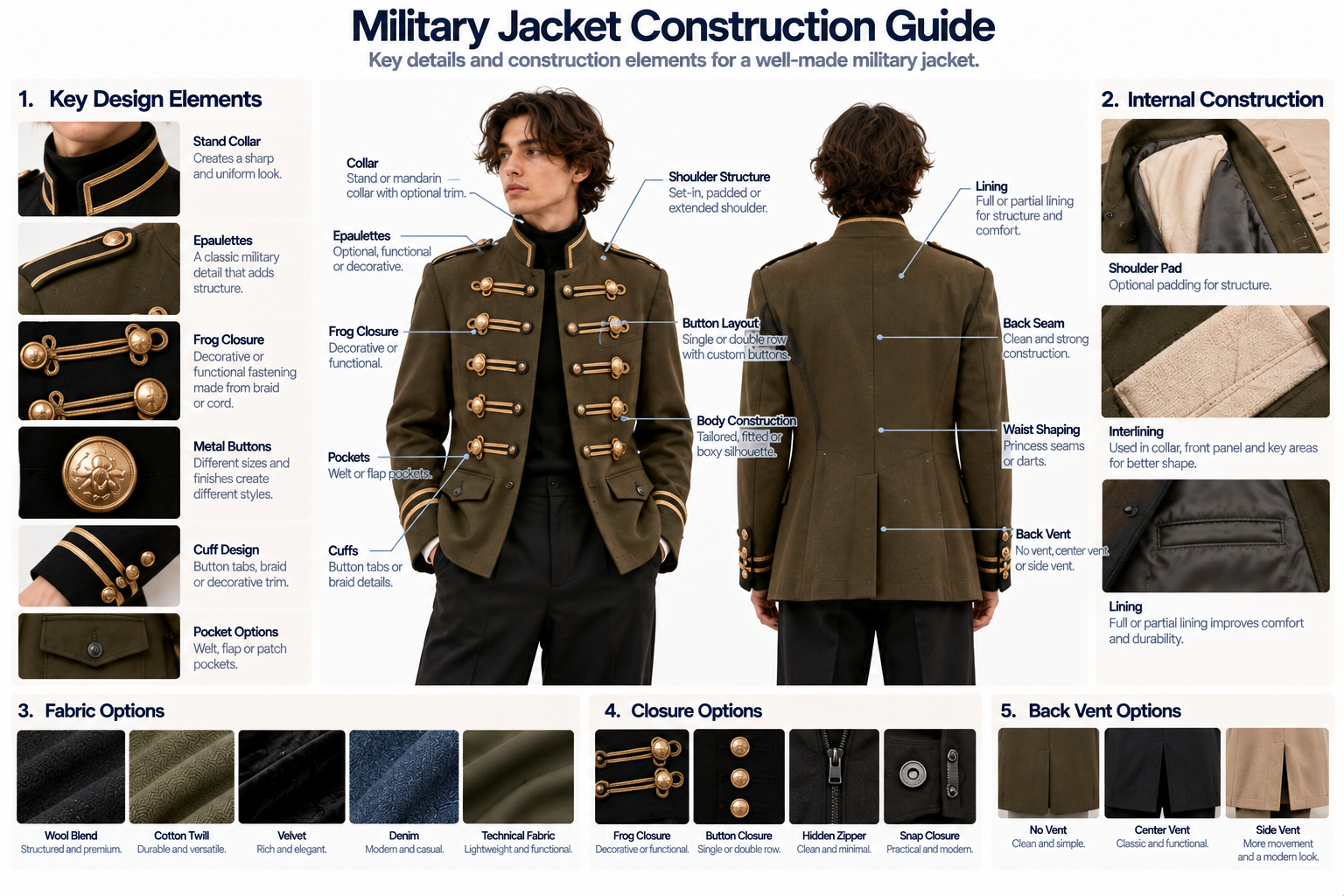
Instead, they borrow recognizable military details such as:
- Stand collars
- Structured shoulders
- Rows of buttons
- Frog closures
- Braided trim
- Epaulettes
- Cuff tabs
- Chest pockets
- High front closures
- Sharp or cropped proportions
In 2026, military-inspired jackets are appearing in much cleaner and more fashion-focused forms.
Some are highly decorative.
Others keep only one or two military references.
For clothing brands, the important point is that a successful military jacket should not be created by simply adding metal buttons to a normal blazer.
The final result depends on the relationship between:
silhouette + shoulder structure + collar + closure + trim placement + fabric + internal support
This guide explains what defines a modern military jacket, how it differs from field and utility jackets, and what brands should specify before developing one for production.
What Is a Military Jacket?
The term "military jacket" covers several garments influenced by military uniforms.
In fashion, it commonly describes a structured jacket using details associated with:
- Officer uniforms
- Hussar jackets
- Band jackets
- Cavalry uniforms
- Ceremonial uniforms
- Field clothing
However, these references create very different products.
A fitted cropped jacket with decorative braid and polished buttons is completely different from a functional four-pocket field jacket.
Both may still be described as military-inspired.
That means the product name alone is not enough for manufacturing.
A development brief should define the specific military elements being used.
Why Are Military Jackets Trending Again in 2026?
The current revival fits several broader fashion directions:
- 2000s nostalgia
- Structured jackets
- Cropped outerwear
- Statement buttons
- Decorative closures
- Heritage clothing
- Modern tailoring
- Romantic military styling
- Uniform-inspired fashion
- Trophy jackets
But the newer military jacket does not always reproduce historical uniforms literally.
Current interpretations often simplify the look.
Instead of combining:
gold braid + large epaulettes + multiple rows of buttons + decorative cuffs
all in one garment, a modern jacket may focus on:
- One frog closure
- Tonal braiding
- Matte buttons
- Cropped body
- Clean stand collar
- Minimal shoulder structure
This makes the military reference more wearable and less costume-like.
Military Jacket vs Field Jacket vs Utility Jacket vs Blazer
These categories are frequently confused.
| Style | Main Influence | Typical Structure | Key Details | Typical Look |
|---|---|---|---|---|
| Military Jacket | Officer / ceremonial uniforms | Structured | Buttons, braiding, stand collar, epaulettes | Sharp / decorative |
| Field Jacket | Functional military outerwear | Relaxed / practical | Multiple pockets, drawcords, high collar | Functional |
| Utility Jacket | General workwear / functional clothing | Regular / relaxed | Practical pockets, durable fabrics | Casual |
| Blazer | Tailoring | Structured | Lapels, buttons, welt/flap pockets | Tailored |
| Bomber Jacket | Flight jacket | Blouson | Rib trim, zipper, rounded body | Sporty / casual |
A fashion military jacket is usually defined more strongly by its visual uniform references.
A field jacket is primarily functional.
A utility jacket can borrow military details without looking like an officer jacket.

Military Jacket vs Field Jacket
A field jacket is directly connected to practical military clothing.
Typical features may include:
- Multiple patch pockets
- Durable woven fabric
- Relaxed body
- Drawcord waist
- High collar
- Snap or zipper closure
- Functional construction
A modern fashion military jacket may instead use:
- Tailored body
- Defined waist
- Decorative buttons
- Braiding
- Stand collar
- Minimal pockets
Think of the distinction as:
Field jacket = military function
Fashion military jacket = military visual language
Some garments combine both.
Military Jacket vs Blazer
A blazer normally uses traditional tailoring elements such as:
- Notch or peak lapel
- Single- or double-breasted closure
- Welt or flap pockets
- Set-in sleeves
- Tailored front
A military jacket can also be tailored, but military details change the visual identity.
For example:
black fitted jacket + notch lapel + two buttons
reads as a blazer.
But:
black fitted jacket + stand collar + eight decorative buttons + cord braid
reads much more clearly as military-inspired outerwear.
Military Jacket vs Band Jacket
Band jackets are closely related to ceremonial military styling.
Common details include:
- High stand collar
- Braided front
- Decorative loops
- Multiple buttons
- Contrast trim
- Structured cuffs
A band jacket is therefore one of the strongest military-inspired fashion directions.
However, modern military jackets can be far more minimal.
Military Jacket vs Officer Jacket
"Officer jacket" is often used for more refined military-inspired styles.
Typical characteristics include:
- Sharp tailoring
- Defined shoulder
- High or structured collar
- Polished buttons
- Clean body shape
The term is not a universal manufacturing classification.
A technical specification should still define the actual collar, closure, fit and trim.
The Collar Is One of the Strongest Military Details
Military jackets can use several collar types.
Stand Collar
One of the most recognizable options.
It creates:
- Upright neckline
- Sharp uniform appearance
- Clean front
- Strong structure
The height should always be specified.
For example:
Finished collar height: 4.5 cm
is much more useful than:
Military collar
Mandarin-Style Collar
A shorter, close-fitting stand collar can create a cleaner military reference.
It may be suitable for:
- Minimal jackets
- Cropped jackets
- Lighter fabrics
High Stand Collar
Creates a stronger visual statement.
It can work well with:
- Decorative buttons
- Frog closures
- Structured wool
- Velvet
But an excessively high collar may become uncomfortable.
Notch Lapel
Military-inspired jackets can also use a tailored lapel.
In this case, the military identity may come primarily from:
- Buttons
- Shoulder structure
- Epaulettes
- Braiding
rather than the collar.
Collar Height Should Be Tested on the Wearer
A collar can look correct on a flat technical drawing but behave differently when worn.
Check:
- Chin clearance
- Neck comfort
- Front opening
- Back-neck height
- Collar symmetry
The wearer should be able to:
- Turn their head
- Look downward
- Sit
- Fully close the jacket
without excessive pressure around the neck.
What Is Frogging on a Jacket?
Frogging is a decorative closure system made from cord, braid or looped trim.
It is strongly associated with:
- Hussar jackets
- Military uniforms
- Ceremonial clothing
- Traditional decorative outerwear
A frog closure normally includes:
looped cord or braid + fastening element
The fastening may use:
- Cord loops
- Toggles
- Buttons
- Knotted elements
Modern fashion versions may simplify the historical structure.
Frog Closure vs Decorative Braiding
These are related but not identical.
Functional Frog Closure
Actually opens and closes the garment.
Decorative Frogging
Creates the military visual effect but may not function as the primary closure.
The jacket may use:
- Hidden snaps
- Internal zipper
- Concealed buttons
underneath decorative braiding.
This is often more practical.
Why Decorative Frogging May Need a Hidden Closure
Highly decorative cord may look impressive but may not provide the most stable everyday fastening system.
Possible issues include:
- Difficult opening
- Cord stretching
- Loop distortion
- Uneven tension
- Slow dressing
A modern jacket can therefore use:
decorative frog details outside
with:
hidden snaps inside
This maintains the aesthetic while improving function.
Types of Braid Used on Military Jackets
Several trims can create military-inspired decoration.
Possible options include:
- Soutache braid
- Flat braid
- Twisted cord
- Round cord
- Metallic braid
- Woven tape
- Custom decorative tape
Each behaves differently.
Soutache Braid
A narrow decorative braid frequently used for:
- Curved motifs
- Loops
- Decorative outlines
It can follow curved shapes relatively well.
Round Cord
Creates stronger three-dimensional relief.
It may be used for:
- Frog closures
- Loops
- Decorative front designs
Metallic Braid
Creates a ceremonial or luxury appearance.
Possible finishes include:
- Gold
- Antique gold
- Silver
- Gunmetal
Metallic trim should be tested for:
- Abrasion
- Washing
- Tarnishing
- Skin comfort
Frogging Placement Must Be Measured
Do not develop decorative front braiding only by eye.
A tech pack should define:
- Number of rows
- Vertical spacing
- Horizontal width
- Start point
- End point
- Distance from center front
- Button position
- Cord width
For example:
6 horizontal frog rows
Vertical spacing: 45 mm
is much clearer than:
Add military braiding like the reference.
Left and Right Symmetry Is Critical
Military-inspired decoration is highly geometric.
Small inconsistencies become very visible.
During sampling, check:
- Left/right braid length
- Curve shape
- Button level
- Cord tension
- Row spacing
- Center-front balance
One side should mirror the other unless asymmetry is intentional.
Decorative Cord Should Not Twist
Round and braided cords can rotate during sewing.
This can create:
- Uneven surface
- Visible twisting
- Irregular curves
The sewing team may need:
- Placement guides
- Temporary fixation
- Controlled stitching
before permanent attachment.
Military Jacket Button Layout
Buttons are one of the easiest ways to create military character.
Possible layouts include:
Single Row
Creates a cleaner and more modern interpretation.
Double Row
Creates stronger uniform influence.
Multiple Decorative Rows
Can create a ceremonial or band-jacket appearance.
Button + Frog Combination
Combines metal hardware with decorative cord.
The button layout should match the body proportion.
Button Size Matters
A small button may disappear on a highly structured jacket.
An oversized metal button may dominate a minimal design.
Button size should be evaluated against:
- Collar
- Chest width
- Body length
- Braid width
- Button spacing
before bulk production.
Metal Button Finishes
Common finishes include:
- Polished gold
- Antique gold
- Silver
- Antique silver
- Gunmetal
- Matte black
- Brushed nickel
- Custom enamel
The finish can completely change the garment.
For example:
black wool + polished gold
creates a strong traditional military reference.
black wool + matte black buttons
creates a much more subtle modern version.
For custom buttons, snaps, labels and other trims, see Brad Apparel's Trims & Branding capabilities.
Button Attachment Needs Reinforcement
Heavy metal buttons create more stress than lightweight plastic buttons.
Depending on the shell fabric, reinforcement may include:
- Backing button
- Internal reinforcement patch
- Interlining
- Stronger thread
- Shank reinforcement
This is especially important on:
- Wool
- Soft woven fabric
- Lightweight jackets
A premium metal button attached poorly will quickly make the entire garment feel low quality.
Military Jacket Construction Anatomy
A typical fashion military jacket may contain:
- Stand collar
- Structured shoulder
- Epaulettes
- Front braid
- Decorative buttons
- Functional closure
- Shaped body panels
- Cuff tabs
- Welt or flap pockets
- Lining
- Interlining
- Back vent
- Custom labels
Epaulettes
Epaulettes are shoulder tabs historically associated with uniforms.
Modern versions may be:
- Functional
- Decorative
- Buttoned
- Snapped
- Sewn permanently
They can reinforce the military reference immediately.
But not every military jacket needs them.
A cleaner modern version may omit epaulettes entirely.
Epaulette Width and Length Need Proportion
An oversized epaulette can make the shoulder appear much broader.
A small epaulette may look insignificant on a large jacket.
Specify:
- Finished width
- Finished length
- Button size
- Position
- Distance from neckline
The epaulette should follow the shoulder line cleanly.
Shoulder Structure Changes the Entire Jacket
Military jackets can range from very sharp to relaxed.
Possible shoulder directions include:
Structured Set-In Shoulder
Creates:
- Sharp silhouette
- Formal appearance
- Officer-jacket character
May use:
- Shoulder pad
- Sleeve-head roll
- Interlining
Natural Set-In Shoulder
Creates a cleaner but less aggressive structure.
Extended Shoulder
Adds:
- Modern proportion
- Strong upper body
- Fashion-forward appearance
Drop Shoulder
Moves the military jacket toward:
- Streetwear
- Relaxed styling
- Oversized silhouettes
This is less historically traditional but works well for modern reinterpretations.
Shoulder Pads Should Match the Design
More padding is not automatically better.
A highly padded shoulder can make a jacket look:
- Too theatrical
- Too formal
- Costume-like
A modern military jacket may use only subtle support.
Possible directions include:
- No shoulder pad
- Thin shoulder pad
- Medium pad
- Strong structured pad
The final decision should be made on the sample.
Sleeve-Head Support
Sleeve-head roll or internal support can help the sleeve transition cleanly from a structured shoulder.
It may improve:
- Sleeve cap shape
- Shoulder smoothness
- Tailored appearance
This detail is largely invisible from the outside but can significantly affect the final silhouette.
Cropped Military Jackets
Cropped military jackets are particularly relevant to modern fashion.
A cropped version may end:
- At natural waist
- Slightly below waist
- At high hip
This creates a stronger contrast between:
structured upper body
and
lower-body silhouette
The crop needs to be intentionally patterned.
Simply shortening a standard jacket can create problems with:
- Pocket position
- Button spacing
- Braid placement
- Waist shaping
- Sleeve proportion
Regular-Length Military Jackets
A more traditional jacket may finish around:
- High hip
- Full hip
This provides more room for:
- Decorative closures
- Multiple button rows
- Pockets
It also works well for more heritage-inspired designs.
Long Military Jackets
Some designs extend toward:
- Upper thigh
- Mid-thigh
These begin to resemble:
- Military coats
- Officer coats
- Band coats
The longer body changes the proportion of every decorative element.
A braid layout designed for a cropped jacket should not simply be copied onto a long coat.
Military Jacket Fit Options
Fitted
May use:
- Defined waist
- Princess seams
- Darts
- Close body fit
Suitable for:
- Officer jackets
- Tailored womenswear
- Peplum military jackets
Regular
Provides:
- Moderate ease
- Traditional body proportion
- Easy layering
Boxy
Uses:
- Wider chest
- Straighter body
- Controlled length
Can create a contemporary uniform-inspired silhouette.
Oversized
May use:
- Wider shoulders
- Larger sleeves
- Increased body volume
- Relaxed structure
The decorative details should scale with the larger body.
Waist Shaping
Traditional officer-inspired jackets often emphasize the waist.
Possible techniques include:
- Princess seams
- Waist darts
- Side-panel shaping
- Curved center-back seams
Modern military jackets do not need a strongly fitted waist.
A straight or boxy body can create a more contemporary result.
Princess Seams
Princess seams can shape:
- Bust
- Waist
- Hip
while maintaining a clean front.
They are particularly useful for fitted military jackets because they provide structure without relying only on darts.
Decorative braiding can also be positioned relative to these seam lines.
Peplum Military Jackets
Military styling can be combined with peplum construction.
Possible combination:
structured shoulder + fitted waist + military buttons + flared lower body
This produces a much more sculptural silhouette.
The peplum should still be engineered independently.
For peplum pattern construction, see our Peplum Top Guide.
Fabric Choice Changes the Military Effect
The same military-jacket pattern can look completely different depending on fabric.
Wool and Wool Blends
Create:
- Traditional uniform character
- Structure
- Premium appearance
- Strong tailoring
Cotton Twill
Creates:
- Casual military styling
- More everyday wearability
- Moderate structure
Velvet
Creates:
- Ceremonial appearance
- Rich surface
- Evening styling
Denim
Creates a more modern and casual interpretation.
Denim military jackets can combine:
- Decorative buttons
- Braiding
- Cropped proportion
without appearing too formal.
Technical Woven Fabric
Can move the category toward modern utility outerwear.
Possible options include:
- Nylon
- Polyester
- Lightweight technical twill
For fabric selection and custom development, see Brad Apparel's Fabric Sourcing & Development.
Fabric Weight Must Match the Structure
A heavily structured jacket needs enough fabric body.
Very lightweight fabric may:
- Collapse at the shoulder
- Pucker around braid
- Distort around heavy buttons
Very heavy fabric may:
- Create excessive seam bulk
- Make decorative construction difficult
- Reduce comfort
Fabric and internal support should be considered together.
Interlining
Interlining may be used around:
- Collar
- Center front
- Button area
- Shoulder
- Hem
Its purpose is to stabilize the garment.
The entire jacket does not necessarily need the same reinforcement.
Selective support often creates a better result.
Decorative Embroidery vs Applied Braid
Military-style decoration can be created in different ways.
Applied Braid
A physical trim is sewn onto the shell.
Advantages:
- Strong three-dimensional appearance
- Traditional character
- Material contrast
Embroidery
The decorative shape is stitched directly onto the garment.
Advantages:
- More design flexibility
- No loose cord
- Easier repeatability for complex motifs
But dense embroidery can stiffen the garment.
The technique should match the desired look.
For embroidery options, see Brad Apparel's Embroidery Techniques guide.
Tonal Military Decoration
Military details do not need to use gold.
A modern jacket can use:
black shell + black braid + black buttons
or:
navy shell + navy cord
This creates military structure without a strong costume effect.
Tonal decoration is particularly useful for:
- Premium streetwear
- Minimal collections
- Modern womenswear
- Unisex jackets
Contrast Military Decoration
Contrast trim creates stronger visual impact.
Examples include:
- Black + gold
- Navy + white
- Burgundy + black
- Cream + black
- Olive + antique brass
The trim color should be approved together with the shell fabric.
Cuff Construction
Military-inspired cuffs can contain:
- Button tabs
- Contrast braid
- Multiple buttons
- Turn-back cuff
- Straight cuff
- Split cuff
A cuff can reinforce the uniform identity even when the rest of the jacket is relatively simple.
Decorative Cuff Buttons
Rows of cuff buttons can create a tailored military appearance.
They may be:
- Functional
- Nonfunctional
For production, specify whether the cuff should actually open.
A nonfunctional decorative cuff can reduce construction complexity.
Pockets
Possible pocket constructions include:
- Welt pocket
- Flap pocket
- Patch pocket
- Zipper pocket
- Hidden side pocket
More formal military jackets often use:
- Welt
- Flap
while utility-inspired versions may use:
- Patch
- Cargo-style pockets
Pocket design strongly affects whether the jacket feels ceremonial or functional.
Pocket Placement Should Follow the Decoration
A common development issue is placing decorative braid and pockets independently.
They may visually collide.
Before sampling, review:
- Braid endpoint
- Button rows
- Pocket opening
- Waist seam
- Side seam
as one complete front layout.
Lining
Structured military jackets often benefit from lining.
A lining can:
- Hide internal construction
- Cover braid stitching
- Improve layering
- Protect interlining
- Create a premium interior
Possible lining fabrics include:
- Polyester
- Viscose
- Acetate
- Satin
- Lightweight twill
The lining should have enough movement ease.
Interior Finishing Matters More on Decorative Jackets
The outer shell may contain numerous:
- Buttons
- Braid seams
- Reinforcement points
- Panel seams
A full lining can hide this complexity.
If the jacket is unlined, the internal finishing needs more attention.
Military Jacket Fit & Detail Options
A modern military jacket can move in several directions.
Minimal Military Jacket
- Stand collar
- Tonal buttons
- Clean body
- Minimal braid
- Straight fit
Cropped Military Jacket
- Short body
- Structured shoulder
- High waist emphasis
- Decorative buttons
Officer Jacket
- Tailored fit
- Defined shoulder
- High collar
- Polished hardware
Band / Hussar-Inspired Jacket
- Multiple braid rows
- Frog closures
- Strong decoration
- Structured body
Oversized Military Jacket
- Wider body
- Extended or dropped shoulder
- Scaled-up trim
- Relaxed styling

Modern Military Jackets Need Restraint
One of the biggest design challenges is knowing when to stop adding details.
A jacket containing:
- Epaulettes
- Gold braid
- Eight metal buttons
- Decorative cuffs
- Contrast collar
- Multiple pockets
can quickly become visually overloaded.
A contemporary product may be stronger with only:
structured shoulder + stand collar + one distinctive closure system
The military influence remains clear without becoming costume-like.
How to Describe a Military Jacket to a Manufacturer
Instead of writing:
I want a military jacket.
write something like:
Cropped structured military-style jacket in black wool-blend fabric with a 4.5 cm stand collar, fitted princess-seam body, lightly padded shoulders, six tonal soutache frog details across the front and matte gunmetal buttons. Hidden snap closure underneath the decorative front.
Then provide:
- Front reference
- Back reference
- Side reference
- Fit
- Body length
- Shoulder construction
- Fabric
- Collar
- Closure
- Button specification
- Braid specification
- Braid position
- Cuff
- Lining
- Branding
This gives the sample team a far clearer starting point.
Example Minimal Military Jacket Development Brief
Boxy military-inspired jacket in washed cotton twill with a short stand collar, four concealed front snaps, tonal decorative cord at the chest, slightly extended shoulders and welt pockets.
This creates a modern and restrained interpretation.
Example Officer Jacket Development Brief
Fitted officer-style jacket in structured wool blend with a high stand collar, lightly padded shoulder, double row of antique-gold metal buttons, princess seams, shaped waist and fully lined interior.
This moves the garment toward traditional tailored military styling.
Example Hussar-Inspired Development Brief
Cropped black jacket with structured shoulders, round black cord frogging across the front, six decorative metal buttons, high stand collar and tonal cuff braid. Hidden internal snaps for functional closure.
This defines both:
visual decoration
and
functional construction
which reduces ambiguity.
Important Military Jacket Measurements
| Measurement | Why It Matters |
|---|---|
| Chest Width | Controls body fit |
| Waist Width | Important for shaped jackets |
| Body Length | Controls cropped vs regular proportion |
| Shoulder Width | Defines upper-body structure |
| Armhole | Controls movement |
| Bicep Width | Controls sleeve volume |
| Sleeve Length | Defines finished arm proportion |
| Sleeve Opening | Controls cuff |
| Collar Height | Defines neckline |
| Neck Opening | Controls comfort |
| Front Overlap | Affects closure |
| Button Position | Controls front layout |
| Frog Width | Controls decorative proportion |
| Frog Spacing | Ensures repeat consistency |
| Epaulette Width | Controls shoulder detail |
| Pocket Position | Affects function and balance |
Decorative measurements are just as important as fit measurements on this type of jacket.
A Separate Trim Specification Sheet Is Useful
For detailed military jackets, create a trim sheet showing:
| Trim | Specification |
|---|---|
| Main Button | Size + material + finish |
| Cuff Button | Size + finish |
| Braid | Type + width + color |
| Cord | Diameter + material |
| Snap | Size + finish |
| Zipper | Type + gauge + color |
| Main Label | Size + placement |
| Care Label | Content + position |
This prevents accessories from being selected independently.
How to Evaluate the First Military Jacket Sample
The sample should be reviewed both for fit and detail accuracy.
Front View
Check:
- Collar
- Shoulder symmetry
- Button alignment
- Frog placement
- Waist shape
- Pocket level
- Body length
Side View
Check:
- Shoulder projection
- Sleeve position
- Chest balance
- Waist shaping
Back View
Check:
- Shoulder balance
- Back seams
- Center-back line
- Hem
- Epaulette position
Check Decorative Symmetry
Measure both sides.
Do not rely only on visual inspection.
Check:
- Frog width
- Row spacing
- Button distance
- Cord curve
- Cuff trim
- Epaulettes
Highly symmetrical decoration makes small errors easy to see.
Check the Jacket Fully Closed
Inspect whether:
- Center front remains straight
- Collar stays level
- Decorative rows remain horizontal
- Buttons do not pull the fabric
- Hidden closure remains invisible
Check the Jacket Open
The inside should still look intentional.
Inspect:
- Facing
- Lining
- Hidden snaps
- Braid stitching
- Reinforcement
A decorative jacket should not look unfinished once opened.
Check Shoulder Movement
Ask the wearer to:
- Raise arms
- Reach forward
- Sit
- Cross arms
A sharp shoulder silhouette should not require excessively restricted movement.
Check Heavy Trims
Heavy buttons and braiding can affect drape.
Look for:
- Front pulling
- Sagging
- Fabric distortion
- Collar imbalance
If the trim is too heavy, the solution may require:
- Stronger fabric
- Additional reinforcement
- Lighter hardware
rather than simply tighter stitching.
Wash and Durability Testing
If the jacket is intended to be washable, test:
- Braid shrinkage
- Cord twisting
- Button finish
- Colorfastness
- Fabric shrinkage
- Lining
- Embroidery
- Seam distortion
Different materials may react differently.
For heavily decorated jackets, dry-clean-only care may sometimes be more appropriate depending on the selected materials.
The final care instruction should be based on actual component testing.
Common Military Jacket Development Mistakes
1. Adding Too Many Military Details
More decoration does not automatically create a better jacket.
2. Treating Frogging as Decoration Only
If it is intended to function, closure strength needs to be tested.
3. Installing Heavy Buttons Without Reinforcement
The shell may distort or tear.
4. Using Braid Without Exact Placement Measurements
Left and right sides may become inconsistent.
5. Making the Collar Too High
The garment can become uncomfortable.
6. Overpadding the Shoulder
The jacket may become costume-like.
7. Using Lightweight Fabric With Heavy Trim
The front can sag or pucker.
8. Shortening a Regular Jacket to Create a Crop
Button, pocket and braid proportions may become incorrect.
9. Ignoring the Interior
Decorative stitching and reinforcement need clean finishing.
10. Approving Only the Front View
Shoulder, sleeve and back balance can still be incorrect.
Military Jacket Tech Pack Example
| Area | Example Specification |
|---|---|
| Product | Cropped Military Jacket |
| Fit | Structured / Fitted |
| Shell | Wool Blend |
| Body Length | Cropped |
| Shoulder | Lightly Padded Set-In |
| Collar | Stand Collar |
| Collar Height | 4.5 cm |
| Front | Decorative Frogging |
| Functional Closure | Hidden Snaps |
| Braid | Tonal Soutache |
| Buttons | Matte Gunmetal |
| Body | Princess Seams |
| Cuff | Button Tab |
| Welt Pocket | |
| Lining | Full Lining |
| Branding | Woven Main Label |
These specifications are examples only.
Minimal Military Jacket Tech Pack Example
| Area | Example Specification |
|---|---|
| Product | Minimal Military Jacket |
| Fit | Boxy |
| Fabric | Washed Cotton Twill |
| Shoulder | Slightly Extended |
| Collar | Short Stand Collar |
| Closure | Hidden Snap |
| Military Detail | Tonal Cord |
| Sleeve | Relaxed |
| Welt | |
| Hem | Straight |
| Lining | Partial / Unlined |
| Hardware | Matte Black |
Officer Jacket Tech Pack Example
| Area | Example Specification |
|---|---|
| Product | Officer Jacket |
| Fit | Tailored |
| Fabric | Structured Wool Blend |
| Shoulder | Structured |
| Collar | High Stand Collar |
| Front | Double-Breasted Appearance |
| Button | Antique Gold |
| Waist | Shaped |
| Sleeve | Two-Piece |
| Cuff | Decorative Buttons |
| Welt | |
| Lining | Full |
| Internal Support | Selective Interlining |
Which Military Jacket Should Your Brand Develop?
Choose a minimal military jacket if you want:
- Easier everyday styling
- Tonal trims
- Cleaner commercial product
- Subtle uniform references
Choose a cropped military jacket if you want:
- Strong fashion proportion
- Defined waist
- Structured upper body
- Modern styling
Choose an officer jacket if you want:
- Tailoring
- Strong shoulder
- Premium wool
- Polished buttons
Choose a frog-closure or Hussar-inspired jacket if you want:
- Strong visual identity
- Decorative trim
- Heritage influence
- Statement outerwear
Choose a field jacket instead if your priority is:
- Functional pockets
- Utility
- Durability
- Relaxed fit
The design direction should be defined before pattern and trim development begin.
FAQ
What Is a Military Jacket?
A military jacket is an outerwear style inspired by military uniforms and garments.
Fashion versions may use details such as stand collars, structured shoulders, metal buttons, epaulettes, braiding and frog closures.
Are Military Jackets in Style in 2026?
Yes.
Military-inspired jackets are one of the notable Fall 2026 outerwear directions, with modern versions using cleaner tailoring, decorative closures and more refined materials.
What Is a Frog Closure?
A frog closure is a decorative fastening made from looped cord or braid.
It is commonly associated with military, ceremonial and traditional garments.
What Is the Difference Between Frogging and Braiding?
Braiding refers broadly to decorative braid or cord.
Frogging usually describes looped decorative structures that may also function as closures.
What Is the Difference Between a Military Jacket and a Field Jacket?
A fashion military jacket typically emphasizes uniform-inspired visual details.
A field jacket is more strongly based on functional military outerwear with practical pockets and relaxed construction.
Can a Military Jacket Be Cropped?
Yes.
Cropped military jackets are common in modern fashion and can combine short body length with structured shoulders, decorative buttons or frog closures.
Can Military Jackets Be Oversized?
Yes.
Modern military-inspired jackets can use oversized bodies or dropped shoulders.
The trim scale should be adjusted to match the larger proportions.
What Fabric Is Best for a Military Jacket?
Common options include:
- Wool blends
- Cotton twill
- Velvet
- Denim
- Technical woven fabrics
The best material depends on whether the jacket should feel tailored, casual or decorative.
Do Military Jackets Need Shoulder Pads?
Not always.
Structured officer jackets may use shoulder pads or sleeve-head support.
More casual or modern versions may use little or no padding.
Are Epaulettes Required?
No.
Epaulettes are a recognizable military detail but are optional.
A jacket can communicate military influence through collar, buttons, braiding or structure instead.
Can Frog Closures Be Decorative Only?
Yes.
Decorative frogging can be combined with hidden snaps, buttons or a zipper for the actual functional closure.
Can Military Jackets Be Embroidered?
Yes.
Embroidery can replace or complement applied braiding.
Dense embroidery should be tested on the selected shell fabric to avoid puckering or excessive stiffness.
What Measurements Are Important for Military-Jacket Frogging?
Important specifications include:
- Frog width
- Frog height
- Number of rows
- Vertical spacing
- Distance from center front
- Button position
- Cord or braid width
What Should a Military Jacket Tech Pack Include?
A detailed tech pack should include:
- Fit measurements
- Collar
- Shoulder construction
- Closure
- Button specification
- Braid or cord specification
- Trim placement
- Pockets
- Cuffs
- Lining
- Artwork
- Labels
Final Thoughts
A military jacket is not defined by one button, one collar or one historical reference.
Its identity comes from the relationship between:
structure + proportion + closure + decorative trim + fabric
A black wool officer jacket with polished buttons can feel traditional.
A cropped jacket with tonal frogging can feel contemporary.
A denim version with concealed fastenings can make the same military influence much more casual.
And an oversized jacket with simplified braid can move directly into modern streetwear.
For clothing brands, the most important step is deciding which military elements actually belong in the design before adding decoration.
Once the collar, shoulder, silhouette and closure are defined, buttons, frogging and trims can be developed around the garment rather than being added as an afterthought.
Keep Reading