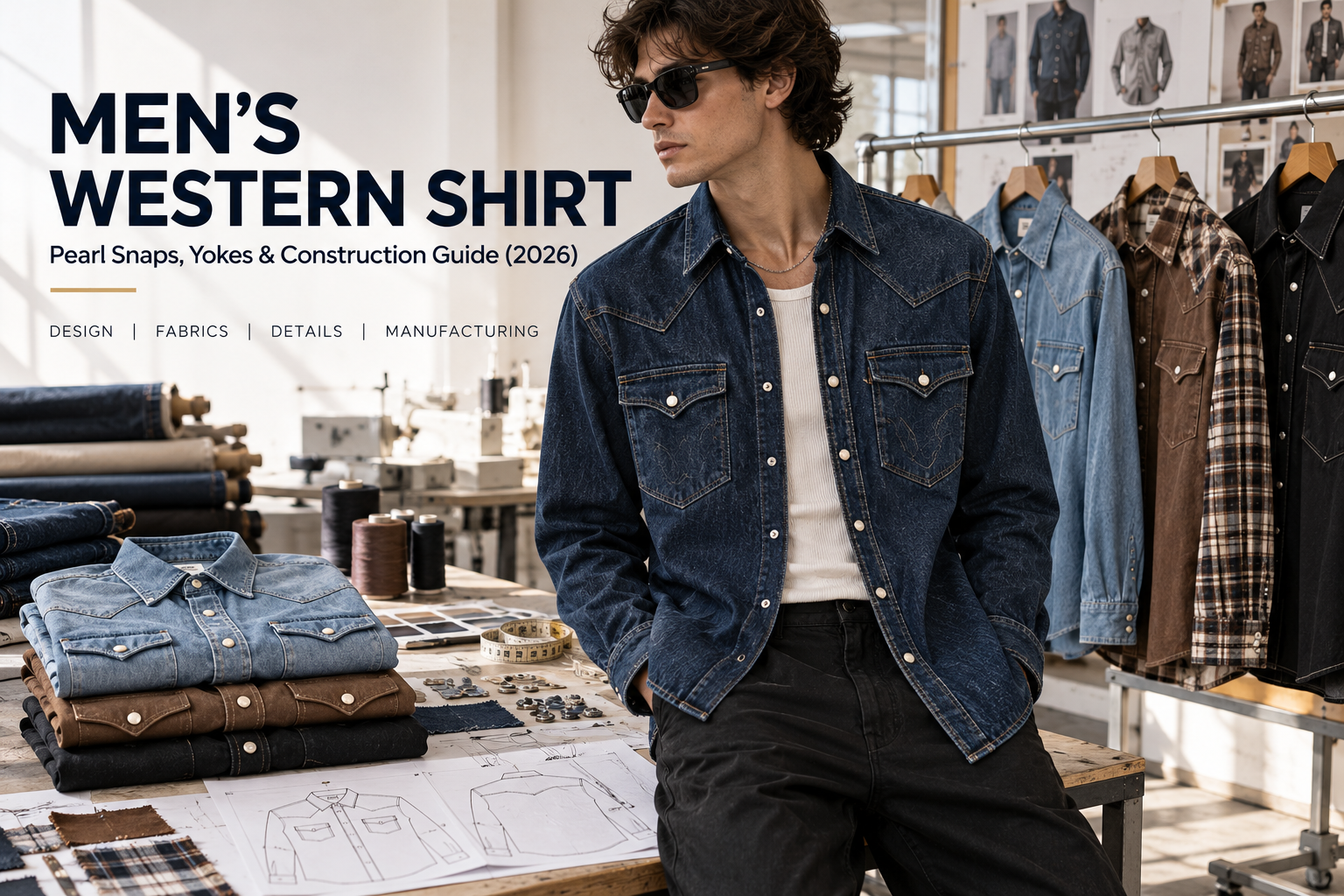
A Western shirt is a woven shirt recognized by details such as shaped shoulder yokes, snap closures, pointed pocket flaps and workwear-inspired construction.
The classic version is closely associated with cowboy and ranch clothing.
But modern Western shirts now appear across:
- Contemporary menswear
- Denim collections
- Heritage workwear
- Streetwear
- Americana
- Rock-inspired fashion
- Premium casualwear
- Modern tailoring
Some versions look unmistakably Western.
Others keep only a few references, such as:
- Pearl-style snaps
- Curved front yokes
- Two pointed chest pockets
For clothing brands, this distinction matters.
A successful Western shirt is not simply a basic button-up with snap buttons added afterward.
Its final appearance depends on the relationship between:
yoke shape + collar + pocket geometry + snaps + fabric + stitching + fit + pattern placement
A yoke that is too shallow can lose the Western character.
Heavy snaps can distort lightweight fabric.
A sawtooth pocket that is too large can overwhelm the chest.
And a plaid Western shirt can look poorly made if the yoke, pocket and front-body checks are not intentionally controlled.
This guide explains what defines a Western shirt and what brands should specify before developing one from sample to bulk production.
What Is a Western Shirt?
A Western shirt is a shirt influenced by traditional ranch and cowboy clothing.
Common features include:
- Front shoulder yokes
- Back yoke
- Pearl-style snaps
- Two chest pockets
- Pointed or sawtooth pocket flaps
- Snap cuffs
- Point collar
- Decorative topstitching
- Curved or shaped panel seams
Not every Western shirt uses all of these details.
For example, a minimal modern version might use:
curved Western yoke + snap front + plain pockets
while a stronger heritage version may use:
pointed front yokes + sawtooth pockets + pearl snaps + contrast piping + decorative stitching
The term therefore describes a recognizable construction language rather than one single fixed pattern.
Why Are Western Shirts Popular in Men's Fashion in 2026?
Western-inspired menswear continues to move beyond costume-like cowboy styling.
Current versions are being combined with:
- Straight jeans
- Relaxed trousers
- Chinos
- Leather jackets
- Denim jackets
- Tailored jackets
- Boots
- Loafers
- Sneakers
That makes the Western shirt useful because it can provide a clear design identity without requiring a highly complicated outfit.
It also works across different fabric directions.
A Western shirt can be made from:
- Denim
- Chambray
- Cotton twill
- Plaid woven fabric
- Flannel
- Corduroy
- Rayon
- Tencel / lyocell
- Lightweight poplin
- Wool blends
The same basic shirt can therefore move from rugged workwear to softer contemporary fashion depending on fabric, fit and detailing.
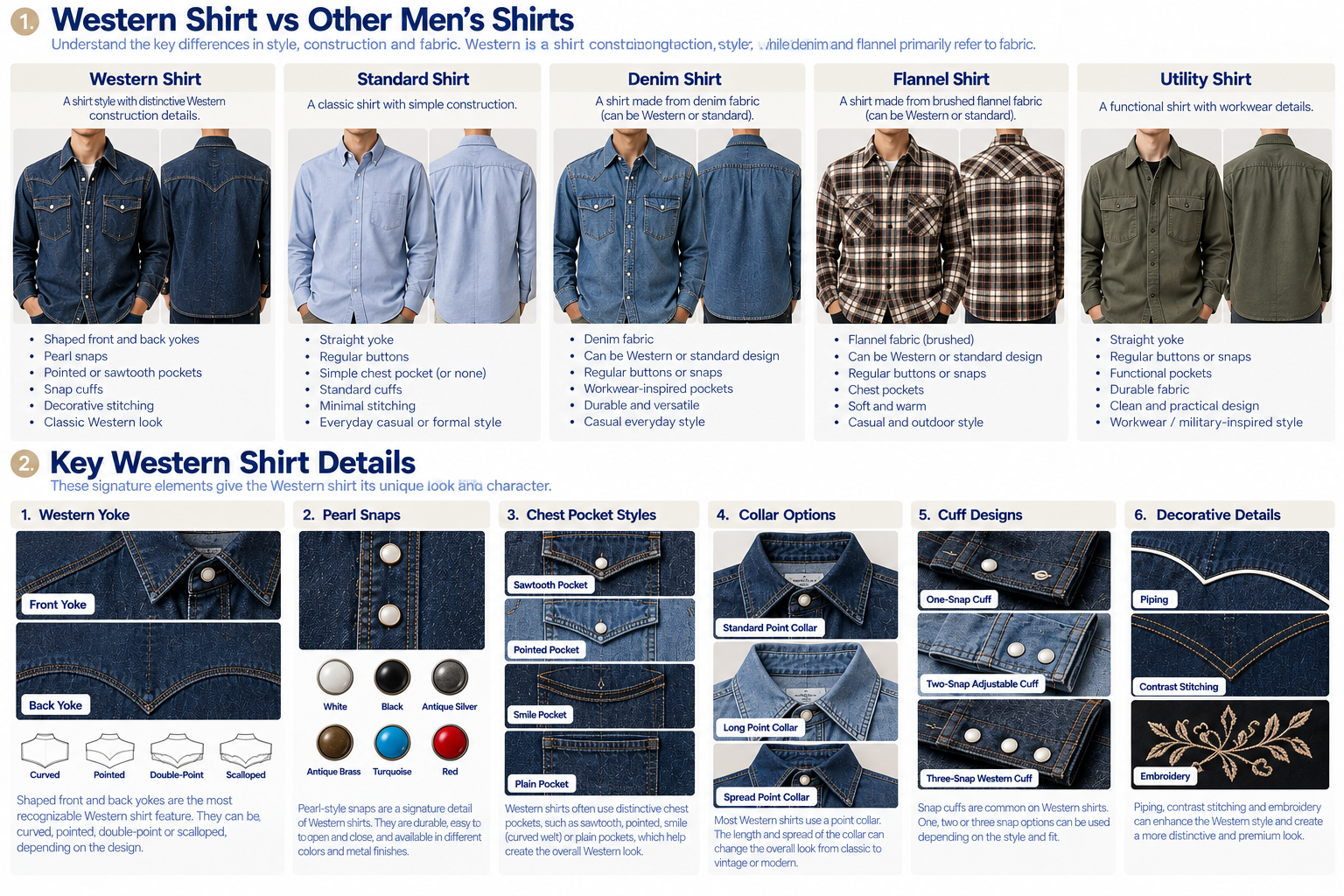
Western Shirt vs Pearl Snap Shirt
These terms overlap heavily.
A pearl snap shirt usually describes a shirt using pearl-look snap fasteners.
Many pearl snap shirts are Western shirts.
But the snap itself does not automatically make a shirt Western.
For example:
A simple work shirt with pearl-look snaps but no Western yokes or Western pocket construction may still read more like a utility shirt.
A more complete Western design normally combines the snaps with details such as:
- Shaped yokes
- Pointed pocket flaps
- Western-style chest pockets
- Snap cuffs
So for product development, it is better to specify the construction rather than relying only on the phrase:
pearl snap shirt
Western Shirt vs Flannel Shirt
These terms describe different things.
Western shirt describes a garment style.
Flannel describes a fabric category or fabric treatment.
A Western shirt can be made from flannel.
But it can also be made from:
- Denim
- Twill
- Chambray
- Rayon
- Corduroy
Likewise, a flannel shirt does not need any Western details.
It may use:
- Standard buttons
- Straight back yoke
- Basic chest pocket
- Conventional cuff
For a deeper explanation of brushed fabric, plaid repeat and flannel construction, see Brad Apparel's Flannel Shirt Guide.
Western Shirt vs Utility Shirt
Utility shirts usually emphasize function.
Typical details include:
- Functional pockets
- Durable fabric
- Reinforced seams
- Simple buttons or snaps
Western shirts emphasize a more specific visual language.
The strongest identifying features are often:
- Western yokes
- Pearl-style snaps
- Pointed pockets
- Decorative seam lines
A utility shirt can borrow Western details.
A Western shirt can also be practical.
But the product categories should not automatically be treated as identical.
For broader utility-shirt construction, see Brad Apparel's Utility Shirt Guide.
Western Shirt vs Denim Shirt
A denim shirt describes the material.
A Western shirt describes the design.
Therefore:
denim Western shirt
is a perfectly normal product description.
But a denim shirt can also use:
- Standard buttons
- Plain back yoke
- One chest pocket
- Button cuffs
without being strongly Western.
This distinction is useful when sourcing references.
If a customer sends a denim shirt and says:
Make this Western.
the development team still needs to determine:
- Yoke shape
- Pocket shape
- Snap type
- Cuff
- Stitching
- Fit
before creating the pattern.
The Western Yoke Is One of the Most Important Details
A Western yoke is a shaped panel around the upper chest, shoulder or upper back.
Unlike a basic straight shirt yoke, Western yokes may use:
- Curves
- Points
- V shapes
- Scallops
- Angled seams
The yoke provides both:
- Visual identity
- Structural construction
Its shape can completely change the character of the shirt.
Front Western Yoke
A front Western yoke normally sits around the upper chest and shoulder.
Possible shapes include:
Curved Yoke
Creates a softer Western appearance.
Useful for:
- Contemporary shirts
- Minimal Western styling
- Rayon shirts
Pointed Yoke
Creates a stronger cowboy reference.
The center or outer edge may form a visible point.
Double-Point Yoke
Uses more dramatic geometry.
This works particularly well for:
- Heritage Western shirts
- Contrast fabric
- Decorative stitching
Minimal Western Yoke
Uses a shallow curve or angle.
This can give a modern shirt subtle Western influence without feeling heavily themed.
Yoke Depth
Yoke depth affects the entire shirt proportion.
A shallow yoke may look:
- Minimal
- Modern
A deeper yoke becomes:
- More visible
- More decorative
- More obviously Western
The correct depth depends on:
- Shirt size
- Chest width
- Pocket position
- Collar size
- Fit
A reference photograph alone may not provide enough information.
The tech pack should define key vertical and horizontal points.
Front Yoke and Pocket Relationship
Western chest pockets often sit directly below the front yoke.
These elements need to look balanced together.
If the yoke is too low and the pocket is too high, the chest can become visually crowded.
If the pocket sits too low, the shirt may lose its classic Western proportion.
Check:
- Yoke lowest point
- Pocket top
- Pocket width
- Pocket flap
- Snap position
as one system.
Back Western Yoke
The back yoke can use:
- Straight shape
- Curved shape
- V shape
- Double-point shape
- Scalloped shape
A strong back yoke becomes a major design feature.
This is especially visible on:
- Solid denim
- Contrast fabrics
- Embroidered shirts
- Piped yokes
Back Yoke Depth
An excessively deep back yoke can:
- Add seam bulk
- Restrict design placement
- Make the upper back appear short
A very shallow yoke may not provide enough Western character.
The shape should be evaluated on the full garment, not only as a flat paper pattern.
One-Layer vs Double-Layer Yoke
A yoke may use:
- Single-layer construction
- Double-layer construction
A double-layer yoke can create:
- Cleaner interior
- More stability
- More structure
But it also adds:
- Fabric
- Thickness
- Sewing time
The correct construction depends on the fabric.
A heavy denim Western shirt may not need excessive extra layering.
Western Yoke Pattern Matching
Plaid Western shirts require additional planning.
The yoke can be cut:
Matching Direction
Plaid direction follows the main body.
Creates:
- Cleaner appearance
- More subtle yoke
Bias Direction
Yoke is rotated approximately 45 degrees.
Creates:
- Stronger visual contrast
- More visible Western styling
Contrast Fabric
The yoke uses:
- Solid fabric
- Different plaid
- Denim
- Suede-look fabric
This creates an even stronger design feature.
Bias-Cut Plaid Yokes
Bias yokes are common because they visually separate the upper shirt from the main plaid body.
But bias cutting can affect:
- Fabric consumption
- Stretch
- stability
- pattern placement
A loose woven fabric may require reinforcement before sewing.
Pearl Snaps
Pearl-style snaps are one of the best-known Western-shirt details.
Typical appearance includes:
- White pearl
- Cream pearl
- Black pearl
- Smoke gray
- Decorative colored insert
The visible cap may be surrounded by:
- Silver metal
- Antique metal
- Black metal
- Brass-tone metal
Modern brands can also use completely matte snaps while keeping Western construction.
Pearl Does Not Necessarily Mean Real Pearl
Most modern Western-shirt snaps use manufactured pearl-look caps rather than natural pearl.
Possible materials include:
- Resin
- Plastic
- Synthetic shell-look materials
The important production specifications are:
- Snap diameter
- Cap shape
- Color
- Metal finish
- Attachment system
- Holding strength
Snap Size
Snap size should match the shirt.
A lightweight rayon Western shirt may look better with a smaller, more refined snap.
A heavy denim shirt may support:
- Larger snap
- Heavier hardware
Oversized snaps can distort thin fabric.
Small snaps may look visually weak on heavy workwear.
Snap Reinforcement
Snaps place concentrated force on the fabric.
Repeated opening can stress:
- Front placket
- Pocket flap
- Cuff
Possible reinforcement methods include:
- Fusible backing
- Additional fabric layer
- Internal tape
- Patch reinforcement
The reinforcement should be hidden whenever possible.
Why Snap Testing Matters
A snap can fail in several ways.
Possible problems include:
- Cap detachment
- Fabric tearing
- Weak holding force
- Excessive holding force
- Misalignment
- Surface scratching
- Plating damage
The strongest snap is not automatically the best snap.
If opening force is too high, the wearer may pull the shirt fabric instead of releasing the fastener cleanly.
Snap Pull Test
During development, test repeated:
- Opening
- Closing
- Pulling
around:
- Front placket
- Cuffs
- Pockets
Observe whether the fabric begins to:
- Stretch
- Fray
- Tear
- Distort
Snap attachment should be tested on the actual production fabric.
Snap Position
Snap spacing affects both function and visual balance.
Check:
- First snap below collar
- Chest-level snap
- Waist-level snaps
- Bottom snap
- Pocket flap snaps
Snap spacing does not always need to be perfectly equal if the shirt design requires specific functional positions.
Front Placket
Western shirts can use different front constructions.
Applied Placket
A separate or folded visible placket creates:
- Strong front structure
- Clear snap placement
French Front
Creates a cleaner shirt appearance.
Hidden Support Placket
The exterior may look simple while additional reinforcement sits inside.
Heavy snaps usually need enough placket stability.
Western Chest Pocket Styles
Pockets are another major identifying feature.
Common options include:
- Sawtooth pocket
- Pointed flap pocket
- Curved flap pocket
- Smile pocket
- Standard patch pocket
The pocket style should support the overall Western direction.
What Is a Sawtooth Pocket?
A sawtooth pocket uses pointed geometric edges.
The flap often creates:
- V shape
- Angled points
- Double-point appearance
This creates a stronger vintage Western character.
The geometry needs accurate sewing.
Small inconsistencies become visible because the points are intended to look sharp and symmetrical.
Sawtooth Pocket Pattern
Important measurements include:
- Pocket width
- Pocket height
- Flap width
- Flap depth
- Point depth
- Snap position
The left and right pockets should normally mirror each other.
Pointed Pocket Flap
A simpler pointed flap may use:
- One central point
- Curved outer corners
- Straight upper edge
This provides Western character without overly complex construction.
Smile Pocket
A smile pocket uses a curved opening resembling a shallow smile.
It may use:
- Zipper
- Welt construction
- Piping
This creates a more decorative vintage-Western appearance.
Smile pockets require careful curved sewing.
Pocket Snap Position
The snap should:
- Secure the flap
- Remain visually centered
- Avoid interfering with the pocket opening
If the flap has a strong central point, the snap usually needs to align intentionally with that geometry.
Pocket Placement
Chest-pocket position affects:
- Visual chest width
- Shirt proportion
- Western character
Pockets placed too close together can make the chest appear narrow.
Pockets too far toward the side seams can look disconnected from the yoke.
The pocket position should be checked on the wearer.
Pocket Pattern Matching
On plaid or striped Western shirts, pocket matching is a design decision.
Fully Matched Pocket
The plaid continues almost invisibly through the pocket.
Creates:
- Cleaner
- More premium appearance
But requires:
- More cutting control
- More fabric consumption
Bias Pocket
Pocket is rotated diagonally.
Creates:
- Strong visual contrast
- More Western styling
Intentional Contrast
Pocket uses a different fabric or pattern section.
The tech pack should clearly define the intended direction.
Western Shirt Collar
Most Western shirts use some form of point collar.
Possible options include:
- Standard point
- Long point
- Narrow point
- Spread point
- Vintage elongated point
The collar changes the overall era and styling.
Standard Point Collar
Works well for:
- Commercial Western shirts
- Denim shirts
- Plaid Western shirts
It keeps the design versatile.
Long-Point Collar
Creates stronger:
- 1970s influence
- Vintage Western character
- Rock styling
The point length should remain proportional to:
- Neck size
- Shirt body
- yoke
Collar Stand
Most conventional Western shirts use:
- Collar
- Separate collar stand
The stand controls:
- Neck shape
- Collar position
- Snap or button position
The collar stand should have enough support without becoming excessively formal.
Collar Interfacing
Possible interfacing levels include:
Soft
Useful for:
- Rayon
- Lightweight shirts
Medium
Useful for:
- Cotton twill
- Flannel
- Midweight denim
Firm
May work for highly structured vintage designs.
The collar should still feel appropriate for the shirt fabric.
Western Shirt Cuffs
Western cuffs commonly use snaps rather than conventional buttons.
Possible designs include:
- One-snap cuff
- Two-snap adjustable cuff
- Three-snap Western cuff
- Extended pointed cuff
Cuff proportions strongly affect the product.
One-Snap Cuff
Creates a clean commercial look.
Useful for:
- Minimal Western shirts
- Lightweight fabrics
Two-Snap Adjustable Cuff
Allows:
- Tighter position
- Looser position
This is practical and still preserves Western styling.
Three-Snap Cuff
Creates:
- Stronger vintage appearance
- Larger cuff
- More visible hardware
It is particularly effective with:
- Denim
- Decorative stitching
- Contrast snaps
Pointed Western Cuff
The cuff itself may use shaped edges or an extended point.
This creates stronger design identity.
But it requires accurate pattern work and more careful topstitching.
Sleeve Placket
A Western shirt may use:
- Standard sleeve placket
- Western-shaped gauntlet
- Snap closure
The placket should allow comfortable dressing while remaining stable through repeated snap use.
Shoulder Fit
Western shirts can use:
- Standard shoulder
- Slightly extended shoulder
- Drop shoulder
Traditional versions usually remain fairly conventional.
Modern streetwear versions may increase:
- Shoulder width
- Chest
- Sleeve width
without changing the Western yoke identity.
Classic Western Fit
Typically uses:
- Regular shoulder
- Moderate chest ease
- Straight or lightly shaped body
- Standard sleeve
This works well for:
- Heritage
- Casualwear
- Everyday menswear
Slim Western Fit
Uses:
- Reduced chest
- More waist shaping
- Narrower sleeve
Large chest pockets should be scaled accordingly.
Otherwise the pockets can dominate the smaller body.
Relaxed Western Fit
A modern relaxed version may use:
- Wider chest
- Slightly dropped shoulder
- Larger sleeve
- Longer or boxier body
The yoke and pocket size should increase proportionally.
Oversized Western Shirt
An oversized Western shirt should be developed intentionally.
Do not simply grade a standard Western shirt several sizes larger.
That can create:
- Excessive body length
- Collar too large
- Pocket position too low
- Cuff too large
- Yoke proportion problems
A good oversized pattern controls width and length separately.
Western Shirt Length
Traditional shirts may use enough body length to remain tucked.
Modern versions may be designed:
- Tucked
- Untucked
- Both
This affects hem shape.
Shirt-Tail Hem
A traditional curved shirt-tail hem provides:
- Additional front/back length
- Better tuck retention
Straight Hem
Works well for:
- Overshirts
- Streetwear
- Boxier Western shirts
Side Slits
Small side slits can improve:
- Movement
- Untucked appearance
and can be reinforced with:
- Gusset
- Bar tack
Best Fabrics for Western Shirts
Fabric strongly changes the final identity.
Common options include:
- Denim
- Chambray
- Cotton twill
- Flannel
- Plaid woven fabric
- Rayon
- Lyocell
- Corduroy
For custom fabric sourcing, see Brad Apparel's Fabric Sourcing & Development.
Denim Western Shirt
Denim is one of the most recognizable options.
Possible directions include:
- Dark indigo
- Rinse wash
- Medium wash
- Light wash
- Vintage wash
- Black denim
Denim supports:
- Pearl snaps
- Contrast stitching
- Structured yokes
- Sawtooth pockets
particularly well.
Denim Weight
A Western shirt should not automatically use jeans-weight denim.
Very heavy denim may create:
- Bulky cuffs
- Thick collar
- Heavy yoke seams
- Difficult snap attachment
Shirt-weight or lighter denim often provides better comfort.
The correct weight depends on whether the product is intended as:
- Shirt
- Overshirt
Chambray Western Shirt
Chambray provides:
- Lighter hand feel
- Breathability
- Indigo-like appearance
- Easier warm-weather wear
It can create a Western look without the structure of denim.
Because chambray is lighter, snap reinforcement becomes more important.
Cotton Twill
Cotton twill provides:
- Stable construction
- Good durability
- Broad color options
It works well for:
- Solid Western shirts
- Workwear-inspired versions
- Garment-dyed shirts
Plaid Western Shirt
Plaid is strongly associated with contemporary Western styling.
The technical challenge is pattern matching.
Important areas include:
- Center front
- Yoke
- Pocket flap
- Sleeve
- Cuff
Not every area needs perfect matching.
The brand should define priorities.
Flannel Western Shirt
A brushed plaid flannel creates:
- Soft surface
- Warmth
- Fall/winter character
Western yokes and snaps can make a familiar flannel shirt feel more distinctive.
Because you already have a dedicated Flannel Shirt article, the main development focus here should remain the Western construction rather than repeating brushing and flannel sourcing in detail.
Rayon Western Shirt
Rayon can create a completely different result.
It provides:
- Softer drape
- Smoother surface
- Vintage appearance
This works particularly well for:
- Rockabilly-inspired shirts
- Embroidered Western shirts
- Dressier styles
But heavy snaps need reinforcement because rayon may not support concentrated hardware stress as well as heavier cotton.
Lyocell Western Shirt
Lyocell can provide:
- Fluid drape
- Smooth hand feel
- Softer contemporary styling
It works well when the brand wants:
Western details + modern fabric movement.
Corduroy Western Shirt
Corduroy creates:
- Strong texture
- Autumn/winter character
- Heritage appearance
But nap direction must be consistent.
Pattern pieces should usually be cut in the intended same direction unless the design deliberately uses contrast nap.
Western Shirt Pattern Development
A production-ready pattern needs to coordinate:
- Collar
- Collar stand
- Front body
- Back body
- Front yokes
- Back yoke
- Sleeves
- Cuffs
- Sleeve plackets
- Chest pockets
- Pocket flaps
- Front placket
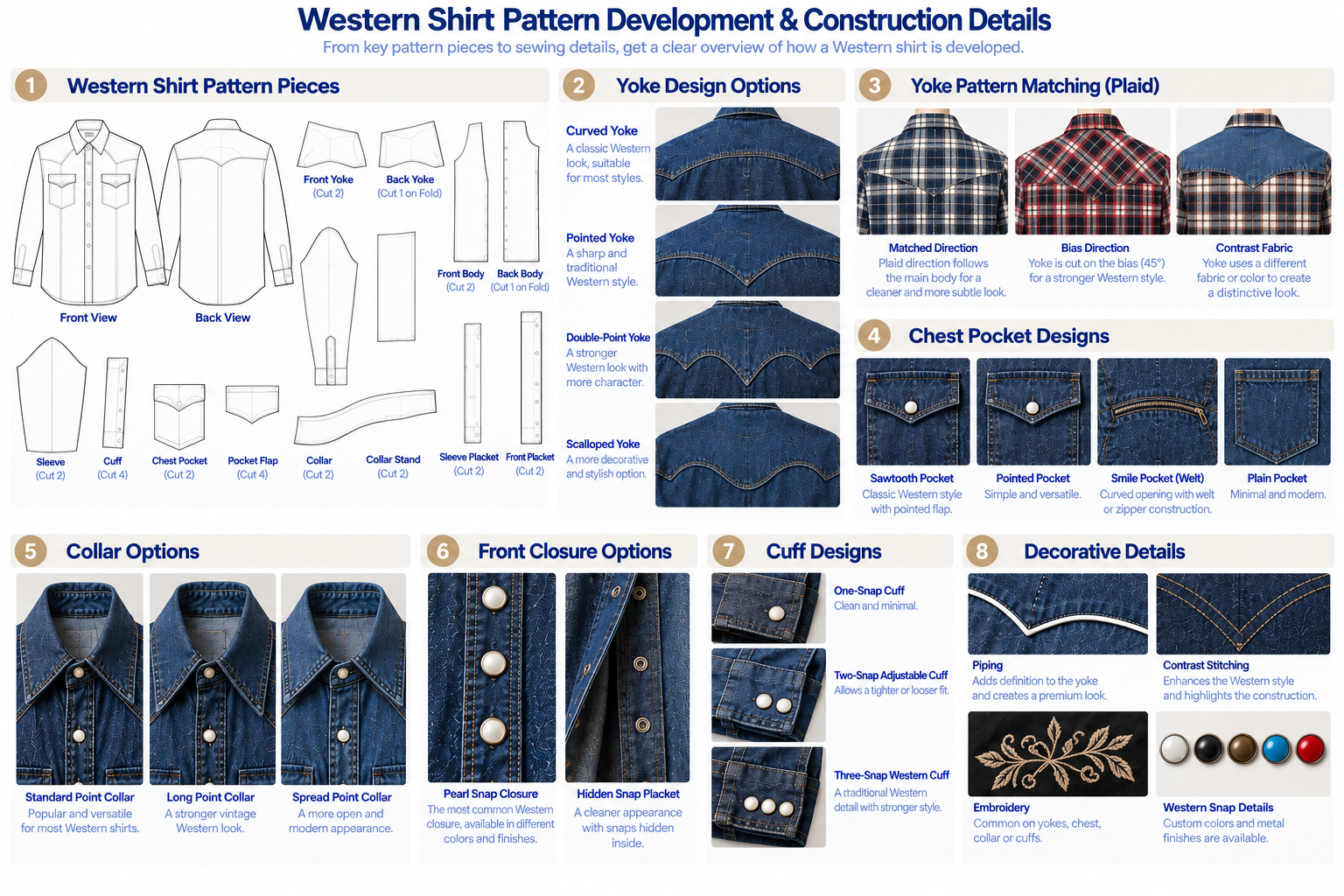
Front Yoke Pattern Pieces
Depending on design, the front yoke may be:
- Separate left/right pieces
- Integrated into front construction
Separate pieces allow:
- Bias plaid
- Contrast fabric
- Piping
- Decorative seams
Back Yoke Pattern Pieces
The back yoke may be:
- One piece on fold
- Two separate pieces
- Double layered
For symmetrical designs, cutting on fold can improve consistency.
Piping Along the Yoke
Piping can emphasize the yoke shape.
Possible directions include:
- Tonal
- White
- Black
- Contrast color
- Metallic
Piping needs consistent seam allowance.
Uneven insertion will make the curved yoke look distorted.
Western Embroidery
Western shirts can include embroidery at:
- Chest
- Front yokes
- Back yoke
- Collar
- Cuff
Common visual directions include:
- Florals
- Horseshoe motifs
- Rodeo imagery
- Brand logos
- Decorative linework
For custom embroidery methods, see Brad Apparel's Embroidery Techniques.
Embroidery Should Be Planned Before Assembly
If embroidery crosses or sits near:
- Yoke seam
- Snap
- Placket
its position needs to be developed early.
It is usually easier to embroider relevant cut panels before final garment assembly.
Avoid Embroidery Under Heavy Snap Areas
Dense embroidery combined with snap reinforcement can create excessive thickness.
This can lead to:
- Poor snap attachment
- Fabric distortion
- Irregular surface
Keep enough clearance around hardware.
Decorative Topstitching
Western shirts often use visible topstitching to emphasize:
- Yokes
- Pockets
- Cuffs
- Placket
Possible styles include:
- Single needle
- Double needle
- Contrast thread
- Tonal thread
Contrast Stitching
Common on denim Western shirts.
Possible colors include:
- Tobacco
- Cream
- Gold
- White
It makes construction more visible.
This also means sewing inconsistency becomes easier to see.
Tonal Stitching
Creates:
- Cleaner appearance
- More premium minimal look
This works particularly well for:
- Black Western shirts
- Modern solid-color versions
- Rayon shirts
Western Shirt Snap Development
A tech pack should specify snaps by more than color.
Include:
- Snap diameter
- Cap design
- Metal finish
- Male/female component
- Attachment position
- Required reinforcement
For custom snaps, buttons and labels, see Brad Apparel's Trims & Branding.
Custom Logo Snaps
Western snaps can be customized with:
- Logo
- Initial
- Symbol
- Custom color
However, very small artwork may not reproduce clearly.
Test the actual hardware sample before bulk production.
Antique Metal Snaps
Possible finishes include:
- Antique brass
- Antique silver
- Gunmetal
- Matte black
These can create a more rugged product.
Pearl Snap Color
Pearl-look inserts do not have to be white.
Possible options include:
- Ivory
- Black
- Smoke
- Turquoise-inspired
- Red
- Brown
The snap should be evaluated directly against the final fabric.
Garment Washing
Western shirts—especially denim and cotton twill versions—can be garment washed.
Possible processes include:
- Rinse wash
- Enzyme wash
- Vintage wash
- Garment dye
- Pigment dye
- Stone effect where appropriate
The finishing process can change:
- Measurements
- Color
- Snap appearance
- Stitch contrast
- Hand feel
Washing With Snaps
Hardware must be compatible with the wash.
Check for:
- Scratching
- Plating loss
- Rust
- Discoloration
- Detachment
Protective measures may be necessary depending on the finishing process.
Denim Wash and Yoke Appearance
Washing can emphasize the Western yoke because seam edges may develop more abrasion.
This can create attractive vintage character.
But excessive abrasion may cause:
- Uneven yoke edges
- Fabric damage
- Excess contrast
The wash standard should be approved on a full garment.
Shrinkage
Cotton and denim fabrics may shrink during washing.
Important measurements include:
- Chest
- Body length
- Sleeve length
- Neck
- Cuff
- Yoke
A Western shirt with detailed yoke construction should remain balanced after finishing.
Pattern Matching for Plaid Western Shirts
Plaid Western shirts require a clear matching standard.
Possible priorities include:
- Center front
- Left/right chest
- Front yoke balance
- Pocket flap
- Back yoke
- Sleeve
- Cuff
Exact matching everywhere may significantly increase fabric consumption.
The highest-visibility areas should receive priority.
Center-Front Matching
The plaid should generally appear balanced when the shirt is snapped closed.
Misaligned horizontal checks at center front are immediately noticeable.
Pocket Matching
There are two valid approaches.
Matched Pocket
Plaid continues through the pocket.
Creates a refined result.
Bias Pocket
Pocket uses diagonal plaid.
Creates a stronger Western design.
The factory should not decide between these randomly.
It belongs in the approved specification.
Yoke Matching
A Western yoke often intentionally changes pattern direction.
Therefore "matching" does not always mean the plaid should continue seamlessly.
Instead, the goal may be:
- Left/right symmetry
- Same angle
- Balanced stripe placement
Stripe Western Shirts
Western shirts can also use stripes.
Possible directions include:
- Body vertical
- Yoke diagonal
- Pocket diagonal
This creates clear visual panel separation.
Sawtooth Pocket Construction
Sharp pocket points require accurate:
- Cutting
- Turning
- Topstitching
Common problems include:
- Blunt point
- Unequal left/right points
- Puckering
- Snap not centered
Templates can improve production consistency.
Yoke Sewing
Curved yoke seams need controlled feeding.
If one layer stretches more than another, the seam may become:
- Wavy
- Twisted
- Uneven
Bias-cut yokes are especially sensitive.
Cuff Construction
Check:
- Cuff dimensions
- Snap alignment
- Interfacing
- Left/right symmetry
If multiple snap positions are used, each position should close cleanly.
Collar Quality
Inspect:
- Collar point symmetry
- Collar stand height
- Neck measurement
- Roll
- Interfacing
A Western shirt can be casual without having an uncontrolled collar.
Snap Quality Control
Bulk QC should test random garments for:
- Snap alignment
- Holding force
- Secure attachment
- Fabric damage
- Surface condition
Pay particular attention to:
- Chest
- Cuffs
- Pocket flaps
Western Shirt Manufacturing Workflow
A practical production sequence may follow:
- Fabric inspection
- Shrinkage testing
- Pattern development
- Yoke and pocket confirmation
- Cutting
- Embroidery if required
- Yoke preparation
- Pocket preparation
- Front and back assembly
- Sleeve assembly
- Collar and cuff construction
- Snap reinforcement
- Snap installation
- Garment washing if required
- Pressing
- Measurement check
- Snap QC
- Final inspection
- Packing
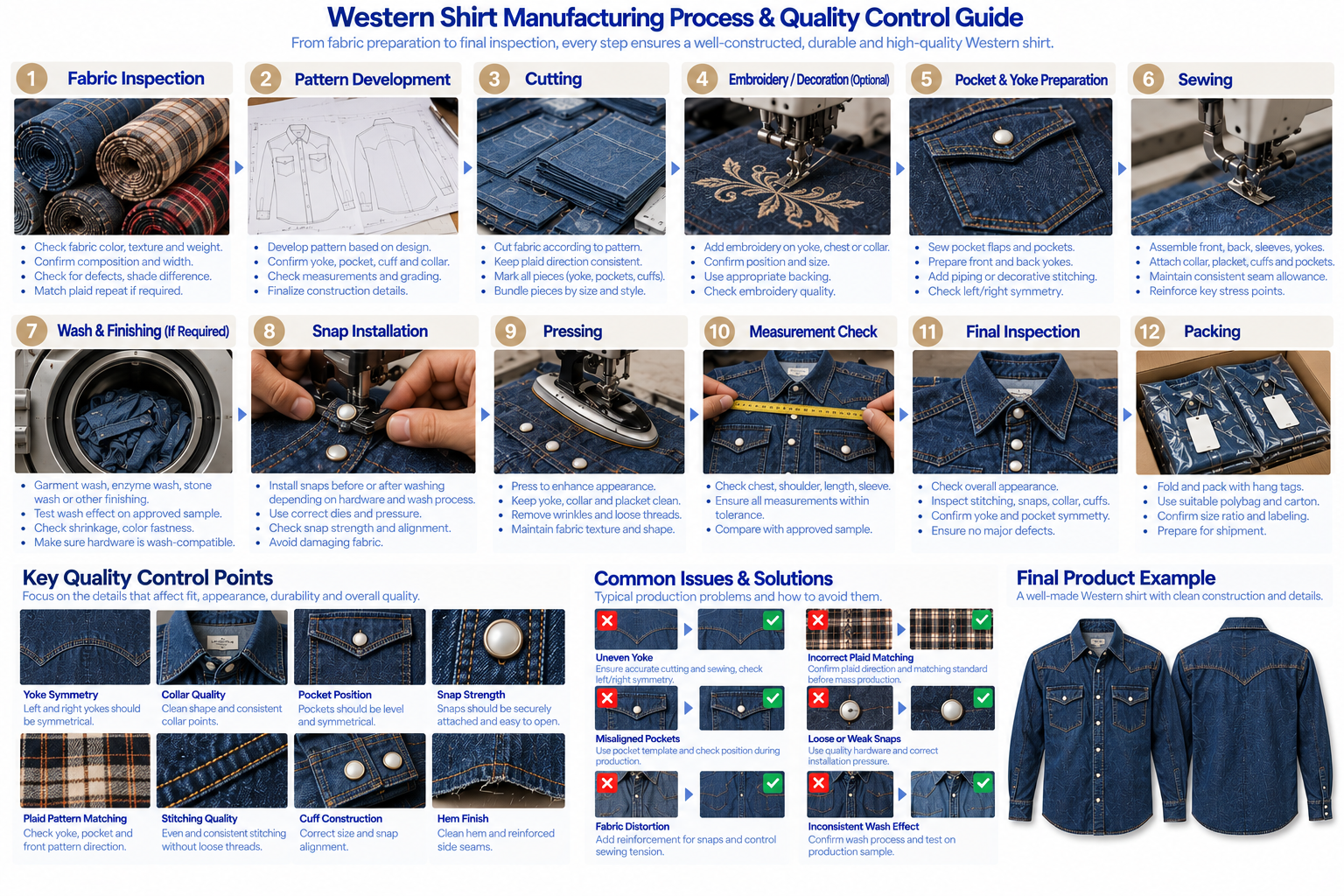
Fabric Inspection
Before cutting, inspect:
- Color
- Width
- Weight
- Surface
- Plaid repeat
- Defects
- Nap where applicable
For plaid fabrics, also confirm:
- Repeat width
- Repeat height
because these affect garment consumption.
Cutting
Cutting needs to control:
- Grainline
- Plaid direction
- Yoke direction
- Pocket direction
- Left/right pairing
For bias plaid pieces, clearly mark the intended angle.
Bundle Control
Western shirts may contain many visually similar small pieces:
- Pocket flaps
- Cuffs
- Yokes
- Sleeve plackets
Bundle identification helps prevent:
- Wrong left/right piece
- Mismatched plaid
- Wrong size parts
Pocket Preparation
Before attaching pockets, check:
- Shape
- Size
- Flap
- Snap reinforcement
- Pattern direction
Pocket preparation should be approved before mass attachment.
Yoke Preparation
Check:
- Shape
- Left/right balance
- Piping if used
- Embroidery
- Pattern direction
Once sewn into the shirt, correcting a yoke problem becomes much more expensive.
Snap Installation
Use the correct dies and pressure for the hardware.
Incorrect installation pressure may cause:
- Loose snaps
- Cracked caps
- Fabric damage
The operator should check both:
- Front appearance
- Back attachment
Pressing
Pressing should clean up:
- Collar
- Yokes
- Pocket flaps
- Cuffs
- Placket
- Hem
Do not flatten intended texture excessively.
This is particularly important with:
- Flannel
- Corduroy
- Embroidery
Measurement Check
Important measurements include:
- Chest
- Shoulder
- Body length
- Sleeve
- Neck
- Hem
- Cuff
- Pocket position
- Yoke position
The final garment should be measured after any intended wash.
Final Appearance
Review the shirt:
- Closed
- Open
- Front
- Back
Check whether:
- Yokes appear balanced
- Pockets sit level
- Snaps align
- Plaid direction is correct
- Collar sits cleanly
Common Western Shirt Development Mistakes
1. Adding Pearl Snaps to a Basic Shirt and Calling It Western
The yokes and pockets are major parts of the identity.
2. Making the Yoke Too Small
The Western detail becomes visually weak.
3. Making the Chest Pockets Too Large
The shirt can appear crowded.
4. Using Heavy Snaps on Lightweight Fabric Without Reinforcement
The fabric may distort or tear.
5. Ignoring Plaid Direction
The yoke or pocket may appear unintentionally mismatched.
6. Requiring Perfect Plaid Matching Everywhere
This can increase fabric consumption significantly.
7. Poor Sawtooth Pocket Points
Uneven points make the garment look lower quality.
8. Incorrect Snap Pressure
The hardware may become loose or damaged.
9. Adding Dense Embroidery Around Snap Areas
Too many layers can affect attachment.
10. Approving the Shirt Before Washing
The final measurements and appearance may change after finishing.
How to Describe a Western Shirt to a Manufacturer
Instead of writing:
I want a men's Western shirt with pearl buttons.
write:
Men's relaxed Western shirt in 6.5 oz medium-wash cotton denim with curved front Western yokes, V-shaped back yoke, two sawtooth chest pockets, 11 mm white pearl-look snaps with antique-silver rims, two-snap adjustable cuffs and tobacco contrast topstitching.
Then provide:
- Chest
- Shoulder
- Body length
- Sleeve length
- Neck
- Fit
- Fabric
- Yoke shape
- Yoke dimensions
- Pocket dimensions
- Pocket flap
- Snap size
- Snap finish
- Cuff
- Stitching
- Wash
- Branding
This gives the sample team a much clearer development target.
Example Classic Denim Western Shirt
Possible specification:
- Regular fit
- Cotton denim
- Medium indigo
- Point collar
- Curved front yokes
- Pointed back yoke
- Sawtooth pockets
- White pearl snaps
- Snap cuffs
- Tobacco stitching
- Medium vintage wash
Example Modern Black Western Shirt
Possible specification:
- Relaxed fit
- Black cotton twill
- Minimal curved yoke
- Two clean pointed pockets
- Matte black snaps
- Tonal stitching
- Straight hem
This creates Western identity without obvious cowboy styling.
Example Plaid Western Shirt
Possible specification:
- Relaxed fit
- Yarn-dyed cotton plaid
- Bias-cut front and back yokes
- Bias pocket flaps
- Standard point collar
- Pearl-look snaps
- Two-snap cuffs
- Curved shirt-tail hem
Plaid direction and left/right symmetry should be approved during sampling.
Example Rayon Western Shirt
Possible specification:
- Regular / relaxed fit
- Fluid rayon twill
- Curved yokes
- Pointed pockets
- Small pearl snaps
- Embroidered chest motifs
- Soft interfacing
- Straight hem
Snap reinforcement should be tested carefully on the lighter fabric.
Western Shirt Tech Pack Example
| Area | Example Specification |
|---|---|
| Product | Men's Western Shirt |
| Fit | Relaxed |
| Fabric | Cotton Denim |
| Weight | 6.5 oz |
| Color | Medium Indigo |
| Collar | Point Collar |
| Front Yoke | Curved Western |
| Back Yoke | Pointed |
| Chest Pocket | Two Sawtooth Pockets |
| Front Closure | Pearl-Look Snaps |
| Snap Size | 11 mm |
| Snap Finish | White / Antique Silver |
| Cuff | Two-Snap Adjustable |
| Stitching | Tobacco Contrast |
| Hem | Curved Shirt Tail |
| Wash | Vintage Wash |
| Branding | Woven Main + Care Label |
These values are examples only.
Important Western Shirt Measurements
| Measurement | Why It Matters |
|---|---|
| Chest | Controls body ease |
| Shoulder | Determines upper-body proportion |
| Body Length | Controls tucked / untucked use |
| Sleeve Length | Controls cuff position |
| Neck | Controls collar fit |
| Collar Point | Changes Western / vintage character |
| Front Yoke Depth | Controls chest proportion |
| Back Yoke Depth | Controls back appearance |
| Pocket Width | Controls pocket scale |
| Pocket Height | Controls function and balance |
| Pocket Position | Affects chest appearance |
| Cuff Width | Controls sleeve opening |
| Hem Sweep | Controls body silhouette |
Size Grading
Western-shirt grading needs to preserve:
- Yoke proportion
- Pocket proportion
- Snap spacing
- Collar proportion
while the body increases across sizes.
Yoke Grading
A fixed yoke may appear too large on small sizes and too small on large sizes.
The amount of grading should be controlled.
Do not automatically scale every decorative curve proportionally.
The visual result should be reviewed.
Pocket Grading
Pocket size may use:
- Small controlled increments
- Different pocket dimensions by size group
A practical design might keep pocket construction relatively stable while adjusting enough to maintain visual balance.
Snap Spacing Across Sizes
The brand should decide whether the number of front snaps remains fixed.
In many cases:
- Number remains the same
- Spacing changes slightly
Very long sizes may require additional consideration.
Western Shirt Fabric Consumption
Western construction can consume more fabric than a basic shirt because of:
- Bias yokes
- Pattern matching
- Two chest pockets
- Pocket flaps
- Directional fabric
- Plaid repeat
The actual marker should be used for costing.
Plaid Repeat and Consumption
Large plaid repeats usually increase cutting constraints.
If the brand requires:
- Matched center front
- Symmetrical yokes
- Matched pockets
fabric consumption can increase significantly.
This should be discussed before final quotation.
Should a Western Shirt Use Real Pearl Snaps?
Not necessarily.
Synthetic pearl-look snaps are common and can provide:
- Consistent appearance
- Better cost control
- More color options
The important factor is hardware quality and attachment performance.
Can Western Shirts Use Regular Buttons?
Yes.
Western styling can come from:
- Yokes
- Pocket shapes
- Stitching
even if buttons are used.
However, snaps create a stronger traditional Western identity.
Can Western Shirts Be Oversized?
Yes.
Modern versions can use:
- Wider chest
- Dropped shoulder
- Larger sleeves
- Shorter boxy body
The yokes and pockets should be redesigned to fit the larger silhouette.
Can Western Shirts Be Embroidered?
Yes.
Embroidery works particularly well on:
- Front yokes
- Back yokes
- Chest
- Collar
But placement should avoid interfering with snaps and seam construction.
Can Western Shirts Be Made From Flannel?
Yes.
Flannel Western shirts are particularly suitable for fall and winter.
The Western construction can include:
- Bias yokes
- Pearl snaps
- Pointed pockets
while the flannel fabric provides warmth and softness.
Can Western Shirts Be Made From Denim?
Yes.
Denim is one of the most classic materials for Western shirts.
Use shirt-appropriate denim weight unless the garment is intended to function as an overshirt.
What Is a Sawtooth Pocket?
A sawtooth pocket uses pointed geometric edges or a sharply pointed flap.
It is strongly associated with vintage Western-shirt design.
What Is a Western Yoke?
A Western yoke is a shaped upper-body panel that may use:
- Curves
- Points
- V shapes
- Decorative seam lines
on the front, back or both.
What Is the Difference Between a Western Shirt and a Cowboy Shirt?
In modern fashion, the terms often overlap.
"Western shirt" is generally the broader and more common product term.
"Cowboy shirt" may imply a stronger traditional or decorative Western appearance.
What Should a Western Shirt Tech Pack Include?
Include:
- Fit
- Chest
- Shoulder
- Body length
- Sleeve
- Neck
- Yoke shapes
- Yoke dimensions
- Pocket shapes
- Pocket placement
- Snap specification
- Cuff
- Collar
- Fabric
- Wash
- Stitching
- Embroidery if required
- Labels
What Should Be Checked During Bulk QC?
Important checks include:
- Yoke symmetry
- Plaid direction
- Pocket position
- Pocket shape
- Snap alignment
- Snap strength
- Collar symmetry
- Cuff size
- Stitching
- Measurements
- Wash consistency
- Final appearance
FAQ
What Is a Western Shirt?
A Western shirt is a woven shirt influenced by cowboy and ranch clothing and commonly uses shaped Western yokes, snap closures, chest pockets and pointed design details.
What Are Pearl Snap Shirts?
Pearl snap shirts use snap fasteners with decorative pearl-look caps.
Many are Western shirts, although the snap alone does not define the entire garment.
Are Western Shirts in Style in 2026?
Yes.
Western-inspired menswear continues to appear across denim, flannel, workwear and contemporary men's collections.
Modern versions range from traditional ranch-style shirts to cleaner minimal designs.
Do Western Shirts Always Have Two Pockets?
No.
Two chest pockets are traditional and highly recognizable, but modern designs can use:
- One pocket
- Hidden pockets
- Minimal chest construction
Why Do Western Shirts Use Snaps?
Snaps provide fast opening and closing and have become one of the recognizable visual features of Western-shirt design.
The fabric should be reinforced appropriately around the hardware.
Can Pearl Snaps Damage Lightweight Fabric?
They can if the fabric is too light or poorly reinforced.
Snap size, opening force and backing construction should be tested on the actual production material.
Can Western Shirts Use Plaid?
Yes.
Plaid Western shirts are common.
Brands should define whether:
- Yokes
- Pockets
- Pocket flaps
are matched, bias-cut or intentionally contrasted.
Can Western Shirts Be Garment Washed?
Yes.
Denim and cotton Western shirts can use various washes and dye processes.
Hardware compatibility and final shrinkage should be tested.
What Fabric Is Best for a Western Shirt?
Common options include:
- Denim
- Chambray
- Cotton twill
- Plaid woven fabric
- Flannel
- Rayon
- Lyocell
- Corduroy
The best fabric depends on the desired fit, season and styling.
What Makes a Western Shirt Different From a Normal Button-Up?
The strongest differences usually come from:
- Western yokes
- Snap closures
- Pointed chest pockets
- Decorative stitching
- Western cuff details
rather than the basic shirt body alone.
Final Thoughts
A Western shirt is one of those menswear products where a few recognizable construction details create a very strong identity.
The key relationship is:
yoke + pockets + snaps + fabric + fit + stitching
A denim version can feel rugged and traditional.
A plaid version can lean into contemporary Americana.
A rayon Western shirt can become softer and dressier.
And a black Western shirt with tonal snaps can look almost minimal while still retaining the category's distinctive construction.
For clothing brands, the strongest results usually come from treating the yokes, pockets and hardware as one coordinated system rather than adding Western details to a finished basic-shirt pattern.
Once the yoke proportions, pocket geometry, snap specification, fabric and fit are approved together, the shirt becomes much easier to reproduce consistently from first sample through bulk production.
Keep Reading