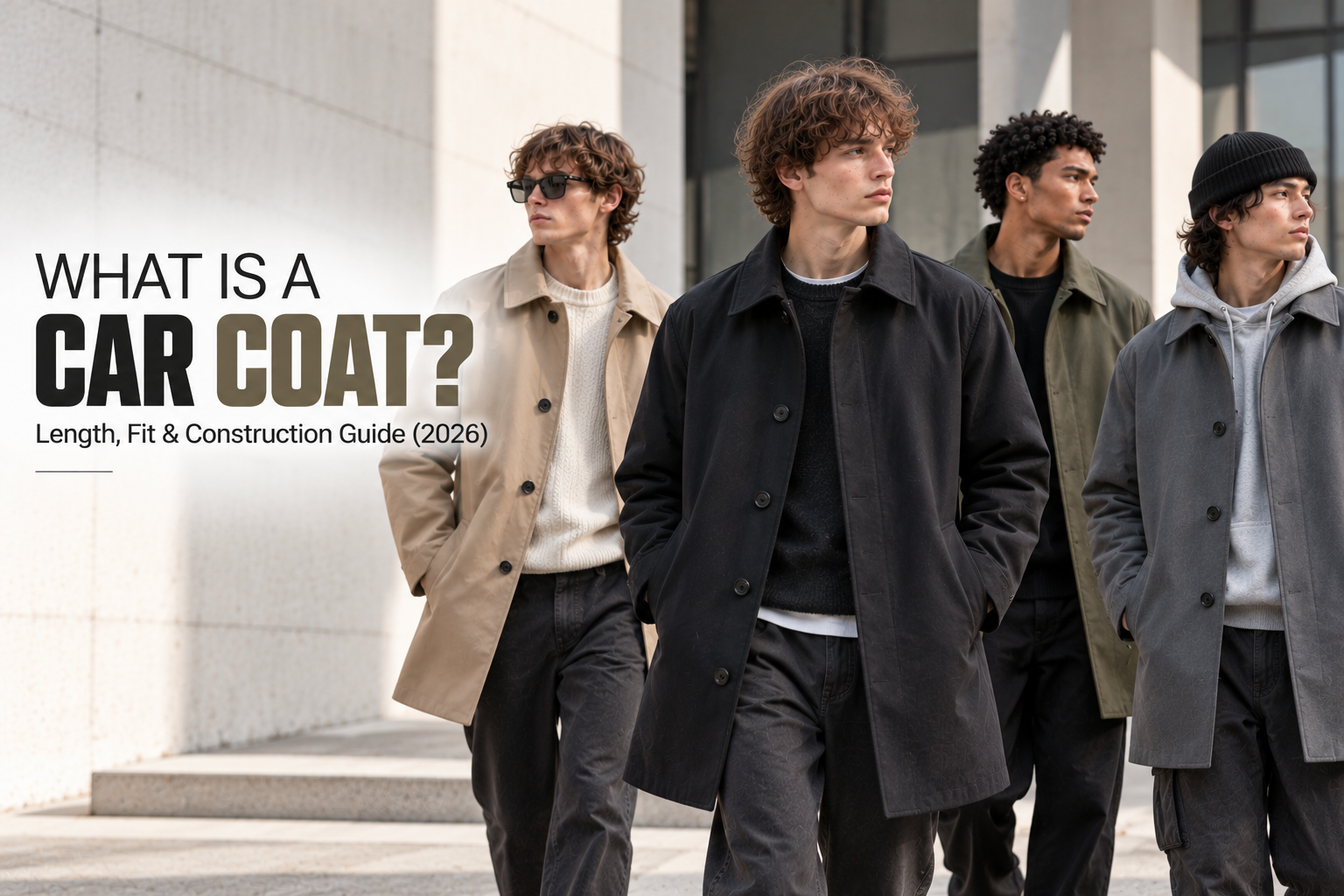
A car coat is a clean, mid-length outerwear garment traditionally designed to provide protection without the bulk or length of a full overcoat.
Modern men's car coats usually sit somewhere between:
- A short jacket
- A trench coat
- A longer overcoat
Their strongest design characteristics are often:
- Mid-thigh length
- Clean front
- Single-breasted closure
- Shirt-style or convertible collar
- Relaxed layering room
- Minimal exterior details
- Raglan or set-in sleeves
- Slanted welt or side pockets
The design looks simple.
That simplicity makes proportion especially important.
A car coat does not rely on:
- Large cargo pockets
- Storm flaps
- Decorative belts
- Heavy quilting
- Complex military details
to create identity.
Instead, the finished garment depends heavily on:
length + shoulder + front balance + collar + fabric + pocket position + lining + drape
If the coat is too short, it begins to read like a jacket.
If it is too long, it can move toward a topcoat or overcoat.
If the fabric is too stiff, the clean body can become boxy in an unintended way.
If the fabric is too soft, the collar and front edge may lose definition.
And if pocket height, button position and coat length are not balanced together, a very simple design can immediately look wrong.
This guide explains what defines a men's car coat and what clothing brands should specify before moving from reference garment to sample and bulk production.
What Is a Car Coat?
A car coat is generally a mid-length coat with relatively clean construction and enough room for comfortable movement and layering.
Modern versions commonly include:
- Mid-thigh length
- Single-breasted front
- Button or hidden-button closure
- Clean collar
- Side or welt pockets
- Straight or lightly shaped body
- Raglan or set-in sleeves
- Full, partial or no lining
Some designs also include:
- Two-way zipper
- Snap closure
- Hood
- Back vent
- Hidden placket
- Internal pockets
- Water-repellent fabric
- Light insulation
There is no single mandatory car-coat pattern.
The term describes a recognizable outerwear proportion and design direction rather than one fixed technical construction.
Why Are Car Coats Relevant in Men's Fashion in 2026?
For several seasons, men's outerwear has often moved toward two extremes:
- Very short cropped jackets
- Very long overcoats and trenches
The car coat creates a useful middle proportion.
It typically ends around:
- Upper thigh
- Mid-thigh
- Around three-quarter outerwear length depending on design
This gives it enough length to feel like a coat without creating the drama or weight of a knee-length overcoat.
That makes the car coat particularly useful for:
- Transitional weather
- Commuting
- Business casual
- Contemporary menswear
- Minimalist collections
- Relaxed tailoring
- Everyday layering
A car coat can work over:
- T-shirt
- Shirt
- Knitwear
- Sweatshirt
- Light blazer
without looking overly formal.
For clothing brands, this makes it a flexible product between casual jackets and traditional tailored coats.
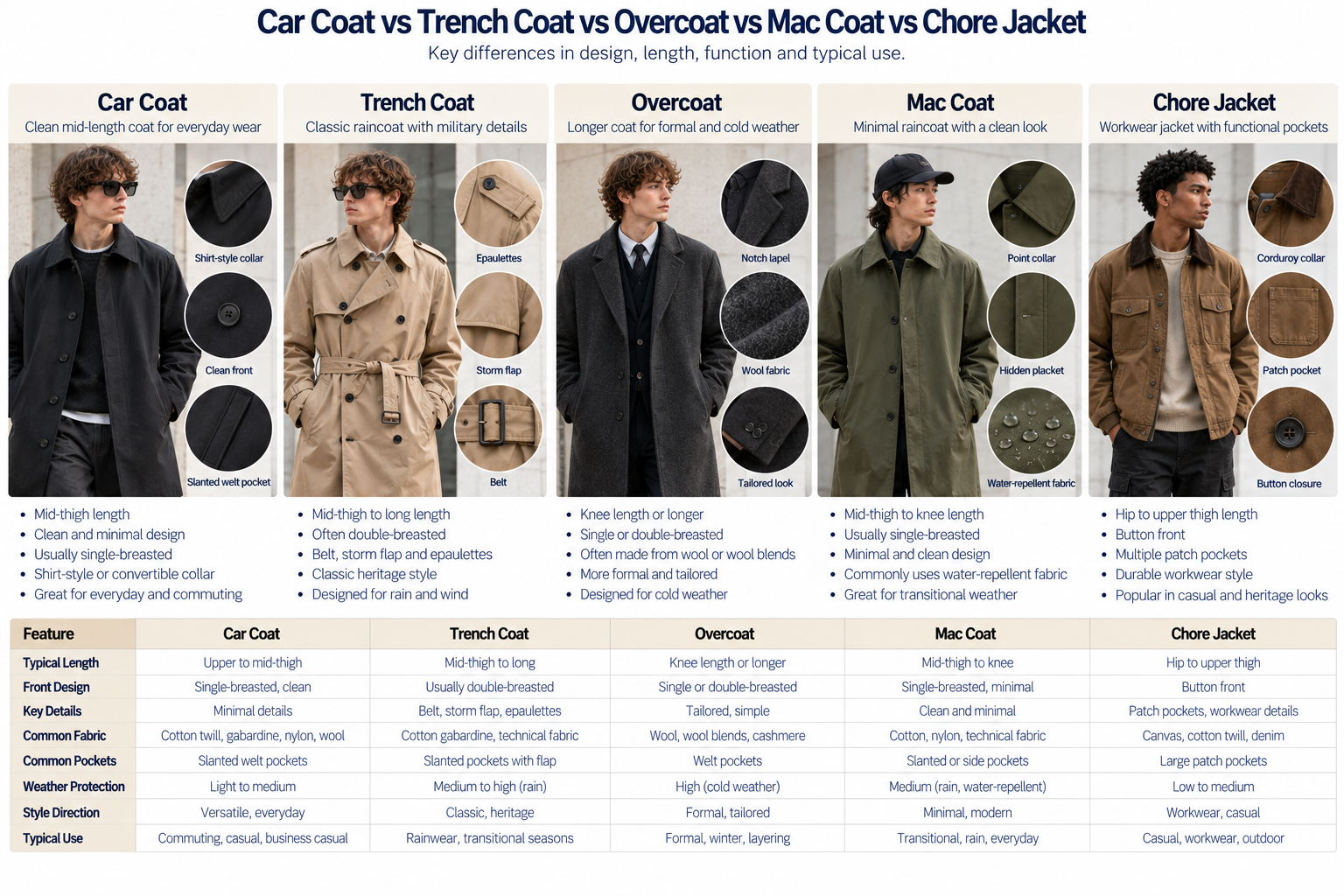
Car Coat vs Other Men's Coats
Several coat categories overlap visually.
The product name alone should never replace an actual specification.
| Style | Main Identifier | Typical Length | Front | Typical Character |
|---|---|---|---|---|
| Car Coat | Clean mid-length coat | Upper to mid-thigh | Usually single-breasted | Minimal / versatile |
| Trench Coat | Storm details, belt, wider overlap | Mid-thigh to long | Often double-breasted | Heritage rainwear |
| Overcoat | Longer coat for layering and warmth | Knee or longer | Single or double-breasted | Tailored / winter |
| Mac Coat | Minimal raincoat construction | Mid-thigh to knee | Usually single-breasted | Clean rainwear |
| Chore Jacket | Workwear pockets and shorter body | Hip to upper thigh | Button front | Functional workwear |
These are general differences rather than universal rules.
Modern fashion frequently mixes details across categories.
Car Coat vs Trench Coat
A classic trench coat usually has more visible construction details.
These may include:
- Belt
- Storm flap
- Epaulettes
- Sleeve straps
- Double-breasted front
- Back storm shield
A car coat is usually cleaner.
It may use only:
- Collar
- Front closure
- Pockets
- Simple back construction
The distinction can be summarized as:
Trench coat = detail-driven heritage outerwear
Car coat = proportion-driven minimal outerwear
For detailed trench-coat construction, see Brad Apparel's Trench Coat Guide.
Car Coat vs Overcoat
An overcoat is normally longer and often designed to be worn over:
- Suit
- Blazer
- Knitwear
- Other substantial layers
Traditional versions may use:
- Wool
- Wool blends
- Cashmere blends
- Tailored internal structure
A car coat is usually shorter and often less formal.
It can be made from:
- Cotton twill
- Gabardine
- Nylon
- Wool
- Technical woven fabric
and may use much lighter internal construction.
Car Coat vs Topcoat
The terms topcoat and overcoat are sometimes used inconsistently.
Generally, topcoats are often lighter than heavy winter overcoats.
But both tend to be longer and more tailoring-oriented than a typical modern car coat.
For manufacturing purposes, avoid relying only on names such as:
car coat
topcoat
overcoat
Instead specify:
- Finished length
- Fabric
- Fit
- Front closure
- Collar
- Lining
- Intended layering
Car Coat vs Mac Coat
This distinction can be subtle.
A mac coat is traditionally associated more strongly with:
- Rainwear
- Weather-oriented shell fabric
- Minimal styling
- Clean front construction
A car coat is defined more strongly by:
- Mid-length proportion
- Mobility
- Versatile everyday outerwear design
One garment can easily borrow from both categories.
For example:
mid-thigh cotton gabardine coat + hidden button front + water-repellent finish
could reasonably be described as either depending on the brand's product language.
The technical specification is more important than the marketing category.
Car Coat vs Chore Jacket
A chore jacket is generally shorter and much more pocket-driven.
Typical details include:
- Large patch pockets
- Chest pocket
- Workwear fabric
- Straight jacket body
A car coat usually:
- Extends farther down the thigh
- Uses cleaner pockets
- Has less visible utility detailing
- Creates a more coat-like silhouette
Car Coat Length Is the Defining Proportion
Length is one of the most important development decisions.
A few centimeters can noticeably change the garment category.
A car coat may finish around:
- Upper thigh
- Mid-thigh
- Slightly lower depending on design
The ideal length depends on:
- Wearer's height
- Fit
- Shoulder proportion
- Pocket position
- Intended base layers
Why Mid-Thigh Length Works
The length provides enough coverage to feel substantial.
But it remains short enough for:
- Sitting
- Driving
- Cycling
- Commuting
- Everyday movement
This practical proportion is central to the car-coat identity.
Car Coat Length vs Jacket Length
A hip-length outerwear piece generally begins to look more like:
- Harrington
- Work jacket
- Chore jacket
- Blouson
rather than a car coat.
If a brand wants the garment to read clearly as a car coat, enough body length should remain below the hip.
Car Coat Length vs Overcoat Length
Once the coat approaches:
- Knee
- Below knee
the visual identity moves much closer to:
- Overcoat
- Topcoat
- Long coat
That does not make the pattern wrong.
It simply changes the product category.
Length Should Be Evaluated on Body
Do not approve coat length only from a flat measurement.
Check the sample on an actual wearer.
Observe:
- Front proportion
- Side proportion
- Pocket height
- Sleeve-to-body relationship
The same numerical body length can appear very different on different garment sizes and fits.
The Car Coat Silhouette
The clean exterior means silhouette becomes extremely important.
Common directions include:
- Classic straight
- Relaxed straight
- A-line
- Boxy
- Oversized
Classic Straight Fit
A traditional clean car coat may use:
- Moderate chest ease
- Straight side seam
- Controlled shoulder
- Mid-thigh body
This works well for:
- Business casual
- Premium basics
- Everyday menswear
Relaxed Fit
A relaxed car coat adds room through:
- Chest
- Back
- Bicep
- Sleeve
without greatly increasing length.
This is especially useful for modern layering.
Boxy Car Coat
A boxy version may use:
- Wider chest
- Wider shoulder
- Straighter body
- Controlled length
The hem remains relatively broad rather than tapering inward.
This works particularly well with:
- Firm cotton twill
- Technical woven fabric
- Structured wool
Oversized Car Coat
Oversized versions should be developed intentionally.
Do not simply increase a standard car coat by several sizes.
That can create:
- Sleeves too long
- Collar too large
- Pockets too low
- Excessive body length
A well-designed oversized coat usually increases:
- Chest
- Shoulder
- Bicep
- Sweep
more aggressively than:
- Collar
- Pocket size
- Body length
Body Sweep
The lower circumference of the coat affects:
- Movement
- Silhouette
- Layering
A very narrow sweep may restrict:
- Sitting
- Walking
especially if the coat is longer.
A very wide sweep can create an unintended A-line shape.
Front Closure Options
A car coat can use several front closures.
Common choices include:
- Visible buttons
- Hidden buttons
- Snaps
- Zipper
- Zipper + snaps
The closure changes the entire product direction.
Visible Button Front
A visible button front creates:
- Classic appearance
- Simple construction
- Traditional coat styling
Possible button materials include:
- Horn-look resin
- Corozo
- Plastic
- Metal
- Custom branded buttons
Hidden Button Placket
A concealed button front creates:
- Cleaner appearance
- More minimalist styling
- Strong uninterrupted front line
This works particularly well for modern car coats.
The hidden placket needs enough structure to avoid:
- Waviness
- Gaping
- Bulky folding
Hidden Snap Closure
Snaps can create a similar minimalist appearance.
Possible advantages include:
- Faster closure
- Cleaner exterior
But snap strength must match the shell fabric.
Heavy snaps on lightweight fabric may distort the front.
Zipper Car Coat
A zipper creates a more:
- Technical
- casual
- contemporary
direction.
Possible options include:
- Coil zipper
- Reverse coil
- Molded zipper
- Metal zipper
- Two-way zipper
A two-way zipper can improve comfort on longer coats when sitting.
Combined Closure
Some designs use:
- Zipper inside
- Snap or button storm placket outside
This creates more visual and functional complexity.
But it also moves the product closer to:
- Technical coat
- Field coat
- Weather-protective outerwear
The design should remain intentional.
Front Overlap
Even a clean single-breasted coat needs enough overlap.
If overlap is too narrow:
- Front may gap
- Wind can enter more easily
- Button positioning becomes awkward
If excessively wide:
- Front becomes heavy
- The coat may hang asymmetrically
The correct overlap depends on:
- Button size
- Placket
- Fabric
- Closure system
Button Spacing
Button spacing affects:
- Visual proportion
- Front stability
Large gaps can cause the front to open between buttons.
Very close spacing can look visually crowded.
Button position should be developed relative to:
- Collar
- Chest
- Hem
Car Coat Collar Options
Common collar directions include:
- Shirt collar
- Point collar
- Convertible collar
- Stand collar
- Covered placket collar
- Corduroy contrast collar
The collar is one of the strongest visual elements on an otherwise minimal coat.
Shirt-Style Collar
A clean shirt-style collar creates:
- Casual appearance
- Easy layering
- Simple manufacturing
It works particularly well with:
- Cotton twill
- Gabardine
- Nylon
Point Collar
A longer point creates:
- Stronger heritage character
- More visual presence
The point length should remain proportional to the coat width.
Convertible Collar
A convertible collar can work:
- Open
- Closed
This improves flexibility in transitional weather.
The pattern should be evaluated in both positions.
Stand Collar
A stand collar creates a cleaner or more technical interpretation.
It may use:
- Button closure
- Snap
- Zipper
around the neck.
This moves the car coat away from classic motoring-coat styling and toward modern minimal outerwear.
Contrast Corduroy Collar
Corduroy can be used as a collar contrast.
This creates:
- Heritage feel
- Texture
- Workwear influence
But it should be used carefully if the product begins to resemble a barn jacket.
The rest of the garment should remain clean if the intended category is car coat.
Collar Scale
A very small collar may appear weak on a broad coat body.
An oversized collar may dominate a minimalist garment.
The collar should be reviewed relative to:
- Shoulder width
- Chest width
- Body length
rather than as an isolated pattern piece.
Collar Interfacing
Possible support levels include:
- None
- Light fusible
- Medium fusible
The choice depends on:
- Fabric
- Desired structure
- Collar construction
Too much interfacing can make a soft casual car coat look overly tailored.
Too little support may cause the collar to collapse.
Raglan Sleeve Car Coat
Raglan sleeves are strongly suited to car coats because they provide:
- Comfortable movement
- Easy layering
- Softer shoulder line
- Minimal appearance
The sleeve seam extends toward the neckline rather than ending at a conventional shoulder seam.
Raglan Sleeve Advantages
A raglan construction can accommodate a broader range of shoulders.
It can also make the coat easier to wear over:
- Knitwear
- Sweatshirts
- Blazers
because the shoulder area is less sharply defined.
Raglan Pattern Balance
A raglan sleeve still needs careful pattern development.
Important areas include:
- Front raglan seam
- Back raglan seam
- Neckline
- Sleeve pitch
- Underarm
Too much fabric near the neck can create:
- Folding
- bunching
Too little can restrict arm movement.
Set-In Sleeve Car Coat
A set-in sleeve creates:
- Cleaner shoulder point
- More tailored appearance
- Sharper upper body
It works well for:
- Wool car coats
- Business casual
- Minimal tailored designs
Extended Shoulder
A modern set-in sleeve can use a slightly extended shoulder.
This provides:
- Relaxed appearance
- Additional layering room
without becoming a full drop shoulder.
Drop Shoulder
A strong drop shoulder can create:
- Streetwear proportion
- Oversized silhouette
But extreme shoulder drop can weaken the traditional clean car-coat character.
Use it when the collection intentionally leans toward fashion outerwear.
Best Fabrics for Car Coats
The fabric determines whether the coat feels:
- Casual
- Technical
- Tailored
- Heritage
- Premium
Common options include:
- Cotton twill
- Cotton gabardine
- Cotton/polyester woven
- Nylon
- Polyester
- Wool
- Wool blends
- Technical woven fabrics
- Leather or suede in specialty versions
For custom fabric development, see Brad Apparel's Fabric Sourcing & Development.
Cotton Twill Car Coat
Cotton twill provides:
- Good structure
- Comfortable hand feel
- Easy casual styling
- Broad color range
It is useful for:
- Transitional coats
- Casual menswear
- Washed designs
Cotton Gabardine
Gabardine creates:
- Dense structure
- Smooth appearance
- Cleaner drape
It works particularly well for:
- Refined car coats
- Business casual
- Weather-oriented outerwear
The physical sample should be evaluated because gabardine fabrics can vary significantly in:
- Weight
- Density
- Fiber
- Finish
Nylon Car Coat
Nylon creates:
- Lightweight feel
- Technical appearance
- Easy layering
- Potential water-repellent performance depending on finish
Possible directions include:
- Matte nylon
- Crinkle nylon
- Dense technical nylon
- Coated nylon
Polyester Car Coat
Polyester woven fabrics can provide:
- Dimensional stability
- Broad color options
- Wrinkle resistance
- Cost flexibility
Performance depends more on actual fabric construction than fiber name alone.
Wool Car Coat
Wool moves the car coat toward a more refined cold-weather product.
Possible fabrics include:
- Wool twill
- Melton
- Brushed wool
- Wool blend
A mid-thigh wool coat can retain car-coat proportion while providing more winter warmth.
Wool Blend
Blends may combine wool with:
- Polyester
- Nylon
- Viscose
- Other fibers
to change:
- Hand feel
- Durability
- Cost
- Weight
- Stability
Leather Car Coat
Leather can create a much stronger fashion statement.
Because leather behaves differently from woven fabric, pattern and construction need special consideration around:
- Seam allowance
- needle holes
- pocket construction
- panel size
This should be developed as a leather-specific project rather than simply changing fabric on a woven car-coat pattern.
Water-Repellent Car Coat
Some car coats use a water-repellent shell.
This can be useful for:
- Commuting
- Transitional rain
- Travel
But:
water-repellent does not mean waterproof.
A brand should avoid making waterproof claims unless:
- Shell
- seams
- closure
- construction
meet the required tested performance.
DWR Finish
Some woven fabrics use a durable water-repellent treatment.
The finish can help water bead on the surface.
Performance may change after:
- Washing
- Abrasion
- Long-term wear
Testing should reflect the intended claim.
Coated Fabric
Coatings can improve weather protection or create surface character.
But they can affect:
- Sewing
- pressing
- printing
- heat transfer
- needle marks
The production team should confirm handling before sampling.
Car Coat Lining
Possible lining constructions include:
- Full lining
- Half lining
- Upper-back lining
- Sleeve-only lining
- Unlined construction
- Light quilted lining
Full Lining
A full lining creates:
- Clean interior
- Easier layering
- More coat-like structure
Smooth sleeve lining makes the coat easier to wear over:
- Shirt
- Sweater
- Blazer
Half Lining
A partial lining can reduce:
- Weight
- warmth
- material cost
while keeping key internal areas clean.
This works particularly well for transitional car coats.
Unlined Car Coat
An unlined product needs clean internal finishing.
Possible options include:
- Bound seams
- Clean overlock
- Flat-felled seams in selected areas
- Hong Kong binding
depending on design and price point.
Quilted Lining
Light quilted insulation can turn the car coat into a colder-weather outerwear product.
But adding insulation changes:
- Fit
- armhole
- sleeve width
- chest ease
- garment weight
An insulated car coat should not use exactly the same internal dimensions as a thin unlined version.
Lining Ease
Lining needs sufficient ease for movement.
It should not copy shell dimensions mechanically.
Insufficient lining ease can:
- Pull the shell
- Restrict arm movement
- Lift the hem
Excess lining can:
- Sag
- Twist
- Hang below the shell
Car Coat Pocket Options
The clean design usually favors relatively discreet pockets.
Common options include:
- Slanted welt pocket
- Vertical welt pocket
- Side-seam pocket
- Hidden zipper pocket
- Flap pocket
- Internal pocket
Slanted Welt Pocket
This is one of the most useful options.
It provides:
- Clean appearance
- Comfortable hand entry
- Minimal exterior bulk
Pocket angle should be tested on the wearer.
Vertical Welt Pocket
A vertical pocket can create a more:
- Minimal
- technical
look.
But a perfectly vertical opening may be less comfortable for hand entry.
Side-Seam Pocket
Side-seam pockets create an almost uninterrupted front.
This works well for very minimal designs.
The pocket bag should not distort:
- Side seam
- hip
Hidden Zipper Pocket
A concealed zipper adds security.
It works particularly well for:
- Travel coats
- Technical outerwear
The zipper tape should not create visible puckering.
Internal Pocket
Internal storage is useful for:
- Phone
- Wallet
- Passport
especially because car coats are commonly used for commuting and travel.
The pocket should be reinforced appropriately if intended for heavier items.
Pocket Position
Pocket height is a major visual reference.
If positioned too high:
- Hand entry can feel awkward
If too low:
- Coat can appear excessively long
- User may need to reach downward
Pocket placement should be checked on body.
Back Construction
A car coat may use:
- Plain back
- Center seam
- Back yoke
- Center vent
- Side vents
- No vent
Minimal versions often use relatively clean backs.
Center-Back Seam
A center-back seam can help control:
- shaping
- fit
- fabric utilization
It can also support a center vent.
Back Vent
A vent improves mobility.
This becomes more important as the coat gets longer.
The vent should open during movement but remain relatively clean when standing.
Side Vents
Side vents can provide:
- Movement
- modern styling
especially on straighter coats.
They should remain balanced left and right.
No Vent
A shorter relaxed car coat may not require a vent if:
- Sweep is sufficient
- Fabric allows movement
The decision should be based on the actual fit.
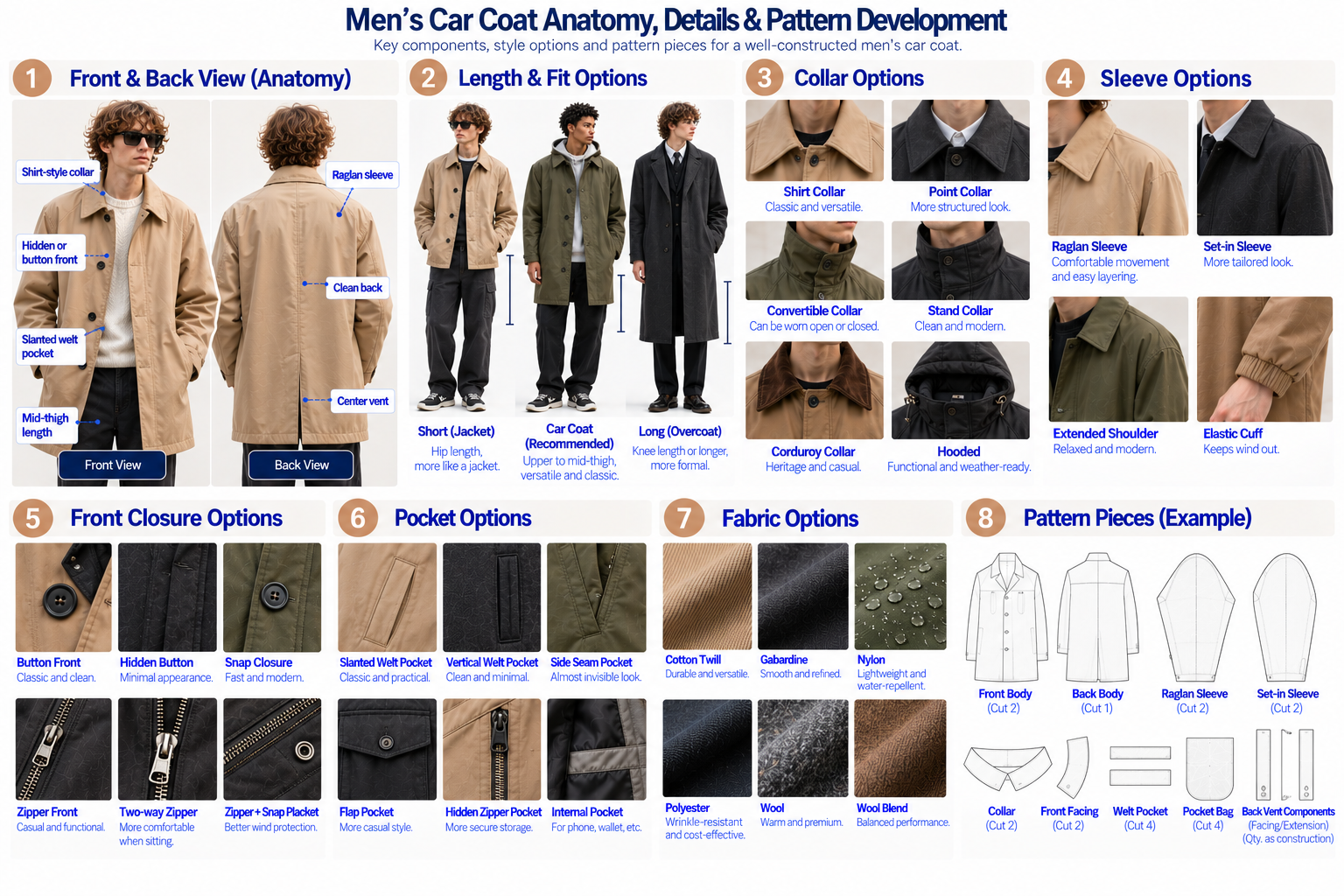
Car Coat Pattern Development
A typical pattern may include:
- Front body
- Back body
- Sleeve
- Collar
- Front facing
- Front placket where required
- Pocket welt
- Pocket bag
- Back vent components
- Lining pieces
Depending on design, it may also include:
- Raglan front sleeve
- Raglan back sleeve
- Hood
- Storm placket
- Internal pocket pieces
Exact pattern-piece quantity depends on construction.
Front Body Pattern
The front body controls:
- Chest
- Front overlap
- Pocket position
- Closure
- Hem
Because the exterior is clean, front balance needs to be particularly accurate.
Back Body Pattern
The back affects:
- Shoulder movement
- Sweep
- Vent
- Overall drape
A long uninterrupted back panel can make:
- Fabric skew
- twisting
- grainline problems
more visible.
Raglan Sleeve Pattern
Raglan sleeves may use:
- One-piece construction
- Two-piece construction
depending on shaping.
Two-piece raglan construction can offer greater control over:
- Sleeve curve
- elbow
- shoulder fit
Set-In Sleeve Pattern
Set-in sleeve development needs to coordinate:
- Armhole
- Sleeve cap
- Bicep
- Shoulder
A coat requires more layering allowance than a fitted shirt.
Collar Pattern
The collar must work with:
- Neckline
- Facing
- front closure
Check the sample:
- Open
- Buttoned
- Collar raised where intended
Facing Pattern
The front facing supports:
- Front edge
- Collar
- Button area
It needs enough width for stability without adding unnecessary weight.
Pocket Pattern
A welt pocket generally requires:
- Pocket opening
- Welt
- Pocket bag
- Reinforcement
The pocket bag should remain hidden and should not hang below the coat hem.
Lining Pattern
The lining is usually derived from the shell but modified for:
- Ease
- facing
- vent
- hem allowance
It should be developed as its own component rather than copied blindly from the outer pattern.
Important Car Coat Measurements
| Measurement | Why It Matters |
|---|---|
| Chest Width | Controls layering room |
| Body Length | Defines car-coat proportion |
| Shoulder Width | Controls silhouette |
| Raglan Length | Required for raglan styles |
| Sleeve Length | Controls wrist position |
| Bicep Width | Controls layering comfort |
| Hem Width / Sweep | Controls movement |
| Neck Opening | Controls collar fit |
| Collar Width | Controls visual scale |
| Front Overlap | Controls closure |
| Pocket Position | Controls function and balance |
| Pocket Opening | Controls hand entry |
| Back Vent Length | Controls movement |
Measuring Body Length
Define a consistent measurement method.
For example:
Measure from the highest point of shoulder to the finished bottom edge.
For raglan designs, the same HPS body-length method can still be used.
Chest Measurement
For a flat garment:
Measure straight across at the specified point below the armhole.
State the exact reference point in the tech pack.
Raglan Sleeve Length
Raglan styles need a clearly defined sleeve method.
Possible method:
Measure from center back neck across shoulder and down sleeve to cuff.
The brand and factory must use the same measurement method.
Hem Sweep
A flat half-width measurement can be used for specification.
Do not confuse:
- Half sweep
- Full circumference
in the size chart.
Pocket Position
Define pocket position from consistent reference points such as:
- HPS
- Center front
- Side seam
- Hem
rather than relying on photographs.
Fit Development
The first sample should be tested over the garment the customer is actually expected to wear underneath.
Examples include:
- T-shirt
- Shirt
- Sweater
- Hoodie
- Blazer
Layering Over Knitwear
If the coat is designed over a sweater, check:
- Chest
- Armhole
- Bicep
- Cuff
- Neck
with the sweater underneath.
Layering Over a Blazer
A business-oriented car coat requires enough room for:
- Structured shoulder
- Lapel
- Sleeve
without crushing the blazer underneath.
Car Coat Grading
Grading needs to preserve the clean proportion.
Not every component should scale at the same rate.
Body-Length Grading
Body length may increase gradually across sizes.
But aggressive vertical grading can cause large sizes to become too long.
Pocket Grading
Pocket size may increase slightly.
Placement also needs to move with:
- Chest
- Length
A completely fixed pocket position can look wrong across a large size range.
Collar Grading
Neck circumference normally changes.
Collar point length may remain more consistent.
Button Grading
Button diameter generally remains the same.
Button position and spacing may adjust with:
- Body
- length
Sleeve Grading
Sleeve length and bicep width should grade separately.
A larger size needs more:
- circumference
- movement room
not simply a longer sleeve.
Sample Evaluation
The first sample should be reviewed from:
- Front
- Side
- Back
and in motion.
Front View
Check:
- Center front
- Collar
- Closure
- Pocket position
- Hem
- Overall width
Side View
Check:
- Body balance
- Sleeve pitch
- Pocket bulk
- Front/back length
The coat should not pitch heavily forward or backward.
Back View
Check:
- Shoulder
- Back width
- Vent
- Hem
- Sleeve symmetry
Open-Coat Test
Wear the coat fully open.
The fronts should:
- Hang cleanly
- Not twist
- Not flare excessively
Closed-Coat Test
Button or zip the coat.
Look for:
- Pulling
- Gaping
- Front distortion
- Collar tension
Sitting Test
The mid-length body should remain comfortable when seated.
Check:
- Front opening
- Hem
- Vent
Walking Test
Observe the coat during walking.
The hem should move naturally without:
- Twisting
- excessive flare
Arm-Movement Test
Raise and extend the arms.
Pay particular attention to:
- Raglan seam
- Armhole
- Back width
- Bicep
Fabric Shrinkage
Cotton and certain other natural-fiber fabrics may shrink.
Test before pattern approval.
Record:
- Length
- Width
according to the intended finishing process.
Shell and Lining Compatibility
The two materials may respond differently to:
- Washing
- Steam
- Heat
If the shell changes dimension but the lining does not, the coat may become distorted.
Garment Washing
Some cotton car coats may be garment washed for:
- Softer hand
- Vintage appearance
- Casual styling
However, washing needs compatibility with:
- Interfacing
- Buttons
- lining
- coating
Pressing
Pressing has a large visual impact on clean outerwear.
Important areas include:
- Collar
- Front edge
- Pockets
- Sleeve
- Hem
Avoid excessive heat on:
- Nylon
- coatings
- synthetic fabrics
Interfacing
Possible interfacing areas include:
- Collar
- Front edge
- Pocket opening
- Button area
The amount should match the garment style.
Minimal Car Coat Interfacing
A casual cotton or nylon car coat may use only selective support.
This preserves:
- Softness
- movement
- relaxed appearance
Structured Wool Car Coat
A wool version may require more support around:
- Front
- Collar
depending on the desired tailoring level.
It still does not automatically require full traditional suit construction.
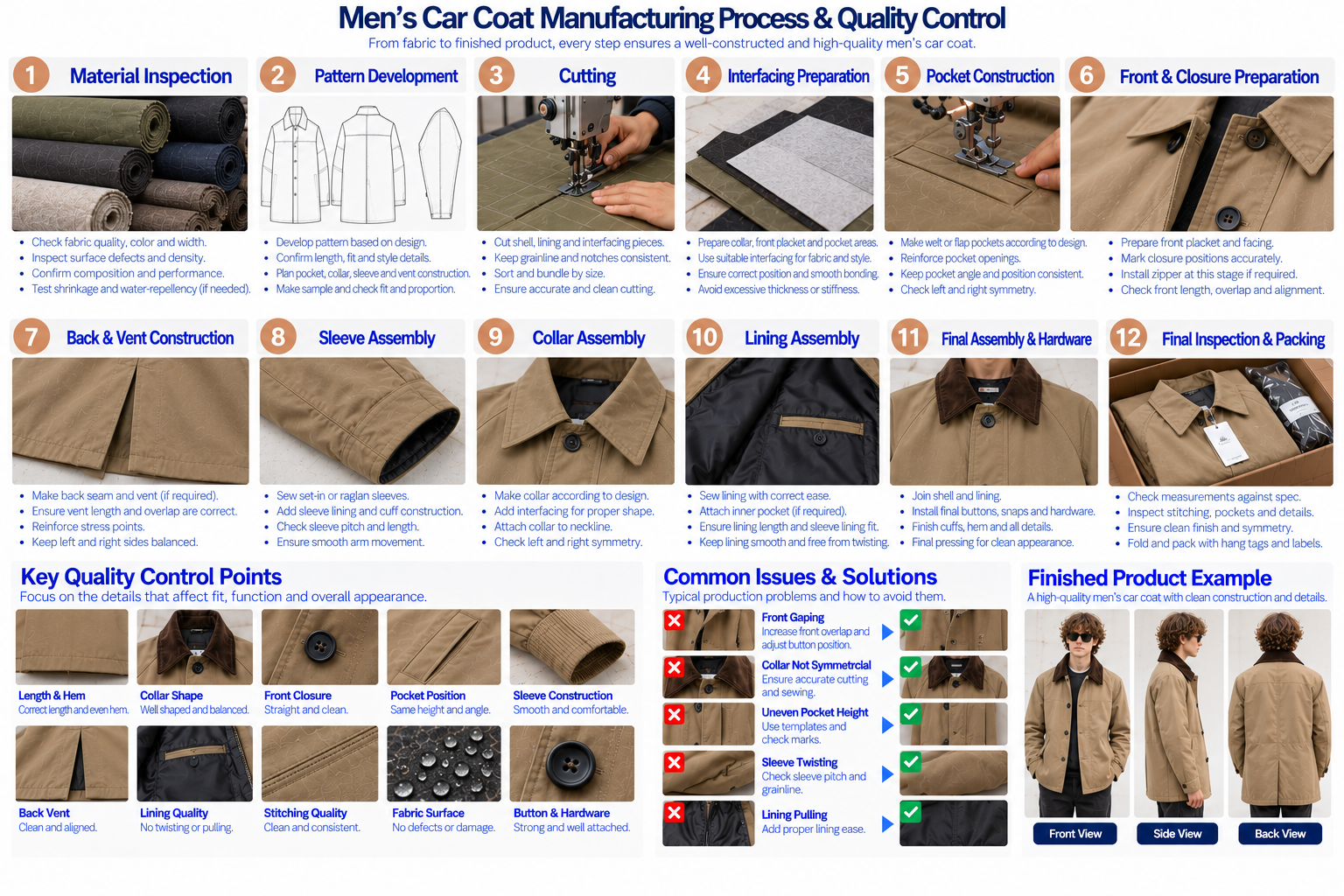
Manufacturing Process
A practical production sequence may include:
- Shell and lining inspection
- Shrinkage or performance test
- Pattern development
- Grading
- Cutting
- Interfacing preparation
- Pocket preparation
- Front-placket preparation
- Back and vent preparation
- Sleeve preparation
- Shell assembly
- Collar and facing assembly
- Lining assembly
- Shell and lining joining
- Buttonholes / closure installation
- Final pressing
- Measurement inspection
- Quality control
- Packing
The exact order varies according to garment construction.
Fabric Inspection
Before cutting, inspect:
- Composition
- Width
- Weight
- Color
- Surface
- Defects
- Direction
For technical shells also check:
- Coating
- water-repellent finish
- visible creasing
Cutting
Maintain:
- Grainline
- Size identification
- Direction
- Paired components
For large clean coat panels, inaccurate grainline can cause visible twisting.
Pocket Preparation
Check:
- Pocket opening
- Welt width
- Angle
- Reinforcement
- Left/right symmetry
Pocket templates can improve consistency.
Front Preparation
Prepare:
- Placket
- Facing
- Closure positions
Check center-front length before major assembly.
Back Preparation
If a vent is used:
- Mark vent length
- Prepare reinforcement
- Confirm overlap
Both sides should remain balanced.
Sleeve Preparation
Pair left and right sleeves.
Check:
- Sleeve pitch
- Bicep
- cuff
- seam
before attachment.
Collar Preparation
Check:
- Left/right symmetry
- Collar points
- Interfacing
- Finished dimensions
Main Shell Assembly
Join:
- Front
- Back
- Sleeves
according to the approved pattern.
Maintain consistent seam allowance.
Lining Assembly
Prepare lining with appropriate:
- Ease
- Sleeve length
- Hem allowance
The lining should not restrict the outer shell.
Joining Shell and Lining
Check:
- Neckline
- Front edge
- Sleeve hem
- Bottom hem
- Vent
for clean attachment.
Buttonhole Construction
Buttonhole length should suit the approved button.
Heavy fabrics may require:
- Different machine settings
- Additional stabilization
Button Attachment
Check:
- Position
- Attachment strength
- Thread shank where required
Thicker fabrics normally need enough space between the button and garment surface for comfortable closure.
Zipper Installation
If using a zipper:
- Keep center front straight
- Control feeding
- Check slider operation
Longer front zippers can make waviness particularly visible.
Final Pressing
The coat should be pressed to establish:
- Collar
- Front edge
- Hem
without making the garment unnaturally flat.
Measurement Inspection
Final measurements should be taken after any intended finishing process.
Check:
- Chest
- Length
- Sleeve
- Bicep
- Hem
- Pocket position
- Collar
against specification.
Key Quality Control Points
Front Balance
Left and right fronts should hang evenly.
Collar Symmetry
Check:
- Collar points
- height
- left/right shape
Closure Alignment
Buttons, snaps or zipper should follow a clean center-front line.
Pocket Position
Left and right pockets should normally match in:
- Height
- angle
Sleeve Symmetry
Compare:
- Length
- pitch
- cuff
Hem
The bottom edge should appear level.
Back Vent
Check:
- Overlap
- Length
- clean opening
Lining
Check for:
- Twisting
- pulling
- excess length
Stitching
Inspect:
- Consistency
- skipped stitches
- puckering
Fabric Surface
Check for:
- Press shine
- needle marks
- stains
- coating damage
Common Car Coat Quality Problems
Uneven Front Length
One front appears longer than the other.
Possible causes include:
- Cutting
- feeding
- pressing
- pattern imbalance
Twisted Center Front
Possible causes include:
- Grainline error
- incorrect facing
- zipper installation
Uneven Pocket Height
Use:
- Position marks
- templates
during sewing.
Collar Points Do Not Match
Possible causes include:
- Cutting
- seam allowance
- turning
- pressing
Front Gaping
The coat opens between buttons.
Possible causes include:
- Insufficient overlap
- Button spacing
- Chest too tight
Sleeve Twisting
Possible causes include:
- Sleeve pitch
- cutting
- grainline
- sewing
Back Vent Opening While Standing
Possible causes include:
- Insufficient sweep
- Hip tightness
- Lining tension
- Incorrect vent construction
Lining Pulling the Shell
The lining may be:
- Too short
- Too narrow
or incorrectly attached.
Lining Hanging Below Hem
Possible causes include:
- Excess length
- Shell shrinkage
- Poor hemming control
Seam Puckering
This can be particularly visible on:
- Nylon
- Fine polyester
- Dense gabardine
Check:
- Needle
- Thread
- Tension
- Feed
Press Shine
Wool and dark fabrics can develop glossy areas after excessive pressure or heat.
Use a material-appropriate pressing method.
Coating Damage
Technical or coated fabrics can be damaged by:
- Heat
- Pressure
- Chemicals
Test before bulk production.
Car Coat Tech Pack Example
| Area | Example Specification |
|---|---|
| Product | Men's Car Coat |
| Fit | Relaxed |
| Length | Mid-Thigh |
| Shell | Cotton Gabardine |
| Fabric Weight | 270 GSM |
| Front | Single Breasted |
| Closure | Hidden Button Placket |
| Collar | Convertible Point Collar |
| Sleeve | Raglan |
| Slanted Welt Pocket | |
| Back | Center Vent |
| Lining | Full Lightweight Lining |
| Stitching | Tonal |
| Button | Horn-Look Resin |
| Finish | Water-Repellent |
| Branding | Woven Main + Care Label |
These specifications are examples only.
Example Minimal Cotton Car Coat
A clean modern version might use:
- Relaxed fit
- Mid-thigh length
- Dense cotton twill
- Hidden button front
- Raglan sleeve
- Point collar
- Slanted welt pockets
- Center-back vent
- Partial lining
- Tonal stitching
This keeps the design extremely simple.
Example Technical Nylon Car Coat
Possible specification:
- Relaxed fit
- Mid-thigh
- Matte nylon shell
- Hidden snap front
- Stand collar
- Raglan sleeves
- Concealed zipper pockets
- Full lightweight lining
- Water-repellent finish
The performance claims should match actual fabric testing.
Example Wool Car Coat
A colder-weather version might use:
- Regular-relaxed fit
- Wool-blend fabric
- Set-in sleeve
- Shirt-style collar
- Visible horn-look buttons
- Welt pockets
- Full lining
- Center vent
This creates a cleaner alternative to a long overcoat.
Example Oversized Car Coat
Possible specification:
- Wide boxy body
- Mid-thigh length
- Extended shoulder
- Wide sleeve
- Hidden button closure
- Large collar
- Minimal welt pockets
- Straight hem
Pocket and collar scale should be adjusted for the larger body.
Example Hooded Car Coat
A modern casual version may combine:
- Mid-thigh clean body
- Attached or detachable hood
- Zipper closure
- Technical shell
- Side pockets
- Adjustable cuffs
Adding a hood makes the product more casual and weather-oriented but does not automatically remove it from the car-coat category.
How to Describe a Car Coat to a Manufacturer
Avoid sending:
I want a men's car coat like this picture.
Instead write:
Men's relaxed mid-thigh car coat in 270 GSM cotton gabardine with raglan sleeves, a medium point collar, concealed five-button front, slanted welt hand pockets, center-back vent and lightweight full lining.
Then provide:
- Chest
- Body length
- Sleeve / raglan length
- Bicep
- Sweep
- Neck
- Collar
- Front overlap
- Pocket dimensions
- Pocket position
- Vent dimensions
- Fabric
- Lining
- Buttons
- Finish
- Branding
This gives the pattern and sample teams a much clearer starting point.
Common Car Coat Development Mistakes
1. Making It Too Short
The garment starts reading as a jacket instead of a coat.
2. Making It Too Long
The silhouette moves toward a conventional overcoat.
3. Copying a Trench Coat Pattern and Removing the Belt
A car coat should have its own:
- Front balance
- Pocket layout
- proportion
rather than being a stripped-down trench.
4. Making the Coat Too Slim
The garment loses its useful layering function.
5. Making the Coat Excessively Oversized
Too much volume can remove the clean proportion that defines the style.
6. Pocket Position Too Low
Longer body length can tempt designers to lower the pockets excessively.
The wearer still needs comfortable hand access.
7. Using a Collar That Is Too Small
The collar may look weak relative to the wider coat body.
8. Over-Interfacing the Coat
A casual car coat can become too stiff and formal.
9. Ignoring Lining Ease
The shell may pull during movement.
10. Ignoring Sitting Comfort
A car coat should remain practical when sitting.
11. Treating Water-Repellent as Waterproof
These are different performance claims.
12. Not Testing Technical Fabric Before Pressing
Heat can damage coatings and synthetic surfaces.
Car Coat Development Checklist
Before sampling, confirm:
- Fit
- Body length
- Intended layering
- Shell fabric
- Weight
- Finish
- Lining
- Shoulder construction
- Sleeve
- Collar
- Front closure
- Back vent
- Cuffs
- Hardware
- Branding
- Performance requirements
Before bulk production, confirm:
- Approved fabric
- Shrinkage
- Final pattern
- Fit sample
- Body length
- Pocket placement
- Collar dimensions
- Front overlap
- Closure
- Vent
- Lining ease
- Pressing standard
- Measurement tolerance
- QC standard
FAQ
What Is a Car Coat?
A car coat is a clean mid-length outerwear garment traditionally designed for easy movement and practical coverage.
Modern versions usually have:
- Mid-thigh length
- Single-breasted front
- Clean collar
- Minimal pockets
- Relaxed layering room
Why Is It Called a Car Coat?
The style developed from coats associated with early motoring.
Its practical length provided protection while remaining easier to move and sit in than a much longer coat.
Modern car coats have evolved into general everyday outerwear.
Are Car Coats in Style in 2026?
Yes.
Mid-length coats are receiving renewed attention in 2026 menswear as an alternative to both very cropped jackets and dramatic long overcoats.
Modern versions commonly use:
- Relaxed silhouettes
- Minimal closures
- Technical fabric
- Wool
- Leather
- Clean tailoring
How Long Should a Car Coat Be?
There is no single required measurement.
A car coat typically ends around the upper to mid-thigh.
The exact length should be developed relative to:
- Wearer's height
- Coat size
- Intended silhouette
Is a Car Coat the Same as a Trench Coat?
No.
A trench coat usually includes more distinctive details such as:
- Belt
- Storm flap
- Epaulettes
A car coat is generally cleaner and more minimal.
Is a Car Coat the Same as an Overcoat?
No.
Overcoats are generally longer and often more tailored or winter-oriented.
Car coats typically use a shorter mid-thigh proportion.
Is a Car Coat the Same as a Mac Coat?
Not exactly, although the categories can overlap.
A mac coat is more closely associated with minimal rainwear.
A car coat is more strongly defined by its practical mid-length proportion.
Can Car Coats Have Raglan Sleeves?
Yes.
Raglan sleeves are particularly suitable because they provide:
- Comfortable movement
- layering ease
- soft shoulder shape
Can a Car Coat Be Oversized?
Yes.
The oversized pattern should control:
- Chest
- Shoulder
- Sleeve
- Length
independently.
Do not simply use a larger standard size.
What Fabric Is Best for a Car Coat?
Common fabrics include:
- Cotton twill
- Gabardine
- Nylon
- Polyester
- Wool
- Wool blends
- Technical woven fabrics
The correct choice depends on season and intended styling.
Can a Car Coat Be Water-Repellent?
Yes.
The shell can use:
- DWR treatment
- coating
- water-repellent fabric construction
depending on the product.
But water-repellent does not automatically mean waterproof.
Should a Car Coat Be Lined?
It may be:
- Fully lined
- Partially lined
- Unlined
depending on season and product direction.
What Pockets Work Best on a Car Coat?
Clean options include:
- Slanted welt pockets
- Vertical welt pockets
- Side-seam pockets
- Hidden zipper pockets
These preserve the minimal exterior.
What Should Be Checked During Car Coat QC?
Important points include:
- Front balance
- Collar symmetry
- Closure alignment
- Pocket height
- Sleeve symmetry
- Hem
- Back vent
- Lining
- Stitching
- Fabric surface
- Final measurements
Final Thoughts
The car coat is defined less by decorative details than by proportion.
Its strength comes from the relationship between:
mid-thigh length + clean front + comfortable layering + restrained pockets + balanced fabric structure
A cotton gabardine version can become an easy everyday transitional coat.
A technical nylon version can feel modern and functional.
A wool version can replace a heavier overcoat during milder weather.
And an oversized version can create a strong contemporary menswear silhouette without relying on complex design details.
For clothing brands, the biggest mistake is treating the car coat as a generic long jacket.
The body length, chest volume, shoulder construction, pocket height, collar scale, front closure and fabric should be developed together.
Once those proportions are correct, the apparent simplicity of the car coat becomes its strongest feature.
Keep Reading