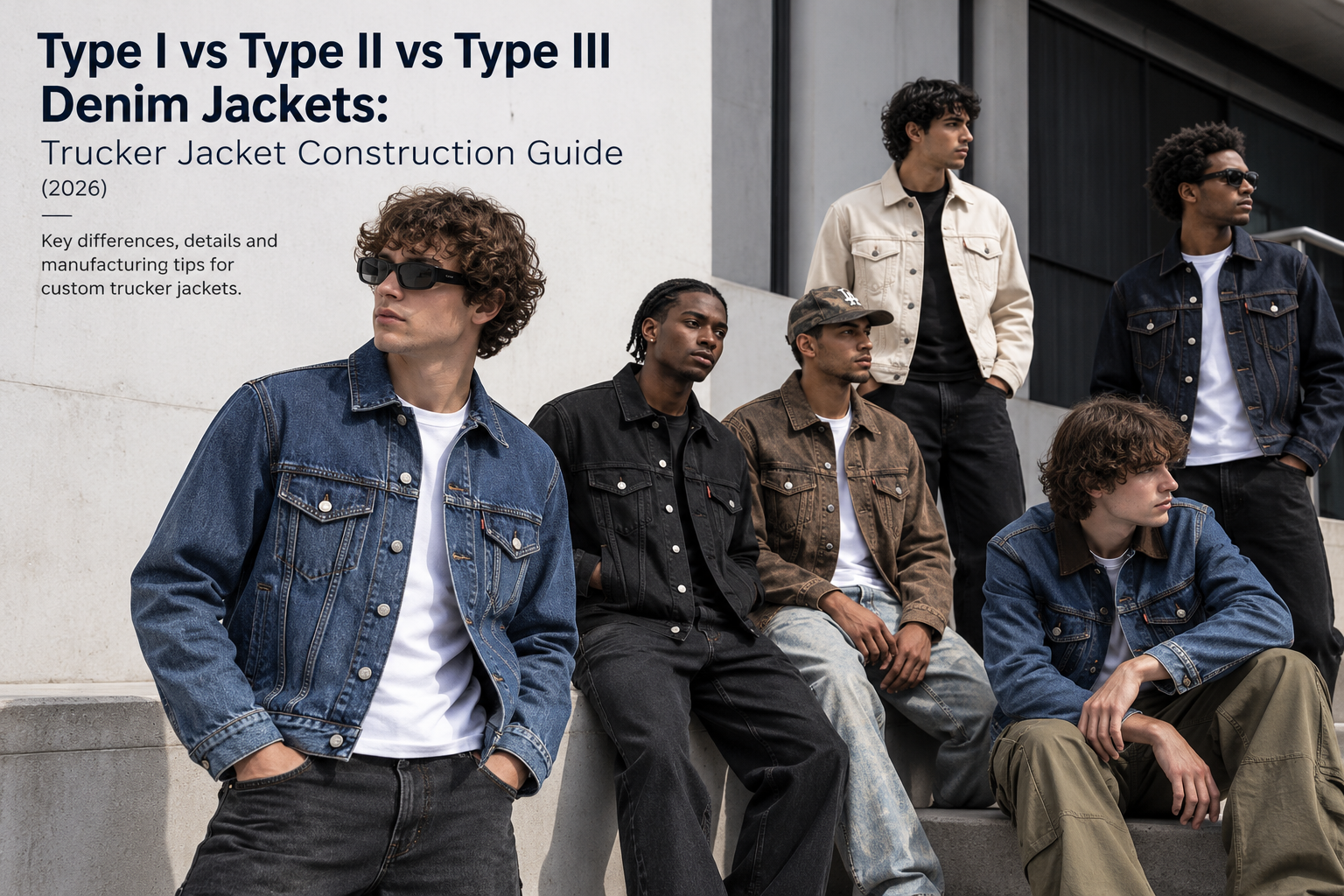
The trucker jacket is one of the most recognizable men's denim jackets, but not every short denim jacket is constructed the same way.
For clothing brands developing a custom trucker jacket, one of the most useful starting points is understanding three heritage construction directions:
- Type I
- Type II
- Type III
They differ in much more than pocket count.
The biggest differences involve:
front pleats + chest pocket layout + waist adjustment + front-panel geometry + body shape
These details affect the entire pattern.
A Type II-inspired jacket cannot be turned into a Type III simply by changing the pockets. Likewise, an oversized modern trucker should not be created by taking a vintage jacket and increasing every measurement.
For manufacturing, the better approach is to decide the intended jacket architecture first, then develop the denim, fit, wash, hardware and construction around it.
This guide explains the differences between Type I, Type II and Type III denim jackets and the key production details brands should control before sampling and bulk manufacturing.
What Is a Trucker Jacket?
A trucker jacket is a short outerwear style most commonly associated with denim.
Modern trucker jackets usually feature some combination of:
- Point collar
- Front button closure
- Chest pockets
- Short waist or high-hip body
- Structured woven fabric
- Visible topstitching
- Button cuffs
- Waist adjustment
- Shaped front panels
However, the term should not be used for every denim jacket.
A denim jacket describes a garment primarily by its fabric.
A trucker jacket describes a more specific silhouette and construction language.
This distinction matters when developing a garment with a manufacturer.
For example:
12 oz denim jacket
describes the fabric but says very little about the actual pattern.
A specification such as:
Relaxed Type III-inspired trucker jacket in 12 oz cotton denim with pointed chest pockets, V-shaped front seams and adjustable waist tabs
gives the pattern team a much clearer direction.
Trucker Jacket vs Denim Jacket
The two terms are often used interchangeably, but technically they are not identical.
A denim jacket can take many different forms, including:
- Trucker jacket
- Chore jacket
- Overshirt
- Western jacket
- Bomber jacket
- Work jacket
- Long jacket
A trucker jacket can also be produced in materials other than denim.
Examples include:
- Corduroy
- Canvas
- Suede
- Leather
- Wool
- Coated cotton
The simplest distinction is:
Denim jacket = defined mainly by fabric
Trucker jacket = defined mainly by silhouette and construction
Trucker Jacket vs Other Men's Jackets
| Jacket | Main Design Identity | Typical Length | Key Detail |
|---|---|---|---|
| Trucker Jacket | Short structured jacket | Waist / high hip | Chest pockets and structured front |
| Denim Jacket | Any jacket made from denim | Varies | Denim fabric |
| Chore Jacket | Functional workwear | Hip | Large patch pockets |
| Western Jacket | Western styling | Waist to hip | Yokes, snaps or decorative details |
| Barn Jacket | Longer utility outerwear | Hip to upper thigh | Large lower pockets |
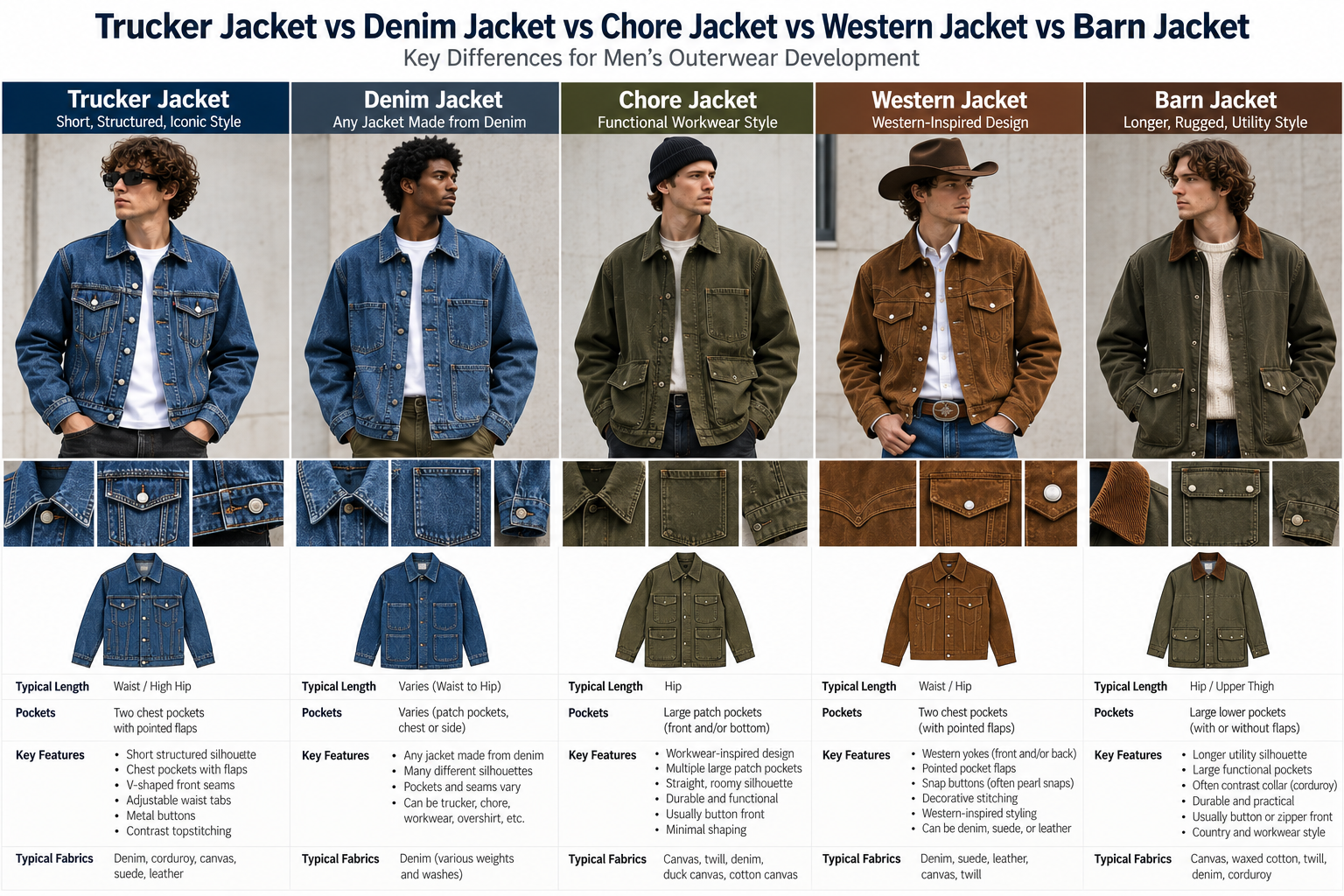
This distinction becomes especially important during sourcing and sample development.
Before pattern development begins, the manufacturer should know whether the garment is intended to be:
- Type II-inspired
- Type III-inspired
- Chore-inspired
- Western-inspired
- Another denim outerwear silhouette
That decision changes the pattern structure.
Type I vs Type II vs Type III Denim Jackets
The three classic denim-jacket constructions provide a useful reference system for modern trucker development.
| Feature | Type I | Type II | Type III |
|---|---|---|---|
| Chest Pockets | Usually one | Two | Two |
| Front Pleats | Yes | Yes | Usually no |
| Front V Seams | No | No | Yes |
| Waist Adjustment | Rear cinch | Waist tabs | Side waist tabs |
| Body Character | Boxy | Boxy / balanced | More structured |
| Visual Focus | Pleats + single pocket | Pleats + twin pockets | V seams + pointed pockets |
Modern brands do not need to reproduce historical jackets exactly.
Instead, Type I, Type II and Type III can be used as construction foundations for new designs.
What Is a Type I Denim Jacket?
The Type I is the simplest and most workwear-oriented of the three major heritage constructions.
Its recognizable characteristics include:
- One chest pocket
- Vertical front pleats
- Short boxy body
- Rear cinch adjustment
- Minimal front detailing
Compared with later trucker jackets, the front can look visually asymmetrical because of the single chest pocket.
That asymmetry is intentional.
Type I Single Chest Pocket
The single pocket is one of the strongest visual identifiers.
For a modern interpretation, brands can modify:
- Pocket width
- Pocket height
- Flap shape
- Button
- Rivet reinforcement
- Stitching
But the pocket still needs to remain proportionate to the garment.
A small vintage-scale pocket may look visually weak on a significantly oversized modern jacket.
Type I Front Pleats
Vertical pleats are another important part of the Type I construction language.
For custom production, specify:
- Pleat width
- Pleat depth
- Pleat position
- Tack position
rather than asking the factory to estimate the construction from a reference photo.
Type I Back Cinch
A rear waist cinch is another recognizable Type I detail.
It can affect both:
- Fit
- Visual identity
For a modern interpretation, the cinch may be:
- Functional
- Decorative
- Simplified
- Removed entirely
If retained, its position should be clearly specified because placement changes the visual proportion of the back.
What Is a Type II Denim Jacket?
The Type II retains much of the boxy, pleated construction of the Type I but creates a more balanced front.
Typical characteristics include:
- Two chest pockets
- Pocket flaps
- Front pleats
- Short boxy silhouette
- Waist adjustment tabs
The second chest pocket creates much stronger front symmetry.
This construction works particularly well with modern relaxed menswear.
Why Type II Works Well for Modern Menswear
The Type II naturally combines:
short length + wider body + simple front geometry
That makes it suitable for styling with:
- Straight jeans
- Wide-leg trousers
- Carpenter pants
- Relaxed chinos
- Layered knitwear
When creating a modern relaxed Type II-inspired jacket, brands can increase:
- Chest width
- Shoulder width
- Bicep width
while keeping the body length relatively controlled.
This preserves the trucker-jacket proportion.
Type II Chest Pocket Placement
Two chest pockets make symmetry much more important.
Key measurements include:
- Pocket width
- Pocket height
- Distance from center front
- Pocket top position
- Flap depth
- Button position
Even a small difference between the left and right pocket can become visible.
For production, it is better to use:
- Fixed measurements
- Pattern markings
- Pocket-position templates
rather than visual placement alone.
Type II Waist Tabs
Type II-inspired jackets commonly use waist adjustment tabs instead of a central rear cinch.
Specify:
- Tab length
- Tab width
- Attachment position
- Button position
- Adjustment positions
The left and right sides should mirror each other.
What Is a Type III Denim Jacket?
The Type III introduced the construction language most people now associate with the classic modern trucker jacket.
The front commonly uses:
- Two chest pockets
- Pointed pocket flaps
- V-shaped front seams
- Short body
- More controlled lower silhouette
- Side waist adjusters
The most important change is the move away from the earlier pleated-front construction.
Instead, the front becomes structured through shaped panel seams.
Why Type III V-Shaped Seams Matter
The diagonal or V-shaped front seams are not simply decorative stitching.
They divide the front body into shaped sections and strongly influence the visual proportion of the jacket.
The relationship between:
V seam + chest pocket + center front + waistband
should be developed as one system.
If one of these components moves, the others may also need adjustment.
V-Seam Position
A V point positioned too low can make the jacket appear longer.
A V point positioned too high can make the upper chest look crowded.
The pattern should therefore define:
- Upper seam position
- Seam angle
- Lower point
- Distance from pocket
- Distance from waistband
This becomes especially important when creating oversized or cropped versions.
Type III Chest Pockets
Pointed chest pockets and flaps reinforce the geometric appearance of the Type III front.
Important measurements include:
- Pocket width
- Pocket height
- Point depth
- Flap depth
- Button position
Pocket size should be developed together with the overall front-panel geometry.
Type I, Type II and Type III Anatomy
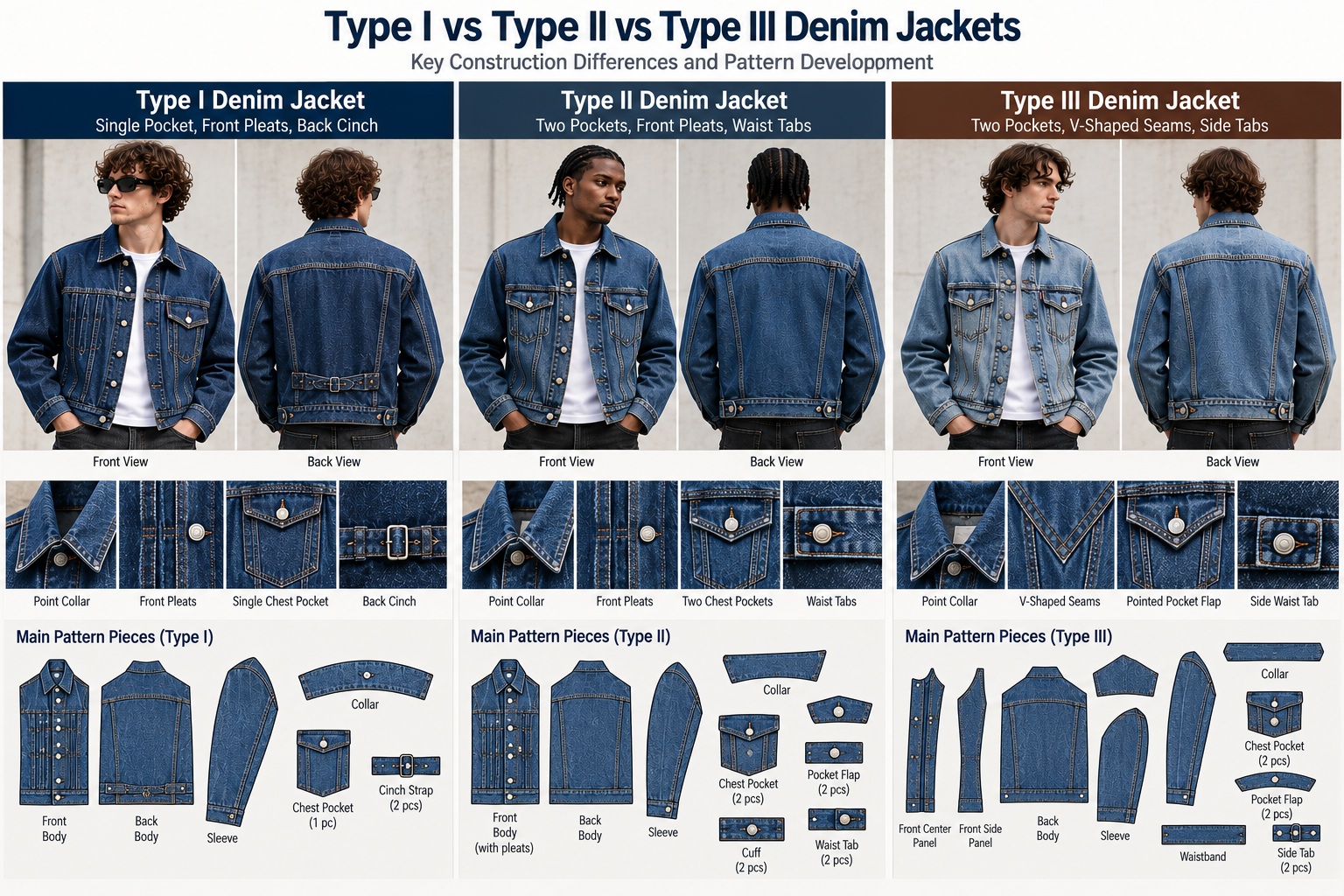
These three structures should be treated as construction references rather than rigid templates.
A brand can combine heritage details with a modern silhouette.
For example:
Modern Type I-Inspired Jacket
- Wider body
- Single oversized chest pocket
- Front pleats
- Rear cinch
- Controlled cropped length
Modern Type II-Inspired Jacket
- Relaxed boxy fit
- Two chest pockets
- Front pleats
- Waist tabs
- Heavy rigid denim
Modern Type III-Inspired Jacket
- Relaxed shoulder
- Two pointed chest pockets
- V-shaped front panels
- Side hand pockets
- Short waistband
The important point is maintaining a consistent design language.
Trucker Jacket Body Proportion
Body length is one of the most important measurements in a trucker jacket.
A typical trucker finishes around:
- Waist
- High hip
If the body becomes significantly longer, the garment may begin to resemble:
- Overshirt
- Work jacket
- Chore jacket
rather than a classic trucker.
How to Make a Trucker Jacket Oversized
Do not simply increase the entire garment several sizes.
That often creates:
- Excessive body length
- Sleeves that are too long
- Pockets positioned too low
- Oversized collar
- Incorrect V-seam position
Instead, increase specific measurements separately.
For example:
- Increase chest
- Increase shoulder
- Increase bicep
- Control body length
- Reposition pockets
- Redraw the V seam
- Adjust sleeve length separately
This creates an oversized silhouette while keeping the trucker proportion.
Cropped Trucker Jacket Development
A cropped trucker requires more than shortening the bottom.
When body length is reduced, review:
- Chest-pocket position
- V-seam depth
- Waistband position
- Hand-pocket opening
- Waist-tab position
Otherwise the upper body can become visually crowded.
Pocket Scale Matters
One common development mistake is changing the jacket fit while leaving the chest pocket unchanged.
For example, a vintage reference may have a relatively narrow chest.
If the same pocket is placed on a much wider oversized jacket, it can look too small.
Pocket size should therefore be reviewed together with:
- Chest width
- Body length
- Front seams
- Collar size
rather than being graded automatically.
Denim Weight for a Trucker Jacket
Fabric weight strongly affects structure.
A practical development reference might be:
| Denim Direction | Approx. Weight | Typical Result |
|---|---|---|
| Lightweight | 8–10 oz | Softer, easier layering |
| Midweight | 10–13 oz | Balanced structure |
| Heavyweight | 13–15+ oz | Strong heritage character |
These are reference ranges rather than fixed rules.
Two fabrics with the same weight can behave differently because of:
- Yarn
- Density
- Fiber composition
- Weave
- Finishing
For custom fabric development, see our Fabric Sourcing & Development.
Rigid Denim vs Stretch Denim
Rigid Denim
Rigid denim works particularly well for:
- Type I
- Type II
- Heritage Type III
- Structured boxy fits
It provides:
- Strong shape
- Authentic denim character
- Clear seam definition
However, the pattern needs enough ease because the fabric provides little stretch.
Stretch Denim
Stretch denim can improve:
- Comfort
- Arm movement
- Everyday wearability
But excessive stretch can weaken the crisp structure expected from a classic trucker jacket.
Check:
- Stretch percentage
- Recovery
- Growth after wear
before bulk approval.
Raw Denim Trucker Jackets
Raw or minimally washed denim creates a deep, clean appearance.
It can also develop more personalized fading with wear.
Before production, evaluate:
- Shrinkage
- Crocking
- Color transfer
- Stiffness
- Finished fit
A raw-denim jacket should be developed with expected dimensional change in mind.
Rinse Wash
A rinse can help:
- Remove excess surface dye
- Reduce initial stiffness
- Stabilize the garment
- Preserve a relatively dark appearance
This is useful for brands wanting a cleaner indigo finish without a strong vintage effect.
Vintage and Enzyme Washes
A stronger wash can change:
- Color
- Surface texture
- Hand feel
- Seam appearance
- Garment measurements
For this reason, washed denim garments should be approved as finished garments, not only as raw sewing samples.
Pattern Compensation for Denim Shrinkage
If washing reduces body length or width, the pattern may need compensation before bulk cutting.
The correct adjustment should be based on actual testing.
A practical development sequence is:
- Test the selected fabric
- Produce the sample
- Apply the intended wash
- Measure the finished garment
- Adjust the production pattern if required
Avoid applying a generic shrinkage percentage without testing the actual denim and finish.
Denim Skew and Sleeve Twisting
Denim can contain skew or torque.
After washing, this may appear as:
- Twisted sleeves
- Rotated side seams
- Distorted panels
This cannot always be corrected through sewing.
Fabric evaluation should therefore happen before bulk cutting.
Shade Control During Cutting
Denim shade can vary between rolls and dye lots.
If panels are mixed carelessly, a finished jacket may show:
- One sleeve darker than the other
- Pocket different from body
- Waistband different from front
- Left and right fronts with different shades
Cutting management should keep corresponding garment panels within the approved shade range.
Trucker Jacket Topstitching
Topstitching is one of the most visible construction details on a trucker jacket.
It commonly appears around:
- Collar
- Chest pockets
- Pocket flaps
- Front panel seams
- Back yoke
- Cuffs
- Waistband
Traditional denim versions often use contrast thread.
Tobacco and Gold Topstitching
Common denim topstitching colors include:
- Tobacco
- Gold
- Orange
- Tan
These colors create a classic denim appearance.
But contrast thread also makes every inconsistency more visible.
Check:
- Stitch distance
- Parallel rows
- Corner turning
- Thread tension
- Stitch length
carefully.
Tonal Topstitching
Tonal stitching can create a more minimal appearance.
It works particularly well for:
- Black denim
- Brown denim
- Monochrome trucker jackets
- Premium fashion styles
The construction remains visible through the panel geometry without relying on strong thread contrast.
Pocket-Flap Points
Sharp pointed flaps are visually important on many Type III-inspired jackets.
Heavy denim can make sharp corners difficult to produce cleanly.
Common problems include:
- Rounded point
- Unequal left and right points
- Excessive bulk
- Puckering
The pattern may require a slightly controlled tip rather than an unrealistically sharp point.
Metal Buttons and Hardware
Typical trucker-jacket hardware includes:
- Tack buttons
- Jeans buttons
- Snaps
- Rivets
- Adjustment buttons
Important specifications include:
- Diameter
- Finish
- Logo
- Post length
- Base material
For custom buttons, labels and garment hardware, see our Trims & Branding.
Why Hardware Post Length Matters
Metal buttons need to match the thickness of the actual fabric layers.
If the post is too short:
- Attachment may be weak
If the post is too long:
- The hardware may not set securely
The final hardware should therefore be tested on the actual production construction.
Hardware and Garment Washing
Hardware should also be tested through the intended wash.
Possible problems include:
- Plating loss
- Scratching
- Oxidation
- Color change
- Loose attachment
The approved production sample should ideally represent:
approved denim + approved wash + approved hardware
rather than testing each component independently.
Should Hardware Be Installed Before or After Washing?
There is no universal answer.
It depends on:
- Desired aging effect
- Wash chemistry
- Hardware plating
- Button construction
- Design requirements
Installing hardware before washing can create a more naturally aged effect.
Installing certain decorative hardware after washing may better protect its finish.
The correct production sequence should be confirmed during sampling.
Trucker Jacket Pattern Development
A Type III-inspired pattern may include:
- Front center panel
- Front side panel
- Back body
- Back yoke
- Sleeve
- Collar
- Chest pocket
- Pocket flap
- Cuff
- Waistband
- Waist tab
- Pocket bag if hand pockets are included
Type I and Type II constructions require different front components because of their pleats.
Important Trucker Jacket Measurements
| Measurement | Why It Matters |
|---|---|
| Chest Width | Controls overall volume |
| Body Length | Defines trucker proportion |
| Shoulder Width | Controls modern vs heritage fit |
| Sleeve Length | Controls cuff position |
| Bicep | Important with rigid denim |
| Hem Width | Controls lower silhouette |
| Collar Point | Controls visual scale |
| Pocket Width | Must suit chest proportion |
| Pocket Height | Controls pocket scale |
| Pocket Position | Major visual balance point |
| V-Seam Point | Defines Type III geometry |
| Waistband Height | Controls lower proportion |
| Waist Tab Position | Controls symmetry |
Pocket Position Should Be Measured
Do not write only:
Pocket position as reference photo.
Instead, specify measurable points such as:
- HPS to pocket top
- Center front to pocket edge
This creates a repeatable production standard.
Type III V-Seam Measurements
For a Type III-inspired jacket, specify:
- Upper seam position
- Lower V point
- Distance from center front
- Distance from waistband
The V-shaped seam should also be checked across graded sizes.
Trucker Jacket Grading
Grading is especially important because a trucker jacket has a compact body.
If every measurement increases at the same rate, larger sizes may become too long.
Body Length Grading
Body length should increase carefully.
The short silhouette should remain recognizable across:
- S
- M
- L
- XL
- XXL
Pocket Size Grading
Chest pockets may increase slightly with size.
However, they do not necessarily need to grow at the same rate as chest width.
Visual proportion is more important.
Pocket Position Grading
As chest and shoulder measurements increase, pocket placement may also need adjustment.
Using exactly the same horizontal pocket position across all sizes can make larger sizes look visually narrow through the center.
V-Seam Grading
The V-shaped front seam should maintain its overall visual angle.
Check multiple graded sizes rather than approving only the base size.
Waist Tab Grading
The physical tab size may remain almost unchanged.
Its position, however, needs to move with the body width and side seam.
Trucker Jacket Sample Approval
Sample review should focus on the details that actually define the garment.
Front View
Check:
- Body length
- Pocket size
- Pocket height
- Pocket symmetry
- V-shaped seams
- Center-front alignment
- Collar
Back View
Check:
- Back yoke
- Shoulder balance
- Waistband
- Waist tabs
After Washing
Check:
- Finished measurements
- Shade
- Seam appearance
- Topstitching
- Hardware
- Fabric twisting
These checks are more useful than applying only a generic jacket QC checklist.
Trucker Jacket Manufacturing Process
A typical production route may include:
- Fabric inspection
- Shrinkage and wash testing
- Pattern development
- Grading
- Shade grouping
- Cutting
- Pocket and flap preparation
- Front pleat or panel construction
- Pocket attachment
- Back and yoke construction
- Sleeve and cuff preparation
- Collar construction
- Main assembly
- Waistband and waist-tab attachment
- Topstitching inspection
- Hardware preparation or installation
- Garment washing
- Final hardware stage where required
- Finished measurement inspection
- Shade and appearance inspection
- Final QC
- Packing
The exact order may change according to the wash, hardware and garment construction.
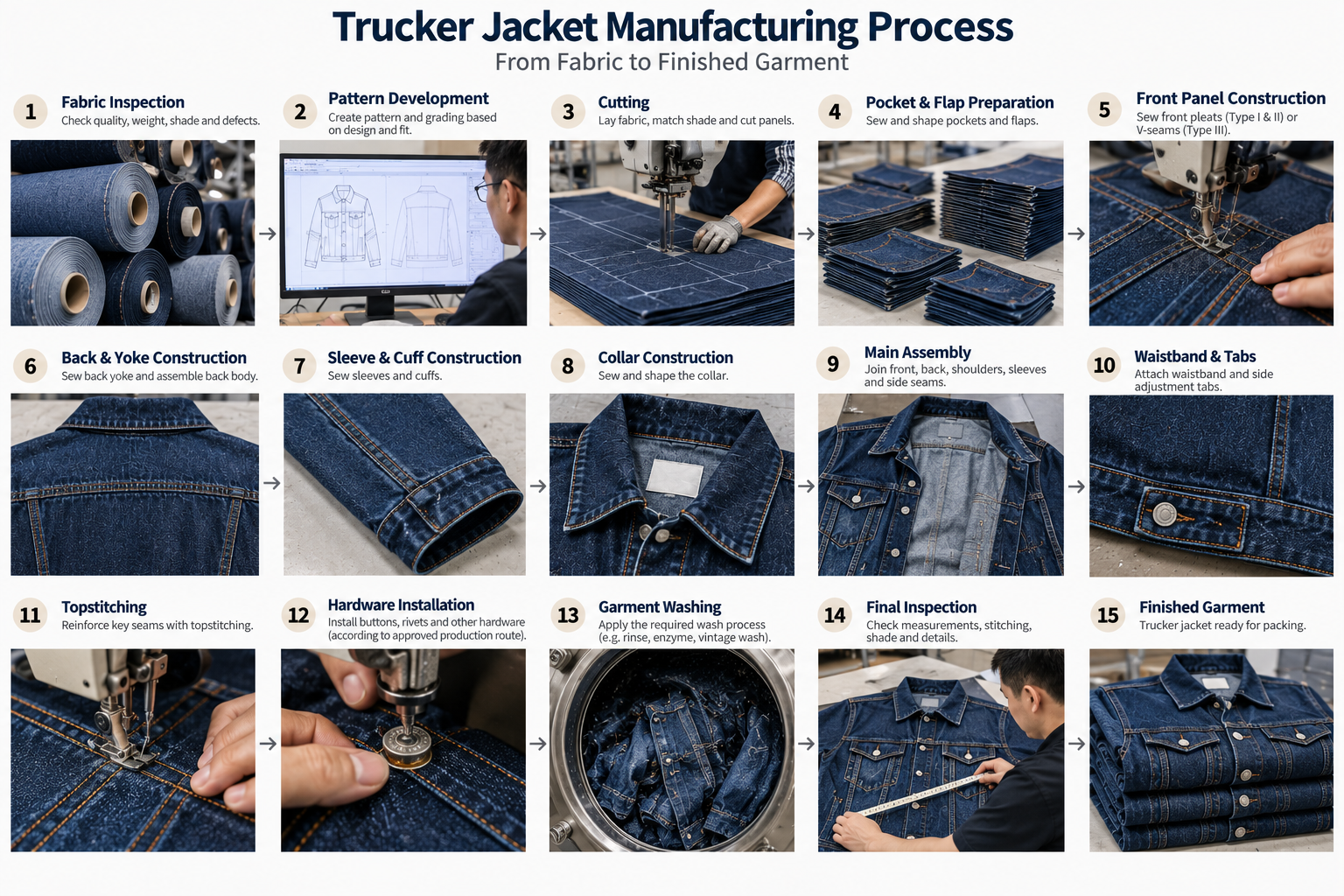
Key Quality-Control Points
Pocket Symmetry
Check that both pockets match in:
- Height
- Width
- Angle
- Distance from center front
V-Seam Symmetry
On Type III-inspired designs, the left and right front seam angles should mirror each other.
Pocket-Flap Shape
Check:
- Point shape
- Flap width
- Button position
Front Pleats
For Type I and Type II-inspired designs, check:
- Pleat width
- Pleat position
- Tack position
- Left and right consistency
Waist Tabs
Check:
- Position
- Length
- Button position
on both sides.
Waistband
The waistband should remain:
- Level
- Untwisted
- Symmetrical
after washing.
Topstitching
Inspect:
- Stitch spacing
- Parallel rows
- Corners
- Thread tension
Wash Shade
Compare:
- Sleeves
- Body
- Pockets
- Waistband
for unintended panel-to-panel variation.
Hardware
Check:
- Attachment strength
- Surface finish
- Alignment
- Function
after the final wash process.
Finished Measurements
Measure the garment after washing and finishing.
For a washed denim product, pre-wash measurements should not be treated as final QC measurements.
Common Trucker Jacket Production Problems
Uneven Chest Pockets
One pocket sits higher than the other.
Control: Use pocket-position templates and fixed measurement points.
Different V-Seam Angles
The left and right front panels do not match.
Control: Use accurate pattern notches, cutting and seam allowances.
Rounded Pocket-Flap Points
Heavy denim creates bulky corners.
Control: Refine the flap pattern and turning method.
Waistband Twisting
The waistband rotates or becomes uneven after washing.
Possible causes include:
- Uneven feeding
- Grainline issues
- Fabric distortion
- Shrinkage
Uneven Waist Tabs
The left and right tabs sit at different heights.
Control: Mark positions before attachment.
Panel Shade Difference
One garment contains visibly different denim shades.
Control: Group fabric shades before cutting.
Sleeve Twisting
The sleeve rotates after washing.
Possible causes include:
- Fabric skew
- Grainline
- Sewing
- Wash shrinkage
Hardware Damage After Wash
Buttons may become:
- Scratched
- Discolored
- Loose
Control: Wash-test approved hardware before bulk production.
Incorrect Oversized Proportion
The jacket becomes long instead of boxy.
Control: Increase width independently from body length.
Example Type II-Inspired Tech Pack
| Item | Example Specification |
|---|---|
| Product | Men's Type II-Inspired Denim Jacket |
| Fit | Relaxed / Boxy |
| Shell | 100% Cotton Denim |
| Weight | 13 oz |
| Wash | Dark Rinse |
| Body Length | High Hip |
| Shoulder | Slightly Extended |
| Chest Pockets | Two |
| Pocket Flaps | Straight / Slight Point |
| Front Pleats | Yes |
| Waist Adjustment | Side Tabs |
| Collar | Point Collar |
| Cuff | Button Cuff |
| Stitching | Tobacco Contrast |
| Hardware | Antique Metal Tack Buttons |
| Branding | Woven Neck Label + Care Label |
Example Modern Type III Trucker Tech Pack
| Item | Example Specification |
|---|---|
| Product | Men's Type III-Inspired Trucker Jacket |
| Fit | Relaxed |
| Shell | 100% Cotton Denim |
| Weight | 12 oz |
| Wash | Medium Vintage |
| Chest Pockets | Two Pointed Flap Pockets |
| Front Structure | V-Shaped Panel Seams |
| Hand Pockets | Side Entry |
| Collar | Point Collar |
| Waistband | Separate |
| Waist Tabs | Adjustable |
| Stitching | Contrast Tobacco |
| Hardware | Antique Brass |
| Branding | Woven Labels / Custom Hardware |
These specifications are examples rather than universal standards.
How to Send a Trucker Jacket Request to a Manufacturer
Instead of writing:
We want a vintage denim jacket like this photo.
A more useful manufacturing brief would be:
Develop a men's relaxed Type III-inspired trucker jacket in 12 oz 100% cotton denim. Use a high-hip body length, natural-to-slightly-extended shoulder, two pointed chest flap pockets, V-shaped front seams, side-entry hand pockets, separate waistband, adjustable side tabs, antique brass tack buttons, tobacco contrast topstitching and a medium vintage wash.
Then provide:
- Chest
- Body length
- Shoulder
- Sleeve
- Bicep
- Hem
- Pocket dimensions
- Pocket position
- V-seam position
- Collar dimensions
- Waistband height
- Tab dimensions
- Denim reference
- Wash reference
- Thread
- Hardware
- Labels
This gives the manufacturer measurable construction information rather than only visual inspiration.
FAQ
What Is a Trucker Jacket?
A trucker jacket is a short outerwear style typically featuring a point collar, front closure, chest pockets and a structured waist-length or high-hip body.
Denim is the most traditional fabric, although trucker jackets can also be made from corduroy, canvas, suede and other woven materials.
Is a Trucker Jacket the Same as a Denim Jacket?
No.
A denim jacket is any jacket made from denim.
A trucker jacket describes a more specific short-jacket silhouette and construction style.
What Is the Difference Between Type I and Type II Denim Jackets?
A Type I-inspired jacket is recognized primarily by its single chest pocket, front pleats and rear cinch.
A Type II-inspired jacket retains front pleats but adds a second chest pocket and uses side waist-adjustment tabs.
What Is a Type III Denim Jacket?
A Type III-inspired jacket typically uses two chest pockets, pointed flaps and distinctive V-shaped front panel seams instead of the earlier pleated-front construction.
This design language became the basis of the modern classic trucker jacket.
Which Type Works Best for an Oversized Trucker Jacket?
Type II-inspired construction works particularly well with a modern boxy fit because its short body, front pleats and symmetrical chest pockets naturally suit additional width.
Type III can also be oversized, but the V-shaped seams and pocket positions should be redrawn for the wider body.
What Denim Weight Is Good for a Trucker Jacket?
There is no single correct weight.
As a general development reference:
- 8–10 oz = lightweight
- 10–13 oz = versatile midweight
- 13–15+ oz = heavier heritage direction
Fabric construction and finishing are just as important as numerical weight.
Why Does a Denim Trucker Jacket Need a Wash Test?
Washing can change:
- Body length
- Chest width
- Sleeve length
- Color
- Hand feel
- Seam appearance
The final production pattern and measurements should therefore be checked against the intended finished wash.
Why Do Denim Jacket Sleeves Sometimes Twist?
Possible causes include:
- Fabric skew
- Grainline
- Sewing
- Dimensional change during washing
The fabric should be evaluated before bulk cutting.
Can a Trucker Jacket Be Made From Corduroy?
Yes.
Corduroy works very well with trucker-jacket construction.
The factory should control:
- Wale direction
- Nap direction
- Panel orientation
during cutting.
Can a Trucker Jacket Be Made From Suede?
Yes.
A suede trucker keeps the same general jacket architecture while changing the material character.
Nap direction and shade matching become particularly important.
What Should Be Included in a Trucker Jacket Tech Pack?
At minimum, specify:
- Type I / Type II / Type III-inspired direction
- Fit
- Body length
- Chest
- Shoulder
- Sleeve
- Pocket size
- Pocket position
- V-seam or pleat construction
- Waistband
- Waist tabs
- Fabric
- Denim weight
- Wash
- Thread
- Hardware
- Branding
Final Thoughts
The most useful way to develop a custom trucker jacket is not to begin with:
We want a denim jacket.
Start with the construction language.
A Type I-inspired jacket emphasizes:
single pocket + front pleats + rear cinch
A Type II-inspired jacket emphasizes:
double chest pockets + front pleats + boxy body + waist tabs
A Type III-inspired jacket emphasizes:
double chest pockets + V-shaped front seams + structured short body
Once that foundation is clear, the manufacturer can develop:
- Fit
- Pocket scale
- Denim weight
- Wash
- Topstitching
- Hardware
- Grading
around the intended silhouette.
For clothing brands, this produces a much more controlled result than copying the appearance of a reference photo alone.
A well-developed trucker jacket should be treated as one complete system:
pattern + denim + pocket geometry + seam geometry + hardware + wash + finished measurements.
Keep Reading