The flannel shirt is returning as one of the most recognizable layering pieces of 2026.
But there is an important detail that clothing brands should understand before developing one:
Flannel is a fabric. Plaid is a pattern.
A shirt can be:
- Flannel and plaid
- Flannel and solid-colored
- Plaid but not flannel
That distinction matters because the final garment depends on much more than choosing a check pattern.
A well-developed flannel shirt requires decisions around:
Fiber composition
Fabric weight
Brushing
Plaid construction
Pattern repeat
Cutting direction
Shrinkage
Collar and placket
Fit
and
Pattern matching
This guide explains what defines a flannel shirt and what clothing brands should consider before moving from fabric sourcing to bulk production.
What Is a Flannel Shirt?
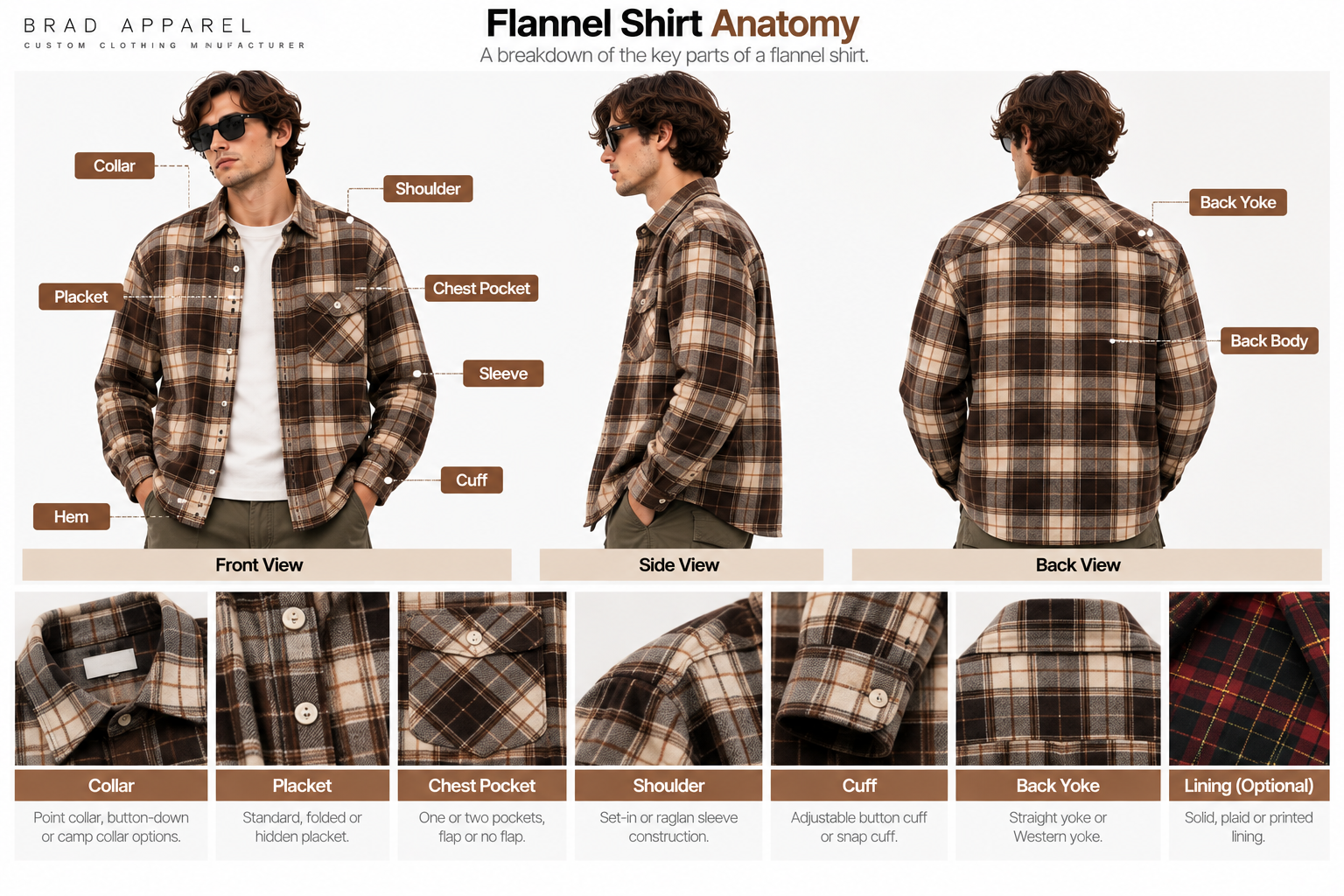
A flannel shirt is a woven shirt made from flannel fabric.
Flannel is generally characterized by a soft surface that may be created through:
- Brushing
- Napping
- Finishing
- Yarn and weave selection
Modern flannel fabrics can use different fibers, including:
- Cotton
- Cotton-polyester blends
- Wool
- Wool blends
- Viscose blends
- Other woven compositions
The fabric may be:
- Plaid
- Check
- Stripe
- Solid
- Mélange
So the word flannel describes the textile more than the visual pattern.
Flannel vs Plaid: What Is the Difference?
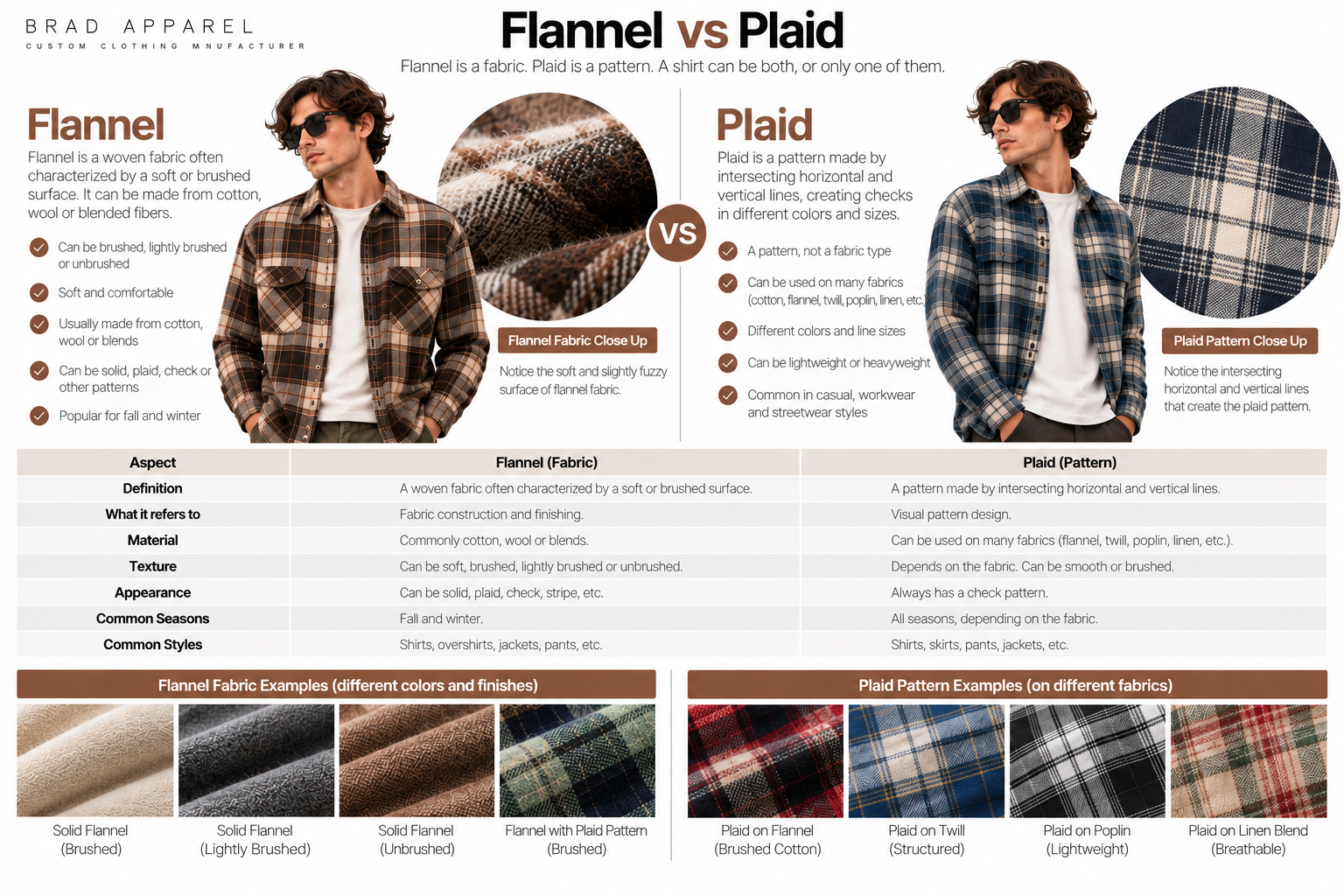
This is one of the most common sources of confusion.
Flannel
Flannel refers primarily to:
fabric construction + finishing + hand feel
It is commonly associated with:
- Soft surface
- Brushed feel
- Warm hand
- Woven construction
Plaid
Plaid refers to a pattern created by intersecting:
horizontal
and
vertical
lines or color blocks.
Plaid can appear on many materials, including:
- Flannel
- Twill
- Poplin
- Wool
- Linen blends
- Synthetic woven fabrics
A lightweight summer plaid shirt is therefore not automatically a flannel shirt.
Why Are Flannel Shirts Trending Again in 2026?
The return of flannel fits several current clothing directions.
These include renewed interest in:
- 1990s casualwear
- 2000s layering
- Workwear
- Western styling
- Preppy clothing
- Relaxed shirts
- Overshirts
- Vintage-looking fabrics
A flannel shirt works particularly well because it can sit between:
shirt
and
lightweight outer layer.
It can be worn:
- Buttoned
- Open over a T-shirt
- Under a jacket
- Around the waist
- As an overshirt
For clothing brands, this makes it a flexible product that can move between seasons and different collections.
Plaid Does Not Have to Be Printed
One of the biggest development decisions is how the pattern is created.
A plaid fabric can generally be produced through:
yarn-dyed weaving
or
surface printing.
The two approaches may look similar from a distance but create different textiles.
What Is Yarn-Dyed Plaid?
In yarn-dyed fabric, yarns are colored before the fabric is woven.
Different colored:
warp yarns
and
weft yarns
intersect to create the final plaid pattern.
This means the check becomes part of the fabric structure.
Possible advantages include:
- Pattern visible through the textile
- More integrated woven appearance
- Strong traditional flannel character
- Different front and back appearance depending on weave
The exact result depends on:
- Yarn count
- Weave
- Color combination
- Brushing
- Density
What Is Printed Plaid?
A plaid design can also be printed onto an existing base fabric.
This can provide more flexibility for:
- Complex artwork
- Rapid pattern changes
- Large numbers of colors
- Graphic effects
However, a print does not create the same textile structure as yarn-dyed plaid.
Brands should therefore specify whether they want:
a true woven check
or
the visual appearance of a check.
Yarn-Dyed vs Printed Plaid
| Detail | Yarn-Dyed Plaid | Printed Plaid |
|---|---|---|
| Pattern Creation | Colored yarns woven together | Artwork applied to fabric surface |
| Visual Depth | Integrated into textile | Surface-based |
| Traditional Flannel Look | Common | Possible |
| Color Flexibility | Depends on yarn development | Often highly flexible |
| Pattern Development | Requires weaving setup | Requires print setup |
| Reverse Side | Pattern often remains visible | May look different from face |
| MOQ / Lead Time | Depends on mill setup | Depends on print method |
Neither method is automatically better.
The correct option depends on the intended garment, quantity and brand positioning.
Brushing Creates the Familiar Flannel Feel
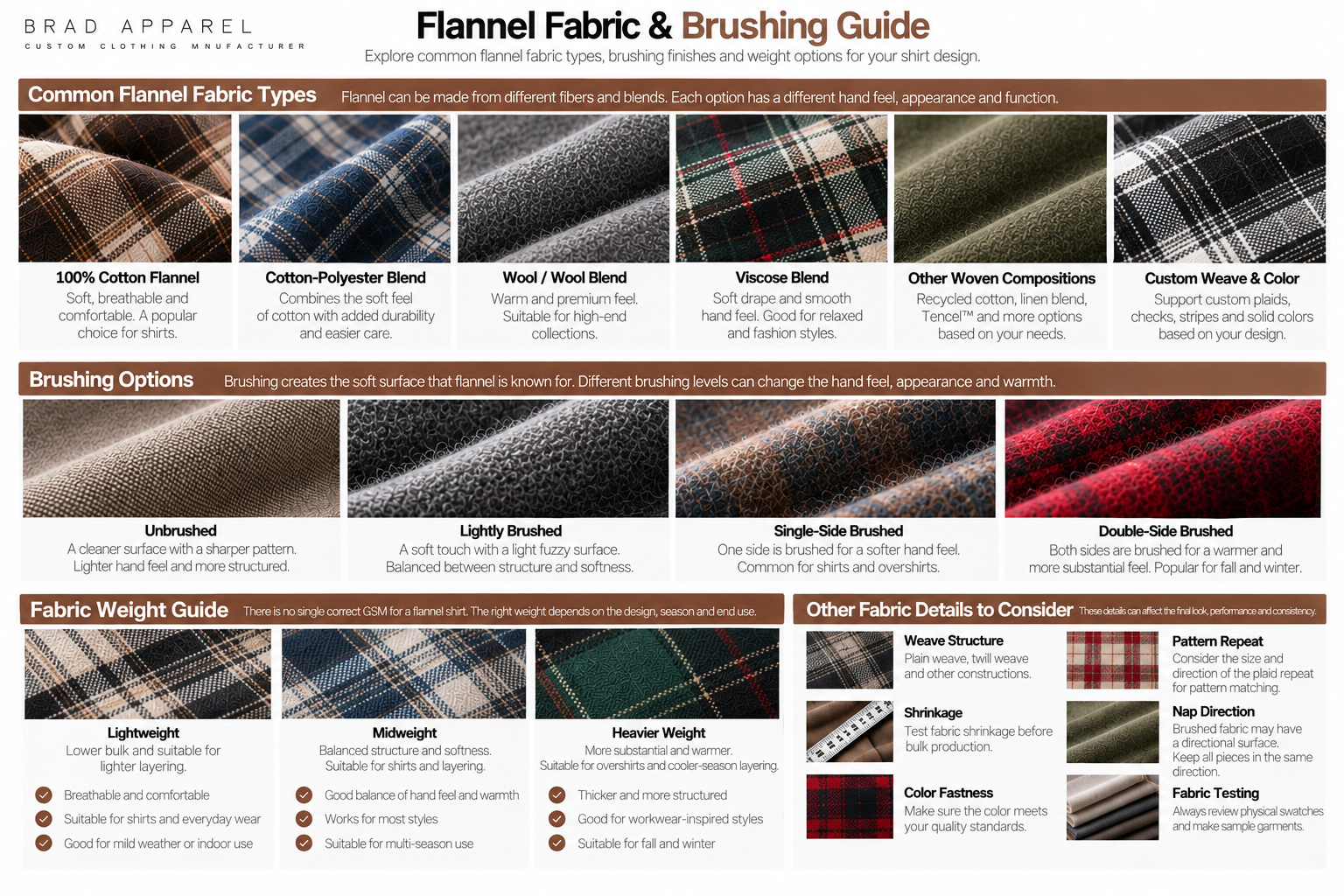
The soft surface commonly associated with flannel is often created by mechanical brushing.
During finishing, fibers are lifted from the fabric surface.
This can change:
- Softness
- Texture
- Visual appearance
- Thickness perception
- Warmth perception
Different finishing levels can create very different products.
Single-Side Brushed Flannel
Only one side receives significant brushing.
This can create:
- Soft exterior or interior
- Less overall bulk
- Different face/back characteristics
The brand should specify which side is intended as the garment face.
Double-Side Brushed Flannel
Both sides are brushed.
Possible results include:
- Softer hand feel
- More substantial texture
- Comfortable interior
But more brushing can also affect:
- Surface definition
- Plaid sharpness
- Pilling behavior
- Fabric thickness
More brushing is not automatically better.
Unbrushed or Lightly Brushed Plaid
Some modern shirts use a dry, clean plaid woven with little or no obvious nap.
This creates a different result:
- Cleaner surface
- Sharper check
- More transitional-season feel
- Less traditional “cozy flannel” appearance
This direction can work particularly well for contemporary streetwear and premium casualwear.
Fabric Weight Should Match the Product
There is no single correct GSM for a flannel shirt.
Instead, the fabric should be chosen according to whether the product is intended as a:
shirt
or
overshirt.
A lighter fabric may work for:
- Indoor wear
- Layering
- Transitional seasons
- Relaxed shirts
A more substantial fabric may work for:
- Overshirts
- Workwear-inspired products
- Cooler seasons
- Structured silhouettes
Fabric weight alone is not enough.
Two fabrics with similar GSM can have different:
- Density
- Softness
- Drape
- Brushing
- Thickness
Physical swatches should therefore be reviewed before sampling.
Brad Apparel's Fabric Sourcing & Development service supports woven fabric sourcing according to composition, structure, weight, texture, color and finishing.
Flannel Shirt vs Flannel Overshirt
These products can look similar but should not always use the same pattern.
Flannel Shirt
Typically has:
- Lighter construction
- Less layering ease
- Standard shirt proportions
- Cleaner cuffs
- Lighter buttons
Flannel Overshirt
May use:
- Wider chest
- More shoulder ease
- Larger armhole
- Heavier fabric
- Larger pockets
- Heavier buttons or snaps
- More layering room
Simply making a normal shirt one size larger does not necessarily create a good overshirt.
The pattern should be developed around the intended base layer.
Fit Is Especially Important With Brushed Fabric
Brushed fabrics can visually appear fuller than smoother woven fabrics.
A shirt that uses the same measurements as a lightweight poplin style may therefore feel different.
Brands should decide whether the target is:
- Slim
- Regular
- Relaxed
- Oversized
- Boxy
before sampling.
Oversized Does Not Mean Increasing Every Measurement
A good oversized flannel might use:
- Wider chest
- Extended shoulder
- Larger sleeve
- More armhole ease
without increasing body length excessively.
Simply grading the entire shirt upward can produce:
- Sleeves that are too long
- Excessively low pockets
- Wrong collar scale
- Poor overall proportion
The oversized silhouette should be purpose-built.
Plaid Pattern Matching Is a Major Manufacturing Decision

When a shirt uses visible checks, seam alignment becomes much more noticeable.
Possible matching areas include:
- Center front
- Chest pockets
- Front placket
- Side seams
- Back yoke
- Sleeve placket
- Cuffs
But matching every possible area increases production complexity.
Brands should decide which locations are important before costing.
Center-Front Matching
When the shirt closes, the plaid can be positioned so that the pattern appears relatively continuous across the front.
This can create a cleaner premium appearance.
However, button plackets and overlap need to be considered when planning the cutting position.
Pocket Matching
A patch pocket can be:
pattern matched
or
intentionally contrasted.
Pattern matching creates a cleaner appearance.
Contrast cutting can create a visible design feature.
Examples include:
- Pocket cut on bias
- Rotated plaid
- Different check scale
- Contrast solid fabric
Both can work.
The decision should be intentional.
Back Yoke Direction Can Become a Design Detail
The back yoke does not always need to follow the same grain and plaid direction as the body.
Possible directions include:
Straight-Matched Yoke
Clean and conventional.
Bias-Cut Yoke
Rotates the check diagonally.
Creates a more visible heritage or Western-inspired detail.
Split Yoke
Allows additional pattern control and shaping.
The choice affects both appearance and cutting requirements.
Why Pattern Matching Can Increase Fabric Consumption
Efficient garment markers normally place pattern pieces to minimize waste.
But plaid matching may require pieces to be moved so specific stripes or checks align.
That can increase:
- Fabric consumption
- Cutting time
- Planning complexity
Large-repeat plaids usually create more placement restrictions than small checks.
Brands should therefore confirm matching requirements before receiving final bulk pricing.
Pattern Repeat Matters
Every plaid has a repeat.
That repeat may be measured horizontally and vertically.
A small check generally provides more flexibility.
A large plaid can make placement more visible and require more careful cutting.
Before production, manufacturers may need to know:
- Horizontal repeat
- Vertical repeat
- Stripe position
- Dominant color bands
- Direction
Fabric Direction and Nap Must Be Controlled
Brushed fabric may have a directional surface.
Depending on how light hits the nap, fabric panels cut in opposite directions can sometimes appear slightly different in shade or texture.
For that reason, pattern pieces may need to be cut consistently in one direction.
This is particularly important for:
- Dark colors
- Heavily brushed surfaces
- Velvety finishes
The production marker should follow the approved direction.
Pre-Shrinkage Matters
Cotton flannel can change dimension after washing or finishing.
Possible changes include:
- Length shrinkage
- Width shrinkage
- Surface tightening
- Softer hand feel
- Plaid distortion
The actual fabric should therefore be tested before bulk cutting.
Wash Testing Should Happen Before Final Fit Approval
If the production garment will receive a wash, the final sample should be evaluated after that process.
A development sequence can follow:
Fabric Selection
↓
Shrinkage Test
↓
Pattern Development
↓
Sample
↓
Garment Wash if Required
↓
Measurement Review
↓
Pattern Adjustment
↓
Bulk Approval
A shirt that measures correctly before washing may not measure correctly afterward.
Collar Construction
The collar is one of the most visible areas of a button-front shirt.
Possible options include:
- Regular point collar
- Button-down collar
- Camp collar
- Western collar
- Spread collar
- Oversized collar
The correct collar depends on the product direction.
Interfacing Changes the Collar Feel
A soft flannel shirt may use relatively light support.
A heavier overshirt may need more structure.
Too much interfacing can make a soft flannel collar feel unnaturally stiff.
Too little can cause:
- Collar collapse
- Poor edge shape
- Uneven points
The interfacing should be tested with the actual shell fabric.
Placket Options
A flannel shirt can use:
Standard Applied Placket
Creates a clearly defined center front.
Folded / Grown-On Placket
Cleaner and simpler.
Hidden Placket
Suitable for more minimal designs.
Snap Front
Useful for Western or workwear interpretations.
The placket must remain stable after washing.
Button vs Snap Closure
Buttons create the most familiar shirt construction.
Possible button directions include:
- Matte resin
- Horn-look
- Metal
- Pearl-look
- Custom branded buttons
Snaps can create:
- Western styling
- Workwear direction
- Faster closure
- More visible hardware
Brad Apparel's Trims & Branding capabilities include custom buttons, snaps, labels and other garment hardware.
Cuff Construction
Possible cuffs include:
- Standard button cuff
- Adjustable double-button cuff
- Snap cuff
- Straight overshirt cuff
The cuff should have enough structure to remain clean without feeling disproportionately stiff compared with the shirt body.
Sleeve Placket
The sleeve placket needs enough reinforcement for repeated opening and closing.
Important checks include:
- Placket length
- Button position
- Plaid alignment
- Stitching
- Reinforcement
On large plaid fabrics, the placket can become visually prominent.
Chest Pocket Options
Flannel shirts commonly use:
- One chest pocket
- Two chest pockets
- Flap pockets
- Western-style pockets
- No pocket
Pocket dimensions should match the overall shirt scale.
An oversized shirt may need a larger pocket.
A small standard pocket can look visually weak on a very wide body.
Western Flannel Shirts
Western-inspired versions are especially relevant to the current return of heritage and workwear styling.
Common details may include:
- Front yokes
- Back yokes
- Snap closure
- Pointed pocket flaps
- Curved shaping
- Contrast piping
But adding more details also increases:
- Sewing operations
- Matching requirements
- Production time
The design should balance visual impact and manufacturability.
Four Modern Flannel Shirt Directions
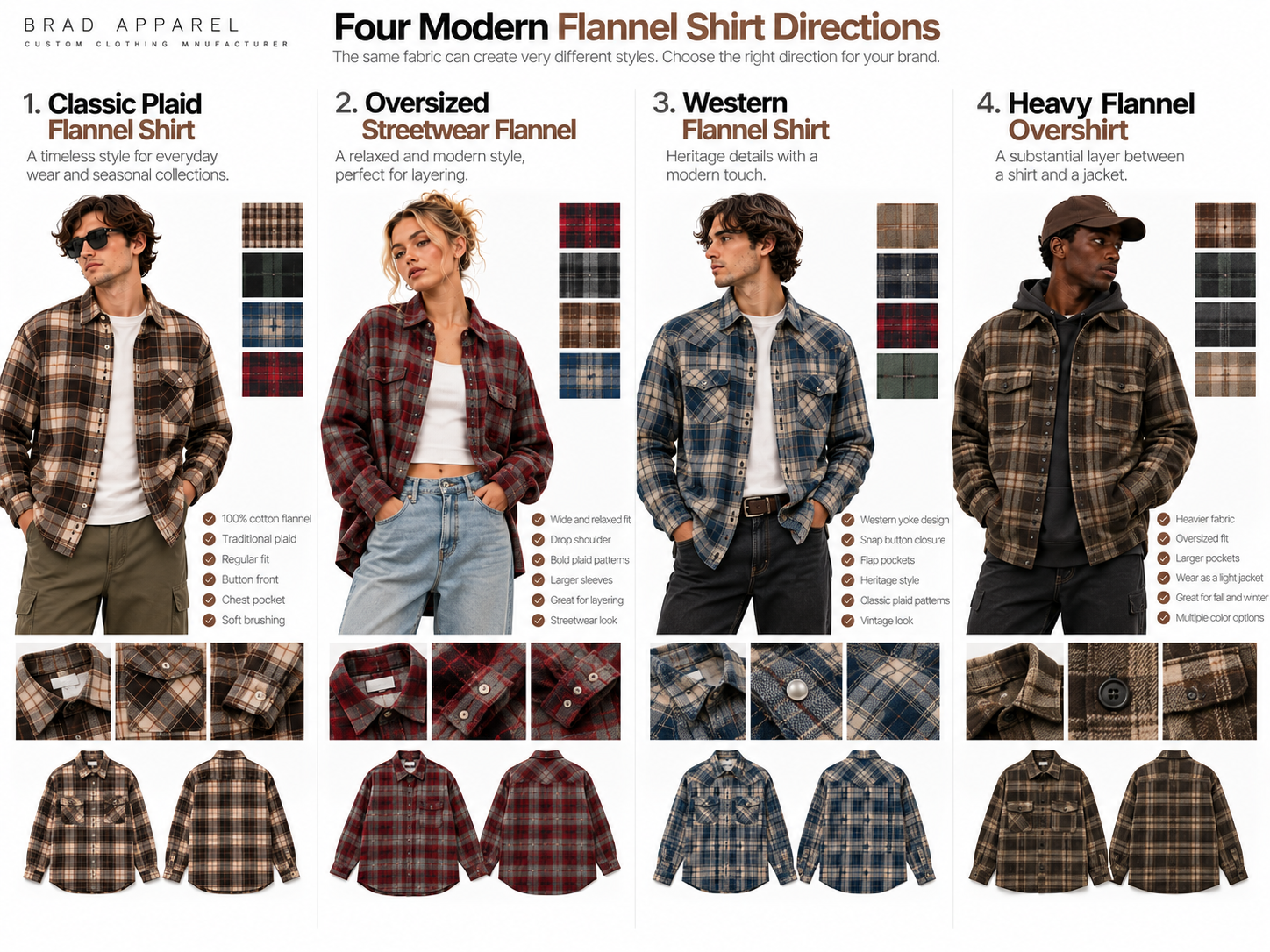
The same category can support very different collections.
1. Classic Plaid Flannel Shirt
Typical features:
- Cotton flannel
- Traditional plaid
- Regular or relaxed fit
- Button front
- Chest pocket
- Soft brushing
Suitable for:
- Casualwear
- Heritage collections
- Everyday basics
2. Oversized Streetwear Flannel
Possible features include:
- Wide body
- Drop shoulder
- Large sleeves
- Longer or boxier proportion
- Larger plaid
- Bold color combinations
This direction works especially well for layering over:
- T-shirts
- Hoodies
- Sweatshirts
The pattern should be purpose-built rather than simply using a larger standard size.
3. Western Flannel Shirt
Typical details include:
- Western yoke
- Snap closure
- Flap pockets
- Contrast stitching
- Bias-cut plaid elements
This creates a stronger heritage and vintage direction.
4. Heavy Flannel Overshirt
Possible features include:
- More substantial woven fabric
- Larger buttons or snaps
- Relaxed fit
- Reinforced pockets
- Straight or slightly curved hem
This product sits between:
shirt
and
light jacket.
The armhole and body ease should allow for layering.
Solid Flannel Is Also an Option
Not every flannel shirt needs plaid.
Solid brushed fabrics can create:
- Cleaner minimal styling
- More premium appearance
- Easier pattern cutting
- Less matching waste
Possible colors include:
- Black
- Cream
- Olive
- Navy
- Brown
- Burgundy
For minimalist brands, the fabric texture alone can provide enough visual interest.
Decoration Options
Flannel shirts can support several types of branding.
Possible options include:
- Small embroidery
- Chest logo
- Back embroidery
- Woven patch
- Leather-look patch
- Custom buttons
- Branded snaps
- Woven label
The decoration should be tested on the actual fabric.
Embroidery on Brushed Fabric
Brushing can make embroidery behave differently from smooth poplin.
Important considerations include:
- Stabilizer
- Stitch density
- Small text clarity
- Puckering
- Surface fibers around the embroidery
A strike-off or actual garment sample is useful before bulk production.
Printing on Flannel
Printing may also be possible depending on the fabric.
However, the brushed surface can affect:
- Ink definition
- Adhesion
- Edge sharpness
The correct print method depends on the fiber composition and surface finish.
Sampling should be done on the actual production fabric.
What Should You Check on a Flannel Shirt Sample?

A plaid flannel shirt should be checked for both:
fit
and
pattern consistency.
1. Front View
Check:
- Body width
- Body length
- Placket
- Collar
- Pocket position
- Hem balance
2. Side View
Check:
- Body volume
- Sleeve angle
- Front/back length
- Hem shape
3. Back View
Check:
- Shoulder width
- Yoke alignment
- Back volume
- Plaid direction
- Hem level
4. Collar
Check:
- Shape
- Symmetry
- Collar points
- Interfacing
- Plaid orientation
5. Front Placket
Check:
- Straightness
- Button spacing
- Plaid matching
- Stitching
- No twisting
6. Pockets
Check:
- Height
- Size
- Symmetry
- Flap shape if used
- Pattern matching if required
7. Shoulder & Yoke
Check:
- Shoulder position
- Yoke symmetry
- Plaid direction
- Seam alignment
8. Sleeves
Check:
- Length
- Width
- Movement
- Left/right balance
- Plaid direction
9. Cuffs & Sleeve Placket
Check:
- Cuff size
- Button or snap position
- Sleeve-placket operation
- Stitching
- Symmetry
10. Fabric Surface
Check:
- Brushing consistency
- Color
- Plaid clarity
- Defects
- Shade variation
11. Wash Result
After the intended care process, compare:
- Measurements
- Shrinkage
- Surface
- Softness
- Plaid shape
- Collar behavior
12. Pattern Matching
If matching was specified, inspect:
- Center front
- Pockets
- Yoke
- Side seams
- Cuffs
against the approved sample.
Common Flannel Shirt Development Mistakes
Assuming Plaid Means Flannel
Plaid describes the pattern.
Flannel describes the fabric.
Choosing Fabric Only From a Photo
Brushing and softness need physical evaluation.
Ignoring Pattern Repeat
Large checks affect both cutting and final appearance.
Requesting Full Pattern Matching After Pricing
Matching requirements should be defined before costing.
Cutting Brushed Fabric in Opposite Directions
Directional nap can create visible shade differences.
Using Heavy Interfacing on Soft Flannel
This can make the collar and cuffs feel disconnected from the garment.
Making an Overshirt by Simply Sizing Up
The layering pattern should be purpose-built.
Approving Fit Before Washing
Cotton flannel may change dimensions after the intended wash process.
Making Every Plaid Seam Match
Perfect matching everywhere may increase fabric consumption and labor without providing equal visual value.
Brands should prioritize the areas that matter most.
What Should You Send a Flannel Shirt Manufacturer?
A useful development brief should define:
| Area | What to Specify |
|---|---|
| Product Type | Shirt / overshirt |
| Fit | Slim / regular / relaxed / oversized |
| Fabric | Cotton / blend / wool blend |
| Surface | Unbrushed / single brushed / double brushed |
| Pattern | Plaid / check / solid / stripe |
| Pattern Method | Yarn-dyed / printed |
| Repeat | Horizontal + vertical repeat |
| Pattern Matching | Required areas |
| Collar | Point / button-down / camp / Western |
| Closure | Button / snap |
| One / two / flap / Western / none | |
| Yoke | Straight / bias / Western |
| Cuff | Button / adjustable / snap |
| Hem | Curved / straight |
| Wash | Required finishing or garment wash |
| Branding | Embroidery / patch / custom trim |
| Quantity | Sample and bulk quantity |
The clearer these decisions are before sampling, the easier it is to control bulk consistency.
How Brad Apparel Can Develop a Custom Flannel Shirt
A custom flannel project can follow:
Design Reference
↓
Fabric Selection
↓
Plaid / Color Direction
↓
Yarn-Dyed or Printed Decision
↓
Shrinkage & Surface Testing
↓
Pattern Development
↓
Pattern-Matching Requirements
↓
First Sample
↓
Fit & Wash Review
↓
Construction Adjustment
↓
Pre-Production Approval
↓
Bulk Production
Brad Apparel supports woven garment development through Fabric Sourcing & Development, custom buttons, snaps and labels through Trims & Branding, and broader garment development through our Manufacturing Capabilities.
FAQ
What Is a Flannel Shirt?
A flannel shirt is a woven shirt made from flannel fabric, commonly characterized by a soft or brushed surface.
It can be plaid, solid or another pattern.
Is Flannel the Same as Plaid?
No.
Flannel is a type of fabric.
Plaid is a pattern.
A plaid shirt can be made from non-flannel fabric, and flannel can be produced in solid colors.
Is Flannel Always Cotton?
No.
Flannel can use cotton, wool, blends and other fibers.
The composition should be selected according to the desired hand feel, structure and price position.
What Is Yarn-Dyed Flannel?
Yarn-dyed flannel uses colored yarns that are woven together to create the plaid or check.
The pattern is part of the textile construction rather than simply printed onto the surface.
Are Flannel Shirts Brushed?
Many are, but not every flannel has the same level of brushing.
Options can include:
- Light brushing
- Single-side brushing
- Double-side brushing
- Cleaner low-nap finishes
Can Flannel Shirts Be Oversized?
Yes.
An oversized flannel should normally be developed with the correct chest, shoulder, sleeve and length proportions rather than simply using a larger standard size.
What Is the Difference Between a Flannel Shirt and an Overshirt?
An overshirt is generally developed with more layering room and may use heavier fabric, larger pockets and stronger trims.
A conventional shirt usually has lighter construction and less ease.
Does Plaid Need to Match Across Pockets?
Not necessarily.
It can be matched for a cleaner appearance or intentionally rotated or cut on the bias as a design feature.
The requirement should be specified before costing.
Why Does Plaid Matching Increase Fabric Usage?
Pattern pieces may need to be positioned according to the plaid repeat rather than purely for maximum cutting efficiency.
This can create additional fabric waste.
Can Flannel Be Embroidered?
Yes.
Embroidery should be tested on the actual brushed fabric because surface fibers and fabric softness can affect stitch appearance and puckering.
Should Flannel Be Washed Before Bulk Approval?
If the final garment will receive a wash or if shrinkage is relevant, post-wash measurements and appearance should be reviewed before final bulk approval.
Final Thoughts
A flannel shirt may look like one of the simplest garments in a collection.
But plaid and brushed fabrics introduce production decisions that a basic solid shirt does not have.
The strongest products balance:
Fabric
+
Brushing
+
Plaid Repeat
+
Pattern Direction
+
Pattern Matching
+
Fit
+
Shrinkage
+
Construction
rather than choosing a check pattern and treating the rest like a standard shirt.
For clothing brands, understanding those details is what separates a basic plaid shirt from a flannel product that remains consistent from first sample to bulk production.
Keep Reading