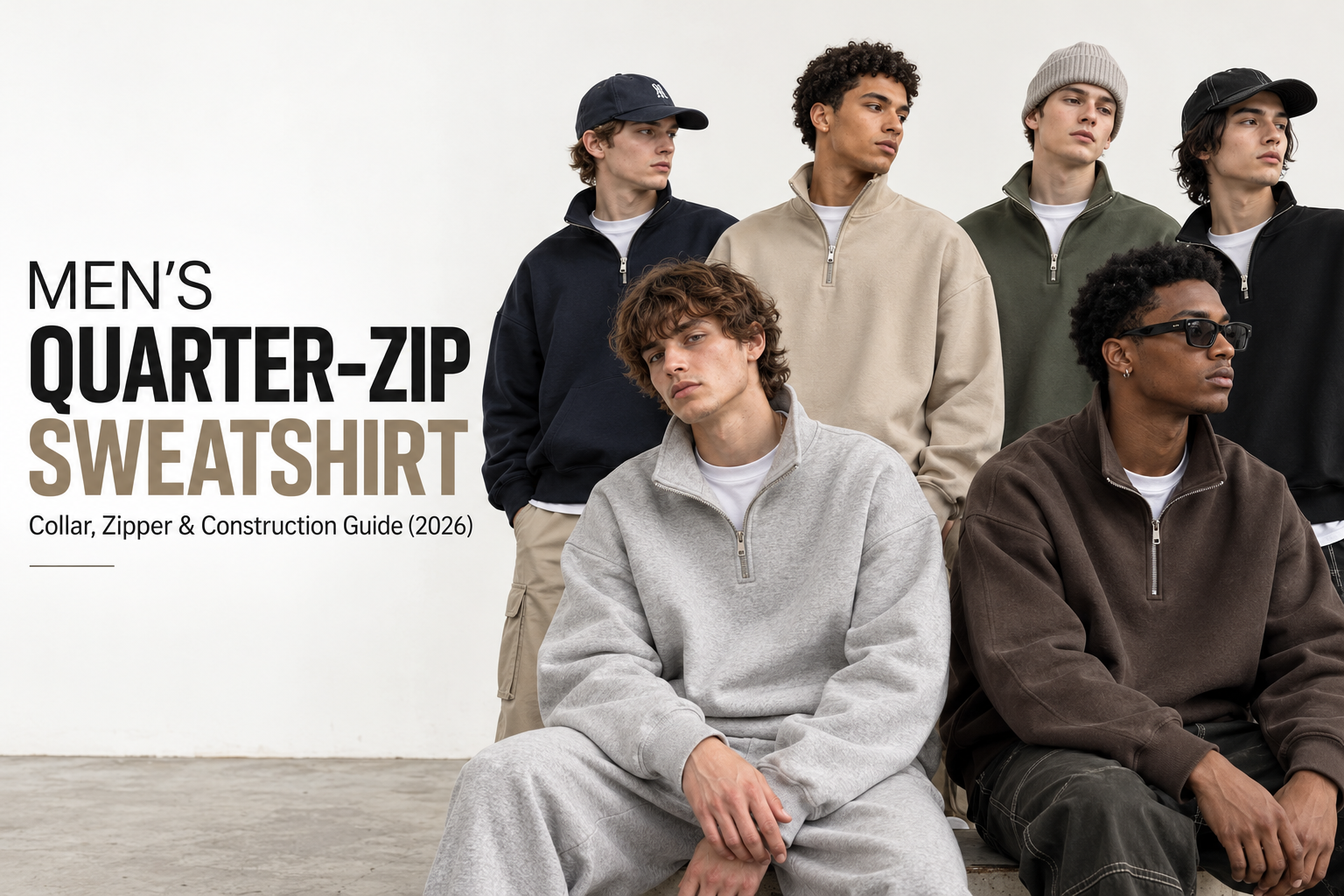
A quarter-zip sweatshirt is a pullover sweatshirt with a short zipper extending from the neckline down the center front.
It looks simple.
But from a manufacturing perspective, a quarter zip is considerably more sensitive than a standard crewneck sweatshirt.
The zipper changes the construction around the:
- Neck opening
- Collar
- Center front
- Chest
- Facing
- Seam stabilization
- Topstitching
It also brings two materials with very different behavior together.
Sweatshirt fabric normally has some mechanical stretch and can shrink during washing.
Zipper tape has much less stretch.
If those two components are not balanced correctly, the finished garment can develop:
- Wavy zipper edges
- Twisted center front
- Uneven collar height
- Puckering
- Zipper distortion
- Poor opening shape
For clothing brands, this means a successful men's quarter zip should not be created by simply cutting a slit into an existing crewneck pattern and adding a zipper.
The final product depends on the relationship between:
collar + zipper length + front opening + facing + fabric + shrinkage + fit + stitching
This guide explains how quarter-zip sweatshirts are developed, how they differ from related garments and what brands should specify before sampling and bulk production.
What Is a Quarter-Zip Sweatshirt?
A quarter-zip sweatshirt is normally a cut-and-sewn pullover made from sweatshirt fabric with a partial center-front zipper.
Common fabrics include:
- French terry
- Brushed fleece
- Cotton/polyester fleece
- Heavyweight jersey
- Double knit
Typical construction features include:
- Stand collar
- Partial front zipper
- Zipper facing
- Optional zipper guard
- Set-in or raglan sleeves
- Rib cuffs
- Rib or self-fabric hem
- Optional pockets
The zipper normally opens enough to make the neckline:
- Easier to put on
- Adjustable
- Better for layering
When zipped closed, the collar can sit higher around the neck.
When opened, the collar can fold outward and create a more relaxed shape.
That ability to change the neckline is one of the main reasons the quarter zip works across:
- Sportswear
- Streetwear
- Casualwear
- Golf-inspired clothing
- Preppy menswear
- Workleisure
- Premium basics
Why Are Men's Quarter Zips Relevant in 2026?
Quarter zips have moved beyond their older associations with office casualwear and golf clothing.
Modern versions now appear in:
- Heavyweight streetwear
- Minimal menswear
- Sportswear
- Knitwear
- Heritage collections
- Oversized casualwear
- Performance clothing
The important change is not simply popularity.
It is the variety of products now being called a quarter zip.
A men's quarter zip might be:
a 450 GSM oversized fleece sweatshirt
or:
a lightweight French terry pullover
or:
a fully fashioned merino sweater
or:
a technical performance top
These products may share a similar neckline, but their manufacturing methods are completely different.
For brands developing custom production, the first question should therefore be:
What type of quarter zip are we actually making?
This guide focuses primarily on the cut-and-sewn quarter-zip sweatshirt.
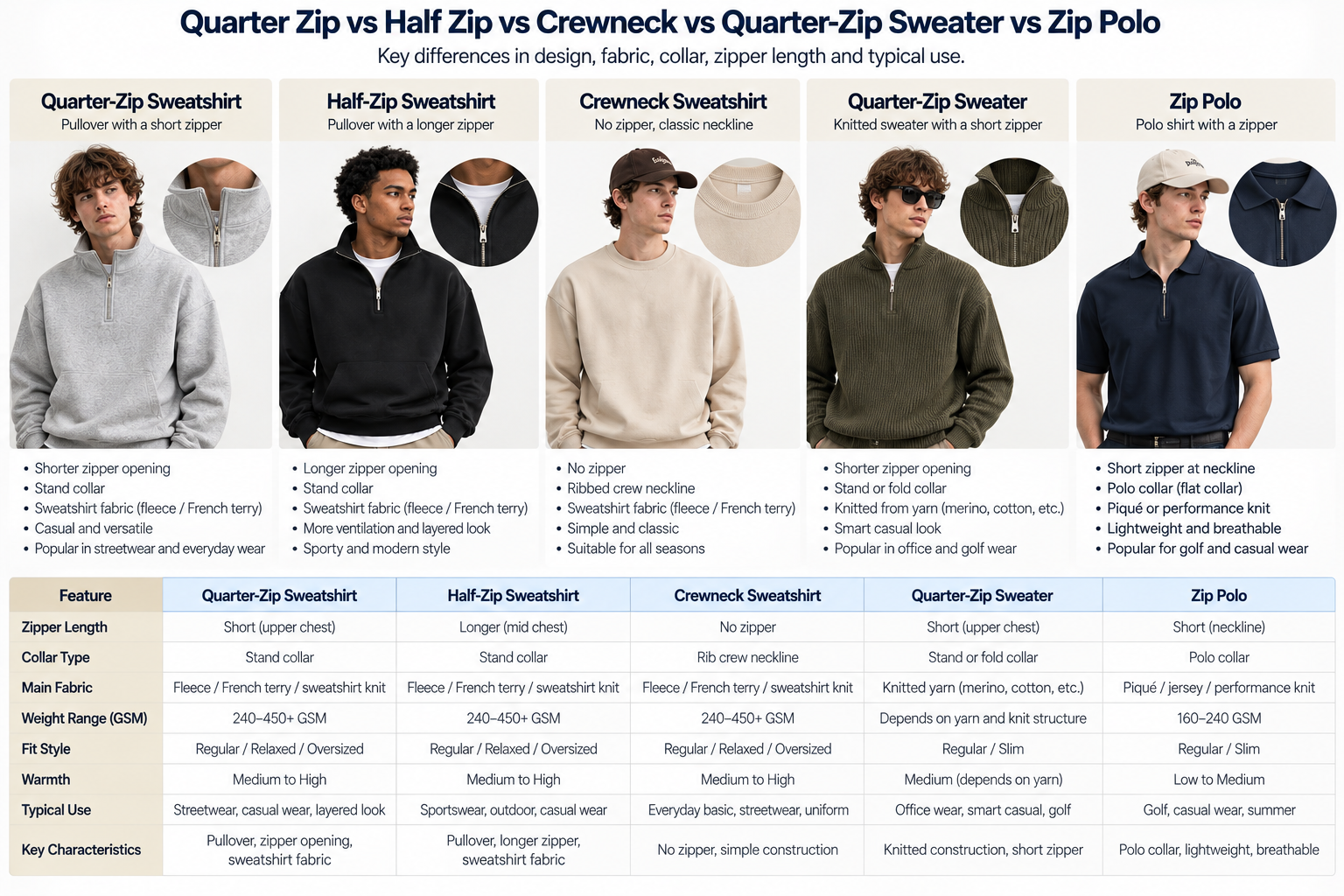
Quarter Zip vs Half Zip
The terms quarter zip and half zip are often used inconsistently.
There is no universal industry rule stating that a quarter zip must use one exact zipper length and a half zip another.
In general:
Quarter Zip
Usually has a shorter opening concentrated around the:
- Collar
- Upper chest
Half Zip
Usually extends farther down the chest.
But brands and retailers sometimes use the terms interchangeably.
For manufacturing, do not rely on the product name alone.
Instead, specify the actual:
finished zipper opening length
in centimeters or inches.
For example:
Center-front zipper opening: 24 cm finished length
is far more useful to a factory than:
Make it a quarter zip.
Quarter-Zip Sweatshirt vs Crewneck Sweatshirt
A standard crewneck sweatshirt normally uses:
- Closed neckline
- Rib neckband
- No front opening
A quarter zip replaces that simple neckline with a more complex system:
- Collar
- Zipper
- Opening
- Facing
- Reinforcement
This changes both:
- Appearance
- Manufacturing difficulty
A crewneck neckline can stretch slightly during dressing.
A quarter zip relies more heavily on the zipper opening.
That means collar circumference and zipper length become important fit measurements.
Quarter-Zip Sweatshirt vs Quarter-Zip Sweater
This distinction is particularly important for sourcing.
A quarter-zip sweatshirt is normally cut and sewn from knitted fabric supplied in rolls.
Examples include:
- French terry
- Fleece
- Jersey
A quarter-zip sweater is usually knitted from yarn.
Possible sweater materials include:
- Merino wool
- Cotton yarn
- Cashmere
- Wool blends
- Synthetic yarn blends
The two garments may look very similar in a product photograph.
But their production methods are different.
| Feature | Quarter-Zip Sweatshirt | Quarter-Zip Sweater |
|---|---|---|
| Main Material | Knitted fabric in rolls | Yarn |
| Production | Cut and sew | Knitted garment construction |
| Common Fabrics | French terry, fleece | Merino, cotton knit, cashmere |
| Typical Feel | Casual / athletic | Knitwear / smart casual |
| Zipper Installation | Sewn into cut opening | Integrated into knit construction |
| Main Factory Type | Cut-and-sew garment factory | Sweater knit factory |
This distinction should be confirmed before quotation.
Quarter-Zip Sweatshirt vs Zip Polo
A zip polo normally uses a polo-style body and collar direction.
Common fabrics include:
- Piqué
- Jersey
- Performance knit
A quarter-zip sweatshirt generally uses:
- Sweatshirt fleece
- French terry
- Heavier knit fabric
and often has:
- Rib cuffs
- Heavier body
- More casual silhouette
The zipper concept may look similar.
The garment construction is not necessarily the same.
For more polo variations, see Brad Apparel's Complete Guide to Polo Shirt Types.
Quarter-Zip Sweatshirt vs Full-Zip Sweatshirt
A full-zip garment opens completely from:
- Neck
- To hem
A quarter zip remains a pullover.
That means the front body can remain mostly continuous.
This creates:
- Cleaner lower front
- More pullover-like fit
- Less zipper weight
It also means the lower endpoint of the zipper becomes an important construction area.
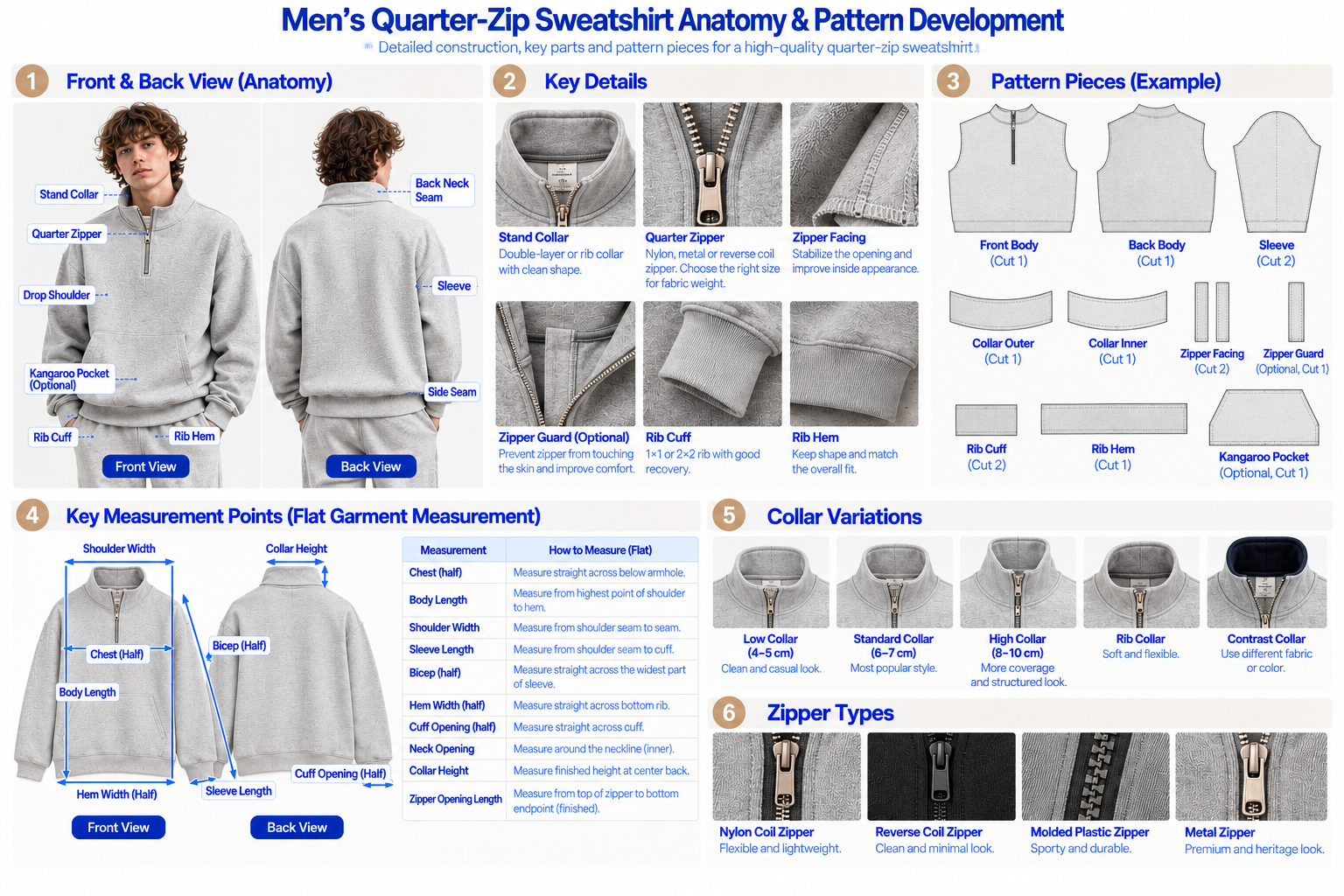
The Anatomy of a Quarter-Zip Sweatshirt
A typical quarter-zip sweatshirt includes:
- Front body
- Back body
- Sleeves
- Stand collar
- Center-front zipper
- Zipper facing
- Optional zipper guard
- Cuffs
- Hem rib or hem finish
- Optional pockets
The area requiring the most development is normally:
collar + zipper opening + upper chest
because all three components need to align.
The Stand Collar
Most quarter-zip sweatshirts use some form of stand collar.
The collar may be made from:
- Self fabric
- Rib knit
- Double-layer self fabric
- Contrast fabric
The collar affects:
- Neck opening
- Overall silhouette
- Warmth
- Zipper length
- Layering
- How the garment looks open and closed
Collar Height
Collar height changes the entire character of the garment.
A lower collar feels:
- Sportier
- Lighter
- More casual
A taller collar can feel:
- More protective
- More structured
- More fashion-focused
But taller is not automatically better.
If the collar is too high, it may:
- Press against the jaw
- Fold unpredictably
- Collapse
- Feel uncomfortable when fully zipped
The correct collar height should be evaluated on the wearer.
Finished Collar Height
The tech pack should define the finished collar height, not simply the pattern-piece height.
For example:
Finished stand collar height: 7 cm
is clearer than providing only a flat pattern dimension.
Remember that:
- Seam allowance
- Turn of cloth
- Fabric thickness
can affect the final visible height.
Collar Circumference
Collar circumference controls how closely the collar sits around the neck.
Too small:
- Restricts the neck
- Pulls the front upward
- Creates tension around the zipper
Too large:
- Collapses away from the neck
- Can look loose or unfinished
The target depends on whether the design is:
- Athletic
- Relaxed
- Oversized
- High-necked
Collar Shape
A stand collar does not always need to be a simple rectangle.
Depending on fit and fabric, the pattern may need shaping to control:
- Neck curve
- Front opening
- Collar roll
- Shoulder relationship
Very heavy fabric makes this more important because bulky material does not naturally collapse into shape as easily.
Self-Fabric Collar
A self-fabric collar uses the same main fabric as the body.
This creates:
- Clean appearance
- Consistent color
- Strong structure
It works particularly well with:
- Dense French terry
- Midweight fleece
- Double knit
However, two layers of very heavy fleece can become bulky.
Rib Collar
Rib can make the collar:
- Softer
- More flexible
- More comfortable
Possible ribs include:
- 1×1 rib
- 2×2 rib
But rib has more stretch than zipper tape.
The collar construction therefore needs to prevent excessive pulling around the zipper.
Collar Interfacing
Not every sweatshirt collar requires fusible interfacing.
This should depend on:
- Fabric weight
- Desired structure
- Collar shape
Some designs may use stabilization in selected areas rather than stiffening the entire collar.
Heavyweight streetwear quarter zips often already have enough structure from the fabric itself.
Zipper Construction Is the Critical Detail
The zipper is the main technical difference between a quarter zip and a crewneck sweatshirt.
A zipper should be selected according to:
- Fabric weight
- Garment style
- Wash
- Desired appearance
- Puller
- Tape color
- Teeth type
Common options include:
- Nylon coil zipper
- Reverse coil zipper
- Molded plastic zipper
- Metal zipper
Nylon Coil Zipper
A coil zipper is relatively flexible.
It works well for:
- Lightweight sweatshirts
- Sportswear
- Clean casual designs
It can create less bulk than heavy metal hardware.
Reverse Coil Zipper
A reverse coil zipper hides most of the zipper teeth from the exterior.
This creates:
- Cleaner appearance
- More minimal styling
It works particularly well for:
- Technical quarter zips
- Modern minimal garments
Molded Plastic Zipper
A molded zipper creates a stronger visible zipper line.
It can work well for:
- Sportswear
- Outdoor-inspired designs
- Heavy casualwear
The zipper scale should still match the fabric.
Metal Zipper
Metal zippers create a stronger:
- Heritage
- Premium
- Workwear-inspired
appearance.
Possible finishes include:
- Silver
- Antique brass
- Gunmetal
- Matte black
But metal zippers can add substantial weight.
On lightweight French terry, a heavy metal zipper may pull the center front downward.
Zipper Size
Zipper size should be selected around:
- Fabric thickness
- Collar thickness
- Visual design
- End use
A fine zipper may look too weak on a very heavy oversized sweatshirt.
An oversized zipper may dominate a lightweight design.
The physical zipper sample should be tested with the actual garment fabric.
Zipper Tape
Do not focus only on the teeth.
The zipper tape matters too.
Check:
- Tape width
- Tape color
- Tape softness
- Shrinkage
- Colorfastness
A zipper tape that behaves differently from the main fabric during washing can distort the front opening.
Zipper Puller
Pullers can be:
- Standard
- Metal
- Rubberized
- Cord pull
- Custom logo
A large decorative puller should be checked for:
- Weight
- Noise
- Washing
- Surface damage
Custom hardware should always be approved physically before bulk production.
For custom zipper pulls, labels and other trims, see Brad Apparel's Trims & Branding.
Zipper Length
Zipper length strongly affects the design.
A short zipper creates:
- Compact neckline
- More traditional quarter-zip look
A deeper zipper creates:
- More ventilation
- Easier layering
- Stronger vertical design line
But there is no universal "correct" quarter-zip length.
It should be specified as an actual measurement.
Where Should the Zipper End?
The lower zipper endpoint usually sits around the upper chest.
Its exact location affects:
- Visual proportion
- Ease of dressing
- Logo placement
- Pocket placement
If the zipper is excessively short:
the head opening may become inconvenient.
If excessively long:
the garment begins to look closer to a half zip.
Center-Front Alignment
The zipper should remain visually centered.
Check alignment relative to:
- Collar
- Neckline
- Body
- Chest logo
- Hem
Even a small shift is noticeable because the zipper creates a strong vertical reference line.
The Zipper Opening
The front body needs a controlled opening for the zipper.
This area must remain:
- Straight
- Stable
- Symmetrical
Sweatshirt fabric is stretchy.
Zipper tape is comparatively stable.
That difference creates one of the main technical challenges.
Stabilizing the Opening
Depending on fabric and design, the opening may be stabilized using:
- Facing
- Knit-compatible reinforcement
- Tape
- Additional fabric layer
The goal is not to make the chest stiff.
It is to prevent the zipper edge from:
- Stretching
- Waving
- Distorting
during sewing and washing.
Zipper Facing
A facing creates a clean interior around the opening.
It can help:
- Stabilize the front
- Hide zipper tape
- Improve inside appearance
- Control the bottom endpoint
Facing shape should follow the actual zipper construction.
It should not create unnecessary bulk.
Zipper Guard
A zipper guard is an optional strip positioned behind the zipper.
It can help prevent:
- Zipper teeth touching the body
- Inner layers catching in the zipper
- Cold air entering through the opening
It also improves the inside appearance.
Possible designs include:
- Full-length guard
- Narrow backing strip
- Upper chin guard only
Chin Guard / Zipper Garage
Some quarter zips include additional protection at the top.
This may be described as a:
- Chin guard
- Zipper garage
Its purpose is to reduce direct contact between the zipper slider and the neck or chin.
This is particularly useful for:
- Sportswear
- Technical clothing
- High collars
It is optional for casual sweatshirts.
The Bottom of the Zipper Opening
The bottom endpoint receives concentrated stress.
This area needs clean construction.
Possible methods include:
- Reinforced facing
- Controlled box construction
- Additional backing
The exact method depends on the pattern.
Avoid adding heavy reinforcement automatically.
Too much thickness can create a hard lump directly on the chest.
Zipper Top Alignment
When fully closed, both sides of the collar should meet evenly.
Common problems include:
- One collar side higher
- Zipper top stops misaligned
- Uneven seam allowance
- Twisted collar
This is one of the most visible QC points.
Zipper Waviness
A wavy zipper is one of the most common visual problems in knit garments.
Possible causes include:
- Fabric stretched during sewing
- Incorrect feeding
- Insufficient stabilization
- Zipper tape and fabric shrinkage mismatch
- Incorrect seam tension
The solution is not simply pressing the zipper flatter.
The construction process needs to control the cause.
Best Fabrics for Quarter-Zip Sweatshirts
The most common choices are:
- French terry
- Brushed fleece
- Cotton/poly fleece
- Dense jersey
- Double knit
For a deeper explanation of sweatshirt fabric structures, see Brad Apparel's Sweatshirt Fabric & Construction Guide.
French Terry Quarter Zip
French terry has a looped interior.
It can provide:
- Breathability
- Moderate structure
- Clean casual appearance
It is useful for:
- Spring
- Fall
- Transitional layering
- Premium casualwear
A dense heavyweight French terry can also create a strong streetwear silhouette.
Fleece Quarter Zip
Brushed fleece has a soft interior surface.
It provides:
- More warmth
- Soft hand feel
- Winter suitability
It works especially well for:
- Cold-weather casualwear
- Oversized silhouettes
- Heavyweight quarter zips
But heavy fleece creates additional bulk around:
- Collar
- Zipper
- Facing
Those areas should be evaluated during sampling.
Heavyweight Quarter Zip
A heavyweight quarter zip can create:
- Stronger silhouette
- Fuller sleeve
- Structured collar
- Premium streetwear appearance
But high GSM alone does not guarantee quality.
Heavyweight construction can also create:
- Thick collar seams
- Bulky zipper opening
- Heavy cuffs
- Difficult seam intersections
Fabric weight must be developed together with construction.
Example Fabric Weight Directions
These are development references rather than universal rules.
| Product Direction | Example Fabric Weight |
|---|---|
| Lightweight Layer | 240–280 GSM |
| Midweight Quarter Zip | 280–350 GSM |
| Heavyweight Streetwear | 350–450+ GSM |
Actual performance depends on:
- Knit density
- Fiber composition
- Finishing
- Brushing
- Compactness
A dense 320 GSM fabric can sometimes feel more structured than a loosely knitted heavier fabric.
100% Cotton
100% cotton can provide:
- Natural hand feel
- Strong dye response
- Premium casual appearance
But cotton generally requires careful shrinkage testing.
This matters even more with a zipper because the zipper itself will not shrink in the same way as the fabric.
Cotton / Polyester Blend
Cotton/polyester fleece may provide:
- Better dimensional stability
- Faster drying
- Reduced shrinkage
- Good shape retention
The correct blend depends on the target product.
Neither 100% cotton nor a blend is automatically superior.
Fabric Shrinkage and Zipper Compatibility
This is one of the most important quarter-zip development points.
Imagine:
Main fabric shrinks 5%.
Zipper tape shrinks very little.
After washing, the fabric becomes shorter while the zipper remains relatively stable.
The center front can then:
- Ripple
- Bow
- Wave
That is why the actual fabric and zipper should be tested together.
Pre-Shrink Testing
Before bulk production, record shrinkage in:
- Length
- Width
Then evaluate the finished zipper area after:
- Intended wash
- Drying
- Pressing
Do not approve the zipper construction only in the unwashed sample.
Rib Matching
If the garment uses rib cuffs or waistband, confirm:
- Composition
- Color
- Weight
- Stretch
- Recovery
- Shrinkage
Main fabric and rib do not always shrink equally.
Poor matching can create:
- Tight waistband
- Loose cuffs
- Wavy hem
Quarter-Zip Fit Options
Common fits include:
- Regular
- Relaxed
- Boxy
- Oversized
- Athletic
The neckline should be developed around the fit rather than copied between styles.
Regular Fit
A regular fit normally uses:
- Conventional shoulder
- Moderate chest ease
- Standard body length
This works well for:
- Casualwear
- Uniforms
- Golf-inspired styles
Relaxed Fit
A relaxed quarter zip may use:
- More chest ease
- Wider sleeve
- Slightly dropped shoulder
This gives the product a more contemporary appearance while remaining easy to layer.
Boxy Quarter Zip
A boxy silhouette normally combines:
- Wider chest
- Wider shoulder
- Reduced or controlled body length
- Straight body
This works particularly well with:
- Heavy French terry
- Dense fleece
The collar should remain proportional to the wider body.
Oversized Quarter Zip
An oversized quarter zip should be intentionally patterned.
Do not simply enlarge a regular pattern by one or two sizes.
That can create:
- Excessive body length
- Collar too large
- Zipper too long
- Sleeves too long
Instead, control:
- Shoulder width
- Chest
- Sleeve width
- Body length
- Collar circumference
independently.
Set-In Sleeve
A set-in sleeve gives:
- Clear shoulder seam
- More conventional structure
It works well for:
- Regular fit
- Premium basics
- Preppy styling
Drop Shoulder
A drop shoulder moves the armhole seam beyond the natural shoulder.
It works well for:
- Streetwear
- Oversized fits
- Boxy silhouettes
The amount of drop should be specified.
Raglan Sleeve
Raglan construction removes the conventional shoulder seam.
It can create:
- Sportier appearance
- Greater visual movement
- Athletic heritage
A raglan quarter zip can work particularly well for retro sportswear.
Cuff Construction
Common cuff options include:
- Rib cuff
- Self-fabric cuff
- Elasticated cuff
Rib is most common for classic sweatshirt construction.
The cuff should have enough recovery to hold shape without feeling excessively tight.
Hem Options
A quarter zip can use several hem constructions.
Rib Waistband
Creates:
- Traditional sweatshirt appearance
- Blouson effect
- Stronger shape
Straight Self-Fabric Hem
Creates:
- Cleaner silhouette
- More modern appearance
It is useful for boxy quarter zips.
Elastic Hem
Can create:
- Technical
- Outdoor
- Sportswear
styling.
Side Slits
Some fashion quarter zips use side slits.
These can improve:
- Movement
- Layering
- Boxy appearance
The slit should be reinforced cleanly at the top.
Pocket Options
Not every quarter zip needs a pocket.
Possible options include:
- No pocket
- Kangaroo pocket
- Side-seam pockets
- Welt pockets
- Zipper pockets
- Chest pocket
Pocket type should support the garment direction.
Kangaroo Pocket
A kangaroo pocket creates a more casual or hoodie-like appearance.
Its position should not interfere with the lower zipper endpoint.
Side-Seam Pocket
Side-seam pockets maintain a clean front.
They work especially well for:
- Minimal quarter zips
- Premium casualwear
But the pocket bag should not distort the side seam.
Chest Pocket
A chest pocket can create:
- Workwear
- Outdoor
- Utility
styling.
The pocket must be positioned carefully around the zipper.
Quarter-Zip Pattern Development
A typical cut-and-sewn quarter-zip sweatshirt may include:
- Front body
- Back body
- Two sleeves
- Collar outer
- Collar inner
- Zipper facings
- Optional zipper guard
- Two cuffs
- Hem rib or hem piece
- Optional pocket pieces
Exact pattern-piece quantity varies according to construction.
Front Body Pattern
The front body requires accurate center-front marking.
Depending on the construction, the body may be cut as:
- One main front panel with a partial zipper opening
- Separate upper construction components
For many standard designs, the body remains continuous below the zipper.
Zipper Opening Mark
The pattern should clearly identify:
- Center front
- Top position
- Bottom endpoint
- Finished zipper length
Do not determine the opening by eye during sewing.
Facing Pattern
Facing dimensions depend on:
- Zipper width
- Fabric thickness
- Opening length
- Interior finish
The facing should provide stability without becoming excessively wide or visible from the exterior.
Collar Pattern
The collar pattern needs to coordinate with:
- Neck opening
- Zipper
- Fabric stretch
- Finished collar height
Changing the collar independently can affect zipper alignment.
Zipper Guard Pattern
If a zipper guard is used, specify:
- Width
- Length
- Shape
- Top finish
It should cover the intended area without rolling into the zipper.
Shoulder Pattern
Shoulder width determines whether the garment is:
- Regular
- Relaxed
- Dropped
The sleeve pattern must be adjusted accordingly.
Sleeve Pattern
Important sleeve measurements include:
- Sleeve length
- Bicep
- Elbow
- Cuff opening
Oversized quarter zips often require additional sleeve volume rather than simply additional length.
Cuff Pattern
Cuff length should account for:
- Rib stretch
- Recovery
- Desired tightness
Do not use the same cuff measurement for every rib quality.
Hem Rib Pattern
If a rib waistband is used, its finished width relative to the body controls how much the hem pulls inward.
Too much negative ease can create an exaggerated balloon shape.
Too little may make the rib appear loose.
Key Quarter-Zip Measurements
A tech pack should define at least:
| Measurement | Why It Matters |
|---|---|
| Chest Width | Controls body volume |
| Body Length | Controls proportion |
| Shoulder Width | Defines regular / drop shoulder |
| Sleeve Length | Controls total arm length |
| Bicep Width | Controls sleeve volume |
| Hem Width | Controls silhouette |
| Neck Opening | Controls collar fit |
| Finished Collar Height | Controls neckline |
| Collar Circumference | Controls neck comfort |
| Zipper Opening Length | Defines quarter / half-zip appearance |
| Zipper Position | Keeps center front balanced |
| Cuff Opening | Controls wrist fit |
| Pocket Position | Controls proportion if used |
Measuring Zipper Opening Length
Define the measurement clearly.
For example:
Measure vertically along center front from the top zipper reference point to the lower zipper endpoint.
The factory and brand should use the same method.
A zipper supplier's nominal chain length and the garment's visible finished opening are not always interpreted in exactly the same way.
Confirm the actual finished garment measurement.
Collar Measurement
Measure:
- Finished height
- Finished circumference
- Front alignment
Collar height should be checked with the garment:
- Zipped
- Unzipped
because both positions affect the appearance.
Chest Measurement
For a flat garment, chest is normally measured:
Straight across the garment at the specified point below the armhole.
The exact reference point should be stated in the measurement chart.
Shoulder Measurement
For set-in or drop-shoulder styles, measure:
Shoulder seam to shoulder seam
according to the approved measurement method.
Raglan styles require a different sleeve measurement system.
Quarter-Zip Grading
Grading requires more than increasing the body.
The zipper, collar and opening need their own rules.
Does Zipper Length Need to Grade?
Not necessarily at the same rate as the body.
A brand may decide to:
- Keep zipper length constant
- Grade slightly
- Use different zipper lengths by size group
The decision depends on the design.
A zipper that grows too much across sizes may change the visual identity.
Collar Grading
Collar circumference normally needs to accommodate size changes.
But collar height may remain constant.
This is a good example of why every measurement should not simply scale by the same percentage.
Pocket Grading
If the garment includes pockets, decide separately:
- Pocket size
- Pocket position
A fixed pocket may look too small in large sizes.
A fully proportional pocket may become excessively large.
Developing the First Sample
The first sample should answer several questions.
Fit
Does the garment have the intended:
- Chest volume
- Length
- Shoulder
- Sleeve
Collar
Does the collar:
- Sit cleanly
- Feel comfortable
- Stay balanced
Zipper
Does the zipper:
- Open smoothly
- Remain centered
- Stay flat
Opening
Does the lower endpoint remain:
- Clean
- Flat
- Reinforced
Fabric
Does the fabric support the intended silhouette?
Check the Garment Zipped and Unzipped
This is important.
A quarter zip effectively has two neckline states.
Fully Zipped
Check:
- Collar height
- Neck comfort
- Zipper alignment
Partially Open
Check:
- Collar fold
- Facing visibility
- Zipper guard
- Symmetry
The garment should look intentional in both states.
Wash Testing
Do not approve a quarter zip only from an unwashed sample.
Test the intended care route.
Check:
- Overall shrinkage
- Zipper waviness
- Collar distortion
- Rib recovery
- Colorfastness
- Zipper function
The final measurement standard should match the actual production finishing process.
Zipper Wash Test
After washing, operate the zipper repeatedly.
Check for:
- Sticking
- Warping
- Slider damage
- Surface damage
- Tape distortion
For metal hardware, also inspect:
- Finish
- Oxidation
- Color change
Custom Quarter-Zip Decoration
Quarter zips can use:
- Embroidery
- Screen print
- Puff print
- Silicone print
- Appliqué
- Patches
But zipper position affects artwork placement.
Chest Embroidery
Small chest embroidery works well on quarter zips.
Possible positions include:
- Left chest
- Right chest
The logo should be positioned relative to:
- Center-front zipper
- Armhole
- Collar
not just the overall garment width.
Center-Front Artwork
Avoid placing conventional printed artwork directly across the zipper opening unless the decoration is intentionally designed around separate panels.
The zipper interrupts the surface.
This can create:
- Broken artwork
- Alignment problems
Large Back Graphics
Back printing and embroidery are generally less affected by the front zipper construction.
But fabric weight still influences decoration quality.
Embroidery on Heavyweight Fabric
Dense sweatshirt fabric can support embroidery well.
But stitch density and backing should still be tested.
For embroidery development options, see Brad Apparel's Embroidery Techniques.
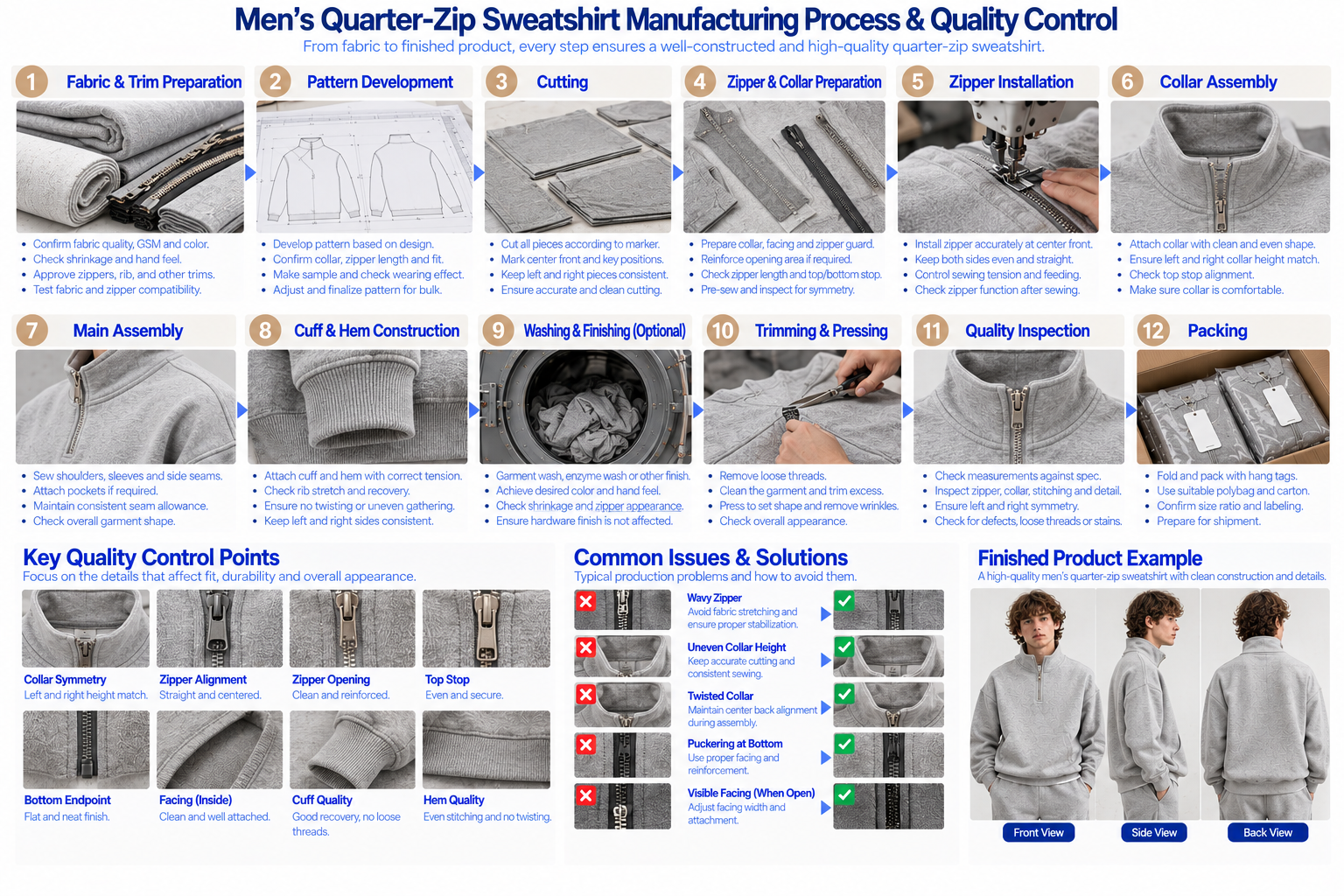
Quarter-Zip Manufacturing Process
A practical production route may include:
- Fabric and rib inspection
- Shrinkage testing
- Zipper and trim approval
- Pattern development
- Cutting
- Stabilizing / preparing zipper opening
- Zipper and facing preparation
- Front zipper installation
- Collar assembly
- Main garment assembly
- Cuff and hem construction
- Decoration where required by the process
- Washing or finishing if required
- Pressing
- Measurement inspection
- Zipper and collar QC
- Final inspection
- Packing
The exact sequence may change according to:
- Decoration
- Wash
- Zipper
- Fabric
- Factory construction method
For a broader overview of sweatshirt production, see Brad Apparel's Custom Sweatshirt Manufacturing Guide.
1. Fabric Inspection
Check:
- Composition
- GSM
- Width
- Shade
- Surface
- Defects
- Stretch
- Shrinkage
The zipper should eventually be tested against the approved fabric rather than a substitute.
2. Shrinkage Test
Test the main fabric using the intended wash.
Record:
- Length shrinkage
- Width shrinkage
Also test:
- Rib
- Zipper tape where necessary
The goal is to understand how the components behave together.
3. Zipper Approval
Confirm:
- Type
- Length
- Tape color
- Teeth color
- Slider
- Puller
- Finish
- Function
If custom hardware is used, approve the physical sample before production.
4. Cutting
Cut:
- Front
- Back
- Sleeves
- Collar
- Facing
- Guard
- Cuffs
- Hem
- Pocket pieces
according to the approved marker and pattern.
Center-front reference marks must remain accurate.
5. Opening Preparation
Prepare and stabilize the center-front opening according to the approved construction.
This stage has a major effect on the final zipper appearance.
Avoid stretching the knit fabric.
6. Zipper Installation
The operator should control:
- Left/right seam allowance
- Zipper position
- Bottom endpoint
- Feeding tension
Both sides should remain equal.
7. Facing / Guard Construction
Check the interior.
The facing should:
- Lie flat
- Cover intended seam areas
- Avoid rolling outward
The guard should not catch in the zipper.
8. Collar Assembly
Attach the collar while maintaining:
- Center-back alignment
- Left/right balance
- Correct neckline circumference
The two front collar edges need to meet cleanly at the zipper.
9. Main Assembly
Complete:
- Shoulder
- Sleeves
- Side seams
- Underarm seams
according to the chosen construction.
Check seam allowance consistency.
10. Cuffs and Hem
Attach cuffs and waistband without:
- Excess stretching
- Uneven gathering
- Twisting
Left and right cuffs should finish equally.
11. Washing and Finishing
If the style requires washing, test for:
- Shrinkage
- Hand feel
- Zipper appearance
- Hardware finish
The approved washed sample should become the visual reference.
12. Pressing
Press the garment enough to:
- Set the collar
- Clean the zipper edges
- Present the seams
Do not use excessive heat on zipper components.
Pressing temperature should be compatible with:
- Fabric
- Zipper
- Decoration
13. Measurement Inspection
Measure the finished garment after the intended finishing process.
Check:
- Chest
- Length
- Shoulder
- Sleeve
- Collar
- Zipper opening
- Hem
against the approved specification.
14. Zipper Function Check
Open and close the zipper.
Check:
- Smooth operation
- Slider function
- Top stop
- Bottom stop
- Puller
The zipper should not require excessive force.
15. Collar QC
Check:
- Height
- Symmetry
- Shape
- Zipper alignment
- Center back
A quarter zip can look poorly made even when the body sewing is good if the collar is uneven.
Key Quality Control Points
Zipper Straightness
The zipper should remain vertically aligned.
Look for:
- Curving
- Bowing
- Waves
Left / Right Opening Symmetry
Both sides of the zipper should have consistent:
- Width
- Topstitching
- Seam allowance
Collar Symmetry
Check:
- Left height
- Right height
- Front meeting point
The collar should not lean to one side.
Bottom Endpoint
Inspect the lower end of the zipper.
It should be:
- Flat
- Secure
- Clean
without excessive puckering.
Facing
The facing should remain inside the garment.
It should not:
- Flip outward
- Create excessive thickness
- Distort the front
Zipper Guard
If included, confirm it:
- Covers the intended area
- Does not twist
- Does not enter the zipper teeth
Zipper Function
Test repeated:
- Opening
- Closing
The zipper should move consistently.
Shrinkage
Finished dimensions must remain within the agreed tolerance after the intended wash.
Pay particular attention to:
- Body length
- Sleeve length
- Zipper area
Common Quarter-Zip Quality Problems
Wavy Zipper
Possible Causes
- Fabric stretching during sewing
- Feed imbalance
- Poor stabilization
- Shrinkage mismatch
Control
Test the construction on production fabric and control feeding during zipper installation.
Zipper Pulling the Front Up
If the fabric shrinks significantly but the zipper does not, the center front can become distorted after washing.
Control
Perform shrinkage testing before final pattern approval.
Uneven Collar Height
One side of the collar may finish higher than the other.
Causes
Possible causes include:
- Unequal sewing
- Zipper placement
- Collar attachment
- Cutting inconsistency
Control
Use accurate reference marks and inspect the collar before final finishing.
Collar Too Loose
A collar that is too large can collapse away from the neck.
Control
Review:
- Collar circumference
- Fabric stretch
- Collar pattern
Collar Too Tight
A tight collar can feel uncomfortable when zipped.
It may also create tension through:
- Neckline
- Shoulder
- Zipper
Fit testing should include the garment fully zipped.
Zipper Endpoint Puckering
The bottom of the opening may become bulky or wrinkled.
Possible Causes
- Excess seam bulk
- Incorrect facing
- Poor turning
- Stretching
The solution should focus on construction rather than simply stronger pressing.
Facing Showing When Open
The quarter zip may look clean when closed but poor when partially open.
Control
Check:
- Facing width
- Attachment
- edge finish
during fitting.
Zipper Guard Catching
If the backing strip sits too close to the zipper chain, it may catch in the slider.
Control
Adjust:
- Width
- Attachment
- Distance from zipper
Twisted Center Front
Possible causes include:
- Pattern imbalance
- Incorrect zipper sewing
- Fabric skew
- Wash distortion
Check both the garment and raw fabric.
Rib Color Mismatch
Main fabric and rib may use different material structures.
Even when dyed to the same target color, they can appear different.
Approve:
- Main fabric
- Rib
together under consistent lighting.
Uneven Rib Tension
Excessive tension during cuff or waistband attachment can create:
- Puckering
- Twisting
- Uneven gathers
The sewing ratio should remain consistent.
Example Men's Heavyweight Quarter Zip
A modern streetwear specification might use:
- Boxy relaxed fit
- Drop shoulder
- 420 GSM French terry
- 100% cotton
- Double-layer self-fabric stand collar
- Metal quarter zipper
- Zipper facing
- Optional zipper guard
- Heavy rib cuffs
- Straight or rib hem
- Small tonal chest embroidery
- Garment wash
This is only an example.
The final construction should be tested around the actual fabric.
Example Minimal Quarter Zip
A cleaner premium version might use:
- Regular-relaxed fit
- 300 GSM French terry
- Tonal reverse coil zipper
- Medium-height stand collar
- Side-seam pockets
- Tonal stitching
- No visible logo
- Straight hem
The zipper becomes a subtle design element rather than the main visual feature.
Example Retro Sports Quarter Zip
Possible specification:
- Relaxed fit
- Raglan sleeve
- Midweight fleece
- Contrast collar
- Contrast zipper
- Rib cuffs
- Rib waistband
- Chest embroidery
This creates a stronger athletic or collegiate direction.
Example Outdoor-Inspired Quarter Zip
Possible specification:
- Relaxed fit
- Fleece or technical knit
- Molded zipper
- High collar
- Chin guard
- Zipper chest pocket
- Elastic or adjustable hem
This direction should be developed separately from a traditional sweatshirt if technical performance is required.
Quarter-Zip Sweatshirt Tech Pack Example
| Area | Example Specification |
|---|---|
| Product | Men's Quarter-Zip Sweatshirt |
| Fit | Relaxed / Boxy |
| Shoulder | Drop Shoulder |
| Main Fabric | Cotton French Terry |
| Weight | 380 GSM |
| Collar | Double-Layer Stand Collar |
| Finished Collar Height | 7 cm |
| Front Opening | Quarter Zip |
| Finished Zipper Length | 25 cm |
| Zipper | Reverse Coil |
| Zipper Tape | Tonal |
| Facing | Self Fabric |
| Zipper Guard | Yes |
| Sleeve | Set-In |
| Cuff | 2×2 Rib |
| Hem | Rib Waistband |
| Decoration | Left-Chest Embroidery |
| Finish | Garment Wash |
| Branding | Woven Main + Care Label |
These specifications are illustrative rather than universal.
What Should a Quarter-Zip Tech Pack Include?
At minimum, define:
- Fit
- Fabric
- Composition
- GSM
- Shoulder type
- Chest
- Body length
- Sleeve length
- Neck opening
- Collar height
- Collar circumference
- Zipper type
- Zipper length
- Zipper color
- Facing
- Zipper guard
- Cuffs
- Hem
- Pockets
- Decoration
- Labels
- Wash
- Measurement tolerance
A reference image alone cannot communicate all of these details.
How to Describe a Quarter Zip to a Manufacturer
Instead of writing:
I need an oversized quarter zip like this photo.
write:
Men's relaxed boxy quarter-zip sweatshirt in 380 GSM cotton French terry with a 6 cm drop shoulder, double-layer self-fabric stand collar, 25 cm tonal reverse-coil zipper, self-fabric zipper facing, internal zipper guard, 2×2 rib cuffs and waistband, tonal stitching and small left-chest embroidery.
Then provide:
- Size chart
- Fabric reference
- Color
- Zipper
- Collar dimensions
- Artwork
- Branding
- Wash
- Quantity
This gives the pattern and sample teams a much clearer development target.
Common Development Mistakes
1. Starting With a Crewneck Pattern and Simply Adding a Zipper
The neckline and collar need to be developed specifically for the zipper construction.
2. Calling It a Quarter Zip Without Specifying Zipper Length
Quarter zip and half zip terminology is not precise enough for production.
Use an actual measurement.
3. Ignoring Fabric Shrinkage
Main fabric and zipper tape can behave differently after washing.
4. Using an Overly Heavy Zipper
The zipper should match the fabric and garment direction.
5. Making the Collar Too High
A dramatic collar may look good flat but become uncomfortable on body.
6. Making the Collar Too Loose
The collar may collapse away from the neck.
7. Failing to Stabilize the Opening
Stretchy fabric can create zipper waves and puckering.
8. Adding Too Much Reinforcement
Excess stabilization can make the upper chest stiff.
9. Ignoring the Inside Construction
Quarter zips are often worn partially open.
The facing and zipper guard may become visible.
10. Approving the Garment Before Wash Testing
The zipper may look perfect before wash and distorted afterward.
11. Positioning Artwork Without Considering the Zipper
A center-front opening changes available decoration space.
12. Mechanically Grading Zipper Length
The zipper does not necessarily need to grow at the same rate as the body.
Quarter-Zip Development Checklist
Before sampling, confirm:
- Product type
- Fit
- Fabric composition
- Fabric weight
- Color
- Collar construction
- Collar height
- Collar circumference
- Zipper type
- Zipper length
- Zipper finish
- Facing
- Zipper guard
- Shoulder
- Sleeve
- Cuffs
- Hem
- Pockets
- Decoration
- Branding
- Wash
Before bulk production, confirm:
- Approved fabric
- Fabric shrinkage
- Approved zipper
- Zipper tape compatibility
- Approved pattern
- Finished zipper opening
- Collar measurements
- Fit sample
- Wash test
- Decoration
- Labels
- Packaging
- Measurement tolerance
- QC standard
FAQ
What Is a Quarter-Zip Sweatshirt?
A quarter-zip sweatshirt is a pullover sweatshirt with a partial zipper extending from the neck down the upper center front.
It commonly uses a stand collar and can be made from French terry, fleece or other cut-and-sewn knit fabrics.
Is a Quarter Zip the Same as a Half Zip?
Not exactly, but the terms are often used inconsistently.
A quarter zip generally has a shorter opening, while a half zip extends farther down the chest.
There is no universal zipper-length rule.
For manufacturing, specify the actual finished zipper length.
What Is the Difference Between a Quarter-Zip Sweatshirt and a Quarter-Zip Sweater?
A sweatshirt is normally cut and sewn from fabric such as:
- French terry
- Fleece
A sweater is normally knitted from yarn.
They require different manufacturing processes.
What Fabric Is Best for a Quarter-Zip Sweatshirt?
Common options include:
- French terry
- Brushed fleece
- Cotton/polyester fleece
- Dense jersey
- Double knit
The best fabric depends on:
- Season
- Fit
- desired structure
- wash
- price target
Is French Terry Good for Quarter Zips?
Yes.
French terry provides a useful balance of:
- Structure
- Breathability
- Comfort
and works particularly well for transitional and premium casual quarter zips.
Is Fleece Good for Quarter Zips?
Yes.
Brushed fleece provides more warmth and works well for:
- Winter
- Heavyweight
- Oversized
styles.
Very heavy fleece requires careful collar and zipper construction to avoid excessive bulk.
What GSM Should a Quarter Zip Use?
There is no single correct GSM.
A lighter design may use approximately:
240–280 GSM.
A midweight version may use approximately:
280–350 GSM.
A heavyweight streetwear version may use:
350–450+ GSM.
These are development references, not mandatory standards.
Why Does a Quarter-Zip Zipper Become Wavy?
Possible causes include:
- Fabric stretching during sewing
- Inadequate stabilization
- Incorrect feed
- Shrinkage difference between fabric and zipper tape
The zipper should be tested with the production fabric.
Should a Quarter Zip Have a Zipper Guard?
Not necessarily.
A guard can improve:
- Comfort
- Interior appearance
- protection from the zipper
but it is optional depending on the product.
Can a Quarter Zip Be Oversized?
Yes.
Oversized quarter zips work particularly well in streetwear.
The pattern should control:
- Shoulder
- Chest
- Sleeve
- Body length
- Collar
independently rather than simply scaling up a regular pattern.
Can Quarter Zips Use Metal Zippers?
Yes.
Metal zippers create a strong premium or heritage appearance.
The zipper weight should be appropriate for the fabric.
Can Quarter-Zip Sweatshirts Be Garment Washed?
Yes, depending on the:
- Fabric
- Zipper
- Decoration
- hardware
The complete garment should be wash tested before bulk production.
Can Quarter Zips Be Embroidered?
Yes.
Popular positions include:
- Left chest
- Right chest
- Sleeve
- Back
Artwork placement should account for the center-front zipper.
Can Quarter Zips Use Custom Zipper Pullers?
Yes.
Custom pullers can use:
- Logos
- Symbols
- Custom finishes
but hardware size and weight should be tested on the actual garment.
What Should Be Checked During Quarter-Zip QC?
Important checks include:
- Zipper straightness
- Zipper function
- Collar symmetry
- Collar height
- Opening length
- Lower zipper endpoint
- Facing
- Zipper guard
- Overall measurements
- Shrinkage
- Cuff and hem recovery
- Stitching
- Final appearance
Final Thoughts
The quarter-zip sweatshirt looks like a simple variation of the crewneck.
From a manufacturing perspective, it is not.
The defining area of the garment combines:
stretchy sweatshirt fabric + stable zipper tape + shaped collar + reinforced opening
and those components need to behave as one system.
A lightweight French terry quarter zip can feel clean and versatile.
A heavyweight fleece version can become a structured streetwear piece.
A raglan quarter zip can reference retro sportswear.
A high-collar version with a reverse zipper can move toward technical minimalism.
But in every case, the same development principle applies:
do not treat the zipper as an accessory added after the sweatshirt is designed.
The zipper length, collar, front opening, fabric and shrinkage should be developed together from the beginning.
Once those details are approved as one system, the garment becomes much easier to reproduce consistently from sampling through bulk production.
Keep Reading