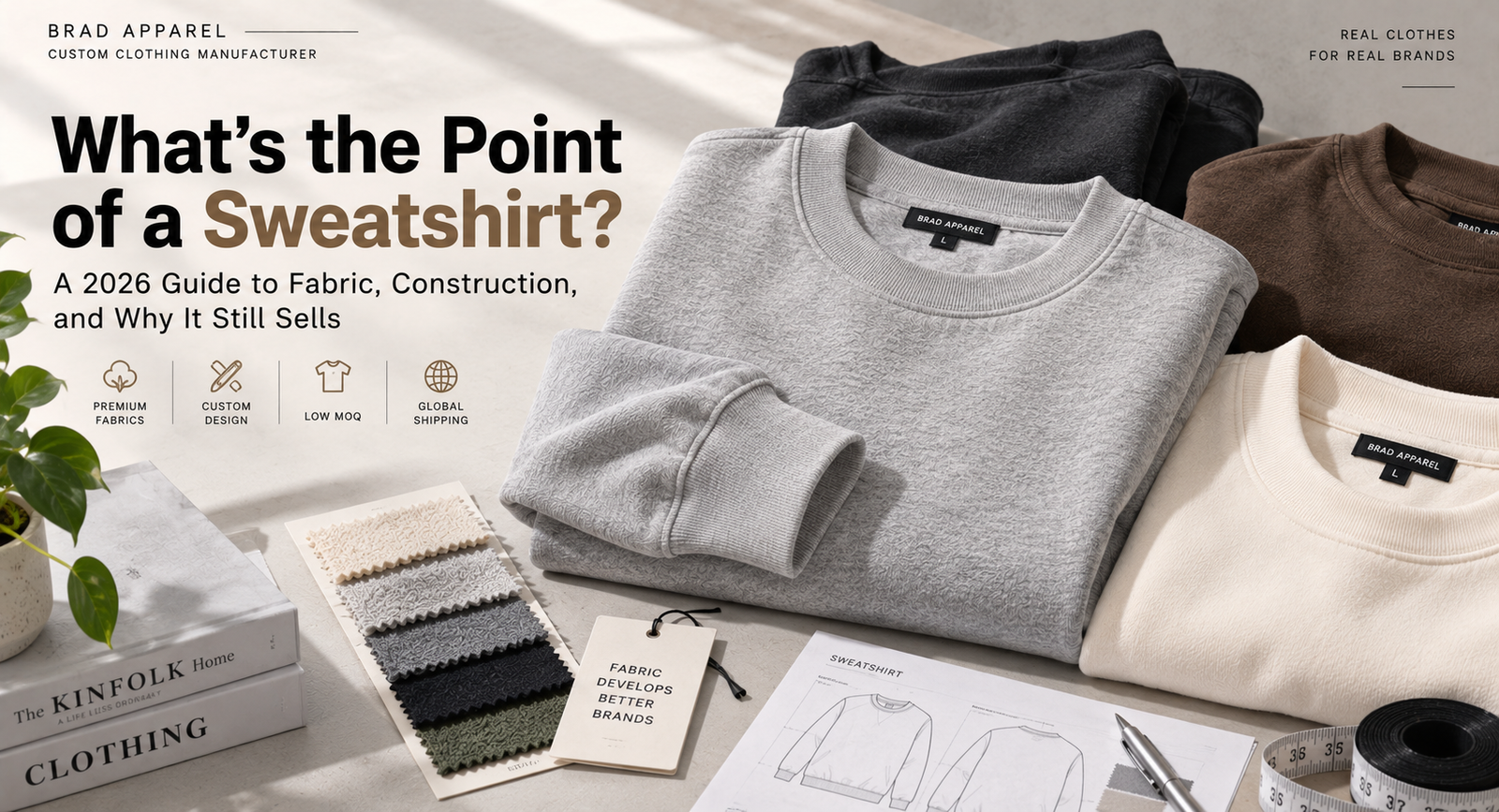
Sweatshirts have been around for more than a century, yet they remain one of the most reliable categories in casualwear.
The reason is simple:
A sweatshirt can be comfortable, easy to layer, easy to decorate and suitable for many different price points.
But not every sweatshirt is built the same.
The final product depends heavily on:
- Fabric construction
- GSM
- Fiber composition
- Fit
- Ribbing
- Printing or embroidery
- Intended season
For clothing brands developing a sweatshirt collection, these production details matter much more than simply choosing a colour and adding a logo.
This guide explains why sweatshirts were created, how they differ from sweaters and hoodies, which fabrics work best, and how to choose the right construction for your collection.
Why Were Sweatshirts Created?
Sweatshirts originally developed as a more comfortable alternative to traditional wool athletic garments.
Early athletic clothing could feel:
- Heavy
- Rough
- Hot
- Restrictive
Cotton sweatshirt fabric provided a softer option that could absorb moisture while allowing easier movement.
Over time, sweatshirts moved far beyond sport.
They became part of:
- College clothing
- Workwear
- Casualwear
- Hip-hop culture
- Streetwear
- Athleisure
- Premium fashion
Today, the sweatshirt works across everything from basic uniforms to high-end streetwear collections.
Sweatshirt vs Sweater vs Hoodie
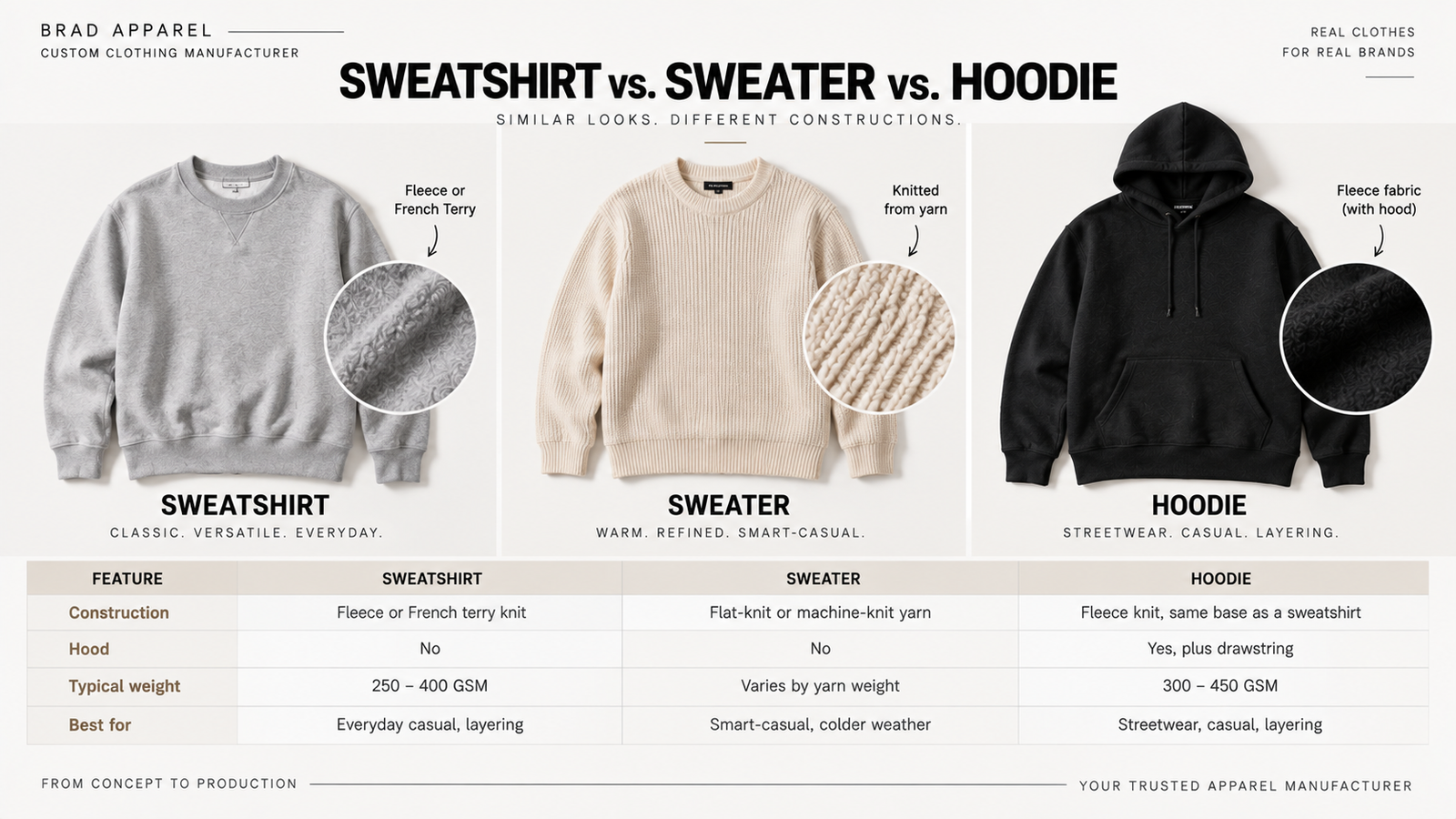
These three terms are sometimes used interchangeably, but they describe different garments.
| Feature | Sweatshirt | Sweater | Hoodie |
|---|---|---|---|
| Construction | Cut-and-sewn fleece or French terry | Knitted directly from yarn | Cut-and-sewn fleece or French terry |
| Hood | No | No | Yes |
| Typical Weight | 250–400+ GSM | Depends on yarn | 300–450+ GSM |
| Best For | Casualwear and layering | Smart-casual and cold weather | Streetwear and casualwear |
The most important distinction is construction.
Sweatshirt
A sweatshirt is normally made from knitted fabric supplied in rolls.
The fabric is:
- Knitted
- Finished
- Cut into pattern pieces
- Sewn into the final garment
Common fabrics include:
- Fleece
- French terry
- Cotton/poly blends
Hoodie
A hoodie usually starts from the same type of fabric as a sweatshirt.
The difference is mainly the added construction.
A hoodie normally includes:
- Hood
- Drawstring or hood opening
- Kangaroo or side pockets
So fabric-wise, a hoodie and sweatshirt can be almost identical.
Sweater
A sweater is different.
Instead of cutting fabric from a roll, sweaters are normally knitted directly from yarn.
Common sweater materials include:
- Cotton yarn
- Wool
- Merino wool
- Cashmere
- Acrylic blends
That is why sweater knit and sweatshirt fabric should not be treated as the same category.
What Fabric Is Used for Sweatshirts?
The two most common sweatshirt fabrics are:
- Fleece
- French terry
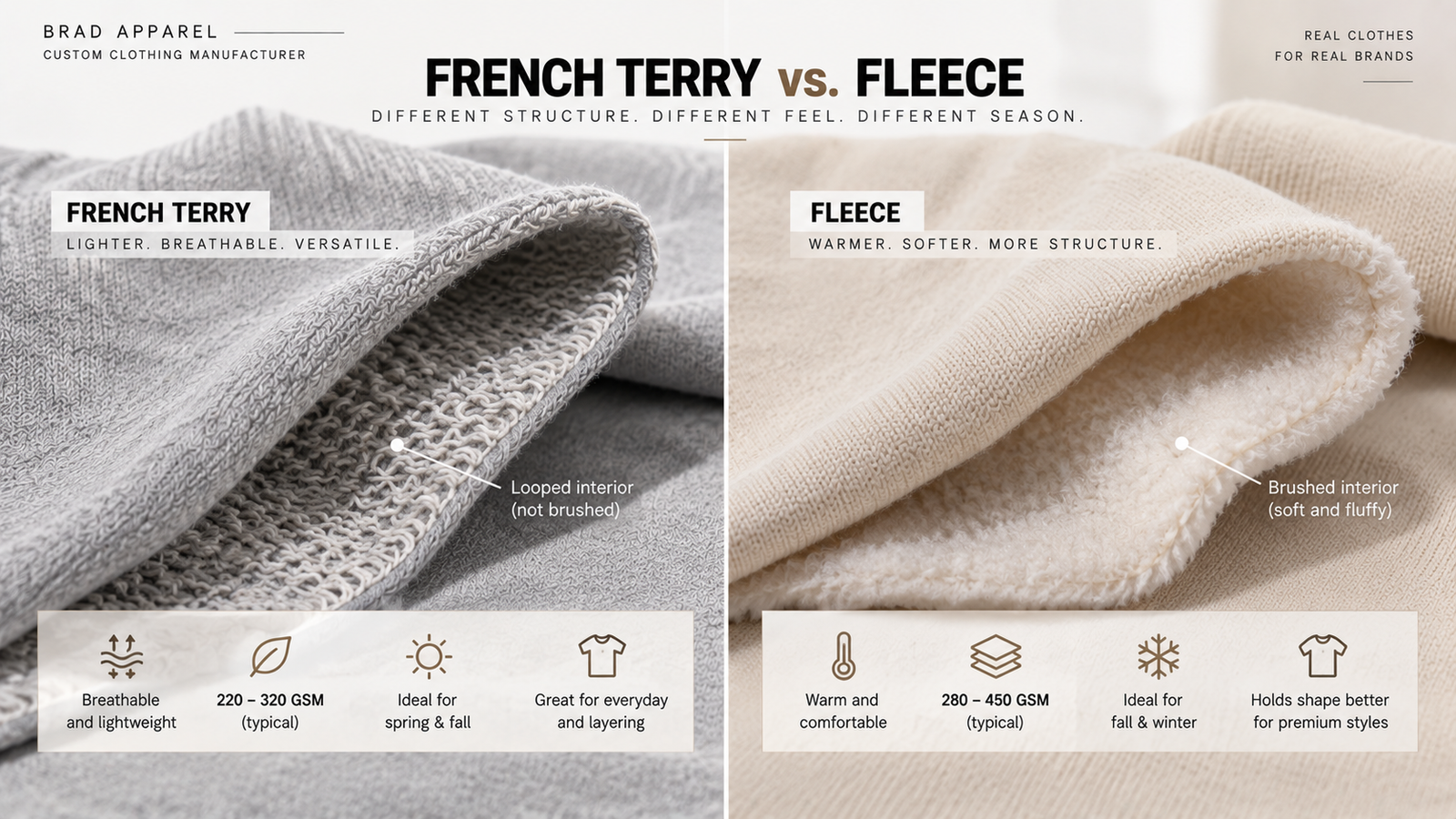
They may look similar from the outside, but the inside construction is different.
1. Fleece
Sweatshirt fleece usually has:
- Smooth outer surface
- Brushed interior
- Soft hand feel
- Warm construction
The inside loops are brushed during finishing, creating the fluffy surface associated with traditional sweatshirts.
Typical GSM
Approximately 280–450 GSM depending on the product.
Heavier fleece can provide:
- More structure
- More warmth
- Premium hand feel
- Better support for embroidery
- More substantial silhouette
2. French Terry
French terry has an unbrushed looped interior.
It normally feels:
- Lighter
- More breathable
- Less bulky
- Better suited to transitional weather
Typical GSM
Approximately 220–320 GSM.
French terry works particularly well for:
- Spring
- Fall
- Warmer climates
- Lightweight sweat sets
- Casual layering
Sweatshirt GSM Guide
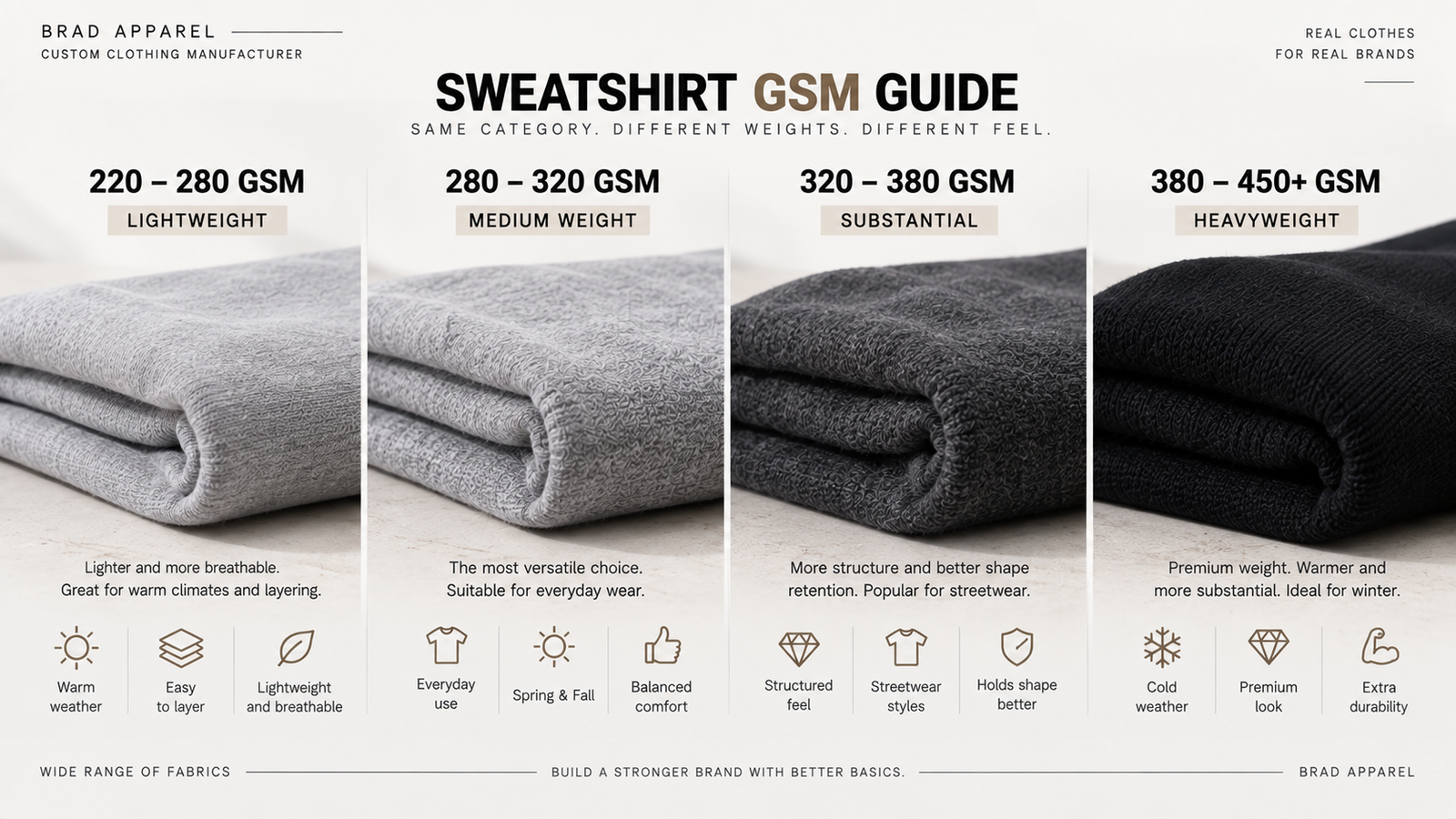
GSM means grams per square meter.
It is one of the most useful specifications when discussing sweatshirt fabric with a manufacturer.
| GSM Range | General Feel | Suitable For |
|---|---|---|
| 220–280 GSM | Lightweight | Warm climates and layering |
| 280–320 GSM | Medium weight | Everyday sweatshirts |
| 320–380 GSM | Substantial | Streetwear and cooler weather |
| 380–450+ GSM | Heavyweight | Premium and winter collections |
A higher GSM does not automatically mean better quality.
The correct weight depends on the product.
Lightweight Sweatshirts
Around 250–300 GSM can work well for:
- Transitional seasons
- Indoor layering
- Warmer markets
- Casual sets
These garments are easier to layer under jackets.
Heavyweight Sweatshirts
Around 380–450 GSM creates a much more substantial garment.
Heavyweight fabric can provide:
- Better structure
- Stronger silhouette
- Warmer feel
- More premium positioning
It also works particularly well with oversized streetwear fits.
Fiber Content Matters Too
GSM is only one part of the fabric specification.
Fiber composition also affects:
- Softness
- Shape retention
- Shrinkage
- Pilling
- Durability
100% Cotton
Advantages include:
- Natural hand feel
- Breathability
- Softness
- Premium cotton positioning
However, cotton can be more sensitive to:
- Shrinkage
- Stretching
- Shape change
Finishing and pre-shrink treatment therefore matter.
Cotton / Polyester Blends
Common blends include:
- 80% cotton / 20% polyester
- 60% cotton / 40% polyester
Polyester can improve:
- Shape retention
- Durability
- Dimensional stability
- Resistance to repeated washing
This is one reason cotton/poly blends are widely used in commercial sweatshirt production.
Why Sweatshirts Remain Popular
The sweatshirt has stayed relevant because it solves several problems at once.
Comfort
The soft knitted construction makes sweatshirts easy to wear for long periods.
Easy Layering
A crewneck sweatshirt can be worn:
- Over a T-shirt
- Under a jacket
- Under a coat
- With casual pants
- With jeans
- As part of a matching sweat set
Few garments work across as many casual outfits.
Streetwear and Athleisure
Sweatshirts remain foundational products in both categories.
Brands can change the product significantly through:
- Oversized fit
- Cropped fit
- Heavyweight fabric
- Washing
- Embroidery
- Printing
- Rib construction
Large Decoration Area
The front and back provide large, relatively flat surfaces.
This makes sweatshirts suitable for:
- Screen printing
- Puff printing
- DTG
- DTF
- Embroidery
- Appliqué
- Silicone printing
Year-Round Potential
Fabric weight can be adjusted according to season.
For example:
Spring / Fall
French terry or lighter fleece.
Winter
Heavy brushed fleece.
This allows brands to keep sweatshirt products in their collections throughout much of the year.
Choosing the Right Decoration Method
The decoration method should match the fabric.
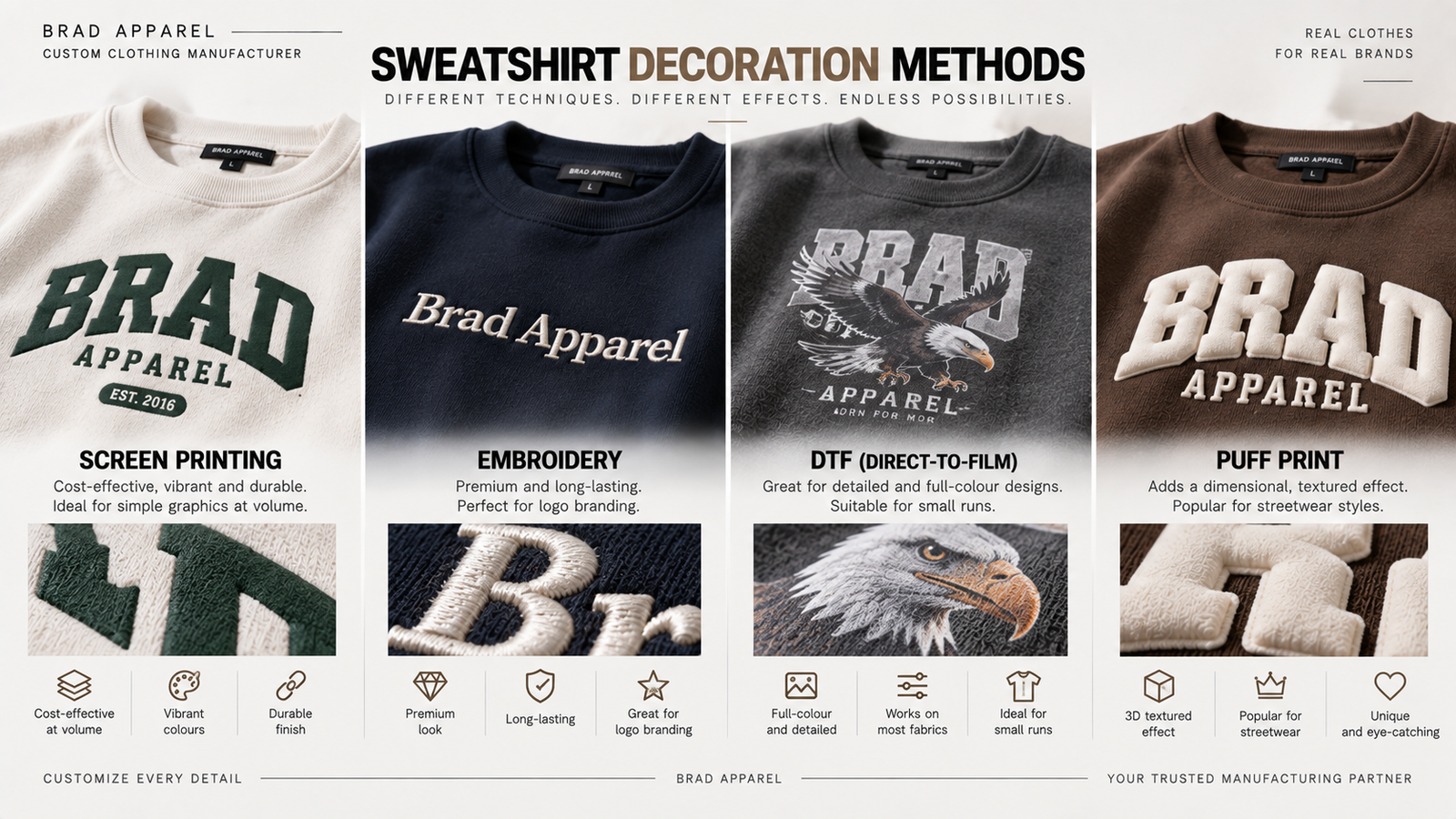
Screen Printing
Screen printing works well for:
- Logos
- Typography
- Large graphics
- Solid colours
- Higher quantities
It can be used on both fleece and French terry.
For larger production runs with relatively simple artwork, screen printing is often an efficient option.
Embroidery
Embroidery works particularly well on heavier fabrics.
Heavy fleece provides a stable base for stitches.
This makes it suitable for:
- Small chest logos
- Sleeve embroidery
- Large back embroidery
- Flat embroidery
- 3D embroidery
- Chenille patches
Fabric Matters
Lightweight or stretchy fabric may require:
- Different backing
- Lower stitch density
- Additional stabilizer
Embroidery should always be developed around the actual garment fabric.
DTF
DTF works well for:
- Detailed graphics
- Multiple colours
- Gradients
- Smaller quantities
It can work across a broad range of sweatshirt fabrics.
Puff Print
Puff printing adds a raised three-dimensional effect.
It works especially well for:
- Typography
- Logos
- Streetwear graphics
Heavyweight fleece can create a strong base for this type of printing.
Fabric and Decoration Should Be Developed Together
One common mistake is choosing the artwork first and fabric later.
The two should be considered together.
For example:
Dense Embroidery
Works better on:
- Heavy fleece
- Stable fabrics
Large Screen Print
Needs:
- Smooth enough surface
- Stable fabric
- Correct ink system
Puff Print
Works best when:
- The fabric can tolerate curing temperature
- The surface is relatively stable
- Artwork is suitable for expansion
Detailed Digital Print
May require:
- Smooth surface
- Suitable fiber composition
- Correct pretreatment or transfer process
Sampling should confirm the actual combination before bulk production.
Sweatshirt Construction Details That Affect Quality
Fabric is important, but construction also changes the finished product.
Important areas include:
- Neck rib
- Cuffs
- Waist rib
- Shoulder seams
- Sleeve construction
- Hem stitching
- Neck tape
- Seams
Ribbing
Good ribbing should recover after stretching.
Brands should confirm:
- Rib composition
- Rib weight
- Elastane content
- Rib density
- Recovery
Weak ribbing can quickly make an otherwise good sweatshirt look old.
Neck Construction
The neckline receives repeated stress when putting the sweatshirt on and taking it off.
Good construction may include:
- Stable rib
- Reinforced seam
- Neck tape
- Clean topstitching
Cuffs and Hem
Cuffs and waist rib affect the silhouette.
A tighter rib creates a more gathered shape.
A looser rib creates a straighter, more relaxed silhouette.
These details should be confirmed during sampling.
Sweatshirt Fit Options
The same fabric can create very different products depending on the pattern.
Common fits include:
Regular Fit
Balanced everyday silhouette.
Oversized Fit
Usually includes:
- Wider chest
- Dropped shoulder
- Wider sleeve
- More relaxed body
Cropped Fit
Shorter body length, often used in women's collections.
Boxy Fit
Wide body with controlled length.
Particularly suitable for modern streetwear.
Sustainability Options
Brands that want sustainability claims should confirm supporting documentation during sourcing.
Possible options include:
- Organic cotton
- Recycled polyester
- GRS-certified recycled materials
- Certified cotton options
The certification should match the actual fabric being used.
A vague sustainability claim is less useful than documented material sourcing.
How Brad Apparel Supports Custom Sweatshirt Production
Brad Apparel helps brands develop custom sweatshirts from fabric sourcing through sampling and bulk production.
Fabric Development
Through our Fabric & Accessory Sourcing service, brands can develop:
- Fleece
- French terry
- Cotton blends
- Custom GSM
- Custom colours
- Ribbing
- Labels
- Packaging
The fabric should be selected according to:
- Climate
- Fit
- Decoration
- Retail positioning
Custom Sweat Sets
Our Custom Sweat Set Production service can support:
- Crewneck sweatshirts
- Sweatpants
- Hoodies
- Matching sets
- Oversized streetwear
- Heavyweight fleece products
The sweatshirt and bottoms can be developed in the same fabric to improve colour and hand-feel consistency.
Printing
Brad Apparel supports Custom Printing Techniques, including:
- Screen printing
- Puff printing
- DTG
- DTF
- Silicone printing
- Heat transfer
Embroidery
Our Custom Embroidery options include:
- Flat embroidery
- 3D embroidery
- Chenille
- Patches
- Logo embroidery
The embroidery method should be selected according to fabric structure and artwork complexity.
FAQ
What GSM Is Best for a Sweatshirt?
For lighter sweatshirts, approximately 250–300 GSM can work well.
For heavier premium sweatshirts, approximately 380–450 GSM provides more warmth and structure.
The best GSM depends on season, fit and target price.
What's the Difference Between a Sweatshirt and a Hoodie?
The fabric may be exactly the same.
A hoodie normally adds:
- Hood
- Drawstring or hood opening details
A crewneck sweatshirt does not have a hood.
What's the Difference Between a Sweatshirt and a Sweater?
A sweatshirt is normally cut and sewn from fleece or French terry fabric.
A sweater is knitted directly from yarn.
They use fundamentally different manufacturing methods.
Is Fleece or French Terry Better?
Neither is automatically better.
Choose fleece when you want:
- Warmth
- Soft brushed interior
- Heavyweight structure
Choose French terry when you want:
- Breathability
- Lighter weight
- Transitional-season comfort
Is 100% Cotton Better Than a Cotton/Poly Blend?
It depends on the product.
100% cotton provides a natural hand feel.
Cotton/poly blends generally provide better dimensional stability and resistance to repeated washing.
What Decoration Method Is Best for Sweatshirts?
For simple graphics at volume:
Screen printing
For premium logo branding:
Embroidery
For detailed multicolour artwork:
DTF
For raised streetwear graphics:
Puff print
The final choice should depend on the artwork and fabric.
What MOQ Should I Expect for Custom Sweatshirts?
MOQ depends on:
- Fabric
- GSM
- Custom colour
- Printing
- Embroidery
- Washing
- Labels
- Packaging
For an accurate production plan, quantity should always be evaluated together with the full garment specification.
Final Thoughts
The point of a sweatshirt is not complicated.
It is a comfortable, adaptable garment that works across sport, casualwear, streetwear and premium fashion.
But the difference between a basic sweatshirt and a product customers want to reorder comes down to details.
The most important are:
- Fabric construction
- GSM
- Fiber content
- Fit
- Ribbing
- Decoration
- Wash performance
A lightweight French terry crewneck and a 450 GSM oversized fleece sweatshirt may belong to the same category, but they are very different products.
For brands developing sweatshirts, the goal should not simply be to choose the heaviest fabric or the most complicated decoration.
The goal is to make the fabric, fit and construction work together for the intended customer.
Keep Reading