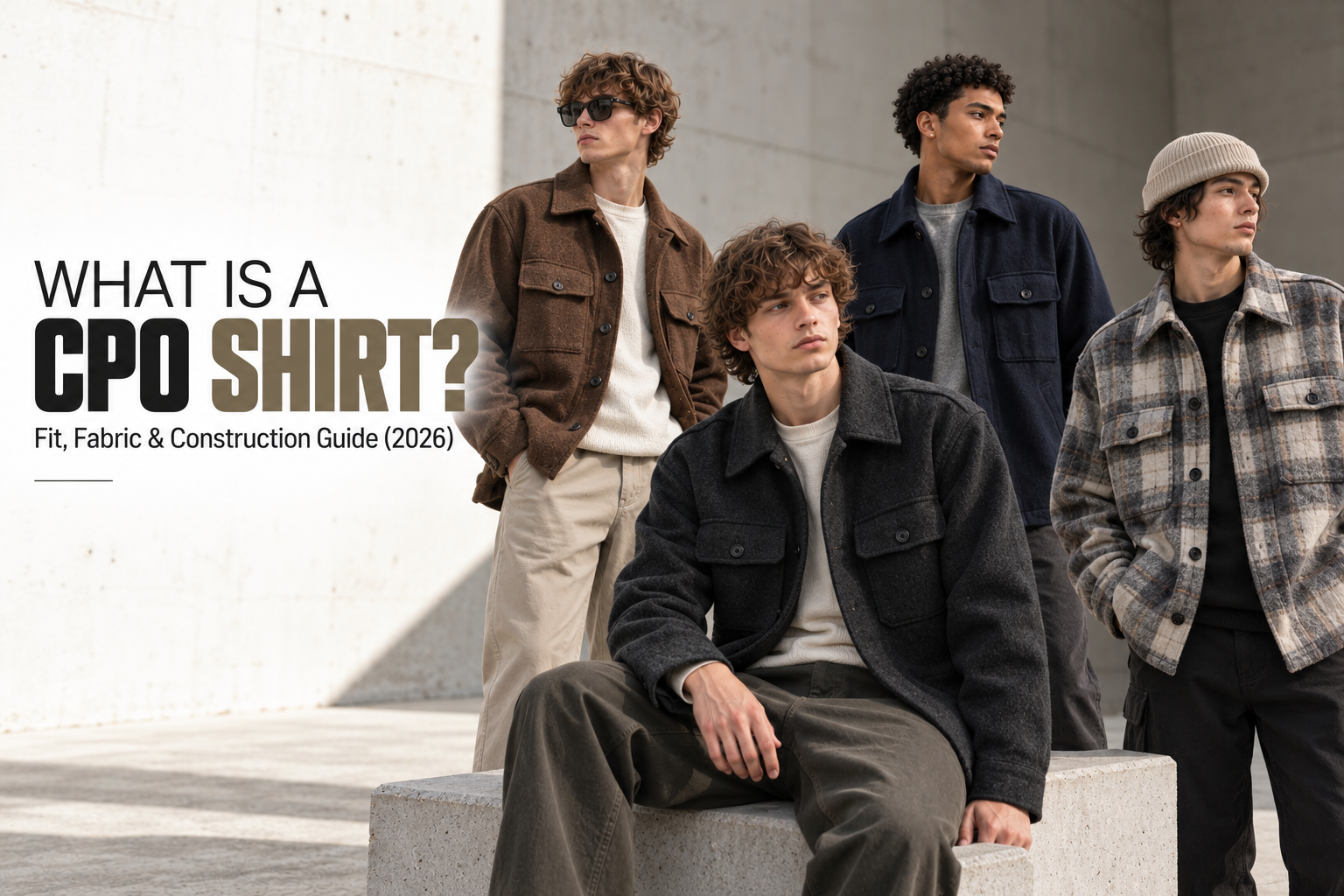
A CPO shirt is a heavyweight overshirt originally influenced by naval workwear and designed to provide more warmth and structure than a conventional shirt.
The name CPO comes from Chief Petty Officer.
Traditional versions are closely associated with:
- Navy-colored wool
- Heavy shirt construction
- Large chest pockets
- Flap closures
- Substantial buttons
- Relaxed layering room
- Straight or slightly boxy proportions
Modern CPO shirts have moved far beyond military reproduction.
Today they appear across:
- Heritage menswear
- Workwear
- Contemporary casualwear
- Streetwear
- Americana
- Outdoor-inspired clothing
- Premium layering collections
A modern CPO shirt can be made from:
- Wool
- Wool blends
- Heavy flannel
- Cotton twill
- Brushed cotton
- Corduroy
- Denim
- Melton-style fabrics
That versatility makes the category useful for clothing brands.
But it also creates confusion.
Some garments sold as CPO shirts are essentially heavyweight flannel shirts.
Others are closer to jackets.
For production, the key is not the product name alone.
A successful CPO shirt depends on the relationship between:
fabric + layering ease + collar + chest pockets + front closure + cuffs + hem + reinforcement
This guide explains what defines a CPO shirt, how it differs from related shirt-jacket categories and what brands should specify before developing one for production.
What Is a CPO Shirt?
A CPO shirt is generally a heavyweight woven shirt or shirt jacket designed for layering.
Its traditional construction is much more substantial than a standard button-up shirt.
Common features include:
- Shirt-style collar
- Button front
- One or two chest patch pockets
- Pocket flaps
- Long sleeves
- Button cuffs
- Heavy woven fabric
- Relaxed fit
- Straight or gently curved hem
Some heritage versions use:
- Anchor-style buttons
- Navy wool fabric
- Large flap pockets
Modern fashion versions may simplify or reinterpret these details.
For example:
heavy brushed cotton + two chest pockets + relaxed body
can still create a recognizable CPO direction without reproducing a historical naval garment exactly.
Why Are CPO Shirts Relevant in Men's Fashion in 2026?
The CPO shirt fits several current menswear directions at the same time.
These include:
- Layering
- Shirt jackets
- Workwear
- Heritage clothing
- Relaxed proportions
- Textured fabrics
- Minimal outerwear
- Transitional-season dressing
It offers something between a shirt and jacket.
That makes it useful during weather where a:
- T-shirt is too light
- Heavy jacket is too warm
A CPO shirt can be worn:
- Over a T-shirt
- Over a long-sleeve tee
- Over knitwear
- Under a coat
- As lightweight outerwear
This flexibility is one of the category's biggest strengths.
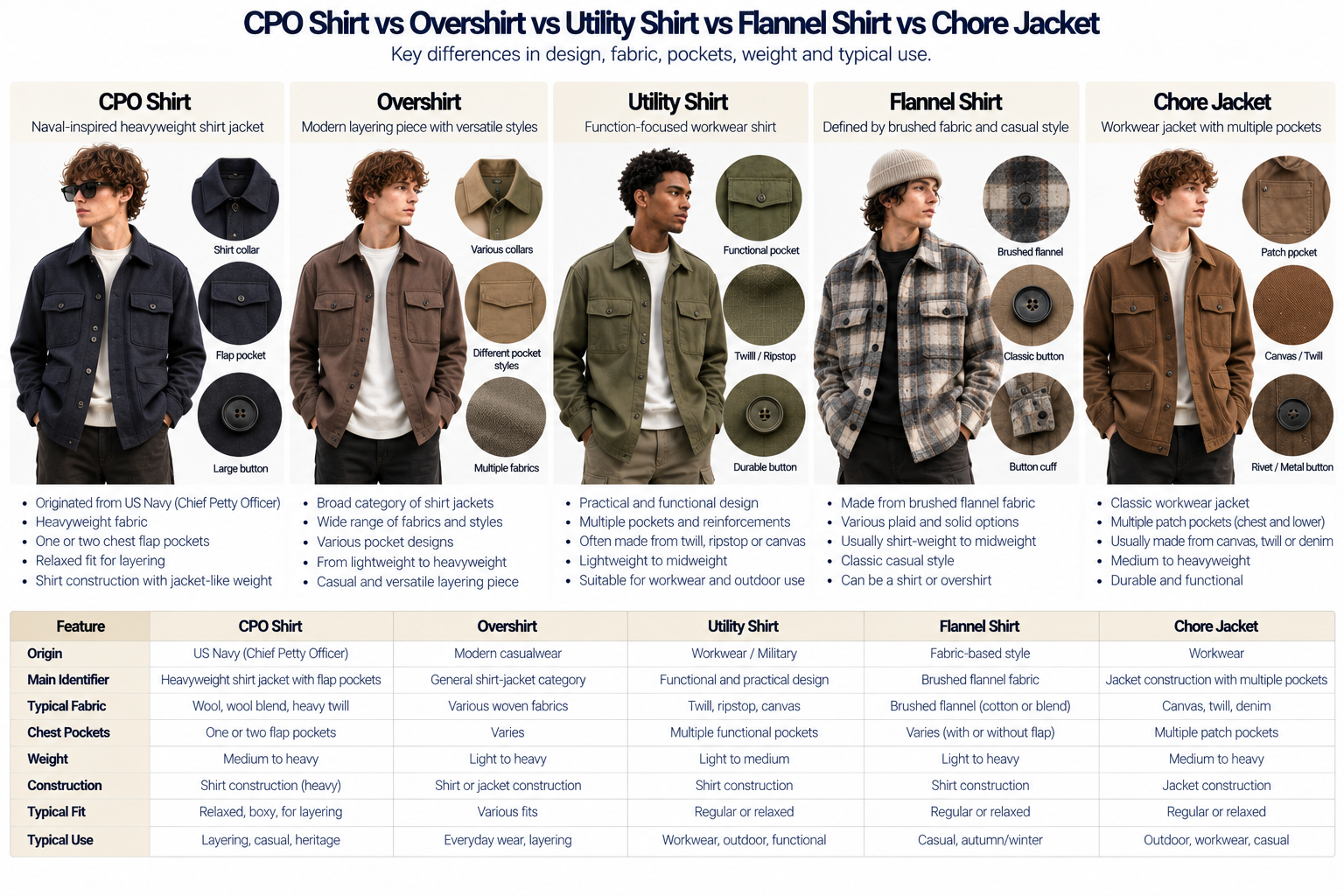
CPO Shirt vs Other Men's Overshirts
A CPO shirt belongs to the broader shirt-jacket and overshirt family.
But not every overshirt is a CPO shirt.
| Style | Main Identifier | Typical Fabric | Chest Pockets | Weight |
|---|---|---|---|---|
| CPO Shirt | Naval-inspired heavyweight shirt jacket | Wool, flannel, twill | One or two flap pockets | Medium to heavy |
| Overshirt | Broad layering-shirt category | Many woven fabrics | Varies | Light to heavy |
| Utility Shirt | Function-focused workwear shirt | Twill, ripstop, canvas | Functional pockets | Light to medium |
| Flannel Shirt | Defined mainly by fabric | Brushed woven fabric | Varies | Light to heavy |
| Chore Jacket | Work jacket construction | Canvas, twill, denim | Multiple patch pockets | Medium to heavy |
The categories can overlap.
For example:
A heavy brushed flannel CPO shirt is also technically a flannel overshirt.
But the CPO identity comes primarily from its:
- Shirt-jacket proportion
- Chest-pocket construction
- Heavy layering fabric
- Naval / heritage design language
CPO Shirt vs Overshirt
"Overshirt" is a broad category.
It describes a shirt designed to be worn over another layer.
An overshirt can use:
- Denim
- Twill
- Flannel
- Nylon
- Corduroy
- Wool
and may have almost any pocket configuration.
A CPO shirt is more specific.
Traditional CPO influence usually appears through:
- Substantial fabric
- Shirt collar
- Front buttons
- Chest patch pockets
- Pocket flaps
- Relaxed layering fit
Therefore:
all CPO shirts can function as overshirts
but:
not every overshirt is a CPO shirt
CPO Shirt vs Utility Shirt
Utility shirts focus more strongly on practical function.
Typical utility-shirt details may include:
- Multiple pockets
- Reinforcement
- Snap closures
- Sleeve tabs
- Technical fabrics
- Travel-oriented details
A CPO shirt normally has a simpler exterior.
The strongest visual elements are often:
- One or two large chest pockets
- Heavy fabric
- Substantial buttons
- Straightforward shirt construction
For broader utility-shirt construction, see Brad Apparel's Utility Shirt Guide.
CPO Shirt vs Flannel Shirt
This distinction is important.
CPO describes a garment style.
Flannel primarily describes a fabric.
A CPO shirt can be made from flannel.
But a flannel shirt can use:
- Standard shirt fit
- Smaller buttons
- No flap pockets
- Lightweight construction
and have almost no CPO influence.
For detailed information about brushing, plaid matching and flannel weight, see Brad Apparel's Flannel Shirt Guide.
CPO Shirt vs Chore Jacket
A chore jacket normally uses stronger jacket construction.
Common features include:
- Large lower patch pockets
- Chest pocket
- Jacket-style body
- Heavier shell
- More outerwear-like construction
A CPO shirt usually stays closer to shirt construction.
It generally emphasizes:
- Chest pockets
- Shirt collar
- Shirt cuffs
- Button placket
rather than multiple large lower-body pockets.
CPO Shirt vs Shirt Jacket
"Shirt jacket" is another broad category.
A CPO shirt can be considered a particular type of shirt jacket.
But modern shirt jackets can also include:
- Padded designs
- Quilted designs
- Technical overshirts
- Minimal wool jackets
- Hooded overshirts
The CPO design language remains more specifically connected to:
naval heritage + chest pockets + substantial woven fabric
Traditional CPO Shirt Details
A heritage-inspired CPO shirt may include:
- Dark navy color
- Wool or wool-flannel fabric
- Large collar
- One or two chest pockets
- Flap pocket closure
- Large tonal buttons
- Anchor-style button details
- Roomy body
- Long sleeves
- Button cuffs
Modern production does not need to reproduce every detail.
The important step is deciding how strongly the brand wants to reference the original workwear character.
One-Pocket vs Two-Pocket CPO Shirts
Both arrangements can be found in CPO-inspired clothing.
One Chest Pocket
Creates:
- Cleaner appearance
- Stronger vintage reference
- Less visual symmetry
It works particularly well for:
- Heritage reproductions
- Minimal CPO shirts
Two Chest Pockets
Creates:
- Stronger visual balance
- More storage
- More familiar modern workwear appearance
This version works especially well for contemporary overshirts.
Chest Pocket Size
CPO pockets are often larger than those on a standard dress shirt.
This is because the overall garment is also larger and heavier.
Pocket size should be developed around:
- Chest width
- Body length
- Collar scale
- Button size
A pocket copied from a standard shirt may look too small on a heavyweight CPO.
Chest Pocket Position
Important measurements include:
- Distance from shoulder
- Distance from center front
- Pocket top position
- Pocket-to-pocket spacing
The pocket should remain visually connected to the chest.
If it sits too low:
the garment may look unbalanced.
If too high:
it can crowd the collar and upper chest.
Pocket Flap Construction
Pocket flaps can use:
- Straight edge
- Pointed edge
- Rounded corners
- Scalloped shape
A simple square or slightly shaped flap is common.
The flap should extend enough to cover the opening without becoming oversized.
Pocket Flap Interfacing
Heavy fabric may already provide enough structure.
Lighter fabric may require:
- Light interfacing
- Additional fabric layer
Too much interfacing can make the pocket flap unnaturally stiff.
The correct amount depends on:
- Fabric density
- Thickness
- Desired appearance
Pocket Button Position
The button should remain visually centered relative to:
- Flap
- Buttonhole
Small positioning errors become obvious because the pocket is a major design feature.
Pocket Reinforcement
Pocket corners may experience stress during use.
Possible reinforcement includes:
- Bartacks
- Dense lockstitch
- Internal reinforcement
The method should match the design.
A clean premium CPO may use tonal reinforcement.
A workwear version can use visible contrast bartacks.
The CPO Shirt Collar
A CPO collar is generally more substantial than a lightweight dress-shirt collar.
Possible directions include:
- Standard point collar
- Wide point collar
- Rounded workwear collar
- Slightly elongated collar
The collar should match the heavier body.
A tiny dress-shirt collar can look visually weak against thick fabric and large chest pockets.
Collar Size
Important collar measurements include:
- Collar point length
- Collar spread
- Collar stand height
- Neck circumference
Larger collars can create:
- Stronger heritage character
- More visible layering
Smaller collars create:
- Cleaner
- More contemporary
styling.
Collar Stand
Many CPO shirts use a conventional:
- Collar
- Collar stand
construction.
The collar stand affects:
- Neck comfort
- Collar position
- Button placement
- How the shirt looks open
Because the garment is commonly worn unbuttoned, the collar should also look clean when open.
Collar Interfacing
The amount of structure should follow the fabric.
For heavy wool:
a large amount of fusible may not be necessary.
For softer cotton:
light interfacing may improve stability.
Avoid using formal-shirt collar stiffness automatically.
A CPO collar should generally retain some casual character.
Front Placket Construction
Common options include:
- Folded front
- Applied placket
- Clean front
The correct approach depends on:
- Fabric thickness
- Button size
- Desired appearance
A very heavy fabric may become bulky if too many layers accumulate through the center front.
Applied Placket
An applied placket creates:
- Visible structure
- Stronger front edge
- Defined button line
It can work well for workwear-style CPO shirts.
Clean Front
A cleaner folded construction can create:
- Minimal appearance
- Less visual bulk
This works well for modern wool or premium overshirts.
Buttons
Buttons are important because CPO shirts usually use larger, more visible hardware than a standard shirt.
Possible materials include:
- Plastic
- Resin
- Horn-look
- Corozo
- Metal
- Custom branded buttons
Heritage versions may use nautical or anchor-inspired button designs.
Button Size
Button scale should match:
- Fabric weight
- Placket
- Pocket flap
- Collar
Small shirt buttons may feel under-scaled on very heavy wool.
Very large buttons may dominate a lighter cotton overshirt.
Button Attachment
Heavy fabric creates additional resistance during opening and closing.
Button attachment should therefore be secure.
Depending on construction, use:
- Strong thread
- Shank allowance
- Reinforcement
The button should have enough thread shank for the fabric thickness.
Custom CPO Buttons
Brands can develop:
- Engraved buttons
- Embossed buttons
- Anchor-inspired buttons
- Logo buttons
- Custom metal finishes
For custom buttons and branded hardware, see Brad Apparel's Trims & Branding.
CPO Shirt Cuffs
Traditional CPO shirts generally use button cuffs.
Possible designs include:
- Standard shirt cuff
- Wider workwear cuff
- Adjustable two-button cuff
The cuff should be substantial enough to balance the garment.
Cuff Size
A heavyweight sleeve may require a slightly larger cuff.
If the cuff is too narrow:
- Sleeve gathers become excessive
- Wrist can feel restricted
If too wide:
- Cuff may collapse
- Sleeve appears oversized unintentionally
Sleeve Placket
A conventional sleeve placket provides:
- Wrist opening
- Easier dressing
- Clean cuff attachment
Heavy wool can make narrow plackets difficult to turn cleanly.
The dimensions should be developed for the actual fabric.
Sleeve Fit
CPO shirts are layering garments.
The sleeve generally needs more room than a conventional shirt.
Important measurements include:
- Bicep
- Elbow
- Sleeve opening
- Armhole
A body with generous layering ease but very slim sleeves will feel inconsistent.
Shoulder Fit
Common directions include:
- Standard shoulder
- Slightly extended shoulder
- Drop shoulder
Traditional versions generally remain relatively straightforward.
Modern versions may use a wider, more relaxed shoulder.
Standard Shoulder
Creates:
- Heritage shirt proportion
- Cleaner fit
- Easier layering under coats
Extended Shoulder
Adds:
- Relaxed appearance
- More contemporary proportion
- Additional upper-body volume
The sleeve length should be adjusted accordingly.
Drop Shoulder
Creates stronger:
- Streetwear
- Oversized
- Casual
character.
But excessive drop can move the garment away from traditional CPO styling and closer to a generic fashion overshirt.
CPO Shirt Fit
The CPO was designed as a layering garment.
Modern fits include:
- Regular
- Relaxed
- Boxy
- Oversized
The pattern should reflect what the wearer is expected to layer underneath.
Regular CPO Fit
A regular fit may allow space for:
- T-shirt
- Thin knit
without creating excessive volume.
This works well for:
- Heritage styling
- Premium basics
Relaxed CPO Fit
A relaxed fit adds room through:
- Chest
- Shoulder
- Sleeve
- Hem
It is one of the most versatile modern options.
Boxy CPO Fit
A boxy design generally uses:
- Wider chest
- Straighter side seam
- Controlled body length
- Wider sleeve
This works particularly well with:
- Heavy flannel
- Wool
- Dense cotton twill
Oversized CPO Shirt
An oversized CPO should not simply be produced by using a larger normal size.
That can create:
- Excessive length
- Collar too large
- Pockets too low
- Sleeves too long
Instead, width and length should be controlled independently.
Layering Ease
Before sampling, define the intended base layer.
For example:
CPO Over a T-Shirt
Requires moderate ease.
CPO Over a Hoodie
Requires significantly more:
- Chest room
- Armhole depth
- Bicep width
- shoulder ease
The intended layering system affects the entire pattern.
CPO Shirt Length
A traditional CPO usually provides enough length to cover the waistband comfortably.
Modern designs may use:
- Regular shirt length
- Short boxy length
- Longer overshirt length
Length should be developed together with:
- Pocket position
- Hem shape
- Fit
Hem Options
Possible hem constructions include:
- Straight hem
- Curved shirt-tail hem
- Slightly dropped back hem
- Side-slit hem
Modern shirt jackets often use a straighter hem than lightweight shirts.
Straight Hem
Creates:
- Jacket-like appearance
- Boxier silhouette
- Clean layering
It works particularly well for heavy fabrics.
Curved Hem
Creates:
- More shirt-like appearance
- Softer shape
This direction may be more suitable for lighter flannel or cotton versions.
Side Slits
Small side slits can improve:
- Movement
- layering
- hem shape
They may be reinforced with:
- Bartack
- triangular gusset
- binding
depending on design.
Best Fabrics for CPO Shirts
Fabric determines whether a CPO feels like:
- Shirt
- Overshirt
- Jacket
Common options include:
- Wool
- Wool blend
- Melton-style wool
- Heavy flannel
- Cotton twill
- Brushed cotton
- Corduroy
- Denim
For custom sourcing by composition, structure, weight and finish, see Brad Apparel's Fabric Sourcing & Development.
Wool CPO Shirt
Wool is closely associated with heritage CPO construction.
It offers:
- Warmth
- Structure
- natural insulation
- traditional appearance
Possible wool constructions include:
- Wool flannel
- Melton-style fabric
- Wool blend woven
The exact hand feel can vary dramatically.
Wool Flannel
Wool flannel can provide:
- Soft surface
- Warmth
- controlled drape
- refined heritage appearance
The fabric may require careful:
- pressing
- shrinkage testing
- cleaning instructions
Melton-Style Wool
Dense melton-type fabric creates:
- Strong structure
- warmth
- smooth compact surface
But heavier fabric can increase:
- Seam bulk
- cuff thickness
- collar thickness
- total garment weight
The pattern and seam allowances should be developed around the fabric.
Wool Blends
Possible blends include:
- Wool / polyester
- Wool / nylon
- Wool / viscose blends
depending on the desired product.
Blends can change:
- Durability
- cost
- weight
- hand feel
- stability
The exact composition should be evaluated physically.
Cotton Flannel CPO Shirt
Cotton flannel creates a softer and often easier-care alternative.
It can provide:
- Brushed hand feel
- warmth
- plaid options
- casual appearance
Heavy cotton flannel can work particularly well for modern CPO overshirts.
Brushed Cotton
A brushed woven cotton can create a CPO look without using classic fuzzy flannel.
Possible advantages include:
- Softer hand feel
- cleaner pattern definition
- broad color options
Cotton Twill
Twill can create a more structured workwear direction.
It works well for:
- Solid colors
- garment washing
- minimal CPO shirts
Common visual directions include:
- Navy
- Olive
- Brown
- Black
- Khaki
Corduroy
Corduroy CPO shirts can create:
- Strong texture
- vintage character
- autumn/winter styling
But nap direction must remain consistent during cutting.
Pattern pieces should normally follow the approved directional layout.
Denim CPO Shirt
Denim creates a stronger workwear appearance.
Possible options include:
- Raw denim
- Rinse wash
- Medium wash
- Black denim
- Ecru denim
Denim can also support:
- Contrast topstitching
- metal buttons
- garment washing
Fabric Weight
There is no universal correct GSM for a CPO shirt.
The weight should match the intended use.
A useful development direction might be:
| Product Direction | Example Weight |
|---|---|
| Lightweight Overshirt | 220–280 GSM |
| Midweight CPO | 280–350 GSM |
| Heavyweight CPO | 350–450+ GSM |
These are reference ranges only.
Fabric:
- density
- fiber
- weave
- brushing
- finishing
can make two materials of the same GSM behave very differently.
Heavyweight Does Not Automatically Mean Better
A heavier fabric may create:
- stronger structure
- more warmth
- premium hand feel
but can also create:
- bulky seams
- heavy cuffs
- thick pocket flaps
- stiff collar
- excessive garment weight
The complete sample should be evaluated rather than judging quality from GSM alone.
Plaid CPO Shirts
Plaid works naturally with heavy overshirts.
But pattern matching becomes important.
Key areas include:
- Center front
- Chest pockets
- Pocket flaps
- Side seams
- Back yoke
- Sleeve
- Cuffs
Center-Front Plaid Matching
When buttoned, horizontal plaid lines should normally appear controlled across the front.
A major mismatch can make the shirt look lower quality.
Pocket Matching
Possible approaches include:
Matched Pocket
The plaid continues through the pocket.
Creates:
- Cleaner
- more refined
appearance.
Bias Pocket
Pocket is rotated diagonally.
Creates:
- more visible workwear character
- deliberate contrast
Neither method is inherently better.
The tech pack should specify the intended direction.
Pocket Flap Matching
The pocket flap can:
- Match body direction
- Match pocket direction
- Use bias direction
The choice should be intentional.
Fabric Consumption
Pattern matching can increase fabric usage.
Large plaid repeats require additional marker control.
Therefore, costing should consider:
- Repeat size
- Matching standard
- Garment size range
not just average garment length.
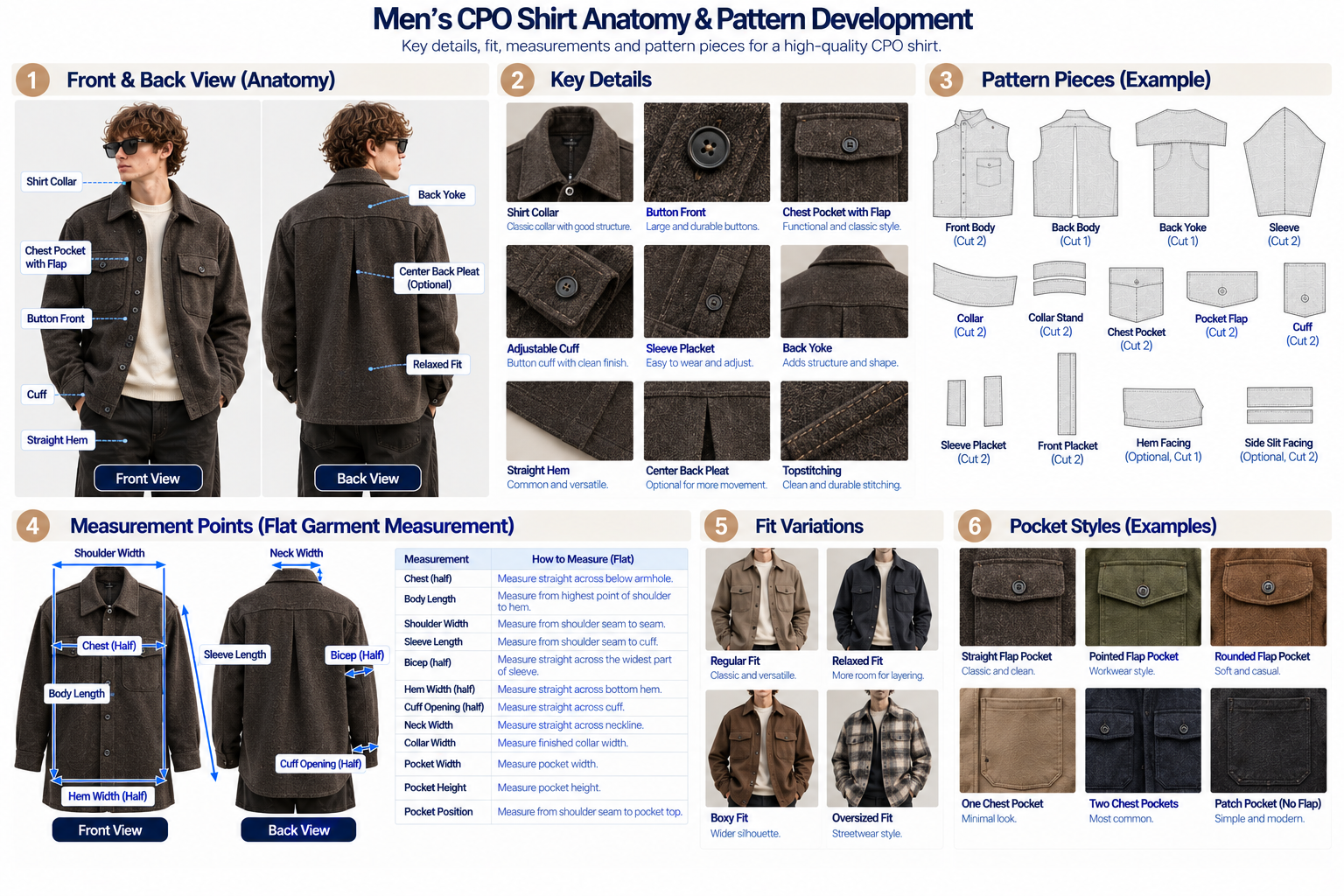
CPO Shirt Pattern Development
A typical pattern may include:
- Front body
- Back body
- Back yoke
- Sleeve
- Collar
- Collar stand
- Chest pocket
- Pocket flap
- Cuff
- Sleeve placket
- Front placket depending on construction
Exact quantities vary by design.
Front Body Pattern
The front body controls:
- Chest width
- Front closure
- Pocket position
- Hem
- shoulder balance
The body should provide enough room for the intended base layer.
Back Body
The back needs enough width for:
- Arm movement
- layering
- shoulder comfort
Possible designs include:
- Plain back
- Back yoke
- Center-back pleat
Back Yoke
A back yoke can add:
- structure
- classic shirt construction
- design detail
The yoke depth should remain proportional to the heavier garment.
Back Pleat
Possible options include:
- Center box pleat
- Side pleats
- No pleat
Pleats can increase movement.
But overly deep pleats may add unwanted volume to already relaxed CPO shirts.
Armhole
A CPO armhole generally needs more layering room than a dress shirt.
But extremely deep armholes can reduce mobility.
The pattern should balance:
- Depth
- Sleeve cap
- Bicep
- shoulder
Chest Width
Chest width is one of the most important measurements.
Too narrow:
- prevents layering
- pulls across pockets
Too wide:
- can make the garment look shapeless
Fit should be tested over the intended clothing.
Shoulder Width
Shoulder width changes the overall silhouette.
It should be developed with:
- chest
- sleeve length
- armhole
- collar
rather than adjusted independently.
Sleeve Length
CPO sleeves should usually finish around the wrist when the cuff is closed.
For oversized styles, extra shoulder width means actual sleeve pattern length may need to be reduced.
Bicep Width
A heavy overshirt often needs more bicep ease than a standard shirt.
This becomes especially important when worn over:
- long-sleeve tops
- knitwear
Hem Width
Hem width determines whether the body is:
- straight
- tapered
- slightly A-line
Traditional CPO shirts often remain relatively straight.
Key CPO Shirt Measurements
| Measurement | Why It Matters |
|---|---|
| Chest Width | Controls layering room |
| Body Length | Controls shirt vs jacket proportion |
| Shoulder Width | Defines silhouette |
| Sleeve Length | Controls cuff position |
| Bicep Width | Allows layering |
| Hem Width | Controls body shape |
| Neck Opening | Controls collar fit |
| Collar Point | Controls collar scale |
| Pocket Width | Controls visual proportion |
| Pocket Height | Controls storage and scale |
| Pocket Position | Controls chest balance |
| Pocket Flap Height | Controls pocket appearance |
| Cuff Opening | Controls wrist fit |
Pattern Grading
CPO grading should preserve the relationship between:
- Body
- Collar
- Pockets
- Buttons
Do not mechanically scale every detail.
Pocket Grading
Pocket dimensions may change only slightly between sizes.
A fixed pocket can look too small on larger sizes.
A fully proportional pocket can become excessively large.
Controlled grading is usually more appropriate.
Pocket Position Grading
Pocket location should move as:
- Body size
- shoulder
- chest
change.
This keeps the pocket visually connected to the chest.
Collar Grading
Collar circumference needs to accommodate size.
But:
- Collar point
- Collar height
may remain much more stable.
Button Spacing
The number of buttons often remains constant across sizes.
Spacing may adjust slightly according to:
- Body length
- placket length
The visual rhythm should remain consistent.
Sampling a CPO Shirt
A sample should be evaluated both:
- As a shirt
- As an outer layer
Try it over the intended base garment.
Front View
Check:
- Collar
- Pocket position
- Button alignment
- Body width
- Hem
Both chest pockets should normally sit level unless asymmetry is intentional.
Side View
Check:
- Body volume
- Sleeve shape
- Hem position
- pocket bulk
The garment should not flare unintentionally.
Back View
Check:
- Shoulder
- Back width
- Yoke
- Hem
- Sleeve symmetry
Collar Check
Review the collar:
- Buttoned
- Unbuttoned
Check:
- Point symmetry
- Neck comfort
- Collar roll
Because the CPO is frequently worn open, both states matter.
Pocket Function Test
Open and close:
- Pocket flaps
- Buttons
Check whether the pocket is actually usable.
The flap should not restrict access unnecessarily.
Layering Test
Try the garment over:
- T-shirt
- Shirt
- Lightweight knit
depending on intended styling.
Check:
- Shoulder movement
- Bicep
- chest
- button tension
Movement Test
Ask the wearer to:
- Reach forward
- Cross arms
- Raise arms
- Sit
The garment should move without severe pulling.
Shrinkage Testing
Natural-fiber woven fabrics can change after finishing.
Test:
- Length
- Width
- Sleeve
- Pocket position
after the intended care process.
Wool Shrinkage
Wool can react strongly to:
- Heat
- moisture
- agitation
Care instructions and finishing should be developed around the actual fabric.
Do not use a cotton washing process automatically on wool CPO garments.
Cotton Shrinkage
Cotton flannel and twill can also shrink.
Pre-production testing should establish:
- Warp shrinkage
- Weft shrinkage
- Final hand feel
Garment Washing
Cotton CPO shirts may use washing for:
- softer hand feel
- vintage color
- worn-in appearance
Possible processes depend on fabric and dye.
Wool garments may require a different finishing route.
Brushing and Surface Direction
Brushed and napped fabrics need additional attention.
Check:
- Nap direction
- Cutting orientation
- Shade appearance
A reversed panel can appear darker or lighter even when cut from the same fabric.
CPO Shirt Topstitching
Visible stitching may appear around:
- Collar
- Pockets
- Flaps
- Placket
- Cuffs
Possible styles include:
- Tonal single needle
- Tonal double needle
- Contrast workwear stitching
Tonal Stitching
Creates:
- Clean appearance
- Premium minimal styling
This works particularly well for:
- Navy wool
- Black twill
- Modern CPO shirts
Contrast Stitching
Creates:
- Stronger workwear look
- More visible construction
It works especially well on:
- Denim
- Brown twill
- heavy cotton
But inconsistencies become more obvious.
Seam Construction
Possible seams include:
- Plain seam with overlock
- Safety stitch
- Flat-felled seam in selected areas
- Clean-bound seam for unlined premium styles
The correct choice depends on:
- Fabric
- weight
- price
- desired interior appearance
Heavy Fabric Seam Bulk
Several layers may meet at:
- Collar
- cuff
- pocket flap
- shoulder
The sewing plan should reduce unnecessary bulk.
Possible solutions include:
- Trimming seam allowances
- Grading seams
- Reducing interfacing
- Adjusting construction
Lined vs Unlined CPO Shirts
Most shirt-like CPO garments can remain unlined.
But jacket-oriented versions may use lining.
Unlined CPO
Advantages include:
- Lighter weight
- More shirt-like feel
- Simpler layering
- Lower bulk
Interior seams need clean finishing.
Lined CPO Jacket
Lining can create:
- More jacket-like feel
- easier layering
- extra warmth
But it also changes:
- Pattern ease
- manufacturing cost
- garment classification
At that point, the garment may function more like a CPO jacket than a shirt.
Quilted CPO Shirt Jacket
Some modern CPO-style jackets include:
- Quilted lining
- Light padding
This creates a winterized shirt jacket.
Additional development is required around:
- Armhole
- Sleeve width
- seam bulk
- hem
- pocket construction
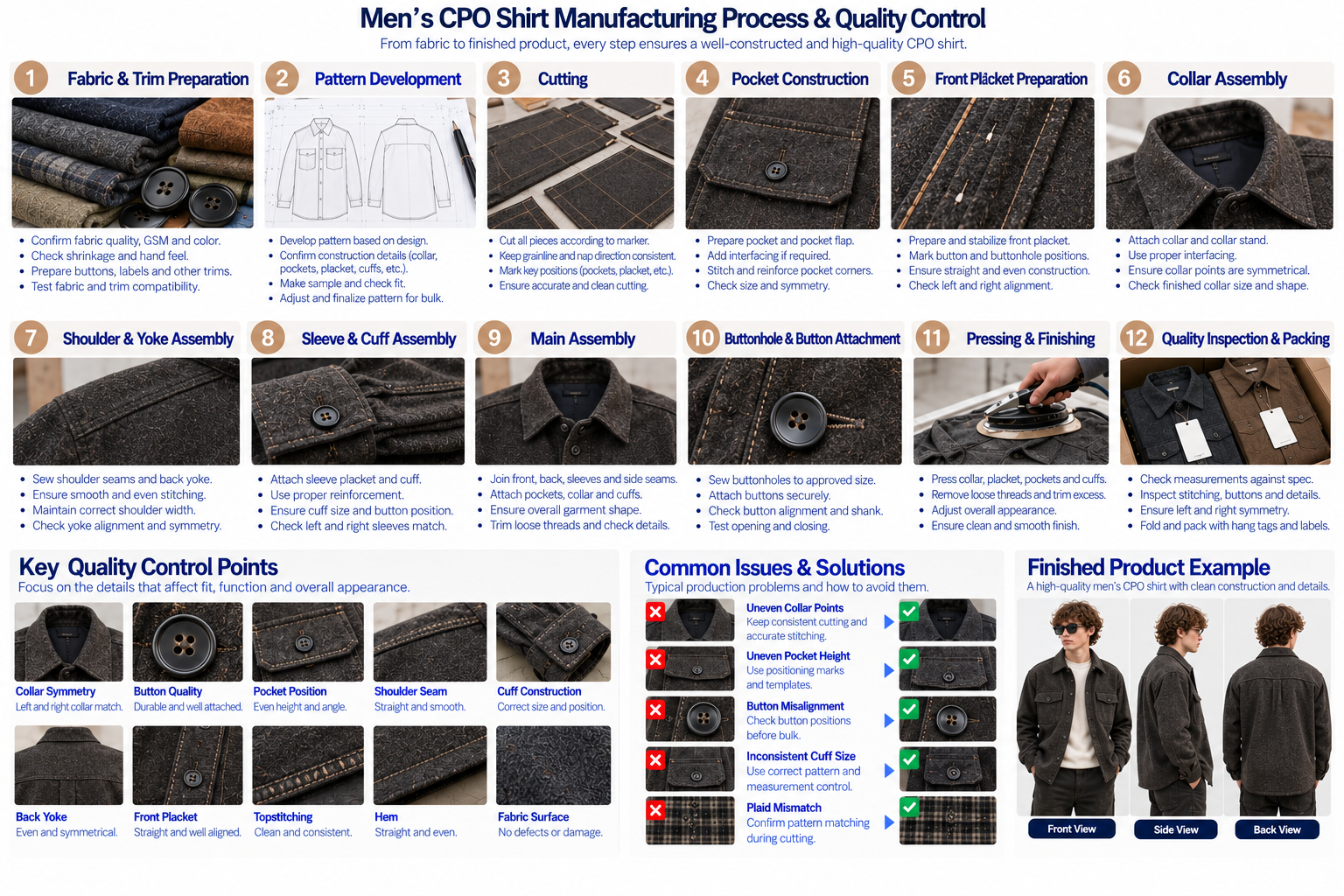
Manufacturing Process
A practical CPO production sequence may include:
- Fabric inspection
- Shrinkage / finishing test
- Pattern development
- Grading
- Cutting
- Pocket preparation
- Pocket-flap preparation
- Back-yoke preparation
- Front-body preparation
- Shoulder assembly
- Sleeve preparation
- Collar assembly
- Cuff and placket preparation
- Main garment assembly
- Buttonholes
- Button attachment
- Washing / finishing where required
- Pressing
- Measurement inspection
- Final QC
- Packing
Exact sequencing varies by construction.
Fabric Inspection
Before cutting, check:
- Composition
- Weight
- Width
- Color
- Surface
- Defects
- Nap
- Plaid repeat where applicable
For wool and brushed fabrics, confirm directional requirements.
Cutting
Maintain:
- Grainline
- Nap direction
- Plaid direction
- Size identification
Pair:
- Pocket flaps
- Cuffs
- sleeves
correctly.
Pocket Preparation
Use templates where appropriate.
Check:
- Width
- Height
- Corner shape
- Flap size
- Buttonhole position
before attaching pockets to the body.
Plaid Pocket Preparation
If matching is required, confirm pocket placement against:
- Main body plaid
- Approved sample
before sewing.
Once attached incorrectly, correction can leave visible needle marks.
Collar Preparation
Check:
- Left/right collar points
- Interfacing
- Edge stitching
- finished dimensions
The collar should remain symmetrical.
Sleeve Placket Preparation
Heavy fabric requires accurate folding.
Check:
- Placket width
- opening length
- button position
Cuff Preparation
Pair left and right cuffs.
Check:
- Finished size
- Buttonhole
- Button position
- Topstitching
Main Assembly
Assemble:
- Front
- Back
- Sleeves
- side seams
while maintaining consistent seam allowance.
Check garment balance before finishing.
Buttonholes
Buttonholes should be appropriate for:
- Button diameter
- Fabric thickness
Heavy wool or flannel may require machine-setting adjustments.
Test before bulk production.
Button Attachment
Check:
- Thread strength
- Shank
- Alignment
- Pocket-button position
Substantial buttons should remain secure without pulling the fabric.
Final Pressing
Pressing should improve:
- Collar
- Pockets
- Placket
- Cuffs
- Hem
without damaging the fabric surface.
Pressing Wool and Napped Fabrics
Excess heat or pressure can create:
- Shine
- Flattened nap
- permanent marks
Use a pressing method suited to the actual material.
Measurement Inspection
Check:
- Chest
- Body length
- Shoulder
- Sleeve
- Bicep
- Hem
- Pocket position
- Cuff
against the approved specification.
Key Quality Control Points
Collar Symmetry
Both collar points should:
- Match
- Sit evenly
Pocket Height
Left and right pockets should remain level.
Pocket Flaps
Check:
- Width
- Shape
- Alignment
- Buttonhole
Button Alignment
The front button line should remain straight.
Plaid Matching
When specified, check:
- Center front
- Flap
- Side seam
against the approved standard.
Shoulder Balance
Left and right shoulders should sit evenly.
Sleeve Length
Both sleeves should match within agreed tolerance.
Cuff Construction
Check:
- Size
- Button position
- Placket
- symmetry
Hem
Check:
- Level
- Stitching
- side slits
Fabric Surface
Check for:
- Nap damage
- shine
- stains
- shade differences
Common CPO Shirt Quality Problems
Uneven Chest Pockets
One pocket sits higher than the other.
Control
Use:
- Position marks
- templates
- inline measurement checks
Pocket Flap Misalignment
A flap that does not align with the pocket body looks immediately incorrect.
Check flap placement before final stitching.
Plaid Mismatch
Common problem areas include:
- Front opening
- pockets
- pocket flaps
Define the acceptable matching standard before cutting.
Collar Points Not Matching
Possible causes include:
- Cutting
- turning
- seam allowance
- pressing
Templates can improve consistency.
Collar Too Small
A lightweight-shirt collar transferred onto a heavy CPO pattern may appear under-scaled.
Evaluate collar size on the actual garment.
Sleeve Too Narrow
This often happens when a standard shirt sleeve is reused for an overshirt body.
The CPO sleeve should support the intended layering.
Excessive Armhole Depth
Making an armhole extremely deep does not automatically improve comfort.
It can actually reduce arm mobility.
Fit should be tested physically.
Button Pulling
Heavy fabric combined with insufficient button shank can cause:
- puckering
- difficult closure
Use attachment suitable for the fabric thickness.
Thick Cuff Corners
Heavy materials can create bulky cuff intersections.
Control:
- Seam allowance
- interfacing
- turning
Nap Direction Mismatch
One panel may look darker because it was cut in the opposite direction.
Directional fabrics should be controlled during marker making and cutting.
Press Shine
Excessive heat or pressure can create glossy marks on dark wool.
Pressing standards should be approved before bulk production.
Uneven Shrinkage
A garment may become:
- shorter
- narrower
- twisted
after finishing.
Shrinkage should be tested before final pattern approval.
CPO Shirt Tech Pack Example
| Area | Example Specification |
|---|---|
| Product | Men's CPO Shirt Jacket |
| Fit | Relaxed |
| Fabric | Heavy Cotton Flannel |
| Weight | 340 GSM |
| Color | Dark Navy |
| Collar | Medium Point Collar |
| Front Closure | Button Front |
| Chest Pocket | Two Patch Pockets |
| Pocket Flap | Straight Flap |
| Pocket Closure | Button |
| Shoulder | Slightly Extended |
| Sleeve | Long Sleeve |
| Cuff | Adjustable Button Cuff |
| Hem | Straight Hem |
| Stitching | Tonal |
| Button | Large Horn-Look Button |
| Finish | Light Garment Wash |
| Branding | Woven Main + Care Label |
These specifications are examples only.
Example Heritage Wool CPO Shirt
A heritage direction might use:
- Relaxed fit
- Dark navy wool flannel
- One or two chest flap pockets
- Large anchor-inspired buttons
- Standard shoulder
- Button cuffs
- Straight hem
- Tonal stitching
The product should feel substantial without becoming excessively stiff.
Example Modern Boxy CPO Shirt
A contemporary version might use:
- Boxy fit
- Slight drop shoulder
- Heavy brushed cotton
- Two large chest pockets
- Minimal tonal buttons
- Straight hem
- Side slits
- No visible branding
This creates a cleaner streetwear direction.
Example Plaid CPO Overshirt
Possible specification:
- Relaxed fit
- Heavy cotton flannel
- Large plaid
- Two chest flap pockets
- Matched or bias pockets
- Large buttons
- Curved or straight hem
Plaid placement should be confirmed during sampling.
Example Corduroy CPO Shirt
Possible specification:
- Relaxed fit
- Midweight corduroy
- Solid brown
- Two chest flap pockets
- Tonal buttons
- Straight hem
- Soft wash
All directional pattern pieces should follow the approved nap direction.
Example Denim CPO Shirt Jacket
Possible specification:
- Relaxed straight fit
- Midweight denim
- Rinse or vintage wash
- Two chest pockets
- Metal buttons
- Contrast stitching
- Straight hem
Wash testing should confirm:
- Shrinkage
- button finish
- seam appearance
How to Describe a CPO Shirt to a Manufacturer
Avoid writing only:
I want a heavy oversized CPO shirt.
A stronger brief would be:
Men's relaxed CPO shirt jacket in 340 GSM navy brushed cotton flannel with a slightly extended shoulder, two large chest patch pockets with buttoned flaps, medium point collar, large matte horn-look buttons, adjustable button cuffs, straight hem and tonal double-needle topstitching.
Then provide:
- Chest
- Shoulder
- Body length
- Sleeve
- Bicep
- Hem
- Collar dimensions
- Pocket dimensions
- Pocket position
- Pocket-flap dimensions
- Button size
- Fabric
- Color
- Finish
- Branding
This gives the pattern and sampling teams a much clearer target.
Common CPO Shirt Development Mistakes
1. Treating a CPO Shirt Like a Standard Button-Up
The garment needs more:
- structure
- pocket scale
- layering ease
than a conventional shirt.
2. Simply Making a Shirt One Size Larger
A true overshirt pattern should control:
- Shoulder
- Chest
- Armhole
- Sleeve
- Length
independently.
3. Choosing Fabric That Is Too Light
Very light fabric can make large CPO pockets and buttons feel visually disproportionate.
4. Choosing Fabric That Is Too Heavy
Excess weight can create:
- bulky collar
- stiff cuffs
- heavy pockets
5. Using Small Dress-Shirt Buttons
Button size should match the heavier garment.
6. Making the Chest Pockets Too Small
CPO pockets normally need enough visual scale for the garment.
7. Positioning Pockets Too Low
This can make the entire body appear longer and unbalanced.
8. Ignoring Layering During Fit Development
The intended base layer should be known before finalizing the pattern.
9. Ignoring Nap Direction
Brushed wool, flannel and corduroy can show visible shade differences when cut in opposite directions.
10. Requiring Plaid Matching Without Costing It
Large-repeat matching can increase fabric consumption.
11. Using Too Much Collar Interfacing
The collar can become too formal and stiff.
12. Approving the Garment Before Finishing Tests
Fabric may change in:
- dimensions
- softness
- surface
- color
after finishing.
CPO Shirt Development Checklist
Before sampling, confirm:
- Product direction
- Intended layering
- Fit
- Shoulder
- Fabric
- Composition
- Weight
- Color
- Nap direction
- Collar
- Front closure
- Button size
- Chest-pocket count
- Pocket dimensions
- Pocket flaps
- Cuffs
- Hem
- Stitching
- Wash / finish
- Branding
Before bulk production, confirm:
- Approved fabric
- Shrinkage
- Final pattern
- Fit sample
- Pocket templates
- Pocket placement
- Collar measurements
- Button specification
- Buttonhole size
- Plaid matching standard where required
- Nap direction
- Pressing standard
- Measurement tolerance
- QC standard
FAQ
What Does CPO Shirt Mean?
CPO stands for Chief Petty Officer.
The garment name comes from its naval workwear heritage.
Modern CPO shirts are generally heavyweight overshirts or shirt jackets inspired by that original style.
Is a CPO Shirt a Shirt or Jacket?
It sits between the two categories.
A CPO shirt normally uses shirt details such as:
- Collar
- Button front
- Cuffs
but uses:
- Heavier fabric
- More layering ease
- Larger pockets
than a conventional shirt.
Is a CPO Shirt the Same as an Overshirt?
A CPO shirt is a type of overshirt.
But overshirt is a much broader category.
Not every overshirt uses CPO-style chest pockets, heavy fabric or naval-inspired design.
Is a CPO Shirt the Same as a Flannel Shirt?
No.
Flannel primarily describes the fabric.
CPO describes the garment style.
A CPO shirt can be made from flannel.
What Fabric Is Best for a CPO Shirt?
Common options include:
- Wool
- Wool blends
- Heavy flannel
- Brushed cotton
- Cotton twill
- Corduroy
- Denim
The best fabric depends on:
- Season
- desired warmth
- silhouette
- cost
- intended layering
Are CPO Shirts Usually Wool?
Traditional versions are strongly associated with wool.
Modern fashion versions frequently use:
- Cotton
- Flannel
- Twill
- Corduroy
- Denim
as well.
What GSM Should a CPO Shirt Use?
There is no universal GSM.
A lightweight overshirt may be around 220–280 GSM.
A more substantial version may use approximately 280–350 GSM.
Heavy CPO shirts may reach 350–450+ GSM depending on fabric construction.
These are development references rather than fixed standards.
Why Do CPO Shirts Have Large Chest Pockets?
Large flap pockets are part of the garment's utilitarian and naval-inspired design language.
Modern versions may use:
- One pocket
- Two pockets
depending on the intended look.
Do CPO Shirts Need Anchor Buttons?
No.
Anchor-style buttons reinforce naval heritage but are not required.
Modern versions can use:
- Horn-look buttons
- Resin buttons
- Metal buttons
- Custom branded buttons
Can a CPO Shirt Be Oversized?
Yes.
But it should be patterned intentionally.
Do not simply increase the garment one or two sizes.
Control:
- Chest
- shoulder
- sleeve
- armhole
- length
separately.
Can CPO Shirts Be Lined?
Yes.
But lining moves the garment closer toward a true shirt jacket.
Many classic shirt-style CPOs remain unlined.
Can a CPO Shirt Be Made From Denim?
Yes.
Denim can create a strong workwear interpretation.
Wash, hardware and contrast stitching should be developed together.
Can CPO Shirts Be Garment Washed?
Cotton, denim and some other woven versions can be garment washed.
Wool garments require more careful finishing and care.
Always test the exact fabric first.
What Should Be Checked During CPO Shirt QC?
Important inspection points include:
- Collar symmetry
- Pocket height
- Pocket-flap alignment
- Button alignment
- Shoulder balance
- Sleeve length
- Cuff construction
- Plaid matching where required
- Nap direction
- Measurements
- Pressing
- Final appearance
Final Thoughts
The CPO shirt is a useful example of a garment that sits between traditional shirting and outerwear.
Its identity does not come from one single feature.
It comes from the relationship between:
heavy fabric + layering fit + collar + chest pockets + buttons + cuffs + construction
A navy wool version can feel strongly heritage-driven.
A brushed plaid CPO can become a casual fall overshirt.
A boxy black twill version can fit easily into contemporary streetwear.
And a denim version can move toward rugged workwear.
For clothing brands, the most important development decision is therefore not simply whether to call the product a:
"CPO shirt"
or:
"shirt jacket."
The fabric weight, intended layering, pocket scale, collar, buttons and pattern proportions should be developed together from the beginning.
When those details are balanced as one system, the CPO shirt becomes much easier to reproduce consistently from the first sample through bulk production.
Keep Reading