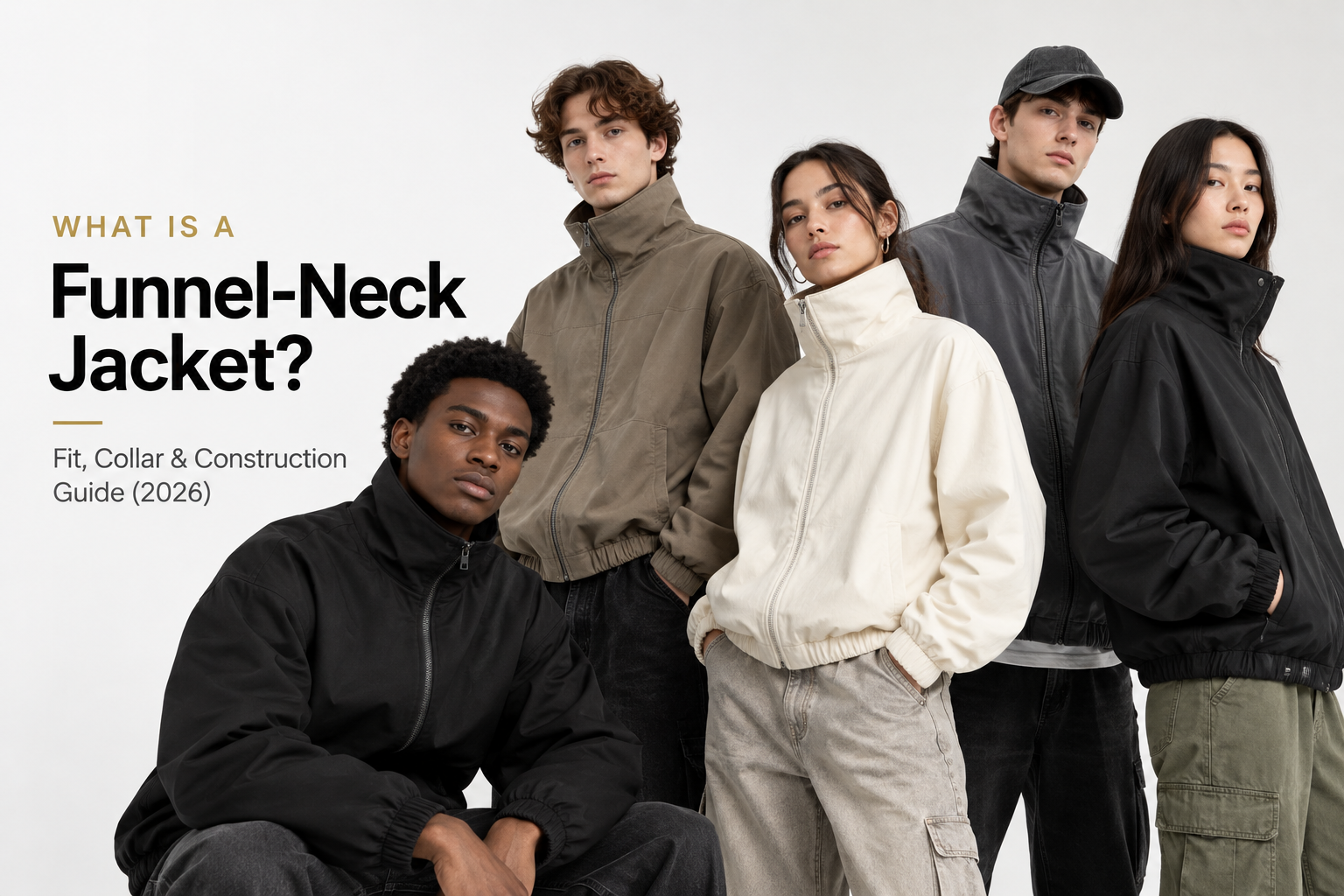
A funnel-neck jacket is defined by a high collar that rises around the neck and creates a clean, sculptural neckline. Unlike a conventional shirt collar, the funnel collar is designed to stand, curve or slightly flare rather than lie flat.
For clothing brands, that apparently simple collar changes much more than the neckline.
It affects:
- Collar height
- Neck opening
- Zipper length
- Front balance
- Shoulder proportion
- Fabric choice
- Interlining
- Lining
- Fit
- How the jacket looks when open and closed
A successful funnel-neck jacket therefore needs to be developed as a complete silhouette rather than by simply adding a taller collar to an existing jacket.
This guide explains what a funnel-neck jacket is, how it differs from other high-collar styles, and what brands should specify before developing one for production.
What Is a Funnel-Neck Jacket?
A funnel-neck jacket is an outerwear garment with a collar that extends upward around the neck.
The collar normally creates a more enclosed shape than a traditional point collar.
Depending on the design, it may:
- Stand vertically
- Curve slightly outward
- Fold softly
- Close completely around the neck
- Open into a wider lapel-like shape
- Incorporate a zipper, snaps or buttons
The term "funnel neck" describes the overall neckline silhouette rather than one exact construction.
This means two funnel-neck jackets can look very different.
One may be:
a lightweight technical jacket with a tall zip collar
while another may be:
a structured wool jacket with a wide sculptural neckline.
The defining characteristic is the raised neckline surrounding the neck.
Why Are Funnel-Neck Jackets Popular in 2026?
The current funnel-neck revival fits several broader fashion directions:
- Cleaner outerwear
- Sculptural silhouettes
- Minimal styling
- High collars
- Boxy jackets
- Cropped proportions
- Technical fabrics
- Transitional layering
The neckline itself creates visual impact without requiring excessive decoration.
That makes it useful for brands that want a jacket to feel distinctive while keeping the garment relatively minimal.
A funnel neck can work across:
- Streetwear
- Premium casualwear
- Technical outerwear
- Womenswear
- Menswear
- Unisex collections
- Minimal fashion
- Performance-inspired products
The same basic neckline can therefore be interpreted in many different ways.
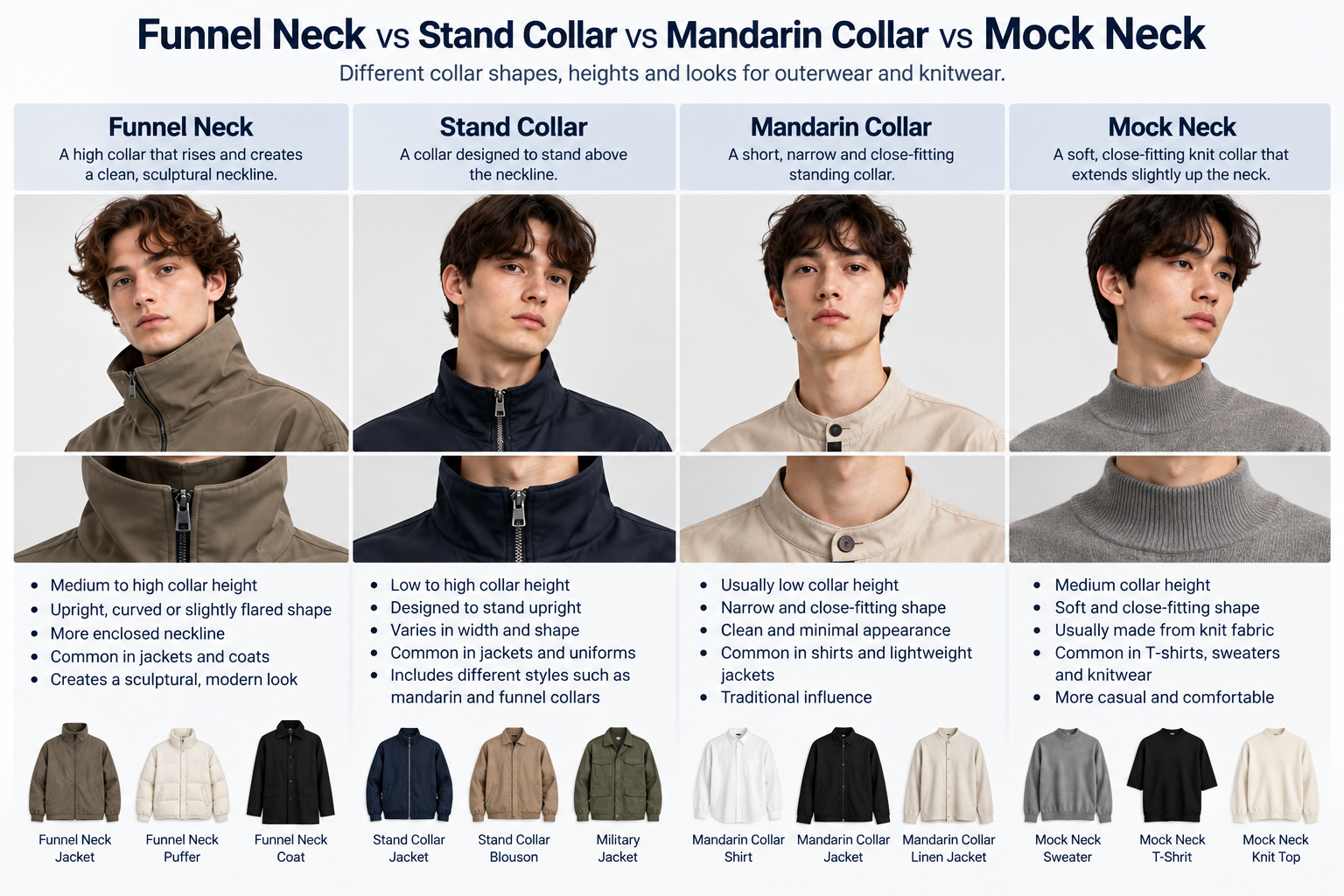
Funnel Neck vs Stand Collar vs Mandarin Collar vs Mock Neck
These terms are often confused.
They are related, but they are not identical.
| Collar Type | Typical Height | Shape | Common Use |
|---|---|---|---|
| Funnel Neck | Medium to high | Upright, curved or flared | Jackets, coats, knitwear |
| Stand Collar | Low to high | Designed to stand upright | Jackets, uniforms, outerwear |
| Mandarin Collar | Usually low | Close-fitting band | Shirts, jackets, traditional garments |
| Mock Neck | Medium | Soft close-fitting knit neck | T-shirts, sweaters, knitwear |
| High Neck | General term | Varies | Multiple garment categories |
A funnel neck is therefore usually a type of standing collar.
But not every stand collar creates the characteristic funnel-shaped silhouette.
Funnel Neck vs Stand Collar
A stand collar is a broad construction category.
Its main characteristic is that the collar stands above the neckline rather than folding flat.
Examples include:
- Mandarin collars
- Military collars
- Short zip collars
- Funnel collars
A funnel collar normally feels more architectural.
It may:
- Be taller
- Have a wider opening
- Flare slightly
- Curve around the face
- Create more visible volume
For manufacturing, the important point is that "stand collar" and "funnel neck" should not replace actual measurements.
Funnel Neck vs Mandarin Collar
A mandarin collar is usually:
- Shorter
- Narrower
- Closer to the neck
- More uniform in height
A funnel collar can be significantly taller and may have a larger circumference at the upper edge.
That difference affects how the collar stands.
If the upper opening becomes wider than the base, the collar can create a subtle outward flare.
If both measurements remain similar, the collar will appear straighter.
Funnel Neck vs Mock Neck
Mock necks are commonly used in:
- T-shirts
- Sweaters
- Knit tops
They generally rely on stretch fabric or rib knit to fit relatively close to the neck.
A jacket funnel neck usually needs more structural engineering because woven outerwear fabric does not stretch in the same way.
The pattern must create enough space for:
- Comfort
- Head movement
- Zipper operation
- Layering
while still maintaining the intended collar shape.
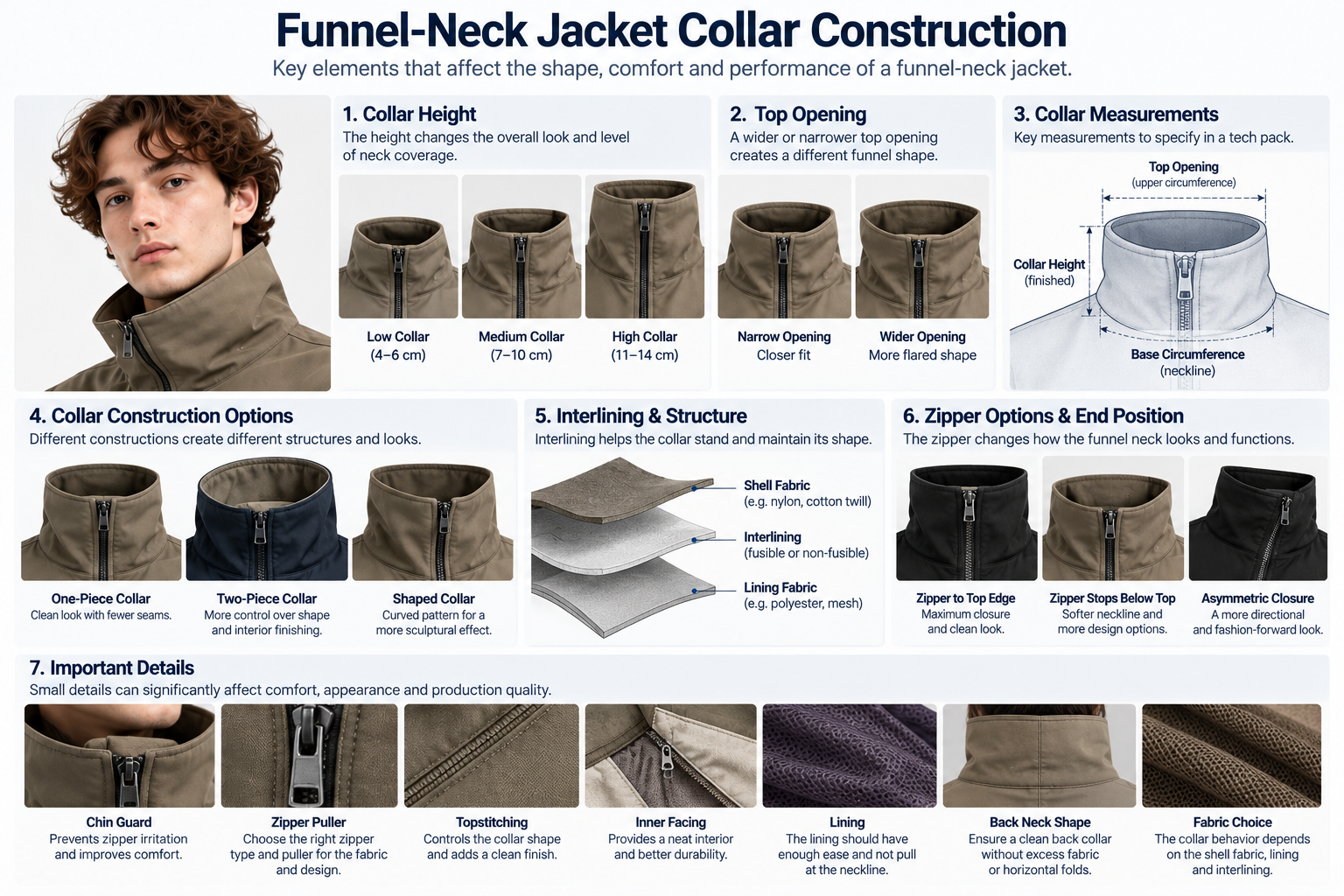
Collar Height Is the First Major Decision
One of the most important funnel-neck measurements is collar height.
Do not specify only:
High collar
Instead, provide an actual finished measurement.
For example:
Finished collar height: 8 cm
or:
Finished collar height: 12 cm
The difference can dramatically change the jacket.
Lower Funnel Neck
Creates:
- Cleaner everyday styling
- Less facial coverage
- Easier movement
- More subtle silhouette
Medium Funnel Neck
Creates:
- Clear funnel shape
- Stronger neckline
- Good balance for many jackets
Extra-Tall Funnel Neck
Creates:
- More dramatic fashion appearance
- Greater face framing
- Strong visual identity
But taller is not automatically better.
An excessively tall collar may:
- Touch the jaw
- Rub against the face
- Fold unexpectedly
- Feel restrictive
- Collapse when unzipped
The height should therefore be tested on the wearer.
The Top Opening Matters Just as Much as Collar Height
Imagine two collars that are both 10 cm tall.
Collar A
Has a narrow upper opening.
It will sit closer to the neck.
Collar B
Has a wider upper opening.
It may flare outward and create a stronger funnel shape.
So the final silhouette depends on:
collar height + collar base + top opening
not collar height alone.
This relationship should be controlled through pattern measurements.
A Funnel Collar Is Not Just a Rectangle
A common mistake is treating the collar as a simple rectangular strip of fabric.
That may work for some basic stand collars.
But sculptural funnel collars often need shaped pattern pieces.
The collar pattern may include:
- Curved upper edge
- Different top and bottom circumference
- Shaped center front
- Curved center back
- Multiple panels
- Darts or seams
- Internal support
These details control how the collar wraps around the neck.
One-Piece vs Two-Piece Funnel Collars
There are several possible constructions.
One-Piece Collar
A single main collar piece is shaped and attached to the neckline.
Advantages:
- Cleaner appearance
- Fewer seams
- Minimal design
However, highly sculptural shapes may be more difficult to achieve.
Two-Piece Collar
The collar may use:
- Outer collar
- Inner collar
or separate shaped panels.
This provides more control over:
- Structure
- Seam position
- Interior finishing
- Material combinations
It is particularly useful when the outer and inner collar use different fabrics.
Self-Fabric Funnel Collar
A self-fabric collar uses the same material as the jacket body.
This creates strong visual continuity.
It works well for:
- Minimal jackets
- Nylon outerwear
- Cotton twill
- Wool blends
- Technical woven fabrics
But body fabric alone may not provide enough structure.
Depending on the intended silhouette, the collar may still require:
- Interlining
- Fusible support
- Additional layer
- Internal facing
Double-Layer Funnel Collar
Using two fabric layers can create more stability.
A double-layer collar may:
- Stand more cleanly
- Hide seam allowances
- Improve interior appearance
- Support zipper installation
However, fabric thickness must be considered.
Two layers of heavy fabric plus interlining can make the neckline excessively bulky.
This is particularly important around:
- Center-front zipper
- Collar seam
- Shoulder / neckline intersection
Interlining Can Completely Change the Collar
Interlining is often invisible from the outside, but it can determine whether the funnel collar stands correctly.
Possible options include:
- Lightweight fusible
- Medium fusible
- Non-fusible support
- Foam or structured reinforcement
- No interlining
The correct choice depends on the shell fabric.
For example:
Lightweight Nylon
May need light stabilization around the zipper while still remaining flexible.
Cotton Twill
May require moderate support depending on collar height.
Heavy Wool
May already have enough body and require only selective reinforcement.
Soft Fleece
May need additional support if the collar is expected to stand rather than collapse.
This is why the collar should be tested using the actual bulk fabric whenever possible.
The Zipper Changes the Funnel-Neck Shape
Many funnel-neck jackets use a center-front zipper.
The zipper does more than close the jacket.
It also controls how the collar behaves.
When fully zipped, it helps hold:
- Left collar
- Right collar
- Center-front line
in position.
When opened, the same collar may:
- Fall outward
- Fold backward
- Create a V-shaped opening
- Form a wider sculptural neckline
The jacket should therefore be evaluated both:
zipped
and
unzipped
before the sample is approved.
Where Should the Zipper End?
There are several possible constructions.
Zipper to the Top Edge
The zipper continues through the full collar height.
This creates:
- Maximum closure
- Clean vertical line
- Strong technical appearance
Zipper Stops Below the Collar Top
The upper collar extends beyond the zipper.
This can create:
- Softer neckline
- More decorative collar shape
- Different folding behavior
Offset or Asymmetric Closure
Some fashion versions move the closure away from center front.
This creates a more directional design but requires careful pattern development.
For most brands, the actual zipper endpoint should be clearly shown in the tech pack.
Brad Apparel's Custom Zippers & Sliders page covers coil, reverse-coil, molded, metal and custom puller options for outerwear.
Zipper Size Should Match the Collar and Shell
A small zipper may suit:
- Lightweight nylon
- Minimal jackets
- Refined fashion outerwear
A larger zipper may suit:
- Heavy canvas
- Thick wool
- Streetwear jackets
- Technical outerwear
But zipper size should not be selected only for appearance.
The factory should also consider:
- Fabric weight
- Collar thickness
- Number of layers
- Zipper tape width
- Slider weight
- Sewing allowance
An unnecessarily heavy zipper can distort lightweight fabric.
Chin Protection Matters on Tall Collars
If the zipper reaches close to the face, consider a chin guard.
A chin guard can help prevent:
- Slider contact
- Cold metal touching the skin
- Zipper irritation
- Pinching
This becomes more important as collar height increases.
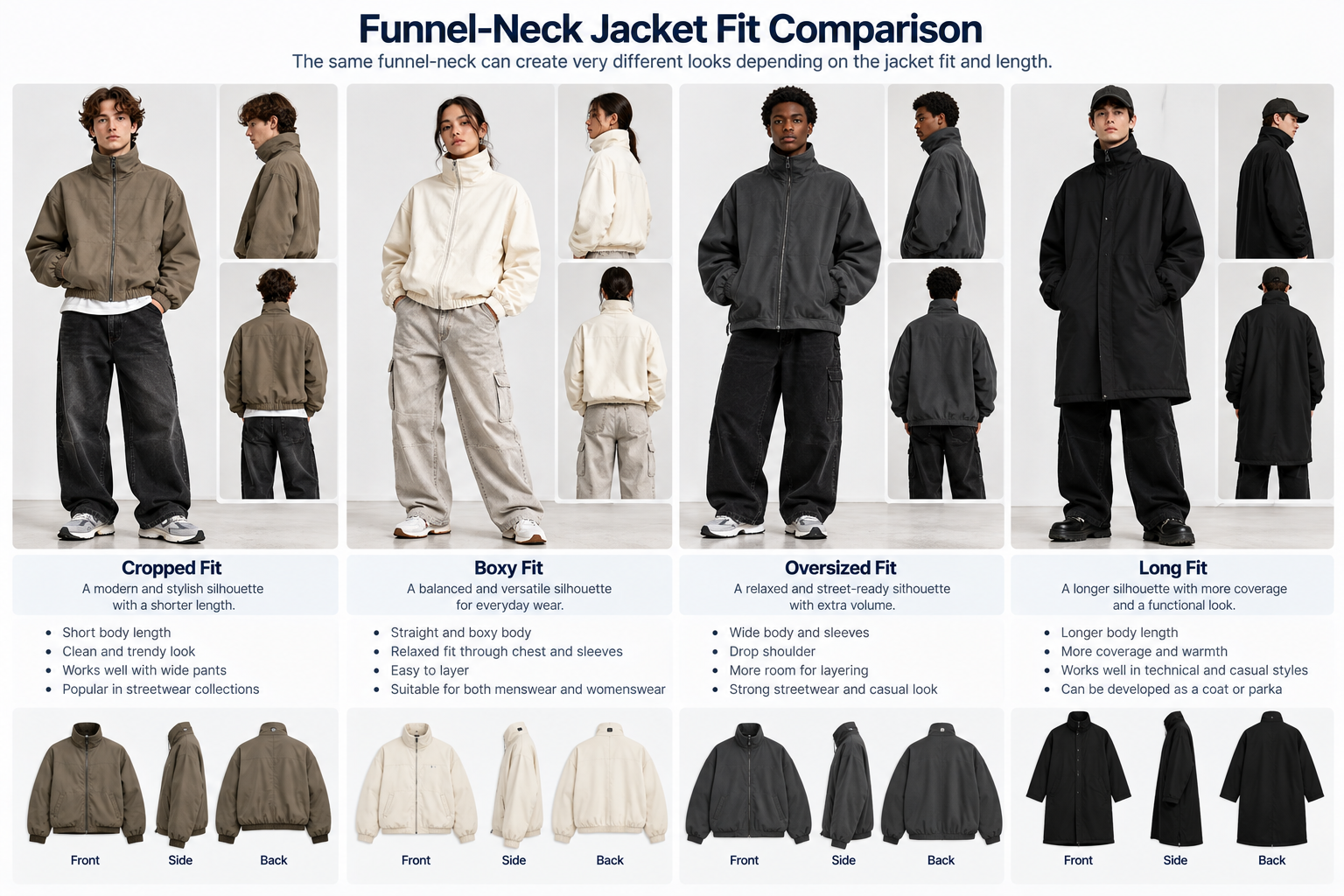
Funnel-Neck Jacket Fit Options
The neckline can be combined with several different body silhouettes.
Cropped Funnel-Neck Jacket
Typical characteristics:
- Short body
- Wider chest
- Strong neckline
- Defined waist area
This creates a fashion-forward silhouette.
Boxy Funnel-Neck Jacket
Typical characteristics:
- Wide chest
- Straight body
- Controlled length
- Structured appearance
The strong horizontal body proportion balances a tall collar well.
Oversized Funnel-Neck Jacket
Typical characteristics:
- Wide body
- Drop shoulder
- Larger sleeves
- More layering space
The collar needs enough visual scale to avoid looking too small relative to the body.
Long Funnel-Neck Jacket
Moves the silhouette toward:
- Coat
- Parka
- Long technical jacket
The longer body creates a completely different proportion even if the collar remains similar.
Collar Scale Should Match Body Volume
This is an important design principle.
Imagine an extremely oversized jacket with:
- Very wide chest
- Large sleeves
- Strong shoulder drop
paired with a tiny narrow collar.
The collar may look visually weak.
The opposite problem can also happen.
A very large sculptural collar on a narrow fitted jacket may dominate the entire garment.
The scale of the collar should therefore be developed together with:
- Shoulder width
- Chest width
- Sleeve volume
- Body length
rather than independently.
Sleeve Volume Affects the Overall Silhouette
Funnel-neck jackets frequently use:
- Full sleeves
- Curved sleeves
- Raglan sleeves
- Drop shoulders
- Elasticated cuffs
because volume in the sleeve can balance the strong neckline.
But this is not a requirement.
A cleaner jacket may use:
- Regular shoulder
- Straight sleeve
- Minimal cuff
The right sleeve depends on the intended design language.
What Fabrics Work for Funnel-Neck Jackets?
A funnel-neck jacket can be made from many materials.
The key question is not simply:
Is this fabric suitable for a jacket?
It is:
How will this fabric behave in the collar?
Technical Nylon
Useful for:
- Lightweight jackets
- Wind-resistant outerwear
- Sport-inspired designs
Characteristics:
- Lightweight
- Smooth
- Often needs collar stabilization
Polyester Woven
Can provide:
- Easy-care performance
- Different coatings
- Technical appearance
Cotton Twill
Creates:
- More natural hand feel
- Cleaner casual styling
- Moderate structure
Canvas
Creates:
- Stronger workwear appearance
- More structure
- Heavier collar
Wool and Wool Blends
Can create:
- Premium appearance
- Soft structured volume
- More tailored funnel shapes
Fleece
Useful for:
- Casual jackets
- Outdoor-inspired garments
- Softer collars
However, fleece may collapse more easily than structured woven fabrics.
For custom material development, see Brad Apparel's Fabric Sourcing & Development page.
Soft Funnel Neck vs Structured Funnel Neck
The same pattern can look very different depending on material.
Soft Funnel Neck
May:
- Fold naturally
- Collapse slightly
- Create relaxed volume
- Feel comfortable around the neck
Structured Funnel Neck
May:
- Stand upright
- Hold a defined shape
- Frame the face
- Create stronger visual impact
Neither is automatically better.
The right direction depends on the design.
Funnel Neck vs Windbreaker Collar
A windbreaker can have a high collar, but that does not automatically make it a funnel-neck jacket.
Many standard windbreaker collars are:
- Relatively narrow
- Functional
- Straight
- Close to the neck
A funnel-neck design usually makes the collar a stronger part of the garment silhouette.
For lightweight technical jacket construction, see our Windbreaker Jacket Guide.
Funnel Neck vs Harrington Collar
A traditional Harrington jacket usually uses a shorter stand collar.
The neckline is recognizable but relatively compact.
A funnel neck is generally:
- Taller
- More enclosing
- More sculptural
If your goal is a shorter heritage-inspired zip jacket rather than a high sculptural neckline, our Harrington Jacket Guide explains that construction in more detail.
Important Funnel-Neck Jacket Measurements
A tech pack should define both normal jacket measurements and collar-specific measurements.
| Measurement | Why It Matters |
|---|---|
| Chest Width | Controls body volume |
| Body Length | Defines jacket proportion |
| Shoulder Width | Affects upper-body silhouette |
| Sleeve Length | Balances jacket volume |
| Sleeve Opening | Controls cuff area |
| Neckline Circumference | Controls collar attachment |
| Collar Height | Defines funnel-neck impact |
| Collar Base Circumference | Controls fit at neckline |
| Collar Top Opening | Controls flare and neck room |
| Zipper Length | Determines closure height |
| Front Neck Drop | Affects front collar balance |
| Back Neck Height | Affects rear collar position |
For asymmetric or shaped collars, additional measurements may be needed.
Example Funnel-Neck Jacket Development Brief
Instead of writing:
I want a high-collar jacket.
a more useful development brief might be:
Boxy lightweight funnel-neck jacket with a 10 cm structured collar, slightly wider top opening, full center-front reverse-coil zipper, dropped shoulder and elasticated hem.
Then provide:
- Reference images
- Shell fabric
- Lining
- Collar height
- Top opening
- Body measurements
- Zipper type
- Zipper length
- Cuff construction
- Hem construction
- Pocket design
- Color
- Branding
This gives the pattern maker a much clearer starting point.
How to Evaluate the First Funnel-Neck Sample
A funnel-neck sample should be reviewed in several different positions.
Fully Zipped
Check:
- Collar height
- Neck comfort
- Collar symmetry
- Zipper alignment
- Chin clearance
- Top opening
The wearer should be able to turn their head comfortably.
Half Open
Check:
- Collar fold
- Left and right balance
- Zipper tape visibility
- Front neckline shape
The collar should not suddenly collapse in an uncontrolled way.
Fully Open
Check:
- Collar fall
- Interior finishing
- Facing
- Lining
- Zipper guard
- Shape around the chest
The jacket should still look intentional when worn open.
Check the Collar From the Side
The front view does not reveal everything.
From the side, check whether the collar:
- Tilts forward
- Tilts backward
- Touches the chin
- Collapses at center back
- Creates unwanted folds
The side profile is especially important for extra-tall funnel collars.
Check the Back Neck
A collar may look perfect from the front while creating problems at the back.
Possible issues include:
- Excess fabric
- Horizontal folds
- Collar pulling away from the neck
- Back neckline tension
- Uneven collar height
The back neckline should therefore be included in fit review photographs.
Movement Testing Matters
Ask the wearer to:
- Turn their head left and right
- Look downward
- Raise their arms
- Sit
- Zip and unzip the jacket
- Wear a layer underneath
The collar must maintain its intended appearance without restricting movement.
Lining Can Affect Collar Construction
If the jacket is lined, the lining should not pull against the shell around the neckline.
Possible problems include:
- Collar twisting
- Front edge pulling
- Lining showing above the collar
- Uneven zipper area
The lining pattern needs enough movement allowance while remaining controlled.
Common Funnel-Neck Jacket Development Mistakes
1. Simply Making a Standard Collar Taller
Increasing height alone does not create a balanced funnel shape.
The top opening and collar shaping also matter.
2. Making the Top Opening Too Narrow
The collar may feel restrictive or press against the neck.
3. Making the Top Opening Too Wide
The collar may collapse outward instead of standing.
4. Ignoring the Unzipped Appearance
A funnel-neck jacket needs to look intentional both open and closed.
5. Using the Wrong Interlining
Too much support can make the collar rigid and uncomfortable.
Too little support can make it collapse.
6. Choosing the Zipper Too Late
The zipper affects collar thickness, seam allowance and front balance.
7. Collar Scale Does Not Match the Jacket
An oversized body needs a collar proportion that supports the silhouette.
8. Approving Only the Front View
Side and back views are essential for tall collar development.
9. Ignoring Layering
A jacket worn over a sweatshirt needs more neckline and body ease than a jacket designed over a T-shirt.
10. Using Only the Term "Funnel Neck"
The manufacturer still needs actual collar measurements.
Funnel-Neck Jacket Tech Pack Example
| Area | Example Specification |
|---|---|
| Product | Funnel-Neck Jacket |
| Fit | Boxy / Relaxed |
| Shell | Lightweight Technical Nylon |
| Lining | Lightweight Polyester |
| Collar | Structured Funnel Neck |
| Collar Height | 10 cm |
| Collar Shape | Slight Outward Flare |
| Closure | Full Front Zipper |
| Zipper | #5 Reverse Coil |
| Shoulder | Drop Shoulder |
| Sleeve | Relaxed |
| Cuff | Elasticated |
| Hem | Elasticated |
| Pockets | Side Welt Pockets |
| Branding | Chest Embroidery + Custom Puller |
These values are examples only.
The correct specifications depend on the intended silhouette, fabric and target customer.
What Should You Send a Manufacturer?
A useful funnel-neck jacket development package should include:
- Front, back and side references
- Desired fit
- Shell fabric
- Lining
- Collar reference
- Finished collar height
- Collar opening
- Zipper type
- Pocket construction
- Sleeve construction
- Cuff
- Hem
- Artwork
- Labels
- Hardware
- Size chart
If the collar shape is especially important, a physical reference garment can be more useful than photos alone.
Why a Physical Reference Can Help
Camera angle can make a funnel collar appear:
- Taller
- Wider
- More flared
- More structured
than it actually is.
A physical reference allows the pattern team to measure:
- Collar height
- Top opening
- Base circumference
- Neckline
- Zipper length
- Fabric thickness
- Internal construction
Then adjustments can be made accurately.
Should the Collar Be Developed Before the Final Sample?
Ideally, the collar should be treated as one of the key sample approval points.
A good sample review should confirm:
fit + collar + zipper + fabric
together.
Changing the collar after the body has already been fully approved can affect:
- Neckline seam
- Front length
- Zipper
- Facing
- Lining
So the collar should not be left until the final stage.
FAQ
What Is a Funnel-Neck Jacket?
A funnel-neck jacket is an outerwear garment with a raised collar that surrounds the neck and creates an upright, curved or slightly flared neckline.
Is a Funnel Neck the Same as a Stand Collar?
Not exactly.
A stand collar is a broader category of collars designed to stand upright.
A funnel neck is usually taller or more sculptural and creates a more noticeable shape around the neck.
Is a Funnel Neck the Same as a Mandarin Collar?
No.
Mandarin collars are usually shorter, narrower and closer-fitting.
Funnel collars may be taller and have a wider opening.
Are Funnel-Neck Jackets Still in Style in 2026?
Yes.
Funnel-neck outerwear remains a visible 2026 jacket direction across minimal, technical and fashion-focused collections.
Can a Funnel-Neck Jacket Be Oversized?
Yes.
Oversized funnel-neck jackets can use wider bodies, dropped shoulders and larger sleeves.
The collar scale should be adjusted to suit the larger silhouette.
Can a Funnel-Neck Jacket Be Cropped?
Yes.
A cropped body combined with a tall funnel collar can create a strong contemporary proportion.
What Fabric Is Best for a Funnel-Neck Jacket?
Common options include:
- Nylon
- Polyester woven
- Cotton twill
- Canvas
- Wool blends
- Fleece
- Technical woven fabrics
The best fabric depends on whether the collar should feel soft or structured.
How Tall Should a Funnel Collar Be?
There is no universal standard.
The correct height depends on the jacket design, wearer and desired silhouette.
The measurement should be specified rather than relying only on the term "high collar."
Does a Funnel Collar Need Interlining?
Not always.
Structured collars may require support, while heavier fabrics may already hold their shape.
Interlining should be selected according to the actual shell fabric and desired stiffness.
What Zipper Is Best for a Funnel-Neck Jacket?
Common options include:
- Nylon coil
- Reverse coil
- Plastic molded
- Metal zipper
The correct zipper depends on shell weight, collar thickness and design direction.
Why Does My Funnel Collar Collapse?
Possible causes include:
- Fabric too soft
- Top opening too wide
- Insufficient interlining
- Incorrect collar pattern
- Excess collar height
- Poor balance between inner and outer collar
The issue should be diagnosed through the actual sample rather than solved by simply adding more stiffness.
What Measurements Should Be Included in a Funnel-Neck Jacket Tech Pack?
Important collar-related measurements include:
- Collar height
- Collar base circumference
- Collar top opening
- Neckline circumference
- Zipper length
These should be provided in addition to standard jacket measurements.
Final Thoughts
A funnel-neck jacket is defined by more than a tall collar.
Its final appearance depends on the relationship between:
collar height + top opening + neckline + fabric + support + zipper + body proportion
A collar that is only slightly too wide may collapse.
A collar that is too narrow may become uncomfortable.
A heavy fabric may hold the shape naturally, while a lightweight shell may require additional internal support.
And a collar that looks perfect when zipped can behave completely differently when the jacket is worn open.
For clothing brands, defining these details during pattern and sample development is the most reliable way to turn a funnel-neck reference into a consistent production-ready jacket.
Keep Reading