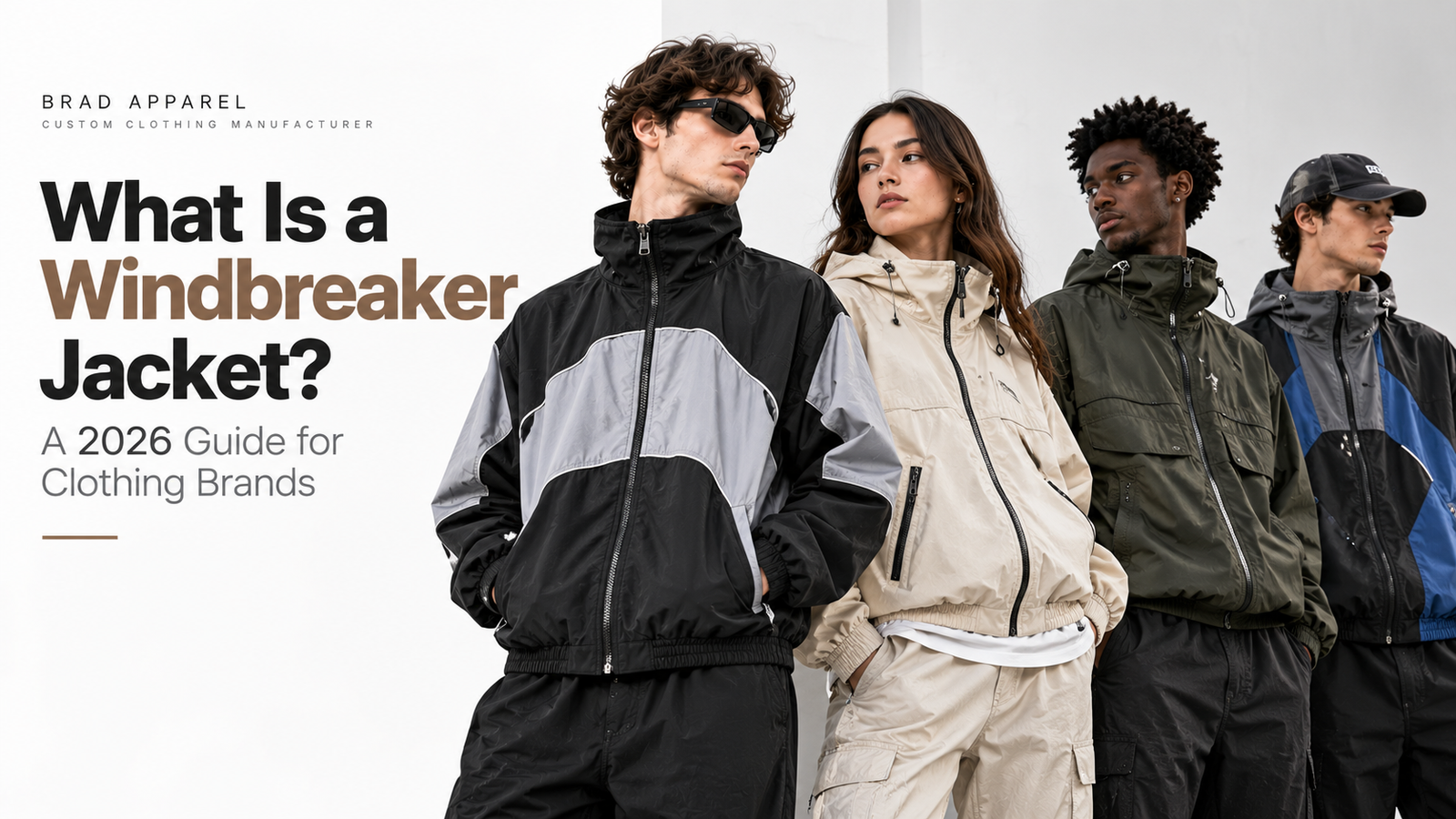
The windbreaker jacket has moved far beyond its original sportswear image.
In 2026, lightweight windbreakers are appearing across:
- Streetwear
- Retro sportswear
- Women's fashion
- Minimal outerwear
- Technical clothing
- Travel collections
- Transitional seasonal jackets
The reason is simple.
A windbreaker can be lightweight and practical while still giving brands plenty of room to experiment with:
Silhouette
Color blocking
Fabric texture
Pockets
Zippers
Elastic
and
Adjustable details
But developing a good windbreaker requires more than choosing a thin nylon fabric.
Fabric density, coating, lining, seam construction, ventilation, zipper type and fit all affect how the finished jacket performs and feels.
This guide explains what defines a windbreaker jacket and what clothing brands should consider before developing one for production.
What Is a Windbreaker Jacket?
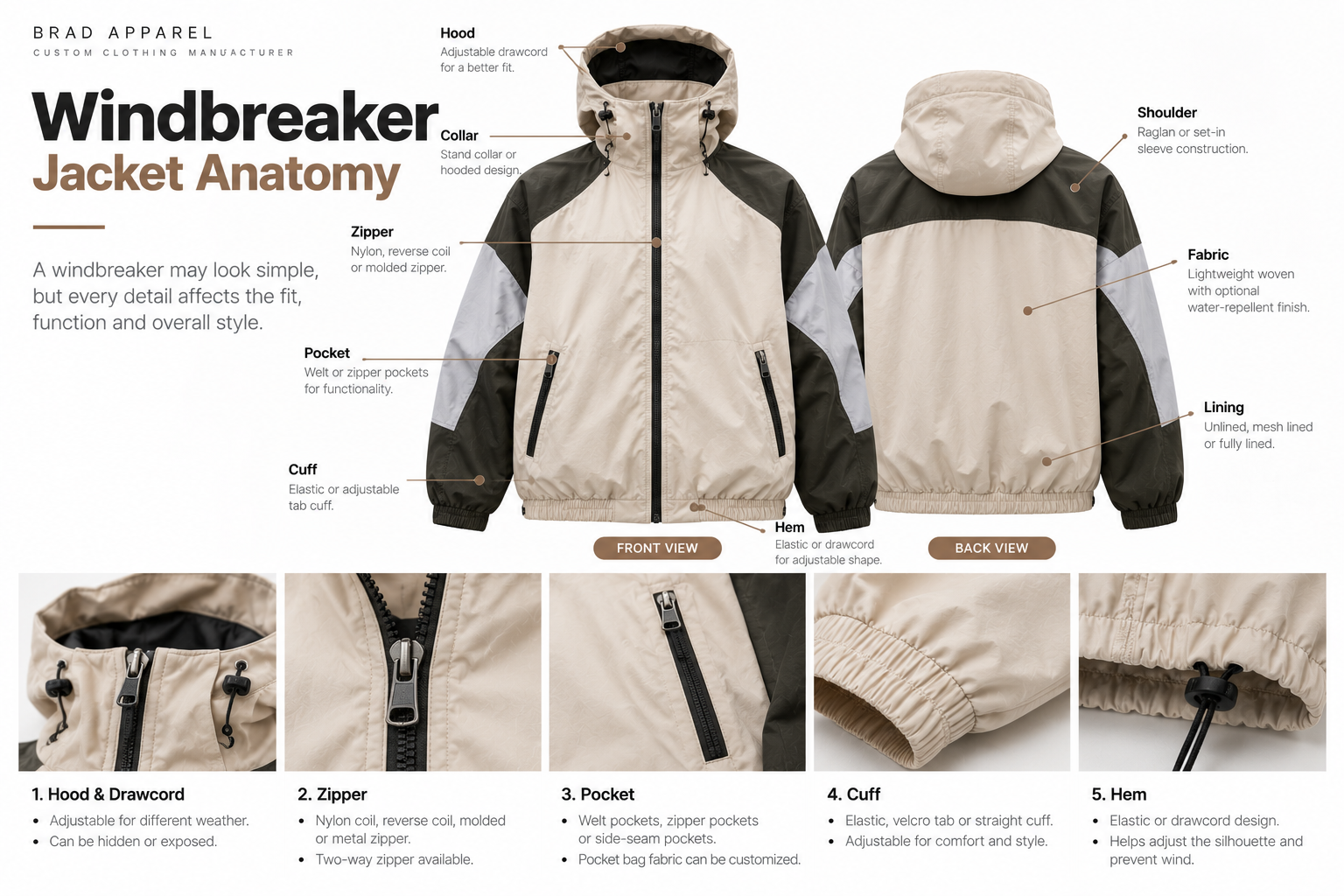
A windbreaker is a lightweight outer jacket designed primarily to provide protection from wind and light changing weather.
Traditional versions usually feature:
- Lightweight woven shell fabric
- Front zipper
- Elastic or adjustable cuffs
- Lightweight construction
- Easy layering
- Minimal insulation
Modern fashion versions can be much more varied.
They may be:
Cropped
Oversized
Color-blocked
Half-zip
Hooded
Funnel-neck
or
Packable
The category therefore describes more than one specific silhouette.
The common idea is a lightweight outer shell with relatively low bulk.
Why Are Windbreakers Trending Again in 2026?
Windbreakers fit several broader fashion movements happening at the same time.
One is the return of:
Retro sportswear
Another is growing interest in:
Technical and functional-looking clothing
And another is the continuing demand for:
Lightweight transitional outerwear
A windbreaker sits between all three.
It can feel sporty without being athletic wear.
It can look technical without becoming a heavy outdoor shell.
And it can provide a more interesting silhouette than a basic sweatshirt or zip hoodie.
For brands, this makes the category especially flexible.
Windbreaker vs Rain Jacket: What's the Difference?
These terms are often confused.
But they should not automatically be treated as the same product.
| Feature | Windbreaker | Rain Jacket |
|---|---|---|
| Primary Purpose | Wind protection / lightweight outer layer | Protection from rain |
| Fabric | Lightweight woven | Waterproof or highly water-resistant construction |
| Weight | Usually light | Varies |
| Seam Sealing | Not always required | Often important |
| Water Protection | Depends on fabric and finish | Usually a key specification |
| Breathability | Depends on material and construction | Depends on membrane and ventilation |
| Typical Use | Casual, sports-inspired, transitional wear | Wet-weather use |
A windbreaker may use a water-repellent finish.
That does not automatically make it waterproof.
This distinction is important when developing product descriptions and technical specifications.
Windbreaker vs Shell Jacket
A shell jacket is a broader technical outerwear category.
It may include:
- Wind shells
- Rain shells
- Soft shells
- Technical waterproof shells
A fashion windbreaker is usually:
- Lighter
- Simpler
- Less structured
- More casual
Some modern products sit somewhere between the two categories.
For manufacturing purposes, the actual fabric and construction specification matters more than the marketing name.
Fabric Is the Most Important Starting Point

The appearance of a windbreaker is strongly influenced by the shell fabric.
Even when two jackets use the same pattern, changing the fabric can produce completely different results.
Nylon
Nylon is one of the most recognizable windbreaker materials.
It can provide:
- Lightweight construction
- Smooth surface
- Slight sheen or matte appearance
- Good flexibility
- Classic sportswear character
Different nylon fabrics can feel completely different depending on:
- Yarn
- Density
- Weave
- Finish
- Coating
A thin glossy nylon may create a retro look.
A dense matte nylon can feel more modern and premium.
Polyester
Polyester is also widely used for lightweight jackets.
Possible advantages include:
- Broad color availability
- Stable construction
- Easy sourcing
- Compatibility with different finishes
- Good suitability for printed designs
Polyester can be useful for:
- Team-style jackets
- Color-block outerwear
- Promotional collections
- Fashion windbreakers
Taslan
Taslan is commonly associated with a more textured technical surface.
Compared with very smooth nylon, it can create:
- Drier hand feel
- More substantial appearance
- Less glossy surface
- Outdoor-inspired character
Taslan is especially useful when a brand wants a windbreaker that feels less like traditional shiny sportswear.
Ripstop
Ripstop fabric uses a reinforcement pattern within the weave.
Visually, it often creates a small grid texture.
It can work well for:
- Technical-inspired collections
- Utility jackets
- Outdoor styling
- Lightweight streetwear
However, the presence of a ripstop grid does not by itself define the fabric's waterproof or durability performance.
Those properties should be confirmed separately.
Cotton-Nylon or Blended Woven Fabrics
Not every windbreaker needs to feel highly synthetic.
Blended woven fabrics can create a softer, more fashion-oriented interpretation.
They may work well for:
- Minimal jackets
- Premium casualwear
- Lifestyle collections
The trade-off is that fabric behavior may differ significantly from lightweight synthetic shells.
Fabric Weight Should Match the Intended Product
There is no single correct GSM for every windbreaker.
Instead, fabric weight should be selected according to the target result.
A very lightweight shell may create:
- Packability
- Soft drape
- Minimal bulk
A more substantial woven may create:
- Stronger silhouette
- More structure
- More premium hand feel
The decision should be based on the finished garment rather than a GSM number alone.
Brad Apparel's Fabric Sourcing & Development service covers technical nylon, polyester, performance fabrics, fabric weight, finishing and functional treatments before sampling.
Water-Resistant Does Not Mean Waterproof
This is one of the most important distinctions when developing a windbreaker.
A fabric can have a:
Water-repellent finish
without becoming a fully waterproof fabric.
Water performance can depend on:
- Fiber and weave
- Fabric density
- Coating
- Lamination
- DWR or other finishing
- Seam construction
- Zipper construction
If a brand wants to market a jacket with a specific water-performance claim, that specification should be confirmed and tested.
Do not assume performance only from how the fabric looks.
Coated vs Uncoated Windbreaker Fabrics
A coating can change both performance and hand feel.
Possible effects include:
- Increased resistance to moisture
- Firmer hand feel
- Different surface appearance
- Reduced air permeability
- Increased fabric noise
That last point is often overlooked.
Some lightweight technical fabrics create a noticeable sound when the wearer moves.
For fashion brands, the balance between:
performance
and
hand feel
can be just as important as the technical specification.
Should a Windbreaker Be Lined?

Not necessarily.
There are several common approaches.
Unlined Windbreaker
An unlined jacket can be:
- Very lightweight
- Packable
- Simple
- Suitable for transitional weather
But the inside construction becomes more visible.
That means seam finishing needs additional attention.
Mesh-Lined Windbreaker
Mesh can provide:
- Separation between skin and shell
- A more finished interior
- Better comfort in some designs
This construction is often associated with sports-inspired jackets.
The mesh type and hole structure should be selected according to the target garment.
Lightweight Full Lining
A full woven lining can make the jacket feel:
- Cleaner
- More premium
- More substantial
But it also adds:
- Weight
- Cost
- Bulk
The lining should not fight against the lightweight purpose of the jacket.
Partial Lining
Some designs only line specific areas.
For example:
- Upper back
- Front body
- Hood
This can balance structure and weight.
Ventilation Can Matter
Because lightweight synthetic shells may reduce airflow, some windbreakers incorporate ventilation details.
Examples include:
- Back vents
- Mesh panels
- Underarm eyelets
- Hidden openings
Whether ventilation is necessary depends on the intended use.
A fashion windbreaker worn casually has different needs from a jacket intended for active movement.
Four Main Windbreaker Directions for 2026

The same basic product category can be developed in very different directions.
1. Retro Sports Windbreaker
Typical features:
- Color blocking
- Contrast piping
- Elastic cuffs
- Elastic hem
- Lightweight shiny or semi-matte woven
- Stand collar
This direction draws heavily from vintage sportswear.
Strong color combinations can become the main visual feature.
2. Minimal Windbreaker
Possible features:
- Solid color
- Matte fabric
- Clean front
- Hidden or low-profile pockets
- Minimal branding
- Simple zipper
This direction works well for premium casual and minimalist labels.
Fabric quality becomes especially important because there are fewer visible design elements.
3. Oversized Streetwear Windbreaker
Typical features may include:
- Wide chest
- Drop shoulder
- Large sleeves
- Longer sleeve length
- Adjustable hem
- Larger hood or collar
The pattern should be intentionally developed as oversized.
Simply grading up a regular windbreaker may make the garment too long rather than creating the correct width and proportion.
4. Technical-Inspired Windbreaker
Possible details include:
- Technical woven fabrics
- Reverse coil zipper
- Adjustable hem
- Cord locks
- Functional pockets
- Hood adjustment
- Ventilation details
This type can look highly functional even when designed primarily for fashion.
Any specific performance claims should still be tied to actual fabric and construction specifications.
Color Blocking Is a Major Design Opportunity
Windbreakers are especially suitable for panel-based design.
Instead of using one shell color, a jacket can combine:
Body Color A
+
Sleeve Color B
+
Shoulder Panel Color C
+
Contrast Zipper
This creates visual identity without requiring a large printed graphic.
Possible panel locations include:
- Shoulder
- Chest
- Sleeve
- Side body
- Back yoke
- Hood
But every additional panel also creates additional seams.
That affects:
- Sewing time
- Alignment
- Production consistency
- Cost
A good color-block design should therefore balance appearance and manufacturability.
Zipper Selection Changes the Character of the Jacket
The zipper is one of the most visible trims on a windbreaker.
Common directions include:
Nylon Coil Zipper
Lightweight and flexible.
Suitable for many casual windbreakers.
Reverse Coil Zipper
Creates a cleaner technical appearance.
Plastic Molded Zipper
More visually substantial.
Can work well on heavier or more technical-inspired designs.
Metal Zipper
Creates a stronger premium or fashion appearance but adds more weight.
Two-Way Zipper
Useful when the design requires additional styling or movement options.
Brad Apparel's Custom Zippers & Sliders page covers coil, reverse coil, molded, metal and custom slider options.
Think About Zipper Weight vs Fabric Weight
A heavy zipper on a very lightweight shell can cause problems.
Possible issues include:
- Front edge distortion
- Zipper wave
- Fabric pulling
- Unbalanced drape
The zipper should therefore be selected together with the fabric.
Not after the jacket pattern is already finished.
Cuffs: Elastic, Velcro or Straight?

The cuff changes both function and silhouette.
Elastic Cuff
A common windbreaker detail.
It:
- Pulls the sleeve opening inward
- Creates a sporty shape
- Helps control sleeve volume
Elastic tension should be checked during sampling.
Too tight:
Uncomfortable
Too loose:
Poor shape
Adjustable Tab Cuff
A tab can provide a more technical appearance.
Possible closures include:
- Hook-and-loop
- Snap
- Button
The cuff width and adjustment range should be tested on the wearer.
Straight Cuff
Creates a cleaner fashion appearance.
Useful for minimalist jackets.
Hem Construction Changes the Entire Silhouette
A windbreaker can use:
Elastic Hem
Creates a traditional blouson shape.
Drawcord Hem
Allows the wearer to adjust volume.
Straight Hem
Creates a cleaner jacket silhouette.
Partial Elastic
Can maintain a clean front while adding shaping at the back or sides.
This detail should be decided early because it affects body length and pattern volume.
Hooded vs Stand-Collar Windbreaker
Both are common.
A stand-collar windbreaker feels:
- Cleaner
- More retro
- Easier to layer
A hooded windbreaker can feel:
- More casual
- More outdoor-inspired
- More technical
If a hood is added, check:
- Hood depth
- Hood opening
- Neck attachment
- Drawcord position
- Collar interaction
A hood should not simply be attached to an existing neckline without considering the pattern.
Packable Windbreakers Need to Be Designed Differently
Some lightweight jackets are designed to fold into:
- Their own pocket
- A separate pouch
- An internal compartment
This requires planning.
The packable pocket needs to accommodate the entire garment.
The zipper direction may also need to work from both sides.
Very bulky:
- Hardware
- Lining
- Rib
- Embroidery
can make packability more difficult.
So the packable feature should be decided before sampling rather than added at the end.
Pocket Construction
Windbreakers commonly use:
Welt Pockets
Clean and minimal.
Zipper Pockets
Useful for technical or active-inspired designs.
Side-Seam Pockets
Keeps the exterior visually clean.
Patch Pockets
Creates a more utility-driven appearance.
Hidden Pockets
Useful for minimalist styling.
Pocket bags should also be evaluated.
A heavy pocket bag inside a thin shell can create visible bulk from the outside.
Decoration Requires Fabric Compatibility
Lightweight windbreaker fabrics behave differently from heavyweight cotton T-shirts or hoodies.
Decoration should therefore be tested before bulk production.
Screen Printing
Possible on compatible fabrics, but:
- Ink adhesion
- Heat sensitivity
- Coating
- Surface texture
must be considered.
Heat Transfer
Can be useful for:
- Small logos
- Fine details
- Reflective effects
- Sports-inspired graphics
But heat and pressure should be tested on the actual shell fabric.
Embroidery
Embroidery can provide a premium result.
However, dense embroidery on very lightweight material may cause:
- Puckering
- Distortion
- Excess weight
Stabilization and stitch density should be adjusted accordingly.
Sublimation
Suitable only when fabric construction and fiber content are compatible with the process.
Brad Apparel's Printing Techniques page explains different decoration options and the importance of matching the process to the actual production fabric.
What Should You Check on a Windbreaker Sample?
A windbreaker should not be approved from a front photo alone.
The sample should be evaluated as a complete product.
1. Front View
Check:
- Overall width
- Body length
- Zipper alignment
- Pocket symmetry
- Hem shape
2. Side View
Check:
- Body volume
- Sleeve shape
- Hem balance
- Pocket bulk
3. Back View
Check:
- Shoulder width
- Back volume
- Panel alignment
- Hood or collar position
4. Sleeve Movement
Raise and move the arms.
Check whether the jacket:
- Pulls excessively
- Rides up
- Restricts movement
- Twists at the sleeve
5. Cuff
Check:
- Elastic tension
- Opening size
- Symmetry
- Comfort
6. Hem
For elastic or adjustable hems, check:
- Tension
- Cord length
- Cord-lock placement
- Shape when tightened
- Shape when relaxed
7. Zipper
Open and close repeatedly.
Check:
- Smoothness
- Fabric catching
- Zipper wave
- Top and bottom reinforcement
8. Pockets
Check:
- Position
- Size
- Opening
- Accessibility
- Pocket-bag bulk
9. Interior
Check:
- Seam finishing
- Lining attachment
- Loose threads
- Label position
- Internal pockets
10. Fabric Appearance
Check:
- Color
- Surface
- Creasing
- Coating consistency
- Fabric noise
- Hand feel
11. Decoration
Check:
- Position
- Color
- Adhesion
- Embroidery puckering
- Heat-transfer marks
12. Care / Performance Test
Where relevant to the product specification, test:
- Shrinkage
- Color change
- Surface appearance
- Zipper behavior
- Coating or finishing
- Intended water-performance requirement
The testing method should match the claims the brand intends to make.
Common Windbreaker Development Mistakes
Choosing Fabric Only From a Photo
Two black nylon fabrics can behave completely differently.
Always evaluate the physical fabric.
Assuming Nylon Means Waterproof
Nylon describes a fiber.
It does not automatically define waterproof performance.
Using a Heavy Zipper on a Thin Shell
This can distort the front.
Making the Jacket Oversized by Simply Sizing Up
The result may become too long without achieving the intended width.
Ignoring Pocket-Bag Weight
Heavy internal components can show through a lightweight shell.
Adding Embroidery Without Testing
Dense stitching can cause puckering.
Approving Only the Garment Appearance
Fit, movement, zipper operation and finishing should also be reviewed.
What Should You Send a Windbreaker Manufacturer?
A useful development brief should define:
| Area | What to Specify |
|---|---|
| Fit | Regular / relaxed / oversized / cropped |
| Shell Fabric | Nylon / polyester / Taslan / ripstop / blend |
| Fabric Finish | Matte / glossy / coated / water-repellent if required |
| Lining | None / mesh / woven / partial |
| Collar | Stand / funnel / hood |
| Zipper | Coil / reverse coil / molded / metal / two-way |
| Cuff | Elastic / tab / straight |
| Hem | Elastic / drawcord / straight |
| Welt / zipper / seam / patch | |
| Panels | Solid / contrast / color-block |
| Decoration | Print / transfer / embroidery / patch |
| Branding | Main label / care label / zipper pull / hang tag |
| Performance | Any specific requirement that must be tested |
| Quantity | Sample and bulk quantity |
Reference images are helpful.
But the factory still needs actual construction and material specifications before production.
How Brad Apparel Can Develop a Custom Windbreaker
A windbreaker development process can follow:
Design Reference
↓
Shell Fabric Selection
↓
Finish / Performance Requirement
↓
Pattern Development
↓
Lining & Ventilation
↓
Zipper / Hardware Confirmation
↓
Sample
↓
Fit & Movement Review
↓
Decoration Testing
↓
Care / Performance Testing
↓
Bulk Approval
Brad Apparel supports custom woven and technical garment development through fabric sourcing, trims, printing, embroidery, sampling and bulk production.
You can explore the complete Manufacturing Capabilities before preparing your windbreaker specification.
FAQ
What Is a Windbreaker Jacket?
A windbreaker is a lightweight outer jacket designed primarily as a wind-protective layer.
Modern versions can include oversized, cropped, technical, retro and fashion-oriented designs.
Are Windbreakers Waterproof?
Not automatically.
Some windbreaker fabrics may include water-repellent coatings or finishes, but waterproof performance depends on the complete fabric and garment construction.
What Fabric Is Used for Windbreakers?
Common options include:
- Nylon
- Polyester
- Taslan
- Ripstop woven
- Cotton-synthetic blends
The best choice depends on the intended weight, appearance, hand feel and performance.
Is Nylon Better Than Polyester for a Windbreaker?
Neither is universally better.
Nylon and polyester can both be developed in many different weights, densities, finishes and textures.
Brands should compare actual fabric swatches rather than choosing based only on fiber name.
Can a Windbreaker Be Oversized?
Yes.
Oversized windbreakers can use:
- Wider chest measurements
- Drop shoulders
- Larger sleeves
- Adjustable hems
The pattern should be purpose-built rather than simply using a larger standard size.
Should a Windbreaker Have a Lining?
It depends on the design.
Possible constructions include:
- Unlined
- Mesh lined
- Fully lined
- Partially lined
Each changes the weight, comfort, appearance and cost.
Can You Embroider a Windbreaker?
Yes, but lightweight shell fabrics can pucker under dense stitching.
Embroidery should be tested on the actual production fabric and stabilized appropriately.
What Is the Difference Between a Windbreaker and a Rain Jacket?
A windbreaker is primarily a lightweight wind-protective layer.
A rain jacket is developed around water protection and may require waterproof fabrics, seam sealing and specialized construction.
The categories can overlap, but they should not automatically be treated as identical.
Can Windbreakers Be Custom Printed?
Yes.
Depending on fabric composition and finish, possible techniques may include:
- Screen printing
- Heat transfer
- Silicone transfer
- Sublimation on suitable polyester fabrics
The process should be tested on the actual shell fabric before bulk production.
Final Thoughts
The modern windbreaker looks simple because it is lightweight.
But lightweight construction often makes small production problems more visible.
A heavy zipper can distort the front.
A bulky pocket bag can show through the shell.
Dense embroidery can create puckering.
The wrong coating can change the hand feel.
And an oversized pattern can become long instead of intentionally wide.
For clothing brands, the best windbreakers are therefore developed as a complete system:
Fabric
+
Fit
+
Lining
+
Hardware
+
Construction
+
Decoration
rather than as a basic jacket made from thin nylon.
That approach creates a lightweight outerwear product that looks intentional, performs according to its actual specification and can remain consistent from sample to bulk production.
Keep Reading