The Harrington jacket is one of the most recognizable lightweight outerwear silhouettes.
Its design looks simple:
Short body
Zip front
Stand collar
Clean pockets
and
A controlled hem
But developing a good Harrington jacket requires more precision than the minimalist appearance suggests.
The final result depends on how the:
- Collar
- Shoulder
- Sleeve
- Body length
- Zipper
- Hem
- Pockets
- Back construction
- Shell fabric
- Lining
work together.
For clothing brands, the Harrington is especially interesting because it can move between:
heritage
preppy
streetwear
minimal casualwear
and
premium outerwear
without losing its recognizable identity.
This guide explains what defines a Harrington jacket and what brands should consider when developing one for production.
What Is a Harrington Jacket?
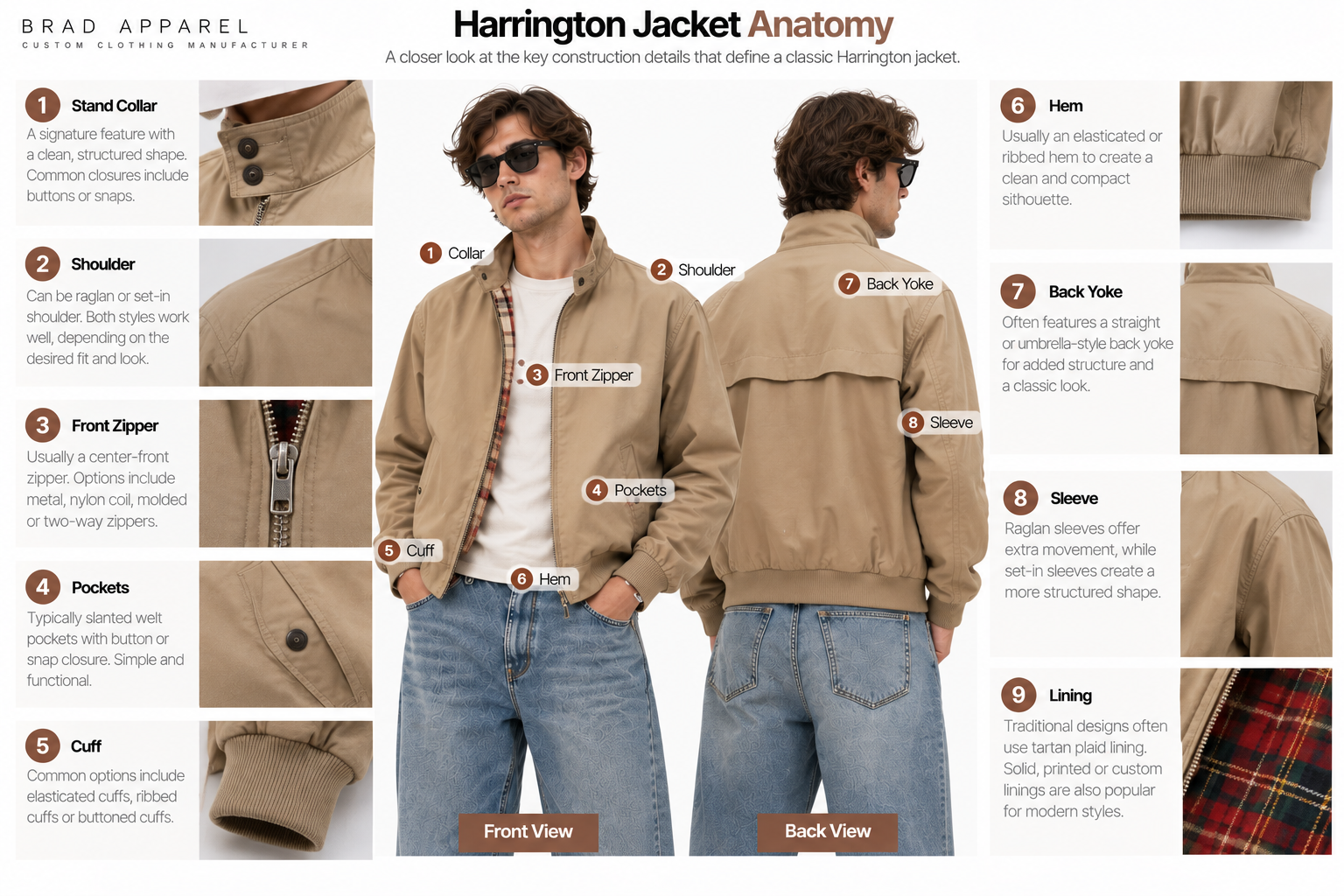
A Harrington jacket is generally a short, lightweight zip-up jacket with a structured collar and clean, compact silhouette.
Traditional interpretations commonly include:
- Stand collar
- Button or snap collar closure
- Center-front zipper
- Slanted front pockets
- Short body length
- Elasticated or ribbed hem
- Adjustable or elasticated cuffs
- Lightweight woven shell
- Full or partial lining
Some heritage versions also use:
- Checked lining
- Back yoke construction
- Vent details
- Raglan-style sleeves
Modern Harrington jackets may simplify, enlarge or reinterpret these elements.
That means the category should be understood as a design framework rather than one fixed construction specification.
Why Is the Harrington Jacket Trending Again in 2026?
The Harrington fits several current fashion directions at once.
Consumers are showing renewed interest in:
- Classic menswear
- Preppy clothing
- Heritage sportswear
- Lightweight transitional jackets
- Minimal branding
- Vintage-inspired silhouettes
The Harrington sits comfortably between these categories.
It is more structured than many windbreakers but usually lighter and shorter than traditional coats.
It can also be styled with:
- Jeans
- Chinos
- Wide-leg trousers
- Cargo pants
- Knitwear
- T-shirts
- Hoodies
For brands, this makes it a versatile outerwear product without requiring an extremely complex design.
Harrington Jacket vs Bomber Jacket
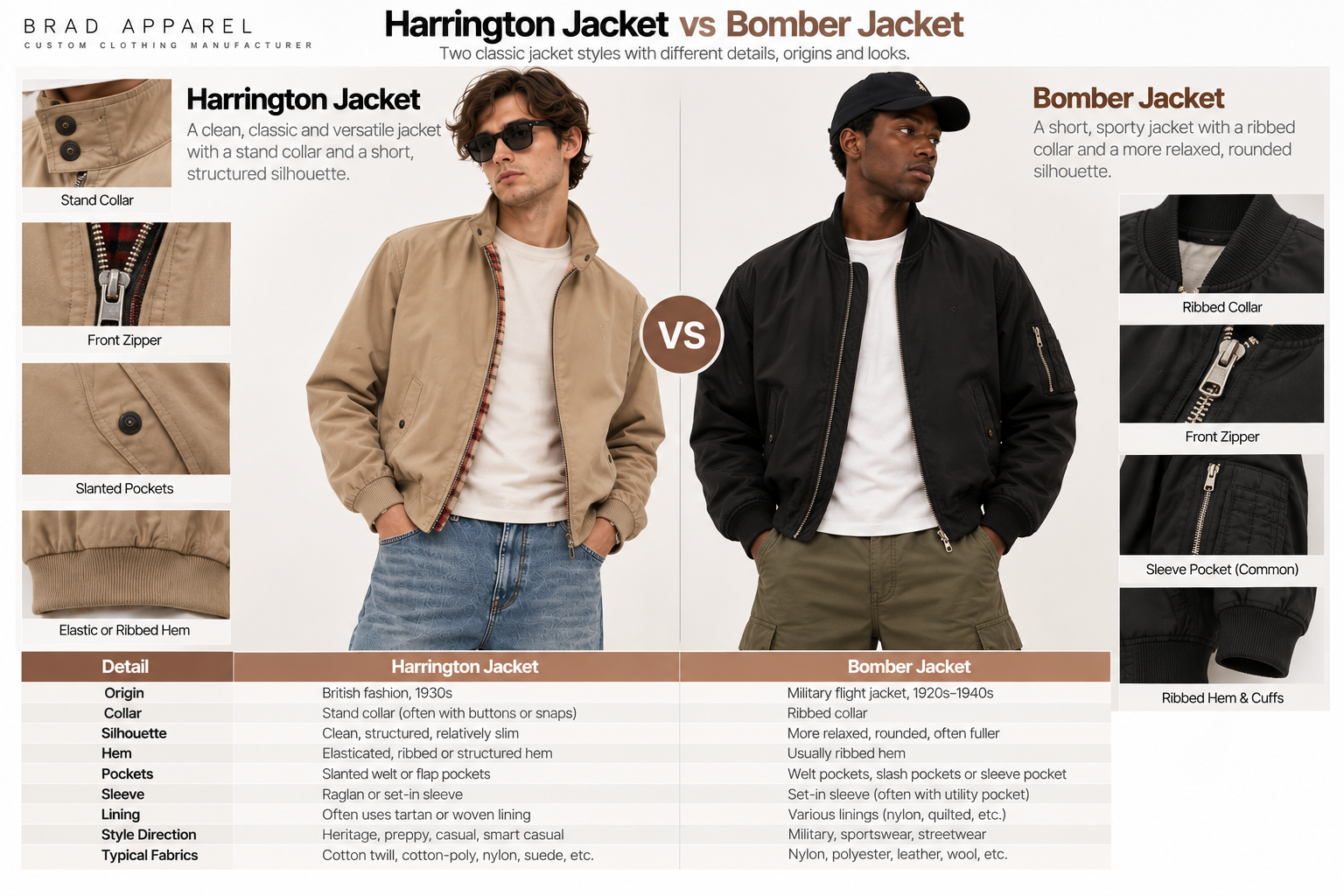
The two silhouettes are often confused because both are short zip jackets.
But they usually have different design language.
| Detail | Harrington Jacket | Bomber Jacket |
|---|---|---|
| Collar | Stand or buttoned collar | Often rib-knit collar |
| Body | Clean, compact | Often fuller or more rounded |
| Hem | Elastic, rib or controlled hem | Commonly ribbed |
| Pockets | Slanted or flap pockets | Welt, slash or utility pockets |
| Lining | Often woven or checked | Varies widely |
| Style Direction | Heritage / preppy / casual | Military / sportswear / streetwear |
These are general tendencies rather than universal rules.
Modern designs often combine elements from both categories.
For manufacturing, the actual pattern and specifications matter more than the product name.
Harrington Jacket vs Windbreaker
Brad Apparel already has a dedicated guide to windbreaker construction.
The key difference is that a windbreaker is usually developed around:
lightweight shell construction
and potentially:
- Hood
- Drawcords
- Ventilation
- Technical finishes
- Packability
A Harrington normally feels more:
structured
clean
and
heritage-inspired.
It commonly relies on the:
- Collar
- Short body
- Zipper
- Pocket angle
- Hem
- Lining
to create its identity.
The categories can overlap, but they should not automatically be treated as the same jacket.
The Collar Is One of the Defining Features
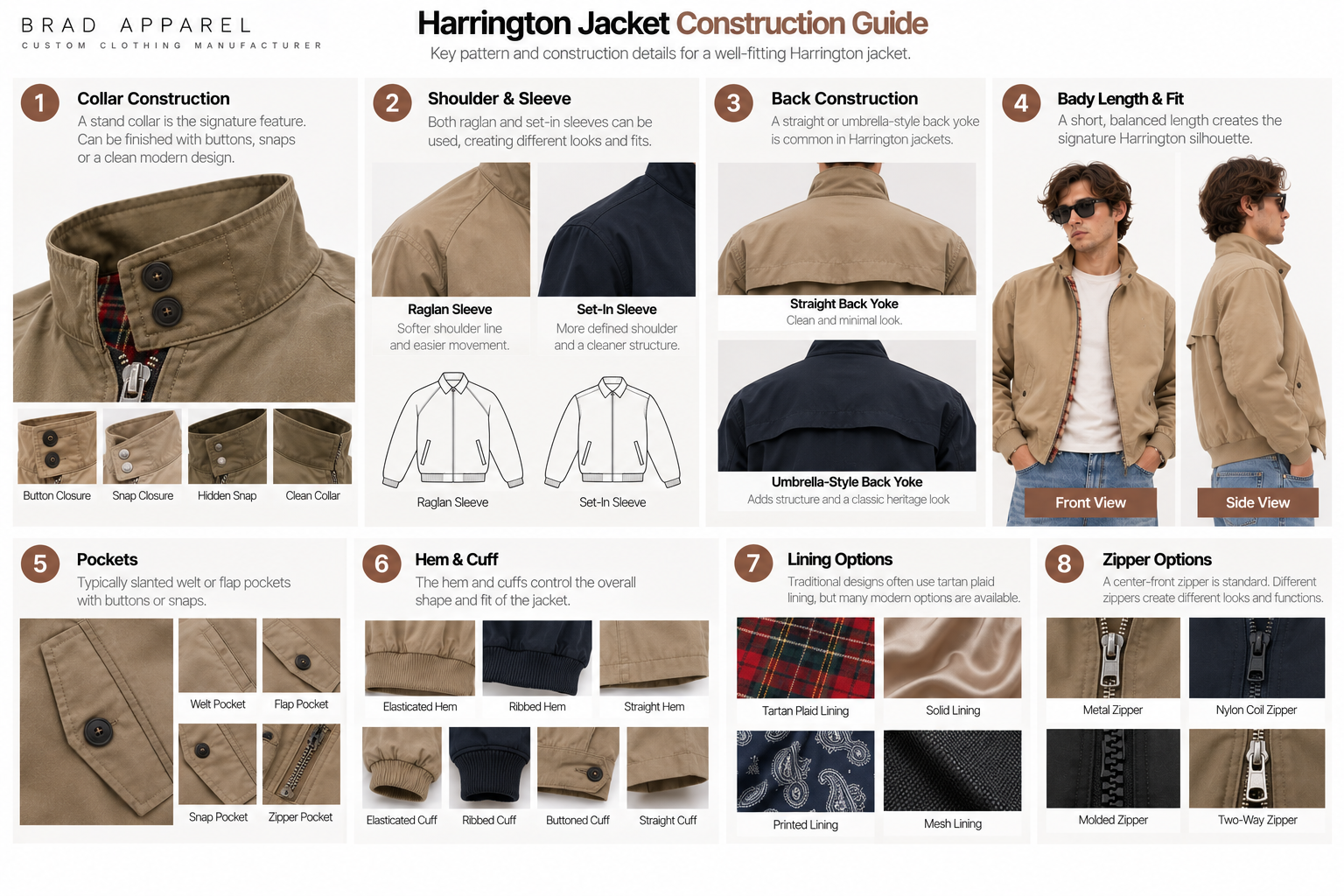
A traditional Harrington-style collar usually stands around the neck instead of folding outward like a shirt collar.
Possible constructions include:
- Stand collar
- Two-button collar
- Snap collar
- Simplified modern collar
The collar should provide enough structure to stay clean without feeling rigid.
Collar Height Changes the Character
A lower collar can feel:
- Minimal
- Casual
- Modern
A slightly taller collar can create:
- Stronger heritage styling
- More neck coverage
- More visible structure
There is no universal correct collar height.
The correct proportion depends on:
- Neck opening
- Jacket size
- Fabric thickness
- Collar closure
- Target aesthetic
The sample should be checked physically rather than approving collar dimensions only from a sketch.
Collar Circumference Matters
A stand collar that is too tight can become uncomfortable.
A collar that is too wide may:
- Collapse
- Sit away from the neck
- Lose the intended shape
The neck opening and upper collar circumference should be developed together.
This becomes even more important if the collar is designed to close with:
- Buttons
- Snaps
- Tabs
Collar Closure Options
Traditional-inspired Harrington jackets may use two visible buttons or snaps around the collar.
Modern interpretations may use:
Buttons
Create a classic appearance.
Snaps
Cleaner and faster to operate.
Hidden Snaps
Useful for a more minimal design.
No Collar Closure
Creates a simplified contemporary version.
The hardware should match the scale and structure of the jacket.
The Body Should Be Short—but Balanced
The Harrington is generally shorter than many casual jackets.
But “short” does not mean randomly cropped.
The body length needs to work with:
- Chest width
- Sleeve length
- Pocket position
- Hem construction
- Intended trousers
A body that is too long can begin to resemble a general casual jacket.
A body that is too short may move toward:
- Cropped bomber
- fashion jacket
- bolero-inspired proportions
The target length should therefore be clearly defined in the tech pack.
The Hem Creates the Characteristic Shape
The lower edge of the jacket helps control body volume.
Possible Harrington directions include:
Elasticated Hem
Creates a subtle blouson shape.
Ribbed Hem
Moves the design closer toward sportswear or bomber styling.
Partial Elastic
Can keep the front clean while controlling volume at the sides or back.
Straight Hem
Creates a more contemporary jacket shape.
The hem construction should be selected before the final body length is approved because it changes how the jacket sits on the wearer.
Elastic Tension Needs Sampling
Elastic that is too tight can cause:
- Excessive bunching
- Jacket riding upward
- Uncomfortable pressure
- Distorted front zipper
Elastic that is too loose may fail to control the silhouette.
The correct tension should therefore be checked on the physical sample.
Raglan vs Set-In Sleeves
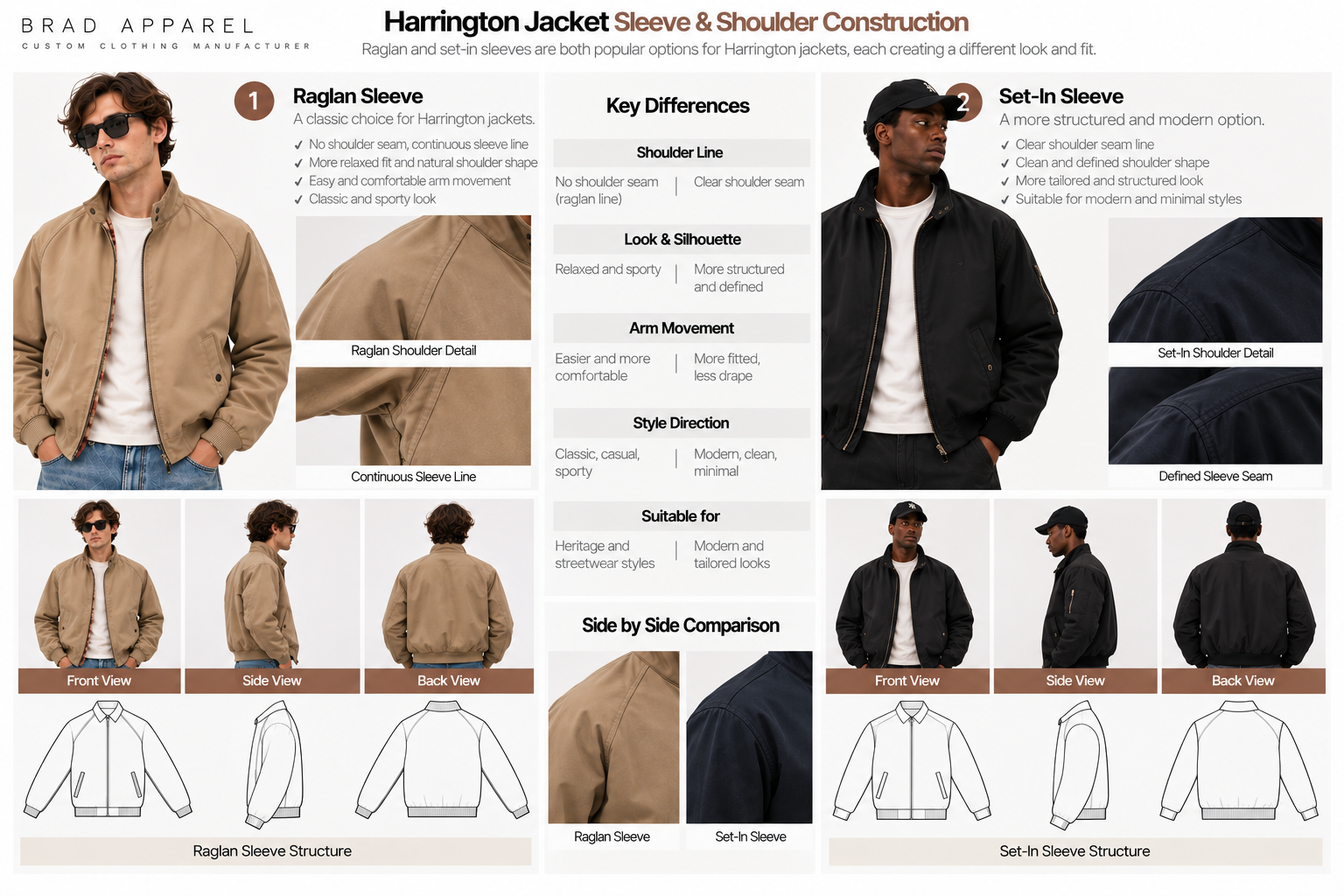
Both constructions are possible.
Raglan Sleeve
A raglan-inspired sleeve can create:
- Softer shoulder line
- Easier movement
- Sportier heritage appearance
It can also influence how the back yoke and shoulder seams are developed.
Set-In Sleeve
A set-in sleeve creates:
- More defined shoulder
- Cleaner modern structure
- Easier adaptation to fashion silhouettes
The choice should follow the intended fit rather than assuming every Harrington must use one traditional construction.
Sleeve Volume Should Match the Body
A classic Harrington may use relatively controlled sleeves.
An oversized interpretation may use:
- Larger bicep
- Lower armhole
- Wider sleeve
- More relaxed cuff
The sleeve should not simply be enlarged independently.
Shoulder width, armhole depth and body volume need to be adjusted together.
Back Construction Can Be a Signature Detail
Many Harrington-inspired jackets use a back yoke or vent-style construction.
This can serve both:
- Visual identity
- Garment structure
Possible directions include:
- Straight back yoke
- Curved yoke
- Vent-style overlay
- Clean one-piece back
The detail should not be added only for decoration.
The pattern needs to consider how additional layers affect:
- Thickness
- Movement
- pressing
- lining attachment
What Is an Umbrella-Style Back Yoke?
Some classic Harrington-style jackets use a curved or layered back detail that resembles an umbrella shape.
It can create a recognizable heritage appearance.
However, modern brands can simplify the back if they prefer:
- Cleaner minimalism
- Lower sewing complexity
- Different fabric behavior
The key is consistency with the overall design direction.
Pocket Design Is Highly Visible
Traditional Harrington pockets are often positioned at an angle.
Possible constructions include:
- Slanted welt pocket
- Flap pocket
- Buttoned flap pocket
- Snap flap pocket
- Hidden zipper pocket
Pocket placement affects both:
function
and
visual proportion.
Pocket Angle Should Be Tested on the Wearer
A pocket that looks correct on a flat drawing may feel awkward once worn.
Check:
- Hand entry
- Opening length
- Angle
- Height
- Symmetry
A heavily angled pocket may look sporty but become less comfortable.
A very horizontal pocket may feel cleaner but change the jacket's character.
Choosing Fabric for a Harrington Jacket
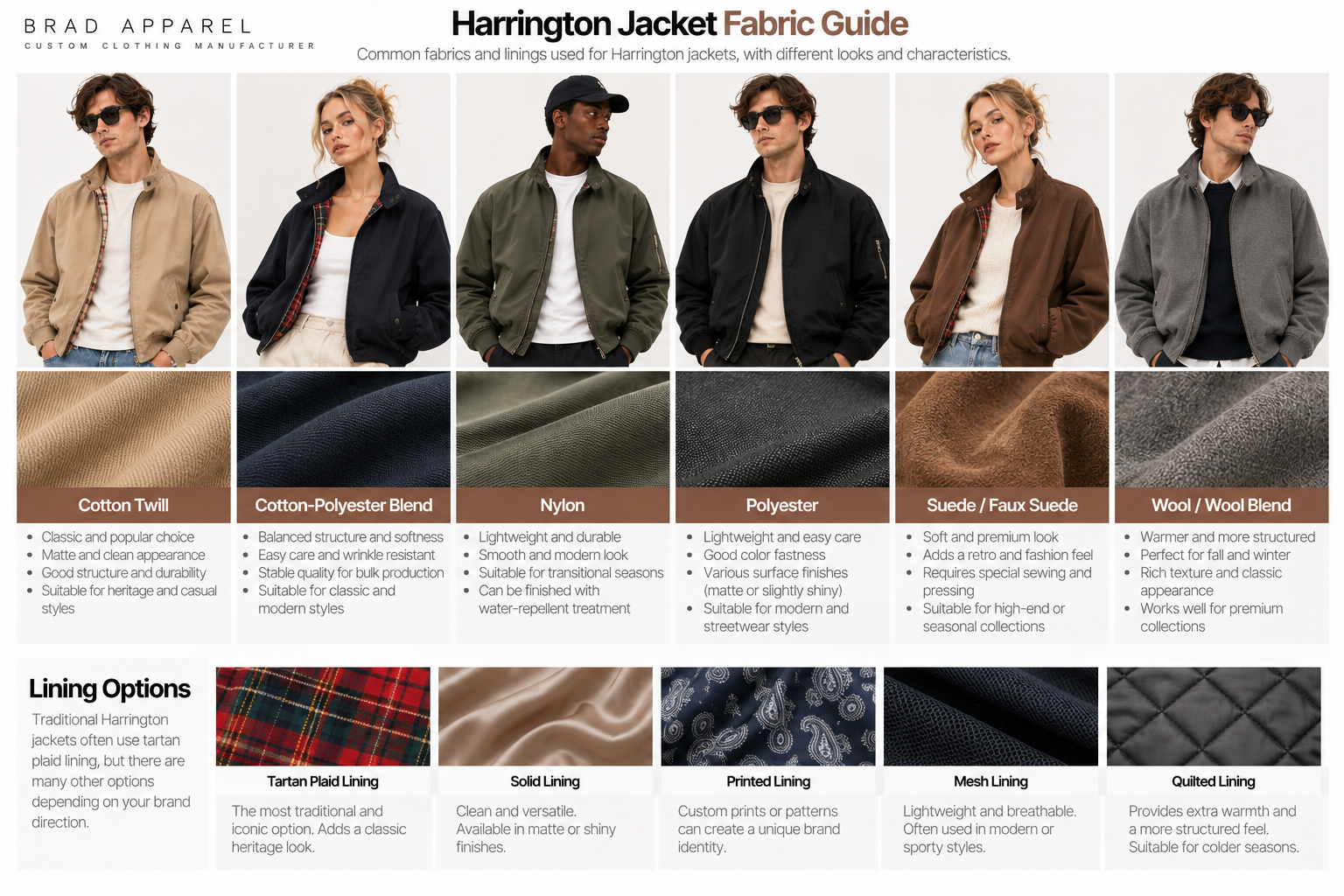
The Harrington silhouette can work with many different woven fabrics.
Cotton Twill
A strong option for heritage and casual versions.
It can provide:
- Clean structure
- Matte appearance
- Familiar cotton hand feel
Different twill constructions can range from soft to highly structured.
Cotton-Polyester Blend
A blended woven can provide a balance of:
- Structure
- stability
- easy care
- consistent production
The final hand feel depends on the exact yarn and finish.
Lightweight Polyester
Useful for:
- Lighter jackets
- Sportier interpretations
- Easy-care garments
The appearance can range from matte to slightly technical.
Nylon
Nylon can push the Harrington toward:
- Technical styling
- Streetwear
- Lightweight outerwear
Any water-resistance claim should depend on the actual fabric specification and finish rather than the fiber alone.
Suede / Faux Suede
Creates a more premium or retro fashion interpretation.
These materials affect:
- Seam construction
- pressing
- edge finishing
- zipper weight
and should be sampled in the actual production material.
Wool or Wool Blend
A heavier Harrington can also work for cooler seasons.
The pattern may need adjustment because thicker fabrics increase:
- Seam bulk
- Collar thickness
- hem volume
Fabric Structure Matters More Than Fiber Name Alone
Two cotton fabrics can behave completely differently.
One may be:
- Soft
- lightweight
- fluid
while another may be:
- dense
- crisp
- structured
Brands should therefore evaluate:
- Weight
- Density
- Surface
- Drape
- Shrinkage
- Hand feel
rather than selecting fabric only from composition.
Brad Apparel's Fabric Sourcing & Development service supports woven fabric sourcing and development according to composition, weight, texture, color and garment requirements.
Does a Harrington Jacket Need a Tartan Lining?
No.
Checked or tartan-style lining is strongly associated with traditional Harrington styling, but it is not a mandatory construction rule.
Modern brands can use:
- Solid woven lining
- Tonal lining
- Printed lining
- Check lining
- Mesh in selected designs
- Partial lining
The lining should support the intended product rather than being included only because of tradition.
Why Lining Matters
A lining can:
- Create cleaner interior construction
- Cover seam allowances
- Make layering easier
- Add visual branding
- Change the jacket's overall weight
A patterned lining can also become a hidden brand detail.
For example:
solid exterior + custom check lining
can create visual interest without large external graphics.
Custom Lining Can Become a Branding Tool
Brands can develop:
- Custom plaid
- Repeat logo
- Tonal monogram
- Printed artwork
- Signature color
for the inside of the jacket.
However, custom fabric development may require:
- Higher MOQ
- Additional lead time
- Color approval
- Print or weaving setup
The lining should therefore be planned early.
The Front Zipper Is a Major Visual Trim
A Harrington normally uses a center-front zipper.
Possible options include:
- Metal zipper
- Nylon coil zipper
- Molded zipper
- Two-way zipper
Each changes the appearance.
Metal Zipper
Creates a stronger:
- Heritage
- premium
- vintage
look.
But metal adds weight.
The shell fabric should have enough stability to support it.
Nylon Coil Zipper
Can create a lighter and cleaner construction.
Useful for:
- Minimal jackets
- Lightweight versions
- Contemporary styling
Molded Zipper
Creates a more visible and sporty appearance.
This can work well for:
- Streetwear
- technical reinterpretations
Two-Way Zipper
A two-way zipper allows the jacket to open from the bottom.
This can help with:
- Styling
- sitting comfort
- movement
but should be selected intentionally rather than automatically.
Brad Apparel's Custom Zippers & Sliders page covers metal, coil, molded and two-way zipper development.
Zipper Weight Should Match the Shell Fabric
A very heavy zipper on a lightweight shell may create:
- Front distortion
- zipper wave
- pulling
- unbalanced drape
The zipper should therefore be selected together with the fabric.
This is especially important for lightweight Harrington jackets.
Cuff Options
A Harrington can use several cuff constructions.
Elasticated Cuff
Simple and lightweight.
Ribbed Cuff
Creates a more sportswear-driven look.
Buttoned Cuff
Moves the design toward classic woven outerwear.
Straight Cuff
Creates a cleaner contemporary silhouette.
The cuff should work together with the hem rather than feeling like a separate design language.
Four Modern Harrington Jacket Directions
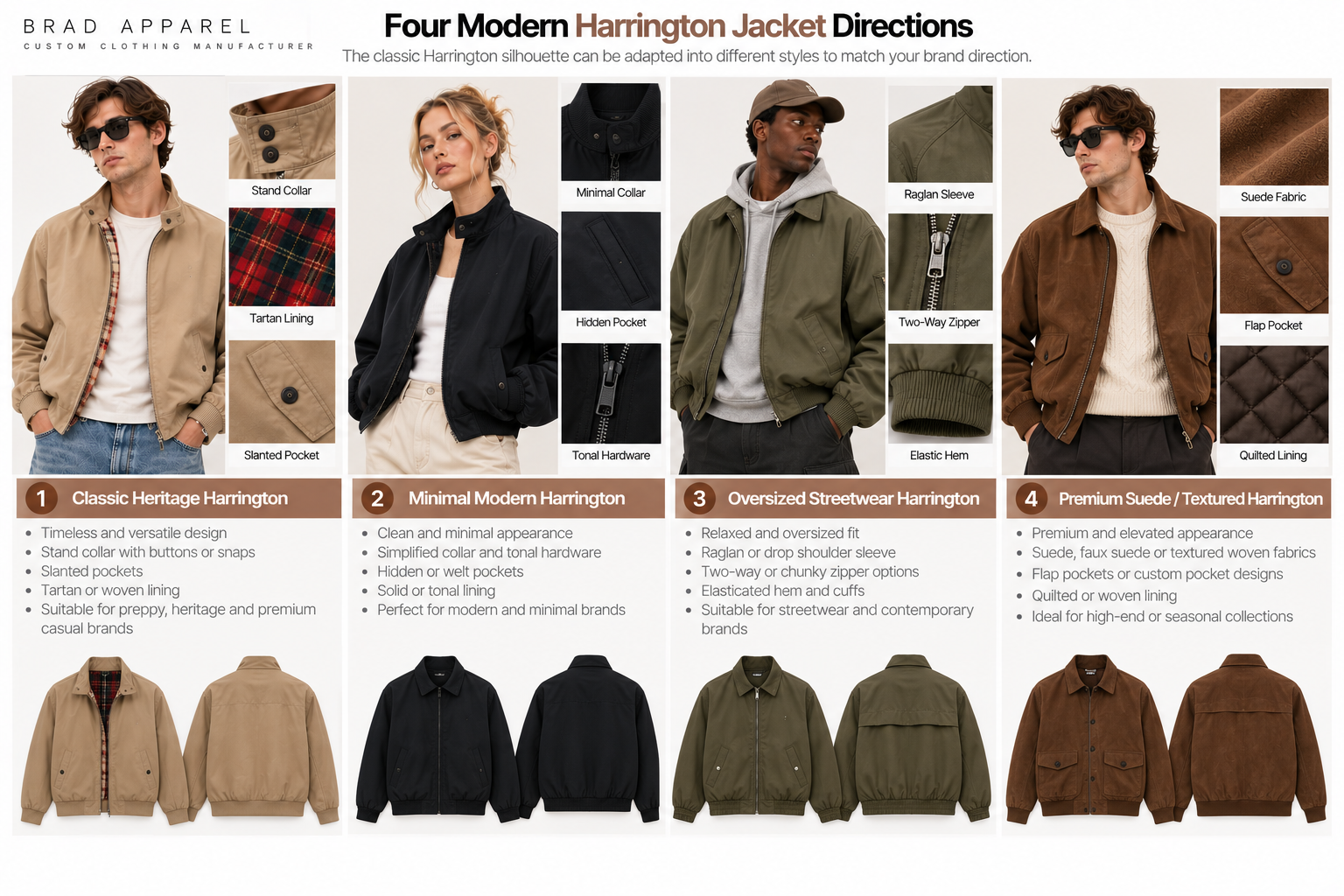
The Harrington framework can support very different product directions.
1. Classic Heritage Harrington
Typical features:
- Cotton-blend shell
- Stand collar
- Collar buttons or snaps
- Metal zipper
- Slanted flap pockets
- Check lining
- Controlled hem
Suitable for:
- Heritage brands
- Preppy collections
- Premium basics
The emphasis is on recognizable traditional detailing.
2. Minimal Modern Harrington
Possible features include:
- Solid matte fabric
- Simplified collar
- Tonal hardware
- Hidden pocket details
- Clean back
- Minimal branding
This direction works well for brands that prefer:
silhouette + fabric
over visible decoration.
3. Oversized Streetwear Harrington
Possible features include:
- Wider chest
- Drop shoulder
- Larger sleeves
- Short body
- Strong hem volume
- Larger zipper
- Custom hardware
The pattern should be purpose-built.
Simply choosing a larger classic Harrington size may create excessive length without the intended width.
4. Premium Suede / Textured Harrington
Possible materials include:
- Suede
- Faux suede
- Wool blends
- Textured woven fabrics
This creates a more fashion-oriented interpretation.
The main challenge becomes controlling:
- thickness
- seam bulk
- zipper weight
- collar structure
Decoration Is Usually Better When Controlled
The Harrington's identity comes mainly from its silhouette and construction.
Possible branding options include:
- Small chest embroidery
- Tonal embroidery
- Woven badge
- Sleeve logo
- Custom zipper pull
- Custom buttons or snaps
- Woven label
- Custom lining
Large graphics are possible, but they can shift attention away from the jacket's clean design.
Brad Apparel's Trims & Branding page covers custom zippers, buttons, snaps, labels and branded garment details.
Embroidery Needs Fabric Testing
Embroidery can work well on a Harrington.
But lightweight shell fabric may pucker when stitch density is too high.
Before bulk production, check:
- Stabilizer
- Stitch density
- Logo size
- Fabric distortion
- Reverse-side finish
The actual production fabric should be tested rather than approving embroidery only on a generic swatch.
What Should You Check on a Harrington Jacket Sample?
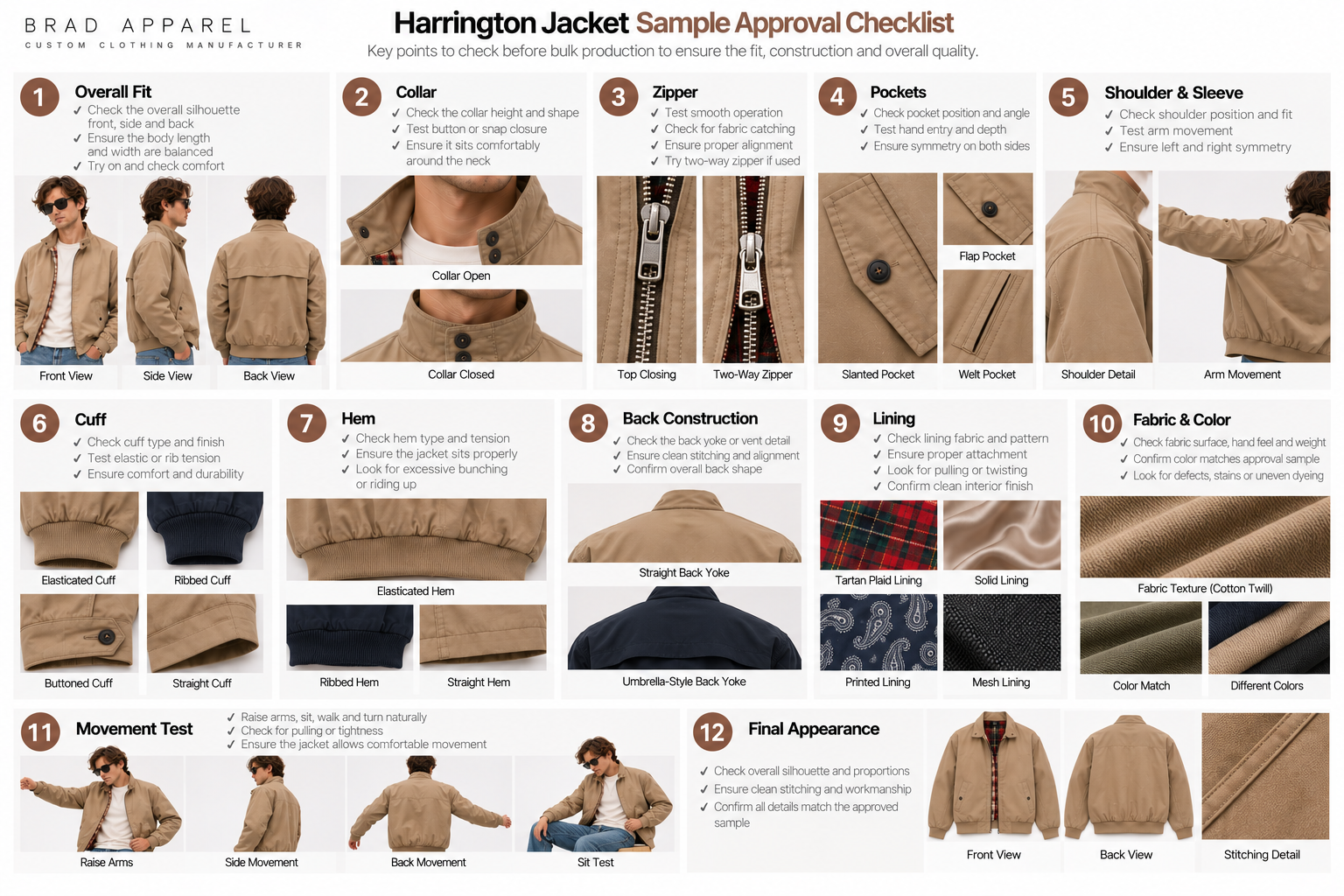
A Harrington jacket should be checked both:
open
and
fully zipped.
1. Front View
Check:
- Overall width
- Body length
- Zipper alignment
- Pocket position
- Hem balance
2. Side View
Check:
- Body volume
- Sleeve shape
- Hem tension
- Front/back balance
3. Back View
Check:
- Shoulder balance
- Back yoke
- Vent detail if used
- Hem level
- Sleeve symmetry
4. Collar
Check:
- Height
- Shape
- Symmetry
- Neck comfort
- Button or snap position
Test the collar both open and closed where applicable.
5. Zipper
Open and close repeatedly.
Check:
- Smooth operation
- Fabric catching
- Zipper wave
- Bottom alignment
- Top finishing
6. Pockets
Check:
- Angle
- Height
- Opening
- Symmetry
- Hand access
7. Shoulder & Sleeve
Check:
- Shoulder position
- Sleeve pitch
- Arm movement
- Left/right symmetry
8. Cuffs
Check:
- Opening
- elastic tension
- comfort
- symmetry
9. Hem
Check:
- tension
- overall shape
- body blousing
- zipper interaction
The jacket should not ride upward excessively.
10. Lining
Check:
- Ease
- attachment
- pattern orientation
- interior cleanliness
- no pulling
11. Movement Test
Ask the wearer to:
- Raise arms
- Reach forward
- Sit
- Walk
- Turn naturally
The jacket should move without excessive pulling.
12. Fabric & Final Appearance
Check:
- Surface
- color
- creasing
- seam appearance
- pressing
- overall silhouette
Common Harrington Jacket Development Mistakes
Making the Body Too Long
The jacket loses its compact proportion.
Making the Collar Too Soft
The stand collar collapses.
Making the Collar Too Tight
The closed position becomes uncomfortable.
Using a Heavy Zipper With Lightweight Fabric
The front can distort.
Using Too Much Hem Elastic
The jacket bunches excessively or rides upward.
Copying a Bomber Pattern
A bomber and Harrington may look similar but use different:
- collar
- body shape
- pocket construction
- lining
- detailing
Adding a Back Yoke Without Considering Layer Thickness
Multiple fabric layers can create bulk.
Approving Only the Front View
The Harrington silhouette depends strongly on:
- side balance
- back construction
- hem shape
Changing Shell Fabric After Pattern Approval
Different fabric structure can change:
- collar behavior
- hem shape
- drape
- zipper balance
A new material may require resampling.
What Should You Send a Harrington Jacket Manufacturer?
A useful development brief should define:
| Area | What to Specify |
|---|---|
| Fit | Classic / relaxed / oversized |
| Body Length | Finished length |
| Shell Fabric | Cotton / blend / nylon / suede / other |
| Fabric Structure | Weight, density, hand feel |
| Collar | Height, shape, closure |
| Shoulder | Raglan / set-in / drop shoulder |
| Sleeve | Width and finished length |
| Zipper | Metal / coil / molded / two-way |
| Welt / flap / snap / zipper | |
| Hem | Elastic / rib / partial elastic / straight |
| Cuff | Elastic / rib / button / straight |
| Back | Clean / yoke / vent-style |
| Lining | None / solid / check / custom |
| Branding | Embroidery / patch / custom hardware |
| Quantity | Sample and bulk quantity |
A reference photo can communicate the visual direction.
But the manufacturer still needs actual measurements, fabric and construction specifications.
How Brad Apparel Can Develop a Custom Harrington Jacket
A Harrington project can follow:
Design Reference
↓
Shell Fabric Selection
↓
Fit & Length Confirmation
↓
Collar Development
↓
Sleeve & Back Construction
↓
Zipper / Hardware Selection
↓
Lining Confirmation
↓
First Sample
↓
Fit & Movement Review
↓
Detail Adjustment
↓
Pre-Production Approval
↓
Bulk Production
Brad Apparel supports Harrington-style woven jacket development through Fabric Sourcing & Development, Custom Zippers & Sliders, Trims & Branding and our broader Manufacturing Capabilities.
FAQ
What Is a Harrington Jacket?
A Harrington jacket is generally a short zip-front outer jacket with a stand collar, clean pockets and controlled hem.
Traditional versions may also use checked lining and distinctive back construction.
Is a Harrington Jacket the Same as a Bomber Jacket?
No.
They can share a short body and zip front, but bombers commonly use rib collars and rounder sportswear proportions.
Harrington jackets typically use a stand collar and cleaner heritage styling.
Is a Harrington Jacket a Windbreaker?
Not necessarily.
Some lightweight Harrington jackets may provide similar transitional use, but windbreakers are generally a broader lightweight shell category.
A Harrington is more strongly defined by its silhouette and heritage construction details.
Does a Harrington Jacket Need a Tartan Lining?
No.
Checked lining is strongly associated with traditional versions, but modern Harrington jackets can use solid, printed, custom or partial lining.
What Fabric Is Best for a Harrington Jacket?
There is no single best fabric.
Possible options include:
- Cotton twill
- Cotton-polyester blends
- Polyester
- Nylon
- Suede
- Faux suede
- Wool blends
The correct material depends on the target structure and season.
Can a Harrington Jacket Be Oversized?
Yes.
But oversized proportions should be purpose-built through the chest, shoulder, sleeve and body length.
Simply using a larger standard size may create the wrong proportions.
Can Harrington Jackets Be Water-Resistant?
They can use fabrics or finishes with water-repellent properties.
However, water resistance depends on the actual textile and construction specification and should not be assumed from the Harrington silhouette itself.
Can You Embroider a Harrington Jacket?
Yes.
Embroidery can work well for small logos and branding.
Lightweight shell fabrics should be tested for puckering and distortion before bulk production.
What Should Be Checked Before Bulk Production?
Important points include:
- Body length
- Collar shape
- Zipper operation
- Pocket position
- Shoulder fit
- Sleeve movement
- Hem tension
- Cuff tension
- Back construction
- Lining ease
- Fabric appearance
- Overall balance
Final Thoughts
The Harrington jacket is a good example of a garment where simplicity makes manufacturing quality more visible.
There are usually no large graphics or complex decorations hiding the construction.
Customers notice:
the collar
the zipper
the body proportion
the pockets
the hem
the lining
and
how the jacket sits on the body.
For clothing brands, the best Harrington jackets are therefore developed as one complete system:
Fabric
+
Pattern
+
Collar
+
Zipper
+
Sleeves
+
Hem
+
Lining
rather than as a generic short jacket with heritage details added afterward.
That is what allows the finished garment to feel recognizable, modern and consistent from sample to bulk production.
Keep Reading