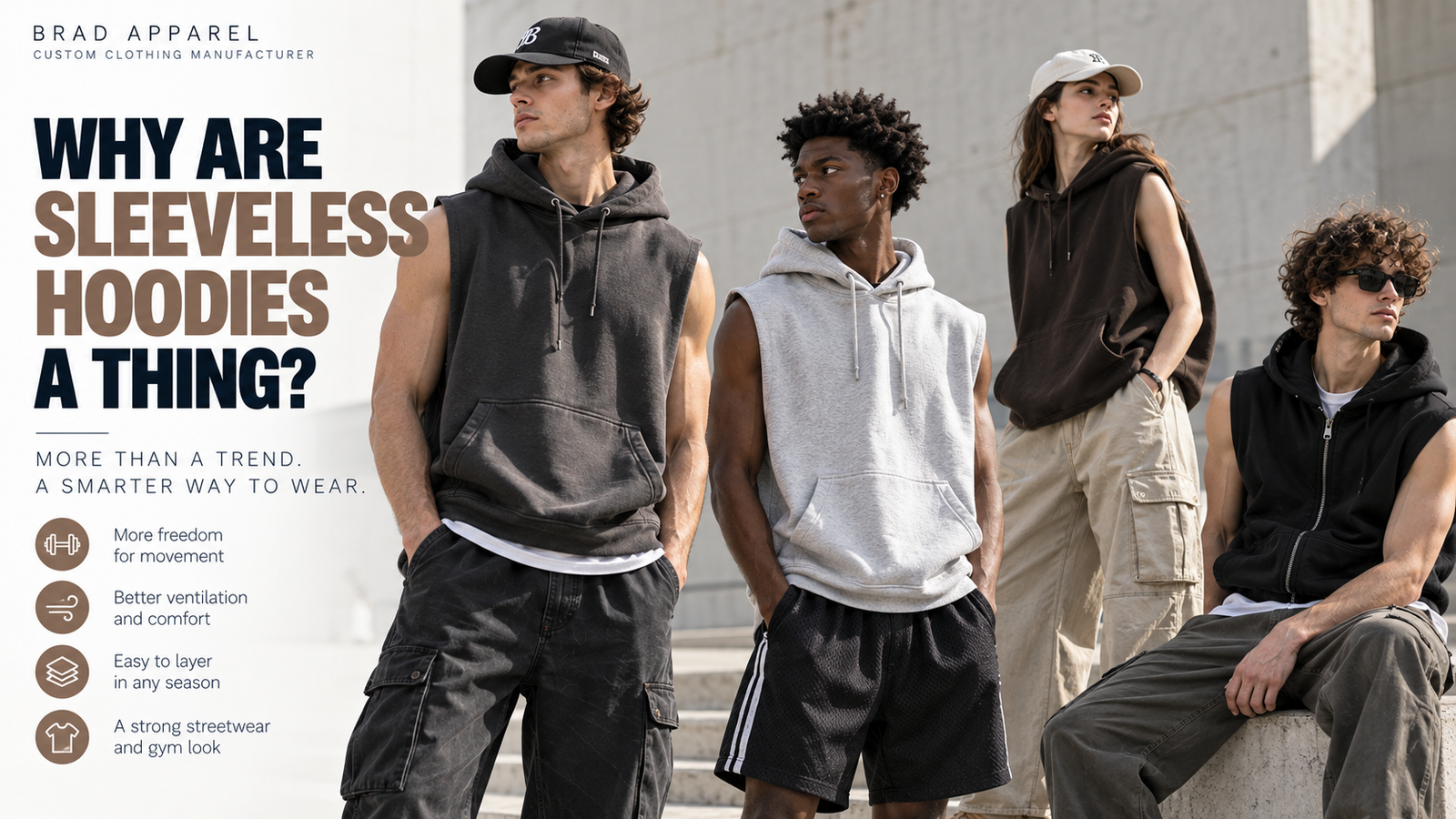
A sleeveless hoodie can look contradictory at first.
A hoodie is normally associated with warmth.
So why remove the sleeves?
Because a sleeveless hoodie is not simply a colder version of a regular hoodie.
It serves a different purpose.
Removing the sleeves can create:
- More shoulder movement
- More ventilation
- Easier layering
- A stronger gym or streetwear silhouette
- More visible arms and shoulder proportions
- A different balance between the hood and body
That is why sleeveless hoodies appear in several different categories, from training apparel to oversized streetwear.
For clothing brands, however, the important point is this:
A good sleeveless hoodie should be designed as a sleeveless garment from the beginning.
Simply cutting the sleeves off a standard hoodie does not automatically create a well-balanced product.
This guide explains why sleeveless hoodies exist, what the different versions are called, and what brands should consider when developing one for production.
Quick Answer: What Is the Point of a Sleeveless Hoodie?

The main idea is simple:
Keep the hood and hoodie body while removing sleeve restriction.
Depending on the design, this can make the garment useful for:
Training
The shoulders and arms remain unrestricted.
Transitional Weather
The torso stays covered without the warmth of full sleeves.
Layering
It can sit over a T-shirt, compression top or long sleeve.
Streetwear
The open armhole creates a different silhouette from a conventional hoodie.
Fashion Styling
Oversized, cropped and raw-edge versions can become statement pieces rather than purely functional athletic garments.
So the sleeveless hoodie is less about replacing a regular hoodie and more about creating a different product category.
What Is a Sleeveless Hoodie Called?
There is no single name used for every version.
Several terms appear in retail and apparel development.
| Term | Typical Meaning |
|---|---|
| Sleeveless Hoodie | General hoodie-shaped garment without sleeves |
| Hooded Tank Top | Usually lighter, more fitted and activewear-oriented |
| Muscle Hoodie | Gym-inspired version with open or deeper armholes |
| Sleeveless Sweatshirt | Sweatshirt body with no sleeves, sometimes without typical hoodie details |
| Hooded Vest | Usually more structured outer-layer construction |
These names overlap, but the actual garment may be very different.
Sleeveless Hoodie vs Hooded Tank Top
A hooded tank top is usually closer to activewear.
Typical features may include:
- Lighter fabric
- Narrower body
- Deeper armholes
- More fitted silhouette
- Minimal pocket bulk
It is commonly designed for:
- Gym training
- Running
- Warm-weather casualwear
- Fitness collections
A sleeveless hoodie can be much broader.
It may be:
- Heavyweight
- Oversized
- Boxy
- Cropped
- Washed
- Graphic-heavy
So:
Every hooded tank is sleeveless, but not every sleeveless hoodie is really a tank top.
Sleeveless Hoodie vs Hooded Vest
This distinction is also important.
A sleeveless hoodie generally keeps the construction language of a sweatshirt:
- Knit fabric
- Hoodie-shaped body
- Rib or sweatshirt-style hem
- Kangaroo pocket
- Drawcord hood
A hooded vest may behave more like outerwear.
It may use:
- Woven nylon
- Padding
- Quilting
- Front zipper
- Utility pockets
- Technical trims
If you are specifically interested in wearing a separate vest over a full-sleeve hoodie, see our Hoodie + Vest Layering Guide.
That is a different construction from a true sleeveless hoodie.
The 4 Main Sleeveless Hoodie Directions
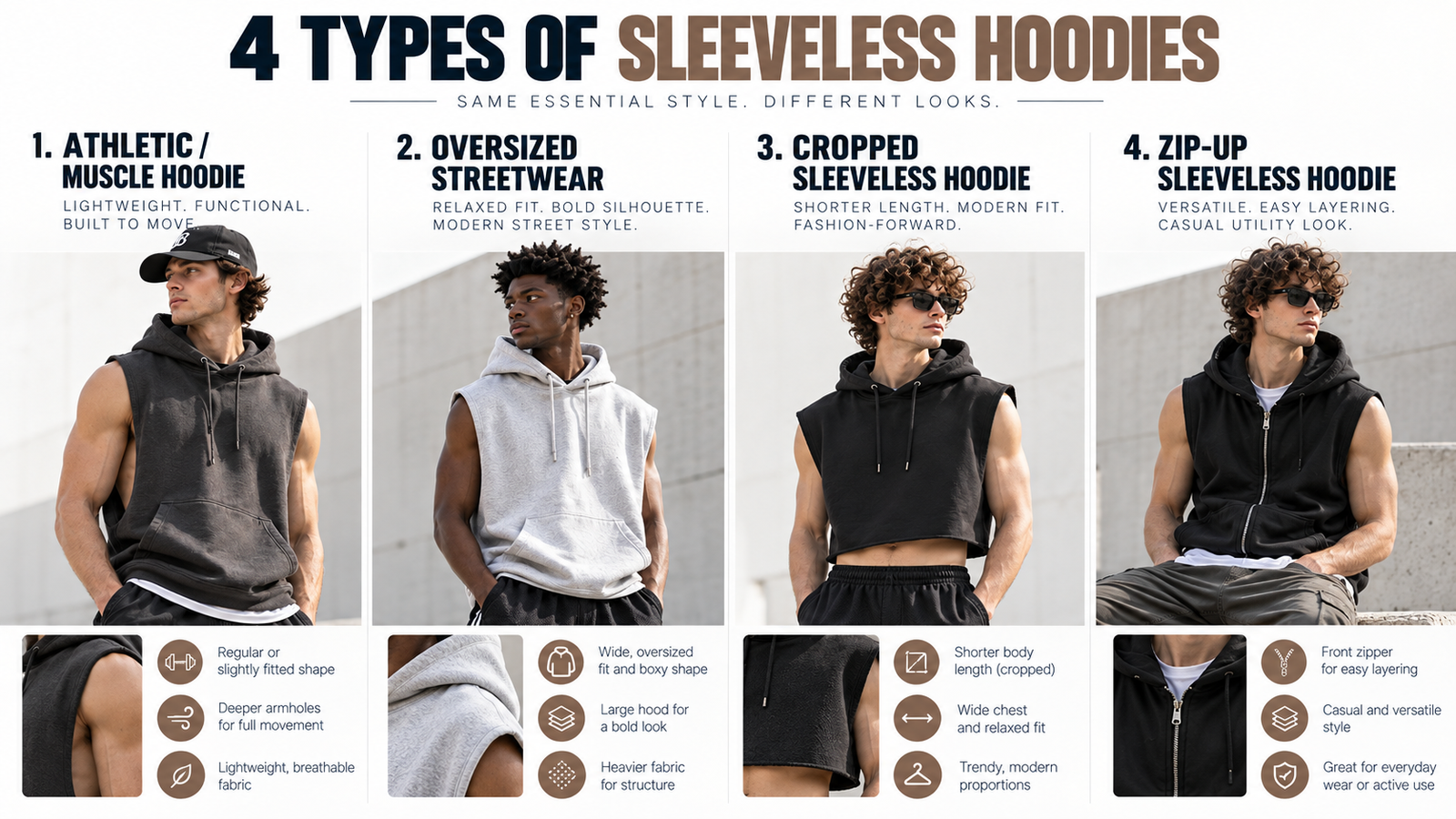
Sleeveless hoodies can be developed in very different ways.
1. Athletic / Muscle Hoodie
This is one of the most functional versions.
Typical characteristics include:
- Regular or slightly fitted body
- Generous arm opening
- Lightweight or midweight fabric
- Simple hood
- Minimal bulk
The goal is usually movement.
It can work well for:
- Weight training
- Fitness brands
- Active lifestyle collections
- Layering over compression wear
2. Oversized Streetwear Sleeveless Hoodie
This version treats the garment as a fashion silhouette.
It may include:
- Wide chest
- Drop or extended shoulder
- Large armholes
- Heavy hood
- Long or boxy body
- Large graphics
The open shoulder area becomes part of the design.
This type can be worn:
- Over a T-shirt
- Over a long sleeve
- As a standalone statement piece
3. Cropped Sleeveless Hoodie
A cropped version changes the proportions significantly.
Common directions include:
- Short body
- Wide chest
- Large hood
- Open armholes
- Elastic or ribbed hem
It can be used for:
- Women's streetwear
- Fashion activewear
- Layering collections
- Trend-driven capsules
The relationship between crop length and armhole depth is especially important.
4. Zip-Up Sleeveless Hoodie
A front zipper makes the garment easier to layer.
Possible applications include:
- Gym warm-up pieces
- Utility streetwear
- Lightweight transitional outerwear
- Casual layering
A zip-up version may also include:
- Side pockets
- Two-way zipper
- Stand collar combined with hood
- Drawcord hem
Why You Should Not Simply Cut the Sleeves Off a Regular Hoodie
This is one of the biggest differences between a homemade cut-off and a production-ready sleeveless hoodie.
A standard hoodie pattern is built around a sleeve and armhole relationship.
If the sleeve is simply removed, several problems can appear.
Armholes May Become Too Small
A standard armhole is designed to connect to a sleeve.
Without that sleeve, the opening can feel tight and visually awkward.
The Shoulder May Be Too Wide
A conventional hoodie shoulder may extend too far once the sleeve disappears.
This can create an accidental cap-sleeve effect.
The Armhole May Expose Too Much
Increasing the opening too aggressively can expose:
- Side chest
- Undergarments
- Too much of the side body
So a larger armhole does not automatically mean a better sleeveless fit.
The Hood Can Feel Visually Too Heavy
A large double-layer hood adds visual and physical weight to the upper garment.
Once the sleeves disappear, that hood becomes much more dominant.
The body pattern needs enough structure to balance it.
Armhole Design Is the Most Important Detail
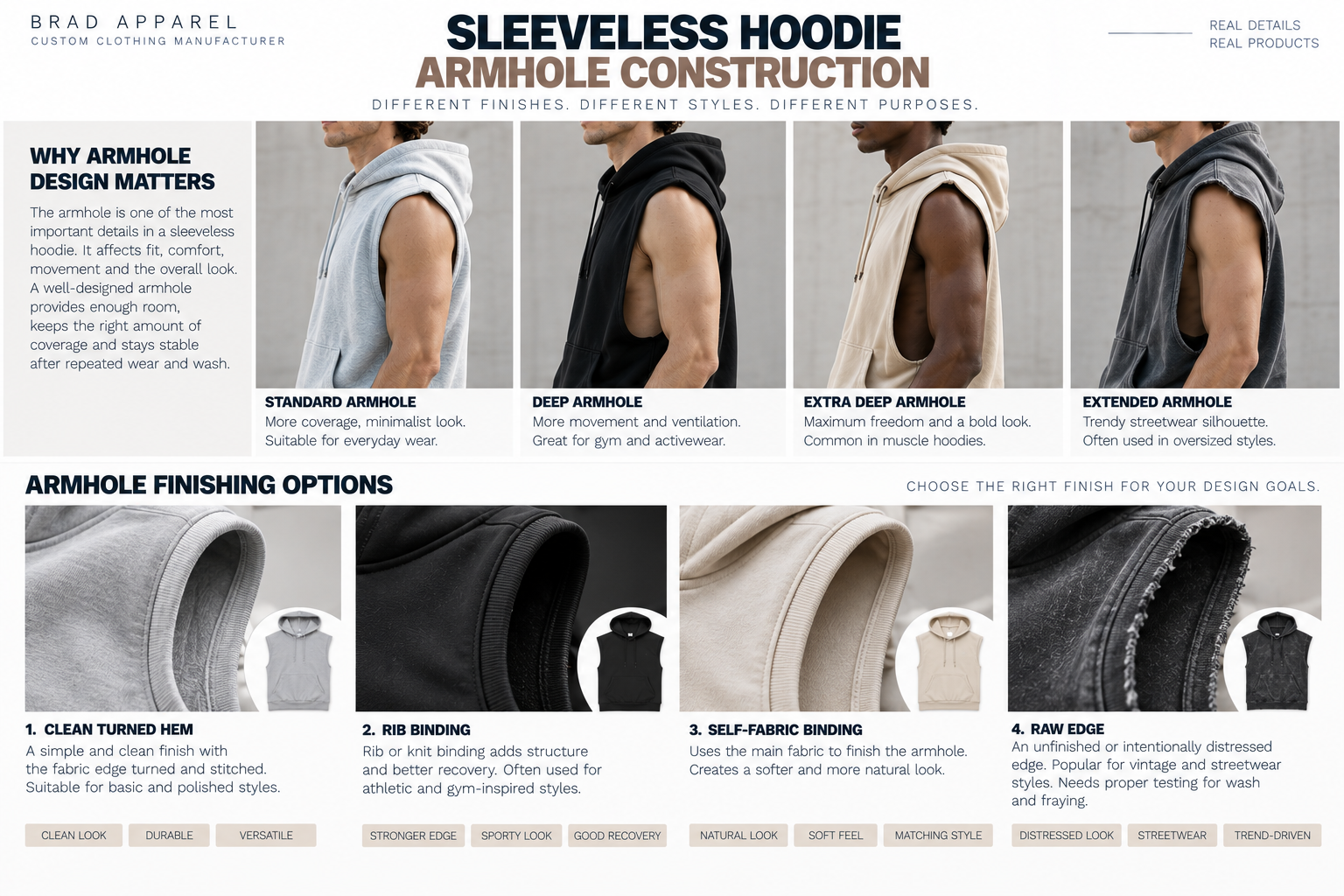
For a sleeveless hoodie, the armhole is no longer just a seam connection.
It becomes one of the main visible edges of the garment.
That means the designer has to decide:
- How deep should it be?
- How wide should the shoulder remain?
- How should the edge be finished?
- How much side body should be visible?
Standard Armhole
Keeps more coverage.
Useful for:
- Casualwear
- Minimal streetwear
- Everyday layering
Deep Armhole
Creates more mobility and visual exposure.
Useful for:
- Muscle hoodies
- Training apparel
- Layering over fitted tops
However, very deep armholes need careful side-seam positioning.
Four Common Armhole Finishes
The edge treatment changes the entire appearance.
1. Clean Turned Hem
The fabric edge is turned and stitched.
This creates:
- Clean appearance
- Minimal styling
- Stable edge
Good for polished retail basics.
2. Rib Binding
A rib or knit binding finishes the opening.
This can provide:
- Stronger recovery
- More defined edge
- Athletic appearance
The binding tension should be tested carefully.
Too much tension may pull the armhole inward.
3. Self-Fabric Binding
The main fabric or matching fabric is used around the arm opening.
This creates a softer visual result than contrasting rib.
4. Raw Edge
The edge is intentionally left unfinished or minimally stabilized.
This can create:
- Distressed appearance
- DIY influence
- Vintage gym aesthetic
But "raw edge" does not mean uncontrolled production.
The factory still needs to consider:
- Fabric curling
- Fraying
- Wash behavior
- Seam stability
Shoulder Width Changes the Entire Silhouette
A sleeveless hoodie can have:
Narrow Shoulder
Creates a more tank-like or athletic appearance.
Natural Shoulder
Creates a balanced casual silhouette.
Extended Shoulder
Creates a boxy streetwear shape.
This is one reason sleeveless hoodies can look dramatically different even when the chest measurement is similar.
Hood Size Needs to Match the Body
A hood designed for a heavyweight oversized hoodie may look disproportionate on a narrow sleeveless body.
Likewise, a very small hood can make a wide streetwear body look unfinished.
The design should balance:
Hood width
Hood height
Shoulder width
Chest width
and
Body length
rather than treating the hood as an independent component.
Fit, Fabric and Use Should Be Developed Together
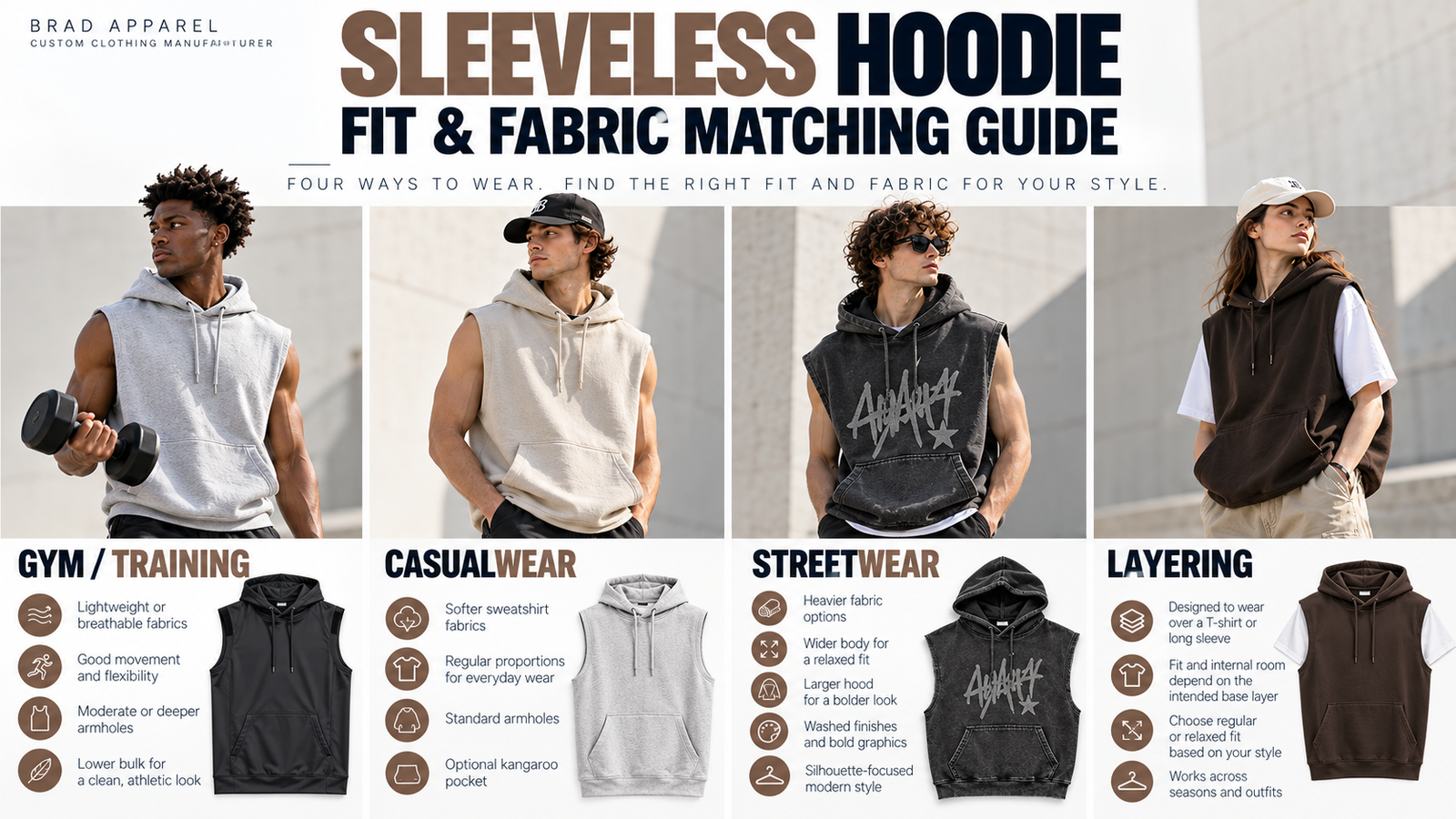
Instead of asking:
"What is the best fabric for a sleeveless hoodie?"
start with:
"How will this garment be used?"
Gym / Training
Usually benefits from:
- Lower bulk
- Good movement
- Breathable construction
- Moderate or deeper armholes
The garment should not become excessively heavy during exercise.
Casualwear
Can use:
- Softer sweatshirt fabrics
- Regular proportions
- Standard armholes
- Kangaroo pocket
This keeps the familiar hoodie appearance.
Streetwear
Can support:
- Heavier fabric
- Wider body
- Larger hood
- Washed finishes
- Bold graphics
The silhouette becomes more important than pure athletic function.
Layering
If the sleeveless hoodie is intended to sit over another garment, test it over the actual intended base layer.
For example:
Sleeveless hoodie + T-shirt
requires less internal room than:
Sleeveless hoodie + heavyweight long sleeve
Does a Sleeveless Hoodie Still Need a Kangaroo Pocket?
Not always.
A kangaroo pocket is visually associated with hoodies, but it changes the front-body weight.
Possible options include:
Kangaroo Pocket
Classic hoodie appearance.
Side-Seam Pockets
Cleaner front.
Zipper Pockets
More technical.
No Pocket
Minimal and lighter.
For athletic sleeveless styles, removing a heavy kangaroo pocket can also reduce bulk.
Body Length Matters More Than You Might Expect
Because there are no sleeves to balance the silhouette, body length becomes more noticeable.
Regular Length
Suitable for:
- Everyday wear
- Gym styles
- Basic collections
Longline
Creates a more athletic or layering-oriented appearance.
Often paired with:
- Slim pants
- Training bottoms
- Longline tees
Boxy
Shorter length combined with wider chest.
Useful for modern streetwear.
Cropped
Creates a fashion-focused proportion.
The hem width and hood size should be developed with the shortened body.
What About the Hem?
Common options include:
Rib Hem
Creates a traditional hoodie appearance.
Straight Hem
Makes the garment feel more like a T-shirt or sleeveless sweatshirt.
Drawcord Hem
Allows adjustable shape.
Raw Hem
Useful for distressed styling.
The hem choice should support the intended fit rather than simply copying a regular hoodie.
Decoration Works Differently on Sleeveless Hoodies
Removing the sleeves changes the available graphic space.
You lose:
- Sleeve printing
- Cuff embroidery
- Arm patches
But other areas become more prominent.
Possible placements include:
- Large chest graphic
- Back artwork
- Hood print
- Side body graphic
- Pocket graphic
- Small chest embroidery
For custom printing options, Brad Apparel's verified Printing Techniques page covers multiple print directions.
Large Graphics Need to Match the Silhouette
A narrow muscle hoodie and an oversized streetwear sleeveless hoodie should not necessarily use the same artwork dimensions.
For example:
A large wide graphic may look balanced on:
Wide boxy body
but crowded on:
Narrow athletic body
Decoration should be positioned after the final pattern proportions are confirmed.
Sleeveless Hoodie vs Regular Hoodie: What Actually Changes?
| Area | Regular Hoodie | Sleeveless Hoodie |
|---|---|---|
| Sleeves | Full sleeve construction | No sleeves |
| Armhole | Designed for sleeve attachment | Visible design feature |
| Shoulder | Works with sleeve shape | Defines final silhouette |
| Movement | Depends on sleeve fit | More open shoulder movement |
| Ventilation | More body coverage | More airflow around arms |
| Layering | Usually outer or mid layer | Can work over T-shirts or long sleeves |
| Decoration | Body + sleeves | Mostly body + hood |
| Overall Look | Traditional hoodie | Athletic, streetwear or fashion-forward |
The difference is therefore much more than simply removing fabric.
What Should Brands Test During Sampling?

A sleeveless hoodie sample should be reviewed from several angles.
Front View
Check:
- Shoulder width
- Armhole symmetry
- Chest balance
- Pocket position
Side View
Check:
- Side-body exposure
- Armhole depth
- Body drape
Back View
Check:
- Hood proportion
- Shoulder line
- Back width
Movement Test
Ask the wearer to:
- Raise both arms
- Reach forward
- Rotate the shoulders
- Bend the elbows
- Walk naturally
Watch for:
- Armhole pulling
- Side-seam distortion
- Hood movement
- Body lifting
Layering Test
If the garment is designed for layering, test it over the intended base garment.
Do not approve a layering product only on a model wearing it directly against the skin.
Common Sleeveless Hoodie Development Mistakes
1. Simply Removing the Sleeves
The remaining pattern may not have the correct armhole or shoulder proportions.
2. Armholes That Are Too Deep
This can expose more of the side body than intended.
3. Armholes That Are Too Tight
Movement becomes restricted and the garment loses the functional benefit of being sleeveless.
4. Hood Too Heavy for the Body
A substantial hood on a narrow lightweight body can pull the garment backward.
5. Wrong Edge Finish
A raw edge, rib binding and clean hem all behave differently.
The finish needs to be chosen intentionally.
6. Too Much Front Bulk
A heavy hood combined with a thick kangaroo pocket can make a lightweight sleeveless body feel unbalanced.
What Should You Send a Manufacturer?
A useful custom sleeveless hoodie brief should specify:
Garment Type
- Muscle hoodie
- Oversized sleeveless hoodie
- Cropped hoodie
- Zip-up sleeveless hoodie
Fit
- Slim
- Regular
- Boxy
- Oversized
Armhole
- Standard
- Deep
- Extra deep
Edge Finish
- Clean hem
- Rib binding
- Self-fabric binding
- Raw edge
Fabric
- Composition
- Weight
- Color
- Finish
Hood
- Single layer
- Double layer
- Drawcord or no drawcord
- Kangaroo
- Side pocket
- Zipper pocket
- None
Decoration
- Printing
- Embroidery
- Hood graphic
- Back graphic
Branding
- Main label
- Care label
- Hang tag
Brad Apparel's verified Custom Hoodie Manufacturing page covers current customization options for fabric, fit, printing and garment details.
How Should You Style a Sleeveless Hoodie?
Styling depends on which type you choose.
Athletic
Sleeveless hoodie
-
Training shorts or joggers
-
Performance sneakers
Minimal Streetwear
Black sleeveless hoodie
-
Wide trousers
-
Clean sneakers
Layered Streetwear
Oversized sleeveless hoodie
-
Long sleeve T-shirt
-
Cargo pants
Vintage Gym
Washed raw-edge sleeveless hoodie
-
Relaxed sweatpants
-
Retro sneakers
The important point is to let the sleeveless construction remain visible rather than adding too many competing layers.
FAQ
Why Do Sleeveless Hoodies Exist?
They combine the visual identity of a hoodie with increased arm mobility, ventilation and layering flexibility.
They are commonly used in fitness, streetwear and casual fashion.
What Is a Sleeveless Hoodie Called?
Common names include:
- Sleeveless hoodie
- Hooded tank
- Muscle hoodie
- Hooded vest
The most accurate term depends on the fabric and construction.
Is a Sleeveless Hoodie the Same as a Vest?
Not necessarily.
A sleeveless hoodie normally retains sweatshirt-style construction, while a vest may use woven outerwear fabrics, padding or more structured construction.
Are Sleeveless Hoodies Good for the Gym?
They can be.
A properly designed gym version can provide more shoulder freedom and ventilation than a full-sleeve hoodie.
Fabric weight and armhole shape should match the intended workout use.
Can You Wear a Shirt Under a Sleeveless Hoodie?
Yes.
They can be layered over:
- T-shirts
- Compression tops
- Long sleeve T-shirts
The armhole should be large enough to accommodate the intended base layer.
Are Sleeveless Hoodies Good for Summer?
Lightweight versions can work in warmer conditions, but a heavy sweatshirt fabric may still feel warm even without sleeves.
Fabric choice matters more than the absence of sleeves alone.
Can a Sleeveless Hoodie Be Oversized?
Yes.
Oversized sleeveless hoodies are especially suitable for streetwear because the wider body and open armholes create a strong silhouette.
Should the Armholes Be Finished or Raw?
Either can work.
Clean binding or hemming creates a polished product.
Raw edges create a distressed or vintage appearance.
The choice should be intentional and tested after washing.
Can Sleeveless Hoodies Be Customized?
Yes.
Brands can customize:
- Fabric
- Fit
- Armhole shape
- Hood
- Hem
- Pockets
- Printing
- Embroidery
- Labels
Final Thoughts
Sleeveless hoodies exist because they solve a different design problem from regular hoodies.
They can offer:
More movement
More ventilation
More layering flexibility
and
A different visual silhouette
But the best versions are not simply normal hoodies with the sleeves removed.
Their:
Armholes
Shoulders
Hood
Body width
Length
and
Edge finishing
should be developed as one complete garment.
For consumers, that creates a sleeveless hoodie that feels intentional.
For clothing brands, it creates a product that can stand on its own instead of looking like an unfinished version of something else.
Keep Reading