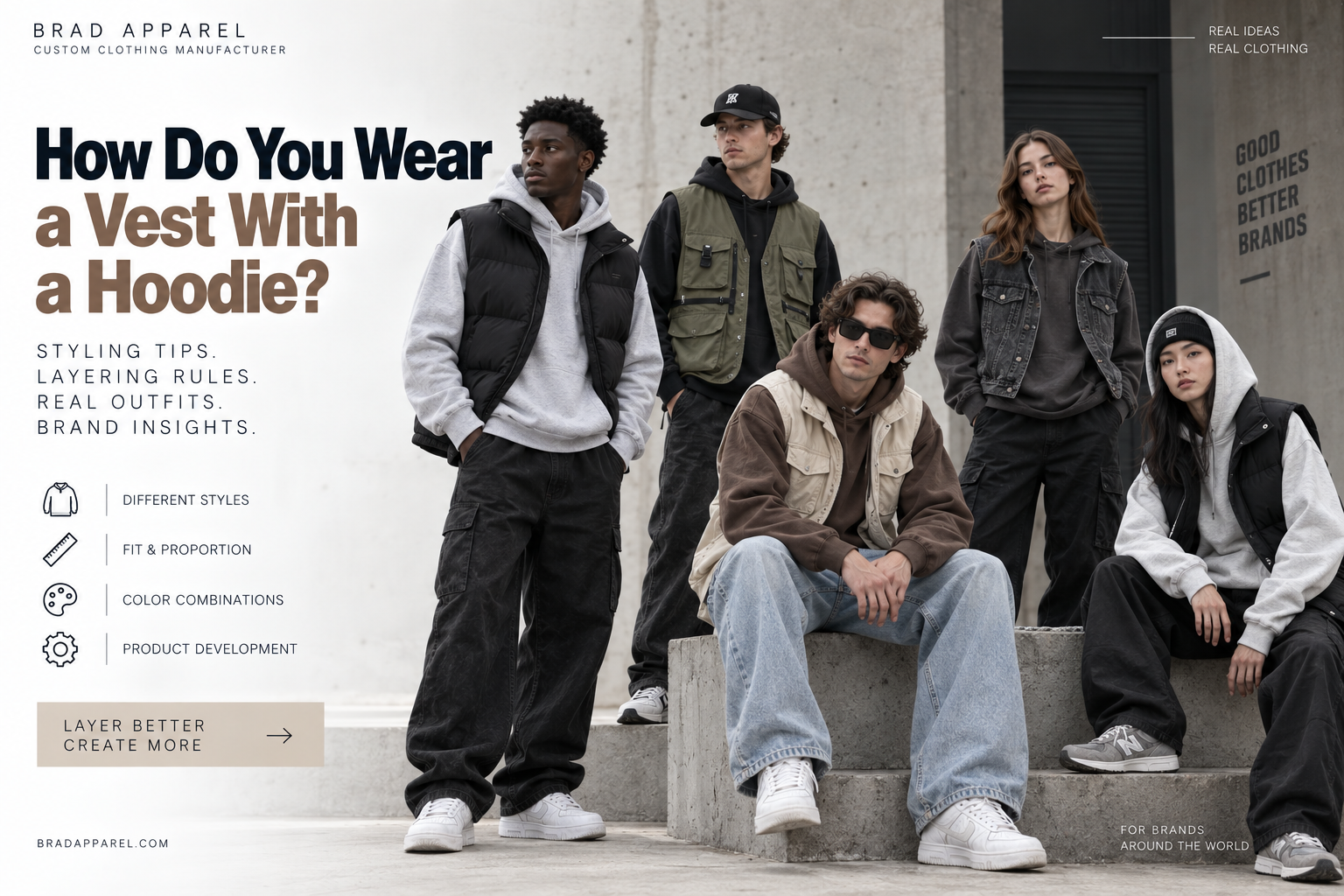
Yes — you can wear a vest over a hoodie.
The combination works best when the two garments have different jobs in the silhouette:
- The hoodie provides softness, sleeve volume and the hood
- The vest adds structure, contrast and another visual layer
The simplest formula is:
Hoodie + slightly more structured vest + relaxed trousers + simple footwear
But whether the outfit looks balanced or bulky depends heavily on:
- Hoodie fit
- Vest length
- Vest volume
- Armhole size
- Hood size
- Fabric thickness
- Color balance
For clothing brands, these same details also matter during product development.
A hoodie and vest can look good separately but still fit poorly when worn together.
This guide explains both how to style the combination and how brands can develop hoodie-and-vest pieces that actually layer well together.
Quick Answer: What Is the Best Way to Wear a Vest Over a Hoodie?

A reliable starting point is:
Relaxed hoodie + structured vest + straight or relaxed pants
The vest should generally leave enough room for:
- The hood
- Shoulder volume
- Sleeve movement
- The hoodie body underneath
For a cleaner outfit, keep one garment visually dominant.
For example:
Look 1 — Minimal
Black hoodie
-
Charcoal vest
-
Black or dark-grey trousers
Look 2 — Outdoor Streetwear
Heather-grey hoodie
-
Olive utility vest
-
Cargo pants
Look 3 — Winter Streetwear
Oversized hoodie
-
Puffer vest
-
Wide-leg trousers
Look 4 — Retro / Y2K
Washed hoodie
-
Denim vest
-
Relaxed denim or cargos
The key is not simply putting one garment over another.
It is balancing their length, width and visual weight.
Why Does a Vest Work So Well Over a Hoodie?
A hoodie is naturally soft and rounded.
It has:
- Sleeves
- Hood volume
- Rib cuffs
- A relatively relaxed body
A vest introduces a different structure.
Depending on the design, it can add:
- Vertical lines
- Pockets
- Quilting
- Technical fabric
- Hardware
- Cropped proportions
- Additional color contrast
That creates visual separation between the upper body and the sleeves.
The combination is also practical because a vest adds insulation around the torso without adding another full sleeve layer.
1. Puffer Vest + Hoodie
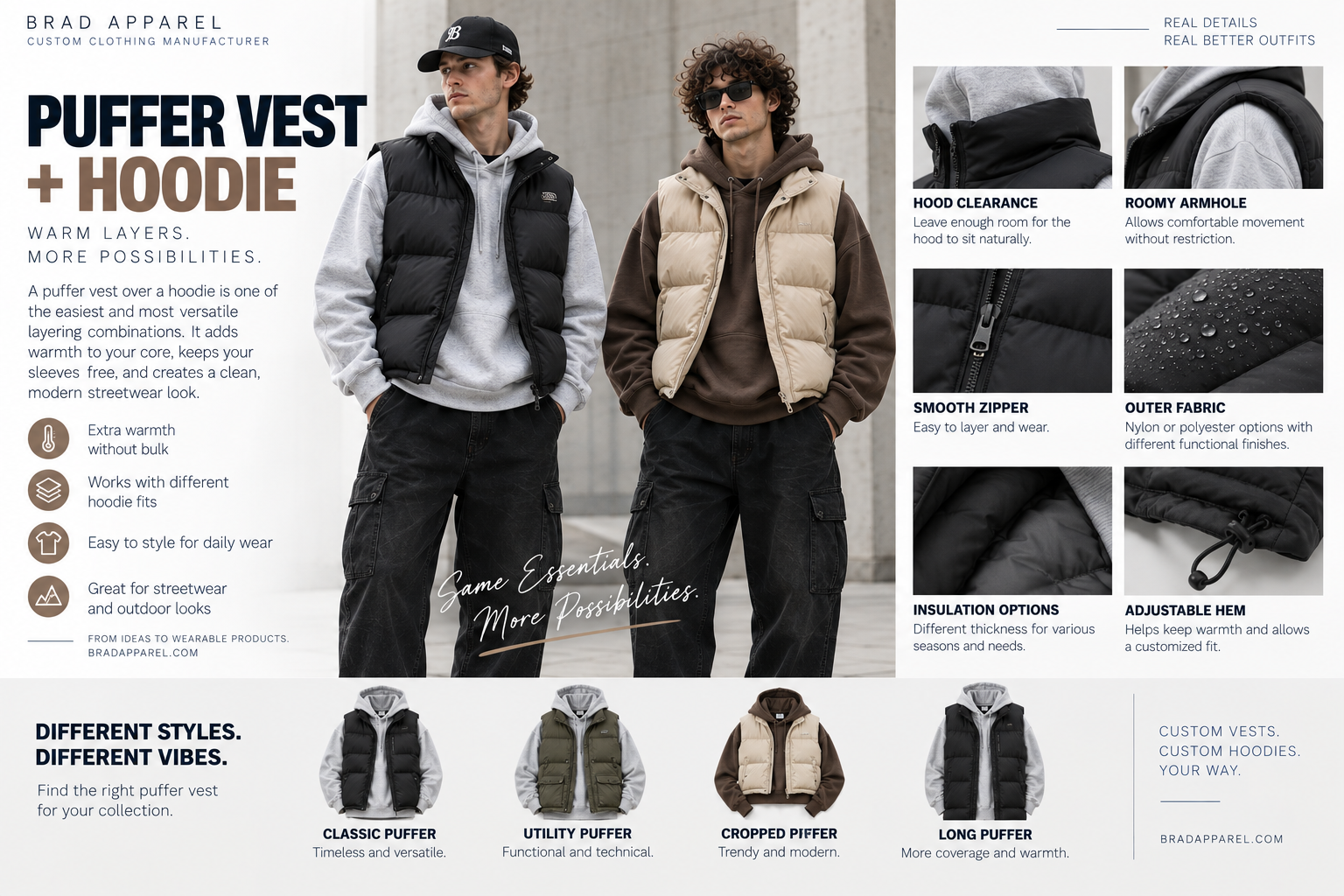
A puffer vest is one of the easiest options to pair with a hoodie.
It works particularly well for:
- Autumn
- Winter
- Outdoor-inspired streetwear
- Casual collections
- Athleisure
But volume matters.
Oversized Hoodie + Puffer Vest
If the hoodie is already very oversized, the puffer vest should not be excessively tight.
Otherwise, the hoodie may bunch around:
- Chest
- Armholes
- Side seams
- Neckline
A slightly roomy vest allows the hoodie to retain its intended silhouette.
Regular Hoodie + Puffer Vest
A regular-fit hoodie can support more vest volume.
For example:
Regular hoodie + moderately padded vest
creates a cleaner outdoor-inspired look.
This is often easier to layer than:
Very oversized hoodie + extremely padded vest
because the latter can create too much volume through the torso.
2. Utility Vest + Hoodie
A utility vest creates a more technical or streetwear-oriented look.
Common details include:
- Patch pockets
- Zippers
- Webbing
- Snaps
- Adjustable hardware
- Technical woven fabrics
Because utility vests already contain many visual details, the hoodie underneath often works better when it is relatively simple.
For example:
Plain charcoal hoodie + olive utility vest
usually feels more balanced than:
Graphic hoodie + multi-pocket vest + multiple contrasting trims
unless a deliberately maximalist look is intended.
Why the Armhole Matters
This is one of the most overlooked details.
A vest worn over a hoodie needs a sufficiently large armhole.
If it is too small:
- Hoodie fabric gathers under the arm
- Movement becomes restricted
- Shoulder seams distort
- The vest can lift upward when the wearer raises their arms
For brands developing a vest specifically for hoodie layering, the armhole should be tested with the intended hoodie underneath, not only over a T-shirt.
3. Denim Vest + Hoodie
A denim vest creates a more casual and retro appearance.
It can work particularly well with:
- Washed hoodies
- Vintage graphics
- Faded colors
- Y2K-inspired collections
- Distressed garments
Denim creates a stronger surface contrast than nylon or polyester.
For example:
Soft fleece hoodie
against
Rigid washed denim
creates an obvious difference in texture.
That can make a relatively simple outfit more interesting without requiring additional graphics.
Hoodie Fit vs Vest Fit: Which Combination Works Best?

There is no universal rule that one garment must always be fitted.
A better approach is to consider the complete silhouette.
| Hoodie Fit | Vest Direction | Overall Result |
|---|---|---|
| Regular | Padded / relaxed vest | Clean and practical |
| Regular | Utility vest | Technical and balanced |
| Oversized | Relaxed vest | Streetwear |
| Oversized | Cropped vest | Strong proportion contrast |
| Boxy | Short structured vest | Contemporary |
| Washed oversized | Denim vest | Vintage / Y2K |
The risky combination is usually:
Very bulky hoodie + very tight vest
because the garments begin competing for space.
Vest Length Changes the Entire Outfit
Vest length is just as important as vest width.
Cropped Vest
A cropped vest emphasizes the hoodie underneath.
It works particularly well with:
- Oversized hoodies
- Boxy hoodies
- Longer hoodie bodies
The visible hoodie hem creates a layered proportion.
This is useful when the hoodie should remain the dominant garment.
Standard-Length Vest
A vest that finishes near the hoodie hem creates a more controlled silhouette.
This works well for:
- Casual collections
- Outdoor looks
- Minimal streetwear
It usually creates the easiest commercial fit.
Long Vest
A longer vest changes the hierarchy.
Now the vest becomes the dominant outer layer.
This direction can work for:
- Technical fashion
- Minimal outerwear
- Layered winter collections
but requires more careful proportion control.
The Hood Needs Space Too
The hood is another area where layering often fails.
A large double-layer hoodie hood already contains significant volume.
If the vest has:
- A very high collar
- A narrow neckline
- A bulky stand collar
the two components can compete with each other.
This can cause the hood to:
- Fold awkwardly
- Push forward
- Sit too high behind the neck
Hood + Stand Collar
This combination can still work.
But the pattern should allow enough space for both pieces.
A lower or slightly wider vest collar often accommodates a substantial hoodie more comfortably.
For brands developing these pieces as a set, testing them together during sampling is much better than developing each garment independently.
How Much Fabric Weight Should You Layer?
This is where brands often overcomplicate the outfit.
You do not always need:
Heavy hoodie + heavy insulated vest
A balanced layering system may use:
Transitional Layering
Midweight hoodie
-
Lightweight woven utility vest
Winter Layering
Substantial fleece hoodie
-
Insulated puffer vest
Fashion Layering
Heavy structured hoodie
-
Unlined or lightly padded cropped vest
The goal is to control combined bulk, not chase the highest possible fabric weight.
Brad Apparel already covers heavyweight hoodie fabric in more detail in our 2026 Hoodie Trends Guide.
Color Combinations That Work
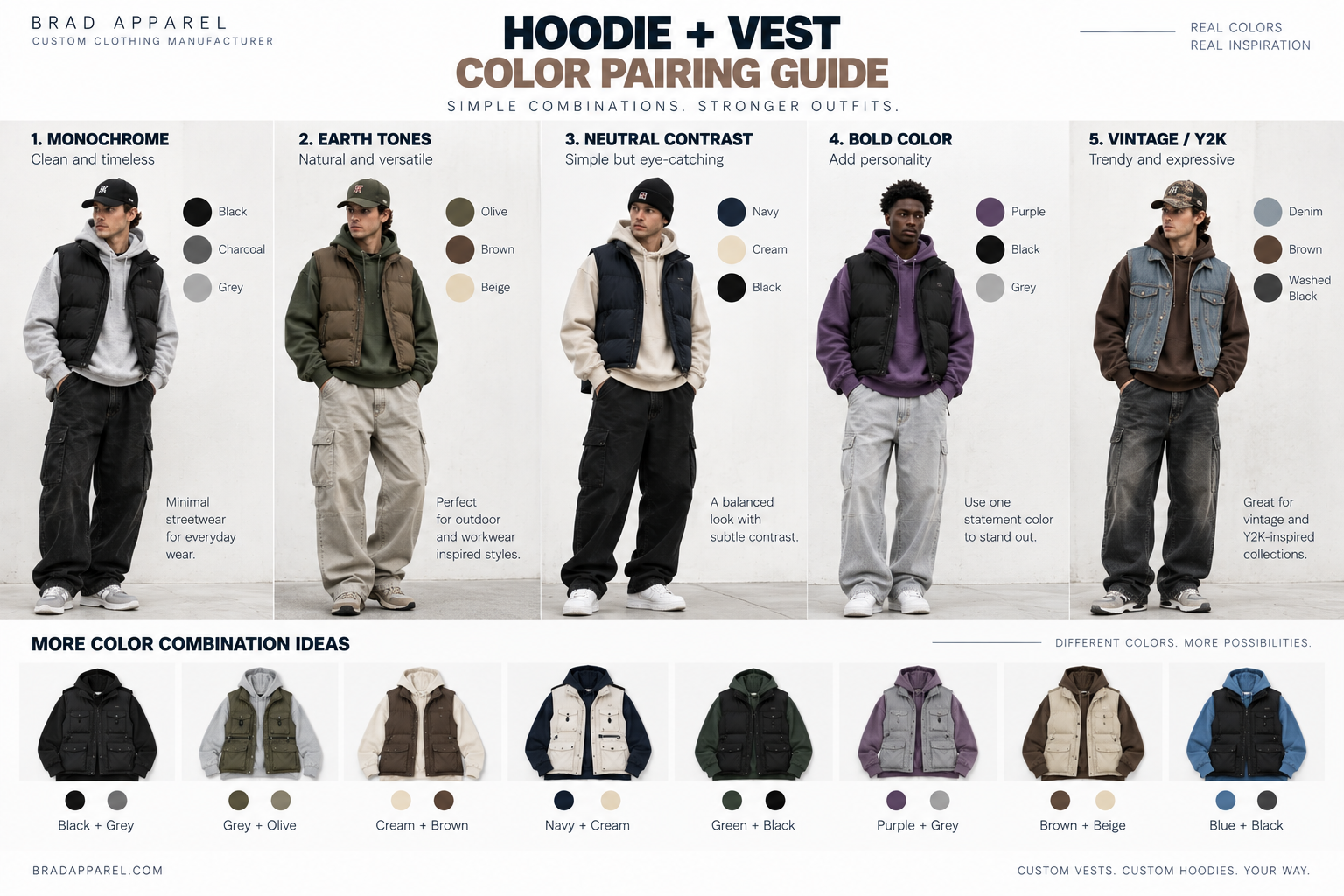
The hoodie and vest do not need to match exactly.
In fact, a small contrast often improves the layered effect.
Monochrome
Examples:
- Black + charcoal
- Cream + beige
- Grey + black
Best for:
- Minimal streetwear
- Premium basics
- Quiet luxury-inspired casualwear
Earth Tones
Examples:
- Olive + cream
- Brown + washed black
- Beige + forest green
Best for:
- Outdoor streetwear
- Workwear
- Autumn collections
One Statement Color
For example:
Neutral hoodie + colored vest
or:
Colored hoodie + neutral vest
This usually works better than making both garments compete for attention.
Should the Hoodie Have a Graphic?
It can.
But remember that the vest covers a large part of the hoodie front.
A large central chest graphic may disappear underneath it.
For hoodie-and-vest outfits, useful graphic placements can include:
- Hood print
- Sleeve graphics
- Lower front graphic
- Back print
- Small chest logo
- Embroidery near the exposed upper chest
This is a product-development consideration, not just a styling choice.
If the garment is specifically intended for layering, decoration placement should be planned around what remains visible.
Designing a Hoodie Specifically for Vest Layering
This is where the combination becomes especially interesting for apparel brands.
Instead of treating the hoodie and vest as unrelated pieces, they can be developed as a layering system.
Important hoodie decisions include:
- Shoulder width
- Sleeve volume
- Hood size
- Fabric thickness
- Body length
- Front pocket bulk
Important vest decisions include:
- Armhole depth
- Chest ease
- Vest length
- Collar height
- Front closure
- Padding thickness
Hoodie + Vest Layering Compatibility

Imagine an oversized hoodie with:
- Wide chest
- Low armhole
- Thick sleeve head
- Large hood
Now place a narrow vest over it.
The result may be:
- Compression
- Wrinkling
- Restricted movement
Instead, the vest pattern needs enough ease to accommodate the base layer.
This does not mean simply sizing the vest up.
The pattern can be developed with:
- More chest ease
- Deeper armholes
- Suitable shoulder width
- Appropriate collar opening
while still keeping the outer silhouette intentional.
Should Brands Sell the Hoodie and Vest as a Set?
They can.
A coordinated layering capsule has several advantages.
The two garments can share:
- Color palette
- Hardware finish
- Labels
- Trim colors
- Graphic language
while still being wearable separately.
For example:
Hoodie
Washed charcoal fleece
Small tonal chest embroidery
Vest
Black technical nylon
Matching charcoal lining
Matte-black zipper
Together they create one outfit.
Separately, each piece remains commercially useful.
Three Hoodie + Vest Product Directions for a Streetwear Brand
Direction 1 — Minimal Urban
Hoodie
- Boxy fit
- Neutral color
- Minimal embroidery
Vest
- Clean padded construction
- Tonal zipper
- No large external branding
Best for:
Premium minimal streetwear.
Direction 2 — Utility Streetwear
Hoodie
- Relaxed fit
- Washed fabric
- Sleeve graphic
Vest
- Lightweight technical woven
- Utility pockets
- Webbing details
Best for:
Gorpcore and technical-inspired collections.
Direction 3 — Retro / Y2K
Hoodie
- Oversized or slightly cropped
- Vintage wash
- Graphic back print
Vest
- Cropped denim or padded vest
- Contrast hardware
Best for:
Trend-driven streetwear capsules.
What Should You Test During Sampling?
If your brand intends the garments to be worn together, do not approve them separately.
Wear the hoodie underneath the vest during the fit review.
Check:
Shoulder Movement
Can the wearer raise their arms comfortably?
Armhole
Does the hoodie bunch beneath the vest?
Hood
Does it sit naturally behind the collar?
Chest
Can the vest close without compressing the hoodie excessively?
Length
Do the two hems create the intended proportion?
Front Pocket
Does a thick kangaroo pocket create unwanted bulk under the vest?
Zipper
Does the outer zipper sit smoothly over the hoodie?
These questions can reveal problems that are invisible when each sample is evaluated alone.
Common Hoodie + Vest Layering Mistakes
1. Too Much Bulk
A thick hoodie and extremely padded vest can overwhelm the silhouette.
2. Tight Armholes
This compresses the hoodie sleeve and restricts movement.
3. Competing Collars
A large hood combined with an excessively high vest collar can become crowded.
4. Poor Length Balance
Two garments finishing at awkwardly different points can make the outfit look accidental.
5. Hidden Artwork
A large front graphic may disappear completely underneath the vest.
6. Developing the Pieces Separately
Two individually good garments can still make a poor layering combination.
How Brad Apparel Approaches Layered Hoodie Development
For brands developing hoodies intended for layering, the garment should be evaluated according to its final use rather than as an isolated sample.
A typical process may involve:
Define the intended silhouette
↓
Select the hoodie fabric and fit
↓
Determine vest structure and volume
↓
Develop samples
↓
Fit the garments together
↓
Adjust armholes, length and ease
↓
Confirm trims and branding
↓
Approve for bulk production
Brands developing a custom hoodie can review our verified Custom Hoodie Manufacturing page for current fabric, fit, printing and construction options.
FAQ
Can You Wear a Vest Over a Hoodie?
Yes.
A vest works particularly well over a hoodie because it adds structure and torso insulation while leaving the sleeves unrestricted.
The fit between the two garments is more important than following one fixed styling rule.
What Kind of Vest Looks Best With a Hoodie?
Three of the easiest options are:
- Puffer vest
- Utility vest
- Denim vest
Each creates a different look.
Puffer is warmer, utility is more technical, and denim creates a more casual or retro direction.
Should a Vest Be Bigger Than the Hoodie?
Not necessarily.
The vest should have enough internal room to accommodate the hoodie, especially through the chest and armholes.
Simply increasing the entire vest by one size is not always the best solution.
Can You Wear an Oversized Hoodie Under a Vest?
Yes.
Oversized hoodies can work particularly well with:
- Relaxed vests
- Cropped vests
- Structured outer layers
Avoid extremely tight armholes that compress the oversized hoodie.
Does a Puffer Vest Work With an Oversized Hoodie?
Yes, but balance the total volume.
If both garments are extremely bulky, the upper body can become visually heavy.
What Pants Work With a Hoodie and Vest?
Common options include:
- Cargo pants
- Straight jeans
- Relaxed denim
- Sweatpants
- Technical trousers
The lower half should support the overall silhouette rather than compete with the layered upper body.
What Colors Work Best?
Easy combinations include:
- Black + grey
- Charcoal + olive
- Cream + brown
- Navy + grey
- Washed black + beige
Using one neutral piece usually makes stronger colors easier to balance.
Should Clothing Brands Design Hoodies and Vests Together?
If they are intended to be sold or styled as a coordinated capsule, yes.
Developing them together makes it easier to control:
- Armhole clearance
- Chest ease
- Hood space
- Length
- Color
- Hardware
- Branding
Final Thoughts
Wearing a vest over a hoodie is simple.
Making the combination look intentional is about proportion.
The best outfits balance:
Hoodie volume
Vest structure
Length
Color
and
Layering space
For consumers, that creates a cleaner outfit.
For clothing brands, the same principles can guide better product development.
Instead of designing a hoodie and vest as two unrelated garments, think of them as a layering system.
When fit, fabric and proportions are developed together, both pieces become more versatile — individually and as a complete look.
Keep Reading