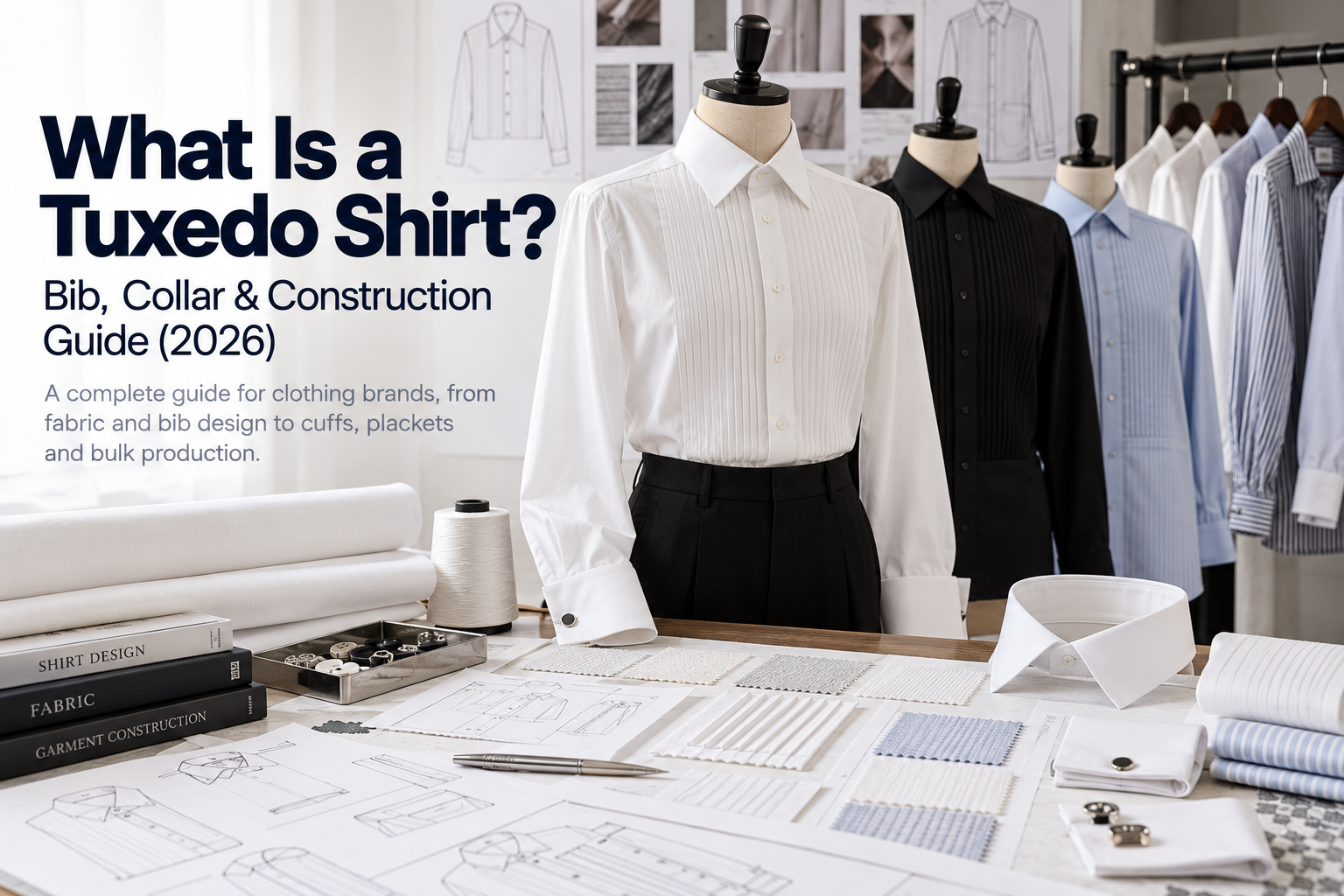
A tuxedo shirt is a button-front shirt distinguished by formal construction details such as a bib front, refined collar, controlled placket and dressier cuff treatment.
Traditional versions were developed for black-tie clothing.
Modern fashion versions can look very different.
They may be:
- Crisp and fitted
- Oversized
- Pleated
- Ruffled
- Striped
- Collarless
- Cropped
- Semi-sheer
- Minimal
- Menswear inspired
For clothing brands, the important point is that a tuxedo shirt should not simply be treated as a normal white shirt with decorative pleats added to the chest.
The final garment depends on the relationship between:
bib construction + collar + placket + cuff + fabric + interfacing + fit + pressing
A poorly engineered bib can pull the front body out of shape.
A collar that is too soft can collapse.
A French cuff that is too large can feel heavy.
And pleats that are not stabilized correctly may twist after washing.
This guide explains what defines a tuxedo shirt, how its construction differs from a standard dress shirt, and what brands should specify before sampling and bulk production.
What Is a Tuxedo Shirt?
A tuxedo shirt is a formal or fashion shirt that uses design elements associated with traditional eveningwear.
Common details may include:
- Front bib
- Pleats
- Piqué or textured front panel
- Point or spread collar
- Wing collar
- Concealed placket
- Shirt studs
- French cuffs
- Refined cotton fabric
- Clean formal finishing
Not every tuxedo shirt includes every detail.
Modern versions may keep only one or two elements.
For example, a fashion tuxedo shirt might use:
a pleated front + oversized body + normal barrel cuffs
while a traditional formal version may use:
a structured bib + dress collar + French cuffs + studs.
The term therefore describes a design language rather than one fixed pattern.
Why Are Tuxedo Shirts Relevant in 2026?
The modern tuxedo shirt fits into several broader directions:
- Menswear-inspired womenswear
- Formal details used casually
- Oversized shirting
- Refined basics
- Black-and-white dressing
- Tailored separates
- Eveningwear details used with denim
- Modern preppy styling
The biggest change is context.
A tuxedo shirt no longer needs to be worn only with:
- Tuxedo jacket
- Bow tie
- Formal trousers
Modern versions may be styled with:
- Denim
- Wide-leg trousers
- Skirts
- Shorts
- Leather
- Knitwear
- Casual tailoring
That makes the construction relevant for brands outside traditional formalwear.
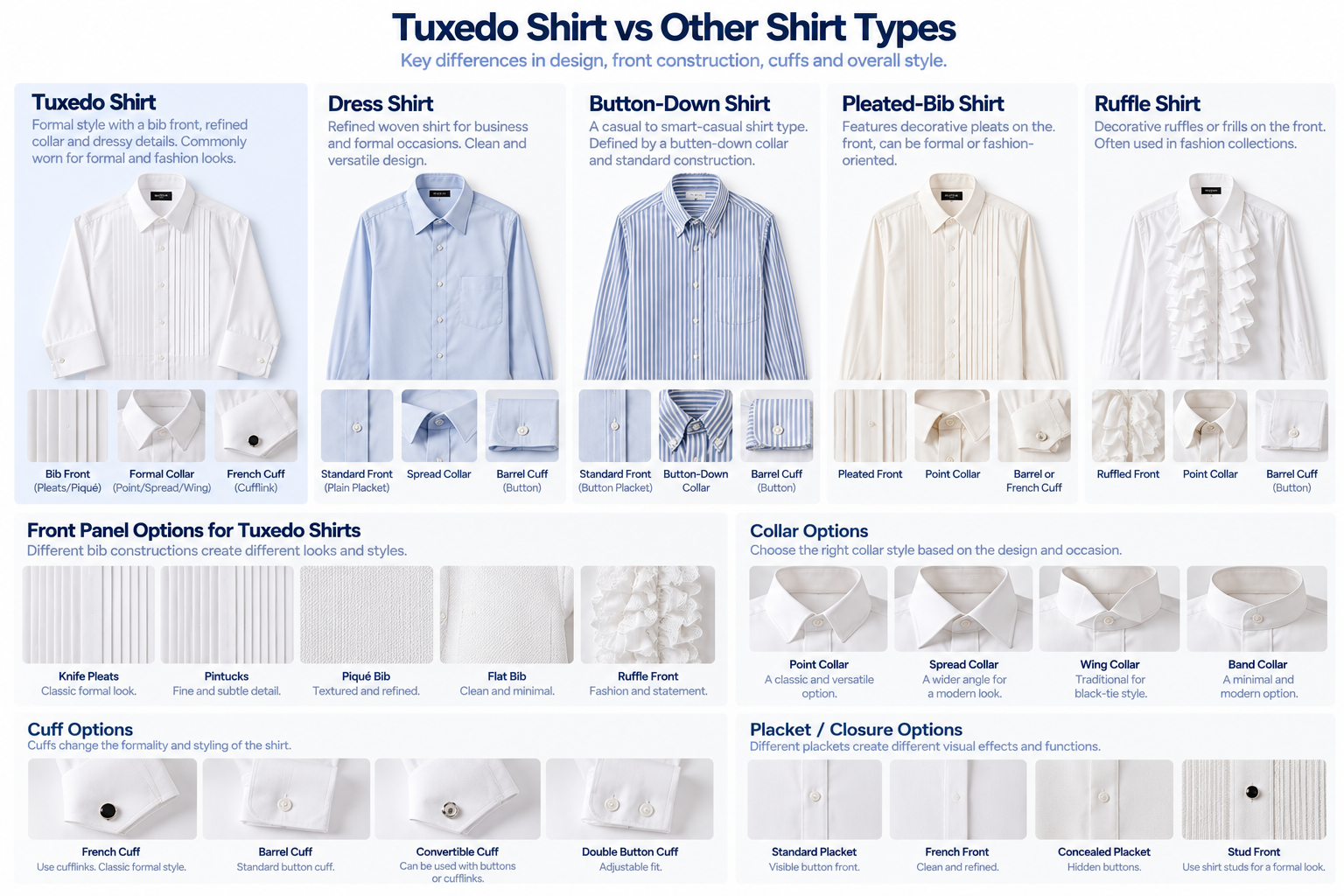
Tuxedo Shirt vs Dress Shirt vs Standard Button-Down
These categories overlap, but they are not identical.
| Shirt Type | Main Characteristic | Front | Cuff | Typical Direction |
|---|---|---|---|---|
| Tuxedo Shirt | Formal decorative construction | Bib / pleats / formal placket | French or formal cuff | Evening / fashion |
| Dress Shirt | Refined woven shirt | Standard placket | Barrel or French cuff | Business / formal |
| Button-Down Shirt | Broad shirt category | Standard button front | Usually barrel cuff | Casual to tailored |
| Pleated-Bib Shirt | Pleated decorative front | Pleated bib | Varies | Formal / fashion |
| Ruffle Shirt | Decorative gathered front | Ruffles / frills | Varies | Fashion / romantic |
A tuxedo shirt can therefore also be a dress shirt.
But not every dress shirt is a tuxedo shirt.
The Bib Is the Most Recognizable Tuxedo-Shirt Detail
The bib is the front area surrounding the upper placket.
It may extend:
- Across the chest
- From shoulder area toward waist
- Only around the upper front
The bib can be created through:
- Pleats
- Separate fabric
- Piqué
- Marcella-style texture
- Pintucks
- Ruffles
- Panel seams
Its size strongly changes the garment.
A narrow bib feels subtle.
A large bib becomes a major visual feature.
Pleated Bib
A pleated bib uses repeated folded fabric.
Possible pleats include:
- Narrow knife pleats
- Wider knife pleats
- Pintucks
- Flat decorative folds
Pleats create:
- Texture
- Shadow
- Formal character
But they require precision.
The factory needs to control:
- Pleat width
- Pleat depth
- Pleat spacing
- Finished bib width
- Left/right symmetry
- Position relative to buttons
Pleat Width vs Pleat Depth
These are not the same measurement.
Pleat Width
The visible portion after folding.
Pleat Depth
The amount of fabric hidden inside the fold.
Two pleated fronts may have identical visible spacing while consuming very different amounts of fabric.
A tech pack should specify both when exact reproduction matters.
Pintuck Front
Pintucks are narrower than conventional pleats.
They create:
- Fine linear texture
- Cleaner appearance
- Less bulk
They work particularly well for:
- Lightweight cotton
- Refined fashion shirts
- Minimal tuxedo-inspired styles
Very small pintucks require accurate sewing.
Uneven spacing becomes visible quickly on a clean white garment.
Flat Bib
A tuxedo shirt does not need visible pleats.
A flat bib can use:
- Double fabric
- Piqué panel
- Contrast texture
- Tonal jacquard
- Structured woven fabric
This creates a cleaner interpretation.
The contrast can come from:
texture
rather than:
color.
Piqué or Marcella-Style Bib
Traditional formal shirts may use a textured front area.
The bib can be made from a fabric with:
- Raised texture
- Waffle-like structure
- Small geometric surface
The body fabric may remain smooth.
This creates subtle contrast without using a different color.
Separate Bib vs Integrated Bib
There are two broad construction directions.
Separate Bib Panel
A separate piece is attached to the front body.
Advantages:
- Easier fabric contrast
- More control over pleats
- Stronger structure
But the attachment seam must remain clean.
Integrated Front
Pleats or pintucks are formed directly into the front panel.
Advantages:
- Fewer visible seam transitions
- Cleaner surface
But pattern preparation becomes more complex because the front piece needs additional fabric allowance.
Bib Shape
The bib does not have to be rectangular.
Possible shapes include:
- Straight rectangle
- Rounded lower edge
- Curved side
- Shield shape
- Narrow vertical bib
- Extra-wide fashion bib
The shape should be clearly shown in the tech pack.
Bib Length Changes the Proportion
A short upper-chest bib feels more traditional.
A longer bib can create:
- Stronger vertical line
- More fashion-forward appearance
- Greater visual impact
An oversized modern shirt may intentionally extend the bib much farther down the front.
Stabilizing the Bib
Pleated or layered fronts can become heavy.
Possible stabilization methods include:
- Lightweight fusible
- Sew-in support
- Internal facing
- Additional fabric layer
Too much interfacing can make the bib:
- Stiff
- Board-like
- Uncomfortable
Too little support may cause:
- Collapse
- Wrinkles
- Button pulling
The correct structure depends on the fabric.
Tuxedo Shirt Collar Options
The collar significantly changes the category.
Common options include:
- Point collar
- Spread collar
- Wing collar
- Band collar
- Oversized fashion collar
Each creates a different product.
Point Collar
A point collar provides a familiar shirt appearance.
It works well for:
- Modern tuxedo shirts
- Oversized designs
- Styling without a bow tie
The collar point length should match the scale of the shirt.
A very small collar may look weak on an oversized body.
Spread Collar
A spread collar opens more widely.
It can create:
- Cleaner neckline
- More contemporary tailoring
- Stronger tie space
The spread angle should be developed together with:
- Collar stand
- Neck opening
- Collar point
Wing Collar
A wing collar is strongly associated with formal eveningwear.
It normally uses:
- Short collar points
- Upright collar structure
- Folded front tips
The collar needs enough stiffness to remain clean.
However, modern fashion tuxedo shirts do not need a wing collar.
Band Collar
A band or stand collar removes the traditional folded collar.
This creates:
- Minimal appearance
- Cleaner neckline
- More modern styling
It can work particularly well with:
- Pleated bib
- Hidden placket
- Oversized shirt body
Collar Stand
A conventional shirt collar normally includes a collar stand.
The stand helps:
- Position the collar
- Control neck shape
- Support roll
- Stabilize buttons
Important measurements include:
- Stand height
- Neck circumference
- Front extension
- Collar attachment length
Collar Interfacing
Interfacing affects:
- Stiffness
- Roll
- Recovery
- Wash behavior
A lightweight fashion shirt may need:
- Softer fusible
while a traditional formal collar may use:
- Stronger support
The objective is controlled structure, not maximum stiffness.
Collar Stay Options
Some formal shirts use collar stays.
They may be:
- Sewn in
- Removable
- Inserted into internal pockets
Collar stays help reduce:
- Curling
- Uneven collar points
They are optional depending on the design.
Front Placket Options
A tuxedo shirt can use several placket constructions.
Standard Placket
The button area remains visible.
Creates:
- Familiar shirt construction
- More casual versatility
French Front
The front edge is folded inward without a separately applied visible placket.
Creates:
- Cleaner surface
- More refined appearance
Concealed Placket
Buttons sit behind an additional fabric layer.
Creates:
- Minimal formal appearance
- Uninterrupted front line
Stud Front
Some formal tuxedo shirts are designed to accept decorative studs.
The construction must support the selected stud system.

Shirt Studs
Formal shirt studs can replace some visible front buttons.
They may use:
- Metal
- Enamel
- Pearl-like surfaces
- Black decorative fronts
If studs are required, confirm:
- Stud diameter
- Number of studs
- Opening construction
- Buttonhole size
- Backing system
Do not assume every tuxedo shirt can automatically accept studs.
Concealed Buttons
For a fashion version, concealed buttons may be more practical than traditional studs.
They provide:
- Clean surface
- Easier dressing
- Lower trim complexity
The hidden placket should lie flat.
Excessive layers can make the front bulky.
Button Material
Possible buttons include:
- Mother-of-pearl
- Resin
- Polyester
- Metal
- Fabric-covered buttons
For premium shirts, button:
- Thickness
- Edge
- Hole size
- Color
- Attachment
all affect perceived quality.
For custom buttons and labels, see Brad Apparel's Trims & Branding.
French Cuffs
French cuffs are one of the best-known formal-shirt details.
The cuff is longer than a conventional barrel cuff and folds back on itself.
It is normally secured with:
- Cufflinks
- Decorative links
- Convertible fastening
This creates:
- More structure
- Formal character
- Larger wrist detail
French Cuff Length
The cuff needs enough length to:
- Fold evenly
- Sit cleanly
- Fit around the wrist
If too short:
- The fold may feel tight
If too long:
- The cuff may feel oversized
- Sleeve length becomes visually heavy
The finished cuff should be evaluated on the wearer.
French Cuff Width
A wider cuff creates more visual impact.
A narrower cuff feels more refined.
The correct scale depends on:
- Sleeve width
- Shirt fit
- Collar size
- Bib size
The details should look like one design system.
Barrel Cuffs
Modern tuxedo shirts may use standard barrel cuffs.
This makes the garment easier to wear casually.
Possible closures include:
- One button
- Two buttons
- Adjustable buttons
A barrel cuff can still look formal when paired with:
- Pleated bib
- Crisp fabric
- Clean collar
Convertible Cuffs
Convertible cuffs allow either:
- Buttons
- Cufflinks
This provides more flexibility.
But the button and buttonhole arrangement needs to be planned carefully so the cuff remains visually clean in both configurations.
Cufflink Holes
If cufflinks are required, check:
- Hole position
- Hole size
- Reinforcement
- Left/right alignment
The cufflink should sit flat rather than pulling the cuff layers together awkwardly.
Sleeve Placket
The sleeve opening affects dressing and cuff shape.
Common components include:
- Sleeve slit
- Gauntlet
- Button
- Reinforcement
A well-made placket should remain:
- Flat
- Straight
- Symmetrical
What Fabric Is Best for a Tuxedo Shirt?
Traditional and modern tuxedo shirts can use:
- Cotton poplin
- Broadcloth
- Fine twill
- Oxford-inspired fashion fabric
- Voile
- Cotton blends
- Satin
- Silk blends
- Textured piqué
The fabric should be selected based on the intended styling.
For custom fabric sourcing, see Brad Apparel's Fabric Sourcing & Development.
Cotton Poplin
Poplin is one of the most useful shirt fabrics.
It typically provides:
- Smooth surface
- Crisp appearance
- Lightweight structure
- Good print and embroidery compatibility
It works particularly well for:
- Pleated shirts
- Oversized fashion tuxedo shirts
- Clean white formal shirts
Cotton Broadcloth
Broadcloth can provide:
- Smooth hand feel
- Fine surface
- Refined appearance
It works well when the goal is:
- Minimal
- Premium
- Dressy
The exact hand feel depends on:
- Yarn count
- Density
- Finishing
Fine Twill
Twill has a diagonal weave structure.
It can provide:
- Slightly softer drape
- More visible texture
- Good durability
A fine twill works well for less rigid fashion interpretations.
Piqué Front Panels
Piqué or textured woven fabric can be used only for the bib while the main body uses:
- Poplin
- Broadcloth
This creates a tonal texture difference.
The two fabrics should be tested together for:
- Shrinkage
- Color
- Thickness
- Pressing response
Satin Tuxedo Shirts
Fashion versions can use satin.
Satin creates:
- Higher shine
- Fluid drape
- Eveningwear character
But satin requires careful sewing.
Possible issues include:
- Seam puckering
- Needle marks
- Pressing marks
- Slippage
Pleated satin also behaves very differently from crisp cotton.
Semi-Sheer Tuxedo Shirts
A lightweight voile or sheer fabric can create a softer modern interpretation.
However, the bib may become:
- More opaque
- More structured
than the surrounding body.
That contrast can be intentional.
The internal finishing should remain clean because seam allowances may be visible through the fabric.
Fabric Weight Should Match the Construction
A very lightweight fabric may struggle to support:
- Heavy bib
- Large French cuff
- Structured collar
A very heavy fabric may create:
- Bulky pleats
- Thick placket
- Heavy cuffs
The shirt should be developed as a complete system.
White Is Not One Color
White shirts can vary between:
- Optical white
- Warm white
- Cream
- Ivory
- Blue white
If the bib and body use different fabrics, they need to be compared together.
Two fabrics described as:
"white"
may look noticeably different under:
- Daylight
- Cool LED light
- Warm indoor light
Fabric Shrinkage
Shirting fabrics can shrink during washing.
Check:
- Body length
- Chest
- Neck circumference
- Sleeve length
- Cuff
- Bib width
The collar and body should not shrink at dramatically different rates.
Pre-Shrink Testing
Before bulk cutting:
- Record fabric dimensions
- Wash according to intended care method
- Measure again
- Calculate shrinkage
- Adjust pattern where necessary
Do not apply one universal shrinkage percentage to every shirt fabric.
Modern Tuxedo Shirt Fit Options
The category now supports several fits.
Classic Fit
Typically uses:
- Moderate chest ease
- Standard shoulder
- Controlled body
- Traditional sleeve width
Suitable for formal styling.
Slim Fit
Uses:
- Narrower chest
- Shaped waist
- Slim sleeve
But the front bib should not pull across the chest.
Relaxed Fit
Uses:
- More body ease
- Straighter side seams
- Softer styling
This works well for modern casual tailoring.
Oversized Fit
Possible features include:
- Wide chest
- Drop shoulder
- Large sleeves
- Longer body
- Larger cuff
- Larger collar
The bib should be scaled to match the oversized proportions.
Oversized Does Not Mean Grading Up
Producing a standard shirt several sizes larger can create:
- Excessive body length
- Excessive sleeve length
- Incorrect collar size
- Bib position too low
- Poor cuff proportion
A proper oversized pattern should increase volume intentionally.
Cropped Tuxedo Shirt
Fashion versions may shorten the body.
A cropped shirt needs careful control of:
- Bib length
- Waist position
- Hem
- Button spacing
A traditional long bib may no longer fit on a short body.
The front design should be rebalanced rather than simply cutting off the lower shirt.
Women's Tuxedo Shirt Development
A womenswear pattern may use:
- Darts
- Princess shaping
- Straighter oversized block
- Cropped body
- Curved hem
There is no requirement that a women's tuxedo shirt must be fitted.
Many modern versions intentionally use a borrowed-from-menswear silhouette.
Unisex Tuxedo Shirt
A unisex design should clearly define:
- Target fit model
- Chest ease
- Shoulder width
- Body length
- Sleeve length
- Size grading
"Unisex" should not replace actual fit development.
Tuxedo Shirt Shoulder Options
Possible constructions include:
- Standard set-in shoulder
- Extended shoulder
- Drop shoulder
A traditional shirt usually uses a standard shoulder.
A fashion shirt may use an extended or dropped shoulder.
This changes:
- Sleeve cap
- Armhole
- Body width
- Overall proportion
Back Construction
Common back options include:
Plain Back
Minimal and clean.
Back Yoke
Very common in shirting.
Provides:
- Shoulder shaping
- Structure
- Clean assembly
Center-Back Pleat
Adds movement.
Side Pleats
Adds upper-back ease while maintaining a relatively clean center.
Back Yoke Construction
The yoke can be:
- Single layer
- Double layer
A double yoke creates a cleaner interior.
It can also add:
- Structure
- Durability
The yoke seam should remain smooth after washing.
Side Seams
Shirt side seams may use:
- Overlock
- Safety stitch
- French seam
- Felled construction
The correct option depends on:
- Fabric
- Price level
- Transparency
- Desired interior appearance
French Seams
French seams enclose the raw edge.
They are useful for:
- Lightweight fabrics
- Sheer shirts
- Premium interiors
But they add:
- Sewing steps
- Cost
- Seam thickness
They are not necessary for every tuxedo shirt.
Flat-Felled Seams
Felled seams create a durable enclosed finish.
They may be used in:
- Shirt construction
- Casual woven products
But on very refined formal shirts, the desired seam appearance should be specified rather than assumed.
Hem Options
Common options include:
- Curved shirt-tail hem
- Straight hem
- Split side hem
- Cropped clean hem
A traditional dress shirt often uses a longer curved hem designed for tucking.
A modern fashion version may use a straight hem intended to remain untucked.
Shirt-Tail Hem
A curved front and back hem provides:
- Extra length
- Better tuck retention
- Traditional shirt appearance
The side curve should remain smooth.
Poor sewing can create:
- Rippling
- Twisting
Gussets
Small reinforcement pieces can be added at side-seam intersections near the hem.
They may provide:
- Reinforcement
- Decorative detail
- Premium shirtmaking character
Gussets are optional.
Stripe Tuxedo Shirts
Modern tuxedo shirts do not need to be plain white.
Striped versions can use:
- Blue and white
- Black and white
- Tonal stripes
- Fine banker stripes
The bib creates another pattern-placement decision.
Stripe Direction at the Bib
Possible approaches include:
Same Direction
Body and bib stripes run vertically.
Creates a cleaner appearance.
Contrast Direction
The bib stripes may run:
- Horizontal
- Diagonal
This makes the bib more visible.
Solid Bib
A striped body can use a white or solid-colored front panel.
The pattern decision should be intentional.
Stripe Matching
Areas to consider include:
- Center front
- Yoke
- Pocket if used
- Cuff
- Sleeve placket
Perfect matching everywhere increases:
- Cutting complexity
- Fabric consumption
The brand should define which areas actually require matching.
Ruffled Tuxedo Shirts
Fashion versions may replace a conventional bib with:
- Ruffles
- Frills
- Cascading pleats
This creates a stronger romantic or maximalist direction.
The ruffle should be specified by:
- Finished width
- Cutting width
- Gathering ratio
- Number of layers
- Edge finish
Gathering Ratio
A ruffle requires more fabric than its finished length.
For example, a design may use a ratio such as:
1.5:1
or:
2:1
depending on desired fullness.
The exact ratio should be confirmed through sampling rather than assumed from a photo.
Raw vs Clean Ruffle Edge
Possible finishes include:
- Narrow hem
- Rolled hem
- Bound edge
- Laser cut where suitable
- Raw fashion edge
The correct finish depends on the fabric.
Embroidery on a Tuxedo Shirt
A tuxedo-style shirt can use:
- Small monogram
- Chest embroidery
- Cuff embroidery
- Bib embroidery
- Decorative motifs
For embroidery development, see Brad Apparel's Embroidery Techniques.
Embroidery on the Bib
Take extra care when embroidering:
- Pleated fabric
- Pintucks
- Multi-layer bibs
Dense embroidery can:
- Flatten pleats
- Distort the bib
- Create puckering
It may be better to embroider a flat section before final assembly.
Logo Placement
Possible locations include:
- Chest
- Cuff
- Collar
- Lower hem
- Back yoke
A subtle logo may suit the refined product better than a very large graphic.
Tuxedo Shirt Pattern Development
A complete pattern normally needs control of:
- Neck
- Shoulder
- Chest
- Waist
- Sweep
- Body length
- Armhole
- Sleeve
- Cuff
- Bib
- Collar
- Collar stand
- Placket
These areas should be developed together.
Bib Position Should Follow Body Size
If the bib stays exactly the same size across every garment size, it may appear:
- Too large on small sizes
- Too small on large sizes
The brand needs to decide how bib dimensions should grade.
Possible strategy:
- Small controlled grading
- Fixed design dimensions
- Proportional grading
There is no universal rule.
Button Spacing
Button spacing affects:
- Gaping
- Visual rhythm
- Bib layout
A button should not land awkwardly at:
- Bottom edge of bib
- Strong pleat intersection
- Bust tension point
The final button layout should be approved on the garment.
Front Balance
The extra layers of a bib can change how the front hangs.
Check whether:
- Front hem drops
- Front body becomes stiff
- Bib pulls the placket
- Left/right fronts remain symmetrical
This is why a tuxedo shirt should be evaluated on a full sample rather than developing the decorative panel independently.
Tuxedo Shirt Manufacturing Workflow
A practical workflow can follow:
- Confirm silhouette
- Select body fabric
- Select bib construction
- Develop collar
- Develop cuff
- Confirm placket / closure
- Make pattern
- Create first sample
- Review fit
- Review bib and pleats
- Test wash
- Adjust measurements
- Confirm trims
- Make pre-production sample
- Begin bulk production

Pleat Production Control
In bulk production, pleat variation can become highly visible.
Check:
- Width
- Spacing
- Direction
- Length
- Symmetry
Useful production controls may include:
- Folding guides
- Templates
- Pressing fixtures
depending on volume and construction.
Pressing Is Part of the Construction
A formal shirt relies heavily on clean pressing.
Important areas include:
- Collar
- Cuff
- Bib
- Pleats
- Placket
- Hem
But excessive pressure can create:
- Shine
- Creases
- Flattened texture
especially on:
- Satin
- Piqué
- Delicate fabrics
The pressing method should be tested.
Collar Quality Control
Check:
- Left/right symmetry
- Point length
- Stand height
- Neck circumference
- Roll
- Interfacing
- No bubbling
A collar can be sewn accurately and still look poor if the fusible does not bond correctly.
Bib Quality Control
Inspect:
- Shape
- Position
- Pleat spacing
- Left/right balance
- Bottom edge
- No puckering
- No distortion
The bib should sit flat on the body.
Placket Quality Control
Check:
- Straightness
- Width
- Button alignment
- Buttonholes
- Concealed layer
- No twisting
The center-front line should remain clean when the garment is buttoned.
Buttonhole Quality
A buttonhole should have:
- Correct length
- Dense stitching
- Clean opening
- No loose threads
Buttonhole length should match button thickness and diameter.
French Cuff QC
Check:
- Fold line
- Cuff symmetry
- Cufflink holes
- Finished width
- Sleeve attachment
- Left/right consistency
The cuff should fold naturally without excessive force.
Sleeve Length
Formal-style shirts make cuff position particularly visible.
The sleeve needs to work with:
- Cuff depth
- Intended styling
- Jacket layering if applicable
Always measure sleeve length using the exact method defined in the tech pack.
Wash Testing
Before bulk approval, test:
- Shrinkage
- Pleat stability
- Collar shape
- Cuff shape
- Bib structure
- Color
- Hand feel
A shirt that looks perfect before washing may lose its formal character afterward.
Wrinkle Testing
Cotton formal shirts can wrinkle naturally.
Finishing options may affect:
- Wrinkle resistance
- Hand feel
- Surface
- Care requirements
Any performance claim should be based on the actual tested fabric and finish.
White Fabric Inspection
White shirts reveal defects easily.
Inspect for:
- Oil marks
- Dirt
- Needle marks
- Thread contamination
- Shade difference
- Pressing shine
Factory handling needs to remain clean from cutting through packing.
Example Modern Oversized Tuxedo Shirt Brief
A brand could specify:
Oversized unisex tuxedo-inspired shirt in crisp white cotton poplin with a wide straight body, dropped shoulder and extended sleeve. Use a long pleated bib, oversized point collar, concealed front placket and wide single-button cuff.
Then provide:
- Chest
- Shoulder
- Body length
- Sleeve length
- Bib size
- Pleat dimensions
- Collar dimensions
- Cuff dimensions
- Fabric
- Buttons
- Hem
- Branding
Example Classic Pleated Tuxedo Shirt
Regular-fit white formal shirt in high-density cotton broadcloth with narrow pleated bib, spread collar, French cuffs and concealed button front.
This creates a more traditional formal direction.
Example Fashion Stripe Tuxedo Shirt
Relaxed blue-and-white striped cotton tuxedo shirt with oversized body, wide pleated white bib, point collar, extended cuffs and curved shirt-tail hem.
The stripe placement should be approved before bulk cutting.
Example Ruffle Tuxedo Shirt
Semi-fitted ivory cotton shirt with layered front ruffles, stand collar, concealed placket and wide barrel cuffs.
The ruffle fullness and edge finishing should be confirmed by sample.
Tuxedo Shirt Tech Pack Example
| Area | Example Specification |
|---|---|
| Product | Tuxedo Shirt |
| Fit | Relaxed |
| Fabric | Cotton Poplin |
| Composition | 100% Cotton |
| Color | Optical White |
| Front | Pleated Bib |
| Bib Shape | Rectangular |
| Collar | Point Collar |
| Collar Stand | Separate |
| Placket | Concealed |
| Sleeve | Long |
| Cuff | French Cuff |
| Closure | Buttons / Cufflinks |
| Back | Double Yoke |
| Hem | Curved Shirt Tail |
| Branding | Woven Main + Care Label |
These values are examples only.
Oversized Tuxedo Shirt Tech Pack Example
| Area | Example Specification |
|---|---|
| Product | Oversized Tuxedo Shirt |
| Fit | Boxy / Oversized |
| Shoulder | Dropped |
| Fabric | Cotton Broadcloth |
| Front | Extra-Wide Bib |
| Bib Detail | Pintucks |
| Collar | Oversized Point |
| Placket | Hidden |
| Cuff | Wide Barrel Cuff |
| Hem | Curved |
| Decoration | Optional Cuff Embroidery |
| Branding | Main + Care Label |
What Should You Send a Tuxedo Shirt Manufacturer?
A useful development package should include:
- Front / back technical sketch
- Fit reference
- Finished measurements
- Fabric requirement
- Bib dimensions
- Pleat dimensions
- Collar dimensions
- Cuff construction
- Placket construction
- Button type
- Stitching
- Hem
- Labels
- Packaging
A fashion photograph is useful for direction.
It is not a replacement for actual construction specifications.
How to Evaluate the First Sample
Evaluate the garment:
- Buttoned
- Unbuttoned
- Untucked
- Tucked in
if those wearing methods are intended.
Front View
Check:
- Center front
- Bib position
- Pleat symmetry
- Collar
- Shoulder
- Hem
Side View
Check:
- Front/back balance
- Body volume
- Sleeve position
- Hem
Back View
Check:
- Yoke
- Shoulder
- Back volume
- Center pleat if used
- Hem
Movement Test
Ask the wearer to:
- Reach forward
- Raise arms
- Sit
- Bend elbows
- Button cuffs
The formal appearance should not eliminate normal movement.
Tuck Test
If the shirt is intended to be tucked into trousers:
- Sit
- Stand
- Walk
- Raise arms
Check whether the shirt pulls out excessively.
Body length and hem shape affect tuck stability.
Layering Test
If the tuxedo shirt will be worn under:
- Blazer
- Tuxedo jacket
- Knitwear
test the sample under those layers.
Large bibs, cuffs or sleeves can create unwanted bulk.
Common Tuxedo Shirt Development Mistakes
1. Treating It Like a Basic Shirt With Pleats Added
The bib affects front structure and balance.
2. Making Pleats Without Exact Measurements
Bulk garments may look inconsistent.
3. Over-Interfacing the Bib
The shirt can become rigid.
4. Using a Collar That Is Too Soft
The formal silhouette may collapse.
5. Using Heavy Cuffs on Lightweight Fabric
The sleeves may pull downward.
6. Ignoring Bib and Body Shrinkage Differences
The front can distort after washing.
7. Making an Oversized Version by Grading Up
The proportion becomes incorrect.
8. Ignoring Button Position
The shirt may gape or the bib may look visually unbalanced.
9. Using Two Different Whites Without Checking Them Together
The bib and body may visibly mismatch.
10. Poor Pressing
Pleats, collar and cuffs may lose their clean appearance.
Tuxedo Shirt vs Rugby Shirt: Which Should Your Brand Develop?
Choose a tuxedo shirt if you want:
- Tailored appearance
- Woven fabric
- Formal detailing
- Bib or pleats
- French cuffs
- Menswear-inspired fashion
Choose a rugby shirt if you want:
- Knitted body
- Athletic heritage
- Reinforced short placket
- Contrast collar
- Stripes
- Casual sportswear
The two garments may both have collars and buttons, but their construction language is very different.
For more on the sportswear version, see Brad Apparel's Rugby Shirt Guide.
How Brad Apparel Can Approach Tuxedo Shirt Development
A production-ready development process should coordinate:
Fabric
↓
Pattern
↓
Bib Construction
↓
Pleat Testing
↓
Collar & Cuff Development
↓
Placket & Button Selection
↓
First Sample
↓
Fit Review
↓
Wash Test
↓
Construction Adjustment
↓
Pre-Production Approval
↓
Bulk Production
Fabric sourcing should happen early because:
- Poplin
- Broadcloth
- Satin
- Piqué
all behave differently in pleats and structured components.
For custom material development, see Brad Apparel's Fabric Sourcing & Development.
FAQ
What Is a Tuxedo Shirt?
A tuxedo shirt is a formal or fashion button-front shirt that typically uses details such as a bib front, pleats, formal collar, French cuffs or concealed placket.
Modern versions can be worn outside traditional black-tie dressing.
What Is the Bib on a Tuxedo Shirt?
The bib is the structured or decorative front panel around the upper chest and placket.
It may use:
- Pleats
- Pintucks
- Piqué
- Flat layered fabric
Does a Tuxedo Shirt Need a Pleated Front?
No.
Some tuxedo shirts use a smooth or textured bib without pleats.
Modern fashion versions may also use ruffles or minimal flat fronts.
What Is the Difference Between a Tuxedo Shirt and a Dress Shirt?
A dress shirt is a broad formal-shirt category.
A tuxedo shirt usually includes additional eveningwear-inspired details such as:
- Bib front
- Formal pleats
- French cuffs
- Stud front
Does a Tuxedo Shirt Need a Wing Collar?
No.
Modern tuxedo shirts commonly use:
- Point collars
- Spread collars
- Wing collars
- Band collars
The correct option depends on the design.
What Are French Cuffs?
French cuffs are extended cuffs that fold back on themselves and are typically secured with cufflinks.
They create a more formal wrist construction than a standard barrel cuff.
Can a Tuxedo Shirt Use Normal Buttons?
Yes.
Fashion versions often use normal buttons or a concealed placket instead of traditional shirt studs.
Can a Tuxedo Shirt Be Oversized?
Yes.
Oversized tuxedo shirts are a modern fashion interpretation.
The bib, collar, sleeve and cuff should be scaled to match the larger body proportion.
Can Tuxedo Shirts Be Striped?
Yes.
Striped tuxedo shirts can use:
- Matching stripe direction
- Contrast bib
- Different stripe orientation
Pattern placement should be confirmed during sampling.
What Fabric Is Best for a Tuxedo Shirt?
Common options include:
- Cotton poplin
- Broadcloth
- Fine twill
- Piqué
- Satin
- Voile
The correct fabric depends on the desired structure and styling.
Can the Bib Use a Different Fabric?
Yes.
A smooth body can use a textured or pleated bib.
The fabrics should be tested for compatible:
- Color
- Shrinkage
- Thickness
- Care requirements
Does a Tuxedo Shirt Need Interfacing?
Collars, cuffs and some bib constructions commonly benefit from interfacing.
The amount of support depends on the fabric and desired structure.
Can a Tuxedo Shirt Have Embroidery?
Yes.
Possible locations include:
- Cuff
- Chest
- Collar
- Bib
- Back yoke
Embroidery density should be tested so it does not distort lightweight shirting.
What Measurements Should a Tuxedo Shirt Tech Pack Include?
Important measurements include:
- Chest
- Shoulder
- Body length
- Sleeve length
- Neck
- Collar point
- Collar stand
- Cuff
- Bib width
- Bib length
- Placket width
- Hem sweep
What Should Be Checked During Tuxedo Shirt QC?
Check:
- Fabric cleanliness
- Measurements
- Collar symmetry
- Bib placement
- Pleat spacing
- Placket
- Buttons
- Buttonholes
- Cuffs
- Sleeve symmetry
- Pressing
- Shrinkage
Final Thoughts
A tuxedo shirt is not simply a white button-down made more formal.
Its character comes from the interaction between:
bib + pleats + collar + placket + cuffs + fabric + fit
A traditional version may use a pleated bib, French cuffs and formal collar.
A modern version may use an oversized silhouette, wide bib and concealed placket.
A striped version can reinterpret classic menswear.
And a ruffled version can move the same construction language into more expressive fashion.
For clothing brands, the key is to develop the decorative front together with the actual shirt pattern.
Once the fabric, bib, collar, cuff, placket and fit are approved as one complete system, the garment becomes much easier to reproduce consistently from first sample through bulk production.
Keep Reading