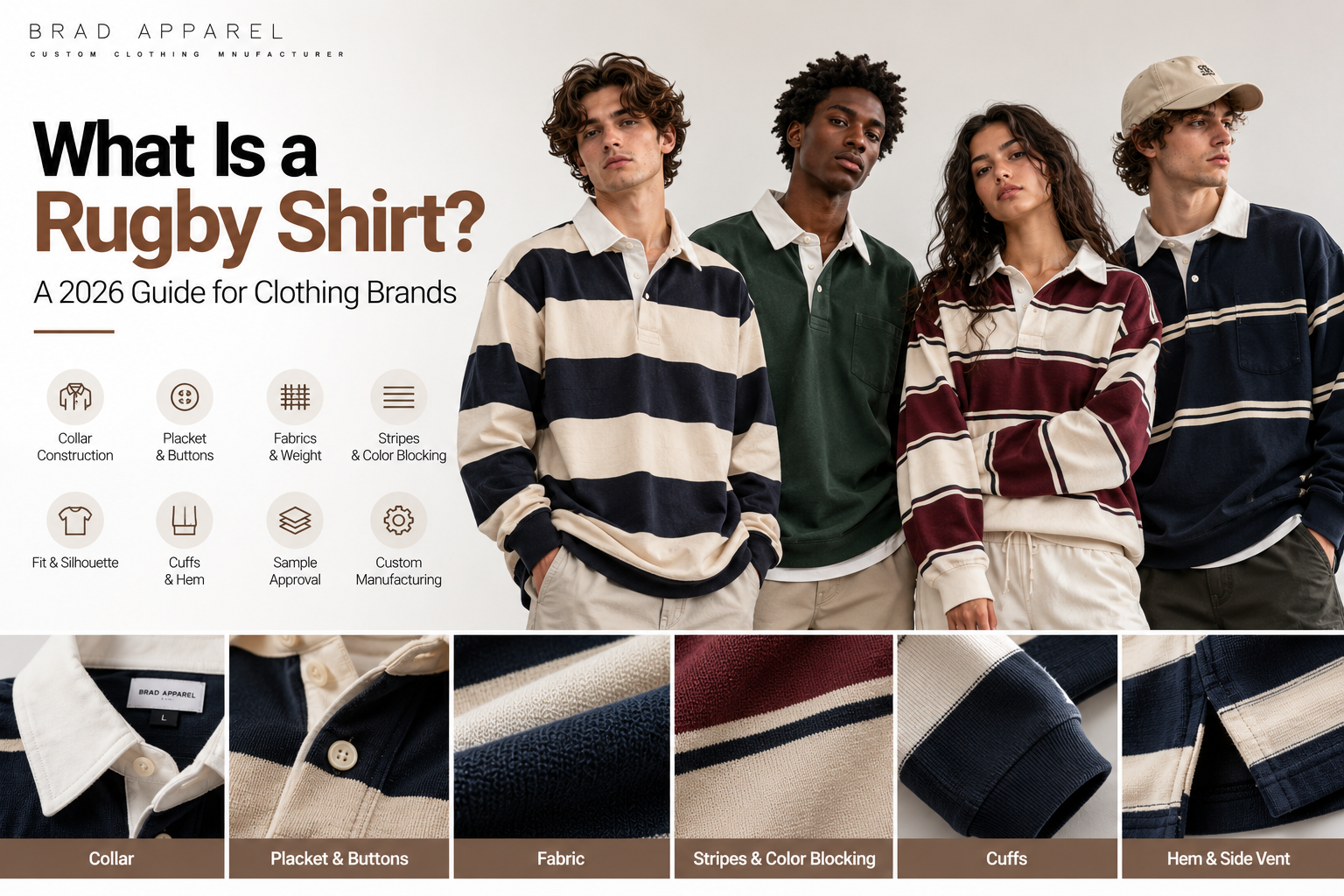
The rugby shirt is returning as one of the most recognizable pieces in modern preppy and heritage sportswear.
At first glance, it looks like a long-sleeve polo.
But a well-developed rugby shirt usually has a much stronger construction language.
Common details may include:
- Substantial knitted fabric
- Contrast woven collar
- Reinforced front placket
- Short button opening
- Horizontal stripes
- Relaxed body
- Long sleeves
- Ribbed or self-fabric cuffs
- Side vents
For clothing brands, the important point is this:
A rugby shirt should not simply be treated as a long-sleeve polo with stripes.
The collar, placket, fabric, stripe placement, fit and wash behavior need to work together.
This guide explains what defines a rugby shirt and what brands should consider when developing one for production.
What Is a Rugby Shirt?
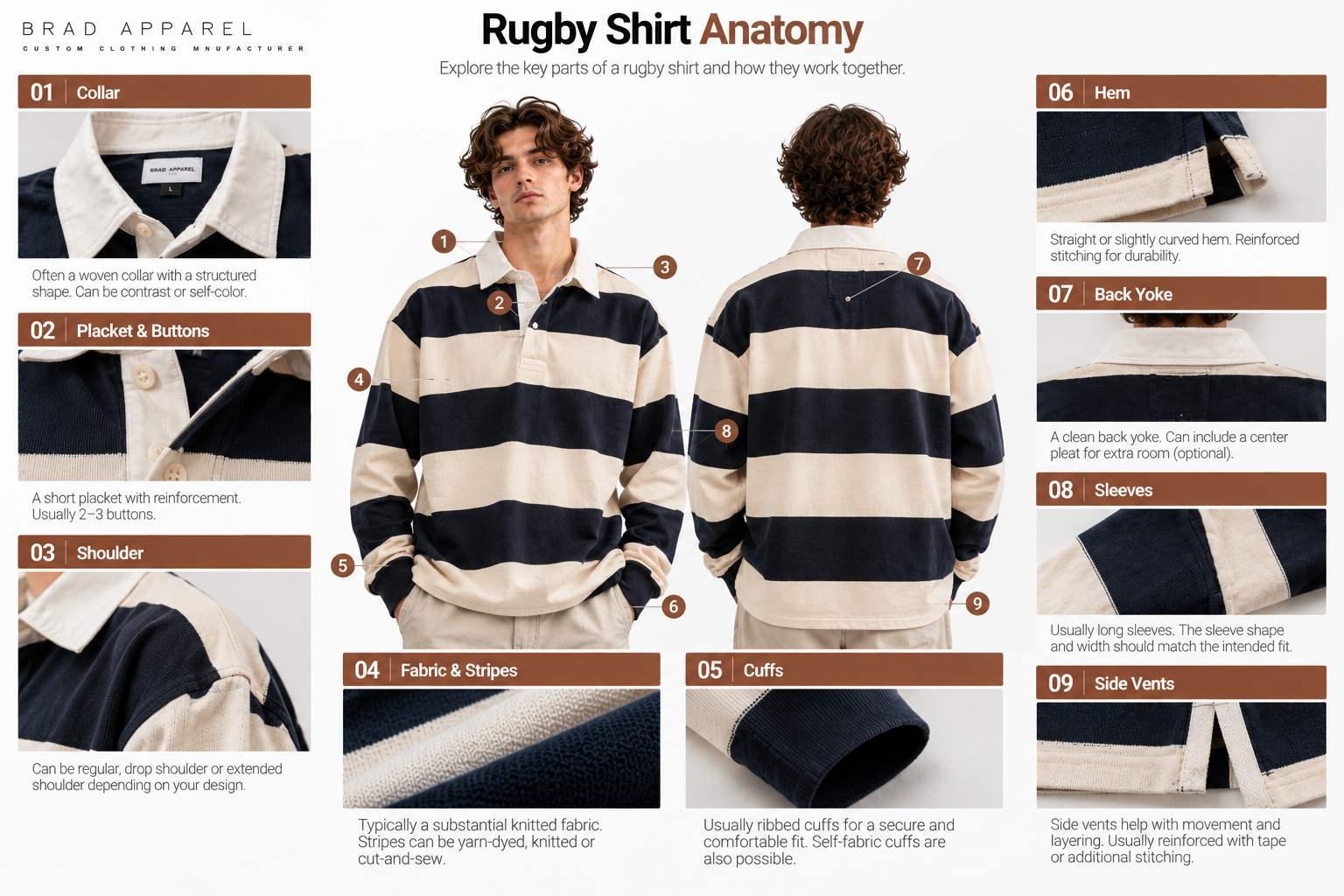
A rugby shirt is a collared knitted top inspired by traditional rugby sportswear.
Modern fashion versions can vary considerably, but common characteristics include:
- Long sleeves
- Fold-down collar
- Short front placket
- Two or more buttons
- Relaxed body
- Substantial knit fabric
- Horizontal stripes or color blocking
Some versions are very traditional.
Others move toward:
- Oversized streetwear
- Minimal solids
- Cropped silhouettes
- Vintage collegiate styling
- Premium casualwear
The recognizable identity comes from the combination of:
collar + placket + fabric + proportion
rather than one single detail.
Why Are Rugby Shirts Popular Again in 2026?
Rugby shirts fit naturally into several current fashion directions:
- Preppy clothing
- Collegiate styling
- Heritage sportswear
- Vintage athleticwear
- Oversized casualwear
- Striped tops
- Layering
- Gender-neutral styling
The garment sits somewhere between:
a polo
and
a sweatshirt-like casual top.
It has more visual structure than a normal T-shirt, but it can still feel relaxed.
For brands, this makes it especially useful for collections that want:
- Stronger identity than a basic tee
- Less formality than a shirt
- More heritage character than a standard polo
Rugby Shirt vs Polo Shirt
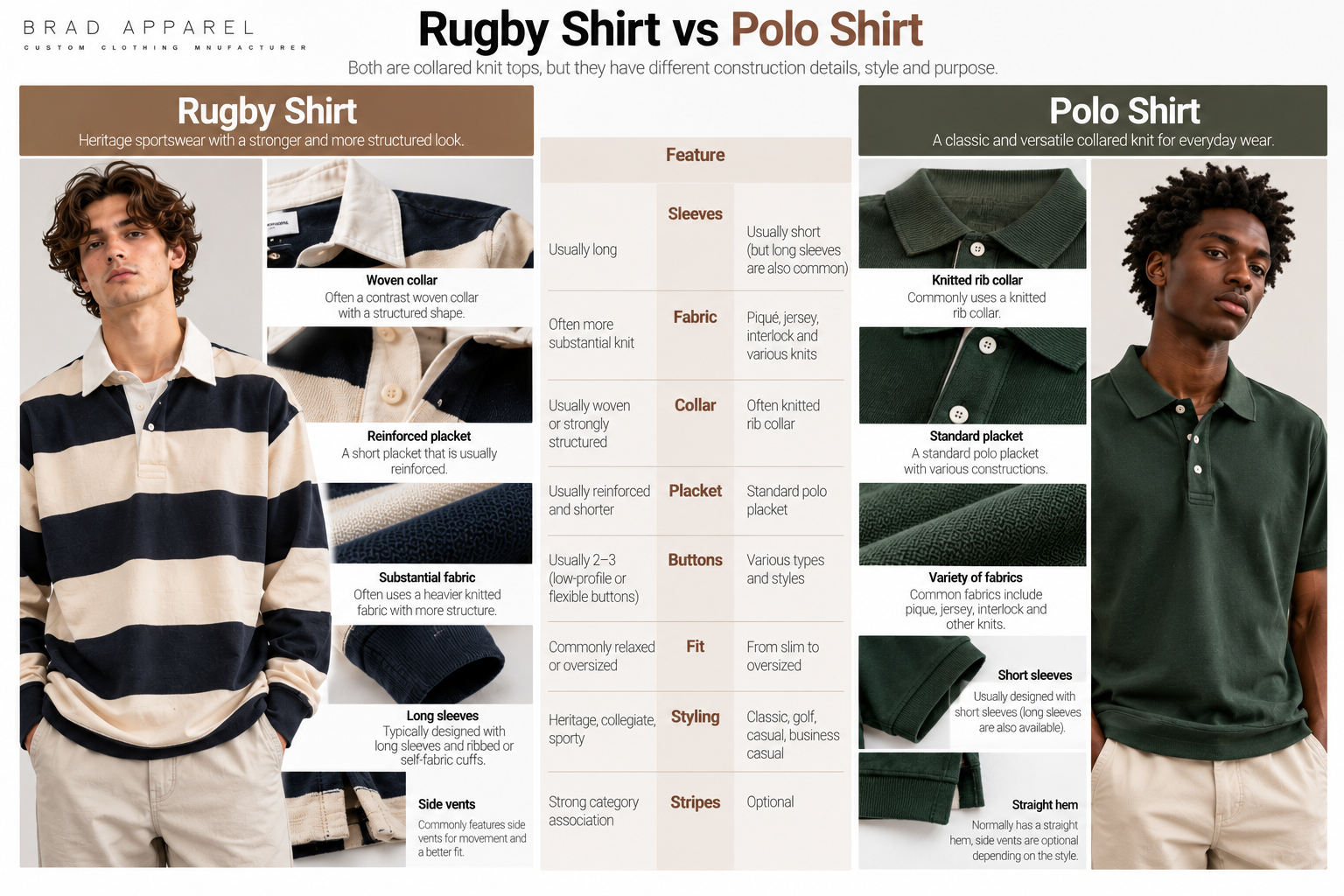
The two garments share some characteristics, but their typical construction is different.
| Detail | Rugby Shirt | Polo Shirt |
|---|---|---|
| Sleeves | Traditionally long, but modern versions vary | Commonly short or long |
| Fabric | Often more substantial knitted fabric | Piqué, jersey, interlock and other knits |
| Collar | Often woven or strongly structured | Frequently knitted rib collar |
| Placket | Often reinforced | Standard polo placket |
| Buttons | Often flexible or low-profile | Wide variety |
| Fit | Commonly relaxed | Slim to oversized |
| Styling | Heritage / collegiate / sporty | Classic / golf / casual / fashion |
| Stripes | Strong category association | Optional |
These are common tendencies rather than universal manufacturing rules.
Modern fashion versions often mix features from both categories.
Brad Apparel's existing Polo Shirt Types Guide covers the broader polo category, while this guide focuses specifically on rugby-shirt construction and development.
The Collar Is One of the Most Important Rugby Shirt Details
A contrast collar is one of the easiest ways to make a rugby shirt instantly recognizable.
Traditional-inspired designs often use a collar that is visually different from the knitted body.
Possible directions include:
- White woven collar
- Cream woven collar
- Self-color collar
- Contrast colored collar
- Heavier knitted collar
- Modern simplified collar
The material should be selected together with the body fabric.
Woven Collar vs Knitted Collar
A woven collar generally creates:
- Cleaner edges
- Stronger contrast
- More traditional appearance
- Less stretch
A knitted collar can create:
- Softer styling
- More stretch
- More casual character
Neither is automatically better.
The choice depends on whether the brand wants:
traditional rugby
or
rugby-inspired fashion.
Collar Structure Needs Balance
A collar that is too stiff can feel disconnected from a soft knitted body.
A collar that is too soft may:
- Curl
- Collapse
- Lose shape
- Sit unevenly
The correct structure depends on:
- Collar fabric
- Interfacing if used
- Collar size
- Body fabric weight
- Wash process
The collar should therefore be evaluated on an actual garment sample.
Collar Size Changes the Entire Look
A wider collar can create:
- Stronger vintage character
- More visible contrast
- More traditional sportswear styling
A smaller collar creates:
- Cleaner proportion
- More modern appearance
- Less visual bulk
The correct collar size should be considered together with:
- Shoulder width
- Neck opening
- Placket length
- Body width
Rugby Shirt Placket Construction
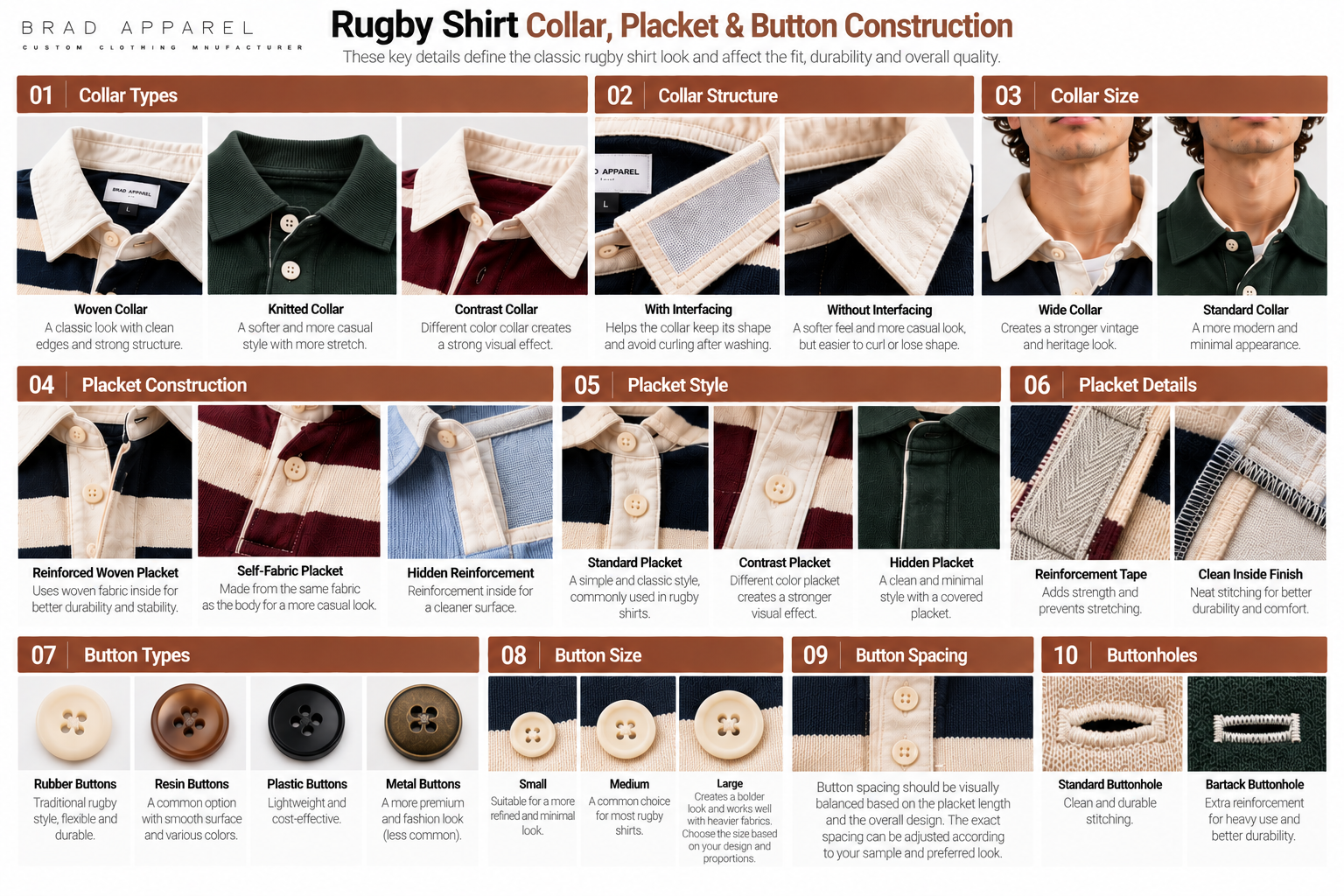
The front placket is another defining construction area.
A rugby shirt normally uses a relatively short opening.
Possible placket directions include:
- Reinforced woven placket
- Self-fabric knitted placket
- Hidden reinforcement
- Contrast placket
The placket should remain:
- Flat
- Straight
- Stable
- Comfortable
after washing and repeated use.
Why Reinforce the Placket?
The front opening receives repeated pulling when the wearer:
- Opens buttons
- Closes buttons
- Pulls the garment over the head
A soft knitted fabric can stretch around this area.
Reinforcement may help stabilize:
- Buttonholes
- Button attachment
- Placket edges
- Neck opening
The exact reinforcement method should match the body fabric.
Too much support can make the front unnecessarily stiff.
Rugby Shirt Buttons
Traditional-inspired rugby shirts are often associated with low-profile or flexible buttons.
Modern fashion versions may use:
- Rubber-style buttons
- Resin buttons
- Plastic buttons
- Tonal buttons
- Contrast buttons
- Custom branded buttons
The button should be chosen according to:
- Placket construction
- Buttonhole size
- Brand direction
- Wash requirements
Brad Apparel's Trims & Branding capabilities include custom buttons, labels and other garment components that can be developed around the finished design.
Button Size Should Match the Placket
A large button on a narrow placket can look visually crowded.
A very small button on a wide heritage-style placket may look weak.
Brands should approve:
- Button diameter
- Button spacing
- Button color
- Button attachment
- Buttonhole length
on the finished sample.
Fabric Gives the Rugby Shirt Its Weight and Character
Traditional-looking rugby shirts often feel more substantial than lightweight fashion polos.
But there is no universal fabric weight that every rugby shirt must use.
Possible knitted constructions include:
- Cotton jersey
- Heavy jersey
- Interlock
- Double-knit
- Cotton blends
- Other stable knitted fabrics
The correct textile depends on:
- Fit
- Season
- Drape
- Target price
- Stripe construction
- Decoration
Brad Apparel's Fabric Sourcing & Development service supports jersey, interlock, piqué, double-knit and custom-developed fabrics according to composition, structure, weight and hand feel.
Heavyweight Does Not Automatically Mean Better
A heavier fabric can create:
- Stronger structure
- More substantial hand feel
- More visible body shape
But it can also create:
- More seam bulk
- Heavier sleeves
- Stiffer drape
- More collar/placket thickness
The fabric should therefore match the intended silhouette.
A relaxed traditional rugby shirt may need a different fabric from an oversized fashion version.
Jersey Rugby Shirt
Jersey can create a softer rugby shirt.
Possible characteristics include:
- Smooth surface
- Natural drape
- Casual appearance
- Comfortable movement
A lighter jersey may feel closer to a long-sleeve polo.
A more substantial jersey can create stronger rugby character.
Interlock Rugby Shirt
Interlock can provide:
- Smoother surface
- More opacity
- Greater structure
- Cleaner embroidery base
It can work particularly well for premium fashion rugby shirts.
However, actual behavior depends on:
- Yarn
- Density
- Composition
- Finishing
rather than the construction name alone.
Rugby Stripes Can Be Developed in Different Ways
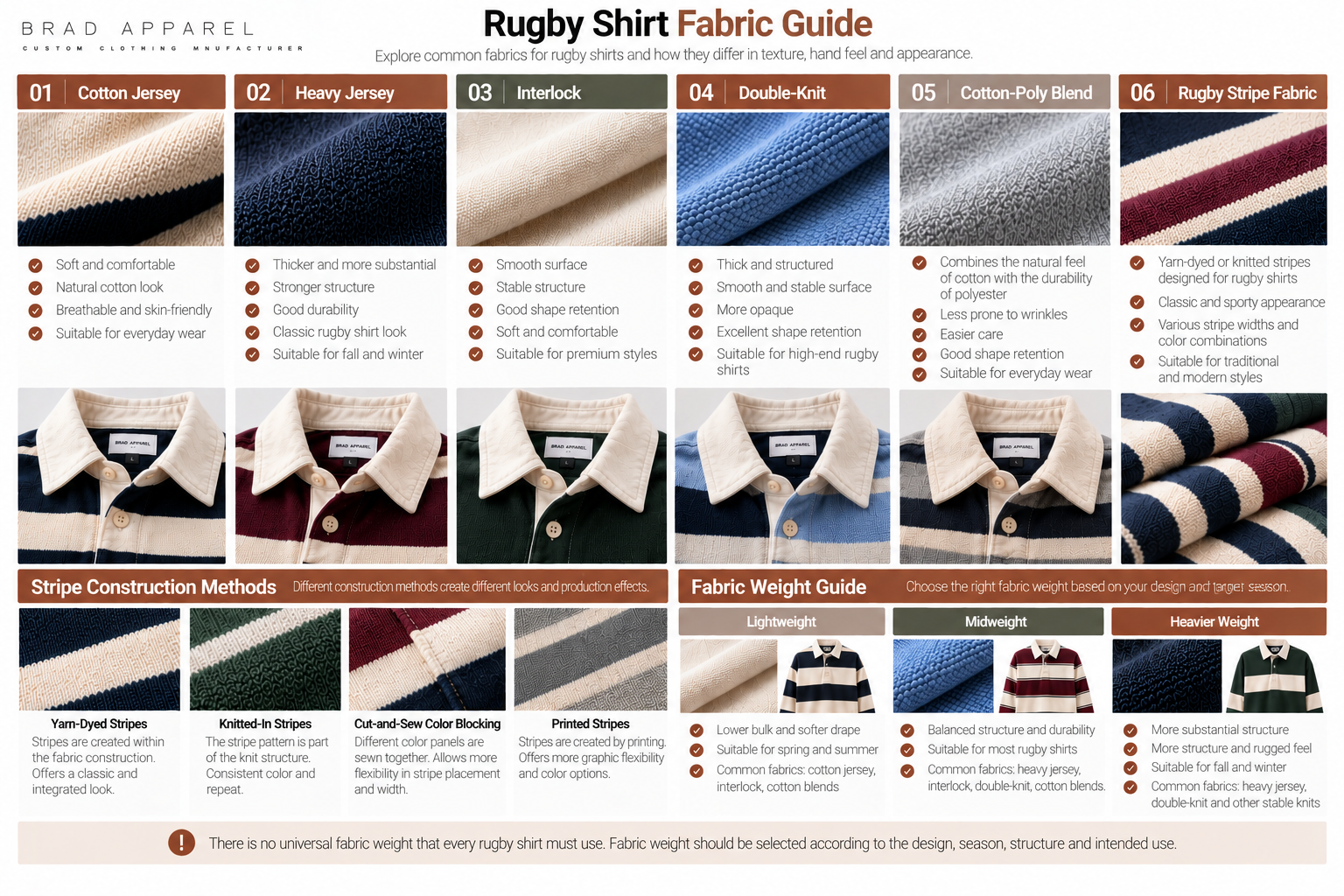
Bold horizontal stripes are strongly associated with rugby styling.
But brands need to decide how those stripes are created.
Possible methods include:
- Yarn-dyed stripes
- Knitted-in stripes
- Cut-and-sew color blocking
- Printed stripes
- Mixed panel construction
These methods create different garments.
Yarn-Dyed or Knitted-In Stripes
When stripe colors are created within the textile construction, the pattern becomes part of the fabric.
This can create:
- Integrated stripe appearance
- Repeating pattern
- Strong heritage character
Important specifications include:
- Stripe width
- Color order
- Repeat size
- Placement
The stripe repeat should be approved before bulk fabric production.
Cut-and-Sew Color Blocking
Another approach is to construct the garment using separate colored fabric panels.
For example:
navy body panel
+
cream panel
+
burgundy panel
This allows more control over exact stripe placement.
But every added seam creates:
- Additional sewing
- Alignment requirements
- More pattern pieces
- More opportunities for distortion
The seam positions should therefore be planned intentionally.
Printed Stripes
A stripe effect can also be printed.
This can provide:
- More artwork flexibility
- Complex color layouts
- Graphic effects
But the visual result differs from woven or knitted-in stripes.
The correct printing technique depends on:
- Fabric composition
- Surface
- Artwork
- Required hand feel
Brad Apparel's Printing Techniques page covers current print options according to fabric and artwork requirements.
Stripe Placement Should Be Approved on the Pattern
Where a horizontal stripe crosses the body can significantly change the garment visually.
Important areas include:
- Chest
- Placket
- Shoulder
- Sleeve
- Cuff
- Hem
For example:
A dominant stripe placed directly across the chest creates a different proportion from one positioned lower on the body.
The brand should therefore approve the actual stripe placement rather than only the fabric swatch.
Should Stripes Match at the Side Seams?
They can.
But complete stripe matching may require more careful cutting and may affect fabric consumption.
Brands should decide which areas are most important.
Possible priorities include:
- Left/right body
- Side seams
- Sleeve alignment
- Front placket
The requirement should be defined before final costing.
Sleeve Stripe Alignment
A striped sleeve can be developed in several ways.
The sleeve stripes may:
- Continue horizontally
- Be intentionally offset
- Use a solid sleeve
- Use contrast cuffs
There is no universal correct approach.
Consistency with the design is more important than forcing every stripe to align everywhere.
Solid Rugby Shirts Also Work
A rugby shirt does not have to use stripes.
Solid versions can rely on:
- Contrast collar
- Reinforced placket
- Heavy fabric
- Embroidery
- Oversized fit
to create the category identity.
This can work especially well for:
- Minimal collections
- Premium basics
- Uniform-inspired designs
- Tonal streetwear
Fit Changes the Meaning of the Rugby Shirt
A traditional rugby shirt may use a relatively relaxed athletic fit.
Modern versions can be:
- Regular
- Relaxed
- Boxy
- Oversized
- Cropped
The pattern should be designed intentionally.
Regular Rugby Fit
A more traditional proportion may use:
- Moderate chest ease
- Standard shoulder
- Long sleeve
- Controlled body length
This direction works well for:
- Heritage collections
- Preppy styling
- Classic sportswear
Oversized Rugby Shirt
An oversized rugby shirt may use:
- Wider chest
- Drop shoulder
- Lower armhole
- Larger sleeve
- Boxier body
- Larger collar
But oversized does not mean increasing every measurement.
If the body becomes too long while everything else is enlarged, the garment may lose the intended proportion.
Cropped Rugby Shirt
A cropped rugby shirt creates a more fashion-led interpretation.
Important areas include:
- Body length
- Stripe placement
- Collar scale
- Sleeve volume
- Hem proportion
The shorter body should be purpose-built rather than created by simply cutting a normal rugby shirt shorter.
Shoulder Construction
Modern rugby shirts may use:
- Standard set-in shoulder
- Extended shoulder
- Drop shoulder
- Raglan-inspired construction
A drop shoulder can create a more streetwear-oriented silhouette.
A traditional shoulder creates a cleaner heritage look.
Cuff Construction
Possible cuff options include:
- Rib cuff
- Self-fabric cuff
- Straight sleeve hem
- Adjustable cuff in more fashion-led designs
The cuff should match the body fabric and overall visual direction.
Side Vents
Small side vents are common on many collared casual tops.
They can help:
- Hem movement
- Layering
- Visual proportion
Possible constructions include:
- Even front/back vent
- Slightly longer back hem
- Reinforced vent opening
The vent should remain flat without twisting.
Longer Back Hem
Some rugby shirts use a back body that is slightly longer than the front.
This can create:
- More traditional sportswear proportion
- Additional coverage
- Different layering effect
It is optional rather than a universal rugby-shirt requirement.
Four Modern Rugby Shirt Directions
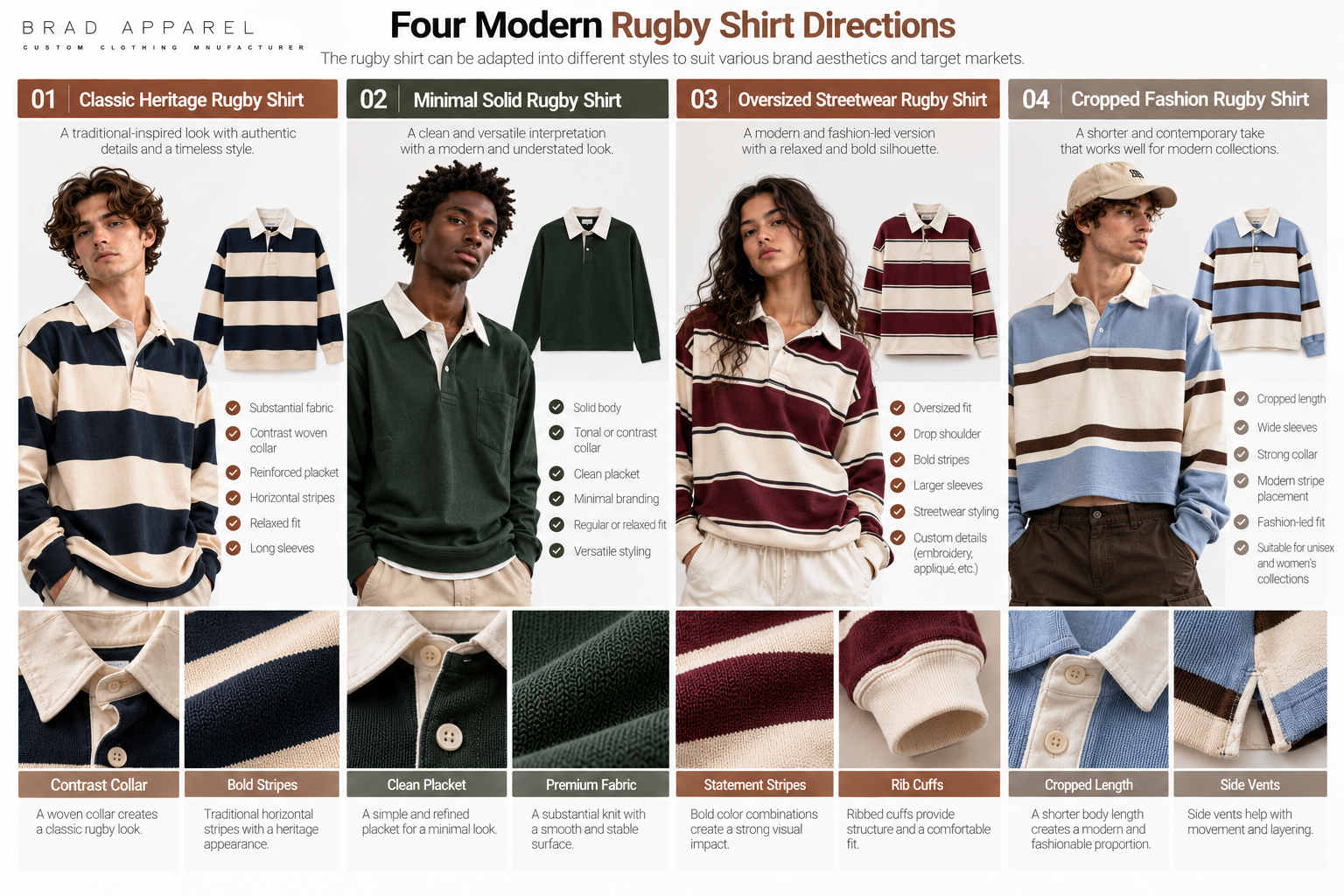
The rugby-shirt framework can support several different collections.
1. Classic Heritage Rugby Shirt
Typical features:
- Substantial cotton knit
- Contrast woven collar
- Reinforced placket
- Horizontal stripes
- Relaxed fit
- Long sleeves
Suitable for:
- Heritage sportswear
- Preppy brands
- Collegiate collections
This direction keeps the most recognizable traditional details.
2. Minimal Solid Rugby Shirt
Possible features include:
- Solid body
- Tonal collar
- Minimal buttons
- Clean placket
- Small embroidery
- Regular or relaxed fit
This creates a more understated interpretation.
The construction details become more important because there are fewer graphics or stripes to distract from them.
3. Oversized Streetwear Rugby Shirt
Possible features include:
- Wide chest
- Drop shoulder
- Large sleeves
- Boxy body
- Bold stripes
- Oversized collar
- Embroidery or appliqué
The pattern should be purpose-built.
Simply producing a classic rugby shirt in several sizes larger may create excessive body length and sleeve length.
4. Cropped Fashion Rugby Shirt
Possible features include:
- Shorter body
- Wide sleeves
- Strong collar
- High-impact stripe placement
- Boxy fit
This direction can work particularly well for:
- Women's collections
- Unisex fashion programs
- Coordinated sets
The crop length should be tested together with the intended trousers or skirt.
Embroidery Works Well on Rugby Shirts
Rugby shirts can support:
- Small chest embroidery
- Crest embroidery
- Collegiate lettering
- Sleeve embroidery
- Embroidered patches
- Appliqué
A stable knitted fabric often provides a useful base for embroidery.
However, stitch density should still be tested against the actual fabric.
Brad Apparel's Embroidery Techniques page covers flat embroidery, appliqué, chenille and other constructions developed according to the garment fabric.
Collegiate Patches and Crests
Rugby styling works naturally with:
- Shield patches
- Number patches
- Initials
- Team-inspired crests
- School-style lettering
These should be developed as original brand graphics rather than copying protected team or school marks.
Patch size should also remain proportionate to the body and stripe layout.
Appliqué for Large Rugby Graphics
Appliqué can be useful for:
- Large numbers
- Collegiate lettering
- Large chest graphics
- Back graphics
Because part of the design is created from fabric rather than dense stitching alone, appliqué can produce a different visual and tactile effect.
The patch fabric, border and base garment should be sampled together.
Shrinkage Needs to Be Tested
Cotton-rich rugby fabrics may change dimension during washing.
Possible effects include:
- Body shrinkage
- Sleeve shrinkage
- Collar behavior
- Stripe distortion
- Placket puckering
The production fabric should therefore be tested before final bulk approval.
The Collar and Body May Shrink Differently
This is particularly important when a woven collar is combined with a knitted body.
The two materials may respond differently to:
- Washing
- Steam
- Heat
- Drying
If their dimensional behavior is poorly matched, the collar area may:
- Pucker
- Twist
- Pull
- Sit unevenly
The combined construction should be tested as a complete garment.
What Should You Check on a Rugby Shirt Sample?
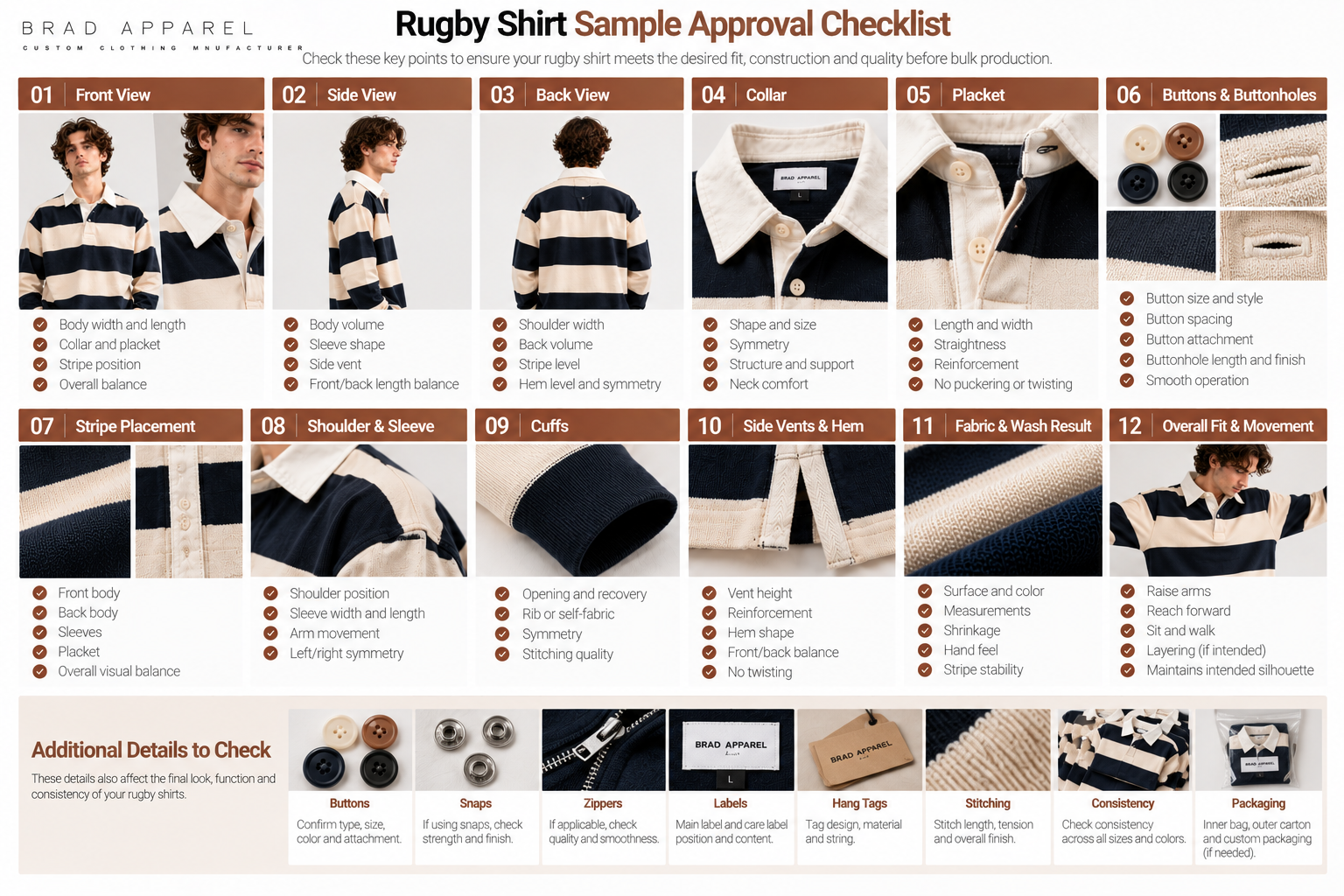
A rugby shirt should be reviewed for both:
fit
and
construction stability.
1. Front View
Check:
- Body width
- Body length
- Collar
- Placket
- Stripe position
- Hem balance
2. Side View
Check:
- Body volume
- Sleeve shape
- Side vent
- Front/back length balance
3. Back View
Check:
- Shoulder width
- Back volume
- Stripe level
- Hem level
- Sleeve symmetry
4. Collar
Check:
- Shape
- Size
- Symmetry
- Structure
- Neck comfort
Inspect the collar both before and after washing.
5. Placket
Check:
- Length
- Width
- Straightness
- Reinforcement
- No puckering or twisting
6. Buttons & Buttonholes
Check:
- Button size
- Spacing
- Attachment
- Buttonhole length
- Smooth operation
7. Stripe Placement
Check:
- Front body
- Back body
- Sleeves
- Placket
- Overall visual balance
8. Shoulder & Sleeve
Check:
- Shoulder position
- Sleeve width
- Sleeve length
- Arm movement
- Left/right symmetry
9. Cuffs
Check:
- Opening
- Rib or fabric recovery
- Symmetry
- Stitching
10. Side Vents & Hem
Check:
- Vent height
- Reinforcement
- Hem shape
- Front/back balance
- No twisting
11. Fabric & Wash Result
Check:
- Surface
- Color
- Measurements
- Shrinkage
- Hand feel
- Stripe stability
12. Overall Fit & Movement
Ask the wearer to:
- Raise arms
- Reach forward
- Sit
- Walk
- Layer the shirt if intended
The garment should maintain the intended silhouette while remaining comfortable.
Common Rugby Shirt Development Mistakes
Treating It Like a Standard Polo
The collar, placket and fabric structure may require different construction.
Choosing the Collar Separately From the Body Fabric
The two materials need compatible behavior.
Making the Placket Too Stiff
Excess reinforcement can create an uncomfortable front.
Using Heavy Buttons on a Soft Placket
This can distort the opening.
Approving Stripes Only From a Fabric Swatch
Stripe placement should be approved on the finished pattern.
Expecting Every Stripe to Match Automatically
Pattern matching may require additional fabric and cutting control.
Making an Oversized Rugby Shirt by Simply Sizing Up
The body, shoulder, sleeve and collar should be rebalanced together.
Ignoring Post-Wash Collar Behavior
Different materials may shrink differently.
Adding Dense Embroidery Without Testing
Even substantial knit fabrics can distort when embroidery density is poorly matched.
What Should You Send a Rugby Shirt Manufacturer?
A useful development brief should define:
| Area | What to Specify |
|---|---|
| Fit | Regular / relaxed / oversized / cropped |
| Body Fabric | Jersey / interlock / double-knit / other |
| Composition | Cotton / blend / other |
| Weight | Target hand feel or approved swatch |
| Collar | Woven / knit / contrast / tonal |
| Placket | Width, length and reinforcement |
| Buttons | Type, size and color |
| Stripe | Solid / yarn-dyed / knitted / panelled / printed |
| Stripe Repeat | Color order and dimensions |
| Shoulder | Standard / drop / extended / raglan |
| Sleeve | Width and finished length |
| Cuff | Rib / self-fabric / straight |
| Hem | Straight / side vent / longer back |
| Decoration | Embroidery / patch / appliqué / print |
| Wash | Required shrinkage or finishing test |
| Quantity | Sample and bulk quantity |
A visual reference is useful.
But the manufacturer still needs actual construction and measurement specifications before production.
How Brad Apparel Can Develop a Custom Rugby Shirt
A rugby-shirt development process can follow:
Design Reference
↓
Body Fabric Selection
↓
Collar Material Selection
↓
Fit & Pattern Development
↓
Placket & Button Construction
↓
Stripe / Color Layout
↓
Decoration Development
↓
First Sample
↓
Fit + Collar + Placket Review
↓
Wash Test
↓
Measurement & Construction Adjustment
↓
Pre-Production Approval
↓
Bulk Production
Brad Apparel supports rugby-shirt development through Fabric Sourcing & Development, custom buttons and labels through Trims & Branding, decoration through Embroidery Techniques and Printing Techniques, and broader production support through our Manufacturing Capabilities.
FAQ
What Is a Rugby Shirt?
A rugby shirt is a collared knitted top inspired by traditional rugby sportswear.
It commonly uses long sleeves, a short placket, a substantial fabric and a relaxed silhouette.
Is a Rugby Shirt the Same as a Polo Shirt?
No.
The categories overlap, but rugby shirts commonly use more substantial fabric, stronger placket construction and heritage sportswear details.
Modern fashion versions can combine elements from both.
Why Do Rugby Shirts Have Contrast Collars?
A contrast collar is part of the traditional visual language of the garment.
Modern rugby shirts may also use tonal or self-fabric collars.
Do Rugby Shirts Need Rubber Buttons?
No.
Rubber-style buttons are associated with traditional rugby construction, but fashion versions can use resin, plastic or other suitable buttons.
The button should match the placket and garment design.
Are Rugby Shirts Always Striped?
No.
Horizontal stripes are strongly associated with the category, but solid and color-blocked rugby shirts are also common.
What Fabric Is Best for a Rugby Shirt?
There is no single best option.
Possible fabrics include:
- Jersey
- Heavy jersey
- Interlock
- Double-knit
- Cotton blends
The correct material depends on the intended fit, season, structure and hand feel.
Can a Rugby Shirt Be Oversized?
Yes.
The body, shoulder, sleeves and collar should be developed together for the oversized silhouette.
Simply using a larger standard size may distort the proportions.
Can Rugby Shirts Be Embroidered?
Yes.
Small chest logos, crests, lettering and patches can work particularly well.
Embroidery density and backing should be tested on the actual production fabric.
What Is the Difference Between a Rugby Shirt and a Long-Sleeve Polo?
A long-sleeve polo may simply use the same construction as a regular polo with longer sleeves.
A rugby shirt generally has stronger heritage sportswear characteristics such as a more substantial body, distinctive collar and reinforced placket.
Do Rugby Shirt Stripes Need to Match at the Seams?
Not always.
Brands can specify which seams or panels should align.
More extensive pattern matching may require additional cutting control and fabric consumption.
Should a Rugby Shirt Be Wash-Tested?
Yes, especially when the collar and body use different materials.
Post-wash measurements, collar behavior, placket stability and stripe appearance should be reviewed before bulk approval.
Final Thoughts
The rugby shirt looks familiar because its basic design has existed for generations.
But the strongest modern versions are not simply long-sleeve polos with bold stripes.
Their identity comes from balancing:
Fabric
+
Collar
+
Placket
+
Buttons
+
Stripes
+
Fit
+
Wash Behavior
as one complete product.
For clothing brands, that is what turns a rugby-inspired top into a garment that feels deliberate, premium and consistent from sample through bulk production.
Keep Reading