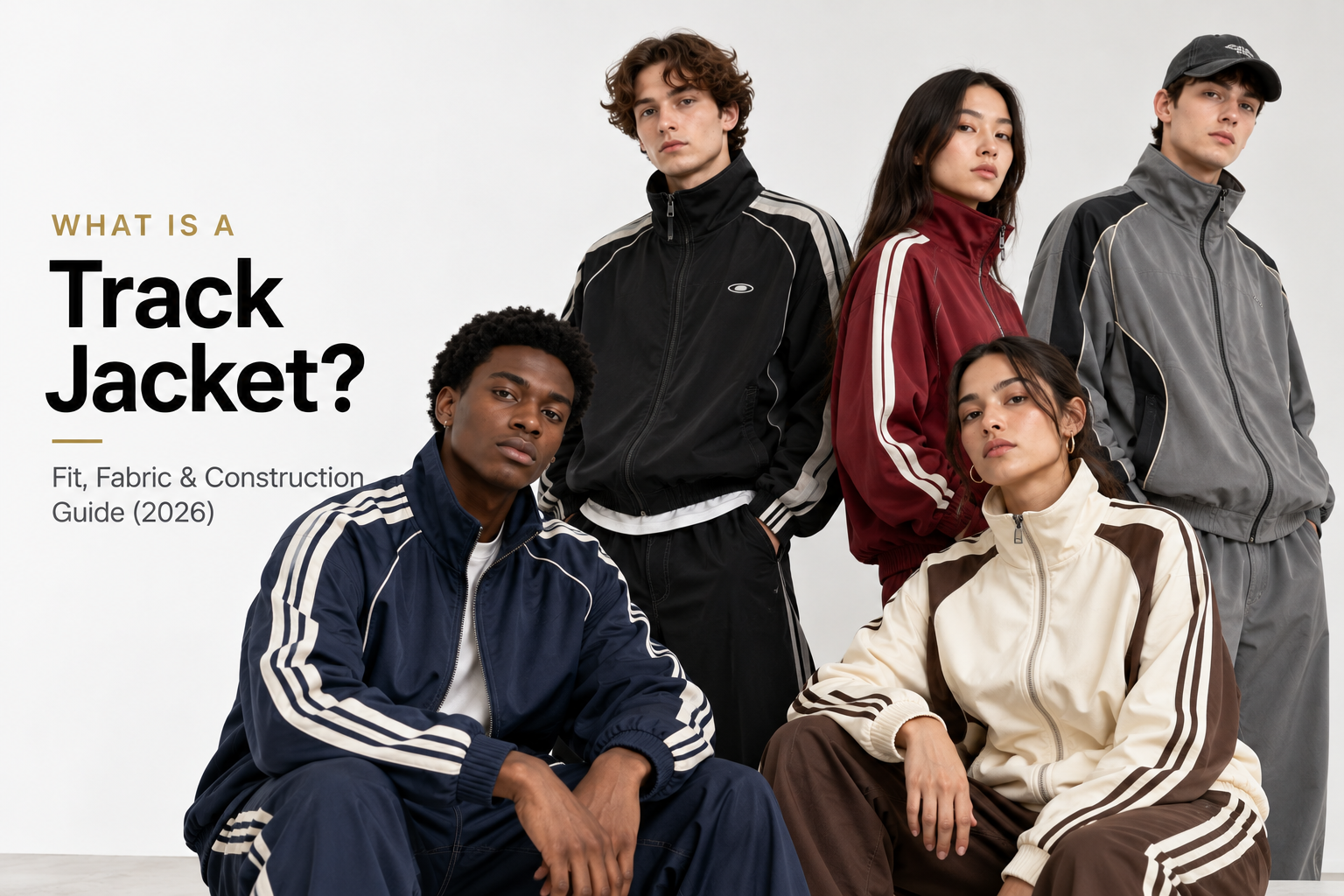
A track jacket is a lightweight zip-front sportswear jacket originally developed for warm-ups, training and athletic tracksuits.
But in 2026, the track jacket has moved far beyond sports.
Modern versions appear across:
- Retro sportswear
- Streetwear
- Blokecore
- Tennis-inspired fashion
- Luxury sportswear
- Y2K collections
- Matching tracksuits
- Minimal everyday outerwear
A track jacket may look simple, but developing one correctly requires several decisions around:
fabric + fit + collar + zipper + sleeve construction + panel lines + stripes + cuffs + hem
For clothing brands, the most important question is not simply:
What fabric should I use?
It is:
What type of track jacket are we actually trying to make?
A performance track jacket, a 1970s-inspired retro jacket and an oversized fashion track jacket may share the same basic name but require very different construction.
This guide explains how track jackets are built, how they differ from windbreakers and bomber jackets, and what brands should specify before developing one for production.
What Is a Track Jacket?
A track jacket is generally a lightweight or midweight zip-front jacket with sportswear-inspired construction.
Common characteristics include:
- Full front zipper
- Stand collar
- Long sleeves
- Elasticated or ribbed cuffs
- Elasticated, ribbed or straight hem
- Side pockets
- Contrast stripes or piping
- Color-blocked panels
- Lightweight knit or woven fabric
Traditional track jackets were often designed as part of a matching tracksuit.
Modern fashion versions may be worn independently.
They can also use:
- Oversized proportions
- Cropped body lengths
- Drop shoulders
- Technical woven fabrics
- Velour
- Heavy double-knit
- Embroidery
- Custom piping
- Branded zipper pullers
The term therefore describes a category rather than one fixed construction.
Why Are Track Jackets Popular Again in 2026?
The current track-jacket revival connects with several fashion movements happening at the same time:
- Retro athleticwear
- Football-inspired fashion
- Tennis styling
- Blokecore
- Y2K sportswear
- Luxury sportswear
- Relaxed layering
- Vintage color blocking
The track jacket is particularly adaptable because it can look completely different depending on styling and construction.
A slim tricot jacket can feel distinctly retro.
A clean black technical track jacket can feel minimal.
A wide drop-shoulder track jacket can become streetwear.
A coordinated jacket and pant can create a complete branded tracksuit.
For clothing brands, this gives one familiar silhouette a large number of possible product directions.
Track Jacket vs Windbreaker vs Bomber Jacket
These three jackets can look similar at first glance, particularly when lightweight fabrics are used.
But their typical construction is different.
| Feature | Track Jacket | Windbreaker | Bomber Jacket |
|---|---|---|---|
| Main Origin | Athletic warm-up wear | Wind protection | Military flight jacket |
| Typical Fabric | Tricot, interlock, polyester, nylon | Lightweight nylon/polyester | Nylon, twill, leather, wool |
| Collar | Usually stand collar | Stand collar or hood | Rib collar commonly used |
| Front | Full zip | Zip / pullover | Full zip |
| Cuff | Rib / elastic | Elastic / adjustable | Rib |
| Hem | Rib / elastic / straight | Elastic / drawcord | Rib |
| Signature Detail | Stripes, piping, panels | Lightweight shell | Rib trim + blouson shape |
| Typical Fit | Slim to oversized | Regular to oversized | Blouson / oversized |
A track jacket is defined more by its athletic construction language.
A windbreaker is primarily defined by its lightweight protective shell.
A bomber is defined more strongly by its blouson shape and ribbed trim.

Track Jacket vs Tracksuit Jacket
These terms often overlap.
A tracksuit jacket is simply the jacket portion of a coordinated tracksuit.
A track jacket can be:
- Part of a matching set
- Sold separately
- Designed purely as a fashion jacket
For manufacturing, the distinction becomes important if a matching pant is also being produced.
Then the brand needs to coordinate:
- Fabric
- Color
- Piping
- Stripe width
- Zippers
- Logo placement
- Rib
- Hardware
- Dye lot
between both garments.
Track Jacket vs Warm-Up Jacket
"Warm-up jacket" is a broader sportswear term.
It may describe jackets designed to be worn:
- Before competition
- During warm-up
- On the sidelines
- Between training sessions
A warm-up jacket can technically be a track jacket.
But modern retail uses track jacket more frequently as a fashion and lifestyle category.
Knit Track Jacket vs Woven Track Jacket
One of the first production decisions is whether the jacket should use:
knitted fabric
or:
woven fabric
The difference strongly affects drape, stretch and overall character.
Knit Track Jackets
Common knit structures include:
- Tricot
- Interlock
- Double knit
- Jersey
- Velour
Knitted track jackets generally provide:
- More natural stretch
- Softer movement
- Classic tracksuit feel
- Easier athletic mobility
They work especially well for:
- Retro tracksuits
- Lifestyle sets
- Tennis-inspired designs
- Minimal sportswear
Woven Track Jackets
Possible woven fabrics include:
- Nylon
- Polyester
- Taslan
- Stretch woven
- Lightweight technical shells
Woven versions can create:
- Crisper structure
- More technical appearance
- Wind resistance
- Lighter shell construction
Some modern track jackets sit somewhere between:
track jacket
and
windbreaker
because fashion categories increasingly borrow details from one another.
For a more detailed explanation of lightweight shell construction, see our Windbreaker Jacket Guide.
What Is Tricot?
Tricot is strongly associated with traditional track jackets.
It is a warp-knit construction that can provide:
- Smooth surface
- Good durability
- Flexible movement
- Stable shape
- Classic sportswear appearance
Depending on yarn and finishing, tricot can feel:
- Smooth
- Shiny
- Matte
- Soft
- Dense
Two fabrics both called tricot can still look and feel very different.
That is why a fabric specification should include more than the word "tricot."
Interlock Track Jackets
Interlock produces a smoother and more substantial knitted structure.
It can work particularly well for:
- Premium tracksuits
- Minimal track jackets
- Structured oversized silhouettes
- Fashion sportswear
Compared with traditional lightweight tricot, interlock can feel:
- Heavier
- Cleaner
- More structured
- Less overtly athletic
This makes it useful for brands that want sportswear construction without an obvious gym-wear appearance.
Velour Track Jackets
Velour creates a very different direction.
It has a soft pile surface and strong associations with:
- Retro tracksuits
- Y2K fashion
- Lifestyle collections
- Premium loungewear
Velour requires careful handling during:
- Cutting
- Sewing
- Pressing
- Embroidery
because pile direction can affect the visible shade.
For a broader comparison of track and tracksuit fabrics, see our Tracksuit Fabric Guide.
The Collar Defines the Track Jacket
Most track jackets use a standing collar.
But the exact collar can completely change the product.
Possible directions include:
- Low stand collar
- Medium stand collar
- Tall retro collar
- Rib collar
- Self-fabric collar
- Contrast collar
- Funnel-inspired collar
The collar should be developed together with:
- Neck opening
- Zipper
- Shoulder
- Body width
rather than treated as an isolated trim.
Low vs Tall Track Jacket Collar
Lower Collar
Creates:
- Cleaner appearance
- More subtle sportswear look
- Easier everyday wear
Taller Collar
Creates:
- Stronger retro identity
- More facial framing
- More visible color-blocking opportunities
A tall collar may also require more structure depending on fabric softness.
Rib Collar vs Self-Fabric Collar
Rib Collar
Can provide:
- Stretch
- Recovery
- Comfortable neck opening
- More obvious sportswear character
Self-Fabric Collar
Can create:
- Cleaner surface
- More minimal styling
- Better visual continuity
The correct choice depends on whether the product should look:
retro athletic
or:
modern and minimal
Full-Zip Construction
A full center-front zipper is one of the most recognizable track-jacket features.
Possible zipper directions include:
- Nylon coil
- Reverse coil
- Plastic molded
- Metal zipper
Traditional lightweight track jackets frequently use flexible zipper constructions.
Fashion versions may intentionally use heavier hardware for visual impact.
But zipper weight still needs to match the fabric.
A heavy metal zipper installed into a soft lightweight tricot may cause:
- Front pulling
- Zipper wave
- Uneven drape
- Collar distortion
Brad Apparel's Custom Zippers & Sliders page covers coil, molded, metal, two-way and branded puller options.
Zipper Pullers Can Become a Branding Detail
The front zipper sits in a highly visible area.
A custom puller can therefore provide subtle branding without adding a large exterior logo.
Possible options include:
- Engraved logo
- Molded logo
- Custom shape
- Matte finish
- Gunmetal finish
- Antique metal
- Color-matched coating
However, custom pullers may require:
- Mold development
- Accessory MOQ
- Additional sampling
These requirements should be confirmed before the bulk order.
Track Jacket Anatomy
A typical track jacket can be broken into several development zones:
- Collar
- Front zipper
- Shoulder
- Sleeve
- Body panels
- Side stripes or piping
- Pockets
- Cuffs
- Hem
- Branding
Each area affects the visual identity.

Set-In Shoulder Track Jacket
A set-in shoulder creates a cleaner and more conventional jacket shape.
Characteristics include:
- Defined shoulder seam
- Controlled upper-body fit
- Cleaner silhouette
It works well for:
- Classic track jackets
- Slim fits
- Minimal designs
- Retro sportswear
Raglan Track Jacket
Raglan sleeves extend toward the neckline rather than using a standard shoulder seam.
They can create:
- Greater visual movement
- Athletic character
- Easier arm mobility
- Strong color-blocking opportunities
Raglan construction works especially well when different colors are used across the:
body + shoulder + sleeve
Drop-Shoulder Track Jacket
A drop shoulder moves the shoulder seam onto the upper arm.
This creates:
- Wider appearance
- More relaxed fit
- Stronger streetwear silhouette
Modern oversized track jackets often use this direction.
However, the sleeve length should be adjusted accordingly.
If the shoulder is extended but a standard sleeve length is retained, the total sleeve can become excessively long.
Side Stripes Are More Complicated Than They Look
Side stripes are one of the most recognizable track-jacket details.
But brands should define exactly how they are created.
Possible methods include:
- Sewn-on tape
- Knitted stripe tape
- Grosgrain
- Contrast fabric panels
- Piping
- Printed stripes
- Sublimated stripes
These methods do not create the same result.
Sewn-On Stripe Tape
A separate stripe tape can be applied along the sleeve.
Advantages include:
- Clean consistent width
- Strong retro identity
- Easy contrast colors
But production needs to control:
- Straightness
- Stretch
- Shrinkage
- Left/right symmetry
A stripe that twists around the sleeve can make the entire garment look poorly made.
Contrast Panel Stripes
Instead of attaching tape, the stripe can be created from separate fabric panels.
For example:
black sleeve
+
white stripe panel
+
black lower sleeve panel
This creates a more integrated construction.
But it also adds:
- Pattern pieces
- Sewing operations
- Seam allowance
- Alignment requirements
Piping
Piping creates a narrower line than a conventional track stripe.
It can be positioned along:
- Raglan seam
- Shoulder
- Sleeve
- Chest panel
- Side seam
Piping works particularly well for more refined retro or tennis-inspired designs.
Printed or Sublimated Stripes
Some lightweight polyester track jackets can use printed graphics instead of sewn stripes.
This allows:
- More complex artwork
- Gradient effects
- Custom repeats
- All-over graphics
For polyester sportswear, sublimation can produce graphics without adding a thick surface layer.
Brad Apparel's Printing Techniques page covers sublimation, screen printing, digital printing and other options.
Stripe Placement Must Be Specified
Do not simply write:
Three stripes on sleeve.
The tech pack should define:
- Stripe width
- Number of stripes
- Gap between stripes
- Start point
- End point
- Distance from shoulder seam
- Color
- Material
For example:
Stripe width: 10 mm
Gap: 7 mm
is much clearer than a reference image alone.
Panel Construction Creates the Retro Look
Track jackets frequently use visible panel lines.
Common positions include:
- Upper chest
- Shoulder
- Sleeve
- Side body
- Back yoke
Panels can be used for:
- Color blocking
- Fabric mixing
- Shape
- Branding
- Ventilation
A simple panel change can move the product from:
basic activewear
to:
retro fashion sportswear
without changing the basic garment block.
Color Blocking Needs Pattern Planning
Suppose the design uses:
navy body
+
cream shoulder panel
+
red sleeve stripe
The color layout should be considered during pattern development.
Otherwise problems may appear around:
- Armhole
- Shoulder
- Zipper
- Collar
- Side seam
The design artwork and garment pattern should therefore be reviewed together.
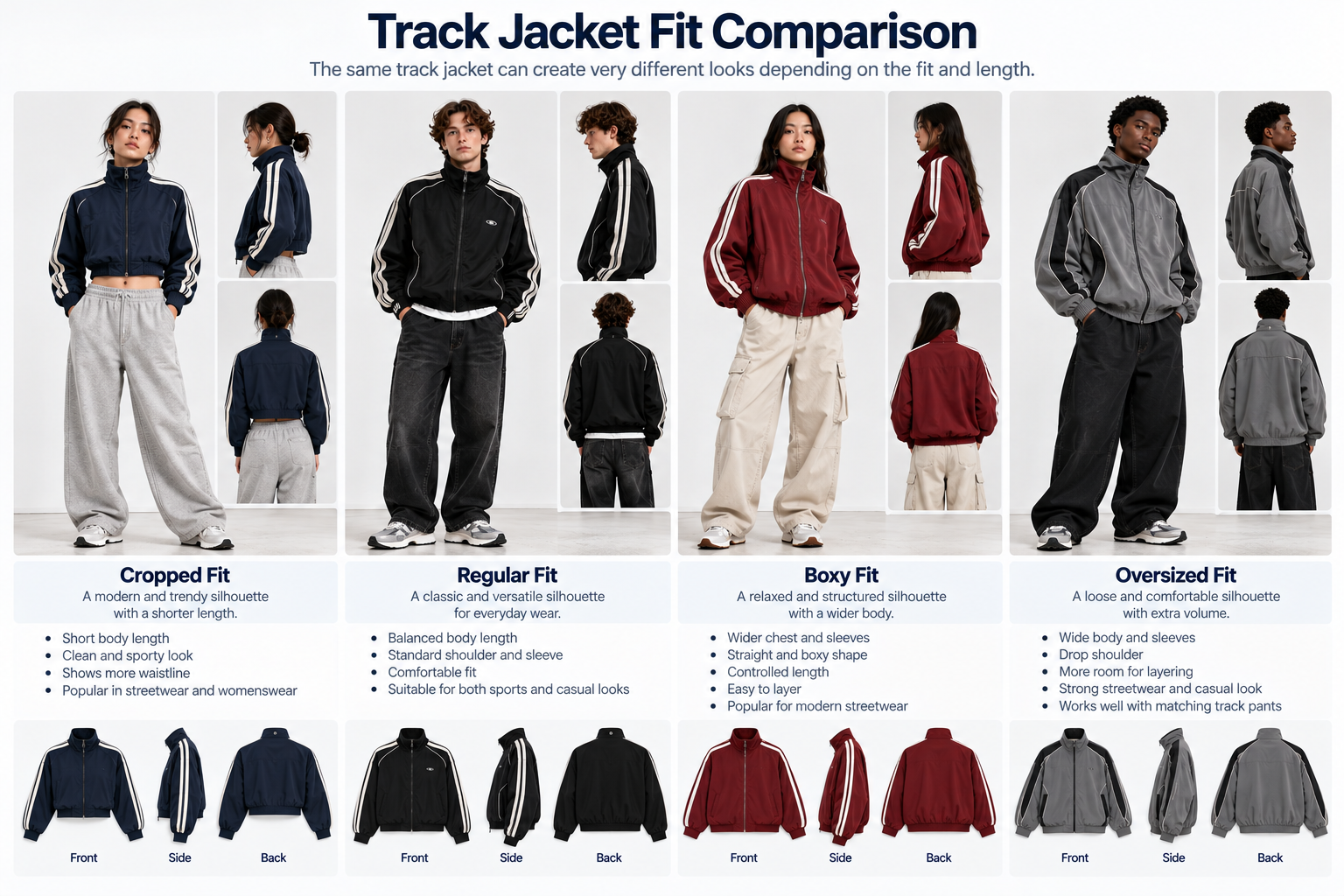
Track Jacket Fit: Slim, Regular, Boxy or Oversized?
Modern track jackets can use very different proportions.
Slim Retro Fit
Typical characteristics:
- Closer chest
- Natural shoulder
- Narrow sleeves
- Standard body length
This can create a stronger 1970s or early-2000s sportswear appearance.
Regular Fit
Provides:
- Moderate ease
- Standard shoulders
- Comfortable sleeve width
- Versatile body length
Suitable for broad commercial collections.
Boxy Fit
Typically uses:
- Wider chest
- Straighter body
- Controlled length
- Wider sleeves
The result looks broader without becoming excessively long.
Oversized Fit
May include:
- Wide chest
- Drop shoulders
- Deep armholes
- Wide sleeves
- More overall volume
This works particularly well for modern streetwear.
Oversized Does Not Mean Sizing Up
A true oversized track jacket should be developed through an intentional pattern.
Simply taking a regular Medium and producing an XL can increase:
- Body length
- Sleeve length
- Neck opening
without creating the correct silhouette.
Instead, the pattern maker can selectively increase:
- Chest
- Shoulder
- Sleeve width
while controlling:
- Body length
- Collar
- Cuff
- Hem
This provides much better proportion.
Cropped Track Jackets
Cropped track jackets are another modern direction.
They may use:
- Shorter body
- Wider chest
- Full sleeves
- Strong collar
- Elastic or rib hem
The body should be patterned specifically for the crop.
Simply shortening an existing jacket can move:
- Pocket position
- Zipper proportion
- Panel lines
- Logo placement
too close to the hem.
Cuff Options
Track jackets commonly use:
Ribbed Cuff
Provides:
- Stretch
- Recovery
- Retro sportswear appearance
Elasticated Cuff
Creates:
- Lightweight construction
- Cleaner woven-jacket finish
Self-Fabric Cuff
Can create:
- Minimal appearance
- Less obvious athletic styling
Straight Sleeve Hem
Works for more fashion-oriented track jackets.
The cuff should match both the fabric and the intended jacket category.
Hem Options
The lower hem controls the jacket's body shape.
Possible constructions include:
- Rib hem
- Elasticated hem
- Internal elastic
- Drawcord hem
- Straight hem
Rib / Elastic Hem
Creates a more traditional blouson-like track shape.
Straight Hem
Creates a cleaner and often more modern silhouette.
Drawcord Hem
Allows the wearer to adjust volume.
This can be useful on oversized technical styles.
Side Pockets
Common pocket constructions include:
- Welt pockets
- Zipper pockets
- Side-seam pockets
- Patch pockets
Track jackets designed for actual training may prioritize secure zipper pockets.
Fashion versions can use cleaner welt or side-seam constructions.
Pocket Position Changes With Body Length
A pocket position that works on a standard-length jacket may not work on a cropped version.
The wearer should be able to insert their hands naturally without:
- Raising the shoulders
- Twisting the wrist
- Pulling the body upward
Pocket placement should therefore be tested on the actual sample.
Should a Track Jacket Be Lined?
Not always.
Unlined Track Jacket
Common for:
- Knit tricot
- Interlock
- Velour
- Double knit
Benefits include:
- Less bulk
- More stretch
- Lighter feel
- Simpler construction
Mesh-Lined Track Jacket
Common for some woven sports jackets.
Mesh can provide:
- Improved interior comfort
- Reduced shell contact
- Sportier construction
Fully Lined Fashion Track Jacket
Some fashion versions may use full lining.
This can improve:
- Interior finishing
- Layering
- Structure
but also adds weight and cost.
The lining should not restrict the movement of the outer shell.
Performance Track Jacket vs Fashion Track Jacket
Before development begins, define the intended use.
Performance Track Jacket
Priorities may include:
- Low weight
- Mobility
- Moisture management
- Quick drying
- Breathability
- Secure pockets
Lifestyle Track Jacket
Priorities may include:
- Hand feel
- Color
- Fit
- Styling
- Everyday comfort
Fashion Track Jacket
Priorities may include:
- Oversized silhouette
- Unique panel construction
- Retro details
- Premium trims
- Embroidery
- Unusual fabric
The product should not automatically inherit sports-performance requirements simply because it is called a track jacket.
Matching Track Jacket and Track Pants
When the jacket is part of a matching set, both garments need to be developed as one visual system.
Confirm:
- Same fabric
- Same shade
- Same stripe width
- Same piping
- Same hardware finish
- Same branding style
One of the most noticeable quality problems in a tracksuit is:
jacket color ≠ pants color
even when both were technically ordered under the same color name.
For detailed fabric and dye-lot considerations, see our Tracksuit Fabric Guide.
Matching Stripe Placement Between Jacket and Pants
The jacket stripe and pant stripe do not necessarily need to use identical positioning.
But they should feel intentionally related.
For example:
10 mm sleeve stripe
paired with:
10 mm side-leg stripe
creates a clear visual connection.
If the widths are different, the change should look deliberate rather than accidental.
Logo Placement on Track Jackets
Common positions include:
- Left chest
- Right chest
- Sleeve
- Upper back
- Collar
- Lower front
Small chest embroidery works particularly well because it does not compete with:
- Zipper
- Panel lines
- Sleeve stripes
For direct embroidery on nylon and performance fabrics, stabilization and stitch density should be tested carefully to reduce puckering.
See our Embroidery Techniques guide for fabric-specific considerations.
Appliqué and Patches
Patches can work well for:
- Retro sports branding
- Team-inspired graphics
- Collegiate styling
- Large sleeve badges
Because patches are produced separately, they can also reduce the amount of dense embroidery stitched directly through a lightweight jacket shell.
However, patch weight should still suit the base fabric.
Important Track Jacket Measurements
A tech pack should normally define:
| Measurement | Why It Matters |
|---|---|
| Chest Width | Controls body volume |
| Body Length | Defines jacket proportion |
| Shoulder Width | Controls upper-body shape |
| Sleeve Length | Controls total arm length |
| Bicep Width | Controls sleeve volume |
| Sleeve Opening | Defines cuff area |
| Collar Height | Changes neckline appearance |
| Neck Opening | Controls comfort |
| Hem Width | Controls lower-body shape |
| Pocket Position | Affects usability |
| Stripe Width | Controls graphic proportion |
| Stripe Position | Ensures consistency |
| Zipper Length | Controls center-front construction |
For raglan designs, sleeve measurements should be defined according to the measurement method used by the factory.
Track Jacket Tech Pack Example
A useful development brief might look like this:
| Area | Example Specification |
|---|---|
| Product | Retro Track Jacket |
| Fit | Relaxed / Boxy |
| Fabric | Polyester Interlock |
| Shoulder | Raglan |
| Collar | Self-Fabric Stand Collar |
| Front | Full Zip |
| Zipper | #5 Nylon Coil |
| Sleeve | Relaxed |
| Stripe | Contrast Sewn-On Tape |
| Stripe Width | 12 mm |
| Cuff | Ribbed |
| Hem | Ribbed |
| Side Welt | |
| Branding | Left-Chest Embroidery |
| Lining | Unlined |
| Matching Bottom | Track Pants |
These values are examples only.
Actual specifications should be based on the target garment and fabric.
Example Development Brief
Instead of telling a manufacturer:
I want a vintage track jacket.
a more useful description would be:
Relaxed retro track jacket in smooth polyester interlock with raglan sleeves, medium stand collar, full front nylon-coil zipper, contrast sleeve tape, ribbed cuffs and hem, and small left-chest embroidery.
Then provide:
- Front reference
- Back reference
- Fit reference
- Fabric direction
- Measurements
- Stripe dimensions
- Color references
- Zipper
- Rib specifications
- Pocket details
- Artwork
- Label requirements
This gives the pattern and sample teams a much clearer starting point.
How to Evaluate a Track Jacket Sample
A track jacket should be reviewed from several angles.
Front View
Check:
- Zipper alignment
- Collar
- Chest width
- Body length
- Panel symmetry
- Logo placement
- Pocket height
Side View
Check:
- Body volume
- Sleeve angle
- Hem shape
- Pocket bulk
Back View
Check:
- Shoulder construction
- Back width
- Panel alignment
- Stripe position
- Left/right symmetry
Check the Zipper Open and Closed
With the jacket fully zipped, inspect:
- Collar symmetry
- Center-front line
- Zipper wave
With the jacket open, inspect:
- Collar fall
- Facing
- Interior finish
A jacket can look correct closed but awkward when worn open.
Check Stripe Straightness
This is especially important on sleeves.
Inspect whether the stripe:
- Runs smoothly
- Maintains constant width
- Is symmetrical left to right
- Twists around the sleeve
- Matches the intended seam
Stripe inconsistency becomes very obvious on clean sportswear designs.
Check Movement
Ask the wearer to:
- Raise arms
- Reach forward
- Bend elbows
- Zip the jacket
- Put hands in pockets
- Sit
The jacket should maintain its intended shape without unnecessary restriction.
Check the Rib
If the garment uses ribbed:
- Collar
- Cuffs
- Hem
check:
- Stretch
- Recovery
- Thickness
- Color match
- Attachment seam
Weak recovery can cause the jacket to lose shape after repeated wear.
Wash Testing
After washing, review:
- Body measurements
- Zipper wave
- Rib recovery
- Stripe appearance
- Color
- Logo
- Panel distortion
Different materials used in one jacket can shrink differently.
For example:
body fabric + rib + stripe tape
may not react identically during washing.
This should be tested before bulk approval.
Common Track Jacket Development Mistakes
1. Treating Every Sport Jacket as a Track Jacket
Windbreakers, warm-up jackets and track jackets overlap but do not always use the same construction.
2. Choosing Fabric Only by GSM
Surface, stretch and structure are equally important.
3. Making Sleeve Stripes Without Exact Dimensions
Small stripe inconsistencies become very visible.
4. Using a Heavy Zipper on Lightweight Fabric
This can distort the center front.
5. Ignoring Rib Recovery
Loose cuffs and hems can make the jacket look worn quickly.
6. Sizing Up to Create Oversized Fit
This often adds too much body and sleeve length.
7. Approving Only the Front View
Back panel and sleeve stripe issues can be missed.
8. Adding Panels Without Considering Seam Bulk
Too many panels can make a lightweight jacket unnecessarily heavy.
9. Treating Matching Pants as a Separate Product
Color and trim inconsistencies become obvious when worn as a set.
10. Approving Before Wash Testing
Different components may react differently after laundering.
What Should You Send a Track Jacket Manufacturer?
A useful development package should specify:
| Area | What to Specify |
|---|---|
| Fit | Slim / regular / boxy / oversized |
| Fabric | Tricot / interlock / woven / velour / other |
| Composition | Polyester / nylon / cotton blend / other |
| Collar | Type + finished height |
| Shoulder | Set-in / raglan / drop |
| Sleeve | Width + length |
| Stripe | Material + width + position |
| Panels | Colors + seam positions |
| Zipper | Type + size + puller |
| Cuff | Rib / elastic / self-fabric |
| Hem | Rib / elastic / straight / drawcord |
| Pockets | Type + position |
| Lining | None / mesh / full |
| Branding | Embroidery / patch / print |
| Matching Pants | Yes / no |
A reference garment can be especially useful when the:
- Fit
- Fabric hand feel
- Collar
- Stripe position
need to be reproduced accurately.
FAQ
What Is a Track Jacket?
A track jacket is a zip-front sportswear jacket originally associated with athletic warm-ups and tracksuits.
Modern track jackets are also widely used in streetwear and fashion collections.
Is a Track Jacket the Same as a Tracksuit Jacket?
Often, yes.
A tracksuit jacket is the jacket portion of a matching tracksuit.
A track jacket can also be designed and sold independently.
What Is the Difference Between a Track Jacket and a Windbreaker?
A track jacket is defined mainly by its sportswear construction and styling.
A windbreaker is primarily designed as a lightweight shell for wind protection.
Modern designs can combine characteristics of both.
What Is the Difference Between a Track Jacket and a Bomber Jacket?
Bomber jackets commonly use a blouson silhouette with ribbed collar, cuffs and hem.
Track jackets more commonly use a stand collar and athletic details such as stripes, piping or color blocking.
What Fabric Is Best for a Track Jacket?
Common options include:
- Tricot
- Interlock
- Double knit
- Polyester
- Nylon
- Velour
- Technical woven fabric
The best option depends on whether the jacket is intended for performance, lifestyle or fashion use.
What Is a Retro Track Jacket?
A retro track jacket usually draws inspiration from older athletic styles.
Common details may include:
- Stand collar
- Tricot fabric
- Sleeve stripes
- Piping
- Color blocking
- Ribbed cuffs and hem
Can Track Jackets Be Oversized?
Yes.
An oversized track jacket can use:
- Wider chest
- Dropped shoulders
- Larger sleeves
- More body volume
The pattern should be intentionally developed rather than simply using a larger standard size.
Can a Track Jacket Have Raglan Sleeves?
Yes.
Raglan sleeves are common in athletic jackets because they create a strong sportswear appearance and can provide comfortable arm movement.
Should a Track Jacket Be Lined?
Not necessarily.
Many knit track jackets are unlined.
Lightweight woven track jackets may use mesh or other lining depending on the intended function.
Can Track Jackets Be Embroidered?
Yes.
Chest logos, sleeve logos, badges and patches are common.
Lightweight fabrics should be stabilized properly to reduce puckering.
How Do You Make Sleeve Stripes on a Track Jacket?
Common methods include:
- Sewn-on stripe tape
- Contrast fabric panels
- Piping
- Printing
- Sublimation
The method should be chosen according to fabric, design and desired appearance.
What Measurements Should Be Included in a Track Jacket Tech Pack?
Important measurements include:
- Chest width
- Body length
- Shoulder or raglan measurement
- Sleeve length
- Bicep
- Sleeve opening
- Collar height
- Hem width
- Pocket position
- Stripe width
- Stripe position
- Zipper length
Final Thoughts
A track jacket is not simply a lightweight jacket with stripes.
Its identity comes from how several elements work together:
fabric + collar + zipper + shoulder + sleeve + panels + stripes + cuffs + hem + fit
A slim tricot track jacket can feel distinctly retro.
A boxy interlock track jacket can feel premium and minimal.
A lightweight woven track jacket can move toward technical sportswear.
And an oversized version with strong panel construction can become a streetwear statement piece.
For clothing brands, defining the intended track-jacket direction before sampling makes it much easier to select the correct fabric, pattern, trims and construction—and to reproduce the same result consistently in bulk production.
Keep Reading