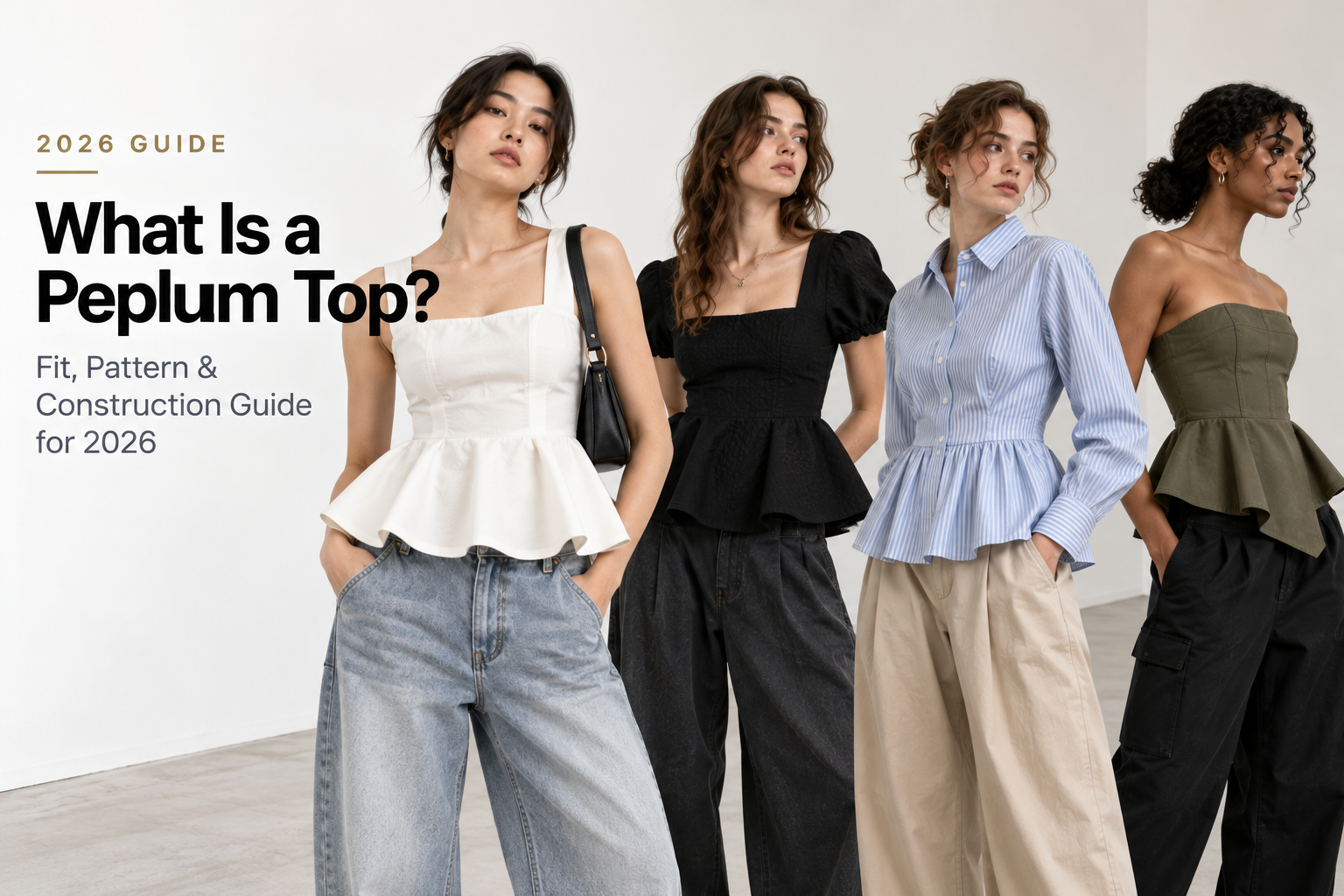
A peplum top is a garment that fits more closely through the upper body and creates additional volume around or below the waist.
The defining feature is the peplum itself: an added or shaped section that extends outward from the waist area.
But modern peplum tops are much more varied than the fitted, ruffled styles many people associate with the early 2010s.
Current versions can be:
- Sculptural
- Minimal
- Asymmetric
- Draped
- Tailored
- Cropped
- Sleeveless
- Shirt-inspired
- Jacket-inspired
- Soft and gathered
- Structured and architectural
For clothing brands, the most important point is that a peplum is not simply a piece of extra fabric sewn around the bottom of a top.
Its final shape depends on:
waist position + flare amount + seam shape + fabric structure + body fit + peplum length
This guide explains what a peplum top is, how different peplum constructions work, and what brands should specify when developing one for production.
What Is a Peplum Top?
A peplum top is generally fitted or shaped through the torso and expands outward around the waist or upper hip.
The peplum may be created using:
- A separate flared panel
- Gathered fabric
- Pleats
- Darts
- Circular pattern pieces
- Godets
- Curved panels
- Draping
- Structured seam construction
This means "peplum" describes the silhouette more than one specific sewing method.
Two tops may both be called peplum tops while having completely different internal construction.
One may use:
a soft gathered cotton panel
while another may use:
a structured curved panel in bonded fabric
The visual effect can be similar, but the manufacturing process is very different.
Why Are Peplum Tops Trending Again in 2026?
The current peplum revival is different from earlier versions.
Instead of focusing only on soft ruffles, many modern designs use:
- Cleaner waist shaping
- Stronger structure
- Sculptural volume
- Minimal seams
- Asymmetric hems
- Tailored fabrics
- Denim
- Technical woven fabrics
- Controlled flare
This makes the silhouette easier to adapt across different categories.
Peplum construction now appears on:
- Tops
- Shirts
- Blouses
- Jackets
- Blazers
- Knitwear
- Denim tops
- Corset-inspired garments
- Dresses
For brands, the attraction is simple:
A relatively small pattern change around the waist can create a very strong visual identity.
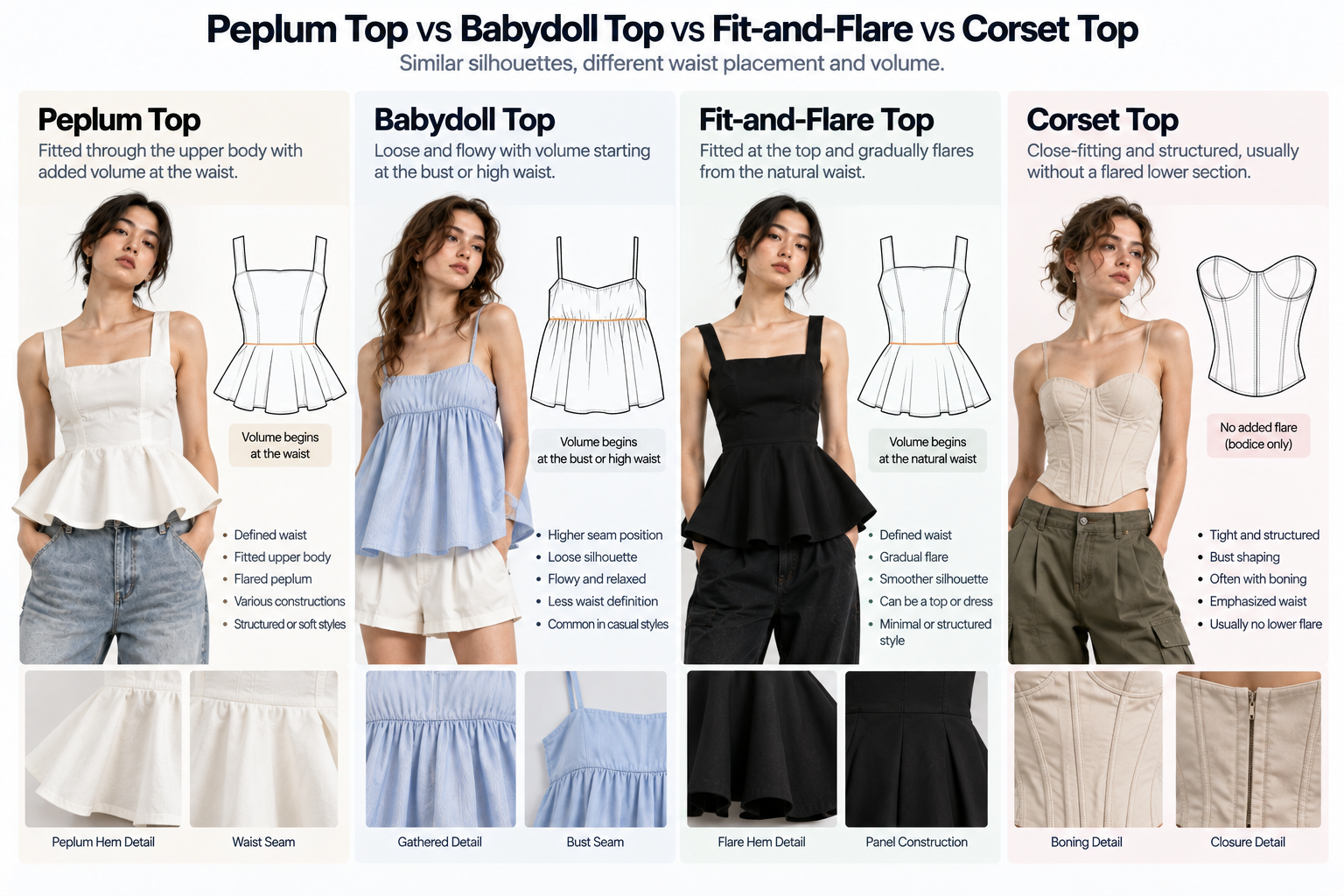
Peplum Top vs Babydoll Top vs Fit-and-Flare vs Corset Top
These silhouettes are often confused.
| Style | Where Volume Begins | Waist Definition | Typical Shape |
|---|---|---|---|
| Peplum Top | Waist / upper hip | Strong | Fitted top + outward flare |
| Babydoll Top | Bust / high waist | Low | Loose and flowing |
| Fit-and-Flare | Natural waist | Strong | Fitted upper body + wider lower section |
| Corset Top | Usually no flare | Very strong | Close-fitting structured body |
| Empire Top | Under bust | Moderate | High seam + flowing lower body |
A peplum top is especially defined by the relationship between:
a controlled upper body
and
added volume below the waist area
Peplum vs Babydoll Top
A babydoll top usually begins to expand much higher on the body.
The seam may sit:
- Under the bust
- Around the high waist
The fabric then falls relatively loosely.
A peplum usually maintains more shape through the torso before expanding lower down.
Think of the difference as:
Babydoll = high seam + loose lower body
Peplum = defined waist + controlled flare
The exact seam position therefore matters.
Peplum vs Fit-and-Flare
These terms can overlap.
A fit-and-flare garment also becomes wider below the waist.
But "fit-and-flare" describes a broader overall silhouette.
Peplum normally refers more specifically to a distinct flared section attached to or engineered around the waist.
For example:
A dress can be fit-and-flare without using a separate peplum.
A fitted top with a 15 cm flared waist panel is clearly a peplum.
Peplum vs Corset Top
Corset-inspired tops usually focus on:
- Close body fit
- Boning
- Panel seams
- Bust shaping
- Waist compression or definition
They do not necessarily flare below the waist.
A peplum top may borrow corset-style upper-body construction and then add a flared lower section.
This creates a hybrid silhouette:
structured bodice + peplum
which is particularly suitable for more architectural fashion styles.
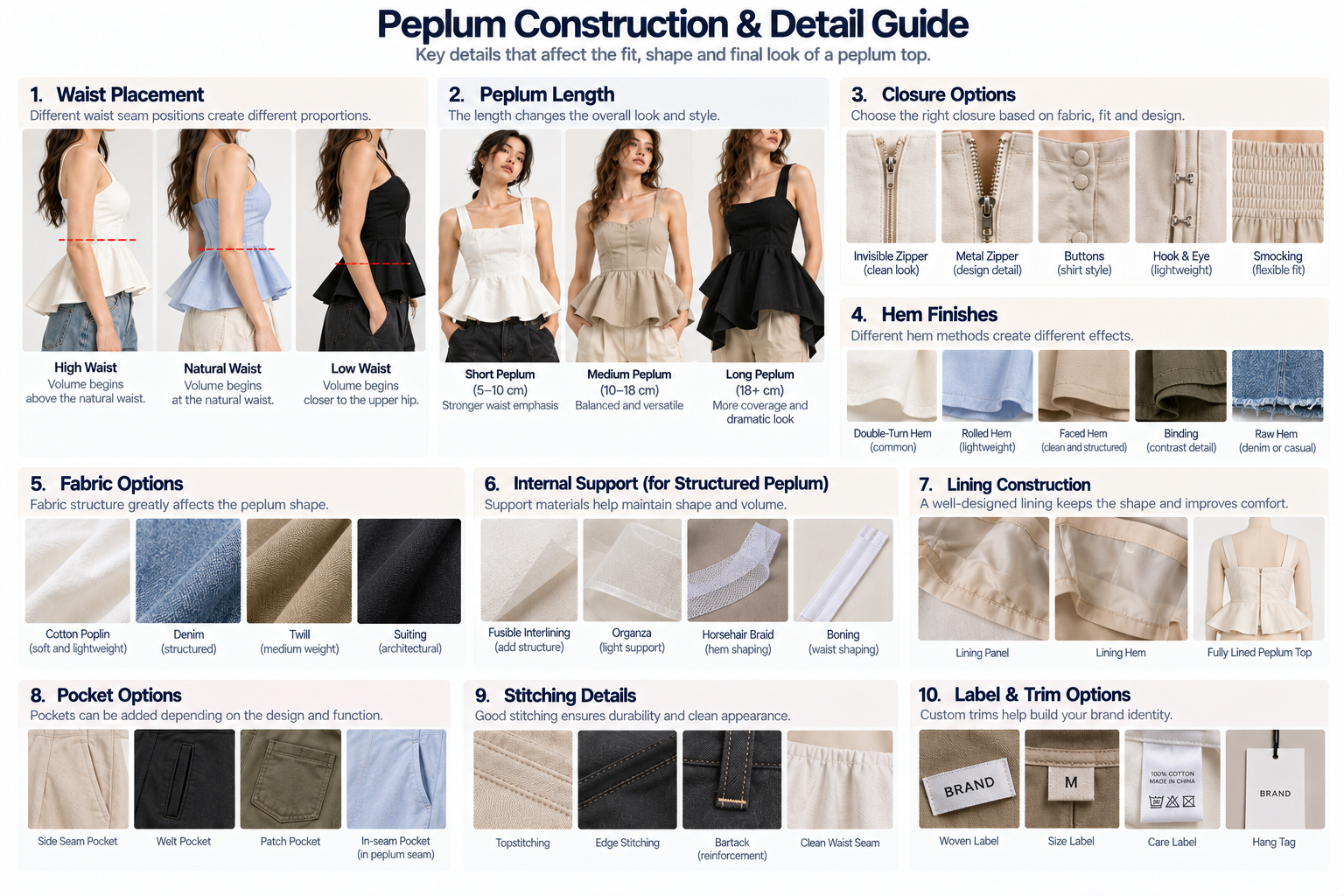
Waist Placement Is the Most Important Peplum Decision
A few centimeters can completely change the silhouette.
Possible seam positions include:
High Waist Peplum
The flare begins above the natural waist.
This can create:
- Longer-looking lower body
- Shorter-looking torso
- More dramatic proportions
Natural Waist Peplum
The seam follows the natural waist area.
This is one of the most balanced constructions.
Low Waist Peplum
The flare begins closer to the upper hip.
This creates:
- Longer torso
- Lower visual volume
- More relaxed silhouette
The correct position should be tested on the intended wearer.
Do not rely only on a reference image.
Camera angle and body proportions can make waist placement difficult to judge accurately.
Peplum Length Changes the Entire Look
The peplum itself may be:
- Very short
- Medium length
- Hip length
- Asymmetric
- Longer at the back
- Longer at the sides
Short Peplum
Creates:
- Stronger waist emphasis
- More obvious flare
- Cropped visual effect
Medium Peplum
Creates:
- More balanced proportion
- Easier everyday styling
- Better coverage
Long Peplum
Can begin to resemble:
- Tunic construction
- Short skirt layering
- Extended blouse
The longer the peplum becomes, the more carefully the hip and hem circumference need to be controlled.
How Much Flare Should a Peplum Have?
There is no standard amount.
A peplum can range from barely visible to extremely dramatic.
Subtle Flare
Creates:
- Minimal silhouette
- Cleaner tailoring
- Easier layering
Moderate Flare
Creates:
- Clear peplum shape
- Balanced volume
- Commercial fit
High-Volume Flare
Creates:
- Strong fashion statement
- More movement
- Sculptural appearance
But additional volume is not always better.
Too much flare in a stiff fabric can create excessive projection.
Too much flare in a very soft fabric may collapse and look more like a ruffle.
The desired appearance must be considered together with fabric behavior.
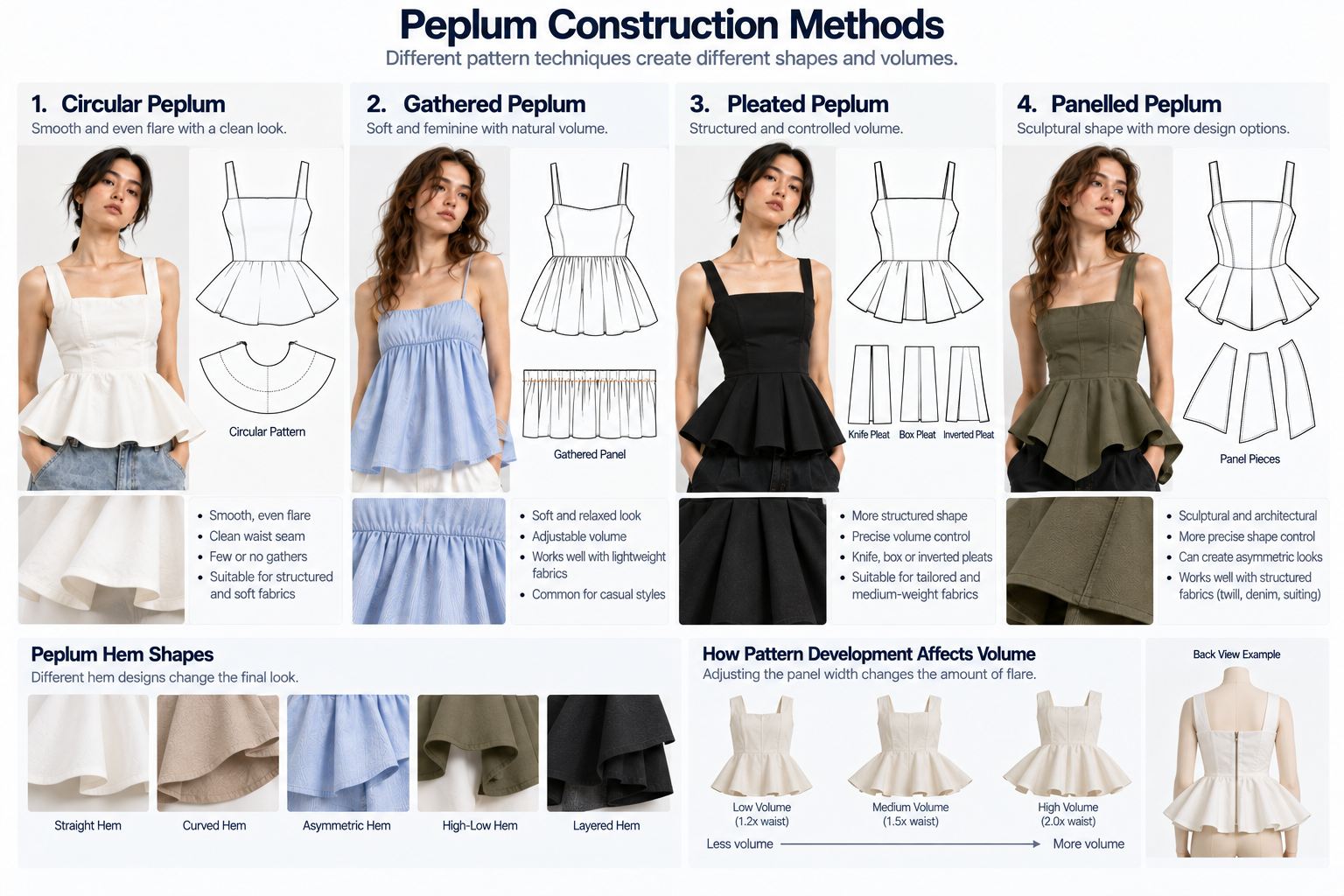
Circular Peplum Construction
One common construction method uses a circular or semi-circular pattern.
This is similar to the geometry used in flared skirts.
A circular peplum can create:
- Smooth flare
- Few or no gathers
- Fluid movement
- Clean waist seam
The amount of circle used changes the volume.
For example:
- Partial circle = lower volume
- Half circle = moderate flare
- Full circle = significantly more volume
The actual result also depends on fabric weight.
Gathered Peplum Construction
A gathered peplum uses a lower panel that is wider than the waist seam.
The excess width is gathered into the attachment seam.
This creates:
- Softer fullness
- More texture around the waist
- More casual appearance
The pattern maker needs to define the gather ratio.
For example:
Waist seam = 70 cm
Peplum panel before gathering = 105 cm
creates a different result from:
Peplum panel = 140 cm
The words "gathered peplum" alone are not enough for production.
Pleated Peplum Construction
Pleats can control volume more precisely than gathering.
Possible options include:
- Knife pleats
- Box pleats
- Inverted pleats
- Side pleats
- Multiple small pleats
Pleats create a more structured visual rhythm.
They can work well for:
- Tailored tops
- Uniform-inspired fashion
- Structured cotton
- Suiting fabrics
Pleat position should be specified.
Moving a pleat closer to the side seam or center front can noticeably change the silhouette.
Panelled Peplum Construction
A sculptural peplum may use multiple shaped pattern panels rather than gathers or circles.
This allows more precise control over:
- Projection
- Curvature
- Side shape
- Front/back volume
- Asymmetry
For example, the front peplum can remain relatively flat while the side panels create most of the volume.
This approach is particularly useful for modern architectural designs.
Front and Back Peplum Volume Do Not Need to Match
A peplum does not need equal flare around the entire garment.
Possible designs include:
More Side Volume
Creates a sculptural hip effect.
More Back Volume
Can produce:
- Dramatic rear silhouette
- Tail-like shape
- High-low construction
Flat Front + Full Back
Can keep the garment clean from the front while adding visual interest from the side and back.
Asymmetric Volume
One side may be:
- Longer
- Fuller
- Gathered differently
The technical drawing should make this clear.
Side-Seam Balance Is Important
Peplum volume changes how the side seam hangs.
If the front and back pattern pieces have poorly balanced volume, the seam may:
- Rotate forward
- Rotate backward
- Flare unevenly
- Lift at one side
The sample should therefore be checked from:
- Front
- Side
- Back
A peplum can look correct from the front but poorly balanced from the side.
Fabric Choice Can Change the Same Pattern Completely
A peplum is highly sensitive to fabric behavior.
The same pattern made in:
soft rayon
and
heavy denim
will produce completely different shapes.
Soft Fabric
Creates:
- More drape
- Softer folds
- Less rigid flare
- More movement
Structured Fabric
Creates:
- Stronger projection
- Cleaner outline
- More architectural volume
- Less collapse
Fabric selection should therefore happen before final pattern approval whenever possible.
Best Fabrics for Soft Peplum Tops
Possible options include:
- Rayon
- Viscose
- Lightweight cotton
- Soft poplin
- Crepe
- Satin
- Lightweight knit
These fabrics work well when the target is:
- Draped
- Feminine
- Fluid
- Gathered
However, extremely lightweight fabrics may require:
- Lining
- Facing
- Stabilization
around the waist seam.
Best Fabrics for Structured Peplum Tops
Possible options include:
- Cotton twill
- Heavy poplin
- Denim
- Canvas
- Suiting
- Bonded fabric
- Scuba
- Double knit
These can help create:
- Stronger waist definition
- Controlled flare
- Architectural shape
The heavier the fabric, the more carefully seam bulk should be managed.
For custom fabric development, see Brad Apparel's Fabric Sourcing & Development.
Peplum Tops in Denim
Denim can create a very strong sculptural peplum.
Possible constructions include:
- Corset-inspired upper body
- Princess seams
- Front zipper
- Button front
- Panelled flare
- Raw hem
- Clean hem
Denim weight matters.
Lightweight Denim
Creates more drape.
Midweight Denim
Balances structure and comfort.
Heavy Denim
Creates stronger projection but can become bulky around the waist seam.
If the garment receives a wash treatment, the final silhouette should be checked after washing.
Peplum Tops in Knit Fabric
Knit peplum tops behave differently.
Possible fabrics include:
- Rib knit
- Interlock
- Jersey
- Double knit
- Ponte
- Sweater knit
Stretch can reduce the need for complex closures.
However, it also changes:
- Waist recovery
- Flare shape
- Hem stability
A highly stretchy fabric may pull the waist seam downward when the lower section is heavy.
Knit-in Peplum vs Cut-and-Sew Peplum
For sweater-knit garments, the peplum may be engineered through knitting rather than attached as a separately cut woven panel.
A knitted peplum can use changes in:
- Stitch structure
- Needle count
- Panel width
- Rib
- Knit tension
to create flare.
This is a different manufacturing process from conventional cut-and-sew peplum tops.
The production method should therefore be confirmed before quotation.
Princess Seams Can Shape the Upper Body
A fitted peplum top often needs shaping above the waist.
Princess seams are useful because they can control:
- Bust
- Waist
- Front contour
- Back contour
They can run:
- From shoulder
- From armhole
down toward the waist seam.
This can create a cleaner fitted upper body before the peplum begins.
Darts Can Also Control the Waist
Simpler tops may use darts instead of princess seams.
Possible darts include:
- Bust dart
- Waist dart
- Back waist dart
Dart intake affects how sharply the garment transitions into the peplum.
Too much waist suppression can make the garment uncomfortable.
Too little can reduce the intended silhouette.
Peplum Tops Do Not Need to Be Extremely Tight
A peplum depends on contrast between the upper body and lower flare.
But the upper body can be:
- Fitted
- Semi-fitted
- Relaxed
- Boxy
A relaxed peplum top may use:
moderate body ease + structured lower flare
rather than a skin-tight torso.
This can make the silhouette easier to wear and more suitable for contemporary streetwear or casual collections.
Cropped Peplum Tops
A cropped peplum top typically places the lower edge:
- Around the waist
- Slightly below the waist
The peplum itself may account for much of the visible body length.
This style requires careful proportion.
If the upper bodice becomes too short, the flare may begin too close to the bust.
If the peplum becomes too long, the garment stops reading as cropped.
Long Peplum Tops
Longer peplum designs can extend toward the upper hip or beyond.
These may work well for:
- Blouses
- Shirts
- Tailored tops
- Tunic-inspired products
However, additional hip room may be required.
A narrow peplum that extends over the widest part of the hip can restrict movement.
Peplum Shirts
A peplum can also be applied to shirt construction.
A peplum shirt may include:
- Shirt collar
- Button placket
- Long sleeves
- Cuffs
- Waist seam
- Flared lower panel
The button placket creates an additional development challenge.
The left and right peplum sections need to align cleanly when the garment is closed.
If the flare begins directly at the placket, the front edge should not kick outward uncontrollably.
Peplum Jackets
Peplum construction is increasingly used on jackets and blazers.
A peplum jacket may combine:
- Structured shoulders
- Fitted waist
- Flared lower body
- Lapel
- Zipper
- Buttons
- Lining
This requires different engineering from a lightweight peplum blouse.
The shell, lining and interlining all need to follow the same shaping.
Peplum Jacket vs Cropped Jacket
A cropped jacket is defined mainly by:
shorter body length
A peplum jacket is defined by:
waist definition + outward lower flare
A jacket can therefore be:
- Cropped without being peplum
- Peplum without being heavily cropped
- Both cropped and peplum
The terms should not be used interchangeably.
Lining a Structured Peplum
A lined peplum requires enough internal ease.
If the lining is too small, it can:
- Pull the flare inward
- Twist the hem
- Flatten the volume
- Restrict movement
If the lining is excessively large, it may:
- Hang below the shell
- Bunch around the waist
- Create unnecessary bulk
The lining pattern should follow the intended outer silhouette without controlling it too tightly.
Interlining and Support
Some structured peplums need internal support.
Possible materials include:
- Lightweight fusible
- Medium fusible
- Organza
- Horsehair braid
- Structured tape
- Foam or bonded layers
Support may be applied:
- Around the waist
- Through the entire peplum
- Only at the hem
- In selected panels
More reinforcement is not automatically better.
The goal is to support the intended shape without making the garment unnaturally stiff.
Horsehair Braid at the Hem
Horsehair braid can help a flared hem maintain shape.
It is commonly used in:
- Skirts
- Dresses
- Structured fashion garments
It can also be useful in certain peplum designs.
The braid can create:
- Cleaner curve
- More projection
- Better hem stability
But it is not suitable for every fabric.
A lightweight sheer fabric may reveal the internal structure.
Peplum Hem Options
Possible hem finishes include:
Double-Turn Hem
Clean and common for many woven fabrics.
Narrow Rolled Hem
Useful for lightweight fabrics.
Faced Hem
Works well for:
- Structured peplums
- Curved edges
- Clean exterior finish
Binding
Can add:
- Contrast detail
- Structure
- Cleaner edge
Raw Hem
Possible for:
- Denim
- Bonded fabric
- Certain technical fabrics
The hem method can affect the way the flare hangs.
Asymmetric Peplum Construction
Modern peplums do not need an even horizontal hem.
Possible designs include:
- Longer side
- Longer back
- Diagonal front
- Layered panels
- Uneven flounces
Asymmetry increases pattern complexity because the designer must control:
- Balance
- Grainline
- Hem behavior
- Left/right relationship
The asymmetric effect should look intentional when worn, not simply uneven.
Layered Peplum
Two or more flared layers can be combined.
This creates:
- More volume
- More texture
- Stronger movement
But each additional layer adds:
- Weight
- Seam bulk
- Fabric consumption
The upper body needs enough structure to support the combined weight.
Peplum Placement and Body Proportion
The same peplum may look different on different body proportions.
This is why sample fitting matters.
Check where the flare begins relative to:
- Bust
- Natural waist
- High hip
- Full hip
A seam that appears perfectly placed on a flat drawing may sit too high or low when worn.
Important Peplum Top Measurements
A tech pack should define both normal top measurements and peplum-specific measurements.
| Measurement | Why It Matters |
|---|---|
| Chest Width | Controls upper-body fit |
| Waist Width | Defines waist shaping |
| Body Length | Controls overall proportion |
| Shoulder Width | Controls upper-body balance |
| Armhole | Affects movement |
| Sleeve Length | Controls sleeve proportion |
| Waist Seam Position | Defines where peplum begins |
| Peplum Length | Controls lower-body proportion |
| Peplum Hem Circumference | Controls flare volume |
| Front Peplum Length | Important for asymmetric designs |
| Back Peplum Length | Controls rear proportion |
| Side Length | Controls side balance |
Highly sculptural designs may require additional measurements.
Peplum Hem Circumference Matters
Peplum volume can be partly understood through the relationship between:
waist seam circumference
and
hem circumference
For example:
A peplum with only a small increase toward the hem will look subtle.
A peplum with a much larger hem circumference can create dramatic flare.
However, circumference alone does not completely define the shape.
Panel curvature and fabric behavior still matter.
Pattern Grainline Affects the Drape
For circular or curved peplums, different sections of the panel may sit on:
- Straight grain
- Cross grain
- Bias
These areas can stretch differently.
As a result, a circular peplum may develop an uneven hem after hanging.
This is particularly important for:
- Viscose
- Rayon
- Satin
- Soft woven fabrics
The sample may need to rest before final hemming.
Closures for Peplum Tops
Possible closures include:
- Invisible zipper
- Center-back zipper
- Side zipper
- Front buttons
- Front zipper
- Hook-and-eye
- Smocking
- Elastic construction
The closure should be selected according to:
- Fabric
- Fit
- Neck opening
- Waist shaping
A fitted woven peplum top generally needs enough opening for the wearer to get into the garment comfortably.
Buttons on Peplum Shirts and Jackets
Button position becomes especially important near the waist seam.
If there is too much tension between buttons, the garment may:
- Gap
- Pull
- Distort the peplum seam
Button spacing should be tested on the wearer.
For custom buttons, labels and trims, see Brad Apparel's Trims & Branding capabilities.
Zipper Placement
An invisible back zipper can preserve a clean front.
A front zipper can become part of the design.
A side zipper can keep both front and back relatively minimal.
But zipper placement can affect the waist seam.
If a zipper crosses the peplum attachment seam, the factory must manage multiple fabric layers cleanly.
Pockets on Peplum Garments
Pockets are possible, but placement needs careful consideration.
Possible constructions include:
- Side-seam pocket
- Welt pocket
- Patch pocket
Large pockets can add weight and distort the flare.
For very sculptural peplums, avoiding pockets may produce a cleaner result.
How to Describe a Peplum Top to a Manufacturer
Instead of writing:
I want a peplum top.
a more useful brief would be:
Fitted sleeveless peplum top with a natural-waist seam, princess-seam bodice, structured cotton twill and a moderate panelled flare extending 18 cm below the waist.
Then specify:
- Chest
- Waist
- Body length
- Waist seam position
- Peplum length
- Peplum volume
- Fabric
- Closure
- Neckline
- Armhole
- Hem finish
- Lining
- Color
- Branding
This reduces interpretation during pattern development.
Example Soft Peplum Development Brief
A softer version might be described as:
Relaxed peplum blouse in lightweight cotton poplin with a slightly raised waist seam, gathered lower panel, moderate flare and clean narrow hem.
This immediately tells the pattern maker that the design should focus on:
soft volume
rather than:
rigid projection
Example Sculptural Peplum Development Brief
A sculptural version might use:
Structured peplum top with fitted princess-seam bodice, natural waist, curved multi-panel peplum and firm double-knit fabric. Volume concentrated at the sides with a cleaner front.
That creates a completely different development direction.
How to Evaluate the First Peplum Sample
A peplum sample should always be evaluated while worn.
Front View
Check:
- Waist position
- Chest fit
- Left/right symmetry
- Flare
- Front hem
The peplum should expand from the intended point.
Side View
This is especially important.
Check:
- How far the peplum projects
- Front/back balance
- Waist seam angle
- Side-seam position
A peplum that looks subtle from the front may project excessively from the side.
Back View
Check:
- Back waist
- Center-back position
- Rear volume
- Hem level
The peplum should not collapse at the back unless that is intentional.
Check the Waist Seam
The waist seam carries much of the construction.
Look for:
- Puckering
- Twisting
- Stretching
- Uneven gathering
- Uneven pleats
A clean seam is especially important on structured designs.
Check the Hem
The hem should be inspected after the garment has been hanging.
Look for:
- Uneven drop
- Bias stretching
- Twisting
- Waves
- Left/right imbalance
Circular peplums are especially sensitive to uneven settling.
Check Sitting Comfort
Ask the wearer to sit.
A peplum that overlaps the upper hip may:
- Fold
- Lift
- Crush
- Push upward
The design still needs to function when seated.
Check Arm Movement
For fitted upper bodies, the wearer should:
- Raise arms
- Reach forward
- Move shoulders
A tightly fitted waist should not be used to compensate for a poorly shaped armhole or chest.
Check the Garment With Intended Bottoms
Peplum proportion is strongly affected by what is worn underneath.
The sample can be tested with:
- Straight trousers
- Wide-leg trousers
- Jeans
- Skirt
- Shorts
This is particularly useful if the design is part of a matching collection.
Fabric Testing Is Important
After washing or finishing, review:
- Waist measurement
- Peplum length
- Flare
- Hem
- Shape retention
- Color
- Hand feel
A structured fabric that becomes significantly softer after washing may produce less flare than the original sample.
Size Grading Requires More Than Widening the Peplum
When grading a peplum top across sizes, the relationship between:
chest + waist + peplum volume + length
needs to remain visually balanced.
If peplum circumference increases too quickly, larger sizes may become excessively voluminous.
If it increases too little, the silhouette may become straighter.
The grading rules should preserve the intended visual proportion.
Common Peplum Top Development Mistakes
1. Treating the Peplum as a Simple Ruffle
Modern peplums can require precise pattern engineering.
2. Choosing Waist Position From a Photo
The actual seam position should be measured and fitted.
3. Adding Too Much Flare
More fabric does not automatically create a better silhouette.
4. Using Fabric That Is Too Soft
A sculptural peplum may collapse.
5. Using Fabric That Is Too Heavy
The waist seam can become bulky and uncomfortable.
6. Ignoring the Side View
Projection is often most visible from the side.
7. Making the Lining Too Tight
This can pull the peplum inward.
8. Ignoring Bias Stretch
Circular hems may become uneven after hanging.
9. Poor Closure Placement
The zipper or buttons can distort the waist seam.
10. Using the Same Grading Rule for Every Section
Upper-body and peplum volume need to remain proportionate.
Peplum Top Tech Pack Example
| Area | Example Specification |
|---|---|
| Product | Sculptural Peplum Top |
| Fit | Fitted Upper Body |
| Fabric | Cotton Twill |
| Neckline | Square Neck |
| Shoulder | Sleeveless |
| Bodice | Princess Seam |
| Waist | Natural Waist |
| Peplum | Curved Panel Construction |
| Peplum Length | 18 cm |
| Volume | Moderate |
| Closure | Center-Back Invisible Zipper |
| Hem | Faced Hem |
| Lining | Bodice Lined |
| Branding | Main Label + Care Label |
These specifications are examples only.
Peplum Shirt Tech Pack Example
| Area | Example Specification |
|---|---|
| Product | Peplum Shirt |
| Fit | Semi-Fitted |
| Fabric | Cotton Poplin |
| Collar | Shirt Collar |
| Front | Button Placket |
| Sleeve | Long Sleeve |
| Cuff | Button Cuff |
| Waist Seam | Slightly Raised |
| Peplum | Gathered |
| Peplum Length | Medium |
| Hem | Narrow Double Turn |
| Branding | Woven Main Label |
The correct specification depends on the intended silhouette.
Peplum Jacket Tech Pack Example
| Area | Example Specification |
|---|---|
| Product | Peplum Jacket |
| Fit | Structured / Fitted |
| Shell | Wool Blend |
| Lining | Polyester |
| Shoulder | Lightly Structured |
| Waist | Defined |
| Peplum | Panelled |
| Closure | Buttons |
| Welt | |
| Hem | Faced |
| Interlining | Selective Fusible |
| Branding | Custom Buttons + Woven Label |
Which Peplum Style Should Your Brand Develop?
Choose a soft gathered peplum if you want:
- Movement
- Lightweight fabric
- Casual styling
- Softer femininity
Choose a structured panelled peplum if you want:
- Strong silhouette
- Cleaner architecture
- Premium fashion appearance
- Controlled volume
Choose a shirt-style peplum if you want:
- Familiar commercial construction
- Collar and button detailing
- Easy everyday styling
Choose a peplum jacket if you want:
- Stronger outerwear structure
- Defined waist
- Tailored appearance
- More sculptural volume
The best direction depends on the fabric, customer and collection.
FAQ
What Is a Peplum Top?
A peplum top is a top that becomes fuller or flares outward around the waist or upper hip.
The peplum may be created using gathered, pleated, circular or panelled construction.
Are Peplum Tops Back in Style in 2026?
Yes.
Peplum silhouettes have returned across 2026 runway and retail collections, with newer versions generally appearing cleaner, more structured and more sculptural than many earlier interpretations.
What Is the Difference Between a Peplum Top and a Babydoll Top?
A peplum usually flares from around the waist.
A babydoll top generally begins to expand much higher, often below the bust.
What Is the Difference Between Peplum and Fit-and-Flare?
Fit-and-flare describes a broader silhouette with a fitted upper area and wider lower area.
A peplum usually refers specifically to an added or shaped flared section around the waist.
Can a Peplum Top Be Oversized?
Yes.
The upper body does not need to be extremely fitted.
A relaxed top can still use a defined peplum section.
What Fabric Is Best for a Peplum Top?
It depends on the desired shape.
Soft peplums may use:
- Cotton
- Rayon
- Viscose
- Crepe
- Satin
Structured peplums may use:
- Twill
- Denim
- Suiting
- Double knit
- Scuba
- Bonded fabrics
Can Peplum Tops Be Made From Denim?
Yes.
Denim can create a strong structured peplum, particularly when using princess seams or panelled construction.
Does a Peplum Need a Waist Seam?
Not always.
Some peplums are created through continuous shaped panels, knitting or draping.
However, a visible waist seam is very common.
How Much Fabric Does a Peplum Need?
This depends on the construction.
Circular, gathered and high-volume designs can require significantly more fabric than subtle panelled peplums.
Fabric consumption should be calculated from the final approved pattern.
Can a Peplum Be Asymmetric?
Yes.
Peplum hems can be longer at the back, sides or one side of the garment.
The pattern should control the asymmetry intentionally.
Does a Structured Peplum Need Interlining?
Sometimes.
Interlining may help support the waist or flare, but the amount depends on fabric structure and the desired stiffness.
What Measurements Are Important for a Peplum Top?
Important measurements include:
- Chest
- Waist
- Body length
- Waist seam position
- Peplum length
- Peplum hem circumference
- Shoulder
- Armhole
- Sleeve measurements when applicable
Highly sculptural designs may require additional measurement points.
Final Thoughts
A peplum top is not defined simply by adding a ruffle around the waist.
The silhouette depends on the relationship between:
waist position + upper-body fit + peplum length + flare volume + fabric structure + pattern construction
A gathered poplin peplum can feel soft and casual.
A denim panelled peplum can feel sculptural.
A tailored peplum jacket can create a strong architectural waist.
And a small change in seam position can completely alter the proportion.
For clothing brands, clearly defining the peplum construction before sampling makes it much easier for the pattern maker to translate a reference image into a consistent, production-ready garment.
Keep Reading