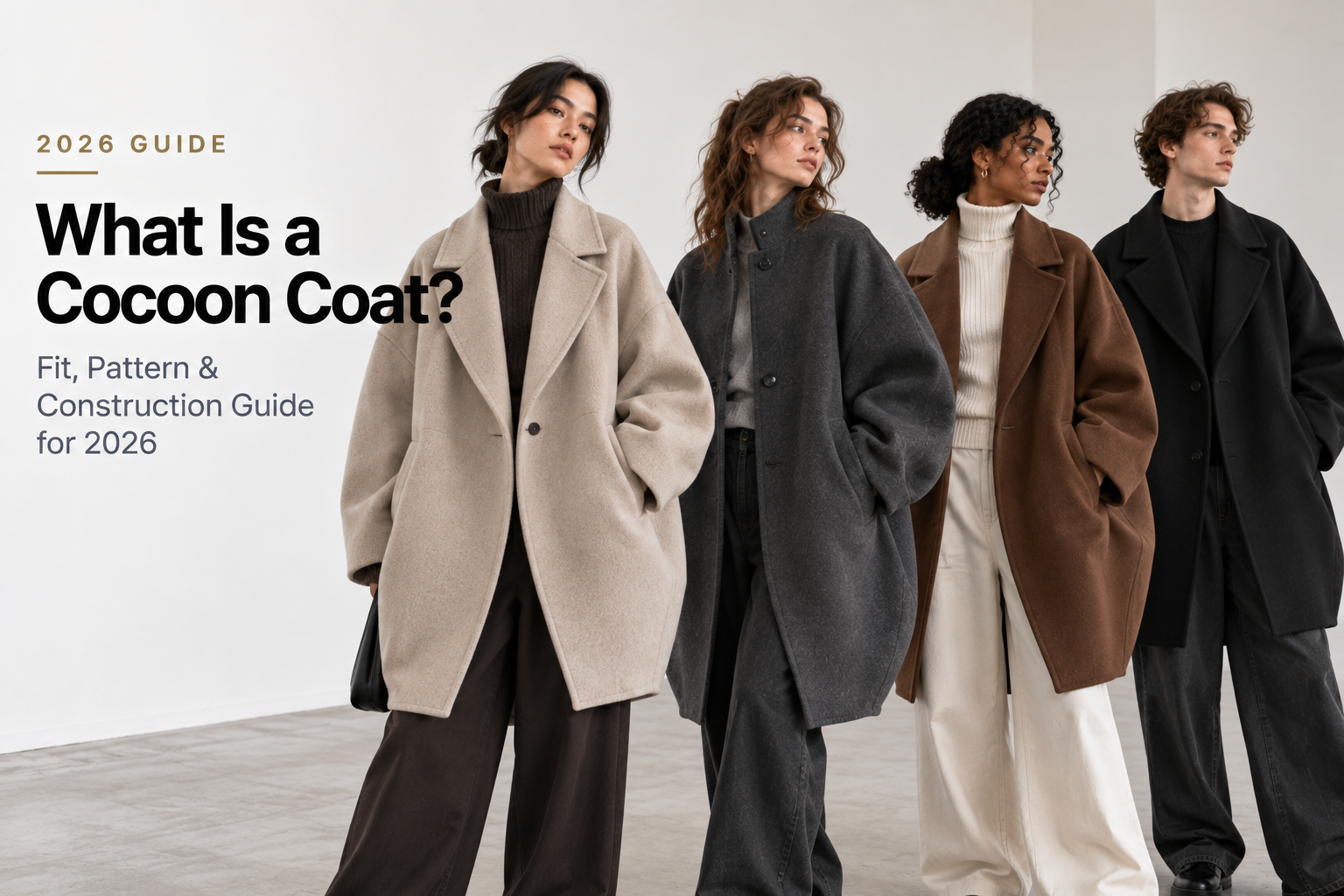
A cocoon coat is an outerwear silhouette with rounded volume through the shoulders and body that gradually narrows toward the lower hem.
The shape is intentionally curved rather than simply oversized.
A successful cocoon coat usually depends on the relationship between:
shoulder shape + chest volume + side-seam curve + sleeve volume + hem opening + fabric structure
That is why developing a cocoon coat is not as simple as making a normal coat one or two sizes larger.
The pattern itself needs to create the rounded silhouette.
This guide explains what defines a cocoon coat, how it differs from oversized, swing and cape-style outerwear, and what clothing brands should specify before developing one for production.
What Is a Cocoon Coat?
A cocoon coat is designed to create an enveloping, rounded body shape.
Typical characteristics include:
- Rounded or softened shoulders
- Extra volume through the upper body
- Curved side seams
- Generous sleeves
- Reduced waist definition
- A hem that is narrower than the widest part of the body
- Minimal or sculptural styling
Viewed from the front, the silhouette may look broad through the shoulder and body.
Viewed from the side, the coat often has visible depth and curvature.
Viewed from the back, the upper body can appear rounded before narrowing toward the hem.
This three-dimensional shape is what separates a true cocoon silhouette from a basic oversized coat.
Why Are Cocoon Coats Trending in 2026?
Cocoon coats fit naturally into several larger 2026 fashion directions:
- Exaggerated proportions
- Sculptural tailoring
- Oversized outerwear
- Rounded shoulders
- Minimal silhouettes
- Soft architecture
- Layering
- Statement winter coats
The silhouette can also move between very different design languages.
A cocoon coat can feel:
- Minimal
- Luxury
- Streetwear
- Tailored
- Technical
- Feminine
- Unisex
- Avant-garde
depending on the fabric, length, collar and construction.
For brands, that makes the cocoon silhouette especially useful because the pattern itself provides visual identity even when the garment uses very little decoration.
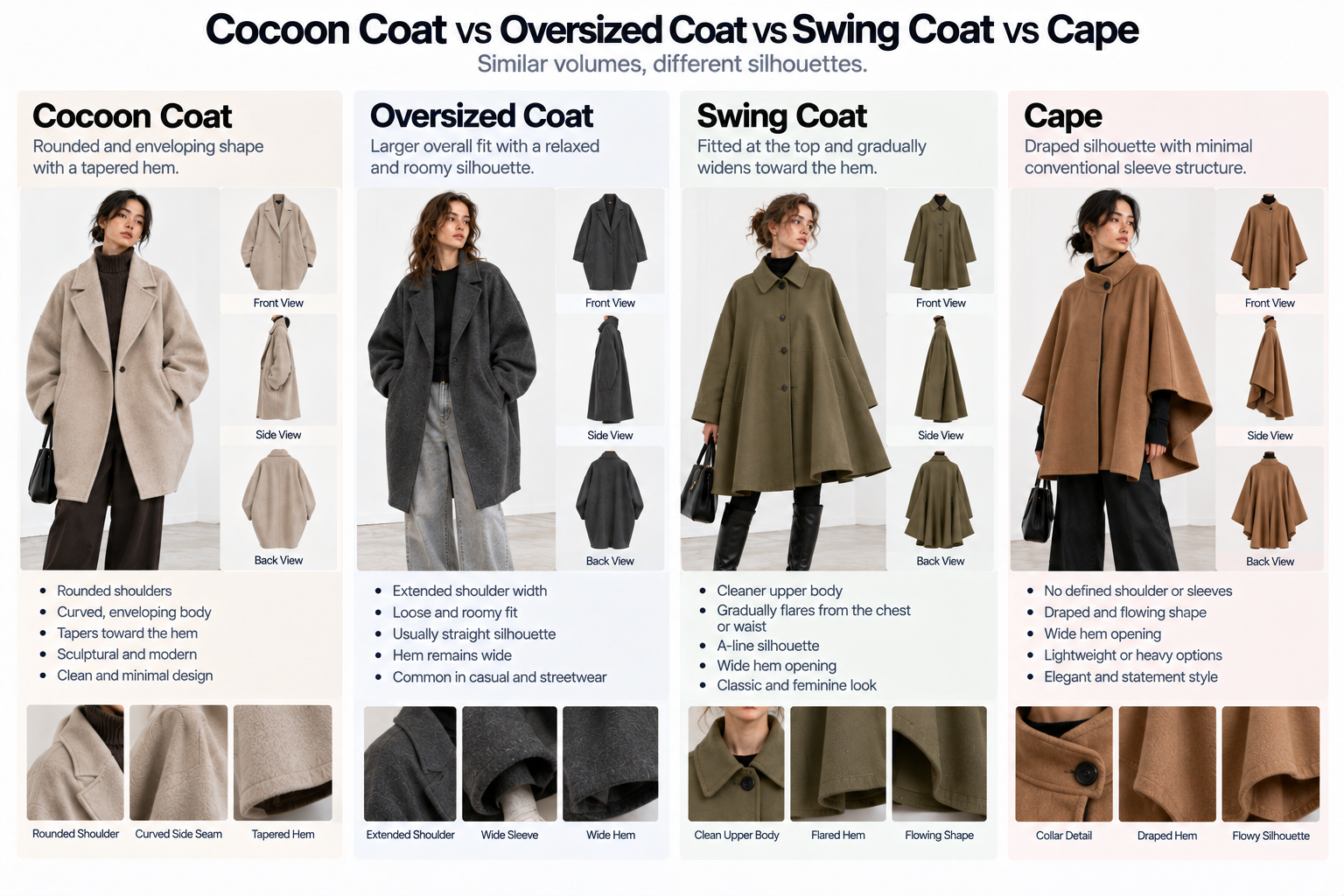
Cocoon Coat vs Oversized Coat vs Swing Coat vs Cape
These silhouettes all use additional volume, but they distribute that volume differently.
| Style | Shoulder | Body Shape | Hem | Main Visual Effect |
|---|---|---|---|---|
| Cocoon Coat | Rounded / dropped / raglan | Curved and enveloping | Narrows inward | Sculptural oval shape |
| Oversized Coat | Usually extended | Large overall | Often remains wide | Overall scale and volume |
| Swing Coat | Clean upper body | Expands downward | Wide | A-line movement |
| Cape | No conventional sleeve or reduced sleeve structure | Draped from shoulder | Wide | Flowing outer layer |
| Straight Coat | Defined / regular | Relatively vertical | Similar to body width | Clean column shape |
The most important difference is the lower half.
An oversized coat can remain wide all the way to the hem.
A cocoon coat normally begins to narrow again.
A Cocoon Coat Is Not Just an Oversized Coat
This is the most important distinction.
Suppose a regular coat has:
- Wider chest
- Wider shoulder
- Longer sleeves
If you increase all of these measurements, you create a larger coat.
But that does not automatically create a cocoon silhouette.
A cocoon pattern needs controlled shaping.
The pattern may intentionally create:
more width through upper body
then:
maximum volume through the chest, hip or mid-body
then:
less width again toward the hem
The change in width creates the characteristic oval or cocoon outline.
Where Should the Cocoon Coat Be Widest?
There is no single fixed position.
The maximum volume can sit in different areas.
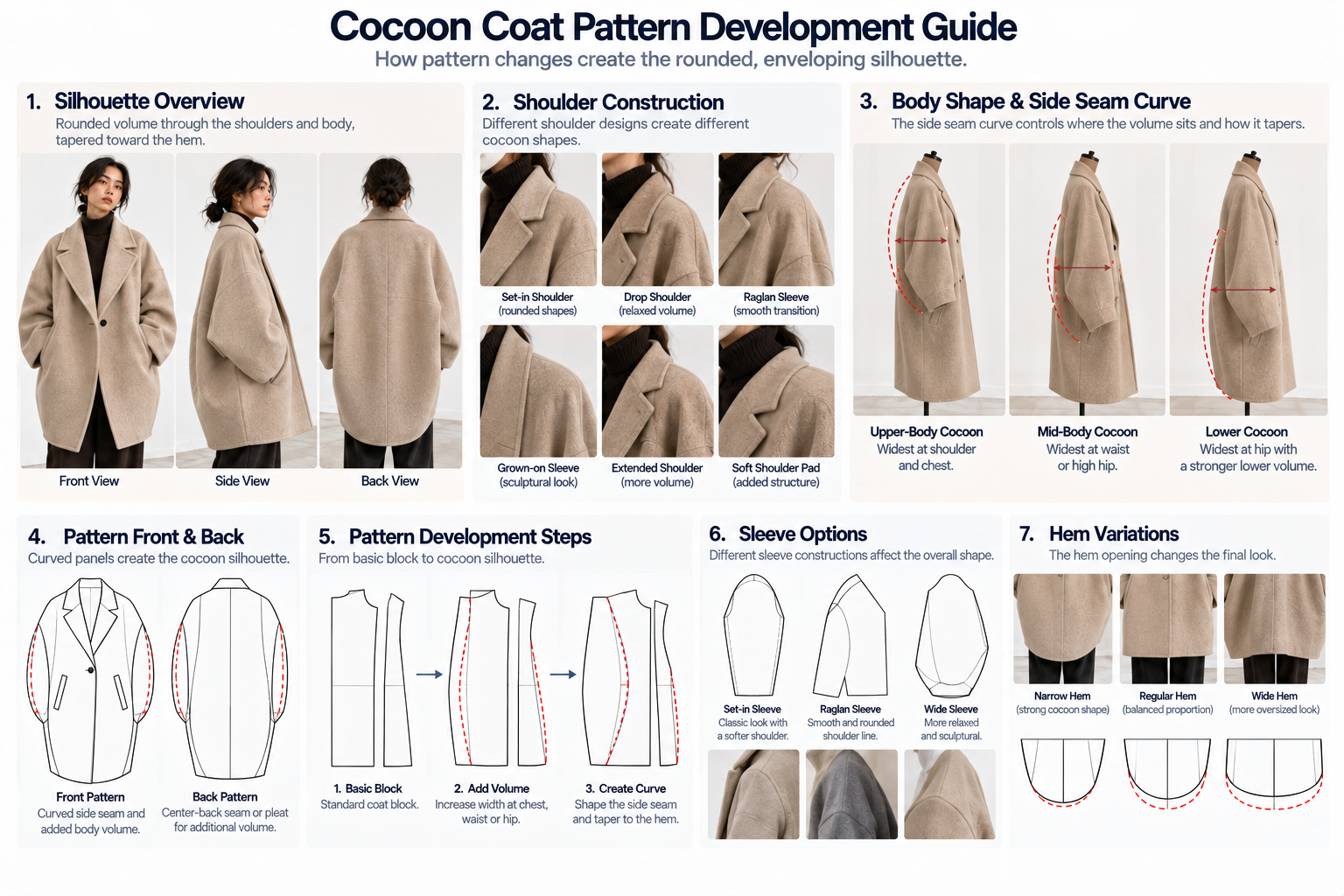
Upper-Body Cocoon
The coat is widest around:
- Shoulder
- Chest
- Upper arm
This creates a strong rounded top.
Mid-Body Cocoon
The maximum width sits around:
- Waist
- High hip
- Mid-torso
This creates a more balanced oval shape.
Lower Cocoon
Volume extends farther downward before tapering.
This can create:
- More dramatic body volume
- Softer architectural effect
- Stronger visual weight
Moving the widest point only a few centimeters can noticeably change the silhouette.
Shoulder Shape Is Critical
The cocoon silhouette often begins at the shoulder.
Several constructions can be used.
Rounded Set-In Shoulder
A conventional shoulder seam can still create a rounded silhouette if:
- Shoulder width is controlled
- Sleeve head is softened
- Padding is minimized
- Body volume begins immediately below the shoulder
This can create a cleaner tailored cocoon coat.
Drop Shoulder
The shoulder seam extends beyond the natural shoulder.
This creates:
- More upper-body width
- Softer structure
- Relaxed silhouette
Drop shoulders work particularly well for oversized cocoon coats.
Raglan Sleeve
A raglan sleeve extends toward the neckline.
This can help create:
- Smooth shoulder transition
- Rounded upper body
- More arm mobility
- Fewer sharp shoulder lines
Raglan construction is especially suitable when the design should feel soft and enveloping.
Modified Raglan / Grown-On Shoulder
More sculptural patterns may use:
- Extended shoulder panels
- Grown-on sleeves
- Kimono-like construction
- Curved shoulder seams
These can create more dramatic volume.
Rounded Shoulder Does Not Mean Heavy Shoulder Padding
A cocoon coat often looks rounded because of pattern construction rather than thick shoulder pads.
Too much padding can create:
- Sharp corners
- Strong horizontal shoulder line
- Traditional tailoring appearance
That may work for some designs, but it can fight against a softer cocoon silhouette.
Possible internal support includes:
- Light shoulder pad
- Sleeve-head roll
- Soft wadding
- Minimal interlining
- No shoulder pad
The correct option depends on the intended shape.
The Side Seam Creates the Cocoon Curve
The side seam is one of the most important pattern lines.
A normal straight coat may have a relatively vertical side seam.
A cocoon coat often uses a controlled outward-and-inward curve.
The pattern can:
- Expand outward through the upper or middle body
- Reach the maximum width
- Curve inward toward the lower hem
This is similar in principle to other curved silhouettes such as barrel pants.
But the body still needs enough room for:
- Walking
- Sitting
- Layering
- Arm movement
The silhouette should never be achieved by simply making the hem uncomfortably narrow.
Hem Opening Controls the Final Shape
The relationship between the widest part of the coat and the hem is critical.
Imagine two coats with identical chest and hip measurements.
Coat A
Has a wide hem.
The silhouette may look:
oversized or straight
Coat B
Has a smaller hem.
The silhouette becomes:
more cocoon-shaped
This means the hem opening needs to be considered together with:
- Chest
- Hip
- Side seam
- Back volume
- Coat length
A smaller hem creates stronger curvature.
But if it becomes too narrow, movement can become restricted.
Back Pattern Shaping
The back of a cocoon coat may use several construction methods.
Center-Back Seam
A center-back seam allows more control over:
- Curvature
- Upper-back volume
- Hem taper
It also gives the pattern maker another shaping line.
Back Darts
Darts can remove volume selectively.
They may help control:
- Neck area
- Shoulder
- Lower back
Back Yoke
A yoke can separate the shoulder structure from the body volume.
This can work well for:
- Technical styles
- Casual coats
- Oversized silhouettes
Curved Back Panels
Multiple panels can provide very precise shaping.
This is especially useful for highly sculptural designs.
One-Piece vs Panelled Cocoon Construction
A relatively simple cocoon coat may use:
- Front panel
- Back panel
- Sleeves
with curved side seams.
A more sculptural version may use multiple panels.
Additional panels can control:
- Chest projection
- Side volume
- Back volume
- Shoulder transition
- Hem taper
This makes it possible to create volume where it is needed without making the entire garment equally large.
Princess Seams Can Also Create Volume
Princess seams are usually associated with fitted garments.
But curved princess-style panels can also be used to create sculptural outerwear.
Instead of removing volume, the seam can be shaped to build:
- Rounded chest
- Side projection
- Back curvature
The technique depends on the design.
Cocoon Coat Sleeve Options
Sleeve volume strongly affects the silhouette.
Possible constructions include:
- Set-in sleeve
- Raglan sleeve
- Drop-shoulder sleeve
- Kimono sleeve
- Grown-on sleeve
- Curved sleeve
- Two-piece tailored sleeve
Each creates a different upper-body shape.
Wide Cocoon Sleeves
A wide sleeve can reinforce the enveloping appearance.
It may use:
- Large bicep width
- Low armhole
- Soft elbow curve
- Narrower cuff
This creates volume through the arm while still controlling the lower sleeve.
Tapered Sleeve
A cocoon coat may also use:
wide upper sleeve + narrower cuff
This mirrors the body silhouette:
volume above + controlled opening below
The visual relationship can make the entire coat feel more coherent.
Sleeve Length Matters
Oversized cocoon coats sometimes use longer sleeves.
But excessive sleeve length can make the garment look incorrectly sized rather than intentionally oversized.
The correct sleeve should be developed together with:
- Shoulder position
- Armhole depth
- Cuff width
For drop-shoulder coats, the sleeve measurement should not simply be copied from a regular shoulder pattern.
Cocoon Coat Length Options
The cocoon silhouette works at several lengths.
Cropped Cocoon Jacket
Ends around:
- Waist
- High hip
Creates:
- Strong rounded volume
- More streetwear character
- Compact silhouette
Hip-Length Cocoon Jacket
Offers:
- Easier everyday wear
- Clear oval body shape
- More commercial fit
Mid-Thigh Cocoon Coat
Provides a balance between:
- Volume
- Warmth
- Wearability
Knee-Length Cocoon Coat
Creates:
- Stronger outerwear presence
- More dramatic silhouette
- Greater layering space
Long Cocoon Coat
Can feel:
- Architectural
- Minimal
- Avant-garde
The longer the coat becomes, the more important walking ease becomes.
Long Cocoon Coats Need Movement Ease
A hem that narrows inward may restrict stride if the coat is too long.
Possible solutions include:
- Back vent
- Side vents
- Hidden pleat
- Two-way zipper
- Slightly wider lower opening
- Snap opening
The visual cocoon shape should remain while preserving functional movement.
Cocoon Coat vs Cocoon Jacket
The same pattern language can be used at different garment lengths.
A shorter garment may be marketed as:
cocoon jacket
while a longer version becomes:
cocoon coat
There is no universal industry length at which one term becomes the other.
For manufacturing, actual finished length is more important than naming.
Fabric Structure Changes the Entire Silhouette
A cocoon pattern is highly sensitive to fabric.
The same pattern may look completely different in:
- Soft wool
- Double-face wool
- Bouclé
- Cotton twill
- Technical nylon
- Quilted fabric
The fabric controls whether the shape feels:
soft and enveloping
or:
structured and architectural
Wool and Wool Blends
Wool is one of the most natural fabrics for cocoon coats.
It can provide:
- Warmth
- Soft structure
- Elegant drape
- Tailored appearance
Possible directions include:
- Melton
- Double-face wool
- Brushed wool
- Wool-cashmere blends
- Wool-polyester blends
The fabric thickness should be matched to the amount of body volume.
Double-Face Fabric
Double-face fabrics can work particularly well for minimal cocoon coats.
They may allow:
- Clean interiors
- Reduced lining
- Soft sculptural seams
- Premium appearance
Some double-face garments use specialized seam construction to create clean finishes on both sides.
This requires more labor than conventional overlocked construction.
Bouclé and Textured Wool
Textured fabrics can emphasize the rounded silhouette.
Possible characteristics include:
- Soft surface
- Visual depth
- More luxurious appearance
However, bulky fabrics may increase seam thickness.
Areas that need attention include:
- Collar
- Armhole
- Hem
- Front closure
Technical Woven Fabrics
Cocoon silhouettes are not limited to wool.
Technical woven fabrics can create:
- Lightweight cocoon jackets
- Padded silhouettes
- Minimal outerwear
- Water-resistant versions
Possible materials include:
- Nylon
- Polyester
- Taslan
- Memory fabric
- Coated woven materials
For custom material development, see Brad Apparel's Fabric Sourcing & Development.
Soft Cocoon vs Structured Cocoon
These are two very different design directions.
Soft Cocoon
May use:
- Soft wool
- Brushed fabric
- Fluid double-face
- Relaxed interlining
The shape appears:
- Rounded
- Comfortable
- Enveloping
- Less rigid
Structured Cocoon
May use:
- Dense wool
- Bonded fabric
- Technical woven
- Canvas support
- Fusible interlining
The silhouette becomes:
- More architectural
- More defined
- More sculptural
Neither direction is inherently better.
The fabric should match the intended visual effect.
Padded Cocoon Coats
Padding can exaggerate the cocoon shape.
Possible constructions include:
- Light polyester batting
- Quilted insulation
- Down-like synthetic fill
- Layered technical padding
Padding affects pattern dimensions.
The shell, insulation and lining all add thickness.
This means a padded cocoon coat cannot simply use the exact same pattern as an unpadded version.
Additional ease may be required.
Quilting Changes Volume Distribution
Quilting controls how insulation sits inside the garment.
Possible patterns include:
- Horizontal channels
- Vertical channels
- Diamond quilting
- Large geometric quilting
- Hidden internal quilting
Large quilting sections can create more visible puffiness.
Smaller quilting can control the fill more tightly.
Collar Options for Cocoon Coats
A cocoon silhouette can work with several collar types.
Possible options include:
- Collarless neckline
- Stand collar
- Funnel neck
- Notch lapel
- Shawl collar
- Hood
- Oversized collar
The collar should support the body silhouette rather than compete with it.
Collarless Cocoon Coat
A clean neckline can emphasize:
- Shoulder shape
- Body volume
- Minimal architecture
It works particularly well with:
- Double-face wool
- Clean front closures
- Hidden snaps
Funnel-Neck Cocoon Coat
A high collar can make the silhouette feel even more enveloping.
The collar needs to be balanced with:
- Shoulder width
- Body volume
- Fabric structure
For more detailed high-collar development, see our Funnel-Neck Jacket Guide.
Oversized Lapel Cocoon Coat
Large lapels can create a stronger tailored direction.
But large lapels add:
- Fabric
- Interlining
- Weight
The front body needs enough structure to support them.
Closure Options
Possible closures include:
- Hidden snaps
- Visible snaps
- Buttons
- Concealed buttons
- Zipper
- Two-way zipper
- Belt
- Open front
The closure can significantly affect how the cocoon shape behaves.
Hidden Snap Closure
Hidden snaps preserve a clean exterior.
They work especially well for:
- Minimal cocoon coats
- Double-face outerwear
- Sculptural designs
Snap reinforcement may still be required inside the garment.
Button Closure
Buttons can add:
- Tailored character
- Heritage influence
- Decorative detail
Button placement should follow the curved body.
Poor placement may pull the front out of shape.
Zipper Closure
A zipper adds a strong vertical line.
This can work for:
- Technical cocoon jackets
- Streetwear versions
- Padded coats
The zipper length and weight should match the fabric.
For branded hardware, Brad Apparel's Trims & Branding page covers custom zippers, buttons, snaps and labels.
Two-Way Zippers Can Improve Long-Coat Movement
A long cocoon coat may benefit from a two-way zipper.
The wearer can open the lower section while:
- Walking
- Sitting
- Driving
without fully opening the coat.
This can be particularly useful when the lower hem is relatively narrow.
Pocket Placement Matters
Large cocoon bodies can make pocket placement difficult.
Common pocket types include:
- Side-seam pockets
- Welt pockets
- Patch pockets
- Flap pockets
- Hidden zipper pockets
The pocket should be positioned where the wearer can naturally reach it.
Side-Seam Pockets
Side-seam pockets preserve a clean exterior.
However, they are sensitive to:
- Curved seam shape
- Pocket bag position
- Body volume
If the side seam curves strongly, the pocket opening may need reinforcement.
Welt Pockets
Welt pockets work well for cleaner tailored cocoon coats.
The angle can be:
- Horizontal
- Diagonal
- Vertical
Pocket angle should follow both aesthetics and hand position.
Patch Pockets
Large patch pockets can reinforce:
- Workwear
- Casual
- Oversized styling
But they also add visual weight.
On a highly sculptural coat, oversized patch pockets can change the perceived body curve.
Lining Construction
Many cocoon coats benefit from lining because the body contains substantial volume.
A lining can improve:
- Layering
- Comfort
- Interior finish
- Sleeve movement
But lining dimensions need enough ease.
A lining that is too small can:
- Pull the outer shell inward
- Flatten the cocoon shape
- Restrict the hem
- Twist the side seams
Lining Pleats
Possible lining ease features include:
- Center-back pleat
- Hem pleat
- Side ease
- Sleeve ease
These allow the lining to move independently from the shell.
Interlining and Internal Support
Structured cocoon coats may use:
- Fusible interlining
- Canvas
- Shoulder support
- Sleeve-head support
- Hem support
But reinforcement should be selective.
If every area becomes rigid, the garment may lose the soft rounded quality that makes the cocoon silhouette distinctive.
Hem Construction
The hem is especially important because it forms the lower edge of the cocoon shape.
Possible finishes include:
- Blind hem
- Faced hem
- Double-turn hem
- Binding
- Clean double-face finish
The finish should not add unnecessary stiffness unless structure is intended.
Faced Hem
A faced hem can work well for curved silhouettes.
It allows:
- Clean edge
- Better control of curved hem
- Structured finish
But the facing should not pull the outer shell inward.
Pattern Development: Building the Cocoon Shape
A simplified development process may start with a basic coat block.
Then the pattern maker can adjust:
- Shoulder position
- Chest volume
- Armhole depth
- Side-seam curve
- Back volume
- Hip width
- Hem opening
- Sleeve volume
- Length
The goal is to distribute volume intentionally.
Simply adding the same amount everywhere usually creates an oversized rectangle rather than a cocoon.
Front and Back Volume Do Not Need to Match
Some cocoon coats use more volume in the back.
This can create:
- Rounded rear silhouette
- Cleaner front
- Strong side profile
Other designs use more side volume.
The pattern should follow the intended view.
Center-Back Pleat
A center-back pleat can create additional upper-body volume.
Possible versions include:
- Box pleat
- Inverted pleat
- Hidden pleat
The pleat may be:
- Free
- Partially stitched
- Controlled with lining
This creates volume without dramatically widening the entire pattern.
Curved Side Panels
Additional side panels can control the cocoon shape very precisely.
A three-panel body may allow the pattern maker to shape:
- Front
- Side
- Back
independently.
This is useful for highly architectural designs.
Important Cocoon Coat Measurements
A technical specification should include standard coat measurements plus volume-control points.
| Measurement | Why It Matters |
|---|---|
| Chest Width | Controls upper-body volume |
| Waist Width | Helps define body curve |
| Hip Width | Controls mid/lower volume |
| Hem Opening | Determines taper |
| Body Length | Defines overall proportion |
| Shoulder Width | Controls upper silhouette |
| Armhole Depth | Affects volume and movement |
| Bicep Width | Controls sleeve volume |
| Sleeve Length | Controls finished arm proportion |
| Sleeve Opening | Controls lower sleeve shape |
| Back Width | Controls rear volume |
| Collar / Neck Opening | Controls neckline |
| Pocket Position | Affects usability |
For highly sculptural designs, additional width measurements can be added at specific points.

Additional Body-Width Measurements Can Help
For example, a tech pack may define:
- 10 cm below armhole
- Waist level
- High hip
- Full hip
- 20 cm above hem
- Hem opening
This gives the pattern maker a clearer map of the curve.
Without these intermediate measurements, two factories could interpret "cocoon" very differently.
Example Cocoon Coat Development Brief
Instead of telling a manufacturer:
I want an oversized cocoon coat.
a clearer brief could be:
Knee-length cocoon coat in medium-weight double-face wool with a relaxed raglan shoulder, rounded upper-body volume, maximum width around the high hip and a controlled tapered hem. Minimal collarless neckline with hidden snap closure.
Then provide:
- Front reference
- Back reference
- Side reference
- Fabric
- Length
- Shoulder construction
- Chest
- Hip
- Hem
- Sleeve
- Collar
- Closure
- Lining
- Color
- Branding
The word "cocoon" provides the direction.
Measurements define the garment.
Example Technical Cocoon Jacket Brief
A technical version could be described as:
Hip-length lightweight cocoon jacket in matte nylon with dropped shoulders, curved side panels, wide sleeves, elasticated cuffs and a two-way front zipper. Body volume should be strongest through the upper torso and narrow slightly toward the elasticated hem.
This creates a very different product from a wool cocoon coat.
How to Evaluate the First Cocoon Sample
A cocoon coat should never be approved from a front flat-lay photo alone.
The garment is three-dimensional.
Front View
Check:
- Shoulder width
- Body volume
- Left/right symmetry
- Hem taper
- Closure
- Pocket position
Ask:
Does the coat look intentionally rounded?
Or simply oversized?
Side View
The side view is critical.
Check:
- Front projection
- Back projection
- Sleeve volume
- Hem position
- Side-seam curve
A true cocoon silhouette should usually have visible depth.
Back View
Check:
- Rounded upper back
- Center-back balance
- Shoulder transition
- Hem taper
- Left/right symmetry
Check the Hem While Walking
Ask the wearer to walk naturally.
If the lower opening is too narrow, the garment may:
- Restrict stride
- Ride upward
- Pull at the side seam
The cocoon appearance should not compromise movement.
Check Sitting Comfort
Long cocoon coats need enough lower-body ease for sitting.
Check:
- Front opening
- Hem
- Hip
- Lining
- Zipper or button tension
A two-way zipper or back vent may help.
Check Layering
If the coat is intended for winter, test it over:
- T-shirt
- Sweater
- Hoodie
The armhole and sleeve need enough room for the intended layers.
A coat that looks correct over a thin fitting top may become restrictive over knitwear.
Check Shoulder Collapse
Soft cocoon coats can sometimes collapse too much at the shoulder.
Look for:
- Deep unwanted folds
- Uneven shoulder
- Fabric sinking around armhole
If necessary, the solution may involve:
- Pattern adjustment
- Lighter support
- Different fabric
rather than simply adding a large shoulder pad.
Check the Coat Open and Closed
The silhouette should work in both positions.
When open, check:
- Front edge
- Collar or lapel
- Lining
- Body fall
When closed, check:
- Front overlap
- Body curve
- Hem shape
- Closure tension
Fabric Testing
After finishing or washing, inspect:
- Shrinkage
- Surface
- Hand feel
- Shape retention
- Hem
- Lining
- Seam behavior
A fabric that becomes softer after finishing may create a noticeably less structured cocoon.
Size Grading Needs Special Attention
Curved silhouettes can lose their character when graded mechanically.
If each horizontal measurement increases by the same amount:
- Larger sizes may become too wide at the hem
- The taper may disappear
- The widest point may shift
The grading system should preserve the visual relationship between:
shoulder + chest + hip + hem
rather than only increasing measurements uniformly.
Common Cocoon Coat Development Mistakes
1. Simply Sizing Up a Regular Coat
This creates overall volume but not necessarily cocoon curvature.
2. Making the Hem Too Wide
The garment may read as oversized or straight.
3. Making the Hem Too Narrow
Movement can become restricted.
4. Ignoring the Side View
Cocoon shape is three-dimensional.
5. Using Fabric That Is Too Soft
The intended architecture may collapse.
6. Using Fabric That Is Too Stiff
The garment may become bulky and uncomfortable.
7. Adding Too Much Shoulder Padding
This can create sharp tailoring rather than rounded volume.
8. Making the Lining Too Small
The lining may pull the outer shape inward.
9. Using Standard Sleeve Measurements With Drop Shoulders
Total arm length may become excessive.
10. Using Standard Grading Rules
The cocoon proportion may disappear across sizes.
Cocoon Coat Tech Pack Example
| Area | Example Specification |
|---|---|
| Product | Cocoon Coat |
| Fit | Relaxed / Sculptural |
| Length | Knee Length |
| Shell | Wool Blend |
| Fabric Structure | Medium / Soft Structured |
| Shoulder | Raglan |
| Body Shape | Rounded / Cocoon |
| Widest Point | High Hip |
| Hem | Tapered |
| Sleeve | Relaxed / Slightly Tapered |
| Collar | Collarless |
| Closure | Hidden Snaps |
| Angled Welt | |
| Lining | Full Lining |
| Interlining | Selective Fusible |
| Branding | Woven Main + Care Label |
These values are examples only.
Technical Cocoon Jacket Tech Pack Example
| Area | Example Specification |
|---|---|
| Product | Technical Cocoon Jacket |
| Fit | Oversized |
| Length | Hip Length |
| Shell | Matte Nylon |
| Shoulder | Drop Shoulder |
| Body | Curved Side Panels |
| Sleeve | Wide |
| Cuff | Elastic |
| Hem | Controlled Elastic |
| Closure | Two-Way Zipper |
| Hidden Zipper Pocket | |
| Lining | Lightweight Mesh |
| Branding | Custom Puller + Heat-Transfer Label |
Actual specifications should be developed around the intended silhouette.
Cocoon Coat vs Oversized Coat: Which Should Your Brand Develop?
Choose a cocoon coat if you want:
- Sculptural shape
- Rounded shoulder
- Curved body
- Controlled hem taper
- Strong silhouette without excessive decoration
Choose a conventional oversized coat if you want:
- More general volume
- Wider hem
- Easier layering
- Simpler pattern development
Choose a swing coat if you want:
- Narrower upper body
- Wider lower hem
- A-line movement
Choose a cape if you want:
- Strong drape
- Minimal conventional sleeve construction
- Dramatic shoulder-to-hem volume
The correct direction depends on your collection, fabric and target customer.
FAQ
What Is a Cocoon Coat?
A cocoon coat is an outerwear silhouette with rounded volume through the shoulders and body that narrows toward the hem, creating an oval or enveloping shape.
What Is a Cocoon Jacket?
A cocoon jacket uses the same rounded and tapered pattern concept at a shorter jacket length.
Is a Cocoon Coat the Same as an Oversized Coat?
No.
An oversized coat primarily increases overall garment volume.
A cocoon coat intentionally creates a curved body that becomes narrower again toward the lower hem.
Why Is It Called a Cocoon Coat?
The rounded, enveloping silhouette resembles the shape of a cocoon surrounding the body.
Are Cocoon Coats in Style in 2026?
Yes.
Rounded, cocoon-like outerwear is a visible Fall/Winter 2026 direction, particularly within the broader trend toward exaggerated and sculptural proportions.
What Is the Difference Between a Cocoon Coat and a Swing Coat?
A swing coat generally widens toward the lower hem.
A cocoon coat usually does the opposite: it expands through the body and then narrows toward the hem.
Can a Cocoon Coat Be Oversized?
Yes.
A cocoon coat can use an oversized scale while still maintaining the curved and tapered cocoon shape.
What Fabric Is Best for a Cocoon Coat?
Common options include:
- Wool
- Wool blends
- Double-face wool
- Bouclé
- Technical nylon
- Polyester woven
- Quilted materials
- Bonded fabrics
The correct material depends on whether the silhouette should be soft or structured.
Does a Cocoon Coat Need Shoulder Pads?
Not necessarily.
The rounded shoulder can be created through pattern shape, sleeve construction and fabric.
Some designs use light internal support, while others use no shoulder padding.
Can Cocoon Coats Have Raglan Sleeves?
Yes.
Raglan sleeves work particularly well because they can create a smooth transition from neckline to sleeve and support a rounded upper-body shape.
Why Does a Cocoon Coat Narrow at the Hem?
The narrower hem helps create the characteristic oval silhouette.
However, the opening still needs enough room for walking and sitting.
Can a Cocoon Coat Have a Hood?
Yes.
A hood can be combined with the cocoon silhouette, particularly for technical, padded or casual outerwear.
What Measurements Are Most Important for a Cocoon Coat?
Important measurements include:
- Chest width
- Waist width
- Hip width
- Hem opening
- Body length
- Shoulder
- Armhole
- Sleeve width
- Sleeve length
Additional body-width measurements can help define the exact curve.
Final Thoughts
A cocoon coat is not simply an oversized coat.
Its identity comes from controlled volume.
The most important relationship is:
rounded shoulder + body volume + curved side seam + controlled hem taper
A soft wool can create a relaxed enveloping cocoon.
A dense double-face fabric can create a cleaner architectural shape.
A lightweight nylon can turn the same concept into modern technical outerwear.
And a small change in the hem opening can determine whether the final garment looks truly cocoon-shaped or simply oversized.
For clothing brands, defining where the coat should expand and where it should narrow gives the pattern maker much more useful information than the word "oversized" alone.
Once those proportions are approved, the cocoon silhouette can be translated into a repeatable production-ready pattern.
Keep Reading