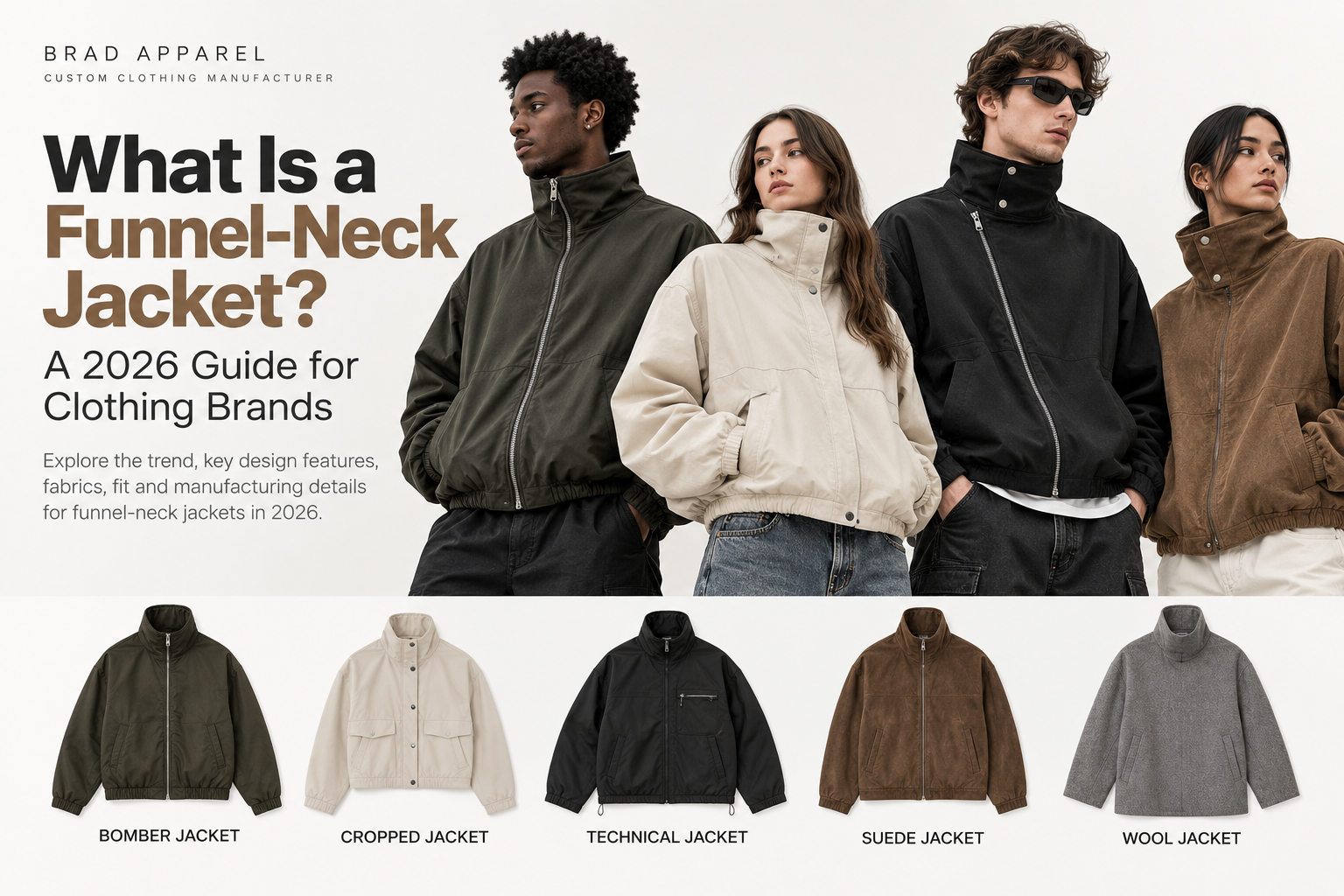
The funnel-neck jacket has become one of the most recognizable outerwear silhouettes of 2026.
Its defining feature is simple:
A high collar that rises around the neck and can become a major part of the jacket's silhouette.
But the category is much broader than one specific coat.
A funnel neck can appear on:
- Cropped jackets
- Oversized bombers
- Wool outerwear
- Technical jackets
- Leather jackets
- Suede jackets
- Lightweight transitional pieces
That versatility is one reason the design has moved so easily between runway fashion, minimal casualwear and streetwear.
For clothing brands, however, the collar is also where the product becomes technically interesting.
A successful funnel-neck jacket depends on the relationship between:
Collar height
Collar circumference
Fabric structure
Front closure
Neckline shape
Body proportion
and
How the collar behaves when open and closed
This guide explains what defines a funnel-neck jacket and what brands should consider when developing one for production.
What Is a Funnel-Neck Jacket?
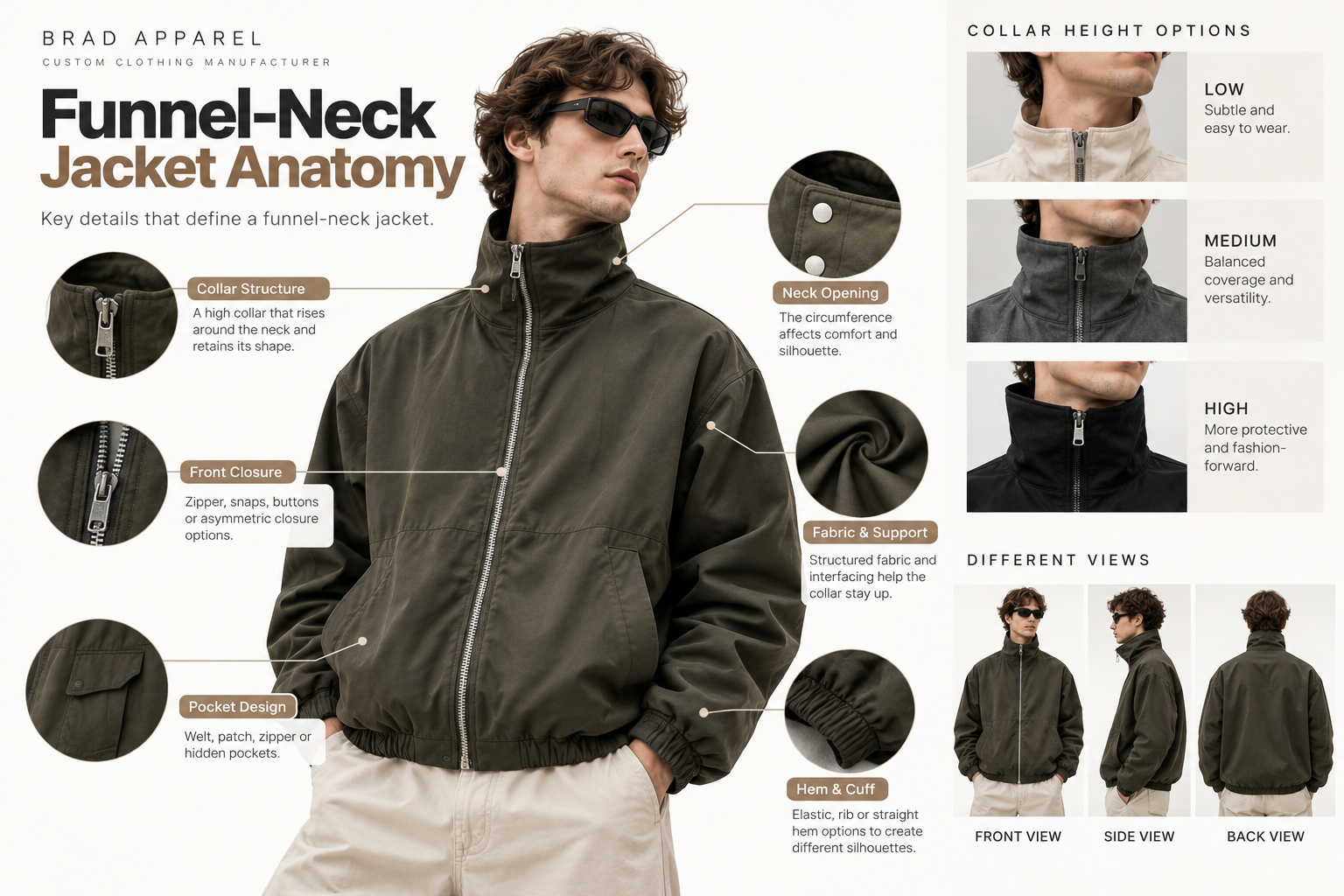
A funnel-neck jacket uses a raised collar that extends upward around the neck rather than folding outward like a traditional shirt or lapel collar.
Depending on the design, the collar may reach:
- Lower neck
- Jawline
- Chin area
The final appearance can range from subtle to highly sculptural.
Unlike a conventional point collar, the funnel collar is normally intended to retain some vertical structure.
When fully closed, it creates a more protective and architectural neckline.
When opened, it may:
- Fold outward
- Fall to the sides
- Create an asymmetric shape
- Remain partially standing
That open-versus-closed behavior is one of the most important parts of the design.
Funnel Neck vs Stand Collar: What's the Difference?
The terms are sometimes used interchangeably, but they do not always describe exactly the same visual effect.
A stand collar is generally a vertical collar that sits relatively close to the neck.
A funnel neck usually has more:
- Height
- Volume
- Opening
- Sculptural shape
It may flare slightly outward toward the top rather than following the neck closely.
| Detail | Stand Collar | Funnel Neck |
|---|---|---|
| Shape | More compact | More sculptural |
| Volume | Usually closer to neck | Often wider |
| Height | Low to medium | Medium to high |
| Open Position | Often remains structured | Can fold or spread dramatically |
| Visual Role | Supporting detail | Major design feature |
These are general design distinctions rather than universal industry rules.
For production, the actual pattern dimensions matter more than the product name.
Why Are Funnel-Neck Jackets Trending in 2026?
The funnel neck fits several current outerwear directions at the same time.
Fashion is moving toward jackets with stronger silhouettes and more visible construction details.
Instead of relying only on graphics or logos, brands are using:
- Collar shape
- Volume
- Proportion
- Fabric texture
- Closure placement
to create identity.
The funnel neck does this particularly well because one pattern detail can dramatically change the appearance of an otherwise simple jacket.
It Makes Minimal Jackets More Distinctive
Imagine two simple black jackets.
Jacket A
Standard collar
Regular zipper
Straight body
Jacket B
High funnel collar
Asymmetric closure
Boxy body
The fabric may be almost identical.
But Jacket B immediately has a stronger visual identity.
That makes funnel collars particularly useful for:
- Minimal brands
- Contemporary streetwear
- Premium casualwear
- Fashion outerwear
where the garment needs to feel distinctive without relying on large decoration.
The Collar Is the Main Engineering Challenge
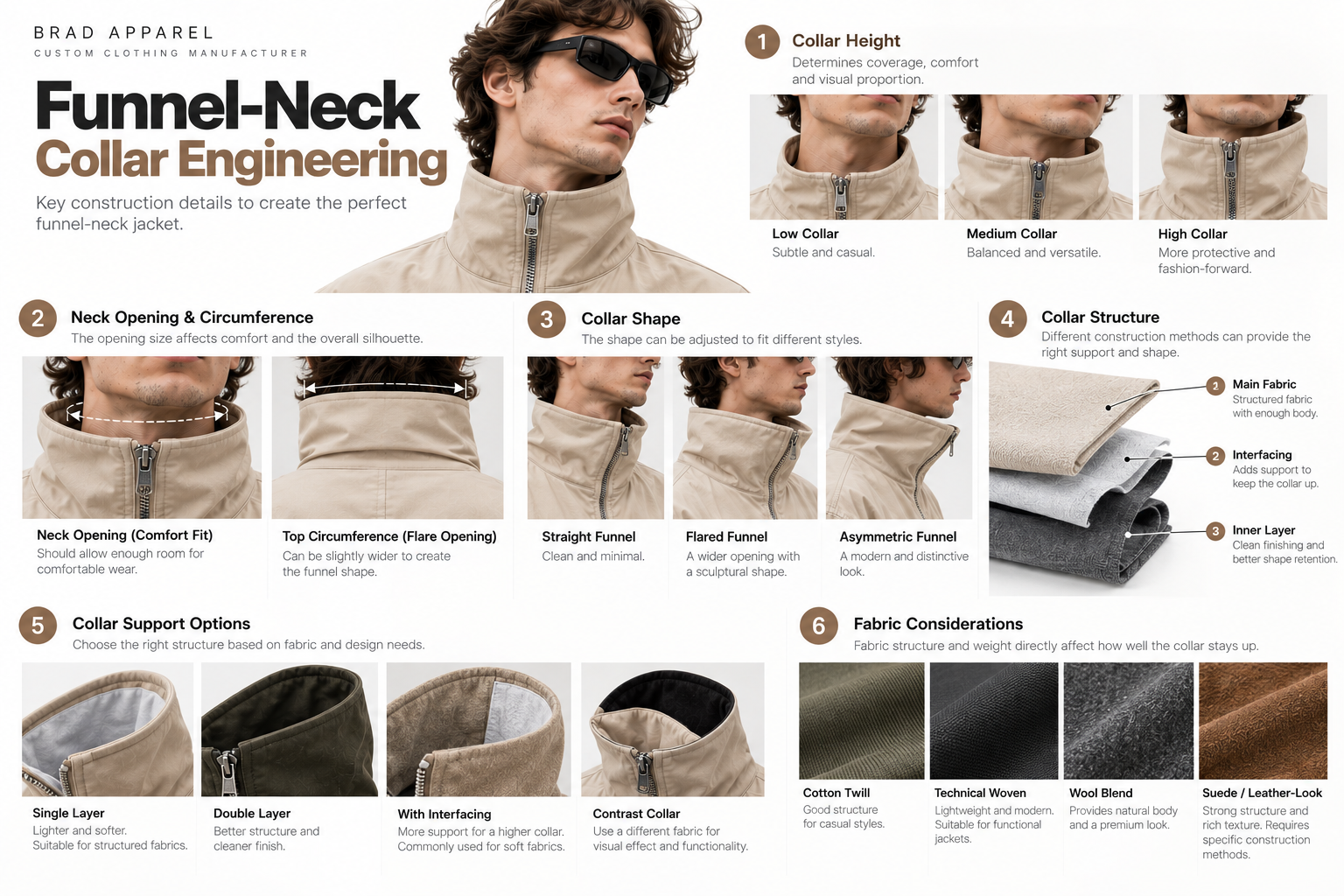
A funnel collar needs more than height.
Several dimensions work together.
Collar Height
The collar determines how strongly the neckline affects the silhouette.
A lower funnel collar feels:
- Easier
- More casual
- Less dramatic
A taller collar can feel:
- Architectural
- Protective
- Fashion-forward
But increasing collar height also increases the risk of:
- Chin contact
- Folding
- Collapse
- Discomfort
The correct height should therefore be evaluated on a physical sample.
Collar Circumference Matters Just as Much
A tall collar that is too narrow can feel restrictive.
A collar that is too wide may collapse and lose the intended shape.
The manufacturer needs to consider the relationship between:
Neck opening
and
Top collar circumference
A funnel collar may widen slightly toward the top to create its characteristic shape.
The amount of flare should be intentional.
Front Neck Drop Changes the Shape
Another important pattern measurement is the front neckline.
A deeper front neckline can create more breathing space when the collar is closed.
A higher neckline creates a more enclosed appearance.
Small changes here can affect:
- Comfort
- Zipper position
- Collar angle
- Open-collar shape
This is difficult to judge accurately from a flat sketch alone.
How Does the Funnel Collar Stay Up?
A common misconception is that the collar simply needs a very stiff fabric.
That is not always the best solution.
Collar structure can come from several sources.
Main Fabric Structure
A dense fabric may naturally provide enough body.
Examples can include:
- Structured twill
- Heavy wool blend
- Dense technical woven
- Firm synthetic outerwear fabric
Interfacing
Interfacing can be added between fabric layers to increase support.
The correct level depends on the intended result.
Too little support:
Collar collapses
Too much support:
Collar feels rigid and uncomfortable
The goal is controlled structure rather than maximum stiffness.
Double-Layer Construction
A double-layer collar can provide:
- More body
- Cleaner interior finish
- Better shape retention
The trade-off is additional thickness.
That matters especially around:
- Zippers
- Snaps
- Collar corners
- Fold points
Funnel-Neck Jacket Closure Options
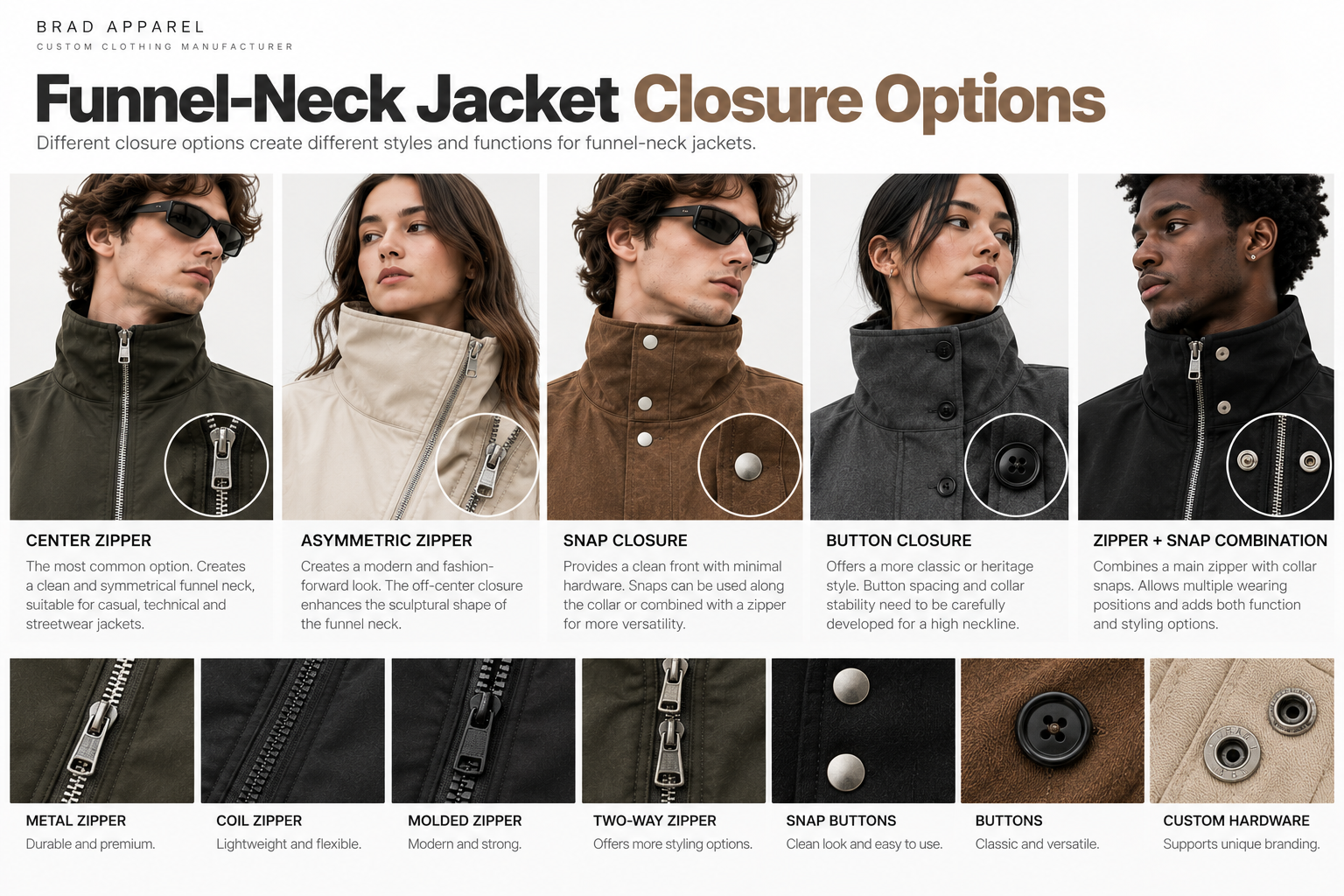
The closure controls both function and appearance.
Center-Front Zipper
The most straightforward construction.
Useful for:
- Bombers
- Technical jackets
- Casual outerwear
When zipped completely, the collar forms a symmetrical funnel.
Asymmetric Zipper
An off-center zipper can create a more fashion-focused silhouette.
When closed:
Clean sculptural neckline
When opened:
Asymmetric folded collar
This makes the closure part of the styling.
Snap Closure
Snaps can create a cleaner front with less visible hardware.
They may be used:
- Instead of a zipper
- Above a zipper
- Along the collar only
Button Closure
Buttons can create a softer or more heritage-inspired interpretation.
However, button spacing and collar stability need to be considered carefully on a tall neckline.
Zipper + Snap Combination
Some designs combine:
Main zipper + collar snaps
This allows the collar to be worn in multiple positions.
That versatility can be useful when the jacket is designed around convertible styling.
Zipper Selection Matters More on a High Collar
A zipper on a normal jacket may end around the base of the neck.
On a funnel-neck design, it may continue much higher.
That means the zipper affects:
- Chin comfort
- Collar structure
- Weight
- Fold behavior
- Visual balance
Brad Apparel's Custom Zippers & Sliders page covers metal, coil, molded and two-way zipper options that can be selected according to garment structure.
Consider a Chin Guard
When a zipper reaches close to the face, direct contact between:
slider + chin
can become uncomfortable.
A small fabric guard may help:
- Cover the zipper top
- Reduce skin contact
- Create cleaner finishing
This is particularly useful on:
- Technical jackets
- Sports-inspired jackets
- High closed collars
Funnel-Neck Jackets Need to Work Open and Closed
A common development mistake is approving the jacket in only one position.
The sample should be reviewed:
Fully closed
Partially open
and
Fully open
because each position reveals different problems.
Closed
Check:
- Collar symmetry
- Chin clearance
- Neck comfort
- Zipper alignment
- Collar support
Partially Open
Check:
- How the collar begins to fold
- Left/right balance
- Zipper tape exposure
Fully Open
Check:
- Collar fall
- Interior appearance
- Facing
- Shape around shoulders
A collar that looks excellent closed may look awkward when opened.
Both positions matter.
Four Main Funnel-Neck Jacket Directions
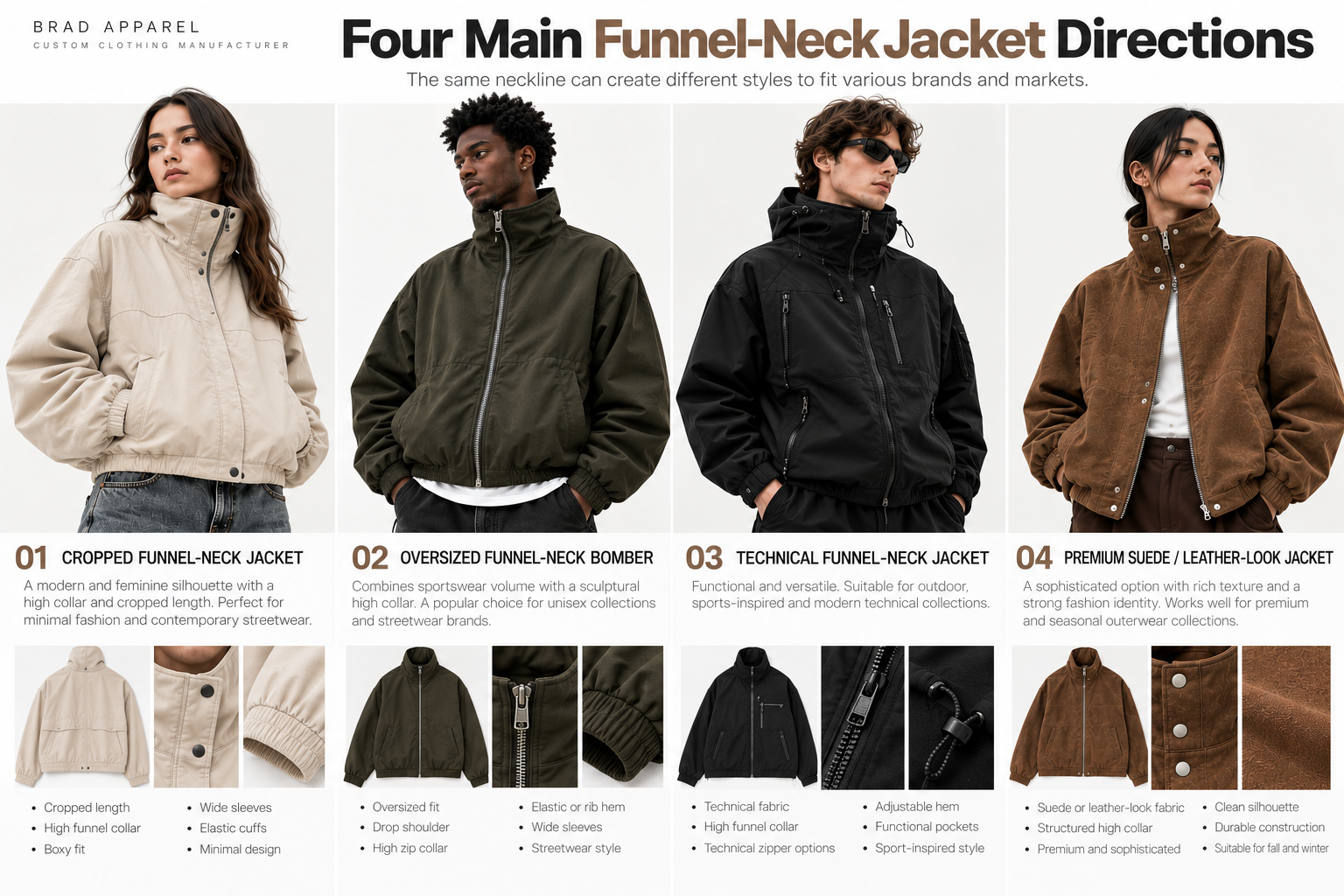
The same neckline can support very different products.
1. Cropped Funnel-Neck Jacket
Typical features include:
- Short body
- Boxy chest
- High collar
- Wider sleeve
- Clean hem
This creates a strong proportion because the collar occupies more visual space relative to the shorter body.
Suitable for:
- Women's fashion
- Contemporary streetwear
- Minimal collections
2. Oversized Funnel-Neck Bomber
Possible features include:
- Wide chest
- Drop shoulder
- Large sleeve
- Elastic or rib hem
- High zip collar
This direction combines:
sportswear volume + sculptural neckline
and can work particularly well for unisex collections.
3. Technical Funnel-Neck Jacket
Possible fabrics include:
- Nylon
- Polyester
- Technical woven
- Stretch woven
Possible details include:
- Waterproof-style zipper options
- Adjustable hem
- Internal pockets
- Lightweight lining
- Technical hardware
Functional properties should always be specified and tested rather than assumed from the appearance of the fabric.
4. Premium Suede / Leather-Look Funnel Jacket
The funnel neck can also work with more substantial outerwear materials.
Possible directions include:
- Suede
- Leather
- Faux suede
- Coated fabrics
These materials create stronger collar structure but require different:
- Needle selection
- Seam construction
- Pressing
- Edge finishing
than ordinary woven jackets.
Funnel Neck vs Bomber Collar
A traditional bomber commonly uses:
- Rib collar
- Low neckline
- Soft circular shape
A funnel-neck bomber replaces this with:
- Taller collar
- More coverage
- Stronger vertical structure
The body may still use classic bomber elements such as:
- Rib hem
- Rib cuffs
- Wide sleeves
- Front zipper
Changing only the collar can completely transform the product.
Funnel Neck vs Hooded Jacket
A hood creates volume behind the head.
A funnel neck creates volume around the neck.
Combining both is possible, but the two structures can compete.
If a jacket includes:
Large hood + high funnel collar
the manufacturer should check:
- Neck bulk
- Hood attachment
- Collar folding
- Comfort
- Back-neck thickness
For many minimalist designs, removing the hood allows the funnel collar to become the main feature.
Choosing Fabric for a Funnel-Neck Jacket
Fabric needs to support both:
the body silhouette
and
the collar
Cotton Twill
Useful for:
- Casual jackets
- Utility-inspired designs
- Transitional outerwear
Twill provides moderate structure without necessarily feeling extremely rigid.
Technical Woven
Suitable for:
- Lightweight jackets
- Sport-inspired designs
- Modern outerwear
Possible finishes vary widely, so any:
- Water repellency
- Wind resistance
- Performance treatment
should be confirmed as an actual fabric specification.
Wool Blends
Suitable for:
- Premium outerwear
- Structured winter jackets
- Minimal fashion collections
The collar may require additional support depending on fabric softness.
Suede / Faux Suede
Creates:
- Rich texture
- Soft surface
- Strong fashion positioning
But the material may behave differently around:
- Fold lines
- Zipper seams
- Collar edges
Sampling is essential.
Leather / Faux Leather
Can naturally create strong collar shape.
However, material thickness can create bulk when several collar layers meet.
The pattern and seam allowance should be developed specifically for the material.
Fabric Sourcing Should Come Before Final Collar Approval
If the sample collar is developed using one material and the bulk fabric changes later, the collar may behave differently.
For example:
A collar developed in:
firm cotton twill
may collapse when changed to:
soft brushed fabric
even if the pattern dimensions remain identical.
Brad Apparel's verified Fabric Sourcing & Development page covers composition, structure, weight, texture and finishing before garment sampling.
Should the Collar Use the Same Fabric?
Not necessarily.
A contrast collar can create another design direction.
Examples include:
Woven body + rib collar
Nylon body + fleece collar
Wool body + leather-look collar
However, mixed materials can introduce:
- Different shrinkage
- Different thickness
- Different stretch
- Different cleaning requirements
These combinations should be tested together.
Pocket Placement Should Follow the Silhouette
Because the collar already creates strong visual attention at the top of the garment, pocket design should support rather than compete with it.
Possible directions include:
Welt Pockets
Clean and minimal.
Zipper Pockets
Technical and practical.
Patch Pockets
More utility-driven.
Hidden Seam Pockets
Keeps the exterior clean.
A minimalist funnel jacket may benefit from fewer visible pocket details.
A technical version can support more functional construction.
Hem Construction Changes the Volume
Different hems create very different silhouettes.
Straight Hem
Creates a clean jacket shape.
Elastic Hem
Pulls volume inward and creates a bomber effect.
Rib Hem
Adds traditional sportswear language.
Adjustable Drawcord
Allows the wearer to switch between:
straight
and
blouson-style
silhouettes.
This can be especially useful for oversized funnel-neck designs.
What About the Sleeves?
A large collar creates strong upper-body volume.
Sleeves should be balanced against it.
Possible options include:
- Regular set-in sleeve
- Drop shoulder
- Raglan sleeve
- Wide sculptural sleeve
A very narrow sleeve combined with an extremely oversized collar and body may look disconnected unless that contrast is intentional.
Minimal Decoration Often Works Best
One reason the funnel-neck jacket is interesting for fashion brands is that it does not require heavy decoration to become recognizable.
The silhouette itself can provide identity.
Useful branding options include:
- Small chest embroidery
- Tonal embroidery
- Sleeve logo
- Custom zipper puller
- Branded snaps
- Woven label
- Subtle patch
Large graphics are possible, but they are not required.
This helps brands build visual identity through:
pattern + fabric + hardware
rather than relying only on print.
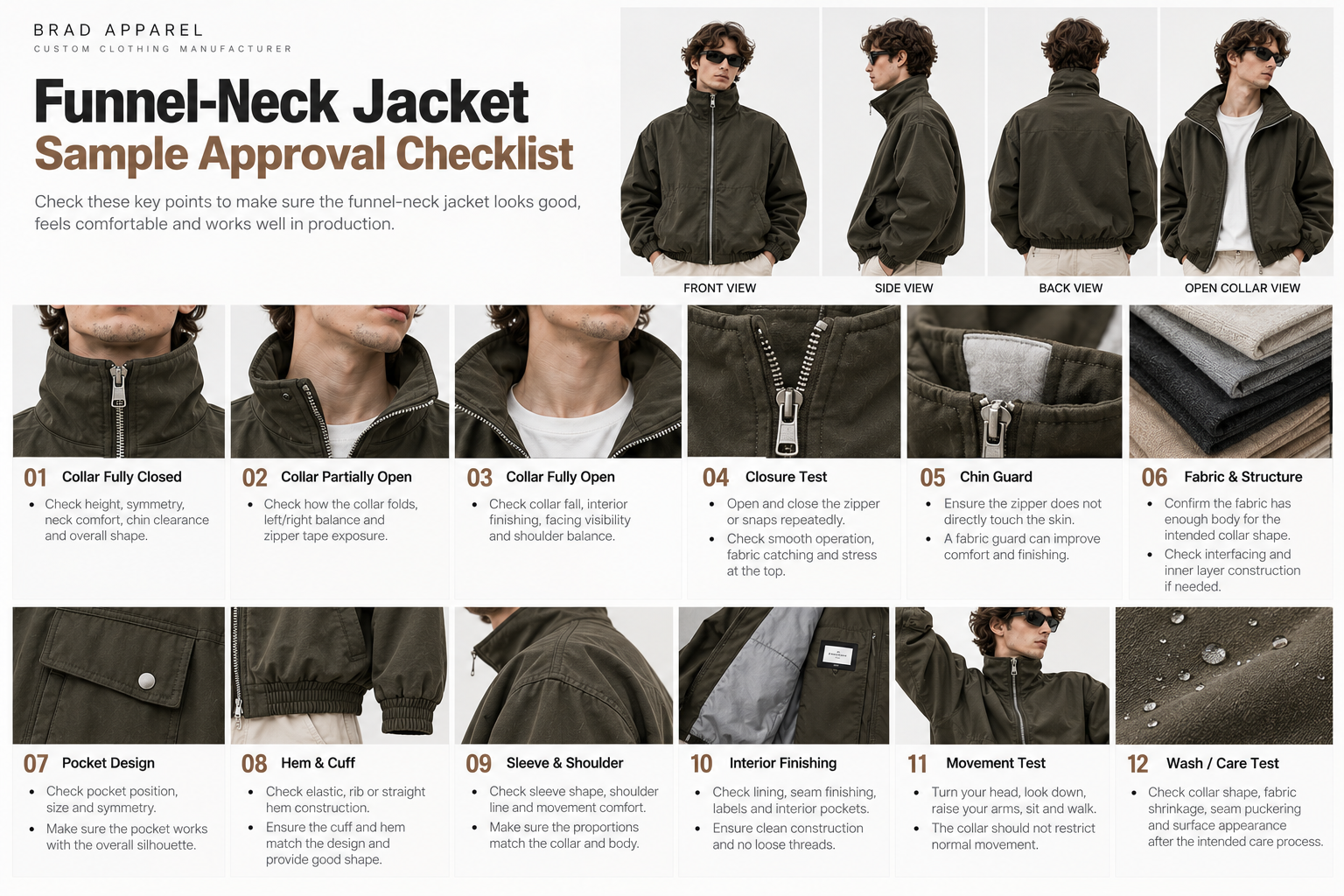
What Should You Check on a Funnel-Neck Jacket Sample?
This product should be reviewed from several angles.
1. Collar Fully Closed
Check:
- Height
- Symmetry
- Neck comfort
- Chin clearance
- Shape
2. Collar Partially Open
Check:
- Fold position
- Left/right balance
- Zipper appearance
3. Collar Fully Open
Check:
- How the collar falls
- Interior finishing
- Facing visibility
- Shoulder balance
4. Front View
Check:
- Jacket width
- Zipper position
- Pocket symmetry
- Hem balance
5. Side View
Check:
- Collar angle
- Shoulder volume
- Body depth
- Sleeve shape
6. Back View
Check:
- Collar attachment
- Back-neck shape
- Shoulder line
- Overall proportion
7. Movement Test
Ask the wearer to:
- Turn their head
- Look down
- Raise their arms
- Sit
- Walk
The collar should not restrict normal movement.
8. Closure Test
Open and close the zipper or snaps repeatedly.
Check:
- Smooth operation
- Fabric catching
- Collar distortion
- Stress at zipper endpoint
9. Wash / Care Test
Where appropriate for the material, check:
- Collar shape
- Fabric shrinkage
- Seam puckering
- Zipper wave
- Surface appearance
after the intended care process.
Common Funnel-Neck Jacket Development Mistakes
Collar Too High
A dramatic sketch may become uncomfortable in real wear.
Collar Too Narrow
The neckline can feel restrictive.
Collar Too Soft
The intended funnel shape collapses.
Collar Too Stiff
The garment feels rigid around the face.
Heavy Zipper on Lightweight Fabric
The closure can pull or distort the center front.
Only Checking the Collar Closed
The jacket may look awkward once opened.
No Chin Protection
The zipper slider can contact the skin.
Bulk Fabric Is Different From Sample Fabric
A fabric change can alter collar behavior even when the pattern remains unchanged.
What Should You Send a Manufacturer?
A useful funnel-neck jacket brief should specify:
| Area | What to Define |
|---|---|
| Fit | Regular / relaxed / oversized / cropped |
| Main Fabric | Composition, structure, weight, color |
| Collar | Desired height, opening and shape |
| Closure | Center zip / asymmetric zip / snaps / buttons |
| Zipper | Type, length, teeth, tape and puller |
| Lining | None / full / partial |
| Sleeve | Set-in / raglan / drop shoulder |
| Hem | Straight / elastic / rib / drawcord |
| Welt / zipper / seam / patch | |
| Branding | Embroidery / label / custom hardware |
| Care | Wash requirements |
| Quantity | Sampling and bulk quantity |
A reference image is useful.
But the final production brief should convert the visual reference into actual specifications.
How Brad Apparel Can Develop a Funnel-Neck Jacket
A custom project can follow:
Design Direction
↓
Fabric Confirmation
↓
Collar Proportion Development
↓
Pattern Development
↓
Zipper / Hardware Selection
↓
Sample
↓
Open + Closed Collar Review
↓
Movement & Fit Test
↓
Bulk Approval
Brad Apparel's manufacturing capabilities include fabric sourcing, custom trims, zipper development, sampling, branding and bulk garment production. Our current Capabilities page provides an overview of these customization routes.
FAQ
What Is a Funnel-Neck Jacket?
A funnel-neck jacket is an outerwear style with a high collar that rises around the neck and usually retains more vertical structure than a conventional folded collar.
Is a Funnel Neck the Same as a Stand Collar?
They can overlap.
A stand collar is usually closer and more compact around the neck.
A funnel collar often has more height, volume or outward flare.
The actual pattern should be specified rather than relying only on terminology.
Why Are Funnel-Neck Jackets Popular in 2026?
The silhouette combines:
- Strong visual identity
- Practical neck coverage
- Minimal styling
- Versatility across different jacket types
It can be adapted to cropped, oversized, technical, leather and wool outerwear.
Can a Funnel-Neck Jacket Be Oversized?
Yes.
Oversized versions can use:
- Wider chest
- Drop shoulder
- Larger sleeves
- High collar
- Elastic or adjustable hem
The collar should be proportioned to the larger body.
What Fabric Works Best for a Funnel Neck?
There is no single best fabric.
Common directions include:
- Cotton twill
- Technical woven
- Wool blends
- Suede
- Faux suede
- Leather-look materials
The fabric should have enough structure for the intended collar shape.
Does a Funnel Collar Need Interfacing?
Not always.
Some fabrics provide enough natural structure.
Softer materials may require interfacing or another internal support layer.
The correct level should be confirmed during sampling.
Can a Funnel-Neck Jacket Have a Hood?
Yes, but the hood and high collar can create additional bulk around the neckline.
The two components should be developed together.
Is a Funnel-Neck Jacket Waterproof?
Not automatically.
A high collar is a design feature, not a waterproof specification.
Water resistance depends on:
- Fabric
- Coating
- Membrane
- Seam construction
- Zipper
These properties should be confirmed separately.
Can the Collar Be Worn Open?
Yes.
Many funnel-neck designs are intended to create different silhouettes depending on whether the closure is:
- Closed
- Partially open
- Fully open
That is why all positions should be checked during sample approval.
Final Thoughts
The funnel-neck jacket is a good example of how one construction detail can completely change a garment.
The strongest designs do not simply add an unusually tall collar to an existing jacket.
They develop the:
Collar
Neck opening
Closure
Fabric
Body proportion
and
Sleeves
as one complete silhouette.
That is what allows the collar to look intentional both open and closed.
For clothing brands, this makes the funnel neck especially interesting:
It creates recognizable visual identity through garment engineering rather than relying only on graphics or logos.
Keep Reading