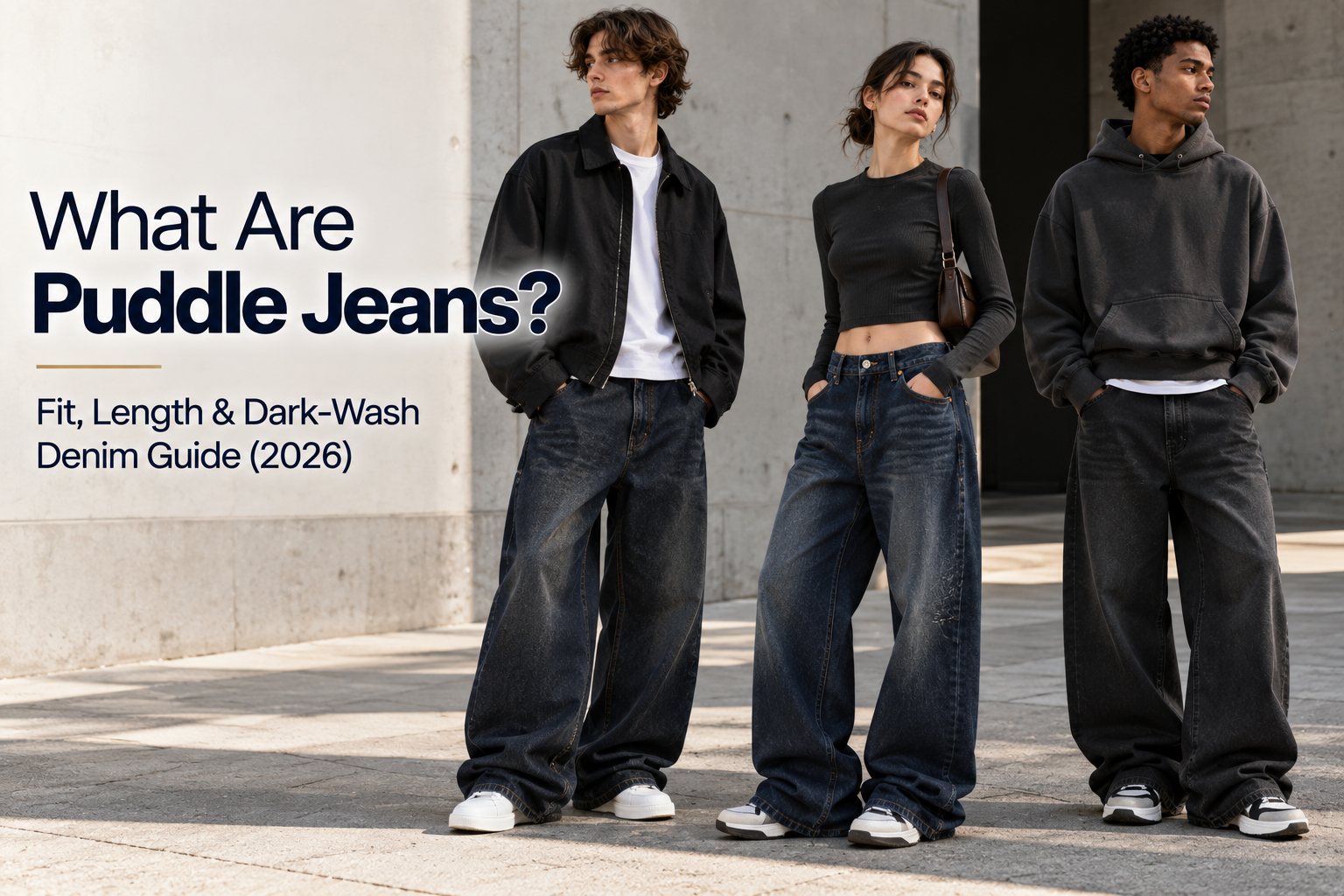
Puddle jeans are extra-long jeans designed so the lower leg extends beyond a conventional full-length hem and creates visible pooling or stacking around the footwear.
Unlike normal wide-leg jeans, the extra length is intentional.
Unlike barrel jeans, the silhouette does not depend primarily on a curved side seam and tapered hem.
For clothing brands, a successful puddle jean depends on the relationship between:
rise + hip + thigh + knee + leg opening + inseam + denim structure + footwear + wash shrinkage
If the jeans are simply made longer without controlling these proportions, the result can look incorrectly sized rather than intentionally oversized.
This guide explains what puddle jeans are, how they differ from baggy, wide-leg and barrel jeans, and what brands should specify when developing them for production.
What Are Puddle Jeans?
Puddle jeans are full-length or extra-long jeans designed to extend onto or around the shoe.
The excess length creates a visual effect often described as:
- Pooling
- Stacking
- Draping
- Floor-skimming
- Puddling
The amount of excess fabric can range from subtle to dramatic.
A relatively commercial pair may create only:
one or two soft breaks above the shoe
while an exaggerated fashion version may produce:
multiple folds around the ankle and footwear
The defining feature is therefore not simply a baggy fit.
It is the intentional relationship between:
pant length + shoe + hem
Why Are Puddle Jeans Trending in 2026?
Puddle jeans fit several current denim directions:
- Dark indigo denim
- Relaxed fits
- Long inseams
- Wide-leg jeans
- Baggy streetwear
- 1990s proportions
- Early-2000s styling
- Cleaner dark washes
- More refined oversized silhouettes
Dark indigo is particularly effective because the deeper color can make an oversized silhouette appear cleaner and more polished.
The style also works across different aesthetics.
Puddle jeans can feel:
- Streetwear
- Minimal
- Premium casual
- Y2K
- Tailored
- Unisex
- Skate-inspired
depending on the fit, fabric, wash and styling.
Puddle Jeans vs Baggy Jeans vs Wide-Leg Jeans vs Barrel Jeans
These categories can overlap, but they are not identical.
| Style | Main Characteristic | Leg Shape | Length | Hem |
|---|---|---|---|---|
| Puddle Jeans | Extra length and pooling | Straight, wide or relaxed | Extra long | Falls onto footwear |
| Baggy Jeans | Overall volume | Loose throughout | Varies | Wide or moderate |
| Wide-Leg Jeans | Wide leg silhouette | Consistently wide | Varies | Wide |
| Barrel Jeans | Curved leg | Bows outward then tapers | Regular to long | Controlled / tapered |
| Straight Jeans | Consistent leg width | Straight | Regular | Moderate |
A pair of jeans can therefore be both:
baggy + puddle
or:
wide-leg + puddle
because "puddle" mainly describes the length and lower-leg behavior.

Puddle Jeans vs Baggy Jeans
Baggy describes overall volume.
A baggy jean normally has more room through:
- Hip
- Thigh
- Knee
- Lower leg
But it does not necessarily need to be extra long.
A baggy jean can finish cleanly at the shoe.
A puddle jean intentionally uses additional length.
Think of it as:
Baggy = width
Puddle = length + pooling
Many current designs combine both.
Puddle Jeans vs Wide-Leg Jeans
Wide-leg jeans maintain generous width through the lower leg.
But their hem can finish:
- Above the shoe
- At the shoe
- Below the shoe
Only the longer versions that intentionally pool around the footwear would normally be described as puddle jeans.
This means:
wide-leg jeans can become puddle jeans by changing the finished length
provided the overall proportions still work.
Puddle Jeans vs Barrel Jeans
Barrel jeans are primarily defined by their leg shape.
They normally use:
- More volume around thigh or knee
- Curved side seams
- Controlled lower leg
- Narrower hem
Puddle jeans are primarily defined by:
- Extra length
- Floor-skimming hem
- Pooling around footwear
A barrel jean can technically be made long enough to puddle, but the two concepts should not be treated as interchangeable.
For more detail on curved-leg construction, see our Barrel Jeans Guide.
Extra Length Is the Key Design Decision
The most important question is:
How much should the jeans puddle?
There is no universal answer.
Subtle Puddle
Creates:
- Slight break
- Minimal stacking
- Easier everyday wear
- Cleaner appearance
This can work well for commercial denim.
Moderate Puddle
Creates:
- Visible folds around the shoe
- Clear extra-long proportion
- Strong fashion silhouette
Extreme Puddle
Creates:
- Multiple fabric stacks
- Floor contact
- Dramatic oversized look
This can work for editorial or streetwear styling but requires more consideration around wear and hem durability.
Do Not Specify Puddle Jeans by Inseam Alone
Inseam is important, but it does not fully describe the final length.
Two people wearing the same inseam can experience different amounts of puddling because of:
- Height
- Rise
- Crotch depth
- Shoe height
- Leg proportions
- Waist position
That is why development should consider:
inseam + outseam + rise + target wearer + target footwear
together.
Inseam vs Outseam
Inseam
Measures from the crotch to the lower hem.
It directly affects lower-leg length.
Outseam
Measures along the outside of the garment.
Depending on the factory's measurement method, it may begin:
- At the top waistband
- Below the waistband
The method should be clearly defined in the tech pack.
For extra-long jeans, both measurements are useful because they help confirm the relationship between:
rise and total length
How Much Extra Length Should Be Added?
There is no standard puddle allowance.
For example, one design might need only:
2–4 cm beyond a normal full length
while another may require substantially more.
The correct amount should be determined through fitting.
Instead of telling a factory:
Make the jeans extra long.
it is better to provide:
- Finished inseam
- Finished outseam
- Model height
- Reference footwear
- Desired hem position
- Reference photo
This reduces interpretation.
Footwear Is Part of the Puddle-Jeans Fit
This is unusual compared with many other pants.
The shoe directly affects the silhouette.
Consider:
Flat Sneakers
The hem may create:
- More stacking
- More floor contact
Chunky Sneakers
A thicker shoe can support more fabric and reduce floor drag.
Boots
The hem may break higher because of the boot shape.
Heels
The extra height can create a longer, cleaner drape.
The sample should therefore be tested with footwear similar to how the final customer is expected to wear the product.
Where Should the Fabric Pool?
The extra fabric should normally collect naturally around:
- Ankle
- Shoe upper
- Heel area
It should not create uncontrolled bulk through the entire calf.
If the jeans stack too high up the leg, possible causes include:
- Excessive length
- Hem opening too narrow
- Denim too stiff
- Lower-leg width too small
Leg Opening Changes the Puddle Effect
Imagine two jeans with the same inseam.
Pair A
Has a narrow hem opening.
The extra length may stack vertically above the shoe.
Pair B
Has a wider hem.
The fabric may fall over and around the footwear more smoothly.
The resulting silhouettes are very different.
So puddle behavior depends strongly on:
inseam + hem width
Straight Puddle Jeans
Straight puddle jeans use relatively consistent leg width from the thigh downward.
The extra length creates:
- Soft breaks
- Controlled stacking
- Cleaner silhouette
This works well for brands wanting a more refined version of the trend.
Wide-Leg Puddle Jeans
Wide-leg versions create:
- More lower-leg volume
- Larger folds
- Strong floor-skimming appearance
These can feel more fashion-forward and oversized.
However, excessively wide hems can:
- Catch under shoes
- Drag heavily
- Wear quickly
The hem should be tested during walking.
Baggy Puddle Jeans
Baggy versions may combine:
- Relaxed hip
- Wide thigh
- Wide knee
- Long inseam
- Large leg opening
This produces the strongest streetwear direction.
The fit should still be intentional.
Simply increasing every measurement equally can create excessive bulk.
Rise Changes the Overall Proportion
Puddle jeans can use:
- Low rise
- Mid rise
- High rise
Low-Rise Puddle Jeans
Create:
- Strong Y2K influence
- Longer-looking torso
- Relaxed styling
Mid-Rise Puddle Jeans
Create:
- Balanced proportions
- Easier unisex development
- Broad commercial appeal
High-Rise Puddle Jeans
Create:
- Longer visual leg
- More defined waist
- Cleaner styling
The same inseam can appear very different when the rise changes.
Puddle Jeans Pattern Development
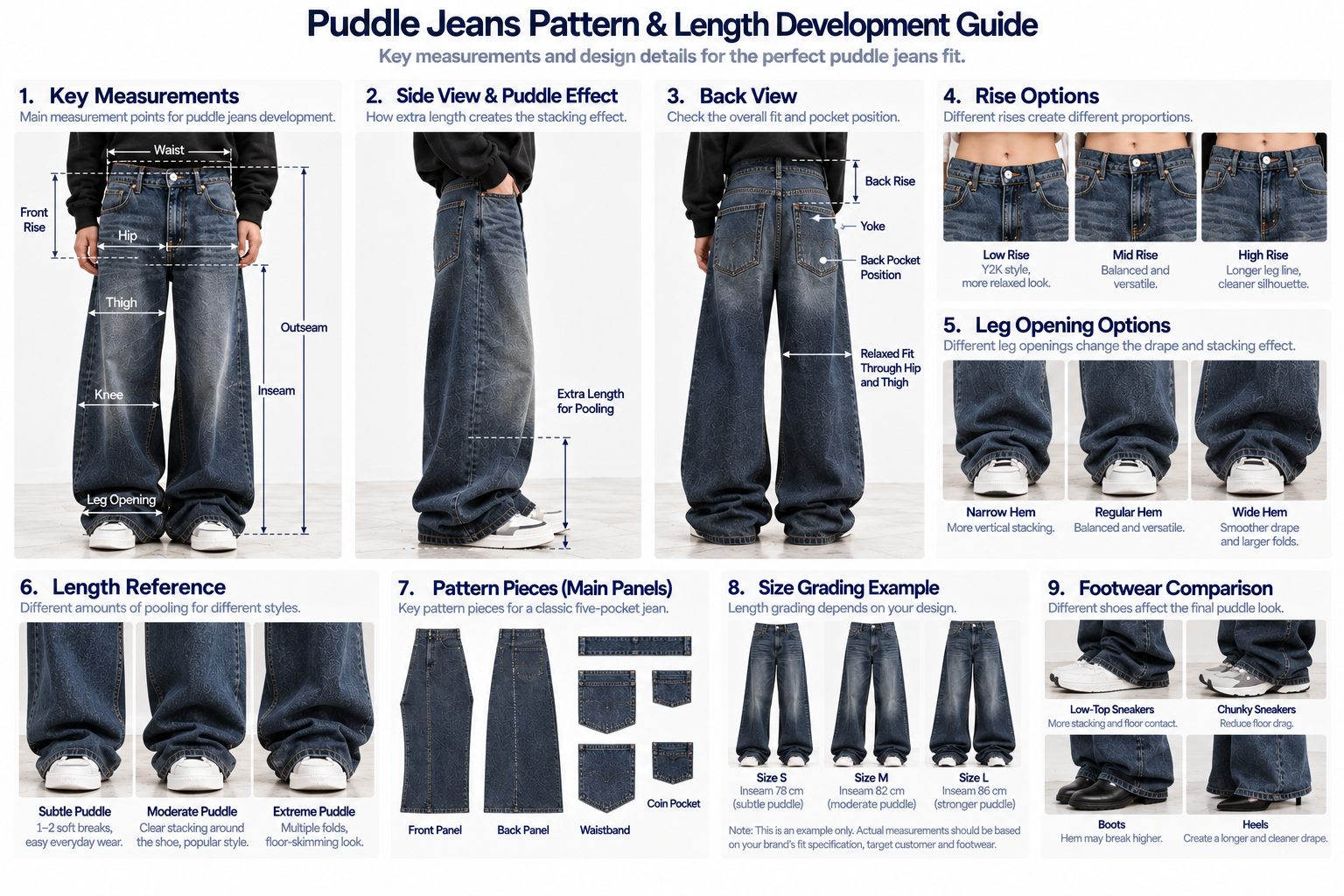
A dedicated puddle-jeans pattern should control:
- Waist
- Hip
- Front rise
- Back rise
- Crotch extension
- Thigh
- Knee
- Calf
- Leg opening
- Inseam
- Outseam
The extra length should be introduced without making the entire garment look accidentally oversized.
Where Should the Extra Length Be Added?
Most of the visual puddling should come from the lower-leg length.
But the pattern maker still needs to review the complete garment.
Adding excessive length below the knee while leaving the upper leg unchanged may create strange proportions.
A good pattern balances:
upper-leg fit
with:
lower-leg length and width
Denim Weight Changes the Puddle Effect
Fabric weight has a major influence.
Lightweight Denim
Creates:
- Softer folds
- More drape
- Easier movement
But very lightweight denim can appear closer to trousers than classic jeans.
Midweight Denim
Provides a useful balance between:
- Structure
- Drape
- Durability
- Denim character
Heavy Denim
Creates:
- Strong folds
- More rigid stacks
- Heavier silhouette
But heavy denim combined with extreme extra length can create significant weight around the ankle.
For custom fabric development, see Brad Apparel's Fabric Sourcing & Development.
100% Cotton Denim vs Stretch Denim
100% Cotton Denim
Often provides:
- Stronger denim character
- More structure
- Better rigid appearance
- More defined folds
It works particularly well for:
- Baggy puddle jeans
- Dark indigo denim
- Vintage-inspired streetwear
Stretch Denim
May provide:
- Greater comfort
- Easier movement
- Softer fit
However, excessive stretch can reduce the strong structured appearance some brands want from oversized denim.
Why Dark Indigo Works So Well for Puddle Jeans
Dark indigo is one of the strongest current directions for long relaxed denim.
It creates:
- Clean surface
- Premium appearance
- Strong contrast with topstitching
- Less visually busy silhouette
Because puddle jeans already contain significant volume, a dark clean wash can help the product feel more intentional.
Possible directions include:
- Deep indigo
- Raw-looking indigo
- Rinse wash
- Clean dark blue
- Blue-black
- Washed black
Raw Denim vs Rinse Wash
Raw / Rigid Denim
Usually feels:
- Crisp
- Structured
- Dark
- More resistant to immediate drape
The extra length may create more angular stacks.
Rinse Wash
Can soften the denim while keeping:
- Deep color
- Clean surface
- Strong structure
This can be a practical compromise for brands wanting dark denim with better initial comfort.
Dark Wash Does Not Mean One Exact Color
"Dark wash" is too broad for accurate production.
One factory may interpret it as:
deep blue indigo
while another may produce:
blue-black
or:
washed charcoal
A brand should provide:
- Physical swatch
- Reference garment
- Approved wash sample
- Pantone reference where appropriate
- High-quality color reference
The final bulk wash should be compared with the approved standard.
Why Wash Testing Is Especially Important
Washing can change:
- Waist
- Hip
- Rise
- Inseam
- Outseam
- Hem width
- Hand feel
- Color
For normal jeans, a small length change may be manageable.
For puddle jeans, that change can alter the entire concept.
A pair designed to create a 5 cm pool can lose much of the effect if the inseam shrinks substantially.
Final measurements should therefore be confirmed after the intended wash.
Preshrink and Bulk Consistency
For washed denim, the factory should consider:
- Fabric shrinkage
- Garment shrinkage
- Wash variation
- Batch variation
The pattern may need shrinkage allowance before cutting.
The goal is for the finished bulk garment—not the pre-wash garment—to match the approved size specification.
Hem Durability Is More Important on Puddle Jeans
The hem sits closer to the ground than on conventional jeans.
That increases the risk of:
- Abrasion
- Fraying
- Dirt
- Moisture
- Heel damage
This should be considered during design.
Clean Finished Hem
A standard folded denim hem creates:
- Cleaner appearance
- More controlled durability
- Traditional jean construction
But repeated floor contact can still damage it.
Raw Hem
A raw edge can intentionally create:
- Fraying
- Grunge appearance
- Vintage effect
This works well when wear at the hem is part of the design.
However, the amount of unraveling may need to be controlled.
Possible methods include:
- Stay stitching
- Reinforcement stitching
- Controlled fraying
Distressed Hem
A pre-distressed hem can make natural wear feel intentional.
Possible effects include:
- Grinding
- Abrasion
- Fraying
- Small tears
But excessive distressing before wear may reduce durability.
The balance should be tested during sampling.
Hem Guard or Reinforcement
For certain premium or technical designs, the inner heel area can receive additional reinforcement.
This may reduce direct abrasion where the hem contacts footwear or the ground.
However, reinforcement can add:
- Thickness
- Stiffness
- Cost
and should only be used if it suits the product.
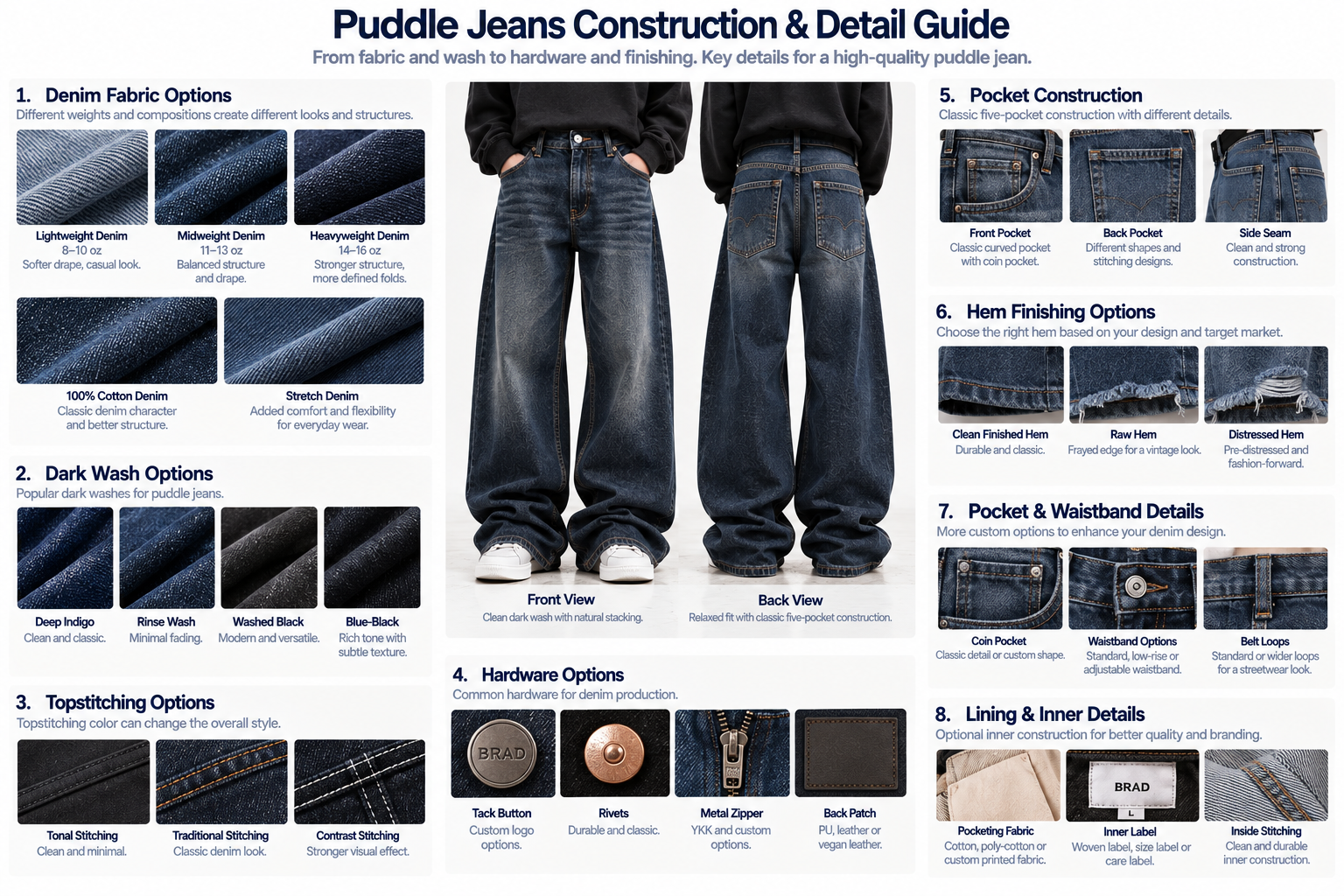
Pocket Construction
Most puddle jeans use conventional five-pocket construction:
- Two front curved pockets
- Coin pocket
- Two back patch pockets
But the proportions should match the oversized silhouette.
A very small back pocket on an extremely wide jean may look visually unbalanced.
Back-Pocket Position
Check:
- Pocket width
- Pocket height
- Distance from center back
- Distance from yoke
- Angle
Pocket placement can make the seat appear:
- Wider
- Narrower
- Higher
- Lower
It should be reviewed on the actual sample.
Waistband Options
Common constructions include:
Traditional Structured Waistband
Provides classic denim construction.
Low-Slung Waistband
Works for more relaxed and Y2K-inspired fits.
Alternative Waistband
Modern denim can also use:
- Extended tabs
- Double waistbands
- Raw waist edges
- Drawcord inserts
- Adjustable tabs
These details should be fully specified rather than copied only from a reference image.
Fly Options
Typical jeans closures include:
Zipper Fly
Provides:
- Familiar operation
- Clean commercial construction
Button Fly
Creates:
- Heritage denim character
- More visible hardware
The choice has little direct effect on the puddle silhouette but can strongly affect the overall product identity.
Denim Hardware
Common hardware includes:
- Tack button
- Rivets
- Metal zipper
- Custom shank button
- Logo rivets
- Back waistband patch
Possible finishes include:
- Antique brass
- Silver
- Gunmetal
- Matte black
The hardware should complement the wash.
Topstitching Color
Topstitching can dramatically change dark denim.
Tonal Dark Stitching
Creates:
- Minimal appearance
- Premium clean look
Traditional Tobacco Stitching
Creates:
- Strong denim identity
- More visible construction
Contrast Light Stitching
Creates:
- Strong graphic effect
- More obvious seam lines
For dark indigo puddle jeans, tonal or traditional golden-brown stitching can create very different moods.
Side-Seam Construction
The side seam should remain balanced despite the extra length.
Possible issues include:
- Seam twisting
- Front panel rotating backward
- Back panel rotating forward
This can be caused by:
- Fabric skew
- Pattern imbalance
- Wash behavior
The side seam should be checked after washing, not only before.
Unisex Puddle Jeans
Puddle jeans work particularly well for unisex streetwear.
But a unisex label does not remove the need for fit development.
Important decisions include:
- Rise
- Hip ease
- Crotch depth
- Waist grading
- Length
- Size range
Some brands may develop one block.
Others may use separate blocks while maintaining a similar visual silhouette.
Cropped Tops and Puddle Jeans
Although styling is not a manufacturing specification, the intended outfit proportion can help guide development.
Extra-long jeans are frequently balanced with:
- Boxy T-shirts
- Cropped jackets
- Fitted knitwear
- Short outerwear
That means the waistband and rise can become especially visible.
The upper construction should therefore be as intentional as the lower-leg puddle effect.
How to Describe Puddle Jeans to a Manufacturer
Instead of writing:
I want long baggy jeans.
a better brief would be:
Unisex dark-indigo puddle jeans with a mid-rise waist, relaxed hip and thigh, wide straight lower leg and extra-long inseam designed to create moderate pooling over sneakers. Use rigid 100% cotton denim with a clean dark rinse and minimal fading.
Then provide:
- Waist
- Hip
- Front rise
- Back rise
- Thigh
- Knee
- Leg opening
- Inseam
- Outseam
- Model height
- Reference shoe
- Denim weight
- Wash
- Hardware
- Stitching
- Pocket measurements
That gives the pattern maker a much clearer starting point.
Example Minimal Dark-Indigo Puddle Jean
A cleaner design could use:
- Mid rise
- Relaxed straight leg
- Moderate extra length
- 100% cotton denim
- Deep indigo rinse
- Tonal stitching
- Minimal fading
- Clean hem
- Matte hardware
This creates a more premium, understated direction.
Example Streetwear Puddle Jean
A stronger streetwear version might use:
- Low or mid rise
- Baggy hip
- Wide thigh
- Large leg opening
- Extreme extra length
- Vintage black wash
- Heavy topstitching
- Distressed hem
The pattern should still be controlled rather than simply oversized.
Example Puddle Jeans Tech Pack
| Area | Example Specification |
|---|---|
| Product | Puddle Jeans |
| Fit | Relaxed / Baggy |
| Rise | Mid Rise |
| Fabric | 100% Cotton Denim |
| Denim Weight | 11–13 oz |
| Wash | Deep Indigo Rinse |
| Leg | Wide / Straight |
| Length | Extra Long |
| Puddle Amount | Moderate |
| Hem | Clean Finished |
| Fly | Metal Zipper |
| Waist Closure | Tack Button |
| Five-Pocket | |
| Stitching | Tonal |
| Hardware | Gunmetal |
| Branding | Back Patch + Woven Label |
These specifications are examples only.
How to Evaluate the First Puddle Jeans Sample
The sample needs to be evaluated while worn.
A flat garment cannot show the final puddle effect accurately.
Front View
Check:
- Waist position
- Hip
- Thigh
- Leg width
- Hem level
- Left/right symmetry
Side View
Check:
- Rise
- Seat
- Leg fall
- Amount of pooling
- Floor contact
Back View
Check:
- Back rise
- Pocket position
- Yoke
- Seat volume
- Hem behavior
Test the Intended Shoes
This step is particularly important.
Photograph the sample with:
- Target sneakers
- Boots
- Other intended footwear
Ask:
Does the puddle begin in the correct place?
Is there enough fabric?
Is there too much fabric?
Does the shoe disappear completely?
These questions should be answered before final approval.
Walk in the Sample
The wearer should:
- Walk normally
- Turn
- Sit
- Climb a step
- Put hands in pockets
Watch whether the hem:
- Catches under the shoe
- Drags excessively
- Twists
- Moves naturally
An editorial silhouette still needs to function as clothing.
Check the Sample After Washing
This is essential.
Compare:
before wash measurements
with:
after wash measurements
especially:
- Inseam
- Outseam
- Leg opening
- Waist
The final washed sample should create the intended pooling.
Size Grading Requires Extra Attention
A single fixed inseam may not create the same visual effect across all sizes.
The brand needs to decide whether length should:
Stay Constant
Useful for some unisex products.
Increase Gradually
Can help maintain proportion in larger sizes.
Be Offered in Multiple Lengths
For example:
- Short
- Regular
- Long
This may provide better customer fit but increases inventory complexity.
Common Puddle Jeans Development Mistakes
1. Simply Adding Length to an Existing Jean
The lower-leg width and overall proportion may not support the extra fabric.
2. Making the Jeans Too Long
The hem may drag excessively and become impractical.
3. Making the Hem Too Narrow
The extra length can stack too high around the ankle.
4. Making the Hem Too Wide
The customer may repeatedly step on the fabric.
5. Ignoring Footwear
The same jeans can look completely different with different shoes.
6. Ignoring Wash Shrinkage
A small loss in inseam can remove the intended puddle effect.
7. Using Denim That Is Too Stiff
The lower leg may form bulky rigid stacks.
8. Using Denim That Is Too Soft
The silhouette may collapse and lose denim character.
9. Ignoring Hem Abrasion
Floor-skimming jeans experience more wear.
10. Grading Length Mechanically
The visual puddle effect may change dramatically across sizes.
Puddle Jeans vs Barrel Jeans: Which Should Your Brand Develop?
Choose puddle jeans if you want:
- Extra-long proportion
- Floor-skimming denim
- Visible pooling
- Relaxed or baggy styling
- Strong interaction with footwear
Choose barrel jeans if you want:
- Curved side seam
- Sculptural leg
- Wider thigh or knee
- Controlled tapered hem
Choose wide-leg jeans if you want:
- Consistent width
- Wider hem
- Cleaner vertical silhouette
Choose standard baggy jeans if you want:
- Overall volume
- Relaxed fit
- Normal or flexible finished length
For a broader overview of different bottoms, see our Complete Guide to Pants Types.
FAQ
What Are Puddle Jeans?
Puddle jeans are extra-long jeans designed to pool, stack or drape around the footwear.
The extra length is intentional rather than a sizing mistake.
Are Puddle Jeans the Same as Baggy Jeans?
No.
Baggy describes the amount of overall garment volume.
Puddle describes the extra length and the way the hem collects around the shoe.
A pair of jeans can be both baggy and puddle.
Are Puddle Jeans the Same as Wide-Leg Jeans?
Not necessarily.
Wide-leg jeans are defined by leg width.
Puddle jeans are defined primarily by extra length.
Wide-leg jeans can also be puddle jeans when they are long enough to pool around the footwear.
Are Puddle Jeans the Same as Barrel Jeans?
No.
Barrel jeans are defined by a curved leg that becomes narrower toward the hem.
Puddle jeans are defined mainly by extra length and pooling.
How Long Should Puddle Jeans Be?
There is no universal standard.
The correct length depends on:
- Wearer height
- Rise
- Shoe
- Leg opening
- Desired amount of pooling
The finished length should be approved on a sample.
What Denim Is Best for Puddle Jeans?
Midweight rigid denim works well for many designs because it balances:
- Structure
- Drape
- Durability
Softer or heavier denim can also be used depending on the desired silhouette.
Are Dark-Wash Puddle Jeans Trending in 2026?
Yes.
Dark indigo and long relaxed denim silhouettes are prominent Fall 2026 directions, particularly in oversized and floor-skimming fits.
Can Puddle Jeans Be Low Rise?
Yes.
Low-rise puddle jeans create a stronger Y2K-inspired silhouette.
Mid-rise and high-rise versions are also possible.
Can Puddle Jeans Be Unisex?
Yes.
The relaxed silhouette is well suited to unisex collections, but waist, hip, rise and size grading still need to be developed carefully.
Should Puddle Jeans Touch the Floor?
They can, but they do not have to.
Some designs intentionally skim the floor.
Others create controlled pooling over the shoe without significant floor contact.
Do Puddle Jeans Wear Out Faster at the Hem?
They can experience more abrasion because the hem sits lower.
Fabric, hem construction and the amount of floor contact all affect durability.
Can Puddle Jeans Have a Raw Hem?
Yes.
A raw or distressed hem can complement the silhouette, but unraveling and durability should be tested.
What Measurements Should a Puddle Jeans Tech Pack Include?
Important measurements include:
- Waist
- Hip
- Front rise
- Back rise
- Thigh
- Knee
- Leg opening
- Inseam
- Outseam
The tech pack should also specify target footwear and desired hem position when possible.
Final Thoughts
Puddle jeans are not simply jeans that are too long.
Their silhouette depends on a controlled relationship between:
fit + leg width + inseam + footwear + denim + wash
A narrow lower leg creates stronger stacking.
A wide leg creates softer pooling.
Rigid denim produces more structured folds.
Softer denim produces more fluid drape.
And wash shrinkage can change the final effect even when the original pattern was correct.
For clothing brands, the most important step is defining exactly how much fabric should reach the shoe and how the hem should behave when the wearer walks.
Once the length, leg opening, denim and wash are approved together, puddle jeans can be translated from a trend image into a consistent, production-ready denim product.
Keep Reading