Barrel jeans are easy to recognize but surprisingly difficult to pattern correctly.
Their defining feature is a curved leg:
More volume through the thigh and knee
followed by
a controlled taper toward the hem.
That sounds simple.
But a successful barrel silhouette depends on the relationship between:
- Waist
- Hip
- Rise
- Thigh width
- Knee position
- Side-seam curve
- Inseam shape
- Hem opening
- Denim structure
- Wash and shrinkage
If these elements are not developed together, the result can look less like an intentional barrel jean and more like an oversized pair of tapered pants.
For clothing brands, barrel jeans are therefore a good example of why fashion silhouettes should be developed through pattern engineering rather than simply sizing an existing block up or down.
What Are Barrel Jeans?

Barrel jeans—also called barrel-leg jeans—use a leg shape that curves outward before narrowing again toward the bottom.
Viewed from the front, the silhouette may appear:
- Relaxed through the hip
- Wider through the thigh
- Rounded around the knee
- Narrower toward the ankle
Viewed from the side, the pattern may create additional three-dimensional volume through the leg.
This distinguishes barrel jeans from a basic straight or wide-leg jean.
The curve is intentional.
Barrel Jeans vs Balloon Jeans: Are They the Same?
The terms often overlap in fashion retail.
There is no single universal industry rule separating them.
However, a useful general distinction is:
| Style | Typical Silhouette |
|---|---|
| Barrel Jeans | Curved leg with controlled taper |
| Balloon Jeans | More exaggerated volume and rounded shape |
| Wide-Leg Jeans | Width continues more consistently toward hem |
| Tapered Jeans | Gradually narrows without a pronounced outward curve |
| Straight Jeans | Relatively consistent line from thigh to hem |
The exact product name matters less during manufacturing than the actual measurements and pattern shape.
A factory needs to know:
where the leg expands
and
where it begins to taper.
Why Are Barrel Jeans Popular in 2026?
Barrel jeans offer something different from the straight and wide-leg silhouettes that have dominated denim for several seasons.
The shape creates visual volume without requiring an extremely oversized overall fit.
That allows brands to combine:
relaxed comfort
with
a more directional silhouette.
They can also be adapted into different aesthetics:
- Minimal
- Vintage
- Utility
- Streetwear
- Premium denim
- Women's fashion
- Unisex collections
The silhouette itself becomes the design feature.
That means a barrel jean can look distinctive even with:
- Minimal branding
- Basic five-pocket construction
- Solid denim
- Simple hardware
The Curve Is Created by the Pattern
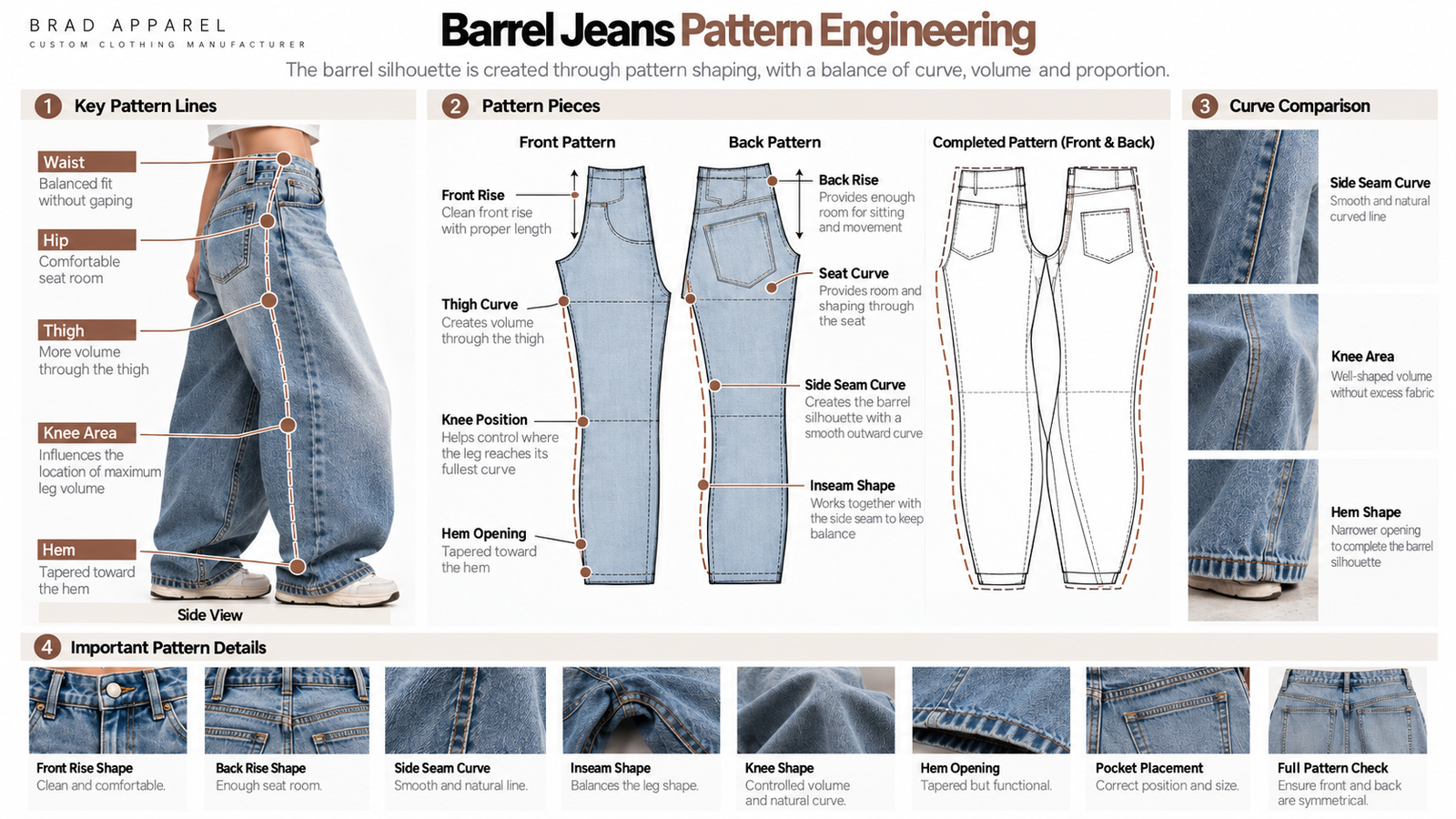
The most important point when developing barrel jeans is this:
The shape should be built into the pattern.
It should not simply come from selecting a larger size.
Several pattern areas work together.
1. Hip and Seat Volume
The upper block needs enough room for:
- Standing
- Sitting
- Walking
- Natural seat movement
But excessive hip width can create:
- Side bulging
- Crotch folds
- Excess fabric under the seat
So the upper volume needs to remain balanced with the rise.
2. Thigh Width
Barrel jeans normally require more thigh volume than a slim or straight jean.
But the amount depends on the intended silhouette.
A subtle barrel shape may only need controlled fullness.
An exaggerated balloon-style jean may need much more.
The thigh cannot be considered independently from the knee.
Knee Position Is Critical
The widest visual point of the leg is often influenced by the knee area.
If the curve reaches its maximum point too high:
the jean can look overly wide through the thigh.
If it reaches its maximum point too low:
the lower leg may look heavy or unbalanced.
The correct location depends on:
- Garment length
- Rise
- Wearer proportions
- Intended style
That is why the side view of a physical sample is especially important.
Side-Seam Shape Creates Much of the Barrel Effect
A straight-leg jean normally follows a relatively controlled line down the side of the body.
A barrel jean can use more deliberate shaping.
The side seam may:
- Move outward from the upper leg
- Reach maximum volume around the intended curve
- Return inward toward the hem
This creates the characteristic bowed silhouette.
But the curve should remain smooth.
An abrupt transition can create:
- Uneven drape
- Strange bulging
- Twisted seams
- Difficult sewing
The Inseam Matters Too
A common mistake is focusing only on the outer side seam.
The inseam also affects:
- Leg balance
- Knee volume
- Crotch shape
- Movement
- Hem orientation
If all the additional width is added only to the outside of the leg, the jean may become visually unbalanced.
Pattern makers normally evaluate both sides of the leg together.
Barrel Jeans Are Not Just Wide-Leg Jeans With a Narrow Hem
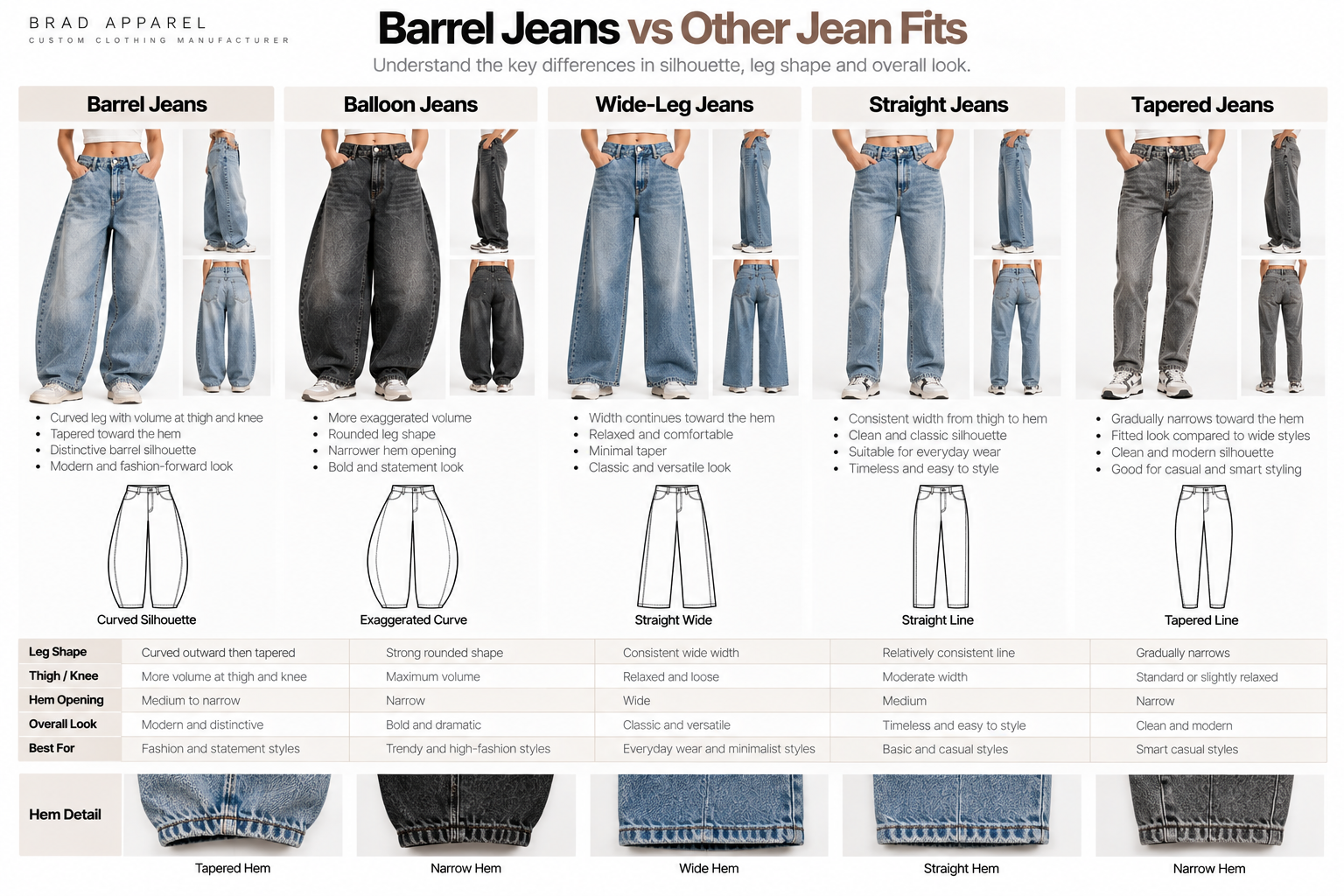
This is one of the most important distinctions.
Imagine taking a wide-leg pattern and simply reducing the hem opening.
The result may technically become narrower at the bottom.
But it may still lack the rounded transition that defines a barrel shape.
A genuine barrel silhouette should feel intentional from:
hip → thigh → knee → lower leg → hem
rather than suddenly becoming narrow near the ankle.
Rise Changes the Entire Proportion
Barrel jeans can be developed with:
- High rise
- Mid rise
- Lower rise
Changing the rise also changes how the curved leg is perceived.
A higher rise can visually lengthen the lower body and emphasize the full leg shape.
A lower rise may create a more relaxed or streetwear-oriented proportion.
But rise is not simply a styling choice.
It affects:
- Front crotch
- Back crotch
- Seat room
- Waist placement
- Pocket position
The complete upper pattern needs to be reviewed when rise changes.
Front Rise and Back Rise Need Different Functions
The front and back of the body do not require the same amount of space.
The back rise normally needs to accommodate:
- Seat projection
- Sitting movement
- Body volume
The front needs to remain clean without excessive bunching around the fly.
If these curves are poorly balanced, common problems include:
- Crotch pulling
- Front bagging
- Seat tightness
- Horizontal drag lines
Brad Apparel's verified Custom Bottom Development page shows how rise, seat and leg-shape corrections are handled during custom pants pattern development.
Hem Opening Controls How Strong the Barrel Looks
A wider hem creates a softer curve.
A narrower hem creates a more dramatic taper.
But making the hem extremely narrow can cause practical problems.
The wearer still needs enough room for:
- Foot entry
- Movement
- Shoes
- Overall balance
The best hem opening therefore depends on the complete silhouette rather than a universal measurement.
Fabric Can Strengthen or Destroy the Shape

The exact same pattern can look completely different depending on the denim.
That is especially important with barrel jeans because the silhouette depends on controlled volume.
Rigid Denim
A more structured denim can hold the barrel shape clearly.
Possible characteristics include:
- Stronger structure
- More visible curve
- Crisp seams
- Traditional denim appearance
This can work particularly well for:
- Sculptural barrel jeans
- Vintage-inspired denim
- Structured unisex fits
But very stiff fabric can feel restrictive if the pattern does not provide enough movement.
Softer Denim
Softer denim creates more drape.
This can make the barrel silhouette:
- More relaxed
- Less architectural
- More fluid
Useful for brands looking for a softer fashion fit rather than a heavily structured shape.
Stretch Denim
A stretch component can improve comfort.
However, higher stretch can change:
- Shape retention
- Knee recovery
- Waist stability
- Overall drape
The pattern should therefore be tested in the intended bulk fabric.
Do not approve a barrel pattern in one denim and assume it will behave the same in another.
Denim Weight Is Only One Part of the Specification
Brands often ask:
What GSM should barrel jeans use?
There is no universal answer.
Fabric behavior depends on more than weight.
Important factors include:
- Fiber composition
- Yarn
- Weave
- Density
- Stretch
- Finishing
- Wash
Two denim fabrics with similar weight can have very different:
- Stiffness
- Drape
- Surface
- Recovery
Physical swatches are therefore much more useful than GSM alone.
Brad Apparel's Fabric Sourcing & Development page includes denim and structured woven fabrics for jeans and custom bottom development.
Wash Development Can Change the Final Fit
Denim finishing is not only visual.
It can also affect garment dimensions and hand feel.
Depending on the project, finishes may include:
- Rinse wash
- Enzyme wash
- Stone-wash effects
- Vintage wash
- Fading
- Whiskering
- Garment washing
The selected process may change:
- Shrinkage
- Softness
- Color
- Surface
- Seam appearance
For this reason, the approved fit should ideally be evaluated after the intended wash process.
Pattern First or Wash First?
The correct approach is not to treat them as completely separate stages.
The factory needs to understand the intended wash before finalizing the production pattern.
For example:
If the finished jean is expected to shrink during processing, the pattern may need appropriate allowance.
The development process therefore becomes:
Fabric
↓
Wash Direction
↓
Pattern
↓
Sample
↓
Wash
↓
Measurement Review
↓
Pattern Adjustment
Five-Pocket Construction Still Works
A barrel silhouette does not require unusual pocket construction.
Traditional denim details can still be used:
- Front scoop pockets
- Coin pocket
- Back patch pockets
- Belt loops
- Fly
- Waistband
But placement matters.
A highly curved silhouette can make ordinary pockets appear visually different.
Back Pocket Placement Changes the Look of the Seat
Back pockets influence perceived proportion.
Moving them:
Higher
can make the seat look different from placing them:
Lower
or
Wider apart.
Brands should approve:
- Pocket size
- Pocket angle
- Height
- Spacing
- Topstitching
on the actual sample.
Do not treat back-pocket placement as an afterthought.
Front Pockets Should Follow the Upper Fit
Front pocket openings need to work with:
- Hip shape
- Rise
- Waistband
- Side seam
A pocket that looks good on a straight jean may need adjustment when the hip volume changes.
Pocket bags should also have enough room without becoming visible from the outside.
Waistband Construction
A barrel jean may use:
- Straight waistband
- Contoured waistband
depending on the fit.
The waistband should sit cleanly without:
- Gaping at the back
- Rolling
- Twisting
- Pulling the side seams
Waistband fit becomes especially important on higher-rise styles.
Fly Options
Common options include:
Zipper Fly
Clean and familiar.
Button Fly
Creates a more traditional denim character.
The closure choice does not define the barrel silhouette, but it influences:
- Front thickness
- Styling
- Hardware
- Sewing construction
Four Modern Barrel Jean Directions
0 A barrel pattern can be adapted into very different products.
1. Clean Minimal Barrel Jean
Typical features:
- Solid denim
- Controlled curve
- Clean five-pocket construction
- Minimal branding
- Simple hardware
Suitable for:
- Contemporary labels
- Minimal collections
- Premium basics
The silhouette does most of the visual work.
2. Exaggerated Balloon Jean
This direction pushes the shape further.
Possible features include:
- More thigh volume
- Stronger knee curve
- Narrower visual hem
- Larger overall silhouette
This works well when the brand wants the jean itself to become a statement piece.
However, comfort and movement still need to be checked.
3. Utility Barrel Pant
The barrel silhouette can also be combined with:
- Cargo pockets
- Tool pockets
- Knee seams
- Reinforcement
- Canvas or twill fabrics
This moves the product away from classic denim and toward:
utility + streetwear
The additional pocket weight should be considered when shaping the leg.
4. Vintage Washed Barrel Jean
Possible details include:
- Faded denim
- Vintage wash
- Contrast topstitching
- Distressed effects
- Antique-finish hardware
The wash can soften a structured pattern and make the silhouette feel more relaxed.
Panel Seams Can Create an Even Stronger Curve
Some barrel designs use additional seams instead of relying only on the traditional side and inseam.
Examples may include:
- Curved front-leg panel
- Knee seam
- Side panel
- Back-leg seam
These seams can be used to introduce three-dimensional shaping.
They also create visual interest.
However, every additional seam adds:
- Sewing operations
- Topstitching
- Alignment requirements
- Production time
The design should therefore use construction lines intentionally.
Darts and Tucks Can Also Add Volume
Some fashion-led barrel pants use:
- Waist pleats
- Knee darts
- Leg darts
- Tucks
to control three-dimensional volume.
These details can create a stronger sculptural silhouette.
But they should not be added randomly.
Each one changes how the fabric moves around the body.
Topstitching Matters on Denim
Denim construction makes seam lines highly visible.
Typical areas include:
- Side seams
- Inseams
- Yoke
- Back pockets
- Coin pocket
- Fly
- Waistband
Topstitching should be checked for:
- Consistent distance
- Even tension
- Clean corners
- Matching thread
- No skipped stitches
On a curved silhouette, inconsistent stitching becomes especially noticeable.
What Should You Check on a Barrel Jeans Sample?
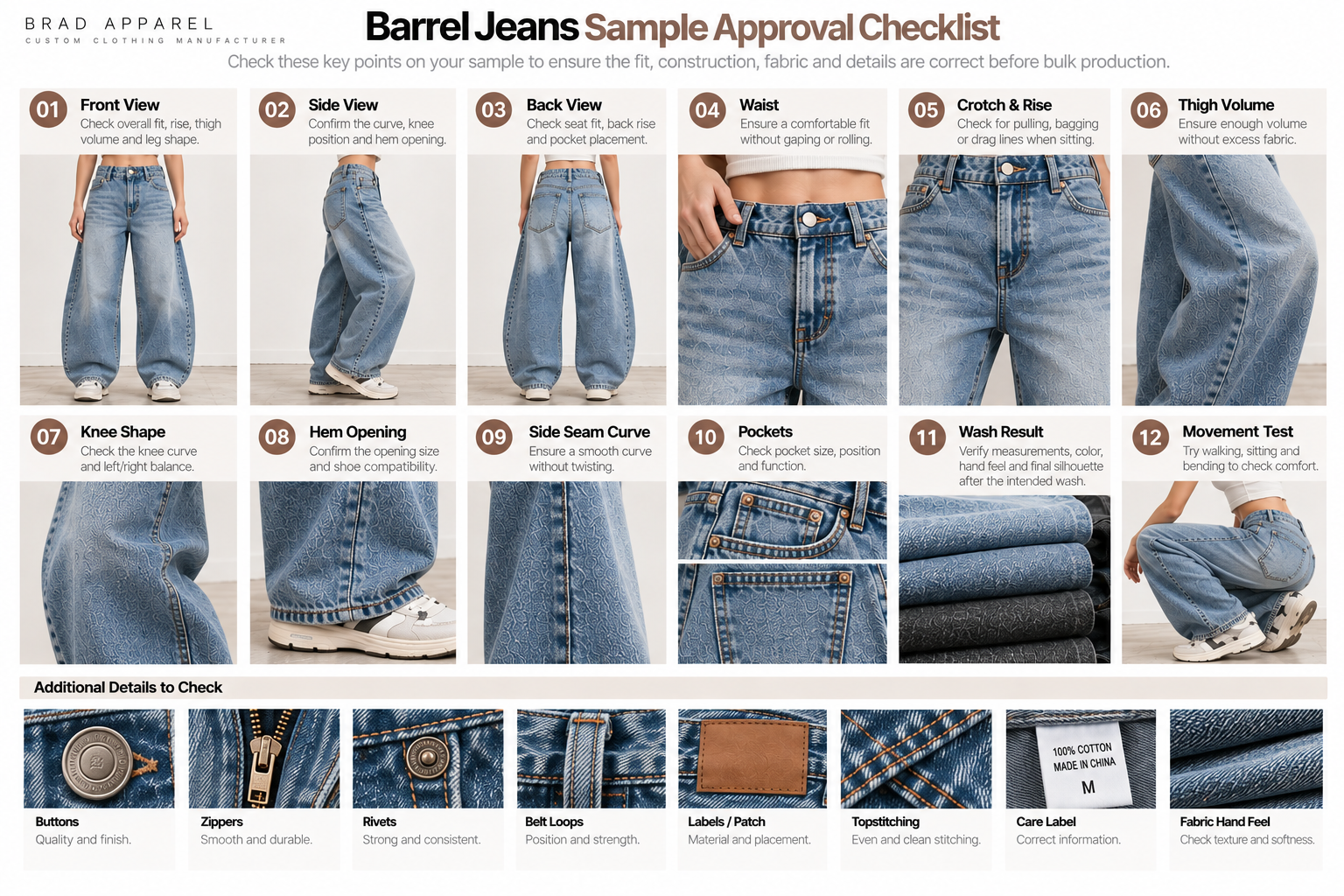
A barrel jean should always be evaluated from multiple angles.
1. Front View
Check:
- Waist balance
- Hip width
- Front rise
- Thigh volume
- Knee curve
- Hem position
The left and right sides should appear balanced.
2. Side View
This is one of the most important views.
Check:
- Where the leg reaches maximum width
- Side-seam curve
- Front-to-back balance
- Hem position
The curve should look intentional rather than like excess fabric.
3. Back View
Check:
- Seat fit
- Back rise
- Yoke
- Pocket placement
- Leg symmetry
Avoid excessive fabric collapsing under the seat.
4. Waist
Check:
- Comfort
- Back gaping
- Waistband shape
- Button position
5. Crotch and Rise
Test both standing and sitting.
Look for:
- Pulling
- Bagging
- Drag lines
- Restricted movement
6. Thigh
Check whether there is enough volume without excessive fabric.
7. Knee
Check:
- Curve location
- Left/right balance
- Bending comfort
- Excessive bagging
8. Hem
Confirm:
- Opening
- Shape
- Symmetry
- Shoe compatibility
9. Side Seam
The seam should flow smoothly through the intended curve.
Check for:
- Twisting
- Waviness
- Sudden shape changes
10. Pockets
Check:
- Position
- Symmetry
- Function
- Pocket-bag visibility
11. Wash Result
After the intended finishing process, compare:
- Measurements
- Color
- Hand feel
- Seam appearance
- Final silhouette
12. Movement
Ask the wearer to:
- Walk
- Sit
- Bend the knee
- Climb a step
- Move naturally
A fashion silhouette still needs to function as a wearable pair of pants.
Common Barrel Jeans Development Mistakes
Simply Sizing Up a Straight Jean
This creates a larger jean.
It does not automatically create a barrel silhouette.
Starting With a Wide-Leg Jean and Only Narrowing the Hem
The leg may taper but still lack the characteristic curve.
Making the Knee Too Wide
The silhouette can become bulky rather than sculptural.
Making the Hem Too Narrow
This can affect:
- Comfort
- Balance
- Foot entry
- Styling
Ignoring the Side View
A barrel jean that looks good only from the front is not fully developed.
Choosing Fabric After Pattern Approval
Changing denim can change the entire silhouette.
Approving the Fit Before Washing
If the bulk garment will be washed, the post-wash dimensions matter more than the raw sample measurements.
Using Poorly Positioned Back Pockets
Pocket position can make a technically correct jean look visually unbalanced.
What Should You Send a Barrel Jeans Manufacturer?
A useful tech pack or development brief should define:
| Area | What to Specify |
|---|---|
| Fit | Subtle barrel / exaggerated barrel / balloon |
| Rise | High / mid / low |
| Waist | Finished waist measurement and waistband style |
| Hip | Finished hip measurement |
| Thigh | Width and measurement position |
| Knee | Width and measurement position |
| Hem | Leg opening |
| Length | Inseam / outseam |
| Fabric | Denim / twill / canvas / other woven |
| Composition | Cotton / stretch blend / other |
| Wash | Rinse / vintage / enzyme / other finish |
| Five-pocket / utility / custom | |
| Fly | Zipper / button |
| Hardware | Button / rivets / zipper |
| Topstitch | Thread color and construction |
| Branding | Patch / label / embroidery |
| Quantity | Sample and bulk quantity |
A reference photo is useful.
But for a curved silhouette, measurements and pattern proportions are much more important than the photo alone.
How Brad Apparel Can Develop Custom Barrel Jeans
A barrel jean project can follow:
Design Reference
↓
Denim Selection
↓
Wash Direction
↓
Measurement Specification
↓
Barrel Pattern Development
↓
First Sample
↓
Front / Side / Back Fit Review
↓
Wash Test
↓
Measurement & Curve Adjustment
↓
Pre-Production Approval
↓
Bulk Production
Brad Apparel's Custom Bottom Development supports custom rise, hip, leg shape and specialty bottom patterns rather than requiring brands to use only a standard pant block.
For denim selection, brands can also use Fabric Sourcing & Development to compare woven fabrics according to structure, composition, weight, stretch, wash and intended garment fit.
FAQ
What Are Barrel Jeans?
Barrel jeans are jeans with a curved leg shape that generally creates more volume through the thigh and knee before tapering toward the hem.
Are Barrel Jeans the Same as Balloon Jeans?
The terms often overlap.
“Balloon jeans” is sometimes used for a more exaggerated rounded silhouette, while “barrel jeans” may describe a more controlled curved leg.
There is no universal naming standard, so brands should define the actual measurements and silhouette.
Are Barrel Jeans the Same as Wide-Leg Jeans?
No.
Wide-leg jeans normally maintain more width toward the hem.
Barrel jeans curve outward and then taper inward.
How Are Barrel Jeans Made?
The silhouette is created through pattern shaping.
Important areas include:
- Hip
- Thigh
- Knee
- Side seam
- Inseam
- Hem
The pattern is then tested in the intended production fabric.
What Fabric Is Best for Barrel Jeans?
There is no single best option.
Structured denim can create a stronger sculptural shape.
Softer denim can create a more relaxed silhouette.
Stretch denim can improve comfort but may change shape retention.
The fabric should match the intended design.
Can Barrel Pants Be Made From Fabric Other Than Denim?
Yes.
The same general silhouette can be developed using materials such as:
- Cotton twill
- Canvas
- Corduroy
- Structured woven fabrics
In that case, the product may be described as barrel pants rather than barrel jeans.
Can Barrel Jeans Be Oversized?
Yes.
But the barrel curve and oversized fit should be developed together.
Simply choosing a larger size may change length and rise without creating the desired proportion.
Do Barrel Jeans Need Stretch?
No.
Rigid and non-stretch denim can work very well for structured barrel silhouettes.
Stretch may be added when comfort or mobility is a priority.
Why Do Some Barrel Jeans Look More Curved Than Others?
The final appearance depends on:
- Pattern shape
- Knee width
- Hem opening
- Fabric structure
- Rise
- Wash
Different brands therefore interpret the silhouette differently.
Should Barrel Jeans Be Fitted Before or After Washing?
If the production garment will receive a wash or finishing process, the post-wash garment should be evaluated before final production approval.
The wash may affect both measurements and fabric behavior.
Final Thoughts
Barrel jeans demonstrate an important principle in garment development:
A silhouette should be engineered—not guessed.
The distinctive curved leg comes from the relationship between:
Rise
+
Hip
+
Thigh
+
Knee
+
Side Seam
+
Inseam
+
Hem
+
Fabric
+
Wash
rather than from one single measurement.
For clothing brands, the strongest barrel jeans are therefore not simply oversized denim with a tapered ankle.
They are purpose-built patterns in which the curve, material and finishing process are developed as one complete product.
Keep Reading