Jorts are denim shorts — but modern jorts are usually longer, wider and more intentionally shaped than traditional denim cut-offs.
In 2026, the most recognizable jorts typically feature:
- A relaxed or baggy fit
- Longer inseam
- Knee-grazing length
- Wide leg opening
- Denim construction
- Five-pocket or jean-inspired details
- Clean, raw or distressed hems
For clothing brands, however, developing jorts is not as simple as cutting a pair of jeans at the knee.
The final silhouette depends on the relationship between:
rise + hip + thigh + inseam + leg opening + denim structure + wash
This guide explains what jorts are, how they differ from regular denim shorts and Bermuda shorts, and what brands should specify when developing custom jorts for production.
What Are Jorts?
The word jorts comes from:
jeans + shorts
At the simplest level, jorts are shorts made from denim.
But in current fashion, the term usually describes a more specific silhouette.
Modern jorts are commonly:
- Longer than conventional denim shorts
- Relaxed through the hip and thigh
- Wider at the leg opening
- Straight rather than tightly tapered
- Designed to finish near the knee
The result often looks more like a pair of loose jeans shortened into a deliberate knee-length silhouette than a traditional pair of short denim cut-offs.
Are All Denim Shorts Jorts?
Technically, the terms can overlap.
But in fashion use, they often describe different proportions.
A classic denim short may have:
- Shorter inseam
- Closer thigh fit
- Smaller leg opening
- More fitted silhouette
Modern jorts usually emphasize:
- More length
- More width
- More volume
- A stronger streetwear or casual silhouette
So although every jort is a denim short, not every denim short necessarily looks like what consumers currently recognize as jorts.
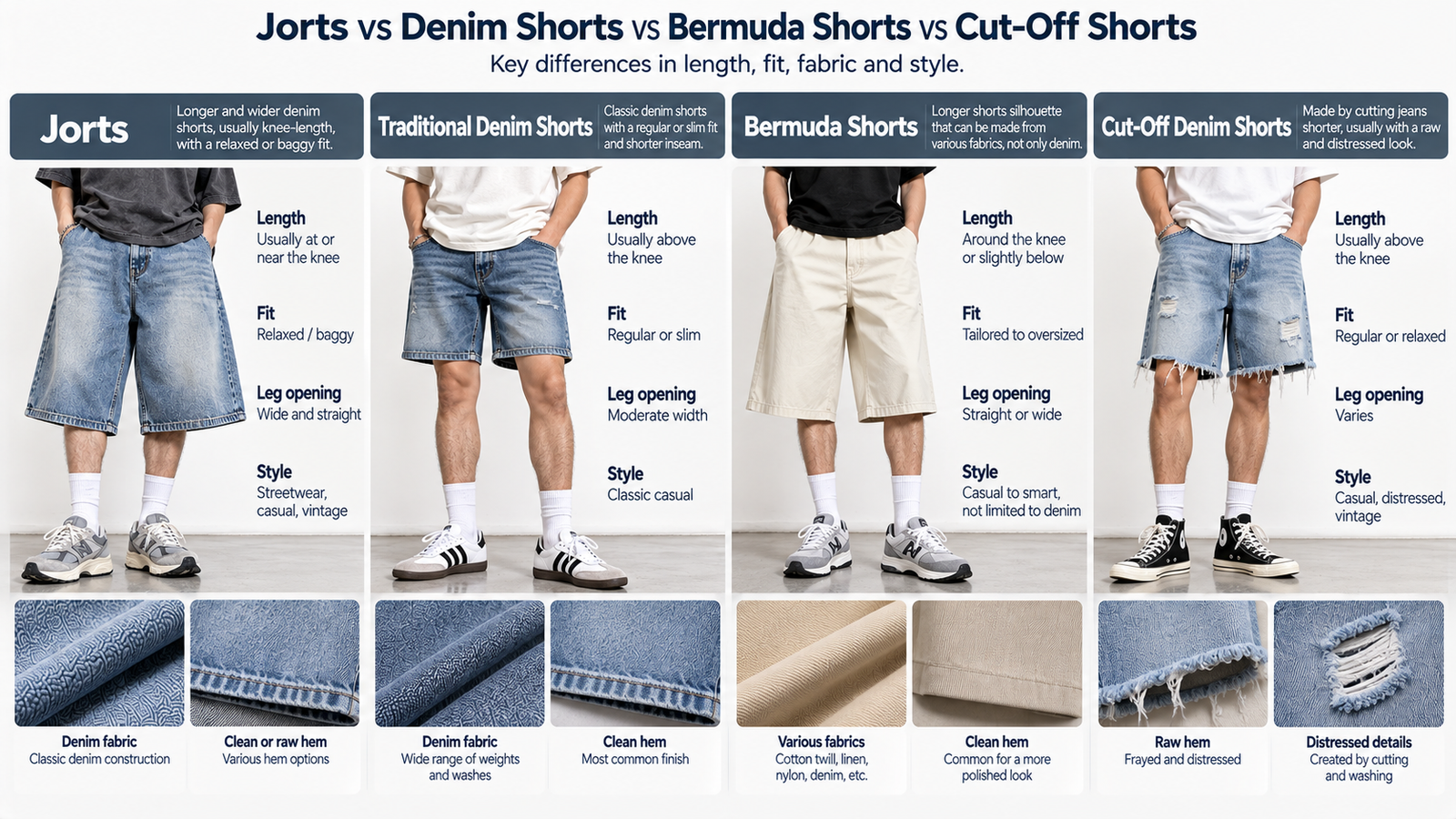
Jorts vs Denim Shorts: Quick Comparison
| Feature | Jorts | Traditional Denim Shorts |
|---|---|---|
| Length | Usually longer | Short to mid-length |
| Fit | Relaxed / baggy | Regular / slim / fitted |
| Leg Opening | Wide | Moderate or narrow |
| Hem Position | Often around the knee | Usually above the knee |
| Silhouette | Straight and loose | More fitted |
| Styling Direction | Streetwear / casual / fashion | Classic casual |
| Common Denim | Structured or washed denim | Wide variety |
| Pattern Approach | Dedicated long-short pattern | Standard shorts block |
The biggest difference is not the denim itself.
It is the proportion of the finished garment.
Why Are Jorts Popular Again?
Longer shorts have returned alongside the broader move toward:
- Baggy jeans
- Wide-leg pants
- Oversized tops
- Relaxed streetwear
- 1990s styling
- Early-2000s references
As upper-body silhouettes became wider, shorts also began moving away from very tight or very short proportions.
Longer jorts provide more visual weight below the waist and work naturally with:
- Boxy T-shirts
- Oversized shirts
- Rugby tops
- Hoodies
- Jackets
- Sneakers and skate-inspired footwear
For brands, jorts are also flexible because the same basic product can move between:
streetwear, skatewear, premium casualwear and fashion denim
depending on the fit, wash and details.
Jorts vs Bermuda Shorts
Jorts and Bermuda shorts can both finish close to the knee, but the terms describe different things.
Jorts
Defined mainly by:
denim construction
Bermuda Shorts
Defined mainly by:
length and silhouette
A Bermuda short may be made from:
- Denim
- Cotton twill
- Linen
- Suiting fabric
- Nylon
- Technical woven fabric
This means a pair of denim Bermuda shorts can also be described as jorts.
But not every Bermuda short is a jort.
| Feature | Jorts | Bermuda Shorts |
|---|---|---|
| Main Definition | Denim shorts | Longer shorts silhouette |
| Fabric | Denim | Many fabrics |
| Length | Usually knee area | Around knee area |
| Fit | Often relaxed / baggy | Tailored to oversized |
| Styling | Denim / streetwear | Casual to tailored |
Jorts vs Cut-Off Denim Shorts
The construction can also be different.
Cut-Off Shorts
Traditionally created by cutting longer jeans shorter.
They often have:
- Raw edge
- Fraying
- Existing jean proportions
- Casual or distressed appearance
Purpose-Built Jorts
Designed as shorts from the beginning.
The pattern can control:
- Rise
- Hip
- Thigh
- Inseam
- Leg opening
- Pocket depth
- Hem
- Overall balance
This gives brands much more control over the final silhouette.
A purpose-built pair of baggy jorts should therefore not simply be treated as full-length jeans with the lower legs removed.
Length Is One of the Most Important Jorts Decisions
A few centimeters can significantly change the appearance.
Possible directions include:
Above-the-Knee Jorts
Create a cleaner and more conventional shorts silhouette.
Suitable for:
- Everyday casualwear
- Less exaggerated streetwear
- Warmer climates
Knee-Length Jorts
One of the most recognizable modern jort proportions.
The hem finishes around the kneecap.
This works particularly well with:
- Relaxed fits
- Wide leg openings
- Oversized tops
Below-the-Knee Jorts
Create a much stronger fashion or skate-inspired silhouette.
These may begin to visually approach:
- Long Bermuda shorts
- Culotte-like proportions
- Cropped denim pants
The longer the inseam becomes, the more important leg width and hem position become.
Do Not Define Jorts by Inseam Alone
Inseam is important, but it cannot describe the entire fit.
Consider two pairs of shorts with the same inseam.
Pair A
- Narrow thigh
- Small leg opening
- Higher rise
Pair B
- Wide thigh
- Large leg opening
- Lower rise
Even if the inseam is identical, they can look completely different.
For jorts, the final silhouette comes from:
length + width + rise
working together.
Your tech pack should therefore define more than just inseam.
For a broader explanation of how changing shorts length affects pattern construction, see our Shorts vs Short Shorts Manufacturing Guide.
Baggy Jorts Need a Dedicated Pattern
One of the easiest mistakes is taking a regular slim denim short and simply increasing the size.
This often creates incorrect proportions.
A properly developed baggy-jort pattern may require changes to:
- Waist
- Hip
- Front rise
- Back rise
- Crotch extension
- Thigh width
- Leg opening
- Inseam
- Pocket position
The goal is not simply:
Make everything bigger.
Instead, the pattern should create controlled volume.
For example, a brand may want:
wide thigh + straight leg + knee length
without excessively increasing:
waist + rise + crotch depth
That requires intentional pattern development.
Straight Jorts vs Baggy Jorts
Not all jorts need the same degree of volume.
Straight Jorts
Usually have:
- Relaxed hip
- Moderate thigh width
- Relatively straight side seam
- Controlled leg opening
They offer a cleaner silhouette.
Baggy Jorts
Typically include:
- More hip ease
- Wider thigh
- Larger leg opening
- More visual volume
They work particularly well for:
- Skate-inspired streetwear
- Oversized collections
- Unisex styles
- Heavy denim
Wide-Leg Jorts
Wide-leg jorts push the silhouette further.
The side seam may fall almost vertically from the hip to the hem.
This creates:
- Stronger volume
- More movement
- More obvious streetwear proportions
The hem opening becomes one of the most important measurements.
If it is too narrow, the jort may look tapered.
If it becomes too wide without enough fabric structure, the silhouette may collapse.

Rise Changes the Character of Jorts
Jorts can be developed with different rise positions.
High Rise
Creates:
- Higher waist placement
- More vintage influence
- Stronger waist definition
Mid Rise
Provides a balanced and versatile fit.
Often suitable for:
- Unisex streetwear
- Everyday denim
- Commercial collections
Low Rise
Creates:
- More Y2K influence
- Longer visual torso
- More relaxed waist positioning
Rise also changes how the garment sits through the hip and crotch.
It should always be specified independently from the inseam.
The Leg Opening Controls the Silhouette
For modern jorts, leg opening is especially important.
Imagine two knee-length denim shorts.
Both have:
- Same waist
- Same rise
- Same inseam
But:
Pair A has a 27 cm half-leg opening
while:
Pair B has a 34 cm half-leg opening
Pair B will appear dramatically more oversized.
That is why brands should specify:
- Thigh width
- Leg opening
- Inseam
together.
What Denim Is Best for Jorts?
There is no single best denim.
The correct fabric depends on the target silhouette.
Lightweight Denim
Can create:
- Softer drape
- Easier movement
- More summer comfort
But very lightweight denim may struggle to hold a strongly structured baggy shape.
Midweight Denim
Provides a useful balance between:
- Structure
- Comfort
- Durability
- Drape
This works for many commercial jort styles.
Heavy Denim
Creates:
- Strong silhouette
- More visible structure
- Premium hand feel
- More pronounced folds
It can work especially well for oversized streetwear.
But excessively heavy denim can make long shorts uncomfortable in hot weather.
Denim Is Better Specified in Ounces Than Only GSM
Denim is commonly described using ounces per square yard (oz) rather than only GSM.
As a general reference:
| Denim Weight | Typical Character |
|---|---|
| 7–9 oz | Lightweight |
| 9–11 oz | Midweight |
| 11–13 oz | Structured |
| 13 oz+ | Heavyweight |
These ranges are not quality grades.
A heavier denim is not automatically better.
Fabric quality also depends on:
- Fiber composition
- Yarn quality
- Weave
- Density
- Finish
- Shrinkage
- Hand feel
For custom denim sourcing, see Brad Apparel's Fabric Sourcing & Development capabilities.
100% Cotton vs Stretch Denim for Jorts
100% Cotton Denim
Often provides:
- More authentic denim structure
- Stronger shape
- Traditional hand feel
- Better rigid-denim appearance
It works especially well for:
- Baggy jorts
- Streetwear
- Vintage-inspired products
- Structured silhouettes
Stretch Denim
May contain a small percentage of elastane.
It provides:
- More flexibility
- Easier movement
- Softer wearing experience
However, high stretch can change the visual character.
For a wide rigid jort, too much stretch may reduce the structured appearance.
Raw Denim vs Washed Denim Jorts
Finishing can completely change the product.
Raw / Rigid Denim
Creates:
- Darker color
- Crisp structure
- Cleaner surface
- Stronger denim feel
Rinse Wash
Softens the denim slightly while maintaining a relatively clean appearance.
Enzyme Wash
Can create:
- Softer hand feel
- Cleaner worn-in appearance
- Reduced stiffness
Stone-Wash / Vintage Wash
Can produce:
- More fading
- Worn character
- Vintage appearance
- More visible seam contrast
Heavy Distressing
May include:
- Abrasion
- Grinding
- Holes
- Destroyed areas
- Frayed edges
Wash direction should be confirmed before bulk production because washing can change both:
appearance and dimensions
Why Washing Changes Jorts Fit
Denim washing may affect:
- Waist
- Hip
- Length
- Leg opening
- Hand feel
- Color
- Surface texture
This is particularly important for knee-length jorts.
If the garment shrinks noticeably in length, the hem may move from:
at the knee
to:
clearly above the knee
changing the intended silhouette.
Final measurements should therefore be checked after the intended wash process whenever possible.
Clean Hem vs Raw Hem Jorts
The hem makes a large visual difference.
Clean Finished Hem
Creates:
- More polished appearance
- Better dimensional control
- Cleaner premium styling
Common for:
- Minimal streetwear
- Premium casual denim
- Cleaner fashion products
Raw Hem
Leaves the denim edge unfinished.
This can create:
- More casual appearance
- Vintage character
- Natural fraying
However, the amount of fraying should still be controlled.
A raw hem can be:
- Lightly frayed
- Heavily frayed
- Ground or distressed
- Reinforced above the raw edge
Folded / Cuffed Hem
Adds another design direction.
A wider turn-up can show the denim underside and create a more intentional vintage or workwear feel.
Five-Pocket Jorts vs Alternative Pocket Construction
Many jorts use traditional jeans construction:
- Two front curved pockets
- Coin pocket
- Two back patch pockets
This immediately makes the garment read as denim.
But brands can also develop:
- Carpenter pockets
- Utility pockets
- Cargo pockets
- Side-seam pockets
- Welt pockets
- Zipper pockets
Pocket design can move the same basic jort pattern into different categories.
For example:
five-pocket + faded wash
feels more like classic denim.
large patch pockets + hammer loop
moves toward workwear.
cargo pockets + oversized fit
moves toward streetwear utility.
Pocket Placement Matters More on Long Shorts
A pocket originally positioned for full-length jeans may look strange when the garment becomes knee-length.
Back pockets should be reviewed for:
- Height
- Width
- Distance from center back
- Relationship to the yoke
Front pockets should be checked for:
- Depth
- Opening size
- Hand access
Long jorts still need functional pocket depth without the pocket bag becoming visible below the hem.
Carpenter Jorts
Carpenter-inspired jorts combine denim shorts with workwear details.
Typical elements include:
- Hammer loop
- Tool pocket
- Additional patch pockets
- Reinforced seams
- Contrast topstitching
This style works particularly well with:
- Heavy denim
- Canvas-like denim
- Vintage washes
- Relaxed fits
But additional pockets should be balanced carefully.
Too many details can make a knee-length short visually heavy.
Jorts Hardware Options
Common denim hardware includes:
- Tack button
- Rivets
- Metal zipper
- Shank buttons
- Custom logo hardware
Hardware finish can significantly change the product.
Examples include:
- Antique brass
- Silver
- Gunmetal
- Matte black
- Custom engraved metal
For custom streetwear, branded buttons or rivets can create a subtle identity without adding large exterior graphics.
Topstitching Is Part of the Design
Denim construction often uses visible topstitching.
Common decisions include:
- Tonal thread
- Golden-brown denim thread
- Contrast color
- Single needle
- Double needle
- Chain stitch
Topstitching may appear around:
- Waistband
- Fly
- Pockets
- Yoke
- Side seam
- Hem
A clean black jort with tonal black stitching looks very different from the same garment with traditional tobacco-colored denim thread.
Black Jorts Need Different Wash Decisions
Black denim can move in several directions.
Clean Black
Keeps a deep, even color.
Suitable for:
- Minimal brands
- Premium streetwear
- Cleaner collections
Washed Black
Moves toward:
- Charcoal
- Gray
- Vintage black
Heavy Vintage Black
May use:
- Strong fading
- Seam highlights
- Grinding
- Distressing
If the target shade matters, "washed black" is not enough information.
The brand should provide:
- Physical reference
- Approved sample
- Wash swatch
- Target image
because different wash recipes can create very different results.
Jorts Do Not Need Heavy Distressing
Modern jorts can work with very clean finishes.
Possible directions include:
Minimal
- Dark indigo
- Clean hem
- Tonal stitching
- Minimal hardware
Vintage
- Medium wash
- Subtle fading
- Frayed hem
Streetwear
- Oversized fit
- Heavy wash
- Distressing
- Custom embroidery
Workwear
- Raw or washed denim
- Utility pockets
- Contrast stitching
- Carpenter details
This makes jorts adaptable to very different brand identities.
Can You Print or Embroider Jorts?
Yes.
Common decoration positions include:
- Front thigh
- Back pocket
- Lower leg
- Side panel
- Waistband
- Coin pocket
Possible techniques include:
- Embroidery
- Screen printing
- Puff printing
- Silicone printing
- Appliqué
- Patches
But decoration should be planned together with the wash process.
For example, if embroidery is completed before an aggressive garment wash, the final embroidery appearance may change.
If the artwork needs to remain especially clean, the production sequence should be confirmed before sampling.

How to Measure Jorts
A jorts size chart should normally include:
| Measurement | Why It Matters |
|---|---|
| Waist | Controls waist fit |
| Hip | Controls seat volume |
| Front Rise | Changes waist position and crotch fit |
| Back Rise | Controls seat coverage |
| Thigh | Defines upper-leg volume |
| Inseam | Controls length |
| Outseam | Confirms total length |
| Leg Opening | Defines baggy vs narrow appearance |
Depending on the style, you may also specify:
- Waistband height
- Pocket opening
- Pocket position
- Back-pocket dimensions
- Yoke depth
Example Jorts Development Direction
Instead of telling the manufacturer:
I want baggy denim shorts.
a more useful development brief would be:
Men's / unisex knee-length baggy jorts with a mid-rise waist, relaxed hip, wide straight leg, rigid 100% cotton denim, medium vintage wash and clean finished hem.
Then provide:
- Target waist
- Hip
- Rise
- Thigh
- Inseam
- Leg opening
- Denim reference
- Wash reference
- Pocket design
- Hardware
- Stitching color
- Branding
That gives the pattern maker a much clearer starting point.
How to Evaluate the First Jorts Sample
Do not evaluate jorts only as a flat garment.
Front View
Check:
- Waist position
- Fly alignment
- Thigh width
- Hem position
- Left/right balance
Side View
Check:
- Hip volume
- Side-seam shape
- Leg width
- Pocket bulk
Back View
Check:
- Seat fit
- Back rise
- Pocket placement
- Yoke position
Sitting
Check:
- Crotch comfort
- Waist tension
- Thigh restriction
- Pocket opening
Walking
Check:
- Leg movement
- Fabric stiffness
- Hem movement
- Crotch mobility
A long pair of denim shorts still needs enough ease to move comfortably.
Common Jorts Development Mistakes
1. Cutting Existing Jeans Shorter
This does not automatically create a balanced jort pattern.
2. Specifying Only the Inseam
Length alone does not define the silhouette.
3. Making the Thigh Wide but Keeping a Narrow Leg Opening
This can accidentally create a tapered shape.
4. Using Denim That Is Too Soft
Very soft fabric may not hold the intended baggy silhouette.
5. Using Denim That Is Too Heavy
Extremely heavy denim can become uncomfortable for summer shorts.
6. Ignoring Wash Shrinkage
The hem may finish higher than intended.
7. Keeping Full-Length Jean Pocket Proportions
Pocket placement may need adjustment for shorts.
8. Over-Distressing the Garment
Distressing should match the brand aesthetic rather than being added automatically.
9. Approving Only the Front View
Side and back views are essential for evaluating baggy proportions.
10. Treating "Baggy" as a Measurement
Baggy is a design direction.
A tech pack still needs actual dimensions.
Jorts Tech Pack Example
A basic development sheet could include:
| Area | Example Specification |
|---|---|
| Product | Baggy Jorts |
| Fit | Relaxed / Wide |
| Rise | Mid Rise |
| Fabric | 100% Cotton Denim |
| Weight | 11–12 oz |
| Wash | Medium Vintage Wash |
| Length | Knee Length |
| Leg | Straight |
| Hem | Clean Finished |
| Fly | Metal Zipper |
| Waist Closure | Tack Button |
| Five-Pocket | |
| Stitching | Contrast Denim Thread |
| Hardware | Antique Silver |
| Branding | Back Patch + Woven Label |
These specifications are examples only.
Actual measurements and materials should be developed around the target customer and reference garment.
Jorts vs Regular Shorts: Which Should a Brand Develop?
Choose jorts if the collection needs:
- Denim identity
- Longer silhouette
- Relaxed or baggy fit
- Streetwear influence
- Stronger structure
Choose conventional shorts if you need:
- Lighter fabrics
- Athletic function
- Shorter inseams
- More seasonal variety
- Easier movement
For a broader overview of different pants and bottom silhouettes, see our Complete Guide to Pants Types.
FAQ
What Are Jorts?
Jorts are shorts made from denim.
In current fashion, the term often refers specifically to longer, relaxed denim shorts that finish near the knee and have a wider leg opening.
What Does Jorts Mean?
The word combines:
jeans + shorts
It has become the common term for denim shorts, especially longer and baggier styles.
Are Jorts and Denim Shorts the Same?
They can be.
However, modern jorts usually refer to longer, wider and more relaxed denim shorts, while "denim shorts" is a broader category that also includes fitted and very short styles.
Are Jorts Supposed to Be Baggy?
Not necessarily.
Jorts can be straight, relaxed or baggy.
However, wider and longer silhouettes are particularly common in current streetwear and fashion.
How Long Should Jorts Be?
There is no universal length.
Common modern styles finish:
- Slightly above the knee
- At the knee
- Slightly below the knee
The correct length depends on the target silhouette and customer.
What Is the Difference Between Jorts and Bermuda Shorts?
Jorts are defined by denim fabric.
Bermuda shorts are defined mainly by their longer length.
A denim Bermuda short can therefore also be a pair of jorts.
What Denim Weight Is Best for Jorts?
Approximately 9–13 oz works for many commercial jort styles.
Lighter denim creates more drape, while heavier denim creates greater structure.
The correct weight depends on the intended fit.
Is 100% Cotton Denim Good for Baggy Jorts?
Yes.
Rigid 100% cotton denim works particularly well when the goal is a structured, wide or vintage-inspired silhouette.
Can Jorts Have a Raw Hem?
Yes.
Raw hems are common for casual and vintage styles.
The degree of fraying should still be controlled during sample development.
Can Jorts Be Oversized?
Yes.
Oversized jorts may use:
- Wider hip
- Larger thigh
- Wide leg opening
- Longer inseam
The pattern should be developed intentionally rather than simply grading a standard short into a larger size.
Can Jorts Be Made With Cargo Pockets?
Yes.
Cargo-pocket jorts combine denim construction with utility styling.
Pocket size and placement should be balanced with the shorts length and leg width.
What Measurements Should Be Included in a Jorts Tech Pack?
Important measurements include:
- Waist
- Hip
- Front rise
- Back rise
- Thigh
- Inseam
- Outseam
- Leg opening
Pocket and waistband measurements should also be included when relevant.
Final Thoughts
Jorts are more than jeans cut into shorts.
Modern jorts depend on carefully controlled proportions.
The most important development decisions are:
rise + hip + thigh + length + leg opening + denim + wash
A narrow leg opening can make a long short look tapered.
A wider leg opening can create a baggy streetwear silhouette.
A rigid denim can hold structure, while a softer washed denim creates more drape.
And even a small change in inseam can move the hem noticeably above or below the knee.
For clothing brands, defining these elements before sampling is the best way to turn a general "baggy jorts" reference into a consistent, production-ready denim product.
Keep Reading