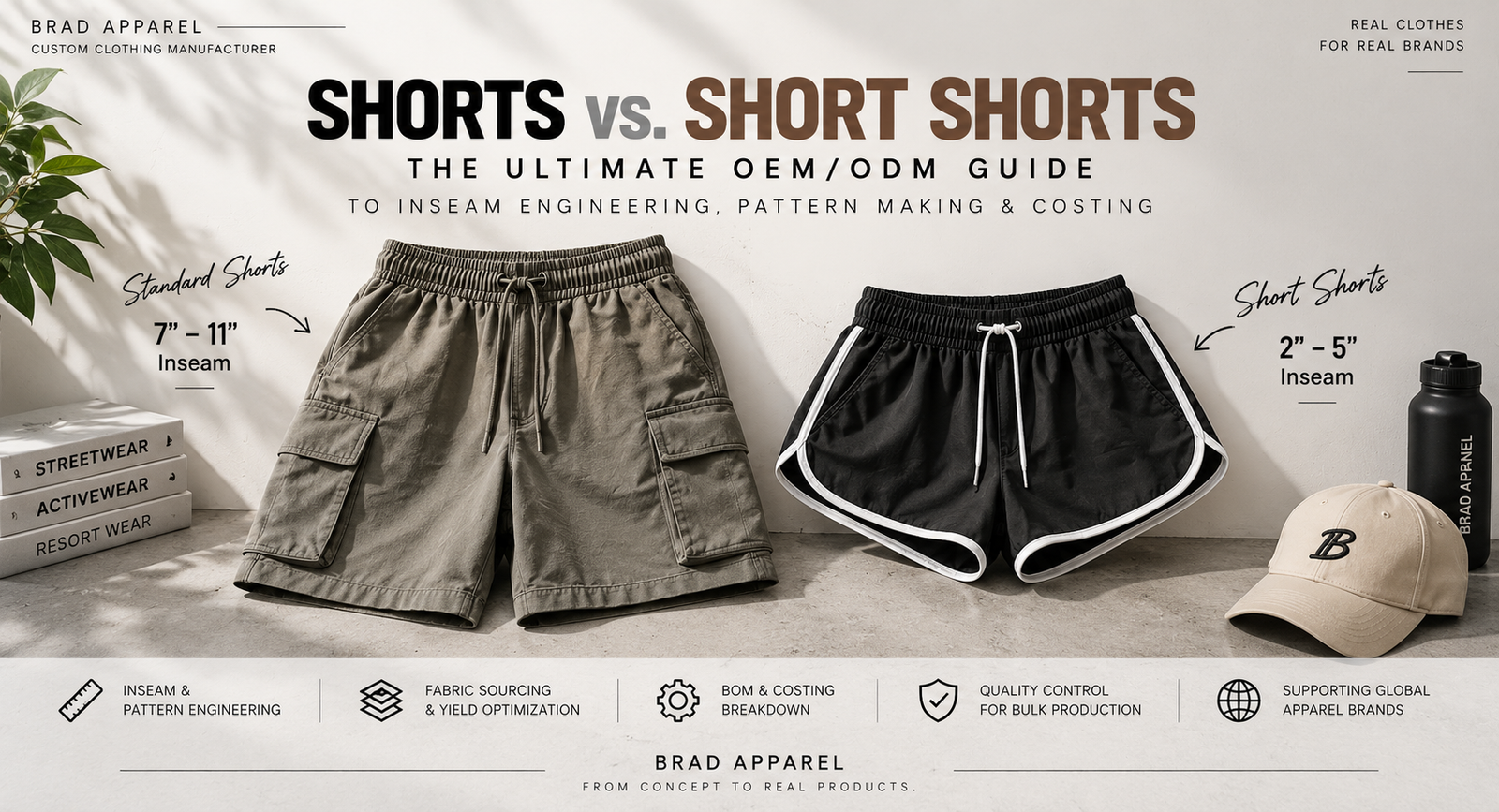
At first glance, the difference between standard shorts and short shorts looks simple:
One is longer. One is shorter.
From a manufacturing perspective, however, changing the inseam affects much more than the hemline.
It can change:
- Pattern geometry
- Front and back rise
- Crotch shape
- Pocket depth
- Leg opening
- Side vents
- Liner construction
- Fabric consumption
- Unit cost
For brands developing streetwear, activewear or resort collections, a 3-inch running short and an 8-inch streetwear short should not be treated as the same pattern with fabric removed from the bottom.
This guide explains how manufacturers develop both styles and what brands should confirm before moving into sampling and bulk production.
Standard Shorts vs. Short Shorts
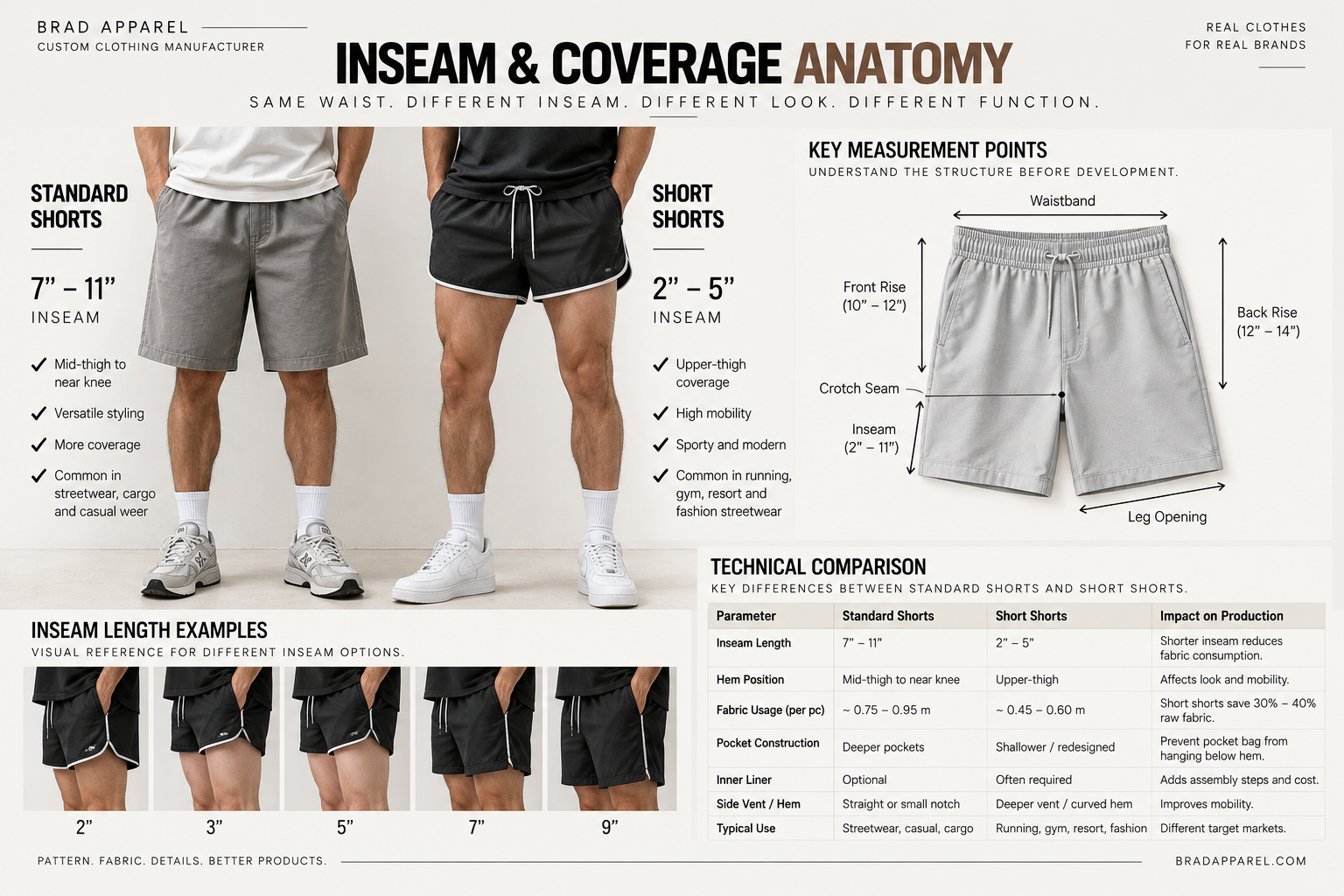
The most obvious difference is inseam length.
Standard Shorts
Typical inseam:
Approximately 7–11 inches
Depending on the style, the hem may finish around:
- Mid-thigh
- Lower thigh
- Near the knee
These proportions are common in:
- Streetwear shorts
- Basketball-inspired shorts
- Cargo shorts
- Sweat shorts
- Casual athletic shorts
Short Shorts
Typical inseam:
Approximately 2–5 inches
The hem usually sits much higher on the thigh.
Common applications include:
- Running shorts
- Gym shorts
- Retro athletic shorts
- Resort shorts
- Fashion-forward streetwear
The shorter length provides more freedom of movement, but it also creates additional pattern challenges.
Quick Manufacturing Comparison
| Specification | Standard Shorts | Short Shorts |
|---|---|---|
| Typical Inseam | 7–11" | 2–5" |
| Hem Position | Mid-thigh to near knee | Upper thigh |
| Pocket Depth | Can support deeper pockets | Usually requires shorter / redesigned pockets |
| Liner | Optional | Common in athletic styles |
| Side Vent | Small or none | Often deeper or curved |
| Fabric Consumption | Higher | Usually lower |
| Main Challenge | Fit and proportion | Coverage, pockets and mobility |
Short Shorts Need a Different Pattern
One of the biggest mistakes during development is taking an existing 7-inch short pattern and simply shortening the hem to 3 inches.
That can create:
- Poor crotch balance
- Excess fabric between the legs
- Ride-up
- Exposed pocket bags
- Poor rear coverage
- Incorrect leg opening
The shorter the inseam becomes, the more important the pattern geometry becomes.
1. Front Rise and Back Rise
Rise determines where the waistband sits and how much coverage the garment provides through the front and back.
For short shorts, the pattern maker may need to rebalance:
- Front rise
- Back rise
- Seat curve
- Crotch depth
The objective is to maintain mobility without making the garment feel excessively loose or exposed.
2. Crotch Curve and Inseam Angle
The inner leg seam is another important area.
If the pattern is shortened without changing the crotch geometry, excess fabric can bunch between the thighs.
A properly developed short-short pattern should account for:
- Inner thigh angle
- Crotch curve
- Leg opening
- Fabric stretch
This becomes especially important for running or training garments.
Pocket Bag Engineering
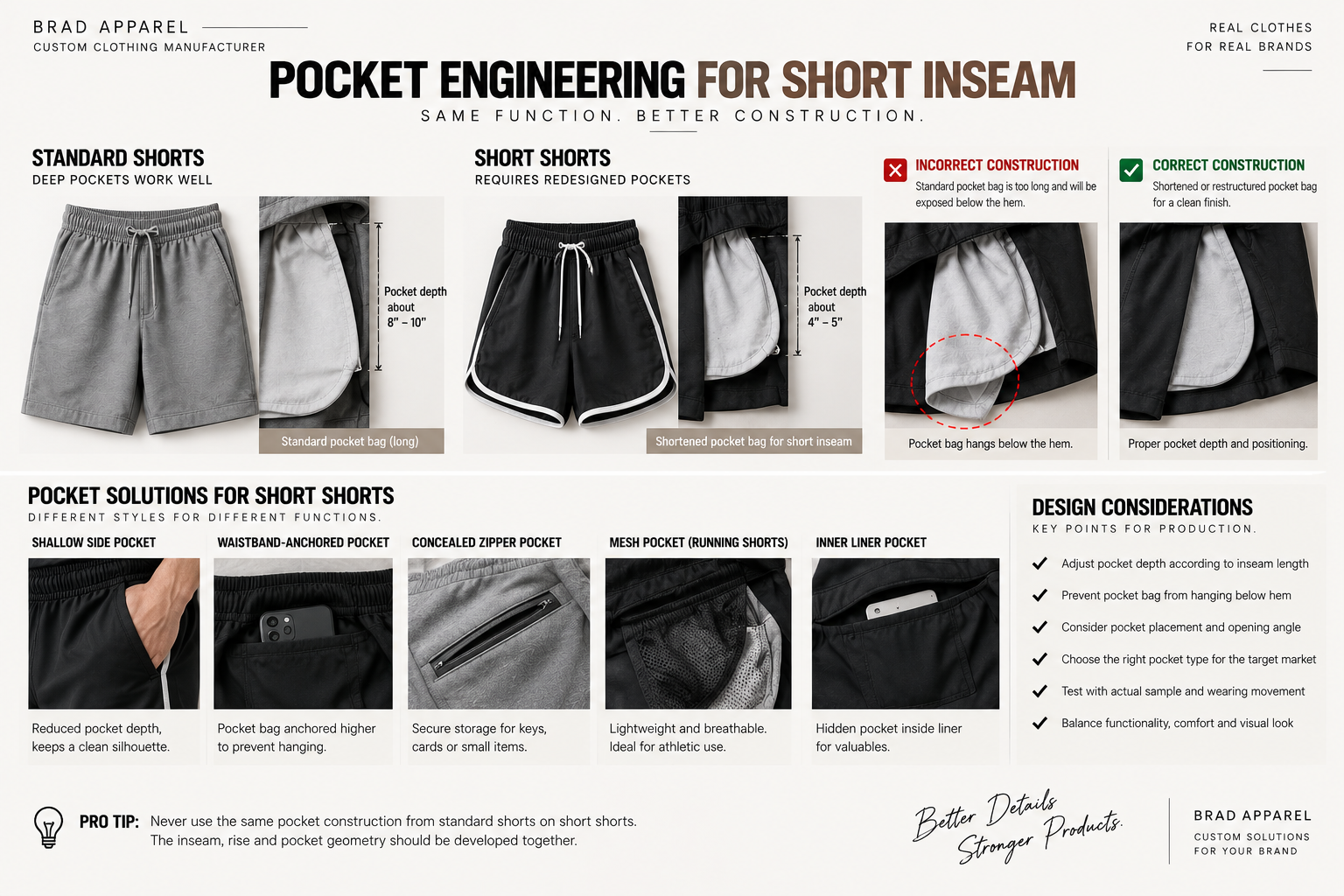
Pocket construction is one of the clearest differences between long and short shorts.
A deep pocket bag that works perfectly in a 9-inch short may hang below the hem of a 3-inch short.
That creates an obvious production defect.
Incorrect Approach
Using the same long pocket bag from a standard short.
Possible result:
Outer short ends before the internal pocket bag.
The pocket lining becomes visible below the hem.
Better Options for Short Shorts
Shallow Side Pocket
Reduce pocket depth while maintaining usable hand access.
Waistband-Anchored Pocket
Anchor the pocket bag toward the waistband to control movement.
Concealed Zipper Pocket
A compact zipper pocket can be integrated into:
- Side seam
- Rear waistband
- Back panel
Internal Storage Pocket
Common in running shorts for:
- Keys
- Cards
- Small valuables
The correct pocket depends on the intended use of the garment.
Athletic Short Shorts Often Need a Liner
A very short outer shell may not provide enough coverage or support during movement.
This is why many running and gym shorts include an internal layer.
Brief Liner
Usually made from lightweight breathable mesh.
Common benefits include:
- Support
- Coverage
- Reduced garment movement
- Better comfort during running
2-in-1 Compression Liner
A longer stretch layer is placed under the outer short.
Common fabric:
Polyester / spandex stretch knit
Benefits include:
- Reduced chafing
- More coverage
- Compression feel
- Additional storage options
The liner should be developed together with the outer shell rather than added as an afterthought.
Side Vents and Dolphin Hems
Very short shorts need enough room for the leg to move freely.
Common solutions include:
- Side vents
- Curved hems
- Dolphin hems
- Overlapping side panels
These designs increase mobility without simply making the entire leg opening excessively wide.
Does a Shorter Inseam Reduce Production Cost?
Usually, shorter shorts consume less outer-shell fabric.
But that does not automatically mean the total garment becomes dramatically cheaper.
You also need to consider:
- Pocket redesign
- Liner
- Side vents
- Binding
- Reinforced seams
- Decoration
- Waistband construction
A technically complex short short can still require significant labor.
Example BOM: 7-Inch vs 3.5-Inch Shorts
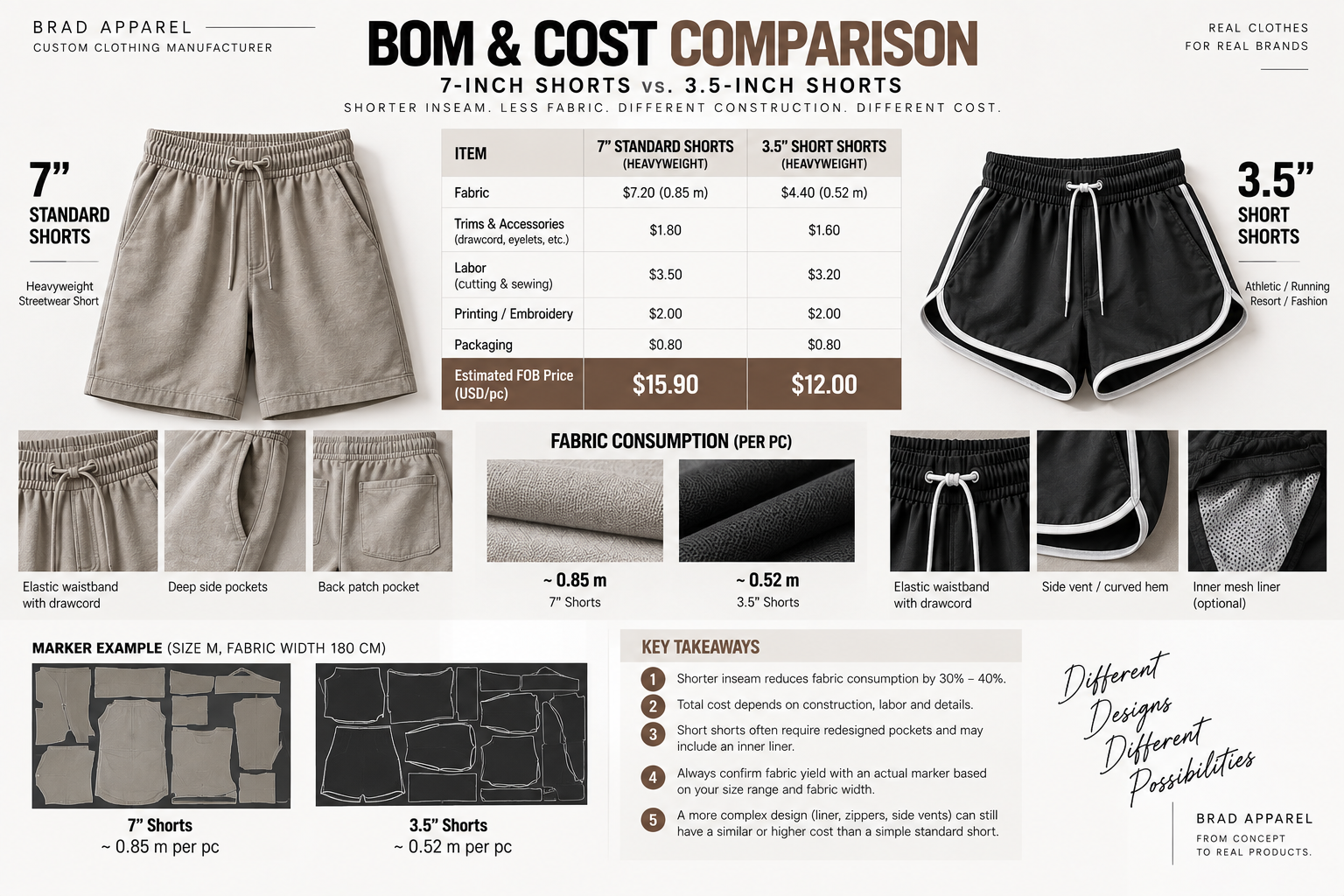
The following is an illustrative manufacturing example based on the sourcing scenario in this guide.
Option A — 7-Inch Heavyweight Sweat Short
Fabric:
400 GSM heavyweight French terry
Construction:
- Deep side pockets
- Rear patch pocket
- Heavy waistband
- Drawcord
- Reinforced stitching
Decoration:
- Puff print or embroidery
The source example uses approximately:
0.85 m fabric per piece
Option B — 3.5-Inch Heavyweight Short Short
Same general fabric:
400 GSM heavyweight French terry
but with:
- Shorter outer shell
- Shallower pockets
- Side vents
- Reinforced crotch construction
The source example uses approximately:
0.52 m fabric per piece
In that particular example, reducing the inseam significantly reduces outer-shell fabric consumption. Actual yield will vary according to fabric width, size range, pattern and marker efficiency.
Fabric Yield Matters
Factories do not calculate fabric use only by garment length.
The actual yield depends on how efficiently all pattern pieces can be placed on the fabric marker.
Important factors include:
- Fabric width
- Size ratio
- Pocket pieces
- Waistband
- Gussets
- Side panels
- Pattern orientation
- Nap direction
- Print direction
This is why fabric consumption should be confirmed from the actual production marker rather than estimated only from inseam length.
Fabric Guide for Shorts

Different shorts categories need completely different fabrics.
Heavyweight Streetwear Shorts
Typical fabric:
360–450 GSM French terry or fleece
Best for:
- Boxy sweat shorts
- Oversized streetwear
- Matching sweat sets
- Premium casualwear
Possible finishes include:
- Pigment wash
- Acid wash
- Enzyme wash
- Vintage treatments
Heavy fabrics create more structure.
Activewear and Running Shorts
Typical fabric:
140–180 GSM nylon/spandex or polyester stretch fabric
Useful features include:
- 4-way stretch
- Lightweight feel
- Quick drying
- Breathability
- Water-repellent finishing
This category prioritizes movement rather than heavy structure.
Resort and Summer Shorts
Common options include:
- Cotton-linen
- Tencel / lyocell
- Lightweight woven cotton
- Terry cloth
These fabrics work well when the goal is:
- Breathability
- Soft drape
- Summer comfort
- Relaxed styling
Streetwear Short Shorts
Short shorts are not only an athletic product.
They can also work in streetwear when the fabric and fit are changed.
For example:
400 GSM heavyweight French terry
can be combined with:
- 3–5" inseam
- Wide leg opening
- Heavy waistband
- Oversized T-shirt
- Puff print
- Embroidery
This creates a very different product from a lightweight running short even though the inseam may be similar.
Waistband Construction
The waistband has a major influence on comfort and fit.
Common options include:
Elastic Waistband
Simple and comfortable.
Ribbed Waistband
Useful for heavier sweat shorts.
Elastic + Drawcord
One of the most common streetwear constructions.
Technical Waistband
May include:
- Hidden elastic
- Internal drawcord
- Bonded construction
- Zipper storage
The waistband should be matched to the weight of the main fabric.
Critical Quality-Control Checks
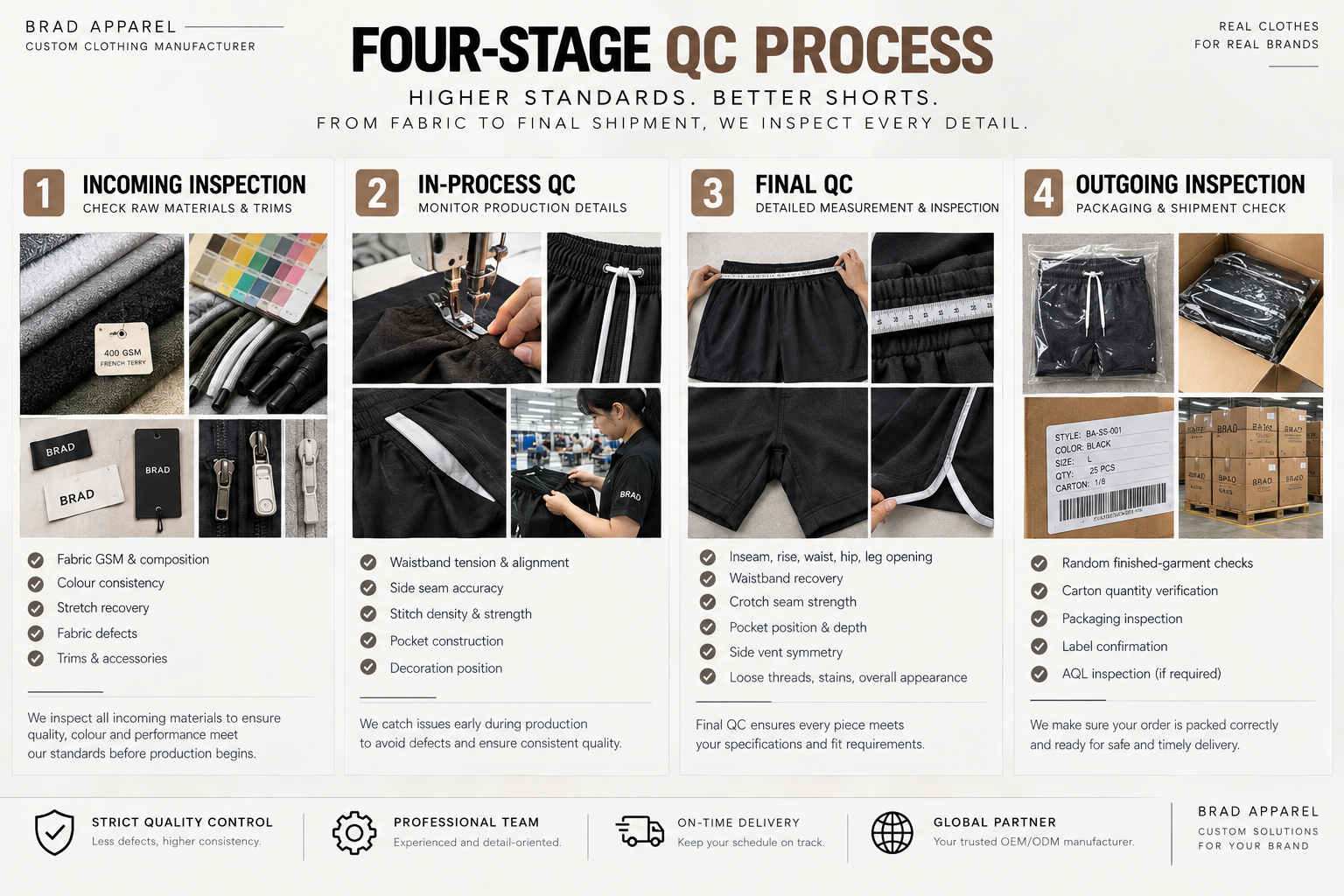
Shorts require several specific QC checks because small measurement differences can noticeably change the fit.
1. Inseam Measurement
Short inseams are especially sensitive to measurement error.
Check:
- Left inseam
- Right inseam
- Front length
- Back length
Small differences become visually obvious on short styles.
2. Waistband Recovery
Elastic should return close to its original measurement after stretching.
Poor recovery can cause:
- Loose waist
- Sagging
- Uneven fit
3. Crotch Seam Strength
This area receives significant stress during:
- Walking
- Squatting
- Running
- Training
Reinforcement and stitch quality are especially important for active shorts.
4. Pocket Position
Confirm:
- Pocket opening
- Pocket depth
- Symmetry
- Lining visibility
For short shorts, make sure the pocket bag never extends below the outer hem.
5. Side Vent Symmetry
Curved hems and deep side vents need accurate left/right matching.
Differences become easy to see when the garment is worn.
A Four-Stage Shorts QC Workflow
Stage 1 — Incoming Inspection
Check:
- Fabric GSM
- Colour
- Stretch recovery
- Fabric defects
- Trims
Stage 2 — In-Process QC
Check:
- Waistband tension
- Side seam alignment
- Stitch density
- Pocket construction
- Decoration position
Stage 3 — Final QC
Check:
- Inseam
- Rise
- Waist
- Hip
- Leg opening
- Loose threads
- Stains
Stage 4 — Outgoing Inspection
Before shipment:
- Random finished-garment checks
- Carton quantity verification
- Packaging inspection
- Label confirmation
Formal AQL inspection can also be arranged when required by the buyer.
How Brad Apparel Develops Custom Shorts
At Brad Apparel, our Custom Bottom Production service supports different shorts categories, including:
- Heavyweight sweat shorts
- Streetwear short shorts
- Running shorts
- Gym shorts
- Cargo shorts
- Mesh shorts
- Matching sets
Pattern Development
Through Pattern Development, brands can customize:
- Inseam
- Rise
- Leg opening
- Pocket depth
- Waistband
- Side vent
- Liner
- Overall fit
Shortening the inseam should always be evaluated together with the rest of the pattern.
Fabric Sourcing
Our Fabric & Accessory Sourcing can support:
- Heavy French terry
- Fleece
- Nylon
- Polyester
- Spandex blends
- Mesh
- Tencel
- Linen blends
- Custom colours
Decoration
Possible options include:
- Screen printing
- Puff printing
- Embroidery
- Silicone printing
- Heat transfer
- DTF
The decoration method should match both the fabric and intended use.
FAQ
What Is the Most Common Inseam for Standard Shorts?
A typical standard short may use approximately:
7–11 inches
depending on the style.
What Inseam Is Considered Short Shorts?
Approximately:
2–5 inches
is a useful general range for short-short silhouettes.
Can I Turn a 7-Inch Short Into a 3-Inch Short by Cutting the Pattern Shorter?
Not ideally.
The pattern may also require changes to:
- Crotch curve
- Rise
- Leg opening
- Pocket bag
- Side vents
Why Do Pocket Bags Hang Out of Some Short Shorts?
The pocket was often developed for a longer outer shell.
Short inseams require shallower or differently positioned pocket construction.
Do Running Shorts Need a Liner?
Not always, but liners are common because they improve:
- Support
- Coverage
- Comfort
- Anti-chafing performance
Are Short Shorts Cheaper to Manufacture?
They generally use less outer-shell fabric.
However, liners, vents, technical pockets and additional construction can offset some of the material savings.
Which Fabric Is Best for Streetwear Short Shorts?
Heavyweight French terry in approximately 360–450 GSM can work well when you want a structured, premium streetwear silhouette.
Which Fabric Is Best for Running Shorts?
Lightweight stretch nylon or polyester blends are usually more appropriate because they prioritize:
- Mobility
- Breathability
- Low weight
- Quick drying
Final Thoughts
The difference between standard shorts and short shorts is much more technical than simply changing the hem length.
As inseam becomes shorter, brands need to pay more attention to:
- Rise
- Crotch geometry
- Leg opening
- Pocket depth
- Side vents
- Liner construction
- Fabric behavior
A 9-inch heavyweight sweat short and a 3-inch technical running short may both belong to the same broad category, but from a manufacturing perspective they are completely different products.
The best development process starts by defining the intended use first.
Then build the fabric, pattern and construction around that use case.
Keep Reading