Creased jeans are denim trousers designed with a visible vertical crease running down the front—and sometimes the back—of each leg.
The effect brings together two traditionally different categories:
denim + tailored trousers
Instead of relying only on fading, distressing or oversized proportions, creased denim uses line, pressing and construction to create a cleaner silhouette.
Modern versions can be:
- Straight leg
- Relaxed straight
- Bootcut
- Flared
- Wide leg
- High rise
- Mid rise
- Dark indigo
- Light wash
- Raw denim
- Trouser-inspired
For clothing brands, however, creating good creased jeans involves more than ironing a line down an ordinary pair of jeans.
The final result depends on the relationship between:
pattern balance + crease position + denim weight + leg shape + wash + pressing + crease-setting method
If the crease is positioned incorrectly, the leg can appear twisted.
If the denim is too soft, the line may disappear quickly.
If the crease is set before an aggressive wash, the finishing process may weaken or distort it.
This guide explains how creased jeans are developed, how pressed creases differ from sewn pintucks, and what brands should specify before sampling and bulk production.
What Are Creased Jeans?
Creased jeans are jeans with an intentional vertical line running along the leg.
The crease usually begins near:
- Waist
- Front hip
- Upper thigh
and continues toward:
- Knee
- Hem
Depending on the design, the crease may be:
- Lightly pressed
- Sharply pressed
- Heat set
- Resin set
- Sewn as a pintuck
- Reinforced through construction
The crease changes how denim looks.
A conventional jean often emphasizes:
- Wash
- Seams
- Five-pocket construction
- Casual texture
A creased jean introduces a more trouser-like vertical line.
This can make denim appear:
- Cleaner
- Longer
- More tailored
- More formal
- More structured
without turning it into a conventional dress trouser.
Why Are Creased Jeans Trending in Men's Fashion?
Men's denim has spent several years moving toward:
- Wider legs
- Baggy fits
- Longer lengths
- Heavily relaxed silhouettes
In 2026, another direction is becoming visible alongside those styles:
cleaner straight denim with more tailoring influence.
Current menswear is using:
- Straight legs
- Higher rises
- Pressed creases
- Cleaner dark denim
- Trouser-inspired waistbands
- Subtle flares
- More controlled proportions
A center crease adds visual structure without requiring an entirely new jeans silhouette.
That makes it especially useful for brands developing:
- Premium casualwear
- Modern menswear
- Smart streetwear
- Minimal collections
- Tailored denim
- Contemporary heritage clothing
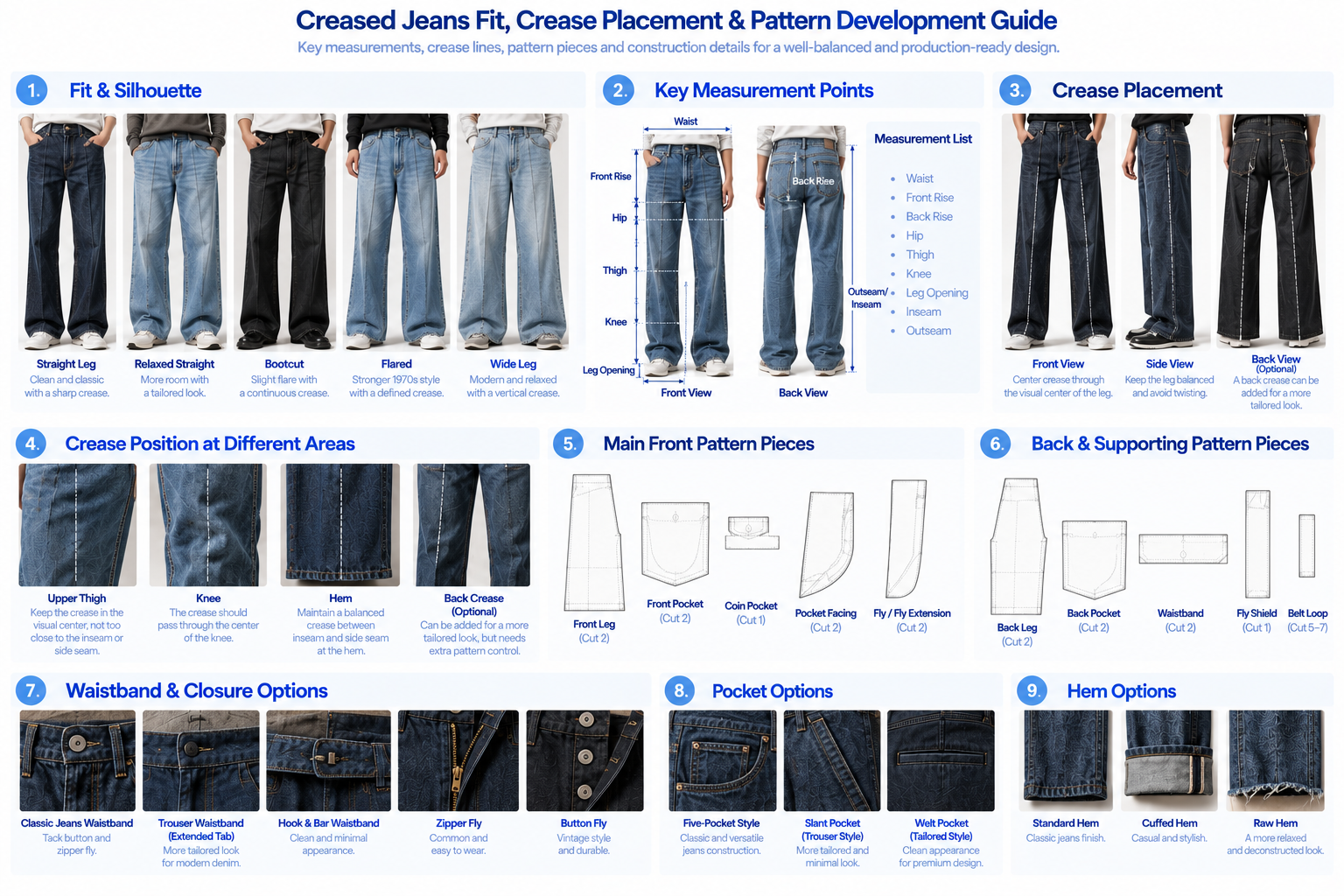
Creased Jeans Are Not One Specific Fit
The term "creased" describes a finishing or construction detail.
It does not define the entire jean silhouette.
A creased jean can be:
Straight
Clean and commercial.
Relaxed Straight
More room through the hip and thigh while maintaining a controlled vertical leg.
Bootcut
The crease continues through the knee before the leg opens slightly toward the hem.
Flared
Creates a stronger 1970s-inspired tailored-denim direction.
Wide Leg
Uses the vertical crease to visually organize a larger amount of leg volume.
This distinction is important for manufacturing.
A factory still needs actual specifications for:
- Rise
- Hip
- Thigh
- Knee
- Leg opening
- Inseam
in addition to the crease itself.
Creased Jeans vs Standard Jeans
Standard jeans may naturally form temporary folds through wear.
That is different from an intentional center crease.
Standard Jeans
Usually rely on:
- Side seam
- Inseam
- Wash
- Leg shape
to define the silhouette.
Creased Jeans
Add a controlled vertical line.
The crease should remain:
- Straight
- Balanced
- Consistent
- Correctly positioned
relative to the actual leg pattern.
Creased Jeans vs Pintuck Jeans
These two products can look similar from a distance.
But the construction is different.
Pressed Crease
Created primarily through pressing.
The fabric is folded temporarily or permanently along a defined line.
Pintuck
A narrow fold is sewn.
The stitch physically holds the fold in place.
This means a pintuck is much more permanent.
The line also has:
- Visible stitching
- Slight raised structure
- More physical definition
A pressed crease can look cleaner and more trouser-like.
A pintuck usually looks more obviously constructed.
Creased Jeans vs Pleated Jeans
Pleats normally begin around:
- Waist
- Front rise
- Upper hip
and create additional volume.
A center crease runs vertically down the leg.
A jean can contain both:
front pleat + center crease
but they perform different functions.
Pleat:
controls volume
Crease:
controls visual line
Creased Jeans vs Tailored Denim
Tailored denim is a broader category.
It can include:
- Creases
- Pleats
- Trouser waistbands
- Welt pockets
- Hook-and-bar closures
- Pressed legs
- Cleaner fits
Creased jeans are one specific direction within tailored denim.

Where Should the Crease Sit?
This is the most important technical question.
The front crease should normally follow the visual center of the leg.
But that does not always mean:
50% of the flat front pattern width
because trouser patterns contain shaping.
The correct position depends on:
- Front rise
- Hip shape
- Thigh
- Knee
- Leg opening
- Side seam
- Inseam
The crease needs to look centered when the jeans are worn.
Crease Placement at the Thigh
At upper thigh level, the crease should normally sit in a visually balanced position.
If it is too far toward the inseam:
- The leg can look rotated inward
If it is too far toward the side seam:
- The leg can appear rotated outward
The crease should be checked on the fit model rather than only on a flat garment.
Crease Placement at the Knee
The crease should normally pass through the intended visual center of the knee area.
This is particularly important because the leg begins changing direction around:
- Thigh
- Knee
- Calf
A crease that is centered at the upper thigh but moves sideways below the knee may indicate a pattern-balance problem.
Crease Placement at the Hem
At the hem, the crease should remain visually balanced between:
- Inseam
- Side seam
for most conventional straight-leg designs.
For flared or twisted constructions, this relationship may intentionally change.
But that should be specified.
Front Crease vs Front and Back Crease
Most fashion creased jeans emphasize the front crease.
Some trouser-inspired designs may use:
front + back crease
This creates a more tailored appearance.
However, the rear crease requires additional control because it runs through:
- Seat
- Back thigh
- Knee
- Calf
A sharp rear crease may also be affected more strongly by sitting.
Temporary Pressed Crease
The simplest method uses pressing only.
The jeans are folded along the desired crease line and pressed using:
- Heat
- Steam
- Pressure
Advantages include:
- Clean appearance
- Low construction complexity
- Easy sampling
But the crease may gradually soften through:
- Wear
- Washing
- Storage
This is appropriate if the brand wants a naturally temporary tailored appearance.
Permanent or Semi-Permanent Crease
A brand may want the line to survive repeated wear and care.
Possible approaches can include:
- Resin treatment
- Crease-setting chemistry
- Heat setting
- Specialized finishing
The exact method depends on:
- Fiber composition
- Denim finish
- Wash process
- Factory capability
The final durability should be tested rather than assumed.
Resin-Set Creases
Resin treatment can help stabilize a crease in cotton-rich denim.
A simplified process may involve:
- Position garment
- Create crease
- Apply or activate resin system
- Press
- Cure with controlled heat
- Test finished garment
The exact chemistry and temperature depend on the finishing system.
For brands, the important issue is the result rather than one universal recipe.
A crease should remain:
- Straight
- Clean
- Stable
without creating unacceptable:
- Stiffness
- Shine
- Discoloration
- Fabric damage
Resin Can Change Hand Feel
A garment that feels soft before crease setting may become:
- Firmer
- Drier
- Stiffer
after treatment.
This is especially noticeable if too much resin is used.
The finish should therefore be approved on the actual production denim.
Sewn Crease / Pintuck
A stitched crease provides the highest visual permanence.
The fold is sewn vertically.
Possible directions include:
- Edge stitch directly on fold
- Narrow pintuck
- Double needle
- Decorative contrast stitch
This method eliminates much of the uncertainty around crease retention.
But it creates a different visual product.
The line becomes a construction feature rather than simply a pressed trouser crease.
Pressed Crease vs Sewn Pintuck
| Feature | Pressed Crease | Sewn Pintuck |
|---|---|---|
| Appearance | Cleaner / trouser-like | More constructed |
| Visible Stitch | No | Yes |
| Permanence | Depends on finish | High |
| Flexibility | Softer | More structured |
| Production | Pressing / finishing | Sewing + pressing |
| Wash Retention | Variable | Strong |
The brand should decide which appearance it actually wants before costing.
When Should the Crease Be Added?
The sequence matters.
Possible stages include:
- Before washing
- After washing
- During finishing
- After final pressing
The correct timing depends on the desired effect.
Crease Before Washing
Creating the crease before washing can allow the washing process to create subtle wear along the fold.
This can produce:
- Natural highlight
- Vintage character
- Crease fading
But aggressive washing may also:
- Move the crease
- Flatten it
- Create irregular abrasion
This method needs testing.
Crease After Washing
Pressing after the final wash provides more control over the final crease location.
Advantages include:
- Final measurements already established
- Denim shrinkage already occurred
- Cleaner crease
- Easier alignment
This is useful for polished tailored denim.
Resin Crease After Washing
For a permanent clean crease, the production sequence may be closer to:
sewing → washing → drying → measurement stabilization → crease setting → curing → final inspection
This prevents the main wash from immediately disrupting the newly created crease.
The exact factory process should still be validated through sample testing.
Denim Weight Matters
A crease behaves differently across different denim weights.
Lightweight Denim
Can provide:
- Soft drape
- Easy crease formation
- Comfortable movement
But the line may soften faster.
Midweight Denim
Often provides the best balance between:
- Structure
- Comfort
- Crease definition
Heavy Denim
Can create:
- Strong crease
- Sharp vertical structure
- Premium rigid appearance
But heavy denim requires:
- More pressing force
- More heat management
- Longer setting time
and may become bulky.
Rigid Denim
100% cotton rigid denim works particularly well for sharp creases.
It naturally provides:
- Structure
- Stable leg shape
- Crisp fold
But movement and washing will still soften the fabric over time.
The crease-setting method needs to suit the intended lifecycle.
Stretch Denim
Stretch denim can also be creased.
However, heat and chemicals can affect:
- Elastane
- Recovery
- Stretch
- Surface
A crease process designed for rigid cotton denim should not automatically be used on stretch denim.
Testing is essential.
Dark Indigo Creased Jeans
Dark indigo is one of the strongest directions for this product.
The combination of:
deep clean denim + sharp crease
creates a particularly tailored appearance.
Possible finishes include:
- Raw
- Rinse wash
- Clean dark wash
- Minimal fading
Heavy whiskering or distressing may compete with the crease.
Light-Wash Creased Denim
A light wash creates more contrast between:
- Casual denim surface
- Formal pressed line
This can create a deliberate high-low mix.
The crease itself may become more visible if subtle abrasion forms along the fold.
Black Creased Jeans
Black works well for:
- Minimal menswear
- Nightwear-inspired styling
- Premium casualwear
Possible finishes include:
- Clean black
- Washed black
- Charcoal
- Pigment black
A sharp crease can help washed black denim look more refined.
Selvedge Creased Jeans
Selvedge denim can also be developed with a crease.
However, brands need to consider whether the garment should emphasize:
- Selvedge side seam
- Traditional denim construction
or:
- Tailored trouser appearance
The two design languages can work together, but the balance should be intentional.
Straight-Leg Creased Jeans
This is probably the easiest modern version to develop.
Typical characteristics:
- Mid or high rise
- Clean hip
- Moderate thigh
- Straight knee
- Controlled hem
The crease reinforces the vertical shape.
Relaxed Straight Creased Jeans
A relaxed straight fit provides:
- More thigh room
- More modern comfort
- Slightly larger hem
The crease prevents the extra fabric from appearing sloppy.
This is especially useful in men's contemporary denim.
Bootcut Creased Jeans
Bootcut jeans have:
- Controlled thigh
- Narrower knee
- Slightly wider hem
The crease line needs to remain clean through this change in width.
If the crease begins drifting around the knee, the flare may look twisted.
Flared Creased Jeans
A stronger flare creates more 1970s influence.
The front crease becomes a major visual line from:
waist → thigh → knee → wide hem.
Because the hem is larger, crease positioning becomes even more visually important.
Wide-Leg Creased Jeans
Wide denim can use creases to create:
- Structure
- Verticality
- Cleaner proportions
Without a crease, very wide dark denim can appear more casual.
With a sharp crease, the same measurements may feel closer to tailored trousers.
Crease Placement & Pattern Development
The jean pattern should be developed before the permanent crease is approved.
Important measurements include:
- Waist
- Front rise
- Back rise
- Hip
- Thigh
- Knee
- Leg opening
- Inseam
- Outseam
- Crease position
Marking the Crease Line on the Pattern
For consistent production, the pattern can contain a defined crease reference.
This may be shown as:
- Internal line
- Drill reference
- Notch relationship
- Pressing template
The marking method should not damage the finished garment.
The goal is to give the pressing team a consistent reference.
Crease Notches
Small reference notches can help identify the fold line at:
- Waist
- Hem
But visible notches should remain within seam allowances.
Additional internal references may be required for long garments.
Pressing Templates
For bulk production, a template can improve consistency.
A template may help operators position:
- Waist
- Knee
- Hem
before pressing.
This is especially useful when every pair needs the crease in exactly the same visual location.
Pattern Balance Comes Before Pressing
A crease cannot fix an unbalanced trouser pattern.
If the leg naturally twists because of:
- Incorrect grainline
- Inseam balance
- Side-seam balance
- Fabric skew
pressing a straight crease over it may temporarily hide the problem.
After wear or washing, the leg may twist again.
Fix the pattern first.
Fabric Skew
Denim can sometimes develop skew during:
- Weaving
- Finishing
- Washing
This can rotate the leg.
Creased jeans make this problem particularly visible because the vertical line creates an obvious reference.
Bulk fabric and wash behavior should therefore be evaluated carefully.
Five-Pocket Construction
Creased denim can still use classic five-pocket construction:
- Two front curved pockets
- Coin pocket
- Two back patch pockets
This keeps the product clearly within the jeans category.
The crease line should not collide visually with the front pocket shape.
Trouser Pockets
More tailored versions may replace classic jeans pockets with:
- Slant pockets
- Welt pockets
This moves the product further toward:
denim trousers
rather than conventional jeans.
Both directions are valid.
Product naming should match the construction.
Waistband Construction
Possible options include:
Classic Jeans Waistband
- Fixed waistband
- Belt loops
- Tack button
- Zipper fly
Trouser Waistband
May include:
- Extended tab
- Hook and bar
- Cleaner front
- Inner waistband finishing
Clean Minimal Waist
Could use:
- Hidden hook
- Concealed closure
- Reduced visible hardware
The crease should visually connect with the overall level of tailoring.
Front Pleats
Creased jeans can include:
- No pleat
- Single pleat
- Double pleat
Pleats add upper-leg volume.
A crease may continue from:
- Pleat edge
- Pleat center
- Separate crease position
This should be clearly indicated on the technical drawing.
Pleat-to-Crease Alignment
One common tailored construction aligns the front crease with the pleat.
This creates one continuous vertical line.
However, depending on the pattern, the crease may begin slightly differently.
Do not assume the alignment.
Specify it.
Hem Construction
Possible hems include:
- Standard jeans hem
- Chain-stitch hem
- Clean trouser hem
- Cuffed hem
- Raw hem
A raw hem can visually conflict with very formal creasing.
That may still be intentional for a deconstructed style.
Cuffed Creased Jeans
A cuff introduces another decision:
Does the crease continue visibly into the cuff?
Possible directions include:
Crease Continues Through Cuff
Creates strong vertical continuity.
Cuff Interrupts Crease
Creates a more casual turn-up effect.
The sample should show the exact intended appearance.
Crease and Inseam Length
The crease changes how the eye reads the trouser length.
A clean vertical line makes the leg appear longer.
Therefore inseam should be approved together with:
- Shoe break
- Hem width
- Crease sharpness
A very long inseam with heavy stacking may conflict with the tailored character.
No Break
Hem finishes cleanly near the shoe.
Creates:
- Sharp tailored appearance
- Strong crease visibility
Slight Break
Creates:
- More conventional menswear proportion
- Easier commercial fit
Full Break
Adds more fabric at the shoe.
This can soften the clean crease line.
For a tailored denim direction, excessive stacking is usually less appropriate unless deliberately designed.
Wash Shrinkage Can Change Crease Position
A garment may shrink unevenly in:
- Length
- Width
after washing.
If crease setting happens before final wash stabilization, the line can move relative to:
- Knee
- Hem
This is another reason the production sequence matters.
Pattern Shrinkage Allowance
The pattern should account for the actual tested shrinkage of:
- Denim
- Wash
- Finishing process
Do not automatically add a universal percentage.
The correct allowance comes from:
fabric + wash testing
Pressing Temperature
The correct pressing temperature depends on:
- Cotton content
- Stretch fiber
- Surface finish
- Resin
- Coating
Too little heat may fail to set the crease.
Too much heat may create:
- Shine
- Color change
- Fiber damage
- Elastane damage
A production standard should be developed during sampling.
Pressure
Pressure influences crease sharpness.
Too little:
- Weak line
Too much:
- Flattened fabric
- Shine
- Hard crease edge
- Surface damage
The objective is repeatable definition.
Steam
Steam can help shape cotton denim.
But moisture also changes fabric behavior.
The combination of:
- Heat
- Steam
- Pressure
- Time
should be standardized for bulk production.
Pressing Cloth
A pressing cloth may help reduce surface damage on certain:
- Black denim
- Coated denim
- Resin-finished denim
- Dark indigo
The need should be confirmed through testing.
Resin and Color Change
Some finishing systems may slightly affect:
- Shade
- Surface
- Hand feel
particularly after curing.
Color approval should therefore be based on the finished creased garment, not only the fabric before crease treatment.
Press Shine
Dark denim can develop unwanted shiny areas when overheated or over-pressed.
Common risk areas include:
- Crease line
- Pocket area
- Waistband
- Fly
Shine should not be mistaken for an intentional polished finish unless specified.
Crease Width
A crease is usually a fold line rather than a measured "width."
But its visual sharpness can vary.
Sharp Crease
Narrow, defined edge.
Creates:
- Strong tailoring
- Formal appearance
Soft Crease
Wider, less aggressive fold.
Creates:
- Casual tailored appearance
- Softer denim character
The approved sample should establish the standard.
How to Describe Creased Jeans to a Manufacturer
Instead of writing:
I want men's jeans with a crease.
write:
Men's mid-rise relaxed-straight creased jeans in 12 oz dark indigo 100% cotton denim, with a clean rinse wash and permanent center-front crease aligned through the visual center of the thigh, knee and hem. Classic five-pocket construction, zipper fly, tack button and minimal fading.
Then specify:
- Rise
- Hip
- Thigh
- Knee
- Leg opening
- Inseam
- Denim weight
- Composition
- Wash
- Crease type
- Crease placement
- Crease durability requirement
- Pocket construction
- Waistband
- Hardware
- Stitching
- Hem
This provides a much clearer production target.
Example Classic Men's Creased Jeans
Possible specification:
- Mid rise
- Straight leg
- 12 oz denim
- Dark indigo
- Five-pocket construction
- Rinse wash
- Sharp front crease
- Tonal stitching
- Clean hem
This creates a simple modern menswear product.
Example Bootcut Creased Jeans
Possible specification:
- Mid-to-high rise
- Fitted upper thigh
- Controlled knee
- Slight bootcut
- 13 oz indigo denim
- Pressed front crease
- Minimal whiskering
- Chain-stitch hem
The crease should remain centered as the leg opens below the knee.
Example Tailored Denim Trousers
Possible specification:
- High rise
- Relaxed straight leg
- Dark rinse denim
- Single front pleat
- Slant pockets
- Welt back pockets
- Trouser waistband
- Permanent crease
- Blind or clean hem
This moves further away from conventional five-pocket jeans.
Example Black Creased Jeans
Possible specification:
- Mid rise
- Straight fit
- Washed black rigid denim
- Five pockets
- Resin-set front crease
- Matte black hardware
- Tonal stitching
The final pressing process should avoid unwanted shine.
Creased Jeans Tech Pack Example
| Area | Example Specification |
|---|---|
| Product | Men's Creased Jeans |
| Fit | Relaxed Straight |
| Rise | Mid Rise |
| Fabric | Rigid Denim |
| Composition | 100% Cotton |
| Weight | 12 oz |
| Color | Dark Indigo |
| Wash | Clean Rinse |
| Front | Five Pocket |
| Closure | Tack Button + Zipper Fly |
| Crease | Center Front |
| Crease Type | Permanent / Semi-Permanent |
| Crease Position | Approved Sample |
| Stitching | Tonal |
| Hem | Clean / Chain Stitch |
| Branding | Back Patch + Woven Label |
These values are examples only.
Important Creased Jeans Measurements
| Measurement | Why It Matters |
|---|---|
| Waist | Controls waist fit |
| Front Rise | Defines front proportion |
| Back Rise | Controls seat fit |
| Hip | Controls overall ease |
| Thigh | Defines upper-leg silhouette |
| Knee | Critical crease reference |
| Leg Opening | Controls lower-leg silhouette |
| Inseam | Controls finished length |
| Outseam | Confirms overall proportion |
| Crease at Thigh | Controls upper alignment |
| Crease at Knee | Confirms leg balance |
| Crease at Hem | Confirms vertical continuity |
Manufacturing Workflow
A practical production process may follow:
- Fabric approval
- Shrinkage and wash testing
- Pattern development
- Crease-position development
- Cutting
- Pocket and fly construction
- Main garment assembly
- Washing / finishing
- Measurement stabilization
- Crease pressing / setting
- Curing if required
- Final pressing
- Crease alignment check
- Measurement QC
- Final inspection
- Packing
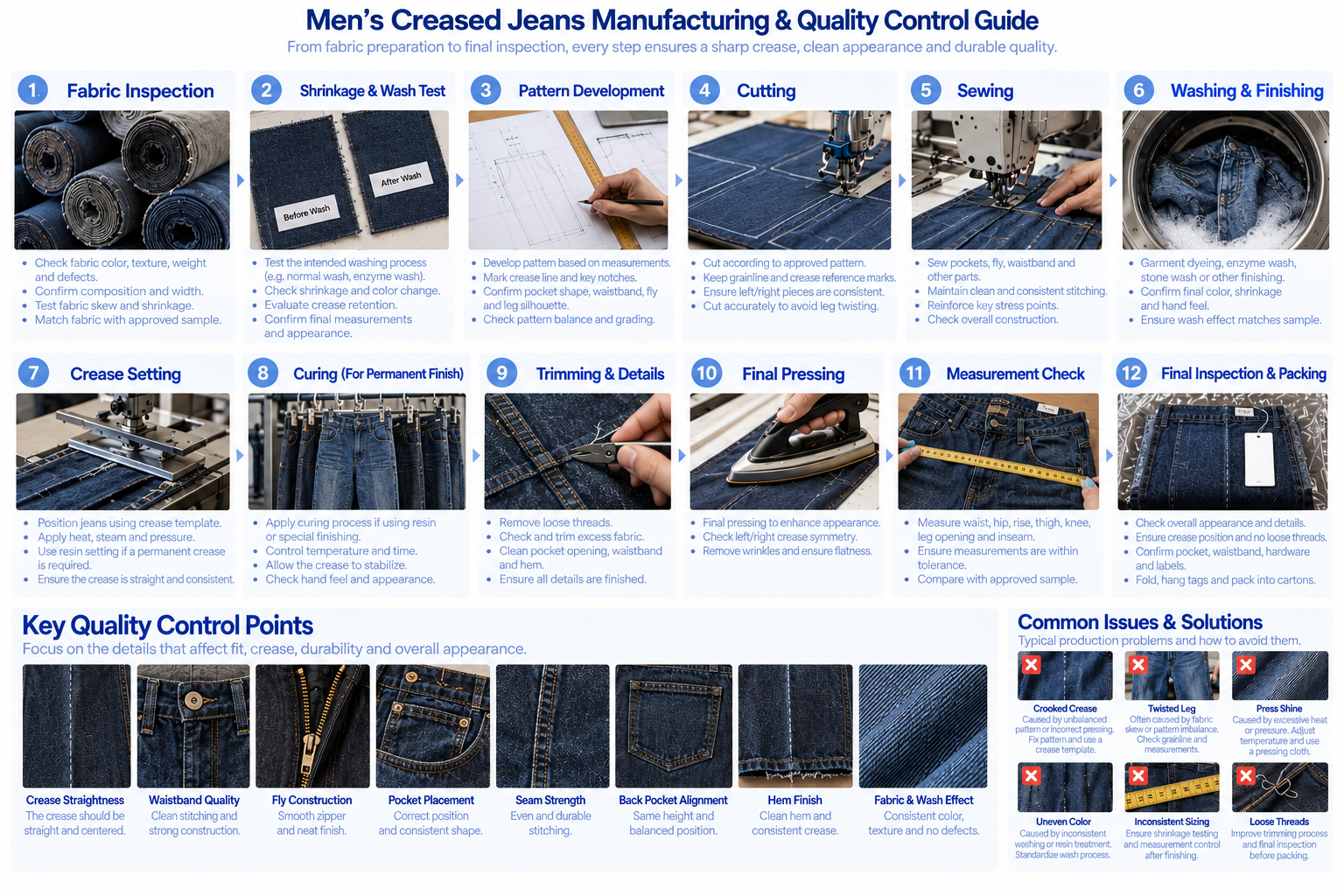
Fabric Inspection
Before cutting, inspect:
- Shade
- Weight
- Width
- Skew
- Surface
- Defects
Denim skew deserves particular attention because it can affect leg balance.
Cutting
Pattern pieces should follow the correct:
- Grain
- Marker
- Direction
If the production fabric has significant skew, resolve the issue before simply forcing a crease into the garment later.
Sewing
Check:
- Side seam
- Inseam
- Fly
- Waistband
for balance.
The leg should already hang correctly before final crease setting.
Washing
Confirm:
- Final shade
- Shrinkage
- Leg twist
- Hand feel
- Surface
The crease-setting stage should work with this finished garment state.
Crease Setting
Use the approved placement reference.
Check:
- Left/right position
- Knee alignment
- Hem alignment
- Sharpness
- Symmetry
Do not press both legs by eye without a consistent production reference.
Left and Right Crease Symmetry
Compare both legs together.
The crease should begin and finish at consistent corresponding positions.
One crease should not sit:
- 2 cm toward inseam
while the other sits:
- 2 cm toward side seam
unless intentionally designed.
Crease Straightness
View the jeans:
- Flat
- Hanging
- Worn
A line that appears straight on the table may curve once the garment is worn if the leg pattern is unbalanced.
Crease Durability Test
If a permanent crease is claimed, test the garment through the agreed care procedure.
Check whether the line:
- Remains visible
- Moves
- Splits
- Becomes wavy
The testing method should match the care label.
Measurement QC
Measure after all:
- Washing
- Pressing
- Crease setting
is complete.
Final measurements should remain within the approved tolerance.
Color QC
Dark indigo and black garments should be compared side by side.
Crease treatment should not create unacceptable:
- Shine
- Color change
- Light line
- Heat mark
Common Creased Jeans Development Mistakes
1. Pressing an Unbalanced Jeans Pattern
The crease cannot permanently correct leg twist.
2. Choosing the Crease Position by Eye
Use defined references.
3. Setting the Crease Before Testing Shrinkage
The final position may move after washing.
4. Using Denim That Is Too Soft
The crease may disappear quickly.
5. Using Excessive Resin
The jeans may become stiff.
6. Using Excessive Heat
Dark denim may become shiny or discolored.
7. Ignoring Stretch Fiber
Heat can affect elastane performance.
8. Crease Does Not Align Through the Knee
The leg may look twisted.
9. Over-Distressing the Denim
Heavy fading can compete with the tailored line.
10. Claiming a Permanent Crease Without Testing
Durability needs to be verified.
Creased Jeans vs Puddle Jeans
These two denim trends solve completely different design problems.
Creased Jeans
Focus on:
- Vertical line
- Tailoring
- Clean shape
- Controlled leg
- Pressing
Puddle Jeans
Focus on:
- Extra inseam
- Pooling
- Stacking
- Shoe interaction
A pair could technically combine both, but visually the concepts compete.
For extra-long denim development, see Brad Apparel's Puddle Jeans Guide.
Creased Jeans vs Conventional Straight Jeans
Choose creased jeans if you want:
- More polished appearance
- Trouser influence
- Strong vertical line
- Tailored denim positioning
Choose conventional straight jeans if you want:
- Simpler production
- Traditional denim appearance
- Natural wear patterns
- Less maintenance of crease detail
For a wider overview of trouser and denim silhouettes, see Brad Apparel's Complete Guide to Pants Types.
Fabric Development Comes Before Crease Approval
The same crease process can behave differently on:
- 100% cotton rigid denim
- Stretch denim
- Lightweight denim
- Heavy denim
- Pigment denim
- Coated denim
Therefore final crease development should happen on the actual intended fabric.
For custom material sourcing, see Brad Apparel's Fabric Sourcing & Development.
FAQ
What Are Creased Jeans?
Creased jeans are denim pants with an intentional vertical pressed or constructed crease running down the leg.
The detail gives denim a more tailored, trouser-inspired appearance.
Are Creased Jeans in Style in 2026?
Yes.
Creased and tailored denim are visible 2026 menswear directions, particularly in straight, bootcut and trouser-inspired silhouettes.
Are Creased Jeans the Same as Pintuck Jeans?
No.
A pressed crease is primarily created through pressing or finishing.
A pintuck is sewn into the fabric and therefore creates a more permanent stitched line.
Are Creased Jeans the Same as Pleated Jeans?
No.
Pleats normally create volume near the waist or upper leg.
A crease is a vertical line running along the leg.
A jean can use both.
Can a Denim Crease Be Permanent?
Yes.
Depending on the denim and finishing method, crease durability may be increased using:
- Resin treatment
- Heat setting
- Specialized finishing
- Sewn pintucks
The final performance should be tested.
Should Creased Jeans Be Pressed Before or After Washing?
For a clean tailored crease, final crease setting is often easier to control after the main wash and shrinkage process.
Other effects may intentionally crease before washing.
The correct sequence depends on the desired finish.
What Denim Weight Works Best for Creased Jeans?
There is no universal weight.
Midweight and structured denim often provide a useful balance between:
- Crease definition
- Comfort
- Shape
The actual fabric should be tested.
Can Stretch Denim Have a Permanent Crease?
Potentially, but the finishing process must be compatible with the stretch fiber.
Excessive heat or aggressive chemistry can affect elastane.
Can Creased Jeans Be Wide Leg?
Yes.
A center crease can help organize the volume of wide-leg denim and create a cleaner vertical appearance.
Can Creased Jeans Be Bootcut?
Yes.
Bootcut creased jeans are especially relevant to the tailored and 1970s-inspired denim direction.
The crease needs to remain aligned through the knee and wider hem.
Are Creased Jeans Formal?
They are still denim.
But the pressed line can make them feel more refined than conventional casual jeans.
Some tailored-denim versions can work in smart-casual collections.
What Is Tailored Denim?
Tailored denim applies trouser-inspired elements to denim garments.
These may include:
- Creases
- Pleats
- Trouser waistbands
- Welt pockets
- Refined silhouettes
Can Creased Jeans Still Use Five-Pocket Construction?
Yes.
A classic five-pocket jean can use a front crease while retaining:
- Curved front pockets
- Coin pocket
- Back patch pockets
- Tack button
Does Resin Make Denim Stiff?
It can.
The effect depends on:
- Resin system
- Application amount
- Denim
- Curing process
Hand feel should be approved on the finished sample.
Why Does the Crease Become Crooked After Washing?
Possible causes include:
- Denim skew
- Leg twist
- Uneven shrinkage
- Incorrect crease position
- Pattern imbalance
The root cause should be identified before re-pressing.
What Should a Creased Jeans Tech Pack Include?
Include:
- Fit
- Rise
- Waist
- Hip
- Thigh
- Knee
- Leg opening
- Inseam
- Denim weight
- Composition
- Wash
- Crease type
- Crease position
- Crease durability requirement
- Pocket construction
- Waistband
- Hardware
- Hem
What Should Be Checked During Bulk QC?
Check:
- Finished measurements
- Leg balance
- Denim shade
- Crease straightness
- Left/right crease symmetry
- Knee alignment
- Hem alignment
- Press shine
- Wash consistency
- Crease durability
Final Thoughts
Creased jeans sit between two familiar menswear categories:
classic denim and tailored trousers.
The denim still provides the casual character.
The crease introduces structure.
A dark straight-leg jean with a sharp front crease can feel clean and refined.
A bootcut version can lean into a 1970s menswear direction.
A relaxed pair can use the crease to keep additional leg volume looking controlled.
And a trouser-style version can combine creases, pleats and welt pockets for an even stronger tailored effect.
For clothing brands, the most important point is that the crease should not be treated as a final cosmetic detail.
It needs to work with:
pattern balance + denim structure + wash + finishing sequence + crease position
from the beginning of development.
Once those elements are approved together, the crease can remain straight, balanced and repeatable from the first sample through bulk production.
Keep Reading