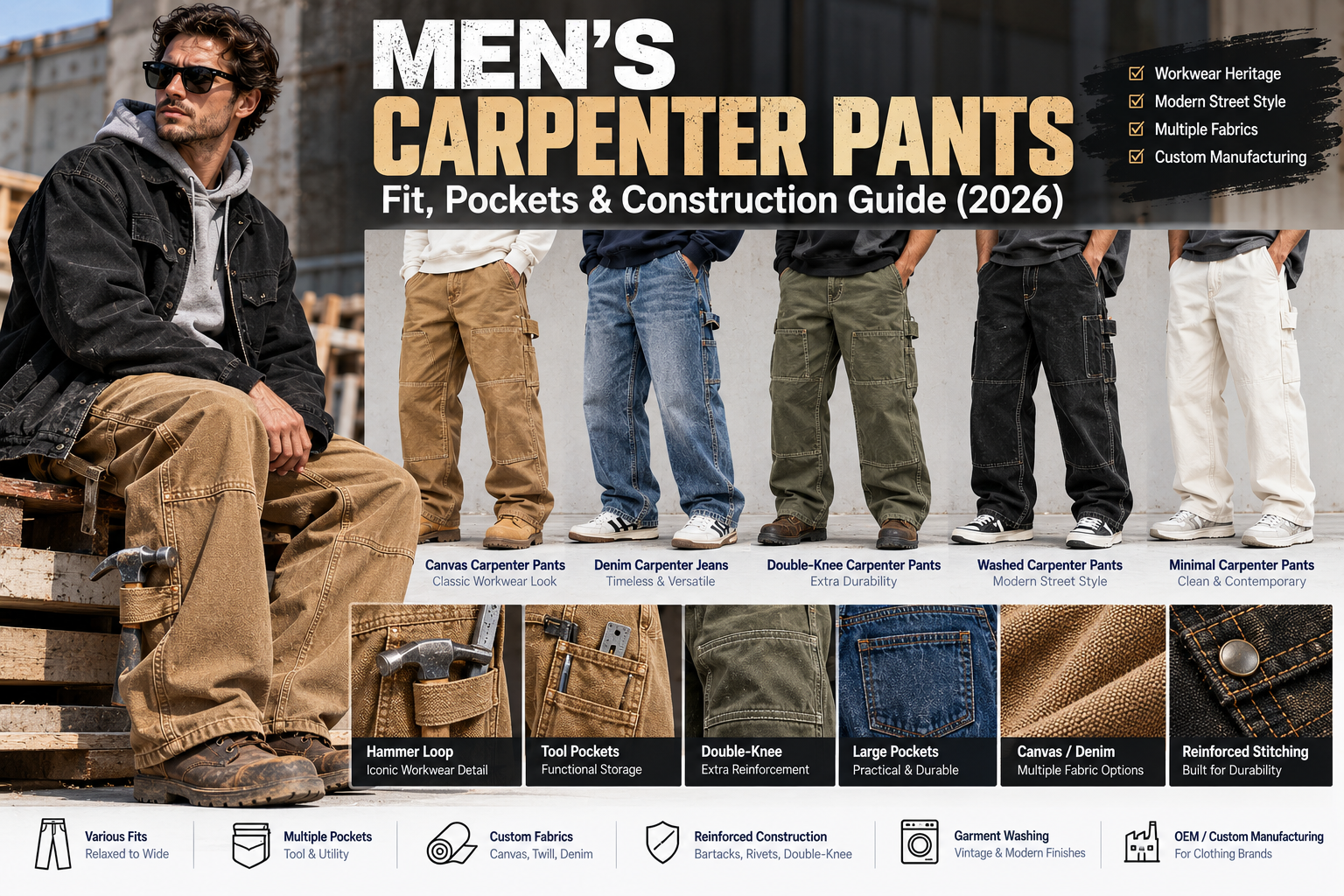
Carpenter pants are workwear-inspired trousers traditionally designed around practical storage, durable fabrics and reinforced construction.
Their most recognizable details often include:
- Hammer loop
- Side tool pockets
- Large front and back pockets
- Relaxed straight leg
- Durable canvas, twill or denim
- Reinforced stress points
- Optional double-knee panels
Originally, these features served a practical purpose.
A carpenter or tradesperson needed space for tools while bending, climbing and working.
Modern carpenter pants have moved far beyond jobsite clothing.
Today they appear across:
- Men's streetwear
- Skatewear
- Heritage workwear
- Contemporary casualwear
- Denim collections
- Oversized fashion
- Utility-inspired collections
But a successful fashion carpenter pant is not simply a basic pair of pants with a hammer loop attached to the side.
The final result depends on the relationship between:
fit + pocket layout + tool loop + fabric + knee construction + reinforcement + stitching + wash
A hammer loop positioned too low can swing awkwardly.
Oversized utility pockets can distort the leg.
A double-knee panel can become excessively stiff if the shell fabric is already heavy.
And a loose carpenter pant can look incorrectly sized rather than intentionally relaxed if the rise, thigh, knee and leg opening are not balanced.
This guide explains how carpenter pants are constructed and what clothing brands should specify before moving from reference garment to sample and bulk production.
What Are Carpenter Pants?
Carpenter pants are utility-inspired trousers originally developed for tradespeople who needed durable clothing with easy access to tools.
Traditional carpenter pants commonly include:
- Hammer loop
- Side utility or tool pockets
- Large front pockets
- Back patch pockets
- Durable woven fabric
- Relaxed seat and thigh
- Straight or loose leg
- Reinforced seams
Some designs also include:
- Double-knee reinforcement
- Rivets
- Bartacks
- Triple-needle stitching
- Utility tabs
- Additional tool compartments
Not every carpenter pant contains every feature.
This is important.
A hammer loop is highly recognizable, but carpenter pants should be understood as a broader workwear construction rather than one fixed pattern.
Modern fashion versions may deliberately simplify the original design.
For example:
relaxed canvas pant + hammer loop + one utility pocket
can still clearly reference carpenter pants without reproducing every traditional workwear detail.
Why Are Carpenter Pants Popular in Men's Fashion in 2026?
Carpenter pants fit naturally into several continuing menswear directions:
- Relaxed straight-leg pants
- Workwear
- Utility clothing
- Skate-inspired styling
- Vintage American clothing
- Heavyweight fabrics
- Washed finishes
- Functional details
- Less formal everyday pants
The silhouette is especially relevant because current men's pants generally allow more room through the thigh and lower leg than the very slim fits that dominated earlier menswear cycles.
Carpenter pants work particularly well with:
- Boxy T-shirts
- Hoodies
- Work shirts
- Western shirts
- Track jackets
- Overshirts
- Denim jackets
- Knitwear
For clothing brands, they also offer more design possibilities than a basic five-pocket pant.
The designer can change:
- Pocket layout
- Hammer loop
- Knee panels
- Fabric
- Hardware
- Stitching
- Wash
- Fit
without losing the workwear identity.
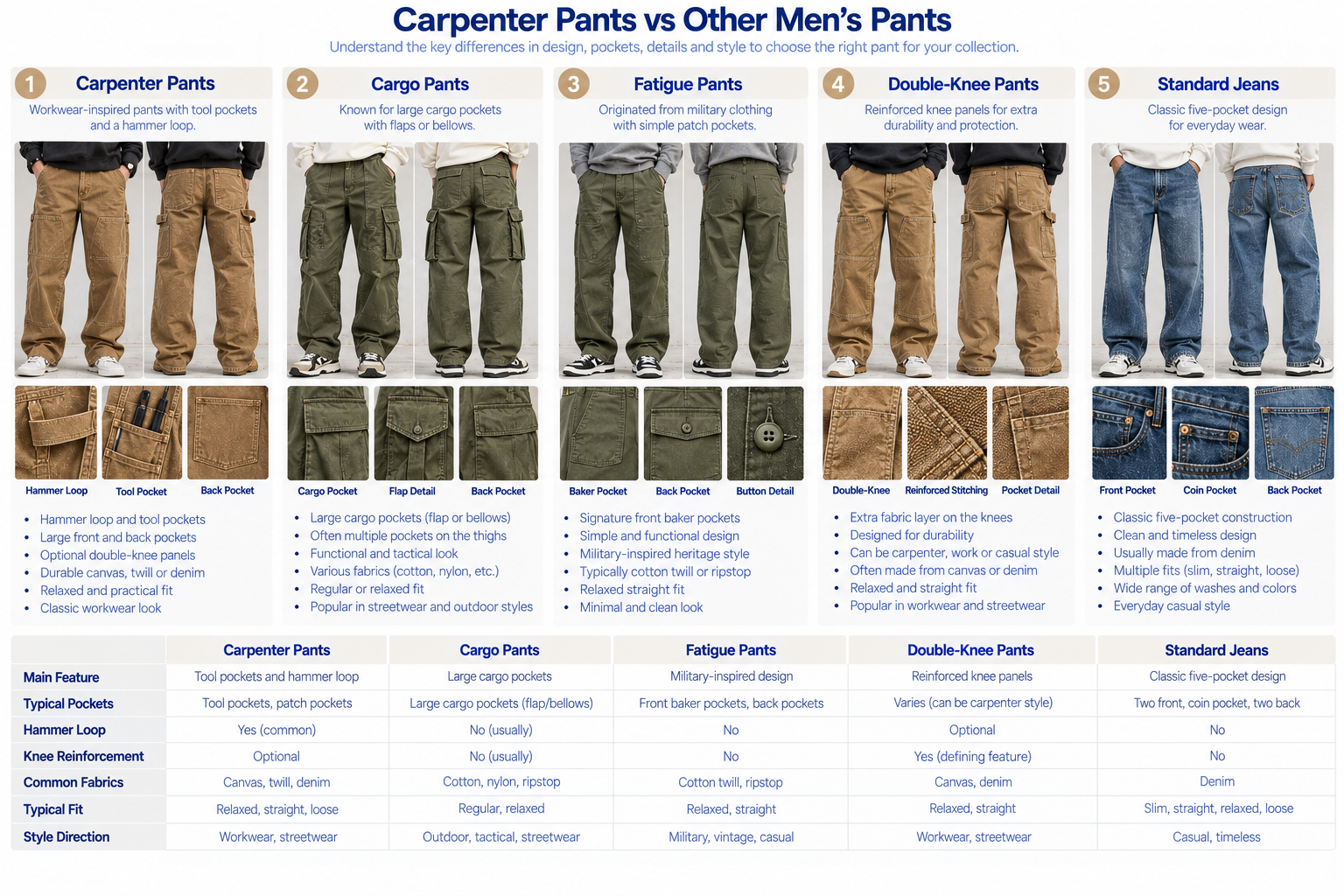
Carpenter Pants vs Other Men's Pants
Several categories overlap with carpenter pants.
But they should not automatically be treated as the same product.
| Style | Main Identifier | Typical Pockets | Knee Reinforcement | Hammer Loop |
|---|---|---|---|---|
| Carpenter Pants | Tool-carrying workwear details | Tool + patch pockets | Optional | Common |
| Cargo Pants | Large thigh cargo pockets | Flap / bellows pockets | Optional | Uncommon |
| Fatigue Pants | Military / OG-107 heritage | Front baker pockets | Usually no | Usually no |
| Double-Knee Pants | Reinforced knee panels | Varies | Defining feature | Optional |
| Five-Pocket Jeans | Denim jean construction | 5-pocket layout | Usually no | Usually no |
The categories can overlap.
For example:
double-knee carpenter pants
are extremely common.
But:
double-knee pants
do not automatically need a hammer loop or carpenter-style tool pockets.
Likewise:
carpenter jeans
are carpenter pants made with denim.
Carpenter Pants vs Cargo Pants
Cargo pants are primarily identified by large utility pockets positioned around the thigh.
These pockets may use:
- Flaps
- Bellows
- Snaps
- Buttons
- Velcro
- Zippers
Carpenter pants normally use a different pocket system.
Typical carpenter details include:
- Narrow tool pockets
- Ruler pockets
- Hammer loop
- Large patch pockets
- Workwear reinforcement
The pocket geometry is therefore different.
Cargo pockets usually create:
volume away from the leg
while carpenter tool pockets often sit:
flatter and closer to the leg
For a deeper explanation of cargo construction, see Brad Apparel's Cargo Pants Guide.
Carpenter Pants vs Fatigue Pants
Fatigue pants come from military clothing.
Traditional fatigue designs are associated with details such as:
- Baker-style front pockets
- Back patch pockets
- Military-inspired fit
- Durable cotton fabric
Carpenter pants come from occupational workwear.
Their design language is more strongly associated with:
- Hammer loop
- Tool storage
- Reinforcement
- Workwear stitching
The two can share:
- Cotton twill
- Relaxed fits
- Patch pockets
- Olive / khaki colors
but their pocket construction and historical design logic are different.
Carpenter Pants vs Double-Knee Pants
This distinction is particularly important.
Carpenter pants describe a pant category.
Double knee describes a reinforcement construction.
A double-knee pant has an additional layer of fabric over the knee area.
That reinforcement may appear on:
- Carpenter pants
- Work pants
- Skate pants
- Utility pants
- Fashion trousers
So:
All carpenter pants are not double-knee pants.
And:
All double-knee pants are not carpenter pants.
A brand should specify both features independently.
Carpenter Pants vs Carpenter Jeans
The terms often overlap.
Carpenter jeans are simply carpenter-style pants made from denim.
Possible fabrics include:
- Indigo denim
- Black denim
- Ecru denim
- Brown denim
- Washed denim
Carpenter pants can also use:
- Duck canvas
- Cotton twill
- Ripstop
- Stretch woven
Therefore:
carpenter jeans = fabric-specific variation
while:
carpenter pants = broader product category
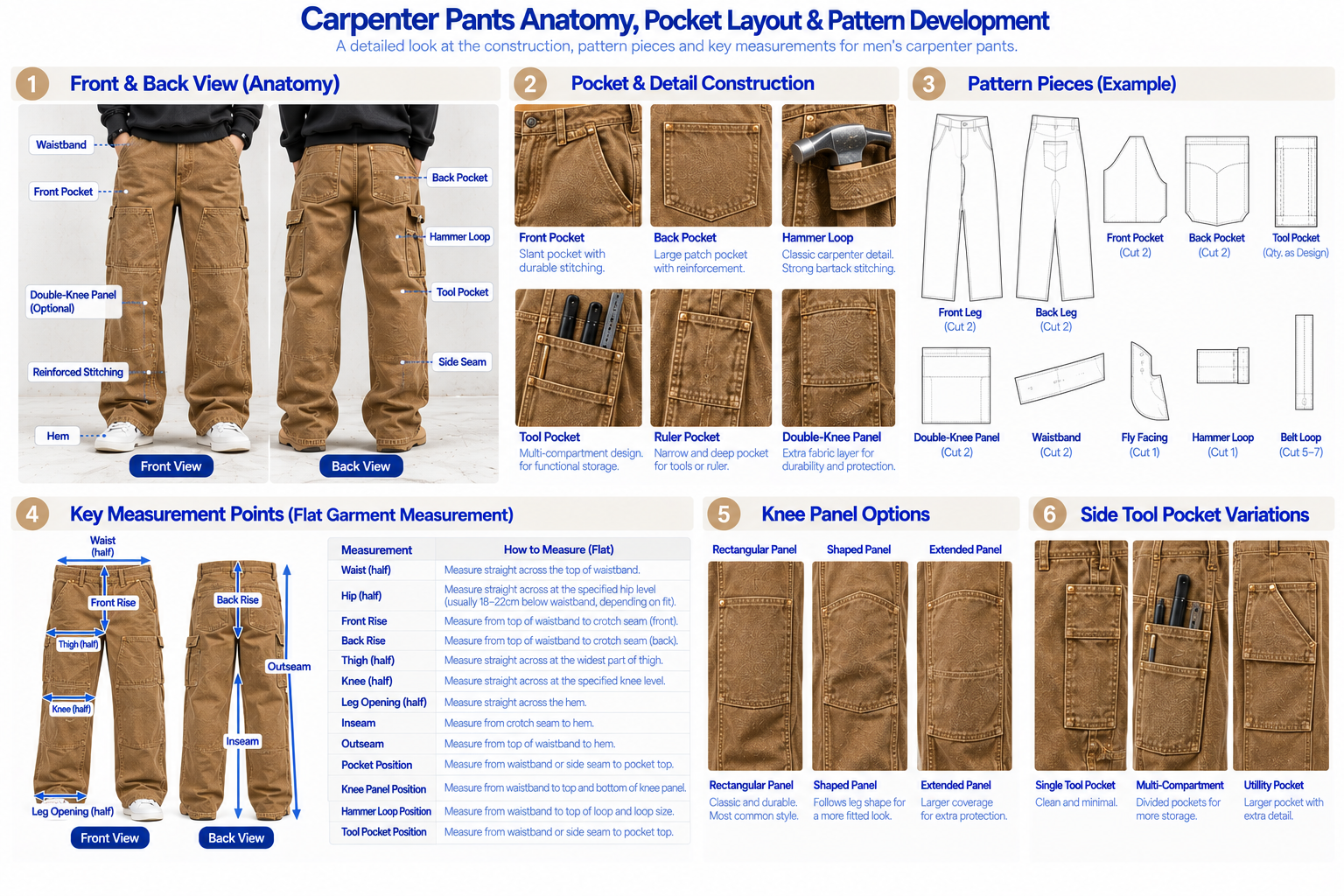
The Anatomy of Carpenter Pants
A carpenter pant can be divided into several important areas:
- Waistband
- Front pockets
- Fly
- Back pockets
- Tool pockets
- Hammer loop
- Optional double-knee panels
- Side seam
- Inseam
- Hem
- Reinforcement points
Each part affects both appearance and production.
Hammer Loop
The hammer loop is one of the most recognizable carpenter-pant details.
Traditionally, it was designed to hold a hammer.
Modern fashion versions often use it mainly as a visual workwear reference.
The loop can be constructed from:
- Self fabric
- Webbing
- Twill tape
- Reinforced woven tape
Self-fabric loops create the most integrated appearance.
Hammer Loop Position
There is no universal rule requiring the hammer loop to sit on one specific side for every carpenter pant.
Its location should be defined in the tech pack.
Important measurements include:
- Distance below waistband
- Distance from side seam
- Finished loop length
- Finished loop width
A loop positioned too high may interfere with the hand or pocket opening.
A loop positioned too low may:
- Swing excessively
- Hit the knee
- distort the leg visually
Hammer Loop Size
The size depends on whether the loop is:
- Functional
- Decorative
- Oversized for fashion
A real workwear loop must provide enough opening for a tool.
A fashion version may be:
- Shorter
- Wider
- Flatter
The brand should specify whether actual tool capacity is required.
Hammer Loop Reinforcement
Even when used decoratively, the loop creates concentrated stress at its attachment points.
Common reinforcement methods include:
- Bartacks
- Box stitching
- Dense lockstitch reinforcement
Heavy-duty versions may require stronger reinforcement than lightweight fashion versions.
The surrounding fabric must also be considered.
A strong bartack on very lightweight fabric can still tear the fabric itself.
Side Tool Pockets
Tool pockets are another defining carpenter detail.
They are commonly positioned along the side or rear-side portion of the leg.
Possible designs include:
- Long narrow ruler pocket
- Dual tool pocket
- Layered utility pocket
- Small rectangular patch pocket
- Divided pocket
These pockets usually sit flatter than traditional cargo pockets.
Ruler Pocket
The ruler pocket is typically:
- Narrow
- Vertically oriented
- Positioned on the side of the leg
The exact dimensions should be defined.
A pocket that is too narrow may become unusable.
One that is excessively wide may begin to look more like a standard patch pocket.
Multi-Compartment Tool Pocket
A larger utility pocket can be divided using stitching.
For example:
one large patch pocket
can become:
two narrow tool compartments
by adding a vertical stitch line.
This creates additional visual detail without adding another separate pattern piece.
Tool Pocket Placement
Pocket placement influences:
- Function
- Leg balance
- Visual proportion
Important reference points include:
- Waistband
- Hip
- Knee
- Side seam
- Back seam
If a tool pocket sits too low, it can overlap the knee area.
If it sits too high, it may interfere with:
- Back pocket
- Hand movement
- Seat fit
Front Pocket Options
Carpenter pants can use several front-pocket styles.
Slant Pocket
Common on work pants and trousers.
Advantages include:
- Easy hand access
- Clean appearance
- Good compatibility with heavy canvas
Scoop Pocket
Creates a jean-like appearance.
Works well for:
- Carpenter jeans
- Denim versions
Patch Pocket
Creates a stronger workwear aesthetic.
Can be useful for oversized fashion carpenter pants.
Back Pocket Options
Common choices include:
- Square patch pocket
- Rounded patch pocket
- Pointed patch pocket
- Utility-shaped pocket
Back pockets should be positioned according to:
- Seat width
- Rise
- Size
- Intended fit
The same pocket placement should not necessarily be used across a slim and oversized pattern.
Pocket Reinforcement
High-stress pocket areas include:
- Pocket opening
- Pocket corners
- Tool-pocket attachment
- Hammer-loop attachment
These areas may use:
- Bartacks
- Rivets
- Reinforced stitching
But reinforcement should follow the intended aesthetic.
A minimal fashion carpenter pant may use tonal bartacks.
A heritage workwear style might deliberately show:
- Contrast bartacks
- Metal rivets
- Triple stitching
What Are Double-Knee Carpenter Pants?
Double-knee carpenter pants add a second layer of fabric over the front knee area.
Traditionally, this helped delay wear in an area exposed to:
- Kneeling
- Friction
- Abrasion
Today the double-knee panel is also an important fashion detail.
It creates:
- More structure
- Visible layering
- Stronger workwear identity
- Additional stitching lines
Double-Knee Panel Shape
Common shapes include:
Rectangular Panel
Simple and highly recognizable.
Shaped Knee Panel
Follows the leg pattern more closely.
Extended Double Front
The reinforcement may extend over a larger portion of the front leg.
The panel should not be treated as a random rectangle.
Its position needs to coordinate with the actual knee level.
Knee Position Matters
The knee level changes according to:
- Size
- Rise
- Inseam
- Overall garment proportion
If the reinforcement panel is too high:
the garment can look visually unbalanced.
If it is too low:
the panel may sit below the wearer's knee.
This becomes especially important when grading multiple sizes.
Double Knee and Fabric Bulk
Adding another layer effectively doubles fabric thickness in part of the front leg.
For heavyweight canvas, this can create significant bulk.
The designer should consider:
- Shell fabric weight
- Panel size
- Seam construction
- Wash
- Desired stiffness
A very heavy shell combined with a large double front can become unnecessarily rigid for fashion use.
Drain / Access Openings
Some functional double-knee constructions include openings in the reinforcement panel.
Depending on design, these may help:
- Release debris
- Provide access
- Support removable knee-pad systems
But these details are not required for fashion carpenter pants.
Do not add them automatically unless they belong to the intended product.
Carpenter Pants Fit
Modern carpenter pants can use several fits.
Common options include:
- Relaxed straight
- Loose straight
- Wide leg
- Baggy
- Tapered
- Cropped workwear fit
The workwear identity does not require one exact silhouette.
Relaxed Straight Carpenter Pants
This is one of the most commercially versatile fits.
Typical characteristics include:
- Comfortable seat
- Room through thigh
- Relatively straight leg
- Moderate leg opening
It works well with:
- Canvas
- Twill
- Denim
and keeps the workwear details easy to see without becoming extremely oversized.
Loose Straight Carpenter Pants
A loose-straight pattern adds more volume through:
- Hip
- Thigh
- Knee
while maintaining a relatively straight lower leg.
This works particularly well for current menswear and streetwear.
The important point is:
loose does not mean proportionally enlarging every measurement.
The waist can remain controlled while the leg receives additional volume.
Baggy Carpenter Pants
Baggy versions may use:
- Lower rise
- Relaxed seat
- Wide thigh
- Wide knee
- Large leg opening
They work especially well for:
- Skatewear
- Streetwear
- Heavy washed canvas
- Denim
Pocket size may also need to increase slightly so the details remain proportional to the larger silhouette.
Wide-Leg Carpenter Pants
Wide-leg versions maintain substantial width toward the hem.
Compared with baggy pants, the silhouette may appear more vertically controlled.
Key measurements include:
- Hip
- Thigh
- Knee
- Leg opening
- Inseam
The tool pocket should not disrupt the clean line excessively.
Tapered Carpenter Pants
Traditional and modern workwear can also use a tapered leg.
The pant may remain relaxed through:
- Seat
- Thigh
then narrow gradually toward:
- Ankle
- Hem
Avoid excessive taper if the design is intended to look like contemporary relaxed workwear.
Rise
Carpenter pants can use:
- Low rise
- Mid rise
- High rise
But mid-rise or natural-waist workwear proportions are generally easier to develop for broad menswear use.
Rise should always be specified separately from leg fit.
Best Fabrics for Carpenter Pants
Fabric is one of the most important development decisions.
Common options include:
- Duck canvas
- Cotton canvas
- Cotton twill
- Denim
- Ripstop
- Stretch cotton woven
For sourcing custom fabric by composition, weight and finish, see Brad Apparel's Fabric Sourcing & Development.
Duck Canvas
Duck canvas is one of the most traditional workwear choices.
It provides:
- Dense structure
- Abrasion resistance
- Strong workwear appearance
- Good support for utility pockets
Possible compositions include:
- 100% cotton
- Cotton blends
Duck fabric should be evaluated for:
- Weight
- Density
- Hand feel
- Shrinkage
- Wash behavior
Duck Canvas vs Regular Canvas
These terms are sometimes used loosely.
Duck canvas generally refers to a tightly woven, durable plain-weave fabric.
The exact construction varies by mill.
For manufacturing purposes, do not rely only on the word:
duck
Specify physical requirements such as:
- Composition
- Weight
- Density
- Hand feel
- Color
- Finish
A physical swatch is more useful than category naming alone.
Cotton Canvas
Cotton canvas provides:
- Structure
- Durability
- Natural workwear character
It is especially suitable for:
- Relaxed carpenter pants
- Double-knee pants
- Garment-washed workwear
Heavy canvas creates a stronger shape.
Lighter canvas creates more movement.
Cotton Twill
Cotton twill provides a smoother alternative.
It can offer:
- Good durability
- Cleaner drape
- Easier movement
- Broad color options
Twill works particularly well for fashion-focused carpenter pants that do not need extremely rugged workwear performance.
Denim Carpenter Pants
Denim turns carpenter construction into carpenter jeans.
Possible directions include:
- Dark indigo
- Rinse wash
- Medium vintage wash
- Light wash
- Black
- Gray
- Brown
- Ecru
Denim also supports:
- Rivets
- Contrast stitching
- Washing
- Abrasion effects
particularly well.
Rigid Denim
100% cotton denim provides:
- Strong structure
- Traditional aging
- Clear utility silhouette
It works especially well for:
- Relaxed straight
- Loose
- Wide carpenter jeans
But very heavy rigid denim can make layered knee panels excessively stiff.
Stretch Denim
A small amount of stretch can improve mobility.
This may be useful for:
- More fitted carpenter jeans
- Commercial casualwear
However, aggressive finishing and high heat can affect stretch recovery.
The intended wash should be tested before bulk production.
Ripstop
Ripstop can create a lighter technical interpretation.
It works well for:
- Utility streetwear
- Lightweight workwear-inspired pants
- Technical carpenter hybrids
Ripstop does not automatically mean the garment has professional protective performance.
If the product is intended for actual occupational use, performance specifications need to be tested separately.
Fabric Weight
There is no universal correct GSM for carpenter pants.
A useful development range might be:
| Fabric | Example Weight Direction | Character |
|---|---|---|
| Lightweight Twill | 200–250 GSM | Softer fashion utility |
| Midweight Twill | 250–320 GSM | Balanced structure |
| Canvas | 280–380 GSM | Strong workwear feel |
| Heavy Canvas | 380 GSM+ | Very structured |
| Denim | Approx. 10–14 oz | Classic carpenter jeans |
These are development references rather than fixed industry rules.
Fabric construction and density matter alongside weight.
Heavyweight Does Not Automatically Mean Better
Very heavy fabric may provide:
- Strong structure
- Premium hand feel
- Durability
but it can also create:
- Bulky seams
- Stiff knees
- Heavy pockets
- Difficult turning
- More sewing resistance
The correct fabric should match the intended product.
A fashion carpenter pant does not always need industrial-level fabric weight.
Pre-Washing and Shrinkage
Cotton canvas, twill and denim can shrink during finishing.
Before approving the pattern, test:
- Warp-direction shrinkage
- Weft-direction shrinkage
- Twisting
- Color change
- Hand feel
If bulk production will be garment washed, final measurements should be evaluated after the intended wash.
Garment-Washed Carpenter Pants
Garment washing can soften heavy workwear fabrics.
Possible effects include:
- Softer hand feel
- More broken-in appearance
- Seam puckering
- Edge fading
- Vintage character
This works particularly well for:
- Canvas
- Twill
- Denim
But the wash standard must be controlled.
Enzyme Wash
Enzyme washing may be used on appropriate cotton garments to create:
- Softer surface
- Cleaner worn appearance
- Controlled fading
The result depends heavily on:
- Fabric
- Dye
- Process time
- Chemistry
Always approve a physical washed garment.
Stone-Washed Workwear
Stone or abrasion effects can create stronger vintage character.
However, heavy abrasion can affect:
- Pocket edges
- Belt loops
- Knee panels
- Stitching
- Hardware
A heavily constructed carpenter pant needs careful wash testing.
Garment-Dyed Carpenter Pants
Cotton twill and canvas carpenter pants can also be garment dyed.
This is useful for colors such as:
- Black
- Olive
- Brown
- Rust
- Stone
- Washed gray
- Khaki
Garment dyeing may produce natural shade variation around:
- Seams
- Pockets
- Waistband
- Knee panels
which can be desirable for vintage workwear.
Carpenter Pants Color Directions
Traditional colors include:
- Tan
- Khaki
- Brown
- Black
- Navy
- Olive
Contemporary fashion can expand into:
- Stone
- Off-white
- Chocolate
- Washed charcoal
- Burgundy
- Faded blue
- Dusty green
The color should be evaluated after the intended wash rather than only on raw fabric.
Contrast Stitching
Contrast stitching is strongly associated with workwear.
Common directions include:
- Tobacco on indigo
- Gold on black
- Cream on brown
- Tonal-on-tonal
Contrast stitching highlights:
- Tool pockets
- Knee panels
- Side seams
- Hammer loops
But it also exposes sewing inconsistencies more clearly.
Tonal Stitching
Tonal thread creates a cleaner appearance.
It works well for:
- Minimal carpenter pants
- Premium streetwear
- Black canvas
- Fashion utility
The garment retains carpenter construction without appearing excessively traditional.
Single-Needle Stitching
Single-needle lockstitch is suitable for many construction areas.
It creates:
- Clean appearance
- Precise seam control
Not every carpenter pant requires visible multi-needle stitching.
Double-Needle and Triple-Needle Stitching
Workwear-inspired designs often use multiple parallel rows of stitching.
These can increase:
- Visual reinforcement
- Workwear character
Depending on the seam construction and machinery, they may also contribute to structural strength.
But:
triple stitching should not be added simply because the garment is called a carpenter pant.
It should match:
- Design
- Fabric
- Seam construction
- Production equipment
Bartacks
Bartacks are useful at concentrated stress points.
Common locations include:
- Pocket openings
- Tool-pocket corners
- Hammer-loop attachment
- Belt-loop ends
Bartack length and thread color can be customized.
Possible approaches include:
- Tonal bartack
- Contrast bartack
- Signature brand color
Rivets
Metal rivets can reinforce certain pocket areas and create a stronger workwear appearance.
Possible finishes include:
- Antique brass
- Gunmetal
- Silver
- Matte black
- Custom branded metal
Rivets should not be placed where the metal may create discomfort against the body.
Custom Hardware
Carpenter pants may use custom:
- Jean buttons
- Tack buttons
- Rivets
- Zippers
- D-rings
For hardware development and branding options, see Brad Apparel's Trims & Branding.
Waistband Construction
Typical carpenter pants may use:
- Straight waistband
- Contoured waistband
The correct option depends on:
- Rise
- Fit
- fabric
- intended styling
Heavy workwear styles often favor straightforward robust construction.
More fashion-oriented versions may use a shaped waistband for improved fit.
Belt Loops
Belt loops should be designed around:
- Belt width
- Waistband height
- Fabric thickness
Heavy canvas loops can become bulky if they are too narrow.
The number and position should also support waistband stability.
Fly Construction
Common closure systems include:
- Zipper fly
- Button fly
A zipper fly is highly common for modern commercial carpenter pants.
Button flies can create stronger:
- Heritage
- Denim
- Vintage workwear
character.
The choice should be defined in the tech pack.
Carpenter Pants Pattern Development
A typical carpenter-pant pattern may include:
- Front leg
- Back leg
- Waistband
- Front pocket pieces
- Back pockets
- Tool pockets
- Hammer-loop piece
- Fly / fly shield components
- Belt loops
- Optional double-knee panels
The actual number of pattern pieces depends on the construction.
Front Leg Pattern
The front leg controls:
- Rise
- Thigh
- Knee
- Leg opening
- Pocket opening
- Knee-panel position
If a double knee is used, its pattern must be coordinated with the front leg.
Back Leg Pattern
The back pattern affects:
- Seat comfort
- Back rise
- Thigh
- Leg balance
A relaxed carpenter pant usually requires enough room through the seat to support movement.
But excessive back-rise extension can create unwanted fabric collapse.
Side Seam Balance
Utility details make the side seam visually important.
The pattern maker should consider:
- Tool pocket
- Hammer loop
- Front pocket
- Knee panel
together.
Adding each component independently can make one side of the pant visually crowded.
Front Rise
Front rise affects:
- Waist position
- Crotch comfort
- Overall silhouette
For loose carpenter pants, simply increasing rise is not enough to create a relaxed fit.
Rise must work together with:
- Hip
- Thigh
- Crotch extension
Back Rise
Back rise needs enough length for:
- Sitting
- Bending
- Movement
especially for workwear-inspired styles.
But fashion carpenter pants should still maintain a clean seat shape.
Thigh Width
Thigh width strongly affects carpenter-pant character.
Too narrow:
- Utility details feel crowded
- Workwear identity weakens
- Movement decreases
Too wide:
- Pant may appear shapeless
- Knee reinforcement can look oversized
Knee Width
Knee width affects:
- Straightness
- Taper
- Baggy appearance
If a double-knee panel is used, its visual width should follow the intended leg shape.
Leg Opening
A smaller opening creates:
- More taper
- Cleaner ankle
A larger opening creates:
- Straight workwear shape
- Baggy appearance
- Stronger skate influence
Leg opening should always be evaluated together with:
- Inseam
- Footwear
Inseam
Longer carpenter pants can:
- Stack
- break over footwear
Shorter versions can create:
- Cleaner workwear silhouette
The correct inseam depends on the intended collection.
Pattern Grading
Utility details need dedicated grading rules.
Do not automatically scale every pocket and loop at the same percentage as the garment.
Important decisions include:
- Does tool-pocket width increase?
- Does hammer-loop size remain constant?
- Does knee-panel height grade?
- Does pocket position move vertically?
- Does back-pocket spacing increase?
These should be determined intentionally.
Hammer Loop Grading
In many fashion collections, the hammer loop itself may remain nearly the same functional size across multiple garment sizes.
Its position, however, may need to move as the pant grows.
The grading rule should distinguish between:
component size
and:
component placement
Tool Pocket Grading
Tool pockets may need only limited size changes.
An excessively large pocket on higher sizes may stop looking like a tool pocket.
A completely fixed pocket on very large sizes may look too small.
Physical fitting should determine the balance.
Double-Knee Grading
Double-knee placement deserves particular attention.
The panel needs to remain visually connected to the wearer's knee region across sizes.
Simply scaling the panel vertically from one fixed point can create poor placement.
Carpenter Pants Sample Evaluation
The sample should be checked:
- Front
- Side
- Back
- Standing
- Sitting
- Walking
The utility components should also be evaluated separately.
Front View
Check:
- Waist alignment
- Fly
- Front pockets
- Knee panels
- Leg width
- Hem balance
If double knees are used, left and right panels should appear consistent.
Side View
Check:
- Side-seam shape
- Hammer-loop position
- Tool-pocket position
- Hip volume
- Leg balance
This is where many carpenter-pant design problems become obvious.
Back View
Check:
- Seat shape
- Back rise
- Pocket placement
- Waistband
- Tool-pocket relationship
Back pockets should remain visually level unless asymmetry is intentional.
Movement Test
Try:
- Sitting
- Squatting
- Walking
- Bending
Fashion carpenter pants do not necessarily need industrial performance, but they should still allow normal comfortable movement.
Pocket Function Test
Check whether:
- Front pockets are deep enough
- Back pockets remain accessible
- Tool pockets sit flat
- Hammer loop does not twist
- Components do not interfere with movement
Even decorative workwear details should look intentionally engineered.
Double-Knee Mobility
A large reinforcement panel can reduce flexibility.
Check:
- Knee bending
- Fabric stiffness
- Seam pressure
after the intended wash.
Washed canvas can behave very differently from raw canvas.
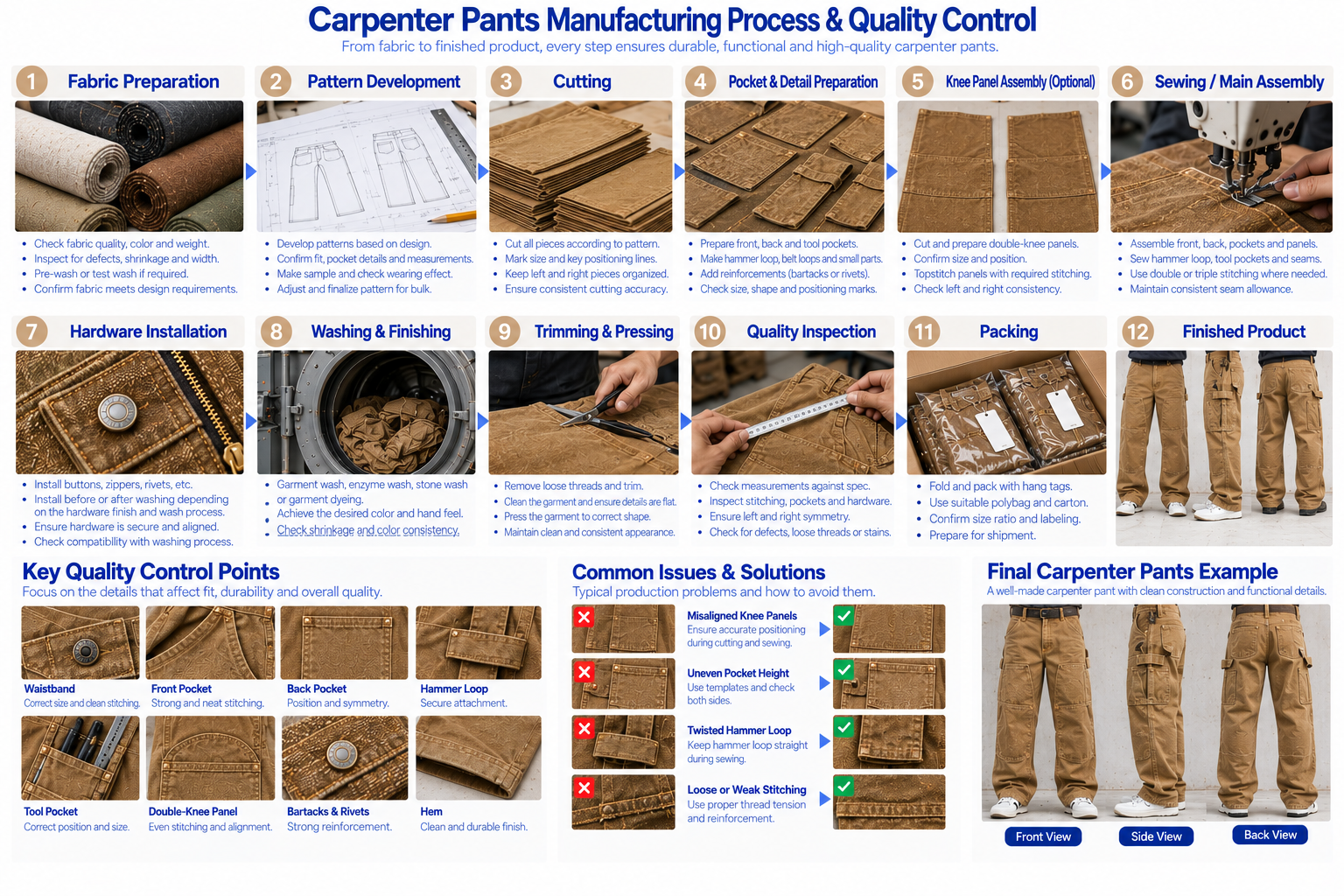
Manufacturing Sequence
A practical carpenter-pants production sequence may include:
- Fabric inspection
- Shrinkage and wash testing
- Pattern development
- Cutting
- Pocket preparation
- Knee-panel preparation if required
- Hammer-loop preparation
- Front and back assembly
- Tool-pocket attachment
- Main seam assembly
- Waistband and fly construction
- Bartack / rivet reinforcement
- Garment washing or dyeing if required
- Final hardware where appropriate
- Pressing
- Measurement inspection
- Final quality control
- Packing
Exact sequencing varies according to:
- Fabric
- Hardware
- Wash
- Machinery
- Construction
Fabric Inspection
Before cutting, inspect:
- Composition
- Width
- Weight
- Shade
- Defects
- Weave
- Surface
- Directionality
For denim, also evaluate:
- Shade lot
- skew
- shrinkage
For garment-dyed canvas, raw fabric shade is not the final color standard.
Shrinkage Testing
Wash the fabric or test garment using the intended production finish.
Record dimensional change in:
- Length
- Width
Pattern allowance can then be adjusted if required.
Do not assume all cotton canvas behaves the same way.
Cutting
During cutting, maintain:
- Grainline
- Size identification
- Left/right component control
- Pocket positioning
- Knee-panel consistency
Heavy canvas requires clean cutting because bulky uneven edges become harder to sew accurately.
Pocket Preparation
Tool pockets should be:
- Folded consistently
- Reinforced where required
- Checked against templates
Incorrect pocket shape becomes highly visible after topstitching.
Double-Knee Preparation
Before the front legs are assembled, confirm:
- Panel size
- Panel height
- Left/right alignment
- Stitching specification
Templates can help maintain consistent positioning.
Hammer Loop Preparation
Check:
- Finished length
- Width
- Folding
- Attachment orientation
The loop should not twist after sewing.
Main Assembly
Assembly normally brings together:
- Front
- Back
- Inseam
- Outseam
- Fly
- Waistband
Sequence varies depending on factory method and pocket construction.
Reinforcement
Apply reinforcement only at specified areas.
Typical locations include:
- Front pocket opening
- Tool pocket
- Hammer loop
- Belt loops
Over-reinforcing every seam can add:
- Cost
- Bulk
- Stiffness
without improving the actual product.
Rivet Installation
If metal rivets are used, check:
- Position
- Attachment
- Surface finish
- Compatibility with wash
Some decorative finishes should be installed after aggressive washing.
The correct sequence depends on the hardware.
Washing & Finishing
Possible finishing routes include:
- Rinse
- Enzyme
- Garment wash
- Vintage wash
- Garment dye
- Pigment effects
The exact process depends on fabric and desired appearance.
Hardware and Wash Compatibility
Do not assume every rivet, button or metal finish can safely go through every wash.
Test for:
- Scratching
- Oxidation
- Plating loss
- Color change
- Detachment
before bulk production.
Final Pressing
Press enough to:
- Clean seams
- Shape waistband
- Present pockets properly
But avoid making intentionally washed workwear look unnaturally flat.
Measurement Inspection
Key carpenter-pant measurements include:
- Waist
- Hip
- Front rise
- Back rise
- Thigh
- Knee
- Leg opening
- Inseam
- Outseam
- Pocket position
- Knee-panel position
Finished measurements should be taken after the intended final wash.
Key Quality Control Points
Hammer Loop
Check:
- Position
- Size
- Reinforcement
- Twisting
Tool Pockets
Check:
- Shape
- Position
- Opening
- Left/right consistency
Double-Knee Panels
Check:
- Height
- Width
- Symmetry
- Stitching
Front Pockets
Check:
- Opening
- Depth
- Reinforcement
Back Pockets
Check:
- Position
- Level
- Stitching
Waistband
Check:
- Measurement
- Shape
- Belt-loop attachment
Fly
Check:
- Alignment
- Zipper operation
- Topstitching
Main Seams
Check:
- Strength
- Seam allowance
- puckering
- twisting
Wash
Check:
- Shade
- Hand feel
- Shrinkage
- abrasion consistency
Common Carpenter Pants Quality Problems
Misaligned Knee Panels
Problem
The left and right reinforcement panels sit at different heights.
Causes
Possible causes include:
- Cutting inconsistency
- Incorrect positioning
- Sewing movement
Control
Use:
- Position marks
- Templates
- Inline checking
Tool Pocket Too Low
The tool pocket can interfere with the knee and make the leg appear visually heavy.
Pocket placement should be confirmed during sampling.
Tool Pocket Too High
It may interfere with:
- Back pocket
- Seat
- hand access
The layout should be evaluated on body, not only flat.
Twisted Hammer Loop
A self-fabric loop can twist if orientation is not controlled during attachment.
Check the loop after:
- Sewing
- Washing
Weak Hammer Loop Attachment
Poor reinforcement may allow the attachment point to pull away from the leg.
Use appropriate:
- Stitching
- Bartack
- Fabric support
depending on intended use.
Knee Panel Too Stiff
This often happens when:
heavy shell + double layer + dense stitching
are combined without considering movement.
Possible solutions include:
- Lighter shell
- Smaller panel
- Softer wash
- Different construction
depending on the design.
Uneven Pocket Placement
Utility pockets create obvious visual reference points.
Even small height differences may become noticeable.
Templates can improve bulk consistency.
Excessive Seam Puckering
Heavy topstitching combined with incorrect:
- Thread tension
- Needle
- feed
can create puckering.
Machine settings should match the fabric.
Leg Twisting
Twisting can come from:
- Pattern imbalance
- Fabric skew
- Cutting
- Washing
Denim and twill should be checked particularly carefully.
Inconsistent Wash
Washed carpenter pants can show unwanted differences in:
- Overall shade
- Knee-panel abrasion
- Pocket edges
- seams
The approved production sample should establish the acceptable wash range.
Carpenter Pants Tech Pack Example
| Area | Example Specification |
|---|---|
| Product | Men's Carpenter Pants |
| Fit | Loose Straight |
| Rise | Mid Rise |
| Fabric | 100% Cotton Canvas |
| Weight | 320 GSM |
| Color | Washed Brown |
| Waistband | Straight |
| Front Closure | Metal Zipper + Tack Button |
| Front Pocket | Slant Pocket |
| Back Pocket | Patch Pocket |
| Tool Pocket | Dual Side Tool Pocket |
| Hammer Loop | Self Fabric |
| Knee | Double-Knee Panel |
| Stitching | Tonal Double-Needle |
| Reinforcement | Bartacks at Stress Points |
| Hem | Standard Double-Turn Hem |
| Finish | Garment Washed |
| Branding | Woven Main / Care Label |
These specifications are examples only.
Important Measurement Points
| Measurement | Why It Matters |
|---|---|
| Waist | Controls top fit |
| Hip | Controls seat volume |
| Front Rise | Controls waist position |
| Back Rise | Controls seat comfort |
| Thigh | Determines upper-leg volume |
| Knee | Controls leg shape |
| Leg Opening | Determines straight / wide / tapered appearance |
| Inseam | Controls finished length |
| Outseam | Confirms overall length |
| Front Pocket Position | Affects access and appearance |
| Tool Pocket Position | Controls utility layout |
| Hammer Loop Position | Controls function and proportion |
| Knee Panel Top | Controls reinforcement placement |
| Knee Panel Bottom | Controls reinforcement placement |
Example Classic Canvas Carpenter Pants
A traditional workwear-inspired version might use:
- Relaxed straight fit
- Mid rise
- 320–360 GSM cotton canvas
- Tan / brown
- Slant front pockets
- Large back patch pockets
- Hammer loop
- Dual tool pocket
- Tonal bartacks
- Garment wash
This keeps the design recognizable without becoming overly complicated.
Example Double-Knee Streetwear Carpenter Pants
A streetwear version might use:
- Loose fit
- Wide thigh
- Straight wide leg
- Heavy canvas
- Large double-knee panels
- Hammer loop
- Oversized tool pockets
- Contrast stitching
- Washed black
- Custom metal hardware
The utility details become stronger visual elements.
Example Denim Carpenter Jeans
A denim version might use:
- Relaxed straight fit
- 12 oz cotton denim
- Medium vintage wash
- Scoop front pockets
- Patch back pockets
- Side tool pocket
- Hammer loop
- Copper-tone rivets
- Tobacco stitching
This combines familiar jean language with carpenter construction.
Example Minimal Carpenter Pants
Not every version needs strong heritage styling.
A cleaner design may use:
- Relaxed straight fit
- Black cotton twill
- Tonal stitching
- One side tool pocket
- Small hammer loop
- No double knee
- Minimal visible hardware
This keeps the carpenter reference while fitting a more modern collection.
Fashion Carpenter Pants vs Real Work Pants
This distinction is important for clothing brands.
A fashion carpenter pant may use workwear-inspired details without being designed or certified as professional protective workwear.
If the garment is intended for occupational use, additional requirements may apply around:
- Abrasion
- Tear strength
- Seam strength
- visibility
- protective performance
- workplace regulations
A fashion garment should not make unsupported performance claims.
How to Describe Carpenter Pants to a Manufacturer
Avoid sending only:
I want baggy carpenter pants.
A more useful brief would be:
Men's loose-straight carpenter pants in 320 GSM 100% cotton canvas, mid rise, relaxed seat and thigh, double-knee front panels, self-fabric hammer loop, two side tool pockets, large back patch pockets, tonal double-needle topstitching and washed dark brown finish.
Then provide:
- Waist
- Hip
- Front rise
- Back rise
- Thigh
- Knee
- Leg opening
- Inseam
- Fabric
- Color
- Wash
- Pocket dimensions
- Pocket positions
- Hammer-loop dimensions
- Double-knee dimensions
- Hardware
- Stitching
- Branding
This gives the pattern and sample teams a much clearer development target.
Common Development Mistakes
1. Treating Carpenter Pants as Cargo Pants
The pocket systems are different.
Do not automatically add large cargo pockets.
2. Assuming Every Carpenter Pant Needs Double Knees
Double knees are optional.
They should support the intended design.
3. Adding a Random Hammer Loop
The loop needs:
- Defined size
- Position
- Reinforcement
4. Making Tool Pockets Too Large
They can turn into generic utility patch pockets and overpower the leg.
5. Ignoring Pocket Placement During Fit Development
Utility details should be developed together with the actual body pattern.
6. Using Fabric That Is Too Heavy
Heavy does not automatically equal premium.
Excessive weight can make knee panels and seams bulky.
7. Using Fabric That Is Too Soft
The utility details may collapse and lose workwear structure.
8. Approving the Pattern Before Washing
Cotton canvas and denim can change substantially after finishing.
9. Overusing Reinforcement
Rivets, bartacks, double knees and triple stitching do not all need to appear on every design.
Too many details can make the garment heavy and visually cluttered.
10. Scaling Every Detail Mechanically
Pocket and loop grading should be intentional.
11. Ignoring Hardware Compatibility With Washing
Metal finishes can change during aggressive finishing.
12. Calling Fashion Carpenter Pants Protective Workwear
Workwear styling does not automatically mean certified occupational performance.
Carpenter Pants Development Checklist
Before sampling, confirm:
- Product direction
- Target customer
- Fit
- Rise
- Fabric composition
- Fabric weight
- Color
- Wash
- Front pockets
- Back pockets
- Tool pockets
- Hammer loop
- Double knees
- Waistband
- Fly
- Belt loops
- Thread color
- Reinforcement
- Hardware
- Labels
Before bulk production, confirm:
- Approved fit sample
- Final measurements
- Shrinkage
- Pocket templates
- Hammer-loop position
- Knee-panel position
- Stitching standard
- Bartack positions
- Hardware
- Wash standard
- Shade tolerance
- QC standard
FAQ
What Are Carpenter Pants?
Carpenter pants are workwear-inspired trousers traditionally designed with tool-carrying details such as a hammer loop and side utility pockets.
Modern versions are widely used in men's casualwear, streetwear and fashion.
Why Do Carpenter Pants Have a Hammer Loop?
The loop was originally designed to carry a hammer.
In modern fashion, it can remain functional or simply act as a recognizable workwear detail.
What Are Carpenter Jeans?
Carpenter jeans are carpenter-style pants made from denim.
They may use:
- Hammer loop
- Tool pockets
- Rivets
- Double knees
while keeping recognizable jean construction.
Are Carpenter Pants the Same as Cargo Pants?
No.
Cargo pants are primarily identified by large thigh cargo pockets.
Carpenter pants are more strongly associated with:
- Hammer loops
- Tool pockets
- Workwear reinforcement
The categories can overlap, but they are not identical.
Are Carpenter Pants the Same as Double-Knee Pants?
No.
Double knee describes a reinforcement construction.
Carpenter pants describe a broader pant category.
A carpenter pant may or may not have double knees.
Do All Carpenter Pants Have Hammer Loops?
No.
The hammer loop is highly recognizable but is not mandatory in every modern fashion interpretation.
What Fabric Is Best for Carpenter Pants?
Common choices include:
- Duck canvas
- Cotton canvas
- Cotton twill
- Denim
- Ripstop
The best fabric depends on:
- Fit
- season
- intended structure
- wash
- end use
What Weight Fabric Should Carpenter Pants Use?
There is no single required weight.
Fashion carpenter pants may use midweight twill, while rugged versions may use substantially heavier canvas.
Fabric density and construction should be evaluated alongside GSM.
Are Double-Knee Panels Necessary?
No.
They are useful when the design requires:
- Stronger workwear identity
- additional reinforcement
- more visual layering
but they are not required.
Can Carpenter Pants Be Baggy?
Yes.
Baggy and loose-straight carpenter pants are particularly suitable for contemporary streetwear.
The pattern should create controlled volume rather than simply increasing the entire garment size.
Can Carpenter Pants Be Made From Denim?
Yes.
Denim carpenter pants are commonly called carpenter jeans.
Both rigid and stretch denim can be used depending on the intended fit.
Can Carpenter Pants Be Garment Dyed?
Yes.
Cotton twill and canvas versions are particularly suitable for garment-dyed or washed effects.
The final shade and shrinkage should be approved after finishing.
Should Carpenter Pants Use Rivets?
Not necessarily.
Rivets can reinforce selected points and add workwear styling.
Bartacks or conventional reinforcement may also be appropriate.
What Should Be Included in a Carpenter Pants Tech Pack?
At minimum, specify:
- Fit
- Waist
- Hip
- Rise
- Thigh
- Knee
- Leg opening
- Length
- Fabric
- Pocket layout
- Tool-pocket dimensions
- Hammer-loop dimensions
- Knee-panel dimensions
- Stitching
- reinforcement
- hardware
- wash
- branding
What Should Be Checked During Carpenter Pants QC?
Important checks include:
- Waist and overall measurements
- Leg balance
- Pocket position
- Tool-pocket symmetry
- Hammer-loop attachment
- Knee-panel alignment
- Stitching
- bartacks
- hardware
- wash consistency
- shade
- final appearance
Final Thoughts
Carpenter pants are a good example of how functional clothing can evolve into a broader menswear category.
The strongest versions are not defined by one decorative hammer loop.
They depend on the relationship between:
fit + fabric + pockets + reinforcement + construction + wash
A classic canvas carpenter pant may emphasize durability and heritage workwear.
A washed denim version can feel more like contemporary carpenter jeans.
A wide double-knee style can move toward skate and streetwear.
And a minimal black twill version can keep only a few carpenter details while fitting into a much cleaner menswear collection.
For product development, the important step is deciding which details are genuinely necessary before sampling.
Once the fit, pocket layout, hammer-loop position, reinforcement, fabric and wash are developed together, the carpenter pant becomes much easier to reproduce consistently from sample through bulk production.
Keep Reading