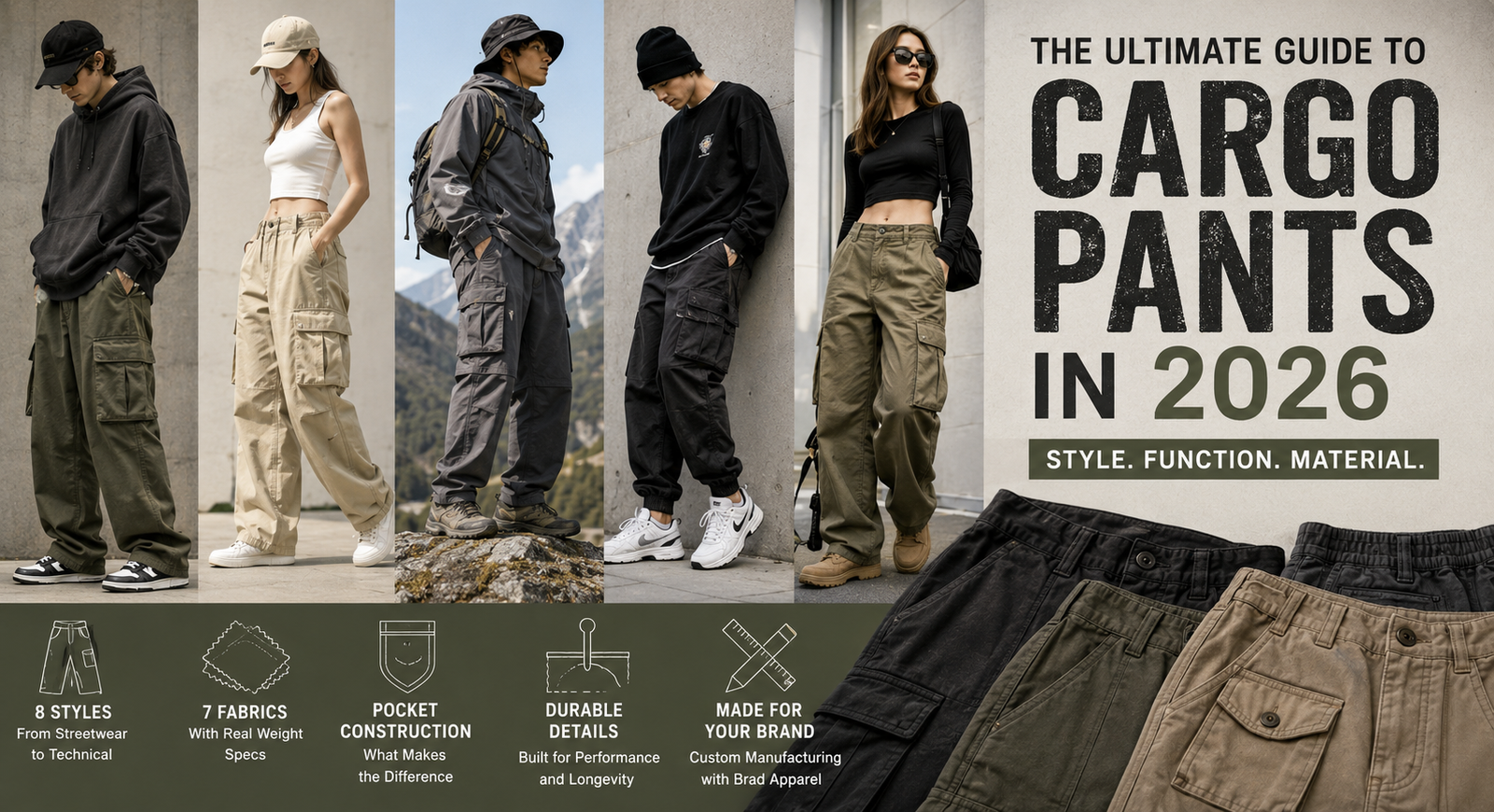
The Ultimate Guide to Cargo Pants in 2026: Styles, Fabrics, Pockets & Manufacturing
Cargo pants have moved far beyond their original military purpose.
By 2026, they are firmly established across streetwear, workwear, outdoor clothing and women's fashion—from oversized utility pants to technical ripstop styles and more tailored silhouettes.
If you're developing cargo pants for your clothing brand, the biggest decisions are not simply colour or pocket count.
You need to get four things right:
- Fit
- Fabric
- Pocket construction
- Reinforcement details
These choices determine how the pants look, how they feel, how much they cost to manufacture and how well they perform after repeated wear.

What Are Cargo Pants?
Cargo pants are trousers defined by their large utility pockets, traditionally positioned around the thigh and sometimes the lower leg.
These pockets may use:
- Flaps
- Buttons
- Snaps
- Velcro
- Zippers
- Expandable gussets
Cargo pants were originally developed for military use, where additional storage and durability were functional requirements.
Today, the same design language appears in:
- Streetwear
- Workwear
- Hiking clothing
- Tactical clothing
- Athleisure
- Women's fashion
- Casual everyday clothing
The basic concept has stayed the same.
What has changed is the fit, fabric and way the utility details are used.
Why Cargo Pants Are Still Popular in 2026
Cargo pants are no longer limited to rugged or military-inspired styling.
The category now includes everything from wide-leg fashion pants to lightweight technical trousers.
Women's cargo pants have also developed into a category of their own, with designs ranging from slim tapered silhouettes to high-waisted Y2K-inspired baggy fits.
At the same time, brands are increasingly using cargo pockets as a visual design element—even when the pants are not intended for heavy-duty utility.
This makes cargo pants one of the most flexible bottom categories for brands developing a broader apparel collection.
8 Cargo Pant Styles Worth Considering
1. Streetwear / Oversized Cargo Pants
Oversized cargo pants remain one of the strongest styles for streetwear-focused brands.
The typical fit is:
- Relaxed through the hip
- Roomy through the thigh
- Straight or slightly tapered through the leg
- Larger cargo pockets
- Relaxed overall proportions
The goal is not simply to make the pants larger.
Good oversized cargo pants still need controlled proportions so that the pockets, rise and leg opening work together.
Manufacturing Focus
Pay particular attention to:
- Fabric structure
- Pocket size
- Pocket placement
- Rise
- Leg width
- Hem opening
A fabric that is too soft can make large cargo pants collapse instead of holding the intended silhouette.
2. Slim-Tapered Cargo Pants
Slim cargo pants use a closer fit through the leg and smaller, flatter pockets.
They work well for brands that want cargo styling without an exaggerated streetwear silhouette.
Typical details include:
- Cleaner thigh pockets
- Reduced pocket volume
- Tapered lower leg
- Structured waistband
- Minimal hardware
This style can work particularly well in smart-casual collections where traditional oversized cargo pockets would feel too bulky.
3. Women's Cargo Pants
Women's cargo pants should not simply be a men's pattern graded down into smaller sizes.
A dedicated women's cargo pattern may need adjustments to:
- Rise
- Hip shape
- Waistband curve
- Waist-to-hip ratio
- Pocket size
- Pocket position
- Leg proportion
Pocket placement is especially important.
Large pockets positioned incorrectly can add unwanted bulk around the hip.
Waistband Options
Women's cargo pants commonly use two different waistband directions.
| Waistband Type | Best For |
|---|---|
| Fully elasticated waistband | Casual, comfort-driven and relaxed styles |
| Structured waistband with belt loops | Tailored, elevated and fashion-focused styles |
A curved waistband can also improve how the pants sit around the waist and hip.

4. Technical / Ripstop Hiking Cargo Pants
Technical cargo pants are designed around actual performance rather than utility-inspired styling alone.
Common features include:
- Ripstop fabric
- DWR finishing
- Articulated knees
- Zippered pockets
- Ventilation details
- Lightweight construction
- Secure closures
Ripstop fabric uses reinforced yarns arranged in a grid structure to help prevent small tears from spreading.
This makes it particularly useful for:
- Hiking
- Travel
- Outdoor clothing
- Lightweight technical pants
5. Tactical / Combat Cargo Pants
Tactical cargo pants prioritise durability and secure storage.
Typical construction may include:
- Heavy-duty fabric
- Reinforced knees
- Reinforced seat
- Multiple pockets
- Secure pocket closures
- Strong stitching
- Bar-tacked stress points
These products are more demanding to manufacture because pocket construction and reinforcement become functional requirements rather than decoration.
6. Cargo Joggers
Cargo joggers combine utility pockets with a more athletic silhouette.
Typical details include:
- Elastic waistband
- Drawcord
- Tapered leg
- Elastic or ribbed cuffs
- Cargo pockets
- Softer or stretch fabrics
They work particularly well for casualwear and athleisure brands.
The main challenge is balancing the cargo pocket volume with the narrower jogger silhouette.
7. Convertible Cargo Pants
Convertible cargo pants use zippers around the leg so that the lower section can be removed.
This allows the garment to change from pants into shorts.
They are especially relevant for:
- Outdoor brands
- Hiking
- Travel clothing
- Adventure apparel
However, they are less relevant for brands focused mainly on fashion-led streetwear.
The zipper position and leg circumference need careful development so the conversion seam remains comfortable when worn as full-length pants.
8. Cargo Shorts
Cargo shorts use the same utility-pocket concept in a shorter warm-weather silhouette.
Compared with full-length cargo pants, brands often choose:
- Lighter fabric
- Fewer reinforcement panels
- Relaxed leg openings
- Simplified pocket construction
Cargo shorts work particularly well for summer streetwear, outdoor and casual collections.
7 Fabrics for Cargo Pants
Fabric is one of the most important decisions when developing cargo pants.
It directly affects:
- Cost
- Durability
- Structure
- Comfort
- Drape
- Weight
- Wash performance
- Final appearance
Here are seven common fabric directions.
| Fabric | Typical Weight | Best For |
|---|---|---|
| Cotton Twill | 220–320 GSM (6.5–9.5 oz/yd²) | Everyday and streetwear cargo pants |
| Cotton Ripstop | 150–260 GSM (4.5–7.7 oz/yd²) | Lightweight technical and hot-climate styles |
| Canvas | 300–400+ GSM | Heavy-duty workwear |
| Polyester Blends | Varies by blend | Wrinkle resistance and quick-dry performance |
| Nylon | Lightweight with high strength-to-weight ratio | Outdoor and travel cargo pants |
| Spandex / Elastane Blends | Usually 2–15% added to base fabric | Stretch and active-inspired cargo pants |
| Cordura® | Available in multiple heavy-duty weights | Tactical and high-durability applications |
Cotton Twill
Cotton twill is one of the most versatile choices for everyday cargo pants.
Its diagonal weave provides a good balance between:
- Durability
- Structure
- Comfort
- Abrasion resistance
For general streetwear or casual cargo pants, approximately 220–280 GSM can provide a useful balance between comfort and durability.
Heavier twill around 300 GSM and above creates a more substantial workwear feel.
Cotton Ripstop
Ripstop fabric contains a visible reinforced grid.
Its main advantage is tear resistance.
It is especially suitable when the garment may encounter:
- Branches
- Sharp objects
- Snagging
- Outdoor movement
Because it can be produced at lighter weights than traditional heavy twill, ripstop works well for technical cargo pants intended for warmer conditions.

Canvas
Canvas is heavier and more rigid.
Typical weights can reach 300–400+ GSM.
It is better suited to:
- Workwear
- Heavy utility pants
- Durable uniforms
- Rugged clothing
The trade-off is reduced drape and additional garment weight.
For fashion-led cargo pants, very heavy canvas may feel unnecessarily stiff.
Polyester Blends
Polyester is commonly blended with cotton to improve:
- Wrinkle resistance
- Drying speed
- Durability
- Shape retention
A common direction for functional clothing is a 65/35 polyester-cotton blend.
The exact ratio should depend on whether the priority is natural hand feel or performance.
Nylon
Nylon offers high strength without requiring a very heavy fabric.
It works particularly well for:
- Outdoor pants
- Lightweight cargo pants
- Travel clothing
- Water-resistant styles
Nylon can also be combined with functional finishes when additional weather resistance is required.
Stretch Fabrics
Stretch cargo pants normally introduce elastane or spandex into the base material.
A small amount provides comfort and movement, while higher percentages are more relevant for activewear-inspired garments.
The source material may contain approximately 2–15% elastane, depending on the required stretch level.
More stretch is not always better.
Too much elasticity can reduce the structured appearance associated with traditional cargo pants.
Cordura®
Cordura® is used when abrasion resistance and durability are major priorities.
Applications include:
- Tactical clothing
- Workwear
- Reinforcement panels
- Extreme-use cargo pants
It is usually more expensive than standard fashion fabrics, so it makes the most sense where its durability is genuinely needed.
Ripstop vs Twill: Which Is More Durable?
There is no single answer because they protect against different types of damage.
| Fabric | Main Strength |
|---|---|
| Ripstop | Better resistance to tearing and snagging |
| Heavy cotton twill | Better resistance to repeated surface abrasion |
If the main risk is brushing against sharp branches or objects, ripstop is often the better choice.
If the garment is regularly rubbing against rough surfaces—for example kneeling or crawling—heavier twill may perform better.
Some technical designs use different fabrics in different areas.
For example:
- Twill for the main body
- Ripstop around knees
- Reinforced fabric around pockets
This allows the construction to match the actual wear pattern of the garment.
Cargo Pocket Construction
The pocket is one of the most recognisable parts of cargo pants.
But not every cargo pocket is constructed the same way.
Bellows / Accordion Pockets
Bellows pockets use folded side gussets that allow the pocket to expand.
They provide:
- More storage volume
- Strong utility appearance
- Better functionality
This is one of the most traditional cargo-pocket constructions.
It also requires more fabric and sewing operations than a simple patch pocket.
Flat Patch Pockets
Flat pockets are attached directly to the surface of the pants.
They create:
- Cleaner styling
- Less bulk
- Lower-profile silhouettes
This style works particularly well for fashion-focused cargo pants where the pocket is mainly a visual design feature.
Flap Cargo Pockets
Pocket flaps create a more finished utility appearance.
Closures may include:
- Snap buttons
- Standard buttons
- Velcro
- Hidden snaps
The closure method should match the intended customer and use.
For example, metal snaps may suit technical or streetwear styles, while hidden closures create a cleaner look.
Zippered Cargo Pockets
Zippered pockets are useful for high-mobility products where items need to remain secure during movement.
They work well for:
- Technical cargo pants
- Outdoor clothing
- Travel pants
- Performance-inspired designs
Zipper quality matters.
Poor zipper hardware can quickly reduce the perceived quality of an otherwise well-made garment.

Reinforcement Details That Affect Quality
One small construction detail can make a significant difference to cargo pant durability:
Bar-tacking.
Stress points commonly include:
- Cargo pocket corners
- Pocket openings
- Belt loops
- Zipper ends
- Drawcord openings
Without reinforcement, repeated pulling can gradually damage the stitching around these areas.
A short bar tack adds relatively little visually but can significantly improve long-term durability.
This is one of the details worth checking during sampling.
What's New for Cargo Pants in 2026?
Several directions are shaping cargo pants going into 2026.
Cargo Pants Are Becoming More Elevated
Wide-leg cargo pants are increasingly appearing in fashion-focused styling rather than only streetwear or workwear.
This has created more demand for:
- Cleaner fabrics
- Wider silhouettes
- Better drape
- Minimal pockets
- More refined waistbands
The cargo pocket becomes part of the silhouette rather than purely functional storage.
Women's Cargo Is Becoming Its Own Category
Women's cargo pants increasingly require dedicated design rather than being treated as smaller men's cargo pants.
Current directions include:
- High-waisted fits
- Baggy Y2K silhouettes
- Curved waistbands
- More considered hip fit
- Adjusted pocket positioning
- Elasticated waist options
Brands entering this category should consider developing a separate women's pattern block.
Earth Tones Continue to Dominate
Traditional camouflage is no longer the only colour direction associated with cargo pants.
Popular neutral and earth-tone palettes include:
- Olive
- Khaki
- Tan
- Stone
- Brown
- Black
- Charcoal
These colours are easy to combine into capsule collections and work across streetwear, outdoor and casual products.
Utility Is Also Becoming an Aesthetic
Cargo pockets no longer need to be highly functional.
Fashion brands may deliberately use:
- Smaller pockets
- Decorative flaps
- Flat pockets
- Asymmetric positioning
- Reduced pocket depth
This gives designers more flexibility to use the cargo identity without making the garment feel overly tactical.
How to Choose the Right Cargo Pants for Your Brand
Before sampling a cargo pant design, decide what the product is actually meant to do.
Ask:
- Is the customer buying for fashion, work or outdoor use?
- Should the fit be oversized, tapered or technical?
- Does the pocket need real storage capacity?
- How heavy should the fabric feel?
- Is stretch important?
- Will the garment be washed or garment-dyed?
- Are zippers, snaps or technical trims required?
- Which areas need reinforcement?
A fashion-led cargo pant and a technical hiking cargo pant may look similar from a distance, but their material and construction requirements can be very different.
Quick Cargo Pants Specification Guide
| Product Type | Recommended Fabric Direction | Important Construction Focus |
|---|---|---|
| Oversized streetwear cargo | 220–320 GSM cotton twill | Large pockets and balanced leg proportions |
| Slim cargo | Midweight twill or stretch blend | Flat pockets and tapered fit |
| Women's cargo | Twill or stretch woven | Curved waistband and pocket positioning |
| Technical hiking cargo | 150–260 GSM ripstop or nylon | Articulated knees and secure pockets |
| Tactical cargo | Heavy twill, canvas or Cordura® | Reinforcement and durability |
| Cargo jogger | Softer twill or stretch fabric | Elastic waist and cuffs |
| Convertible cargo | Lightweight ripstop or nylon | Zip-off leg construction |
| Cargo shorts | Lightweight twill or ripstop | Comfortable leg opening and pocket balance |
How Brad Apparel Supports Custom Cargo Pants Production
Cargo pants involve more development than simple trousers because the fabric, pocket construction and trim choices all need to work together.
Brad Apparel supports brands through the main stages of custom cargo pant development.
Fabric & Accessory Sourcing
Through our Fabric & Accessory Sourcing service, we can help brands source suitable:
- Cotton twill
- Ripstop
- Canvas
- Nylon
- Stretch fabrics
- Zippers
- Snaps
- Drawcords
- Cord locks
- Labels
- Packaging
Fabric should be selected according to the intended fit, durability requirement and target price.
Custom Bottom Development
Through our Custom Bottom Production, brands can develop cargo pants with different:
- Fits
- Rise options
- Leg widths
- Pocket layouts
- Waistbands
- Hem constructions
- Reinforcement details
This includes streetwear, casual and utility-inspired bottom styles.
Sample Development
Sampling is especially important for cargo pants because pocket placement can completely change the appearance of the garment.
Before bulk production, brands should confirm:
- Waist and hip fit
- Rise
- Leg width
- Fabric weight
- Pocket size
- Pocket position
- Pocket depth
- Closure hardware
- Reinforcement
- Shrinkage
- Final garment measurements
A technically correct pocket can still look wrong if it is positioned too high, too low or too far toward the side seam.
Bulk Production and Quality Control
During bulk production, consistency should be checked across:
- Fabric colour
- Pocket placement
- Pocket dimensions
- Waist measurements
- Leg length
- Stitching
- Bar tacks
- Zippers
- Snaps
- Labels
- Final finishing
For cargo pants, accurate pocket placement is particularly important because differences are visually obvious when multiple garments are compared together.
Contact Brad Apparel to discuss your cargo pant design, fabric requirements and sampling plan.
FAQ
What Is the Best Fabric Weight for Everyday Cargo Pants?
For general streetwear and casual cargo pants, approximately 220–280 GSM cotton twill provides a useful balance between durability and comfort.
For genuine heavy-duty workwear, fabrics above 300 GSM may be more appropriate.
Are There Women's Cargo Pants With a Fully Elastic Waistband?
Yes.
A fully elasticated waistband is a common option for casual women's cargo pants.
It can also be combined with stretch-woven materials when additional comfort and shape retention are required.
However, it is not standard on every cargo style, so the waistband construction should be clearly specified during development.
Is Ripstop or Twill Better for Cargo Pants?
It depends on how the pants will be used.
Ripstop is generally better at resisting tears and snags.
Heavier cotton twill is generally better at handling repeated surface abrasion.
For technical garments, different materials can also be combined in different areas.
What Fabric Is Best for Streetwear Cargo Pants?
Cotton twill around 220–320 GSM is one of the most versatile options.
It provides enough structure for oversized silhouettes and cargo pockets without becoming as stiff as very heavy workwear canvas.
What Makes a Cargo Pocket High Quality?
Important details include:
- Accurate pocket placement
- Strong stitching
- Clean corners
- Suitable closures
- Reinforced stress points
- Consistent pocket dimensions
- Proper gusset construction when using bellows pockets
Bar-tacking around pocket stress points is especially important for durability.
Can Cargo Pants Be Made With Stretch Fabric?
Yes.
Elastane or spandex can be blended into cotton, polyester or other base fabrics.
Lower percentages create moderate comfort stretch, while higher percentages are more appropriate for activewear-inspired cargo pants.
What Is the MOQ for Custom Cargo Pants?
The minimum order depends on:
- Fabric
- Custom colour
- Pocket complexity
- Washing
- Zippers and trims
- Size breakdown
- Overall design
More complicated cargo pants usually require additional sampling and production operations.
Contact Brad Apparel with your design or tech pack to discuss a realistic production plan.
Final Thoughts
Cargo pants remain relevant in 2026 because they can adapt to very different customers.
The same basic garment category can become:
- Oversized streetwear
- Women's fashion cargo
- Tactical clothing
- Technical outdoor pants
- Casual joggers
- Workwear
- Travel clothing
The key is not adding as many pockets as possible.
It is matching the fit, fabric and pocket construction to the customer who will actually wear the product.
For an everyday streetwear cargo pant, a well-balanced 220–280 GSM cotton twill and clean pocket construction may be enough.
For technical or tactical products, reinforcement, ripstop fabrics and secure closures become much more important.
Brands that get those fundamentals right will usually create a stronger product than brands that focus only on the visual trend.
For brands developing custom cargo pants, joggers, shorts or other bottoms, contact Brad Apparel to discuss fabric sourcing, sample development and bulk production.
Keep Reading