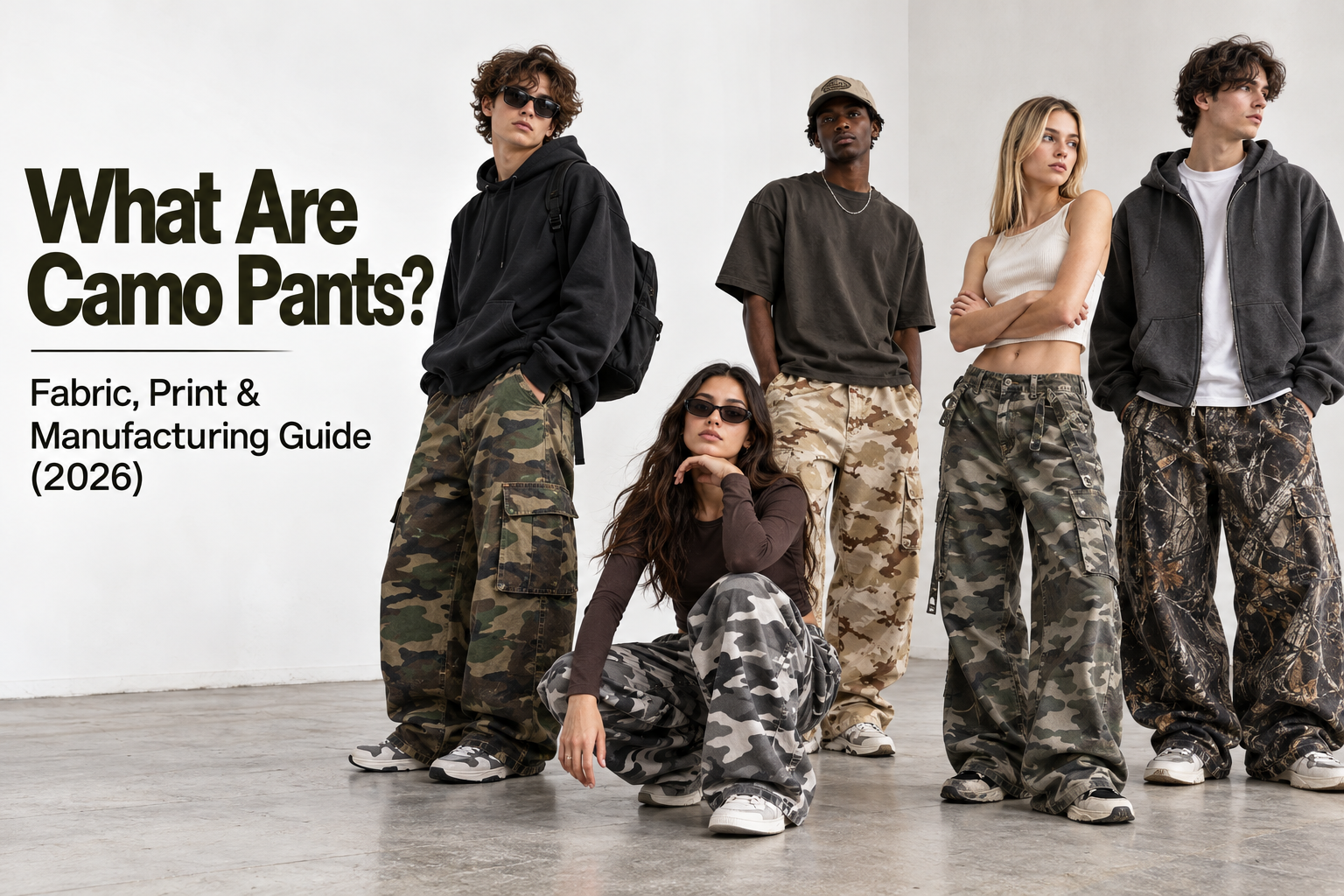
Camo pants are trousers that use camouflage as a visual surface design rather than one specific garment construction.
They can be:
- Baggy pants
- Cargo pants
- Straight-leg pants
- Barrel pants
- Denim jeans
- Technical pants
- Jogger-inspired pants
That distinction is important for clothing brands.
A camouflage pattern does not determine the fit, fabric or construction by itself.
The final product depends on the relationship between:
camo artwork + repeat scale + colorway + fabric + print method + garment fit + panel placement + washing
A good pair of camo pants therefore starts before cutting and sewing.
The print itself needs to be developed around the garment.
This guide explains how camouflage pants are made, how different camo patterns behave on different fabrics, and what clothing brands should specify before sampling and bulk production.
What Are Camo Pants?
Camo pants are pants that use camouflage-inspired surface patterns.
The original purpose of camouflage was functional concealment.
Fashion uses the same general visual language very differently.
Modern camo pants may use:
- Traditional earth tones
- Oversized organic shapes
- Pixel-style graphics
- Tonal black camouflage
- Brown camouflage
- Washed vintage camouflage
- Abstract fashion camouflage
- Custom brand-specific color combinations
This means a pair of camo pants does not need to look like actual military equipment.
The design can simply borrow the visual idea of overlapping irregular shapes and multiple tonal colors.
Why Are Camo Pants Trending Again in 2026?
Camouflage fits several current fashion directions:
- Y2K revival
- 1990s styling
- Baggy pants
- Utility clothing
- Workwear
- Streetwear
- Earth-tone dressing
- Maximalist prints
- Vintage washing
- Technical outdoor influences
One of the biggest changes is how camo is being styled.
Instead of creating a complete military-inspired outfit, modern camouflage pants are increasingly paired with simple pieces such as:
- Plain T-shirts
- Hoodies
- Knitwear
- Minimal jackets
- Basic sneakers
- Clean shirts
This allows the camouflage pattern to act almost like a neutral.
For brands, that makes camo easier to use across streetwear, casualwear and fashion collections.
Camo Is a Pattern, Not a Pant Type
This is the first manufacturing distinction brands should understand.
"Camo pants" describes the surface design.
It does not tell the factory whether the product should be:
- Cargo
- Straight
- Baggy
- Barrel
- Wide leg
- Jogger
- Denim
For example:
baggy cotton-twill camo pants
and
nylon camo cargo pants
may share similar artwork but require completely different patterns and construction.
When sending a development request, define the silhouette separately from the camouflage artwork.
Common Camo Pattern Directions
Modern camouflage can be developed in several visual directions.
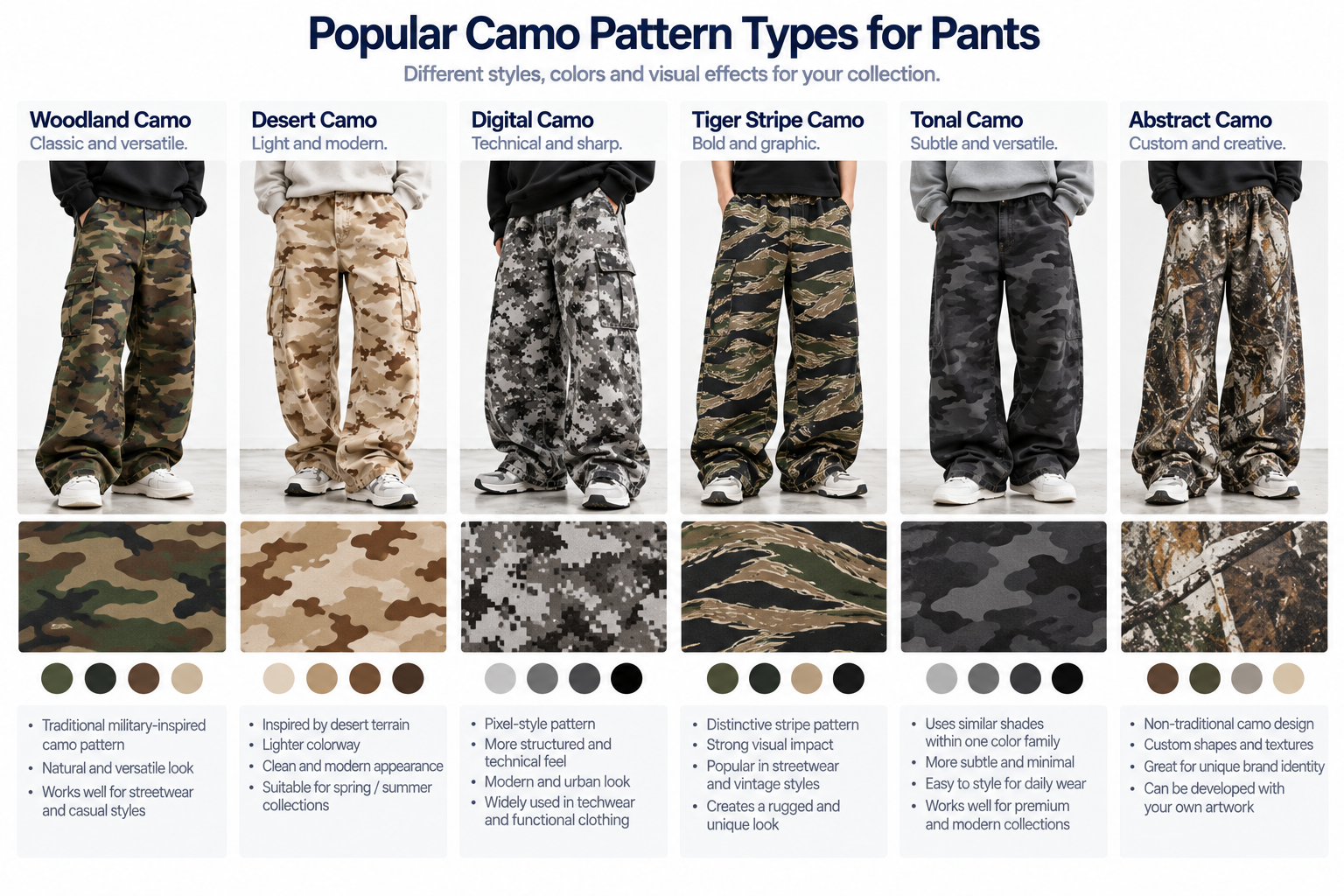
Woodland-Inspired Camo
Usually uses organic overlapping shapes.
Common colors may include:
- Olive
- Dark green
- Brown
- Black
- Khaki
This creates the most recognizable traditional camouflage appearance.
Desert-Inspired Camo
Uses lighter colors such as:
- Sand
- Beige
- Tan
- Light brown
- Stone
This direction works particularly well for:
- Summer collections
- Neutral streetwear
- Washed cotton pants
Digital / Pixel Camo
Uses small geometric or pixel-like elements rather than large organic shapes.
It creates:
- More technical appearance
- Higher visual density
- Modern surface texture
The scale needs careful control.
If the pixels become too small, the print may visually blend into a single color from a distance.
Tiger-Stripe-Inspired Camo
Uses longer irregular bands or brush-like shapes.
It can create:
- Stronger movement
- More directional artwork
- More graphic visual identity
Tonal Camo
Uses several shades within one color family.
Examples:
black + charcoal + dark gray
or:
olive + moss + dark olive
This creates a subtler effect.
Tonal camouflage works particularly well for brands that want camouflage without a strong military appearance.
Fashion / Abstract Camo
Brands can also create original camouflage using:
- Custom shapes
- Distorted graphics
- Hand-painted artwork
- Brand symbols
- Organic forms
- Enlarged pattern elements
This allows the print to become part of the brand identity rather than simply using a standard camouflage pattern.
Pattern Scale Changes the Entire Garment
One of the most important camouflage decisions is pattern scale.
Imagine exactly the same artwork printed at three sizes.
Small-Scale Camo
Creates:
- More visual texture
- More frequent color changes
- Less obvious individual shapes
Suitable for:
- Technical fabrics
- Smaller garments
- More subtle camouflage
Medium-Scale Camo
Usually provides a balanced appearance.
Individual shapes remain visible without dominating the entire garment.
Large-Scale Camo
Creates:
- Stronger graphic impact
- Fewer pattern elements per garment
- More obvious color blocks
This works particularly well for:
- Baggy pants
- Oversized streetwear
- Wide-leg pants
But large repeats need more careful placement.
Two pants cut from different parts of the same printed fabric can look noticeably different.
Repeat Size Needs to Be Defined
A camouflage artwork intended for fabric printing normally needs to repeat continuously.
The repeat must connect:
left to right
and
top to bottom
without obvious breaks.
Important artwork specifications may include:
- Repeat width
- Repeat height
- Artwork scale
- Color count
- Orientation
- Resolution
- Print direction
For example:
Repeat size: 60 × 60 cm
is much clearer than sending a small JPG and asking the mill to "make it all-over."
Seamless Repeat Matters
A poorly prepared repeat may create visible:
- Lines
- Gaps
- Repeated blocks
- Abrupt color changes
once several meters of fabric are printed.
The repeat should therefore be checked over a larger simulated area before production.
Do not approve camouflage only by viewing one small artwork tile.
Camouflage Does Not Need to Be Symmetrical
Unlike stripes or plaid, camouflage generally does not require perfect left/right matching.
That is one of its production advantages.
The random appearance allows different pattern areas to meet at:
- Side seams
- Inseams
- Pockets
without looking obviously incorrect.
However, placement still matters when large distinctive elements are used.
Large Camo Elements Need Placement Control
Suppose the artwork includes a large black shape measuring 35 cm across.
If it happens to fall directly across the center front, the garment may look very different from another unit where the same element falls at the side.
This is especially important for:
- Large-scale camouflage
- High-contrast camouflage
- Limited-repeat artwork
Brands should decide whether they want:
random placement
or:
controlled placement
before bulk cutting.
Random Placement vs Engineered Placement
Random Placement
The printed fabric is cut normally.
Each garment has slightly different camouflage placement.
Advantages:
- Lower cutting complexity
- More efficient fabric usage
- Natural camouflage appearance
Engineered Placement
Specific artwork elements are positioned intentionally on the garment.
For example:
- Dark area on lower leg
- Specific motif around pocket
- Matching artwork across front panels
Advantages:
- Greater visual consistency
- More controlled design
But it may require:
- Digital placement printing
- Special markers
- More fabric
- More cutting time
For most commercial camouflage pants, random placement is completely normal.
Stock Camo Fabric vs Custom Camo Fabric
Brands generally have two sourcing options.
Stock / Existing Camo Fabric
The mill already has camouflage fabric available.
Advantages:
- Lower MOQ
- Faster sampling
- No custom print development
- Lower setup cost
Disadvantages:
- Less exclusive
- Limited colorways
- Limited fabric choices
- Other brands may use the same print
Custom Camo Development
The brand supplies original artwork or modifies an existing direction.
Advantages:
- Custom colors
- Custom repeat
- Custom scale
- More distinctive identity
Disadvantages:
- Higher development cost
- Print MOQ may apply
- Longer sampling time
- Strike-off approval required
For low-volume collections, stock fabric may be more practical.
For signature collections, custom printing provides much more control.
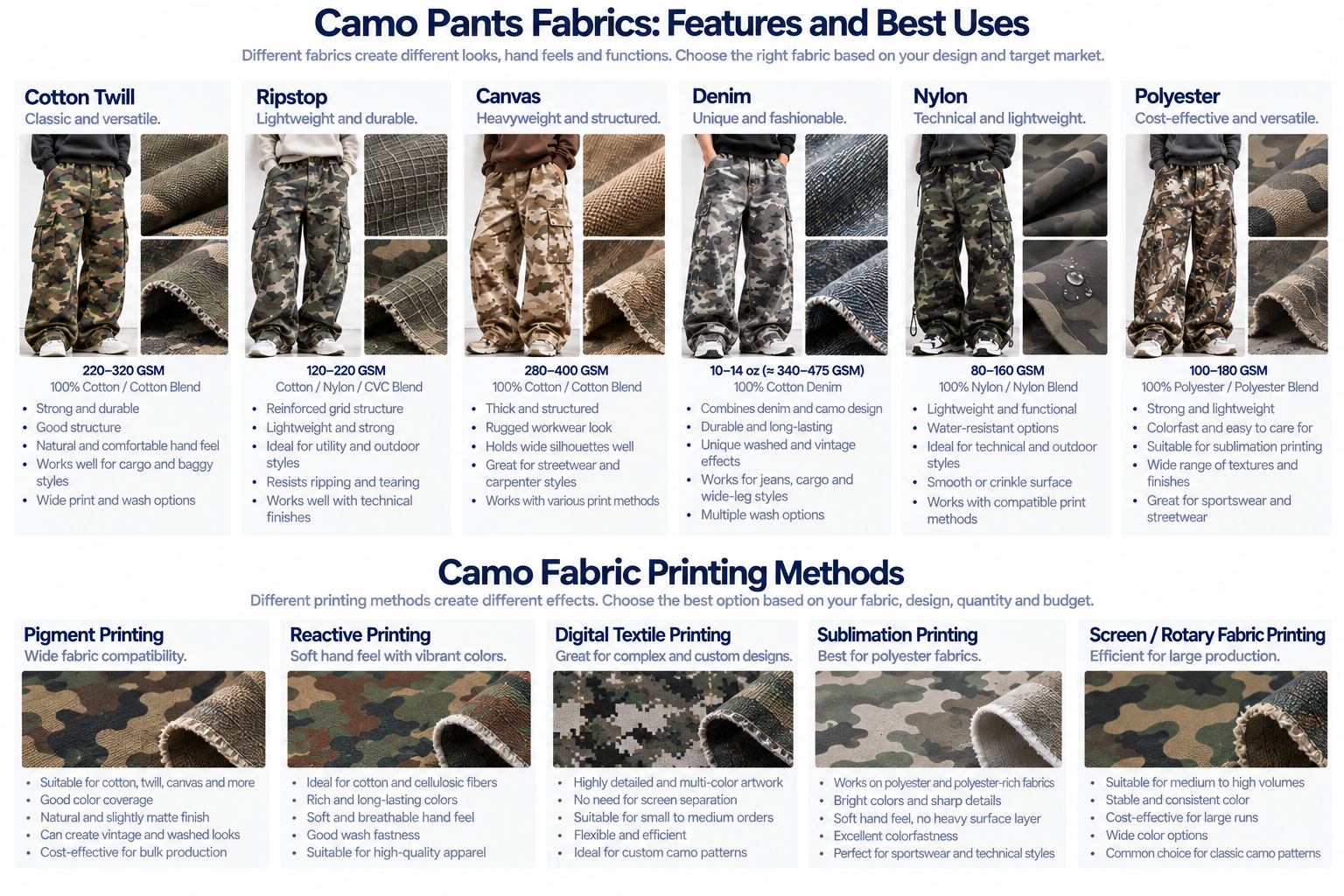
What Fabric Is Best for Camo Pants?
There is no single best fabric.
The correct fabric depends on the intended silhouette.
Common options include:
- Cotton twill
- Ripstop
- Canvas
- Denim
- Nylon
- Polyester woven
- Cotton-nylon blends
- Stretch woven fabric
For custom material sourcing, see Brad Apparel's Fabric Sourcing & Development.
Cotton Twill Camo Pants
Cotton twill is one of the most versatile options.
It provides:
- Good structure
- Comfortable natural hand feel
- Strong print compatibility
- Familiar casual appearance
It works particularly well for:
- Baggy pants
- Utility pants
- Straight pants
- Casual cargo styles
Example starting ranges may be around:
220–320 GSM
depending on the desired structure.
These are not fixed industry standards.
Ripstop Camo Pants
Ripstop uses reinforcement yarns that create a visible grid structure.
It works well for:
- Utility clothing
- Technical streetwear
- Outdoor-inspired products
- Lightweight cargo pants
The ripstop grid remains visible underneath the camouflage artwork.
This creates a stronger technical appearance.
Possible compositions include:
- Cotton
- Cotton/polyester
- Cotton/nylon
- Nylon
The correct option depends on durability, hand feel and intended function.
Canvas Camo Pants
Canvas creates:
- Heavier structure
- Workwear character
- More rugged appearance
It works well for:
- Carpenter-style pants
- Heavy streetwear
- Structured baggy silhouettes
However, very heavy canvas can feel stiff when combined with extremely wide pants.
The garment pattern should be developed around the actual fabric.
Camo Denim
Camouflage can also be applied to denim.
This creates a hybrid between:
jeans construction
and
camo surface design
Possible directions include:
- Printed denim
- Tonal camouflage denim
- Washed camouflage
- Overprinted indigo denim
Important considerations include:
- Denim weight
- Base color
- Print penetration
- Wash process
- Shrinkage
- Surface fading
A heavy wash can significantly change the camouflage contrast.
Nylon Camo Pants
Nylon works particularly well for:
- Technical pants
- Lightweight streetwear
- Wind-resistant clothing
- Outdoor-inspired silhouettes
Possible surface finishes include:
- Matte
- Slight sheen
- Crinkle
- Coated
- Water-resistant finish
The print method must be compatible with the exact nylon construction and finishing.
Do not choose the printing process before confirming the base fabric.
Camo Fabric Weight and Fit Need to Work Together
A soft lightweight camo fabric may work well for:
- Balloon pants
- Relaxed summer pants
- Technical trousers
but may not hold a strong structured barrel silhouette.
A heavier cotton twill can hold:
- Wider legs
- Stronger pocket shapes
- More defined folds
but may become bulky in extremely oversized designs.
Fabric should therefore be selected after the target silhouette is defined.
How Is Camouflage Printed on Fabric?
Camouflage can be produced using several textile-printing methods.
The correct method depends on:
- Fiber content
- Color count
- Quantity
- Artwork detail
- Desired hand feel
- Price target
- Wash requirements
Common methods include:
- Pigment printing
- Reactive printing
- Rotary or flat-screen fabric printing
- Digital textile printing
- Sublimation / disperse printing for suitable polyester fabrics
These are different from simply printing a small logo onto a finished garment.
All-Over Camo Is Usually Printed Before Cutting
For full camouflage pants, the most common production approach is:
print the fabric → approve fabric → cut garment panels → sew pants
rather than:
sew pants → print the entire finished garment
Printing before cutting provides:
- More consistent coverage
- Easier bulk production
- Cleaner seam areas
- Better fabric handling
Garment printing can still be used for certain creative effects, but it is a different development direction.
Pigment Printing
Pigment printing can be used on many woven fabrics.
The color is bound to the fabric surface using a binder system.
Advantages can include:
- Broad fabric compatibility
- Strong color options
- Efficient production
- Vintage wash potential
The hand feel depends on:
- Pigment concentration
- Binder
- Print coverage
- Fabric
Large areas of heavy pigment may feel stiffer than the base fabric.
Reactive Printing on Cotton
Reactive printing is commonly used for cellulosic fibers such as cotton.
The dye reacts with the fiber rather than simply sitting on the surface.
It can provide:
- Softer hand feel
- Good color penetration
- Strong wash performance
- Rich colors
However, the process requires additional washing and processing after printing.
For high-quality cotton camouflage, reactive printing can be a useful option when MOQ and production conditions support it.
Digital Textile Printing
Digital fabric printing is useful for:
- Complex artwork
- Many colors
- Gradients
- Detailed camouflage
- Smaller development runs
It avoids traditional screen separation for every color.
However, cost and suitability depend heavily on:
- Fabric
- Quantity
- Printer type
- Ink system
Digital printing should not automatically be assumed to be cheaper.
Sublimation for Polyester Camo
For suitable polyester fabrics, sublimation can produce:
- Detailed graphics
- Strong color
- Soft surface
- Good flexibility
Because the dye becomes part of the polyester fiber, the print does not create a heavy surface layer.
This makes it particularly useful for:
- Lightweight technical pants
- Sportswear
- Polyester woven garments
Sublimation is not the correct method for standard 100% cotton twill.
For an overview of apparel printing methods, see Brad Apparel's Printing Techniques.
Print Method Should Follow Fabric Selection
One common development mistake is deciding:
We want sublimation.
before selecting the fabric.
A better sequence is:
- Define garment
- Define fit
- Choose fabric
- Confirm fiber content
- Choose compatible print process
- Produce strike-off
- Approve fabric
- Make garment sample
This reduces technical problems later.
What Is a Print Strike-Off?
A strike-off is a small test print produced before bulk fabric printing.
It allows the brand to check:
- Color
- Pattern scale
- Repeat
- Sharpness
- Fabric appearance
- Hand feel
For custom camouflage, the strike-off is one of the most important approval stages.
Computer screens should not be treated as final color approval.
Approve Camo on the Actual Fabric
The same artwork can look different on:
- White cotton
- Khaki twill
- Nylon
- Denim
because the base material affects:
- Color
- Texture
- Absorption
- Surface sheen
Whenever possible, approve the camouflage on the actual bulk fabric.
Camo Colorways Should Be Defined Clearly
Avoid specifications such as:
Dark green camo.
Instead, define every color.
For example:
- Dark olive
- Medium olive
- Khaki
- Dark brown
- Black
For custom printing, a brand may use:
- Pantone references
- Physical swatches
- Approved strike-offs
The approved physical sample becomes more important than how the image looks on a monitor.
Three-Color vs Four-Color vs Five-Color Camo
Increasing the number of colors changes:
- Visual complexity
- Print setup
- Cost
- Registration requirements
A simple tonal camo may use:
2–3 colors
while a more complex design may contain:
4–6+ colors
More colors are not automatically better.
A well-designed three-color camouflage can look more premium than an unnecessarily complicated print.
Tonal Camo Is Easier to Style
A tonal camouflage can use low contrast between colors.
For example:
charcoal + black + washed gray
This provides:
- More subtle appearance
- Easier styling
- Less obvious military reference
It can work particularly well for premium streetwear.
High-Contrast Camo Creates More Impact
Examples include:
cream + olive + brown + black
or:
white + gray + black
High contrast makes individual shapes more visible.
This can work well for statement products, but placement variation becomes more noticeable.
Baggy Camo Pants
Baggy camo pants are one of the most natural current applications.
The larger surface area gives the camouflage artwork more space.
Typical pattern features may include:
- Relaxed hip
- Wide thigh
- Wide knee
- Straight or wide lower leg
- Moderate to long length
Large-scale camouflage works particularly well with this silhouette.
Straight-Leg Camo Pants
A straight fit creates:
- Cleaner silhouette
- Easier commercial styling
- Less exaggerated volume
It can work well with:
- Cotton twill
- Ripstop
- Denim
For brands that want camouflage without an extreme streetwear fit, this can be a strong option.
Barrel Camo Pants
Camouflage can also be combined with curved-leg pants.
The side seam may:
- Expand through thigh / knee
- Curve inward toward hem
The print should not hide the silhouette.
If the camouflage contrast is extremely strong, the pattern shape can become visually less obvious.
A more tonal camo may work better when the barrel construction itself is the main design feature.
Camo Cargo Pants
Cargo and camouflage naturally overlap because both have military roots.
But they should not be treated as the same thing.
A camo pant does not need cargo pockets.
A cargo pant does not need camouflage.
If you are developing cargo construction, see our Cargo Pants Manufacturing Guide.
Pocket Placement on Camo Pants
Pockets affect how the camouflage artwork is interrupted.
Common pocket options include:
- Front slant pocket
- Side-seam pocket
- Patch pocket
- Cargo pocket
- Welt pocket
- Back patch pocket
For a clean fashion version, simpler pockets may allow the print to remain the main visual feature.
Do Camo Pockets Need Pattern Matching?
Usually, not necessarily.
Camouflage is visually random enough that exact matching is often unnecessary.
However, a brand may intentionally request pocket matching for a premium result.
For example:
A patch pocket can be cut from the same pattern area as the body underneath it.
When sewn correctly, the camouflage appears to continue through the pocket.
This creates an almost hidden pocket effect.
Pattern-Matched Pockets Increase Fabric Consumption
Matching artwork requires the cutter to select specific areas of fabric.
That can create:
- More cutting waste
- Lower marker efficiency
- More labor
- Higher cost
The brand should decide whether the visual benefit justifies the additional production complexity.
Waistband Pattern Placement
The waistband can use:
Continuous Camo
Same camouflage as the body.
Contrast Solid Fabric
For example:
- Black waistband
- Olive waistband
- Brown waistband
Different Camo Scale
A smaller pattern can create additional design interest.
However, using multiple scales should be intentional.
Camo Orientation
Traditional camouflage may not have an obvious up/down direction.
But custom camouflage might.
For example:
- Long brush shapes
- Logos hidden in artwork
- Typography
- Directional motifs
If the print is directional, every pattern piece should be cut in the correct orientation.
This usually increases fabric consumption compared with a non-directional print.
One-Way vs Non-Directional Fabric Markers
Non-Directional Camo
Pattern pieces can sometimes be rotated during marker making.
This can improve fabric efficiency.
One-Way Camo
All pieces need the same orientation.
This may increase:
- Fabric usage
- Cutting waste
Directional requirements should be communicated before costing.
Camo Across Side Seams
Most camouflage pants do not require the pattern to continue perfectly through the side seam.
But the factory should avoid obviously poor combinations.
For example:
A very large black area on the front joining an almost completely beige area on the back can create an unwanted visual split.
A first sample helps determine whether the natural random placement is acceptable.
Camo Across Cargo Pockets
Large cargo pockets create another design choice.
Contrast Placement
The pocket deliberately uses a different part of the camouflage.
This makes the pocket visible.
Matched Placement
The pocket follows the body artwork.
This creates a cleaner look.
Neither option is inherently better.
It depends on the design.
Camo Pattern and Garment Wash
Washing can significantly affect printed camouflage.
Possible finishing processes include:
- Enzyme wash
- Garment wash
- Stone wash
- Acid-style fashion washing
- Vintage wash
- Softening
The correct process depends on the print chemistry and fabric.
Not every print can tolerate every wash equally well.
Vintage Camo
Vintage camouflage often uses:
- Reduced contrast
- Faded colors
- Softer fabric
- Slight surface wear
This can be created through a combination of:
- Artwork color
- Printing method
- Garment washing
A good vintage effect should be approved through a finished garment sample, not only an unwashed fabric strike-off.
Printed Fabric Can Change After Washing
Check:
- Color loss
- Print cracking
- Uneven fading
- Shrinkage
- Fabric hand feel
- Seam appearance
Bulk wash testing should use the same fabric and print process approved during sampling.
Shrinkage Matters
Cotton camo fabrics may shrink after:
- Printing
- Washing
- Finishing
The pattern may require shrinkage allowance.
This is especially important for:
- Waist
- Inseam
- Outseam
- Leg opening
Finished garment measurements should be confirmed after the intended wash.
Camo Pants Stitching
Thread color can be selected several ways.
Tonal Stitching
Uses a thread color that blends into the camouflage.
Creates:
- Cleaner surface
- Less visual interruption
Contrast Stitching
Creates stronger construction lines.
Possible colors include:
- Cream
- Brown
- Black
- Orange
- Olive
Contrast stitching should be tested against every camouflage color, not only one area.
Hardware for Camo Pants
Possible hardware includes:
- Tack buttons
- Snaps
- Rivets
- Zippers
- Eyelets
- Drawcord ends
Common finishes include:
- Matte black
- Gunmetal
- Antique brass
- Silver
Military-looking hardware is not mandatory.
Minimal matte hardware can make camouflage feel much more contemporary.
For custom trims, see Brad Apparel's Trims & Branding.
Branding on Camo Pants
Large camouflage already creates substantial visual information.
Branding can therefore be kept relatively simple.
Possible options include:
- Small embroidery
- Woven label
- Rubber patch
- Leather / PU patch
- Metal badge
- Screen-printed logo
Logo placement should avoid competing with the strongest areas of the camouflage.
Embroidery on Camo
A solid-color embroidery may disappear when placed over a complex pattern.
Possible solutions include:
- High-contrast thread
- Outline border
- Patch background
- Larger embroidery size
A sew-out should be tested directly on the actual camouflage fabric.
Printing Logos Over Camo
Logo printing can also be difficult when the base artwork is visually busy.
Before production, test:
- Opacity
- Contrast
- Edge visibility
For example:
A black logo may disappear over dark woodland camouflage.
A light or bordered graphic may work better.
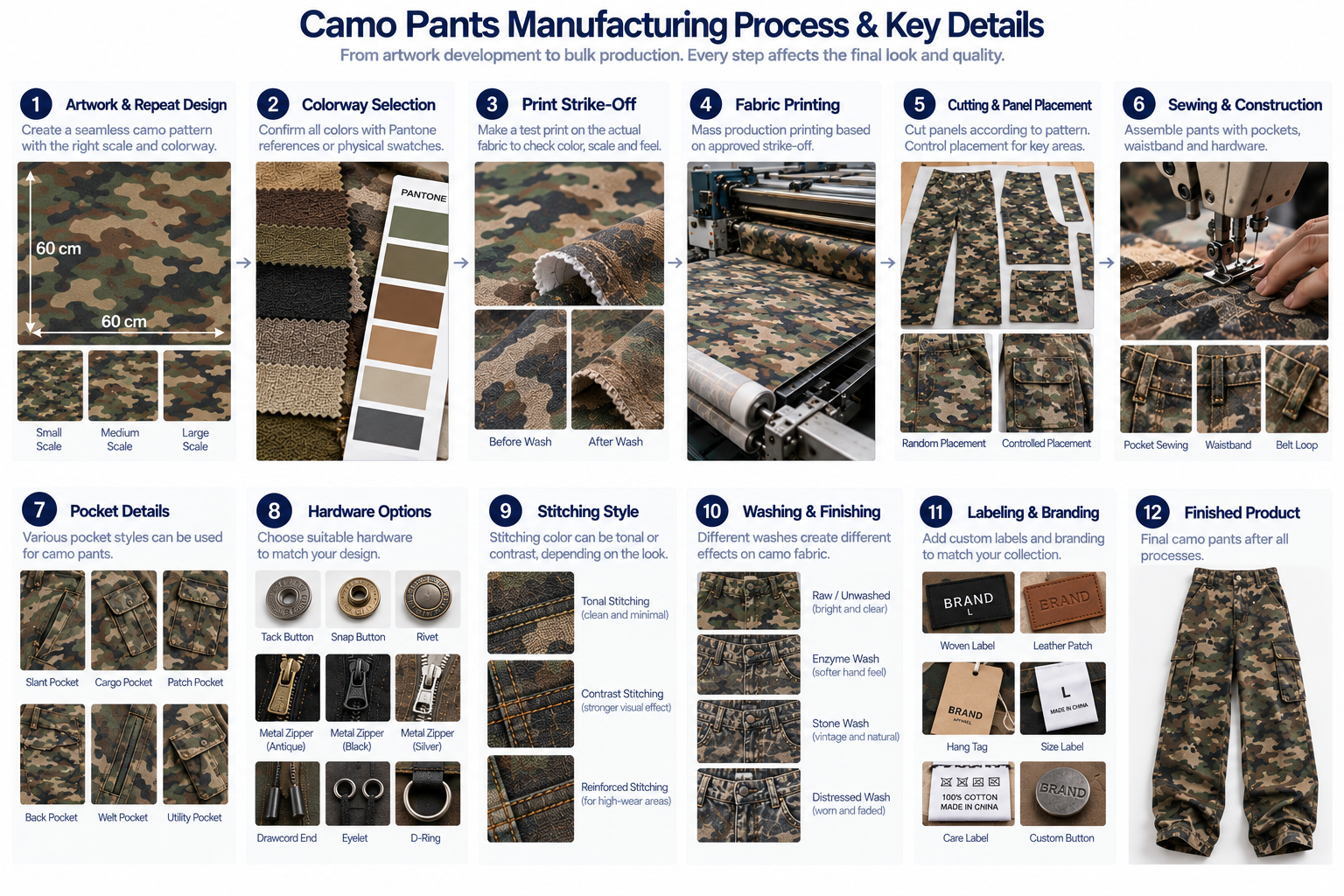
Camo Pattern Development Workflow
A reliable development sequence is:
- Choose garment silhouette
- Select target fabric
- Define camouflage direction
- Build seamless artwork repeat
- Confirm pattern scale
- Define colorway
- Choose print process
- Produce strike-off
- Test wash / finish
- Produce garment sample
- Review placement
- Approve bulk fabric
This is safer than approving the artwork digitally and immediately printing bulk yardage.
What Files Should a Brand Send?
For custom camouflage, useful files include:
- AI
- PSD
- High-resolution TIFF
- High-resolution PNG
Vector artwork is particularly useful when the camouflage needs clean scalable shapes.
The design file should clearly state:
- Artwork dimensions
- Repeat dimensions
- Colors
- Scale
- Orientation
Do not send only a low-resolution screenshot when exact print development is required.
Reference Images Are Not Print Files
A Pinterest or product screenshot can help communicate the visual direction.
But it should not automatically be treated as final production artwork.
Reference images may contain:
- Compression
- Distorted colors
- Unknown pattern scale
- Unknown repeat
- Perspective distortion
The artwork should be rebuilt into a production-ready repeat.
Example Camo Pants Development Brief
Instead of writing:
I want baggy camouflage pants.
a better specification would be:
Relaxed unisex camo pants in 280 GSM 100% cotton twill with a wide straight leg, mid-rise waist and clean hem. Custom four-color woodland-inspired camouflage using olive, dark brown, khaki and black with a medium-scale seamless repeat. Soft garment wash after printing.
Then provide:
- Waist
- Hip
- Rise
- Thigh
- Knee
- Leg opening
- Inseam
- Fabric composition
- GSM
- Camo artwork
- Repeat size
- Pantone references
- Pocket design
- Hardware
- Wash
- Branding
That gives the factory a much more complete starting point.
Example Tonal Streetwear Camo
A premium streetwear direction could use:
- Boxy / baggy fit
- 260–300 GSM cotton twill
- Black / charcoal tonal camo
- Large pattern scale
- Tonal stitching
- Matte black hardware
- Minimal branding
- Soft vintage wash
This creates camouflage without a traditional military appearance.
Example Technical Camo Pants
A technical version could use:
- Relaxed fit
- Lightweight ripstop
- Nylon or nylon blend
- Digital-style camouflage
- Zipper pockets
- Elastic waistband
- Drawcord hem
- Matte hardware
The print process should be selected according to the exact fabric composition.
Example Camo Denim Pants
A denim version could use:
- Relaxed straight leg
- Mid-rise
- 11–13 oz denim
- Tonal printed camouflage
- Five-pocket construction
- Antique metal hardware
- Controlled wash
Print and wash testing becomes especially important because denim finishing can change the artwork dramatically.
Camo Pants Tech Pack Example
| Area | Example Specification |
|---|---|
| Product | Baggy Camo Pants |
| Fit | Relaxed / Wide |
| Rise | Mid Rise |
| Fabric | 100% Cotton Twill |
| Weight | 280 GSM |
| Camo | Custom 4-Color |
| Repeat | Medium Scale |
| Pigment / Reactive Based on Fabric Approval | |
| Waist | Structured Waistband |
| Leg | Straight / Wide |
| Slant Front + Back Pocket | |
| Hem | Clean Finished |
| Hardware | Matte Black |
| Stitching | Tonal |
| Wash | Soft Garment Wash |
| Branding | Woven Label |
These values are examples only.
How to Evaluate the First Camo Pants Sample
A sample should be reviewed for both:
fit
and
Front View
Check:
- Waist
- Hip
- Leg shape
- Pattern scale
- Color distribution
- Pocket placement
Side View
Check:
- Side seam
- Pattern transitions
- Pocket bulk
- Leg width
Back View
Check:
- Back rise
- Back pockets
- Pattern balance
- Seat fit
The camouflage should support the silhouette rather than hide construction problems.
Check the Pattern From a Distance
This is important.
View the garment from:
- Close range
- 2–3 meters away
- Photograph
A pattern that looks detailed up close may visually become one dark mass from a distance.
This is especially common with:
- Small repeats
- Low-contrast colors
The desired viewing effect should be considered before bulk printing.
Check Multiple Samples for Placement Variation
If placement is random, do not evaluate only one garment.
Two or three samples cut from different fabric areas can reveal how much the camouflage appearance varies.
Ask:
- Is the variation acceptable?
- Can one garment become excessively dark?
- Can another become excessively light?
If the variation is too large, the artwork scale or color distribution may need adjustment.
Check Pocket Pattern Placement
Determine whether pockets should:
- Blend into the body
- Contrast against the body
Then ensure the bulk cutting method follows that decision.
Do not leave this detail undefined.
Check After Washing
Compare the sample before and after finishing.
Review:
- Print color
- Fabric shrinkage
- Print adhesion
- Hand feel
- Pocket distortion
- Measurements
The final approved sample should reflect the actual bulk production process.
Common Camo Pants Development Mistakes
1. Treating Camo as a Pant Construction
Camouflage is a surface design.
Fit and construction still need independent specifications.
2. Sending Low-Resolution Artwork
Poor files can create blurry repeats and weak edges.
3. Ignoring Repeat Scale
The artwork may appear much larger or smaller than expected on the garment.
4. Choosing Printing Before Choosing Fabric
The print process needs to match the fiber and finish.
5. Approving Colors Only on Screen
Screen colors are not reliable production standards.
6. Ignoring Placement Variation
Random cutting can create noticeably different garments.
7. Requiring Full Pattern Matching Without Costing It
Matching pockets and panels may increase fabric usage.
8. Using Too Many Colors
Additional colors may increase complexity without improving the design.
9. Washing Without Print Testing
Some wash processes can significantly alter the print.
10. Making the Camo Too Busy for the Garment
Highly detailed artwork can hide pockets, seams and branding.
Camo Pants vs Plain Utility Pants: Which Should Your Brand Develop?
Choose camo pants if you want:
- Strong surface identity
- Y2K or streetwear influence
- Print-driven product
- Earth-tone styling
- More visual impact
Choose plain utility pants if you want:
- Construction to be the main feature
- Easier styling
- More visible seam and pocket details
- Less print development
Choose camo cargo pants if you want both:
surface pattern + strong utility construction
but remember that each adds production complexity.
For a broader overview of pant categories, see our Complete Guide to Pants Types.
FAQ
What Are Camo Pants?
Camo pants are pants made with camouflage-patterned fabric or an all-over camouflage print.
The pants themselves can use many different fits and constructions.
Are Camo Pants in Style in 2026?
Yes.
Camouflage pants are one of the visible 2026 streetwear and fashion revivals, particularly in relaxed, baggy and utility-inspired silhouettes.
Are Camo Pants the Same as Cargo Pants?
No.
Camo describes the surface pattern.
Cargo describes pants with utility pockets.
A pair of pants can be both camo and cargo, but the terms are not interchangeable.
What Fabric Is Best for Camo Pants?
Common fabrics include:
- Cotton twill
- Ripstop
- Canvas
- Denim
- Nylon
- Polyester woven
The best option depends on the intended fit and use.
How Is Camouflage Printed on Cotton?
Possible methods include pigment printing, reactive printing, screen-based fabric printing and suitable digital textile printing.
The correct method depends on fabric, artwork, quantity and desired finish.
Can Camouflage Be Sublimated?
Yes, on suitable polyester fabrics.
Sublimation is generally not the appropriate method for standard 100% cotton twill.
What Is a Camo Repeat?
A repeat is the section of artwork designed to connect seamlessly in every direction so it can be printed continuously across fabric.
Does Camo Need Pattern Matching at Seams?
Usually not.
The irregular pattern makes random seam placement acceptable for many products.
However, premium designs may intentionally match pockets or selected panels.
Can I Create a Custom Camouflage Pattern?
Yes.
A custom camouflage can use unique shapes, scale and colors to create a brand-specific print.
What Is the Best Camo Scale for Baggy Pants?
There is no fixed standard.
Medium or large-scale patterns often work well because baggy pants provide a larger visual surface.
The scale should be approved on an actual garment sample.
Does Camo Printing Increase MOQ?
Custom printing may require higher minimums than using stock printed fabric.
The exact MOQ depends on the fabric mill, print process and artwork.
Does Pattern Matching Increase Cost?
It can.
Matching pockets or panels can reduce cutting efficiency and increase fabric consumption and labor.
Can Camo Pants Be Washed or Vintage Finished?
Yes, depending on the fabric and print chemistry.
The selected wash should be tested on the printed fabric before bulk approval.
What Should Be Included in a Camo Pants Tech Pack?
Include:
- Fit measurements
- Fabric
- Composition
- Weight
- Camo artwork
- Repeat size
- Colors
- Print method
- Pocket construction
- Hardware
- Stitching
- Wash
- Branding
Final Thoughts
Camo pants are not simply ordinary pants made from a patterned fabric.
The quality of the final garment depends on how several elements work together:
artwork + repeat + scale + color + fabric + printing + pattern + wash
A small tonal camouflage can create a subtle technical surface.
A large woodland-inspired print can create strong streetwear impact.
A lightweight ripstop can make the garment feel functional.
A heavy cotton twill can produce a structured baggy silhouette.
And the same camouflage artwork can look completely different when printed on different fabrics.
For clothing brands, the most important step is defining the camouflage as part of the garment development process rather than treating it as decoration added at the end.
Once the fabric, artwork, print process and fit are approved together, camouflage pants can be reproduced much more consistently from sampling through bulk production.
Keep Reading