The quarter-zip has become one of the most visible layering pieces of 2026.
Once associated mainly with:
- Golf
- Corporate casualwear
- Preppy menswear
- Outdoor clothing
the quarter-zip is now appearing across:
- Streetwear
- Women's fashion
- Athleisure
- Matching sets
- Oversized casualwear
- Premium basics
Why?
Because it sits somewhere between several familiar garments.
It is cleaner than a hoodie.
More adjustable than a crewneck sweatshirt.
More casual than a traditional sweater.
And easier to layer than many collared tops.
For clothing brands, however, a good quarter-zip is not created simply by cutting a zipper into the neckline of a sweatshirt.
The:
Collar
Zipper
Neck opening
Fabric
Pattern
and
Front-body construction
all need to work together.
This guide explains why quarter-zips are trending and what brands should consider when developing one for production.
What Is a Quarter-Zip Sweatshirt?
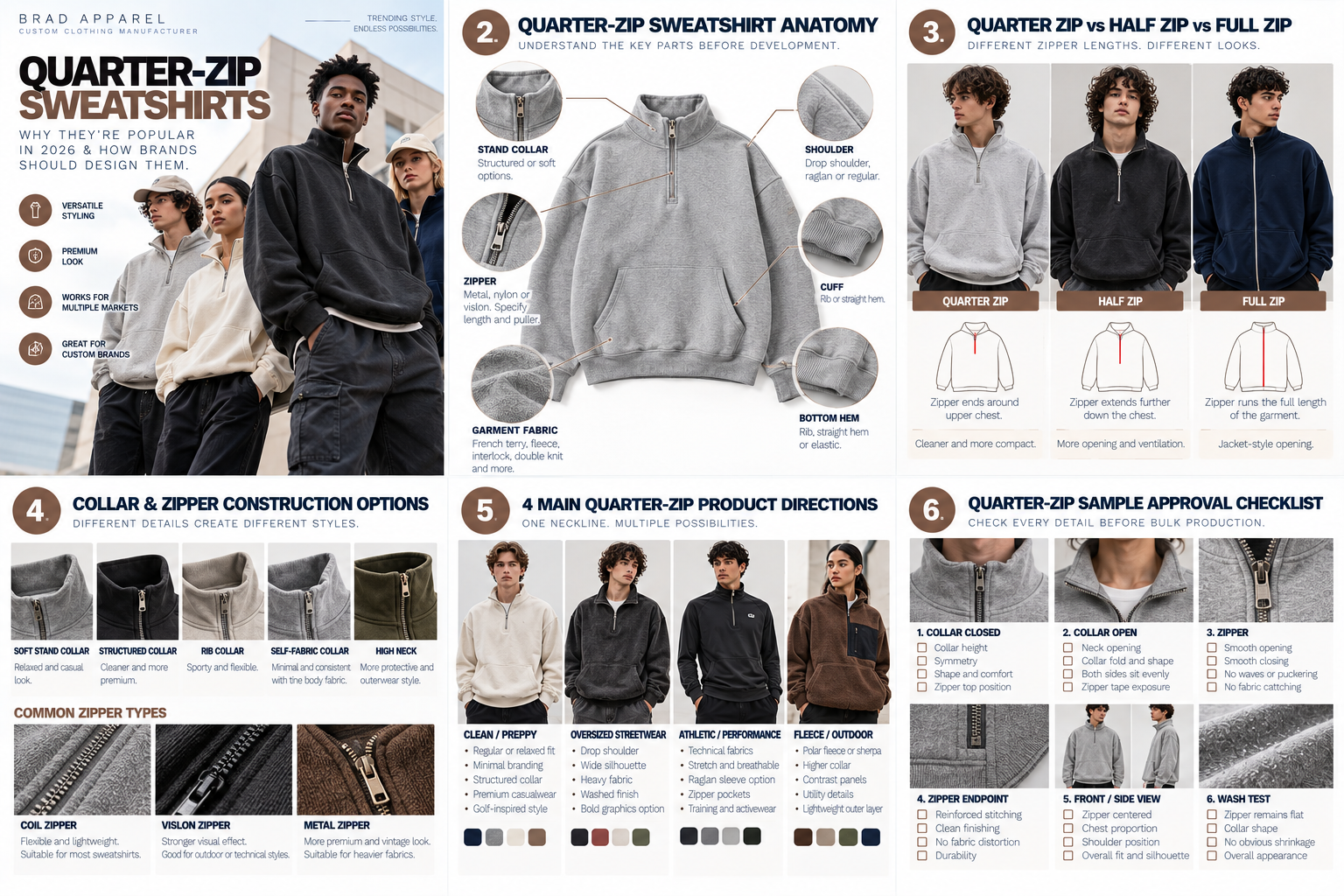
A quarter-zip sweatshirt is a pullover garment with a zipper running from the neckline partway down the upper chest.
Typical construction includes:
- Stand collar or structured neckline
- Short front zipper
- Pullover body
- Rib or straight cuffs
- Rib or straight hem
- Sweatshirt, fleece or double-knit fabric
The zipper allows the wearer to adjust the neckline without turning the garment into a full zip-up jacket.
Closed:
Cleaner and more structured
Partially open:
Relaxed and easy to layer
Fully open at the neck:
More ventilation and a wider neckline
That flexibility is one reason the style works across so many categories.
Why Are Quarter-Zips Trending in 2026?
The quarter-zip fits several broader fashion directions happening at the same time.
1. Casual Clothing Is Becoming More Polished
For several years, oversized hoodies and very relaxed athleisure dominated casualwear.
Quarter-zips offer another direction.
They keep the comfort of a sweatshirt but introduce:
- A collar
- A cleaner neckline
- Less hood bulk
- More structure around the upper body
The result feels more refined without becoming formal.
2. Preppy and Heritage Sportswear Are Back
Modern fashion continues to revisit:
- Collegiate clothing
- Rugby styling
- Tennis apparel
- Golf influences
- Vintage sportswear
- Ivy-inspired dressing
The quarter-zip fits naturally into this category.
But today's versions are not limited to traditional slim-fit preppy styling.
They can also be:
- Oversized
- Cropped
- Heavyweight
- Washed
- Technical
- Minimal
3. It Works Across Different Age Groups
A quarter-zip does not belong to one narrow aesthetic.
A clean cotton version can work for office casualwear.
An oversized washed version can work for streetwear.
A technical double-knit version can work for activewear.
A soft fleece version can work for loungewear.
This makes it commercially flexible for brands.
Quarter Zip vs Half Zip: What's the Difference?
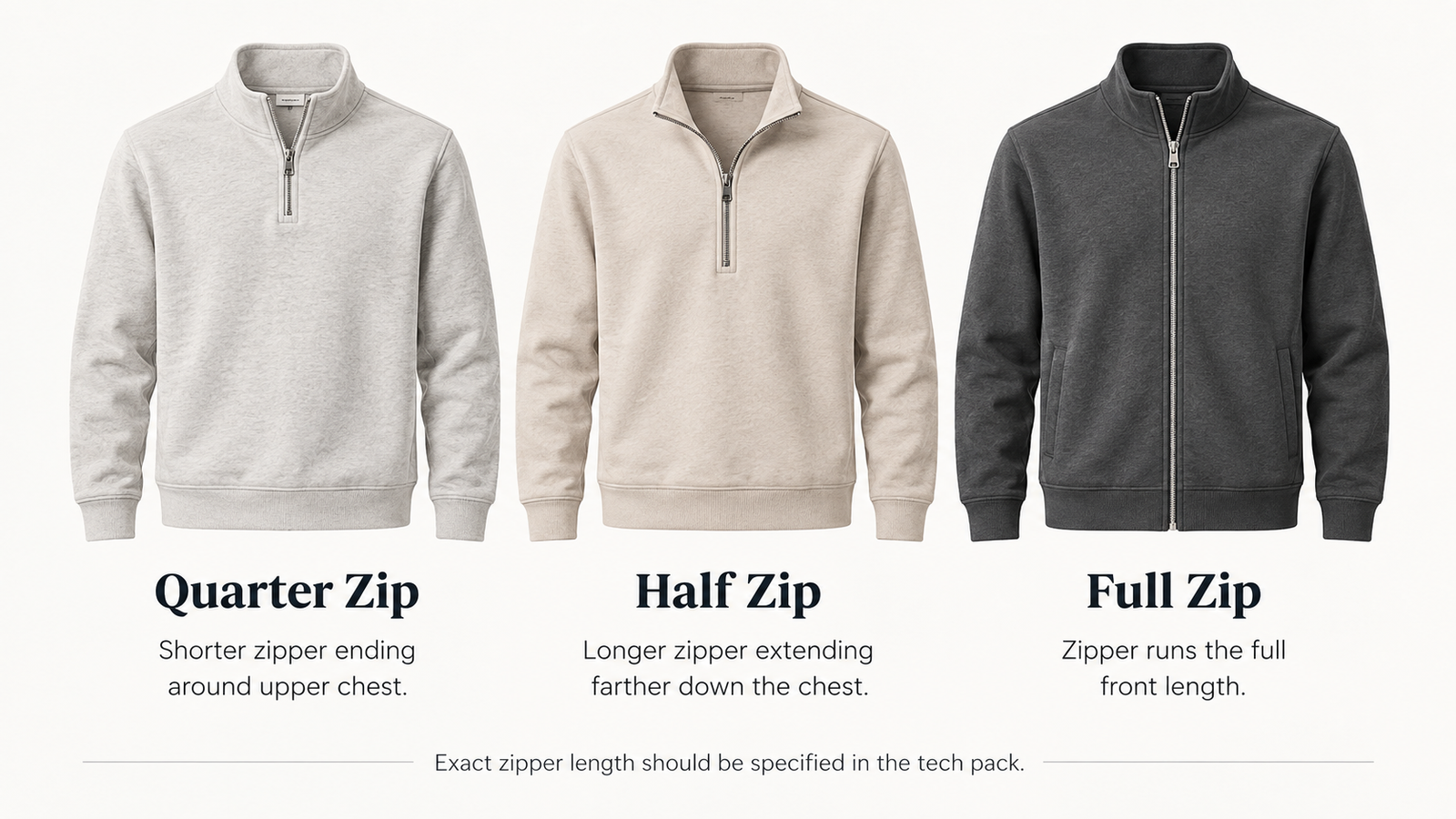
The terms quarter zip and half zip are sometimes used interchangeably in fashion.
But technically, they can describe slightly different zipper lengths.
| Style | Typical Zipper Direction | Visual Effect |
|---|---|---|
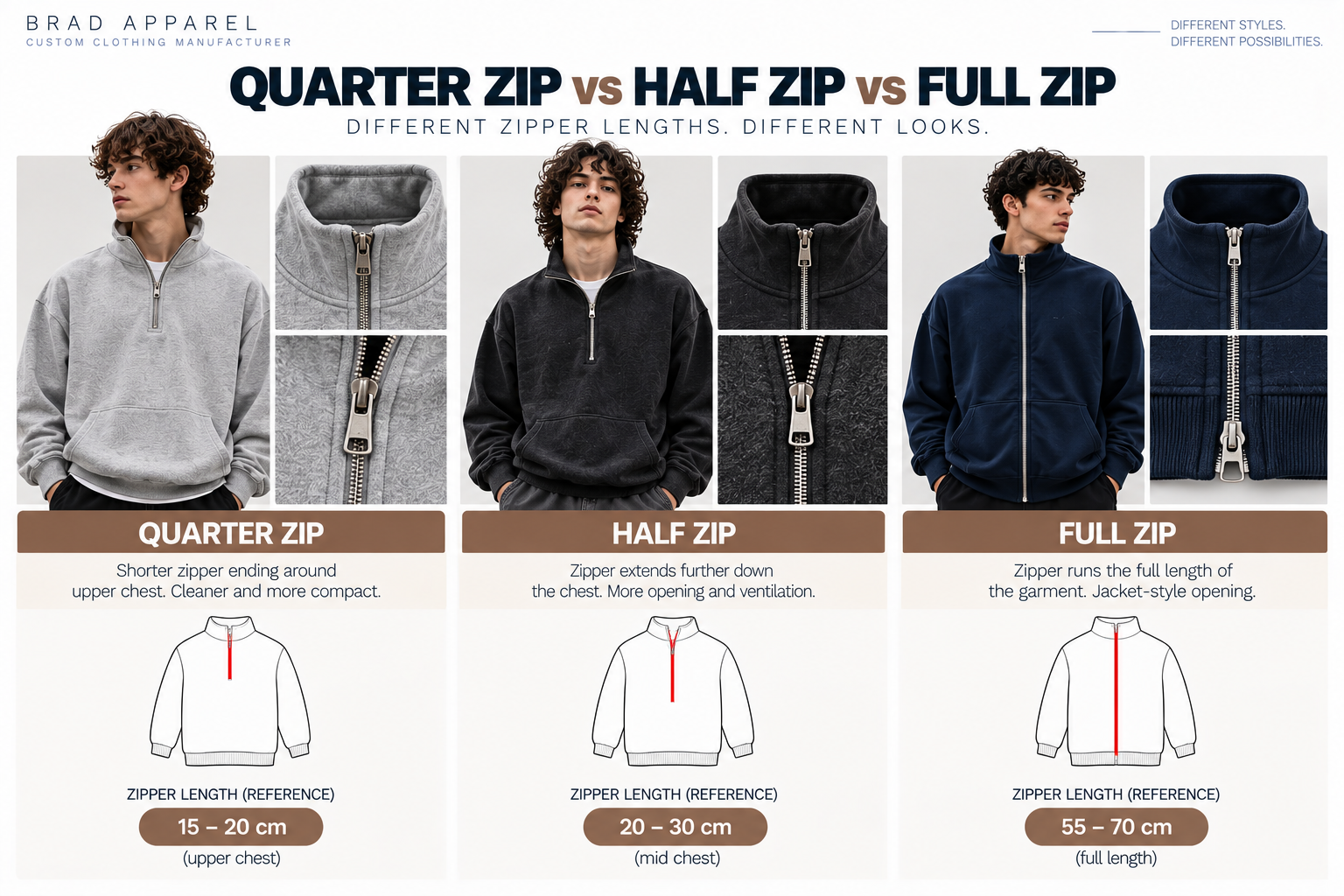
| Quarter Zip | Shorter zipper ending around upper chest | Cleaner and more compact |
| Half Zip | Longer zipper extending further down chest | More opening and ventilation |
| Full Zip | Zipper runs entire front length | Jacket-style opening |
There is no universal industry measurement that defines exactly where every quarter zip must end.
What matters in product development is specifying the actual:
zipper length
rather than relying only on the name.
Quarter-Zip Sweatshirt vs Quarter-Zip Sweater
These are also different products.
A quarter-zip sweater is normally made using sweater-knit construction.
Possible materials include:
- Merino wool
- Cotton knit
- Cashmere
- Wool blends
- Synthetic sweater yarns
A quarter-zip sweatshirt is normally cut and sewn from knitted garment fabric such as:
- French terry
- Fleece
- Interlock
- Double knit
- Jersey
- Performance knit
The visual idea may be similar.
The manufacturing method is not.
For a cut-and-sew apparel brand, the quarter-zip sweatshirt usually offers more flexibility for:
- Oversized fits
- Streetwear styling
- Washing
- Printing
- Embroidery
- Matching sweat sets
Quarter-Zip vs Zip Polo
A zip polo normally maintains more of the visual language of a polo.
That may include:
- Polo collar
- Piqué fabric
- Interlock
- Shorter body
- More structured sportswear fit
A quarter-zip sweatshirt normally feels closer to:
crewneck sweatshirt + stand collar + zipper
The zipper may look similar, but the body construction and intended use can be very different.
The 4 Main Quarter-Zip Product Directions
One reason quarter-zips are commercially interesting is that the same basic neckline can support very different products.
1. Clean / Preppy Quarter-Zip
Typical characteristics:
- Regular or relaxed fit
- Clean surface
- Minimal branding
- Structured collar
- Small chest embroidery
Suitable for:
- Premium casualwear
- Corporate-inspired fashion
- Golf-inspired collections
- Minimal brands
Neutral colors work particularly well.
Examples include:
- Navy
- Charcoal
- Cream
- Heather grey
- Dark brown
2. Oversized Streetwear Quarter-Zip
This version moves away from traditional preppy styling.
Typical features may include:
- Drop shoulder
- Wide chest
- Wide sleeves
- Controlled body length
- Large collar
- Heavy fabric
- Washed finish
Possible decoration includes:
- Back graphics
- Sleeve prints
- Small chest embroidery
- Appliqué
- Tonal branding
A quarter-zip can therefore work within streetwear without becoming another hoodie.
3. Athletic / Performance Quarter-Zip
Performance versions may use:
- Double knit
- Polyester blends
- Nylon blends
- Stretch fabrics
Possible construction features include:
- Raglan sleeves
- Zipper pockets
- Thumbholes
- Reflective details
- Lightweight collar
- Mesh panels
These products are closer to:
training layers
than traditional sweatshirts.
4. Fleece / Outdoor Quarter-Zip
Another direction uses:
- Polar fleece
- Sherpa
- Brushed fleece
- Textured pile fabrics
These styles may include:
- Higher collars
- Contrast chest panels
- Utility pockets
- Elastic or adjustable hems
The quarter zip becomes a lightweight outer layer rather than only a sweatshirt.
The Collar Is the Most Important Design Detail

The collar determines much of the final appearance.
A quarter-zip collar may be:
Soft Stand Collar
Relaxed and casual.
Structured Stand Collar
Cleaner and more premium.
Rib Collar
Sporty and flexible.
Self-Fabric Collar
Minimal and consistent with the body fabric.
High Neck
More protective and outerwear-oriented.
Collar Height Changes the Entire Look
A short collar creates a subtle neckline.
A taller collar creates a stronger visual feature.
But taller is not automatically better.
A collar that is too high may:
- Touch the chin
- Fold awkwardly
- Feel restrictive
- Collapse when the zipper is open
The collar should therefore be tested:
zipped
and
unzipped
during sampling.
Zipper Length Should Be Specified in Centimeters
Do not send a manufacturer only:
"Make it quarter zip."
Specify the actual zipper length.
For example:
18 cm
22 cm
25 cm
depending on:
- Garment size
- Collar height
- Intended opening
- Overall proportions
The correct length should be confirmed on the sample.
Zipper Type Changes the Product
Several zipper constructions can work.
Coil Zipper
Flexible and relatively lightweight.
Suitable for:
- Sweatshirts
- Sportswear
- Casual pieces
Vislon / Molded Zipper
Creates a stronger visual zipper.
Often suitable for:
- Outdoor products
- Technical clothing
- Heavier fleece
Metal Zipper
Adds a more premium or vintage appearance.
But it is:
- Heavier
- More visually dominant
- Less flexible than a lightweight coil zipper
The garment fabric should be able to support it.
Exposed vs Hidden Zipper
An exposed zipper becomes part of the design.
A concealed or cleaner zipper construction creates a more minimal appearance.
Brands should specify:
- Zipper tape color
- Teeth color
- Puller
- Slider
- Length
- Exposure
- Top finish
Do not treat the zipper as a generic component.
Why Quarter-Zip Zippers Sometimes Wave
One of the most common defects is a zipper that does not lie flat.
Instead, the center front looks:
wavy
or
puckered
This usually happens because the zipper and garment fabric behave differently.
For example:
The fabric may stretch.
The zipper tape may not.
If they are fed through the sewing machine at different tensions, the front can distort.
How Factories Reduce Zipper Puckering
Depending on the fabric and design, production may require:
- Stabilization
- Appropriate seam allowance
- Controlled zipper feeding
- Suitable sewing tension
- Pre-shrunk fabric
- Accurate zipper length
- Sample washing
The most important test is simple:
Does the zipper remain flat after washing?
A quarter-zip can look perfect before washing and develop waves afterward if the fabric shrinks differently from the zipper tape.
The Bottom of the Zipper Needs Reinforcement
The zipper endpoint concentrates stress in one small area.
When the wearer opens the neckline, the bottom of the zipper can be pulled repeatedly.
The construction may therefore require:
- Reinforced stitching
- Bartack where appropriate
- Clean facing
- Stable backing
Poor construction can lead to:
- Fabric tearing
- Seam distortion
- Zipper separation
Consider a Zipper Guard
A zipper guard or underlay can sit behind the zipper.
Possible benefits include:
- Reducing skin contact
- Preventing fabric from catching
- Cleaner interior appearance
- Added structure
For higher collars, a small chin guard may also improve comfort.
Fit Changes How a Quarter-Zip Looks
The exact same collar can feel completely different on different body patterns.
Regular Fit
Creates:
- Classic appearance
- Easy layering
- Cleaner proportions
Suitable for:
- Casualwear
- Premium basics
- Uniform-inspired collections
Oversized Fit
Creates:
- Wider silhouette
- More streetwear influence
- Stronger visual collar contrast
Important measurements include:
- Chest width
- Shoulder width
- Body length
- Sleeve width
- Sleeve length
A quarter-zip should be designed around the intended silhouette rather than simply sizing up an existing regular pattern.
Cropped Fit
Cropped quarter-zips are increasingly relevant in fashion and women's collections.
Possible details include:
- Wide body
- Short length
- Elastic hem
- Straight hem
- High collar
Collar height becomes especially important because it occupies more visual space on a shorter garment.
Which Fabric Works Best?
There is no single best quarter-zip fabric.
Choose according to the product direction.
French Terry
Works well for:
- Casualwear
- Streetwear
- Transitional collections
Offers the familiar sweatshirt feel without requiring a brushed interior.
Brushed Fleece
Suitable for:
- Autumn
- Winter
- Loungewear
- Matching sets
Provides more warmth.
Interlock / Double Knit
Useful when the goal is:
- Clean surface
- More structure
- Stable collar
- Premium appearance
This can work particularly well for minimal quarter-zips.
Polar Fleece
Suitable for:
- Outdoor-inspired styles
- Casual layering
- Winter products
Its texture makes the quarter-zip feel closer to light outerwear.
Performance Knit
Suitable for:
- Training
- Golf
- Tennis
- Activewear
The appropriate composition depends on the required:
- Stretch
- Weight
- Breathability
- Surface
- End use
Brad Apparel's Fabric Sourcing & Development service covers fabric structure, weight, composition, color and finishing before sampling.
Decoration Placement Needs to Account for the Zipper
A quarter-zip changes the most obvious decoration area:
the center chest.
A standard crewneck can use a large central front logo.
A quarter-zip cannot always do this because the zipper interrupts the artwork.
Better Decoration Placements
Consider:
Left Chest
Ideal for:
- Small embroidery
- Logo
- Patch
Back
Useful for:
- Large graphics
- Typography
- Screen printing
Sleeves
Suitable for:
- Text
- Small logos
- Embroidery
Lower Front
Can work when the graphic is intentionally positioned below the zipper.
Avoid Accidentally Splitting Artwork
If a large front design crosses the zipper, ask:
Is the split intentional?
If not, move the graphic.
Trying to force a continuous print across:
zipper + zipper tape + garment fabric
can create unnecessary alignment problems.
Brad Apparel's verified Printing Techniques page explains available printing directions for different garment surfaces and artworks.
Quarter-Zip as Part of a Matching Set
One strong commercial direction is:
quarter-zip top + matching pants
Instead of another standard hoodie-and-jogger set.
Possible bottoms include:
- Straight sweatpants
- Wide-leg sweatpants
- Joggers
- Shorts
Using the same fabric helps create:
- Consistent color
- Consistent hand feel
- Stronger collection identity
The quarter-zip gives the set a noticeably different appearance from a traditional hoodie tracksuit.
What Should You Check on the Sample?

A quarter-zip sample should be checked both:
open
and
closed.
1. Collar Closed
Check:
- Collar height
- Symmetry
- Comfort
- Shape
- Zipper top position
2. Collar Open
Check:
- How the collar folds
- Whether both sides sit evenly
- Neck opening
- Zipper tape exposure
3. Zipper
Check:
- Smooth opening
- Smooth closing
- Flatness
- No waves
- No fabric catching
4. Zipper Endpoint
Check:
- Reinforcement
- Stitch quality
- Fabric distortion
- Interior finishing
5. Front View
Check:
- Zipper centered
- Collar symmetrical
- Chest proportions
- Decoration placement
6. Side View
Check:
- Collar angle
- Body drape
- Shoulder position
7. Wash Test
After washing, check:
- Zipper wave
- Collar shape
- Fabric shrinkage
- Seam distortion
- Overall appearance
This is particularly important because zipper tape and sweatshirt fabric may shrink differently.
Common Quarter-Zip Development Mistakes
1. Zipper Too Long
The garment begins to look like a half-zip or technical jacket unintentionally.
2. Zipper Too Short
The opening may not provide enough functional adjustment.
3. Collar Too Soft
It collapses rather than holding the intended shape.
4. Collar Too Stiff
It feels uncomfortable around the neck.
5. Zipper Waves After Washing
Usually indicates tension, shrinkage or stabilization problems.
6. Oversized Body With a Tiny Collar
The proportions feel disconnected.
7. Heavy Metal Zipper on Lightweight Fabric
The zipper can dominate or distort the garment.
8. Artwork Competes With the Zipper
A large centered graphic may no longer work once the zipper is introduced.
What Should You Send a Manufacturer?
A useful quarter-zip development brief should include:
Garment Type
- Quarter zip
- Half zip
- Zip polo
- Performance quarter zip
Fit
- Slim
- Regular
- Relaxed
- Oversized
- Cropped
Fabric
- Composition
- Structure
- Target weight
- Color
- Finish
Collar
- Height
- Structure
- Self fabric or rib
Zipper
- Exact length
- Zipper type
- Color
- Puller
- Exposed or hidden
Cuffs
- Rib
- Self fabric
- Elastic
- Straight hem
Bottom Hem
- Rib
- Straight
- Elastic
- Drawcord
Decoration
- Embroidery
- Patch
- Placement
Branding
- Main label
- Care label
- Hang tag
Packaging
- Polybag
- Custom bag
- Barcode
The more specific the brief, the less the factory needs to guess.
How Brad Apparel Approaches Quarter-Zip Development
A quarter-zip project can follow a development process such as:
Design Direction
↓
Fabric Confirmation
↓
Fit & Pattern
↓
Collar Development
↓
Zipper Selection
↓
Sample
↓
Fit + Zipper Review
↓
Decoration Approval
↓
Bulk Production
Because the zipper and collar affect the garment's structure, they should be confirmed during sampling rather than treated as last-minute accessories.
For brands unfamiliar with factory development, our existing guide to custom sweatshirt manufacturing explains the broader process from specification to bulk production.
FAQ
What Is a Quarter-Zip Sweatshirt?
A quarter-zip sweatshirt is a pullover sweatshirt with a zipper running from the neckline partway down the upper chest.
It usually uses a stand collar or structured neckline.
Why Are Quarter-Zips So Popular?
Quarter-zips combine:
- Comfort
- Layering flexibility
- Adjustable neckline
- Cleaner styling than many hoodies
They can work across preppy, casual, athletic and streetwear categories.
Is a Quarter Zip the Same as a Half Zip?
The terms are sometimes used interchangeably.
Generally, a half zip extends further down the chest.
For production, it is better to specify the exact zipper length instead of relying only on the name.
Is a Quarter-Zip a Sweatshirt or a Sweater?
It can be either.
A quarter-zip sweater is generally produced using sweater-knit construction.
A quarter-zip sweatshirt is cut and sewn from fabrics such as French terry, fleece, interlock or performance knits.
Can a Quarter-Zip Be Oversized?
Yes.
An oversized quarter-zip can use:
- Drop shoulders
- Wider chest
- Wider sleeves
- Controlled body length
- Larger collar proportions
The pattern should be developed intentionally.
What Fabric Is Best for a Quarter-Zip?
It depends on the intended product.
Common options include:
- French terry
- Fleece
- Interlock
- Double knit
- Polar fleece
- Performance knits
Can You Print on a Quarter-Zip?
Yes.
However, the zipper interrupts the center-front area.
Common decoration placements include:
- Left chest
- Back
- Sleeve
- Lower front
Embroidery, screen printing and other techniques can all work depending on the fabric.
Why Does My Quarter-Zip Zipper Look Wavy?
Possible causes include:
- Fabric stretch
- Sewing tension
- Zipper-feed tension
- Fabric shrinkage
- Incorrect stabilization
The zipper should be evaluated again after washing the sample.
Should I Use a Metal or Nylon Zipper?
Neither is universally better.
Metal provides a heavier, more visible appearance.
Coil or molded plastic zippers can be lighter and more flexible.
Choose according to:
- Fabric
- Product style
- Weight
- Desired appearance
Final Thoughts
The quarter-zip is popular because it sits between several familiar clothing categories.
It can feel:
more polished than a hoodie
more flexible than a crewneck
and
more casual than traditional knitwear.
But for clothing brands, its simplicity can be deceptive.
The final quality depends heavily on:
Collar proportion
Zipper length
Zipper stability
Fit
Fabric
and
Decoration placement
A strong quarter-zip should look balanced both open and closed.
That is the difference between simply adding a zipper to a sweatshirt and developing a quarter-zip as its own product.
Keep Reading