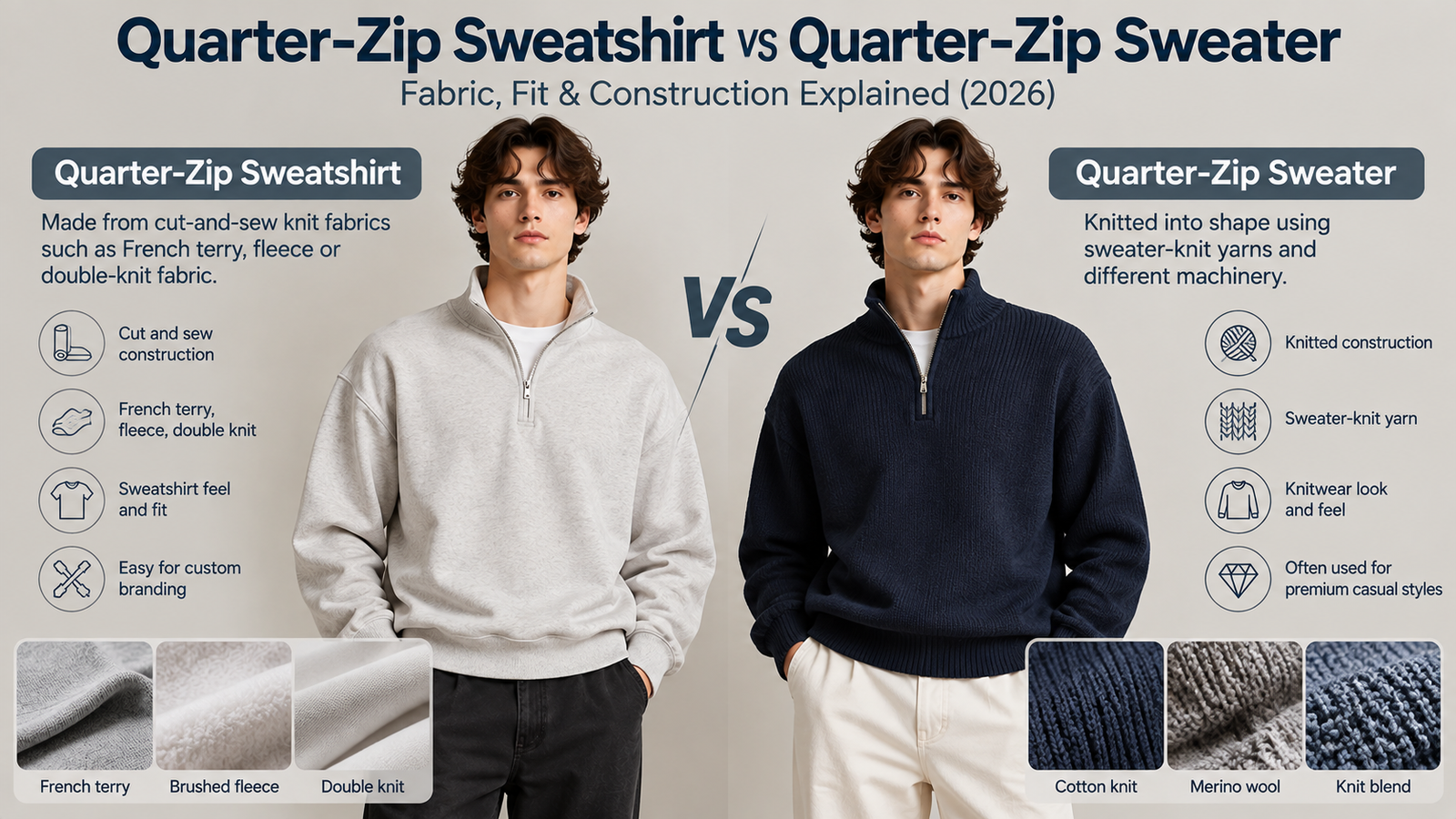
They may look similar in photos, but they are usually built very differently.
A quarter-zip sweatshirt is normally made from cut-and-sew knit fabrics such as French terry, fleece or double-knit fabric.
A quarter-zip sweater is normally knitted into shape using sweater-knit yarns and different machinery.
The difference affects:
- Fabric
- Pattern construction
- Collar structure
- Zipper installation
- Fit
- Stretch
- Seam construction
- Sampling
- Production method
This guide explains how quarter-zip sweatshirts are developed, how they differ from sweaters and half-zips, and what clothing brands should specify before sampling.
What Is a Quarter-Zip?
A quarter-zip is a pullover garment with a zipper starting at the top of the collar and extending partway down the front chest.
Unlike a full-zip jacket, the zipper does not continue to the hem.
The garment is pulled over the head like a sweatshirt or sweater.
A typical quarter-zip includes:
- High or stand collar
- Short center-front zipper
- Pullover body
- Long sleeves
- Ribbed, self-fabric or elasticated cuffs
- Straight or ribbed hem
Depending on the design, the silhouette can feel:
- Preppy
- Athletic
- Minimal
- Outdoor-inspired
- Streetwear
- Premium casual
This versatility is one reason quarter-zips work across very different clothing collections.
Quarter-Zip vs Half-Zip: Is There a Difference?
The terms are often used interchangeably.
Technically, they describe the approximate length of the zipper.
Quarter-Zip
The zipper normally extends from the collar to the upper chest.
Half-Zip
The zipper generally extends further down the front body.
However, there is no universal industry rule defining exactly where a quarter-zip must end.
Two brands may both call their garments quarter-zips even if one zipper is noticeably longer.
For manufacturing, the name is therefore less important than the actual specification.
Instead of writing:
Quarter zip
the tech pack should define:
- Zipper length
- Zipper width
- Collar height
- Opening position
- Zipper type
- Zipper tape color
- Puller design
This prevents different interpretations during sampling.
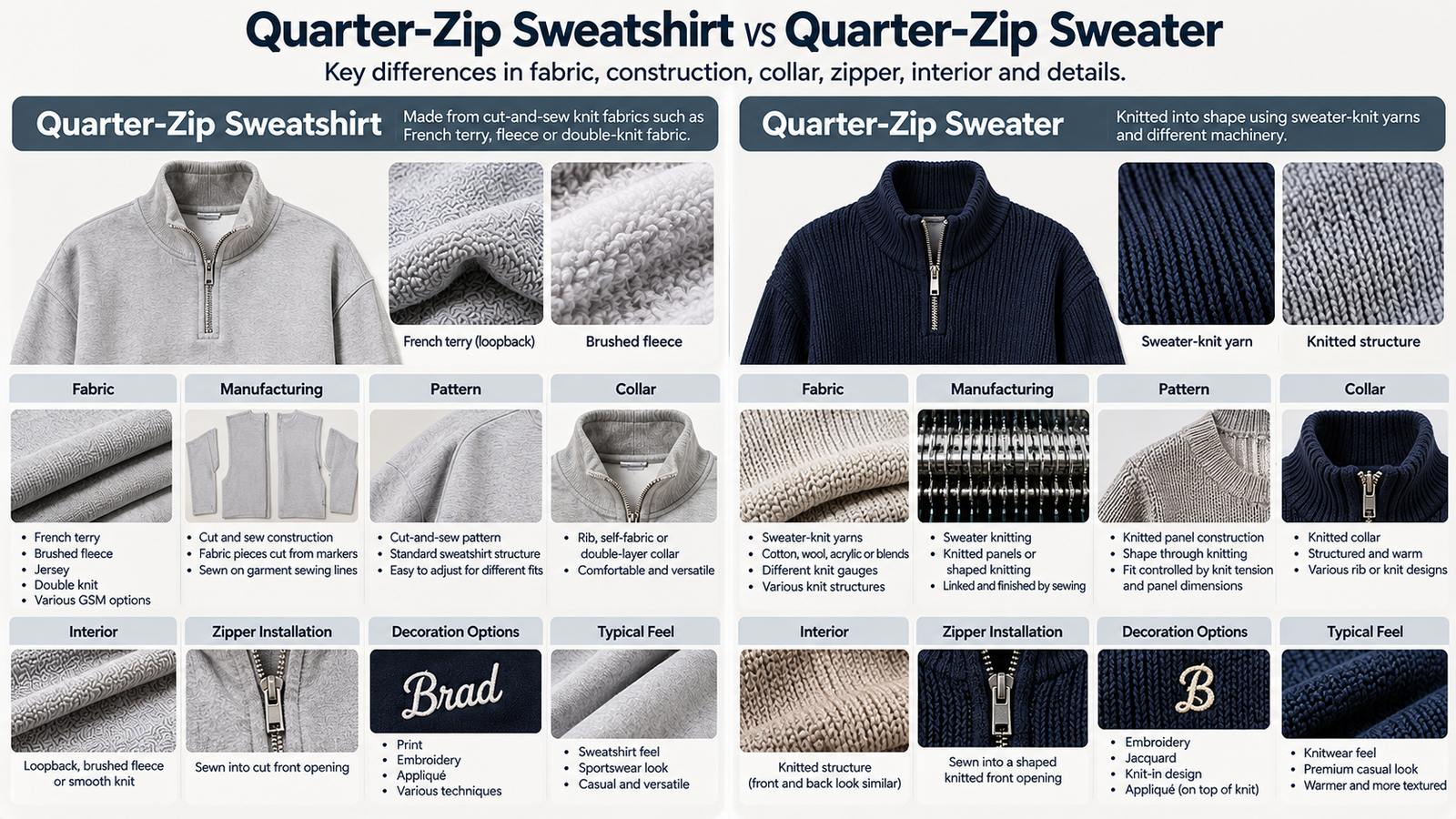
Quarter-Zip Sweatshirt vs Quarter-Zip Sweater
The biggest difference is how the garment itself is produced.
| Feature | Quarter-Zip Sweatshirt | Quarter-Zip Sweater |
|---|---|---|
| Main Material | French terry, fleece, jersey, double knit | Knitted yarn |
| Manufacturing | Cut and sew | Sweater knitting |
| Pattern | Fabric pieces cut from markers | Knitted panels / shaped knitting |
| Interior | Loopback, brushed fleece or smooth knit | Knitted structure |
| Fit Control | Cut-and-sew pattern | Knit tension + panel dimensions |
| Collar | Rib, self-fabric or structured fabric | Knitted collar |
| Decoration | Print, embroidery, appliqué | Embroidery, jacquard, knit-in design |
| Typical Feel | Sweatshirt / sportswear | Knitwear / premium casual |
| Zipper Installation | Sewn into cut front opening | Integrated into knit construction |
This distinction matters when requesting quotations.
A factory specializing in cut-and-sew hoodies and sweatshirts may produce a quarter-zip sweatshirt very well but may not necessarily manufacture fully knitted sweaters.
Likewise, sweater factories use machinery and development methods that are very different from traditional garment sewing lines.
What Is a Quarter-Zip Sweatshirt Made From?
There is no single correct fabric.
The right material depends on the silhouette, season and price target.
French Terry
French terry has visible loops on the inside and a smoother surface on the outside.
It works well when a brand wants:
- Clean structure
- Breathability
- Transitional-season wear
- Premium streetwear feel
French terry can range from relatively light constructions to substantial heavyweight fabrics.
Brushed Fleece
Brushed fleece has a soft interior surface.
It is suitable for:
- Autumn and winter
- Loungewear
- Heavyweight streetwear
- Warm casual layers
Compared with French terry, brushed fleece normally feels warmer and softer internally.
Double-Knit Fabric
Double-knit constructions can create a cleaner and more structured appearance.
They may be suitable when the quarter-zip needs to feel:
- Smooth
- Minimal
- Modern
- Slightly more technical
Some double knits also offer more stability around the collar and zipper area.
Performance Knits
Quarter-zips are also common in golf, training and technical apparel.
Possible fabrics include:
- Polyester jersey
- Nylon blends
- Polyester/spandex
- Moisture-wicking knits
- Interlock
- Scuba-style knits
These fabrics produce a very different garment from a heavyweight cotton quarter-zip.
The fabric should therefore be selected around the intended product rather than around the name "quarter zip."
Brad Apparel's Fabric Sourcing & Development service covers fabric composition, GSM, structure, stretch, hand feel and finishing for custom garment development.
What GSM Is Good for a Quarter-Zip Sweatshirt?
There is no universal ideal GSM.
A useful starting range can be:
| Fabric Weight | Typical Direction |
|---|---|
| 180–240 GSM | Lightweight / athletic |
| 240–320 GSM | Midweight everyday quarter-zip |
| 320–420 GSM | Premium heavyweight |
| 420 GSM+ | Very structured streetwear |
But GSM alone does not determine how the garment will behave.
Two 350 GSM fabrics can have very different:
- Thickness
- Density
- Drape
- Stretch
- Surface texture
- Hand feel
A dense French terry may hold the collar differently from a soft brushed fleece at the same nominal GSM.
This becomes especially important around the zipper opening.
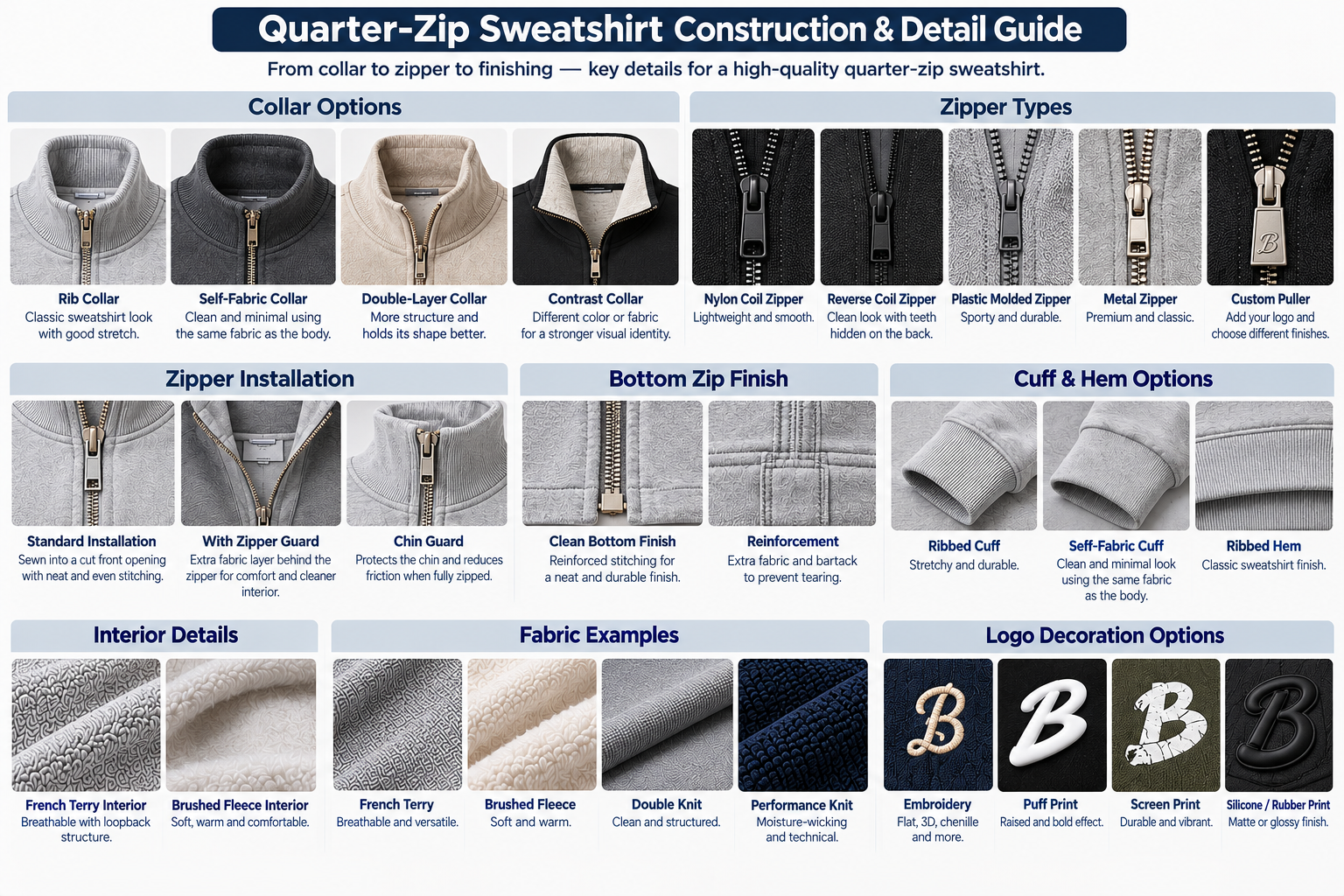
The Collar Defines the Character of a Quarter-Zip
The collar is one of the most important design elements.
A small change in collar height or structure can move the garment from sportswear to premium casualwear.
Common collar directions include:
Rib Collar
A ribbed collar provides stretch and a traditional sweatshirt feel.
It can work well for:
- Vintage sportswear
- Casual quarter-zips
- Relaxed streetwear
Self-Fabric Collar
The collar uses the same fabric as the body.
This often creates:
- Cleaner visual continuity
- More structure
- Minimal appearance
Heavy fabrics may require additional reinforcement to prevent the collar from collapsing.
Double-Layer Collar
Two layers of fabric can create more body.
This may help the collar:
- Stand upright
- Hold its shape
- Frame the zipper cleanly
But an excessively thick collar can become bulky when folded.
Contrast Collar
A different color or fabric can create a stronger visual identity.
This works particularly well for:
- Retro sportswear
- Rugby-inspired designs
- Collegiate collections
- Color-block garments
Collar Height Should Be Specified
Do not simply write:
High collar
Different manufacturers may interpret this differently.
Instead, define the finished collar height.
For example:
Collar height: 7 cm
or:
Collar height: 9 cm
Then evaluate the sample:
Fully zipped
and
Partially open
because the collar behaves differently in both positions.
A collar that looks clean when zipped may flare outward awkwardly when opened.
Zipper Length Changes the Entire Look
The zipper is not simply functional hardware.
Its length affects the proportions of the garment.
Shorter Quarter-Zip
Creates:
- Cleaner upper chest
- More classic appearance
- Smaller opening
- Stronger collar emphasis
Longer Half-Zip Style
Creates:
- Larger opening
- More layering options
- More visible underlayer
- More athletic or outdoor appearance
The zipper should be considered together with:
- Chest width
- Collar height
- Logo placement
- Front seam construction
A zipper that looks proportionate on a regular-fit Medium may look too short on an extremely oversized garment.
What Type of Zipper Should a Quarter-Zip Use?
Several zipper types can work.
Nylon Coil Zipper
Advantages:
- Lightweight
- Flexible
- Smooth operation
- Less bulky
Suitable for many casual and performance quarter-zips.
Reverse Coil Zipper
The zipper teeth face inward, creating a cleaner exterior.
This can work particularly well for:
- Minimal styles
- Performance wear
- Technical designs
Plastic Molded Zipper
More visually substantial.
Suitable when the design needs a stronger sporty or outdoor feel.
Metal Zipper
Metal creates a more noticeable hardware detail.
It can work well for:
- Premium streetwear
- Vintage-inspired designs
- Heavyweight fabrics
But the weight should match the body fabric.
A heavy metal zipper installed into a soft lightweight knit can pull the center front downward or create distortion.
Brad Apparel's Custom Zippers & Sliders options include metal, nylon coil, reverse coil, molded zippers and custom-branded pullers.
Zipper Weight Should Match Fabric Weight
This is one of the most common development mistakes.
Imagine:
lightweight fabric + heavy metal zipper
The zipper may dominate the garment.
Possible problems include:
- Wavy center front
- Fabric pulling
- Collar distortion
- Uneven drape
- Heavy zipper fall
The opposite problem can also happen.
A very lightweight zipper may visually disappear on an extremely heavy streetwear pullover.
Fabric and zipper should therefore be selected together.
Why Quarter-Zips Sometimes Develop a Wavy Front
A quarter-zip can look clean on the table but develop waves when worn.
This may happen because of differences between:
zipper stability
and
fabric stretch
Knitted sweatshirt fabrics can stretch during sewing.
Zipper tape generally stretches much less.
If the fabric is stretched while the zipper is installed, the center front may become uneven after sewing or washing.
Possible causes include:
- Incorrect sewing tension
- Fabric stretching during installation
- Poor stabilization
- Zipper length mismatch
- Shrinkage differences
- Uneven seam allowance
A clean zipper opening should therefore be evaluated on the finished sample, not only during sewing.
The Bottom of the Zipper Needs Clean Finishing
The lower end of the zipper creates a concentrated construction point.
Several layers may meet there:
- Left front
- Right front
- Zipper tape
- Facing
- Reinforcement
- Topstitching
If poorly developed, the lower zipper point can become:
- Bulky
- Uneven
- Puckered
- Difficult to press
The exact finishing method depends on fabric thickness and design.
Heavyweight fleece generally requires different handling from thin performance jersey.
Should a Quarter-Zip Have a Zipper Guard?
It can.
A zipper guard is a fabric layer positioned behind or around the zipper.
It may help:
- Reduce zipper contact with skin
- Create cleaner interior finishing
- Support the opening
- Reduce wind penetration
- Improve comfort
For taller collars, the upper section can also include a chin guard.
This is particularly useful if the zipper reaches close to the wearer's neck or face.
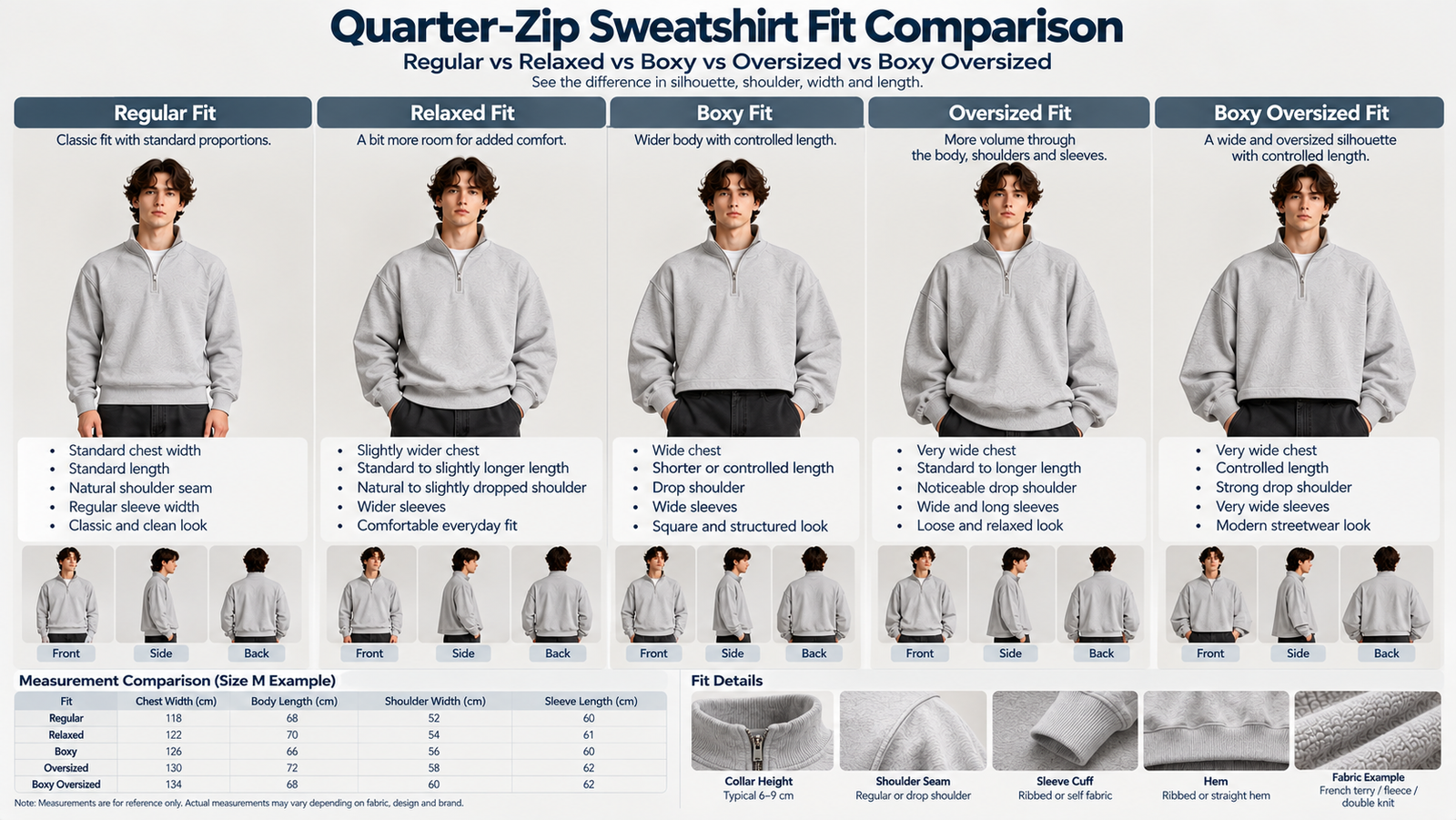
Quarter-Zip Fit: Regular, Relaxed or Oversized?
Quarter-zips can work with very different silhouettes.
Regular Fit
Usually features:
- Moderate chest width
- Natural shoulder
- Standard body length
- Controlled sleeve volume
This works well for:
- Golf-inspired products
- Smart casual
- Uniform-style garments
- Classic menswear
Relaxed Fit
Usually adds:
- More chest room
- Slight shoulder extension
- Wider sleeves
- Comfortable layering space
This is a flexible middle ground between classic and streetwear.
Oversized Quarter-Zip
May include:
- Wide chest
- Drop shoulders
- Wide sleeves
- Deeper armholes
- Controlled or longer body length
This moves the garment firmly toward modern streetwear.
Oversized Does Not Mean Sizing Up
An oversized quarter-zip should ideally use an intentional oversized pattern.
Simply grading a regular Medium into an XL can increase:
- Body length
- Sleeve length
- Neck dimensions
without producing the intended silhouette.
For a dedicated oversized design, the pattern maker can increase:
chest width + shoulder width + sleeve width
while independently controlling:
body length + collar + zipper length
This gives much better control.
The same principle applies to hoodies, sweatshirts and oversized T-shirts.
Should a Quarter-Zip Be Boxy?
It can be.
A boxy quarter-zip may use:
- Wide chest
- Straight side seams
- Controlled length
- Wide sleeves
- Moderate or strong shoulder drop
This creates a wider streetwear silhouette without excessive length.
It can work particularly well with heavyweight French terry or fleece.
However, a boxy fit should be defined through actual measurements rather than simply writing "boxy" in the tech pack.
Important Quarter-Zip Measurements
A development sheet should include standard sweatshirt measurements plus several quarter-zip-specific dimensions.
| Measurement | Why It Matters |
|---|---|
| Chest Width | Controls body volume |
| Body Length | Defines overall proportion |
| Shoulder Width | Controls shoulder position |
| Sleeve Length | Balances the silhouette |
| Sleeve Opening | Controls sleeve volume |
| Collar Height | Defines neckline appearance |
| Collar Opening | Affects comfort |
| Zipper Length | Defines front opening |
| Zipper Width / Gauge | Influences hardware weight |
| Hem Width | Controls lower silhouette |
| Cuff Height | Changes sleeve finish |
The zipper position should also be centered accurately.
Even a small difference becomes visually obvious because the zipper creates a strong vertical line.
Quarter-Zip Sweatshirt Tech Pack Example
A useful development brief may look like this:
| Area | Example Specification |
|---|---|
| Product | Quarter-Zip Sweatshirt |
| Fit | Relaxed / Boxy |
| Fabric | 100% Cotton French Terry |
| GSM | 360 GSM |
| Shoulder | Drop Shoulder |
| Collar | Double-Layer Self Fabric |
| Collar Height | 8 cm |
| Zipper | #5 Reverse Coil |
| Zipper Length | 24 cm |
| Puller | Custom Logo |
| Cuff | 2×2 Rib |
| Hem | Ribbed |
| Decoration | Small Chest Embroidery |
| Color | Pantone Reference |
| Labels | Custom Woven Neck + Care Label |
These numbers are examples only.
Actual specifications should be developed around the desired garment.
Quarter-Zip vs Crewneck Sweatshirt
Both start from a similar pullover category, but the neckline creates very different development requirements.
Crewneck
Simpler neckline construction.
Normally includes:
- Neck rib
- Neck tape
- Standard front body
Quarter-Zip
Adds:
- Collar
- Zipper
- Front opening
- Additional seam stabilization
- More complex topstitching
The quarter-zip therefore requires more components and more sewing operations.
Quarter-Zip vs Hoodie
The main visual difference is obvious:
hood vs collar
But from a production perspective, this changes more than appearance.
A hoodie needs:
- Hood panels
- Hood opening
- Drawcord or clean-finished edge
- Hood attachment seam
A quarter-zip needs:
- Structured collar
- Center-front opening
- Zipper installation
Quarter-zips can therefore create a cleaner neckline while maintaining the comfort of sweatshirt fabric.
For a general overview of hoodie construction and current production directions, see our 2026 Hoodie Trends Guide.
Quarter-Zip vs Full-Zip Sweatshirt
A full-zip sweatshirt divides the entire front body into two sides.
A quarter-zip keeps most of the front body uninterrupted.
This can be useful for designs that require:
- Large front graphics
- Cleaner body silhouette
- Pullover styling
- Fewer visible seams
However, the center zipper still affects graphic placement.
Logo Placement Needs to Consider the Zipper
A standard center-chest logo may not work on a quarter-zip because the zipper occupies that space.
Common alternatives include:
- Left chest embroidery
- Right chest embroidery
- Sleeve logo
- Small collar branding
- Back graphic
- Lower front artwork
The relationship between zipper and logo should be approved on the actual sample.
Do not assume artwork placement from a crewneck can simply be transferred to a quarter-zip.
Embroidery Can Work Especially Well
Quarter-zips often suit smaller, more restrained branding.
Common embroidery positions include:
- Left chest
- Sleeve
- Upper back
- Collar
- Cuff
A small embroidered logo can reinforce a premium or preppy direction without competing visually with the zipper.
For different embroidery structures, Brad Apparel's Embroidery Techniques page covers flat embroidery, 3D embroidery, appliqué and other options.
Custom Zipper Pullers Can Become Part of the Branding
Because the zipper sits near the face and chest, the puller is highly visible.
Possible customization includes:
- Engraved logo
- Debossed logo
- Custom molded shape
- Matte black finish
- Antique silver
- Gunmetal
- Polished metal
- Color-matched finish
This small component can significantly change the perceived quality of the garment.
However, custom zipper tooling may have separate MOQ and mold-cost requirements.
That should be confirmed before the bulk order quantity is finalized.
Quarter-Zip Sampling: What Should You Check?
A quarter-zip sample should be evaluated in several positions.
Fully Zipped
Check:
- Collar symmetry
- Collar height
- Neck comfort
- Zipper alignment
- Center-front straightness
Half Open
Check:
- Collar fold
- Left/right balance
- Zipper tape visibility
- Shape around the chest
Fully Open
Check:
- Inner facing
- Zipper finish
- Collar fall
- Interior appearance
A quarter-zip should look intentional in all three positions.
Check the Zipper While the Garment Is Worn
Do not approve the zipper only by laying the garment flat.
On-body fitting can reveal:
- Chest pulling
- Collar pressure
- Wavy zipper tape
- Uneven shoulder balance
- Excess fabric around the opening
The wearer should also:
- Sit
- Raise their arms
- Turn sideways
- Open and close the zipper repeatedly
The zipper needs to work smoothly without changing the garment silhouette.
Wash Testing Is Especially Important Around the Zipper
Fabric and zipper components do not always react to washing in the same way.
After wash testing, inspect:
- Body shrinkage
- Zipper wave
- Collar shape
- Zipper tape
- Puller finish
- Color change
- Seam puckering
If the body fabric shrinks more than the zipper tape, the center-front area may distort.
That is why quarter-zip development should ideally use the intended bulk fabric during sampling.
Common Quarter-Zip Development Mistakes
1. Specifying Only "Quarter Zip"
This does not define the zipper length, collar or construction.
2. Choosing the Zipper After the Fabric
Hardware weight should be considered together with fabric weight.
3. Making the Collar Too Soft
The collar may collapse even if the rest of the garment looks good.
4. Making the Collar Too Thick
More structure is not always better.
Excessive thickness can create uncomfortable bulk around the neck.
5. Ignoring the Open-Collar Appearance
The garment must work both zipped and unzipped.
6. Using a Regular Sweatshirt Pattern Without Adjustment
Adding a zipper and collar changes the neckline construction and front balance.
7. Using an Oversized Zipper on Lightweight Fabric
Heavy hardware can distort soft fabrics.
8. Approving the Sample Before Washing
Shrinkage can change the zipper area significantly.
9. Positioning the Logo Before Confirming the Zipper
The front opening changes the available decoration area.
10. Ignoring Zipper Pull Quality
A sticky or rough zipper can make an otherwise premium garment feel cheap.
What Should You Send a Quarter-Zip Manufacturer?
A useful development package should include:
| Area | What to Specify |
|---|---|
| Product | Quarter-zip sweatshirt |
| Fit | Regular / relaxed / oversized / boxy |
| Fabric | Composition + structure |
| Weight | Target GSM |
| Color | Pantone or physical reference |
| Collar | Height + construction |
| Zipper | Type + size + length |
| Puller | Standard / custom logo |
| Shoulder | Regular / drop shoulder |
| Sleeve | Length + opening |
| Cuff | Rib / self fabric / elastic |
| Hem | Rib / straight / elastic |
| Decoration | Print / embroidery / other |
| Labels | Woven / printed / heat transfer |
| Quantity | Sample + bulk quantity |
Reference photos are useful.
A physical reference garment is even better when the fit or collar structure is critical.
Quarter-Zip Development Workflow
A practical development process can follow:
Design Reference
↓
Choose Sweatshirt or Sweater Construction
↓
Fabric Selection
↓
Fit & Pattern Development
↓
Collar Specification
↓
Zipper & Puller Selection
↓
Artwork Placement
↓
First Sample
↓
Fit + Collar + Zipper Review
↓
Wash Test
↓
Measurement Adjustment
↓
Pre-Production Approval
↓
Bulk Production
For broader sweatshirt manufacturing details such as fabric confirmation, grading and bulk QC, see our Custom Sweatshirt Manufacturing Guide.
FAQ
What Is a Quarter-Zip Sweatshirt?
A quarter-zip sweatshirt is a pullover sweatshirt with a short zipper running from the collar to the upper chest.
It is normally made from cut-and-sew knit fabrics such as French terry, fleece or performance knit.
Is a Quarter-Zip the Same as a Half-Zip?
The terms are often used interchangeably.
Generally, a quarter-zip has a shorter front zipper, while a half-zip extends further down the chest.
For manufacturing, the exact zipper length should always be specified.
What Is the Difference Between a Quarter-Zip Sweatshirt and a Quarter-Zip Sweater?
A quarter-zip sweatshirt is usually cut and sewn from fabrics such as French terry or fleece.
A quarter-zip sweater is generally produced using knitted yarn and sweater-knitting machinery.
The materials, construction and production processes are different.
What Fabric Is Best for a Quarter-Zip Sweatshirt?
Common options include:
- French terry
- Brushed fleece
- Double knit
- Cotton blends
- Polyester performance knit
- Nylon blends
The best option depends on the intended season, fit and style.
What GSM Is Good for a Heavyweight Quarter-Zip?
Approximately 320–420 GSM can work well for many heavyweight quarter-zip sweatshirts.
However, fabric structure and density are just as important as GSM.
Can a Quarter-Zip Be Oversized?
Yes.
An oversized quarter-zip can use a wider chest, dropped shoulders, larger sleeves and increased overall volume.
The pattern should be intentionally developed rather than created by simply sizing up a regular garment.
Can a Quarter-Zip Be Boxy?
Yes.
A boxy quarter-zip typically combines a wide chest with controlled body length and wider sleeves.
What Type of Zipper Is Best for a Quarter-Zip?
Nylon coil and reverse coil zippers are common because they are lightweight and flexible.
Metal and molded zippers can also work when the fabric and design support more substantial hardware.
Can I Customize the Quarter-Zip Puller With a Logo?
Yes.
Custom pullers can be engraved, molded or finished in different colors and metal treatments.
Custom tooling may require a separate mold charge or accessory MOQ.
Why Does a Quarter-Zip Become Wavy?
Common causes include fabric stretching during sewing, mismatched shrinkage, sewing tension or insufficient stabilization around the zipper opening.
The zipper should be checked again after washing.
Should a Quarter-Zip Have a High Collar?
Not necessarily.
The collar height depends on the intended aesthetic.
Lower collars can feel more classic and casual, while taller structured collars can create a stronger premium or technical appearance.
Final Thoughts
A quarter-zip may look like a simple variation of a sweatshirt, but the zipper and collar introduce several additional development decisions.
The most important distinction is first deciding whether the product is a:
quarter-zip sweatshirt
or a:
quarter-zip sweater
For a cut-and-sew quarter-zip sweatshirt, the key elements are:
fabric + fit + collar + zipper + front opening + sleeve proportion
These elements need to be developed together.
A heavier zipper changes how a lightweight fabric hangs.
A taller collar changes the proportions of the neckline.
An oversized body changes how long the zipper appears.
And a poorly stabilized opening can affect an otherwise well-developed garment.
For clothing brands, clearly defining these details before sampling is the most reliable way to turn a reference image into a repeatable production-ready quarter-zip.
Keep Reading