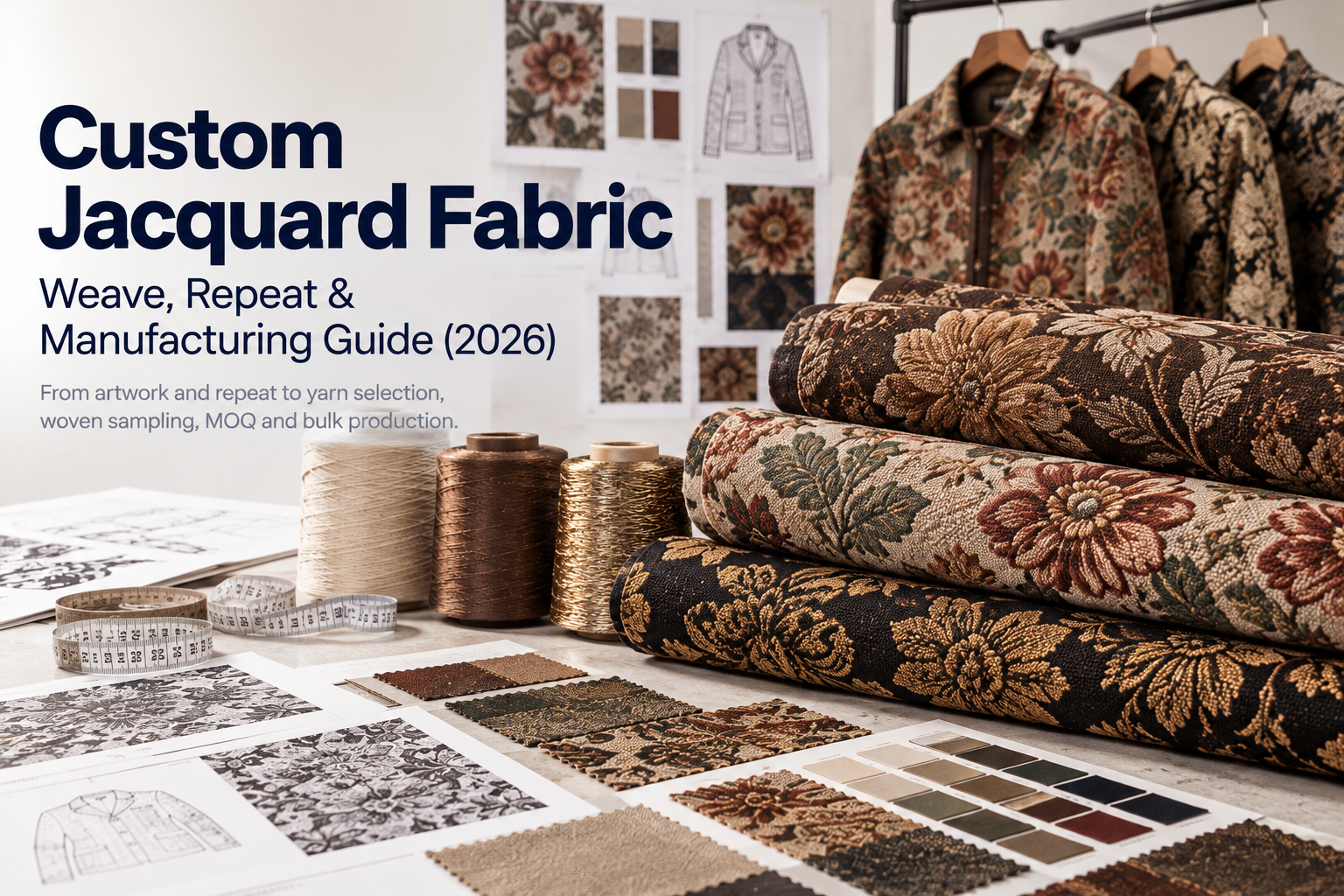
Custom jacquard fabric allows a clothing brand to build artwork, logos, motifs and texture directly into the textile instead of adding the entire design later through surface printing.
For brands, the important part is not simply choosing a jacquard pattern.
A custom development project requires several decisions to work together:
artwork + repeat + yarn + color + weave structure + fabric weight + usable width + finishing + garment construction
Changing any one of these can change the final fabric.
A design that looks balanced on a computer screen may become too large once woven.
A metallic yarn that looks premium in a swatch may feel too rough for an unlined garment.
A large repeat may look impressive but dramatically increase fabric consumption when the garment requires controlled motif placement.
This guide focuses specifically on how custom jacquard fabric is developed for apparel—from artwork preparation and woven sampling to bulk weaving, cutting and quality control.
When Should a Brand Develop Custom Jacquard Fabric?
Custom jacquard makes sense when an existing market fabric cannot provide the exact:
- Pattern
- Logo
- Scale
- Colorway
- Texture
- Fiber composition
- Weight
- Brand identity
It is particularly useful when the textile itself is intended to become a recognizable part of the collection.
Examples include:
- Repeating monogram fabric
- Tonal logo jacquard
- Custom floral artwork
- Geometric streetwear patterns
- Heritage-inspired motifs
- Metallic decorative textiles
- Custom lining jacquard
- Brand-symbol repeats
The fabric can therefore function almost like an all-over branding system.
Stock Jacquard vs Custom Jacquard
These are two very different sourcing routes.
Stock Jacquard
The fabric already exists.
The brand selects from available:
- Designs
- Colors
- Compositions
- Weights
Advantages include:
- Faster sampling
- Lower development cost
- Smaller practical quantities
- Immediate fabric evaluation
The main limitation is exclusivity.
Another buyer may be able to purchase exactly the same fabric.
Custom Jacquard
The fabric is developed specifically around the brand's requirements.
Possible custom elements include:
- Artwork
- Repeat
- Yarn colors
- Composition
- Weight
- Surface texture
- Metallic yarn
- Logo integration
This provides much stronger control.
But it normally requires:
- Mill development
- Woven sampling
- Higher fabric MOQ
- More time
- Additional approvals
For smaller first orders, stock jacquard may still be the more practical option.
For material sourcing and custom textile development, see Brad Apparel's Fabric Sourcing & Development.
Start With the Garment Before Developing the Fabric
The fabric should not be developed completely independently from the garment.
First define what the fabric will become.
For example:
- Cropped jacket
- Overshirt
- Pants
- Skirt
- Dress
- Vest
- Lining
- Trim panel
This affects the textile specification.
A heavy decorative jacquard that works for a structured jacket may be unsuitable for a flowing skirt.
Likewise, a soft lightweight jacquard may not provide enough structure for a boxy outerwear design.
The correct development sequence begins with:
garment direction → desired fabric behavior → jacquard development
rather than simply:
pretty artwork → fabric
What Information Should Be in a Custom Jacquard Brief?
A useful starting brief should include:
| Area | What to Define |
|---|---|
| End Product | Jacket / pants / skirt / lining / other |
| Artwork | Logo, floral, geometric or custom motif |
| Repeat | Target repeat size |
| Colors | Number of yarn colors and references |
| Fiber | Cotton / polyester / viscose / blend / other |
| Weight | Target range |
| Fabric Width | Required usable width |
| Surface | Matte / textured / glossy / metallic |
| Direction | One-way / non-directional |
| Hand Feel | Soft / structured / dry / smooth |
| Finish | Washed / brushed / coated / other |
| Quantity | Sample and expected bulk quantity |
The mill may adjust some specifications after evaluating feasibility.
Artwork Comes First
Custom jacquard begins with artwork that can be translated into a woven structure.
Suitable artwork may include:
- Logos
- Geometric shapes
- Florals
- Symbols
- Repeating monograms
- Abstract graphics
- Text-based motifs
However, an image suitable for printing is not automatically suitable for weaving.
Printing can reproduce extremely fine:
- Gradients
- Tiny lines
- Photographic shading
Jacquard is limited by actual yarn intersections.
Very small details may disappear or merge.
Simplify Artwork Before Weaving
Imagine a logo containing:
- Fine text
- Hairline outlines
- Tiny internal gaps
At screen size it may look perfect.
Once translated into yarn, those details may become unclear.
The artwork may need to be simplified by:
- Increasing line thickness
- Enlarging small text
- Removing tiny details
- Increasing spacing
- Reducing unnecessary colors
The objective is not to reproduce the digital artwork pixel for pixel.
The objective is to preserve the visual identity in woven form.
Vector Files Are Preferable
Useful files include:
- AI
- EPS
- SVG
High-resolution raster files may also help as references.
A vector file makes it easier to:
- Resize motifs
- Adjust repeat
- Separate colors
- Modify shapes
Avoid supplying only a compressed social-media screenshot when exact custom development is required.
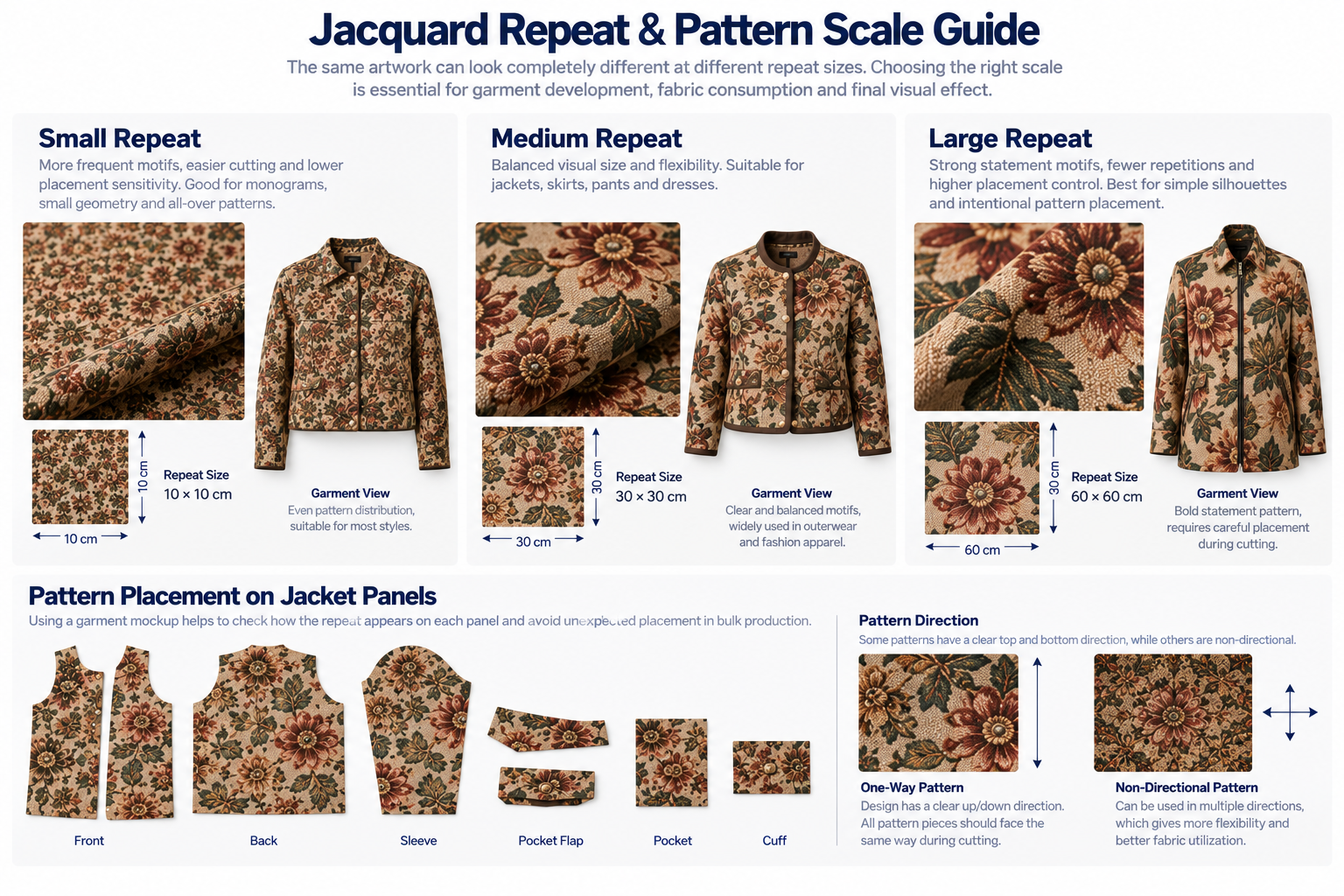
What Is a Jacquard Repeat?
The repeat is the section of artwork that repeats across the fabric.
It has:
- Horizontal repeat
- Vertical repeat
For example:
40 cm × 50 cm
means the woven artwork repeats every 40 cm across and 50 cm along the fabric.
The repeat directly affects how often each motif appears on the garment.
Repeat Size Changes the Final Product
The same artwork can produce completely different garments depending on scale.
Small Repeat
Creates:
- More frequent motifs
- More even distribution
- Easier cutting
- Lower placement sensitivity
Useful for:
- Monograms
- Small geometry
- Tonal branding
Medium Repeat
Creates a stronger visible design while still providing reasonable placement flexibility.
Large Repeat
Creates:
- Strong statement graphics
- Fewer motifs per garment
- Greater placement variation
- More cutting complexity
A large floral repeat may look excellent across the back of a jacket but create problems when cut into:
- Sleeves
- Pocket flaps
- Collars
The garment pattern should therefore be considered before the repeat is finalized.
Test the Repeat on a Full Garment Mockup
Do not approve the repeat by looking only at one square of artwork.
Apply it digitally across:
- Front body
- Back body
- Sleeve
- Collar
This helps answer:
- Is the motif too large?
- Are there too many repetitions?
- Does the logo disappear on small pattern pieces?
- Does one large motif dominate the entire garment?
A simple garment simulation can prevent expensive redevelopment later.
One-Way vs Non-Directional Patterns
This affects fabric consumption.
One-Way Pattern
The design has a clear top and bottom.
Examples include:
- Flowers growing upward
- Text
- Logos
- Animals
- Directional leaves
Every garment piece must normally face the correct direction.
Pattern pieces cannot simply be rotated 180 degrees to save fabric.
Non-Directional Pattern
The design works from multiple directions.
Examples include:
- Some geometric repeats
- Small abstract motifs
- Symmetrical monograms
This gives the cutting marker more flexibility.
More flexible markers normally mean better fabric utilization.
Yarn Selection Changes More Than Color
Jacquard fabric is built from yarn.
Different yarns affect:
- Surface
- Structure
- Shine
- Texture
- Weight
- Durability
Possible fibers include:
- Cotton
- Polyester
- Viscose
- Wool
- Nylon
- Silk
- Metallic yarn
- Blends
The yarn selection should reflect the intended garment.
Cotton Jacquard
Cotton can provide:
- Natural touch
- Matte appearance
- Breathability
- Casual character
It works well for:
- Casual jackets
- Overshirts
- Pants
- Summer apparel
Cotton also needs shrinkage testing.
Polyester Jacquard
Polyester can provide:
- Strong color
- Dimensional stability
- Crisp woven detail
- Glossy or metallic effects
It is useful for:
- Decorative fashion fabrics
- Linings
- Structured garments
Different yarn finishes can make polyester appear:
- Matte
- Semi-dull
- Bright
so "polyester jacquard" alone does not fully describe the appearance.
Viscose Jacquard
Viscose can create:
- Softer drape
- Rich hand feel
- More fluid movement
This may suit:
- Dresses
- Softer jackets
- Skirts
But the garment may require more internal support if the design should be sharply structured.
Metallic Yarn
Metallic yarn can create:
- Gold
- Silver
- Bronze
- Gunmetal
- Colored metallic effects
It can dramatically increase visual impact.
But it also introduces additional concerns.
Check:
- Skin comfort
- Snagging
- Abrasion
- Flexibility
- Pressing temperature
- Tarnishing
Metallic appearance should not be approved only visually.
Yarn Count Affects Fabric Character
Finer yarn can create:
- Finer detail
- Smoother surface
- Potentially lighter fabric
Thicker yarn can create:
- Stronger texture
- Heavier structure
- More visible woven character
A very detailed logo may require a different yarn strategy from a bold oversized floral.
The mill should evaluate artwork together with yarn construction.
How Many Colors Can Custom Jacquard Use?
That depends on the machinery and weave structure.
A design may use:
- Two colors
- Three colors
- Four colors
- Multiple yarn colors
But adding colors can affect:
- Complexity
- Fabric structure
- Cost
- Minimums
More colors do not automatically create a better fabric.
A tonal two-color jacquard can appear extremely premium when the surface texture is strong.
Tonal Logo Jacquard
A particularly useful direction for streetwear brands is:
same color family + different yarn appearance
For example:
- Matte black ground
- Slightly glossy black logo
From far away the garment appears nearly solid.
From close range the branding becomes visible.
This can create a subtle premium effect without relying on large external logos.
Custom Monogram Jacquard
Brands can repeat:
- Initials
- Logo marks
- Symbols
throughout the fabric.
Important decisions include:
- Motif size
- Spacing
- Rotation
- Repeat density
An overly dense logo repeat may feel more like packaging than apparel.
Testing several scales is useful before weaving.
Background and Motif Structure
Jacquard design is not simply:
background color + printed logo
Both areas are woven.
The mill may use different structures to create contrast through:
- Texture
- Float
- Shine
- Yarn exposure
This means the motif can remain visible even when the yarn colors are similar.
Front and Reverse Side
Always review both sides of a woven sample.
The reverse may contain:
- Different colors
- Floating yarns
- Rougher texture
- More exposed structure
This matters if the garment is:
- Unlined
- Reversible
- Open at the front
- Designed with visible interior details
A beautiful face side does not guarantee a comfortable reverse side.
Double-Face Jacquard
Some fabrics can be engineered with usable appearance on both sides.
This may create:
- Reversible garments
- Contrast cuffs
- Turned collars
- Visible interior panels
But double-face development can increase complexity.
It should be specified from the beginning rather than assumed after the fabric is woven.
Fabric Weight Should Follow the Garment
There is no single ideal GSM for jacquard.
The correct target depends on:
- Fiber
- Weave
- Yarn
- End use
A lightweight fabric may be useful for:
- Shirts
- Linings
- Dresses
A midweight fabric may suit:
- Jackets
- Skirts
- Pants
A heavy jacquard may suit:
- Structured jackets
- Outerwear
But weight alone does not describe stiffness.
GSM and Structure Are Different
Two fabrics may both weigh:
280 GSM
while one is:
- Soft
- Flexible
and the other:
- Dense
- Rigid
This can happen because of:
- Yarn type
- Weave structure
- Finishing
- Density
Always review:
GSM + hand feel + drape
together.
Fabric Width Matters During Costing
Custom fabrics have a loom width and a usable finished width.
These are not always identical.
For example, edge areas may contain:
- Selvage
- Uneven finishing
- Unusable portions
Garment consumption calculations should use:
usable width
rather than only nominal fabric width.
Narrow Fabric Can Increase Consumption
Imagine the garment front is wider than the usable fabric section available beside other marker pieces.
The cutting room may need:
- More fabric length
- Different marker layout
This can increase cost even when the fabric price per meter is unchanged.
Fabric width should therefore be confirmed before final garment costing.
What Is Woven Sampling?
Before bulk weaving, a mill normally needs to develop a sample of the textile.
This allows the brand to review:
- Artwork
- Repeat
- Colors
- Texture
- Hand feel
- Weight
- Reverse side
This is more relevant to custom jacquard than approving a print strike-off.
The correct approval is the actual woven result.
Digital Mockup Is Not Final Approval
A simulation helps visualize the design.
But it cannot accurately show:
- Actual yarn texture
- Metallic reflection
- Hand feel
- Thickness
- Reverse-side floats
- Drape
Bulk production should be based on an approved physical woven sample whenever possible.
Woven Sample Approval
Check the sample for:
Artwork
Are small details still readable?
Repeat
Is the scale correct?
Color
Do the yarns create the intended overall shade?
Texture
Is the motif too raised or too flat?
Hand Feel
Is it appropriate for the garment?
Reverse
Is it clean enough for the intended construction?
Weight
Does it support the target silhouette?
Only after these are approved should the project move toward bulk weaving.
Color Approval Is Different From Solid Dyeing
With solid fabric, a brand may focus heavily on one Pantone shade.
A jacquard may contain:
- Ground yarn
- Motif yarn
- Accent yarn
- Metallic yarn
The colors interact visually.
A brown yarn next to gold may appear warmer.
The same brown beside black may appear darker.
Therefore evaluate the complete woven textile, not each yarn in isolation.
Colorway Development
One artwork can produce multiple colorways.
For example:
Colorway A
Black + charcoal
Colorway B
Cream + beige
Colorway C
Brown + antique gold
Colorway D
Navy + silver
If several colorways are planned, it is useful to keep:
- Same repeat
- Same structure
and change only selected yarn colors when technically possible.
This can reduce development complexity.
Custom Jacquard Fabric Development Workflow
A practical workflow can follow:
- Define garment
- Select target fabric direction
- Prepare artwork
- Build repeat
- Select yarns
- Define colors
- Confirm target weight and width
- Develop woven sample
- Review and revise
- Approve sample
- Weave bulk fabric
- Inspect bulk fabric
- Cut garment sample
- Approve pattern placement
- Begin bulk garment production
Do not treat step 12 as optional.
The bulk textile should be checked before large-scale garment cutting.
Bulk Weaving Can Differ Slightly From Sampling
Production conditions can create variation in:
- Color
- Weight
- Width
- Hand feel
- Pattern clarity
The first bulk fabric should be compared directly with the approved woven sample.
If the difference is outside the agreed tolerance, resolve it before cutting.
Custom Jacquard MOQ
MOQ varies greatly.
It can depend on:
- Mill
- Loom
- Yarn availability
- Composition
- Number of colors
- Fabric width
- Development complexity
Therefore there is no universal jacquard MOQ.
A brand may have:
garment MOQ = 50 pieces
but:
custom fabric MOQ = several hundred meters
These are different minimums.
This distinction should be understood before development begins.
Fabric MOQ vs Garment MOQ
This is one of the most common sources of confusion.
Suppose one jacket uses:
1.5 meters
of fabric.
If the mill requires:
500 meters
for custom jacquard, the fabric quantity could theoretically support far more garments than a small initial order requires.
Possible solutions include:
- Use stock jacquard
- Use the custom fabric across several styles
- Produce additional fabric for later orders
- Simplify development
- Choose a different mill
This decision should happen before expensive sampling.
Use One Fabric Across Several Products
A useful collection strategy is to develop one signature jacquard and use it for:
- Jacket
- Skirt
- Bag
- Vest
- Trim panel
This spreads the fabric MOQ across more products.
It can also create stronger collection identity.
Bulk Lead Time
Custom weaving normally takes longer than purchasing available fabric.
The timeline may include:
- Artwork preparation
- Mill setup
- Yarn preparation
- Sample weaving
- Revision
- Bulk weaving
- Finishing
- Inspection
- Transportation
Do not plan the garment production calendar using only sewing lead time.
Fabric development may become the longest part of the project.
Pattern Placement Begins After Fabric Approval
Once fabric is approved, the garment pattern needs to be tested against the repeat.
Important pieces include:
- Front
- Back
- Sleeve
- Collar
- Cuff
The objective is not always perfect pattern matching.
The objective is controlled and intentional placement.
Random Placement
Random placement allows normal marker efficiency.
It works best when the pattern is:
- Small
- Dense
- Non-directional
- Visually balanced
Individual garments may not be identical.
That variation should be acceptable to the brand.
Controlled Placement
Specific areas are controlled.
For example:
- Main flower near chest
- Logo centered on back
- Similar left/right front balance
This provides more consistency without requiring exact matching at every seam.
Engineered Placement
The highest-control option positions artwork specifically for each pattern piece.
This may require:
- Special fabric layout
- Increased consumption
- Individual cutting
It should be costed differently from standard all-over jacquard.
Pattern Matching Increases Fabric Use
Matching may be requested at:
- Center front
- Center back
- Patch pocket
- Collar
- Side seam
Every matching requirement limits where the pattern piece can be placed.
This reduces marker efficiency.
Before quotation, define:
where matching is required
instead of simply writing:
Match pattern everywhere.
Center Front Is Usually Highest Priority
For many jackets, the front closure is the most visible area.
If a large motif is cut unevenly, the jacket may appear unbalanced.
Common approaches include:
- Approximate symmetry
- Continuous motif
- Intentional random placement
The approved sample should establish the standard for bulk.
Logo Placement Needs Extra Control
If the jacquard includes an identifiable brand logo, random placement can create awkward results.
A logo might be:
- Cut in half at pocket
- Upside down on sleeve
- Partially hidden in seam
The cutting plan should consider brand elements separately from abstract motifs.
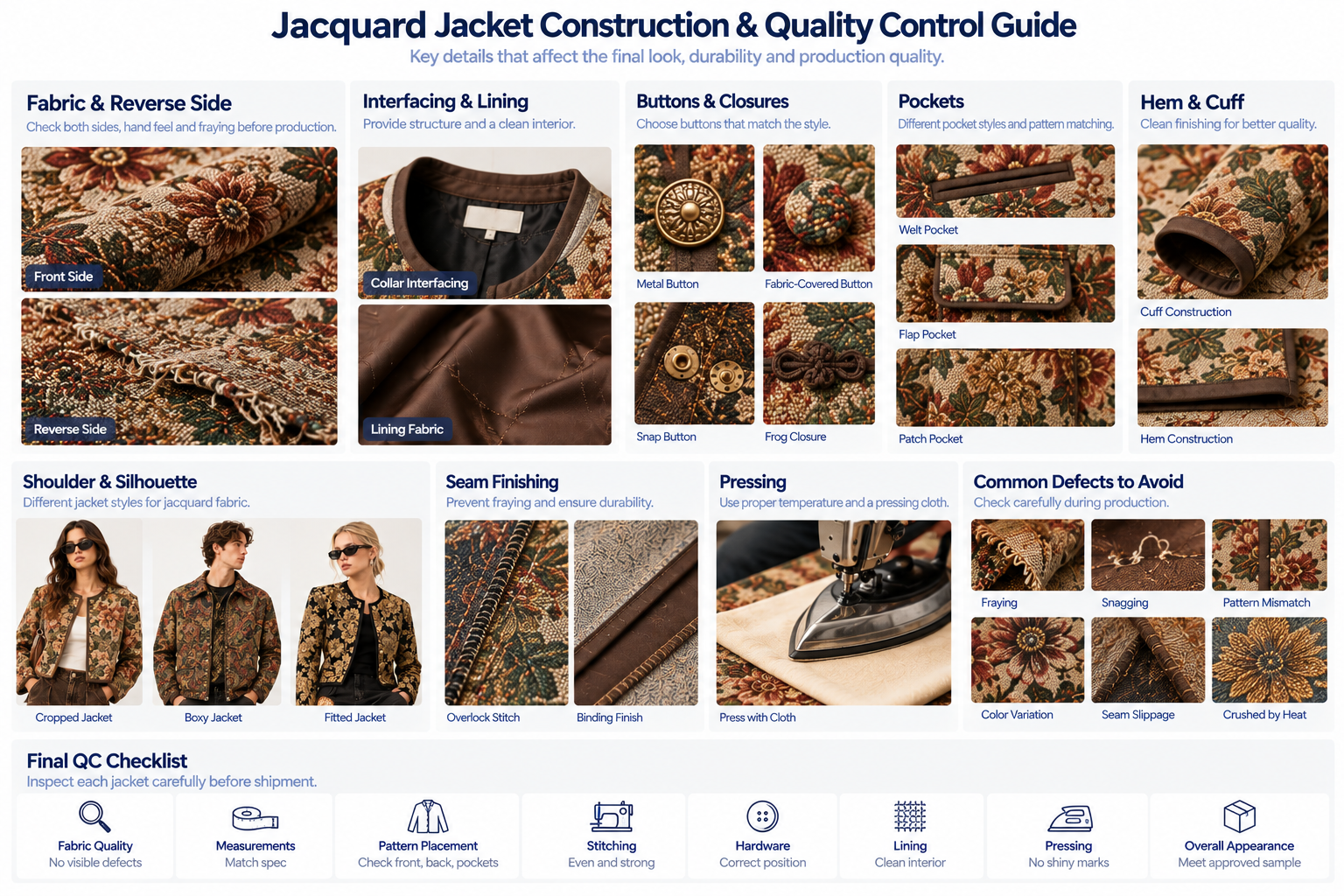
Jacquard Fabric Can Fray
Decorative woven fabrics often contain more complex yarn structures than simple twill.
Cut edges may begin to unravel during:
- Cutting
- Bundling
- Sewing
Possible controls include:
- Overlock
- Stay stitching
- Binding
- Fusing
- Adequate seam allowance
The actual method should be tested on the approved fabric.
Seam Slippage Testing
Some looser jacquards can experience seam slippage.
The yarns move away from the seam under tension.
High-risk areas can include:
- Armholes
- Side seams
- Seat seams
- Pocket openings
If the fabric performs poorly, possible solutions include:
- Different seam construction
- Wider seam allowance
- Reinforcement
- Reduced garment tension
Interfacing Compatibility
Fusing can change the surface of jacquard.
Before production, test:
- Temperature
- Pressure
- Time
- Adhesive compatibility
Look for:
- Flattened texture
- Shine
- Color change
- Delamination
Delicate jacquards may require lower-temperature or sew-in solutions.
Lining
A lining can protect:
- Floating yarns
- Rough reverse surfaces
- Internal seams
It can also improve wearing comfort.
Full lining is particularly useful when the reverse side is not suitable for direct contact with clothing or skin.
Pressing
Pressing is another high-risk stage.
Raised woven texture can be damaged by excessive:
- Heat
- Steam
- Pressure
Possible precautions include:
- Pressing cloth
- Lower temperature
- Reduced pressure
- Testing on offcuts
The pressing standard should be established before bulk sewing.
Washing and Finishing
Not every jacquard should be garment washed.
Possible finishes depend on:
- Fiber
- Yarn
- weave
- Metallic content
Some fabrics may tolerate:
- Soft wash
- Enzyme treatment
- Gentle garment washing
Other decorative fabrics may require:
- Dry-clean care
- Minimal wet processing
Testing should determine care instructions.
Custom Jacquard for Jackets
Jackets normally require attention to:
- Structure
- Pattern placement
- Fraying
- Interfacing
- Lining
- Pressing
A medium- or heavy-weight jacquard can work particularly well with simple silhouettes.
The more complex the textile, the less construction decoration may be necessary.
Custom Jacquard for Pants
Pants require different testing.
Pay attention to:
- Seat abrasion
- Seam strength
- Knee movement
- Snagging
- Fabric recovery
An ornate fabric that works perfectly for a jacket may not be durable enough for pants.
Custom Jacquard for Skirts
Skirts may allow stronger decorative development because the garment often contains:
- Larger uninterrupted panels
- Less sleeve construction
- Fewer high-friction areas
Repeat placement still matters, especially with:
- Center-front motifs
- Pleats
- Panel seams
Custom Jacquard for Linings
Jacquard lining can create subtle internal branding.
Common directions include:
- Logo repeat
- Monogram
- Tonal pattern
Because the lining is lightweight, its construction differs from heavy outerwear jacquard.
Do not use the same fabric specification simply at a lower GSM.
The yarn and structure should be developed specifically for lining performance.
Jacquard Logo vs Printed Logo
A jacquard logo is integrated into the textile.
It does not create the same appearance as:
- Screen print
- Heat transfer
- DTG
A woven tonal logo can create a more subtle premium effect.
Printing remains more suitable when the brand needs:
- Highly detailed artwork
- Frequent color changes
- Photographic graphics
Choose the technique based on the visual goal rather than assuming woven is always better.
Jacquard Logo vs Embroidery
Embroidery adds thread to an existing fabric.
Jacquard builds the motif into the fabric itself.
Custom jacquard can be useful when the logo should repeat throughout the textile.
Embroidery is often more practical for:
- One chest logo
- Back artwork
- Small localized branding
For localized decoration, see Brad Apparel's Embroidery Techniques.
Bulk Fabric Quality Control
Before garment cutting, inspect the fabric for:
- Width
- Weight
- Repeat
- Color
- Motif clarity
- Fabric defects
- Bow
- Skew
- Snags
- Broken yarns
- Surface inconsistency
Decorative fabrics make some defects much easier to see.
Repeat Consistency
Measure the repeat at several positions.
It should remain within the agreed tolerance.
Distorted repeats can cause:
- Pattern alignment problems
- Unexpected placement
- Different garment appearance
Bow and Skew
A woven design should run correctly across the fabric.
If it is distorted, motifs may appear:
- Slanted
- Curved
- Uneven
This can become very obvious after cutting.
Color Consistency
Compare:
- Beginning of roll
- Middle
- End
and multiple rolls where relevant.
Multicolor fabric requires evaluating the overall appearance, not only one yarn.
Fabric Width
Confirm the actual usable width for each production lot.
Even small width changes can affect:
- Marker layout
- Consumption
- Garment quantity
Weight
Bulk fabric weight should remain reasonably consistent with the approved standard.
Large variation can change:
- Drape
- Structure
- Hand feel
and may affect garment fit.
Snagging Inspection
Check whether loops or floats have been damaged during:
- Weaving
- Finishing
- Transport
Small snags can become obvious on metallic or high-contrast jacquard.
Jacquard Jacket Construction & Quality Control
Once fabric passes inspection, garment production still requires textile-specific controls.

Garment QC Should Check Pattern Placement
Compare bulk garments against the approved sample.
Check:
- Center-front balance
- Front motif position
- Back motif position
- Pocket placement
- Direction
- Left/right appearance
The standard does not need to be identical placement unless that was specified.
But it should stay within the approved visual range.
Check the Interior
For lined garments, inspect:
- Lining
- Loose threads
- Fraying
- Fusing
- Pocket bags
The textile may be complex, but the interior should still be clean.
Check Pressing Damage
Look for:
- Flattened motifs
- Unwanted shine
- Metallic yarn distortion
Pressing damage may not be obvious until the garment is viewed under different lighting.
Check Snagging After Sewing
Machinery and handling can catch long yarns.
Inspect especially around:
- Zippers
- Buttons
- Pockets
- Cuffs
Example Custom Logo Jacquard Brief
A brand could write:
Develop a tonal black woven jacquard for a streetwear jacket using a repeating 45 mm logo motif. Polyester/cotton blend, medium weight, matte black ground with slightly higher-luster black logo. Pattern should be non-directional where possible and suitable for full lining.
This is much clearer than:
We want custom black logo fabric.
Example Floral Jacquard Brief
Custom floral jacquard for a cropped women's jacket. Medium-scale repeat approximately 45 × 55 cm, dark brown ground with rust, olive and cream floral yarns. Midweight structure, full lining, one-way pattern. Center-front placement should remain visually balanced.
Example Metallic Jacquard Brief
Black and antique-gold decorative jacquard for a structured evening jacket. Medium repeat, black polyester ground with restrained metallic-gold motif. Metallic yarn must be tested for snagging, pressing and skin comfort.
Example Custom Jacquard Fabric Specification
| Area | Example Requirement |
|---|---|
| End Use | Cropped Jacket |
| Fabric | Custom Woven Jacquard |
| Composition | Cotton / Polyester Blend |
| Weight | Target Midweight |
| Artwork | Custom Floral |
| Repeat | 45 × 55 cm |
| Direction | One Way |
| Colors | 4 Yarn Colors |
| Surface | Matte / Textured |
| Metallic Yarn | No |
| Width | Confirm With Mill |
| Reverse | Full Lining Required |
| Pattern Placement | Controlled |
| Matching | Center Front + Pocket |
| Finish | Clean / No Heavy Wash |
These values are examples only.
Common Custom Jacquard Development Mistakes
1. Starting With Artwork Without Knowing the Garment
The end product should influence the textile.
2. Making the Repeat Too Large
A motif that looks attractive on screen may not fit properly across small pattern pieces.
3. Keeping Details Too Fine
Tiny lines may disappear when woven.
4. Approving Only a Digital Simulation
Texture and hand feel require physical evaluation.
5. Ignoring the Reverse Side
Floating yarns can affect comfort and lining decisions.
6. Confusing Fabric MOQ With Garment MOQ
The mill may require much more fabric than the first garment order consumes.
7. Ignoring Fabric Width
A narrow usable width can increase consumption.
8. Demanding Pattern Matching Everywhere
This may dramatically increase fabric usage without improving the most visible areas.
9. Changing Fabric After Garment Pattern Approval
Different jacquards may vary in thickness and stability.
The garment may need another fit sample.
10. Beginning Bulk Cutting Before Fabric Approval
Bulk weaving should be inspected before garment production.
Custom Jacquard vs Stock Fabric: Which Should You Choose?
Choose stock jacquard when:
- Quantity is smaller
- Speed matters
- Existing design is acceptable
- Lower development risk is important
Choose custom jacquard when:
- Brand exclusivity matters
- Custom logos are required
- Specific repeat is required
- Custom colors are important
- Textile identity is part of the collection
Neither option is automatically better.
The correct choice depends on:
quantity + timeline + budget + exclusivity
How Brad Apparel Approaches Custom Jacquard Development
A custom textile project should coordinate the mill and garment development rather than treating them as separate tasks.
A typical sequence is:
Garment Concept
↓
Fabric Specification
↓
Artwork & Repeat
↓
Yarn / Color Selection
↓
Woven Sample
↓
Fabric Approval
↓
Garment Sample
↓
Pattern Placement Review
↓
Bulk Fabric
↓
Bulk Fabric QC
↓
Garment Production
This reduces the risk of developing an expensive custom fabric that later does not work with the intended garment.
Existing Decorative Fabric vs Full Custom Development
Not every project requires custom weaving.
If the customer mainly wants:
- Floral surface
- Rich texture
- Decorative appearance
an existing jacquard may already solve the problem.
If the project requires:
- Original brand artwork
- Specific repeat
- Logo integration
- Exact colors
custom weaving becomes much more relevant.
For a broader explanation of tapestry-style, jacquard, brocade and other decorative jacket constructions, see our Tapestry Jacket Guide.
FAQ
What Is Custom Jacquard Fabric?
Custom jacquard is a woven textile developed using brand-specific artwork, colors, repeat and fabric specifications.
The motif is created through the textile structure rather than simply printed onto the surface.
Can I Put My Logo Into Jacquard Fabric?
Yes.
Logos, initials and other brand symbols can be developed as repeating woven motifs.
The artwork may need to be simplified depending on size and yarn construction.
What File Should I Send for Custom Jacquard?
Vector artwork such as AI, EPS, SVG or vector PDF is preferable.
High-resolution images can also be used as references.
What Is a Jacquard Repeat?
The repeat is the artwork area that repeats horizontally and vertically across the fabric.
Repeat size affects motif scale, placement and cutting efficiency.
What Is the MOQ for Custom Jacquard Fabric?
There is no universal MOQ.
It depends on the mill, loom, yarn, composition, number of colors and fabric construction.
Fabric MOQ may be substantially higher than garment MOQ.
Why Does Custom Jacquard Have a Higher MOQ?
The mill may need to:
- Prepare yarn
- Set up weaving
- Develop the pattern
- Produce sample fabric
These setup requirements make very small custom quantities less efficient.
How Long Does Custom Jacquard Development Take?
It normally takes longer than sourcing ready-market fabric because development may include:
- Artwork
- Repeat engineering
- Yarn preparation
- Woven sampling
- Revision
- Bulk weaving
The exact timeline depends on the project and mill.
Can Jacquard Be Made in Custom Pantone Colors?
Yarn colors can be developed toward approved brand references.
However, the final woven appearance should be approved from the complete physical fabric rather than relying only on Pantone references.
Can Jacquard Use Metallic Yarn?
Yes.
Metallic yarn can create gold, silver or other decorative effects.
It should be tested for snagging, abrasion, comfort and pressing.
Can Jacquard Be Made With a Tonal Logo?
Yes.
A logo can be made visible through differences in:
- Yarn sheen
- Texture
- Weave structure
even when both areas use similar colors.
Can Jacquard Fabric Be Used for Hoodies?
Yes, depending on the construction.
However, traditional woven jacquard behaves differently from knitted sweatshirt fabric.
A brand wanting stretch or sweatshirt-like comfort may instead need a custom jacquard knit.
Is Jacquard Always Woven?
Jacquard refers to the control system used to create complex patterned textile structures and can also be used in knitting.
For woven jackets and similar garments, custom woven jacquard is a common direction.
Does Jacquard Fabric Need Lining?
Not always.
Lining may be recommended when the reverse has:
- Floats
- Rough yarn
- Metallic yarn
- Complex seam finishing
The decision depends on the fabric and garment.
Does Pattern Matching Increase Jacquard Fabric Consumption?
Yes.
Matching motifs limits where garment pattern pieces can be placed on the fabric.
This may increase material consumption.
Can Every Jacquard Garment Look Identical?
Only when placement is tightly controlled.
Standard all-over cutting may create natural variation between garments.
Brands should define whether placement is:
- Random
- Controlled
- Engineered
before costing.
What Should Be Approved Before Bulk Jacquard Weaving?
Check:
- Artwork
- Repeat
- Colors
- Yarn
- Surface
- Hand feel
- Weight
- Width
- Reverse side
- Direction
using a physical woven sample whenever possible.
What Should Be Checked When Bulk Fabric Arrives?
Bulk inspection should include:
- Color
- Width
- Weight
- Repeat
- Pattern direction
- Bow / skew
- Snagging
- Broken yarn
- Surface defects
before large-scale cutting begins.
Final Thoughts
Custom jacquard fabric gives clothing brands much more control than selecting a ready-made patterned textile.
But the biggest advantage—customization—is also what makes development more technical.
The artwork must work as a repeat.
The repeat must work with the garment.
The yarn must create the correct surface.
The fabric width must work with the cutting marker.
And the bulk textile must remain close to the approved woven sample.
The strongest custom jacquard projects therefore develop the garment and textile together rather than treating fabric as a decorative decision made at the end.
When artwork, repeat, yarn, fabric structure and garment pattern are coordinated early, custom jacquard can become a recognizable part of a brand's product identity while remaining practical for bulk manufacturing.
Keep Reading