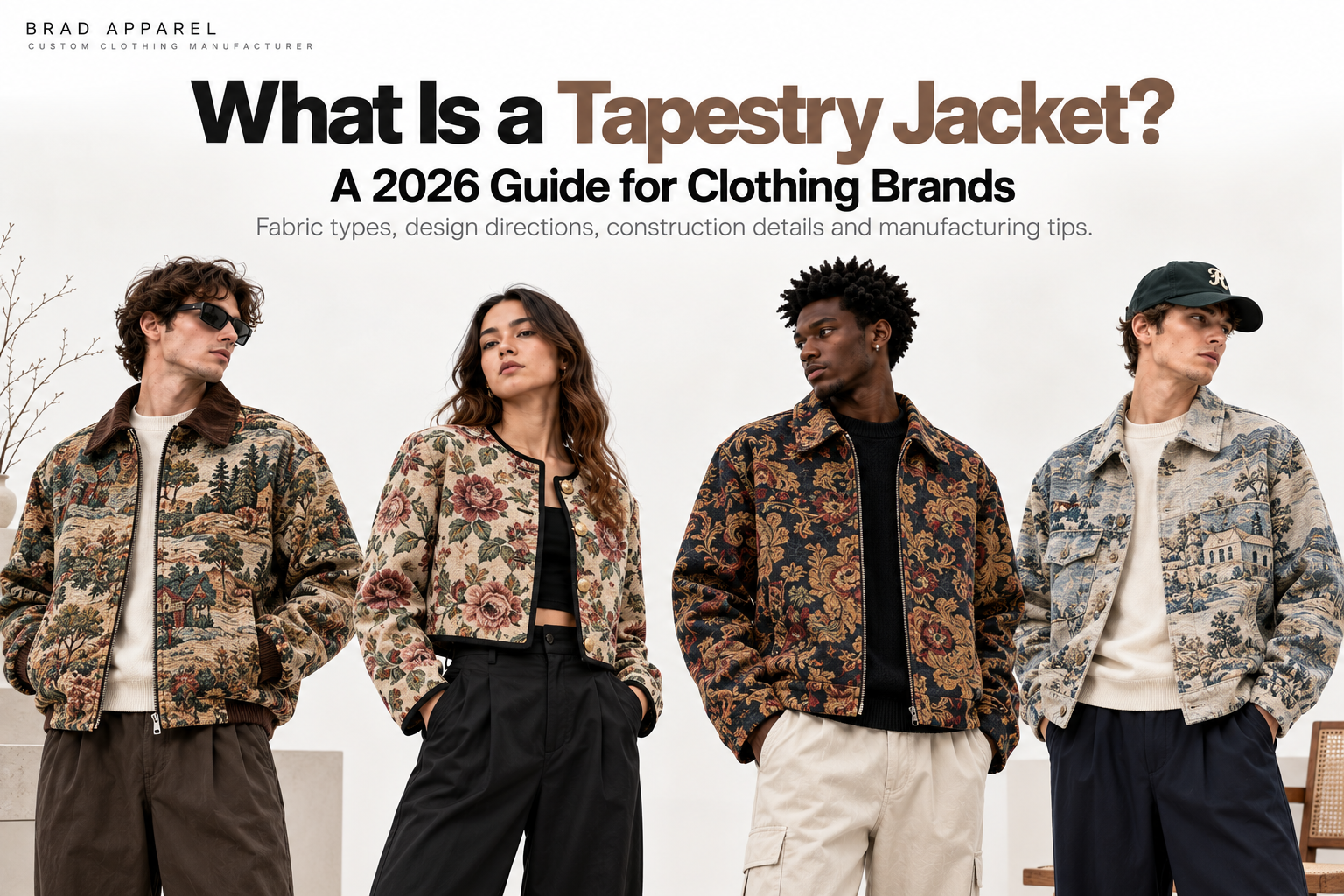
The tapestry jacket has become one of the most distinctive outerwear directions of 2026.
Instead of relying on a basic solid fabric, these jackets use:
- Woven floral patterns
- Ornamental motifs
- Vintage-inspired artwork
- Rich surface texture
- Contrast trims
- Decorative buttons
- Embroidery
- Metallic yarn effects
The result is a jacket that can feel more like a textile artwork than a basic piece of outerwear.
But there is an important manufacturing detail:
Not every jacket sold as a “tapestry jacket” is made using the same textile process.
A similar visual effect can be created using:
Jacquard weaving
Brocade
True tapestry-style woven fabric
Embroidery
or
Printed fabric
These methods can look similar in photos but behave very differently during cutting, sewing, washing and bulk production.
For clothing brands, understanding the difference is essential before developing a custom version.
What Is a Tapestry Jacket?
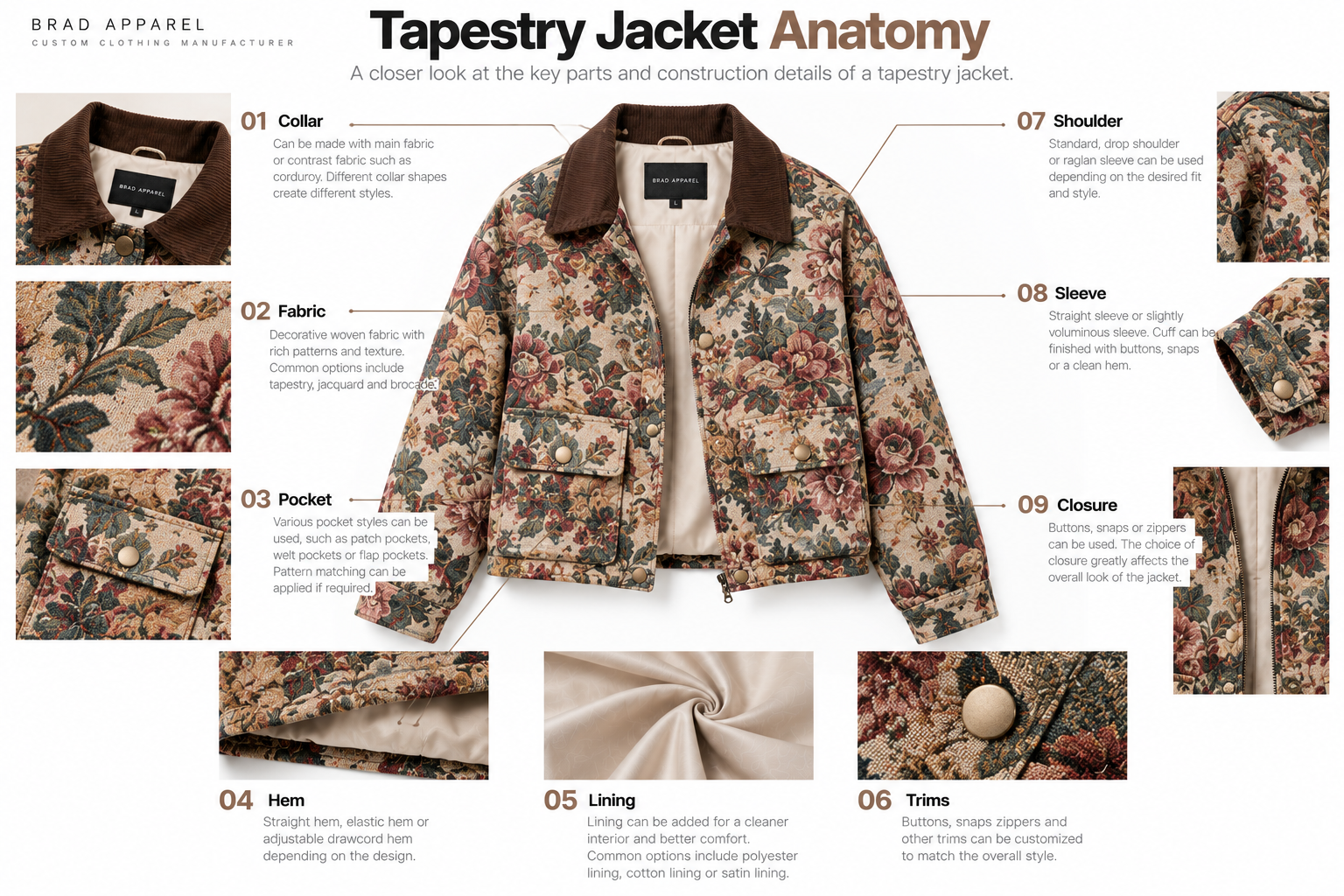
A tapestry jacket is generally a fashion jacket made from richly patterned woven fabric that resembles decorative tapestry or upholstery textiles.
Common visual characteristics include:
- Floral motifs
- Botanical artwork
- Geometric patterns
- Vintage patterns
- Dense woven texture
- Multicolor yarns
- Decorative trims
Modern versions may use silhouettes such as:
- Cropped jackets
- Boxy jackets
- Collarless jackets
- Bomber jackets
- Overshirts
- Quilted jackets
- Structured evening jackets
The term tapestry jacket is therefore often describing the visual appearance of the fabric rather than one universal garment construction.
Why Are Tapestry Jackets Trending in 2026?
Fashion has spent several seasons focusing heavily on:
- Minimalism
- Neutral colors
- Clean technical outerwear
- Simple silhouettes
Tapestry-style jackets move in the opposite direction.
They allow texture and pattern to become the main design element.
Instead of adding a large printed logo to a basic jacket, the entire surface of the garment can carry visual identity.
This fits the growing interest in:
Craftsmanship
Decorative textiles
Vintage references
Heirloom-inspired clothing
and
Statement outerwear
A relatively simple jacket pattern can therefore look highly distinctive when developed in the right fabric.
Tapestry vs Jacquard vs Brocade: What's the Difference?
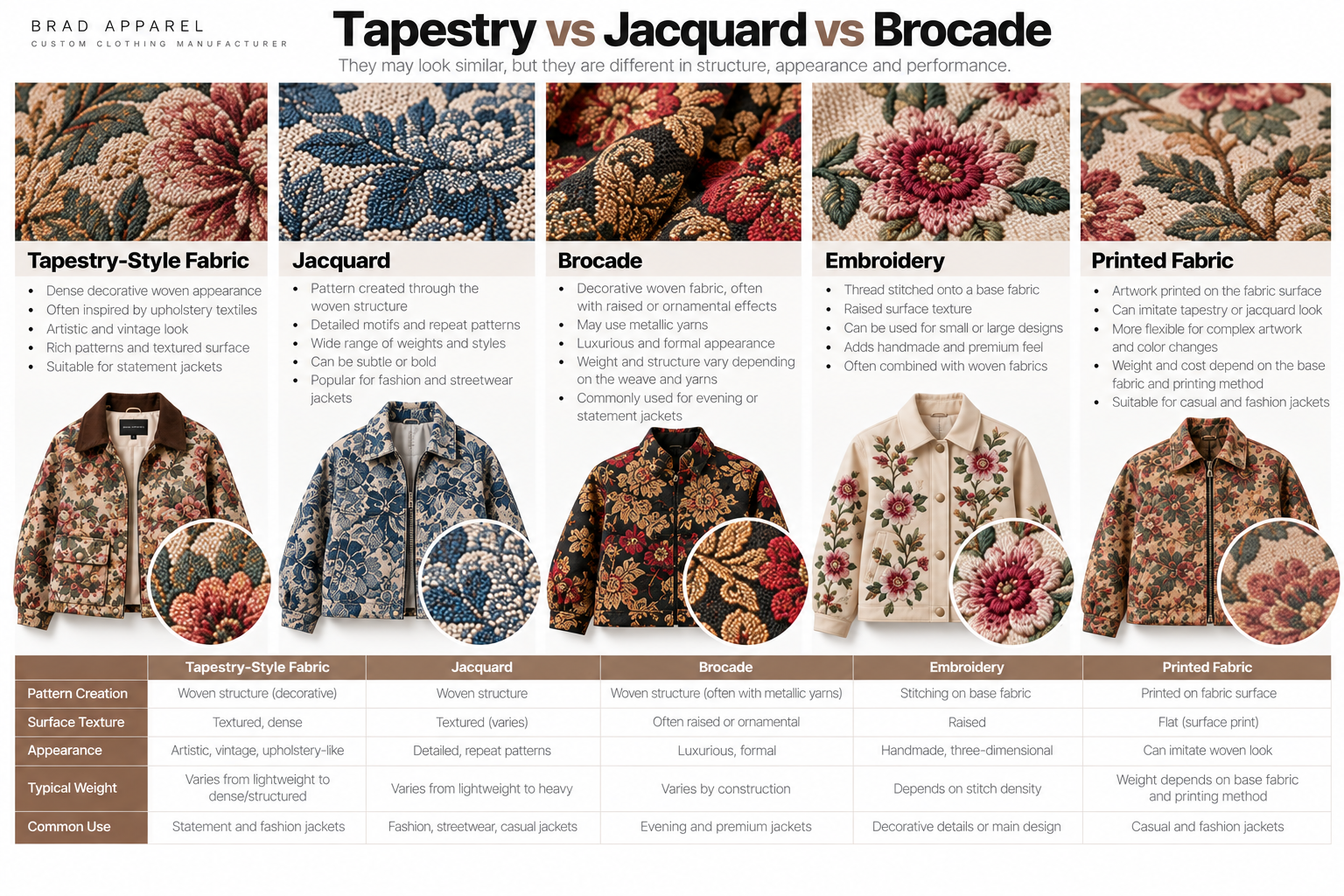
These terms are often mixed together in fashion marketing.
From a manufacturing perspective, however, they should not automatically be treated as identical.
| Textile | Main Characteristic | Typical Appearance |
|---|---|---|
| Tapestry-Style Fabric | Dense decorative woven appearance | Artistic, vintage, upholstery-inspired |
| Jacquard | Pattern created through the woven structure | Detailed motifs and repeat patterns |
| Brocade | Decorative woven fabric, often with raised or ornamental effects | Luxurious and formal |
| Embroidery | Thread stitched onto an existing base fabric | Raised surface decoration |
| Artwork applied to the fabric surface | Can imitate woven artwork visually |
The key difference is:
Is the artwork actually woven into the fabric, stitched onto the fabric, or printed onto the surface?
That decision affects:
- Cost
- MOQ
- Pattern repeat
- Weight
- Hand feel
- Production lead time
- Seam behavior
What Is Jacquard Fabric?
Jacquard refers to fabric in which the design is created through the weaving or knitting structure rather than simply printed on top.
This allows complex patterns such as:
- Florals
- Geometric artwork
- Logos
- Repeating motifs
- Abstract graphics
to become part of the textile itself.
Depending on the yarn and construction, jacquard can be:
- Lightweight
- Dense
- Matte
- Shiny
- Soft
- Highly structured
This makes it one of the most useful directions for developing a modern tapestry-style jacket.
Brad Apparel's Fabric Sourcing & Development service includes custom textile development such as jacquard structures when ready-market fabrics do not match the required design.
What Is Brocade?
Brocade is usually associated with more decorative and luxurious woven fabrics.
Common characteristics may include:
- Raised patterns
- Metallic yarn
- Floral motifs
- Ornamental artwork
- High visual contrast
Compared with a casual cotton jacquard, brocade can feel more formal and decorative.
It is often suitable for:
- Evening jackets
- Cropped statement jackets
- Structured fashion pieces
- Limited seasonal collections
However, brocade fabrics vary widely.
Some are soft and fluid.
Others are:
- Thick
- Stiff
- Fragile
- Prone to fraying
The actual fabric must therefore be evaluated before the pattern is finalized.
A Printed Tapestry Look Is Not the Same Construction
A brand can also reproduce tapestry-style artwork using printing.
This can be useful when the goal is:
- Complex artwork
- Lower fabric development requirements
- More flexible color changes
- Large illustrations
But visually similar does not mean technically identical.
A printed fabric usually creates the artwork on the surface.
A jacquard-woven design creates the pattern through the yarn structure.
This affects:
- Texture
- Reverse side appearance
- Drape
- Perceived depth
- Cost
Brands should decide whether the product needs a true woven effect or simply the visual appearance of tapestry artwork.
Pattern Repeat Is One of the Most Important Decisions
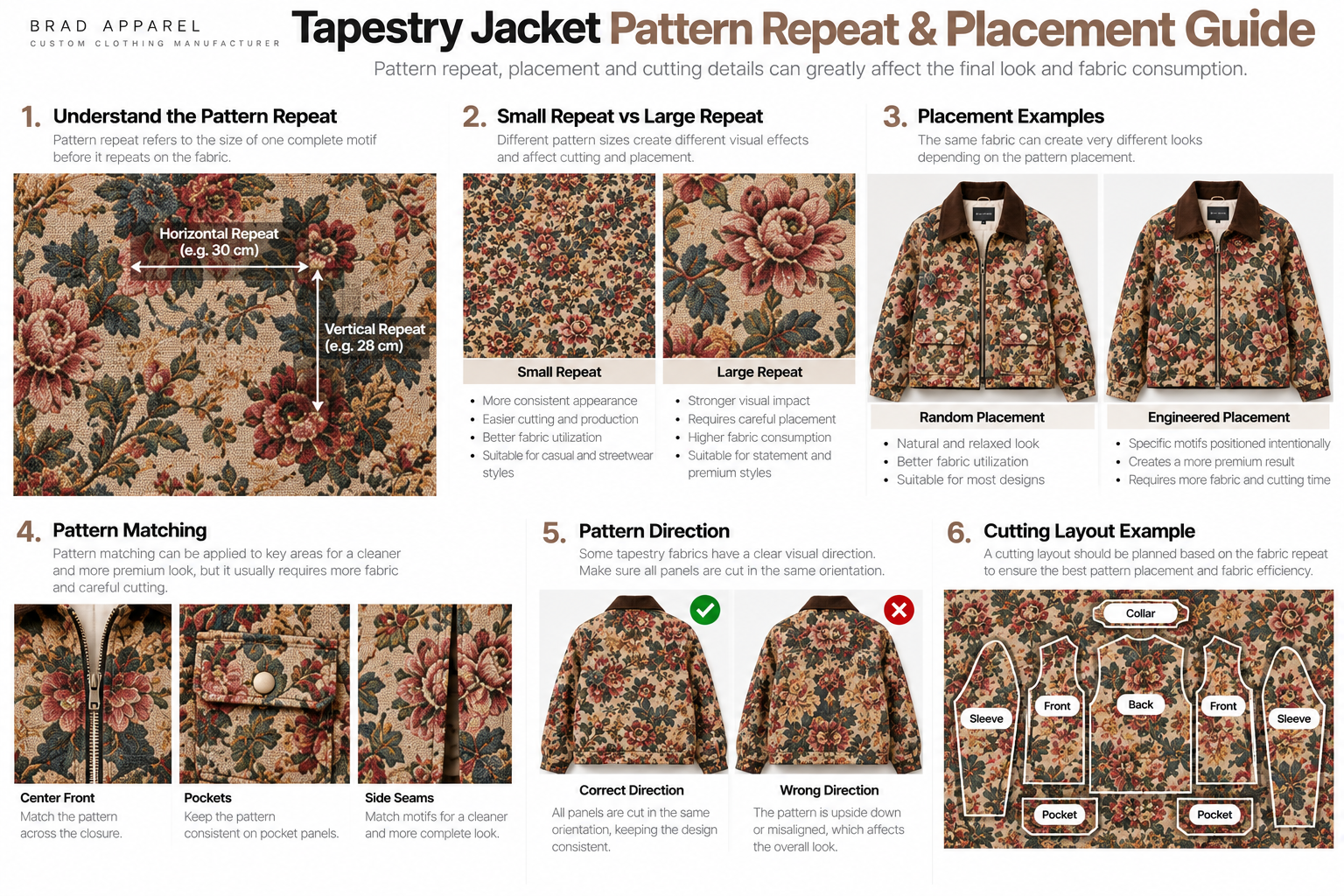
Unlike a solid fabric, patterned fabric creates placement challenges.
Imagine a large floral motif repeated across the cloth.
When the jacket is cut, that motif may appear:
- Centered on one front panel
- Cut in half on the other
- Misaligned across the zipper
- Uneven between sleeves
That can make the garment appear inconsistent.
Before bulk production, brands should understand the fabric's:
Horizontal repeat
and
Vertical repeat
The larger the repeat, the more important cutting placement becomes.
Engineered Placement vs Random Placement
There are two basic approaches.
Random Placement
Garment panels are cut normally without requiring every motif to appear in the same location.
Advantages:
- Better fabric utilization
- Easier cutting
- Lower production complexity
Suitable when the pattern is:
- Dense
- Small
- Abstract
- Non-directional
Controlled / Engineered Placement
Specific motifs are positioned intentionally.
For example:
Large flower centered on back
or
Symmetrical artwork around front closure
This can create a much more premium result.
But it may require:
- Additional fabric
- More cutting time
- More careful marker planning
- Stricter QC
A brand should clarify this before receiving a bulk quotation.
Pattern Matching Can Increase Fabric Consumption
Matching a decorative pattern across seams can look excellent.
Possible locations include:
- Center front
- Chest
- Side seams
- Back seam
- Collar
But pattern matching can require the cutter to move pattern pieces away from the most fabric-efficient position.
That means additional fabric may be required.
For highly detailed jacquard or tapestry fabrics, this should be considered during costing rather than discovered after sampling.
Fabric Direction Also Matters
Some tapestry-style fabrics have a clear visual direction.
For example:
- Flowers pointing upward
- Animals facing one direction
- Vertical vines
- Architectural motifs
If one pattern panel is accidentally rotated, the garment can look obviously wrong.
The cutting marker should therefore identify:
Top
and
Bottom
for directional designs.
How Heavy Should a Tapestry Jacket Be?
There is no universal correct GSM.
The fabric needs to match the intended silhouette.
A softer, lighter jacquard may work for:
- Overshirts
- Relaxed jackets
- Lightweight layering
A heavier tapestry-style woven may work better for:
- Boxy jackets
- Cropped structured pieces
- Statement outerwear
The correct choice depends on:
- Yarn
- Weave
- Density
- Lining
- Fit
- Season
Brands should evaluate the physical swatch rather than choosing only from a GSM number.
Fabric Thickness Changes the Pattern
A jacket pattern developed using a thin fabric may not behave the same when produced in a thick decorative woven.
Heavier materials can affect:
- Seam bulk
- Collar shape
- Pocket construction
- Sleeve movement
- Hem thickness
Areas with several layers may become particularly bulky.
Examples include:
Front facing
Collar
Cuff
Pocket flap
and
Hem
The pattern should therefore be tested in the intended production fabric.
Fraying Can Be a Major Construction Issue
Many decorative woven fabrics contain complex yarn structures.
Once cut, the raw edge may fray more easily than a stable plain weave.
That makes seam finishing especially important.
Possible approaches include:
- Overlock
- Binding
- Lining
- Enclosed seams
- Suitable seam allowance
The correct construction depends on the actual fabric.
A sample should be physically tested before bulk cutting begins.
Should a Tapestry Jacket Be Lined?
In many cases, lining is useful.
A lining can:
- Hide internal seam construction
- Reduce contact with rough yarn floats
- Create a cleaner interior
- Make the jacket easier to put on
- Improve perceived quality
Possible lining directions include:
- Polyester woven lining
- Satin-look lining
- Lightweight cotton
- Viscose-type lining
The correct option depends on the jacket design and main fabric.
Unlined Construction Is Still Possible
Not every tapestry jacket needs a lining.
A softer and cleaner woven fabric may work in an unlined construction.
But internal finishing becomes much more important.
The manufacturer should check:
- Raw edges
- Yarn floats
- Seam appearance
- Pocket construction
- Label attachment
If the back of the fabric is visually messy, a full lining may create a better product.
Four Modern Tapestry Jacket Directions
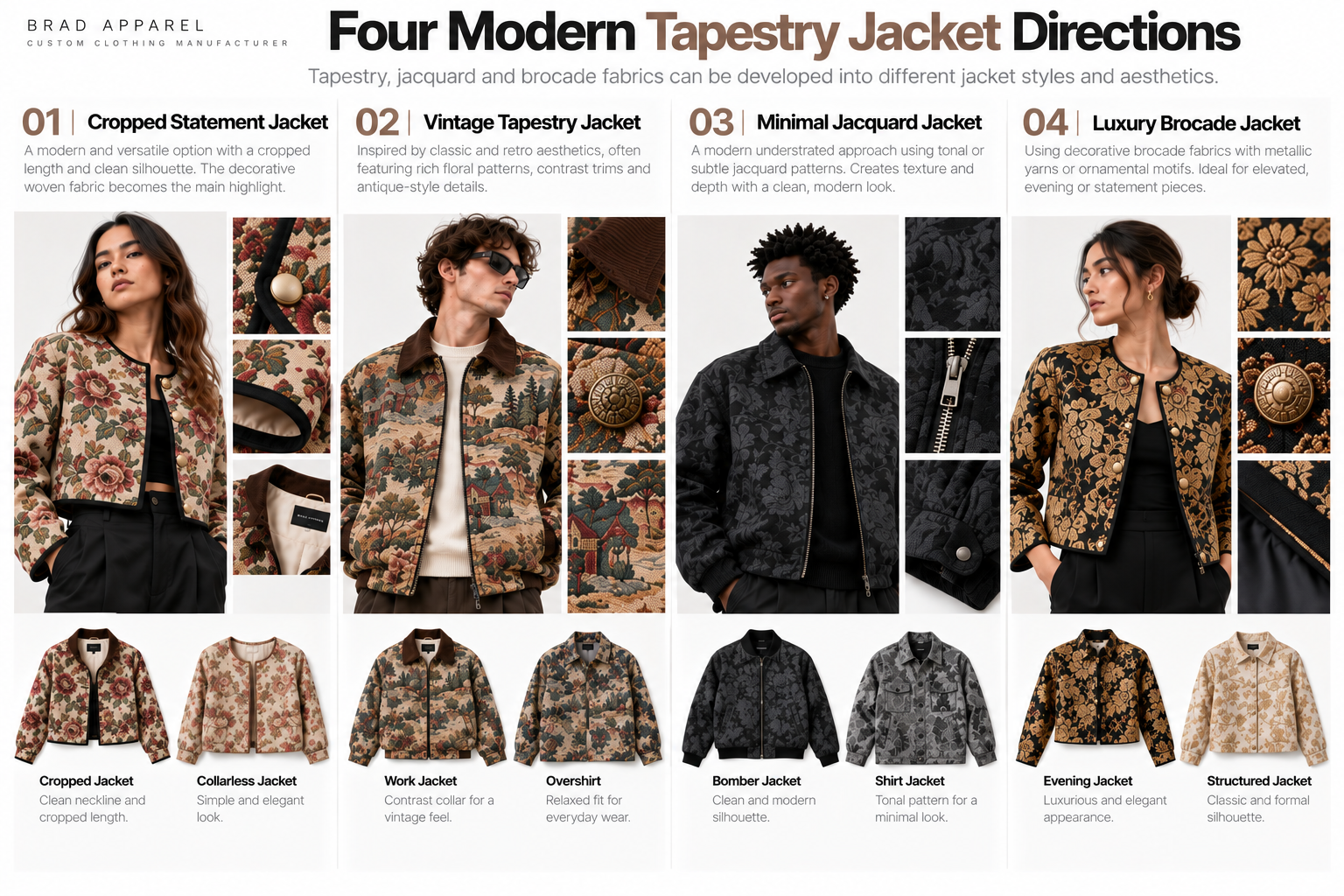
The textile can be adapted into several very different product directions.
1. Cropped Statement Jacket
Typical features:
- Short body
- Boxy fit
- Decorative woven fabric
- Clean collar or collarless neckline
- Button closure
This direction keeps the silhouette relatively simple so that the fabric becomes the focus.
Suitable for:
- Women's fashion
- Premium casual collections
- Seasonal statement pieces
2. Vintage Tapestry Jacket
Possible features include:
- Floral motifs
- Dark earth-tone colors
- Antique-style buttons
- Contrast binding
- Relaxed fit
This direction can create a strong:
heritage + vintage + artistic
identity.
3. Minimal Jacquard Jacket
Not every jacquard needs to be extremely decorative.
A tonal fabric can use:
- Black-on-black pattern
- Cream tonal motifs
- Subtle geometric weaving
- Small repeat artwork
This creates texture without a highly colorful appearance.
It works especially well for brands that want:
minimal design with more material depth.
4. Luxury Brocade / Evening Jacket
Possible characteristics include:
- Metallic yarn
- Ornamental motifs
- Structured shoulders
- Decorative buttons
- Clean fitted or cropped silhouette
The fabric becomes the luxury feature.
Construction should remain controlled so that too many design details do not compete with the textile.
Collarless Jackets Work Particularly Well
A decorative fabric already contains significant visual information.
Using a simple collarless neckline can help keep the design balanced.
Possible finishing methods include:
- Clean facing
- Binding
- Full lining
- Small round neckline
This direction can make the garment feel closer to an elevated evening or occasion jacket.
A Traditional Collar Creates a More Casual Look
Adding a traditional shirt-style or workwear collar changes the character.
The result can feel:
- More casual
- More vintage
- More like an overshirt
- Easier to style with denim
Contrast collars are also possible.
For example:
Jacquard body + corduroy collar
or
Tapestry body + solid woven collar
The two fabrics should be tested together for thickness and shrinkage compatibility.
Choosing the Right Closure
The closure can completely change the jacket.
Buttons
Buttons work especially well with decorative woven jackets.
Possible directions include:
- Horn-look buttons
- Matte buttons
- Metal buttons
- Covered buttons
- Antique-finish buttons
The button size should be balanced with the scale of the fabric artwork.
Snaps
Snaps create a cleaner and more modern appearance.
They can work well on:
- Boxy jackets
- Casual jacquard pieces
- Minimal designs
Zipper
A zipper makes the product feel more casual or contemporary.
It can work particularly well for:
- Bomber-style jacquard jackets
- Streetwear interpretations
- Cropped jackets
Frog Closures
Decorative frog closures can create a very different identity.
They may suit:
- Ornamental jackets
- East-Asian-inspired styling
- Evening jackets
- Vintage-inspired garments
Because the closure itself is decorative, the scale and placement should be tested against the fabric pattern.
Brad Apparel's Trims & Branding capabilities include custom buttons, zippers, labels and other garment details that can be developed around the main textile.
Embroidery Can Be Added—but Carefully
A tapestry-style fabric may already contain significant detail.
Adding embroidery can create an even more premium effect.
But more decoration is not automatically better.
Possible approaches include:
- Small tonal logo
- Embroidered chest branding
- Sleeve motif
- Additional floral details
- Appliqué accents
Dense embroidery on an already heavy woven fabric can make an area excessively stiff.
The decoration should therefore be tested on the actual fabric.
Brad Apparel's Embroidery Techniques include flat embroidery, appliqué, chenille and other methods that can be adjusted according to the base material.
Woven Pattern vs Embroidery: Which Is Better?
Neither is universally better.
Choose woven artwork when:
- The pattern covers a large area
- Textile texture is important
- The design repeats across the garment
- The fabric itself should be the visual feature
Choose embroidery when:
- Artwork placement needs to be controlled
- Only specific areas require decoration
- Branding needs to be added after fabric selection
The two methods can also be combined.
What About Metallic Yarn?
Metallic effects can add depth to brocade and decorative jacquard.
However, metallic yarn may affect:
- Hand feel
- Flexibility
- Surface abrasion
- Needle selection
- Washing
The sample should therefore be evaluated physically rather than judging only from photos.
Color Development Can Be More Complex Than Solid Fabric
A solid fabric may require matching one Pantone color.
A multicolor jacquard might contain:
- Background color
- Main motif color
- Secondary motif
- Accent color
- Metallic yarn
This means color approval should consider the entire combination.
One yarn may be correct individually but make the overall textile feel different once woven together.
For custom development, reviewing:
physical strike-offs or woven swatches
is more reliable than approving colors only from a digital mockup.
Custom Jacquard vs Ready-Market Fabric
Brands generally have two sourcing routes.
Ready-Market Jacquard
Useful when:
- Quantities are smaller
- Sampling speed matters
- An existing pattern is acceptable
Advantages:
- Faster sourcing
- Lower development risk
- Easier sampling
The limitation is exclusivity.
Another brand may be able to purchase the same textile.
Custom Jacquard Development
Useful when the brand needs:
- Original artwork
- Exclusive pattern
- Specific colors
- Custom scale
- Logo integration
But custom development may require:
- Higher fabric MOQ
- Longer lead time
- Artwork preparation
- Woven sampling
- Additional testing
Brad Apparel's Fabric Sourcing & Development service supports both ready-market sourcing and custom textile development depending on the project requirements.
How Should Artwork Be Prepared?
For custom woven patterns, clean artwork is important.
Brands should ideally provide:
- Vector artwork where possible
- Clear repeat dimensions
- Color references
- Desired scale
- Orientation
- Placement reference
A digital fashion sketch alone may not provide enough information for the textile mill.
Large Artwork vs Small Repeat
The size of the motif dramatically changes the finished jacket.
Small Repeat
Creates:
- More consistent panel appearance
- Easier cutting
- Less placement variation
Large Repeat
Creates:
- Strong statement artwork
- More dramatic visual impact
But may require:
- Controlled placement
- Additional fabric
- More careful cutting
Neither is better.
The right choice depends on the product.
Pocket Design Should Not Fight the Pattern
Large patch pockets can interrupt decorative artwork.
For that reason, tapestry jackets often benefit from cleaner pocket constructions.
Possible options include:
Welt Pocket
Keeps the exterior relatively clean.
Seam Pocket
Reduces visual interruption.
Patch Pocket
Can work when the pattern is carefully matched.
No Visible Pocket
Useful for highly decorative evening jackets.
If a patch pocket is used, deciding whether the motif should match the body panel is important before costing.
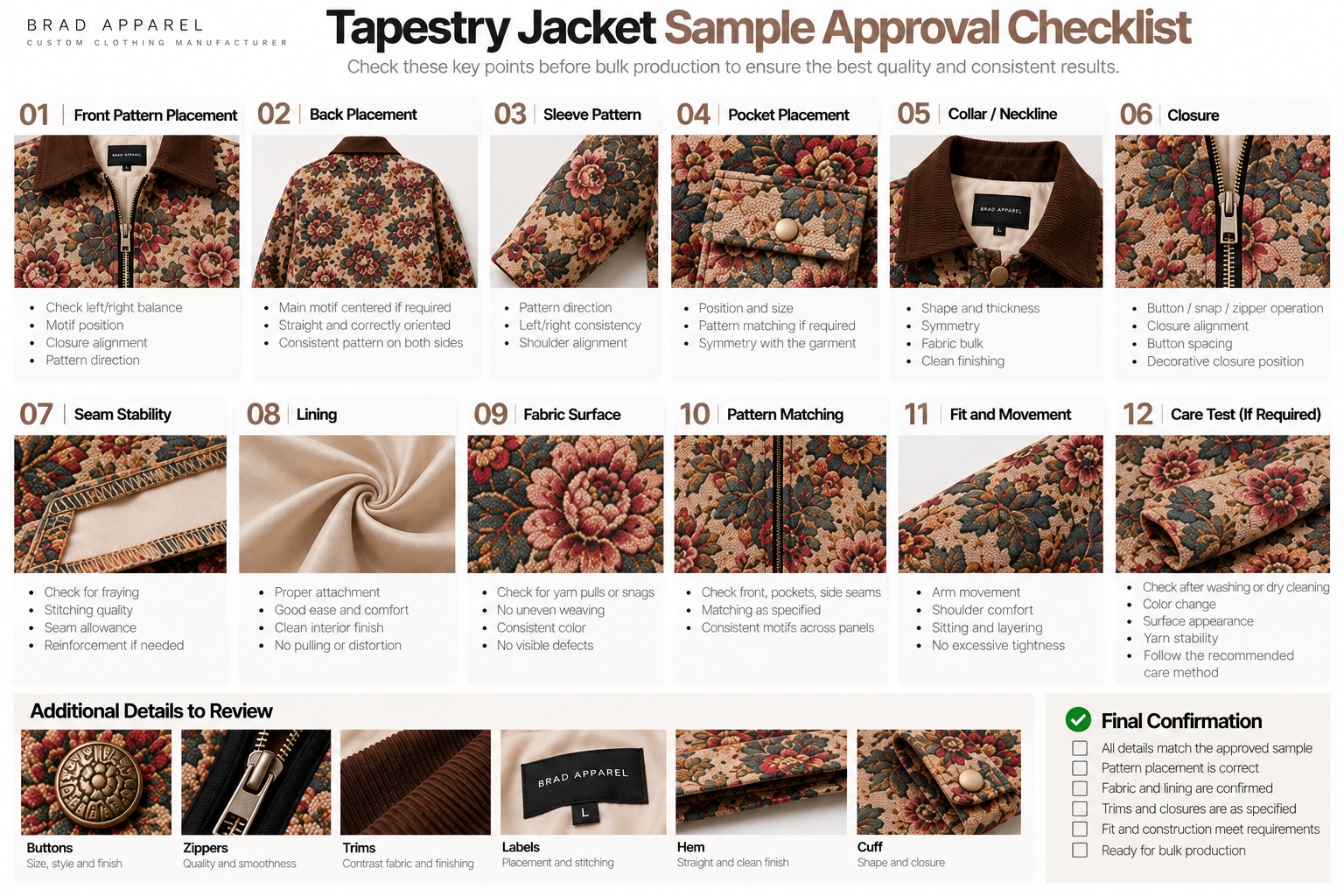
What Should You Check on a Tapestry Jacket Sample?
A decorative jacket should be reviewed for more than basic fit.
1. Front Pattern Placement
Check:
- Left/right balance
- Motif position
- Closure alignment
- Pattern direction
2. Back Placement
Check whether the main motif is:
- Centered if required
- Straight
- Correctly oriented
3. Sleeve Pattern
Check:
- Pattern direction
- Left/right consistency
- Shoulder alignment
4. Pocket Placement
Check:
- Position
- Size
- Pattern matching if required
- Symmetry
5. Collar / Neckline
Check:
- Shape
- Thickness
- Symmetry
- Fabric bulk
6. Closure
Check:
- Button spacing
- Snap operation
- Zipper alignment
- Decorative closure position
7. Seam Stability
Inspect areas where the fabric may fray.
Check:
- Raw edge control
- Stitching
- Seam allowance
- Reinforcement
8. Lining
Check:
- Attachment
- Ease
- Interior cleanliness
- Hem connection
The lining should not pull the outer shell out of shape.
9. Fabric Surface
Check for:
- Yarn pulls
- Snags
- Uneven weaving
- Color inconsistencies
- Surface defects
10. Pattern Matching
If pattern matching was specified, check:
- Front
- Pockets
- Side seams
- Back seams
against the approved sample.
11. Fit and Movement
Decorative fabrics can sometimes be less flexible.
Test:
- Arm movement
- Shoulder comfort
- Sitting
- Layering
12. Care Test
Where appropriate, evaluate:
- Dimensional change
- Surface appearance
- Yarn stability
- Color change
- Lining behavior
The care method should match the actual fabric composition and garment construction.
Common Tapestry Jacket Development Mistakes
Choosing Fabric Only From a Digital Image
Texture and stiffness cannot be judged accurately on screen.
Always review a physical swatch when possible.
Assuming Every “Tapestry” Fabric Is the Same
Jacquard, brocade, embroidery and print can produce very different garments.
Ignoring Pattern Repeat
Large motifs can end up awkwardly positioned after cutting.
Requiring Pattern Matching Without Including It in Costing
Matching patterns usually reduces fabric efficiency and increases cutting complexity.
Using Too Many Decorative Details
The fabric may already be the statement feature.
Too much embroidery, hardware and trim can make the product visually overloaded.
Ignoring Fraying
Decorative woven fabrics may need additional edge control.
Changing Fabric After Pattern Approval
A new fabric can have completely different:
- Thickness
- Drape
- Stability
- Seam bulk
The garment may need to be resampled.
What Should You Send a Tapestry Jacket Manufacturer?
A useful development brief should include:
| Area | What to Specify |
|---|---|
| Silhouette | Cropped / boxy / relaxed / fitted |
| Fabric Direction | Tapestry / jacquard / brocade / embroidered |
| Composition | Cotton / polyester / blend / other |
| Artwork | Pattern file or physical reference |
| Repeat Size | Horizontal and vertical repeat |
| Colors | Pantone or reference colors |
| Placement | Random / controlled / engineered |
| Pattern Matching | Required areas |
| Lining | None / partial / full |
| Closure | Buttons / snaps / zipper / frog closure |
| Welt / seam / patch / none | |
| Decoration | Embroidery / appliqué / branding |
| Trims | Buttons, labels and hardware |
| Quantity | Sample and bulk quantity |
This information helps the manufacturer understand whether the project is simply:
a jacket using an existing decorative fabric
or
a fully custom textile development project.
Those two projects can have very different production requirements.
How Brad Apparel Can Develop a Custom Tapestry Jacket
A typical development sequence can follow:
Design Reference
↓
Fabric Direction
↓
Ready Fabric or Custom Jacquard Decision
↓
Pattern Repeat & Color Approval
↓
Garment Pattern Development
↓
Closure / Trim Selection
↓
Sample Production
↓
Pattern Placement Review
↓
Fit & Construction Review
↓
Bulk Fabric Approval
↓
Bulk Production
The important point is to develop the textile and garment together.
With highly decorative fabrics, the fabric should not be treated as an afterthought.
The scale of the artwork, fabric structure and pattern repeat can directly affect the final jacket pattern and production cost.
FAQ
What Is a Tapestry Jacket?
A tapestry jacket is generally a jacket made from decorative woven fabric featuring rich patterns such as florals, geometric motifs or vintage-inspired artwork.
The retail term can include several textile constructions, including jacquard and brocade.
Is Tapestry the Same as Jacquard?
Not exactly.
Jacquard refers to a method of creating patterns through the fabric structure.
“Tapestry jacket” is often used more broadly in fashion to describe a decorative woven appearance.
Many modern tapestry-style jackets may technically use jacquard fabric.
What Is the Difference Between Brocade and Jacquard?
Jacquard is a broader category of patterned woven construction.
Brocade is usually a more decorative type of woven fabric and may feature raised, ornamental or metallic effects.
Can You Custom Make Tapestry Fabric?
Yes.
A custom jacquard or decorative woven fabric can be developed using original artwork, yarn colors and pattern repeats.
Custom fabric development normally requires higher minimums and longer lead times than choosing an existing fabric.
Can a Tapestry Jacket Be Embroidered?
Yes.
Embroidery can be added to a decorative woven jacket.
However, stitch density, backing and placement should be tested because the main fabric may already be thick or textured.
Does a Tapestry Jacket Need a Lining?
Not always.
But lining can help create a cleaner interior and cover raw seams or yarn floats.
The correct construction depends on the back surface and stability of the main fabric.
Can the Pattern Be Matched Across Pockets?
Yes.
But pattern matching may increase fabric consumption and cutting time.
Brands should specify exactly which seams and components require matching before receiving a production quotation.
Are Tapestry Jackets Heavy?
Not necessarily.
The weight depends on the actual yarn, weave and fabric construction.
Tapestry-style fabrics can range from relatively lightweight decorative jacquards to dense, structured woven materials.
Is a Printed Tapestry Pattern the Same as Woven Jacquard?
No.
Printing places artwork on the fabric surface.
Jacquard creates the pattern through the textile structure itself.
Both can create decorative jackets, but they produce different texture, appearance and production requirements.
Final Thoughts
The most important thing about developing a tapestry jacket is understanding what creates the visual effect.
The answer may be:
Jacquard weaving
Brocade
Embroidery
Printing
or
A combination of techniques.
Once that is clear, the rest of the product can be engineered around it.
For clothing brands, the strongest tapestry jackets usually come from balancing:
Artwork
+
Fabric structure
+
Pattern placement
+
Silhouette
+
Construction
rather than simply choosing the most decorative fabric available.
When those elements are developed together, a highly patterned jacket can still feel controlled, wearable and production-ready.
Keep Reading