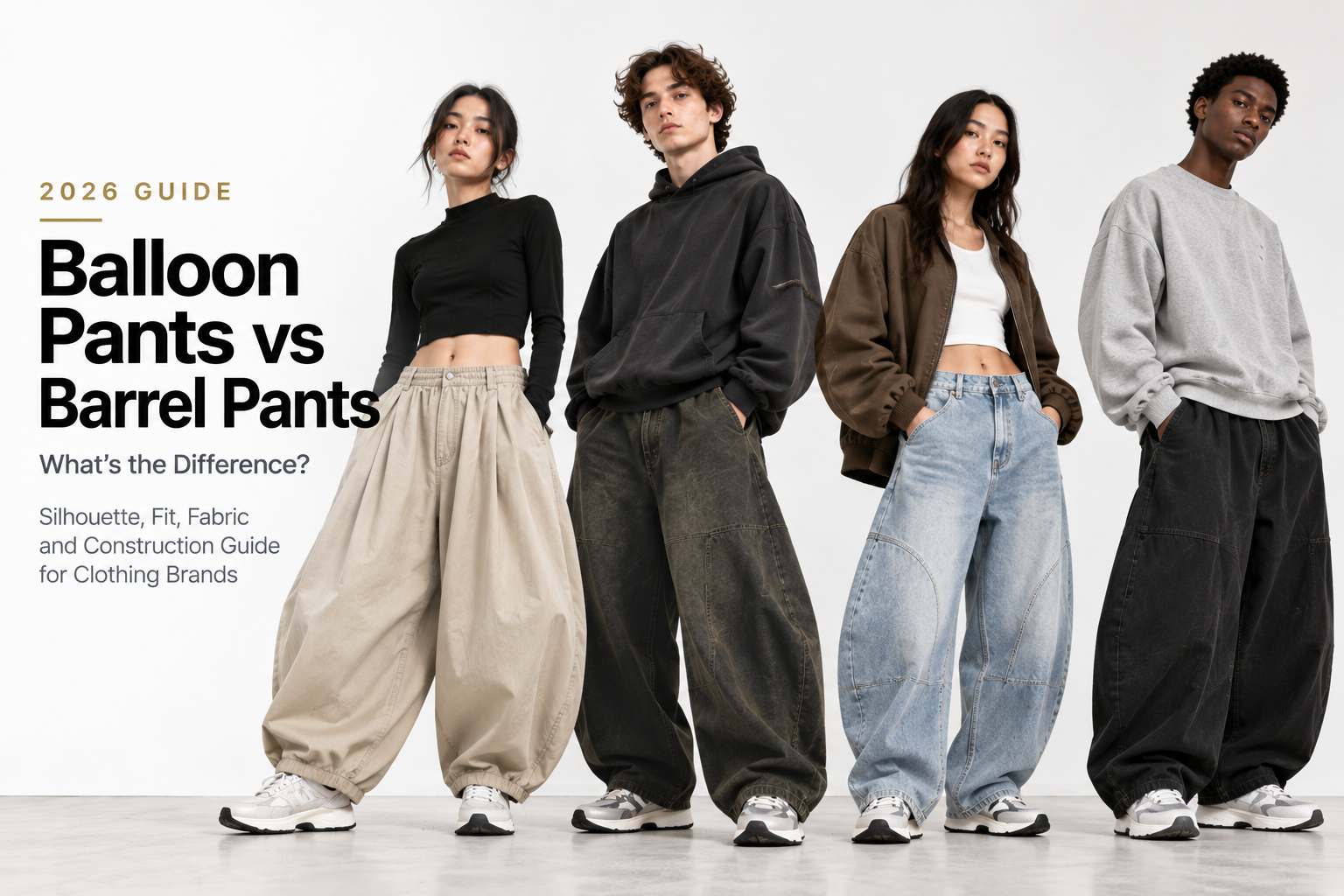
Balloon pants and barrel pants both create volume through the leg, but they are not the same silhouette.
The simplest difference is this:
Balloon pants usually create fuller, softer volume through the leg before narrowing significantly toward the ankle.
Barrel pants usually create a more controlled curved shape that bows outward through the thigh or knee and then narrows toward the hem.
For clothing brands, that difference affects much more than styling.
It changes:
- Pattern shape
- Side-seam curve
- Inseam
- Knee width
- Hem opening
- Rise
- Fabric choice
- Waistband construction
- Drape
- Size grading
This guide explains balloon pants vs barrel pants from a garment-development perspective and shows how they differ from wide-leg, harem and tapered pants.
What Are Balloon Pants?
Balloon pants are trousers designed with substantial volume through the leg before narrowing toward the lower leg or ankle.
The silhouette typically becomes:
fuller through the hip and thigh → widest through the leg → narrower toward the hem
Depending on the design, the hem may be:
- Tapered
- Pleated
- Elasticated
- Drawcord-adjusted
- Gathered
- Narrow but clean finished
The result is a rounded silhouette that creates visible volume around the leg.
Modern balloon pants can range from relatively clean fashion trousers to extremely voluminous streetwear or harem-inspired designs.
What Are Barrel Pants?
Barrel pants also use curved volume, but the shape is normally more controlled.
A typical barrel-leg pattern:
- Fits or sits relatively cleanly around the waist
- Adds volume through the thigh and knee area
- Curves outward along the side seam
- Narrows again toward the lower leg
- Finishes with a controlled hem opening
This creates a shape that resembles a barrel or horseshoe.
The silhouette is sculptural rather than simply oversized.
Barrel pants may be made from:
- Denim
- Cotton twill
- Canvas
- Suiting
- Poplin
- Technical woven fabrics
Fabric structure plays a major role in making the curve visible.
Balloon Pants vs Barrel Pants: Quick Comparison
| Feature | Balloon Pants | Barrel Pants |
|---|---|---|
| Overall Volume | High to very high | Moderate to high |
| Leg Shape | Full and rounded | Curved / horseshoe |
| Widest Area | Thigh to lower leg | Usually thigh / knee |
| Hem | Narrow, gathered or elastic | Controlled / tapered |
| Drape | Often softer and more fluid | Often more structured |
| Side Seam | Can be very full | Deliberately curved |
| Typical Fabric | Poplin, nylon, lightweight woven, soft twill | Denim, twill, canvas, structured woven |
| Visual Effect | Billowy and voluminous | Sculptural and curved |
| Common Fit | Relaxed / oversized | Relaxed / shaped |
| Pattern Focus | Volume distribution | Controlled curvature |
These are general tendencies rather than universal industry rules.
Brands and retailers sometimes use "balloon," "barrel," "horseshoe" and even "harem" differently.
For manufacturing, the actual pattern measurements matter more than the product name.
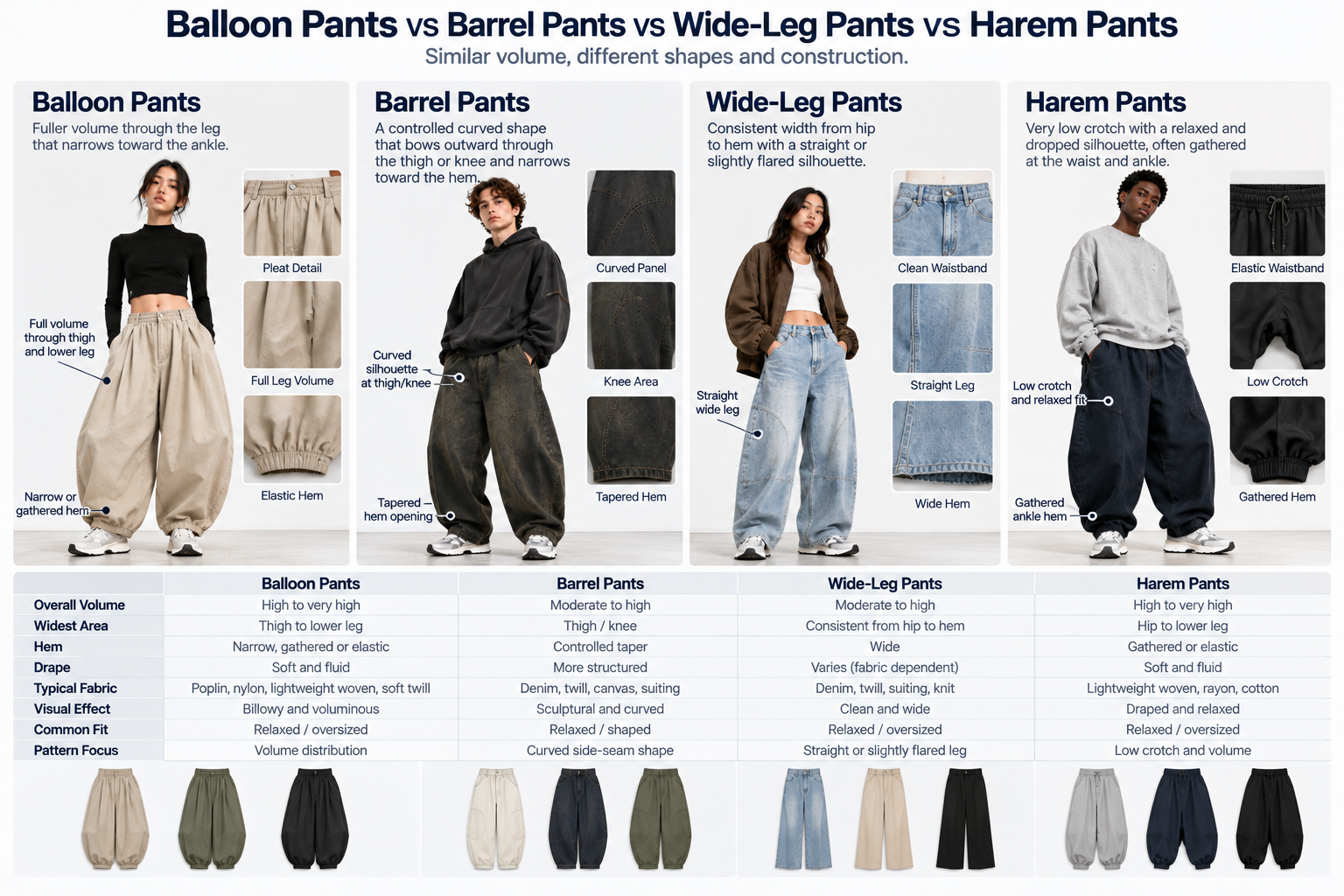
Balloon Pants vs Wide-Leg Pants
Wide-leg pants and balloon pants both use additional leg volume.
But the direction of that volume is different.
Wide-Leg Pants
A typical wide-leg silhouette stays relatively wide from the upper leg toward the hem.
The side seam may appear:
- Straight
- Slightly flared
- Almost vertical
The hem remains wide.
Balloon Pants
Balloon pants usually reduce width again before reaching the hem.
That narrowing creates the rounded appearance.
Think of the difference as:
Wide leg = width continues downward
Balloon = width expands and then contracts
That lower-leg reduction is one of the most important visual differences.
Balloon Pants vs Harem Pants
These categories can overlap, but they are not automatically the same.
Harem Pants
Traditional harem-inspired trousers may use:
- Very low crotch
- Deep rise
- Large amount of fabric
- Strong ankle taper
- Gathered waistband
- Gathered hem
Balloon Pants
Modern balloon trousers may retain:
- Normal or moderate rise
- Conventional crotch depth
- Cleaner waistband
- Curved volume through the leg
This means a balloon pant can create dramatic leg volume without using an extremely dropped crotch.
For a fashion brand, the rise and crotch shape should therefore be specified separately from the leg silhouette.
Barrel Pants vs Wide-Leg Pants
The main difference is the side-seam shape.
A wide-leg trouser often falls relatively straight from the hip.
A barrel pant intentionally curves outward and then returns inward.
This means the barrel pattern may have:
- More width around the knee
- More shaping at the side seam
- Reduced hem width
- More pronounced front or back leg shaping
The curve should look deliberate.
If the lower leg remains too wide, the garment may simply read as a wide-leg trouser.
Barrel Pants vs Tapered Pants
Both may narrow toward the hem.
But traditional tapered pants generally become progressively narrower from the thigh downward.
A barrel pant behaves differently:
narrower upper area → outward curve → inward curve
rather than:
wide upper area → gradually narrower hem
That outward curve is what gives the barrel silhouette its sculptural character.
The Side Seam Creates the Barrel Shape
The side seam is one of the most important pattern lines in barrel pants.
A conventional straight-leg pattern may have a relatively smooth line from hip to hem.
For a barrel silhouette, the side seam may:
- Move outward from the upper thigh
- Reach maximum width around the thigh or knee
- Return inward toward the hem
The exact curve determines whether the pants look:
- Subtle
- Sculptural
- Extremely rounded
Too little curve and the pants look straight.
Too much curve without enough structure can create uncontrolled folds rather than a clean barrel shape.
The Inseam Also Matters
It is easy to focus only on the outside seam.
But changing only the side seam can distort the leg.
The inseam may also need adjustment to control:
- Leg balance
- Knee position
- Fabric distribution
- Front/back rotation
The curved silhouette should be built around the entire leg pattern, not simply by adding fabric to the outside seam.
Where Should the Leg Be Widest?
There is no single correct answer.
The widest point may sit:
Higher on the Thigh
Creates a stronger upper-leg volume.
Around the Knee
Creates a classic barrel-like curve.
Below the Knee
Creates a more exaggerated balloon effect.
Moving the maximum width by only a few centimeters can change the character of the pants.
This should be evaluated on the actual wearer rather than only on a flat pattern.
Hem Opening Is Critical
The hem determines how strongly the volume above it is perceived.
Imagine two pants with the same thigh and knee width.
Pant A
Has a relatively wide hem.
The result may look:
wide-leg
Pant B
Has a significantly narrower hem.
The result may look:
barrel or balloon
So the silhouette depends on the relationship between:
knee width + lower-leg width + hem opening
rather than one measurement alone.
How Balloon Pants Create More Volume
Balloon pants can create volume in several ways.
Wider Pattern Pieces
The simplest method is adding width through the leg.
Pleats
Pleats can concentrate volume around the waist or upper leg.
Possible options include:
- Single pleat
- Double pleat
- Inverted pleat
- Tuck
- Dart-like shaping
Gathers
Gathering can create softer volume around:
- Waist
- Hem
- Ankle
Panel Construction
Additional panels can shape the leg more precisely.
Elastic or Drawcord Hem
A wide lower leg can be gathered into a smaller opening.
This produces a stronger balloon effect.
Balloon Pants Pattern Development
A balloon pattern should control several measurements together:
- Waist
- Hip
- Front rise
- Back rise
- Thigh
- Knee
- Calf
- Hem
- Inseam
- Outseam
The design should define where the volume begins and where it ends.
For example:
clean waist + relaxed hip + very wide knee + narrow ankle
creates a different silhouette from:
gathered waist + extremely wide thigh + gathered ankle
even though both may be sold as balloon pants.
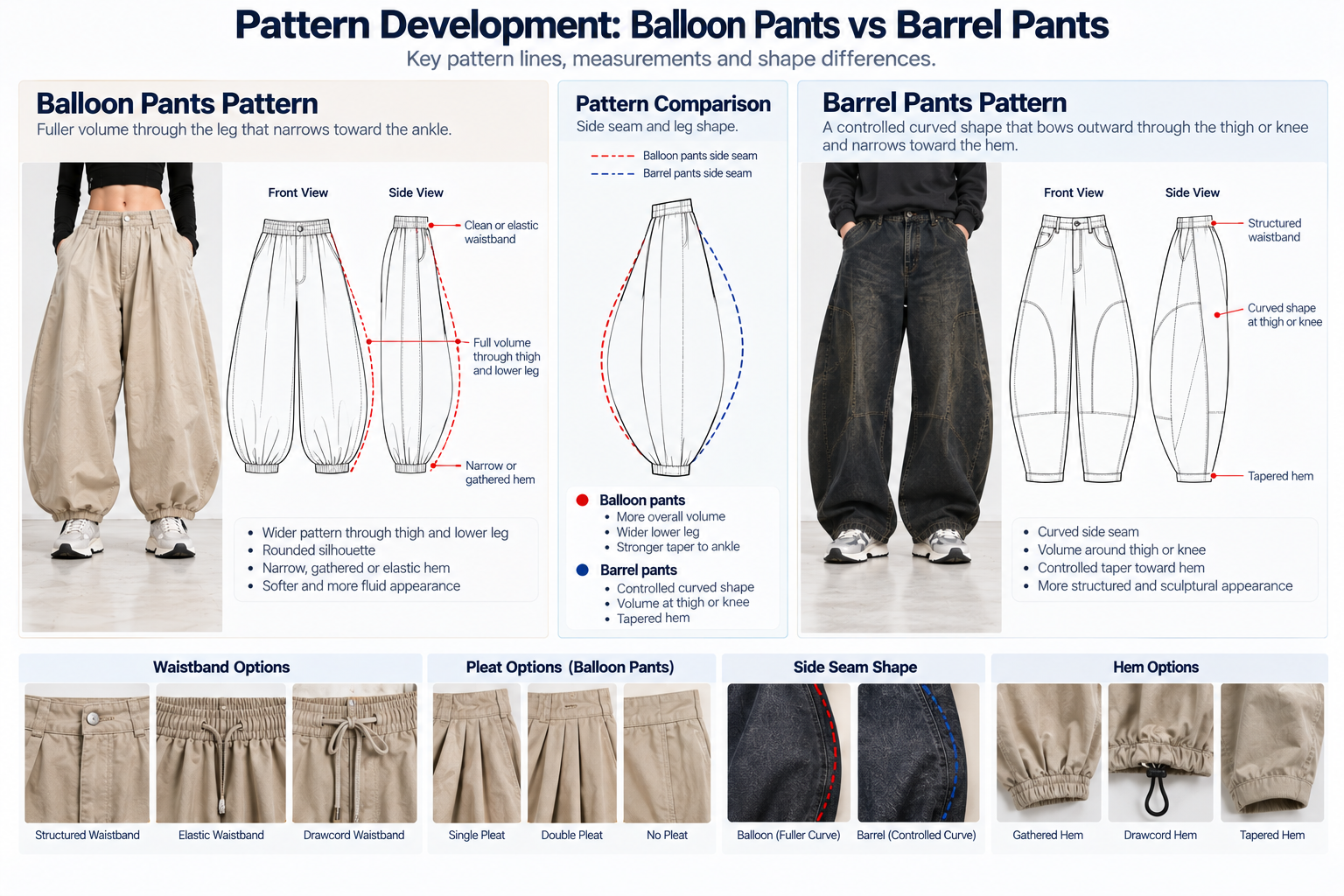
Rise Changes the Silhouette
Rise is especially important when developing voluminous pants.
High Rise
Can create:
- Longer visual leg
- More defined waist
- Stronger fashion silhouette
Mid Rise
Creates a more balanced and versatile proportion.
Low Rise
Can create:
- Y2K influence
- More relaxed positioning
- Longer-looking torso
Rise also affects how the extra fabric sits around the hip and crotch.
A low-rise balloon pant and a high-rise balloon pant may have the same leg width but look completely different.
Crotch Depth Should Be Controlled
One mistake is assuming balloon pants always need a very low crotch.
They do not.
Additional crotch depth can create:
- More relaxed drape
- More harem influence
- More movement
But too much depth can make the pants feel:
- Heavy
- Sloppy
- Difficult to walk in
- Different from the intended silhouette
For cleaner balloon pants, a conventional rise with carefully developed leg volume may work better.
Front Pleats Can Change the Shape
Pleats can add volume without increasing the entire waistband.
For example:
Single Pleat
Creates moderate front volume.
Double Pleat
Allows more fullness around the upper leg.
No Pleats
Creates a cleaner waist and moves more of the volume into the leg pattern.
Pleat depth should be specified in the tech pack.
A reference photo alone does not show how much fabric is actually folded into the pleat.
Darts vs Pleats
Darts remove fabric.
Pleats add or control visible fullness.
For barrel pants, darts may help create:
- Cleaner waist
- Controlled hip shape
while the curved leg provides the visual volume.
Balloon trousers may use pleats when a softer transition from waist to leg volume is desired.
Fabric Choice Can Completely Change the Same Pattern
Two pants made from the same pattern can look very different in different fabrics.
Soft Fabric
Creates:
- More drape
- Softer folds
- More movement
- Less rigid curvature
Structured Fabric
Creates:
- Stronger outline
- More visible barrel shape
- Cleaner volume
- More sculptural appearance
This is one reason fabric selection should happen early in sample development.
Best Fabrics for Balloon Pants
Balloon pants often work well with fabrics that combine:
volume + movement
Possible directions include:
Cotton Poplin
Provides:
- Lightweight structure
- Crisp volume
- Comfortable movement
Nylon
Creates:
- Technical appearance
- Lightweight volume
- Streetwear direction
Lightweight Cotton Twill
Adds:
- More structure
- Casual feel
- Better shape retention
Taffeta-Like Wovens
Can create:
- Dramatic volume
- Crisp folds
- Fashion-forward appearance
Soft Suiting
Works for more refined balloon trousers.
The fabric should have enough body to create volume without becoming unnecessarily heavy.
For custom sourcing, see Brad Apparel's Fabric Sourcing & Development.
Best Fabrics for Barrel Pants
Barrel pants often benefit from more structure.
Common options include:
- Denim
- Cotton twill
- Canvas
- Structured suiting
- Gabardine
- Medium-weight woven fabrics
These materials help preserve the curved silhouette.
Very soft fabrics can still be used, but the result becomes more fluid and less architectural.
Denim Barrel Pants
Denim works particularly well because it naturally holds shape.
Important decisions include:
- Denim weight
- Wash
- Shrinkage
- Side-seam construction
- Hem opening
- Pocket placement
A rigid denim creates a stronger barrel.
A heavily washed denim produces softer curves.
The pattern may therefore need adjustment when changing from rigid to heavily washed denim.
Waistband Options
Balloon and barrel pants do not require one specific waistband.
Possible options include:
Structured Waistband
Suitable for:
- Tailored balloon trousers
- Denim barrel pants
- Cleaner fashion silhouettes
Elasticated Waist
Works for:
- Relaxed balloon pants
- Lightweight nylon
- Casual products
Drawcord Waist
Adds:
- Adjustability
- Sportswear influence
- Streetwear styling
Half-Elastic Waist
Combines a cleaner front with greater comfort at the back.
Waistband choice affects the entire visual direction of the product.
Hem Construction Options
The hem is particularly important on balloon pants.
Clean Tapered Hem
Creates a refined silhouette without visible gathering.
Elasticated Hem
Creates stronger volume above the ankle.
Internal Elastic
Maintains a cleaner exterior.
Drawcord Hem
Allows adjustable shape.
The same pants can sometimes move between:
wide
and
ballooned
depending on how tightly the drawcord is adjusted.
Pleated Hem
Fabric can also be controlled through pleats or darts near the lower leg.
This can create volume without using visible elastic.
Barrel Pants Usually Need a Cleaner Hem
Barrel pants generally rely on pattern shape rather than gathering.
Common finishes include:
- Clean folded hem
- Blind hem
- Denim hem
- Cropped raw hem
The hem width should support the curve above it.
If the opening is excessively tight, the garment can begin to resemble a carrot or tapered pant instead of a barrel shape.
Cropped vs Full-Length Barrel Pants
Length also changes the silhouette.
Cropped Barrel Pants
Can emphasize:
- Curved lower leg
- Ankle
- Sculptural shape
Full-Length Barrel Pants
May:
- Stack slightly on footwear
- Create heavier visual volume
- Feel more streetwear-oriented
A full-length design requires careful evaluation because excessive length can hide the intended curve.
Balloon Pants Length Options
Balloon pants can be:
- Cropped
- Ankle length
- Full length
- Extra long
Full-length versions may create fabric pooling around the ankle.
Cropped versions make the tapered hem more visible.
Again, the name "balloon pants" does not define the exact finished length.
Pocket Placement Needs to Follow the Volume
Pocket position should be reviewed when the side seam becomes highly curved.
Possible pocket types include:
- Side-seam pocket
- Slant pocket
- Welt pocket
- Patch pocket
- Cargo pocket
If a pocket is placed directly across the maximum curve, it may:
- Flare outward
- Distort
- Add unwanted bulk
The pocket should be tested on the actual sample.
Cargo Balloon Pants
Balloon and cargo construction can be combined.
A cargo balloon pant may use:
- Large thigh pockets
- Technical nylon
- Elastic waistband
- Drawcord hem
- Oversized leg volume
But large cargo pockets add additional visual and physical weight.
The pocket dimensions should therefore match the overall pant volume.
For more detailed cargo construction, see our Cargo Pants Guide.
Seams Can Be Used to Control the Curve
Some barrel pants use additional seam lines to create shape.
Possible options include:
- Curved side panels
- Knee panels
- Front-leg seams
- Back-leg seams
- Darts
These allow the pattern maker to distribute shape more precisely than a basic two-piece trouser pattern.
This can be particularly useful for highly sculptural designs.
Curved Panels vs Simple Side Seam
Simple Side Seam
Advantages:
- Cleaner look
- Fewer sewing operations
- Lower construction complexity
Curved Panel Construction
Advantages:
- More shape control
- More design options
- Stronger technical appearance
But additional seams increase:
- Sewing time
- Alignment requirements
- Potential seam puckering
The extra construction should serve a design or fit purpose.
How to Specify Balloon Pants to a Manufacturer
Instead of writing:
I want oversized balloon pants.
a clearer development brief would be:
High-rise balloon pants with a clean waistband, relaxed hip, strong volume through the thigh and knee, tapered lower leg and 20 cm half-hem opening. Lightweight cotton poplin with a crisp but soft hand feel.
Then provide:
- Waist
- Hip
- Rise
- Thigh
- Knee
- Hem
- Inseam
- Outseam
- Pleat details
- Pocket construction
- Fabric
- Color
- Waistband
- Hem finish
The word "balloon" should describe the direction.
Measurements should define the actual garment.
How to Specify Barrel Pants to a Manufacturer
A barrel-pant brief could read:
Mid-rise structured barrel pants with a clean waist, moderate hip ease, curved side seam, maximum leg width around the knee and controlled tapered hem.
Then define:
- Hip
- Thigh
- Knee
- Hem
- Side-seam shape
- Finished length
- Fabric structure
- Pocket position
This provides much more information than simply sending a reference image.
Important Balloon and Barrel Pant Measurements
| Measurement | Why It Matters |
|---|---|
| Waist | Controls waist fit |
| Hip | Controls upper-body volume |
| Front Rise | Changes waist position |
| Back Rise | Controls seat fit |
| Thigh | Defines upper-leg volume |
| Knee | Critical for curved silhouette |
| Calf | Controls lower-leg shape |
| Hem Opening | Defines taper |
| Inseam | Controls finished length |
| Outseam | Confirms total length |
For highly curved pants, additional measurement points may be necessary.
For example:
15 cm above knee
or:
20 cm below knee
can help the pattern team reproduce the exact curve.
Why a Standard Size Chart May Not Be Enough
Traditional pants size charts often focus on:
- Waist
- Hip
- Thigh
- Inseam
- Hem
That may not fully describe a barrel silhouette.
Two patterns can have the same waist, thigh and hem measurements but very different curves between those points.
A technical sketch should therefore show:
- Where the leg expands
- Maximum width position
- Where tapering begins
This gives the pattern maker additional control.
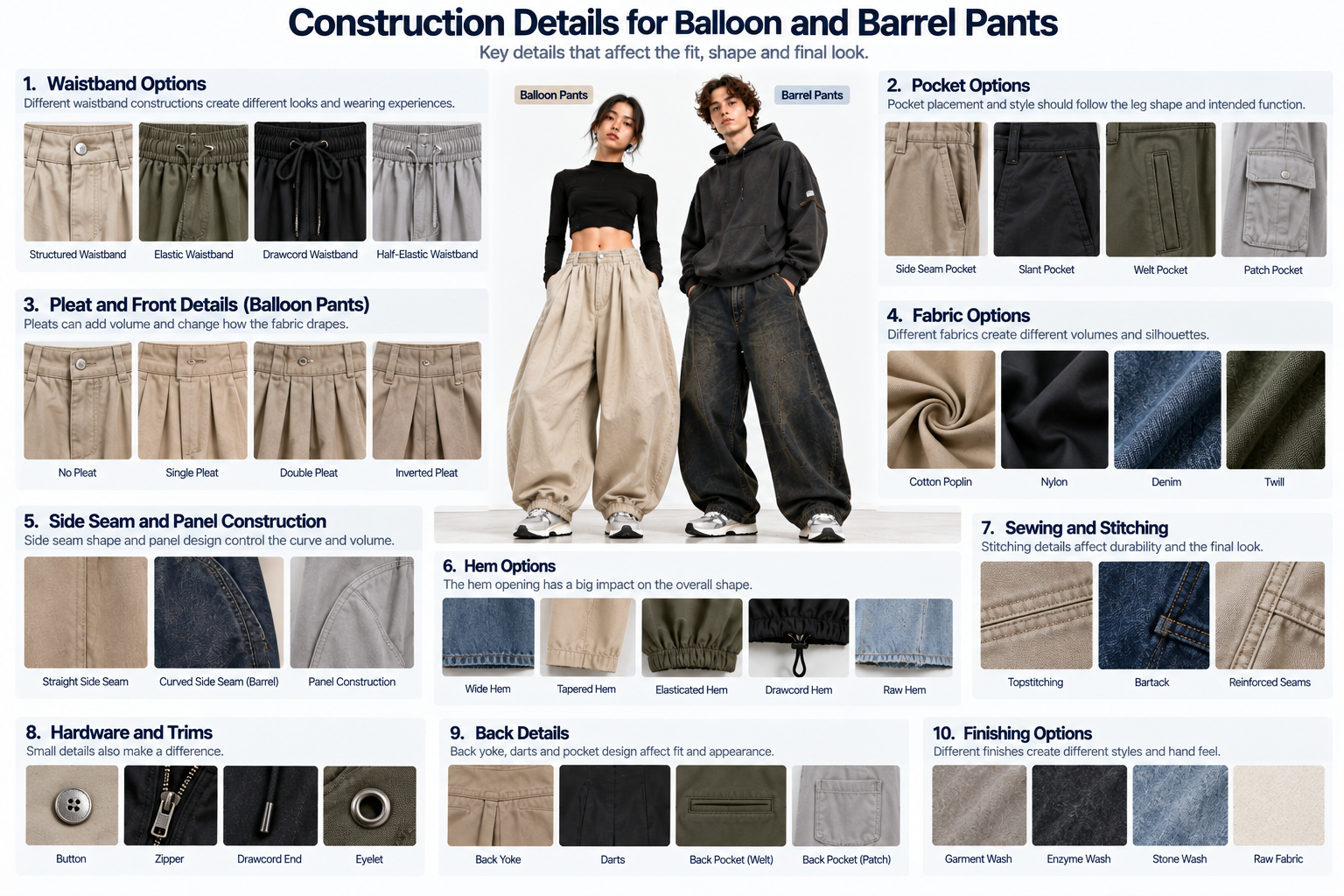
How to Evaluate the First Sample
A balloon or barrel pant should always be evaluated on a wearer.
Flat-lay appearance is not enough.
Front View
Check:
- Waist position
- Hip volume
- Leg symmetry
- Knee width
- Hem width
Side View
This is especially important.
Check:
- Curve position
- Front/back volume
- Crotch balance
- Side-seam shape
A barrel silhouette that looks good from the front can look excessive from the side.
Back View
Check:
- Seat fit
- Back rise
- Pocket position
- Leg curve
- Left/right symmetry
Check the Maximum Volume Point
Ask:
Where does the garment appear widest?
Is it:
- Upper thigh?
- Knee?
- Below knee?
Then compare this with the original design intention.
If the widest area appears too high or too low, the pants can look completely different from the reference.
Check the Hem While Walking
The wearer should walk naturally.
A narrow hem can affect:
- Stride
- Foot clearance
- Movement
- How fabric moves around the ankle
This becomes especially important for long balloon trousers.
The silhouette should not compromise basic movement.
Check Sitting Comfort
Voluminous pants still need correct:
- Rise
- Crotch extension
- Hip ease
Ask the wearer to sit.
Look for:
- Waist pulling
- Crotch tension
- Excessive fabric bunching
- Pocket opening
- Knee restriction
Volume should not be used to hide poor crotch construction.
Fabric Testing Matters
After washing or finishing, check:
- Shrinkage
- Leg length
- Hem opening
- Side-seam twisting
- Drape
- Surface
- Hand feel
A fabric that becomes significantly softer after washing may no longer hold the same barrel shape.
The final silhouette should therefore be evaluated after the intended finishing process.
Size Grading Needs Extra Attention
Curved trousers can be more difficult to grade than simple straight-leg pants.
If all widths are increased mechanically, larger sizes may become excessively voluminous.
If too little volume is added, the curved silhouette may disappear.
Grading should preserve the visual relationship between:
hip + thigh + knee + hem
rather than simply adding the same amount to every point.
Common Balloon Pants Development Mistakes
1. Treating Balloon as Simply Oversized
Balloon pants need controlled volume and taper.
2. Making the Entire Leg Equally Wide
This creates a wide-leg pant rather than a balloon silhouette.
3. Making the Hem Too Tight
The pants may become uncomfortable or look like joggers.
4. Adding Too Much Crotch Depth
This can unintentionally turn the silhouette into harem pants.
5. Choosing Fabric That Is Too Heavy
Excess weight can make large-volume pants uncomfortable.
6. Choosing Fabric That Is Too Soft
The intended shape may collapse.
7. Ignoring the Side View
The side silhouette is essential when evaluating curved pants.
8. Using a Standard Grading Rule
The characteristic curve can disappear across sizes.
Common Barrel Pants Development Mistakes
1. Adding Width Without Curving the Pattern
The result may simply look baggy.
2. Curving Only the Side Seam
The inseam and leg balance may also require adjustment.
3. Making the Hem Too Wide
The barrel shape becomes less visible.
4. Making the Hem Too Narrow
The pants may look tapered rather than sculptural.
5. Using Extremely Soft Fabric
The clean horseshoe shape may disappear.
6. Putting Pockets at the Wrong Point
Pocket bulk can distort the leg curve.
7. Making the Curve Too Extreme
Wearability and proportion still matter.
Balloon Pants Tech Pack Example
| Area | Example Specification |
|---|---|
| Product | Balloon Pants |
| Fit | Relaxed / Voluminous |
| Rise | High Rise |
| Fabric | Cotton Poplin |
| Waistband | Clean Structured Waist |
| Front | Double Pleat |
| Hip | Relaxed |
| Leg | High Volume |
| Knee | Wide |
| Hem | Tapered |
| Side Seam | |
| Length | Full Length |
| Closure | Zipper + Hook |
| Finish | Garment Washed |
These specifications are examples only.
Barrel Pants Tech Pack Example
| Area | Example Specification |
|---|---|
| Product | Barrel-Leg Pants |
| Fit | Relaxed / Sculptural |
| Rise | Mid Rise |
| Fabric | Cotton Twill |
| Waistband | Structured |
| Hip | Moderate Ease |
| Leg | Curved |
| Maximum Width | Around Knee |
| Hem | Controlled Taper |
| Slant Front + Welt Back | |
| Length | Ankle Length |
| Closure | Zipper Fly + Button |
| Stitching | Tonal |
Actual specifications should be developed around the target silhouette and fabric.
Balloon Pants vs Barrel Pants: Which Should Your Brand Develop?
Choose balloon pants if you want:
- More dramatic volume
- Softer movement
- Strong ankle taper
- Lightweight fabric options
- Fashion-forward silhouette
- Adjustable or gathered hems
Choose barrel pants if you want:
- Controlled sculptural volume
- Cleaner curved silhouette
- More structured fabrics
- Horseshoe-shaped leg
- Minimal styling
- Strong pattern-driven design
Choose wide-leg pants if you want:
- Consistent width through the leg
- Wider hem
- Cleaner vertical silhouette
Choose harem pants if you want:
- Deeper crotch
- More drape
- Stronger gathered volume
- More traditional harem influence
For a broader overview of different trouser silhouettes, see our Complete Guide to Pants Types.
FAQ
What Is the Difference Between Balloon Pants and Barrel Pants?
Balloon pants generally use more overall volume and taper significantly toward the ankle.
Barrel pants use a controlled outward curve through the leg before narrowing toward the hem.
Are Balloon Pants the Same as Barrel Pants?
Not necessarily.
The terms can overlap in retail naming, but balloon pants usually feel more voluminous and billowy, while barrel pants normally have a cleaner sculptural curve.
Are Balloon Pants the Same as Harem Pants?
No.
Harem pants often use a deeper or dropped crotch and strong gathered volume.
Balloon pants can maintain a more conventional rise and crotch while creating volume mainly through the leg.
What Are Barrel-Leg Pants?
Barrel-leg pants are trousers with a curved leg that expands outward through the thigh or knee and then narrows again toward the hem.
They are sometimes also called horseshoe pants.
What Fabric Is Best for Balloon Pants?
Common options include:
- Cotton poplin
- Nylon
- Lightweight twill
- Taffeta-like woven fabrics
- Soft suiting
The best fabric depends on how crisp or fluid the silhouette should be.
What Fabric Is Best for Barrel Pants?
Common options include:
- Denim
- Cotton twill
- Canvas
- Gabardine
- Structured suiting
More structured fabrics generally create a clearer barrel shape.
Can Balloon Pants Have an Elastic Waist?
Yes.
Elasticated and drawcord waistbands work particularly well for relaxed and casual balloon pants.
Structured waistbands can also be used for more tailored versions.
Can Balloon Pants Have Elastic Ankles?
Yes.
Elasticated hems create a stronger balloon silhouette by gathering a wider lower leg into a smaller opening.
Do Barrel Pants Need Elastic at the Hem?
No.
Most barrel pants create their tapered shape through the pattern itself rather than elastic gathering.
Are Barrel Pants the Same as Wide-Leg Pants?
No.
Wide-leg pants usually maintain more width toward the hem.
Barrel pants curve outward and then narrow again.
Can Barrel Pants Be Made From Denim?
Yes.
Denim is particularly suitable because its structure can help maintain the curved leg shape.
What Measurements Matter Most for Balloon and Barrel Pants?
Important measurements include:
- Waist
- Hip
- Rise
- Thigh
- Knee
- Calf
- Hem opening
- Inseam
- Outseam
For sculptural styles, additional leg-width measurements can improve pattern accuracy.
Final Thoughts
Balloon pants and barrel pants are both built around volume, but the volume is controlled differently.
Balloon pants focus on:
fullness + movement + lower-leg taper
Barrel pants focus on:
curve + structure + controlled narrowing
The difference does not come from one measurement alone.
It comes from the relationship between:
rise + hip + thigh + knee + hem + side-seam shape + fabric
For clothing brands, clearly defining where the leg should expand and where it should narrow is much more useful than simply asking a factory to make the pants "baggy."
Once those proportions are defined, the pattern can turn a trend-driven silhouette into a repeatable production-ready garment.
Keep Reading