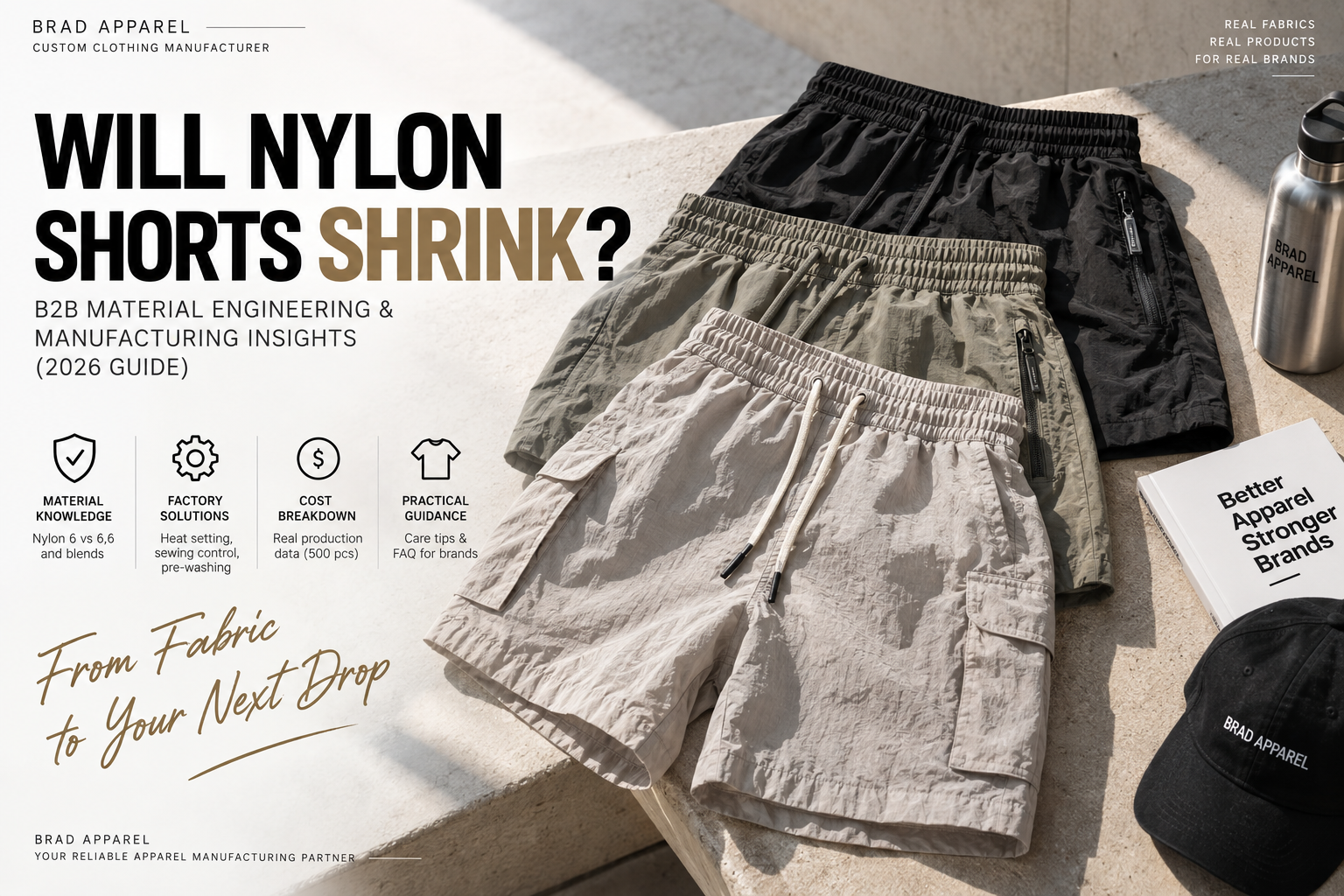
When brands develop nylon shorts, running shorts, cargo shorts or technical activewear, one question comes up frequently during sampling:
Will nylon shorts shrink?
The short answer is:
Pure nylon generally shows much less wash shrinkage than natural fibers such as cotton.
But that does not mean nylon is completely dimensionally stable under every condition.
Because nylon is a thermoplastic synthetic fiber, excessive heat can cause:
- Dimensional change
- Surface distortion
- Seam puckering
- Fabric stiffening
- Loss of the intended shape
For apparel brands, the important question is therefore not simply:
"Does nylon shrink?"
It is:
"What nylon are we using, how was it heat-set, and what temperatures will the finished garment experience?"
Why Nylon Usually Resists Shrinkage
Nylon behaves differently from cotton.
Natural fibers can absorb moisture, swell and change dimension during washing and drying.
Nylon has much lower moisture regain and does not normally contract through the same mechanism.
Under normal low-temperature home washing, dimensional change is generally limited when the fabric has been properly manufactured and heat-set.
Heat Is the Bigger Risk
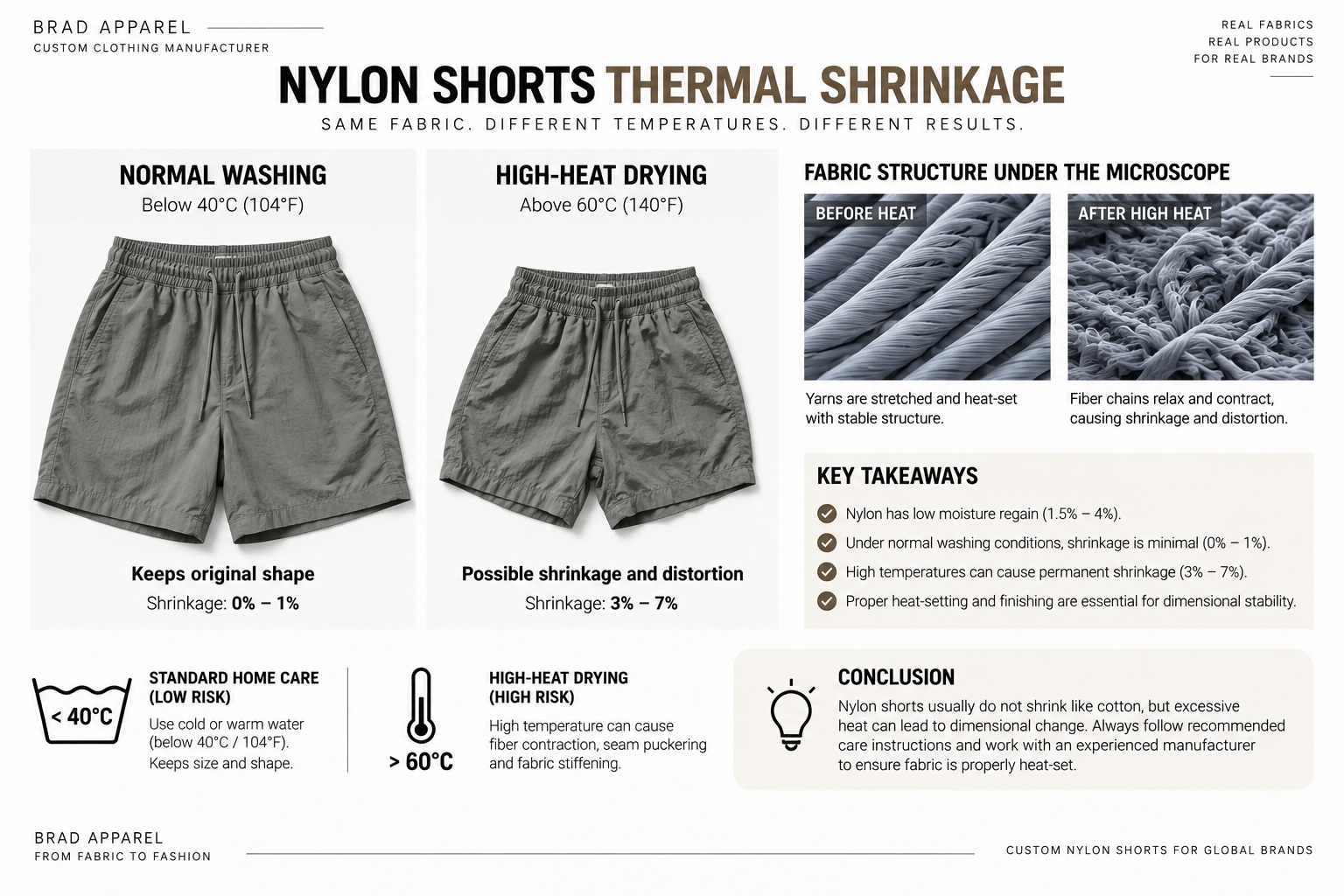
Nylon is a thermoplastic polymer.
During textile manufacturing, synthetic yarns are stretched and stabilized using heat.
When nylon is later exposed to excessive temperature, the polymer structure may relax.
That can lead to permanent dimensional change.
Standard Home Washing
A practical low-risk care condition is:
Below approximately 40°C
Under controlled washing conditions, properly heat-set nylon normally shows relatively little dimensional change.
The source brief uses approximately:
0–1%
as a reference for stable pure nylon under normal home-care conditions.
Actual performance depends on:
- Nylon type
- Fabric construction
- Heat setting
- Finish
- Garment construction
High-Temperature Drying
The source brief identifies temperatures above approximately:
60°C / 140°F
as a higher-risk condition.
Possible results include:
- Fabric contraction
- Seam puckering
- Distortion
- Harder hand feel
- Surface glazing
The guide uses approximately 3–7% dimensional change as an example of what may occur under excessive heat.
These numbers should be treated as sourcing references rather than universal guarantees for every nylon fabric.
Nylon 6 vs Nylon 6,6 vs Nylon Blends
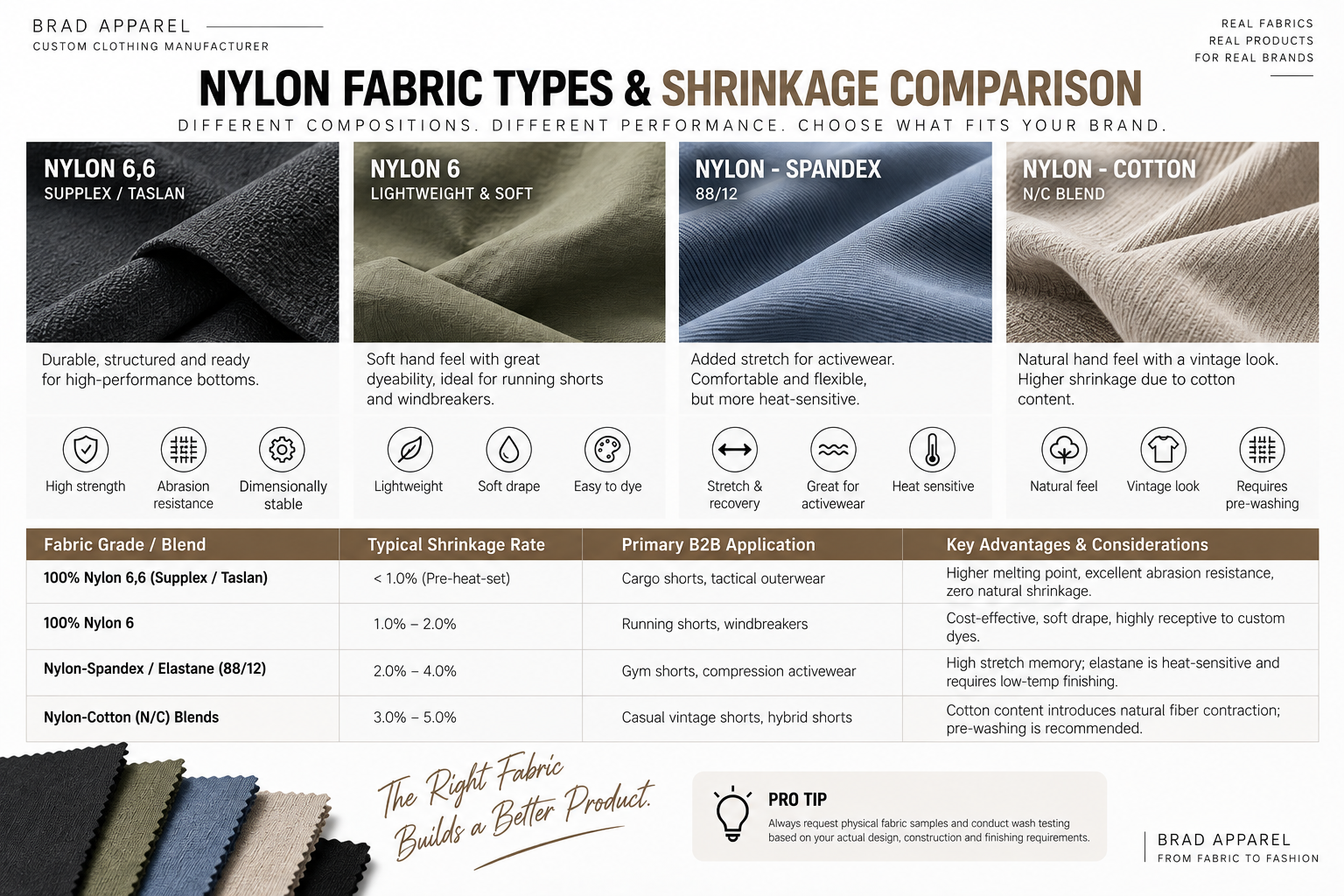
Not all nylon fabrics behave the same way.
When creating a tech pack, brands should specify:
- Fiber type
- Composition
- GSM
- Fabric construction
- Stretch
- Finish
rather than simply writing:
"Nylon fabric."
Nylon Fabric Comparison
| Fabric Type | Reference Dimensional Change | Typical Application | Key Consideration |
|---|---|---|---|
| Nylon 6,6 / Taslan-Type Nylon | Under ~1% when properly stabilized | Cargo shorts, outerwear, technical bottoms | Strong abrasion resistance and dimensional stability |
| Nylon 6 | Approx. 1–2% | Running shorts, windbreakers | Lightweight, soft and dyeable |
| Nylon / Spandex 88/12 | Approx. 2–4% | Gym shorts, activewear | Elastane is more heat-sensitive |
| Nylon / Cotton Blend | Approx. 3–5% | Casual shorts, hybrid bottoms | Cotton introduces natural-fiber shrinkage |
The exact result should always be confirmed through actual wash testing.
Nylon 6,6
Nylon 6,6 is often selected for products requiring:
- Abrasion resistance
- Strength
- Technical performance
- Stable construction
Typical applications include:
- Cargo shorts
- Technical outerwear
- Workwear-inspired bottoms
Nylon 6
Nylon 6 is commonly used in lighter products.
It can work well for:
- Running shorts
- Lightweight activewear
- Windbreakers
- Summer technical garments
Its softer drape can make it useful when the goal is mobility rather than heavy structure.
Nylon / Spandex
Adding elastane provides stretch.
A common activewear blend might be:
88% nylon / 12% spandex
Benefits include:
- Stretch
- Recovery
- Mobility
- Close-to-body comfort
However, spandex is more sensitive to high temperatures.
That means finishing and consumer care should generally remain more conservative.
Nylon / Cotton Blends
Adding cotton changes the behavior of the fabric.
Cotton can introduce:
- More moisture absorption
- Softer natural hand feel
- Vintage appearance
- Higher wash shrinkage
This is why nylon/cotton blends should not be treated like 100% synthetic nylon.
Pre-washing and shrinkage testing become more important.
Factory Shrinkage Control
The best time to control dimensional stability is before the garment reaches the customer.
Several manufacturing processes can help.
1. Heat Setting Before Cutting
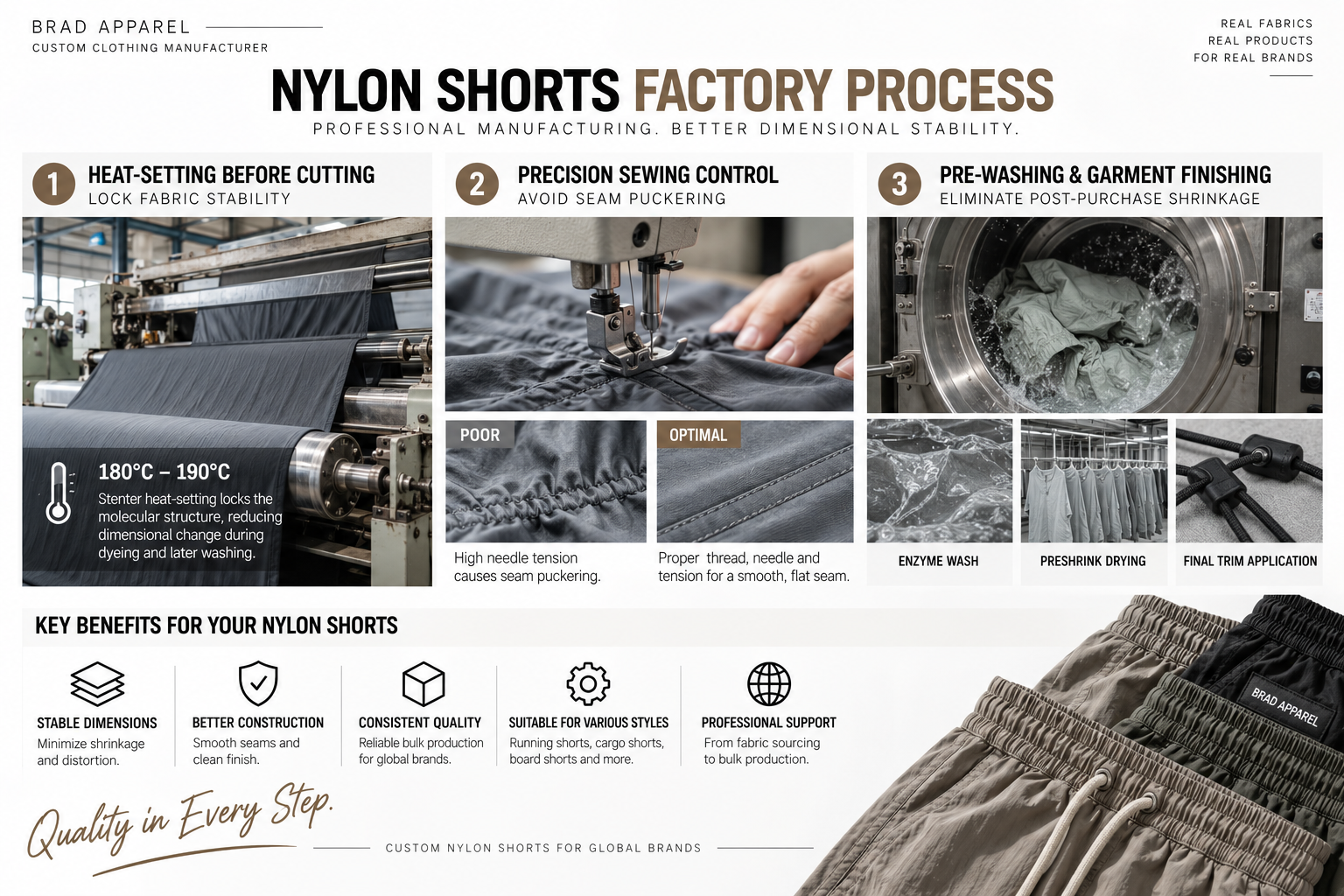
Synthetic fabrics are commonly stabilized using controlled heat before garment cutting.
The objective is to:
- Stabilize yarn tension
- Control fabric width
- Reduce later dimensional movement
- Improve bulk consistency
The source brief references stenter temperatures around:
180–190°C
for certain nylon textile processes.
The actual heat-setting temperature should always be matched to:
- Nylon grade
- Elastane content
- Fabric construction
- Coating
- Finish
A nylon/spandex fabric should not automatically use the same settings as a 100% nylon woven.
2. Seam Tension Matters
Sometimes a garment appears to have "shrunk" even when the main fabric did not actually change significantly.
The problem can instead come from sewing tension.
Excessive Needle or Thread Tension
If the thread pulls the fabric too tightly, the seam can become puckered.
This creates:
- Wavy seams
- Shortened seam lines
- Distorted leg openings
- Uneven side seams
Visually, this can resemble shrinkage.
Better Seam Control
A more stable sewing setup involves matching:
- Thread
- Needle
- Feed
- Stitch density
- Machine tension
to the actual nylon fabric.
The goal is a seam that lies:
Flat, smooth and stable.
Seam Puckering vs. Real Shrinkage
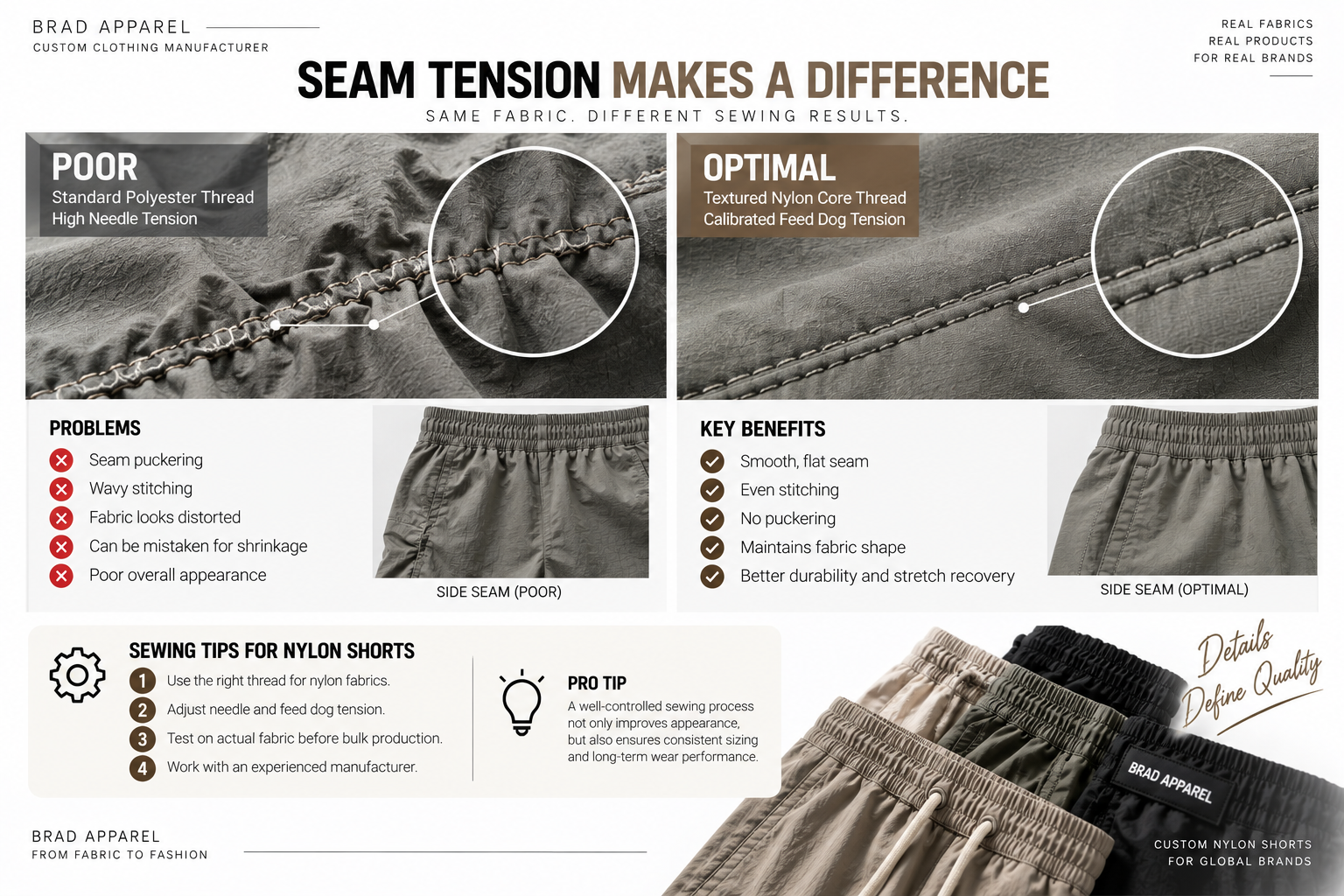
These two problems should not be confused.
Actual Shrinkage
The fabric dimensions change.
Seam Puckering
The sewing process pulls or distorts the fabric locally.
Correct diagnosis matters because the production solution is different.
3. Pre-Washing and Garment Finishing
Some nylon garments may undergo additional finishing depending on the desired look.
Examples can include:
- Crinkle effects
- Garment washing
- Pre-shrink drying cycles
- Pigment-related treatments on compatible constructions
These processes should be tested during sampling before bulk production.
The objective is to stabilize the final garment before:
- Labels
- Hardware
- Final packaging
are completed.
Example BOM: Custom Nylon Shorts
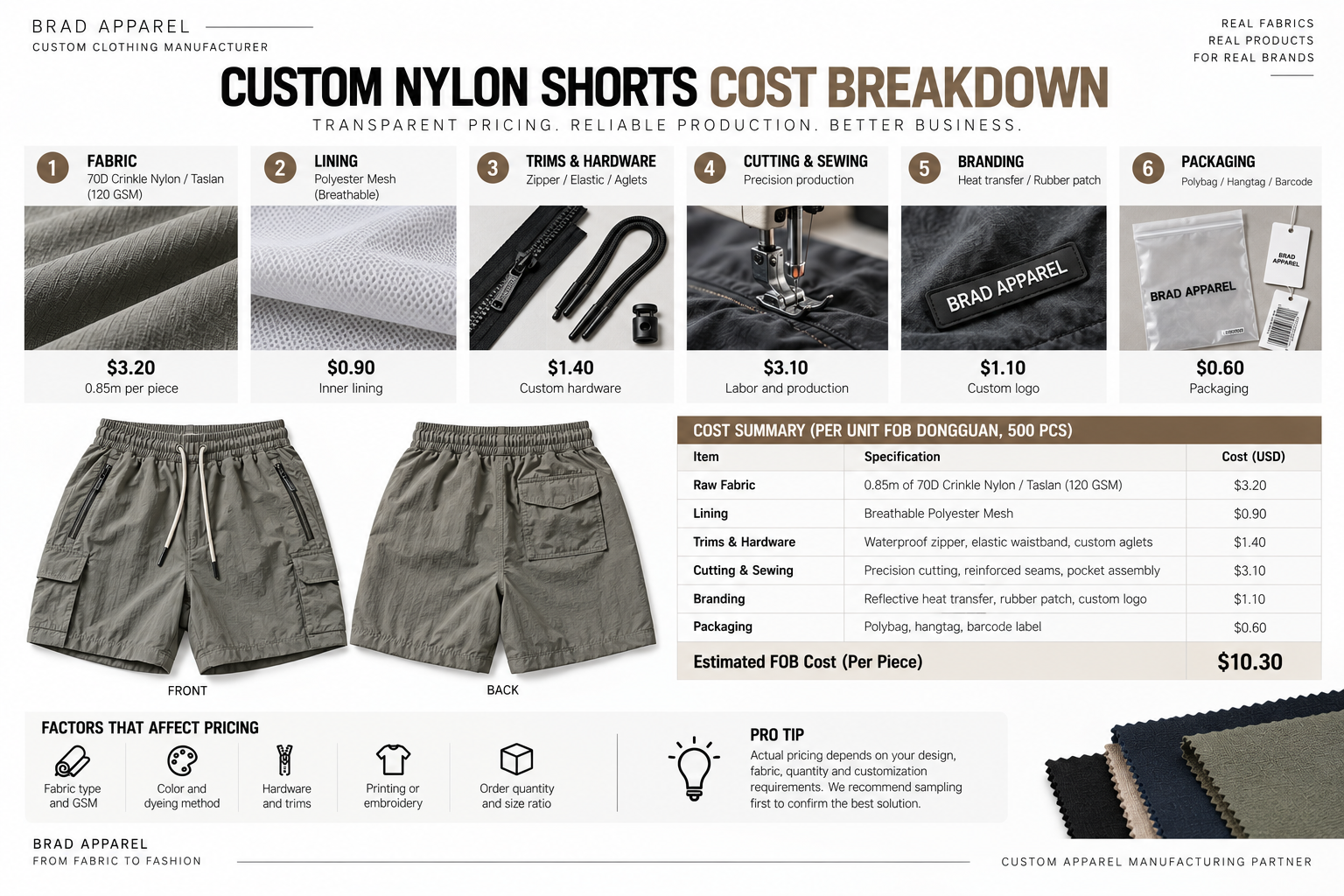
The source brief provides an illustrative 500-piece nylon shorts production scenario.
Main Fabric
70D crinkle nylon / Taslan
Approximate weight:
120 GSM
Approximate consumption:
0.85 m per piece
Reference cost:
$3.20
Inner Lining
Breathable polyester mesh liner.
Reference cost:
$0.90
Trims & Hardware
Possible components include:
- Waterproof zipper
- Elastic waistband
- Custom aglets
Reference cost:
$1.40
Cutting & Sewing
Includes:
- Precision cutting
- Reinforced seams
- Pocket assembly
Reference cost:
$3.10
Branding
Example:
- Reflective heat transfer
- Rubber patch
- Custom logo
Reference cost:
$1.10
Packaging
Includes:
- Polybag
- Hangtag
- Barcode label
Reference cost:
$0.60
Estimated FOB
The source example totals:
$10.30 per piece
for the illustrative 500-piece production scenario.
Actual pricing depends on:
- Fabric
- Quantity
- Colour
- Hardware
- Liner
- Printing
- Packaging
- Size ratio
Best Nylon Fabrics for Different Shorts
Lightweight Running Shorts
A lightweight nylon woven can work well when you need:
- Low weight
- Quick drying
- Mobility
- Breathability
Possible construction:
70D nylon around 100–140 GSM
Stretch Gym Shorts
For training garments, consider:
Nylon / Spandex
Benefits include:
- Four-way stretch
- Recovery
- Mobility
- Athletic fit
Cargo and Technical Shorts
Taslan-style nylon can work particularly well for:
- Cargo pockets
- Technical hardware
- Utility styling
- Outdoor-inspired garments
Fabric weight and coating can be adjusted depending on the desired structure.
DWR and Water-Repellent Finishing
Nylon shorts can also use a water-repellent finish.
This is useful for:
- Running shorts
- Outdoor shorts
- Technical cargo shorts
- Travel garments
Water resistance should not automatically be confused with full waterproofing.
If a brand needs a specific waterproof rating, the actual finished fabric should be tested.
Care Instructions for Nylon Shorts
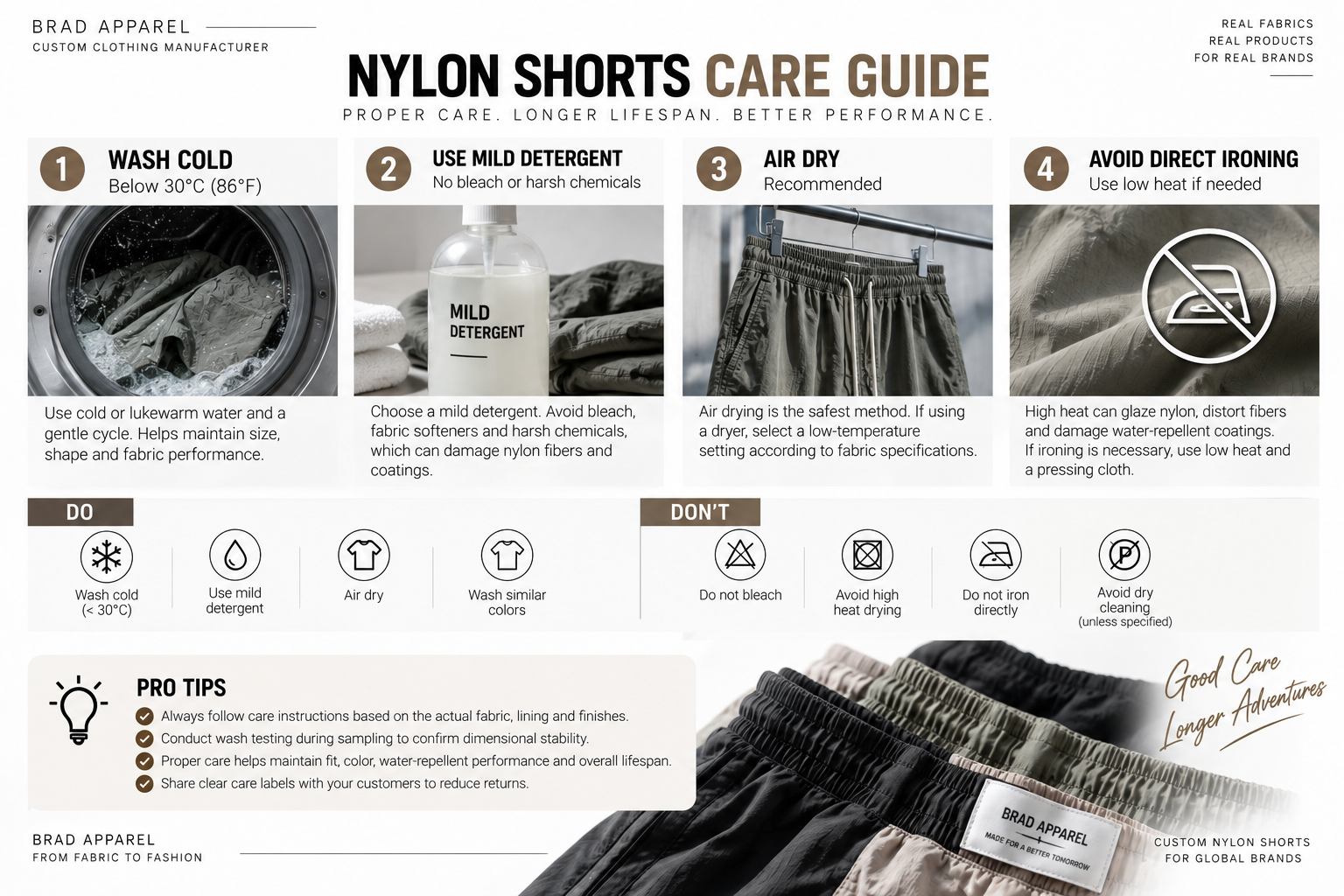
Correct care instructions help reduce dimensional problems and product returns.
Wash Cold
Recommended:
Below approximately 30°C / 86°F
Use a gentle cycle where appropriate.
Avoid High Heat
Air drying is the safest approach.
If tumble drying is permitted, use a low-temperature setting according to the tested fabric specification.
Avoid Direct Ironing
High direct heat can:
- Glaze nylon
- Distort fibers
- Damage coatings
- Affect stretch fibers
If pressing is required during manufacturing, temperature and protective pressing methods should be tested first.
How Brad Apparel Develops Custom Nylon Shorts
At Brad Apparel, our Custom Bottom Production service supports development of:
- Running shorts
- Gym shorts
- Nylon cargo shorts
- Board shorts
- Technical shorts
- Mesh-lined shorts
- Streetwear bottoms
Fabric & Accessory Sourcing
Through our Fabric & Accessory Sourcing service, brands can customize:
- Nylon type
- GSM
- Stretch
- Colour
- DWR treatment
- Mesh liner
- Elastic
- Zippers
- Drawcords
- Aglets
Physical fabric samples should be evaluated before bulk production.
Pattern Development
Our Pattern Development process can customize:
- Rise
- Inseam
- Leg opening
- Pocket structure
- Side vents
- Waistband
- Inner liner
- Overall fit
The pattern should always be tested using the actual selected nylon fabric.
FAQ
Do Nylon Shorts Shrink?
Pure, properly stabilized nylon generally shows relatively little shrinkage under normal low-temperature washing.
High heat can still cause permanent dimensional change.
Can Nylon Shrink in a Dryer?
High-temperature drying can deform synthetic nylon fibers.
Air drying or low-temperature drying is generally safer.
Does Nylon Shrink More Than Cotton?
Usually no.
Cotton is a natural fiber and generally shows more moisture-related shrinkage.
Nylon is more sensitive to excessive heat than normal water exposure.
Does Nylon-Spandex Shrink?
It can show more dimensional change than pure nylon because elastane is heat-sensitive.
Low-temperature care is particularly important.
Does Nylon-Cotton Shrink?
Yes, it can shrink more than pure nylon because the cotton component introduces natural-fiber contraction.
Pre-washing is recommended when dimensional stability is important.
What Nylon Is Best for Running Shorts?
Lightweight Nylon 6 or nylon/spandex woven fabrics can work well depending on the desired stretch, feel and performance.
What Nylon Is Best for Cargo Shorts?
Taslan-style or heavier nylon fabrics can provide more:
- Structure
- Abrasion resistance
- Utility styling
What MOQ Does Brad Apparel Support?
Brad Apparel supports custom development from approximately 50 pieces per style/color for many projects.
Actual MOQ depends on:
- Fabric
- Custom dyeing
- Hardware
- Liner
- Decoration
Final Thoughts
Nylon shorts usually do not shrink the same way cotton shorts do.
But that does not mean nylon is immune to dimensional problems.
The most important factors are:
- Nylon grade
- Blend composition
- Heat setting
- Sewing tension
- Finishing process
- Consumer care temperature
For brands, the safest approach is simple:
Test the actual fabric and finished garment before bulk production.
Proper heat setting, controlled sewing and realistic wash testing make dimensional stability much easier to manage.
Keep Reading