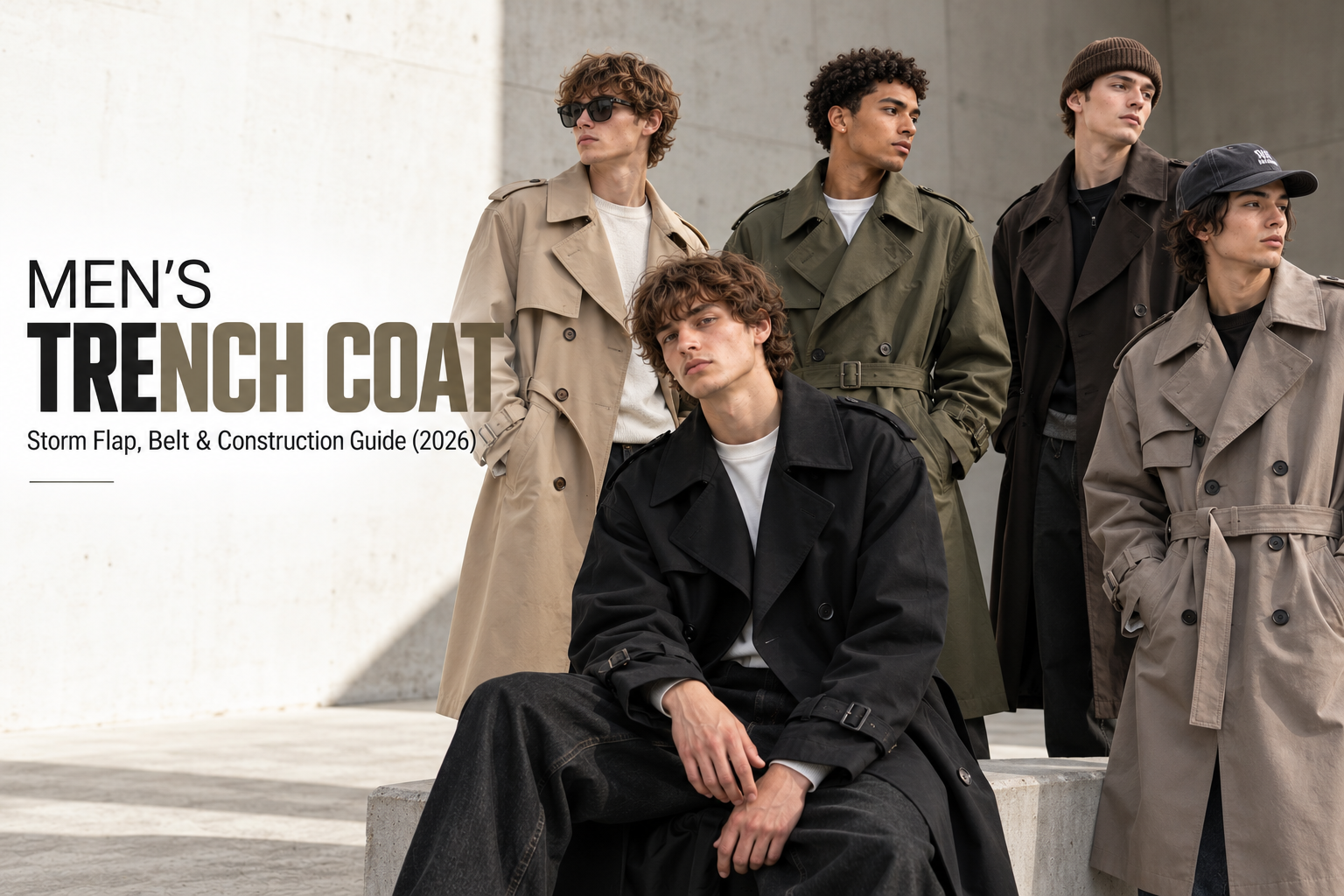
A trench coat is a long woven outerwear garment recognized by details such as a double-breasted front, belt, storm flap, structured collar and weather-oriented construction.
The silhouette has military and rainwear roots, but the modern trench coat now appears across:
- Classic menswear
- Contemporary fashion
- Minimal outerwear
- Streetwear
- Business casual
- Luxury collections
- Technical outerwear
Some versions remain very traditional.
Others keep only a few recognizable elements.
A modern trench might use:
single-breasted front + oversized body + storm flap + belt
while a heritage-inspired version may combine:
double-breasted closure + epaulettes + gun flap + sleeve straps + back storm shield + waist belt
For clothing brands, the important point is that a trench coat is not simply a long jacket with a belt added around the waist.
Its finished appearance depends on the relationship between:
body proportion + front overlap + collar + storm flap + sleeves + belt + pockets + fabric + lining
If the front overlap is too narrow, the double-breasted construction can look weak.
If the storm flap is too heavy, it can pull the upper body out of shape.
If the belt position is wrong, the entire coat proportion changes.
And if the shell and lining do not have enough compatible ease, the coat may twist or pull during movement.
This guide explains what defines a trench coat and what clothing brands should specify before moving from reference garment to sampling and bulk production.
What Is a Trench Coat?
A trench coat is generally a knee-length or longer outer coat developed from practical rainwear and military-inspired outerwear.
Traditional details commonly include:
- Double-breasted front
- Wide collar and lapel
- Waist belt
- Storm flap
- Back storm shield
- Epaulettes
- Sleeve straps
- Welt or slant pockets
- Back vent
- Raglan sleeves
- Full or partial lining
Not every modern trench coat includes every feature.
A minimal trench may remove:
- Epaulettes
- D-rings
- Sleeve straps
- Extra storm-flap construction
while retaining:
- Long body
- Belt
- Large collar
- Relaxed silhouette
The product should therefore be understood as a design framework rather than one fixed sewing pattern.
Why Are Trench Coats Relevant in 2026?
The trench coat remains useful because it combines several current menswear directions in one garment:
- Longer outerwear
- Relaxed tailoring
- Heritage clothing
- Oversized proportions
- Functional details
- Minimal branding
- Strong collars
- Layering
It can also change character dramatically without changing the basic garment category.
A beige cotton gabardine trench can feel:
classic and refined
while a washed black oversized trench can feel:
streetwear and contemporary
and a technical nylon trench can move toward:
modern utility outerwear
For brands, this makes the trench coat a flexible outerwear platform rather than only a traditional formal coat.
Trench Coat vs Other Men's Coats
Several outerwear categories can look similar at first glance.
But their construction logic differs.
| Style | Main Identifier | Typical Length | Belt | Weather Focus |
|---|---|---|---|---|
| Trench Coat | Storm details + belt + structured outerwear construction | Mid-thigh to long | Common | Often |
| Mac Coat | Clean raincoat construction | Mid-thigh to knee | Usually no | Common |
| Overcoat | Tailored cold-weather outerwear | Knee to long | Optional | Not defining |
| Field Jacket | Functional military pockets | Hip to thigh | Usually no | Utility focused |
| Raincoat | General weather-protective category | Varies | Optional | Defining purpose |
These categories can overlap.
A trench coat can also be a raincoat if its material and construction provide the required weather performance.
But the trench silhouette alone does not guarantee waterproofing.
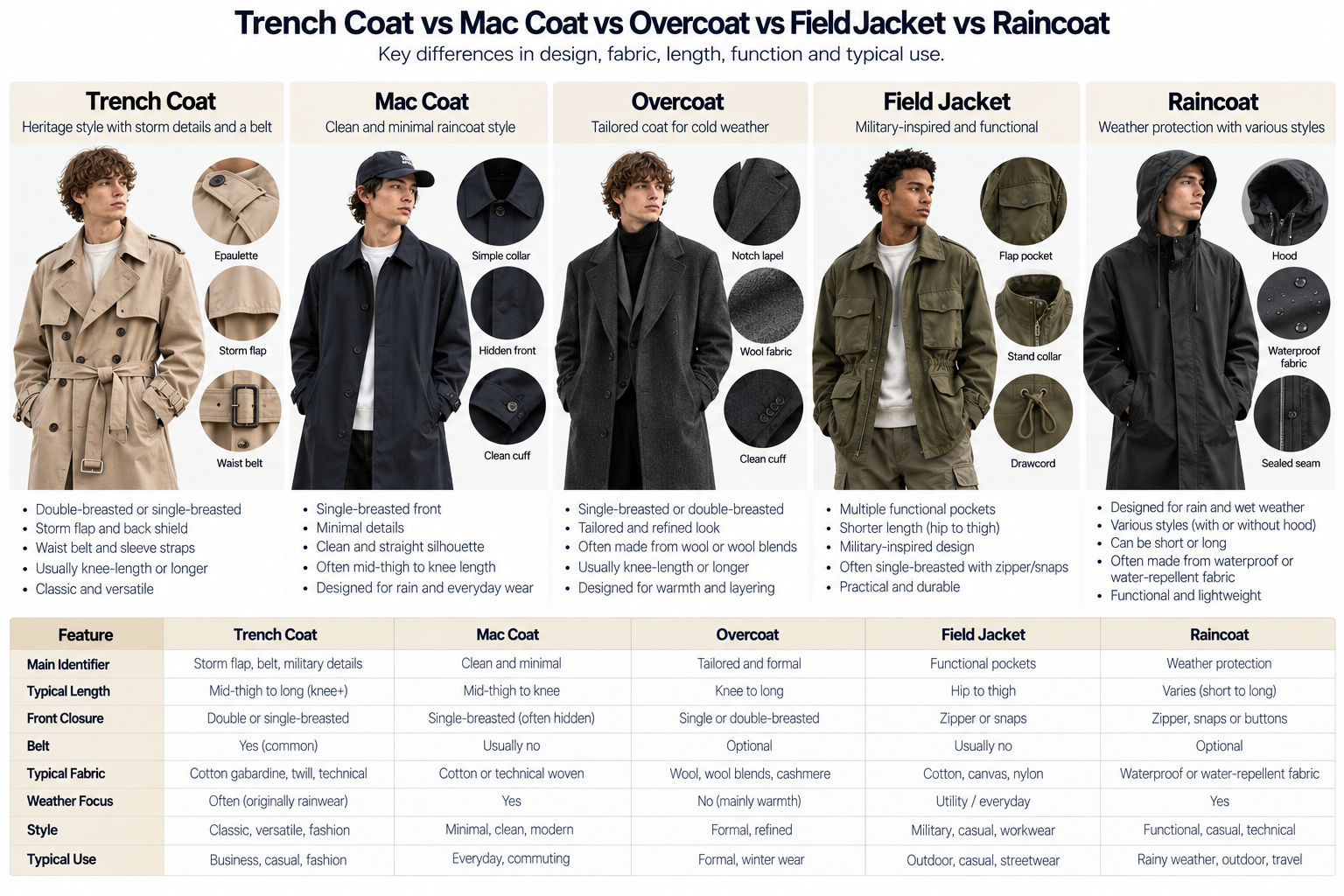
Trench Coat vs Mac Coat
A mac coat generally has a much cleaner construction.
Typical mac-coat characteristics include:
- Single-breasted front
- Minimal exterior details
- Simple collar
- Straight body
- Hidden or clean closure
A trench coat normally contains more visible construction.
Common trench details include:
- Storm flaps
- Belt
- Epaulettes
- Sleeve straps
- Double-breasted closure
The two garments may use similar weather-oriented fabrics.
But visually:
Mac = cleaner and simpler
while:
Trench = more detailed and structured
Trench Coat vs Overcoat
An overcoat is a broader outerwear category.
It is commonly designed primarily for warmth and layering over other clothing.
Typical fabrics may include:
- Wool
- Wool blends
- Cashmere blends
- Heavy woven fabrics
A trench coat is traditionally lighter.
Common trench fabrics include:
- Cotton gabardine
- Cotton twill
- Cotton/polyester blends
- Technical woven fabrics
An overcoat may use:
- Lapels
- Tailored shoulder
- Full lining
without using:
- Storm flap
- Epaulettes
- Belt
Therefore, the two product categories should not automatically be treated as interchangeable.
Trench Coat vs Field Jacket
A field jacket normally emphasizes practical storage.
Common features include:
- Four front pockets
- High collar
- Drawcord
- Snap or zipper closure
- Shorter body
- Utility construction
A trench coat usually creates identity through:
- Longer body
- Front overlap
- Belt
- storm details
- Collar and lapel
The field jacket is generally more compact and pocket-driven.
The trench coat is more strongly defined by overall silhouette.
Trench Coat vs Raincoat
"Raincoat" describes a function more than one specific silhouette.
A raincoat may be:
- Trench
- Mac
- Hooded shell
- Packable coat
- Technical parka
A trench coat is not automatically waterproof simply because it resembles traditional rainwear.
Actual protection depends on:
- Fabric
- Coating
- Membrane
- Seam construction
- Closure
- Testing
Brands should never make unsupported waterproof claims based only on appearance.
The Anatomy of a Trench Coat
A traditional trench coat may include:
- Front body
- Back body
- Collar
- Lapels
- Double-breasted front
- Front storm / gun flap
- Back storm shield
- Epaulettes
- Raglan or set-in sleeves
- Sleeve straps
- Waist belt
- Belt loops
- Pockets
- Back vent
- Lining
Each component affects both appearance and manufacturing.
The Double-Breasted Front
The double-breasted front is one of the most recognizable traditional trench-coat features.
It uses a wider front overlap than a standard single-breasted coat.
This creates:
- More visual structure
- Additional front layering
- Traditional trench appearance
The design may use:
- Two functional button rows
- One functional row + decorative row
depending on construction.
Front Overlap Matters
The overlap needs enough width to support the intended button configuration.
If it is too narrow:
- Buttons may sit too close together
- Lapels become small
- Front balance looks weak
If it is too wide:
- Excess fabric accumulates
- Front becomes bulky
- Coat can feel heavy
The overlap should be developed together with:
- Chest width
- Lapel width
- Button spacing
- Belt position
Button Layout
Traditional trench coats often use multiple front buttons.
But the exact number is not universal.
A modern design may use:
- Four-button double-breasted
- Six-button
- Eight-button
- Hidden buttons
- Minimal single-breasted closure
During development, specify:
- Button diameter
- Horizontal spacing
- Vertical spacing
- Distance from center front
- Functional versus decorative positions
Button Size
Large buttons create:
- Stronger heritage appearance
- More visible outerwear scale
Smaller buttons can create:
- Cleaner
- More minimal
styling.
The button should be evaluated on the full-size garment rather than selected independently.
What Is a Storm Flap?
The storm flap is an additional fabric layer positioned around the upper body.
It may appear on:
- Front
- Back
- Both
Depending on the trench design, it can also be referred to as:
- Storm shield
- Gun flap
The exact terminology varies according to placement and historical interpretation.
For manufacturing, the important point is the actual pattern piece.
Front Storm Flap
A front storm flap commonly sits over one side of the upper chest.
It can create:
- Visual layering
- Weather-oriented styling
- Traditional trench identity
Its shape may be:
- Curved
- Angled
- Straight
- Extended
The flap must sit cleanly over the body rather than pulling the lapel or armhole.
Back Storm Shield
A back storm shield normally covers part of the upper back.
It may be:
- Fully attached
- Partially floating
- Ventilated underneath
depending on construction.
The shield needs enough room to remain flat when the wearer moves.
If it is too tight, the upper back may pull.
If it is too loose, it can lift excessively.
Storm Flap Fabric Bulk
The storm flap creates another fabric layer.
With a lightweight gabardine, this may remain clean.
With heavy twill, the combination of:
body + flap + facing + lining
can create considerable thickness.
Fabric weight should therefore be considered before finalizing the flap construction.
The Trench Coat Collar
A trench collar usually has enough size and structure to be visually important.
Possible directions include:
- Traditional wide point collar
- Medium collar
- Oversized fashion collar
- Convertible collar
- High / funnel-inspired collar
Current fashion versions increasingly experiment with larger or higher necklines.
Collar Width Changes the Character
A wider collar creates:
- More heritage character
- Stronger visual framing
- More dramatic open position
A smaller collar feels:
- Cleaner
- More minimal
- More contemporary
The collar should be balanced with:
- Shoulder width
- Coat length
- Lapel width
- Wearer's neck
Collar Stand
Some trench constructions use a separate collar stand.
Others integrate collar shaping differently.
A separate stand can help control:
- Neck shape
- Collar roll
- Closed position
The actual construction should follow the intended design rather than assuming every trench uses the same collar pattern.
Throat Latch
Some heritage trench coats include a throat latch.
This is a small strap that allows the collar to close more securely around the neck.
It can be:
- Functional
- Decorative
- Removable
If included, specify:
- Length
- Width
- Button position
- Storage position when not in use
Epaulettes
Epaulettes are shoulder straps associated with military-inspired trench construction.
They may attach:
- Into the armhole seam
- Into the shoulder / neckline area
and fasten with:
- Button
- Snap
Modern fashion versions may make them:
- Narrow
- Oversized
- Minimal
- Completely removable from the design
Epaulette Position
The strap should follow the shoulder line cleanly.
If it sits too far forward:
the coat can look unbalanced.
If too far backward:
the strap may twist or disappear from the front view.
Its length should also correspond to:
- Shoulder width
- Sleeve construction
- Button position
The Waist Belt
The belt is another major trench-coat identifier.
Possible belt constructions include:
- Self-fabric belt
- Buckled belt
- Tie belt
- D-ring belt
- Hidden fastening belt
The belt changes both:
- Function
- Silhouette
Belt Width
A narrow belt can feel:
- Refined
- Minimal
A wider belt creates:
- Stronger visual structure
- More workwear / heritage character
Belt width should correspond with:
- Button size
- Epaulette scale
- Sleeve straps
These components should feel like one trim system.
Belt Length
Belt length depends on whether it is intended to:
- Buckle normally
- Tie at front
- Tie at back
- Hang loose
Do not assume one belt length can perform all styling methods equally well.
The tech pack should specify the intended use.
Belt Loops
Belt loops determine the vertical belt position.
They are often positioned around the natural waist or slightly below depending on the silhouette.
Important considerations include:
- Loop height
- Loop width
- Attachment strength
- Position relative to pockets
A poorly positioned belt can make the coat look short-waisted or long-waisted.
D-Rings
Some trench coats use metal D-rings around:
- Belt
- Straps
Today they are often retained as a heritage design detail.
They may also be used for:
- Decorative function
- Accessory attachment
For fashion production, the brand should specify whether the D-rings are:
- Functional
- Decorative only
Hardware weight should also match the fabric.
Sleeve Construction
Two main sleeve directions are common:
- Raglan
- Set-in
The choice significantly changes the coat.
Raglan Sleeve Trench Coat
Raglan sleeves extend toward the neckline instead of using a conventional shoulder seam.
They create:
- Softer shoulder line
- More movement
- Heritage trench appearance
- Easier layering
Traditional trench coats are strongly associated with raglan construction.
But raglan sleeves still require careful shaping.
Raglan Sleeve Angle
The seam angle affects:
- Shoulder appearance
- Chest width
- Arm movement
An excessively straight seam may restrict the upper body.
An overly wide raglan can create excess fabric around the neckline.
The pattern needs to balance:
- Front raglan
- Back raglan
- Sleeve pitch
- Neck opening
Set-In Sleeve Trench Coat
A set-in sleeve creates a defined shoulder seam.
It works well for:
- Tailored trench coats
- Minimal coats
- Structured fashion versions
The shoulder can then be:
- Natural
- Extended
- Lightly padded
- Dropped
depending on design.
Sleeve Straps
Trench sleeves commonly include adjustable straps around the cuff.
Possible constructions include:
- Button strap
- Buckle strap
- D-ring strap
- Snap tab
These can be functional or primarily decorative.
Sleeve Strap Position
The strap should sit cleanly around the lower sleeve.
Check:
- Distance from sleeve edge
- Strap width
- Buckle position
- Adjustment range
A loose strap can hang awkwardly.
A very tight strap can distort the sleeve.
Trench Coat Pockets
Common pocket options include:
- Slanted welt pocket
- Welt pocket with flap
- Side-entry pocket
- Large patch pocket
- Internal pocket
Traditional trenches generally use relatively clean exterior pockets.
Pocket Angle
Slanted pockets should be comfortable for hand entry.
The angle affects both:
- Function
- Visual line
Too horizontal:
- Can feel awkward
Too vertical:
- May become difficult to access
The pocket should be tested on body.
Pocket Placement
Pocket location should be coordinated with:
- Waist belt
- Button layout
- Coat length
- Hip level
A common development problem is placing the pocket exactly where the belt crosses it.
This can make hand access uncomfortable.
Pocket Reinforcement
High-stress points include:
- Welt ends
- Pocket opening corners
- Pocket-bag attachment
Reinforcement may include:
- Bartacks
- Internal reinforcement
- Additional stitching
The exterior should still remain clean.
Back Vent
Many trench coats use a center-back vent.
The vent improves:
- Walking
- Sitting
- Movement
particularly on longer coats.
Vent Length
Longer coats generally require enough vent length for movement.
But a very long vent may:
- Open excessively
- Expose lining
- Lose structure
The vent should be tested during:
- Walking
- Sitting
- Stairs
not only while standing.
Vent Overlap
A traditional vent uses overlapping fabric.
The overlap should remain closed when standing naturally.
If it spreads open without movement, check:
- Back width
- Hip width
- Vent construction
- Lining
- Pattern balance
Best Fabrics for Trench Coats
Common shell materials include:
- Cotton gabardine
- Cotton twill
- Cotton/polyester blend
- Polyester woven
- Nylon
- Technical woven fabrics
The best choice depends on:
- Season
- Structure
- Weather requirements
- Price
- Desired drape
What Is Gabardine?
Gabardine is a tightly woven fabric with a visible diagonal twill structure.
For trench coats, cotton or cotton-blend gabardine can provide:
- Dense construction
- Clean surface
- Good structure
- Smooth drape
- Traditional appearance
However, not every fabric sold as "gabardine" will have identical:
- Weight
- Density
- fiber
- finish
A physical fabric sample should be approved before production.
Cotton Gabardine
Cotton gabardine works well for:
- Heritage trench coats
- Premium casualwear
- Clean tailored outerwear
It can provide enough structure for:
- Collar
- Storm flap
- Belt
without necessarily becoming excessively heavy.
Shrinkage still needs testing.
Cotton Twill
Cotton twill can create:
- Softer
- More casual
- Workwear-influenced
versions.
Possible finishes include:
- Garment wash
- Peach finish
- Pigment dye
depending on design.
A softer twill can make an oversized trench more relaxed.
Cotton / Polyester Blend
Blends can offer:
- Better dimensional stability
- Lower wrinkling
- Easier care
- Different weather performance
The actual result depends on fiber ratio and fabric construction.
Do not evaluate the fabric only from composition.
Technical Woven Fabric
Modern trenches can also use:
- Nylon
- Polyester
- Recycled synthetic woven
- Laminated or coated textiles
This moves the product toward:
- Technical outerwear
- Travel wear
- Minimal performance-inspired fashion
Construction should change if actual weather performance is required.
Is a Trench Coat Waterproof?
Not automatically.
This is one of the most important distinctions for product descriptions.
A trench coat can be:
- Non-water-resistant
- Water-repellent
- Water-resistant
- Waterproof
depending on its actual specification.
The silhouette alone proves none of these.
Water-Repellent Finishing
A fabric may use a surface treatment such as DWR to improve resistance to light moisture.
Performance should be supported by appropriate testing if the brand plans to make a specific claim.
The finish can also change after:
- Washing
- Abrasion
- Repeated wear
depending on the chemistry.
Waterproof Construction
If a brand requires genuine waterproof performance, consider:
- Waterproof membrane
- Coated fabric
- Seam sealing
- Waterproof zipper or protected closure
- Tested hydrostatic resistance
A normal sewn cotton trench with untreated seams should not simply be marketed as waterproof.
Fabric Weight
There is no universal correct GSM for a trench coat.
Instead, evaluate:
- Structure
- drape
- season
- lining
- garment length
A long coat consumes a large amount of fabric.
Even a moderate GSM can create substantial total garment weight.
Heavy Fabric Can Become Too Heavy
A trench already contains extra components such as:
- Storm flaps
- Belt
- Straps
- Facings
- Double front
Using an unnecessarily heavy shell may create:
- Excess garment weight
- Bulky seams
- Stiff movement
The design should be tested as a complete garment.
Trench Coat Lining
Possible options include:
- Fully lined
- Half lined
- Upper-back lined
- Unlined
- Removable lining
The correct option depends on season and construction.
Full Lining
A full lining creates:
- Cleaner interior
- Easier layering
- Better coverage of internal construction
Common lining materials include:
- Polyester
- Viscose
- Acetate-type linings
- Blended lining fabrics
The actual fiber should be selected according to cost and desired performance.
Lining Ease
The lining cannot simply copy the shell dimensions exactly.
It needs enough ease for:
- Movement
- Sitting
- Arm reach
Without sufficient lining ease, it may pull the shell.
Too much lining can also:
- Sag
- Hang below hem
- Gather inside sleeves
Sleeve Lining
Smooth sleeve lining can help the coat slide easily over:
- Shirt
- Sweater
- Jacket
This is particularly useful for a trench intended as a layering piece.
Half-Lined Trench
A partial lining can reduce:
- Weight
- heat
- material usage
while still covering important upper-body construction.
This can work well for:
- Spring
- Early fall
- Lightweight trenches
Unlined Trench Coat
An unlined trench needs cleaner internal finishing because:
- Seams
- Pocket bags
- Facings
remain visible.
Possible finishing methods include:
- Binding
- Clean-finished seams
- Overlock where appropriate
The correct solution depends on price point and fabric.
Trench Coat Fit Options
Modern trench coats can use:
- Classic
- Relaxed
- Oversized
- Boxy
- Cropped
- Long
The category does not require one fixed silhouette.
Classic Men's Trench Fit
A classic men's trench normally provides enough room for layering without becoming extremely wide.
Important areas include:
- Chest
- Shoulder / raglan
- Bicep
- Body sweep
The wearer should be able to layer at least the intended base garment underneath.
Relaxed Trench Coat
A relaxed trench may increase:
- Chest
- Sleeve width
- Back width
- sweep
while maintaining controlled overall length.
This can make a traditional design feel more contemporary.
Oversized Trench Coat
An oversized trench should be patterned intentionally.
Do not simply grade up several sizes.
That can create:
- Excessively long sleeves
- Huge neck opening
- Incorrect belt position
- Pockets too low
- Excess body length
A true oversized pattern controls:
width and length separately
Boxy Trench Coat
A boxy trench may use:
- Wider chest
- Straight side seams
- Less waist shaping
- Shorter or controlled length
It can also omit the belt or wear the belt loosely.
Cropped Trench Jacket
Modern fashion may shorten trench construction into a jacket.
It can retain:
- Storm flap
- Belt
- Epaulettes
- Sleeve straps
while reducing body length.
When the body becomes shorter, all other details need to be scaled accordingly.
A traditional large storm flap can overwhelm a cropped garment.
Long Trench Coat
Longer trench coats create:
- Strong vertical silhouette
- More movement
- More coverage
But pattern balance becomes increasingly important.
Check:
- Sweep
- vent
- lining
- total garment weight
Important Trench Coat Measurements
A tech pack should define both standard coat measurements and trench-specific detail placement.
| Measurement | Why It Matters |
|---|---|
| Chest Width | Controls layering room |
| Body Length | Defines overall trench proportion |
| Shoulder / Raglan | Controls upper-body fit |
| Sleeve Length | Controls cuff position |
| Bicep Width | Controls layering and movement |
| Sleeve Opening | Controls cuff |
| Body Sweep | Controls lower-body movement |
| Neck Opening | Controls collar |
| Collar Width | Controls visual scale |
| Front Overlap | Controls double-breasted construction |
| Button Position | Controls front balance |
| Pocket Position | Controls access |
| Belt Position | Controls waist proportion |
| Belt Length | Controls styling |
| Storm-Flap Depth | Controls upper-body proportion |
| Back Vent Length | Controls movement |
| Epaulette Length | Controls shoulder detail |
Trench Coat Pattern Development
A full trench-coat pattern can contain many components.
Typical pieces may include:
- Front body
- Back body
- Front facing
- Sleeve pieces
- Collar
- Collar stand where required
- Front storm flap
- Back storm shield
- Pocket welt / flap
- Pocket bag
- Epaulettes
- Sleeve straps
- Waist belt
- Belt loops
- Vent components
- Lining pieces
Exact pattern-piece quantity depends on construction.
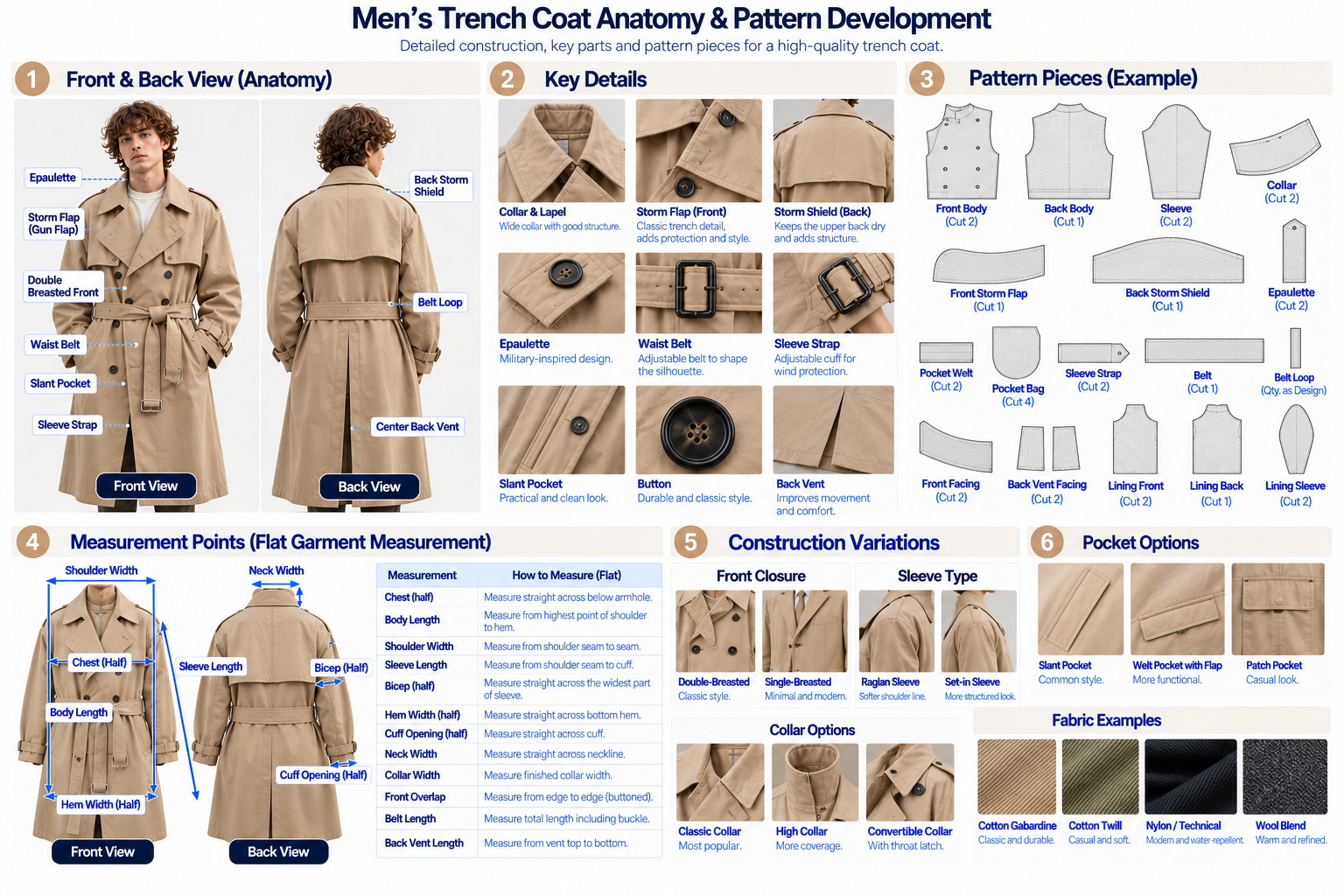
Front Body Pattern
The front body controls:
- Front overlap
- Lapel roll
- Button position
- Pocket location
- Hem
Double-breasted trenches require enough overlap to remain balanced when:
- Open
- Buttoned
- Belted
Back Body Pattern
The back controls:
- Upper-body movement
- Storm shield
- Back vent
- Sweep
Long coats need particularly careful back balance.
Raglan Pattern Pieces
A raglan sleeve may use multiple pieces depending on construction.
The pattern should define:
- Front sleeve seam
- Back sleeve seam
- Neckline attachment
A two-piece raglan sleeve can provide more shaping than a very simple one-piece construction.
Storm Flap Pattern
The storm flap should have defined:
- Width
- Depth
- Curve
- seam placement
Do not develop it purely by eye during sewing.
A few centimeters can noticeably change the upper-body proportion.
Belt Pattern
Specify:
- Finished width
- Finished length
- seam construction
- buckle
- eyelets if required
The belt may be:
- Bagged out
- Turned
- Topstitched
depending on fabric.
Sleeve Strap Pattern
Sleeve tabs need enough length for their intended adjustment.
Define:
- Finished width
- Button / buckle positions
- Number of adjustment positions
Pocket Pattern
A trench pocket often requires:
- Pocket opening
- Welt
- Pocket bag
- Reinforcement
The pocket bag needs enough depth without hanging below the coat hem.
Facing Pattern
Front facings help finish:
- Front edge
- Lapel
- neckline
Facing width should provide stability without creating excessive interior bulk.
Interfacing
Selective interfacing may be used around:
- Collar
- Lapel
- Front edge
- Pocket opening
- Button areas
depending on shell fabric and desired structure.
Not every trench needs heavily tailored internal construction.
Too Much Interfacing
Excess reinforcement can make a casual cotton trench feel:
- Stiff
- formal
- board-like
The internal structure should match the product direction.
Too Little Interfacing
A very soft shell may allow:
- Collar collapse
- button-area distortion
- wavy lapel
The first sample should help determine the necessary support.
Trench Coat Topstitching
Visible topstitching is common around:
- Collar
- Lapel
- Storm flap
- Belt
- Epaulettes
- Sleeve tabs
- Pockets
It helps define the garment visually.
Tonal Topstitching
Creates:
- Cleaner
- more refined
- minimal
appearance.
Contrast Topstitching
Can create stronger:
- Workwear
- utility
- fashion
character.
But contrast thread also makes inconsistencies much more visible.
Trench Coat Hardware
Possible trims include:
- Buttons
- Buckles
- D-rings
- Snaps
- Zippers
- Eyelets
All metal finishes should be selected as one coordinated system.
For custom hardware, buttons and branding elements, see Brad Apparel's Trims & Branding.
Buckle Options
Trench belts may use:
- Metal buckle
- Covered buckle
- Plastic buckle
- Leather-covered buckle
- D-ring closure
The buckle affects both:
- appearance
- garment weight
A heavy buckle can pull a lightweight belt downward.
Covered Buckles
A fabric-covered buckle can create a more refined appearance.
However, it adds production complexity.
Check:
- fabric thickness
- corner finishing
- adhesive / construction
- durability
Button Reinforcement
Coat buttons experience more force than many shirt buttons because outerwear fabric is heavier.
Areas may require:
- backing button
- reinforcement layer
- stronger attachment thread
depending on construction.
Buttonholes
Buttonholes should be:
- correctly sized
- cleanly cut
- positioned consistently
Heavy fabrics may require careful testing before bulk production.
Developing the First Trench Coat Sample
The first sample should answer both fit and construction questions.
Review the coat:
- Open
- Buttoned
- Belted
- Collar down
- Collar raised
Each configuration can reveal different problems.
Front View
Check:
- Center-front balance
- Button level
- Storm flap
- Pocket symmetry
- Belt height
- Hem
Side View
Check:
- Body volume
- Sleeve position
- Pocket bulk
- Belt interaction
- Front/back balance
Back View
Check:
- Storm shield
- Raglan seam
- Vent
- Belt loops
- Back length
Check the Coat Open
When open, inspect:
- Lapel shape
- Facing
- Lining
- front fall
The two front panels should hang cleanly.
Check the Coat Buttoned
Look for:
- Pull lines
- front distortion
- incorrect overlap
- button strain
A trench that looks correct open can become distorted when closed.
Check the Coat Belted
The belt should shape the coat without causing strange bunching.
Observe:
- Waist
- Back
- Front overlap
- pockets
A belt can reveal pattern-balance problems that are hidden when the coat hangs loose.
Movement Test
Ask the wearer to:
- Walk
- Sit
- Reach forward
- Raise arms
- Cross arms
The coat should remain comfortable over the intended base layers.
Pocket Test
The wearer should be able to insert their hands naturally.
Check whether:
- Belt blocks pocket
- Pocket is too low
- Opening is too narrow
Vent Test
Walk and sit while observing the back vent.
The vent should:
- Open when needed
- Return cleanly
- Not expose excessive lining
Layering Test
Test over the actual intended clothing.
Possible base layers include:
- Shirt
- Knitwear
- Sweatshirt
- Light jacket
A trench designed over a T-shirt block may become too restrictive when worn over winter layers.
Shrinkage Testing
If cotton-based shell fabric will be washed or wet-finished, test:
- Length shrinkage
- Width shrinkage
- twisting
- seam appearance
Different materials may behave differently.
For example:
cotton shell + polyester lining
will not necessarily shrink equally.
Shell and Lining Compatibility
If the shell shrinks more than the lining:
the lining can become too long.
If the lining shrinks more:
it can pull the outer shell inward.
This should be tested before final bulk approval.
Garment Washing
Some fashion trenches use washing for a softer, vintage appearance.
Possible results include:
- Softened hand feel
- Washed color
- Seam character
- Casual appearance
But garment washing is not appropriate for every trench construction.
Check compatibility with:
- Interfacing
- lining
- buttons
- buckles
- coating
before production.
Technical Performance Testing
If the coat is sold with performance claims, tests should match those claims.
Possible requirements include:
- Water repellency
- Hydrostatic resistance
- Colorfastness
- Seam performance
- Abrasion
- Dimensional stability
A fashion trench without performance specifications should not be described as professional rainwear.
Manufacturing Process
A practical trench-coat production sequence may include:
- Fabric inspection
- Shrinkage / performance testing
- Pattern development
- Grading
- Cutting
- Interfacing preparation
- Pocket preparation
- Storm-flap preparation
- Front and back assembly
- Sleeve assembly
- Collar assembly
- Facing construction
- Lining preparation
- Shell and lining assembly
- Belt / epaulette / sleeve-strap preparation
- Buttonhole / hardware installation
- Final pressing
- Measurement inspection
- Quality control
- Packing
The exact order varies according to construction and factory method.
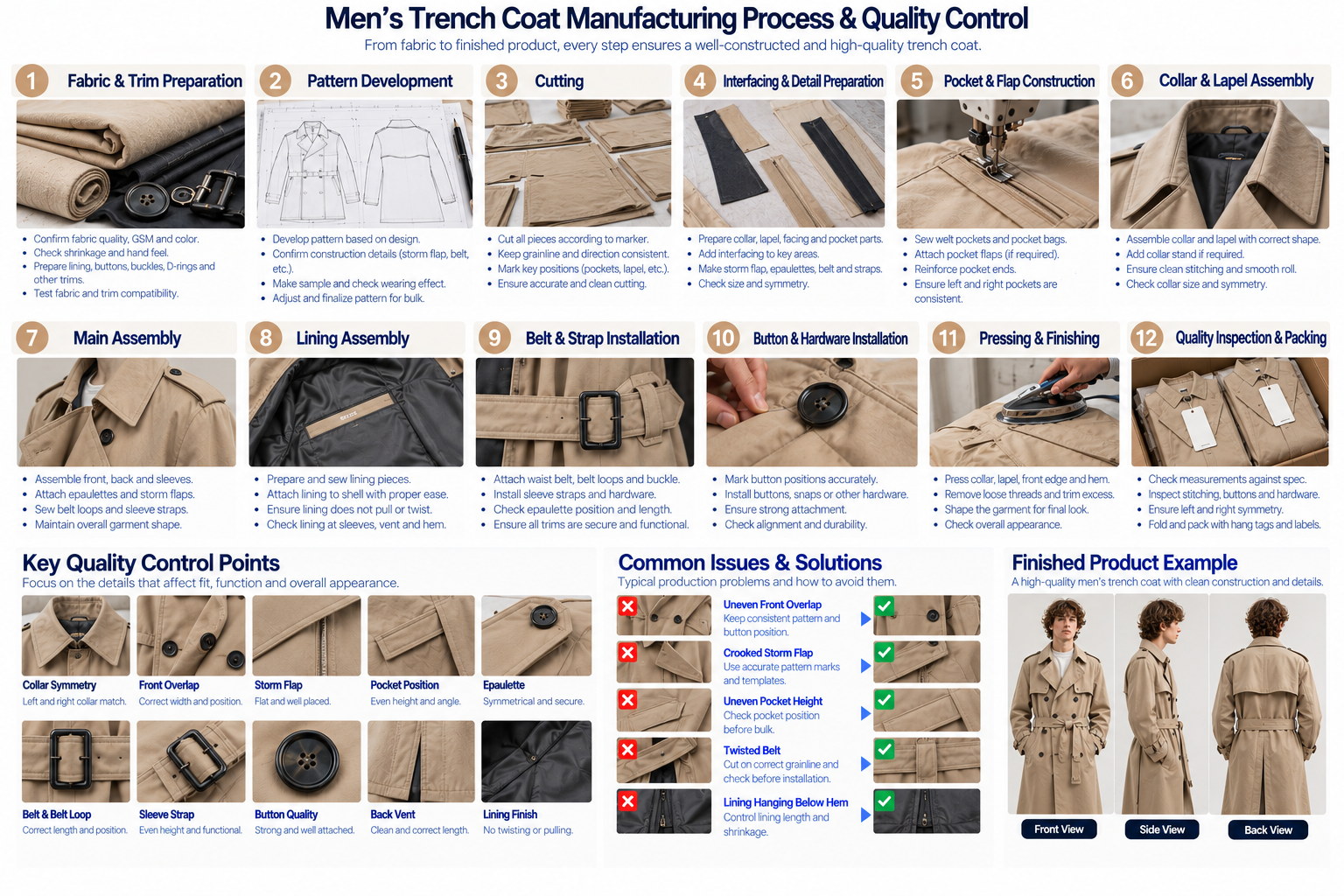
Fabric Inspection
Before cutting, inspect:
- Fabric width
- Composition
- Weight
- Color
- Surface
- Defects
- Direction
- Shade variation
For coated or water-resistant fabric, also inspect the finish.
Shade Control
Long coats contain large visible fabric areas.
Shade differences can therefore become obvious.
Check:
- Front left vs right
- Sleeve vs body
- Storm flap vs main body
- Belt vs coat
Components from different dye lots should not be mixed without approval.
Cutting
Cutting must maintain:
- Grainline
- directional consistency
- size identification
- paired components
Important paired pieces include:
- Epaulettes
- Sleeve straps
- Pocket welts
Left and right components should remain matched.
Storm-Flap Preparation
Before attachment, inspect:
- Shape
- symmetry
- edge stitching
- reinforcement
Once attached into shoulder or neckline construction, correction becomes more expensive.
Pocket Preparation
Use templates where useful for:
- opening length
- angle
- welt width
Uneven pockets are highly visible on a clean trench coat.
Belt Preparation
Inspect:
- Finished width
- Length
- Topstitching
- Buckle
- Belt-end shape
Long belts can twist if cut or sewn inconsistently.
Strap Preparation
Epaulettes and sleeve straps should be paired by:
- length
- width
- buttonhole
- topstitching
Small differences become obvious because these pieces are symmetrical.
Main Shell Assembly
Assemble the main:
- Front
- Back
- Sleeves
while maintaining consistent seam allowance.
Check body balance before attaching the lining.
Collar Assembly
Collar construction should maintain:
- Symmetry
- point shape
- roll
- neckline fit
The collar should be inspected:
- Down
- Raised
- Fully closed where applicable
Lining Assembly
Lining should have appropriate ease.
Check:
- Center-back pleat where used
- sleeve ease
- hem attachment
- vent relationship
The lining should not pull the shell.
Hardware Installation
Buttons, buckles and other hardware should be checked for:
- Position
- Attachment
- Finish
- durability
If the garment undergoes special washing, confirm whether certain hardware should be installed:
- Before treatment
- After treatment
according to finish compatibility.
Final Pressing
Pressing is especially important on trench coats.
Key areas include:
- Collar
- Lapels
- Storm flap
- pockets
- front edge
- belt
- hem
But excessive pressure can create:
- Shine
- Flattened texture
- coating damage
Pressing temperature should match the fabric.
Measurement Inspection
Finished measurements should be checked against the approved specification.
Important points include:
- Chest
- Body length
- Sleeve
- sweep
- front overlap
- pocket position
- belt position
- vent length
Key Quality Control Points
Front Balance
Left and right fronts should hang evenly.
Button Alignment
Button positions should remain consistent vertically and horizontally.
Storm Flap
Check:
- Shape
- placement
- symmetry
- flatness
Collar
Check:
- Left/right symmetry
- points
- roll
- neckline
Pocket Position
Left and right pockets should match unless intentional asymmetry is part of the design.
Epaulettes
Check:
- Length
- angle
- button placement
Sleeve Straps
Check:
- Height
- width
- adjustment
- buckle position
Belt
Check:
- Length
- width
- loops
- buckle
Back Vent
Check:
- Overlap
- length
- lining
- movement
Lining
Check:
- Ease
- attachment
- twisting
- hem
Common Trench Coat Quality Problems
Uneven Front Overlap
Possible Causes
- Pattern imbalance
- Sewing inconsistency
- Button placement
Control
Check overlap and button position during inline production.
Crooked Storm Flap
A large flap creates a strong horizontal or diagonal reference line.
Even small positioning errors can be visible.
Use accurate pattern marks.
Uneven Pocket Height
Left and right pocket positions should be checked with templates or measured references.
Belt Loops at Different Heights
This creates a visibly tilted belt around the body.
Check loop placement before side seams or lining make corrections difficult.
Twisted Belt
Possible causes include:
- Grainline error
- Uneven feeding
- Poor turning
Check the finished belt before attaching hardware.
Uneven Sleeve Straps
Compare:
- Distance from cuff
- strap length
- buckle orientation
between both sleeves.
Vent Pulling Open
Possible causes include:
- Insufficient hip ease
- lining tension
- incorrect vent overlap
Check the wearer walking and standing.
Lining Hanging Below Hem
Possible causes include:
- Excess lining length
- shell shrinkage
- attachment error
Final inspection should be performed with the coat hanging naturally.
Collar Not Sitting Flat
Possible causes include:
- Neckline mismatch
- collar pattern
- interfacing
- sewing stretch
Pressing alone may not solve an incorrect pattern.
Lapel Rolling Incorrectly
The lapel should naturally follow the intended break line.
Problems may come from:
- incorrect pattern
- interfacing
- pressing
- fabric stiffness
Seam Puckering
This may be caused by:
- Thread tension
- differential feeding
- needle choice
- fabric behavior
Long seams make puckering particularly visible on trench coats.
Hardware Damage
Buckles and buttons can become:
- Scratched
- discolored
- loose
during washing or transport.
Protect hardware according to the finishing process.
Trench Coat Grading
A trench contains many details that should not simply scale at the same percentage as the body.
Important grading decisions include:
- Button spacing
- Storm-flap depth
- Pocket size
- Belt width
- Belt length
- Epaulette size
- Collar width
- Sleeve-strap size
Does Belt Width Need to Grade?
Usually not significantly.
A brand may keep the same belt width across most sizes.
Belt length, however, normally requires adjustment.
Does Button Size Grade?
Generally the same hardware size is used across the size range.
But button placement changes with the garment.
Pocket Grading
Pocket size may increase slightly.
But fully proportional grading can produce oversized pockets in larger sizes.
The visual balance should be checked.
Storm-Flap Grading
A storm flap should maintain its relationship with:
- shoulder
- chest
- armhole
A fixed flap can become too small on large sizes.
An aggressively graded flap can overwhelm them.
Use controlled grading.
Example Classic Men's Trench Coat
A traditional direction could use:
- Relaxed classic fit
- Knee length
- Cotton gabardine
- Beige
- Double-breasted front
- Raglan sleeves
- Front storm flap
- Back storm shield
- Epaulettes
- Self-fabric belt
- Sleeve straps
- Slanted welt pockets
- Center-back vent
- Full lining
This preserves the recognizable trench language.
Example Oversized Black Trench
A contemporary version might use:
- Oversized body
- Drop or raglan shoulder
- Long length
- Washed black cotton twill
- Wide collar
- Minimal button layout
- Large back storm shield
- Loose belt
- Tonal hardware
This moves the garment closer to modern streetwear.
Example Minimal Single-Breasted Trench
A cleaner design could use:
- Relaxed fit
- Mid-calf length
- Cotton/poly gabardine
- Single-breasted hidden closure
- No epaulettes
- Reduced storm flap
- Narrow belt
- Welt pockets
- Full lining
It still references trench construction without reproducing every heritage detail.
Example Technical Trench
A technical interpretation may use:
- Lightweight synthetic woven
- High collar
- Hidden zipper
- Snap storm placket
- Adjustable belt
- Waterproof or water-resistant construction where tested
- Seam sealing if required
- Technical lining
Performance specifications should be confirmed separately from fashion styling.
Trench Coat Tech Pack Example
| Area | Example Specification |
|---|---|
| Product | Men's Trench Coat |
| Fit | Relaxed |
| Length | Knee Length |
| Shell | Cotton Gabardine |
| Lining | Full Polyester / Viscose-Style Lining |
| Front | Double Breasted |
| Sleeve | Raglan |
| Collar | Wide Convertible Collar |
| Front Detail | Storm / Gun Flap |
| Back Detail | Storm Shield |
| Shoulder | Epaulettes |
| Waist | Self-Fabric Belt |
| Cuff | Adjustable Sleeve Strap |
| Slanted Welt Pocket | |
| Back | Center Vent |
| Hardware | Matte Horn-Look Buttons |
| Stitching | Tonal |
| Finish | Clean / Unwashed |
These specifications are examples only.
How to Describe a Trench Coat to a Manufacturer
Avoid writing only:
I need a men's oversized trench coat.
A better brief would be:
Men's oversized knee-length trench coat in midweight black cotton gabardine with a relaxed raglan shoulder, wide convertible collar, double-breasted six-button front, asymmetric front storm flap, full back storm shield, self-fabric waist belt, adjustable sleeve straps, slanted welt pockets, center-back vent and full tonal lining.
Then provide:
- Chest
- Body length
- Sweep
- Sleeve length
- Neck opening
- Collar dimensions
- Front overlap
- Button spacing
- Storm-flap dimensions
- Pocket dimensions
- Belt position
- Belt dimensions
- Epaulette dimensions
- Sleeve-strap dimensions
- Vent
- Shell fabric
- Lining
- Hardware
- Branding
This gives the pattern and sample teams a much clearer development target.
Common Trench Coat Development Mistakes
1. Treating a Trench as a Long Jacket With a Belt
The storm details, overlap, collar and proportion need to be developed together.
2. Making the Front Overlap Too Narrow
This weakens the double-breasted appearance.
3. Making the Storm Flap Too Heavy
Too much layered fabric can distort the upper body.
4. Positioning the Belt Too High or Too Low
Belt placement strongly affects body proportion.
5. Making Pockets Difficult to Reach
Pocket position should be tested with the belt in place.
6. Using Fabric That Is Too Heavy
The coat already contains multiple layered details.
Excess weight can make the garment uncomfortable.
7. Using Fabric That Is Too Soft
Collar, lapel and storm flap may collapse if the intended design requires structure.
8. Forgetting Shell and Lining Shrinkage Differences
The two materials may react differently during finishing.
9. Grading Every Detail Mechanically
Belts, pockets, buttons and flaps require separate grading decisions.
10. Ignoring the Back Vent
A long coat needs enough movement through the lower body.
11. Approving the Coat Only Unbelted
Fit should also be checked with the belt tied or buckled.
12. Calling the Garment Waterproof Without Testing
Trench-coat styling alone does not establish weather performance.
Trench Coat Development Checklist
Before sampling, confirm:
- Intended silhouette
- Body length
- Shell fabric
- Fabric weight
- Color
- Lining
- Shoulder / sleeve type
- Collar
- Front closure
- Front overlap
- Storm flap
- Back shield
- Epaulettes
- Belt
- Belt loops
- Sleeve straps
- Pockets
- Back vent
- Buttons
- Buckles
- Branding
- Performance requirements
Before bulk production, confirm:
- Approved shell
- Approved lining
- Shrinkage
- Pattern
- Fit
- Storm-flap dimensions
- Button spacing
- Belt position
- Pocket placement
- Vent
- hardware
- topstitching
- pressing standard
- measurement tolerance
- QC standard
FAQ
What Is a Trench Coat?
A trench coat is a longer woven outerwear garment traditionally associated with rainwear and military-inspired construction.
Common features include:
- Double-breasted front
- Belt
- Storm flap
- Epaulettes
- Sleeve straps
- Raglan sleeves
- Back vent
Modern designs may simplify these details.
Are Trench Coats in Style in 2026?
Yes.
Trench coats remain an important outerwear category, with modern versions using:
- Oversized proportions
- Stronger colors
- Longer silhouettes
- High collars
- Minimal detailing
- Technical materials
alongside traditional beige gabardine versions.
What Is the Best Fabric for a Trench Coat?
Common options include:
- Cotton gabardine
- Cotton twill
- Cotton/polyester blends
- Polyester
- Nylon
- Technical woven fabrics
The best fabric depends on:
- Season
- structure
- performance
- price
- intended silhouette
What Is Gabardine?
Gabardine is a tightly woven fabric with a diagonal twill structure.
Cotton and cotton-blend gabardines are commonly associated with trench coats because they can provide a clean combination of:
- Structure
- durability
- drape
Actual fabric characteristics vary by mill.
Is Every Trench Coat Waterproof?
No.
A trench-coat silhouette does not automatically provide waterproof performance.
Water resistance depends on:
- Fabric
- finishing
- membrane
- seams
- closure construction
Performance claims should be supported by appropriate specifications and testing.
What Is a Storm Flap?
A storm flap is an additional fabric layer positioned around part of the upper body.
It is a recognizable trench-coat detail and can also contribute to weather-oriented construction depending on design.
What Is the Back Flap on a Trench Coat Called?
It is commonly called a:
- Back storm shield
- Storm flap
Terminology can vary.
For production, specify the actual pattern shape and dimensions.
Why Do Trench Coats Have Belts?
The belt allows the wearer to control the waist shape and is also one of the trench coat's strongest visual identifiers.
Modern versions may wear it:
- Buckled
- Tied
- Tied behind the body
- Loose
Why Do Trench Coats Have Epaulettes?
Epaulettes come from the garment's military-influenced design history.
In modern fashion trenches they are commonly retained as a visual heritage detail.
Do Trench Coats Need Raglan Sleeves?
No.
Raglan sleeves are strongly associated with traditional trench construction, but modern versions can use:
- Set-in sleeves
- Extended shoulders
- Drop shoulders
depending on the design.
Should a Trench Coat Be Lined?
It can be:
- Fully lined
- Partially lined
- Unlined
A full lining can improve layering and interior finishing.
A lightweight unlined trench can work well for transitional weather.
Can a Trench Coat Be Oversized?
Yes.
But the pattern should be developed intentionally.
An oversized trench needs controlled changes to:
- Chest
- shoulder
- sleeve
- length
- sweep
rather than simply increasing the entire garment size.
Can a Trench Coat Be Garment Washed?
Some cotton fashion trenches can use garment washing.
But the process must be tested against:
- Shell
- interfacing
- lining
- hardware
- coating
before production.
What Should Be Checked During Trench Coat QC?
Important inspection points include:
- Front overlap
- Button alignment
- Collar symmetry
- Storm-flap position
- Pocket height
- Belt-loop height
- Belt
- Epaulettes
- Sleeve straps
- Back vent
- Lining
- Measurements
- Final pressing
Final Thoughts
The trench coat is one of those garments where recognizable heritage details can make the product appear simple even though the construction is relatively complex.
Its identity is created by the relationship between:
fabric + front overlap + collar + storm flap + sleeves + belt + pockets + length
A traditional beige gabardine version can remain highly classic.
An oversized black trench can feel completely contemporary.
A simplified single-breasted trench can move toward minimal menswear.
And a technical version can borrow the silhouette while introducing modern performance materials.
For clothing brands, the strongest development approach is therefore not to ask a factory to "add trench details" to a generic coat.
The body proportion, storm-flap size, collar, front overlap, belt position, sleeve construction and fabric should be developed together.
When those components are balanced from the first pattern onward, the finished trench coat is much easier to reproduce consistently from sampling through bulk production.
Keep Reading