A suede jacket can look deceptively simple.
Soft matte surface.
Clean zipper.
Minimal pockets.
Relaxed silhouette.
But suede is a material where small production decisions can dramatically affect the finished garment.
The final result depends on how the:
Material
Nap direction
Shade
Thickness
Pattern
Seams
Hardware
Lining
and
Finishing
work together.
This is especially important because the word “suede” can describe very different materials.
A brand may be developing:
- Genuine suede
- Split suede
- Faux suede
- Microfiber suede
- Suede-look woven fabric
- Bonded suede-look material
These materials may look similar in a photograph but behave very differently during manufacturing.
This guide explains what clothing brands should consider before developing a custom suede or faux suede jacket.
What Is a Suede Jacket?

A suede jacket is an outerwear garment made with genuine suede or a textile designed to create a similar soft, napped appearance.
The recognizable surface is usually:
- Matte
- Soft
- Slightly directional
- Visually rich
- Less reflective than smooth leather
Modern suede-inspired jackets can include:
- Bomber jackets
- Harrington jackets
- Shirt jackets
- Cropped jackets
- Funnel-neck jackets
- Western jackets
- Oversized zip jackets
- Minimal blousons
- Long outerwear
That means suede does not define one particular jacket pattern.
It defines a material direction that can be combined with many silhouettes.
For manufacturing, the material should therefore be confirmed before the final pattern and construction are approved.
Why Are Suede Jackets Relevant in 2026?
Suede works particularly well with several current fashion directions:
- Rich brown color palettes
- Retro outerwear
- Relaxed tailoring
- Western influences
- Cropped jackets
- Oversized bombers
- Heritage casualwear
- Texture-led minimalism
One reason suede works so well in outerwear is that it can make a relatively simple jacket feel distinctive without requiring large graphics.
A jacket may use:
minimal branding
+
clean silhouette
+
rich suede texture
and still have strong visual identity.
For clothing brands, that makes the material particularly useful for:
- Premium casualwear
- Streetwear
- Contemporary menswear
- Women's outerwear
- Heritage-inspired collections
Genuine Suede vs Faux Suede
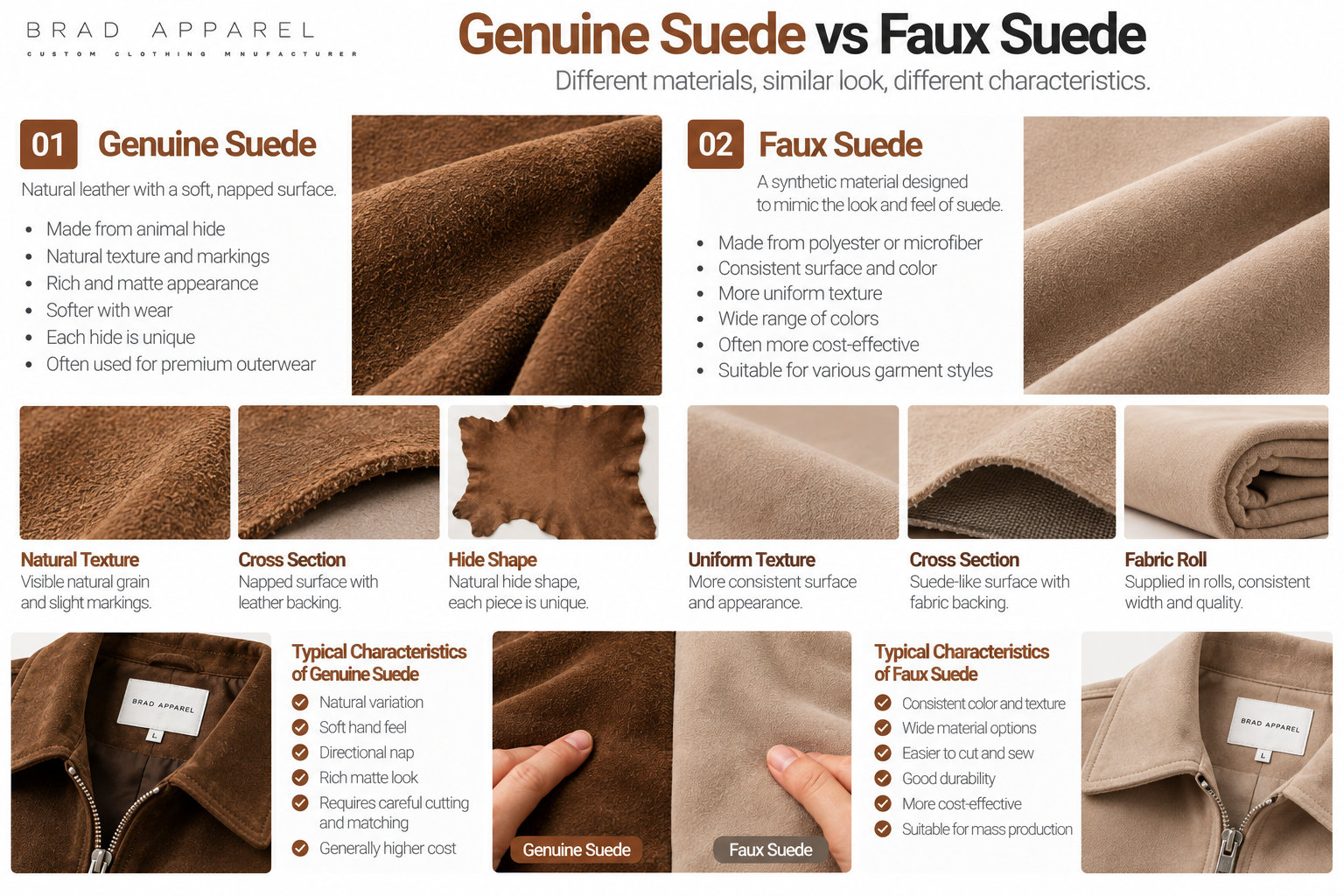
This distinction should be made before sampling begins.
Genuine Suede
Genuine suede is a type of leather with a napped surface.
Depending on the hide and processing method, it can vary in:
- Thickness
- Nap
- Softness
- Shade
- Surface consistency
- Natural markings
Individual hides are not identical.
That creates additional considerations for:
- Material matching
- Cutting
- Yield
- Panel placement
- Shade control
Faux Suede
Faux suede is a textile engineered to imitate the appearance and hand feel of suede.
It may use:
- Polyester
- Microfiber constructions
- Woven bases
- Knitted bases
- Bonded structures
depending on the material.
Compared with natural hides, roll goods can often provide more consistent:
- Width
- Surface
- Color
- Thickness
However, faux suede can still have:
- Directional nap
- Shade variation
- Stretch
- Pressure marks
- Different backing structures
So it still needs physical testing.
Genuine and Faux Suede Are Not Automatically Interchangeable
A pattern developed in one material should not automatically be transferred to another.
For example:
soft microfiber faux suede
and
substantial genuine suede
may require different:
- Seam allowances
- Needle selection
- Interfacing
- Zipper weight
- Pocket construction
- Collar support
Even if the visual reference is similar.
The final material should ideally be confirmed before the production sample.
The Suede Surface Has Direction
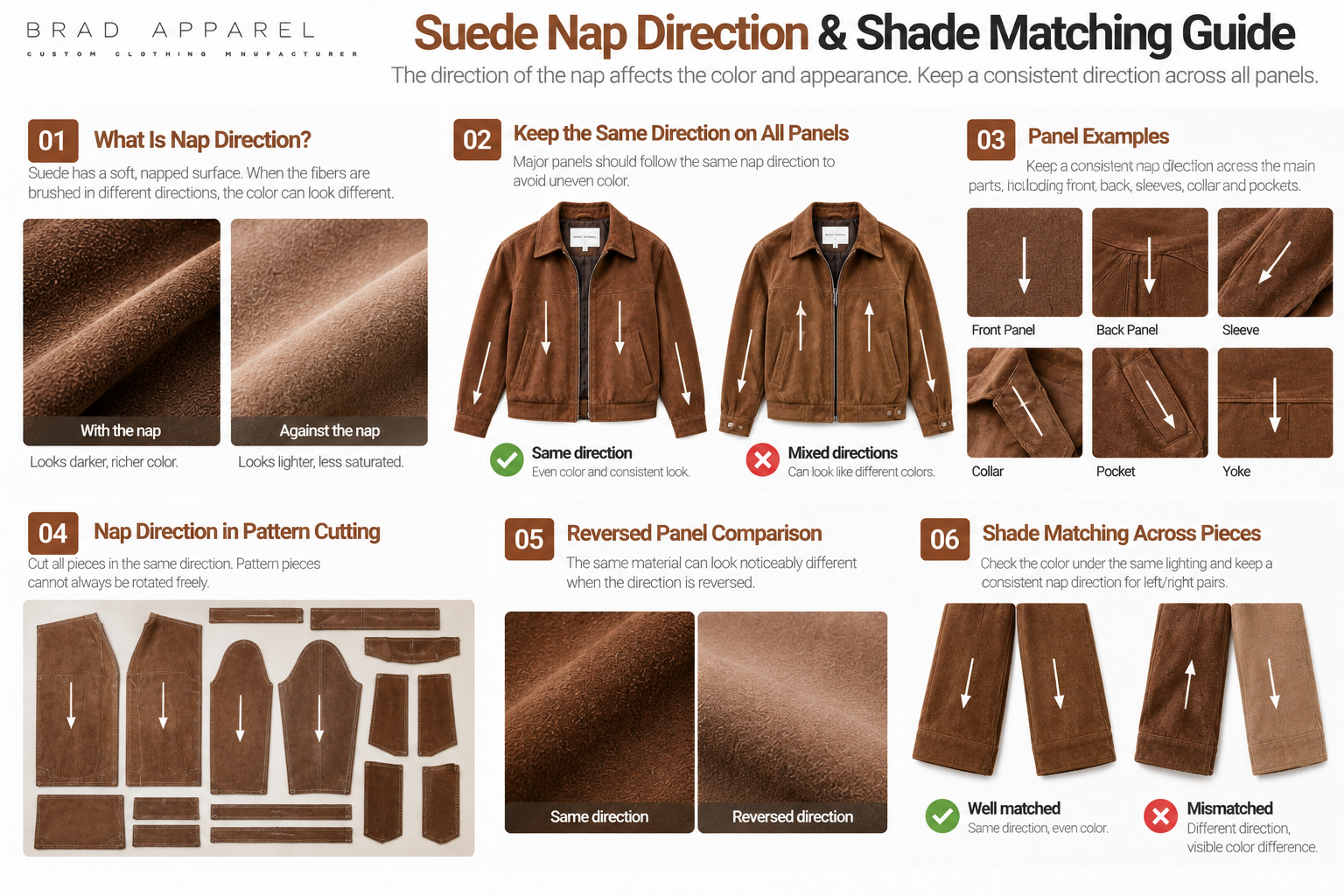
One of the most important characteristics of suede is its:
nap.
When the surface fibers are brushed in different directions, light can reflect differently.
The same material may therefore appear:
- Lighter
- Darker
- More saturated
- More matte
depending on:
- Nap direction
- Viewing angle
- Lighting
This is not necessarily a color defect.
It is part of the material's surface behavior.
Nap Direction Should Be Intentional
Imagine a jacket where:
left front panel
is cut in one direction,
while:
right front panel
is cut in the opposite direction.
The two sides may appear to be different shades under the same light.
For major jacket pieces, manufacturers may therefore need to control direction across:
- Left front
- Right front
- Back
- Sleeves
- Collar
- Pocket flaps
- Yokes
The exact cutting rule depends on the material and design.
But random orientation should be avoided when the nap is visually directional.
Shade Matching Is Especially Important
Genuine suede can also vary naturally between hides or sections of the same hide.
That makes panel matching particularly important.
For example, the manufacturer should avoid creating:
one sleeve noticeably darker than the other
unless the design intentionally uses contrast.
Important areas include:
- Left/right front
- Sleeves
- Collar
- Pocket pieces
- Back panels
Material sorting may therefore be necessary before cutting.
Faux Suede Can Also Change Shade With Direction
Synthetic suede should not automatically be treated like ordinary flat woven fabric.
Some faux suede surfaces also show visible directional shading.
Before bulk cutting, check:
- Face direction
- Nap
- Shade under light
- Panel consistency
on the actual material.
Material Direction Can Affect Consumption
When pieces need to follow the same nap direction, marker efficiency may decrease.
Pattern pieces cannot always be rotated freely simply to reduce waste.
This can affect:
- Material consumption
- Cutting efficiency
- Costing
Genuine suede introduces another variable:
hide shape.
Unlike roll fabric, natural hides do not provide a perfectly rectangular usable area.
Natural markings and edge areas may further affect yield.
For that reason, suede consumption should be calculated from the actual material rather than copied from a normal woven jacket.
Material Thickness Changes the Jacket
There is no universal thickness that every suede jacket should use.
A softer, lighter material can create:
- More drape
- Easier movement
- Relaxed silhouette
- Shirt-jacket feeling
A more substantial material can create:
- Stronger structure
- Sharper collar
- More defined jacket shape
- Greater seam bulk
The correct material depends on the intended product.
Soft Suede vs Structured Suede
Two jackets with the same measurements can look completely different.
Softer Material
May create:
- Slouchier silhouette
- Softer collar
- More relaxed body
- Less defined panel shape
More Structured Material
May create:
- Cleaner jacket architecture
- Sharper seams
- Stronger collar shape
- More controlled volume
This is why fabric approval should happen before final fit approval whenever possible.
Brad Apparel's Fabric Sourcing & Development process allows fabric options to be evaluated according to structure, hand feel, color and garment requirements before sampling.
Faux Suede Backing Matters
The face of a faux suede fabric may look similar across several materials.
But the backing can be completely different.
Possible backing structures may be:
- Woven
- Knitted
- Bonded
- Laminated
This affects:
- Stretch
- Stability
- Drape
- Fraying
- Sewing
- Edge finishing
A brand should therefore evaluate both:
front surface
and
back construction.
Stretch Should Be Checked Before Pattern Development
Some faux suede fabrics have noticeable mechanical or knitted stretch.
Others are relatively stable.
If the material stretches, the manufacturer should consider:
- Chest recovery
- Elbow behavior
- Pocket openings
- Hem shape
- Zipper stability
A pattern developed for rigid material may behave differently in stretchy faux suede.
Four Modern Suede Jacket Directions

The suede material direction can support several different silhouettes.
1. Suede Bomber Jacket
Possible features include:
- Short body
- Relaxed chest
- Rib or structured collar
- Front zipper
- Welt pockets
- Rib or elastic hem
Suede changes the familiar bomber silhouette by introducing:
- Softer texture
- Matte surface
- More premium visual depth
Hardware should remain proportional to the material.
A very lightweight zipper may appear weak on a substantial suede body.
2. Cropped Suede Jacket
Possible features include:
- Short body length
- Boxy chest
- Larger collar
- Wider sleeve
- Clean hem
A cropped jacket needs intentional proportion.
Simply shortening a standard jacket can cause:
- Pocket placement problems
- Zipper imbalance
- Incorrect hem-to-sleeve proportion
The pattern should be designed around the intended crop length.
3. Oversized Suede Jacket
Possible features include:
- Wide chest
- Drop shoulder
- Larger sleeves
- Boxy silhouette
- Larger pockets
- Strong hardware
The oversized pattern should be purpose-built.
Increasing every measurement equally may create:
too much length
rather than the intended width and volume.
4. Suede Shirt Jacket
Possible features include:
- Shirt collar
- Button or snap front
- Patch pockets
- Straight hem
- Relaxed fit
This creates a lighter outerwear direction between:
shirt
and
jacket.
Material softness becomes especially important because the garment should retain enough movement for layering.
Suede Jacket vs Leather Jacket
Suede and smooth leather can come from related material categories, but the surfaces behave differently.
A smooth leather jacket generally has:
- Smoother exterior
- More surface reflection
- Less obvious nap
- Different abrasion appearance
Suede has:
- Raised nap
- Matte texture
- Directional surface
- More visible shade variation from brushing
That changes how the garment should be handled during:
- Cutting
- Sewing
- Pressing
- Finishing
- QC
Suede Jacket Construction Requires Planning
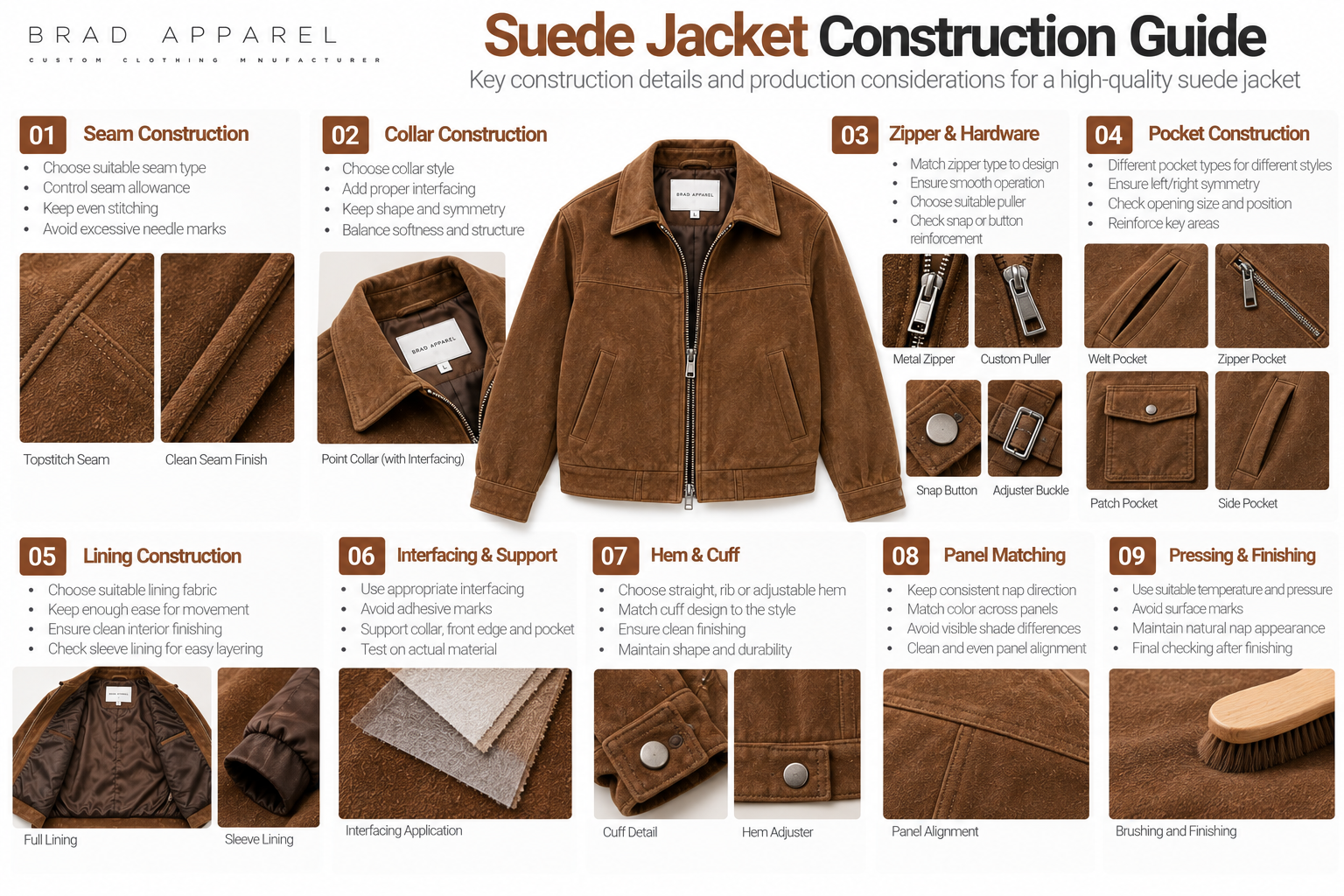
Suede can make simple construction details highly visible.
Several areas deserve special attention.
Seam Construction
Possible seam directions depend on the specific material.
Important considerations include:
- Material thickness
- Seam allowance
- Bulk
- Surface marking
- Stitch length
- Edge stability
The production team should test the seam on the actual material.
A construction that works on lightweight cotton should not automatically be used on suede.
Needle Holes Can Be Difficult to Hide
Some suede and suede-look materials may retain visible needle marks.
That means repeated unpicking and resewing can leave a permanent line.
This makes accurate first-time sewing particularly important.
Factories should avoid unnecessary:
- Restitching
- Pin holes
- Incorrect pocket placement
- Multiple fitting lines
on sensitive materials.
The exact behavior depends on the material.
Stitch Length Matters
Very short stitches may create too many perforations along one line on certain materials.
Very long stitches can make the seam look uncontrolled.
The correct stitch length should therefore be tested rather than copied from a normal woven jacket specification.
Seam Bulk Needs Attention
Areas with multiple layers can become thick.
Common examples include:
- Collar corners
- Cuffs
- Pocket flaps
- Zipper edges
- Hem
- Shoulder intersections
Construction should avoid unnecessary overlapping layers where possible.
Pressing Requires Care
Suede surfaces can be sensitive to:
- Heat
- Pressure
- Steam
- Contact marks
The correct pressing method depends on the exact genuine or synthetic material.
Before production, the factory should test:
- Temperature
- Pressure
- Press cloth
- Steam exposure
on a material offcut.
The goal is to shape seams without changing the visible surface.
Interfacing Needs Testing
Interfacing can help support:
- Collar
- Front edge
- Pocket flap
- Cuff
- Hem
But it should not automatically be applied using the same method as a cotton jacket.
Possible issues include:
- Adhesive marking
- Surface change
- Stiffness
- Bubble formation
- Visible outline
The selected interfacing and bonding process should be tested on the real material.
Collar Construction
Possible collar directions include:
- Point collar
- Spread collar
- Stand collar
- Funnel collar
- Bomber-style collar
The collar should balance:
material softness
and
desired structure.
A very soft suede may require support for a sharp collar.
A naturally structured material may need less internal reinforcement.
Zipper Selection
Possible zipper types include:
- Metal zipper
- Nylon coil
- Reverse coil
- Plastic molded
- Two-way zipper
The correct option depends on the silhouette.
For example:
premium retro jacket
may visually suit a metal zipper,
while:
minimal lightweight faux suede jacket
may work better with a cleaner, lighter closure.
Brad Apparel's Custom Zippers & Sliders capabilities include metal, coil, molded and custom puller options for jacket development.
Hardware Weight Should Match the Material
A large heavy zipper or snap can distort soft material.
Possible problems include:
- Front edge pulling
- Sagging
- Fabric distortion
- Uneven drape
The jacket should therefore be reviewed with the real hardware installed.
Button and Snap Reinforcement
If a suede jacket uses:
- Buttons
- Snaps
- Press studs
the attachment area may need additional support.
The reinforcement method should match:
- Material thickness
- Hardware weight
- Closure force
Heavy hardware should not be attached to a soft base without testing.
Pocket Construction
Common suede-jacket pockets include:
- Welt pockets
- Zipper pockets
- Patch pockets
- Flap pockets
- Seam pockets
- Chest pockets
Pocket type strongly changes the visual direction.
Patch Pockets
Patch pockets create a casual or workwear-inspired result.
However, placement mistakes may be more difficult to correct on materials that retain needle marks.
Pocket position should therefore be confirmed carefully before sewing.
Welt Pockets
Welt pockets create a cleaner appearance.
Important checks include:
- Opening length
- Left/right symmetry
- Corner quality
- Material direction
- No excessive bulk
Zipper Pockets
Pocket zipper weight should match both:
- Main material
- Center-front zipper
A jacket can look inconsistent when the pocket zipper is visually much heavier than the main closure.
Lining Changes the Finished Jacket
Suede jackets may be:
- Unlined
- Fully lined
- Partially lined
depending on the material and design.
A lining can provide:
- Cleaner interior
- Easier layering
- Covered seam allowances
- Different garment structure
But it also changes:
- Weight
- Drape
- Warmth
- Cost
- Sewing complexity
Lining Needs Enough Ease
The lining should not pull against the shell.
Important areas include:
- Back
- Armhole
- Elbow
- Sleeve
- Hem
Insufficient lining ease can restrict movement even when the outer jacket fits correctly.
Sleeve Lining Is Especially Important
Some suede surfaces create more friction against:
- Knitwear
- Sweatshirts
- Long sleeves
A smooth sleeve lining can make layering easier where the design requires it.
Again, lining material should be selected according to the intended product.
Edge Finishing Depends on the Material
Different suede materials may require different edge treatments.
Possible constructions include:
- Turned edge
- Bound edge
- Faced edge
- Lined edge
- Material-specific raw-edge styling
Not every option is appropriate for every genuine or faux suede.
The manufacturer should test:
- Fraying
- Delamination
- Stretch
- Thickness
before selecting the finish.
Color Approval Should Be Physical
Digital color references are useful for communication.
But suede can appear different depending on:
- Nap direction
- Lighting
- Surface brushing
- Material batch
Colors such as:
- Chocolate brown
- Camel
- Tan
- Burgundy
- Olive
- Navy
- Black
can appear noticeably different as the surface moves.
Physical swatches should therefore be reviewed whenever color is important.
Brown Is Not One Suede Color
Two “brown suede” jackets can look completely different.
Possible directions include:
- Light tan
- Camel
- Cognac
- Chocolate
- Espresso
- Reddish brown
- Olive brown
The color reference should be as specific as possible.
A physical swatch is often more useful than a screen image alone.
Decoration Should Respect the Surface
Suede jackets can use:
- Embroidery
- Patches
- Woven labels
- Debossed or embossed branding where material allows
- Custom hardware
- Small printed details on suitable materials
But heavy decoration is not always necessary.
The material itself already creates strong visual identity.
Embroidery on Suede
Embroidery may be possible depending on:
- Material thickness
- Backing
- Stitch density
- Artwork size
- Placement
Potential problems include:
- Surface distortion
- Needle marks
- Puckering
- Excess stiffness
A physical sew-out should be tested before bulk production.
Brad Apparel's Embroidery Techniques process adjusts stitch density, backing and construction according to the base garment material.
Patches Can Be Easier for Some Designs
A separate patch can create controlled branding without placing extremely dense stitching directly through a sensitive jacket surface.
Possible directions include:
- Embroidered patch
- Woven patch
- Fabric patch
The:
- Patch weight
- Size
- Edge
- Attachment method
should still match the jacket.
Custom Hardware Can Become the Branding
A suede jacket often works well with subtle branding.
Possible details include:
- Custom zipper pull
- Engraved snap
- Branded button
- Woven label
- Small chest logo
Brad Apparel's Trims & Branding capabilities cover custom zippers, buttons, patches, labels and other branded components.
What Should You Check on a Suede Jacket Sample?

A suede jacket should be reviewed for both:
fit
and
surface consistency.
1. Front View
Check:
- Body width
- Body length
- Collar
- Closure alignment
- Pocket position
- Hem balance
- Left/right shade consistency
2. Side View
Check:
- Body depth
- Shoulder position
- Sleeve shape
- Pocket bulk
- Hem balance
3. Back View
Check:
- Shoulder width
- Back volume
- Panel symmetry
- Nap direction
- Shade consistency
- Hem level
4. Collar
Check:
- Shape
- Height
- Symmetry
- Structure
- Edge finishing
- Comfort
5. Main Closure
Check:
- Zipper / button / snap operation
- Front alignment
- Reinforcement
- No material catching
- No excessive pulling
6. Pockets
Check:
- Position
- Size
- Left/right symmetry
- Hand access
- Opening quality
- Surface direction
7. Nap & Shade
Compare:
- Left front
- Right front
- Sleeves
- Back
- Collar
- Pocket components
Check for unintended shade differences.
8. Seams
Check:
- Stitching consistency
- No unnecessary needle marks
- Seam bulk
- No twisting
- Clean intersections
9. Surface
Check:
- Nap
- Color
- Marks
- Pressure areas
- Scratches
- Natural variation where applicable
10. Lining
Check:
- Ease
- Attachment
- Sleeve movement
- Interior finishing
- No pulling
11. Decoration & Hardware
Check:
- Embroidery or patch quality
- Hardware attachment
- Zipper pull
- Labels
- No material distortion
12. Wear & Care Result
Where appropriate for the selected material, review:
- Measurements
- Surface appearance
- Shape
- Seam condition
- Hardware
- Lining
- Color
- Overall silhouette
Care testing should follow the actual material supplier's requirements.
Common Suede Jacket Development Mistakes
Saying Only “Suede”
The factory still needs to know whether the project uses:
- Genuine suede
- Faux suede
- Microfiber suede
- Suede-look woven
- Another material
Selecting the Pattern Before the Material
Material thickness and drape affect the silhouette.
Ignoring Nap Direction
Panels can appear to be different colors.
Ignoring Shade Matching
This can be particularly noticeable between:
- Sleeves
- Front panels
- Pocket pieces
Treating Faux Suede Like Normal Twill
The surface and backing may behave very differently.
Repeatedly Unpicking Seams
Some materials retain visible needle holes.
Using Heavy Hardware on Very Soft Material
The closure can distort the garment.
Using Standard Pressing Without Testing
Heat or pressure can alter the surface.
Applying Interfacing Without Testing
The adhesive or stiffness may affect appearance.
Making an Oversized Jacket by Simply Sizing Up
Width, shoulder, sleeve and length should be developed intentionally.
Approving Color Only From a Screen
Nap and lighting affect suede color appearance.
What Should You Send a Suede Jacket Manufacturer?
A useful development brief should define:
| Area | What to Specify |
|---|---|
| Jacket Type | Bomber / cropped / oversized / shirt jacket / other |
| Material | Genuine suede / faux suede / approved swatch |
| Composition | If applicable |
| Surface | Nap, texture and target hand feel |
| Color | Physical reference / Pantone where relevant |
| Fit | Regular / relaxed / oversized / cropped |
| Collar | Point / stand / funnel / bomber / other |
| Closure | Zipper / buttons / snaps |
| Zipper | Metal / coil / molded / custom |
| Welt / zipper / patch / flap | |
| Lining | None / full / partial |
| Cuff | Straight / snap / elastic / rib |
| Hem | Straight / elastic / rib / adjustable |
| Branding | Embroidery / patch / labels / custom hardware |
| Care | Material-specific requirements |
| Quantity | Sample and bulk quantity |
A reference image is helpful.
But for suede projects, a physical material swatch can be even more important than the image.
How Brad Apparel Can Develop a Custom Suede-Look Jacket
A material-led jacket development process can follow:
Design Reference
↓
Material Sourcing & Confirmation
↓
Surface / Nap / Color Review
↓
Fit Direction
↓
Pattern Development
↓
Seam & Edge Testing
↓
Zipper / Hardware Selection
↓
Lining Confirmation
↓
First Sample
↓
Fit + Surface Review
↓
Decoration Testing
↓
Pre-Production Approval
↓
Bulk Production
Brad Apparel can support material and garment development through Fabric Sourcing & Development, Custom Zippers & Sliders, Trims & Branding, Embroidery Techniques and broader Manufacturing Capabilities.
For projects involving specialized genuine leather or suede, the exact material and production requirements should be confirmed before sampling.
FAQ
What Is a Suede Jacket?
A suede jacket is an outerwear garment made from genuine suede or a suede-look material with a soft, matte and often directional surface.
The term can cover many silhouettes, including bombers, cropped jackets, shirt jackets and oversized outerwear.
What Is the Difference Between Suede and Faux Suede?
Genuine suede is a leather material with a napped surface.
Faux suede is a textile engineered to create a similar appearance and hand feel.
They can require different cutting, sewing and finishing methods.
Is Faux Suede Polyester?
Many faux suede fabrics use polyester or microfiber-based constructions, but composition and backing vary.
The actual textile specification should be confirmed.
Why Does Suede Change Color When You Touch It?
The raised surface fibers can move in different directions.
That changes how the surface reflects light and can make the material appear lighter or darker.
Does Suede Have a Nap Direction?
Many genuine and synthetic suede surfaces have visible direction.
The cutting direction should be evaluated before bulk production to avoid unintended shade differences.
Can Suede Jackets Be Oversized?
Yes.
The pattern should be developed through the:
- Chest
- Shoulder
- Armhole
- Sleeve
- Length
rather than simply increasing a standard jacket size.
Can Suede Jackets Be Embroidered?
Depending on the material, yes.
However, stitch density, needle marks, backing and surface distortion should be tested before bulk production.
Can a Suede Jacket Have a Metal Zipper?
Yes.
But the zipper weight should be balanced with the material thickness and jacket structure.
Does a Suede Jacket Need Lining?
Not always.
The decision depends on:
- Material backing
- Jacket structure
- Intended season
- Layering
- Interior finish
A lining changes the weight and drape of the jacket.
Can Faux Suede Be Pressed?
It depends on the material.
Heat and pressure should be tested according to the supplier's material specifications before production.
Why Can Two Suede Panels Look Like Different Colors?
Possible causes include:
- Different nap direction
- Lighting
- Natural hide variation
- Batch variation
- Surface brushing
The production team should check shade and direction before sewing.
What Should Be Checked Before Bulk Production?
Important points include:
- Fit
- Material thickness
- Nap
- Shade
- Surface
- Collar
- Zipper
- Pockets
- Seams
- Lining
- Decoration
- Hardware
- Overall appearance
The production sample should use material and trims that accurately represent the intended bulk garment.
Final Thoughts
A suede jacket is not simply a standard jacket made from a softer-looking material.
The surface changes the manufacturing process.
Nap affects color.
Natural variation can affect panel matching.
Material thickness affects seams.
Needle marks affect sewing accuracy.
Pressing affects the surface.
Hardware affects drape.
And lining changes how the finished jacket moves.
For clothing brands, a successful suede or faux suede jacket should therefore be developed as one complete system:
Material
+
Nap
+
Shade
+
Pattern
+
Seams
+
Hardware
+
Lining
+
Finishing
rather than applying a suede material to a pattern that was originally developed for an unrelated woven fabric.
Keep Reading