A knee-length skirt is a skirt designed to finish around the knee rather than high on the thigh or farther down the calf.
That sounds simple, but "knee length" does not describe one fixed garment.
A knee-length skirt can be:
- Pencil
- Straight
- A-line
- Pleated
- Wrap
- Bias cut
- Utility inspired
- Denim
- Tailored
- Low rise
- High rise
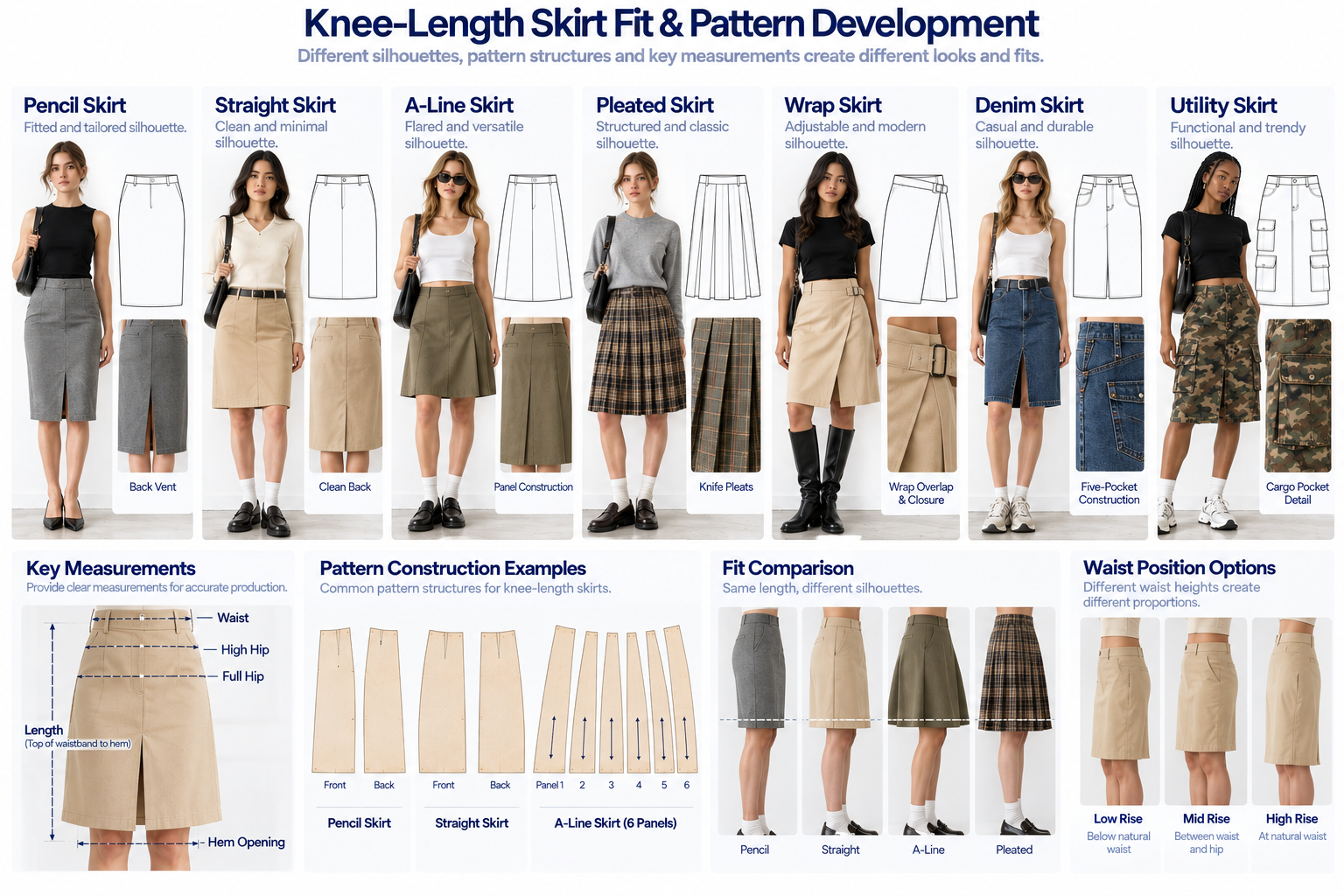
For clothing brands, the finished result depends on much more than skirt length.
The key relationship is:
waist position + hip fit + silhouette + finished length + hem width + fabric + construction
A pencil skirt finishing at the knee behaves very differently from an A-line skirt of exactly the same length.
This guide explains what defines a knee-length skirt, how it differs from mini and midi skirts, and what brands should specify before developing one for production.
What Is a Knee-Length Skirt?
A knee-length skirt generally finishes around the wearer's knee.
Depending on the design, the hem may sit:
- Slightly above the knee
- At the center of the knee
- Slightly below the knee
This is important because there is no single universal centimeter measurement that automatically creates a knee-length skirt for every wearer.
Finished length changes according to:
- Wearer height
- Waist position
- Rise
- Body proportions
- Size
- Intended styling
For manufacturing, the word "knee-length" should describe the design direction.
An actual finished measurement should define the garment.
Why Are Knee-Length Skirts Trending Again?
The knee-length skirt sits between two familiar extremes:
mini skirt
and
midi skirt
For several seasons, those two lengths dominated fashion.
The knee-skimming silhouette is now returning because it creates a different proportion.
It can feel:
- Clean
- Tailored
- Minimal
- Preppy
- Feminine
- Utilitarian
- 1990s inspired
- Office inspired
- Fashion forward
Modern versions also move far beyond the traditional corporate pencil skirt.
Current interpretations may use:
- Printed fabrics
- Denim
- Lace
- Satin
- Wool
- Technical materials
- Utility pockets
- Low-rise waists
- Unusual panel construction
- Raw edges
- Embellishment
That makes the length useful across many different brand directions.
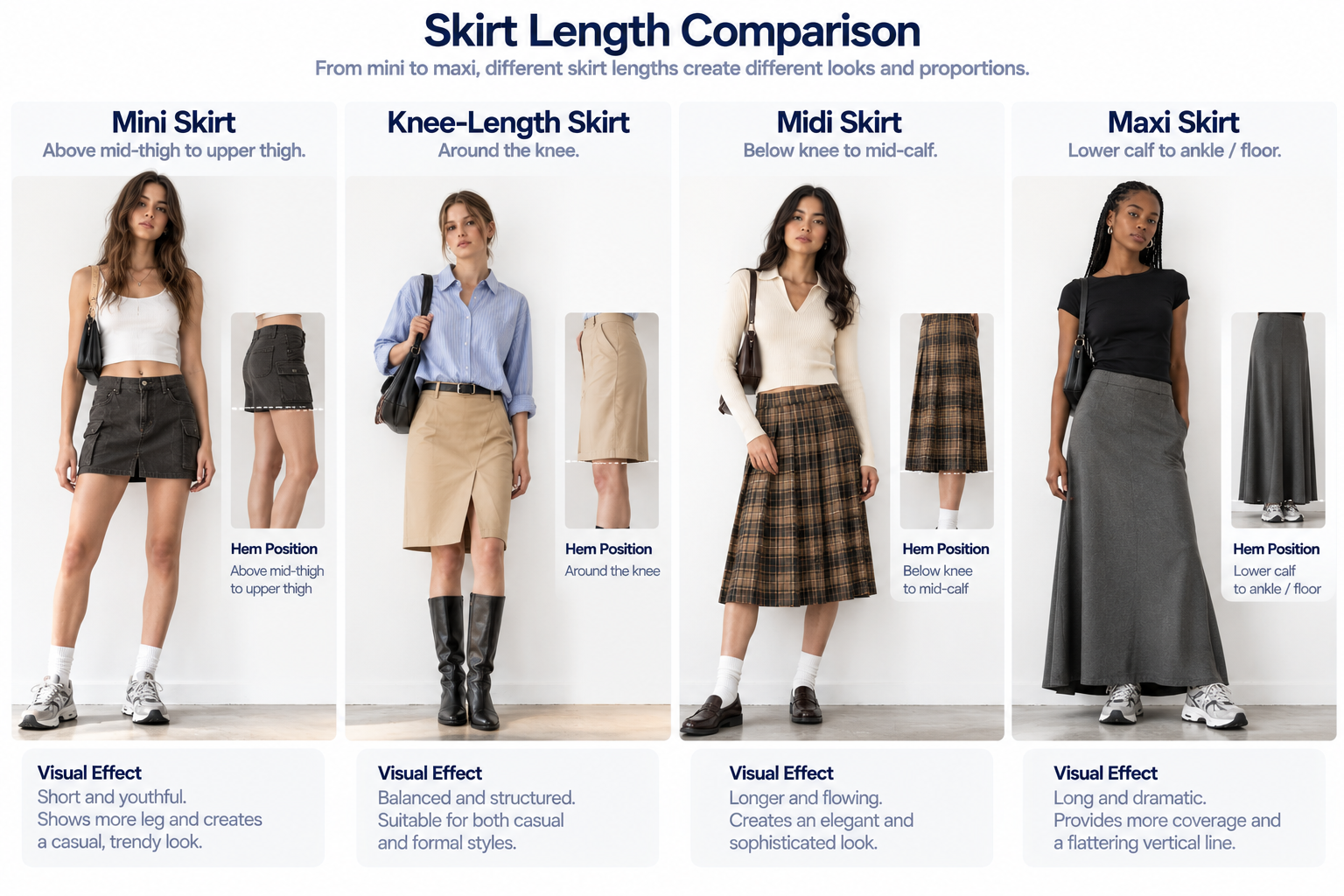
Knee-Length Skirt vs Mini Skirt vs Midi Skirt vs Maxi Skirt
The main difference is finished hem position.
| Skirt Type | Typical Hem Position | Main Visual Effect |
|---|---|---|
| Mini Skirt | Above mid-thigh to upper thigh | Short and youthful |
| Knee-Length Skirt | Around the knee | Balanced and structured |
| Midi Skirt | Below knee to mid-calf | Longer and flowing |
| Maxi Skirt | Lower calf to ankle / floor | Long and dramatic |
These are general fashion categories rather than rigid industrial standards.
A person who is 155 cm tall and a person who is 180 cm tall will not reach the same knee position with exactly the same finished skirt length.
Knee-Length Skirt vs Midi Skirt
These terms are sometimes used loosely in retail.
But their visual proportion is usually different.
Knee-Length Skirt
Finishes approximately around the knee.
This exposes more of the lower leg and creates a shorter visual proportion.
Midi Skirt
Extends clearly below the knee.
It may finish:
- Upper calf
- Mid-calf
- Lower calf
A midi skirt therefore usually creates more fabric movement and a longer vertical line.
For product development, avoid relying only on:
midi
or:
knee length
Provide the actual body length measurement.
Knee-Length Skirt vs Pencil Skirt
These terms describe different things.
Knee length describes length.
Pencil describes silhouette.
A pencil skirt can be:
- Mini
- Knee length
- Midi
Likewise, a knee-length skirt can be:
- Pencil
- A-line
- Pleated
- Straight
This distinction matters when communicating with a manufacturer.
A request such as:
I want a knee-length skirt.
still does not tell the pattern maker how the skirt should fit through the hip or hem.
Pencil Knee-Length Skirt
The pencil skirt is one of the most recognizable knee-length silhouettes.
Typical characteristics include:
- Fitted waist
- Close hip
- Narrow body
- Controlled hem opening
- Front or back darts
- Back or side vent
- Zipper closure
The silhouette should follow the body without preventing normal movement.
Pencil Skirt Does Not Mean Skin-Tight
A pencil skirt normally uses controlled ease.
If the garment is too tight through:
- Hip
- Seat
- Thigh
it may:
- Pull horizontally
- Ride upward
- Twist
- Restrict walking
- Distort pockets
A fitted appearance should come from correct pattern shaping rather than simply reducing circumference.
Straight Knee-Length Skirt
A straight skirt maintains a more consistent width from the hip toward the hem.
Compared with a pencil skirt, it normally provides:
- More hem room
- Easier movement
- Less taper
It can create:
- Minimal appearance
- Uniform-inspired styling
- Clean tailoring
Straight construction works particularly well for fabrics with moderate structure.
A-Line Knee-Length Skirt
An A-line skirt becomes progressively wider toward the hem.
The silhouette may use:
- Side-seam flare
- Multiple panels
- Darts
- Godets
Compared with a pencil skirt, it provides:
- More walking room
- More movement
- Wider hem circumference
The amount of flare can range from extremely subtle to dramatic.
Pleated Knee-Length Skirt
Pleats can create additional volume while keeping the waistband controlled.
Common options include:
- Knife pleats
- Box pleats
- Inverted pleats
- Accordion pleats
- Partial pleats
Pleating changes:
- Fabric consumption
- Movement
- Waist bulk
- Hem width
The pleat type should be shown clearly in the tech pack.
Knife Pleats
Knife pleats all fold in the same direction.
They create:
- Repeated visual rhythm
- Controlled fullness
- Strong school / prep association
Pleat width and depth should be specified separately.
For example:
Finished pleat width: 4 cm
does not automatically define how much fabric is hidden underneath.
Box Pleats
A box pleat opens in opposite directions.
It can create:
- Larger structured volume
- Clean geometric shape
- Stronger skirt movement
Box pleats are often useful for:
- Uniform-inspired styles
- Tennis-inspired skirts
- Tailored skirts
Inverted Pleats
An inverted pleat places the fullness inward.
From the outside, it can appear relatively clean when standing.
During movement, the hidden fabric opens.
This can add walking ease without creating continuous visible pleats around the entire skirt.
Wrap Knee-Length Skirt
Wrap skirts use overlapping front panels.
Possible closures include:
- Buttons
- Snaps
- Ties
- Buckles
- Hidden fastening
The overlap needs enough width.
If it is too small, the skirt may expose too much during:
- Walking
- Sitting
- Wind
Overlap depth should be measured rather than judged only from a flat sketch.
Bias-Cut Knee-Length Skirt
A bias-cut skirt places fabric at approximately a 45-degree angle to the grain.
This can create:
- Softer drape
- More fluid movement
- Closer body following
- Fewer darts in some designs
Bias fabric behaves differently from straight-grain fabric.
It may:
- Stretch during hanging
- Grow in length
- Distort at the hem
The sample may need to hang before final hemming.
Low-Rise Knee-Length Skirt
Low-rise skirts place the waistband below the natural waist.
This can create:
- Longer-looking torso
- 1990s / Y2K influence
- Relaxed styling
But lowering the waistband changes more than the waist position.
The pattern must also account for:
- Larger body circumference
- Different hip position
- Zipper length
- Dart placement
A natural-waist skirt cannot simply have the waistband removed and be called low-rise.
Mid-Rise Knee-Length Skirt
A mid-rise position usually sits between:
- Natural waist
- Low hip
This can provide:
- Balanced styling
- Easier comfort
- Broad commercial appeal
The exact waistband position should still be defined through measurements.
High-Rise Knee-Length Skirt
High-rise skirts sit near or at the natural waist.
They can create:
- Defined waist
- Longer visual leg
- More classic tailoring
This works particularly well for:
- Pencil skirts
- A-line skirts
- Pleated styles
- Tailored wool skirts
How to Measure Skirt Length
Factories may measure skirt length from different starting points.
Common methods include:
Center Front Length
Measured vertically from:
top of waistband → hem
at center front.
Center Back Length
Measured from:
top of waistband → hem
at center back.
Side Length
Measured along the side seam.
These numbers may differ depending on:
- Waistband shape
- High-low hem
- Body shaping
- Curved waistline
The measurement method should be stated clearly in the tech pack.
Waistband Height Affects Finished Length
Suppose two skirts have:
Body length below waistband: 55 cm
but:
- Skirt A has a 3 cm waistband
- Skirt B has a 6 cm waistband
Their total finished lengths are different.
Therefore clarify whether the length measurement:
includes
or:
excludes
the waistband.
Use the Target Wearer When Setting Knee Position
If the exact knee position matters, provide:
- Model height
- Sample size
- Waist position
- Target finished length
For example:
Sample size M, model height 170 cm, skirt hem should finish approximately at the center of the knee.
This gives the pattern maker much more context.
Skirt Silhouette Is Controlled by Several Widths
A skirt should not be developed using only:
- Waist
- Hip
- Length
Important horizontal measurements may include:
- Waist
- High hip
- Full hip
- Thigh area
- Hem opening
The relationship between these widths determines the silhouette.
Pencil Skirt Taper
For a pencil skirt, the lower body normally narrows between:
hip → hem
The amount of taper needs to balance:
- Appearance
- Walking ease
- Fabric stretch
- Vent length
Too little taper may create a straight skirt.
Too much taper may restrict movement.
A-Line Flare
For an A-line skirt, the opposite happens.
The hem becomes wider than the hip-level body.
The flare may be added through:
- Side seams
- Center panels
- Princess-style seams
- Godets
Different methods can create the same approximate hem circumference but very different visual shapes.
Panel Construction
A skirt can use:
- 2 panels
- 4 panels
- 6 panels
- 8 panels
- More complex multi-panel construction
Additional panels allow more control over:
- Hip shaping
- Flare
- Seam position
- Color blocking
- Print placement
But every additional seam also increases:
- Sewing time
- Alignment requirements
- Production cost
What Are Godets?
Godets are triangular or flared pieces inserted into seams.
They can add:
- Hem volume
- Movement
- Decorative shape
while keeping the upper skirt relatively fitted.
A fitted knee-length skirt may remain narrow through the hip and then open through godets near the lower body.
This creates movement without making the entire skirt A-line.
Darts vs Panel Seams
Both can shape the waist and hip.
Darts
Remove excess fabric from a larger panel.
Advantages:
- Simpler pattern
- Fewer seams
- Classic tailoring
Panel Seams
Distribute shaping across several pieces.
Advantages:
- More contour control
- More design possibilities
- Easier color blocking
The choice depends on both aesthetics and production complexity.
Back Darts
Back waist darts are especially common in tailored skirts.
They help transition between:
waist circumference
and
hip circumference
Dart length and intake should follow the body.
Very deep darts can create:
- Pointing
- Bubble effects
- Uneven shaping
Splitting a large dart into two smaller darts can sometimes create smoother contouring.
Front Darts
Some skirts use front waist darts.
Others remove them by:
- Moving shaping into seams
- Using stretch fabric
- Using a lower waist position
Front darts can be useful, but they may create unwanted volume if placed poorly.
Back Yoke
Denim and casual skirts may use a back yoke similar to jeans construction.
A yoke can help shape:
- Waist
- Seat
- Back hip
while adding visual identity.
This works especially well for:
- Denim skirts
- Utility skirts
- Five-pocket skirts
Waistband Options
Several waistband constructions are possible.
Straight Waistband
A relatively simple strip-shaped waistband.
Works well when the waistline is relatively horizontal.
Contoured Waistband
Uses curved pattern pieces that follow the body more naturally.
Common for:
- Low-rise skirts
- Fitted pencil skirts
- Tailored styles
Facing Instead of Waistband
The exterior can appear waistband-free.
An internal facing finishes the upper edge.
This creates:
- Minimal appearance
- Cleaner waist
- Less visible structure
Elastic Waistband
Useful for:
- Casual skirts
- Pull-on designs
- Knit skirts
- Some utility products
The elastic can be:
- Exposed
- Encased
- Partially elasticated
Half-Elastic Waistband
A skirt can use:
clean front + elastic back
This provides:
- Better comfort
- Some fit flexibility
- Cleaner front appearance
It is particularly useful for commercial products requiring a forgiving fit.
Closure Options
Common skirt closures include:
- Invisible zipper
- Coil zipper
- Metal zipper
- Button front
- Snap front
- Hook and bar
- Hook and eye
- Tie closure
- Elastic pull-on construction
The right closure depends on:
- Fabric
- Fit
- Styling
- Waistband
Invisible Zipper
A concealed zipper creates a clean exterior.
Common placements include:
- Center back
- Side seam
It works particularly well for:
- Pencil skirts
- A-line skirts
- Tailored skirts
- Occasionwear
The seam around the zipper should remain flat.
Metal Zipper
An exposed metal zipper creates a more visible design feature.
It may suit:
- Denim
- Leather
- Utility skirts
- Streetwear
But zipper weight needs to match fabric weight.
A heavy zipper can distort a lightweight skirt.
Button-Front Skirt
Buttons can create:
- Heritage styling
- Utility appearance
- Vintage influence
The front needs enough overlap to prevent:
- Gaping
- Pulling
- Exposure while sitting
Button spacing should be checked on the actual wearer.
Vent vs Slit
These terms are related but are often used differently.
Slit
An opening created at a seam or within a panel.
Vent
Usually has overlapping construction.
A vent generally looks more tailored.
Both can improve movement.
Why Pencil Skirts Need Walking Ease
A fitted knee-length skirt may have a relatively small hem circumference.
Without an opening, walking can become uncomfortable.
Possible solutions include:
- Center-back vent
- Center-back slit
- Side slit
- Front slit
- Stretch fabric
- Slightly wider hem
The design should be tested while walking.
Center-Back Vent
A traditional tailored solution.
It provides:
- Controlled walking ease
- Clean appearance
- Familiar pencil-skirt construction
The vent length should relate to:
- Skirt length
- Hem width
- Fabric
A very short vent may not provide enough movement.
Front Slit
A front slit creates:
- More visible design impact
- Easier stride
- Modern styling
Possible positions include:
- Center front
- Offset front
- Along a panel seam
The top of the slit should be reinforced.
Side Slit
Side slits can be:
- One side only
- Both sides
They work particularly well for:
- Straight skirts
- Knit skirts
- Minimal silhouettes
Pocket Options
Possible pockets include:
- Side-seam pocket
- Slant pocket
- Welt pocket
- Patch pocket
- Cargo pocket
- Five-pocket denim construction
Pocket choice can strongly change the category.
A tailored pencil skirt with welt pockets feels very different from the same silhouette with large cargo pockets.
Side-Seam Pockets
These maintain a clean exterior.
But a close pencil skirt may not have enough space for a large pocket bag.
Pocket bulk should not distort the hip.
Patch Pockets
Patch pockets can create:
- Utility look
- Workwear influence
- Casual styling
They can be placed on:
- Front
- Side
- Back
Pocket proportion should match the skirt body.
Cargo Knee-Length Skirt
A knee-length skirt can use cargo pockets.
This combines:
- Feminine / skirt silhouette
- Utility construction
Possible details include:
- Bellows pockets
- Flaps
- Snaps
- D-rings
- Webbing
The pocket should not become so heavy that it pulls the skirt downward at one side.
Denim Knee-Length Skirt
Denim works particularly well for the current knee-length proportion.
Possible details include:
- Five-pocket construction
- Front fly
- Tack button
- Rivets
- Back yoke
- Contrast topstitching
- Raw hem
- Wash effects
The skirt can be:
- Straight
- Pencil
- A-line
Fabric weight influences how strongly it holds the silhouette.
Fabric Choice Changes the Entire Skirt
The same skirt pattern can behave very differently in:
- Wool
- Satin
- Cotton twill
- Denim
- Linen
- Poplin
- Knit
- Technical woven
Fabric should therefore be selected before the final pattern is approved.
Wool and Wool Blends
Wool works well for:
- Tailored skirts
- Pencil skirts
- Pleated styles
- Structured A-line skirts
It can provide:
- Shape
- Warmth
- Premium appearance
The amount of structure depends on:
- Weave
- Weight
- finishing
Suiting Fabric
Suiting can produce a clean professional skirt while still looking modern.
Possible constructions include:
- Twill suiting
- Tropical wool
- Polyester-viscose blends
- Stretch suiting
A small amount of stretch can improve comfort in fitted pencil silhouettes.
Satin
Satin works particularly well for:
- Bias skirts
- Fluid straight skirts
- Occasionwear
The surface can show:
- Needle marks
- Seam puckering
- Pressing marks
Sewing and pressing need more control than on heavier cotton fabrics.
Cotton Twill
Cotton twill provides:
- Moderate structure
- Casual hand feel
- Durability
It works well for:
- Utility skirts
- A-line skirts
- Straight skirts
- Workwear-inspired products
For custom fabric sourcing, see Brad Apparel's Fabric Sourcing & Development.
Denim
Denim gives a knee-length skirt more:
- Structure
- Casual character
- Streetwear potential
Possible directions include:
- Dark indigo
- Vintage blue
- Washed black
- Raw denim
- Printed denim
Wash shrinkage needs to be considered before final measurements are approved.
Leather and Faux Leather
Leather-like materials can create:
- Strong pencil silhouettes
- Minimal panel construction
- Structured shape
However, unlike conventional woven fabrics, stitch holes may remain permanent.
Sample development should therefore minimize unnecessary seam corrections.
Knit Knee-Length Skirts
Knit fabrics create a softer category.
Common options include:
- Rib knit
- Ponte
- Interlock
- Jersey
- Sweater knit
Knit skirts may use:
- Elastic waistband
- Pull-on construction
- Fewer darts
Stretch and recovery are especially important around the waist and seat.
Lining
Many tailored skirts benefit from lining.
Lining can:
- Improve comfort
- Reduce static against hosiery
- Hide internal seams
- Improve opacity
- Reduce fabric catching
Possible lining fabrics include:
- Polyester
- Viscose
- Acetate
- Stretch lining
Lining Should Not Restrict Movement
A fitted outer skirt with a too-small lining can feel tight even when the shell measurements are correct.
The lining needs appropriate ease.
It may also need:
- Matching vent
- Slit opening
- Stretch
depending on the shell design.
Partial Lining
Some skirts use lining only through:
- Waist
- Hip
- Upper body
while leaving the lower skirt unlined.
This may reduce:
- Weight
- Cost
- Heat
It can work well for fuller A-line or pleated skirts.
Hem Construction
Possible hem finishes include:
Blind Hem
Common for tailored skirts.
Creates minimal visible stitching.
Double-Turn Hem
Useful for many cotton and casual fabrics.
Faced Hem
Good for:
- Curved hems
- Structured skirts
- Clean premium finishing
Narrow Rolled Hem
Works for lightweight fabrics such as:
- Chiffon
- Light satin
Raw Hem
Common for:
- Denim
- Certain coated materials
- Deconstructed fashion
Hem Depth Can Affect Drape
A deep hem adds more weight to the bottom of the skirt.
This can improve the fall of some fabrics.
But on lightweight materials, it may:
- Show through
- Become bulky
The hem construction should suit both the fabric and silhouette.
Print Placement on Knee-Length Skirts
Printed skirts require another layer of planning.
Possible issues include:
- Plaid matching
- Stripe alignment
- Large floral placement
- Directional prints
- Repeat scale
A strong print can make poor seam matching more visible.
Plaid Skirts
Plaid may require matching at:
- Side seams
- Center back
- Front panels
Perfect matching can increase:
- Fabric consumption
- Cutting time
- Cost
The brand should specify which seams require matching.
Stripe Direction
Stripes can be:
- Vertical
- Horizontal
- Bias
- Mixed direction
Panel construction can intentionally rotate the stripe direction to create graphic effects.
This needs to be planned in the pattern.
Large Printed Skirts
Large motifs may require controlled placement.
For example:
- One floral motif at center front
- Graphic aligned with side seam
- Poster print positioned across multiple panels
This is very different from random all-over print cutting.
For printing options, see Brad Apparel's Printing Techniques.
Embroidery and Embellishment
Current skirt directions can also use:
- Embroidery
- Beading
- Sequins
- Fringe
- Lace appliqué
- Patches
These details add weight.
The base fabric must support them.
For embroidery development, see Brad Apparel's Embroidery Techniques guide.
Embroidery Placement
Avoid placing very dense embroidery directly over areas requiring significant stretch or shaping.
Possible issues include:
- Fabric stiffness
- Puckering
- Distorted fit
A sew-out should be tested before bulk production.
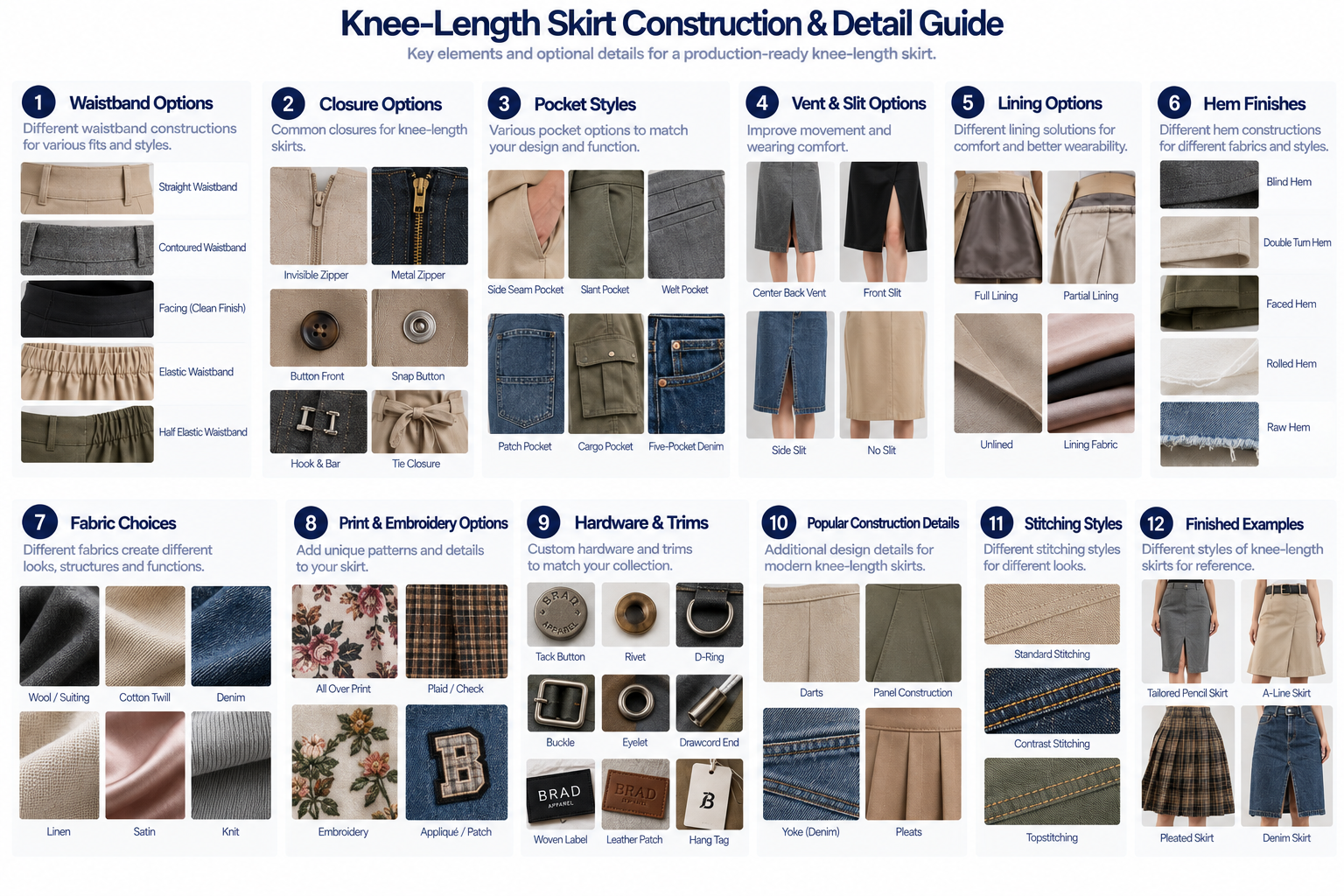
Knee-Length Skirt Construction & Detail Options
A modern knee-length skirt can combine several different construction directions:
- Pencil or A-line silhouette
- Natural, low or high waist
- Darts or panels
- Waistband or facing
- Zipper or button closure
- Vent or slit
- Lining
- Pockets
- Embroidery
- Custom hardware
How to Describe a Knee-Length Skirt to a Manufacturer
Instead of writing:
I need a knee-length skirt.
write:
High-rise knee-length pencil skirt in medium-weight stretch wool suiting with a contoured waistband, fitted hip, moderate taper toward the hem, center-back invisible zipper and 18 cm back vent. Finished hem should sit approximately at the center of the knee on a 170 cm fit model.
Then provide:
- Waist
- High hip
- Full hip
- Finished length
- Hem opening
- Waist position
- Waistband
- Closure
- Vent
- Fabric
- Lining
- Color
- Branding
This gives the pattern maker a much clearer starting point.
Example Modern Pencil Skirt Brief
Mid-rise knee-length pencil skirt in charcoal stretch suiting with a clean faced waist, slightly relaxed hip, moderate hem taper and offset front slit. Fully lined with concealed side zipper.
This creates a modern version without relying on traditional office styling.
Example A-Line Skirt Brief
High-rise knee-length A-line skirt in structured cotton twill with a 4 cm waistband, clean front, moderate side-seam flare, side pockets and center-back zipper.
Example Utility Skirt Brief
Relaxed knee-length utility skirt in washed cotton twill with mid-rise waistband, straight silhouette, front patch pockets, cargo side pocket, back vent and matte snap hardware.
Example Denim Skirt Brief
Mid-rise knee-length denim skirt in 12 oz dark-indigo 100% cotton denim with five-pocket construction, front zipper fly, tack button, back yoke, straight body and center-front slit.
Important Knee-Length Skirt Measurements
| Measurement | Why It Matters |
|---|---|
| Waist | Controls upper fit |
| High Hip | Controls early body shaping |
| Full Hip | Critical for seat fit |
| Finished Length | Determines knee position |
| Hem Opening | Controls silhouette and movement |
| Waistband Height | Affects total proportion |
| Front Dart | Controls waist-to-hip shaping |
| Back Dart | Controls seat shaping |
| Vent / Slit Length | Controls walking ease |
| Pocket Position | Affects appearance and function |
| Zipper Length | Affects dressing ease |
Additional measurements may be needed for:
- Pleats
- Panels
- Asymmetric hems
- Wrap overlaps
Pencil Skirt Tech Pack Example
| Area | Example Specification |
|---|---|
| Product | Knee-Length Pencil Skirt |
| Rise | High Rise |
| Shell | Stretch Wool Blend |
| Fit | Fitted |
| Waist | Contoured Waistband |
| Hip | Shaped |
| Body | Tapered |
| Closure | Center-Back Invisible Zipper |
| Movement | Back Vent |
| Lining | Full |
| None / Welt | |
| Hem | Blind Hem |
| Branding | Woven Main + Care Label |
These values are examples only.
A-Line Skirt Tech Pack Example
| Area | Example Specification |
|---|---|
| Product | Knee-Length A-Line Skirt |
| Rise | Natural Waist |
| Fabric | Cotton Twill |
| Fit | Clean Upper Body |
| Flare | Moderate |
| Waist | Structured Waistband |
| Closure | Back Zipper |
| Side Seam | |
| Lining | Optional |
| Hem | Double Turn |
| Branding | Woven Label |
Pleated Skirt Tech Pack Example
| Area | Example Specification |
|---|---|
| Product | Knee-Length Pleated Skirt |
| Rise | Mid Rise |
| Fabric | Polyester / Wool Blend |
| Pleat | Knife Pleat |
| Waist | Clean Waistband |
| Closure | Side Zipper |
| Length | Knee Length |
| Lining | Partial |
| Hem | Clean Finished |
| Branding | Main Label + Care Label |
How to Evaluate the First Skirt Sample
Always evaluate the skirt while worn.
A flat-lay cannot show:
- Hip tension
- Hem level
- Movement
- Waist position
accurately.
Front View
Check:
- Waist position
- Hip fit
- Dart direction
- Center front
- Hem level
- Pocket symmetry
Side View
Check:
- Abdomen fit
- Hip balance
- Side-seam position
- Hem projection
The side seam should normally remain balanced rather than rotating strongly forward or backward.
Back View
Check:
- Waist fit
- Seat shape
- Back darts
- Zipper
- Vent
- Hem
Horizontal pulling lines around the seat can indicate insufficient width or incorrect shaping.
Check Sitting Comfort
Ask the wearer to sit naturally.
Check:
- Waist pressure
- Hip tension
- Hem rise
- Vent opening
- Front pulling
A skirt that looks correct standing may become uncomfortable when sitting.
Check Walking
This is especially important for fitted skirts.
Ask the wearer to walk at a normal pace.
If stride becomes unnaturally short, review:
- Hem circumference
- Vent length
- Fabric stretch
The visual silhouette should not make the garment impractical.
Check Hem Position With Shoes
Footwear changes the visual proportion of a knee-length skirt.
Test the sample with the type of footwear expected in styling.
However, the technical finished length should still be approved independently of footwear.
Check Zipper Behavior
The zipper area should remain:
- Flat
- Straight
- Smooth
Look for:
- Zipper wave
- Puckering
- Waistband distortion
Lightweight and bias fabrics may need additional stabilization.
Check Lining
Make sure the lining does not:
- Pull the outer shell
- Show below the hem
- Block the vent
- Twist inside the garment
The wearer should be able to walk and sit comfortably.
Check Pleat Recovery
For pleated skirts, wear and move in the sample.
Check whether pleats:
- Open evenly
- Return to position
- Twist
- Lose crease definition
For permanent pleating, fabric composition and heat-setting capability matter.
Check After Washing or Cleaning
Depending on care method, inspect:
- Shrinkage
- Waist
- Length
- Pleats
- Lining
- Color
- Surface
- Hem
The finished production specification should reflect the garment after the intended care or finishing process.
Size Grading Needs More Than Waist Enlargement
As sizes increase, the pattern needs to preserve the intended relationship between:
waist + hip + length + hem
If a pencil skirt hem expands too quickly during grading, the silhouette may become straight.
If it expands too little, larger sizes may become restrictive.
The visual proportion should remain consistent across the size range.
Finished Length Grading
Brands need to decide whether skirt length should:
- Stay constant
- Increase gradually by size
- Use separate petite / regular / tall lengths
There is no universal rule.
The grading should follow the target customer and brand fit system.
Common Knee-Length Skirt Development Mistakes
1. Using "Knee Length" Without a Measurement
Knee position varies between wearers.
2. Confusing Length With Silhouette
Pencil, A-line and pleated describe shape—not finished length.
3. Making a Pencil Skirt Too Tight
The garment may ride upward and restrict movement.
4. Forgetting Walking Ease
A narrow hem may need a slit or vent.
5. Making the Lining Too Small
The lining can restrict an otherwise correct shell.
6. Ignoring Waist Position
Moving from high rise to low rise requires pattern changes.
7. Poor Dart Placement
Incorrect darts can create pointing or unwanted volume.
8. Ignoring Fabric Drape
The same pattern looks different in wool, satin and denim.
9. Not Testing Sitting Comfort
A skirt is not worn only while standing.
10. Grading Only Waist and Hip
Hem proportion and length also need to remain balanced.
Knee-Length Skirt vs Midi Skirt: Which Should Your Brand Develop?
Choose a knee-length skirt if you want:
- Shorter, cleaner proportion
- Visible lower leg
- 1990s or modern tailored influence
- Easier pairing with boots or flats
- Strong pencil or structured silhouettes
Choose a midi skirt if you want:
- Longer silhouette
- More fabric movement
- Greater lower-leg coverage
- Strong flowing or bias styles
Choose a mini skirt if you want:
- Short proportion
- Youthful styling
- Stronger leg exposure
The best length depends on the target customer, collection and intended silhouette.
FAQ
What Is a Knee-Length Skirt?
A knee-length skirt is a skirt designed to finish approximately around the wearer's knee.
The exact finished length depends on wearer height, waist position and garment proportions.
Are Knee-Length Skirts in Style in 2026?
Yes.
Knee-length skirts are a major current fashion direction and are continuing strongly into Spring/Summer 2027 across pencil, tailored, printed, pleated and utility interpretations.
Is a Knee-Length Skirt the Same as a Pencil Skirt?
No.
Knee length describes hem position.
Pencil describes the fitted, tapered silhouette.
A pencil skirt can be knee-length, mini or midi.
What Is the Difference Between a Knee-Length Skirt and a Midi Skirt?
A knee-length skirt finishes around the knee.
A midi skirt extends clearly below the knee toward the calf.
How Long Is a Knee-Length Skirt?
There is no universal centimeter measurement.
The correct length depends on the wearer and waist position.
A tech pack should provide an actual finished length measurement.
What Fabric Is Best for a Knee-Length Skirt?
Common options include:
- Wool
- Suiting
- Cotton twill
- Denim
- Satin
- Linen
- Knit fabrics
- Technical woven fabrics
The best option depends on the intended silhouette.
Does a Pencil Skirt Need a Back Vent?
Not always.
But fitted skirts often need a vent, slit, stretch fabric or sufficient hem circumference to allow comfortable walking.
Can a Knee-Length Skirt Be Low Rise?
Yes.
Low-, mid- and high-rise constructions are all possible.
The waistband and body pattern need to be developed for the intended rise.
Can Knee-Length Skirts Have Cargo Pockets?
Yes.
Cargo pockets can create a modern utility interpretation.
Pocket weight and placement should be tested so they do not distort the skirt.
Can a Knee-Length Skirt Be Made From Denim?
Yes.
Denim works well for straight, pencil and A-line knee-length skirts and can use traditional five-pocket construction.
Should a Skirt Be Lined?
It depends on the fabric and construction.
Tailored, sheer, scratchy or cling-prone materials often benefit from lining.
What Measurements Should a Knee-Length Skirt Tech Pack Include?
Important measurements include:
- Waist
- High hip
- Full hip
- Finished length
- Hem opening
- Waistband height
- Dart position
- Vent or slit length
- Pocket position
- Zipper length
Final Thoughts
A knee-length skirt is defined by much more than where the hem finishes.
Its final appearance depends on the relationship between:
waist position + hip fit + silhouette + hem opening + fabric + finished length
A fitted wool pencil skirt can look sharp and tailored.
A washed denim straight skirt can feel casual and streetwear-focused.
A pleated plaid skirt can move toward preppy styling.
A technical utility version with cargo pockets can feel completely contemporary.
For clothing brands, the first step is therefore not simply telling a manufacturer to make the skirt "knee length."
Define the silhouette, waist position, target finished length and fabric together.
Once those proportions are approved on the fit model, the design can be translated into a repeatable production-ready skirt pattern.
Keep Reading