A fleece jacket may look simple.
Soft fabric.
A zipper.
A collar.
A few pockets.
But fleece is one of those materials where the fabric itself creates much of the product.
Change the:
- Pile height
- Fabric density
- Surface finish
- Backing
- Nap direction
- Panel construction
- Binding
- Zipper
- Fit
and the same basic jacket pattern can become a completely different garment.
For clothing brands, the first question should therefore not be:
“What GSM fleece should I use?”
It should be:
“What type of fleece jacket are we trying to make?”
This guide explains the main fleece constructions, fit and manufacturing details brands should consider before moving from fabric sourcing to bulk production.
What Is a Fleece Jacket?
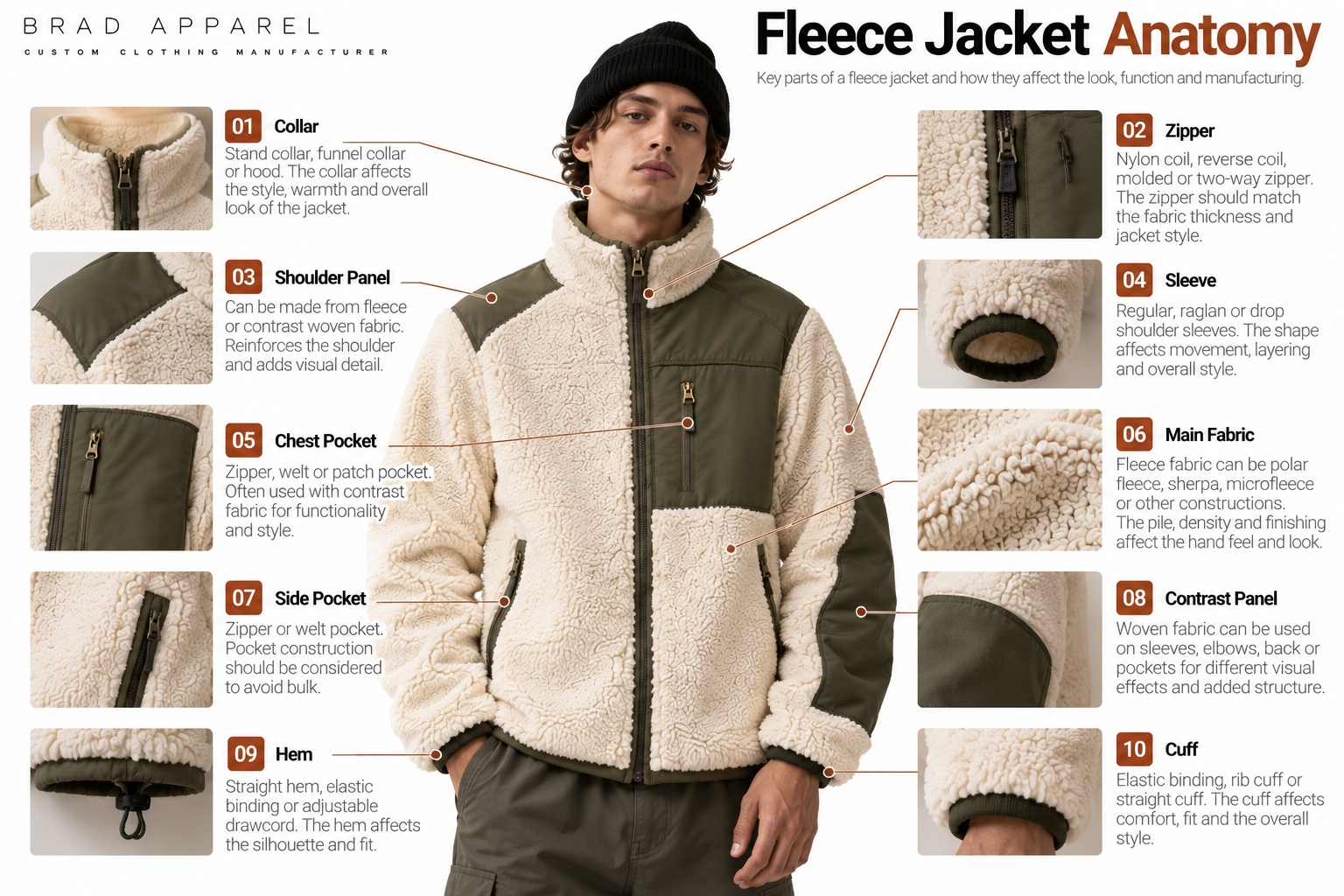
A fleece jacket is generally a casual or outdoor-inspired layer made with a soft piled or brushed knitted fabric.
Modern versions can include:
- Full-zip jackets
- Half-zip pullovers
- Quarter-zips
- Funnel-neck fleeces
- Hooded fleeces
- Oversized streetwear fleece
- Sherpa-style jackets
- Lightweight layering fleece
- High-pile fashion fleece
Common construction details may include:
- Stand or funnel collar
- Center-front zipper
- Zipper or welt pockets
- Elastic binding
- Woven reinforcement panels
- Adjustable hem
- Contrast fabric details
- Embroidery or patches
Not every fleece jacket needs all of these elements.
The category is better understood through the relationship between:
fabric + pile + construction + fit
rather than one fixed jacket specification.
Why Are Fleece Jackets Relevant in 2026?
Fleece now sits between several clothing categories.
It can function as:
- Outdoor-inspired clothing
- Casual outerwear
- Streetwear
- Transitional layering
- Travel clothing
- Lifestyle sportswear
That flexibility is important for brands.
A lightweight fleece can be developed as a layering piece.
A more substantial high-pile fleece can become the main outer layer.
A boxy contrast-panel fleece can move directly into streetwear.
And a clean solid-colored fleece can work inside a more minimal collection.
The same category can therefore support very different brand directions.
Fleece Jacket vs Sweatshirt Fleece

This distinction is especially important when communicating with a manufacturer.
The word fleece can refer to different textile constructions.
Fleece Jacket Fabric
When discussing fleece jackets, brands often mean fabrics such as:
- Polar fleece
- Microfleece
- High-pile fleece
- Sherpa-style fleece
- Grid fleece
These fabrics normally have a clearly visible soft or raised surface.
Sweatshirt Fleece
Sweatshirt fleece is commonly used for:
- Hoodies
- Sweatshirts
- Sweatpants
It is usually a knitted sweatshirt fabric with:
- Smooth face
- Brushed interior
The brushed surface is primarily on the inside rather than creating the same outer pile appearance as many fleece jackets.
Why the Difference Matters
If a tech pack simply says:
“Fleece fabric”
the factory may not know whether the brand means:
polar fleece
or
brushed-back sweatshirt fleece.
These materials have completely different:
- Surfaces
- Construction
- Cutting behavior
- Sewing requirements
- Finished appearance
The exact fleece type should therefore be confirmed before sampling.
Main Types of Fleece Fabric
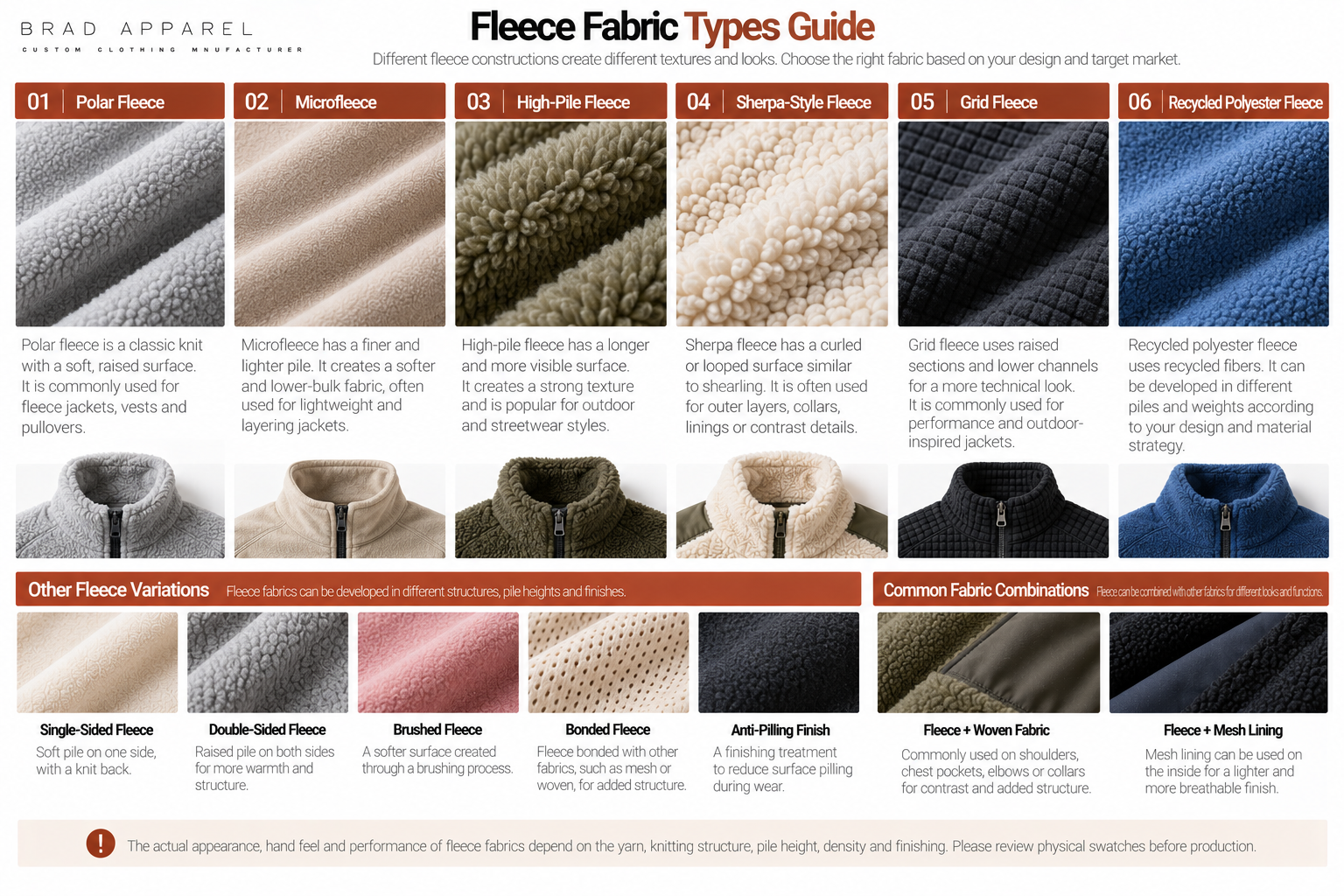
There is no single fabric called simply “fleece.”
Different constructions can produce very different products.
Polar Fleece
Polar fleece is commonly associated with a soft raised synthetic surface.
It is often made from polyester, although exact compositions can vary.
Possible characteristics include:
- Soft pile
- Knitted construction
- Different thickness options
- Different surface densities
Polar fleece can be used for:
- Full-zip jackets
- Half-zips
- Outdoor-inspired pullovers
- Casual layering products
The final hand feel depends on more than composition.
Important variables include:
- Yarn
- Knitting structure
- Brushing
- Shearing
- Density
- Finishing
Two polyester fleece fabrics can therefore feel completely different.
Microfleece
Microfleece generally describes a finer and lighter fleece direction.
It can create:
- Lower bulk
- Softer layering
- Cleaner silhouette
This can work well for garments intended to sit:
under another jacket
rather than act as the outermost layer.
But the term itself does not define one universal weight or performance specification.
Brands should still review the physical fabric.
High-Pile Fleece
High-pile fleece has a longer and more visually obvious surface.
This can create:
- Strong texture
- More dimensional appearance
- Retro outdoor styling
- Statement fashion pieces
Longer pile also affects manufacturing.
It can make:
- Seam lines less visible
- Embroidery harder to read
- Zipper areas bulkier
- Cutting more sensitive to direction
These details need to be considered during development.
Sherpa-Style Fleece
Sherpa fleece usually has a curled or looped surface associated visually with shearling.
It can be used as:
- Outer fabric
- Collar contrast
- Lining
- Pocket detail
- Panel material
A sherpa-style surface can create a very different product from smooth polar fleece.
The pile should be evaluated for:
- Density
- Curl
- Softness
- Shedding
- Recovery
- Surface consistency
before bulk production.
Grid Fleece
Some fleece fabrics use raised sections separated by lower channels or grid-like structures.
This creates a more technical visual appearance.
Grid constructions can vary significantly.
The existence of a grid alone does not automatically define:
- Warmth
- Breathability
- Moisture management
- Durability
Those properties depend on the complete fabric specification.
Recycled Polyester Fleece
Recycled polyester can also be used when it fits the brand's material strategy.
However:
recycled fiber content does not by itself define finished fabric quality.
Brands should still evaluate:
- Surface
- Density
- Pile
- Recovery
- Shrinkage
- Pilling
- Hand feel
on the actual production fabric.
Brad Apparel's Fabric Sourcing & Development service supports fleece, polyester, knitted fabrics and custom-developed textiles according to composition, weight, texture, color and finishing.
There Is No Universal GSM for a Fleece Jacket
Fabric weight matters.
But it should not be treated as the only specification.
A fleece can feel substantial because of:
- Dense pile
- Long pile
- Thick base knit
- Double-sided surface
- Finishing
Another fabric with a similar nominal weight may feel much flatter.
So instead of selecting fleece only from a GSM number, evaluate:
- Actual thickness
- Pile height
- Density
- Compression
- Drape
- Surface
- Intended layering
Physical swatches are especially important for fleece.
Pile Height Changes the Jacket
Pile height is one of the biggest visual differences between fleece fabrics.
Lower Pile
Can create:
- Cleaner surface
- Lower bulk
- Easier layering
- More minimal appearance
Medium Pile
Can provide a balance between:
- Texture
- Structure
- Everyday wear
Higher Pile
Creates stronger:
- Visual texture
- Outdoor character
- Retro styling
- Fashion impact
But more pile also increases the importance of cutting and seam control.
Pile Direction Must Be Controlled
Fleece can have a visible direction or nap.
If two panels are cut in opposite directions, they may appear different when viewed under the same lighting.
Possible differences include:
- Shade
- Surface reflection
- Texture direction
- Pile appearance
For that reason, garment pattern pieces may need to follow a consistent cutting direction.
This is especially important for:
- Dark fleece
- Long pile
- Sherpa-style fabrics
- Directional brushed surfaces
The marker should be planned accordingly.
Pile Direction Can Increase Fabric Consumption
Normal marker making tries to place pattern pieces as efficiently as possible.
Directional fleece may reduce that flexibility.
If all major panels need to face the same direction, some pieces cannot simply be rotated to fill empty marker space.
That can increase fabric consumption.
Brands should therefore avoid calculating fleece consumption only from a similar jersey or sweatshirt pattern.
Cutting Fleece Creates Another Production Challenge
Cut fleece edges may release loose fibers.
The amount depends on:
- Fabric construction
- Pile
- Cutting method
- Surface finishing
Factories need to control loose fiber during:
- Cutting
- Sewing
- Cleaning
- Final inspection
The sample should also be checked around:
- Raw edges
- Zipper seams
- Pocket openings
- Binding
for unwanted fiber shedding.
Anti-Pilling Matters—but Should Be Tested
Pilling can affect the appearance of fleece over time.
The result depends on:
- Fiber
- Yarn
- Knit
- Brushing
- Shearing
- Finish
- Wear
- Washing
An anti-pilling finish can be specified where required.
However, the phrase:
“anti-pilling fleece”
should not automatically be treated as a permanent guarantee.
The actual fabric should be tested according to the brand's quality requirement.
Brad Apparel's fabric-development capabilities include finishing options such as anti-pilling where required for the target fabric.
Fleece Jacket Construction Details

Fleece is soft, but that does not mean construction is automatically simple.
Several details strongly affect the finished product.
Full-Zip Construction
A full front zipper is one of the most common fleece-jacket constructions.
Possible zipper directions include:
- Nylon coil
- Reverse coil
- Plastic molded
- Two-way zipper
The zipper should match:
- Fabric thickness
- Jacket weight
- Visual direction
- Pocket zippers
- Intended use
Brad Apparel's Custom Zippers & Sliders capabilities include coil, reverse-coil, molded and custom slider options for jackets.
Zipper Weight vs Fleece Thickness
A very light zipper may feel visually weak on a substantial high-pile fleece.
A very heavy zipper can make a lightweight fleece front feel rigid.
The relationship should be tested on the complete garment.
Check:
- Zipper wave
- Front balance
- Bottom alignment
- Fabric catching
- Slider operation
before bulk approval.
Zipper Guard
A fleece jacket can use an internal zipper guard behind the center-front zipper.
This can provide:
- Cleaner interior
- Separation between zipper and wearer
- Additional structural support
The guard can use:
- Fleece
- Jersey
- Woven fabric
- Binding
depending on the design.
Collar Construction
Common fleece collar directions include:
- Stand collar
- Funnel collar
- Fold-over collar
- Hood
- Collarless neckline
The collar becomes especially important on:
- High-pile fleece
- Oversized fleece
- Half-zip pullovers
because too much fabric can create bulk around the neck.
Contrast Woven Panels
Many modern fleece jackets combine fleece with woven fabric.
Possible panel locations include:
- Shoulder
- Chest pocket
- Elbow
- Upper back
- Collar
- Pocket welt
A woven contrast can create:
- Outdoor-inspired styling
- Stronger color blocking
- Additional visual structure
Common directions may include:
- Nylon
- Polyester woven
- Ripstop-style woven
- Twill
The correct fabric should be selected according to the design rather than assuming the contrast material provides a particular technical performance.
Pocket Construction
Possible fleece-jacket pockets include:
- Zipper pockets
- Welt pockets
- Patch pockets
- Chest pockets
- Kangaroo pockets
- Internal pockets
Pocket construction needs special attention because fleece creates bulk.
A complex pocket with:
multiple fleece layers
can become unnecessarily thick.
One solution may be to use a lighter woven or jersey pocket bag where appropriate.
Chest Pockets Can Become a Design Feature
A contrast chest pocket is strongly associated with outdoor-inspired fleece.
Possible constructions include:
- Woven patch pocket
- Zipper chest pocket
- Flap pocket
- Hidden chest pocket
The pocket should be scaled with the jacket body.
A very small pocket can look visually weak on an oversized fleece jacket.
Binding Is an Important Fleece Detail
Fleece edges are often finished using binding.
Possible locations include:
- Cuffs
- Hem
- Pocket openings
- Collar edge
- Hood opening
Possible materials include:
- Stretch binding
- Elastic binding
- Knit binding
- Woven binding
The binding needs enough recovery to sit cleanly without:
- Waving
- Pulling
- Flipping outward
- Restricting movement
Binding Tension Must Be Sampled
If the binding is too tight:
- Cuffs may feel restrictive
- Hem may gather excessively
- Garment edges may curl
If it is too loose:
- Edge finishing may wave
- Openings may lose shape
The correct tension should therefore be approved on the sample rather than decided theoretically.
Cuff Options
A fleece jacket can use:
Elastic Binding
Clean and lightweight.
Internal Elastic
Creates a softer exterior appearance.
Rib Cuff
Moves the jacket closer toward sweatshirt or varsity styling.
Straight Fleece Cuff
Creates a relaxed minimal result.
The cuff should match the intended jacket direction.
Hem Options
Possible hems include:
- Straight fleece hem
- Elastic binding
- Internal elastic
- Drawcord hem
- Adjustable cord and lock
An adjustable hem can change the silhouette significantly.
The garment should therefore be checked:
fully relaxed
and
fully adjusted.
Seams Can Become Bulky
High-pile fleece can create thick seam intersections.
Common problem areas include:
- Underarm
- Collar
- Pocket corners
- Cuff
- Hem
- Shoulder panel intersections
Construction should avoid unnecessary layers where possible.
A pattern that works perfectly in lightweight jersey may need modification when converted to thick fleece.
Fleece Jacket vs Sherpa Jacket
The terms are sometimes used interchangeably, but they do not always describe exactly the same surface.
A conventional polar fleece may have:
- More uniform pile
- Smoother texture
- Cleaner surface
Sherpa-style fleece usually has:
- More visible curl
- More irregular texture
- Shearling-inspired appearance
From a manufacturing perspective, the actual fabric construction is more important than the marketing name.
Brands should approve the real swatch.
Fleece Jacket vs Pile Jacket
“Pile jacket” is another term sometimes used for highly textured fleece garments.
It often refers to a more visible or longer surface pile.
Again, there is no need to rely solely on the category name.
Specify:
- Pile height
- Surface
- Composition
- Weight
- Color
- Back structure
to avoid misunderstanding.
Four Modern Fleece Jacket Directions
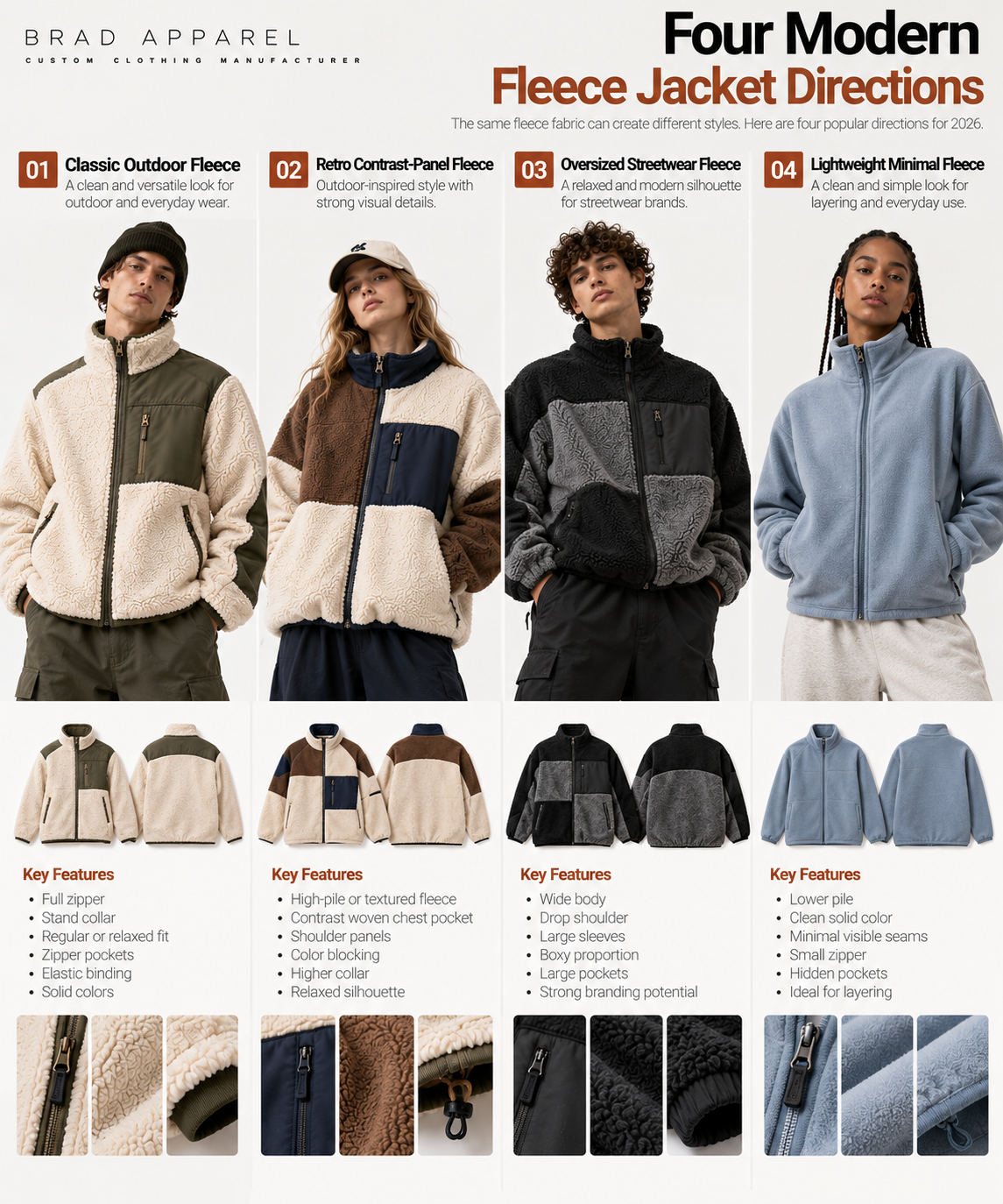
Fleece can support very different product directions.
1. Classic Outdoor Fleece
Possible features include:
- Full zipper
- Stand collar
- Regular or relaxed fit
- Zipper pockets
- Elastic binding
- Solid colors
This creates a clean outdoor-inspired product.
2. Retro Contrast-Panel Fleece
Possible features include:
- High-pile or textured fleece
- Contrast woven chest pocket
- Shoulder panels
- Color blocking
- Higher collar
- Relaxed silhouette
This direction works well for:
- Heritage outdoor styling
- Streetwear
- Retro sportswear collections
3. Oversized Streetwear Fleece
Possible features include:
- Wide body
- Drop shoulder
- Large sleeves
- Boxy proportion
- Large pockets
- Strong branding
The pattern should be purpose-built.
Simply increasing a regular fleece jacket by several sizes may create too much:
- Length
- Sleeve length
- Neck opening
without achieving the correct streetwear proportion.
4. Lightweight Minimal Fleece
Possible features include:
- Lower pile
- Clean solid color
- Minimal visible seams
- Small zipper
- Hidden pockets
- Minimal branding
This can work particularly well as:
a layering jacket
rather than the main outerwear piece.
Fabric quality becomes especially visible when decoration is minimal.
Embroidery on Fleece Requires Different Thinking
Fleece can support embroidery well.
But pile creates another challenge:
stitches can sink into the surface.
That can reduce:
- Edge clarity
- Small lettering visibility
- Fine detail
A temporary embroidery topping may be used where appropriate to help keep stitches visible above the pile.
Other variables include:
- Stitch density
- Backing
- Thread tension
- Logo size
- Pile height
Brad Apparel's Embroidery Techniques capabilities include embroidery development according to fabric weight, surface and garment construction.
High-Pile Fleece Needs Simpler Artwork
Very fine lettering can disappear into long pile.
For high-pile fabrics, stronger embroidery designs may work better:
- Larger lettering
- Thicker strokes
- Simple logos
- Patches
- Appliqué
The artwork should be tested on the real fleece before bulk production.
Patches Can Work Well on Fleece
Possible patch options include:
- Embroidered patch
- Woven patch
- Fabric appliqué
- Silicone-style patch
A patch can create a more controlled surface than direct embroidery on very high pile.
But the patch:
- Weight
- Backing
- Size
- Attachment
still needs to match the fleece.
Brad Apparel's Trims & Branding service supports patches, labels, zippers and other branded garment details.
Fleece Color Should Be Checked Physically
Pile can affect how color appears under different light.
The same nominal color may look:
- Darker
- Lighter
- More dimensional
depending on pile direction.
For custom colors, brands should review:
- Physical swatch
- Lab dip where relevant
- Face direction
- Bulk shade consistency
rather than relying only on a digital Pantone display.
Panel Color Matching
When fleece is combined with woven contrast fabric, two materials may reproduce the same requested color differently.
For example:
olive fleece
and
olive nylon
may not look identical even when both are developed toward the same color reference.
This may be intentional.
If exact tonal matching is required, both materials should be reviewed together.
Fleece Jackets Need Layering Ease
A fleece jacket may be worn:
- Over a T-shirt
- Over a base layer
- Under a shell
- As outerwear
These different roles need different amounts of ease.
A fleece designed as a mid-layer may need:
- Controlled volume
- Lower bulk
- Cleaner sleeves
A streetwear fleece may need:
- Wider body
- Larger armhole
- More sleeve volume
The intended layering system should be defined before pattern development.
What Should You Check on a Fleece Jacket Sample?
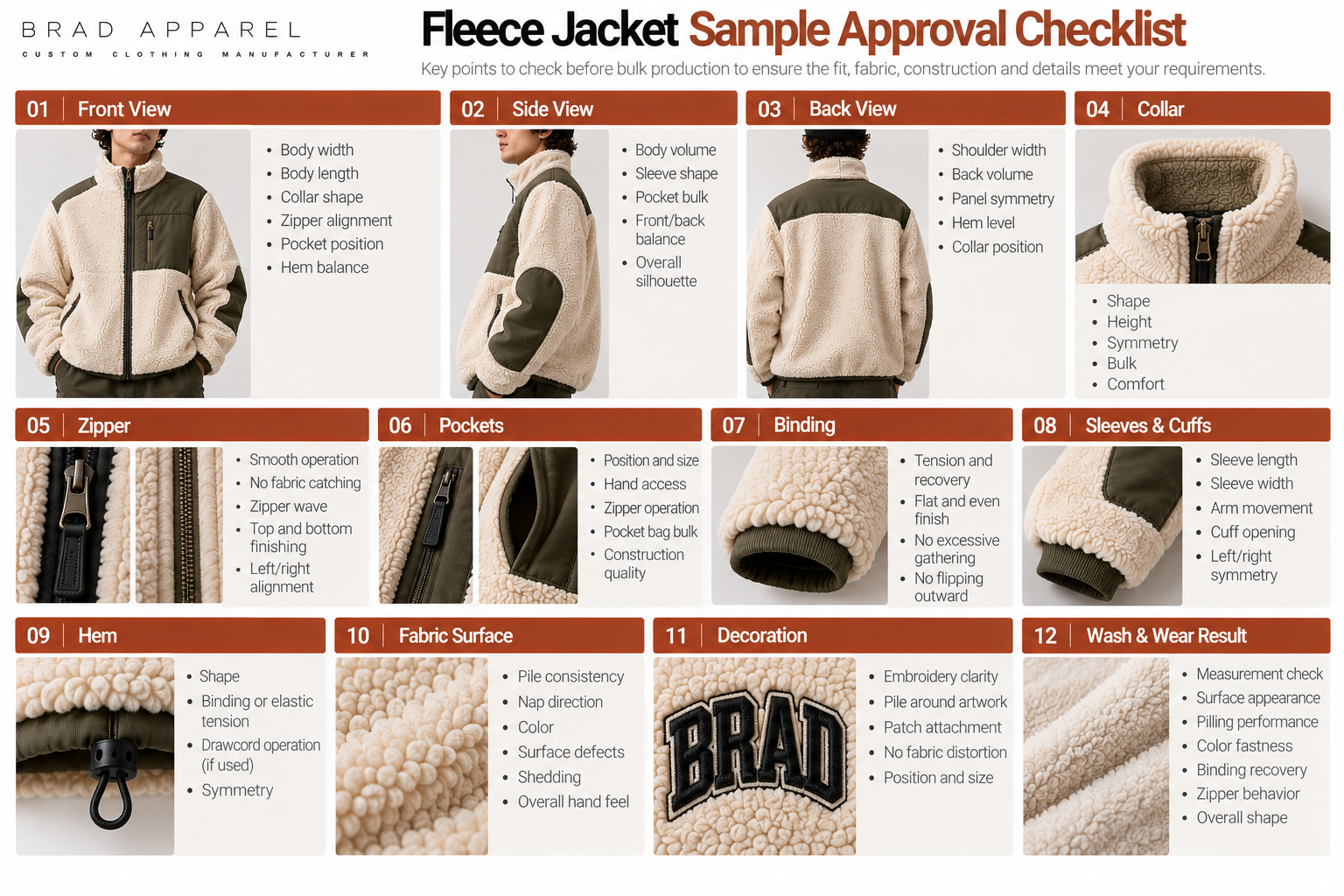
A fleece sample should be evaluated for both:
fit
and
fabric behavior.
1. Front View
Check:
- Body width
- Body length
- Collar
- Zipper alignment
- Pocket position
- Hem balance
2. Side View
Check:
- Body volume
- Sleeve shape
- Pocket bulk
- Front/back balance
3. Back View
Check:
- Shoulder width
- Back volume
- Panel symmetry
- Hem level
- Collar position
4. Collar
Check:
- Shape
- Height
- Symmetry
- Bulk
- Comfort
5. Zipper
Open and close repeatedly.
Check:
- Smooth operation
- Fabric catching
- Zipper wave
- Top finishing
- Bottom alignment
6. Pockets
Check:
- Position
- Size
- Hand access
- Zipper operation
- Pocket-bag bulk
7. Binding
Check:
- Tension
- Recovery
- Flatness
- Symmetry
- No excessive gathering
8. Sleeves & Cuffs
Check:
- Sleeve length
- Sleeve width
- Arm movement
- Cuff opening
- Left/right symmetry
9. Hem
Check:
- Shape
- Binding or elastic tension
- Drawcord operation if used
- Symmetry
10. Fabric Surface
Check:
- Pile consistency
- Nap direction
- Color
- Surface defects
- Shedding
- Overall hand feel
11. Decoration
Check:
- Embroidery clarity
- Pile around artwork
- Patch attachment
- Fabric distortion
- Branding position
12. Wash & Wear Result
Where required, review:
- Measurements
- Surface appearance
- Pilling
- Shedding
- Color
- Binding recovery
- Zipper behavior
- Overall shape
The test method should reflect the brand's actual care and quality requirements.
Common Fleece Jacket Development Mistakes
Saying Only “Fleece Fabric”
This does not define whether the brand wants:
- Polar fleece
- Sweatshirt fleece
- Sherpa fleece
- High-pile fleece
- Microfleece
Always confirm the actual material.
Selecting Fleece Only by GSM
Pile and density can change how the fabric feels even at similar weights.
Review a physical swatch.
Ignoring Nap Direction
Panels may appear different in color or texture when cut in opposite directions.
Using a Standard Fabric Marker
Directional pile may require one-way cutting and can affect consumption.
Making Every Component From Thick Fleece
Pocket bags, zipper guards and layered details can become unnecessarily bulky.
Choosing Binding Without Testing Tension
Incorrect binding tension can distort:
- Cuffs
- Hem
- Pocket openings
Using Fine Embroidery on High Pile
Small details can disappear into the surface.
Making an Oversized Fleece by Simply Sizing Up
Correct oversized proportions should be purpose-built.
Approving Color Only From a Screen
Pile changes how color reflects light.
Physical approval is important.
Ignoring Pilling and Surface Testing
The appearance after wear and washing matters as much as the initial sample.
What Should You Send a Fleece Jacket Manufacturer?
A useful fleece development brief should define:
| Area | What to Specify |
|---|---|
| Product Type | Full zip / half zip / pullover |
| Fit | Regular / relaxed / oversized / cropped |
| Fleece Type | Polar / micro / sherpa / high pile / other |
| Composition | Polyester / recycled polyester / blend |
| Fabric Surface | Low pile / medium pile / high pile |
| Weight | Target weight or approved swatch |
| Color | Pantone / physical reference |
| Collar | Stand / funnel / fold / hood |
| Zipper | Coil / reverse coil / molded / two-way |
| Zipper / welt / patch / chest | |
| Contrast Panels | Nylon / woven / other |
| Cuff | Binding / elastic / rib / straight |
| Hem | Straight / binding / elastic / drawcord |
| Decoration | Embroidery / patch / appliqué |
| Finish | Anti-pilling or other required treatment |
| Quantity | Sample and bulk quantity |
A reference photo is useful.
But the factory still needs fabric and construction specifications before production.
How Brad Apparel Can Develop a Custom Fleece Jacket
A fleece-jacket project can follow:
Design Reference
↓
Fleece Type Selection
↓
Pile / Weight / Color Confirmation
↓
Fit & Layering Requirement
↓
Pattern Development
↓
Zipper / Pocket / Binding Development
↓
Contrast Panel Confirmation
↓
First Sample
↓
Fit + Surface Review
↓
Embroidery / Patch Testing
↓
Wash / Pilling Review
↓
Pre-Production Approval
↓
Bulk Production
Brad Apparel supports fleece-jacket development through Fabric Sourcing & Development, Custom Zippers & Sliders, Embroidery Techniques, Trims & Branding and broader Manufacturing Capabilities.
FAQ
What Is a Fleece Jacket?
A fleece jacket is generally a soft knitted layering or outerwear garment made with a raised, brushed or piled fleece surface.
Different fleece constructions create very different textures and garment weights.
Is Polar Fleece the Same as Sweatshirt Fleece?
No.
Polar fleece commonly has a visible soft outer pile.
Sweatshirt fleece normally has a smoother face and a brushed interior and is commonly used for hoodies and sweatshirts.
Is Fleece Always Polyester?
No.
Polyester is common for many fleece-jacket fabrics, but exact compositions and blends can vary.
The physical fabric should be selected according to the desired product.
What Is Sherpa Fleece?
Sherpa-style fleece has a curled or looped pile associated visually with shearling.
It can be used as an outer material, lining or contrast detail.
What Is Microfleece?
Microfleece generally describes a finer, lower-bulk fleece direction that can work well for lightweight layering.
There is no universal weight that defines every microfleece.
What Is High-Pile Fleece?
High-pile fleece uses a longer, more visible surface pile.
It creates stronger texture but can require additional attention to cutting direction, seams and embroidery.
Does Fleece Pill?
Some fleece fabrics can develop surface pilling depending on fiber, yarn, construction, finishing, washing and wear.
If pilling performance is important, the intended fabric should be tested before bulk production.
Can Fleece Jackets Be Embroidered?
Yes.
Embroidery can work well on fleece, but pile height, stitch density, backing and artwork size need to be considered.
Very high pile can reduce the clarity of fine embroidery.
Can You Make an Oversized Fleece Jacket?
Yes.
The chest, shoulder, armhole, sleeve and length should be developed together.
Simply selecting a larger standard size may create the wrong proportion.
Can Fleece Be Combined With Nylon Panels?
Yes.
Contrast woven panels are commonly used as a design direction.
The two fabrics should be evaluated together for color, thickness and construction compatibility.
Does a Fleece Jacket Need Lining?
Not necessarily.
Many fleece jackets are unlined.
Lining can be added when required by the design, but it changes:
- Weight
- Bulk
- Interior construction
- Drape
and should be planned during development.
What Should Be Tested Before Bulk Production?
Important checks can include:
- Fit
- Pile consistency
- Nap direction
- Color
- Pilling
- Shedding
- Zipper operation
- Binding recovery
- Pocket construction
- Decoration
- Wash result
- Overall measurements
The final approved sample should represent the intended production fabric and trims.
Final Thoughts
A fleece jacket is not simply a basic zip jacket made from a soft fabric.
The fabric itself affects nearly every production decision.
A longer pile changes embroidery.
Directional nap changes cutting.
Thicker fleece changes seams.
Binding changes edge shape.
Pocket construction changes bulk.
And the wrong zipper can change the entire front of the garment.
For clothing brands, a successful fleece jacket is therefore developed as one complete system:
Fleece Structure
+
Pile
+
Fit
+
Cutting Direction
+
Zipper
+
Binding
+
Pockets
+
Decoration
rather than treating the fabric and jacket pattern as separate decisions.
That is what helps the finished product stay consistent from the first sample through bulk production.
Keep Reading