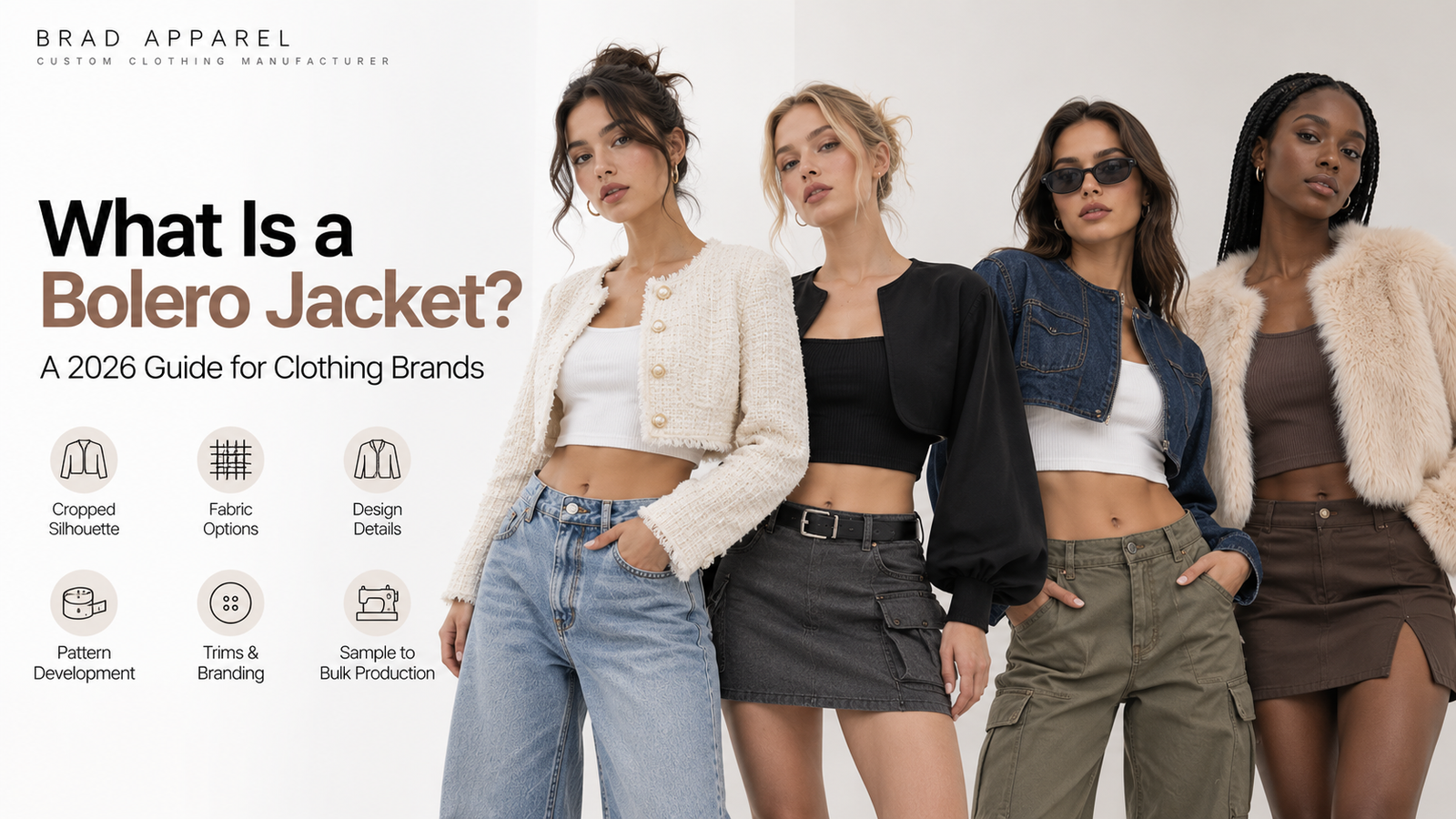
The bolero jacket is one of the most distinctive cropped silhouettes returning to fashion in 2026.
Its defining feature is simple:
The body ends much higher than a conventional jacket.
But developing a good bolero is not simply a matter of shortening an existing blazer or jacket pattern.
Because the body is so abbreviated, small changes in:
Length
Shoulder width
Armhole
Sleeve volume
Neckline
Front opening
and
Fabric structure
can completely change the proportion.
For clothing brands, the bolero is therefore a useful example of how a seemingly simple garment can require very precise pattern development.
This guide explains what defines a bolero jacket, how it differs from a shrug and cropped jacket, and what brands should consider before moving from design to bulk production.
What Is a Bolero Jacket?

A bolero is a very short outer layer that normally covers:
- Shoulders
- Upper back
- Arms
- Part of the upper torso
while leaving much of the garment underneath visible.
Unlike a standard cropped jacket, a bolero may finish:
- Around the bust
- Slightly below the bust
- Above the natural waist
The front can be:
- Completely open
- Lightly overlapped
- Buttoned
- Hook-and-eye closed
- Tied
- Zipped
Modern boleros appear in many different materials, including:
- Suiting fabrics
- Tweed
- Wool blends
- Satin
- Denim
- Faux fur
- Jersey
- Rib knit
- Structured woven fabrics
This means “bolero” describes the silhouette more than one specific construction method.
Why Are Bolero Jackets Trending Again in 2026?
The bolero fits several current fashion directions at the same time.
One is the return of:
Very cropped proportions
Another is renewed interest in:
2000s-inspired styling
And another is the use of:
small statement layers
that change an outfit without covering most of it.
A bolero can be worn over:
- Dresses
- Tank tops
- Corset-style tops
- T-shirts
- Knit tops
- Bodysuits
while leaving the base garment visible.
That makes it different from conventional outerwear.
The bolero does not always need to become the entire outfit.
Instead, it can change the proportion of what is already underneath.
Bolero vs Shrug vs Cropped Jacket
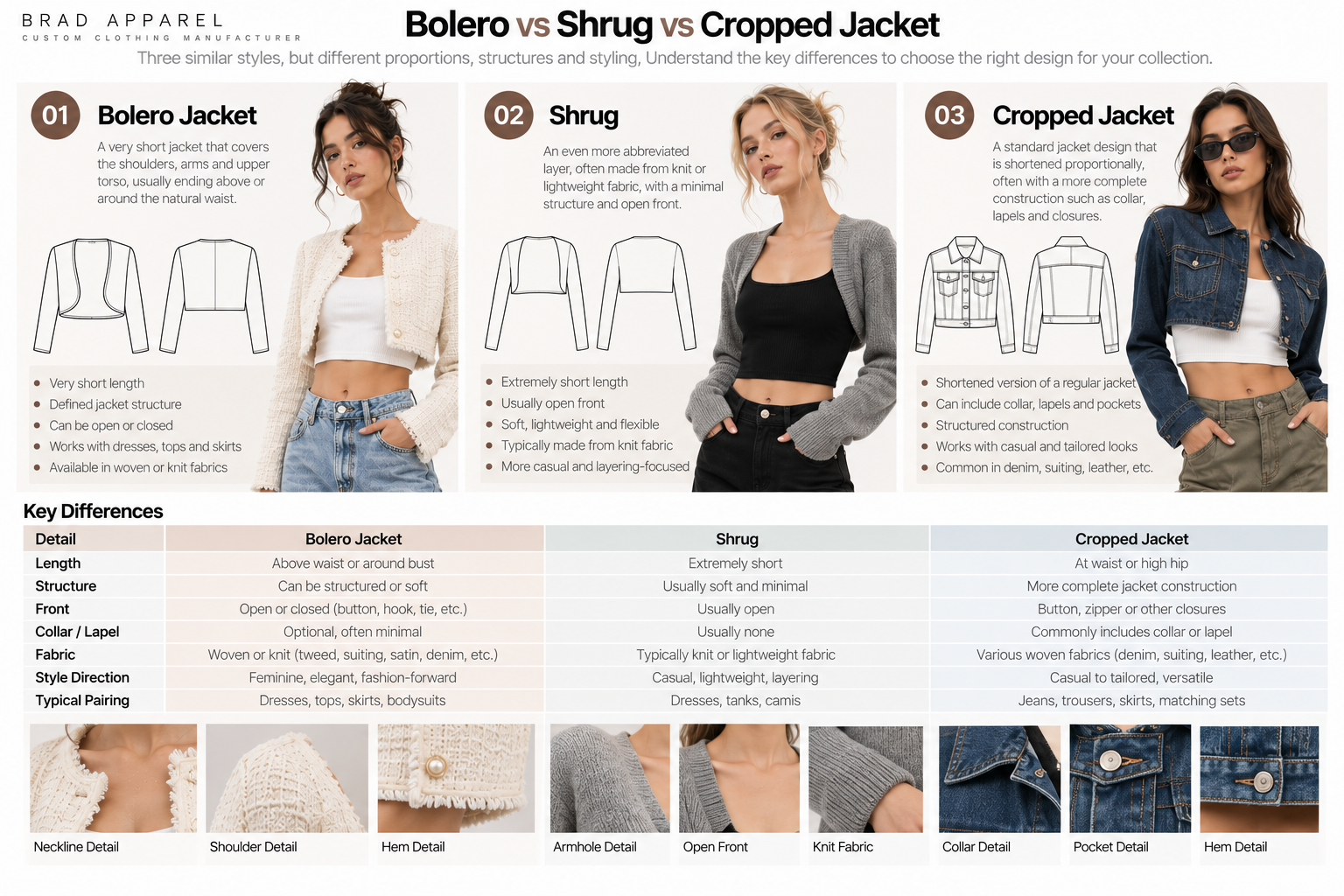
These terms are frequently mixed together in retail descriptions.
They can overlap, but they are not always the same product.
| Style | Typical Construction | Typical Length | Structure |
|---|---|---|---|
| Bolero Jacket | Short outer layer with defined body and sleeves | Above waist / around bust | Can be soft or structured |
| Shrug | Very abbreviated layer, often knit | Extremely short | Usually softer |
| Cropped Jacket | Standard jacket shortened proportionally | Waist or high hip | Usually more complete jacket construction |
| Cropped Blazer | Tailored cropped jacket | Waist or above | More structured and tailored |
These are general design tendencies rather than universal naming rules.
For manufacturing, the actual:
- Finished body length
- Shoulder width
- Sleeve specification
- Front opening
- Fabric
- Construction
matter more than the retail name.
A Bolero Is Not Just a Jacket With the Bottom Cut Off
This is one of the biggest development mistakes.
Imagine taking a regular jacket pattern and simply cutting away the bottom half.
The resulting garment may have:
- Incorrect pocket placement
- Poor chest proportion
- Excess fabric at the front
- Wrong lapel length
- Armholes that feel too low
- Sleeves that look oversized relative to the body
A purpose-built bolero needs to be balanced around its shortened torso.
The entire upper-body proportion should be reviewed.
Body Length Is the First Critical Measurement
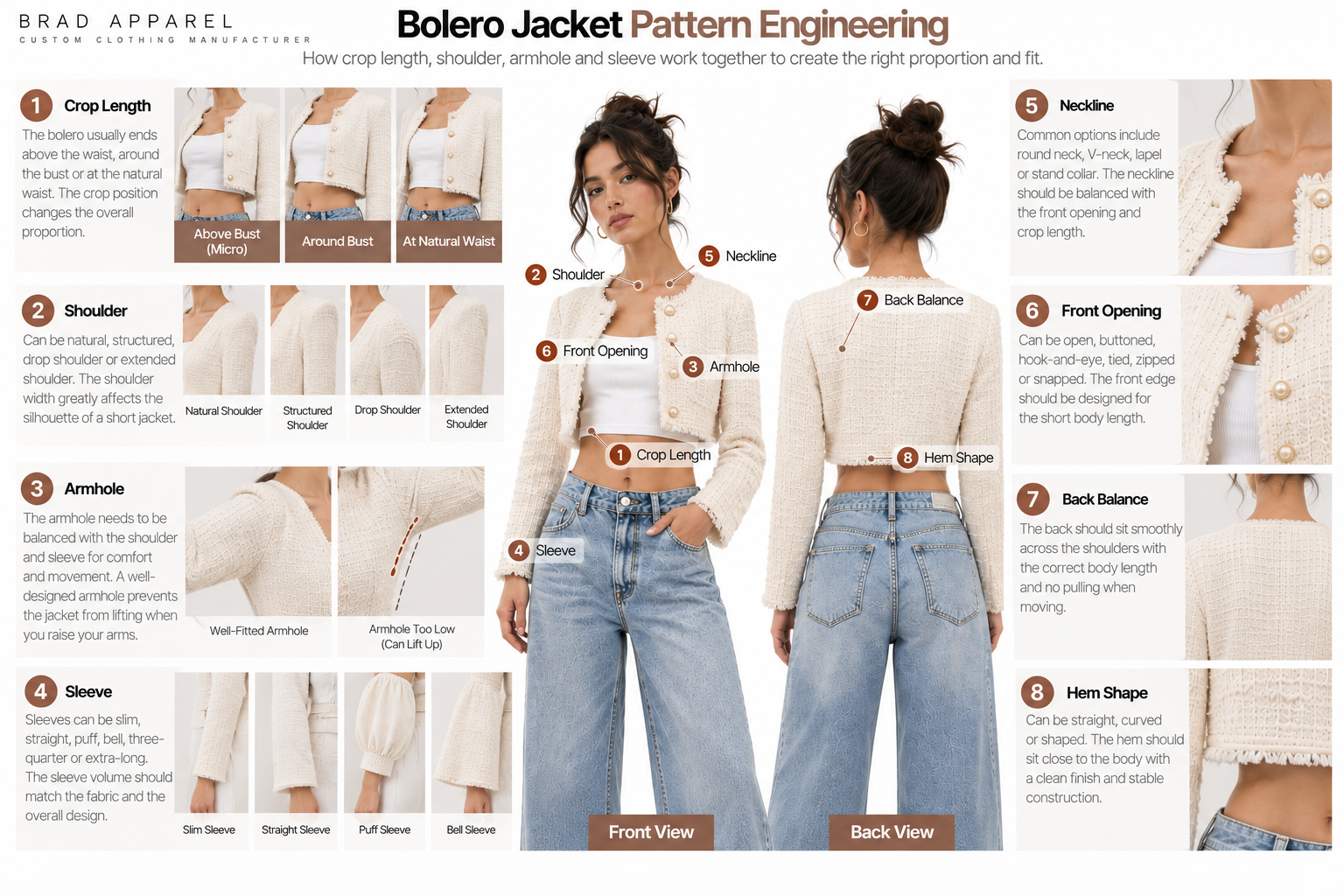
There is no universal bolero length.
The right position depends on the design.
A slightly longer bolero may finish near:
the natural waist
A more fashion-forward version may finish:
below the bust
An extreme micro-bolero may cover little more than:
the shoulders and arms
Each version changes how the rest of the garment is perceived.
Crop Length Should Be Tested With the Intended Outfit
A bolero designed to be worn over a dress may require different proportions from one intended for:
- Low-rise jeans
- High-rise trousers
- A bodysuit
- A crop top
- A matching skirt
The sample should therefore be evaluated together with its intended base garment whenever possible.
The question is not only:
Is this jacket length correct?
It is also:
Does this jacket length create the intended proportion with the rest of the outfit?
Front Length and Back Length Do Not Always Need to Match
Some bolero designs use:
- Straight front and back
- Curved front hem
- Shorter front
- Slightly longer back
- Rounded hem
These changes can make the silhouette feel:
- Softer
- Sharper
- More tailored
- More sculptural
The front edge should transition smoothly into the neckline or closure.
Shoulder Width Has a Bigger Visual Impact on a Short Jacket
Because the torso is very short, the shoulder occupies a larger percentage of the overall silhouette.
A narrow shoulder can create:
- Feminine proportion
- Cleaner shape
- More fitted appearance
A wider shoulder can create:
- Stronger fashion silhouette
- Oversized effect
- More architectural shape
Possible constructions include:
- Natural shoulder
- Structured shoulder
- Drop shoulder
- Extended shoulder
- Shoulder pad
The choice should be intentional.
Armhole Development Is Critical
A bolero may look visually small but still needs enough mobility.
If the armhole is:
too high
the garment may feel restrictive.
If it is:
too low
the short body may lift excessively when the wearer raises their arms.
The armhole needs to work together with:
- Shoulder width
- Sleeve shape
- Chest ease
- Fabric stretch
This is why fitting a bolero only on a mannequin is not enough.
Movement testing matters.
The Sleeve Can Become the Main Design Feature
Because the body is minimal, sleeves can carry much more visual weight.
Possible sleeve directions include:
- Slim sleeve
- Straight sleeve
- Wide sleeve
- Bell sleeve
- Puff sleeve
- Sculptural sleeve
- Short sleeve
- Three-quarter sleeve
- Extra-long sleeve
A very large sleeve paired with a tiny body creates a dramatic proportion.
A fitted sleeve creates a cleaner, more refined look.
Sleeve Volume Needs Support From the Pattern
A voluminous sleeve should not be created only by increasing sleeve width randomly.
The pattern maker also needs to consider:
- Sleeve cap
- Armhole
- Shoulder
- Gathering
- Pleats
- Cuff
- Fabric stiffness
For example:
A puff sleeve may require volume concentrated near:
the shoulder
while a balloon sleeve may place more volume through:
the lower sleeve
These create different silhouettes.
Bolero Neckline Options
The neckline strongly influences the identity of the garment.
Round Neck
Creates:
- Clean appearance
- Feminine proportion
- Easy layering
Works well for:
- Tweed boleros
- Evening jackets
- Minimal pieces
Collarless
A collarless construction keeps the silhouette clean and allows the fabric to become the main feature.
Possible finishing methods include:
- Facing
- Binding
- Full lining
Small Collar
A compact collar can introduce a more traditional jacket appearance without overwhelming the short body.
Lapel
A tailored bolero can include:
- Notch lapel
- Shawl-style lapel
- Narrow lapel
But lapel length needs to be redesigned for the shorter body.
A full-length blazer lapel simply shortened at the hem may look disproportionate.
Stand Collar
A small stand collar can create a more structured or contemporary direction.
The collar height should remain balanced against the extremely short torso.
Front Opening Changes the Entire Look
Some boleros are completely open.
Others use a closure.
Possible options include:
No Closure
Clean and easy for layering.
Single Button
Creates a small central focal point.
Multiple Buttons
Works well for more structured cropped jackets.
Hook-and-Eye
Keeps the closure visually minimal.
Tie Front
Creates a softer or more feminine direction.
Zipper
Useful for:
- Streetwear
- Technical interpretations
- Cropped bomber-inspired boleros
Snap Closure
Provides a clean modern appearance.
Brad Apparel's Trims & Branding capabilities include custom buttons, snaps, zippers, labels and branded hardware for custom garment development.
Fabric Determines Whether the Bolero Feels Soft or Structured
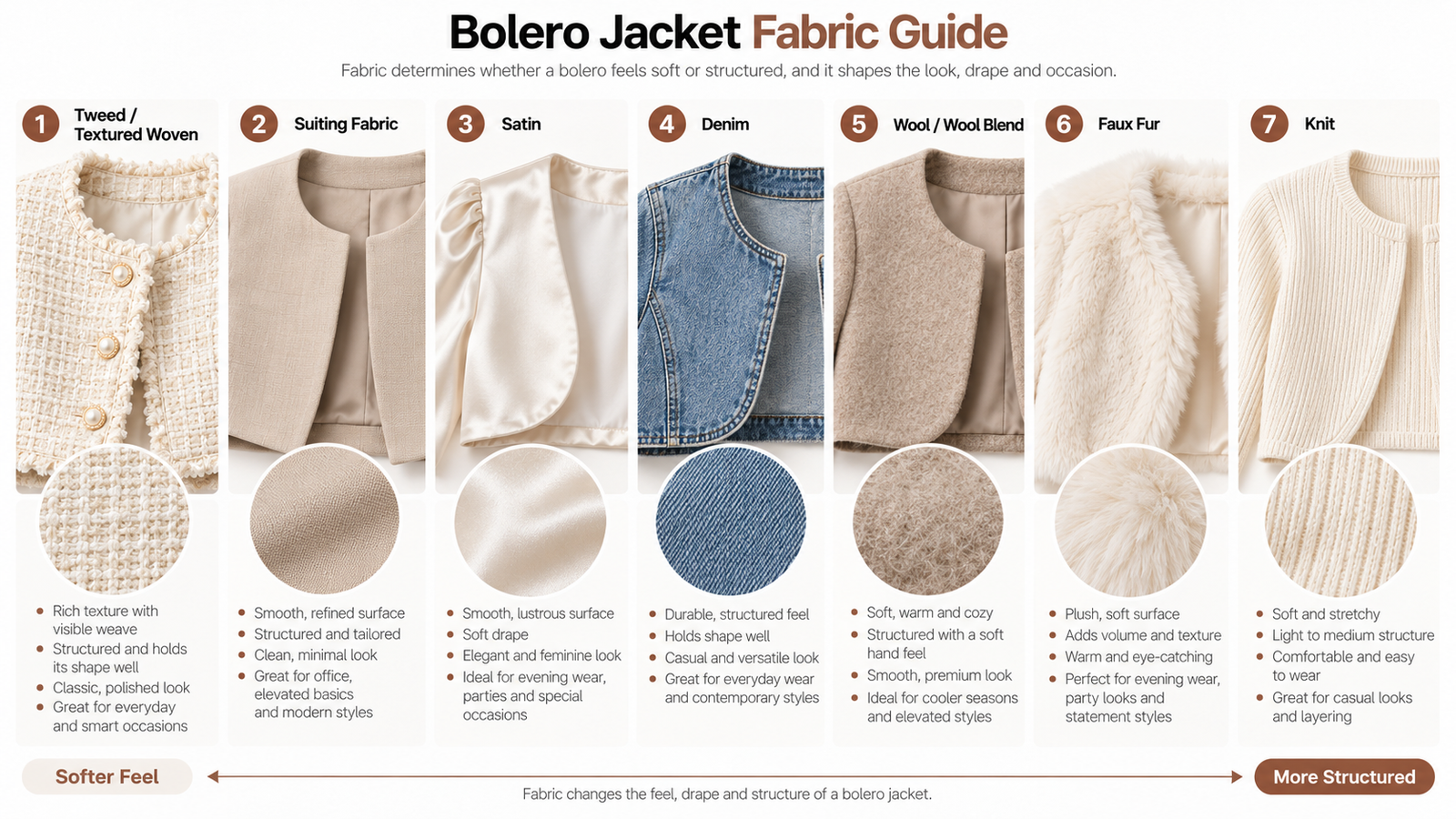
The same bolero pattern can produce very different results depending on fabric.
Tweed / Textured Woven
Useful for:
- Cropped statement jackets
- Premium women's collections
- Classic-inspired designs
Texture becomes a major part of the product.
Because tweed structures vary widely, check:
- Fraying
- Thickness
- Seam stability
- Edge finishing
before finalizing construction.
Suiting Fabric
Suitable for:
- Tailored boleros
- Minimal cropped jackets
- Matching sets
Suiting provides a cleaner surface and can support:
- Lapels
- Shoulder shaping
- Precise seams
The level of structure depends on the actual fabric and interfacing.
Satin
Satin can create:
- Eveningwear appearance
- Softer drape
- Smooth reflective surface
However, some satin fabrics can show:
- Needle marks
- Seam puckering
- Pressing marks
Sampling should be done in the intended production fabric.
Denim
Denim creates a more casual interpretation.
A denim bolero can use:
- Raw denim
- Washed denim
- Vintage wash
- Contrast topstitching
- Metal buttons
Wash development should be considered before final fit approval.
Wool / Wool Blend
Suitable for:
- Fall and winter
- Structured short jackets
- Premium outerwear
The main challenge is bulk.
A very thick fabric can become difficult around:
- Neckline
- Front edge
- Sleeve head
- Hem
Faux Fur
Faux-fur boleros can create a highly seasonal or evening-focused product.
The pattern needs to consider:
- Pile direction
- Seam bulk
- Lining
- Cutting method
- Fur trapped in seams
A full lining is commonly useful for a cleaner interior.
What About Knit Boleros?
Not every bolero is a woven jacket.
Some are made using:
- Jersey
- Rib knit
- Stretch knit
- Sweater-knit structures
These usually create a softer garment closer to a shrug.
It is important to distinguish between:
cut-and-sew knit bolero
and
fully fashioned knitted bolero
because the manufacturing processes are different.
A true sweater-knit bolero may require specialized knitting equipment rather than normal cut-and-sew jacket production.
Fabric Weight Should Follow the Silhouette
There is no universal GSM for a bolero.
A lightweight design may need:
- Soft drape
- Less structure
- Fine seams
A structured bolero may need:
- More body
- Better shape retention
- Interfacing
A dramatic puff sleeve may also require a fabric with enough body to hold volume.
Brad Apparel's Fabric Sourcing & Development service supports woven and knitted fabrics across different compositions, weights, textures, colors and finishes.
Interfacing Should Be Used Only Where Needed
Structured boleros may use interfacing around:
- Front edge
- Neckline
- Lapel
- Button area
- Collar
But the garment is small.
Too much interfacing can quickly make it feel:
- Rigid
- Thick
- Uncomfortable
The support level should match the shell fabric and desired silhouette.
Should a Bolero Be Lined?
It depends on the fabric and design.
A full lining can provide:
- Cleaner interior
- Easier dressing
- Covered seams
- Better comfort
- Premium appearance
This can be especially useful for:
- Tweed
- Wool
- Faux fur
- Structured tailoring
Unlined Boleros Can Work Too
A lightweight bolero can remain unlined when the fabric and seam finishing allow it.
Possible finishing methods include:
- Overlock
- Binding
- Clean facing
- Enclosed seams
Because the body is short, internal construction may become more visible than expected when the jacket is open.
Interior appearance should therefore be checked during sampling.
Four Modern Bolero Jacket Directions

The same basic cropped concept can create very different products.
1. Tailored Cropped Bolero
Typical features:
- Structured shoulder
- Clean neckline
- Suiting or textured woven fabric
- Minimal closure
- Long sleeve
Suitable for:
- Contemporary womenswear
- Matching sets
- Elevated casualwear
The pattern should remain clean rather than looking like a blazer that has simply been shortened.
2. Soft Bolero / Shrug
Possible features include:
- Stretch knit
- Soft jersey
- Open front
- Slim sleeves
- Minimal structure
This direction is closer to a shrug.
It works well for:
- Layering
- Casual fashion
- Lightweight collections
3. Faux-Fur Evening Bolero
Typical features:
- Very short body
- Faux fur or plush texture
- Full lining
- Minimal front closure
- Statement silhouette
Useful for:
- Eveningwear
- Occasionwear
- Seasonal collections
Because the material itself is visually strong, the pattern can remain relatively simple.
4. Streetwear Cropped Bolero
A bolero can also move away from traditional feminine styling.
Possible features include:
- Denim
- Technical woven
- Oversized sleeve
- Zipper
- Elastic detail
- Drop shoulder
This creates a more directional:
cropped outerwear + streetwear
product.
A Matching Set Can Make the Bolero More Commercial
Because the bolero is such a small garment, it can work especially well as part of a coordinated outfit.
Examples include:
Bolero + skirt
Bolero + trousers
Bolero + dress
Bolero + matching top
Using the same fabric helps create a strong collection identity.
But colour consistency should be controlled when the garments are produced from separate fabric lots.
Hem Construction Needs Special Attention
Because the hem sits high on the torso, any instability becomes very visible.
Possible hem directions include:
- Clean facing
- Turned hem
- Binding
- Elastic
- Rib
- Raw-edge effect where technically appropriate
A stiff hem can make the jacket stand away from the body.
A very soft hem can collapse.
The finish should support the intended shape.
Curved Front Hems Can Improve Proportion
Some boleros look better with a front hem that curves upward or inward.
This can create:
- More open center front
- Softer shape around the bust
- Cleaner transition to the side seam
The curve should be tested on the body.
A flat technical sketch does not always show how the hem interacts with the chest.
Decoration Should Match the Scale of the Garment
A bolero has limited surface area.
Large decoration can quickly dominate the garment.
Possible branding directions include:
- Small embroidery
- Tonal logo
- Decorative buttons
- Custom zipper pull
- Woven label
- Small patch
- Edge piping
For highly textured fabrics, minimal branding often allows the material to remain the visual focus.
Pocket Design Is Optional
Many boleros do not need pockets.
The body may simply be too short.
Adding a full-size pocket can:
- Distort proportion
- Add bulk
- Interrupt a clean front
If storage is needed, possible options include:
- Small welt pocket
- Hidden seam pocket
- Decorative mini pocket
Pocket usefulness should be tested rather than added automatically.
What Should You Check on a Bolero Sample?
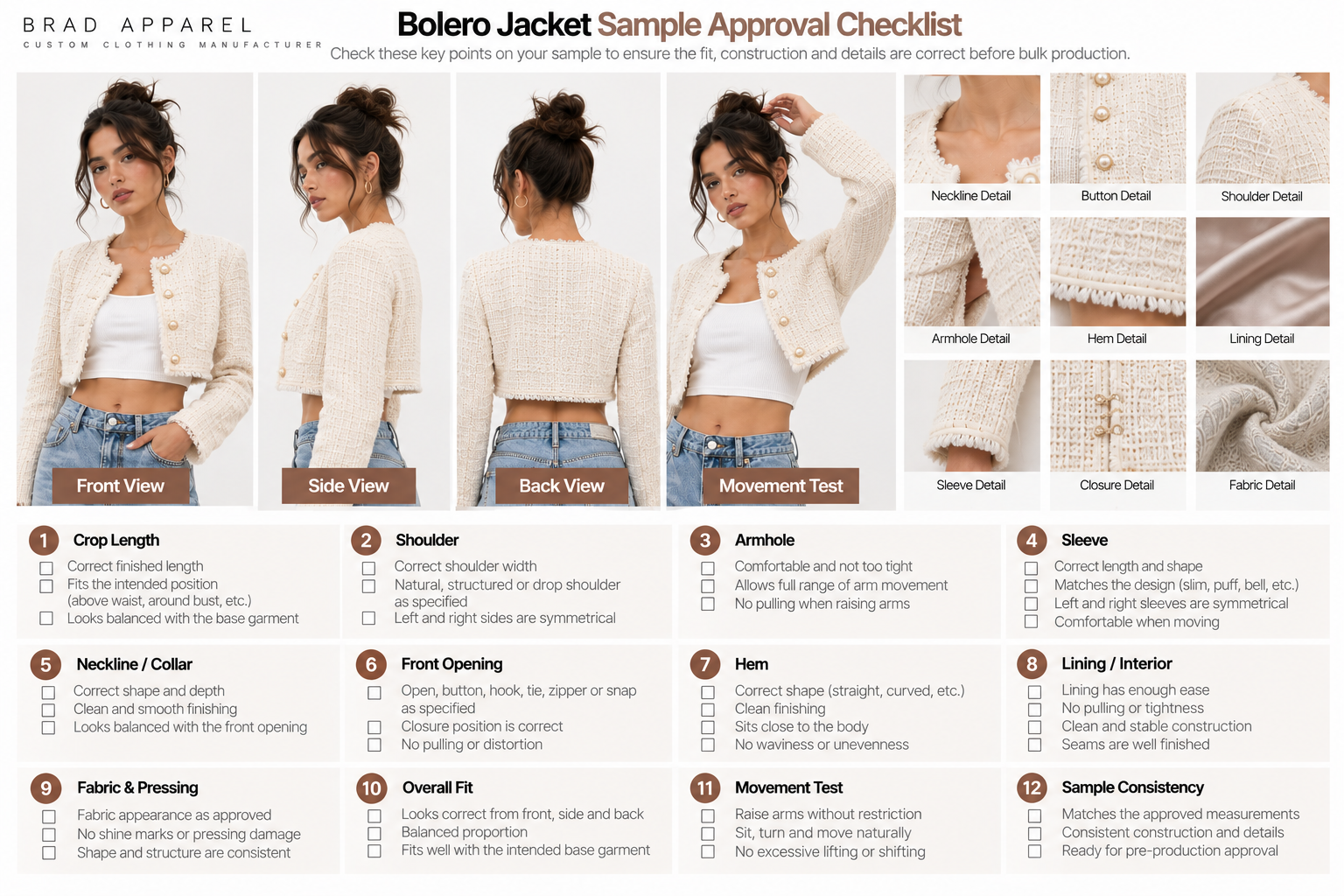
Because the body is so short, fit errors become very obvious.
1. Front View
Check:
- Body length
- Left/right balance
- Front opening
- Neckline
- Shoulder position
The garment should not appear accidentally shortened.
2. Side View
Check:
- Front/back length balance
- Shoulder position
- Sleeve angle
- Hem position
The short body should sit naturally against the torso.
3. Back View
Check:
- Back width
- Shoulder symmetry
- Center-back position
- Hem level
4. Crop Position
Confirm exactly where the jacket ends relative to:
- Bust
- Waist
- Base garment
This is one of the most important approval points.
5. Shoulder
Check:
- Width
- Shape
- Shoulder pad if used
- Left/right balance
6. Armhole
Test:
- Comfort
- Range of motion
- Underarm pulling
- Garment lifting
7. Sleeve
Check:
- Length
- Volume
- Sleeve cap
- Cuff
- Left/right symmetry
8. Neckline / Collar
Check:
- Shape
- Symmetry
- Edge stability
- Comfort
9. Closure
If used, test:
- Button position
- Hook-and-eye
- Zipper
- Snap
- Tie
The closure should not pull the short front out of shape.
10. Hem
Check:
- Shape
- Stability
- Symmetry
- Clean finishing
11. Lining / Interior
Check:
- Ease
- Attachment
- No pulling
- Clean internal construction
12. Movement
Ask the wearer to:
- Raise the arms
- Reach forward
- Sit
- Turn
- Move naturally
The bolero should not ride up excessively or restrict the upper body.
Common Bolero Development Mistakes
Simply Cutting a Normal Jacket Shorter
This usually creates the wrong proportion.
The shoulder, armhole, sleeve and front should be developed specifically for the cropped body.
Making the Body Too Short Without Testing It on the Wearer
A few centimeters can significantly change the silhouette.
Sample fitting is essential.
Ignoring Arm Movement
A tiny jacket still needs functional mobility.
Using Oversized Sleeves Without Rebalancing the Shoulder
The garment can become visually heavy or unstable.
Adding Full-Size Pockets to a Very Short Body
The pockets may dominate the entire garment.
Using Heavy Fabric Without Considering Seam Bulk
Very short jackets can have several construction layers concentrated in a small area.
Using a Standard Blazer Lapel
A full-length lapel may not scale correctly to a bolero.
Approving the Bolero Without the Intended Base Garment
The crop proportion should be evaluated as part of the full outfit.
What Should You Send a Bolero Jacket Manufacturer?
A useful development brief should define:
| Area | What to Specify |
|---|---|
| Style | Bolero / shrug / cropped jacket |
| Body Length | Finished front and back length |
| Fit | Fitted / regular / oversized |
| Shoulder | Natural / structured / extended / drop |
| Sleeve | Slim / wide / puff / bell / short |
| Fabric | Woven / jersey / tweed / satin / denim / faux fur |
| Composition | Target fiber content |
| Neckline | Round / collarless / lapel / stand collar |
| Closure | Open / button / hook / zipper / snap / tie |
| Hem | Straight / curved / facing / elastic |
| Lining | None / partial / full |
| Interfacing | Required structure |
| Decoration | Embroidery / piping / custom trims |
| Base Garment | What the bolero is designed to layer over |
| Quantity | Sample and bulk quantity |
A reference image is useful.
But the reference should be converted into real measurements and construction details before production.
How Brad Apparel Can Develop a Custom Bolero Jacket
Bolero development can follow:
Design Reference
↓
Target Crop Position
↓
Fabric Selection
↓
Shoulder & Armhole Development
↓
Sleeve Development
↓
Neckline & Closure
↓
First Sample
↓
Fit With Base Garment
↓
Movement Test
↓
Construction Adjustment
↓
Pre-Production Approval
↓
Bulk Production
Brad Apparel supports custom apparel development through Fabric Sourcing & Development, custom buttons, zippers and branding through Trims & Branding, and sampling and garment engineering through our Manufacturing Capabilities.
FAQ
What Is a Bolero Jacket?
A bolero jacket is a very short outer layer that usually covers the shoulders, arms and upper torso while ending above or around the natural waist.
Is a Bolero the Same as a Shrug?
Not always.
A shrug is typically softer and more minimal, often using knitted or stretch fabric.
A bolero can have a more developed jacket body and may use woven or structured fabrics.
The terms sometimes overlap in retail.
Is a Bolero the Same as a Cropped Jacket?
A bolero is a type of extremely cropped outer layer.
A cropped jacket is a broader category and may still include most features of a conventional jacket.
How Short Is a Bolero Jacket?
There is no universal length.
Some finish near the natural waist, while others end around or above the bust.
The correct crop position should be defined in the tech pack.
What Fabric Is Best for a Bolero Jacket?
There is no single best fabric.
Possible options include:
- Tweed
- Suiting
- Satin
- Denim
- Wool blends
- Faux fur
- Jersey
- Stretch knit
The fabric should match the intended silhouette.
Can a Bolero Jacket Have Long Sleeves?
Yes.
Boleros can use:
- Long sleeves
- Short sleeves
- Three-quarter sleeves
- Puff sleeves
- Bell sleeves
- Oversized sleeves
Sleeve proportion is often one of the garment's main design features.
Does a Bolero Need a Lining?
Not always.
Structured tweed, wool and faux-fur boleros often benefit from lining.
Lightweight or knit versions may remain unlined.
Can a Bolero Have Pockets?
Yes, but pocket space is limited because the body is so short.
Small welt or hidden pockets are generally easier to integrate than large patch pockets.
Can a Bolero Be Oversized?
Yes.
An oversized bolero can use:
- Extended shoulders
- Wide sleeves
- Drop shoulders
- Boxy proportions
The short body and oversized upper volume should be developed together.
Can a Bolero Be Made From Denim?
Yes.
Denim creates a more casual or streetwear-oriented bolero.
The final pattern should be checked after any intended wash or finishing process.
What Should Be Checked Before Bulk Production?
Key points include:
- Crop length
- Shoulder width
- Armhole
- Sleeve volume
- Neckline
- Front opening
- Closure
- Hem
- Lining
- Movement
- Fabric behavior
- Overall proportion with the intended outfit
Final Thoughts
The bolero proves that less fabric does not necessarily mean simpler development.
Because the garment is so short, every proportion becomes more visible.
A successful bolero depends on balancing:
Crop Length
+
Shoulder
+
Armhole
+
Sleeve
+
Neckline
+
Fabric
+
Closure
rather than simply cutting a conventional jacket shorter.
For clothing brands, that is the key manufacturing lesson behind the 2026 bolero trend:
The best versions are purpose-built around the cropped silhouette from the beginning.
Keep Reading