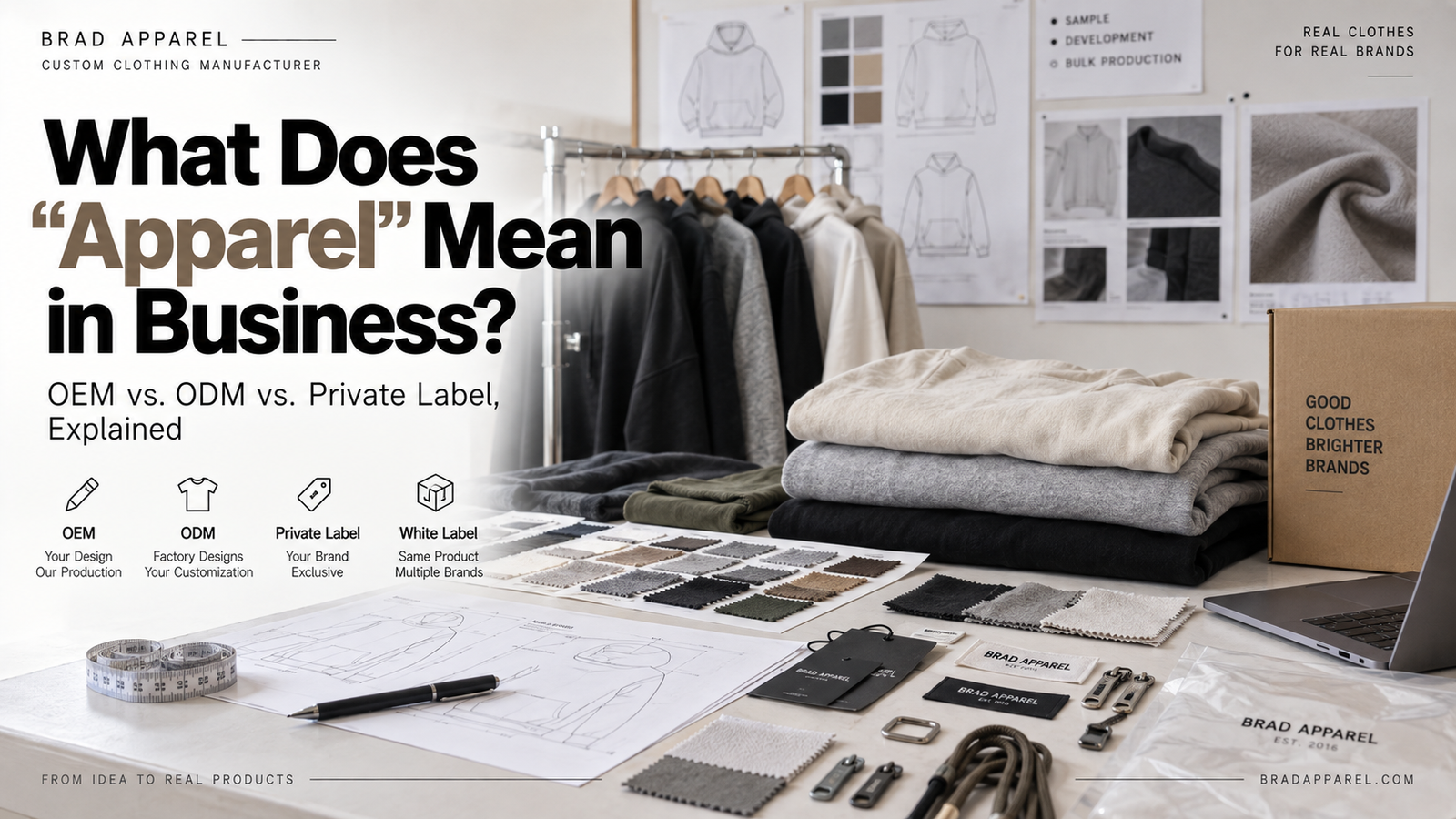
If you're starting a clothing brand, the word apparel is probably one of the first industry terms you'll encounter.
But the dictionary definition is the easy part.
In clothing manufacturing, the more important questions are:
- Who creates the design?
- Does the factory develop the pattern?
- Can you customize the fabric?
- Is the product exclusive to your brand?
- What does the factory quote actually include?
- Are you comparing FOB, DDP or landed cost?
This is where terms like OEM, ODM, private label and white label become much more useful than simply defining apparel as "clothing."
This guide explains what these terms mean, how they differ, and what they mean for your cost, MOQ and level of product control.
What Does "Apparel" Mean in Business?
In a commercial context, apparel refers to clothing manufactured and sold as a product.
This can include:
- T-shirts
- Hoodies
- Sweatshirts
- Jackets
- Pants
- Shorts
- Sweat sets
- Polo shirts
- Uniforms
But for a clothing brand, the more useful question is not simply:
"What is apparel?"
It is:
"How is my apparel going to be developed and manufactured?"
That is where OEM, ODM and private label manufacturing come in.
OEM vs. ODM vs. Private Label vs. White Label
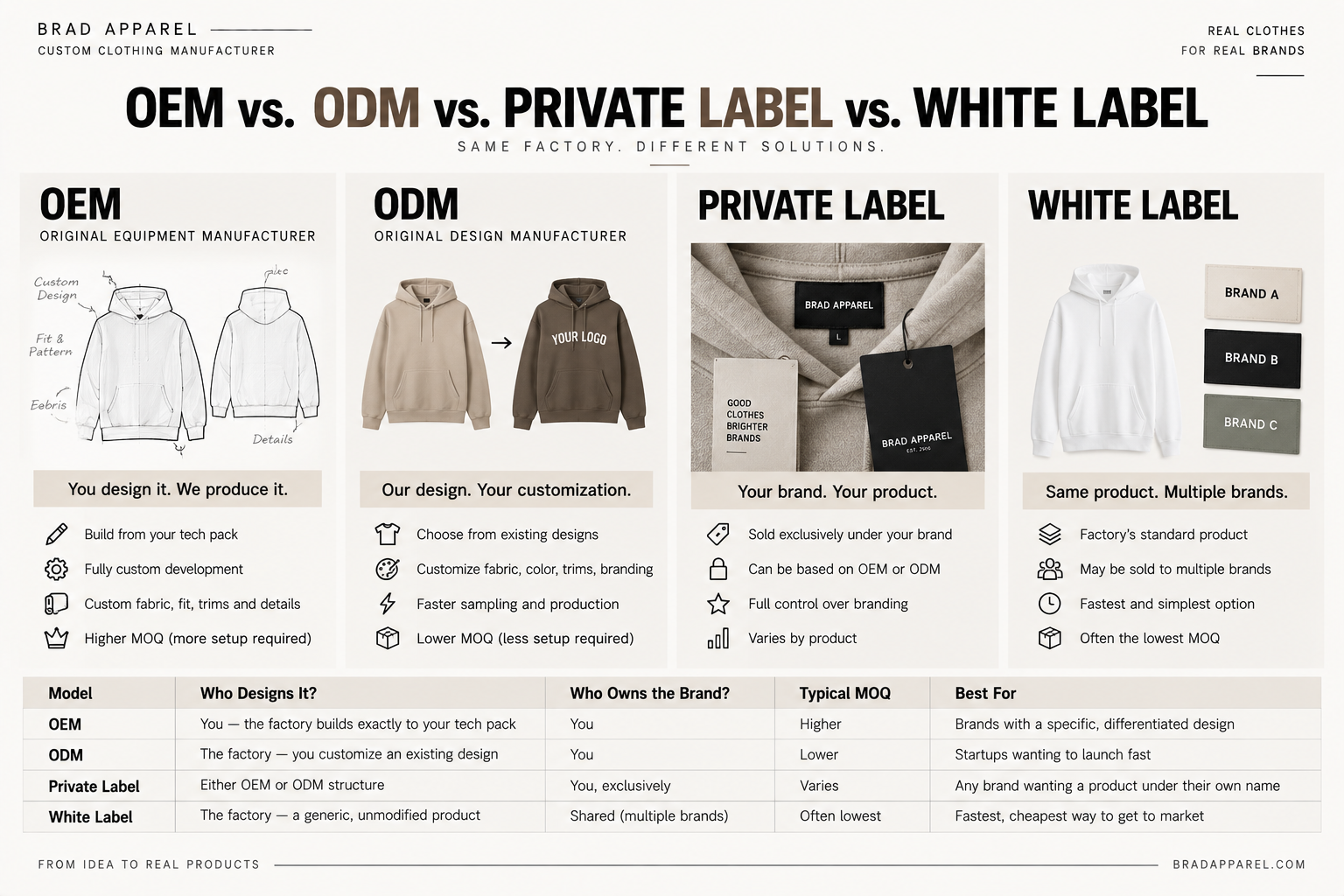
These four terms are often mixed together, but they describe two different parts of the manufacturing relationship.
OEM and ODM describe how the garment is developed.
Private label and white label describe how the finished product is branded and sold.
Quick Comparison
| Model | Who Designs It? | Who Owns the Brand? | Typical MOQ | Best For |
|---|---|---|---|---|
| OEM | You | You | Usually higher | Brands with fully custom designs |
| ODM | Factory base design + your customization | You | Usually lower | Startups and faster launches |
| Private Label | Can use OEM or ODM | You exclusively | Varies | Brands selling under their own name |
| White Label | Factory | Multiple brands may use the same base product | Often lowest | Fast, simple branded launches |
The easiest way to remember the difference is:
OEM / ODM = How was the garment developed?
Private Label / White Label = Whose brand is on the garment?
What Is OEM Apparel Manufacturing?
OEM stands for:
Original Equipment Manufacturer
In apparel manufacturing, OEM usually means the brand provides the product concept and specifications, while the factory manufactures the garment according to those requirements.
The brand may provide:
- Tech pack
- Measurements
- Pattern references
- Fabric requirements
- Colours
- Printing artwork
- Embroidery artwork
- Labels
- Packaging specifications
The factory then develops and produces the garment based on those specifications.
OEM Gives You More Control
OEM is suitable when you want control over:
- Fit
- Pattern
- Fabric
- GSM
- Construction
- Trims
- Decoration
- Labels
- Packaging
For example, you may request:
420 GSM fleece hoodie
80% cotton / 20% polyester
Oversized dropped-shoulder fit
Custom embroidery
Custom woven label
Custom zipper
This is very different from choosing an existing factory garment and simply adding your logo.
Who Is OEM Best For?
OEM is generally better suited to brands that:
- Already have a clear product concept
- Need a unique fit
- Want custom fabrics
- Need specific construction details
- Want greater control over the finished product
The trade-off is that fully custom development usually requires more setup.
This can mean:
- More sampling
- Pattern development
- More technical communication
- Higher MOQ than a standard existing product
What Is ODM Apparel Manufacturing?
ODM stands for:
Original Design Manufacturer
With ODM, the factory already has an existing product or base design.
You then customize selected parts of that product.
For example, a manufacturer may already have an oversized hoodie block.
You could customize:
- Fabric
- GSM
- Colour
- Printing
- Embroidery
- Labels
- Drawcord
- Packaging
without developing the entire garment from zero.
Why Brands Choose ODM
ODM can reduce development work because the basic product already exists.
That can make it useful for:
- Startup brands
- Testing a new category
- Faster launches
- Smaller initial production
- Brands without a complete tech pack
ODM does not necessarily mean the product cannot be customized.
It simply means the starting point comes from an existing manufacturer-developed base.
OEM vs. ODM
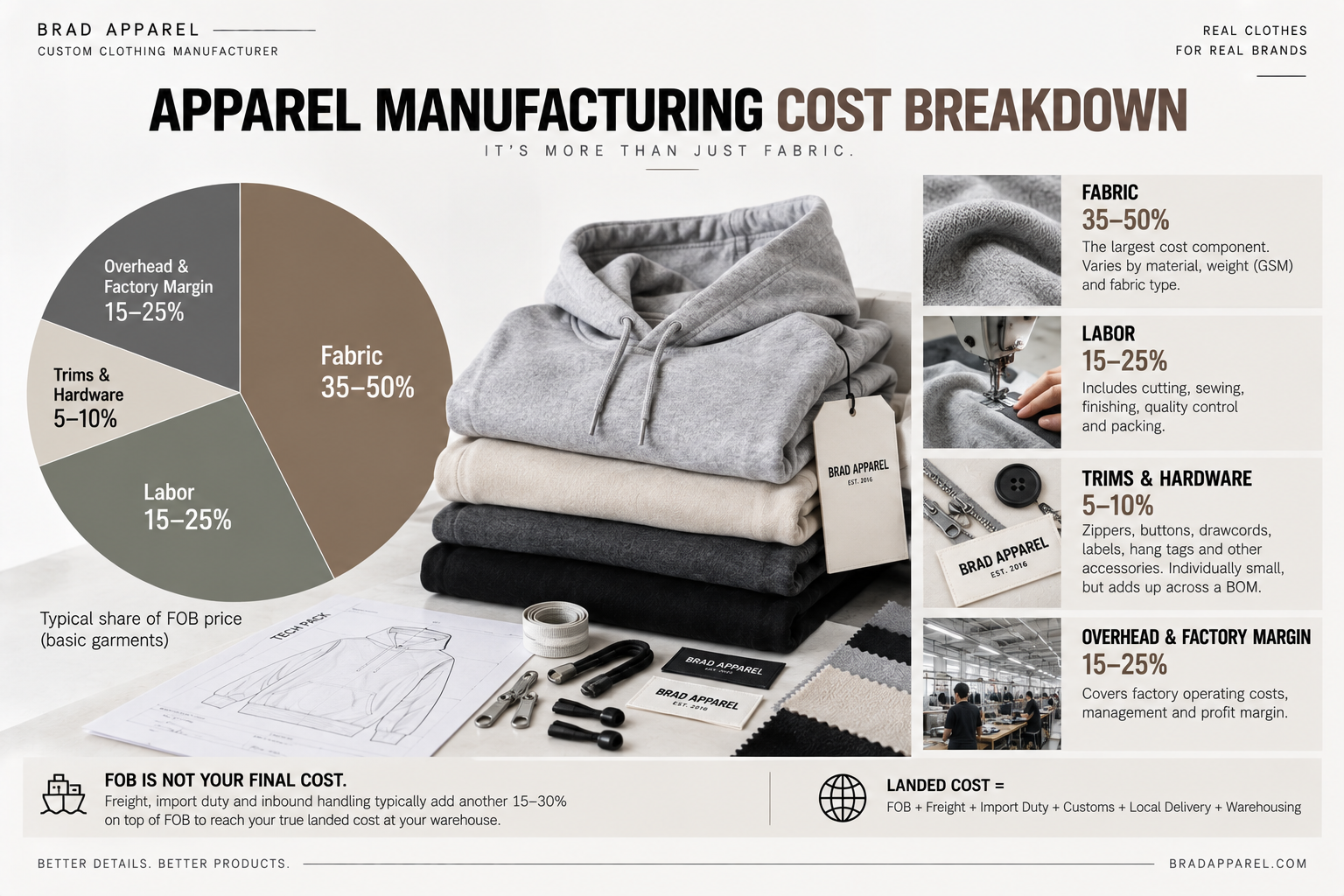
The main difference is where product development begins.
OEM
You start with:
Your design
The factory develops the product around it.
ODM
You start with:
The manufacturer's existing base product
Then customize it for your brand.
OEM vs. ODM Comparison
| Feature | OEM | ODM |
|---|---|---|
| Starting Point | Your original design | Existing factory design |
| Pattern Development | Usually required | Often already available |
| Product Control | Higher | Moderate to high |
| Development Time | Usually longer | Usually faster |
| MOQ | Often higher | Often lower |
| Best For | Unique custom products | Faster product launches |
Neither model is automatically better.
The right option depends on how much customization your brand actually needs.
What Is Private Label Apparel?
Private label means the garment is sold under your brand name.
The product may be manufactured through either:
- OEM
- ODM
Private label is therefore not necessarily a separate manufacturing system.
It describes the branding relationship.
For example:
You could develop a completely custom OEM hoodie and sell it under your brand.
That is:
OEM + Private Label
Or you could customize an existing factory ODM hoodie and sell it exclusively under your own brand.
That can be:
ODM + Private Label
What Is White Label Apparel?
White label usually involves a more standardized product.
The manufacturer already has a garment that may also be available to other buyers.
You mainly customize branding elements such as:
- Logo
- Neck label
- Hang tag
- Packaging
The base garment itself may remain largely unchanged.
White Label Is Usually Best When Speed Matters Most
White label can be useful when the priority is:
- Faster launch
- Minimal product development
- Lower setup requirements
- Simpler customization
But it usually provides less product differentiation.
Another brand may be selling a very similar base garment.
Private Label vs. White Label
The most important difference is exclusivity and customization.
Private Label
The product is developed and sold for your brand.
White Label
A generic base product may also be supplied to other brands.
This is why simply asking:
"Do you offer private label?"
does not fully explain what you need.
You should also tell the manufacturer how customized you want the actual garment to be.
How Apparel Pricing Actually Works
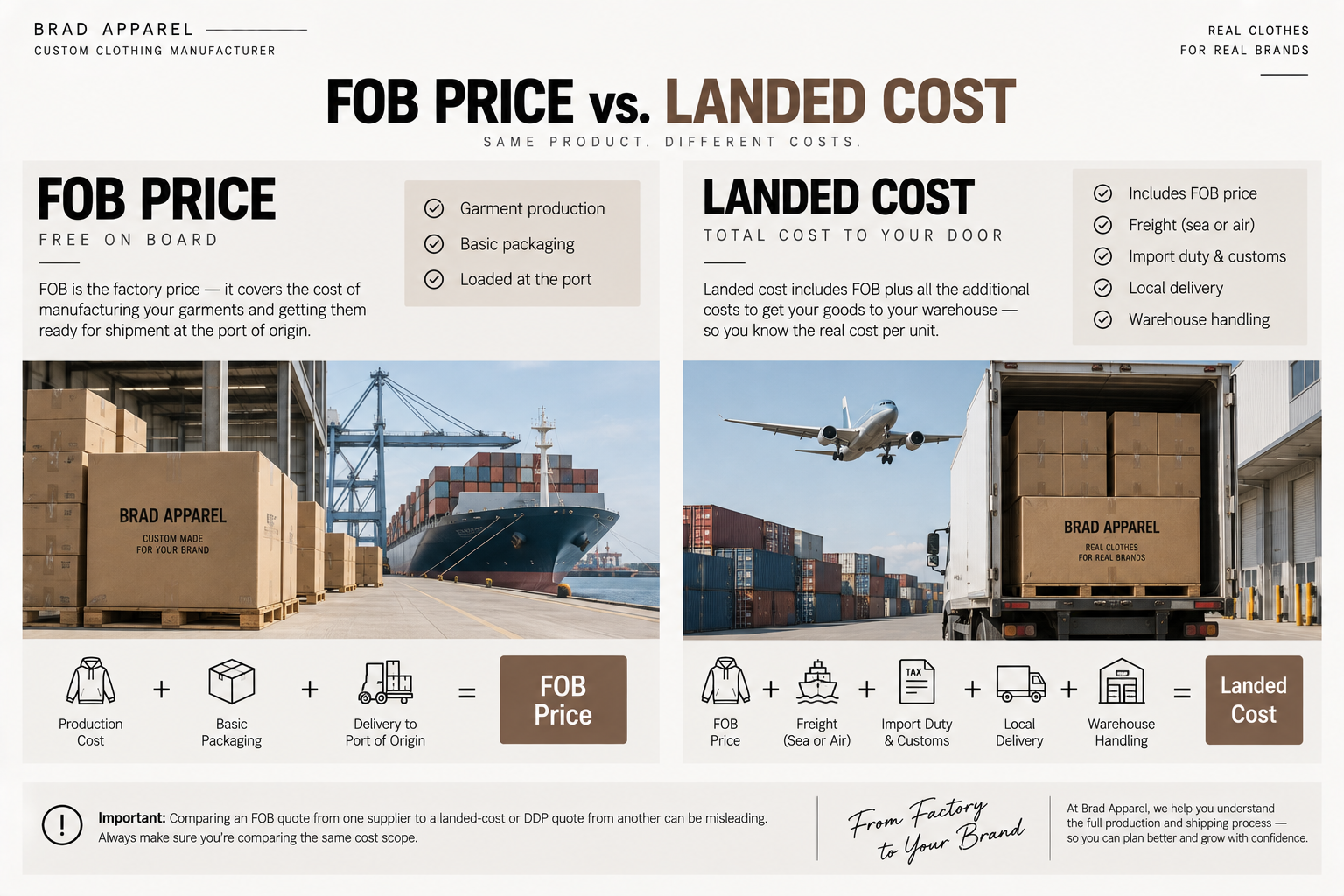
When a factory gives you a clothing quote, the number is built from several different costs.
For many basic garments, one of the largest components is the fabric.
Fabric
For basic garments, fabric may account for roughly:
35–50% of the FOB price
The percentage can become higher when using:
- Heavyweight fabric
- Premium cotton
- Specialty blends
- Custom dyeing
- Technical fabrics
This is why fabric specifications can change a garment quote significantly.
Labor
Labor can include:
- Cutting
- Sewing
- Finishing
- Quality control
- Ironing
- Packing
For many garments produced in Asian manufacturing regions, the source guide estimates labor at approximately:
15–25% of FOB
The actual percentage depends heavily on garment complexity.
Trims and Hardware
Individual components may look inexpensive, but they add up.
Possible trims include:
- Zippers
- Buttons
- Drawcords
- Eyelets
- Woven labels
- Main labels
- Size labels
- Hang tags
- Elastic
- Custom hardware
A garment with many customized components will naturally cost more than a simple basic T-shirt.
Factory Overhead and Margin
The remaining portion of the price also needs to cover areas such as:
- Production overhead
- Factory operating costs
- Quality management
- Factory margin
That is why comparing garments only by fabric price does not give you the full production cost.
What Does FOB Mean?
FOB stands for:
Free on Board
A factory FOB price is not necessarily the final cost of getting the product into your warehouse.
Your actual cost may still include:
- International freight
- Import duty
- Customs charges
- Local transportation
- Inbound handling
FOB Price vs. Landed Cost
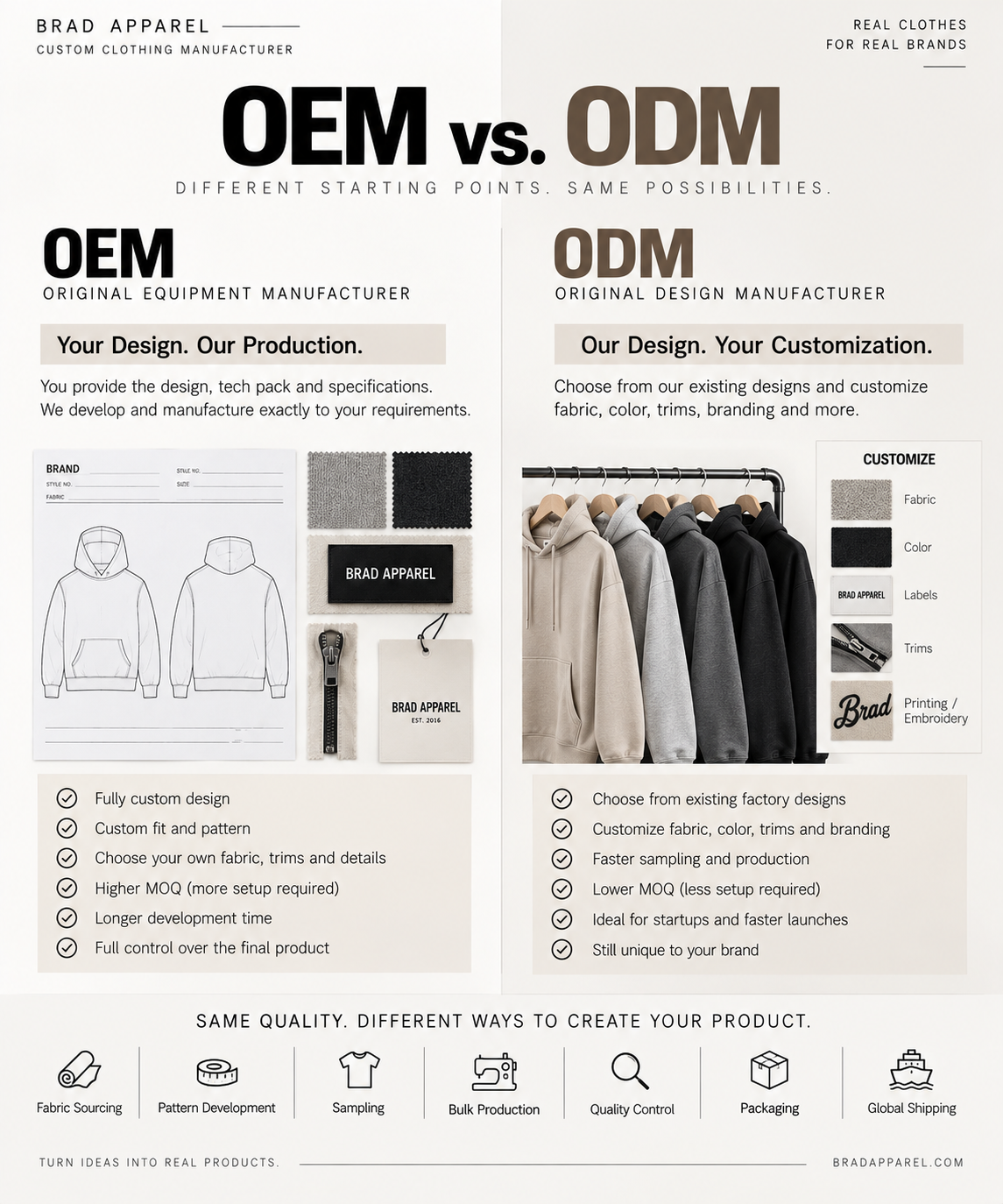
This distinction is extremely important when comparing supplier quotations.
For example:
Supplier A
Quotes:
FOB price
Supplier B
Quotes:
DDP or landed price
Supplier B may appear more expensive.
But the quotation may already include logistics or import-related costs that Supplier A has not included.
Comparing the two numbers directly would therefore be misleading.
Typical Landed-Cost Additions
The source guide estimates that freight, import duty and inbound handling can add approximately:
15–30% above FOB
depending on destination and shipment conditions.
Your real product cost should therefore be evaluated beyond the factory unit price.
Why This Matters Before Requesting a Quote
Before contacting a manufacturer, determine where your project sits on the customization spectrum.
If You Have a Fully Custom Design
You are closer to an OEM project.
Prepare:
- Design references
- Tech pack if available
- Measurements
- Fabric requirements
- GSM
- Artwork
- Target quantity
Expect more product development and sampling.
If You Want to Launch Faster
An ODM starting point may be more practical.
You can ask the factory:
- What existing fits are available?
- Which fabrics can be changed?
- Can colours be customized?
- Can labels be replaced?
- Can printing or embroidery be added?
- What is the MOQ?
This lets you develop a branded product without creating every element from scratch.
Always Start With the Fabric Specification
Whether you choose OEM or ODM, ask about fabric early.
Confirm:
- Composition
- Fabric type
- GSM
- Colour
- Finish
- Shrinkage
Fabric is one of the largest cost components in apparel manufacturing.
It also affects:
- Feel
- Structure
- Durability
- Decoration compatibility
- Final retail positioning
A clear fabric specification makes the quotation more meaningful.
A Better Way to Request an Apparel Quote
Instead of writing:
"How much for 100 hoodies?"
provide a clearer request.
For example:
Product: Oversized hoodie
Quantity: 100 pcs
Fabric: Cotton/poly fleece
Weight: 420 GSM
Colour: Black
Decoration: Front embroidery
Fit: Dropped shoulder oversized
Labels: Custom woven main label
Packaging: Individual polybag
This gives the manufacturer enough information to provide a more useful quotation.
How Brad Apparel Supports OEM and ODM Development
At Brad Apparel, we support both fully customized and adaptable-base apparel development.
Our custom manufacturing services include:
Fabric Sourcing
Our Fabric & Accessory Sourcing service can support:
- Fabric composition
- GSM selection
- Custom colours
- Ribbing
- Trims
- Hardware
- Labels
- Packaging
Pattern Development
For fully customized garments, Pattern Development can be used to turn a design or reference into a production-ready garment pattern.
This is particularly important for:
- Oversized fits
- Custom proportions
- Cropped fits
- Specialty bottoms
- Unique garment construction
FAQ
Is Private Label the Same as ODM?
No.
ODM describes how the product is developed.
Private label describes whose brand the product is sold under.
An ODM garment can also be a private-label garment.
Which Usually Has a Lower MOQ: OEM or ODM?
ODM typically requires less setup because an existing pattern or base garment is already available.
This can allow lower MOQs than a fully custom OEM product.
OEM projects may require:
- New pattern development
- More sampling
- Additional production setup
What Percentage of a Clothing Quote Is Fabric?
For a basic garment, the source guide estimates fabric at approximately 35–50% of the FOB price.
The percentage may be higher for premium or heavyweight fabrics.
Is FOB My Final Cost?
No.
FOB does not necessarily include:
- International freight
- Import duty
- Customs
- Local delivery
- Warehouse handling
Your landed cost gives a better picture of what the product actually costs once it reaches you.
What Is the Difference Between Private Label and White Label?
Private label products are sold under your brand and can be developed through OEM or ODM.
White-label products are usually standardized products that may also be supplied to other brands.
What MOQ Does Brad Apparel Work With?
Brad Apparel works with a 50-piece MOQ per style/color for most custom orders.
Sample turnaround is typically 4–7 days for many custom projects.
The exact MOQ and sampling time depend on the garment, fabric and customization requirements.
Final Thoughts
Understanding apparel manufacturing terminology makes supplier communication much easier.
The simplest way to remember it is:
OEM = Your design, manufactured by the factory
ODM = Factory base design, customized for your brand
Private Label = Your brand on the product
White Label = Standardized product that may be used by multiple brands
And when comparing prices, remember:
FOB price is not always your final landed cost.
Before requesting a quote, define:
- Product type
- Development model
- Fabric
- GSM
- Quantity
- Decoration
- Labels
- Packaging
- Shipping terms
The clearer your specifications are, the easier it becomes for a manufacturer to give you an accurate production plan and quotation.
Keep Reading