Fatigue pants are military-inspired trousers recognized by their large front patch pockets, clean straight-leg shape and practical workwear construction.
The classic design is closely associated with U.S. military OG-107 utility trousers, but modern fashion versions now appear across:
- Heritage menswear
- Streetwear
- Workwear
- Japanese Americana
- Contemporary casualwear
- Outdoor-inspired collections
- Premium basics
For clothing brands, fatigue pants are more technical than they first appear.
Their identity depends on the relationship between:
fabric + rise + hip ease + thigh width + front patch pockets + back pockets + waistband + leg shape + washing
A poorly positioned front pocket can make the entire pant look wrong.
A fabric that is too stiff can turn a relaxed military trouser into a bulky work pant.
And a leg that tapers too aggressively can lose the characteristic fatigue-pant silhouette.
This guide explains what fatigue pants are, how OG-107 and baker-pant details work, and what brands should specify before developing them for production.
What Are Fatigue Pants?
Fatigue pants are utility trousers originally associated with military work uniforms.
Traditional versions generally use:
- High or medium rise
- Relaxed hip
- Straight leg
- Large front patch pockets
- Back patch pockets
- Durable cotton fabric
- Simple closure
- Functional construction
The overall design is deliberately uncomplicated.
Unlike cargo pants, fatigue pants do not depend on large side-thigh cargo pockets.
Instead, much of their identity comes from the distinctive front pockets.
These are often called:
baker pockets
because of their large rectangular or curved patch-pocket shape.
What Does OG-107 Mean?
OG-107 refers to a well-known U.S. military utility uniform associated with an olive-green color specification and a family of fatigue garments.
The trousers became recognizable for their combination of:
- Olive cotton fabric
- Straight relaxed fit
- Large front patch pockets
- Simple back pockets
- Practical waistband construction
Modern brands frequently use the OG-107 trouser as inspiration.
However, a fashion brand does not need to reproduce an original military specification exactly.
Modern versions may change:
- Rise
- Leg width
- Fabric
- Pocket size
- Closure
- Color
- Wash
- Hardware
while keeping the visual language recognizable.
Why Are Fatigue Pants Relevant to Men's Fashion in 2026?
Menswear trouser proportions are moving toward a practical middle ground.
Instead of extremely skinny pants or extremely oversized trousers, many modern men's fits use:
- Higher or medium rises
- More room through the thigh
- Straight legs
- Cleaner hems
Fatigue pants already have these proportions built into their design.
They also fit naturally with several broader menswear directions:
- Military-inspired clothing
- Heritage workwear
- Earth-tone palettes
- Rugged casualwear
- Japanese Americana
- 1990s-inspired straight fits
- Simple functional design
This makes them useful for brands that want a trouser with more character than a chino but less complexity than a cargo pant.
Fatigue Pants vs Baker Pants
These terms are often used almost interchangeably in modern fashion.
A baker pant generally refers to the fatigue-style trouser with:
- Large front patch pockets
- Relaxed utility construction
- Straight leg
The term is especially common in:
- Japanese menswear
- Heritage clothing
- Reproduction workwear
From a manufacturing perspective, do not rely only on the product name.
Specify the actual:
- Pocket shape
- Rise
- Fit
- Waistband
- Fabric
- Back-pocket construction
because two products both called "baker pants" may fit very differently.
Fatigue Pants vs Cargo Pants
This is one of the most important distinctions.
Fatigue Pants
Usually rely on:
- Large front patch pockets
- Simple leg
- Minimal side details
- Clean military utility appearance
Cargo Pants
Usually rely on:
- Side-thigh cargo pockets
- Flaps
- Bellows
- Snaps
- More complex utility detailing
A fatigue pant can include additional pockets.
But once large side cargo pockets become the dominant feature, the garment begins to read more like a cargo pant.
Fatigue Pants vs Chinos
Chinos usually have a cleaner trouser construction.
Common chino details include:
- Slant front pockets
- Welt back pockets
- More conventional trouser waistband
- Cleaner dress-casual appearance
Fatigue pants normally look more rugged because of their visible patch pockets.
Think of the difference as:
Chino = clean trouser utility
Fatigue pant = visible military / workwear utility
Fatigue Pants vs Utility Pants
"Utility pants" is a much broader category.
Utility pants may include:
- Cargo pants
- Work pants
- Carpenter pants
- Technical pants
- Fatigue pants
So fatigue pants are one specific type of utility trouser.

Baker Pockets Are the Signature Detail
The front pockets have a major influence on the final appearance.
Traditional fatigue-style front pockets are usually:
- Large
- Visible
- Patch constructed
- Positioned high on the front body
They may use:
- Straight top opening
- Slight curved opening
- Angled opening
- Reinforced top edge
The pocket needs to look functional without overwhelming the leg.
Front Pocket Width
Pocket width should relate to:
- Waist
- Hip
- Size
- Trouser width
If the pocket is too narrow:
- It may look decorative
- Hand access becomes poor
If it is too wide:
- It may dominate the entire front
- Side seams can feel crowded
Pocket dimensions should normally grade with garment size.
Front Pocket Height
A long pocket creates stronger military character.
But the pocket bottom should not sit awkwardly near:
- Crotch level
- Upper thigh seam
- Knee
The first sample should be checked while worn rather than only flat.
Pocket Opening
The opening must be large enough for comfortable hand access.
Check:
- Opening length
- Opening angle
- Reinforcement
- Topstitching
A pocket may look correct visually but still be uncomfortable to use.
Reinforcing the Pocket Opening
The opening receives frequent stress.
Possible reinforcement methods include:
- Bartacks
- Triangle reinforcement
- Extra topstitching
- Internal reinforcement
- Double-layer construction
The correct solution depends on fabric weight.
Pocket Corners
Sharp pocket corners concentrate stress.
Rounded or angled corners can sometimes improve:
- Durability
- Sewing consistency
If square military-style corners are required, reinforce them properly.
Back Pocket Construction
Classic fatigue pants often use visible back pockets.
Possible versions include:
- Plain patch pocket
- Patch pocket with flap
- Buttoned patch pocket
- Welt pocket
- One pocket only
- Two symmetrical pockets
Changing the back pocket can significantly change the product direction.
Flap Back Pockets
A flap adds:
- Security
- Military character
- Visual structure
Possible closures include:
- Button
- Snap
- Hidden snap
- No closure
The flap width should normally align visually with the pocket beneath it.
Patch Pocket Placement
Back-pocket placement affects how the seat looks.
Too high can make the rise appear shorter.
Too low can make the seat look dropped.
Check placement on:
- Small size
- Base sample size
- Large size
rather than assuming one fixed distance works for every size.
Waist Rise
Fatigue pants historically work particularly well with a higher rise.
Modern versions can be:
- High rise
- Mid rise
- Lower rise
But the rise changes the entire proportion.
Higher Rise
Creates:
- Stronger vintage appearance
- Longer leg line
- More OG-107 character
Mid Rise
Creates:
- Easier commercial fit
- More contemporary appearance
Low Rise
Creates:
- More fashion-driven interpretation
- Less traditional military character
The waistband position should be decided before pocket placement is finalized.
Front Rise and Back Rise
Important measurements include:
- Front rise
- Back rise
A relaxed fatigue pant still needs correct seat shaping.
If the back rise is too short:
- Waist may pull downward
- Seat becomes tight
If it is too long:
- Excess fabric can collapse below the waistband
Hip Ease
Fatigue pants should normally provide enough room for movement.
A traditional look may use:
- Relaxed hip
- Comfortable seat
- Moderate crotch depth
Modern slim versions may reduce that ease.
But removing too much room can make large patch pockets:
- Flare
- Pull
- Distort
The pocket and fit need to be developed together.
Thigh Width
The thigh is one of the most important silhouette measurements.
Too narrow:
- Garment looks like slim chinos with patch pockets
Too wide:
- Garment can become baggy cargo-style trousers
A classic fatigue pant usually uses a comfortable thigh with a relatively clean vertical line.
Straight-Leg Fatigue Pants
A straight leg is the most recognizable shape.
Typical relationship:
roomy thigh → controlled knee → similar or slightly reduced hem
This creates a clean line without aggressive taper.
Straight fatigue pants work particularly well with:
- Boots
- Sneakers
- Loafers
and layered menswear styling.
Relaxed Fatigue Pants
A relaxed version may use:
- Wider hip
- Wider thigh
- Wider hem
This works well for:
- Streetwear
- Contemporary menswear
- Oversized styling
The leg should still look intentionally shaped.
"Relaxed" should not mean simply increasing every width without proportion control.
Tapered Fatigue Pants
Some modern versions taper toward the ankle.
This can create:
- Cleaner silhouette
- Easier footwear pairing
- More contemporary fit
However, too much taper changes the category.
A strongly tapered pant may look closer to:
- Jogger-inspired utility pants
- Modern chinos
than traditional fatigues.
Wide-Leg Fatigue Pants
Wide versions can preserve the baker-pocket identity while increasing:
- Thigh width
- Knee width
- Leg opening
This creates a more fashion-forward interpretation.
The pocket should be scaled up enough so it does not appear too small on the wider leg.
Fatigue Pants Pattern Development
Important measurements usually include:
- Waist
- High hip
- Full hip
- Front rise
- Back rise
- Thigh
- Knee
- Leg opening
- Inseam
- Outseam
- Front pocket width
- Front pocket height
- Back pocket position
- Waistband height

Side Seam Position
The side seam should remain visually balanced.
Large front pockets can sometimes make the front panel appear wider.
Check the garment from the side.
The side seam should not twist excessively:
- Forward
- Backward
unless the design intentionally uses twisted construction.
Inseam Shape
The inseam influences:
- Thigh comfort
- Crotch movement
- Knee shape
A straight-looking outer silhouette still needs correct internal shaping.
The pant should be tested while:
- Walking
- Sitting
- Squatting lightly
What Fabric Were Traditional Fatigue Pants Made From?
One of the most recognizable traditional directions uses cotton sateen or reverse sateen.
Modern fatigue pants can use many fabrics.
Common options include:
- Reverse sateen
- Cotton sateen
- Cotton twill
- Herringbone twill
- Ripstop
- Canvas
- Cotton/nylon blends
- Corduroy
- Denim
The fabric dramatically changes the character.
What Is Reverse Sateen?
Reverse sateen—sometimes called back sateen—uses the reverse side of a sateen weave as the visible face.
It can create:
- Matte surface
- Subtle texture
- Softening with wear
- Strong heritage appearance
This makes it particularly suitable for military-inspired fatigue pants.
Sateen vs Satin
These terms should not be confused.
Sateen
Normally uses spun yarn such as cotton and has a satin-type weave structure.
Satin
Usually refers to a similar weave structure made using smoother filament yarns such as:
- Silk
- Polyester
- Nylon
Traditional fatigue-pant fabric should not be described as shiny fashion satin.
The appearance is normally much more matte and rugged.
Cotton Twill
Cotton twill provides:
- Durability
- Stable structure
- Easy sourcing
- Broad color possibilities
It is a good modern alternative when exact military reproduction is not required.
Possible weights can range from relatively light to heavy.
The correct weight depends on the target silhouette.
Herringbone Twill
HBT fabric creates a visible chevron-like weave.
It has strong associations with:
- Military clothing
- Workwear
- Heritage garments
Herringbone twill can make a fatigue pant feel more textured and vintage.
Ripstop
Ripstop contains reinforced yarns forming a visible grid.
It can create:
- Lighter weight
- Military appearance
- Functional character
It works well for:
- Spring / summer fatigues
- Technical reinterpretations
- Lightweight utility pants
The hand feel is very different from reverse sateen.
Canvas
Canvas provides:
- Heavy structure
- Durability
- Workwear appearance
It can work for fatigue pants, but very heavy canvas may make the large front pockets bulky.
Check:
- Pocket seam thickness
- Waistband bulk
- Fly construction
before approving the fabric.
Cotton/Nylon Fatigue Pants
Cotton/nylon blends can create a more technical version.
Possible benefits include:
- Lower weight
- Faster drying
- Added strength
- Different surface character
This moves the garment away from pure heritage reproduction and toward modern utility clothing.
For custom material sourcing, see Brad Apparel's Fabric Sourcing & Development.
Fabric Weight
There is no single required fatigue-pant weight.
A practical development framework might include:
Lightweight
Useful for:
- Warm weather
- Ripstop
- Soft utility pants
Midweight
Useful for:
- Everyday fatigue pants
- Reverse sateen
- Cotton twill
Heavyweight
Useful for:
- Structured workwear
- Heritage products
- Heavy canvas
The best choice depends on:
fit + climate + desired structure + washing
rather than one fixed GSM.
Olive Green
Olive remains the most recognizable fatigue-pant color.
But even "olive" covers many directions:
- Olive drab
- Army green
- Sage
- Brown olive
- Gray olive
- Dark forest olive
A physical color reference is useful for production.
Modern Fatigue-Pant Colors
Modern versions can also use:
- Black
- Navy
- Ecru
- Khaki
- Brown
- Charcoal
- Stone
- Indigo
- Rust
Changing the color can make the silhouette feel less obviously military.
Garment Dyeing
Fatigue pants work especially well with garment-dyed finishes.
A typical sequence may be:
prepared fabric → cutting → sewing → garment dyeing → finishing
Possible effects include:
- Softer hand
- Slight seam variation
- Vintage appearance
- Rich muted colors
But garment dyeing affects measurements.
Always evaluate the final garment after the intended processing.
Pigment Dyeing
Pigment finishes can create:
- Washed appearance
- Surface variation
- Faster fading
- Vintage character
This works well for:
- Black
- Charcoal
- Brown
- Faded olive
But rubbing and colorfastness should be tested.
Sulfur-Dyed Fabrics
Sulfur dyes can produce deep:
- Olive
- Brown
- Black
- Earth tones
and may develop visible aging over time.
They work particularly well for brands that want fatigue pants to develop patina through wear.
Stone Washing
Stone or abrasion-based finishing can create:
- Softer fabric
- Worn seams
- Vintage color variation
But excessive abrasion can weaken:
- Pocket corners
- Belt loops
- Hem edges
These areas should be inspected after washing.
Enzyme Washing
Enzyme washing can soften cotton and reduce surface fuzz.
It can create a more controlled worn-in appearance than aggressive distressing.
The process needs to be tested against:
- Fabric weight
- Dye
- Shrinkage
Pre-Washed Fatigue Pants
A clean pre-wash can make the garment feel:
- Softer
- More comfortable
- Less rigid
without creating a strongly distressed appearance.
This is often a good option for premium basics.
Waistband Construction
Possible waistband designs include:
- Standard fixed waistband
- Internal facing
- Side adjusters
- Elastic back
- Drawcord
- Belt loops
Traditional fatigue-pant styling often looks best with a relatively clean fixed waistband.
Side Adjusters
Side adjusters are a useful military-inspired detail.
They allow limited waist adjustment without a belt.
Possible systems include:
- Button tabs
- Buckle tabs
- Metal adjusters
The adjustment range should be defined.
For example:
approximately 4 cm adjustment per side
is clearer than:
adjustable waist.
Button Side Tabs
Button tabs are relatively simple.
They can use:
- One alternate position
- Multiple button positions
The tab should not create excessive bulk at the waist.
Metal Side Adjusters
Metal hardware creates a more premium or technical appearance.
Check:
- Slider function
- Fabric thickness
- Hardware edges
- Plating
- Wash compatibility
The adjuster should remain secure during wear.
Belt Loops
Even pants with side adjusters may include belt loops.
Important details include:
- Loop width
- Loop length
- Number of loops
- Reinforcement
The back-center loop often receives significant tension.
Front Closure
Common options include:
- Button fly
- Zipper fly
- Snap + zipper
- Button waistband + zipper
Traditional reproductions may use button fly construction.
Modern commercial versions often use zippers for easier wear.
Button Fly
A button fly reinforces heritage styling.
It requires control of:
- Button spacing
- Fly extension
- Buttonhole size
- Reinforcement
A heavy fabric can create significant bulk when several layers overlap.
Zipper Fly
A zipper fly creates:
- Faster dressing
- Familiar trouser construction
- Cleaner commercial finish
Possible zipper types include:
- Metal
- Coil
The zipper weight should match the fabric.
Custom Buttons
Possible options include:
- Urea-style buttons
- Metal buttons
- Resin
- Custom logo buttons
Button color can be:
- Tonal
- Contrast
- Military-inspired
For custom buttons, labels and trims, see Brad Apparel's Trims & Branding.
Stitching
Fatigue pants normally benefit from visible durable stitching.
Possible constructions include:
- Single-needle topstitching
- Double-needle stitching
- Chain stitching
- Felled seams
- Overlock + topstitch
The exact method depends on:
- Fabric
- Price level
- Visual direction
Tonal Stitching
Tonal thread creates:
- Cleaner appearance
- More modern styling
- Less visual noise
It works well for:
- Black
- Navy
- Minimal olive
Contrast Stitching
Contrast thread emphasizes:
- Pockets
- Seams
- Waistband
This moves the garment closer to:
- Workwear
- Heritage
- Vintage utility
The thread color should be approved against the final washed garment.
Seam Construction
Durability matters especially at:
- Crotch
- Seat
- Pocket corners
- Side seam
- Inseam
The construction should match how the garment will be used.
A fashion fatigue pant does not need military-spec engineering, but weak seams will still reduce perceived quality.
Crotch Reinforcement
Depending on fit and fabric, additional reinforcement may be useful.
Possible methods include:
- Strong seam construction
- Additional stitch rows
- Reinforced seam allowance
A gusset is possible but not typical for every fatigue design.
Hem Options
Common hems include:
- Standard double-turn hem
- Chain-stitched hem
- Blind hem for refined versions
- Drawcord hem
- Adjustable tab
The hem can significantly change the category.
Clean Hem
A simple clean hem preserves the classic trouser silhouette.
It works best for:
- Straight
- Relaxed
- Heritage fatigue pants
Drawcord Hem
A drawcord can transform the leg into:
- Adjustable straight fit
- Cinched utility fit
This creates a more technical product.
But if cinching is not part of the intended design, it can dilute the classic fatigue-pant identity.
Cuffing
Many fatigue pants are styled cuffed.
If the brand expects cuffing, consider:
- Inseam
- Hem width
- Interior seam finishing
A heavy seam inside the cuff may look bulky.
Fatigue Pants Pattern & Construction Summary
A production-ready fatigue pant normally coordinates:
- Rise
- Hip ease
- Thigh
- Straight leg
- Baker pockets
- Back pockets
- Waistband
- Fly
- Belt loops / adjusters
- Fabric
- Wash
- Stitching
The simplest-looking details are often the most visible.
How to Describe Fatigue Pants to a Manufacturer
Instead of writing:
I need olive military pants.
write:
Men's mid-to-high-rise fatigue pants in 100% cotton reverse sateen with a relaxed straight fit, large front baker pockets, two buttoned back patch pockets, zipper fly, belt loops and button-tab side adjusters. Garment washed for a soft vintage olive finish.
Then provide:
- Waist
- Front rise
- Back rise
- Hip
- Thigh
- Knee
- Leg opening
- Inseam
- Pocket dimensions
- Pocket placement
- Waistband height
- Fly
- Adjuster
- Fabric
- Color
- Wash
- Stitching
- Branding
This gives the pattern maker a much clearer starting point.
Example Classic OG-107-Inspired Brief
Men's high-rise fatigue trousers in medium-weight olive 100% cotton reverse sateen. Relaxed hip and thigh with straight leg, large front patch pockets, buttoned back pockets and button fly. Clean one-wash finish with tonal stitching.
Example Modern Straight Fatigue Pants
Men's mid-rise fatigue pants in washed cotton twill with a relaxed straight silhouette, large front baker pockets, two clean back patch pockets, zipper fly and belt loops. Deep olive color with minimal fading.
Example Black Streetwear Fatigue Pants
Men's relaxed black fatigue pants in garment-dyed cotton twill, slightly wider straight leg, oversized front patch pockets, button side adjusters, matte black hardware and tonal stitching.
Example Lightweight Ripstop Fatigue Pants
Men's lightweight fatigue trousers in cotton ripstop with medium rise, straight leg, large front patch pockets, rear flap pockets, zipper fly and adjustable waist tabs. Designed for warm-weather casualwear.
Fatigue Pants Tech Pack Example
| Area | Example Specification |
|---|---|
| Product | Men's Fatigue Pants |
| Fit | Relaxed Straight |
| Rise | Mid / High |
| Fabric | Reverse Sateen |
| Composition | 100% Cotton |
| Color | Olive |
| Front Pocket | Large Baker Patch Pocket |
| Back Pocket | Buttoned Patch Pocket |
| Waistband | Fixed |
| Adjuster | Button Side Tabs |
| Closure | Zipper Fly |
| Belt Loops | Yes |
| Stitching | Tonal |
| Wash | Soft Garment Wash |
| Hem | Double Turn |
| Branding | Woven Main + Care Label |
These values are examples only.
Important Fatigue Pants Measurements
| Measurement | Why It Matters |
|---|---|
| Waist | Controls waist fit |
| Front Rise | Determines front proportion |
| Back Rise | Controls seat fit |
| Hip | Controls overall ease |
| Thigh | Defines relaxed silhouette |
| Knee | Controls leg transition |
| Leg Opening | Determines straight / tapered appearance |
| Inseam | Controls finished length |
| Outseam | Confirms overall proportion |
| Front Pocket Width | Controls signature pocket scale |
| Front Pocket Height | Affects visual balance and function |
| Back Pocket Position | Affects seat appearance |
| Waistband Height | Changes military / modern proportion |
Size Grading
Fatigue pants should preserve the relationship between:
waist + hip + leg + pocket scale
as sizes increase.
A common mistake is grading the trouser body while barely changing the front pockets.
On larger sizes, the pockets can then look too small.
On smaller sizes, fixed oversized pockets may dominate the front.
Pocket Grading
Brands need to decide how much the pockets should grow.
Possible strategies include:
- Full proportional grading
- Small controlled increments
- Mostly fixed dimensions
There is no universal rule.
The visual result should be checked across several sizes.
Rise Grading
The rise may increase gradually across the size range.
Too little grading can create:
- Tight crotch
- Low back waist
Too much can create:
- Excess seat
- Dropped appearance
The target fit should remain recognizable across sizes.
Leg Opening Grading
If the hem grows too quickly, larger sizes can become wide-leg.
If it grows too little, they may appear tapered.
The brand should define the intended straight-line relationship across sizes.
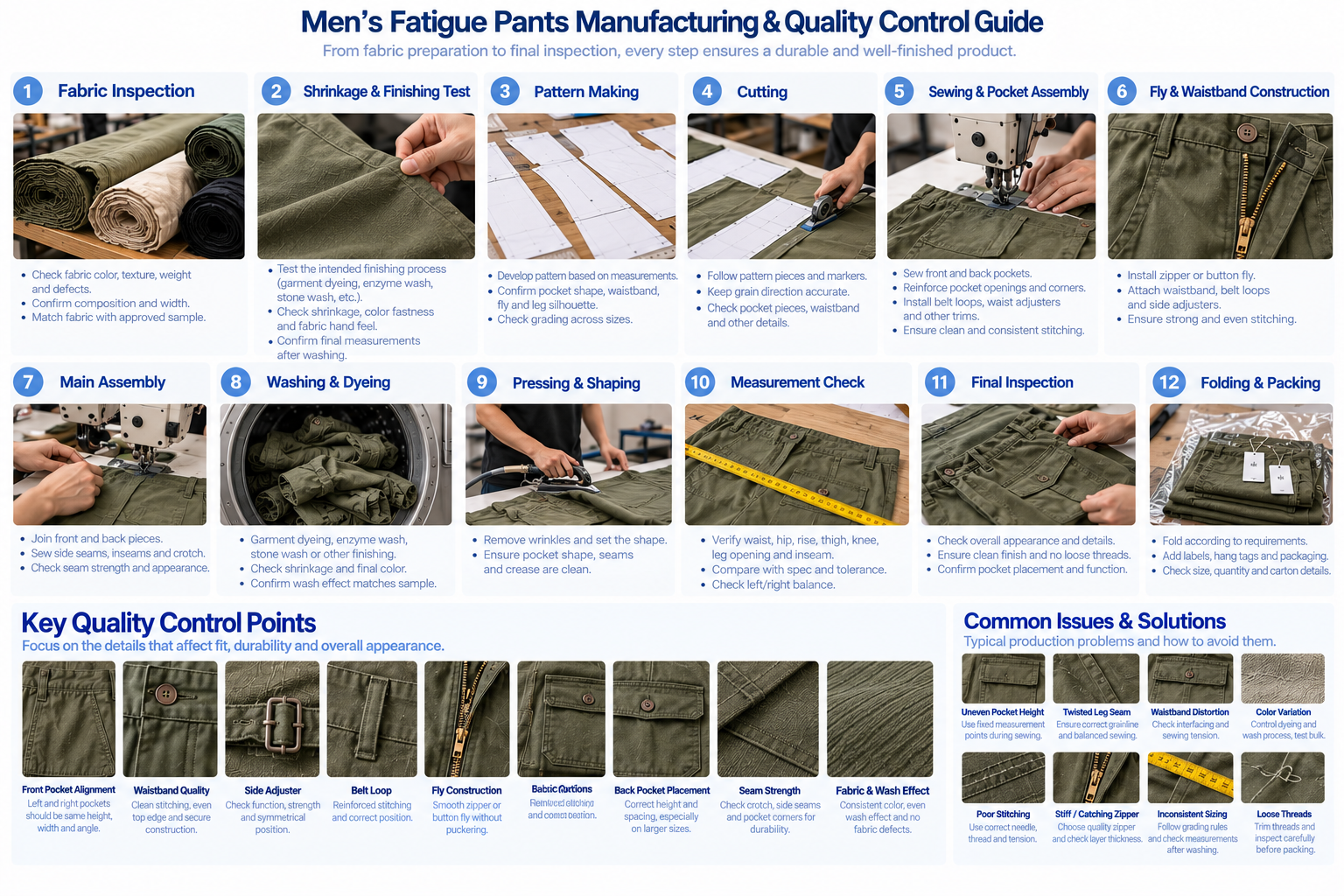
Fatigue Pants Manufacturing Workflow
A practical production sequence is:
- Fabric inspection
- Shrinkage test
- Pattern development
- Pocket pattern confirmation
- Cutting
- Pocket preparation
- Front / back assembly
- Fly and waistband construction
- Leg assembly
- Topstitching and reinforcement
- Garment washing / finishing
- Measurement check
- Final QC
- Packing
Fabric Inspection
Before cutting, check:
- Color
- Width
- Weight
- Surface
- Defects
- Bow / skew where relevant
For garment-dyed products, the initial fabric may not represent final color, but fabric quality still needs approval.
Shrinkage Testing
Cotton fatigue fabrics can change during:
- Washing
- Garment dyeing
- Drying
Test the actual intended process.
Compare:
- Length
- Width
- Hand feel
- Surface
before and after finishing.
Pocket Preparation
Because the front pockets are so visible, pocket preparation needs control.
Check:
- Pocket dimensions
- Left/right symmetry
- Fold width
- Corner shape
- Opening reinforcement
Poor pocket preparation will remain visible even if the rest of the trouser is sewn correctly.
Pocket Placement QC
Measure both front pockets from consistent reference points.
For example:
- Waist seam
- Side seam
- Center front
Check that left and right pockets have:
- Equal height
- Equal width
- Consistent angle
unless intentional asymmetry is part of the design.
Back Pocket QC
Check:
- Height
- Spacing
- Flap
- Button position
- Alignment
Back pockets are especially noticeable when worn.
Waistband QC
Inspect:
- Waist measurement
- Top-edge shape
- Belt-loop spacing
- Side adjusters
- Closure
- No twisting
The waistband should sit cleanly after washing.
Fly QC
Check:
- Straight zipper / button placement
- Fly length
- Topstitching
- No puckering
- Smooth operation
A heavy reverse sateen may need careful layer control around the fly.
Side Adjuster QC
If side adjusters are used, test:
- Both sides
- Adjustment range
- Button / buckle security
- Fabric distortion
The waist should remain reasonably balanced when adjusted.
Leg Balance
Hang the trousers vertically.
Check whether:
- Side seams twist
- Inseams rotate
- One leg appears longer
- Hem angles differ
Twisting can result from:
- Fabric skew
- Cutting
- Incorrect sewing
- Wash distortion
Measurement Check
Measure after the final production wash.
Important points include:
- Waist
- Rise
- Hip
- Thigh
- Knee
- Leg opening
- Inseam
The finished garment is the measurement standard that matters to the customer.
Color Consistency
For garment-dyed or washed fatigue pants, compare several pieces together.
Check:
- Main body
- Waistband
- Seam areas
Natural wash variation may be acceptable.
Large unexplained shade differences may not be.
Wash Effect
The wash should match the approved standard.
Possible issues include:
- Excessive fading
- Uneven abrasion
- Pocket-edge damage
- Different shade between panels
Do not judge only one garment.
Compare bulk pieces side by side.
Common Fatigue Pants Development Mistakes
1. Making the Front Pockets Too Small
The garment loses its recognizable baker-pocket proportion.
2. Making the Pants Too Slim
They begin to resemble chinos with patch pockets.
3. Making the Leg Too Tapered
The classic straight fatigue silhouette disappears.
4. Choosing Fabric That Is Too Heavy
Pocket, fly and waistband layers become bulky.
5. Using Soft Fabric With No Pocket Support
Large pockets may sag.
6. Ignoring Pocket Grading
The pockets look incorrect across different sizes.
7. Placing Back Pockets Too Low
The seat appears visually dropped.
8. Forgetting Wash Shrinkage
The rise, inseam and waist can change after finishing.
9. Weak Pocket Reinforcement
High-use areas can fail prematurely.
10. Copying Cargo-Pant Details
Too many side pockets and straps can dilute the fatigue-pant identity.
Fatigue Pants vs Cargo Pants: Which Should Your Brand Develop?
Choose fatigue pants if you want:
- Cleaner military styling
- Large baker pockets
- Straight relaxed fit
- Heritage / workwear character
- Simple functional construction
Choose cargo pants if you want:
- More storage
- Thigh pockets
- Stronger technical / utility appearance
- More visible hardware
Choose chinos if you want:
- Cleaner front
- More conventional trouser styling
- Easy smart-casual use
For a broader overview of trouser categories, see Brad Apparel's Complete Guide to Pants Types.
Fatigue Pants vs Field Jacket
Both come from military-inspired utility clothing, but they solve different product needs.
A fatigue pant focuses on:
- Baker pockets
- Straight leg
- Waist construction
- Durable woven fabric
A field jacket focuses on:
- Multi-pocket upper body
- High collar
- Front closure
- Outerwear layering
A brand can combine both in one collection without the products becoming redundant.
Modern Men's Fatigue Pants Should Balance Heritage and Fit
Brands do not need to reproduce a vintage military trouser exactly.
A modern version may retain:
- Baker pockets
- Olive color
- Straight leg
- Military-inspired fabric
while adjusting:
- Rise
- thigh
- inseam
- pocket scale
- waistband
for a contemporary customer.
The key is deciding which heritage details are essential to the identity and which can be updated.
FAQ
What Are Fatigue Pants?
Fatigue pants are military-inspired utility trousers typically characterized by large front patch pockets, a relaxed fit and straight leg.
They are closely associated with classic OG-107 military trousers.
What Are Baker Pants?
Baker pants are a fashion term commonly used for fatigue-style trousers with large front patch pockets.
The terms baker pants and fatigue pants often overlap.
What Are OG-107 Pants?
OG-107 trousers are associated with U.S. military utility uniforms and are recognizable for their olive color, functional pockets and straightforward military construction.
Modern brands often reinterpret this style.
Are Fatigue Pants in Style in 2026?
Yes.
Fatigue pants fit strongly into current men's interest in military utility clothing, straight relaxed trousers, heritage workwear and olive or earth-tone colors.
Are Fatigue Pants the Same as Cargo Pants?
No.
Cargo pants are usually defined by large side-thigh cargo pockets.
Fatigue pants are more strongly identified by large front patch or baker-style pockets.
What Is the Difference Between Fatigue Pants and Chinos?
Chinos generally use cleaner trouser pockets such as slant front pockets.
Fatigue pants use large visible patch pockets and have stronger military / workwear character.
What Fabric Is Best for Fatigue Pants?
Common options include:
- Reverse sateen
- Cotton sateen
- Cotton twill
- Herringbone twill
- Ripstop
- Canvas
- Cotton/nylon blends
The correct fabric depends on the intended season, fit and styling.
What Is Reverse Sateen?
Reverse sateen uses the reverse side of a sateen weave as the visible fabric face.
It usually creates a matte, durable and heritage-oriented appearance that works particularly well for fatigue pants.
Are Fatigue Pants Usually Olive?
Olive is the most traditional color, but modern fatigue pants can also be:
- Black
- Navy
- Brown
- Khaki
- Ecru
- Charcoal
Should Fatigue Pants Be Baggy?
Not necessarily.
They are usually more relaxed than slim chinos but can be:
- Straight
- Relaxed
- Wide
- Slightly tapered
The classic silhouette normally provides room through the hip and thigh.
Should Fatigue Pants Have a High Rise?
Traditional versions often use a higher rise.
Modern versions may use mid-rise proportions for easier commercial fit.
Do Fatigue Pants Need Side Adjusters?
No.
Side adjusters are optional.
They can provide useful waist adjustment and reinforce the military-inspired appearance.
Can Fatigue Pants Be Garment Dyed?
Yes.
Garment dyeing works especially well for:
- Olive
- Black
- Brown
- Faded earth tones
but shrinkage and final measurements need to be tested.
Can Fatigue Pants Use Ripstop?
Yes.
Ripstop creates a lighter, more technical military direction and can work particularly well for warmer climates.
Can Fatigue Pants Be Made From Denim?
Yes, although using denim changes the visual character.
The garment can still retain fatigue identity through:
- Baker pockets
- Straight fit
- Military-inspired pattern
What Measurements Should a Fatigue Pants Tech Pack Include?
Important measurements include:
- Waist
- Hip
- Front rise
- Back rise
- Thigh
- Knee
- Leg opening
- Inseam
- Outseam
- Front pocket dimensions
- Back pocket placement
- Waistband height
What Should Be Checked During Bulk QC?
Important checks include:
- Fabric
- Color
- Pocket size
- Pocket placement
- Waistband
- Fly
- Side adjusters
- Stitching
- Leg balance
- Measurements
- Wash effect
- Final appearance
Final Thoughts
Fatigue pants are a good example of a garment where simple construction creates a very recognizable identity.
The essential relationship is:
fabric + straight fit + rise + baker pockets + waistband + washing
The large front pockets make the design immediately recognizable.
Reverse sateen creates a traditional military character.
A relaxed straight leg makes the silhouette work naturally with modern menswear.
And different washes, colors and waistband details allow brands to move the same basic pattern from heritage reproduction to contemporary streetwear.
For clothing brands, the strongest fatigue pants are usually not the versions with the most added details.
They are the versions where the pocket scale, fabric, rise and leg shape are properly balanced.
Once those proportions are approved, the design can be reproduced consistently from sample development through bulk production.
Keep Reading