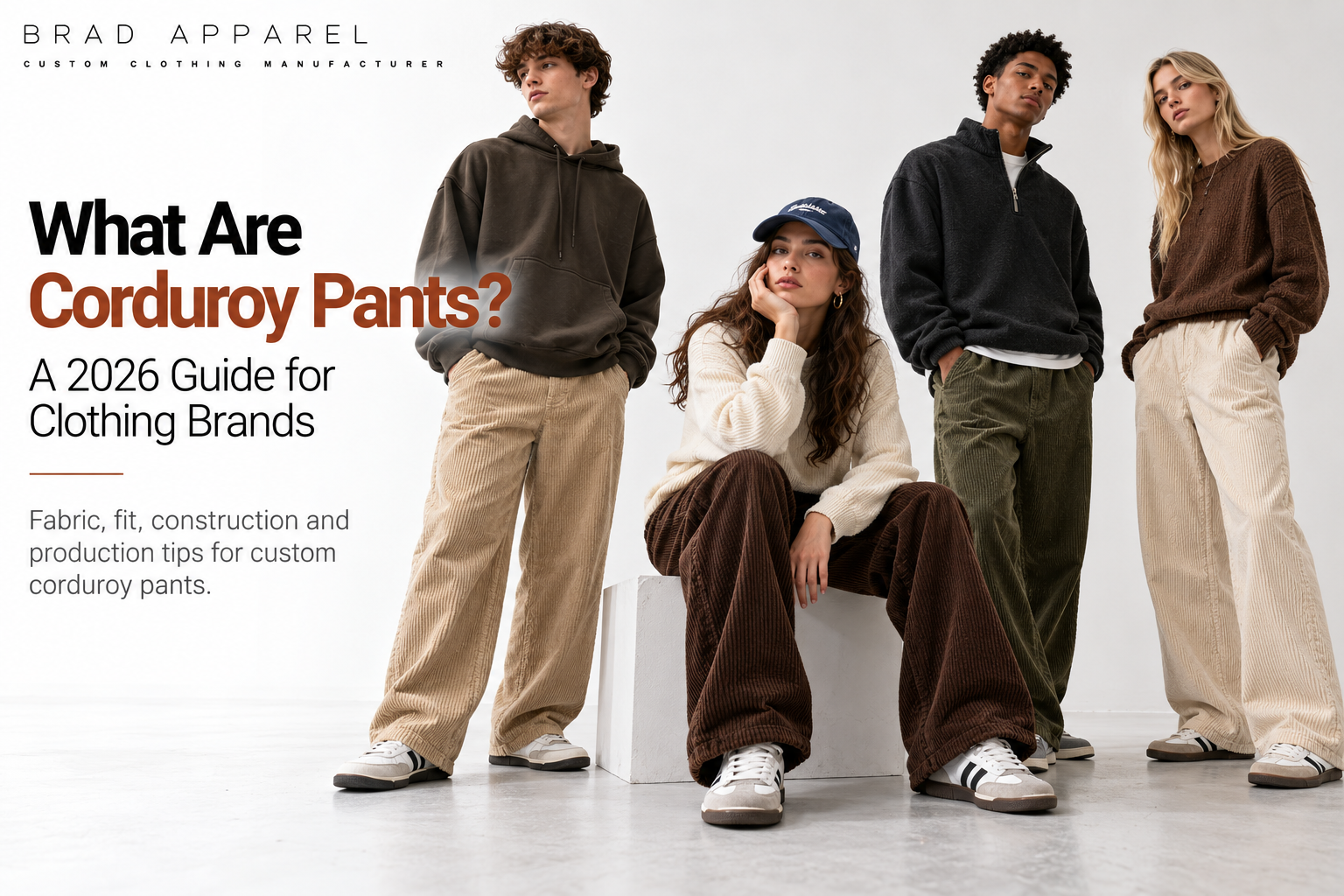
Corduroy pants are returning as one of the most visible textured bottoms of 2026.
Wide-leg cords.
Relaxed straight-leg trousers.
Barrel silhouettes.
Cropped pants.
Vintage-inspired flares.
The category can look very different depending on the fit.
But from a manufacturing perspective, the most important detail is not the silhouette.
It is the fabric.
Corduroy has a directional piled surface made up of vertical ribs, commonly called:
wales.
That structure affects almost every stage of production:
- Fabric selection
- Pattern placement
- Cutting direction
- Fabric consumption
- Pocket construction
- Pressing
- Washing
- Color appearance
- Final inspection
For clothing brands, developing corduroy pants therefore requires more than selecting a brown textured fabric and applying an existing trouser pattern.
This guide explains the main fabric, fit and production decisions brands should understand before developing custom corduroy pants.
What Are Corduroy Pants?
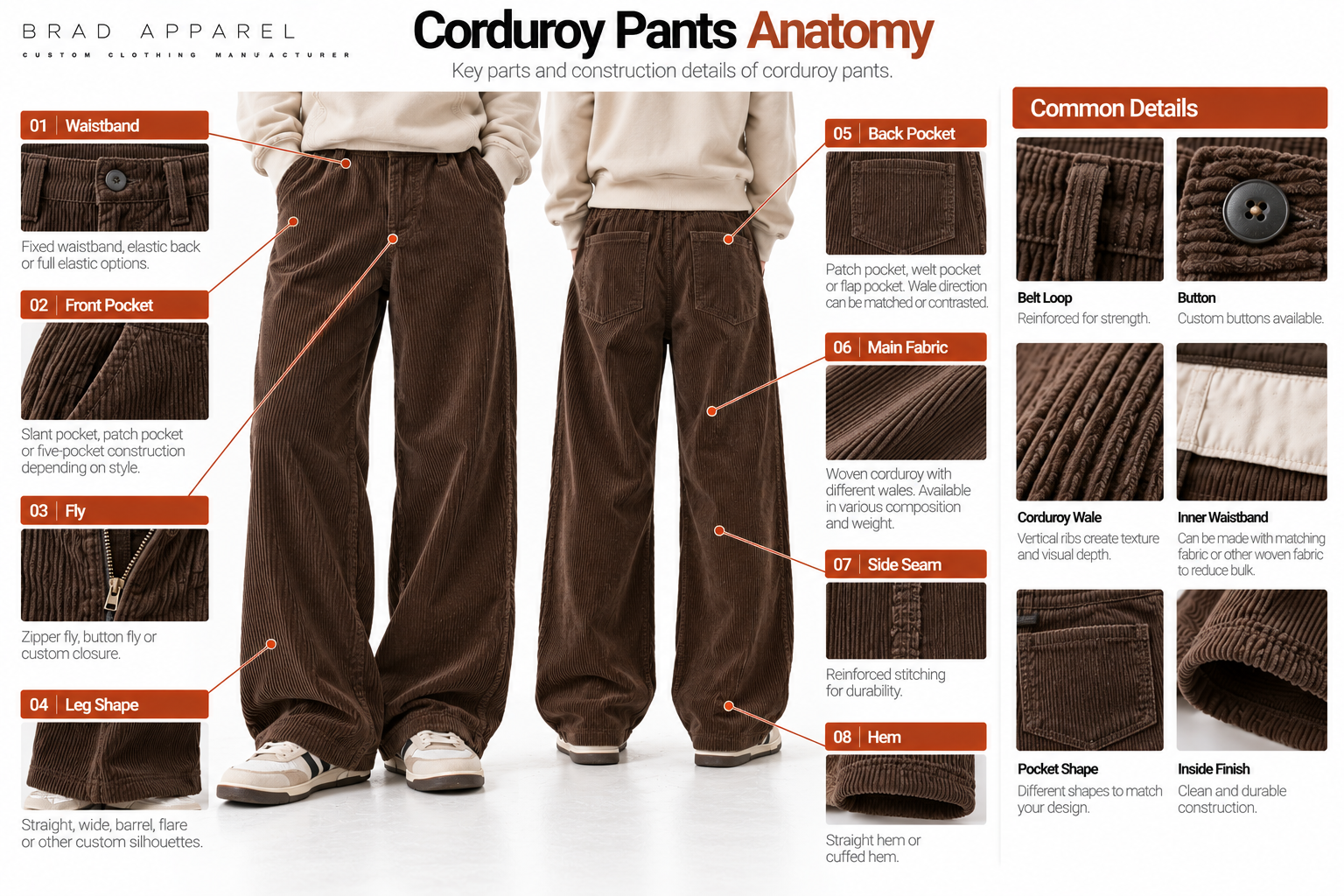
Corduroy pants are woven trousers made from corduroy fabric.
Corduroy is recognizable by its raised parallel ribs running along the fabric surface.
These ribs create the characteristic:
- Texture
- Shadow
- Direction
- Soft hand feel
- Visual depth
Corduroy can be developed into many pant silhouettes, including:
- Straight leg
- Wide leg
- Relaxed fit
- Barrel leg
- Flare
- Cropped
- Pleated trousers
- Elastic-waist pants
That means “corduroy pants” describes the relationship between:
fabric
and
garment
rather than one fixed trouser pattern.
Why Are Corduroy Pants Relevant in 2026?
Corduroy fits naturally into several current fashion directions:
- 1970s-inspired styling
- Preppy clothing
- Heritage casualwear
- Relaxed tailoring
- Wide-leg pants
- Barrel silhouettes
- Earth-tone dressing
- Texture-led collections
The fabric also creates an alternative to:
denim
and
plain twill trousers
without requiring an overly complicated garment design.
For clothing brands, that can be useful.
A relatively simple five-pocket or trouser pattern can become visually distinctive through:
- Wale scale
- Color
- Wash
- Fit
- Pocket shape
- Topstitching
The material itself becomes part of the design.
What Does “Wale” Mean in Corduroy?
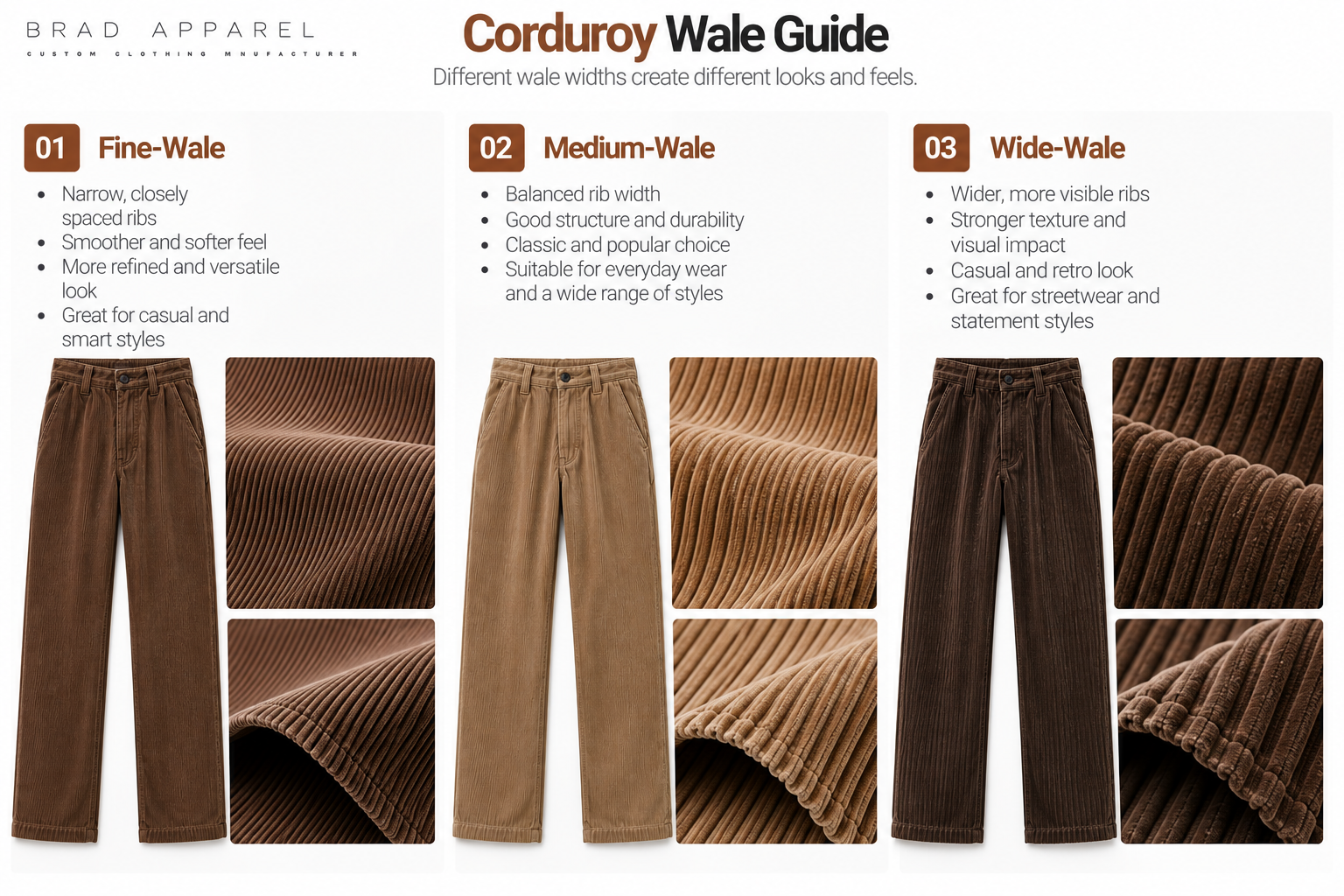
The raised ribs on corduroy are called:
wales.
The number and width of these ribs affect how the fabric looks and feels.
A finer wale creates a different garment from a very wide wale.
There is no single best wale for pants.
The correct choice depends on:
- Silhouette
- Target market
- Season
- Brand aesthetic
- Fabric weight
- Finished hand feel
Fine-Wale Corduroy
Fine-wale corduroy uses narrower and more closely spaced ribs.
It can create:
- Cleaner visual texture
- More subtle surface
- Refined trouser appearance
- Easier integration into minimal collections
It can work well for:
- Tailored-looking pants
- Slim or straight fits
- Cropped trousers
- Cleaner fashion silhouettes
The final appearance still depends on the actual fabric construction and finishing.
Medium-Wale Corduroy
A medium rib can provide a balance between:
visible texture
and
everyday versatility.
It can work across:
- Straight-leg pants
- Relaxed trousers
- Wide-leg fits
- Casual bottoms
This direction is often useful when a brand wants the corduroy texture to be obvious without allowing it to dominate the entire garment.
Wide-Wale Corduroy
Wider ribs create a stronger visual effect.
They can make the garment feel:
- More retro
- More casual
- More dimensional
- More statement-driven
Wide-wale fabric can work especially well with:
- Wide-leg pants
- Relaxed silhouettes
- Barrel shapes
- Oversized streetwear bottoms
However, wider ribs also make cutting direction and visual alignment more noticeable.
Wale Count Is Not the Only Fabric Specification
Brands sometimes focus too heavily on the number of ribs.
But two fabrics with similar wale scale can still feel very different.
Important variables include:
- Fiber composition
- Base weave
- Fabric density
- Pile height
- Stretch
- Finishing
- Washing
- Surface softness
A physical swatch should therefore be evaluated before sampling.
Brad Apparel's Fabric Sourcing & Development service supports woven fabric sourcing according to composition, structure, weight, color, texture and finishing.
Corduroy Fiber Composition
Corduroy can be produced using different fiber compositions.
Possible directions include:
- Cotton
- Cotton-polyester blends
- Cotton with stretch fiber
- Other blended woven constructions
The fiber composition affects the fabric, but it does not determine the finished garment by itself.
For example, two cotton corduroys may have very different:
- Surface softness
- Density
- Recovery
- Drape
- Shrinkage
The complete textile specification matters.
Cotton Corduroy
Cotton corduroy can create a natural and familiar surface.
Possible results include:
- Soft hand feel
- Matte appearance
- Vintage character
- Strong response to washing and finishing
However, dimensional change should be checked before bulk cutting.
The actual result depends on the fabric construction and finishing process.
Stretch Corduroy
Stretch fiber can be introduced where the design requires additional flexibility.
This can be useful for:
- Slimmer fits
- Fitted waist and hip areas
- Pants requiring more movement
But more stretch is not automatically better.
The fabric should be checked for:
- Recovery
- Knee bagging
- Waist stability
- Seam behavior
- Post-wash dimensions
A stretch fabric with poor recovery can lose shape even if the initial sample feels comfortable.
Corduroy Has a Directional Nap
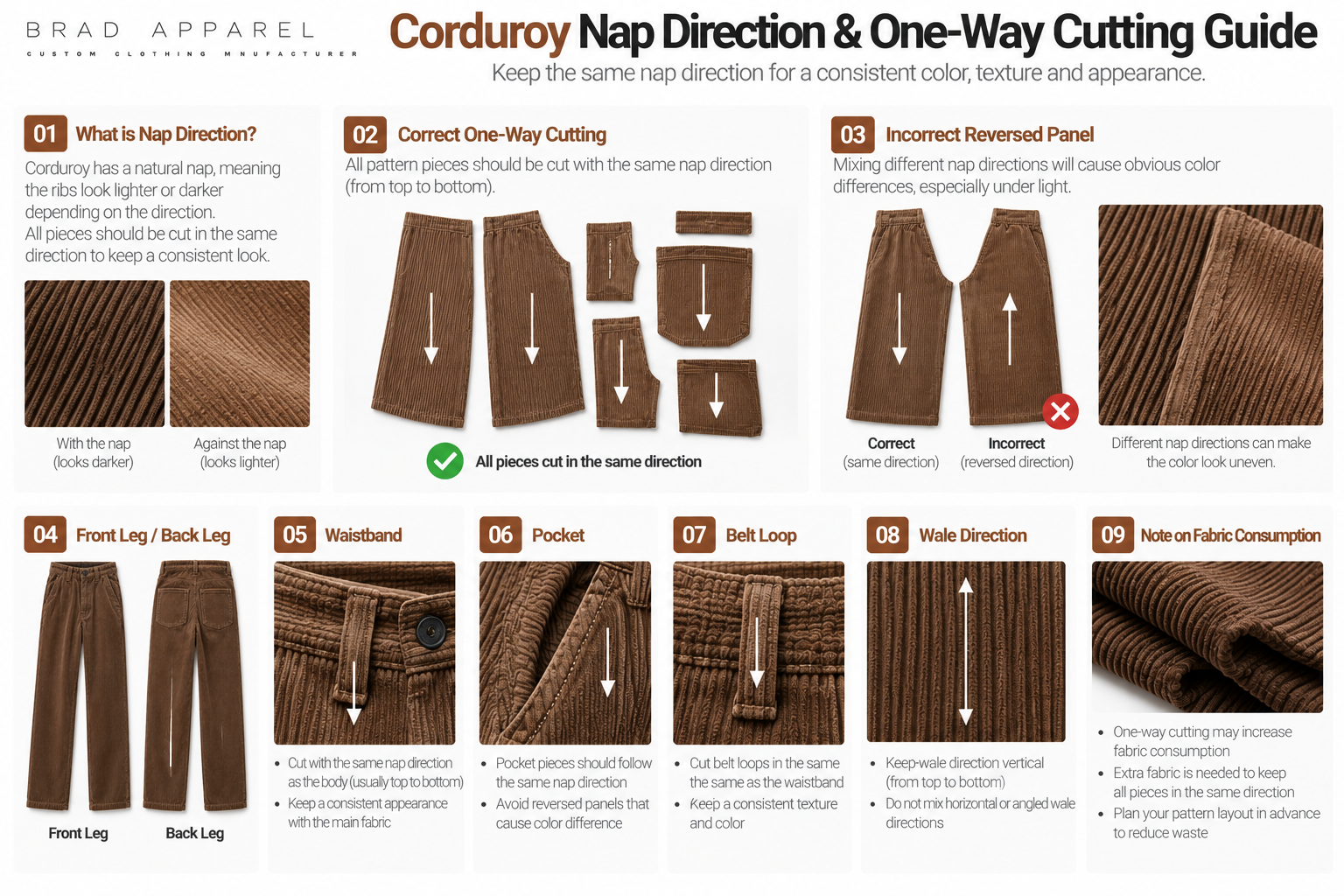
One of the most important corduroy manufacturing details is:
nap direction.
The raised surface can reflect light differently depending on which direction the pile faces.
As a result, two panels cut in opposite directions can appear to be different colors even when they come from the same roll.
Possible differences include:
- Lightness
- Darkness
- Surface reflection
- Texture
- Shade perception
This means cutting direction must be controlled.
One-Way Cutting
For many corduroy garments, major pattern pieces should be arranged consistently in the same direction.
That may include:
- Front legs
- Back legs
- Waistband
- Pockets
- Belt loops
- Yoke pieces
The exact cutting plan depends on the garment.
But the key principle is simple:
direction should be intentional.
Rotating pieces only to save fabric can create visible shade differences in the finished pants.
Nap Direction Can Increase Fabric Consumption
Normal marker making attempts to arrange pattern pieces as efficiently as possible.
Directional fabric creates additional restrictions.
If major pieces all need to face one way, the cutter has fewer options to rotate pieces into unused areas.
This can increase:
- Marker length
- Fabric consumption
- Cutting waste
For brands, this is important because corduroy consumption should not automatically be estimated from a visually similar twill pant.
Wale Direction Must Stay Straight
Corduroy's vertical ribs make grain problems easy to see.
If a trouser leg is cut slightly off direction, the wales may appear to lean rather than running cleanly down the leg.
That can make the finished garment look twisted even when the sewing is technically straight.
Important areas to inspect include:
- Front leg
- Back leg
- Fly
- Waistband
- Patch pockets
- Belt loops
The rib direction should look intentional across the garment.
Four Important Corduroy Pant Silhouettes
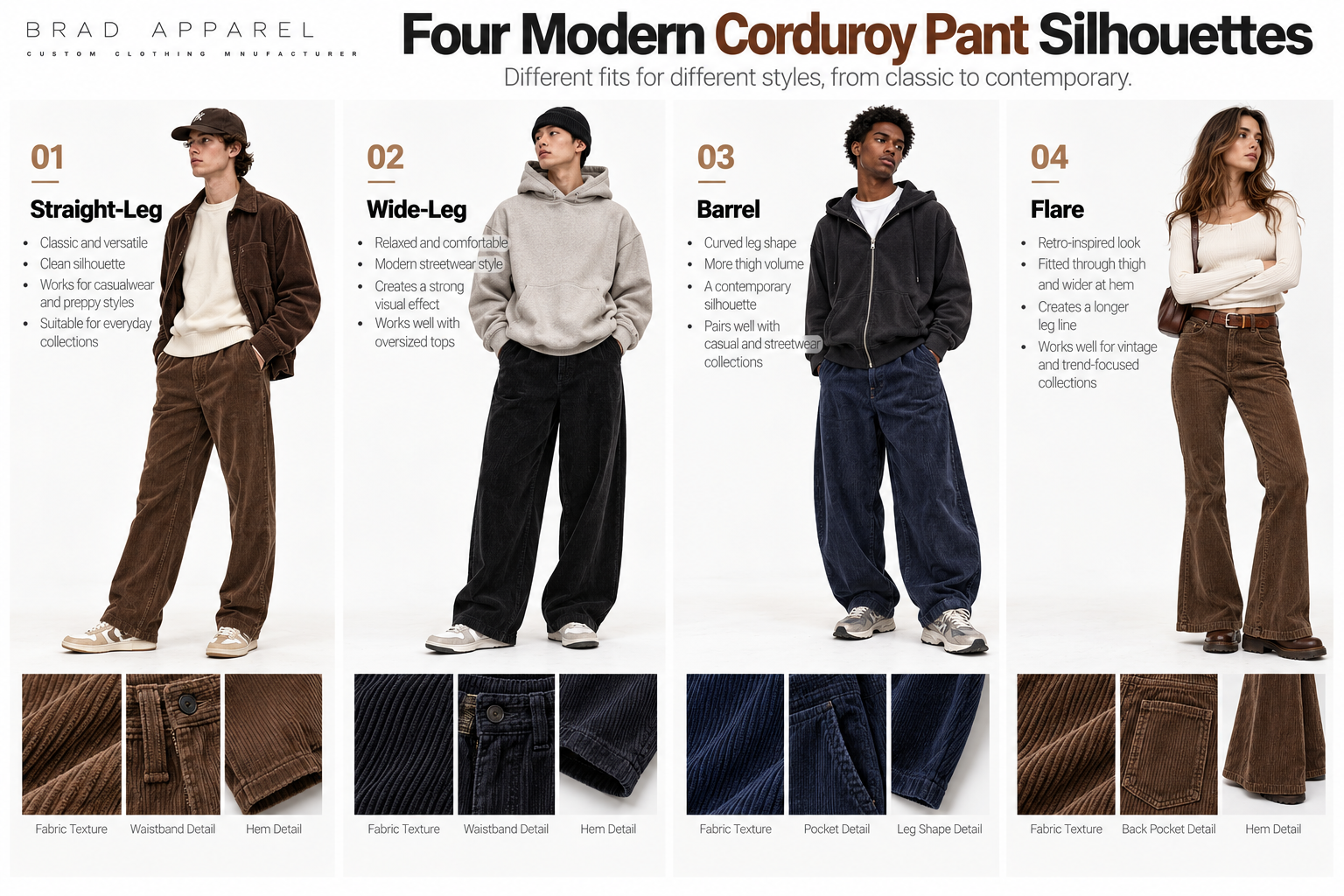
Corduroy can support very different fits.
1. Straight-Leg Corduroy Pants
A straight-leg pattern creates a relatively consistent leg width from thigh toward hem.
This works well for:
- Classic casualwear
- Preppy collections
- Minimal styling
- Heritage menswear
The visible vertical ribs naturally emphasize the length of the leg.
2. Wide-Leg Corduroy Pants
Wide-leg corduroy has become especially relevant for contemporary collections.
A good wide-leg pattern should balance:
- Waist
- Hip
- Thigh volume
- Knee width
- Hem opening
- Overall length
Fabric drape matters.
A very rigid corduroy will create a different silhouette from a softer fabric using the same measurements.
3. Barrel Corduroy Pants
Corduroy can also work with a curved barrel silhouette.
This may use:
- More thigh volume
- Controlled knee shape
- Tapered lower leg
- Structured fabric
The wale makes the curve especially visible.
For this reason, left/right symmetry and grain direction need careful review.
A barrel shape should be purpose-built rather than created simply by widening a straight-leg pattern.
4. Flared Corduroy Pants
Flared corduroy creates a stronger retro direction.
The pattern usually becomes wider below the knee.
Important areas include:
- Knee position
- Flare start point
- Hem width
- Full length
- Fabric structure
A soft corduroy creates a different flare from a dense structured version.
Rise Changes the Corduroy Pant Proportion
Corduroy pants can be developed with:
- High rise
- Mid rise
- Lower rise
Changing the rise affects much more than waistband position.
It also changes:
- Front crotch
- Back crotch
- Hip balance
- Pocket position
- Fly length
- Overall silhouette
For wide-leg or barrel corduroy pants in particular, the upper block needs to balance the amount of volume in the leg.
Waistband Construction
Possible waistband constructions include:
- Fixed waistband
- Contoured waistband
- Elastic-back waistband
- Full elastic waistband
- Drawcord waistband
A traditional trouser direction may use a clean fixed waistband.
A casual or relaxed version may use:
- Elastic
- Drawcord
- Internal adjustment
The waistband construction should match both the fit and fabric.
Waistband Bulk Needs Attention
Corduroy can become thick when several layers overlap.
A waistband may include:
- Outer corduroy
- Inner waistband
- Interfacing
- Seam allowance
- Belt loops
If every layer uses heavy corduroy, the waistband can become unnecessarily bulky.
Depending on the design, the inner waistband may use another compatible woven fabric.
The final construction should be tested physically.
Pocket Options
Corduroy pants can use many pocket constructions.
Possible directions include:
- Slant pockets
- Side-seam pockets
- Patch pockets
- Welt pockets
- Five-pocket construction
- Back flap pockets
Pocket choice can move the garment toward:
trouser
workwear
jeans
or
streetwear
styling.
Patch Pockets Make Wale Direction Visible
Patch pockets deserve special attention.
The ribs can be:
matched vertically
or
intentionally contrasted.
For example, a designer might rotate the wale direction on a pocket to create a visible design detail.
There is no universal rule.
But the direction should be intentional and approved before bulk production.
Welt Pockets Need Clean Cutting
The strong texture of corduroy makes pocket openings visually noticeable.
Important points include:
- Opening position
- Welt width
- Left/right symmetry
- Pile direction
- Clean corners
The pocket area should remain flat without unnecessary bulk.
Front Fly Construction
Possible closures include:
- Zipper fly
- Button fly
- Concealed hook-and-bar with zipper
- Elastic waist with no traditional fly
The correct construction depends on the product.
For conventional corduroy trousers, a zipper fly is a common direction.
The zipper and waistband should be selected according to the fabric thickness and finished garment style.
Brad Apparel's Trims & Branding capabilities support custom buttons, zippers, labels and branded garment components.
Corduroy Construction & Finishing Details
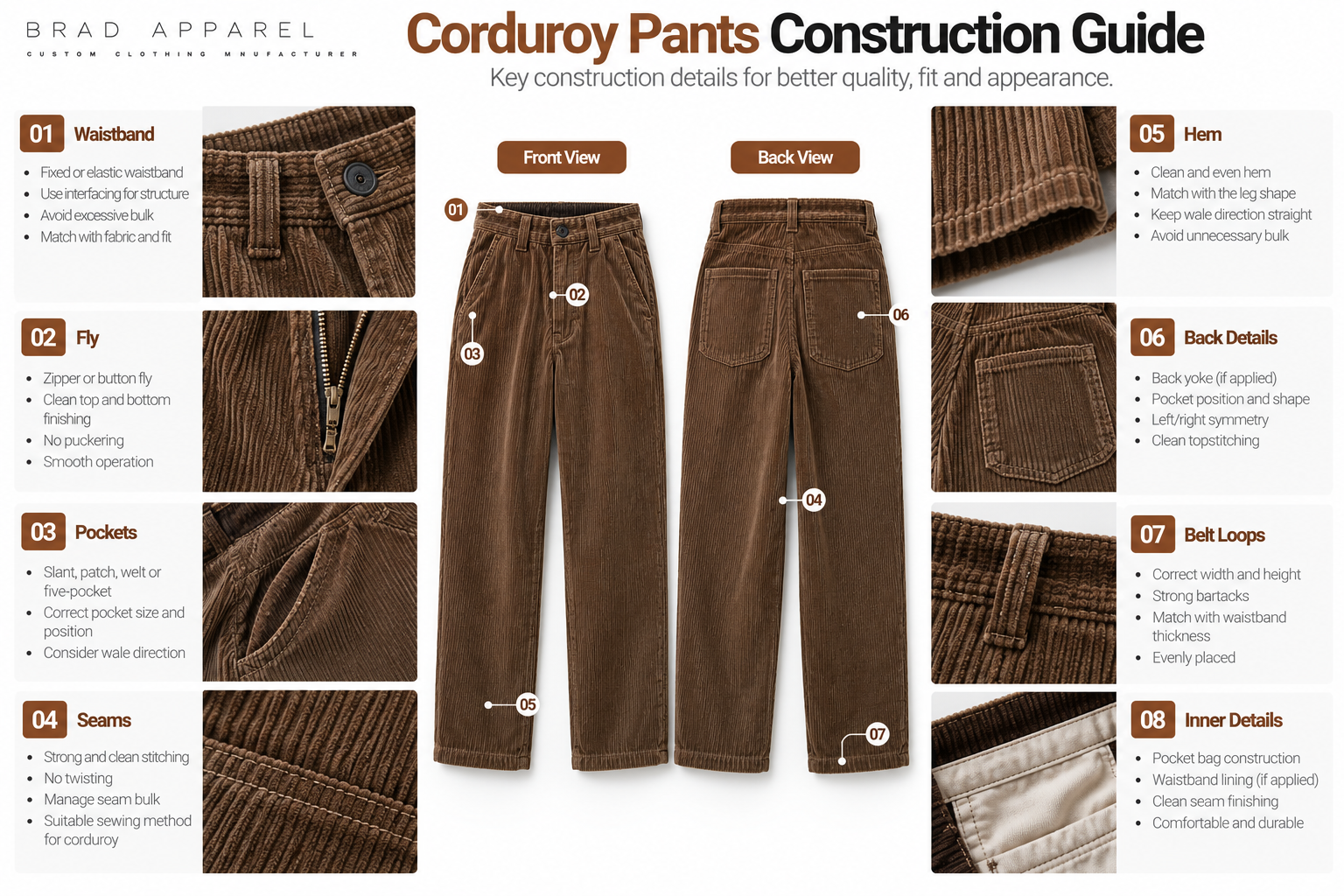
Corduroy looks soft, but production requires careful handling.
Seam Bulk
Multiple corduroy layers can create thickness at:
- Waistband
- Fly
- Pocket corners
- Belt loops
- Hem
- Side-seam intersections
Construction should avoid unnecessary overlapping layers where possible.
The sewing method should match the actual fabric.
Topstitching
Topstitching can become part of the visual identity.
Possible directions include:
- Tonal thread
- Contrast thread
- Single-row stitching
- Double-row stitching
On wide-wale corduroy, stitch placement should be checked carefully because the ribs can make slightly uneven stitching more visible.
Pressing Corduroy Requires Care
Corduroy's pile can be crushed by excessive pressure or inappropriate pressing.
Potential problems include:
- Flattened ribs
- Shiny areas
- Visible press marks
- Uneven surface
The pressing method should therefore be tested on the production fabric.
The goal is to control seams without permanently flattening the pile.
Handling During Production Matters Too
Pile damage can occur before the garment reaches final pressing.
Possible causes include:
- Heavy stacking
- Excessive pressure
- Poor handling
- Improper pressing
- Long-term compression
Factories should inspect the surface throughout production rather than only at final QC.
Washing Changes Corduroy
Corduroy can be developed with several finish directions.
Possible examples include:
- Clean finish
- Garment wash
- Soft wash
- Vintage-inspired finish
- Pigment-dyed appearance
The actual process depends on the fabric and desired result.
Washing can affect:
- Color
- Shrinkage
- Surface softness
- Pile appearance
- Seam puckering
The final fit should therefore be approved after the intended finishing process where relevant.
Shrinkage Should Be Tested Before Bulk Cutting
Cotton-rich corduroy may change dimensions during washing.
The development process should compare:
before wash
and
after wash
measurements.
Possible areas affected include:
- Waist
- Hip
- Inseam
- Outseam
- Leg opening
Pattern allowance should be based on the actual production fabric and finishing process.
Color Can Look Different Because of Nap
A corduroy swatch may appear lighter or darker depending on the direction it is viewed.
This makes physical color approval particularly important.
Brands should review:
- Swatch direction
- Lighting
- Nap
- Bulk shade consistency
rather than evaluating the color from a digital screen alone.
Dark Corduroy Needs Extra Shade Attention
Deep colors such as:
- Black
- Chocolate brown
- Navy
- Burgundy
- Dark olive
can make directional shading easier to notice.
Even small pile-direction differences may become visually obvious.
That is another reason consistent one-way cutting matters.
Decoration on Corduroy
Corduroy pants can support:
- Embroidery
- Patches
- Woven labels
- Leather-look patches
- Printed branding
- Branded hardware
The technique should be selected according to the fabric surface.
Embroidery on Corduroy
Direct embroidery can work well on stable corduroy.
But the wale creates an uneven surface compared with flat twill.
Important considerations include:
- Stitch density
- Backing
- Thread tension
- Logo size
- Wale scale
- Placement
Small lettering should be tested before bulk production.
Brad Apparel's Embroidery Techniques capabilities are developed according to fabric structure, artwork and final garment application.
Patch Branding
Patches can be useful on:
- Back waistband
- Thigh
- Utility-style panels
Possible materials include:
- Woven patch
- Embroidered patch
- Fabric patch
- Leather-look patch
The patch weight and attachment method should match the pants fabric.
What Should You Check on a Corduroy Pants Sample?
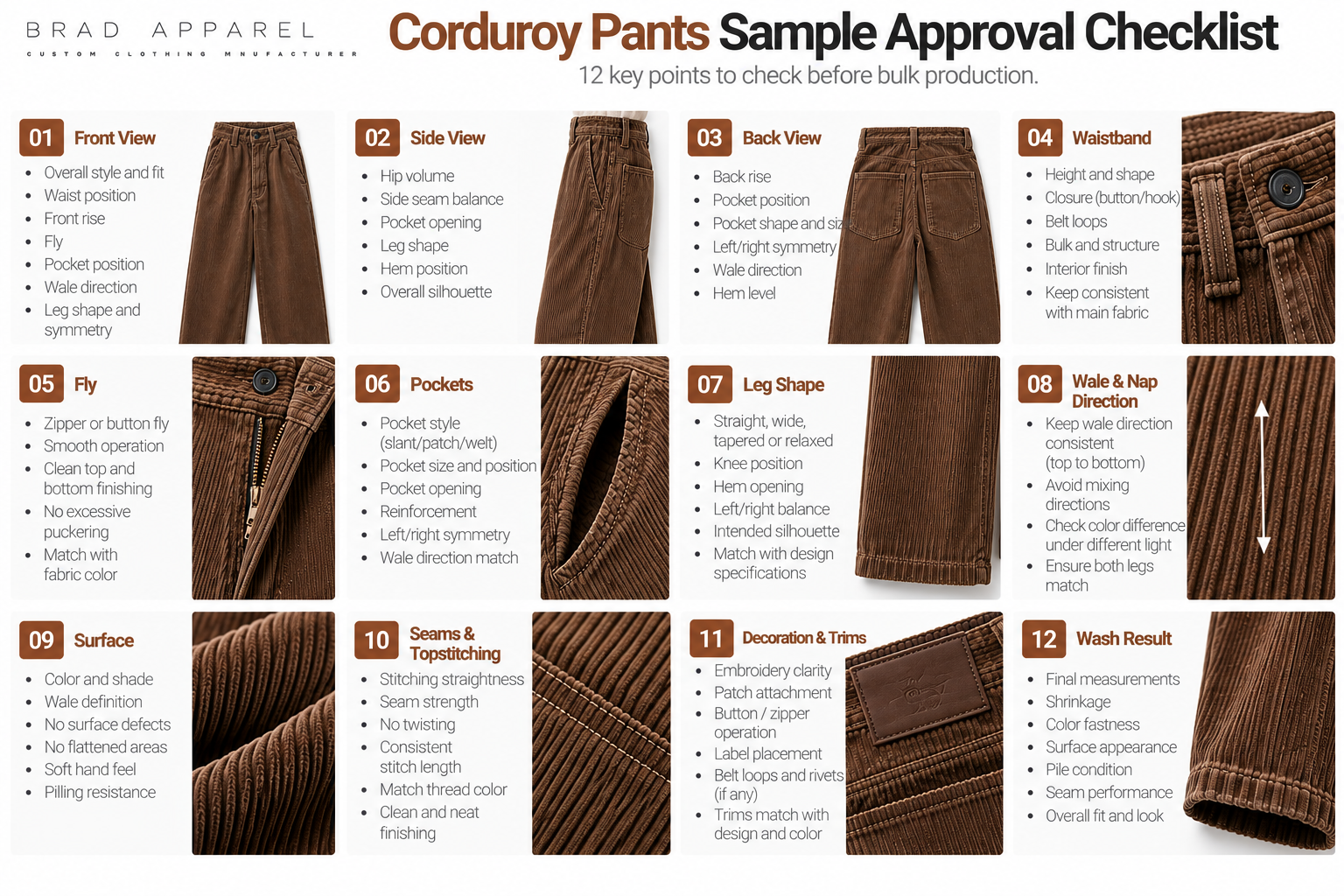
Corduroy pants should be checked for both:
fit
and
surface consistency.
1. Front View
Check:
- Waist position
- Hip width
- Front rise
- Fly
- Pocket position
- Wale direction
- Leg symmetry
2. Side View
Check:
- Hip volume
- Leg shape
- Side-seam balance
- Pocket opening
- Hem position
3. Back View
Check:
- Back rise
- Seat fit
- Pocket position
- Left/right symmetry
- Wale direction
- Hem level
4. Waistband
Check:
- Height
- Shape
- Closure
- Belt loops
- Bulk
- Interior finish
5. Fly
Check:
- Straightness
- Zipper or button operation
- No excessive puckering
- Clean topstitching
6. Pockets
Check:
- Size
- Position
- Hand access
- Left/right symmetry
- Wale direction
- Pocket-bag bulk
7. Leg Shape
Check:
- Thigh
- Knee
- Hem opening
- Left/right balance
- Intended straight / wide / barrel / flare silhouette
8. Wale & Nap Direction
Check:
- Front legs
- Back legs
- Waistband
- Pockets
- Belt loops
for unintended directional differences.
9. Surface
Check:
- Pile consistency
- Flattened areas
- Shade
- Surface defects
- Rib definition
10. Seams & Topstitching
Check:
- Stitching straightness
- Seam bulk
- No twisting
- No unnecessary pile crushing
11. Decoration & Trims
Check:
- Embroidery clarity
- Patch attachment
- Button / zipper operation
- Label placement
- Fabric distortion
12. Wash Result
Where washing or finishing is required, check:
- Final measurements
- Shrinkage
- Color
- Surface
- Pile
- Seam appearance
- Overall silhouette
Common Corduroy Pants Development Mistakes
Choosing Corduroy Only by Color
Wale, density, pile and finishing can completely change the garment.
Ignoring Nap Direction
Panels can appear to be different shades when cut in opposite directions.
Using a Normal Two-Way Marker Without Checking Direction
Rotating pieces may save fabric but create visible inconsistency.
Selecting the Fit Before Reviewing Fabric Drape
A wide-leg or flare silhouette can behave very differently in soft versus structured corduroy.
Making Waistband Layers Too Thick
Multiple heavy corduroy layers can create unnecessary bulk.
Pressing Like Plain Twill
Excessive pressure can flatten or mark the pile.
Approving Color Only Digitally
Corduroy changes appearance with lighting and pile direction.
Physical approval is more reliable.
Ignoring Post-Wash Measurements
The finished size should reflect the actual production washing process.
Using Fine Embroidery Without Testing
Small artwork can lose clarity against the wale structure.
Making a Wide-Leg or Barrel Pant by Simply Sizing Up
The rise, hip, thigh, knee and hem need to be developed as one silhouette.
What Should You Send a Corduroy Pants Manufacturer?
A useful development brief should define:
| Area | What to Specify |
|---|---|
| Fit | Straight / wide / barrel / flare / relaxed |
| Rise | High / mid / low |
| Fabric | Corduroy reference or swatch |
| Wale | Fine / medium / wide or approved reference |
| Composition | Cotton / blend / stretch blend |
| Surface | Clean / soft / washed / vintage |
| Color | Pantone or physical reference |
| Waistband | Fixed / elastic / drawcord / custom |
| Fly | Zipper / button / other |
| Slant / welt / patch / five-pocket | |
| Wale Direction | Matching or intentional contrast |
| Hem | Finished leg opening |
| Topstitching | Tonal / contrast / custom |
| Branding | Embroidery / patch / label / hardware |
| Wash | Required finishing process |
| Quantity | Sample and bulk quantity |
For corduroy, a physical fabric reference is especially valuable because photographs cannot accurately communicate pile, wale and hand feel.
How Brad Apparel Can Develop Custom Corduroy Pants
A corduroy pants project can follow:
Design Reference
↓
Corduroy Fabric Selection
↓
Wale / Color / Surface Confirmation
↓
Fit & Rise Development
↓
Pattern Development
↓
Nap Direction & Marker Planning
↓
Pocket / Waistband / Fly Development
↓
First Sample
↓
Front / Side / Back Fit Review
↓
Surface & Wale Review
↓
Wash / Shrinkage Test if Required
↓
Pre-Production Approval
↓
Bulk Cutting & Production
Brad Apparel's Custom Bottom Development supports custom rise, leg shape, waistband, pocket and trouser pattern development.
Fabric can be developed or sourced through Fabric Sourcing & Development, while buttons, zippers and labels can be customized through Trims & Branding and logos can be developed through Embroidery Techniques.
FAQ
What Are Corduroy Pants?
Corduroy pants are woven trousers made using corduroy fabric, which has raised parallel ribs known as wales.
They can be developed in many different silhouettes, including straight, wide-leg, barrel and flared fits.
What Does Wale Mean in Corduroy?
A wale is one of the raised ribs running along the surface of corduroy.
Finer wales create a subtler texture, while wider wales create a stronger and more visible surface.
Is Fine-Wale or Wide-Wale Corduroy Better?
Neither is universally better.
The correct wale depends on:
- Fit
- Fabric weight
- Design direction
- Target customer
- Desired texture
A physical fabric sample should be reviewed before production.
Are Corduroy Pants Always Cotton?
No.
Cotton is common, but corduroy can also use blends and stretch fibers.
The final fabric should be selected according to the required hand feel, structure and garment fit.
Why Does Corduroy Have a Direction?
The raised pile reflects light differently depending on which way it faces.
That means pieces cut in opposite directions may appear slightly different in shade.
Does Corduroy Require One-Way Cutting?
Directional corduroy often benefits from consistent cutting direction so major panels have the same nap orientation.
The final cutting plan should be confirmed for the actual fabric and design.
Does Corduroy Use More Fabric?
It can.
Directional cutting may reduce marker efficiency because pattern pieces cannot always be rotated freely.
The actual fabric consumption should be calculated from the approved pattern and material.
Can Corduroy Pants Be Wide Leg?
Yes.
Wide-leg corduroy can work particularly well, but the fabric drape and structure need to match the intended silhouette.
Can Corduroy Pants Be Barrel Fit?
Yes.
The curved leg should be developed intentionally through the pattern rather than simply widening a straight pant.
Can Corduroy Be Embroidered?
Yes.
Embroidery can work well on corduroy, but stitch density, backing, wale scale and artwork size should be tested on the real fabric.
Can Corduroy Pants Be Garment Washed?
Yes, depending on the textile and design.
The wash process can affect:
- Color
- Shrinkage
- Softness
- Pile appearance
so the final sample should be evaluated after the intended finishing process.
What Should Be Checked Before Bulk Production?
Important points include:
- Fit
- Rise
- Leg shape
- Wale direction
- Nap
- Surface
- Color
- Pockets
- Waistband
- Fly
- Topstitching
- Decoration
- Post-wash measurements
The approved sample should represent the intended production fabric and finishing.
Final Thoughts
Corduroy pants look familiar because the fabric has existed for generations.
But the material introduces production decisions that are easy to overlook.
The direction of the pile affects cutting.
The wale affects appearance.
The fabric structure affects the fit.
The pile affects pressing.
Washing affects both size and surface.
And directional cutting can affect fabric consumption.
For clothing brands, a successful corduroy pant therefore depends on balancing:
Wale
+
Nap Direction
+
Fabric Structure
+
Fit
+
Pattern
+
Construction
+
Finishing
rather than treating corduroy as a simple substitute for twill or denim.
Keep Reading