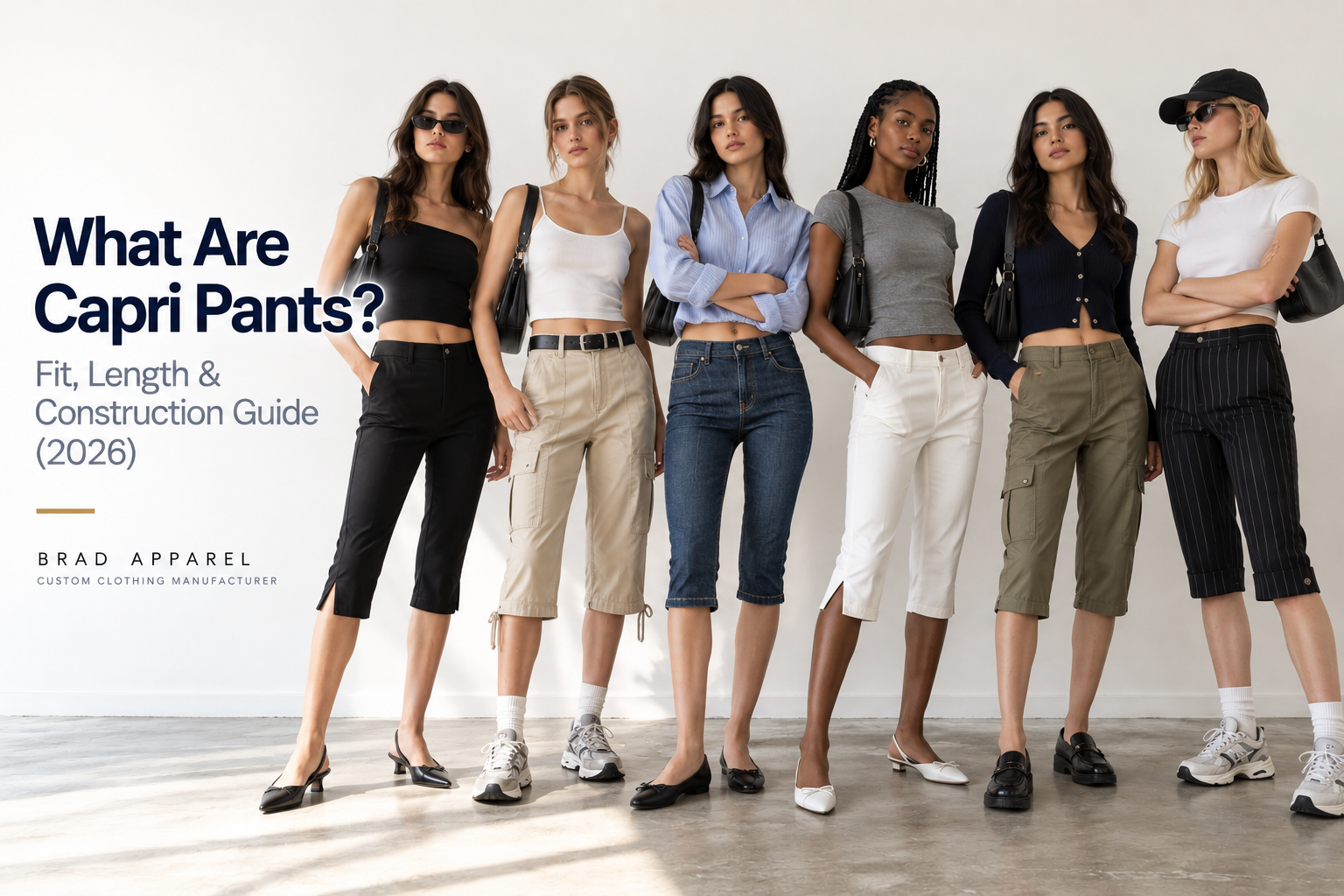
Capri pants are cropped trousers designed to finish below the knee and above the ankle, usually somewhere around the upper to mid-calf.
But creating a good capri pant is not as simple as shortening a normal pair of trousers.
The final silhouette depends on the relationship between:
rise + hip fit + thigh width + knee width + calf position + hem opening + finished length + fabric stretch
A slim black capri pant behaves completely differently from a wide denim capri, even when both finish at exactly the same point on the leg.
For clothing brands, this makes capri pants a length category rather than one fixed pattern.
This guide explains how capri pants differ from pedal pushers, cropped trousers and culottes, and what brands should specify before developing them for production.
What Are Capri Pants?
Capri pants are trousers with a cropped length that typically finishes somewhere between the knee and mid-calf.
Modern capris can be:
- Slim
- Straight
- Relaxed
- Wide
- Denim
- Tailored
- Knit
- Low rise
- Mid rise
- High rise
This means the word "capri" mainly communicates:
finished length
rather than one specific fit.
A brand still needs to define the:
- Waist
- Rise
- Hip
- Thigh
- Knee
- Calf
- Leg opening
- Inseam
- Outseam
- Fabric
- Stretch
- Closure
before a manufacturer can accurately reproduce the silhouette.
Why Are Capri Pants Trending Again in 2026?
Capri pants fit naturally into several current fashion directions:
- 1990s minimalism
- Y2K revival
- Cropped trousers
- Slim tailored pants
- Clean black basics
- Denim experimentation
- Ballet-inspired styling
- Transitional dressing
- Low-rise silhouettes
One reason the category is interesting is its versatility.
A capri can look:
minimal and tailored
in black stretch suiting,
or:
casual and Y2K-inspired
in washed denim.
It can also move between:
- Womenswear
- Streetwear
- Resortwear
- Office-inspired fashion
- Athleisure
- Premium casualwear
depending on the fabric and pattern.
Capri Pants vs Pedal Pushers vs Cropped Pants vs Culottes
These terms often overlap in retail descriptions, but they are not exactly the same.
| Style | Typical Length | Typical Leg Shape | Main Characteristic |
|---|---|---|---|
| Capri Pants | Below knee to mid-calf | Slim to wide | Cropped calf-length trouser |
| Pedal Pushers | Around knee to upper calf | Usually slim / fitted | Shorter retro capri shape |
| Cropped Pants | Any length above ankle | Any fit | Broad length category |
| Culottes | Knee to mid-calf | Very wide | Skirt-like wide-leg silhouette |
| Bermuda Shorts | Around knee | Straight / relaxed | Long shorts rather than cropped trousers |
These are fashion categories rather than rigid industrial standards.
The technical measurements should always define the actual garment.

Capri Pants vs Pedal Pushers
Capri pants and pedal pushers are closely related.
In modern retail, the terms are sometimes used interchangeably.
Historically, pedal pushers generally refer to a slightly shorter cropped trouser designed to avoid interfering with bicycle pedals.
Modern versions often finish:
around the knee or upper calf
while capris may extend farther toward:
mid-calf
But there is no universal measurement separating the two.
For manufacturing, it is much better to specify:
Finished inseam: 48 cm
than:
Make it pedal-pusher length.
Capri Pants vs Cropped Pants
"Cropped pants" is a broader category.
Any trouser ending noticeably above the ankle may be described as cropped.
This includes:
- Capri pants
- Ankle pants
- Cropped wide-leg pants
- Cropped straight pants
- Pedal pushers
So:
all capri pants are cropped pants
but:
not all cropped pants are capri pants
The hem position is what creates the difference.
Capri Pants vs Culottes
Culottes normally use significantly more leg width.
Their defining characteristics are:
- Wide leg
- Large hem opening
- More fabric movement
- Sometimes skirt-like appearance
A capri can technically be wide, but classic capris usually retain a clearer trouser silhouette.
Think of the difference as:
Capri = cropped length
Culotte = cropped length + very wide leg
Capri Pants vs Bermuda Shorts
Bermuda shorts normally finish:
- Just above the knee
- At the knee
- Slightly below the knee
Capris extend farther down the leg.
Construction can still be very similar.
Both can use:
- Trouser waistband
- Zipper fly
- Slant pockets
- Belt loops
- Tailored fabrics
The key visual difference is length.
Finished Length Is the Most Important Capri Measurement
The capri silhouette depends heavily on where the hem crosses the calf.
A difference of only a few centimeters can noticeably change the appearance.
Possible positions include:
Just Below the Knee
Creates:
- More pedal-pusher character
- Strong retro influence
- Greater lower-leg exposure
Upper Calf
Creates:
- Classic cropped appearance
- Cleaner everyday proportion
Mid-Calf
Creates:
- Longer capri silhouette
- More dramatic cropped proportion
Once the hem moves much closer to the ankle, the garment may read more like:
ankle-length trousers
than true capri pants.
There Is No Universal Capri Length in Centimeters
The same 55 cm inseam can look completely different on two wearers.
Why?
Because final hem position depends on:
- Height
- Leg length
- Rise
- Crotch depth
- Waist placement
- Size
That is why brands should provide both:
finished garment measurements
and
target fit information
whenever length positioning is important.
How Should Capri Pants Be Measured?
Important vertical measurements include:
Inseam
Measured from:
crotch intersection → hem
This is one of the clearest ways to control cropped length.
Outseam
Measured along the outside of the leg.
The starting point should be defined.
Some specifications measure from:
top of waistband
while others begin:
below waistband
Front Rise
Controls where the waistband sits relative to the crotch.
Back Rise
Controls seat fit and back waist position.
Together these measurements define the total vertical proportion.
Why Calf Position Matters
Capri pants end around one of the widest and most variable areas of the lower leg.
This creates a unique fit issue.
If the hem opening is too small, it may:
- Grip the calf
- Ride upward
- Twist
- Restrict movement
- Create horizontal pulling
If it is too large, the silhouette may:
- Flare unexpectedly
- Look unfinished
- Lose the intended slim proportion
This makes the calf and leg-opening measurements particularly important.
Measure the Actual Calf
For fitted capris, a brand may need measurements at:
- Knee
- 10 cm below knee
- Widest calf
- Hem
This gives the pattern maker a much clearer picture of the lower-leg shape.
A basic trouser specification containing only:
thigh + knee + hem
may not provide enough control for an extremely fitted capri.
Capri Pants Fit Options
Capris can use several different silhouettes.
Slim Capri Pants
Typical characteristics:
- Fitted hip
- Fitted thigh
- Narrow knee
- Controlled calf
- Small hem opening
Often made with stretch.
Straight Capri Pants
Maintain more consistent width between:
- Knee
- Calf
- Hem
They provide:
- Cleaner vertical line
- More movement
- Less calf tension
Relaxed Capri Pants
Use:
- More hip ease
- More thigh volume
- Softer leg shape
This can create a more contemporary alternative to classic fitted capris.
Wide-Leg Capri Pants
Use a larger hem opening.
They may overlap visually with:
- Wide cropped pants
- Culottes
The distinction becomes increasingly dependent on styling and product naming.
Slim Capri Pants Need Stretch or Sufficient Ease
One of the easiest mistakes is making a woven capri extremely narrow around the calf.
When the wearer bends the knee or sits, the fabric needs somewhere to move.
Possible solutions include:
- Stretch fabric
- Increased knee ease
- Increased calf ease
- Side slit
- Back slit
- Larger hem opening
A garment should not rely solely on fabric stretch to compensate for an incorrect pattern.
Low-Rise Capri Pants
Low-rise capris create a stronger Y2K direction.
The waistband sits below the natural waist.
This changes:
- Waist circumference
- Hip relationship
- Front rise
- Back rise
- Pocket position
- Fly length
A high-rise trouser cannot simply have several centimeters removed from the top.
The entire upper pattern needs to be rebalanced.
Mid-Rise Capri Pants
Mid rise often provides the most versatile proportion.
It can work for:
- Tailored capris
- Denim
- Casual styles
- Stretch trousers
The exact waist position should still be confirmed through a fit sample.
High-Rise Capri Pants
High-rise versions can create:
- More defined waist
- Longer visual leg above the cropped hem
- More tailored appearance
They work especially well for:
- Pleated capris
- Suiting
- Wide-leg versions
Waistband construction becomes particularly important because the garment sits on a smaller part of the body.
Capri Pants Pattern Development
A capri pattern should control the entire leg rather than simply cutting off the bottom of a full-length trouser block.
Important measurements include:
- Waist
- High hip
- Full hip
- Front rise
- Back rise
- Thigh
- Knee
- Calf
- Leg opening
- Inseam
- Outseam
The leg shape should be intentionally rebuilt around the shorter length.

Why Shortening Normal Pants Can Fail
Suppose a tapered trouser becomes progressively narrower toward the ankle.
If you simply cut it off at mid-calf, the new hem falls at a wider part of the body.
The original pattern was never designed to finish there.
Possible problems include:
- Hem too tight
- Unbalanced taper
- Strange calf shape
- Side-seam distortion
The lower leg should therefore be redrawn for the intended capri length.
Knee Width and Hem Width Work Together
Two capris with identical hem openings can look different if their knee measurements differ.
Narrow Knee + Similar Hem
Creates:
- Slim straight silhouette
Wide Knee + Narrow Hem
Creates:
- Strong taper
Wide Knee + Wide Hem
Creates:
- Relaxed or wide crop
The overall line should be evaluated from the hip downward.
Side-Seam Shape
A clean capri may use a relatively straight side seam.
A fitted version may curve:
- Out around the hip
- In toward the knee
- Around the calf
- Toward the hem
The curve should look smooth.
Poor shaping can create visible bumps around:
- Knee
- Calf
- Side seam
Inseam Shape
The inseam also affects:
- Thigh comfort
- Knee movement
- Lower-leg balance
Changing only the side seam is not always enough.
The entire front and back leg should remain balanced.
Stretch Capri Pants
Stretch fabrics are common because cropped fitted trousers often sit close to:
- Hip
- Thigh
- Knee
- Calf
Possible fabrics include:
- Stretch cotton
- Stretch twill
- Stretch suiting
- Ponte
- Stretch denim
But stretch percentage alone does not define performance.
Stretch Percentage vs Fabric Recovery
A fabric can stretch well but recover poorly.
Poor recovery may cause:
- Bagging at knee
- Loose seat
- Wavy waistband
- Permanent calf expansion
For fitted capris, test:
- Stretch
- Recovery
- Growth after wear
especially at the knee.
Cotton Twill Capri Pants
Cotton twill is one of the most versatile options.
It can provide:
- Clean structure
- Comfortable hand feel
- Casual appearance
- Good color options
Stretch cotton twill works particularly well for slim capris.
Rigid twill is better for:
- Straight
- Relaxed
- Wider silhouettes
Suiting Capri Pants
Suiting creates a more polished direction.
Possible fabrics include:
- Polyester-viscose
- Wool blends
- Stretch suiting
- Tropical wool
- Crepe
These work well for:
- Office-inspired styles
- Minimal black capris
- Tailored collections
The fabric should have enough recovery if the fit is close.
Ponte Capri Pants
Ponte is a stable double-knit fabric.
It can provide:
- Stretch
- Recovery
- Smooth surface
- Easier pull-on construction
Possible benefits include:
- Fewer darts
- Elastic waistband
- Comfortable slim fit
However, fabric weight and stretch need to be controlled.
A very heavy ponte can feel bulky around the calf.
Jersey Capri Pants
Jersey creates a softer category.
This moves the product closer toward:
- Capri leggings
- Casualwear
- Athleisure
The pattern requires negative or reduced ease depending on the amount of stretch.
Do not use woven capri measurements directly for a highly stretchy jersey style.
Denim Capri Pants
Denim capris have returned as part of the broader cropped-denim revival.
Possible silhouettes include:
- Slim
- Straight
- Relaxed
- Wide
- Raw hem
Important decisions include:
- Denim weight
- Stretch percentage
- Rise
- Wash
- Hem construction
- Five-pocket layout
Rigid Denim Capri Pants
100% cotton denim creates:
- More structure
- Strong denim character
- Cleaner straight silhouette
It works especially well for:
- Relaxed capris
- Wide capris
- Vintage-inspired styles
A tight calf fit is harder to achieve comfortably without stretch.
Stretch Denim Capri Pants
Stretch denim allows:
- Closer thigh fit
- Smaller hem opening
- Easier bending
This makes it useful for more traditional fitted capri jeans.
But wash testing is important because stretch denim can change:
- Recovery
- Measurements
- Hand feel
after laundering.
Dark-Wash Capri Jeans
Dark indigo can create a cleaner interpretation.
Possible directions include:
- Deep indigo
- Rinse wash
- Clean black
- Blue-black
These work particularly well with minimalist or tailored styling.
Raw-Hem Capri Jeans
A raw hem can make the cropped proportion feel deliberate.
Possible finishes include:
- Clean cut
- Controlled fraying
- Grinding
- Distressed edge
If fraying should stop at a certain point, reinforcement stitching may be required.
For custom fabric development, see Brad Apparel's Fabric Sourcing & Development.
Capri Pants Waistband Options
Possible constructions include:
Structured Waistband
Suitable for:
- Suiting
- Denim
- Twill
Contoured Waistband
Useful for:
- Low rise
- Fitted silhouettes
- Curved waist positions
Elastic Waistband
Suitable for:
- Knit capris
- Casual trousers
- Pull-on styles
Half-Elastic Waist
Creates:
clean front + comfort at back
This works well for relaxed or commercial styles.
Waistband Height Changes the Proportion
A narrow waistband creates a different visual effect from a wide waistband.
Possible widths include:
- Narrow clean waistband
- Standard trouser waistband
- Wide fashion waistband
The width should be shown in the tech pack.
Closure Options
Capri pants can use:
- Zipper fly
- Side zipper
- Invisible zipper
- Button fly
- Hook and bar
- Snap
- Pull-on elastic
The closure should match:
- Fabric
- Rise
- Intended styling
Side-Zip Capri Pants
A side zipper can create a particularly clean front.
It works well for:
- Minimal black capris
- Tailored styles
- High-rise silhouettes
Without a front fly, front waist shaping becomes more visually important.
Front Fly Construction
A conventional zipper fly works well for:
- Denim
- Twill
- Casual trousers
It also makes the garment feel more like a traditional trouser rather than a legging.
Pocket Options
Possible pockets include:
- Slant pocket
- Side-seam pocket
- Welt pocket
- Patch pocket
- Five-pocket denim construction
Pocket bags should not create visible bulk through a slim leg.
Slant Pockets
Common in tailored capris.
The opening angle affects:
- Hand access
- Visual shape
- Hip appearance
If the fit is too tight, the pocket may flare open.
Welt Pockets
Welt pockets work well for cleaner tailored styles.
They may be:
- Functional
- Decorative
Back welt pockets can reinforce the trouser-like appearance.
Five-Pocket Capri Jeans
Denim versions may use classic jeans construction:
- Two front curved pockets
- Coin pocket
- Two back patch pockets
- Yoke
- Tack button
- Rivets
The pocket dimensions should be scaled to the shorter overall garment.
Capri Hem Construction
The hem is unusually important because it sits directly around the calf.
Possible finishes include:
Clean Folded Hem
Suitable for:
- Twill
- Suiting
- Denim
Blind Hem
Creates a cleaner tailored exterior.
Turn-Up Cuff
Adds visual weight at the lower leg.
Raw Hem
Common in denim.
Side Slit
Provides both design interest and additional calf ease.
Side-Slit Capri Pants
A short slit at the hem can reduce tightness without dramatically increasing the leg opening.
Possible slit positions include:
- Outer side seam
- Inner seam
- Back lower leg
The slit length should be specified.
Buttoned Hem Tabs
Capri pants can also use an adjustable hem detail.
Possible constructions include:
- Button tab
- Buckle tab
- Snap tab
This can create a stronger utility or retro direction.
Cuffed Capri Pants
A cuff changes the lower-leg proportion.
It adds:
- Visual weight
- Fabric thickness
- Structured hem
The pattern needs extra length for the turn-up.
Do not simply fold an existing finished length unless the pattern already includes cuff allowance.
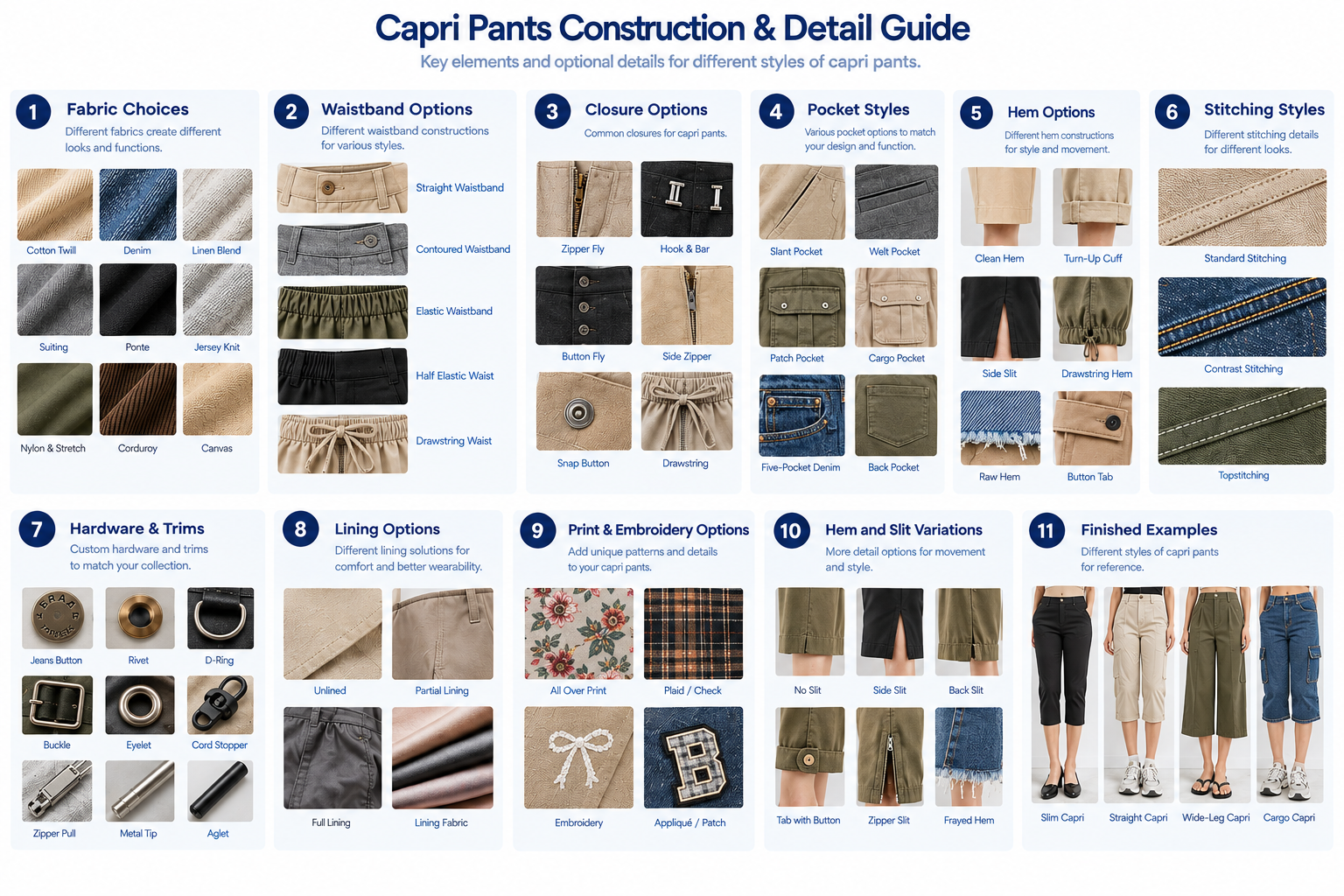
Capri Pants Construction & Detail Options
Modern capris can combine:
- Slim / straight / wide fit
- Low / mid / high rise
- Twill / denim / suiting / knit
- Structured / elastic waistband
- Fly / side zip / pull-on closure
- Slant / welt / denim pockets
- Clean / cuff / slit / raw hem
- Tonal / contrast stitching
- Custom hardware
Tailored Capri Pants
A modern tailored capri may use:
- Mid or high rise
- Slim or straight fit
- Stretch suiting
- Pressed crease
- Slant pockets
- Welt back pockets
- Hook-and-bar closure
- Blind hem
This creates a cleaner alternative to a full-length trouser.
Minimal Black Capri Pants
One of the easiest modern directions uses:
- Black fabric
- Minimal visible stitching
- Slim straight leg
- Clean waistband
- Side zipper or hidden closure
Because the garment has few decorative details, fit accuracy becomes especially important.
Printed Capri Pants
Capris can also use:
- Plaid
- Polka dots
- Florals
- Stripes
- Custom prints
Pattern placement becomes more visible because the shorter leg concentrates the print into a smaller area.
Stripe Placement
Vertical stripes can visually emphasize the trouser line.
Horizontal stripes can emphasize width.
For side-seam matching, the brand should specify whether:
- Exact matching is required
- General visual alignment is acceptable
Exact matching may increase fabric consumption.
Plaid Capri Pants
Plaid often requires additional cutting control.
Important areas include:
- Side seam
- Center front
- Center back
The more precise the matching requirement, the greater the cutting complexity.
Pleated Capri Pants
Capris do not need to be slim.
A pleated version can use:
- Single pleat
- Double pleat
- Relaxed thigh
- Tapered or straight calf
This creates a more tailored interpretation.
Pleat depth should be specified in the tech pack.
Utility Capri Pants
Utility versions may include:
- Cargo pockets
- Patch pockets
- D-rings
- Webbing
- Snap tabs
But the shorter leg provides less available space.
Pocket size and placement need to be adapted rather than copied directly from full-length cargo pants.
Cargo Capri Pants
Large cargo pockets can visually overwhelm a short trouser.
Review:
- Pocket height
- Pocket width
- Flap size
- Position relative to knee
A pocket sitting directly across the knee may also reduce comfort.
Capri Leggings
Capri leggings are a separate subcategory.
They normally use:
- High stretch
- Negative ease
- Elastic waistband
- Flatlock or stretch stitching
They should not use the same pattern rules as woven capri trousers.
The stretch percentage and recovery become central.
Fabric Weight Matters
A fitted capri needs enough fabric body to remain smooth.
If the fabric is too thin, it may:
- Show underwear lines
- Become transparent when stretched
- Reveal pocket bags
If it is too heavy, it may:
- Restrict movement
- Feel bulky around the knee
- Hold stiff folds around the calf
Fabric should therefore be evaluated together with fit.
Shrinkage Can Change Capri Position
A capri finishing perfectly at the upper calf before washing may move noticeably upward after shrinkage.
This is especially important for:
- Cotton twill
- Denim
- Linen blends
Final length should be evaluated after the intended:
- Wash
- Dye
- Finishing process
The production specification should describe the finished garment.
Pattern Shrinkage Allowance
If fabric is expected to shrink, the pre-wash pattern may need additional allowance.
The exact amount should come from:
- Fabric testing
- Wash tests
- Sample measurements
rather than a universal percentage.
How to Describe Capri Pants to a Manufacturer
Instead of writing:
I need black capri pants.
write something like:
Mid-rise slim-straight capri trousers in black stretch cotton twill, finishing at the upper calf. Clean front waistband with concealed hook-and-bar and zipper fly, slant front pockets and 4 cm side slits at the hem.
Then provide:
- Waist
- Hip
- Front rise
- Back rise
- Thigh
- Knee
- Calf
- Leg opening
- Inseam
- Outseam
- Waistband
- Closure
- Fabric
- Stretch
- Hem
- Color
- Branding
This gives the pattern maker a much clearer development target.
Example Classic Capri Development Brief
Mid-rise fitted capri trousers in cotton stretch twill with a slim thigh, lightly shaped knee and controlled calf opening. Length should finish approximately at mid-calf on a 170 cm fit model.
Example Tailored Capri Brief
High-rise straight capri trousers in lightweight stretch suiting with a clean contoured waistband, single front pleat, pressed crease, slant pockets and blind hem.
Example Denim Capri Brief
Low-rise dark-indigo denim capri jeans with relaxed hip, straight leg, five-pocket construction and clean raw hem finishing at the upper calf.
Important Capri Pants Measurements
| Measurement | Why It Matters |
|---|---|
| Waist | Controls waist fit |
| High Hip | Controls upper shaping |
| Full Hip | Controls seat fit |
| Front Rise | Defines front waist position |
| Back Rise | Controls seat and back waist |
| Thigh | Defines upper-leg ease |
| Knee | Controls leg transition |
| Calf | Critical for fitted capris |
| Leg Opening | Controls final lower-leg silhouette |
| Inseam | Controls capri length |
| Outseam | Confirms overall length |
| Waistband Height | Affects proportion |
| Slit Length | Adds movement when used |
For very fitted styles, additional measurements below the knee can improve accuracy.
Capri Pants Tech Pack Example
| Area | Example Specification |
|---|---|
| Product | Capri Pants |
| Fit | Slim Straight |
| Rise | Mid Rise |
| Fabric | Stretch Cotton Twill |
| Composition | Cotton / Elastane |
| Waistband | Contoured |
| Front | Clean |
| Closure | Zipper + Hook & Bar |
| Slant Front + Welt Back | |
| Length | Upper / Mid Calf |
| Hem | Clean + Side Slit |
| Stitching | Tonal |
| Branding | Woven Main + Care Label |
These specifications are examples only.
Denim Capri Tech Pack Example
| Area | Example Specification |
|---|---|
| Product | Capri Jeans |
| Fit | Relaxed Straight |
| Rise | Low Rise |
| Fabric | Stretch / Rigid Denim |
| Wash | Dark Indigo |
| Front | Five-Pocket |
| Closure | Tack Button + Zipper Fly |
| Leg | Straight |
| Length | Upper Calf |
| Hem | Raw / Clean |
| Hardware | Antique / Gunmetal |
| Branding | Back Patch + Woven Label |
Knit Capri Tech Pack Example
| Area | Example Specification |
|---|---|
| Product | Knit Capri Pants |
| Fit | Fitted |
| Rise | High Rise |
| Fabric | Ponte / Interlock |
| Waist | Elastic |
| Closure | Pull On |
| Optional | |
| Length | Mid Calf |
| Hem | Coverstitch / Clean |
| Stretch | High |
| Branding | Heat Transfer / Woven Label |
How to Evaluate the First Capri Sample
The sample needs to be evaluated while worn.
A flat garment cannot show calf fit accurately.
Front View
Check:
- Waist
- Hip
- Thigh
- Knee
- Lower-leg shape
- Hem position
- Left/right symmetry
Side View
Check:
- Rise
- Seat
- Knee position
- Calf curve
- Hem opening
Back View
Check:
- Back rise
- Seat
- Pocket position
- Knee
- Calf
- Hem
Check the Hem Position Carefully
Ask:
Does it finish:
- Just below knee?
- Upper calf?
- Mid-calf?
Compare this with the approved design.
A few centimeters can materially change the style.
Check the Widest Calf Point
This is particularly important for slim capris.
Determine whether the hem finishes:
above
at
or:
below
the widest point of the calf.
If the hem sits directly around the widest point, extra ease may be necessary.
Walk in the Sample
The wearer should:
- Walk normally
- Bend knees
- Climb stairs
- Sit
Look for:
- Hem riding upward
- Knee pulling
- Calf restriction
- Pocket opening
- Waist movement
Sit in the Sample
Sitting increases tension through:
- Hip
- Thigh
- Knee
A close capri may appear perfect standing but become uncomfortable when seated.
Check Knee Recovery
After sitting or bending repeatedly, stand again.
Look for:
- Knee bagging
- Permanent stretching
- Wrinkles
This is particularly important for stretch fabrics.
Check Side Slits
If used, confirm:
- Equal length
- Reinforced top
- Clean opening
- No twisting
The slit should open naturally rather than pulling the lower leg outward.
Check After Washing
Compare:
- Waist
- Hip
- Inseam
- Hem position
- Leg opening
- Fabric recovery
before and after washing.
Capri length is sensitive to shrinkage because the hem position is such an important part of the design.
Size Grading Needs Special Attention
Length grading can be difficult with capri pants.
If every size uses exactly the same inseam, the hem may sit differently relative to the calf.
If length increases too aggressively, larger sizes may begin looking like ankle trousers.
The brand needs a deliberate grading strategy.
Constant Inseam
All sizes use the same inseam.
Advantages:
- Simple production
- Consistent garment length
But body proportions can still vary between customers.
Graded Inseam
The inseam increases slightly across sizes.
This can help maintain overall proportion.
The exact increments should follow the brand's fit system.
Petite / Regular / Tall Capri Lengths
For a more precise fit system, a brand can offer separate lengths.
This improves hem placement but increases:
- SKUs
- Inventory
- Pattern development
- Production complexity
For most smaller brands, one carefully developed regular length may be more practical initially.
Common Capri Pants Development Mistakes
1. Simply Shortening Existing Trousers
The lower-leg shape may no longer suit the new hem position.
2. Ignoring Calf Circumference
A narrow hem can grip the leg.
3. Using Only Inseam to Define Length
Rise and wearer height also affect hem position.
4. Making the Knee Too Tight
Walking and sitting become uncomfortable.
5. Using Stretch Fabric With Poor Recovery
Knee bagging can appear quickly.
6. Ignoring Shrinkage
The capri can become substantially shorter after washing.
7. Making Cargo Pockets Too Large
Shorter pants have less visual space for oversized details.
8. Copying Full-Length Trouser Pocket Placement
Pocket position may need to move to suit the shorter body.
9. Treating Capri and Culotte as the Same Product
One describes length; the other strongly implies width.
10. Grading Length Without Checking the Calf
The hem position may shift across sizes.
Capri Pants vs Cropped Pants: Which Should Your Brand Develop?
Choose capri pants if you want:
- Clear calf-length proportion
- 1990s / Y2K influence
- Strong cropped silhouette
- Slim, straight or tailored styling
- Visible lower leg
Choose ankle-length cropped pants if you want:
- Easier commercial fit
- Longer trouser proportion
- Less focus on calf fit
Choose culottes if you want:
- Much wider leg
- More movement
- Skirt-like silhouette
Choose Bermuda shorts if you want:
- Knee-area length
- More conventional short construction
For a wider overview of bottoms categories, see our Complete Guide to Pants Types.
FAQ
What Are Capri Pants?
Capri pants are cropped trousers that typically finish below the knee and above the ankle, usually around the upper to mid-calf.
Are Capri Pants in Style in 2026?
Yes.
Capri pants have returned strongly in 2026 across runway, street-style and retail collections, including slim black trousers, denim versions and more tailored interpretations.
Are Capri Pants the Same as Pedal Pushers?
They are closely related.
Pedal pushers traditionally tend to be slightly shorter, while capris may extend farther down the calf.
Modern retailers often use the terms interchangeably.
What Is the Difference Between Capri Pants and Cropped Pants?
Cropped pants are a broad category covering any trousers that finish above the normal full length.
Capri pants are a specific cropped length that generally finishes around the calf.
What Is the Difference Between Capri Pants and Culottes?
Capri describes length.
Culottes are defined more strongly by a very wide leg that can resemble a skirt.
How Long Should Capri Pants Be?
There is no universal measurement.
The correct finished length depends on:
- Wearer height
- Rise
- Body proportions
- Desired calf position
A garment specification should use an actual inseam and/or outseam measurement.
Where Should Capri Pants End?
Most finish somewhere between just below the knee and mid-calf.
The exact location depends on the design.
Should Capri Pants Be Tight Around the Calf?
They can be fitted, but they should not restrict movement or ride upward excessively.
Stretch, calf circumference and leg opening all need to be considered.
What Fabric Is Best for Capri Pants?
Common options include:
- Stretch cotton twill
- Suiting
- Ponte
- Jersey
- Denim
- Linen blends
The correct material depends on whether the silhouette should be fitted, tailored or relaxed.
Can Capri Pants Be Made From Denim?
Yes.
Denim capris can use slim, straight, relaxed or wide silhouettes and may include standard five-pocket jeans construction.
Can Capri Pants Be Wide Leg?
Yes.
However, extremely wide calf-length pants can begin to overlap visually with culottes or wide cropped trousers.
Do Capri Pants Need Stretch?
No.
Relaxed and straight capris can be made from rigid woven fabrics.
Very fitted versions usually benefit from stretch or additional ease.
Can Capri Pants Have Side Slits?
Yes.
A side slit can increase calf movement while also creating a design detail.
What Measurements Are Important for Capri Pants?
Important measurements include:
- Waist
- Hip
- Rise
- Thigh
- Knee
- Calf
- Leg opening
- Inseam
- Outseam
For close-fitting styles, additional lower-leg measurements are useful.
Final Thoughts
Capri pants are defined by much more than simply shortening a pair of trousers.
The final silhouette depends on the relationship between:
rise + leg shape + calf position + hem opening + length + fabric
A slim stretch capri can create a clean 1990s-inspired look.
A dark denim capri can feel more Y2K.
A pleated suiting version can look tailored and contemporary.
And a wider cropped version can move toward culotte territory.
For clothing brands, the most important step is deciding exactly where the hem should finish on the target wearer and then developing the lower-leg shape around that position.
Once the rise, knee, calf, hem and fabric are approved together, capri pants can be translated into a repeatable production-ready pattern rather than simply looking like trousers that were cut too short.
Keep Reading