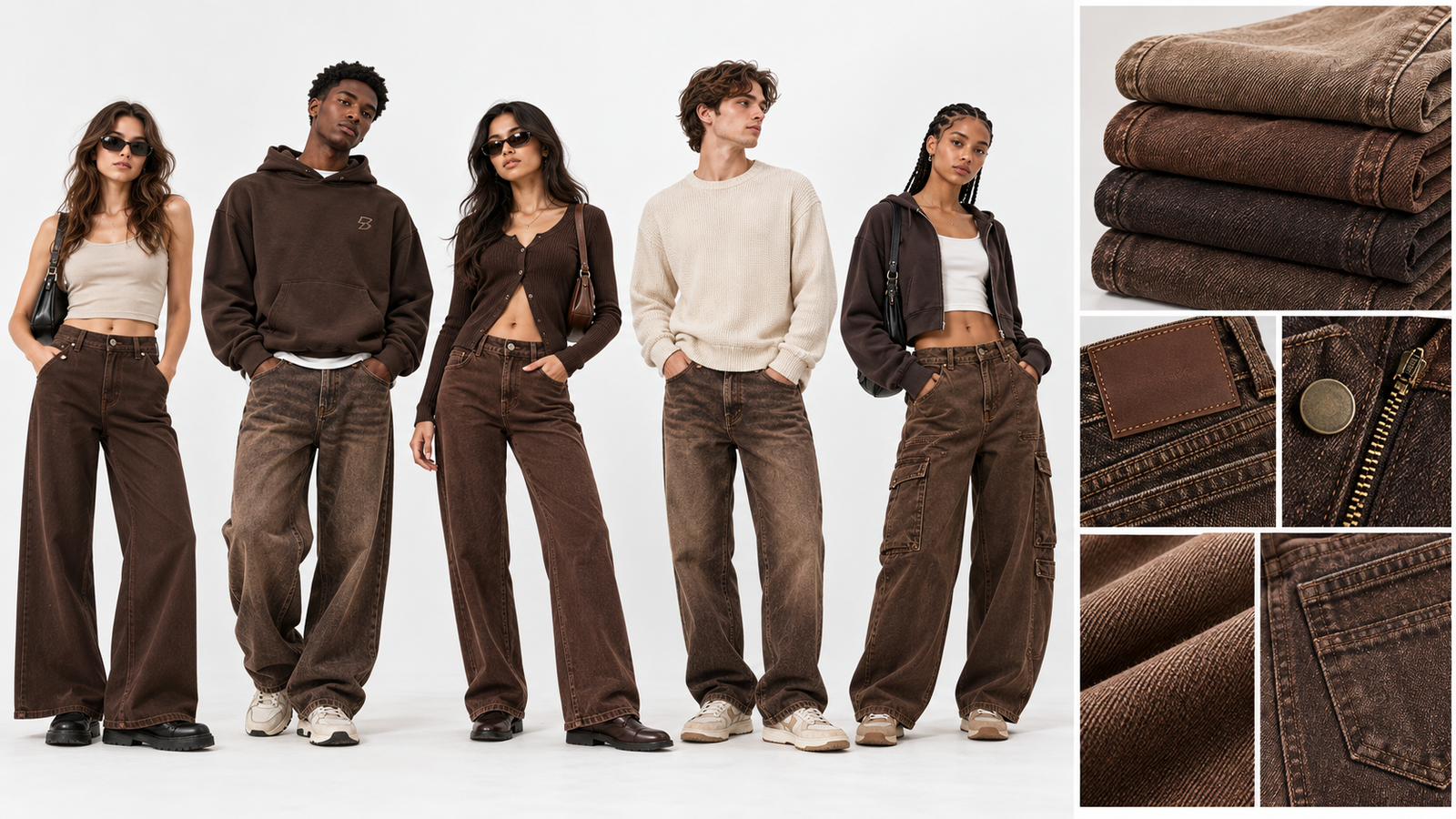
Brown jeans are denim pants developed in shades ranging from light camel and dusty mocha to deep chocolate and almost-black espresso.
Unlike traditional blue jeans, their identity comes as much from color development as from the fit itself.
Brown denim can be used for:
- Straight-leg jeans
- Wide-leg jeans
- Baggy jeans
- Barrel jeans
- Carpenter jeans
- Cropped jeans
- Five-pocket classics
- Utility-inspired denim
For clothing brands, the important question is not simply:
"Which brown do we want?"
The finished result depends on the relationship between:
base denim + dye system + color depth + wash + fabric weight + stitching + hardware + bulk shade control
A clean chocolate jean and a washed vintage-brown jean may begin with similar patterns but require very different fabric and finishing development.
This guide explains how brown denim can be developed, how different brown shades behave during washing, and what brands should specify before sampling and bulk production.
Why Are Brown Jeans Trending in 2026?
Blue denim remains a permanent category.
But brown denim offers brands a way to refresh jeans without changing the basic product completely.
Current brown denim directions include:
- Chocolate brown
- Espresso
- Coffee brown
- Mocha
- Caramel
- Tobacco
- Dusty brown
- Washed brown
- Brown-black
- Brown with blue undertones
The color can work with both clean and distressed products.
A dark chocolate straight jean may feel:
- Minimal
- Premium
- Tailored
while a washed brown baggy jean may feel:
- Vintage
- Streetwear
- Workwear inspired
- 1990s influenced
That flexibility is one reason brown denim works across very different collections.
Brown Jeans Are a Color Direction, Not a Fit
This distinction matters during product development.
"Brown jeans" tells the factory the color family.
It does not define:
- Rise
- Hip
- Thigh
- Knee
- Leg opening
- Length
- Pocket construction
For example:
dark chocolate wide-leg jeans
and:
washed mocha barrel jeans
may use completely different patterns.
The color development and garment pattern should therefore be specified separately.
Brown Jeans vs Brown Trousers
Brown trousers may be made from:
- Cotton twill
- Suiting
- Canvas
- Corduroy
- Stretch woven fabrics
Brown jeans specifically use denim construction or denim fabric.
Typical jeans details include:
- Twill denim
- Five-pocket construction
- Front fly
- Tack button
- Rivets
- Back yoke
- Denim topstitching
A brown cotton-twill trouser is not automatically brown denim just because the fabric is heavy.
Brown Denim vs Brown-Washed Blue Denim
These are also different.
Brown Denim
The denim itself is developed in a brown color direction.
The base may be:
- Undyed / ecru denim
- Prepared-for-dye denim
- Brown-dyed yarn denim
- Piece-dyed denim
Brown-Overdyed Blue Denim
Traditional or lighter indigo denim is treated with an additional brown color.
This can create:
- Brown with blue undertones
- Dirty vintage brown
- Olive-brown
- Smoky brown
- Uneven aged effects
When the garment is washed or abraded, the underlying blue may become more visible.
That can be desirable, but it should be intentional.
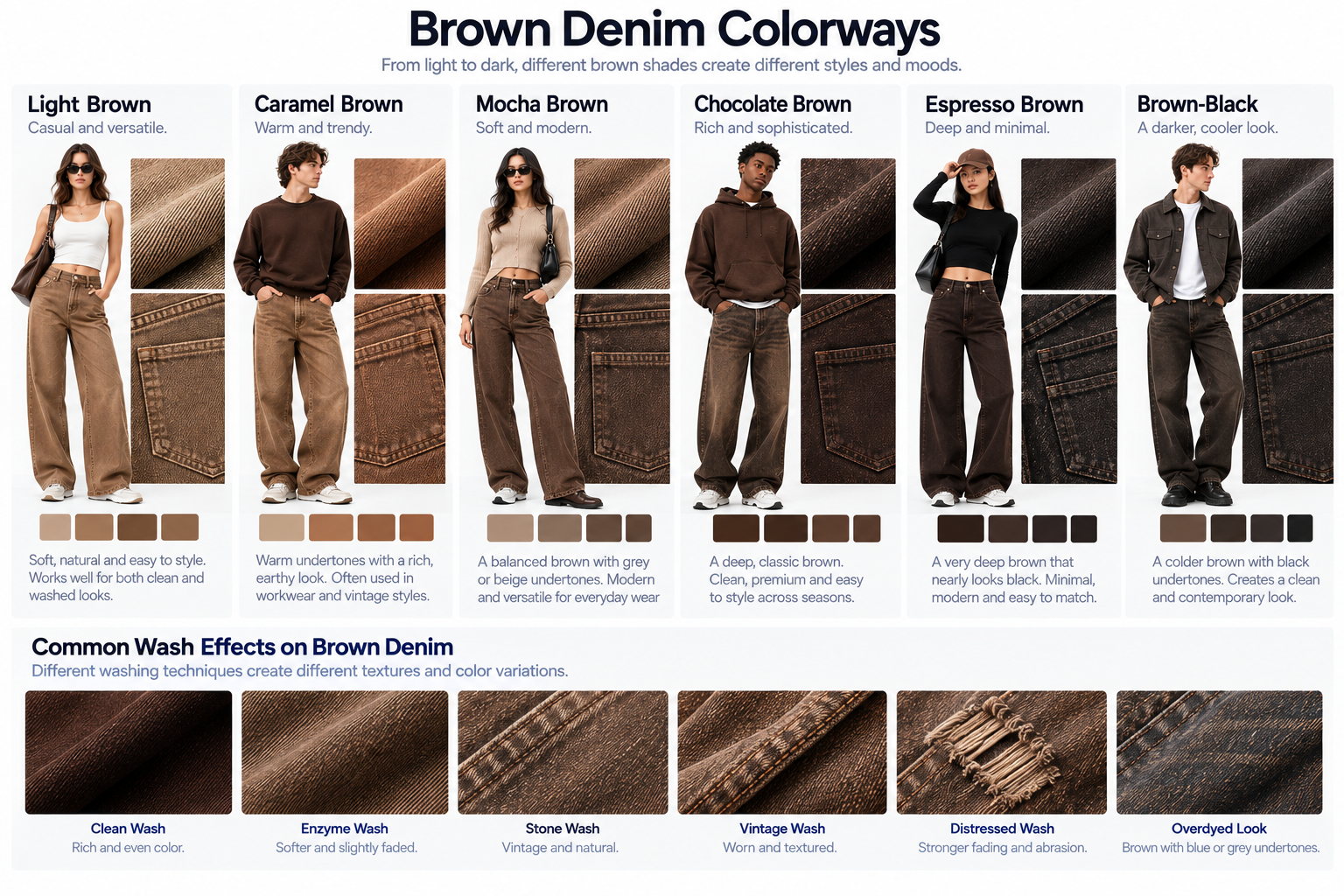
Main Brown Denim Color Families
Brown is a very broad color family.
For production, the difference between two brown shades can be significant.
Chocolate Brown
A rich medium-to-dark brown.
Typical appearance:
- Warm
- Deep
- Clean
- Premium
It works particularly well for:
- Straight jeans
- Wide-leg denim
- Barrel jeans
Espresso Brown
Very dark brown approaching black.
This creates:
- Strong depth
- Minimal appearance
- Easy styling
- Less obvious vintage character
From a distance, espresso jeans can almost appear black.
Mocha Brown
Usually softer and lighter than chocolate.
It can contain:
- Gray undertones
- Beige undertones
- Muted warm tones
This works well for washed or casual denim.
Caramel / Tobacco Brown
Warmer shades with:
- Yellow
- Orange
- Tan
undertones.
They can create a stronger:
- Heritage
- Workwear
- 1970s
appearance.
Brown-Black
This is useful when a brand wants something darker than conventional chocolate but warmer than black denim.
The undertone becomes particularly important under:
- Daylight
- Warm indoor lighting
- Cool LED lighting
Do Not Approve Brown From a Screen Only
Brown is sensitive to screen and lighting differences.
A digital reference can appear:
- More red
- More yellow
- More gray
- Darker
- Lighter
depending on the device.
For production, color approval should ideally use:
- Physical fabric reference
- Approved lab dip
- Approved fabric strike-off where relevant
- Approved garment sample
- Pantone reference as supporting information
The physical approved sample should remain the primary bulk reference whenever possible.
Brown Undertone Matters
Two fabrics can have the same apparent darkness but feel completely different.
Red Brown
Contains more:
- Burgundy
- Rust
- Red
undertone.
Yellow Brown
Moves toward:
- Tobacco
- Tan
- Camel
Gray Brown
Creates a more:
- Muted
- Dusty
- Minimal
appearance.
Blackened Brown
Uses very dark undertones.
It works well for:
- Premium basics
- Dark streetwear
- Minimal collections
When requesting a custom shade, simply writing:
dark brown
is usually not enough.
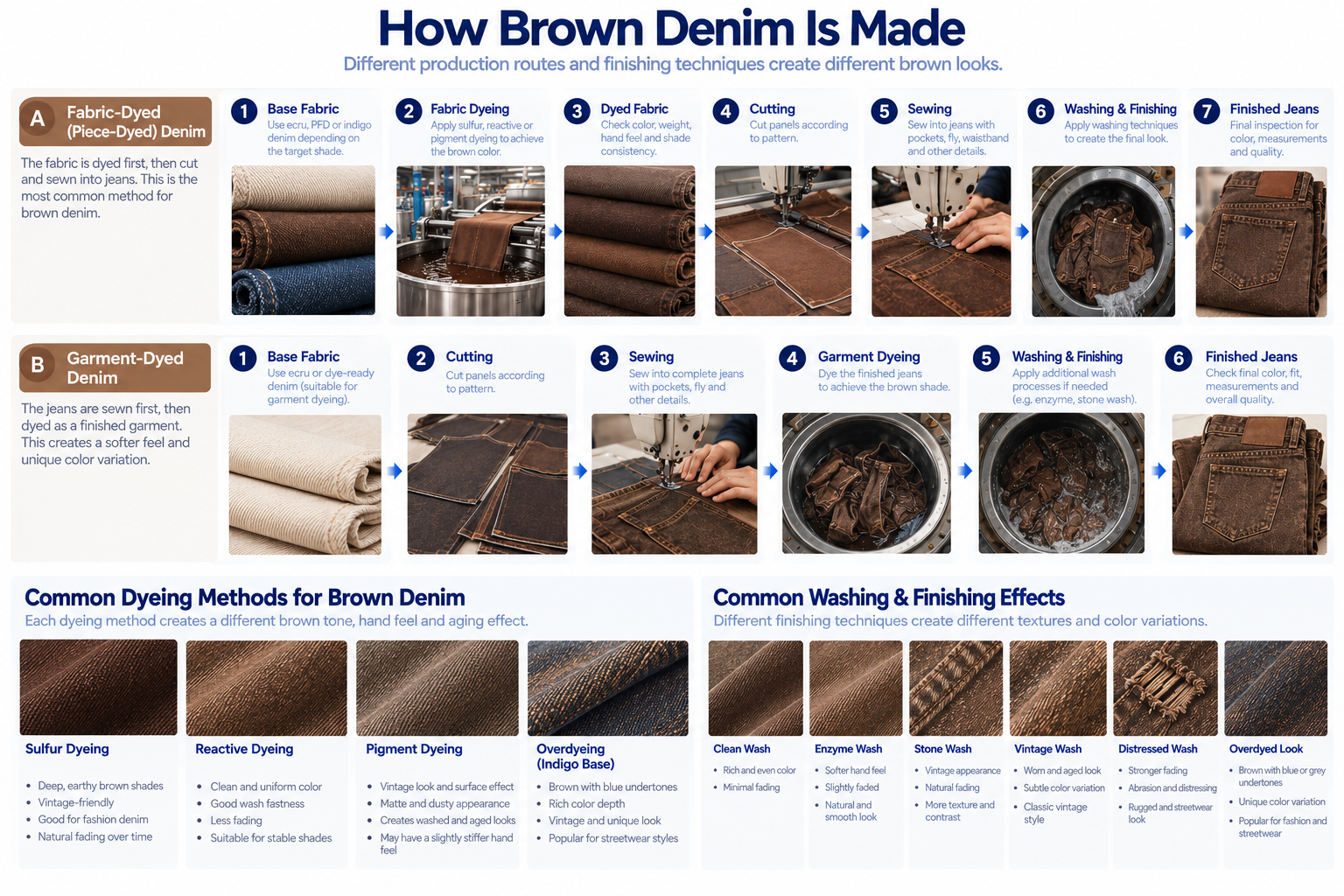
How Is Brown Denim Made?
There is no single production method.
Brown denim can be created using different dyeing systems depending on:
- Base fabric
- Fiber composition
- Desired fading
- Quantity
- Target price
- Wash effect
Common approaches include:
- Sulfur dyeing
- Reactive dyeing
- Piece dyeing
- Garment dyeing
- Pigment dyeing
- Overdyeing an existing denim base
Each creates a different visual result.
Sulfur-Dyed Brown Denim
Sulfur dyes are commonly used for deep fashion shades on cotton, including:
- Brown
- Black
- Olive
- Charcoal
They can work particularly well for denim because they can create:
- Deep color
- Muted shades
- Good commercial durability
- Vintage-friendly aging
Sulfur brown may gradually soften in appearance through washing and wear.
The exact fading depends on:
- Dye recipe
- Fabric
- Washing
- Abrasion
- Finishing
Sulfur dyeing can be particularly useful when the target is:
dark chocolate / tobacco / earthy brown
with a denim-like aging character.
Reactive-Dyed Brown Denim
Reactive dyes chemically bond with cellulosic fibers such as cotton.
They are useful when a brand wants:
- Clean color
- Strong uniformity
- Good wash fastness
- Less dramatic fading
Reactive brown can be suitable for products where the desired appearance is:
clean and stable
rather than aggressively vintage.
For example:
A premium dark-brown straight jean may benefit from a more uniform color direction than a heavily washed streetwear jean.
Pigment-Dyed Brown Denim
Pigment color sits more toward the fabric surface compared with fiber-reactive dye systems.
This can help create:
- Vintage appearance
- Surface variation
- Washed-down color
- Faster visual aging
Pigment development can be useful for:
- Dusty brown
- Faded mocha
- Vintage tobacco
- Washed workwear
However, excessive surface pigment may create:
- Stiffer hand feel
- Higher rubbing risk
- More obvious abrasion
The recipe needs to be tested on the actual fabric.
Garment-Dyed Brown Jeans
Another approach is to first sew the garment using a dye-ready fabric and then dye the completed jeans.
A simplified sequence may be:
prepared fabric → cutting → sewing → garment dyeing → finishing
This can create:
- Softer garment feel
- Vintage character
- Natural seam variation
But garment dyeing adds dimensional risk.
The garment can change in:
- Waist
- Hip
- Inseam
- Leg opening
during processing.
The pattern should therefore be developed around the final finished measurements rather than only the pre-dye size.
Piece-Dyed Brown Denim
In piece dyeing, fabric is dyed before garment cutting.
This allows:
- More uniform yardage
- Conventional cutting
- Better bulk measurement control
The final garment can still receive additional washing afterward.
Piece-dyed fabric is useful when consistency is more important than strong garment-dye variation.
Overdyed Indigo Denim
Brown can also be introduced over an indigo base.
This creates a more complex surface.
Depending on the wash, the garment may reveal:
- Brown top tones
- Blue undertones
- Mixed vintage areas
This can be attractive for streetwear or experimental denim.
But brands should understand that:
brown over indigo
will age differently from:
brown denim with no blue base
They should not be approved using the same color expectations.
The Base Denim Changes the Final Brown
The same brown recipe will not look identical on different denim fabrics.
Important variables include:
- Cotton color
- Yarn structure
- Twill
- Fabric weight
- Surface hairiness
- Stretch fiber
- Previous dyeing
An ecru base can create a different brown from an indigo base.
A heavily textured denim can also reflect light differently from a smoother fabric.
Color should therefore be developed on the actual intended fabric whenever possible.
Ecru or PFD Denim
An undyed or prepared-for-dye base gives the dyehouse a relatively neutral starting point.
This makes it useful for:
- Clean brown
- Chocolate
- Mocha
- Camel
- Custom fashion colors
It reduces interference from an existing blue or black base.
Indigo Base
Using indigo creates more complex color development.
After overdyeing and washing, the garment may show:
- Brown
- Blue
- Gray
- Olive
in different areas.
This is useful if the design requires depth.
It is less suitable when the goal is perfectly flat, uniform chocolate brown.
Black Denim Base
A black base can create:
- Extremely deep espresso
- Brown-black
- Smoky dark brown
But the final undertone must be tested carefully.
Too much black can make the brown almost invisible.
Denim Weight for Brown Jeans
Color does not replace fabric selection.
Common denim ranges may include:
Lightweight Denim
Approximately:
8–10 oz
Useful for:
- Softer jeans
- Summer denim
- Fluid wide legs
Midweight Denim
Approximately:
10–13 oz
Useful for:
- Straight jeans
- Wide-leg jeans
- Barrel jeans
- General streetwear
Heavy Denim
Approximately:
13–16 oz+
Creates:
- More structure
- Stronger folds
- More substantial hand feel
But heavy denim may also make:
- Washing more difficult
- Wide silhouettes heavier
- Seam areas bulkier
The weight should support the intended fit.
100% Cotton Brown Denim
Rigid cotton denim provides:
- Strong denim character
- Structured silhouette
- Traditional aging
- More visible crease development
It works well for:
- Baggy
- Straight
- Wide
- Barrel
silhouettes.
Stretch Brown Denim
Adding elastane can improve:
- Comfort
- Movement
- Fitted silhouette
It may be useful for:
- Slim jeans
- Fitted straight jeans
- Women's denim
However, stretch fabrics need testing after washing.
Heat and aggressive finishing can affect:
- Recovery
- Stretch
- Dimensions
Wide-Leg Brown Jeans
Wide-leg is one of the easiest silhouettes for brown denim to adopt.
The large fabric surface makes the color highly visible.
Important measurements include:
- Hip
- Thigh
- Knee
- Leg opening
- Inseam
A dark chocolate wide leg can feel significantly cleaner than a heavily faded blue version of the same pattern.
Straight-Leg Brown Jeans
Straight brown denim works well as a simpler commercial product.
It can use:
- Clean five-pocket construction
- Minimal wash
- Tonal stitching
- Dark hardware
This keeps the color as the main design element.
Barrel Brown Jeans
Brown can also work with barrel silhouettes.
The pattern needs:
- Controlled thigh volume
- Curved side seam
- Knee shaping
- Tapered lower leg
A rich solid brown may make the curved pattern line easier to see than a highly distressed or heavily patterned denim.
Baggy Brown Jeans
Baggy versions create a stronger streetwear direction.
Possible combinations include:
- Low rise
- Relaxed hip
- Wide thigh
- Long length
- Vintage brown wash
A washed tobacco or dusty mocha can create a more vintage appearance.
Carpenter Brown Jeans
Carpenter details work naturally with brown denim because the color already has a workwear association.
Possible details include:
- Hammer loop
- Utility pockets
- Reinforced seams
- Patch pockets
- Contrast stitching
However, too many workwear details can make the garment look like conventional work pants rather than fashion denim.
The brand should decide which direction it wants.
Dark Brown vs Washed Brown
These are two different development goals.
Clean Dark Brown
Usually emphasizes:
- Color uniformity
- Minimal abrasion
- Clean stitching
- Controlled washing
Washed Brown
May intentionally use:
- Fading
- Abrasion
- Enzyme washing
- Stone effects
- Grinding
- Whiskers
The wash should be selected based on the dye system.
Not every brown dye responds identically to the same process.
Enzyme Washing
Enzyme washing can soften cotton denim and remove some surface fiber.
Possible effects include:
- Softer hand
- Cleaner surface
- Mild color reduction
The degree depends on:
- Enzyme type
- Time
- Temperature
- Fabric
- Dye
A dark brown garment should be tested before the treatment is applied to bulk production.
Stone Washing
Stone washing can create stronger:
- Abrasion
- Vintage appearance
- Seam highlighting
- Surface variation
For brown denim, excessive abrasion can change the color dramatically.
A rich chocolate brown may become:
- Tan
- Gray-brown
- Rusty
depending on the dye and base.
The final approved wash standard should therefore be physical.
Vintage Brown Wash
A vintage finish may combine several techniques.
The objective may be:
- Softer brown
- Uneven surface
- Worn seam areas
- Muted color
- Reduced saturation
Vintage does not need to mean heavily distressed.
A subtle faded chocolate can look more premium than extreme abrasion.
Dirty Brown / Muddy Brown
Some brands want an intentionally less clean shade.
This may combine:
- Brown
- Gray
- Olive
- Blue undertones
The result can feel more:
- Workwear
- Vintage
- Experimental
A physical reference is especially important because terms like:
dirty brown
are highly subjective.
Whiskers and Fading
Classic blue jeans often use high-contrast whiskers.
Brown denim can also use whisker effects, but the contrast should match the product.
A clean chocolate jean may look better with:
- Minimal whiskering
- Soft fading
while a vintage brown jean may use stronger abrasion.
Do Not Copy a Blue Denim Wash Recipe Directly
The same process can produce very different effects on brown denim.
Reasons include:
- Different dye chemistry
- Different base color
- Different fabric construction
- Different desired contrast
A blue denim wash standard should therefore not automatically become the wash recipe for brown denim.
Brown Denim Shade Consistency
Bulk color consistency is one of the most important production concerns.
Potential variation can occur between:
- Fabric lots
- Dye lots
- Wash lots
- Production batches
For dark brown, even a small difference in undertone can be visible.
One lot may appear:
- More red
while another appears:
- More gray
or:
- More yellow
Bulk production should therefore be compared to the approved color standard.
Shade Bands
A practical bulk approval process may use a shade band containing:
- Approved target
- Slightly lighter acceptable shade
- Slightly darker acceptable shade
This gives the QC team a controlled reference.
The exact tolerance depends on the brand.
Inspect Brown Under Multiple Light Sources
Dark neutrals can change appearance significantly under different lighting.
Review samples under:
- Daylight
- Standard light box where available
- Typical indoor lighting
A brown that looks perfect under warm light may look:
- Gray
- Green
- Almost black
under cooler lighting.
Colorfastness and Crocking
Dark denim should be tested for potential color transfer.
Important checks may include:
- Dry rubbing
- Wet rubbing
- Washing
- Perspiration where relevant
This is particularly important for:
- Dark chocolate
- Espresso
- Pigment surfaces
A dark fashion color should not be approved only for appearance.
Shrinkage
Washing can affect:
- Waist
- Hip
- Rise
- Inseam
- Leg opening
For denim, final garment measurements should be based on the intended finished wash.
A pre-wash sample that fits perfectly may not remain correct after processing.
Pattern Allowance for Wash
If the fabric or garment shrinks during finishing, the pattern may require compensation.
The allowance should be based on actual testing.
Do not assume a universal:
- 2%
- 3%
- 5%
shrinkage value.
Different fabrics and wash processes behave differently.
Topstitching for Brown Jeans
Thread color can change the entire look.
Tonal Brown Stitching
Creates:
- Minimal appearance
- Cleaner premium look
Tobacco Stitching
Creates:
- Traditional denim contrast
- Heritage appearance
Cream Stitching
Creates stronger contrast.
It can make:
- Seams
- Pockets
- Yoke
much more visible.
Black Stitching
Works particularly well with:
- Espresso
- Dark chocolate
- Brown-black
for a darker streetwear direction.
Hardware for Brown Denim
Possible hardware finishes include:
- Antique brass
- Dark brass
- Gunmetal
- Matte black
- Silver
Warm brown denim works naturally with antique brass.
Dark espresso can work well with:
- Gunmetal
- Black
- Dark antique finishes
For custom buttons, rivets, zippers and labels, see Brad Apparel's Trims & Branding.
Back Patch Options
Common materials include:
- Leather
- PU
- Jacron
- Woven label
- Embossed synthetic patch
The patch color should be selected against the final washed garment.
A patch approved against unwashed fabric may appear too light or dark after washing.
Pocket Bags
Pocketing fabric can use:
- Cotton
- Cotton/polyester
- Printed pocketing
- Custom branded fabric
For very dark brown denim, a light pocket bag may become visible at:
- Pocket opening
- Inside fly
if construction is not controlled.
How to Develop a Custom Brown Denim Color
A practical development sequence is:
- Confirm target jean silhouette
- Select denim composition and weight
- Choose brown color family
- Confirm base denim
- Select dyeing direction
- Develop color sample
- Approve physical shade
- Develop wash
- Make full garment sample
- Check measurements after finishing
- Approve stitching and hardware
- Establish bulk shade standard
This sequence keeps color development connected to the actual garment.
Color Should Be Approved Before Bulk Cutting
If the bulk fabric color is not approved before cutting, a large amount of fabric can be committed to the wrong shade.
For piece-dyed fabric, confirm:
- Color
- Surface
- Weight
- Hand feel
before cutting.
For garment-dyed products, approve:
- Garment dye recipe
- Finished color
- Finished measurements
before bulk.
First Sample vs Wash Sample
A development project may require more than one type of sample.
Fit Sample
Used mainly to confirm:
- Pattern
- Measurements
- Silhouette
Wash / Color Sample
Used to confirm:
- Brown shade
- Fade
- Hand feel
- Surface
Pre-Production Sample
Confirms the final combination of:
- Pattern
- Bulk fabric
- Wash
- Hardware
- Labels
- Stitching
These stages should not be confused.
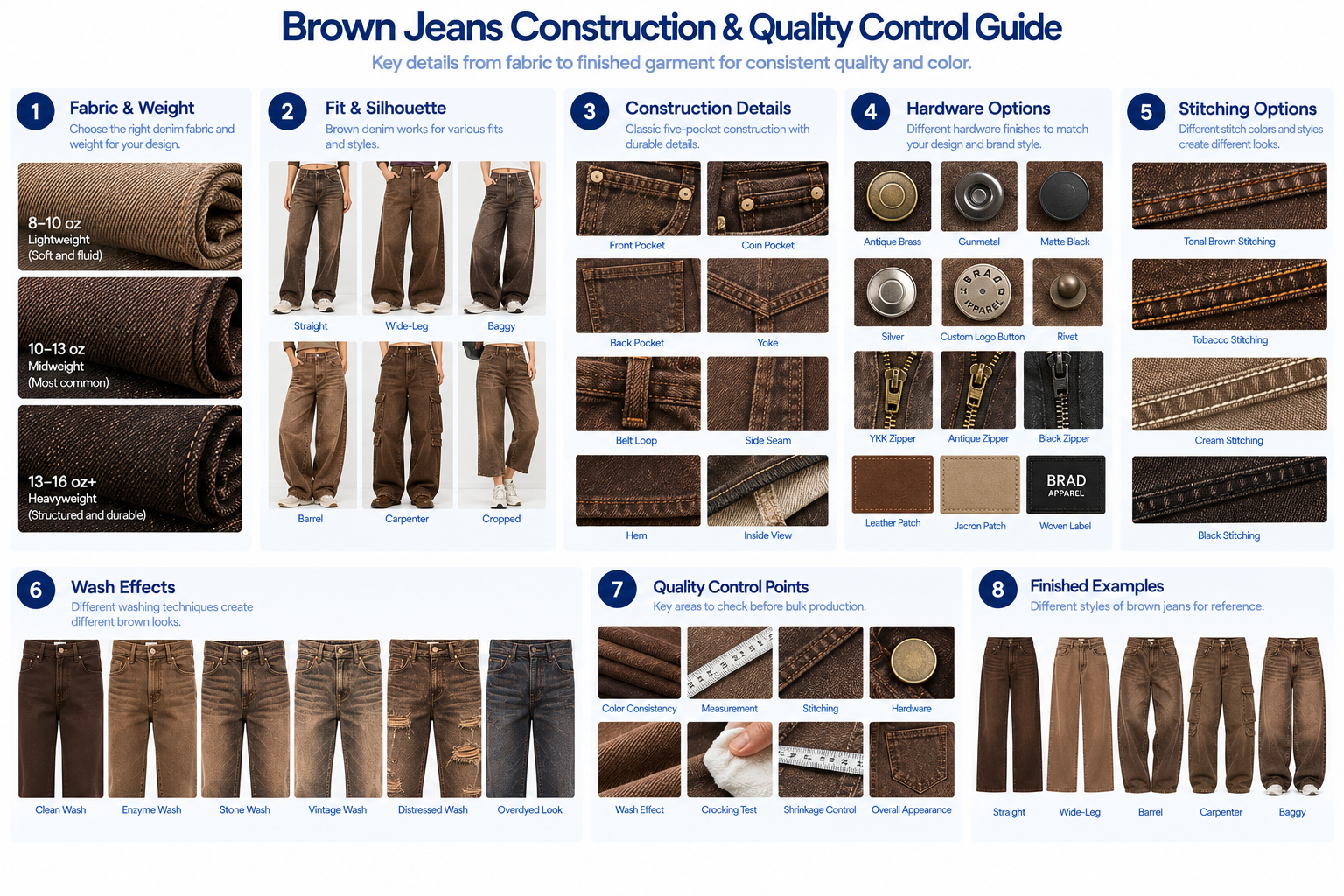
Brown Jeans Construction & Quality-Control Guide
Important production areas include:
- Denim weight
- Brown color
- Dye method
- Rise
- Fit
- Five-pocket construction
- Stitching
- Hardware
- Wash
- Shrinkage
- Shade variation
- Final measurements
Important Brown Jeans Measurements
| Measurement | Why It Matters |
|---|---|
| Waist | Controls waist fit |
| High Hip | Controls upper shaping |
| Full Hip | Controls seat fit |
| Front Rise | Defines front waist position |
| Back Rise | Controls seat and back waist |
| Thigh | Controls upper-leg ease |
| Knee | Defines leg silhouette |
| Leg Opening | Controls lower-leg shape |
| Inseam | Controls length |
| Outseam | Confirms overall proportion |
| Back Pocket Position | Affects seat appearance |
| Yoke Depth | Influences back shaping |
The required measurements depend on the silhouette.
Example Chocolate Brown Jeans Brief
Instead of writing:
I want chocolate brown jeans.
write something like:
Mid-rise relaxed straight jeans in 12 oz 100% cotton denim, developed in a deep chocolate-brown shade with a clean low-fade finish. Five-pocket construction with tonal dark-brown topstitching, antique-brass tack button and rivets, and minimal surface abrasion.
Then specify:
- Pantone / physical color reference
- Fabric weight
- Composition
- Rise
- Waist
- Hip
- Thigh
- Knee
- Leg opening
- Inseam
- Wash
- Hardware
- Stitching
- Patch
- Branding
This greatly reduces interpretation.
Example Espresso Wide-Leg Jeans
A modern premium direction might use:
- High or mid rise
- Wide leg
- 11–13 oz cotton denim
- Very dark espresso brown
- Minimal wash
- Black or gunmetal hardware
- Tonal stitching
- Clean hem
This keeps the color sophisticated.
Example Washed Brown Baggy Jeans
A streetwear direction could use:
- Mid or low rise
- Relaxed hip
- Baggy thigh
- Wide hem
- Dusty brown dye
- Vintage wash
- Mild seam abrasion
- Antique hardware
- Contrast topstitching
The wash should be approved on the full garment because the larger surface creates more visible shade variation.
Example Brown Carpenter Jeans
A workwear-inspired version might use:
- Straight / relaxed fit
- Medium-weight denim
- Tobacco brown
- Hammer loop
- Utility pockets
- Reinforced stitching
- Antique brass hardware
The workwear elements should still be scaled according to the fashion silhouette.
Brown Jeans Tech Pack Example
| Area | Example Specification |
|---|---|
| Product | Brown Jeans |
| Fit | Relaxed Straight |
| Rise | Mid Rise |
| Fabric | 100% Cotton Denim |
| Weight | 12 oz |
| Color | Deep Chocolate Brown |
| Color Standard | Approved Physical Swatch |
| Dye Direction | Sulfur / Reactive Based on Development |
| Wash | Clean Soft Wash |
| Front | Five-Pocket |
| Closure | Tack Button + Zipper Fly |
| Stitching | Tonal Brown |
| Hardware | Antique Brass |
| Hem | Clean Finished |
| Branding | Back Patch + Woven Label |
These values are examples only.
Washed Brown Denim Tech Pack Example
| Area | Example Specification |
|---|---|
| Product | Vintage Brown Baggy Jeans |
| Fit | Baggy |
| Rise | Mid |
| Fabric | Cotton Denim |
| Weight | 11–13 oz |
| Color | Dusty Mocha Brown |
| Wash | Vintage / Enzyme Based on Approval |
| Surface | Mild Fade |
| Stitching | Tobacco |
| Hardware | Antique Brass |
| Hem | Clean / Distressed Optional |
| Branding | Jacron Patch |
How to Evaluate the First Brown Jeans Sample
The garment should be evaluated for both:
fit
and:
color
Front View
Check:
- Waist
- Fly
- Hip
- Thigh
- Leg shape
- Front pocket
- Color distribution
Side View
Check:
- Rise
- Seat
- Side-seam balance
- Wash transition
- Color consistency
Back View
Check:
- Back rise
- Yoke
- Back pockets
- Seat fit
- Shade consistency
Compare Color Before and After Washing
Record:
- Original shade
- Finished shade
Ask:
- Did it become too red?
- Too yellow?
- Too gray?
- Too light?
- Too uneven?
The wash should move toward the approved target rather than simply "look vintage."
Check Seam Areas
Denim washing can create stronger fading around:
- Pocket edges
- Fly
- Waistband
- Side seams
- Hem
This may be intentional.
But one seam should not appear dramatically different from the rest unless the design requires it.
Check Crocking
Rub the dark denim against an appropriate test material according to the required testing standard.
Dark brown can transfer color if the dyeing and finishing are not sufficiently controlled.
The required performance level should be established before bulk approval.
Check Hardware After Washing
Verify:
- Button finish
- Rivet finish
- Zipper operation
- No corrosion
- No unwanted staining
Metal finishes can react differently to aggressive washing.
Check Final Measurements
Always measure after:
- Dyeing
- Washing
- Drying
- Finishing
if those processes are part of production.
The customer receives the finished garment, not the pre-wash garment.
Bulk Shade Control
For bulk production, compare production lots with the approved reference.
Inspect:
- Front
- Back
- Multiple garments together
One jean may look acceptable alone but appear obviously different when placed next to another lot.
Common Brown Jeans Development Mistakes
1. Specifying Only "Chocolate Brown"
The color still needs a physical reference and undertone direction.
2. Choosing the Fit Before Testing the Fabric
Different denim weights produce different silhouettes.
3. Approving Color Only Before Washing
The final washed shade may be significantly different.
4. Copying a Blue-Denim Wash Recipe
Brown dyes can react differently.
5. Ignoring Undertone
Red-brown and gray-brown can look completely different.
6. Not Checking Shade Lots
Bulk batches can vary.
7. Using Heavy Contrast Stitching Without Testing
Stitch color can dominate dark brown denim.
8. Choosing Hardware Before Final Wash Approval
The hardware may look different against the finished shade.
9. Ignoring Crocking
Dark colors may transfer.
10. Measuring Before Finishing Only
Shrinkage can change fit.
Brown Jeans vs Blue Jeans: Which Should Your Brand Develop?
Choose brown jeans if you want:
- Warmer neutral color
- Strong Fall/Winter relevance
- A more unusual denim basic
- Chocolate / espresso / mocha shades
- Heritage or premium styling
Choose classic blue denim if you want:
- Familiar denim identity
- Traditional indigo fading
- Broad commercial recognition
Choose black denim if you want:
- Darker streetwear direction
- Easier monochrome styling
- Less visible brown undertone
Choose brown-overdyed blue denim if you want:
- More complex aging
- Visible undertones
- Vintage character
For a broader overview of different trouser categories, see Brad Apparel's Complete Guide to Pants Types.
Fabric Sourcing Comes Before Color Approval
Brown denim development works best when the brand first confirms:
- Composition
- Weight
- Stretch
- Twill
- Hand feel
and then develops the shade on that fabric.
Changing the base fabric after color approval can change the result.
For material development, see Brad Apparel's Fabric Sourcing & Development.
FAQ
What Are Brown Jeans?
Brown jeans are denim trousers developed in brown colorways such as chocolate, espresso, mocha, tobacco or washed brown.
They can use the same basic construction as traditional blue jeans.
Are Brown Jeans Trending in 2026?
Yes.
Brown denim is one of the noticeable denim color directions of 2026, particularly in chocolate, espresso and earthy washed shades.
Are Chocolate Brown Jeans the Same as Brown Jeans?
Chocolate brown is one specific shade within the broader brown-jeans category.
Other options include:
- Espresso
- Mocha
- Tobacco
- Camel
- Brown-black
How Is Brown Denim Dyed?
Brown denim may use sulfur, reactive, pigment, piece-dye, garment-dye or overdye processes depending on the fabric and desired appearance.
Is Brown Denim Normally Indigo?
Not necessarily.
Some brown denim begins from an undyed or dye-ready base.
Other products use indigo denim that is later overdyed brown.
The two approaches create different aging effects.
What Dye Is Best for Dark Brown Denim?
There is no universal best method.
Sulfur dyes can be useful for deep earthy shades and vintage-friendly denim.
Reactive dyes can be useful when cleaner, more stable color is required.
The choice depends on the desired finish and fabric.
Does Brown Denim Fade?
Yes.
How it fades depends on:
- Dye system
- Base denim
- Washing
- Wear
- Abrasion
Some brown denim develops a soft vintage patina, while other dye systems are designed to remain more stable.
What Denim Weight Is Best for Brown Jeans?
It depends on the silhouette.
Typical starting points may include:
- 8–10 oz for lighter denim
- 10–13 oz for general jeans
- 13 oz+ for heavier structured denim
The actual fabric should be approved by hand feel and sample fit.
Can Brown Jeans Be Wide Leg?
Yes.
Brown denim works well in:
- Wide-leg
- Straight
- Baggy
- Barrel
- Carpenter
silhouettes.
Can Brown Jeans Be Garment Dyed?
Yes, provided the fabric, thread and trims are compatible with the process.
Garment dyeing can create softer, more lived-in color but requires shrinkage and measurement testing.
What Is the Difference Between Chocolate and Espresso Denim?
Chocolate brown is usually a rich dark brown with more visible warmth.
Espresso is generally darker and may approach black.
Actual color standards should be approved physically.
Should Brown Denim Use Tonal Stitching?
It can.
Tonal stitching creates a cleaner look.
Tobacco, cream or contrast stitching can create a stronger heritage denim appearance.
What Hardware Works With Brown Jeans?
Common options include:
- Antique brass
- Gunmetal
- Matte black
- Silver
- Dark antique metal
The finish should be selected against the final washed shade.
Why Does My Brown Denim Look Different After Washing?
Washing can change:
- Dye depth
- Surface fibers
- Abrasion
- Undertone
- Fabric texture
This is why final color approval should happen after the intended wash process.
What Should a Brown Jeans Tech Pack Include?
Include:
- Fit
- Rise
- Waist
- Hip
- Thigh
- Knee
- Leg opening
- Inseam
- Denim composition
- Denim weight
- Brown color reference
- Dye direction
- Wash
- Stitching
- Hardware
- Back patch
- Labels
Final Thoughts
Brown jeans are not simply blue jeans recolored in brown.
A successful product depends on how:
base denim + dye chemistry + brown undertone + wash + pattern + trims
work together.
Clean chocolate denim can create a premium modern basic.
Espresso brown can replace black in a darker collection.
Washed mocha can create a vintage streetwear direction.
And overdyed indigo can produce a more complex brown with blue undertones.
For clothing brands, the key is to approve the fabric, color and wash as one complete system.
Once the final brown shade, denim structure and finished measurements are approved together, the factory can reproduce the product much more consistently from sample development through bulk production.
Keep Reading