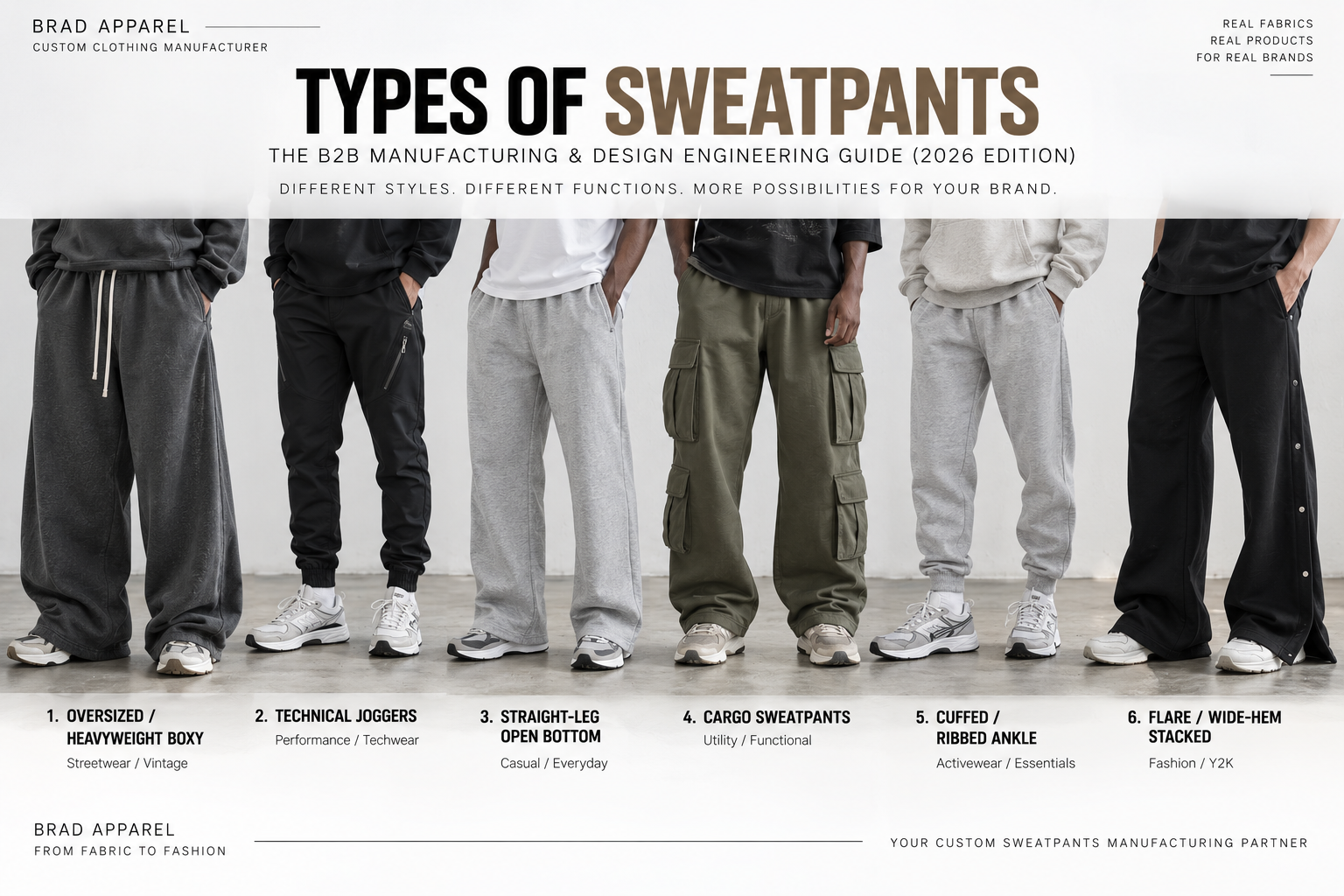
Sweatpants are no longer just basic loungewear.
For streetwear, athleisure and private-label brands, the final product depends on much more than choosing a fleece fabric and adding an elastic waistband.
Professional sweatpant development requires decisions around:
- Leg silhouette
- Fabric GSM
- Fabric composition
- Pocket construction
- Waistband structure
- Cuff design
- Hardware
- Pattern engineering
- Decoration
- Quality control
In 2026, six sweatpant silhouettes are especially useful for brands building custom collections.
This guide explains how each style differs from a manufacturing perspective and how fabric, pattern and construction should be matched to the intended look.
6 Essential Types of Sweatpants
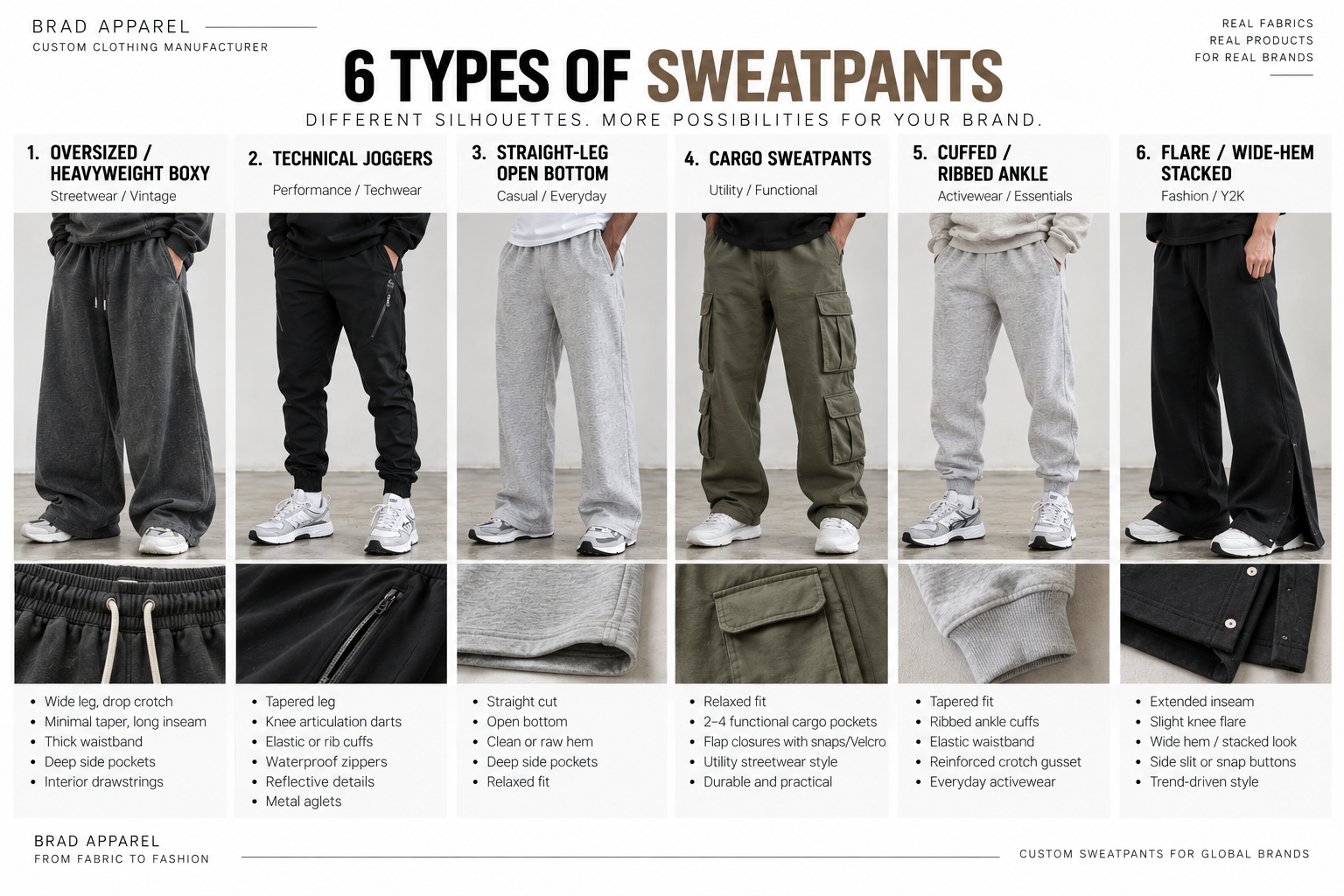
1. Oversized / Heavyweight Boxy Sweatpants
This silhouette is built around volume.
Typical characteristics include:
- Wide leg
- Dropped crotch
- Minimal taper
- Longer inseam
- Heavy fabric
- Relaxed drape
Common construction details include:
- Thick waistband
- Interior drawcord
- Deep side pockets
- Heavy rib or open hem
This style works particularly well for:
- Streetwear brands
- Skate labels
- Vintage-inspired collections
- Pigment-washed drops
A heavier fabric helps the silhouette maintain its shape.
2. Technical Joggers
Technical joggers use a slimmer and more engineered silhouette.
Common pattern details include:
- Tapered leg
- Articulated knee
- Elastic or ribbed cuffs
- More controlled thigh width
Possible trims include:
- Waterproof zippers
- Reflective heat transfers
- Metal aglets
- Technical drawcords
These styles are commonly developed for:
- Performance activewear
- Gym brands
- Running collections
- Techwear
3. Straight-Leg Open Bottom Sweatpants
Straight-leg sweatpants maintain a similar width from the hip down toward the hem.
Unlike joggers, they do not use a tight ankle cuff.
Common details include:
- Straight leg
- Open bottom
- Coverstitched hem
- Deep side pockets
- Relaxed fit
This silhouette works well for:
- Casual athleisure
- Collegiate-inspired apparel
- Lounge collections
- Everyday basics
4. Cargo Sweatpants
Cargo sweatpants combine fleece construction with utility details.
Typical features include:
- Relaxed leg
- Multiple side pockets
- Bellows pockets
- Flap closures
- Snaps
- Velcro
- Nylon webbing
This makes them suitable for:
- Functional streetwear
- Utility collections
- Outdoor-inspired styling
- Urban capsule drops
The pocket pattern needs to be balanced carefully so that heavy cargo pockets do not distort the leg.
5. Cuffed / Ribbed Ankle Sweatpants
This is one of the most traditional sweatpant constructions.
Typical details include:
- Tapered leg
- Ribbed ankle cuffs
- Elastic waistband
- Drawcord
- Reinforced crotch area
This style is commonly used for:
- Core activewear
- Gym bottoms
- Everyday essentials
- Matching sweat sets
Heavy 2x2 rib can create a more premium appearance than very lightweight ribbing.
6. Flare / Wide-Hem Stacked Sweatpants
Flare or stacked sweatpants use an extended leg length to create more fabric around the shoe.
Typical details include:
- Longer inseam
- Slight knee flare
- Wide hem
- Fabric stacking over sneakers
Possible design elements include:
- Side-seam slits
- Adjustable snaps
- Zippers
- Raw-edge styling
This silhouette is useful for:
- Fashion streetwear
- Y2K-inspired brands
- Trend-focused collections
Sweatpants Style Comparison
| Sweatpants Style | Main Silhouette | Key Details | Best For |
|---|---|---|---|
| Oversized / Boxy | Wide and relaxed | Heavy waistband, deep pockets | Streetwear |
| Technical Jogger | Slim and tapered | Zippers, articulated knee | Activewear / techwear |
| Straight-Leg | Straight open hem | Deep pockets, clean hem | Casual athleisure |
| Cargo Sweatpants | Relaxed utility fit | 3D cargo pockets | Functional streetwear |
| Cuffed Sweatpants | Tapered with rib cuff | Rib cuff, reinforced crotch | Everyday activewear |
| Flare / Stacked | Long and wide hem | Side slit / adjustable hem | Fashion streetwear |
Choosing the Right Fabric for Sweatpants
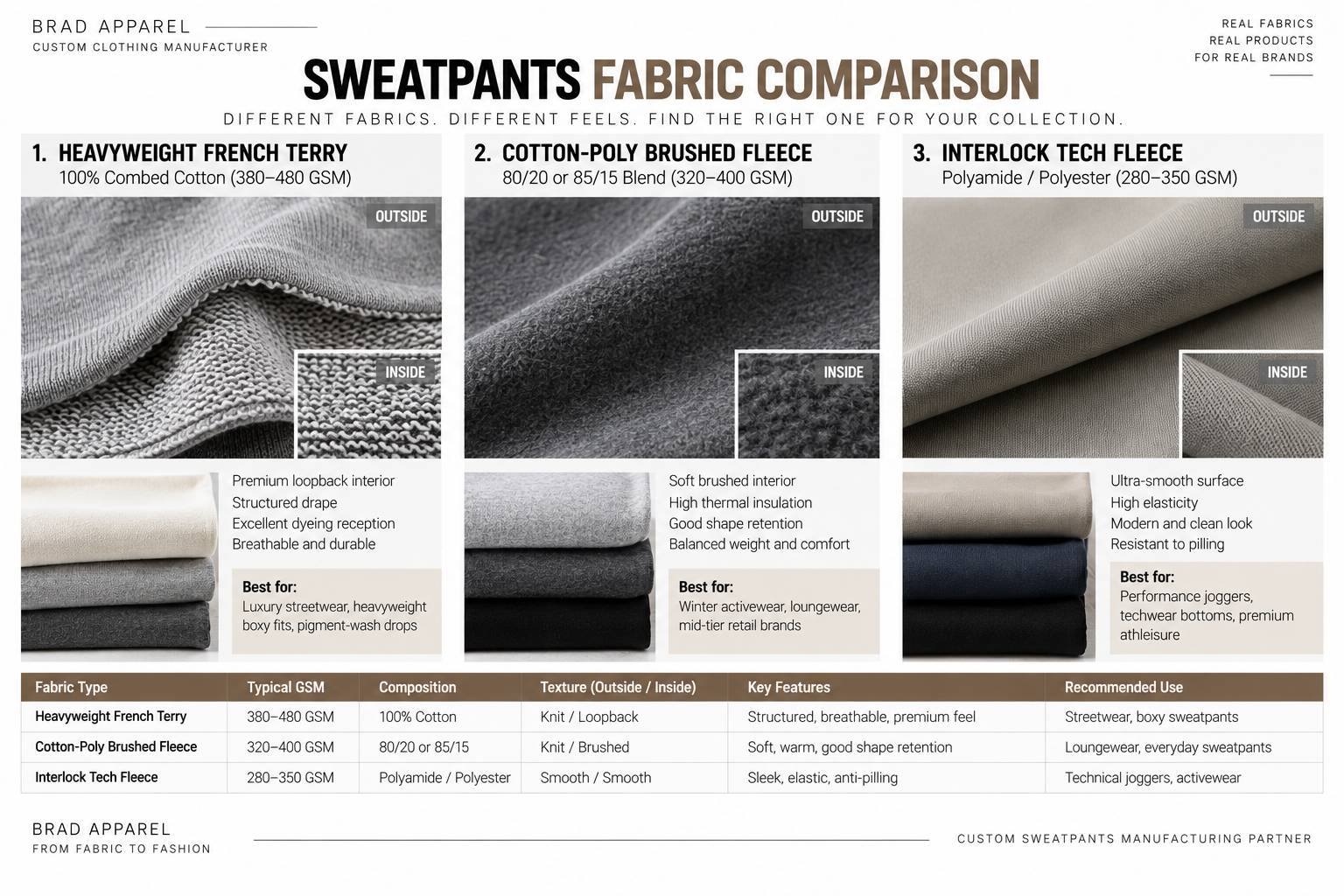
The fabric determines how sweatpants:
- Drape
- Hold their shape
- Feel against the skin
- Perform after washing
- Work with decoration
Three fabric categories are particularly useful for custom sweatpants.
1. Heavyweight French Terry
Typical specification:
380–480 GSM
Common composition:
100% combed cotton
or cotton-rich blends.
Key characteristics include:
- Loopback interior
- Structured drape
- Premium hand feel
- Good breathability
- Suitable for pigment washing
Best suited to:
- Heavyweight streetwear
- Boxy sweatpants
- Oversized fits
- Premium collections
2. Cotton-Poly Brushed Fleece
Typical specification:
320–400 GSM
Common blends include:
80% cotton / 20% polyester
or:
85% cotton / 15% polyester
Characteristics include:
- Soft brushed interior
- More warmth
- Comfortable hand feel
- Good shape retention
Best suited to:
- Winter sweatpants
- Loungewear
- Everyday activewear
- Matching sweat sets
3. Interlock / Tech Fleece
Typical specification:
280–350 GSM
This category has a smoother and more technical appearance.
Typical characteristics include:
- Smooth surface
- Cleaner modern look
- Higher elasticity
- More controlled structure
Best suited to:
- Technical joggers
- Running pants
- Premium athleisure
- Techwear bottoms
Fabric Weight Reference
| Fabric Type | Typical GSM | Structure | Typical Use |
|---|---|---|---|
| Interlock / Tech Fleece | 280–350 GSM | Smooth and controlled | Technical joggers |
| Brushed Fleece | 320–400 GSM | Soft and warm | Everyday sweatpants |
| Heavy French Terry | 380–480 GSM | Dense and structured | Premium streetwear |
The best GSM depends on the intended silhouette.
A 480 GSM fabric may work very well for oversized boxy sweatpants but may be unnecessarily heavy for a slim running jogger.
Pattern Engineering Matters
Premium sweatpants are not created by fabric alone.
Pocket construction, crotch geometry and seam reinforcement affect how the garment performs during daily wear.
Pocket Bag Anchoring
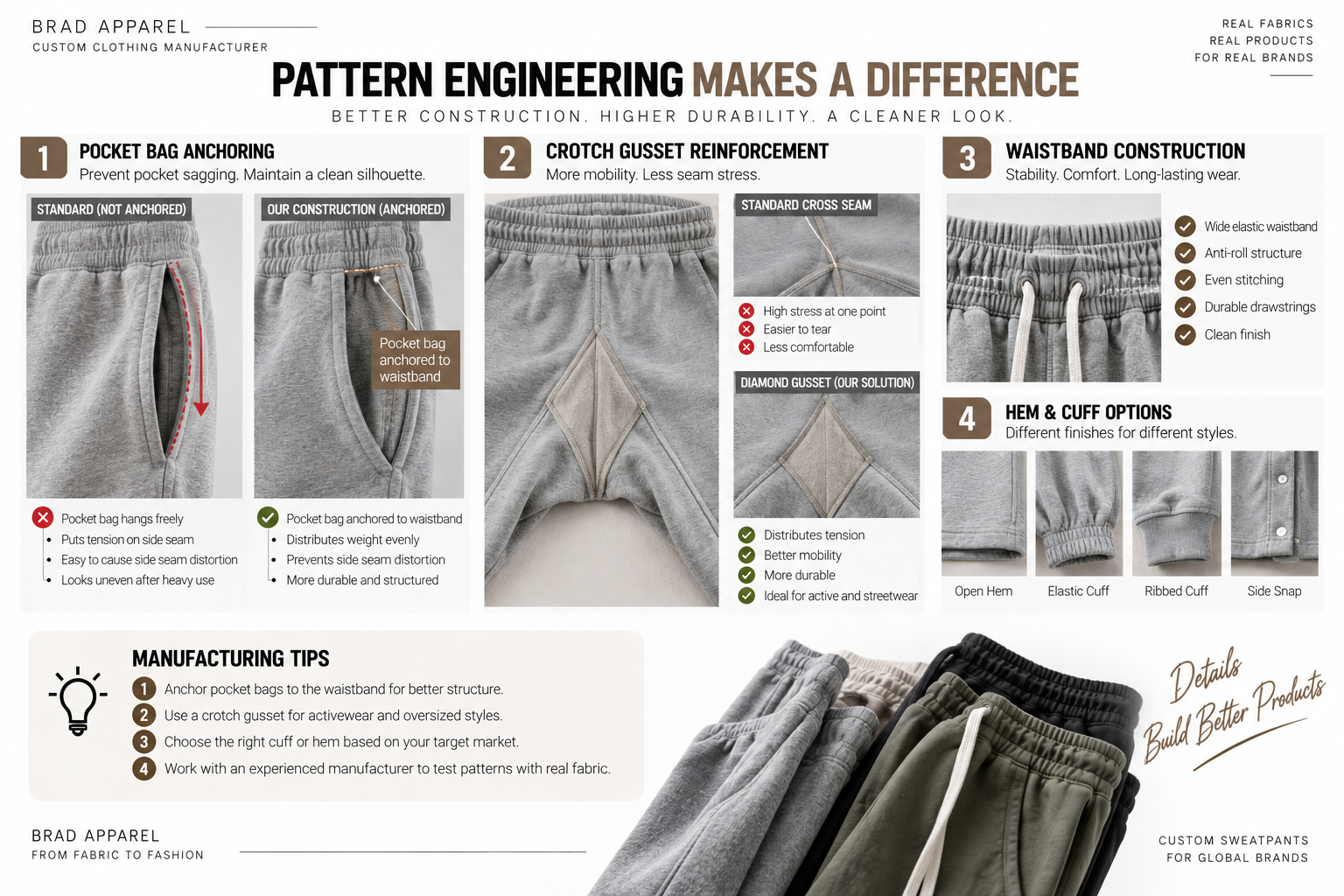
A common issue with lower-cost sweatpants is a floating pocket bag.
When a wearer places a heavy phone or wallet in the pocket, the entire pocket can pull down on the side seam.
This may cause:
- Side-seam distortion
- Uneven drape
- Sagging
- Poor silhouette
Floating Pocket Construction
In a simple construction, the pocket bag hangs freely inside the garment.
When weight is added:
Pocket weight → side seam tension → visible distortion
Waistband-Anchored Pocket Construction
A stronger solution is connecting the top edge of the pocket bag directly into the waistband seam.
This helps:
- Distribute weight
- Improve stability
- Reduce side-seam distortion
- Maintain a cleaner silhouette
This construction is particularly useful for deep streetwear pockets.
Crotch Gusset Reinforcement
Standard cross-crotch seams concentrate stress at one point.
For sweatpants designed for greater mobility, a diamond or oval gusset can help distribute tension across a larger area.
Potential benefits include:
- Better mobility
- Reduced seam stress
- More comfort
- Improved durability
This can be particularly useful for:
- Gym sweatpants
- Technical joggers
- Oversized fits
- Activewear bottoms
Example BOM: 420 GSM Custom Sweatpants
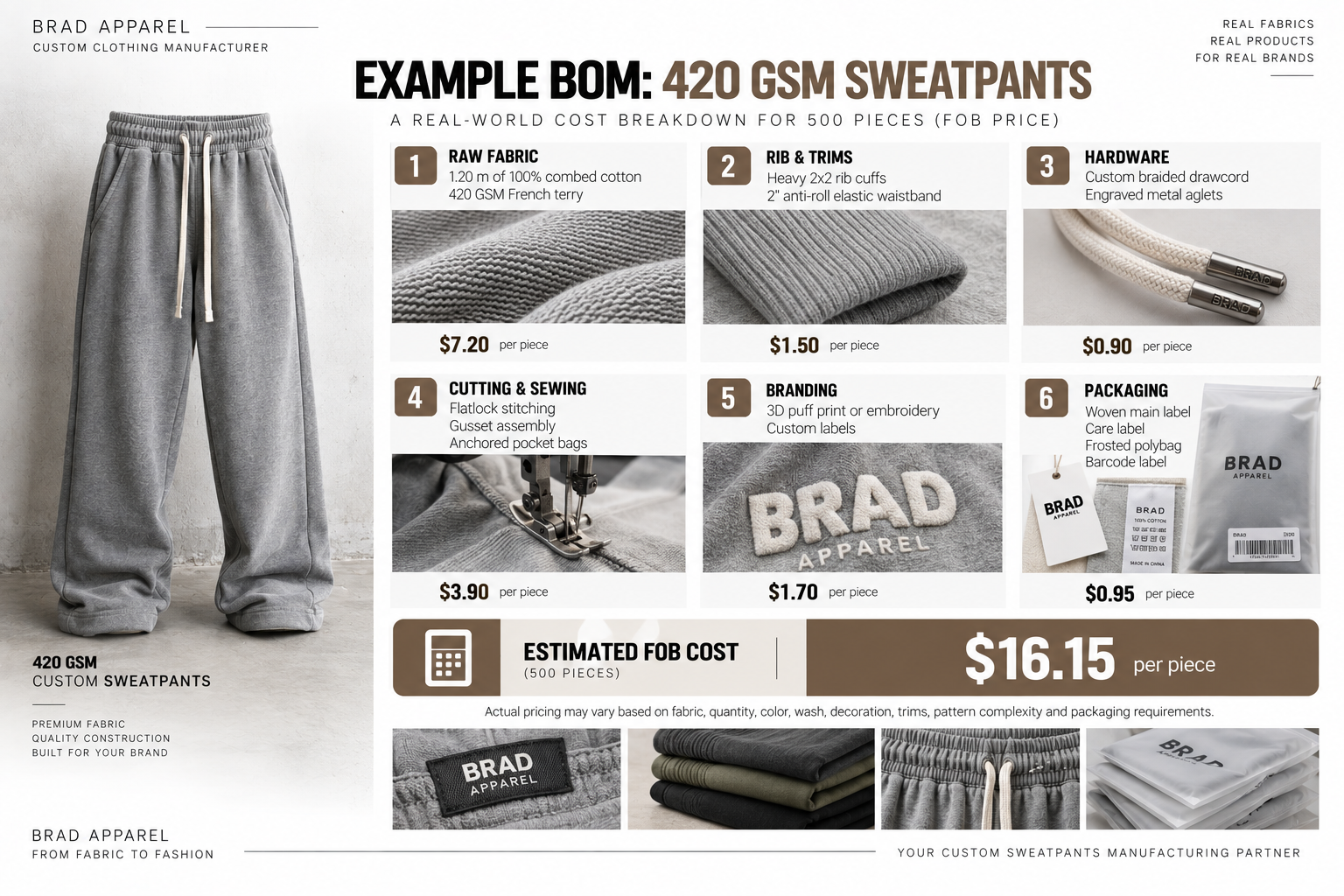
The source production example is based on a 500-piece custom sweatpants order.
Raw Fabric
1.20 m of 100% combed cotton 420 GSM French terry
Reference cost:
$7.20
Rib & Trims
Heavy 2x2 rib cuffs plus a 2-inch anti-roll elastic waistband.
Reference cost:
$1.50
Hardware
Custom braided cotton drawcord plus engraved metal aglets.
Reference cost:
$0.90
Cutting & Sewing
Includes:
- Flatlock stitching
- Gusset assembly
- Anchored pocket bags
Reference cost:
$3.90
Branding
Example:
- 3D puff screen print
- Custom embroidery
Reference cost:
$1.70
Packaging
Includes:
- Woven main label
- Care label
- Frosted polybag
- Barcode label
Reference cost:
$0.95
Estimated FOB Cost
The source production example totals:
$16.15 per piece
Actual pricing depends on:
- Fabric
- Quantity
- Colour
- Wash
- Decoration
- Trims
- Pattern complexity
- Packaging
What Changes Sweatpants Cost the Most?
Several specification decisions can quickly change FOB pricing.
Fabric Weight
Higher GSM requires more raw material.
Pattern Consumption
Wide-leg and stacked silhouettes may consume more fabric than tapered joggers.
Cargo Pockets
Additional panels increase:
- Fabric
- Cutting
- Sewing operations
Hardware
Custom:
- Zippers
- Snaps
- Aglets
- Drawcords
increase cost.
Decoration
Embroidery, puff printing or multiple decoration processes increase production time and material cost.
Quality Control for Custom Sweatpants
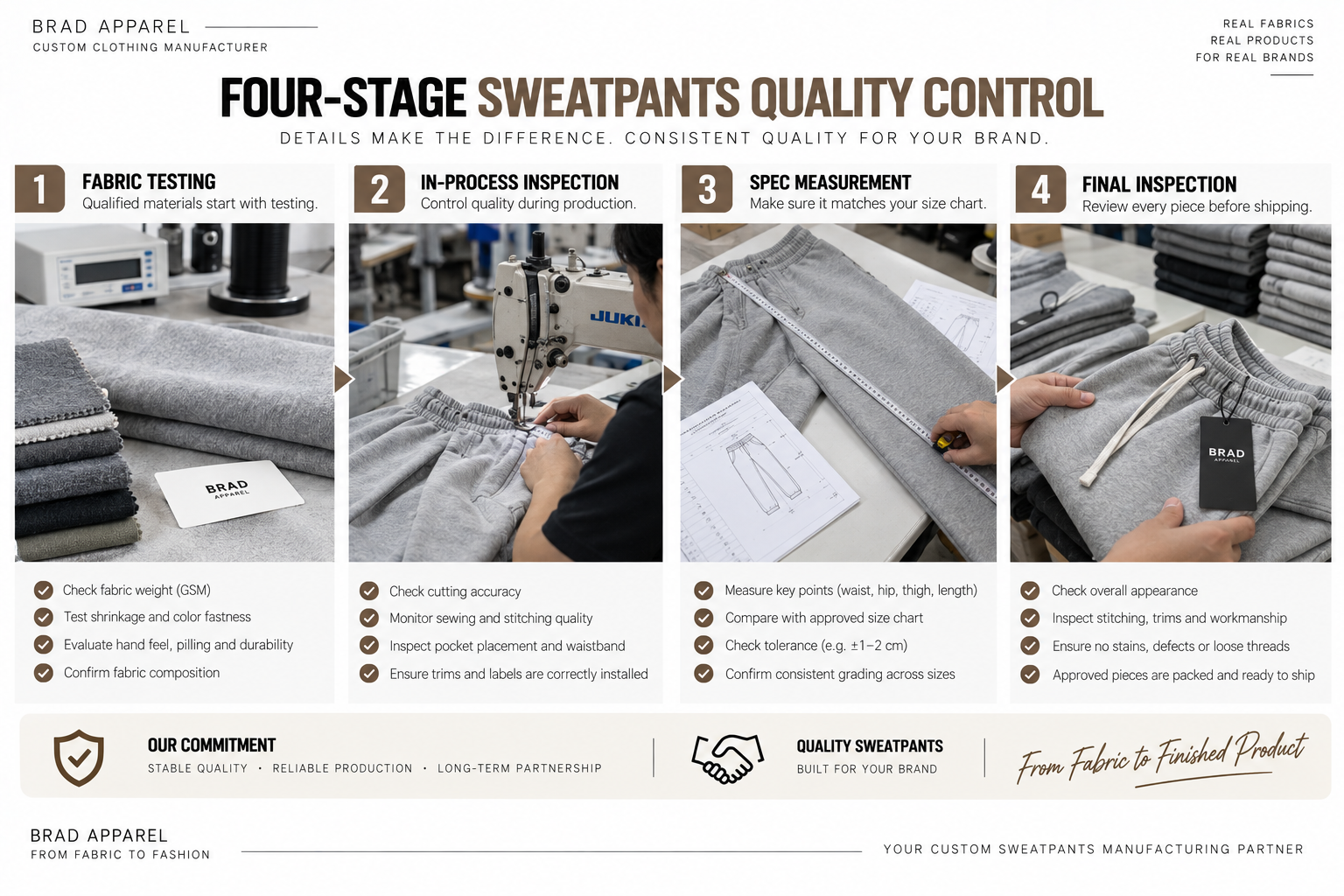
Bulk sweatpants should be checked throughout production rather than only at the end.
Stage 1 — Fabric Testing
Before cutting, check:
- GSM
- Colour
- Fabric defects
- Shrinkage
- Composition
This helps ensure the bulk fabric matches the approved sample.
Stage 2 — In-Process QC
During sewing, check:
- Stitch density
- Crotch seams
- Waistband elasticity
- Pocket construction
- Side-seam alignment
- Decoration position
Stage 3 — Final Measurement
Finished garments should be checked against the approved size specification.
Important measurements include:
- Waist
- Hip
- Front rise
- Back rise
- Thigh
- Inseam
- Outseam
- Leg opening
The source guide uses a reference measurement tolerance of approximately:
±0.8 cm
for its production scenario.
Stage 4 — Final Inspection
Before shipping, check:
- Random finished garments
- Labels
- Packaging
- Carton quantities
- Needle detection where required
- Moisture control
Formal AQL inspection may also be used according to buyer requirements.
How Brad Apparel Develops Custom Sweatpants
At Brad Apparel, our Custom Bottom Production service supports custom sweatpants including:
- Oversized sweatpants
- Technical joggers
- Straight-leg sweatpants
- Cargo sweatpants
- Cuffed joggers
- Flare sweatpants
- Stacked sweatpants
Fabric & Accessory Sourcing
Through our Fabric & Accessory Sourcing, brands can customize:
- Fabric composition
- GSM
- Colour
- Rib
- Elastic
- Drawcord
- Zippers
- Aglets
- Labels
- Packaging
Physical fabric samples should be evaluated before bulk production.
Pattern Development
Through Pattern Development, brands can customize:
- Rise
- Hip
- Thigh
- Knee
- Inseam
- Leg opening
- Crotch shape
- Pocket position
- Cargo pockets
- Cuffs
- Stacked length
The pattern should always be tested with the actual selected fabric.
FAQ
What Are the Main Types of Sweatpants?
Six useful categories for 2026 are:
- Oversized / heavyweight boxy
- Technical joggers
- Straight-leg open bottom
- Cargo sweatpants
- Cuffed / ribbed ankle sweatpants
- Flare / stacked sweatpants
What GSM Is Best for Heavyweight Sweatpants?
Approximately 380–480 GSM works well for structured heavyweight streetwear sweatpants.
What Fabric Is Best for Joggers?
Brushed fleece or interlock / tech-fleece constructions can work well depending on whether you want:
- Warmth
- Stretch
- Structure
- Technical appearance
What Fabric Is Best for Oversized Sweatpants?
Heavy French terry around 380–480 GSM works particularly well when the goal is a structured, premium oversized silhouette.
Why Do Sweatpant Pockets Sag?
A floating pocket bag can pull directly on the side seam when loaded.
Anchoring the pocket toward the waistband helps distribute the weight more effectively.
Do Sweatpants Need a Crotch Gusset?
Not every style needs one.
A gusset is particularly useful for:
- High mobility
- Training
- Technical joggers
- Oversized fits
What MOQ Does Brad Apparel Support?
Brad Apparel supports custom production starting at approximately 50 pieces per style/color for many projects.
Actual MOQ depends on:
- Fabric
- Colour
- Pattern
- Decoration
- Trims
Final Thoughts
Sweatpants should not be treated as one universal product.
An oversized 480 GSM streetwear sweatpant and a 300 GSM technical jogger may both be called sweatpants, but they require completely different:
- Fabrics
- Patterns
- Trims
- Construction
- Production methods
The best development process starts with the intended silhouette.
Then build the:
Fabric → Pattern → Pockets → Waistband → Cuffs → Decoration
around that target.
When all of these details work together, the final sweatpant feels more intentional, performs better and is much easier to reproduce consistently in bulk production.
Keep Reading